Jesus and His Dog

Muscovite Detained While Walking Dog, Police Leave Dog on Street Alone
Mediazona
April 4, 2020

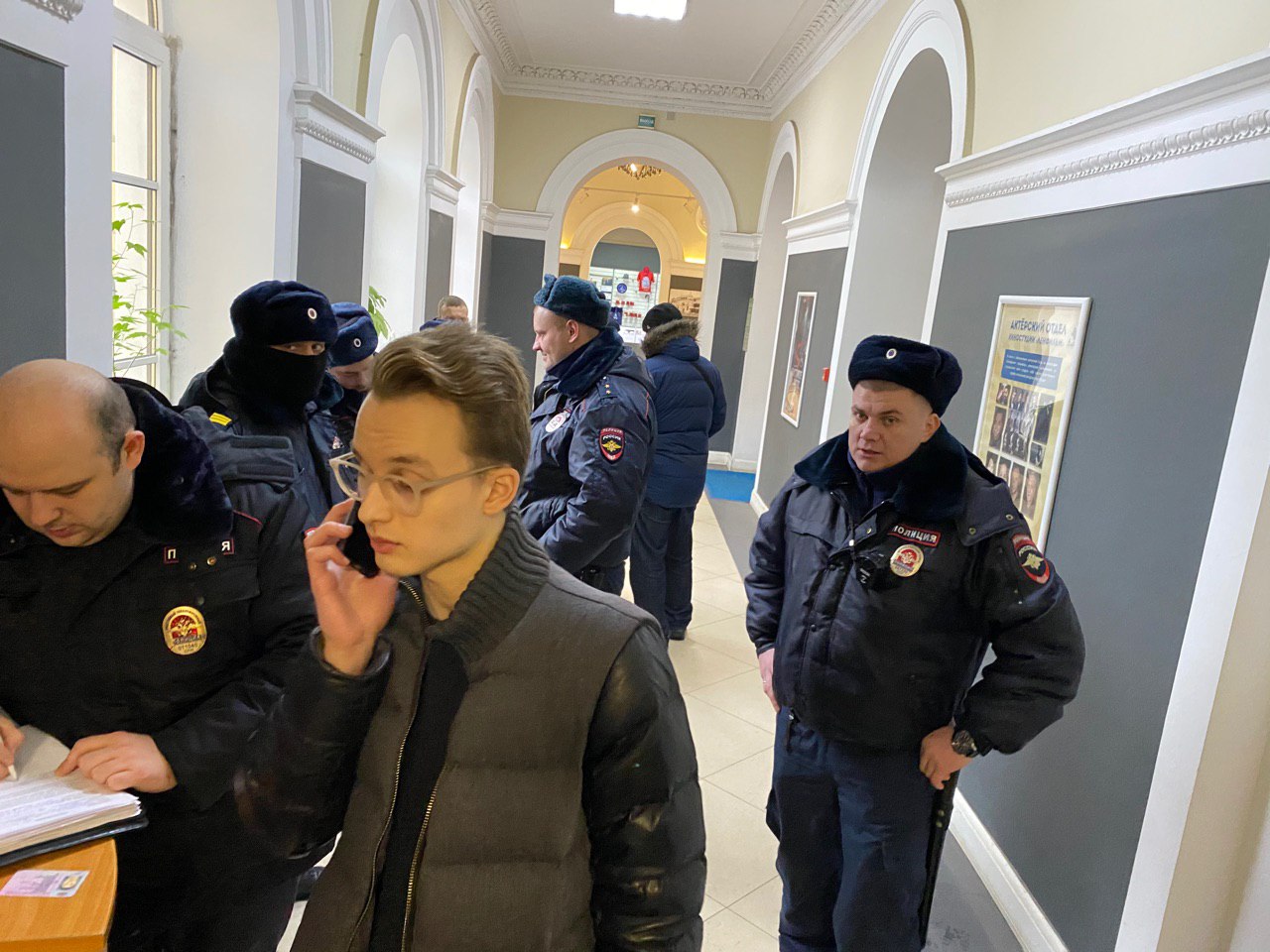
Eyewitness Snezhana Mayskaya has told Mediazona that a young man was detained by police while walking a dog at Patriarch Ponds in downtown Moscow. Police officers put the man in a police van and drove away, leaving the dog on the street, Mayskaya added.

“They tried to call the dog. But it didn’t go up to them—it got scared and ran away. In the end, the young man was driven away, while the dog remained here,” she said.


Smartphone video of the incident, shot by Snezhana Mayskaya, as posted on @patriarshi

The Twitter account @patriashi claims the detained man’s wife retrieved the dog.

OVD Info reports that the detained man was delivered to the Presna District police precinct. “The police still refuse to specify what they are charging the detainee with,” it writes. According to OVD Info, the police said that Patriarch Ponds were closed when they detained the man.

The detained man, Jesus Vorobyov, told TV Rain that he was walking the dog within one hundred meters of his home when they were stopped by police. “They didn’t let me take the dog home or contact my wife, and they put me in their van. The dog was running around and barking,” he said. Vorobyov added that, during the arrest, police “twisted” his arm, while he was threatened at the precinct with fifteen days in jail.

A stay at home order has been in effect in Moscow since March 30 due to the coronavirus. People may now leave their homes only to walk their dogs, shop for groceries, seek medical attention, and go to work.

Translated by the Russian Reader

Victory Daze

web-2548333-1070x601
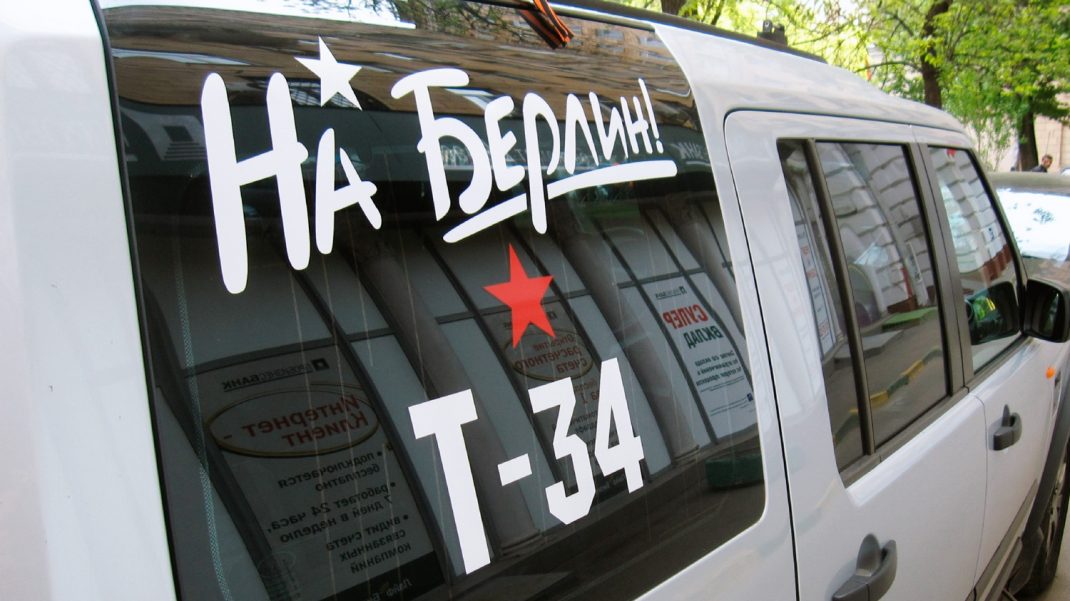
A Russian car sporting an “Onward to Berlin!” decal. Photo courtesy of Open Media

Novosibirsk Russian National Guard Includes May 9th “Onward to Berlin” Auto Decals in Purchase Plan
Mediazona
February 28, 2020

Open Media reports that the Novosibirsk Regional Office of the Russian National Guard has included “Onward to Berlin!” auto decals in its purchase plan. According to the website, on February 28, the office announced it was receiving bids on a contract to service and repair its vehicles. Journalists found the decals in a list of spare parts and accessories in the technical specifications for the bid. According to the document, each decal should cost no more than 436 rubles [approx. 6 euros].

The list of accessories also includes a decal featuring the Russian flag and national emblem and the caption “Admit everywhere,” a decal featuring the image of a shoe on a red triangle background, and May 9th decals featuring stars, tanks, and planes.

Translated by the Russian Reader

They Got Crazy Prophylactics

Petersburg Schools Required to Do “Prophylactic Work” to Prevent Pupils from Attending Nemtsov Memorial Rallies
Mediazona
February 28, 2020

The St. Petersburg Education Committee has ordered schools to do “prophylactic work” to prevent pupils from participating in “unauthorized” rallies on February 29. The letter sent to school administrators was published on the Telegram channel Yabloko Human Rights in Petersburg.

The letter was marked “Urgent!” Yelena Spasskaya, the committee’s deputy head, pointed out that the request to schools was prompted by a letter they had received from Viktor Borisenko, deputy head of the Interior Ministry’s Petersburg and Leningrad Region office.

On February 29, as in previous years, events in memory of slain politician Boris Nemtsov will take place in a number of Russian cities.

On February 25, Petersburg authorities refused to authorize a memorial march, citing as one of the reasons its supposed ignorance of the abbreviation “RF” (“Russian Federation”).

Boris Nemtsov was shot and killed on February 27, 2015, on Bolshoy Moskvoretsky Bridge near the Kremlin in Moscow. After a jury rendered its verdict, the alleged killer, Zaur Dadayev, was sentenced to twenty years in a maximum security prison. The remaining defendants received sentences ranging from eleven to nineteen years in prison. The people who ordered the killing have not yet been found.

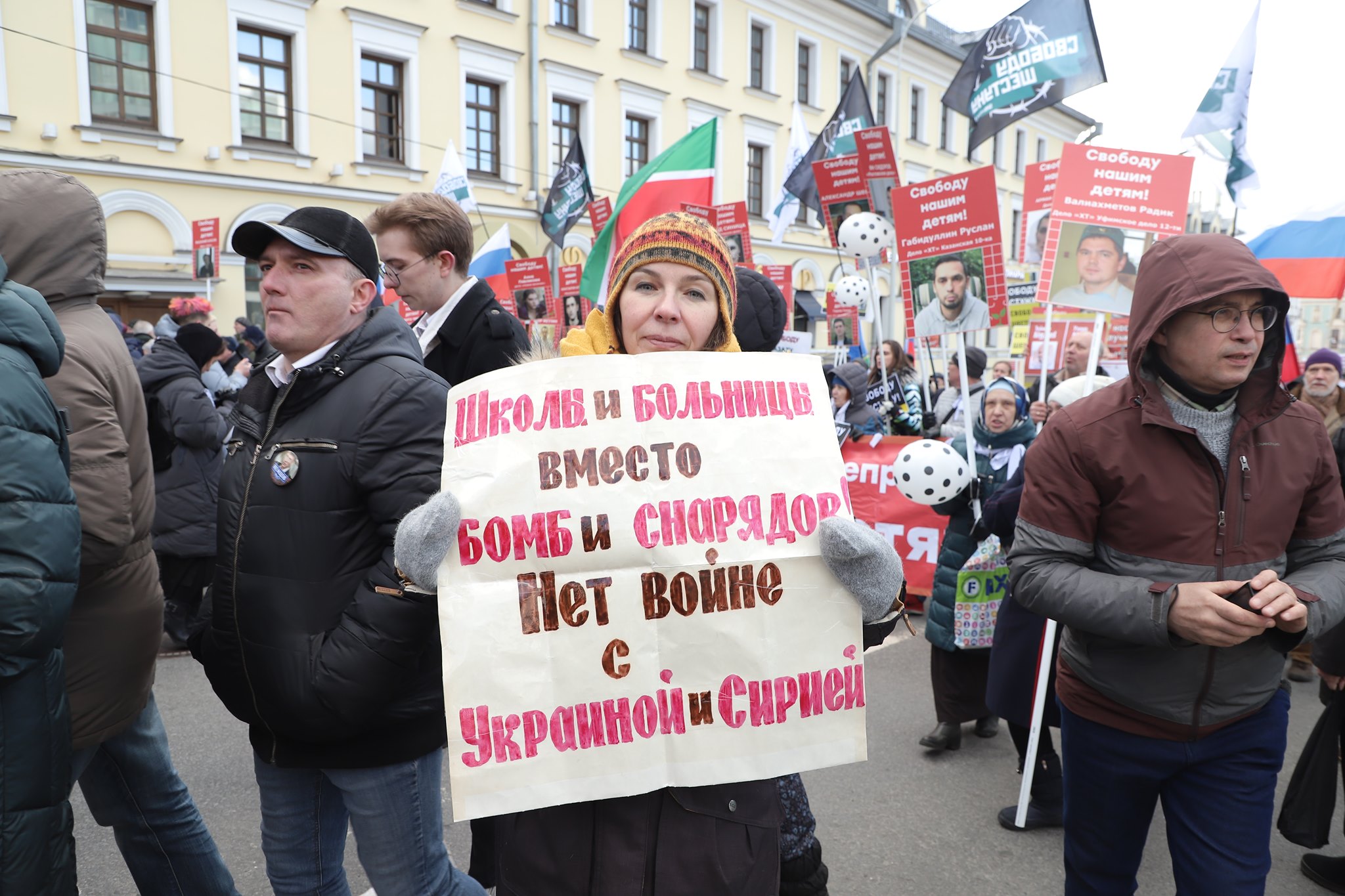
87952337_10207112861577322_8619842742794584064_o“Schools and Hospitals Instead of Bombs and Missiles. No to War with Ukraine and Syria.” A protester at the Boris Nemtsov memorial march in Moscow, February 29, 2020. Photo by Anatrr Ra

Petersburg Authorities Claim Ignorance of Abbreviation “RF” as Reason for Refusing to Authorize Nemtsov Memorial March
Mediazona
February 25, 2020

Petersburg city hall has claimed that the “ambiguity” of the event’s aims was one of the reasons it refused to authorize a memorial march for slain politician Boris Nemtsov, according to Denis Mikhailov, a member of the march’s organizing committee.

As stated in a letter sent to the committee, the organizers had listed “condemnation of political crackdowns [and] violation of human rights and freedoms” and “demanding the rotation of authorities in the RF” among the aims of the planned march.

“It is not clear what crackdowns and violations of human rights and freedoms are meant; where and how they have been carried out, and by whom,” wrote city officials, adding “There is no such abbreviation [as “RF”] in the current legislation and Constitution of the Russian Federation.”

Earlier, march organizers reported that the city’s committee for law and order had not agreed any of the march routes they proposed. The committee suggested that the opposition activists hold the march not in the city center, but in Udelny Park, located in the city’s north. The opposition activists turned down the suggestion, calling it “unacceptable.”

Translated by the Russian Reader

Quarantine

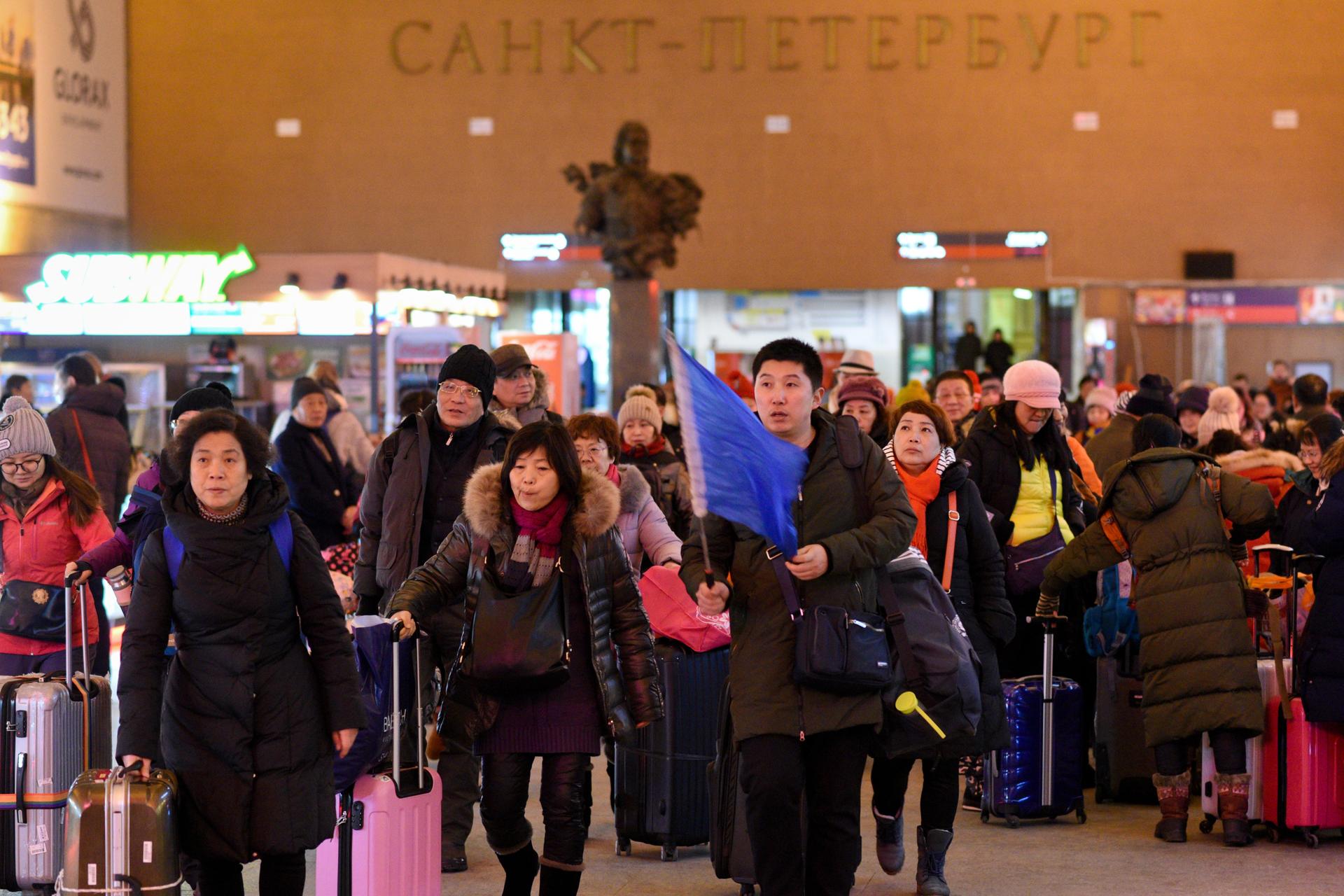
china friendlyChinese holidaymakers at the Moscow Station in Petersburg. The coronavirus has “legalized” one of Russia’s favorite pastimes: loathing the Chinese. Photo by Sergei Yermokhin. Courtesy of Delovoi Peterburg

Public Monitoring Commission: Russian National Extradited from China to Be Quarantined in One and a Half Meter Wide Moscow Jail Cell
Mediazona
February 28, 2020

A Russian national extradited from Guangzhou, China, will be quarantined in a solitary confinement cell in Moscow’s Remand Prison No. 4, Marina Litvinovich, a member of the Moscow Public Monitoring Commission, reported on Facebook.

According to Litvinovich, all other prisoners have been cleared from the inpatient medical facility at the jail. The Russian national will be placed for fourteen days in a three by one and a half meter cell in which the air vents have been blocked. The room will undergo additional disinfecting before his arrival. The prisoner’s temperate will be taken every day, for which purpose a special sheet of paper has been hung on the cell’s door, Litvinovich added.

The guards escorting the man will also be quarantined.

“Not in the remand prison, of course, but somewhere else,” Litvinovich wrote.

She did not specify the offenses for which the Russian national was being extradited.

This past December, an outbreak of a new type of coronavirus occurred in the Chinese city of Wuhan. As of February 28, 83,734 people have been infected with the virus—2,868 have died, while 36,439 people have recovered. On February 18, Russian Prime Minister Mikhail Mishustin barred Chinese nationals from entering China as part of the fight against the coronavirus.

Translated by the Russian Reader

Petersburg Police Sabotage Pussy Riot Video Shoot

Police Sabotage Pussy Riot Video Shoot at Lenfilm Studio
Mediazona
February 9, 2020

Pussy Riot member Nadezhda Tolokonnikova has told Mediazona that police have sabotaged the filming of a video for the Pussy Riot song “Rage” at Lenfilm Studio in Petersburg.

“There are cops and Center ‘E’ officers at the filming of our video at Lenfilm. First, they came and made us sign an obligation not to promote ‘homosexualism’ and ‘extremism,” and then left to talk with Lenfilm management. Half an hour later, the lights were turned off throughout the building. The shoot was scheduled to run from noon to six in the morning. So, the whole thing’s a bust,” Tolokonnikova said.

riotPolice at Lenfilm in Petersburg. Photo by Nadezhda Tolokonnikova. Courtesy of Mediazona

The producers tried to rent a generator, but they were not permitted to bring it on the premises of the studio.

“Two days before the shoot, plainclothes officers visited Lenfilm and insisted they cancel the shoot. Surprisingly, Lenfilm refused to heed their request, telling them that we had paid and all the paperwork was in order,” the performance artist added.

Tolokonnikova said that feminist activist Nixel Pixel (aka Nika Vodwood), artist Lölja Nordic, and photographer Aleksandr Sofeev were among the people slated to appear in the video.

“There were supposed to be riot cops [OMON] in the video, but a real patrol showed up instead. The song is about resisting the authorities,” Tolokonnikova told Mediazona.

In an interview with Znak.com, Inessa Yurchenko, who was appointed Lenfilm’s new director general two days ago, called Tolokonnikov’s story a provocation.

“The guys were supposed to have actors in police uniforms, so they cannot pass that off as there being police officers there. There are no police officers on the premises of Lenfilm. It’s not nice to show pictures of actors and provoke the public,” she said.

Yurchenko threatened to call the police.

“I won’t be surprised if there are more provocations on their part—then I will be forced to call the police,” she said.

Yurchenko explained that the blackout in the studio had been caused by an accident on the power grid.

“The head of security will now have to follow regulations while the cause of the accident is established, and so he will have to ask [people] to evacuate Lenfilm because it’s a [secure] facility,” she said.

She added that the activists could return to the film studio when the power was restored.

Translated by the Russian Reader

“I Examined You from a Distance”: Journalist and Human Rights Lawyer Attacked in Grozny

84412382_3207050759323702_7873276774191202304_n“My poor head.” This was the photo that reporter Elena Milashina posted on her Facebook page after being attacked in Grozny earlier today.

Novaya Gazeta Journalist Elena Milashina and Human Rights Lawyer Marina Dubrovina Assaulted in Grozny
Mediazona
February 6, 2020

Novaya Gazeta has reported that persons unknown assaulted its correspondent Elena Milashina and human rights lawyer Marina Dubrovina in Grozny.

Milashina and Dubrovina had arrived in Grozny for the trial of blogger Islam Nukhanov, who shot a video entitled How Kadyrov and His Associates Live, Part 1. After the video was posted, Nukhanov was charged with illegal possession of weapons, punishable under Article 222 Part 1 of the Russian Criminal Code.

Novaya Gazeta writes that the assault took place in the lobby of the Continent Hotel and near the building’s entrance. Unidentified men and women beat up lawyer Marina Dubrovina.

“It was mostly women who assaulted her, punching and kicking her,” the newspaper said.

The newspaper noted that the assailants videotaped the incident.

Milashina and Dubrovina are now having their injuries documented by physicians and plan to file charges with Chechen law enforcement authorities.

84105461_3207145192647592_8637423701794488320_nHuman rights lawyer Marina Dubrovina. “We are being driven to the crime scene in a police van with its lights flashing,” writes Elena Milashina.

Milashina has just written that Musa Bekov, a neurosurgeon at the Grozny hospital [where they went], refused to examine Dubrovina carefully.

“I examined you from a distance. Everything is fine, everything will heal. Have a nice day,” Milashina quoted the doctor as saying.

______________________

Yegor Skovoroda
Facebook
February 6, 2020

It so happened that four years ago, when Kadyrov’s men attacked our van in Ingushetia, lawyer Marina Dubrovina was the first person I called and told about it —while lying on the floor of the van, its windows broken. I was beaten with sticks, first in the van, and then in a roadside ditch. Several young women next to me were beaten in the same way.

Today in Grozny, Marina Dubrovina and Elena Milashina, from Novaya Gazeta, were attacked near a hotel. I would not be surprised if the perpetrators were the same, but the man who commissions all crimes in Chechnya is Ramzan Kadyrov. Novaya writes that Marina was beaten up.

______________________

Chechen Man Who Shot Video “How Kadyrov and His Associates Live” Charged with Crime
Mediazona
December 9, 2019

Novaya Gazeta reports that Islam Nukhanov, a Chechen man who shot a video entitled How Kadyrov and His Associates Live, has been charged with a criminal offense.

According to the newspaper, Nukhanov spent most of his time outside Chechnya, but in the spring he came to the republic to apply for a free operation. It writes that Nukhanov often watched the videos of opposition blogger Tumso Abdurakhmanov.

“He frequently raised in conversation the question of how people were so filthy rich and lived in such palaces in a subsidized republic with very high unemployment,” Novaya Gazeta writes.

On October 31, Nukhanov posted a video, entitled How Kadyrov and His Associates Live, on YouTube. Shot from a car, the video features houses in a Grozny neighborhood that Novaya Gazeta calls the “Chechen Rublyovka.”

The newspaper describes the video’s contents: “The dashcam blankly records the houses on either side of the road. The driver does not utter a single word.”

According to Novaya Gazeta, the next day men in camouflage uniforms burst into Nukhanov’s house and took the young man away. It writes that the men confiscated all of his telephones, his computer and CPU, and the “ill-fated” Ford Focus whose dashcam Nukhanov used to shoot his video.

Novaya Gazeta writes that a day after the arrest Nukhanov’s father saw his son at the police station. He had been beaten up, his hand was bandaged, and his clothes were bloody and nearly torn to shreds.

Nukhanov was charged with illegal possession of weapons, as punishable under Article 222.1 of the Criminal Code. According to investigators, the young man was summoned to the police station to “verify intelligence.” Once at the station, Nukhanov allegedly behaved suspiciously, and so it was decided to search him. Police allegedly found two gun cartridges in his pocket, and when they searched his car, they also found a pistol. The young man pleaded guilty on the advice of his state-appointed lawyer.

The newspaper writes that Nukhanov spent nearly a month in the basement of the Grozny central police station. The court remanded him in custody only on November 27. After his wife hired Nukhanov a “proper” lawyer, he withdrew his confession.

Thanks to Yegor Skovoroda for the heads-up. Translated by the Russian Reader

I Am the Lizard King, I Can Say Anything

The flag of Polevskoy. Courtesy of Wikipedia

United Russia Councillor Suggests Ural Villagers Send Children to Boarding School Due to Lack of Bus
Mediazona
January 27, 2020

In Sverdlovsk Region, Lyudmila Boronina, a member of the Polevskoy Urban District Council, suggested that residents of the village of Krasnaya Gorka send their children to a boarding school since the village does not have its own school or a bus to take children to Polevskoy, the nearest town. Boronina’s remarks were quoted by the newspaper Vechernye Vedomosti.

As the newspaper writes, on January 21, the council’s committee on social policy discussed educational issues, including the fact that there are few regular buses to Polevskoy from Krasnaya Gorka, forcing children to walk four kilometers along the highway to school. Boronina, who took part in the discussion, works at the Center for Culture and Folk Art and coordinates United Russia’s Strong Families project.

“Let’s recall the good old Soviet times: we had a system of boarding schools for children from rural areas. Children were brought to school on Monday morning and picked up on Saturday evening. We have a remedial school in the district. It is temporarily under repairs, but the district owns the building, and it is heated. Maybe we could consider a boarding school for rural children whose parents are not able to drive them to school?” Boronina said at the committee meeting.

Maxim Bestvater, a spokesman for the regional branch of the United Russia party, told the website Nakanune.RU that the proposal was far from perfect and would probably not be implemented since it had been met with hostility.

Bestvater urged people not to compare Boronina with Olga Glatskikh, as their remarks were of a “different caliber.”

As director of the Sverdlovsk region’s youth policy department, Glatskikh met with teenagers in Kirovgrad in 2018. She told them that the state basically did not owe them anything, but their parents did. She also said that the state had not asked their parents to have them. Glatskikh’s department was soon abolished, and she herself resigned.

Translated by the Russian Reader

Why do I translate and post stories like this? There are several reasons. First, because seemingly unimportant dispatches from the Russian back of beyond punch big holes in the myth of the “stability and prosperity” supposedly enjoyed by people in the nonexistent “Russian heartlands” under Putin. If I had the time, the money, and some extra help, I could churn out dozens of posts a day, all of them from places other than Moscow and Petersburg (although they are not immune to these problems, either) showing the staggering instability and immiseration the regime has visited upon villages and towns like Krasnaya Gorka and Polevskoy. Second, the fact that stories like this one are widely reported in Russian media and hotly discussed in Russian social media complicates the simplified picture of Russia as a country with no independent media or civil society. Third, they show how an authoritarian-populist regime functions in the twenty-first century—by “welcoming” certain limited, localized expressions of public discontent, thus deflecting attention away from the decision-making elites in the capitals and their overawing responsibility for the “minor apocalypses” that have been unfolding for decades in the provinces. Given Putin’s new “social turn,” as outlined in his recent state of the nation speech, it will be interesting to see what contradictions and collisions are sparked as the mafia state pretends to put on a more human face. [trr]

Judge Not

trialStill from Judge Gramm. Courtesy of YouTube

Activist Karim Yamadayev Could Face Criminal Charges for Video Depicting “Execution” of Sechin and Peskov
Grani.ru
January 3, 2019

Quoting human rights activist Ruzil Mingalimov, MBKh Media reports that the Tatarstan branch of the Russian Investigative Committee has opened a criminal investigation under Article 319 of the Russian Criminal Code (“insulting a government official”) over an episode of the web series Judge Gramm in which activist Karim Yamadayev, playing a judge, sentences Igor Sechin and Dmitry Peskov.

Judge Gramm (Episode 1)

In the video, the judge reads out sentences to people wearing black bags over their heads and signs reading “Vladimir Putin,” “Dmitry Peskov,” and “Igor Sechin,” respectively. The judge sentences Peskov and Sechin to death before escorting them off camera, taking a gun with him, in Peskov’s case, and an axe, in Sechin’s. Sounds of a gunshot and an axe striking a chopping block are then heard. At the end of the video, the judge says that the trial has been recessed until the following week.

Investigators searched Yamadayev’s home on Friday before taking him to the Russian Investigative Committee. Police also searched an office and the home of Yamadayev’s parents, said Alexei Glukhov, head of Apologia for Protest. Mingalimov reported to Mediazona that Yamadayev was interrogated and qualified as a witness before being released.

During the search, investigators seized computer equipment and a notebook containing passwords to online payment systems.

“[Yamadayev] is afraid the investigators will clean them out,” Mingalimov said.

On December 31, Yamadayev was summoned to the police over the same video.

“They got a tip, which they didn’t show us, by the way. They said they were obliged to react to the tip within seventy-two hours, and so they summoned [Yamadayev],” Mingalimov said.

After making a statement, Yamadayev was released.

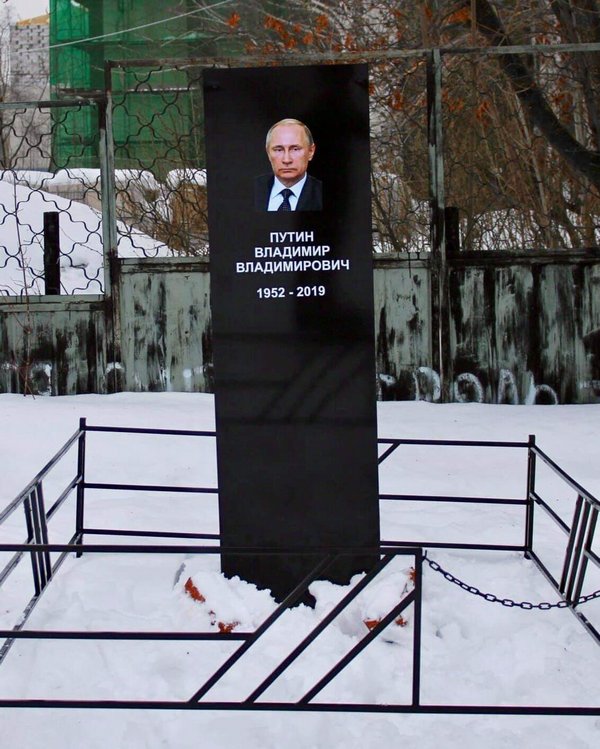
96593“Vladimir Vladimirovich Putin, 1952–2019.” Photo courtesy of Grani.ru

A resident of Naberezhnye Chelny, Yamadayev was jailed on March 12, 2019, for twenty-eight days for, allegedly, setting up a gravestone with Putin’s name outside the city’s Investigative Committee office. Another activist, 32-year-old Nikolai Peresedov, was sentenced to six days in jail over the incident. Yamadayev was found guilty of violating Article 20.2.8 of the Administrative Offenses Code (“repeated violation of the procedure for holding public events”), while Peresedov was found guilty of violating Article 20.2.2 (“holding a public event without prior notification”). Yamadayev went on hunger strike during his time in jail. In September, he filed a complaint with the European Court of Human Rights.

Translated by the Russian Reader

Prosecutor Asks for Life in Prison for Four Defendants in Petersburg Show Trial

KMO_158163_00033_1Shohista Karimova. Photo courtesy of Fontanka.ru

Court Asked to Sentence Some Defendants in Petersburg Subway Bombing Case to Life in Prison
Mediazona
November 18, 2019

The prosecutor has asked the court to sentence some of the defendants in the 2017 Petersburg subway bombing case to life in prison, our correspondent has reported from the courtroom.

The prosecutor [Nadezhda Tikhonova] asked the court to sentence Akram Azimov, Abror Azimov, Ibrahimjon Ermatov, and Muhamadusup Ermatov to life imprisonment in a high-security penal colony and fines of one million rubles [approximately 14,000 euros] each. She asked the court to sentence Sodik Ortikov to 28 years in a maximum-security penal colony and a fine of one million rubles. She requested sentences of 27 years in a maxium-security penal colony and fines of one million rubles each for Mahamadusuf Mirzaalimov, Azamjon Mahmudov, Seifulla Hakimov, Bahrom Ergashev, and Dilmurod Muidinov.

Defendant Shohista Karimova had a nervous breakdown during the hearing, which led to a thirty-minute recess. After the recess, Karimova refused to return to the courtroom, screaming and resisting attempts to make her move. Consequently, the hearing was postponed until tomorrow.

Convening in Petersburg, the Moscow District Military Court began hearing the case on April 2, 2019. All the defendants pleaded not guilty, and four of them said they had been brutally tortured. On April 17, 2017, an explosion occurred on a subway train traveling between the stations Sennaya Ploshchad and Tekhnologichesky Institut. Sixteen people were killed, and another fifty [sic] people were injured.

_______________________________________

Yana Teplitskaya
Facebook
November 18, 2019

Today, the state prosecutor announced her wishes in the Petersburg subway bombing case: life imprisonment for four of the defendants (the Azimov brothers and the Ermatov brothers), and between 27 and 28 years in prison for all the other defendants, except Shohista Karimova. (The prosecutor will request a sentence for her tomorrow.)

And she asked that all the defendants be fined a million rubles each.

Most likely, the sentences handed down by the court will not differ greatly from the prosecution’s wishes. (Maybe the more uproar there is now, the greater the difference will be.)

Most likely, the verdict will be upheld on appeal.

Most likely, someday this case (like hundreds of others) will be reviewed, and the convicted defendants exonerated.

I’d like to live to see the day when that happens. And for the accused and their loved ones to live to see it, too.

http://3apr2017.tilda.ws/#court

Translated by the Russian Reader. Please read my previous posts on the terrorist attack, the case against its alleged planners, its roots in the Islamophobia that has infected Russia under Putin, and the shocking lack of local and international solidarity with the thirteen defendants in the case:

Feminists vs. Police in Petersburg

2019-06-05-russia03-01-3

Police Show Up at Eve’s Ribs Feminist Festival in Petersburg
Mediazona
November 10, 2019

Police have shown up at the Eve’s Ribs Feminist Festival in Petersburg, human rights defender Varya Mikhaylova has informed Mediazona.

Mikhaylova reported that a uniformed male officer and a female plainclothes officer were in the festival space, and a police cruiser was parked next to the entrance. The male officer had asked festival organizer Leda Garina to show them the rental agreement and had inquired about the festival’s repertoire.

Mikhaylova added that the police visit had been triggered by a complaint filed by anti-gay activist Timur Bulatov.

“A performance of the play ’10 Scenes of Sexual Violence’ is scheduled for today,” Mikhaylova said. “[The police officers] want to stay and watch.”

garina policeEve’s Ribs Festival organizer Leda Garina and a police officer. This photo was posted yesterday on the festival’s VK page

Police Promise to Show Up Every Day of Feminist Festival Eve’s Ribs
Fontanka.ru
November 11, 2019

Police officers have visited the Skorokhod theater space, where the Eve’s Ribs international feminist art festival has been taking place. Festival co-founder Leda Garina told Fontanka.ru about the incident on November 11.

“The police officers told us they would monitoring the presence of minors at the festival,” Garina said. “They’re going to inspect the bar at the Skorokhod. And if we summon human rights defenders, the police will call in the guys in the masks, who will line us up against the wall, and then find a way to shut us down.”

As Garina noted, police had already been at the festival the previous day in response to a complaint by activist [sic] Timur Bulatov and had demanded Garina show them the lease agreement for the festival space.

“The police summoned the site’s managers, issued them an order to check the documents of visitors, and warned that they would come to the festival every day,” said Garina. “We’re afraid of provocations and really will be checking everyone’s IDs at the door. This is quite sad, however, because children face sexual abuse and lack of financial support from their fathers much earlier than the age of eighteen, but we cannot talk to them about it.”

Eve’s Ribs, an international festival of feminist theater, cinema, and performance art, runs from November 10 to November 17 in Petersburg. The main venues are the Skorokhod and the space run by the organizers, the social and artistic project Eve’s Ribs.

Thanks to Darya Apahonchich for the heads-up. First photo courtesy of The World. Translated by the Russian Reader

___________________________________________________

After decades in the shadows, Russia’s feminists grab their spotlight
Indra Ekmanis
The World
June 5, 2019

Russian feminists paraded a 13-foot-tall model vagina down the streets of St. Petersburg on May 1, 2018, without getting arrested. It was a big win.

“[Police] arrested only those who they have orders to arrest,” says Leda Garina, director of the Eve’s Ribs, a social, artistic, documentary and communication project devoted to the subject of gender discrimination. “But there were no vagina orders, so they didn’t know how to react.”

The giant vagina didn’t spark police action in 2018, but participants were not so lucky in 2019. Six Eve’s Ribs activists were detained.

In a country where the concept of feminism remains at best socially neutral and at worst a “mortal sin,” activists fighting for gender equality under the banner of feminism have to take success where they can get it. And it’s often fleeting.

“This year, one of the girls wore a vagina costume, and they made her take it off so right there in the middle of the May 1 parade, so she was walking basically naked in the middle of the parade and she was just showing everyone the finger,” says Garina, 37.

Activists like Garina and other women at Eve’s Ribs are working to unite people interested in feminism by bringing them together in a physical space. To that end, they opened Cafe Simona — a women-only workspace by day and event space by night.

“The idea was that here you can feel at ease, because in public spaces in Russia, men always bother you,” Garina says. “Men will always come up and ask, ‘What are you writing, what are you eating, what does it say on your shirt?’ It’s terrible.”

There’s a generational shift happening when it comes to feminism in Russia. Millennials and Gen Zers are online — many read English and have been exposed to the fundamental reasoning behind the concept of men and women being born equal. And after decades of repression under the Soviet Union, feminist activism is reemerging in today’s Russia.

“Officially, after the [1917 Russian] Revolution, all women’s rights were achieved, so therefore according to the Soviet system, feminism as a movement had no need to exist,” Garina says.

But the ideal of gender equality as espoused in Marxist doctrine was far from reality. Though equality was touted in principle after the Communist revolution and women’s education and literacy rates rose, in practice, it looked quite different. Female participation in the labor force was not free of gender gaps and didn’t translate into equality in domestic duties. Despite some strides (the Soviet space program had a woman cosmonaut decades before the US did), women were still largely expected to take on work in the home, care for children, and stand in long lines for food in addition to their “equal work” outside the home.

As the USSR was crumbling, feminism began to resurface as a more active movement. But when the Soviet Union did collapse in 1991, women faced new challenges.

“The next problem that women encountered was capitalism. Suddenly there was this new pressure where women became objectified,” Garina says. “This was not the case during the Soviet Union. This meant that women needed to look like super sexualized models in addition to doing all the housework.”

In the post-Soviet years, the main achievements of feminist activists has been “gradual conscious-raising,” pointing to issues that had rarely been in the public discourse previously, such as domestic violence, sexual harassment and discrimination against women and sexual minorities.

But these gains have sustained major blows. In 2017, the Russian State Duma, or lower house of parliament, eased penalties for perpetrators of domestic violence.

“The 2017 amendments symbolized a green light for domestic violence by reducing penalties for perpetrators, made it harder for women to seek prosecution of their abusers, and weakened protections for victims,” according to Human Rights Watch.

Studies suggest that at least one in five women face domestic violence, largely from partner abuse. The vast majority of such incidents go unreported — only about 3% make it to court. The 2017 law — sometimes dubbed the “slapping law” — allows first-time offenders against a partner or a child to be subject to a fine, rather than a criminal charge. It was also supported by the Russian Orthodox Church, which touts “traditional family values.”

The church has been vocally opposed to feminist groups. The band Pussy Riot was famously detained for a rebellious performance in Moscow’s Christ the Savior Cathedral, then found guilty of “hooliganism motivated by religious hatred” — directly linked, by the judge, to feminism.

Garina of Eve’s Ribs has been arrested more than once for her feminist work. But she says it won’t deter her.

“My personal goal, as a creative person and as a director, is spread the word about feminism,” she says. “Therefore it needs to be funny, controversial, sexualized, but we can’t just complain. We can always complain about domestic abuse and sexual abuse, but I think that if we don’t show that we can be aggressive, none of our complaints will be heard.”

Another prominent feminist activist, Zalina Marshenkulova, 30, has taken to social media to talk directly to people. Marshenkulova runs “Woman Power” — a channel on Telegram, a popular messaging app in Russia.

Her goal is to explain feminism to a mainstream Russian audience, but Marshenkulova is also known for a Russian Reebok ad campaign that sparked outrage with this slogan on Instagram:

“Don’t sit around hooked on male approval — sit on a man’s face.”

Reebok deleted the campaign, but later put the images back up, except for the controversial one.

Internet users shared screen grabs of the deleted ad.

“I think this ad was good for the Russian audience because if this ad were to run in this light, vanilla, Western style, which I don’t like — something like, ‘be strong, women are great’ — you know, the stuff you see in European ads, this doesn’t work at all here,” Marshenkulova says. “Basically whining and saying ‘let’s respect women’ — this doesn’t work here. This is not Europe, it’s not America.”

Still, Marshenkulova’s frank attitude toward Russian feminism has won her a lot of fans online — including men.

“Yes, I have very many male supporters,” she says. “They understand what I want and they understand the patriarchy kills men too, not only women.”

Marshenkulova, who grew up in a small town in Russia’s far north, says she was raised to “be modest, be quiet,” but it didn’t suit her personality.

“Since I was a kid, I’ve always been rowdy,” she says. “I have a strong personality, you can’t shut me up, you can’t tell me my place. My place is wherever I want it to be, so I try to pass this idea along to other women.”

As in politics, going against the status quo in Russia means taking on some risk. “Opinion makers in this country are always in danger,” Marshenkulova says. But change is happening — slowly.

“I think that one of the big victories for feminism happened just in the past two years,” she says. “Now feminists sometimes appear on television, and not too long ago we were completely invisible. It’s a big accomplishment for us that some channels started talking about feminism in a neutral tone as opposed to highly negative tone. In the past, it was all negative.”

Marshenkulova and Garina take different approaches to feminist activities in Russia, but they agree most activists are largely working toward the same goal.

“Some of them are radical and separatist — they want to work with women exclusively. Others are more liberal,” Garina says. “I believe that all of these movements are important and are moving in one direction because they all influence society. I am willing to work with everyone, women, men, animals, plants, as long as we actually cause some change.”