Court Extends Yuri Dmitriev’s Arrest to Late January Chernika
October 12, 2017
Yuri Dmitriev, head of the Karelian branch of Memorial, will remain in police custody until next year. Judge Marina Nosova made this ruling on October 11 as part of the criminal case against the famous historian and researcher of the Stalinist Terror, who has been charged with producing pornography featuring his foster daughter. The prosecution had petitioned the court to extend Dmitriev’s arrest for three months. The defense, however, plans to appeal Judge Nosova’s ruling in the Karelia Supreme Court.
Judge Nosova also rejected an appeal made by Dmitriev’s defense counsel to disqualify the forensic experts who have been evaluating the photographs of Dmitriev’s foster daughter, which are the main evidence in the criminal case. As Chernikareported earlier, the previous findings, reached by analysts from the Center for Sociocultural Expertise, who concluded the snapshots were pornographic, were smashed to smithereens by Dr. Lev Shcheglov, president of the National Institute of Sexology, who drew the attention of both the court and the public to the fact that the forensic experts in the Dmitriev case were not professionals, but an art historian, a maths teacher, and a pediatrician. Consequently, the court ordered a new forensic examination from the so-called Federal Department of Independent Forensic Expertise, based in Petersburg. It has transpired, however, that this “department” is an ordinary firm, founded with the minimal amount of charter capital.
Moreover, Novaya Gazeta v Sankt-Peterburge has claimed the pompously named firm is registered in a flat on Srednayaya Podyacheskaya Street in Petersburg. The firm was recommended to the court by Petrozavodsk prosecutor Yelena Askerova.
Yuri Dmitriev, head of the Karelian branch of Memorial, was jailed late last year. He has pleaded not guilty, calling the case against him a “set-up.”
According to Dmitriev’s defense attorney Viktor Anufriev, the photographs found on the historian’s computer, which are essentially the main evidence against him, are not pornographic, but a record of the child’s health. Anufriev also claims that shortly before Dmitriev’s arrest someone broke into his flat and turned on his computer. Subsequently, an anonymous complaint against Dmitriev was filed with the prosecutor’s office, and Dmitriev was detained soon thereafter.
Many famous politicians, writers, actors, filmmakers, and musicians have voiced their support for Dmitriev, including Lyudmila Ulitskaya, Vladimir Voinovich, Dmitry Bykov, Andrei Zvyagintsev, Venyamin Smekhov, and Boris Grebenshchikov.
Translated by the Russian Reader. Photo courtesy of 7X7/Barents Observer.
What follows is the speech Malobrodsky made in Moscow City Court on September 6, 2017. Everyone who considers himself or herself a decent person in this fucked-up country, which destroys the best people and supports thieves and scoundrels, should read this.
“Today is the seventh court hearing in which I have taken part. Your honor, honor has a place in court. All parties to the proceedings should be guided by the law. So the police investigators should follow these rules. How long can they make do with false accusations and false facts? The team of investigators has been mocking the law. They have not carried out any investigative actions. They have only been busy with lies and intimidation. I refuse to take part in any investigative actions in handcuffs. I have a right to be treated decently and presumed innocent. When the investigators suggest I ‘confess to something or other,’ I refuse to reply. Except for the ridiculous story about [Gogol Center’s production of] Midsummer Night’s Dream, I have not been suspected of anything. I have been denied visits from and communication with my wife; my property has been arrested, our things and dishes; my and my wife’s work and home computers have been confiscated. What is this, if not coercion? I am ready to cooperate with the investigators and answer their questions, but don’t force me to bear false witness against my colleagues.”
Over thirty people agreed to stand surety for Alexei Malobrodsky, including Chulpan Khamatova, Lev Rubinstein, Vladimir Mirzoyev, Vasily Sigarev, Andrei Moguchy, Marina Davydova, Elena Koreneva, Ksenia Larina, and Yevgenia Shermeneva. But he was left behind bars.
I ask you to repost this text and Alexei’s speech so that as many people as possible find about Alexei Malobrodsky, who has been behind bars since June 21, although no charges have been filed against him.
Thanks to Comrade AK for the heads-up. Translated by the Russian Reader
Vadim F. Lurie, from the series “Russia Day in Petersburg,” June 12, 2017
Ekaterina Prokopovich
July 4, 2017
Saint Petersburg, Russia Facebook
I finally must tell you about the events of June 12. Otherwise, I will lose their thread altogether.
Navalny announced another round of anti-corruption rallies nationwide. The first rallies were on March 26. I wrote about it. I was detained at the rally [in Petersburg]. I was also detained during a rally on April 29. I wrote about that as well. You all know I have a ton of gripes against Navalny, but I think it’s important to demonstrate publicly.
On June 12, my son and I arrived at the Field of Mars. We walked several meters. There were a lot fewer people than in March. Somewhere, people were shouting, “Russia will be free!” and stuff like that. I saw the Russian National Guard lining up. I said to my son, “Let’s get the heck out of here.” I really did not want to get arrested again. We turned around and were leaving. I suddenly saw that the Russian National Guard had kettled us. That was all she wrote.
People next to me asked what was happening. I told them I’d been through it before. I said we would be taken to different police precincts, charged with violating Article 20.2 of the Administrative Offenses Code (“violating the rules for holding a public event”), and go home late in the evening. I said that, by law, the police had three hours to do this, but they violate the law. What I didn’t realize then was that our arrest would last not three hours, but several days.
Now I understand we should have broken out of the kettle and left. We cannot let them treat us like sheep and illegally detain us. I had already talked to people who had managed to break through another kettle and with a man who had given the slip to a Russian National Guardsman who had grabbed him. That’s the way to do it.
Skipping ahead, I’ll say that a young man who interrogated me about what would happen to us, a young man who had come to the Field of Mars simply to hang out, was sentenced to fourteen days in jail. Everyone got the same sentence, no matter why they were there.
We were thrown onto buses and taken to police precincts. Once there, we were initially charged with violating Article 20.2, but in the evening, the police got orders to charge us with violating Article 19.3 (“disobeying a police officer’s lawful request”) as well. We know this, because the police dicussed it in front of us. One female officer was even outraged. “Why charge them with 19.3?” she wondered. The precinct deputy commander replied, “Do I need to explain why? Let’s go and I’ll explain it to you!” So we spent the night in a cell. We were taken to court only in the evening of the next day. Personally, I was convicted and sentenced in the dead of the night, around two in the morning. The women generally got five days in the slammer. For some reason, I got seven. On the other hand, I’m a recidivist. My son got a lighter sentence: his defender, Yevgeny Pirozhkov, argued his case for several hours, trying to get him off. In short, the district courts were operating round the clock. Around six hundred people were detained. Around two hundred or so were sent to the slammer. The temporary detention center could not have handled any more. Everyone’s charge sheets were identical down to the last comma. The police faked the charge sheets, and the judges had gotten word from up top that people should be sent to jail for several days based on the trumped-up charge sheets.
We were taken to the temporary detention center twice. The first time was on June 14 at six in the morning. We waited, but they had run out of mattresses. We were shipped back to the precinct. They brought us back in the afternoon and put us in our cells in the evening.
In short, they tormented us for two days, but everything was decent at the detention center, both in terms of the staff and the conditions. I have no gripes against the detention center. I’ll write about it separately, because this text is too long as it is.
Translated by the Russian Reader. Thanks to Alexei Kouprianov for the heads-up. Please read my other postings on the events of June 12 and their horrendous (il)legal aftermath:
On June 13 and 14, 2017, emergency courts, expressly forbidden by the Russian Constitution, were set in motion in St. Petersburg.
What were the peculiarities of the court hearings that took place on June 13–14, 2017, in St. Petersburg?
— The unprecedented scale. On June 13 and 14, 2017, 943 administrative cases were heard by 123 judges in sixteen of St. Petersburg’s twenty-two district courts. The defendants had been charged with violating Article 19.3, Part 1 (“Disobeying the lawful order or demand of a policeman, military serviceman, penal system officer or Russian National Guard member in connection with the performance of their duties to protect public order and ensure public safety, as well as obstructing the performance of their official duties”) and Article 20.2, Part 5 (“Violation, by a participant of a public event, of the established procedure for holding a meeting, rally, demonstration, procession or picket”) of the Russian Federal Administrative Offenses Code (KoAP). The overwhelming majority of those detained on the Field of Mars on June 12, 2017, were simultaneously charged with both offenses, regardless of the circumstances of their arrests.
— The unprecedented speed with which cases were heard: zero minutes (eleven district courts), one minute (seven district courts), etc.
— The unprecedented numbers of cases heard by individual courts in a single twenty-four-hour period: 95 (Kalinin District Court), 106 (Krasnoye Selo District Court), 110 (Frunze District Court).
— Violation of territorial jurisdiction. All the administrative cases should have been heard by the Dzerzhinsky District Court, in whose jurisdiction the Field of Mars is located. At the request of the persons charged with administrative offenses, their cases could also have been transferred to the courts in the districts where they are registered as residebts. In the event, the detainees were bused from police precincts to sixteen district courts. Their cases were assigned to judges regardless of territorial jurisdiction.
— Violation of the right to a defense. No more than a quarter of the defendants enjoyed the services of a lawyer or public defender. Some judges rejected appeals for adjournment so that defendants would be able to secure defense counsel. Some judges gave defendants a ridiculously short amount of time to secure defense counsel. Defense attorneys and public defenders were physically unable to get into the majority of the courthouses, especially after six o’clock in the evening.
— Violation of the right to a public trial. Information about the court hearings on June 13–14, 2017, was posted on the courts’ official websites only several days after the hearings themselves. People who might have wanted to attend the hearings had no way of finding out what cases were being heard, nor when or where they were being heard. Judges’ rulings have not been published in full. Currently, only 26 of the 943 rulings, which have already taken force, have been published on the courts’ websites.
— Violation of the principle of adversarial proceedings. There were no prosecutors or police officers present at any of the hearings, and the judges essentially acted as prosecutors.
— Night courts are forbidden. But even on official court websites the starting times of hearings are listed well past midnight, e.g., 12:23 a.m. (Krasnoye Selo District Court), 12:45 a.m. (Kalinin District Court), 5:00 a.m. (Kolpino District Court), 5:20 a.m. (Frunze District Court).
Despite the violations, listed above, the St. Petersburg City Court has rejected all appeals filed, moreover, in the very same fashion as the district courts. This means the people who organized and launched the conveyor belt of emergency justice in St. Petersburg have direct control not only of the police and the Russian National Guard but also the of district and city courts.
P.S. The mass trials that occurred on June 13–14, 2017, in St. Petersburg, differed from extreme justice only in the sense that they were executed by regular judicial entities, rather than by specially instituted extraordinary courts with distinct powers.
Translated by the Russian Reader
____________________
Are you wondering how you might react to this nastiness, especially if you live far from Petersburg? Here’s one simple suggestion. FIFA’s Confederations Cup is currently underway at four venues in Russia (Kazan, Moscow, Sochi, and St. Petersburg). Take a gander at the match schedule and the list of corporate sponsors (which includes Adidas, Coca-Cola, Visa, McDonalds, and Bud). Give them a call or send them an email saying that, because of the way the Russian leadership treats its own people when it comes to the freedoms of speech and assembly, and the right to a fair trial, you won’t be buying their products anymore, since they make common cause with flagrant tyrants.
You can also get in touch with the TV channels broadcasting the Confederations Cup matches in your city or country and tell them you won’t be watching the matches and why you won’t be watching them.
These are simple ways to show your solidarity with the six hundred and sixty some people who were arrested on Petersburg’s Field of Mars for no good reason on Russia Day, a national holiday celebrating the country’s independence from the Sovet Union, and then put through the kangaroo courts, as described above and elsewhere.
These are also effective ways of showing the Russian leadership, who set great store by their power to win bids to host major global sporting events like the Winter Olympics and the Football World Cup that we are not impressed by their prowess, especially when our Russian sisters and brothers live in conditions of such rampant unfreedom and poverty. TRR
The other day, a friend of mine who works with kids complained to me that kids in Russia had no real heroes. Like kids most everywhere, they are in love with the wretched, hyper-commercialized Spider-Man and Harry Potter, not with homegrown heroes.
It might be a bit of a reach (because how do you explain this stuff to kids?), but from where I sit there are lots of heroes in modern Russia. Prominent among them are all the people convicted as part of the shameful sham known as the Bolotnaya Square case.
One of those heroes is Sergei Krivov, recently released after serving over four years in prison for the nonexistent crimes of being beaten over the head with a truncheon by a policeman and attempting nonviolently to prevent policemen from doing the same to other peaceable demonstrators in Moscow on May 6, 2012.
In the country I would like to live in, I would go outside and see dozens of people wearing t-shirts with Krivov’s totally ordinary but heroic face emblazoned on them. Krivov’s birthday would be a minor holiday, celebrated with a rousing march down every town’s main thoroughfare, followed by hearty little picnics, to celebrate the fact that Krivov undertook two hunger strikes, nearly dying in the attempt, in order to defend the freedom of speech and assembly in Russia.
Needless to say, Krivov’s would be a household name. Kids would read comics about the adventures of Sergei Krivov, where the hard facts would be mixed with a light helping of fantasy to make them more palatable to childish fancy.
If you have never heard of Sergei Krivov or don’t understand why he is a modern-day Russian hero, you need to read this interview with him. TRR
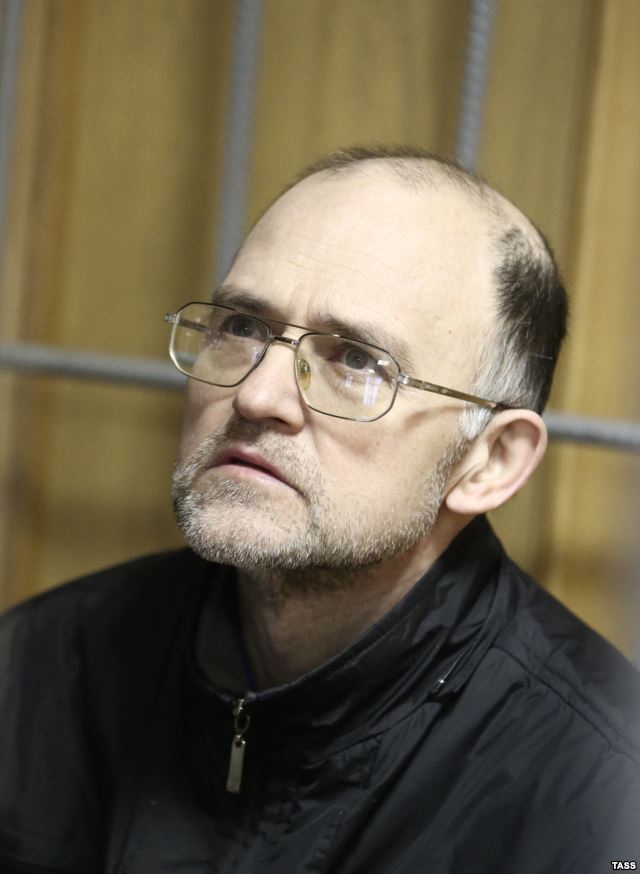
Sergei Krivov, Nikulinsky District Court, Moscow, December 23, 2013. Photo courtesy of Radio Svoboda and TASS
“It Is Not Recommended to Live in This Country”
Natalia Dzhanpoladova and Nikita Tatarsky Radio Svoboda
July 26, 2016
Yet another person convicted in the so-called Bolotnaya Square case, Sergei Krivov, a 54-year-old with a Ph.D. in physics and mathematics, has been released. Krivov was released from a prison colony in Bryansk Region, having served his sentence in full. In 2014, a court found him guilty of involvement in rioting and using force against police officers during a May 6, 2012, opposition rally on Bolotnaya Square in Moscow.
Krivov received one of the harshest sentences in the case, three years and nine months imprisonment.
His allies explained this was because the authorities avenged Krivov for the uncompromising stand he had taken throughout the trial. Krivov went on two lengthy hunger strikes. The first, to protest his arrest, lasted over forty days. During the second, he did not eat for sixty days in order to secure transcripts of the court proceedings. Krivov suffered two heart attacks during the second hunger strike.
Krivov was arrested as part of the Bolotnaya Square investigation several months after the events, in October 2012. According to police investigators, on May 6, 2012, when the crowd broke through police lines, Krivov seized a rubber truncheon from a policeman and used it to deliver several blows to police officers. Krivov himself repeatedly claimed he had been beaten by police on Bolotnaya Square, but the Investigative Committee refused to investigate his complaint.
Krivov served his sentence in two penal colonies in Bryansk Region, first at a correctional facility in Starodub. He was then transferred to a penal colony in Klintsy. The wardens put him in solitary, because they felt his life was in danger.
In an interview with Radio Svoboda, Kriov admitted his sentence might have been shorter had he “kept [his] mouth shut.” He spoke in detail about the reasons for his uncompromising stance, what happened on Bolotnaya Square, and how much Russia has changed since 2012.
The changes have been quite huge, and for the worse, although I still cannot say I have figured out what is what. I had been gradually following these changes by watching TV and reading Novaya Gazeta newspaper and New Times magazine, so they did not happen all at once for me and were not news. Nevertheless, I am perfectly aware the country as it was in 2012 and the country as it is in 2016 are two fundamentally different countries. There are far fewer freedoms, naturally, and It is nearly impossible to do anything within this framework.
Do you feel you have changed over these years?
In fact, after I got out, changed my clothes, and bathed, I had the feeling everything was as it had been. Although I did have big problems during the middle of my sentence: lots of things happened. But when it is all behind me, when I have come back to the “free” world, I cannot say I have changed. I think I am the same person I was.
Have you managed to meet with friends and relatives since your release? What are your impressions from these meetings and conversations?
Of course I have managed to meet with them. Let me put it is this way: almost no has chewed me out, except my wife, of course. In general, the feelings have been positive, because everyone has been friendly. They all congratulate me and wish me the best.
Naturally, anyone would find this pleasant. I want to say thank you to all the people who wrote me letters, held pickets, and collected money through the Internet, and to the leaders of the PARNAS Party, who paid my lawyers and sent me care packages: Boris Nemtsov, Mikhail Kasyanov, Vladimir Ryzhkov, and Ilya Yashin. In addition, Lyudmila Alexeyeva was involved. Despite her age, she attended the court hearings. A big thank-you to everyone for their support.
Last Wednesday, you also met with activists in Sokolniki Park. You mentioned you had no hope of being paroled. [In March, the court turned down Krivov’s parole application — Radio Svoboda.] Did you pin any hopes on the court in this case, that is, the trial court that heard the Bolotnaya Square case?
No. We had no chance from the get-go. What would have been the point of cooking all this up and then releasing us later? Obviously, the authorities conceived a quite definite plan, and they have been carrying it out. From my point of view, there was no reason to change anything, and nothing changed. I had been detained on misdemeanor charges several times., and I knew perfectly well how such matters were decided. There were no doubts in this case.
And yet your tactics in court were quite different from those of the other fellows. You were one of the most active participants in all the court proceedings.
Yes, I was, because I felt it could not make things any worse. That is how it happened, if you look at the sentences handed down. Naturally, my sentence would have been shorter if I had kept my mouth shut. But here, you know, six months more, six months less do not matter. Naturally, we had to defend ourselves to the hilt. After all, we did not take to the streets only to snitch on the protest movement, to put it crudely. We did not do what we did to make the court rule in our favor. It was a continuation of the protest. Pavlensky said it: court is a continuation of my protest action. For me, it was simply a continuation of the opposition’s fight. It can happen anywhere: in court, outside of court, on Bolotnaya, away from Bolotnaya. It is like a way of thinking. It is as Solzhenitsyn put it: “Not living a lie.” Every single moment you do what you think is right. The situation changes, but the individual does not change in the situation.
Were your fairly long, serious hunger strikes also a continuation of this same story?
Basically, yes.
What prompted you to do it? Do you remember what you felt when you decided there were no other methods left?
During both hunger strikes, I was perfectly aware my demands would not be met. I got carried away with the second hunger strike: let’s put it that way. But retreating? Chapayev never retreated. So the only way was forward. The main objective was to attract attention, to shake up the situation somehow. Because getting results, especially in the first case, when it was a matter of custody measures, was totally unrealistic. All I was charged with (not what I did, but what I was charged with) was causing the bruise on the back of the hand of a policeman who in fact assaulted me. The policeman’s name is Alexander Ivanovich Algunov. He completely flagrantly hit me over the head with a truncheon. I had three lumps on my head, one of which clearly visible on my temple. It was both videotaped and photographed. And there were eyewitnesses who saw everything.
Sergei Krivov during a hunger strike, Nikulinsky District Court, Moscow, November 2013. Photo courtesy of TASS and Radio Svoboda
But when it was matter of conducting a judicial review or investigatining this conflict… The bruise I allegedly caused the policeman was investigated by the Investigative Committee of Russia, meaning the country’s top investigative body. But what he did to me (and they believe that these actions took place at the same time) has been investigated by another committee. When I filed a written complaint against the officer, the case was not just dropped down to the municipal level, but to a neighborhood precinct, where an investigator wrote there was nothing to investigate. The bruise on the policeman’s hand was investigated by the Investigative Committee of Russia, while beating a person with a truncheon was investigated by a completely different division, the lowest on the totem pole, and it said there was nothing to investigate. I am simply a victim in the Bolotnaya Square case. But I was really visible in the video footage. I was in a confrontation with a policeman who was assaulting me. I grabbed the truncheon with which he was beating me, because at one point I nearly fainted. He hit me so hard on the head it felt like I had been hit with a sharp nail, not a truncheon.
You were not the only victim on Bolotnaya Square, and yet the authorities investigated these incidents so unfairly. How do you explain this?
In the trial documents, for example, there is this bit of evidence. There were two ambulance crews on duty on Bolotnaya Square. They kept a record of injuries in which they wrote down the names and addresses of everyone whom they examined. As far as I remember, there are forty-eight civilians in this list, who suffered something like seventeen concussions and thirteen head injuries and injuries to the soft part of the skull, meaning they had mainly been beaten on the head. There were three policemen who sought medical attention on the square. Of the forty-eight civilians, only two people were deemed injured parties by the authorities. One was hit in the back with a stone, while the other person’s trousers caught fire, and he suffered burns on his leg from a Molotov cocktail. We do not know who threw the bottle or the stone. The authorities assume it was the protesters, so only two individuals were deemed victims. The rest were not recognized as victims, because these forty-six individuals were victims of the police. Who the heck is going to investigate injuries caused by the police? That is not how things are done.
The public commission who investigated the events on Bolotnaya Square came to the conclusion it was the Moscow authorities and police who provoked the confrontation? Do you share this point of view?
I also came to the same conclusion. Only I think it was not the Moscow authorities, but the federal authorities [who provoked the conflict]. Moscow, in this case, did not have the authority to decide these questions. There were provocateurs there. I saw a man in a mask step forward, chunks of asphalt in both hands. At the time, I wondered what was so black, because I was looking into the light. At first, I thought he was throwing black earth, because the asphalt everywhere was so clean. This guy stepped forward and tossed one stone. Then he shifted a second stone [to his throwing hand] and threw the second stone. A policeman was standing there. I was standing there looking back and forth between the two. Either I should have said, “Why are you tossing stones?” or I should have gone up to the policeman and said, “Why are you just standing and watching?” The policeman saw what he did, and then turned around and walked away. The police were completely uninterested in the people who were actually throwing stones, just as the people throwing the stones knew the police were not going to do anything to them.
Yes, and the most interesting thing is the authorities alleged the protesters shouted things about attacking the Kremlin and Red Square, and overthrowing someone. I was there. I heard no such cries. There are twenty-six hours of video footage in the case file. There are no such appeals in that footage. When the police cordon fell apart, people did not run to the bridge. This is clearly visible in the footage. People who were squeezed out of the crowd ran ten or fifteen meters away, because there was a crowd behind them and the danger of being crushed. Then, at a leisurely place, these people fixed their clothes or tied their shoelaces or something, and headed towards the square. This, too, is visible in the footage. Yet the investigators continue to claim, and the courts have not refuted it, but take it as a proven fact, that people were shouting to run across the bridge somewhere and were, allegedly, trying to escape.
So it transpires the whole thing was a planned provocation. How do you explain it? What goals was the regime pursuing via this case? Has it achieved them?
It was the first [opposition] rally after the elections. All the major protest rallies had taken place between the December [parliamentary] elections and the March [presidential] election. May 6, 2012, was the eve of the presidential inauguration: the regime no longer had anything to fear. If they had used force before the elections, naturally, it could have turned against them. But there was nothing to fear after the elections, so they were going to put the heat on people and arrest them. This was followed by the adoption of a series of repressive laws and amendments to the laws on elections, and pickets and demonstrations, not to mention the fact they introduced Criminal Code Article 212.1, which they used to put away [Ildar] Dadin.
You were not detained immediately after the events of May, but around five months later. Did you follow what was happening to the guys who were arrested first? Were you afraid you might become a defendant in the case?
Of course, I followed what was happening. I went and picketed outside the Investigative Committee building. I had this routine: one evening at home with the family, the next evening I would go picketing, and so on. At first, I did not take it very seriously. Why did they take so long to arrest me? First, they checked out everyone who had been detained on Bolotnaya. Despite the fact I had been detained, there was no arrest sheet on me; I had refused to sign some of the pages. They tossed out my arrest documents, and so it turned out I had not been detained. So, apparently, this was the reason it took so long to track me down. But the problem was that I was all over the footage. Despite the fact I inflicted no blows—I would like to emphasize I inflicted no blows, and I am absolutely certain I caused no physical pain to any policeman—I did try and prevent them from assaulting other people. I used my hands to restrain the police. Afterwards, when I found footage of myself on the Internet, I thought to myself: yeah, that was me in action. My emotional sense was that I had prevented beatings without resorting to violence. But when I watched the videos, I did think I had reasons to be worried. But I decided what was the point of worrying now? I should have thought about it then.
Sergei Krivov picketing the Investigative Committee, Moscow, summer 2012. His placard reads, “Prisoners of May 6: Russia will be free!” Photo courtesy of Natalia Dzhanopoladova (RFE/RL)
Four years have passed, but the authorities are still prosecuting people [as part of the Bolotnaya Square case], people whose cases have not even gone to trial, for example, Dmitry Buchenkov and Maxim Panfilov. Do you think this will go on for a long time?
No, I don’t think it will go on for long. They are just running on momentum. The case is not so interesting nowadays. There are many new, interesting articles [that have been added to the Criminal Code]. The authorities can charge people to their heart’s content: for slander, for incitement to hatred. The amended laws have now given them such possibilities they can put away any person who says anything the least bit negative or critical.
Basically, the alternatives are this: either just one opposition party will be seated in the parliament or it won’t. There are also the single-mandate districts, which also helps. A party might not get its list into parliament, but someone can get into the Duma by winning a single-mandate district. I have read that [Alexei] Navalny is inclined to boycott the elections. I understand his resentment: his party was not registered, and he himself was not admitted as a candidate. But there are other parties besides his, and they are also opposition parties. I think all fourteen percent [of Russians who, according to the country’s extremely problematic opinion polls, disapprove of President Putin’s performance] definitely have to go and vote. Anyone who can do it should be an election observer, because it is not enough just to go and vote; we also have to monitor the vote. In the current circumstances, the authorities just cannot do without electoral fraud. Maybe we have few opportunities to stop the fraud, but we have to record the incidents and talk about them. Of course, it is very unpleasant the Democratic Coalition was not able to pull it together, but the law is such that for this to happen, people would have had to join another party. Unforunately, the majority was unwilling to do this. I think they should have come to an agreement whatever the conditions, but they didn’t.
As I understand it, this is part of the old conversation about attempts to unite democratic forces, which have been going on since the 1990s.
First, the law is wrong, because it does not allow electoral coalitions. Second, in my opinion, there should be no minimum barrier [for being seated in the Duma] at all. Democracy is a regime in which decisions are taken by the majority, but the problem is the majority is quite often mistaken. For example, on the stock exchange, the majority always lets the big money get away. The minority turns out to be on the money. The majority differs from minorities in the sense that there is one majority, but there can be two, three, four, five minorities, and so on. The minority has to be allowed to speak its mind, and then, perhaps, the majority will reorient itself. So there should be no barriers. The only barrier should be each physical person. The current laws, naturally, are designed to monopolize power, which is convenient to those currently in power. So they have no need of any competitors. Competitors are harassed, persecuted, and forced off the road.
As far as I know, you were educated as a physicist and worked in science for a long time. How did it happen that you switched from science to grassroots activism and began following political events? What prompted you to do this?
A profession is a profession, but one’s own opinion is something else. I first served as an elections observer in 1989. I was still working at MEPhI (Moscow Engineering Physics Institute) then. One thing did not interfere with the other, and it even helped. I left science, because salaries in the field had completely dried up, and I completely lost interest in what I was working on at the time. There was no future in it. In 1989, I was a member of an election commission for the first time. I went and found the election commission myself. It was perestroika. People had serious doubts and asked what perestroika was all about. They said perestroika would rearrange everything, but everything would be the same, [the Soviet Communist Party] would again get 99.9% of the vote, and so on. Those were the first actual elections, when Sakharov was elected [to the All-Union Congress of People’s Deputies].
What pleasantly surprised me was that there was no electoral fraud at all. In the evening, MEPhI’s Communist Party organizer came to check out the polling station, to see how we were doing. I tensed up, thinking that now they would come up with something. Nothing of the sort! I kept my eyes peeled. Everything was clean. But in 2011, when I also worked as an observer, everything was dirty, beyond dirty. It so dirty that, for example, there was an old woman, an observer from United Russia, working at our polling station. She did not get up to any tricks herself, but she would come up to us and say, “What is she doing?! Imagine the insolence!” She was referring to the woman who chaired our election commission. The old woman was indignant, her blood was boiling, but it did not go beyond that. She was already quite old, but [the electoral fraud] itself was too much for her. I was very glad a United Russia party member was outraged by our chairwoman’s behavior.
During the four years you spent in custody, how hard was it to get information about what was happening in Russia? How did you find out about events? What events during this time amazed you the most?
I was given subscriptions to Novaya Gazeta and New Times, although they only started to come regularly when I was in the penal colony. I would read these periodicals and try and watch the news. In some places, this was easier; in some places, harder. For example, the last three months, I was basically without TV, because the guys did not want to watch any news. They would turn on MUZ-TV, which would be spinning a popular music video for the hundredth time. I could not stand to listen to it. But the TV, as you know, is a biased source of information. As for events, of course, the annexation of Crimea and the war in Donbass. Incidentally, there were lots of Ukrainians in the penal colony, because the border is nearby. There was a guy in there who was himself from Russia, but his wife was from over there: he had got married in Ukraine. There was fighting in Kramatorsk. I asked him, “When were you there last?” He said, “Five years ago. Everything there was fine.” “Are Russians harassed there?” I asked. “Are you kidding?” he said, “Everyone lived in perfect peace. There were no problems at all.” Meaning no one discriminated against anyone, neither Russians nor Ukrainians. Where did this all come from? Why does the TV tell us that certain people are in danger there, that there is hostility? Russian TV has been kindling hostility between two sister nations. You cannot just go to war for their “bright future,” if everything in their country is okay. They have to say that everything there is bad.
You served your sentence in two penal colonies. Is it true that there are totally different rules depending on the colony?
The rules are different. That is why they say there are “red” colonies and “black” colonies. But those are the extremes, as it were, because the spectrum is continuous. The penal code is one thing, the laws are another, and if they were all obeyed, then it would make no difference where you did your time, but in reality the differences are fundamental. There is constant trench warfare between the convicts and the wardens over wrestling themselves more rights or forbidding more things. Figuratively speaking, for example, in one colony, the convicts march in formation, while in another they don’t. Even on this primitive level, marching in formation or not, there is constant conflict. The convicts try not to march in formation, while the wardens try to force them to march. It turns out different in every colony. And that applies to everything else.
Considering you were convicted as part of the Bolotnaya Square case, how were you treated in these colonies? Was there any talk about the fact you were basically a political prisoner?
The majority could care less. But some talked about it, especially in the pretrial detention facility, where I would come across sensible people. We would talk about who had been convicted and was doing time for no reason at all. When I was in the pretrial detention facility, it seemed there were many such prisoners. First, this was Moscow. Second, I was told, roughly speaking, that the accountants were on that floor, members of some other profession were on some other floor, and so on. Seemingly around thirty percent of the prisoners were in there for nothing. But when I got to Bryansk Region, this figure was no longer thirty percent, but much lower, somewhere between five and ten percent. A lot of guys were in for petty theft and drugs. Over a third were doing time for drugs. Realistically, a maximum of ten percent were doing time for nothing, or even five percent. As for how I was treated, well, I was repeatedly on the verge of a conflict. There were conflicts.
With the convicts or the wardens?
With both the wardens and the convicts. It is just that the wardens foist their rules on you, and the convicts foist theirs. You are a free man, and you realize you cannot abide by either set of rule.s So you don’t want to carry out either set of orders, and you start weaving and dodging. I was involved in several conflicts of that sort. My age was my salvation. Basically, there are all sorts of kids in there, and they could not bring themselves to hurt old people. Or rather, they could: I saw sixty-year-olds get beaten up in there, but it was still much more complicated. They also look at what you have been sent down for, although I cannot say it is so meaningful. But in this case it was a factor that worked in my favor; it was meaningful. I did not conceal the fact I had not assaulted any policemen, but a conviction is a conviction.
Now you are free and in Moscow. What are your plans? Do you see a future for yourself in Russia? Have you had thoughts of leaving the country?
By and large, I realize it is not recommended to live in this country. If a person has the opportunity and the desire, it is in his or interests to emigrate. But I somehow feel inherently Russian. I am afraid in any other country I would feel like an immigrant, an alien, if not like a guest worker. I cannot imagine living somewhere else. I feel it is okay to emigrate, and some people should emigrate, but I am afraid I am incapable of it.
Sergei Krivov is the twelfth person convicted in the Bolotnaya Square case to have been released from prison. A total of thirty-five people were prosecuted as part of the case. Thirteen of them were amnestied. Eight people remain in prison or under investigation.
Taganrog City Court Judge Georgy Serebryanikov sentenced 31-year-old local resident Elizaveta Tsvetkova to a year of corrective labor for disseminating leaflets criticizing the police, reportsCaucasian Knot. As published on the court’s website, the verdict stipulates that fifteen percent of Tsvetkova’s wages will be docked by the state for a year. The activist has also been charged 6,000 rubles in court costs.
Serebryanikov found the defendant guilty under Criminal Code Article 281.2 (incitement of hatred or enmity toward the social group “police officers”), which stipulates a maximum punishment of four years in a penal colony.
During closing arguments on May 16, Taganrog Deputy Chief Prosecutor Vadim Dikaryov asked that Tsetkova be sentenced to one year in a work-release colony. Serebryanikov thus imposed a lighter sentence than was requested by the prosecution.
The activist, however, pleaded not guilty. During her closing statement, on May 27, she stressed she had protested the illegal actions of law enforcement officers. She reminded Judge Serebryanikov of high-profile criminal cases against policemen, including the cases of Major Denis Yevsyukov and the Dalny police station in Kazan.
Lawyer Yuri Chupilkin had also asked the court to acquit his client.
Initially, the reading of the verdict in Tsvetkova’s trial had been scheduled for May 30. However, an hour before the scheduled hearing, the activist was called and informed it would be postponed. The reasons for the delay were not explained to the defendant.
It is unclear whether Tsvetkova would appeal the verdict.
Charges were filed against the activist in January 2015. According to investigators, Tsvetkova downloaded a leaflet criticizing the police from the Vkontakte social network, printed it out, and the day before Law Enforcement Officers Day, in November 2014, posted it at public transport stops and on street lamps.
The investigation was completed in August 2015. However, in September, the acting Taganrog city prosecutor uncovered numerous legal violations in the investigation, refused to confirm the indictment, and sent the case back to the Russian Investigative Committee. The indictment was confirmed the second time round, in November.
However, investigators ignored a sociological forensic study, carried out by Professor Vladimir Kozyrkov at Nizhny Novgorod University. Professor Kozyrkov rejected claims that police officers constitute a social group.
At preliminary hearings in December, Chupilkin insisted on striking a number of pieces of evidence from consideration, in particular, studies done by the regional interior ministry. Judge Serebryanikov, however, rejected the defense’s motions.
The hearing on the merits began on January 15, 2016. During the April 20 hearing, Viktor Chernous, a sociology professor at Southern Federal University in Rostov-on-Don, subpoenaed as an expert witness, also testified that police officers were not a social group, and consequently there had been nothing criminally culpable in the actions imputed to the defendant.
In turn, Elizaveta Koltunova, an assistant professor of linguistics at Nizhny Novgorod University, who was subpoenaed as an expert witness, noted that she could find nothing extremist about the leaflet that had led to the charges filed against Tsvetkova.
Rosfinmonitoring has included Tsvetkova in its list of terrorists and extremists and blocked her bank account.
* * *
An excerpt from the closing statement of activist Elizaveta Tsvetkova (Taganrog) at her trial on charges of extremism, May 27, 2016:
I still think that escapades like my own, the case in Stavropol involving the [alleged] offense to the feelings of religious believers, and other cases, have caused no real harm, but the outcome is that our law enforcement system acquires the image of a satrap for some reason. In addition, people are distracted from real dangers such as identifying terrorists. Perhaps I am an overly sensitive person, but it seems to me that one cannot remain indifferent after such high-profile cases as that of Major Yevsyukov, who gunned down civilians in a supermarket, and the case of torture at the Dalny police station, where a man died. These cases would cause anyone to have a negative attitude towards the illegal actions of police officers. I remain convinced that cases of bribery, torture, and murder must be stopped. People should not be afraid of police officers who break the law and engage in rough justice, but should put a stop to their actions, report their illegal activists, and publicly criticize police officers. Only then we will live in a country under the rule of law and be able to improve life in Russia. Cliquishness and special privileges are always abnormal and generally unfair, especially when it comes to such questions. A divided society cannot function normally. We must realize that if people are be unable to stand up for their rights in any area, if they are forced to put up with lawlessness in policing, housing, and health care, we will never live in a civilized, well-developed country.
Judge Refuses to Return Case of Environmentalist Accused of Extremism to Prosecutor OVDInfo.org
January 26, 2016
Maykop City Court has refused to return the case of environmentalist Valery Brinikh, accused of inciting hatred against the Adyghe people, to the prosecutor’s office for further investigation. This happened on January 26 at the first hearing in Brinikh’s trial. Lawyer Alexander Popkov, Brinikh’s defense attorney, told OVD Info that the reason for the motion to return the case to the prosecutor were the violations of criminal procedural law that have surfaced during the case. According to Popkov, the case files which the police investigator allowed them to examine did not match the case files submitted to the court.
Valery Brinikh
“The dates of the inspection protocols of the items seized during the search [of Brinikh’s home] have been changed,” Popkov explained.
According to him, during the investigation, he and his client discovered that the inspection protocolshad been drawn up before the items were confiscated. After they pointed this out, protocols that were formally drawn up later than Brinikh and Popkov reviewed them were submitted to the court.
Brinikh told OVD Info that the court had refused to admit two defenders to the case: retired judge Oleg Alexeev and Zaurbiya Chundyshko (an ethnic Adyghe), chair of the Maykop grassroots organization Adhyge Khase. The presiding judge has refused to call to the stand the witnesses and experts whom Brinikh and his attorney had asked to testify, including the people who performed the computer and linguistic forensic examinations during the investigation. The defense has a number of questions for them.
According to police investigators, in the fall of 2014, Valery Brinikh produced a piece of extremist matter: the article “The Silence of the Lambs,” which dealt with the environmental problems cause by a hog farming facility in Adygea’s Teuchezhsky District. It was founded by Vyacheslav Derev, the Federation Council member for Karachaevo-Cherkessia.
Translated by the Russian Reader. Photo courtesy ofCogita.ru
Please read my previous posts on the Brinikh case:
No, today’s subject is not a rally in memory of the martyred victims of political repression in the Gulag during the distant 1930s, 1940s, and 1950s.
It is more trivial and terrible. Evenki leader Sergei Nikiforov has been thrown in prison after leading a protest movement of his tiny people in the Selemdzhinsk District. As village head, he had been organizing resistance to the expansion of gold mining companies attempting to take over tribal reindeer pastures and hunting grounds.
Blagoveshchensk City Court sentenced Nikiforov, the father of five adopted children, to five years in a maximum security prison and a fine of 16 million rubles [approx. 232,000 euros] for bribery and embezzlement. The fellow villagers who were present in the courtroom have reached their own conclusions about the court’s bias. The court disregarded all the particulars that pointed to the defendant’s innocence, for example, the fact that at the time the bribe was made in Blagoveshchensk, Nikiforov was in Ekimchan, administrative center of the Selemdzhinsk District, hundreds of kilometers away, and the fact that the only witness was unable to identify Nikiforov in court and testified she did not know the man. Nor was the bribegiver arraigned. According to the Evenki, the trial was clearly a frame-up.
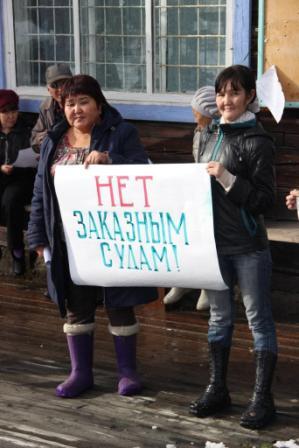
Nikiforov was convicted in Blagoveshchensk in late October of this year. On October 3, all the residents of his native village of Ivanovskoye who were not out on the hunt attended a protest rally in defense of Sergei Nikiforov.
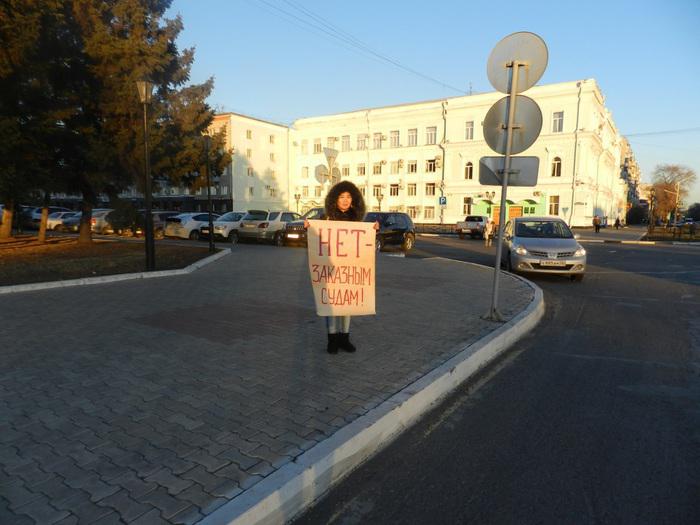
“No to kangaroo courts!” Residents of the village of Ivanovskoye demonstrating in support of Sergei Nikiforov, October 3, 2015
You cannot fool the people. If the village head had really been stealing money from the already meager village budget, who would have come out to support him?! You cannot hoodwink villagers, as people who have lived there would know.
After the protest, the regional authorities kept a low profile. Nowhere in the media did anyone comment on the trial of the disgraced village head. A small group of Evenki woman managed to travel to the regional center, overcoming hundreds of kilometers of bumpy roads on an UAZ off-road vehicle.
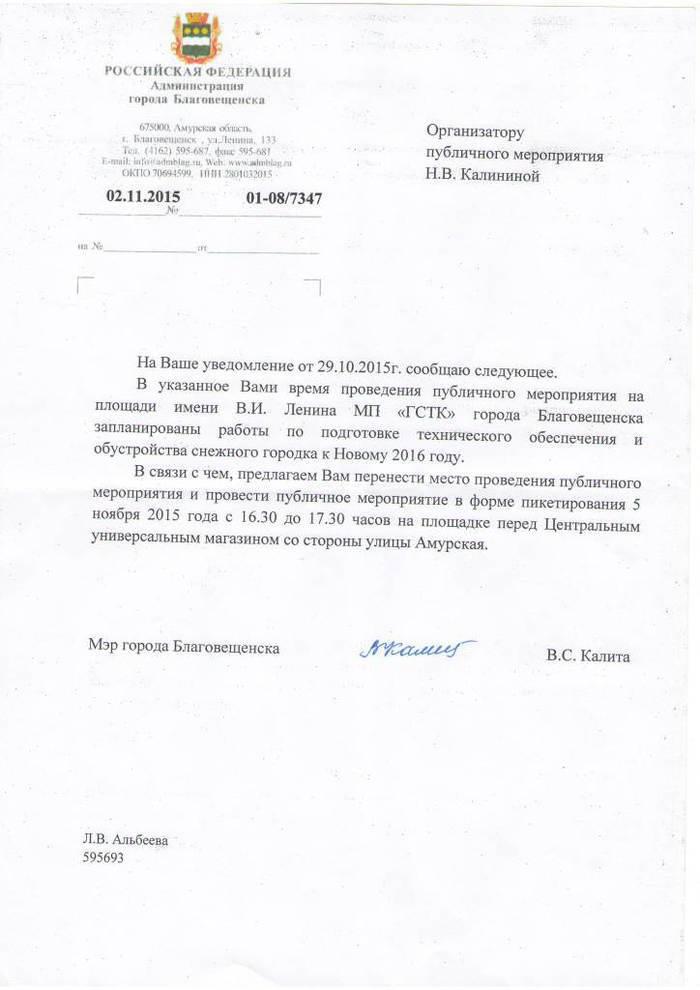
The Amur branch of the Yabl0ko Party gave due notice of plans for a protest rally on Lenin Square. Officials made a fuss. None of them wanted to see Evenki waving placards under the windows of the regional government house. I was contacted and asked to move the protest behind a department store, “out of sight of the authorities.” Clearly, it would have been pointless to protest behind a department store. So we were forced to to alter the format of the protest, but not the purpose and place.
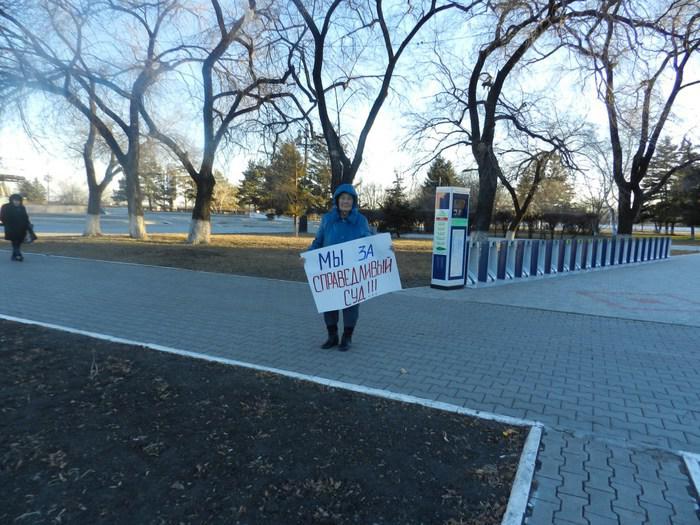
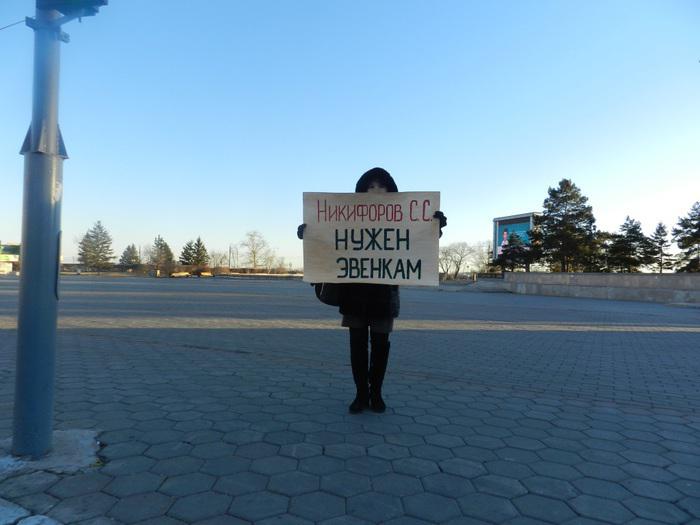
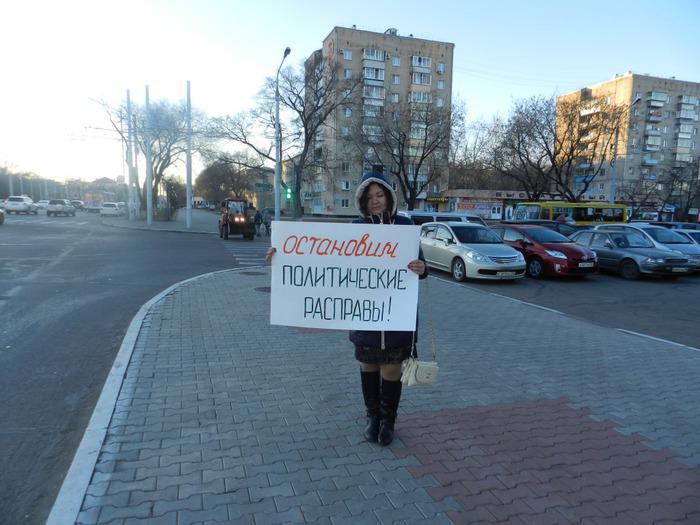
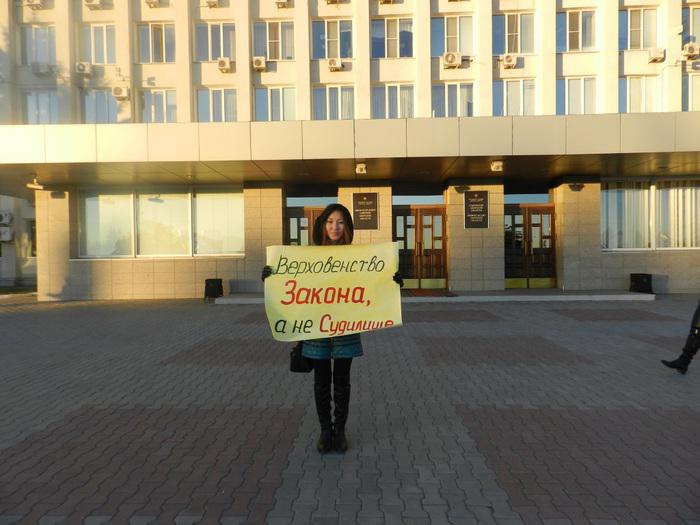
We held a series of solo pickets in downtown Blagoveshchensk. People stood alone at a distance of a several dozen meters from each other on both sides on Lenin Street in the vicinity of the eponymous square. Just opposite the windows of the regional government house, legislative assembly, and the public reception office of the Russian President stood women (wives and daughters of hunters and reindeer herders) holding placards with the slogans “The Evenki need S.S. Nikiforov,” “Free Sergei Nikiforov,” “Sergei Savelyevich, we are with you!” “We ask the Russian federal authorities to pay attention to the criminal case of S.S. Nikiforov,” “We want a fair trial!!!” “No to kangaroo courts!” “The rule of law, not a tribunal!” and “Put an end to political reprisals.” They hoped to attract the attention of authorities to the injustice perpetuated in the Amur Region.
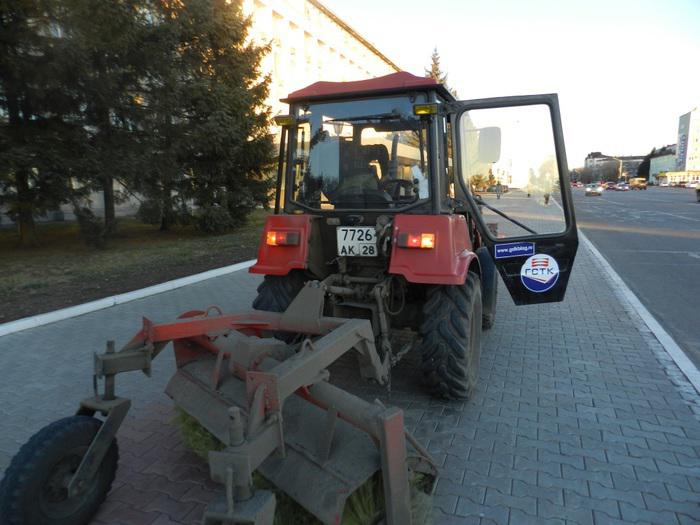
The reaction of officials was unexpected. No, neither the governor nor lawmakers came out to meet with their constituents. Nor did the chair of the regional court or the prosecutor show up. No, it was much more tedious. Frightened by the female protesters, the officials summoned several pieces of maintenance equipment from the City and Trade Services Center Municipal Enterprise (MP “GSTK”). A tractor drove on the sidewalk back and forth exactly where the protesters were standing. At times we imagined that the driver (a young chap with a brazen face) was defiantly trying to run over the small, fragile women, who would barely dodge out of his way. The oldest protester later said that she had physically sensed the tractor was about to run her over. It was noticeable that the moron behind the wheel was clearly getting some kind of sadistic thrill from his attacks on the defenseless women. Despite the fact the tractor was driving on the sidewalk, no special warning signs had been set up to this effect.
As soon as the picket ended, and the protesters left the square, the special maintenance equipment hastily turned around and drove away. By the way, the policemen on the square were quite polite. They were not at all keen to detain us “protestants,” apparently supporting us in their hearts.
Of course, it is too early to say that a protest rally was held and Nikiforov will be released tomorrow. Of course, that will not happen. We need to do much more. Maybe the next item on the agenda is a trip by Evenki to the capital and pickets on Red Square? In any case, people are becoming citizens and learning to assert their rights in practice. That is worth a lot!
“We want a fair trial!”“We ask the Russian federal authorities to pay attention to the criminal case of S.S. Nikiforov.”“The Evenki need S.S. Nikiforov.”“Sergei Savelyevich, we are with you!”“Put an end to political reprisals!”“The rule of law, not a tribunal!”“No to kangaroo courts!”“Free Sergei Nikiforov!”
N.B. I wish to inform Valentina Kalita, mayor of Blagoveshchensk, and MP “GSTK” head Igor Banin, United Russian party members and partners of ex-mayor Alexander Migulya, now under investigation, that actions aimed at disrupting a public event (to which every citizen of Russia has a constitutional right!) are covered by Article 149 of the Russian Federal Criminal Code (“Obstruction of assemblies, rallies, demonstrations, marches, and pickets or involvement in them”).
Finally, Igor Banin, the driver of the tractor, who spread dust and rubbish over the square today, deserves a bonus. The lad tried really hard to carry out your orders (which had nothing to do with the cleaning the sidewalk, as you know).
The wild Blagoveshchensk municipal services tractor and street sweeperA letter from Blagoveshchensk Mayor Valentina Kalita, dated November 2, 2015, and addressed to protest rally organizer Natalya Kalinina, stating that MP “GSTK” had planned to carry out preparatory work for building a “snow fortress” [sic] on Lenin Square for 2016 New Year’s celebrations at the same time as Kalinina and her group had informed the authorities they would be protesting there. Mayor Kalita therefore asks that the venue be switched to the area in front of the Central Shopping Center on the Amur Street side, and that the rally be turned into a series of pickets from 4:30 p.m. to 5:30 p.m. on November 5, 2015.
Translated by the Russian Reader. Thanks to Comrade AD for the heads-up
It is important to realize that the sentences that Kolchenko and Sentsov received are a fiction.
No one actually takes the charges against them seriously.
Even the most loyal Putinists do not take the charges seriously. What terrorism? What does the Right Sector have to do with any of this?
Kolchenko and Sentsov are hostages. Their being held in a Russian prison is an act of intimidation directed at the Crimeans who stayed home but could have fought back. Their being held in prison is an act of intimidation directed against all the people of Ukraine and those Russian citizens who could have supported them.
The trial was a fiction. The verdict is a fiction. That is why I reacted without emotion to the sentences, although I understand the shock felt by many comrades, among whom there are close friends of both Kolchenko and Sentsov. Twenty years and ten years in prison? The Russian judges could have give them sentences of forty years and twenty-five years. Or given both of them life sentences. Or given them each six months in prison, then retried the case. Or they could have not announced the verdict at all, but just laughed and made faces. Or mannequins dressed in judicial robes could have replaced the judges. Nobody would have noticed the difference.
Kolchenko and Sentsov are in prison as long as the Russian Federation is ruled by Putin’s repressive, aggressive authoritarian regime. They cannot be freed using lawyer’s tricks. They cannot be freed via “diplomatic channels.” They can be freed only by defeating Putinist Russia. Or if it “defeats” itself by choking on its own rage and madness.
And when that happens, it will not matter a whit what numbers have been written in Kolchenko and Sentsov’s sentences. It doesn’t matter what the judges whip up in Savchenko’s sentence. The release of the hostages does not depend on the actions of lawyers. It depends on politicans and military men. And, in part, on the price of petroleum.
As soon as the “Russian bear,” who has turned out to be a rabid rat, finally kicks the bucket, all the regime’s hostages will be freed.
Translated by The Russian Reader. As is nearly always the case, my opinions might not coincide entirely with those expressed by the authors whose texts I translate and post here. But it has been strange to read the angry reactions of leftist progressive Russian comrades to this particular text given the almost total lack of any visible, public solidarity with Sentsov and Kolchenko on their part.
I won’t even go into the haziness they and many other “ordinary” “apolitical” Russian citizens experience when figuring out who to blame for the whole mess in Ukraine. But this is the privilege all imperialist, metropolitan peoples enjoy: pretending not to know or understand what is being done in their name somewhere else in the world.
_________
Russia’s Sentsov–Kolchenko case “an absolutely Stalinist trial”
Halya Coynash
August 21, 2015 khpg.org
The prosecutor has demanded 23 years for Ukrainian film director Oleg Sentsov, and 12 years for civic activist Oleksandr Kolchenko in a case with no crime and where all evidence was obtained through torture. Russian human rights activist Zoya Svetova likens this to Stalinist repression, not a court trial.
Svetova has seen a huge number of trials over the last 15 years, but nothing like the “absolutely insane hearing” on Aug 19. She can’t remember a case where, with no elements of a crime, or criminal (terrorist) acts, the prosecutor should be seriously demanding 23-year and 12-year sentences. This, the fact that everybody expects the court on August 25 to convict two innocent men, and much more, she says, is reminiscent of Stalinist repressions where people were arrested for nothing.
Sentsov is charged with leading a ‘terrorist organization,’ Kolchenko of taking part in it and involvement in one specific firebomb attack on a pro-Russian organization active in helping Russia seize control of Crimea in 2014. There is no evidence that an organization even existed, and the only specific charge against Kolchenko is one that has not previously been classified by any Russian court as ‘terrorism.’
“The prosecutor is demanding 23 and 12 years for people accused of crimes they didn’t commit. Today Sentsov and Kolchenko’s lawyers clearly demonstrated that there are no elements of a crime in this case, nor any criminal act. On August 19, 2015, I saw a totally Stalinist trial. Three judges were sitting there, a real ‘troika,’ with cold, virtually dead eyes who were listening to the prosecutor and the lawyers,” Svetova writes here.
Another of the disturbingly Stalinist features of this case has been the fixation on some demonized organization, in this case the far-right and nationalist Right Sector. Russia has constantly exaggerated this organization’s role in both Euromaidan and subsequent events in Ukraine. There was even a Russian media attempt on the night of the Ukrainian presidential elections on May 25, 2014, to claim distortion of the election result after the Right Sector candidate gained a pitiful 0.9% of the votes. It was therefore no surprise that five days after those elections, the FSB should have claimed that it had uncovered a supposed Right Sector ‘terrorist plot.’ It has never produced any evidence at all, nor did any of the witnesses for the prosecution even demonstrate a clear understanding of what the Right Sector is, although they were all convinced it was dangerous, etc. There is nothing to link Sentsov, the left-wing and anarchist Kolchenko or Gennady Afanasyev with the far-right organization. In court on Wednesday, the prosecutor Oleg Tkachenko changed their story, saying that Sentsov and Kolchenko are not accused of membership in Right Sector, but of having “taken on the ideology of this organization as a guide for action.” What this means remains a mystery since the court has not demonstrated any interest in seeking clarification on this subject or with respect to the numerous other discrepancies in the prosecution’s case.
At the final hearing on Wednesday, the defence demolished all of the charges against the two men, then Dmitry Dinze, Sentsov’s lawyer, read out the account given by Gennady Afanasyev of how he had been tortured to get him to testify against Sentsov.
As reported, Afanasyev and Oleksy Chirniy were arrested at the same time as Sentsov and Kolchenko. Their ‘confessions’ and testimony are literally all that the charges against Sentsov are based on. It is therefore of critical importance that Afanasyev retracted his testimony on July 31, stating that it had been given under duress. He then spoke for the first time to a lawyer not provided by the investigators and gave a detailed account of the torture applied immediately after his arrest, and also the pressure placed on him to repeat this testimony in court. As well as threats against him, a FSB officer who appeared at the prison warned him that his mother “could have an accident” if he didn’t cooperate.
All of this information was read to the court. The judges simply looked down and did not react in any way, and the prosecutor continued to demand 23 and 12 years. It should be stressed that the details in Afanasyev’s account fully coincide with those given by Sentsov, and Chirniy is also known to have told the Ukrainian consul that he had been forced to ‘confess.’
Sentsov’s final statement was, as all previous statements, courageous and moving. So too was Kolchenko’s, who spoke of the fact that the court had heard about the use of threats and torture by the FSB against Sentsov and Afanasyev.
“It’s interesting that people using such methods to obtain testimony have no qualms about accusing us of terrorism.”
He called the charges against them fabricated and politically motivated, and said that this trial, like those against Nadiya Savchenko, the Bolotnaya Square protester, and others are aimed at extending the life of the current regime.
“Yet throwing us in prison, this regime speeds up its end, and those people who still yesterday believed in law and order, today, watching such trials, have lost that faith. And tomorrow or the day after tomorrow, those people who are part of the 86 percent [supposedly supporting President Vladimir Putin – HC] will overturn this authoritarian regime.”
Kolchenko noted that, in the letter read out to the court, Afanasyev said that the FSB officer had told him that the day he gave testimony in court would be the most important day in his life.
“Seemingly, Afanasyev took those words to heart and interpreted them in his own way. I was very taken with this great and powerful act of his.”
Gennady Afanasyev is in danger; Oleg Sentsov and Oleksandr Kolchenko are facing long sentences on preposterous charges. And Russia is descending into a frightening Soviet tradition in which people are tortured for ‘confessions’ with neither the prosecutor nor the judges even batting an eyelid when this is demonstrated to the world.
Please write to all three men!
The website of the Solidarity Committee with the Crimean Hostages will try to get messages to them.
In the first box, write one of the following names one at a time:
Олег Сенцов (Oleg Sentsov)
Олександр Кольченко (Oleksandr Kolchenko)
Геннадий Афанасьев (Gennady Afanasyev)
Then in the next box, write your name.
The next box asks for a telephone number if you wish to give it. An email address is, however, needed (the fourth box).
Finally, in the fifth box, write your message.
The key aim is to ensure that all three men know that they are not forgotten. The following would be quite sufficient (if you do write in Russian, please avoid anything controversial or overly political).
Мы восхищаемся Вашим мужеством и надеемся на Ваше скорое освобождение.
Спасибо, что нашли в себе силы остаться честным с самим собой.
Держитесь!
(We admire your courage and hope for your speedy release. Thank you for finding the strength to remain true to yourself. The last word is a word of support, like “take care!”)
The question under the last box asks whether you are on social networks: yes, no, in that order (or leave it blank)
Then hit SEND.
Thanks to Comrade SP for the heads-up. I have lightly edited the text to make it more readable.
“Trial”
Ilya Budraitskis
July 24, 2014 OpenLeft.Ru
Udaltsov: four and a half years in prison. Razvozzhayev: four and a half years in prison.
“You were paid to come here, right?” the girl in uniform at the entrance to Moscow City Court asked out of habit. Then came the long hours of standing with sympathizers, acquaintances, and strangers listening as the sentence in the trial of Sergei Udaltsov and Leonid Razvozzhayev was read out. The Bolotnaya Square case is only two years old, but it seems a whole lifetime has passed.
Slurring the words, Judge Alexander Zamashnyuk and his henchmen took turns reading out the full version of the idiotic detective story, a puzzle whose pieces have finally fallen into place: long-cherished dreams of violent revolution, the heady atmosphere of the Movement for Fair Elections, the connection with Georgian intelligence and clandestine seminars on how Maidan was organized (then it was still the previous Maidan), the columns of “anarchists and nationalists” on May 6, 2012, in Moscow, the “riots,” with all their participants and “hallmarks.”
The absurd picture of a conspiracy, which just recently provoked laughter, now finds support and understanding in the eyes of the frightened and brutalized “new Putin majority,” who seemingly think it is nice everything ended on May 6, 2012, and that the prison sentences and frame-ups are the price that must be paid for perpetual Russian stability.
Like the other Bolotnaya Square prisoners, Sergei Udaltsov is no longer a symbol of a movement that served its purpose but something much more than that. He is a reminder that resisting, dissenting, and undermining the false unity of the people and the state continue to be historical possibilities.









 Alexander Kolchenko and Oleg Sentsov