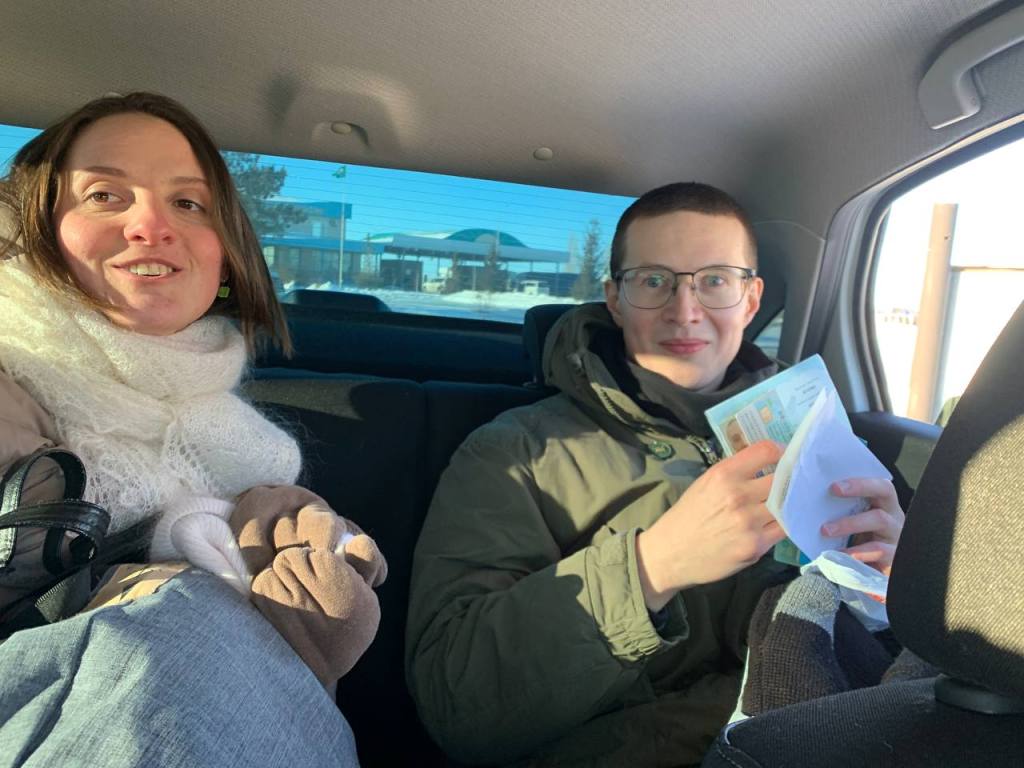
Jenya Kulakova y Viktor Filinkov después de cruzar la frontera de Kazajistán. Foto: Mediazona.
El programador Viktor Filinkov fue liberado después de siete años de permanecer en prisión bajo custodia policial como acusado y convicto por el caso Network. El mismo Filinkov contó a Mediazona que había sido liberado de la colonia penal n.º 1 de Oremburgo por la mañana, tras lo que fue conducido por oficiales de policía a la frontera con Kazajistán y entregado a agentes de frontera locales.
Antes de ser liberado, Filinkov fue entrevistado por oficiales del caso en la colonia penal, quienes le advirtieron que no volviese a Rusia tras su deportación. Los oficiales de policía le llevaron hasta la frontera engrilletado.
Filinkov es nacional de Kazajistán. En el 2021, mientras estaba encarcelado, el servicio federal penitenciario (FSIN) determinó que la presencia de Filinkov en Rusia era “indeseable” y le prohibió ingresar al país por ocho años, práctica común entre los convictos por cargos de terrorismo. Basada en este fallo, la oficina del ministerio del interior en Oremburgo ordenó la deportación de Filinkov.
Filinkov es nacional de Kazajistán. En el 2021, mientras estaba encarcelado, el servicio federal penitenciario (FSIN) determinó que la presencia de Filinkov en Rusia era “indeseable” y le prohibió ingresar al país por ocho años, práctica común entre los convictos por cargos de terrorismo. Basada en este fallo, la oficina del ministerio del interior en Oremburgo ordenó la deportación de Filinkov.
Filinkov y su esposa Yevgenia (también conocida como Jenya) Kulakoba están ahora en Kazajistán. Ellos se dirigen a Petropavl, al norte del país, en donde reside la madre de Filinkov.
Antes de ser liberado, oficiales del FSIN lavaron y entregaron a Filinkov la chaqueta verde que él vestía cuando, hace siete años, fue detenido y torturado con una pistola paralizante.
Viktor Filinkov, programador y antifascista, fue detenido en San Petersburgo el 23 de enero del 2018. En ese momento tenía veintitrés años. Tras su arresto, Filinkov describió en detalle como oficiales del FSB le llevaron al bosque y le torturaron con una pistola paralizante, obligándole a memorizar los testimonios que querían que él entregase. Otros acusados y testigos del caso describieron torturas similares.
Investigadores del FSB elevaron cargos contra once antifascistas y anarquistas en Penza y San Petersburgo, bajo el artículo 205.4 del código criminal que criminaliza “la organización de un grupo terrorista”. De acuerdo al FSB, los jóvenes se habían unido en la “red de una comunidad terrorista” y se preparaban para “derrocar al régimen por las armas”.
Las sentencias contra los convictos en Penza varían entre los seis y dieciocho años en prisión, mientras que los convictos de San Petersburgo recibieron condenas de entre tres y medio hasta siete años en prisión. Filinkov fue el último convicto en cumplir condena.
Desde el verano del 2021, Filinkov sufrió cárcel en la colonia penal n.º 1 de Oremburgo, en donde enfrentó la represión de los guardias: fue enviado repetidamente a confinamiento solitario y sus cartas fueron constantemente robadas y falsificadas. Aún así, Filinkov interpuso apelaciones contra los castigos de la colonia penal, con la asistencia de su abogado, Vitaly Cherkasov, y su defensora pública, Yevgenia Kulakova. Cuando Filinkov comenzó a ganar un caso tras otro contra la colonia penal, los guardias prefirieron dejarle tranquilo. En los últimos dos años no ha sido hostigado.
Fuente: Mediazona, 22 de enero del 2025. Traducción al español por Hugo Palomino para The Russian Reader. En las actualizaciones periódicas del Network Case dossier (en inglés) se encuentran enlaces a todo lo publicado por The Russian Reader acerca del caso Network en los últimos siete años.
Jenya Kulakova y Viktor Filinkov
Vitya y yo estamos juntos y libres finalmente. No había seguridad de que todo esto funcionaría hasta el último momento, así que lo de hoy es para mí un milagro y un alivio después de tanta tensión y esfuerzo.
¡Muchas gracias a todos por las felicitaciones que han llovido desde todos lados! Es genial saber que un evento feliz en mi vida ha traído tanta alegría a quienes me conocen. Gracias a los medios de comunicación y su cobertura de la liberación de Vitya (y con esto, sus peticiones de entrevistas).
Todo esto es precioso para mí, pero justo ahora ni Vitya ni yo podemos leer todo lo que ha llegado, ni mucho menos responder. Por favor entiendan que ambos (sobre todo Vitya) necesitamos tiempo para racionalizar y vivir estos momentos.
¡Gracias a Alina por la foto!
Fuente: Jenya Kulakova (Facebook), 22 January 2025. Traducción al español por Hugo Palomino para The Russian Reader, a partir de la nota de Thomas Campbell, amigo personal de Jenya.
Programmer Viktor Filinkov was released after seven years in police custody and prison as a defendant and convict in the Network Case. Filinkov himself told Mediazona that he had been released in the morning from Penal Colony No. 1 in Orenburg, after which police officers drove him to the border with Kazakhstan and turned him over to local border guards.
Before his release, Filinkov was interviewed by the penal colony’s case officers, who warned him not to return to Russia after he was deported. Police officers transported him to the border in handcuffs.
Jenya Kulakova and Viktor Filinkov after crossing the border with Kazakhstan. Photo: Mediazona
Filinkov is a Kazakhstani national. In 2021, while he was still incarcerated, the Federal Penitentiary Service (FSIN) ruled that Filinkov’s presence in Russia was “undesirable” and banned him from entering Russia for eight years, a common practice for those convicted on terrorism charges. Based on this ruling, the Orenburg office of the Interior Ministry ordered Filinkov deported.
Filinkov and his wife Yevgenia [aka Jenya] Kulakova are now in Kazakhstan. They are headed to Petropavlovsk in the north of the country, where Filinkov’s mother resides.
Before his release, FSIN officers laundered and gave Filinkov the green jacket in which Filinkov was detained seven years ago and tortured with a stun gun by FSB officers.
Programmer and antifascist Viktor Filinkov was detained in St. Petersburg on 23 January 2018. He was twenty-three years old at the time. After his arrest, Filinkov described in detail how FSB officers had taken him to the woods and tortured him with a stun gun, forcing him to memorize the testimony they wanted him to give. Other defendants and even witnesses in the case described similar torture.
FSB investigators then charged eleven antifascists and anarchists in Penza and St. Petersburg under Article 205.4 of the Criminal Code (which criminalizes “organization of a terrorist group”). According to the FSB, the young men had banded together into “the Network terrorist community” and were preparing for an“armed overthrow of the regime.”
The sentences handed down to the Penza defendants ranged from six to eighteen years in prison, while the Petersburg defendants were handed sentences of between three and a half to seven years in prison. Filinkov was the final of the Petersburg activists to serve out his sentence.
Since the summer of 2021, Filinkov had been incarcerated at Orenburg Penal Colony No. 1, where at first he faced pressure from the prison wardens: he was repeatedly sent to solitary confinement, and his letters were constantly stolen and forged. Filinkov, however, consistently filed legal appeals against the penal colony’s punishments with the assistance of his lawyer Vitaly Cherkasov and his public defender Yevgenia Kulakova. When they began to win one court case after another against the penal colony, the wardens preferred to leave Filinkov alone. They had not harassed him during the last couple of years.
Vitya and I are finally together and free. There was no certainty until the last moment that everything would work out, so today’s event is a miracle to me and a relief after a lot of effort and tension.
Thank you all so much for the congratulations that have been pouring in from everywhere! It’s quite cool to know that a happy event in my life has brought so much joy to people who know me. And thanks to the media for their coverage of Vitya’s release (and, consequently, their requests for interviews).
All of this is quite precious to me, but right now neither Vitya nor I can even read everything that has come in, let alone reply. Please understand that both of us (Vitya especially) need time to come to our senses and experience these moments.
Yekaterina Duntsova, who wants to run for president, said the Kremlin should end the conflict in Ukraine, free political prisoners and undertake major reform to halt the slide towards a new era of “barbed wire” division between Russia and the West.
Nearly 32 years since the 1991 fall of the Soviet Union stoked hopes that Russia would blossom into an open democracy, Duntsova, 40, said she was afraid as she spoke to Reuters in Moscow.
In opinion polls, Russians voice support for the Putin regime’s action in Ukraine. And yet, many Russia would like the war to end, and the dynamics of recruiting “contract” soldiers does not demonstrate that a large number of people are ready to rise up “to fight the West in Ukraine.” What are the real sentiments of Russians? What do they think about the war and how do they justify it?
Lev Gudkov, deputy director, research director, Levada Center, “The war and collective identity,” (online)
Andrei Kolesnikov, senior researcher at the Carnegie Russia Eurasia Center in Berlin, “A semi-mobilized society in a hybrid totalitarian regime” (online)
Svetlana Erpyleva, Humboldt Fellow, Research Center for Eastern European Studies at the University of Bremen; researcher, Public Sociology Lab and the Centre for Independent Sociological Research, “Accepting the inevitable: how Russians justify the war in Ukraine”
Source. Annotation translated by the Russian Reader
Viktor Filinkov, convicted in the Petersburg portion of the high-profile Network Case, turned twenty-nine in early November. It was his third birthday in the penal colony, and for the first time he was not given any special “gift” there. Previously, surprises had been waiting for him that were even hard to imagine—for example, a new uniform with a piece of razor inside it. Filinkov has been imprisoned for six years total. During this time, he has seen a lot, including being threatened with dispatch to a war zone, but he quickly put a stop to such “jokes.” Now he is housed in the high-security wing along with other “repeat offenders.” And he constantly files suits against the penal colony. We talked to his girlfriend and public defender Yevgenia Kulakova, who loves him with all her heart and helps defend his rights behind bars.
Source. Excerpt translated by the Russian Reader, who looks forward to the day when he can see his friend and heroine Jenya Kulakova again and meet his hero Viktor Filinkov in person.
Putin noted that visitors from Tajikistan can stay in Russia for an extended period—fifteen days—without registering with the immigration authorities. They can also apply for a work permit that is valid for up to three years.
In addition, Putin announced the expansion of the quota for university students and postgraduates from Tajikistan—from 900 to 1,000 individuals.
The head of the Russian Federation added that the state would allocate 200 million rubles annually from this year for purchasing textbooks for Russian-speaking schools in Tajikistan.
Various regions of Russia have recently imposed restrictions on migrant labor. There have also been proposals to introduce such bans everywhere for visitors from countries where the Russian language is not recognized at the state level. In Tajikistan, Russian is enshrined in the constitution as the language of interethnic communication.
Due to the unstable financial situation, migrant workers have been leaving Russia. Up to a third of Tajik and Uzbek nationals may leave the country.
As of February 24, 2022, Russian President Vladimir Putin declared the beginning of what he dubbed the “special military operation” and the Russian Armed Forces invaded Ukrainian territory. What the Russian authorities assumed would be a swift operation soon became a drawn-out, full-fledged war. Many events occurred over the course of the first year of war, keeping Russians in suspense, forcing them to detach themselves from the situation, giving them hope, and then driving them to despair. When we conducted our first interviews in spring 2022, many thought the war would not last long.
Since then, it has become clear that the war will be with us for a while. The daily life of Russian citizens has been invaded time and again by dramatic events. The Russian retreat from the occupied territories, the annexation of new regions, the bombing of Kiev, the first Crimean Bridge explosion, and the “partial mobilization”— to name just a few. Have these events changed the average Russian’s view of the war, and if so, how? How did residents of the Russian Federation perceive the “special military operation” more than half a year later? These questions are the focus of the report you see before you.
There are several research teams monitoring changes in Russian perceptions of the war through opinion polls (for example, Russian Field and Chronicles). The work they are doing is very important. However, like any research method, surveys have their drawbacks—there are some things they simply will not show. For example, surveys do not always allow us to understand a respondent’s attitude towards sensitive or hot-button topics, as sometimes people have a tendency to hide their true views. But more importantly, for Russians largely removed from the political process, perceptions of such politically-charged issues as the “special military operation,” war, and military conflict do not fit neatly into the standardized set of coherent positions that a survey is capable of capturing. These perceptions may be complex and contradictory, and in this case, in-depth interviews and long conversations with people allow us to better understand the idiosyncrasies of each viewpoint. To our knowledge, we are the only team that systematically monitors Russian perceptions of the war using qualitative (interview) rather than quantitative (survey) methods.
We released our first analytical report in September 2022. You can read it here (in Russian) and here (in English). In it, we presented the results of our qualitative study through interviews conducted over several months after the start of the war, in March, April, and May 2022. Our interviewees held a variety of opinions on the military conflict—there were those who supported the hostilities in one way or another (war supporters), those who condemned military aggression (war opposers), and those who tried to avoid giving any explicit assessment of the situation (undecided). We compared these three groups of respondents with each other: how they perceive the armed conflict, what emotions they associate with it, and how they consume information, assess the victims of the conflict, discuss the situation with loved ones, reflect on the consequences of the war, and so on. We have also published the results of this research in analytical media outlets, a few examples of which can be found here, here, and here, as well as in scientific journals, such as those found here (in Russian) and here.
The paper you are currently reading is the second analytical report we have published and a continuation of this research. It is based on qualitative sociological interviews with Russian citizens conducted in fall 2022, from 7 to 9 months after the outbreak of the war. We wanted to determine how Russian perceptions of the war had changed during this period. This time, we excluded subjects who consistently opposed the war from the sample and decided to focus our study on the specifics of perceptions held by Russian citizens who did not have an unambiguous anti-war stance.
In audio intercepts from the front lines in Ukraine, Russian soldiers speak in shorthand of 200s to mean dead, 300s to mean wounded. The urge to flee has become common enough that they also talk of 500s — people who refuse to fight.
As the war grinds into its second winter, a growing number of Russian soldiers want out, as suggested in secret recordings obtained by The Associated Press of Russian soldiers calling home from the battlefields of the Kharkiv, Luhansk and Donetsk regions in Ukraine.
The calls offer a rare glimpse of the war as it looked through Russian eyes — a point of view that seldom makes its way into Western media, largely because Russia has made it a crime to speak honestly about the conflict in Ukraine. They also show clearly how the war has progressed, from the professional soldiers who initially powered Vladimir Putin’s full-scale invasion to men from all walks of life compelled to serve in grueling conditions.
“There’s no f—— ‘dying the death of the brave’ here,” one soldier told his brother from the front in Ukraine’s Kharkiv region. “You just die like a f—— earthworm.”
The prospect of another wave of mobilization lingers, even as Moscow has been trying to lure people into signing contracts with the military. Russia’s annual autumn conscription draft kicked off in October, pulling in some 130,000 fresh young men. Though Moscow says conscripts won’t be sent to Ukraine, after a year of service they automatically become reservists — prime candidates for mobilization.
Twenty months ago, after Vladimir Putin had launched his full-scale invasion of Ukraine, many high-ranking Russians believed that the end was near. The economy faced disaster, as they saw it, and the Putin regime was on the brink of collapse.
Today, the mood has changed dramatically. Business leaders, officials and ordinary people tell me that the economy has stabilized, defying the Western sanctions that were once expected to have a devastating effect. Putin’s regime, they say, looks more stable than at any other time in the past two years.
Restaurants in Moscow are packed. “The restaurant market is growing, not only in Moscow, but throughout Russia, facilitated by the development of domestic tourism,” said a top Russian restaurateur. “And the quality of food is also changing for the better. Sure, panic struck the industry in early 2022, but it quickly passed.”
Due to Helsinki’s decision to temporarily close the border with Russia, Finnish resident Yevgeny doesn’t know when he will be able to see his father again. He and other Russian-speaking residents of Finland are trying to get through to the authorities to convince them to open at least one border crossing.
Source. Annotation translated by the Russian Reader
Unprecedented dragnets for conscripts have been taking place in Moscow. The capital’s military enlistment offices have launched a large-scale “single-day” conscription campaign, dispatching people with serious illnesses and visitors from other regions to the army. The Russian conscripts have not yet been sent to Ukraine for full-scaled combat. But the number of lawsuits against draft commissions has tripled compared to 2022 and is approaching a thousand cases. The BBC tells how conscription is taking place in the Russian capital, which lawyers describe as lawlessness.
Maria Andreeva, whose husband has been fighting in Ukraine for more than a year, is also waging a battle in Moscow: to get him home.
She is not alone.
A growing movement of Russian women is demanding the return from the front of their husbands, sons and brothers who were mobilised after a decree by President Vladimir Putin in September last year.
Initially, the movement pledged loyalty to what the Kremlin calls its “special military operation” (SVO) but what they regard as the perfunctory response they have received is hardening some of their opinions.
The Udege language is so phonetically rich that linguists have devised several Cyrillic-based alphabets for it in an attempt to capture this wealth. Udege has both an inclusive and exclusive first-person plural pronoun (“we”), and the terms describing spatial relationships have parallel meanings in the home and beyond its confines. The language of the Udege people reflects their idea of the equality of time and space, and the starting point for the speaker is either a river or a hearth. Linguist Elena Perekhvalskaya acquaints us with the Udege language.
Source. Excerpt translated by the Russian Reader, who was told the other day by a prominent Udege civil rights activist that the number of native speakers of Udege is now eleven.
In reality, as the testimony of numerous witnesses shows, the armed conflicts between the Russian state and the subjugated peoples of Siberia demonstrate that Russian colonization differs little from European colonialism in Africa, Asia, and the Americas. The only apparent difference was how the colonizers treated the people they conquered. While the Spanish Conquistadors committed large-scale massacres in their pursuit of gold, the Siberian Cossacks were more interested in extracting lucrative tributes from locals. These tributes, paid in the form of furs collected by the legendary hunters of the conquered peoples, became a major source of wealth for the tsars. The legend that indigenous peoples were such expert hunters they could “shoot a squirrel in the eye” persists to this day.
Irina Gurskaya, a human rights activist and volunteer, arrived in Cologne from Penza a year ago. More precisely, she did not come willingly but fled to Germany on a humanitarian visa. At the age of sixty, the pensioner had to leave her home, fearing for her life. The reason for Irina’s intimidation and harassment by the security forces in Penza was that she had helped Mariupol residents taken to Penza to return to their homeland or leave for safe countries.
We don’t know whether there will be a stalemate on the battlefield moving into 2024, or more dramatic changes in the frontline like we saw in May and November 2022. It remains to be seen whether a more ambitious mobilization campaign will be attempted after the presidential elections in March 2024. It would face the same problems as those I have described here. Utter lack of capacity and resources among the commissariat, informal institutionalized ways of avoiding or undoing the will of the centre to recruit. Massive labour shortages which make industry hostile. A counter-productive administrative system of coercive command. Active and passive agency of the vast majority to avoid the draft. There are various indirect signs that the authorities collectively fear the results of having to implement further mobilization.
The botched first mobilization created an atmosphere of bitterness, fear and hostility to the state’s conduct regarding the war. It would be a mistake to say that mobilization in 2022 broke the social contract between state and people, because there was none to begin with. If the war continues, Russian society will become ‘insurgent’. Not literally, but figuratively, people will become more actively resistant to recruitment to the meatgrinder. No monetary offers, nor spreadsheet autocracy will be effective.
Despite decades under Putin’s rule, it is too simplistic to assert that authoritarianism in Russia has eliminated activism, especially in relation to everyday life. Instead, we must build an awareness of diverse efforts to mobilize citizens to better understand how activism is shaped by and, in turn, shapes the regime.
Varieties of Russian Activism focuses on a broad range of collective actions addressing issues from labor organizing to housing renovation, religion, electoral politics, minority language rights, and urban planning. Contributors draw attention to significant forms of grassroots politics that have not received sufficient attention in scholarship or that deserve fresh examination. The volume shows that Russians find novel ways to redress everyday problems and demand new services. Together, these essays interrogate what kinds of practices can be defined as activism in a fast-changing, politically volatile society.
An engaging collection, Varieties of Russian Activism unites leading scholars in the common aim of approaching the embeddedness of civic activism in the conditions of everyday life, connectedness, and rising society-state expectations.
The Bolshoy Kinel River flows among the forests of the Orenburg Region. Its name derives from the Bulgar word kin, meaning “wide.” When the ancient Bulgars first encountered it, they saw a wide, full-flowing river and decided to settle there. But nowadays the river is gradually disappearing: the banks have shoaled, the bottom is silted up, and the springs that feed it are clogged. And yet, the Bolshoy Kinel is only source of water for several towns. Its tributaries are also drying up. In 2021, the Turkhanovka River, which flows through the entire length of the city of Buguruslan, completely disappeared. It was a tragedy for the townspeople. The local residents joined together and together cleared the river of debris—and the water returned. It transpired that there are many people living in the town who feel a great love for their land. I spoke with them. And, as I gathered their stories, I saw how everyone’s small deeds, like rivulets, combine into one big, important cause—just as the Turkhanovka River flows into the Bolshoy Kinel, the Bolshoy Kinel into the Samara, the Samara into the Volga, and the Volga into the Caspian Sea.
Source. Excerpt translated by the Russian Reader. Photo by Darya Aslanyan for Takie Dela
There’s an idea about how children learn to read that’s held sway in schools for more than a generation — even though it was proven wrong by cognitive scientists decades ago. Teaching methods based on this idea can make it harder for children to learn how to read. In this podcast, host Emily Hanford investigates the influential authors who promote this idea and the company that sells their work. It’s an exposé of how educators came to believe in something that isn’t true and are now reckoning with the consequences — children harmed, money wasted, an education system upended.
Both sides of the author’s family were remarkable. His maternal grandfather, Alfred Wiener, was a prominent German Jew who created the most extensive archives documenting the Holocaust; Alfred’s wife and daughters were deported to a concentration camp. The author’s paternal grandmother was transported to a gulag in Siberia. A tale of survival, eloquently told.
A lyrical excavation of trauma and healing in the midst of early motherhood – the debut work of an endlessly inventive poet whose work ‘fizzes with energy, physicality, and the levitating openness of song’.
It was snowing heavily when Yulia walked across the only open border between Ukraine and Russia last month, carrying her two cats and dragging a large suitcase behind her.
She had left her village on the edge of Russian-occupied Melitopol, a city in Ukraine’s Zaporizhzhia region, more than 24 hours earlier, paying a Russian ‘carrier’ with a minivan around $250 (nearly £200) to take her to the border-crossing in Ukraine’s northern Sumy region.
Walking across the two-kilometre no-man’s land was the final step in a long journey that is not without risk. Just two weeks earlier, a Russian volunteer who was transporting Ukrainians to the Sumy checkpoint was detained and tortured by Russian security personnel.
It was Yulia’s second attempt at the crossing. The first time, in early autumn, she was turned back at the border because she did not have a Russian passport and her name was flagged in a Russian state database as she had been questioned by the security services twice: once for tearing down Russian propaganda posters and then for arguing with a neighbour about life during the Soviet Union.
If you’d like to see any of the Russian-language articles excerpted here translated in full and published on this website, make a donation in any amount to me via PayPal, indicating which article you’d like me to translate, and I’ll make it happen. ||| TRR
“Timur, we will always remember you”: a memorial to the Russian anarchist, anti-fascist, punk rock musician and university philosophy major Timur Kacharava at the site of his murder by Russian neo-Nazis in downtown Petersburg
Eighteen years ago today the anarchist Timur Kacharava was murdered outside the Bukvoyed bookstore on Vosstania. I haven’t seen any announcements anywhere, but I’m sure that today, as every year, people will come there to remember him. It seems that Timur’s parents usually arrive early, around five o’clock, and everyone else makes their way there during the evening. I’m planning to be there at six o’clock.
“Timur Kacharava was murdered by nationalists on 13 November 2005”
A recent philosophy major at St. Petersburg State University, where Timur studied, came to Bukvoyed. She said that not so long ago in class she drew the lecturer’s attention to a logical error (it had something to do with Descartes), for which he praised her and said that previously his student Timur Kacharava had noticed the same error—and he told her about him. That’s how she found out about him. Timur was murdered eighteen years ago. And today this young woman was scrolling through her news feed and saw something on Bumaga about the event in memory of Timur. She was able to come, find Timur’s mother here, and tell her this story about the logical error. Timur’s mom was smiling.
Irina (Timur’s mother) says that every year she goes to Bukvoyed thinking that no one will come this year for sure. And she is mistaken: the photos, flowers, and candles are already there. She said, “Today, boys came who are not even eighteen. They were born after the murder, and yet they still come!”
I just noticed that the Australian band Died Pretty released their gorgeous first album, Free Dirt, on 8 August 1986, two days before my nineteenth birthday. Sadly, the band’s unforgettable lead singer Ron S. Peno died on 11 August this year, a day after my birthday. Happily, my equally unforgettable friend Jenya Kulakova celebrates her thirty-fifth birthday today. She was not yet around to enjoy Free Dirt when it hit the record stores thirty-seven years ago, but maybe she’ll enjoy it today—along with my translation of a poem written by one of the most famous writers from her adopted hometown. ||| TRR
The cover of Died Pretty’s 1986 debut LP Free Dirt Image courtesy of Jittery White Guy Music
August

Provincial towns, where you’ll never get a straight answer.
What’s it to you? It was yesterday however you cut it.
Outside the elms murmur, nodding to a landscape
Only the train ever sees. Somewhere a bee buzzes.

The knight made a career of crossroads, but these days
Is himself a stoplight. Plus there’s a river in the distance.
And between the mirror into which you gaze
And those who can’t recall you there’s also little difference.

Closed fast in the heat, the shutters are entwined in gossip,
Or merely ivy, to avoid making a blunder.
Bounding through the front door, a sunburnt stripling
Clad in only his swim trunks has come to collect your future.

So twilight’s a long time in descending. Evening’s usually cast
In the shape of a train station square, with a statue, etc.,
Where the glance in which you read “You bastard!”
Is in direct proportion to the crowd that’s not present.
Source: VK. Translated (many moons ago too) by the Russian Reader
Fundraiser for continuing Viktor “Vitya” Filinkov’s campaign against the FSIN, the Russian Federal Penitentiary Service!
I haven’t written here for a long time generally and about Vitya in particular. We haven’t seen each other for almost two months. That’s an awfully long time, and I miss him terribly. Soon I will fly back to Orenburg and tell you how Vitya is doing, but after meeting with him.
In the meantime, I’ll tell you about the money, my favorite topic, because there is a constant need for it and it is constantly running out.
Vitya is now “painting the town red” on his own money. Recently, I got hold of 100 thousand rubles from his bank account, which Vitya had earned before he was sent down and which were blocked because he is a “terrorist.” I couldn’t get my hands on the other 70 thousand. They are frozen until Vitya is removed from the registry of “terrorists.”
Those 100 thousand rubles have really come in handy. I am now using them to pay for trips and lawyer’s fees. In 2023, we have already spent 190 thousand rubles on tickets and lawyer’s fees over eight trips. (Luckily, the tickets in January were also quite cheap.) And to this we have to add lodging costs in Orenburg and monthly transfers to Vitya’s account for shopping in the penal colony’s commissary and penalties “for refusing to work” (we are now appealing the latter in court), as well as all sorts of unforeseen expenses, such as notary services, medicines, etc.
So very soon Vitya’s 100 thousand rubles will be done. In 2023, 60 thousand rubles have trickled onto the bank card we use to solicit donations for Vitya, and even then only because 50 thousand rubles were suddenly donated in February. In other months, total donations have ranged between three and 15 thousand. We still have a small reserve left, but it’s really small. It will last us for another month or two at most.
The good news is that we seemingly might be able to get back some of this money, but it will take a long time. In January, the court made the first decision to compensate our expenses in one of the cases we won. This is not compensation for moral injury, but only reimbursement of the lawyer’s travel expenses (50 thousand). The penal colony filed an appeal of course, and the date for that hearing has not even been set yet. And the district court judge has been postponing all our other claims for compensation, waiting for the appeal court’s decision on the first case. Then, if the ruling remains in force, we will wait for this money to be returned: it seems this will take up to three months, So it’s still a long time before we’ll see those initial 50 thousand again, so for the time being we definitely need donations. We have also finally started filing claims for compensation for moral injury, but there have been no hearings on these claims yet.
All the year and a half that Vitya has been in Orenburg, we have spent a lot of money fighting on his behalf, but we have been winning half of our cases in the courts, and ultimately this leads to an improvement in Vitya’s conditions (which are still harsh, however). Lawyer Vitaly Cherkasov has been working selflessly on all of Vitya’s cases since the first days of his arrest, traveling several times a month between St. Petersburg and Orenburg.
To get to the point: if you are able to donate money, please do. If you have no way to donate money, then maybe you know someone who does and you can share this post with them. Or just repost it. Or maybe you can advise us about where or to whom we can apply for financial support. All such help on your part is incredibly valuable.
In keeping with established tradition, if someone from the FSIN and their ilk are reading this, DON’T HOLD YOUR BREATH — WE’RE NOT GIVING UP.
Send your donations to help pay the lawyer’s fees and Vitya’s daily expenses to:
Source: Jenya Kulakova (Facebook), 20 March 2023. Ms. Kulakova, who is a friend of mine and one of my favorite people on this planet, is the public defender of Viktor Filinkov, a young Kazakhstani national convicted as part of the notorious Network Case, in which the Russian Federal Security Service (FSB) tortured and framed a dozen anti-fascists in Penza and Petersburg for, allegedly, “creating a terrorist community.” I have posted extensively on the case and its aftermath over the last five years. The wardens at the penal colony in Orenburg where Mr. Filinkov is currently serving his sentence have seemingly singled him out since his arrival there, endlessly finding him “guilty” of various (mythical) infractions. With the help of Ms. Kulakova and his defense attorney, Vitaly Cherkasov, Mr. Filinkov has mounted a series of successful legal challenges against this flagrant abuse of his civil and legal rights. The PayPal account that Ms. Kulakova lists, above, is managed by the Moscow chapter of the Anarchist Black Cross and is completely reliable. I have made donations to it on several occasions in the past. Thank you! ||| Thomas H. Campbell, The Russian Reader
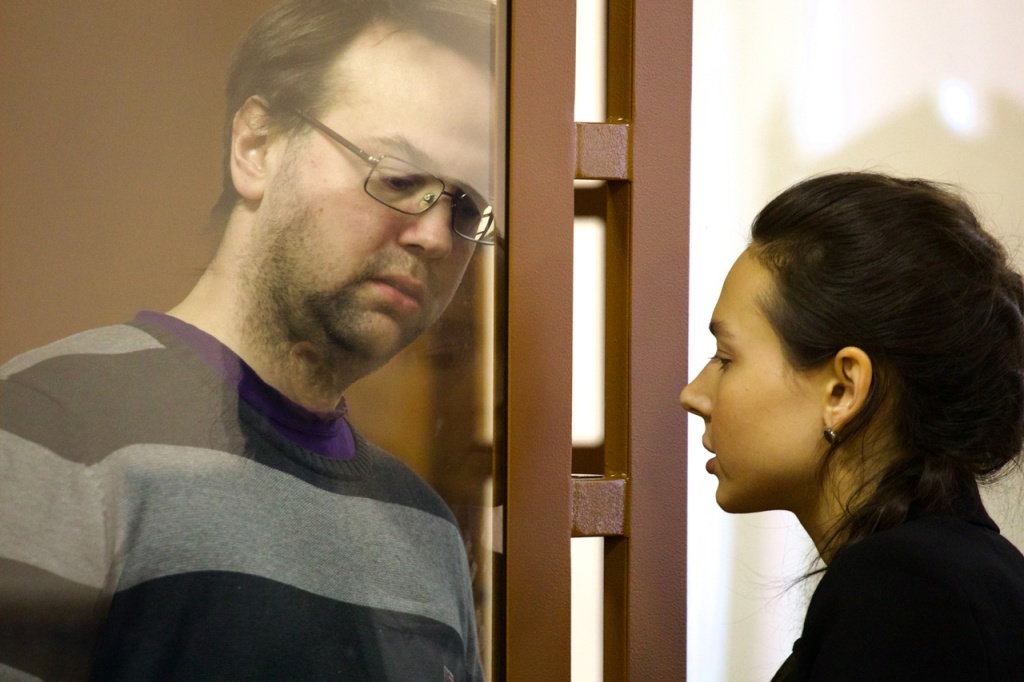
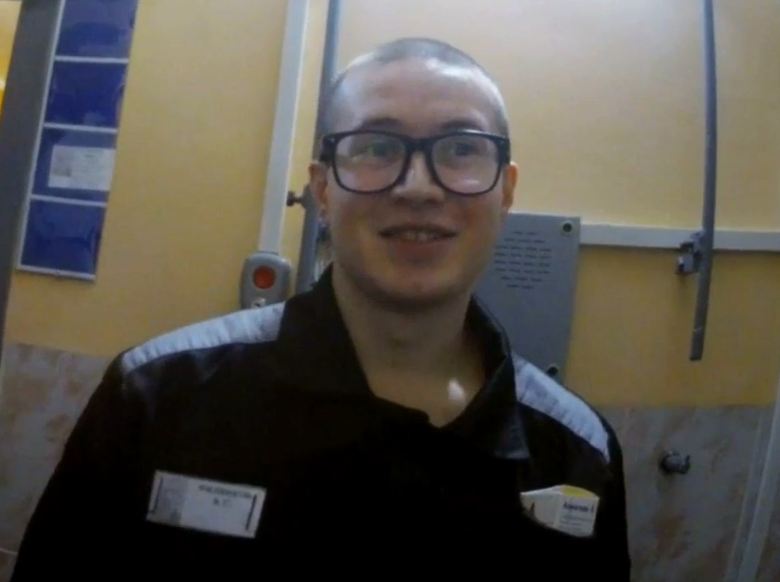
Ms. Kulakova and Mr. Filinkov met earlier today (25 March 2023), and Ms. Kulakova posted this snapshot from their meeting:
“An anti-prison coloring book for Jenya and Viktor and everyone”
Not so long ago I wrote that coloring brightens up my minutes and hours of waiting for Viktor at the penal colony. So Yana Teplitskaya has designed an entire coloring book in support of Viktor and me!!
The coloring book can be downloaded at the link below and printed out on a printer, and you can make a donation for it.
If you have a coloring maniac in your life, the book can be your New Year’s gift to them.
And if you’ve never colored, then maybe New Year’s is the time to check it out?
Download, print, and color the pages — and send us the results.
Donations for my trips to see Viktor in Orenburg should be sent to my Sberbank or Raiffeisen account via phone number 89217772541.
You can also make donations in euros [and dollars] via PayPal to abc-msk@riseup.net, [writing “Filinkov” at the “What’s this payment for?” prompt.]
Thanks.
You can and should share this post if you like.
Source: Jenya Kulakova, Facebook, 30 December 2022. Ms. Kulakova is the public defender of Viktor Filinkov, a young Kazakhstani national convicted as part of the notorious Network Case, in which the Russian Federal Security Service (FSB) tortured and framed a dozen anti-fascists in Penza and Petersburg for, allegedly, “creating a terrorist community.” I’ve published extensively on the case and its aftermath over the last five years. The wardens at the penal colony in Orenburg where Mr. Filinkov is currently serving his sentence have seemingly singled him out since his arrival there, endlessly finding him “guilty” of various (mythical) infractions and isolating him from the general population on these pretexts. With the help of Ms. Kulakova and his defense attorney, Vitaly Cherkasov, Mr. Filinkov has mounted a series of successful legal challenges against this flagrant abuse of his civil and legal rights. You can help pay for Ms. Kulakova’s frequent trips to Orenburg by donating to the PayPal account indicated, above. It is managed by the Moscow chapter of the Anarchist Black Cross and is totally reliable. I just made a donation myself and I screenshotted, below, the critical step in that process if you need help. Thank you! ||| Thomas Campbell, The Russian Reader
When you’re a real artist, you make art with whatever comes to hand. Legendary Petersburg artist Oleg Kotelnikov (a driving force behind the New Artists of Leningrad) is definitely the real thing. Here, the late Yuri “Compass” Krasev (of the necrorealists and Pop Mechanics) displays a shower curtain that Mr. Kotelnikov repurposed back in the good bad old days. Photo by the late Oleg Kuptsov, as posted on his Facebook page on 2 June 2015.
Sometimes a picture is worth more than a thousand words, as when a whole time and a place is captured in a single snapshot, as in this one taken in Petersburg by the fantastic photographer, anthropologist, photo archivist, and frequent TRR contributor Vadim F. Lurie, who posted it on his Facebook page on 3 June 2015.
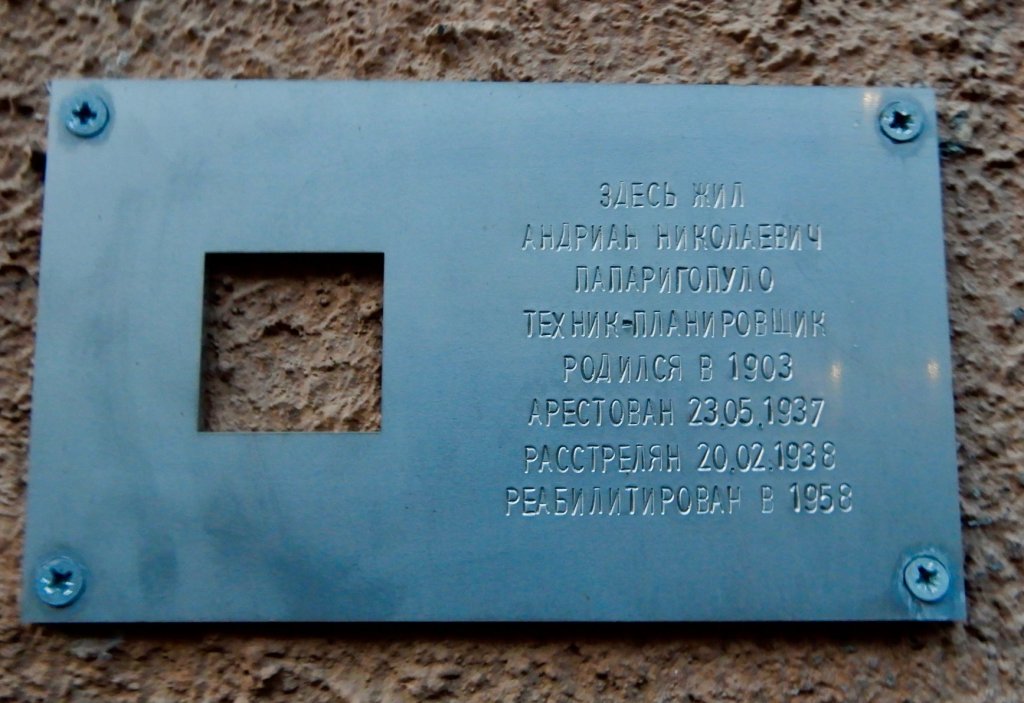
On 3 June 2019, I posted this announcement from Last Address in Petersburg: “Next Thursday, June 6, at 12 p.m., a Last Address plaque will be installed at 12th Line, No. 9, on Vasilievsky Island in Petersburg, in memory of Konstantin Andreyevich Poplavsky, who served as a seaman on the battleship Marat and worked at the Bolshevik Factory. A father of two children, he was shot by order of an NKVD troika on 28 October 1938, a few days after his 28th birthday. His great-granddaughter will install the plaque for him.”
But by way of illustrating this announcement I used a snapshot I had taken in 2018 during an inventory of Last Address plaques in my neighborhood to check on their condition. (The inventory was a citywide affair performed by numerous volunteers.) The plaque pictured above memorializes Andrian Nikolayevich Paparigopulo, whose story is told on the Last Address Foundation’s website (and duplicated on the Open List project’s website):
Andrian Nikolayevich Paparigopulo was born in Narva in 1903 to a family of hereditary nobles. His father was a retired major general who died in 1915. Andrian Nikolayevich and his mother presumably moved to Petrograd in the early 1920s. His investigative file in the archives records that in 1922 they traveled to Estonia to sell a dacha located near Narva that belonged to his mother. After the sale, they went back to Petrograd without having their passports checked at the Soviet Consulate in Reval. This was regarded as an illegal border crossing, for which Andrian Nikolayevich was consequently sentenced to three months of forced labor.
After moving to the city on the Neva, Andrian enrolled at the Institute of Technology, but failed to finish his studies. On 23 March 1935, he was arrested, and later, along with his mother Vera Nikolayevna, he was exiled to Kuibyshev for five years as a “family member of a socially dangerous element.” However, a year later, the Special Council of the NKVD canceled the expulsion order, and the family returned to Leningrad.
Andrian got a job at the Krasnyi Rabochii [Red Worker] plant as a planning technician. The Great Terror did not spare him: on 23 May 1937, he was arrested for the third time. For nine months, NKVD officers cooked up a case against him that was based on two interrogations that took place in May and September 1937. During the May interrogation, Paparigopulo denies his involvement in counter-revolutionary and espionage work. The September 28th interrogation begins on the same note. But there soon appears in the interrogation record a reference to the testimony of Georgy Kirillovich Kolychev (whom Andrian Nikolayevich mentions as an artist friend in the 1935 case file): “There is a group of artists bonded by their common counter-revolutionary beliefs who organized their c-r gatherings at Paparigopulo’s apartment.” Later in the record, Andrian Nikolayevich admits his guilt: “I have to admit that Kolychev is telling the truth… Indeed, I have been an active member of the c-r fascist group and its leader since 1933.“
According to the fabricated evidence, the group’s members included Viktor Konstantinovich Lavrovsky, Georgy Kirillovich Kolychev, Ivan Ivanovich Bogdanov, Mikhail Vasilyevich Ivanov, and Terenty Romanovich Romanov.
On 20 February 1938, a military collegium sentenced Paparigopulo to death in a closed court hearing for involvement in a “terrorist organization.” Andrian Nikolayevich did not admit his guilt at the trial, nor did he corroborate the testimony he had given, allegedly, during the preliminary investigation, calling it phony. He was shot on the day of his sentencing. He was thirty-four years old.
The list of items seized from Paparigopulo during the search of his home includes letters and photographs, as well as four tickets to the Hermitage. The confiscated correspondence was destroyed in its entirety on 13 March 1938, after Andrian Nikolayevich’s execution. His wife (whose name, like his mother’s, was Vera Nikolayevna) was sentenced to eight years in correctional labor camps as a “family member of a traitor to the Motherland.” She served her sentence in Karlag.
Andrian Paparigopulo was fully exonerated only twenty years later, in 1958.
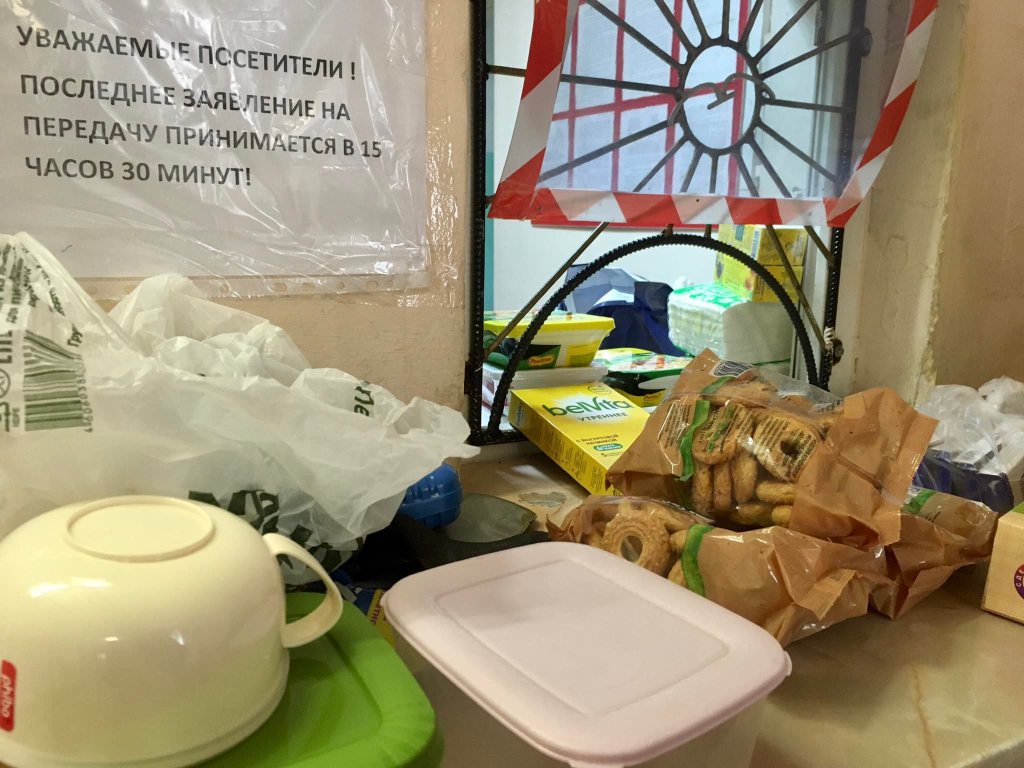
Jenya Kulakova’s photo of the care package that she and Boris Romanov’s mother Margarita delivered to the political prisoner at Pretrial Detention Center No. 6 in Gorelovo, a distant suburb of Petersburg.
Today, Boris Romanov’s mother Margarita and I went to Pretrial Detention Center No. 6 to deliver a care package to him. Borya will finally get delicious food and basic necessities. (It is very difficult to get into the prison with care packages because of the always crowded electronic queue.)
Lawyer Luiza Magomedova is also waiting for a meeting with Borya in the pretrial detention center today. The pre-registration for lawyers [to see clients] is all booked up for the next two weeks, so in the morning she queues without any guarantee that she will get in to see him.
Gorelovo is far away, and all the way there I listened to Boris’s mother’s stories about him. How he was twice elected chairman of his housing co-op, and had tried to whip the building into shape, how he had issued paperwork to the janitor and knew all the neighbors. What an impossibly principled, thrifty and honest man he was, intolerant towards even the hint of corruption in its smallest everyday manifestations. How he would not compromise and take good-paying jobs if they were pro-government. What an attentive son and caring father he was. What an educated man he was — a good simultaneous translator from German, a graduate of the European University’s history program. (Besides electronic devices, Boris’s German-language books were seized by police during the search of his mother’s flat.) How, after studying for one and a half years in Germany, he had come back home “to build a new Russia.”
But now Russia is whipping Borya into shape instead. This Russia does not need smart, honest, principled people.
Yesterday, I received my first letter from Borya, and it contained two requests to help his cellmates. When I told this to his mother, she laughed, saying that it was just like her son: he had already found a way to be helpful to someone in prison.
Source: Jenya Kulakova, Facebook, 18 May 2022. Translated by the Russian Reader
Boris Romanov with his lawyer, Luiza Magamedova. Photo: Konstantin Lenkov for Zaks.ru
Activist Boris Romanov has been remanded in custody on charges of spreading “fake news” about the Russian army (punishable under Article 207.3 Part 2 of the Criminal Code). He is the fifth person in Petersburg remanded in custody for the duration of the investigation on these charges. Romanov is accused of making harsh statements about the “special operation” during a meeting of the Svetlanovskoye municipal district council. He faces up to ten years of imprisonment. Zaks.ru has examined this new case of “fake news” about the Armed Forces.
This time round, Petersburg oppositionist Boris Romanov, who has long been known among the city’s activists, is suspected of disseminating false information. In September 2021, as part of the Yabloko party regional group, he was nominated to run for the St. Petersburg Legislative Assembly’s fifth district. In the municipal elections of 2019, he tried to run for a seat on the Svetlanovskoye municipal district council, but was refused registration. But the lack of a deputy’s mandate did not prevent him from regularly attending the council’s meetings and broadcasting them on a VKontakte community page.
There are now over 1,800 subscribers to this page. Romanov did not have good relations with the local deputies. For example, he alleged that the wife of one of them sprayed pepper spray in his face. In addition to problems in the Svetlanovskoye neighborhood, Romanov paid great attention to issues of urban development and historical preservation. In particular, he often participated in the grassroots gatherings at the Pulp and Paper Industry Research Institute building [threatened with demolition] in the city’s Vyborg district. Since the beginning of the “special military operation,” he sometimes devoted his speeches to the events in Ukraine, taking a pacifist stance. In mid-March, Romanov was detained at a protest rally near Gostiny Dvor. He was present there as a member of the St. Petersburg Human Rights Council’s monitoring group.
The Ukrainian question at a district council meeting
On May 5, the FSB’s Petersburg regional office launched a criminal investigation into dissemination of deliberately false information about deployment of the Russian Armed Forces (per Article 207.3 Part 2 of the Criminal Code). According to the security forces, a man (his name is not mentioned in the Investigative Committee’s press release) posted a video on the internet containing knowingly false information about the Armed Forces. As Zaks.ru has learned, Romanov’s alleged “criminal activity” was detected in a video recording of a Svetlanovskoye municipal district council meeting. The case file mentions eyewitness testimony. According to Luiza Magomedova, an attorney with the civil rights project Apologia of Protest, the eyewitness in question was Romanov’s neighbor and district chair Yanina Yevstafieva. In conversation with Zaks.ru, Yevstafyeva said that the security forces were interested in the council’s March 29 meeting. The council chair stated that on that day, activist Romanov came to the district offices and allegedly made what she regarded as “anti-Russian” statements.
Yevstafieva alleges that Romanov indulged in rude expressions directed at Russian servicemen. She noted that he also made an invidious comparison involving the symbols of the “special operation.”
According to her, Romanov’s speech caused a negative reaction among council members. Yevstafieva argues that such statements are unacceptable. Romanov’s statements were captured on a video posted on March 29 in the Svetlanovskoye Neighbors group page in VKontakte. After studying the recording, police investigators concluded that the activist’s words could be regarded as purveying deliberately false information about deployment of the Armed Forces, motivated by political hatred or enmity.
The topic of Romanov’s speech was probably related to statements made on March 29 by Russian deputy defense minister Alexander Fomin and Russian peace negotiator Vladimir Medinsky. After the latest round of the negotiations between the two countries [sic], the Russian officials stated that they intended to curtail military operations in the Chernihiv and Kyiv areas.
The fifth arrest in the “fake news” investigation
The police found Romanov in his apartment on the morning of May 10. The activist’s electronic devices were confiscated, as well as various informational materials. The latter, the investigators allege, may be “extremist” in nature. A couple of hours later, the security forces showed up at the apartment of Romanov’s mother, at whose address Romanov is officially registered. Her communications devices was also confiscated.
“They said that I had raised a bad son. That I should have monitored him and brought him up right,” Margarita Romanova, the defendant’s mother, said in conversation with Zaks.ru, quoting what the police had told her.
During the search, she was told that a criminal case had been opened against her son because of a speech he made during a meeting of the Svetlanovskoye municipal district council.
After the preliminary investigation, Romanov was placed in the temporary detention facility on Zakharyevskaya Street, where he spent the night awaiting his bail hearing, which took place on May 11 in Petersburg’s Vyborg District Court. Police investigators asked the court to remand the oppositionist in custody.
Judge Oksana Golovinova read out a statement by the investigators.
“The accused Romanov posted […] knowingly false information that was aimed at destabilizing the political situation in the country and arousing panic among citizens, as well as causing a negative attitude towards Russian federal authorities, thereby demonstrating his indifference to public safety.”
The prosecution argued that Romanov could attempt to destroy evidence, influence witnesses, escape from justice, and continue his alleged “criminal activities.”
Magomedova petitioned the court to impose a restraining order on her client that would ban him from doing certain things. Romanov has an underage daughter who needs her father. He is also his family’s sole breadwinner.
Judge Golovinova took Romanov’s having a child into account, but did not consider this sufficient grounds to order a milder form of pretrial restraint. But the court did not share the prosecution’s position on the likelihood of Romanov’s attempting to hide from the authorities, since his foreign travel passport had already been confiscated. After spending about an hour deliberating in her chambers, the judge remanded the activist in custody in Pretrial Detention Center No. 1 [sic] for the duration of the investigation. He will remain there at least until July 5. The activist denies any wrongdoing.
Romanov is the fifth person arrested in Petersburg on charges of spreading “fake news” about the Russian army (as punishable under Article 207.3 Part 2 of the Criminal Code). Previously, artist Alexandra [Sasha] Skochilenko, journalist Maria Ponomarenko, Peaceful Resistance member Olga Smirnova, and Victoria Petrova had been arrested. They face from five to ten years in prison. As in the case of Romanov, the criminal charges against them were most often occasioned by social media posts.
Source: Konstantin Lenkov, “From a District Council Meeting to a Pretrial Detention Center: Yet Another ‘Fake News’ about the Army Case,” Zaks.ru, 12 May 2022. Translated by the Russian Reader
I have spent half the day wandering around Orenburg on various errands. At a crossing, I saw a yellow PAZ bus, marked “Children” and with a flashing light. I thought, wow, how they take care of their children’s safety. But I didn’t look inside. But now I have just seen a column of three yellow “Children” buses with flashing lights — and it wasn’t children inside them, but soldiers.
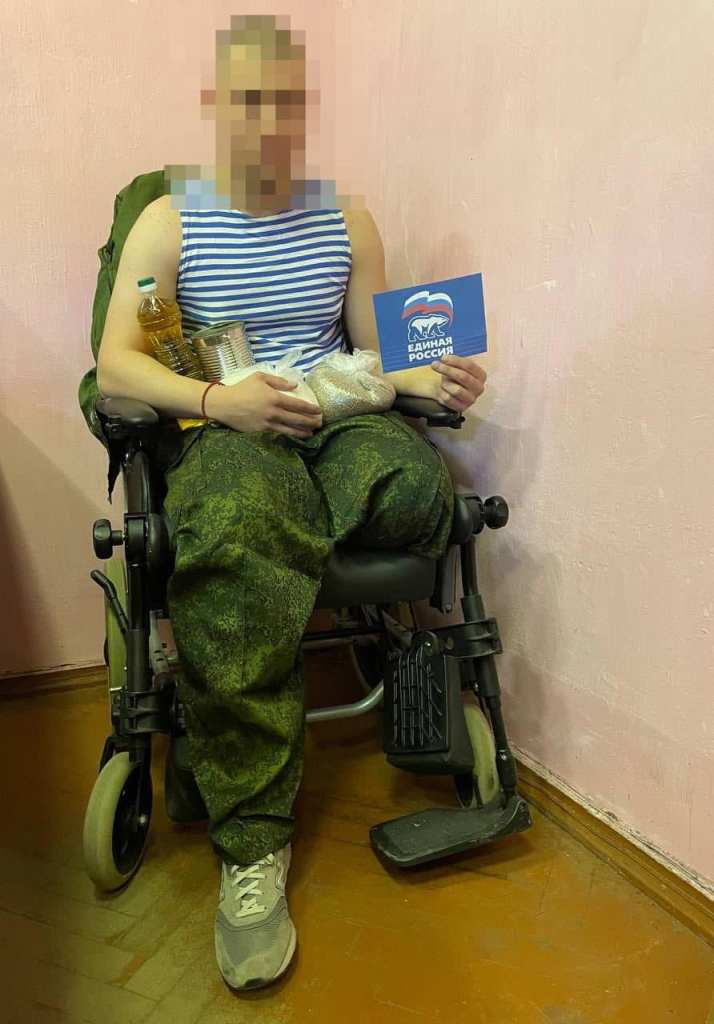
Sometimes it seems that United Russia has reached the limits of cynicism and nothing they do can surprise you. But their functionaries hand a crippled soldier a package of buckwheat and a bottle of sunflower oil, shove the party logo in his hand, and proudly post the photo. And it becomes clear that United Russia’s cynicism is a bottomless pit.
If anyone did not understand why I think that my daughter should not go to school in the Russian Federation, this is her class and homeroom teacher at a fucking Victory Day trivia competition.
Fortunately, my daughter didn’t go to school today.



 Fundraiser for continuing
  has been working selflessly on all of Vitya’s cases since the first days of his arrest, traveling several times a month between St. Petersburg and Orenburg.