To Not Die as Slaves: Solidarity Zone’s Mission to Aid Russia’s Radical Anti-War Protesters

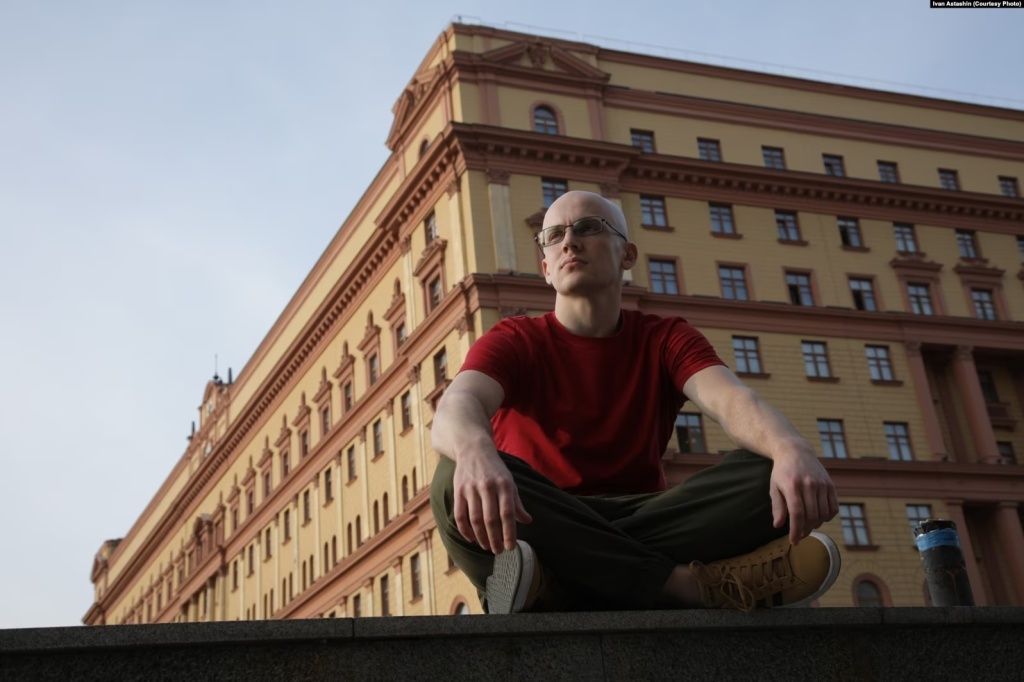
Ivan Astashin

Muscovite Ivan Astashin knows firsthand what human rights activism, Russian prisons, and terrorism and arson charges look like. As a young man, he was close to Eduard Limonov’s National Bolsheviks and was arrested as part of the high-profile Autonomous Combat Terrorist Organization (ABTO) case, in which a group of young men were charged with a series of arson and terrorist attacks.

At the turn of the 2000s and 2010s, this story was widely discussed in the media, sparking debates over whether the arson attacks were justified. Astashin was convicted of torching an FSB district office in 2012 and spent over nine years behind bars.

Upon his release, Astashin worked for Andrei Babushkin’s Committee for Civil Rights and was involved in defending the rights of prison inmates. In February 2022, Astashin joined the protests against the invasion of Ukraine and was soon forced to leave Russia.

Astashin is now involved in the campaign Solidarity Zone, which aids Russians who have been arrested for radical anti-war protests.


How did the “Solidarity Zone” come into being?

When full-scale war broke out, large protests took place in many Russian cities, and criminal charges were filed against protesters, both charges of “violence against police officers,” which have been routine at protest rallies (police officers themselves use violence, but they don’t pay for it), and charges that were newish for Russia.

There was Anastasia Levashova, who threw a Molotov cocktail at police officers. There was the case against Anton Zhuchkov and Vladimir Sergeyev: they were detained near Pushkin Square in Moscow on 6 March 2022 on their way to an anti-war rally. A Molotov cocktail was found in Sergeyev’s backpack. The police did not know what they guys were planning, so they were able to accomplish part of what they’d planned. Zhuchkov and Sergeyev had planned to commit suicide publicly at an anti-war rally as a sign of protest—they were so desperate. As they were being detained, they took lethal doses of methadone. The police failed to notice this. They put them in a paddy wagon and beat them up there, but on the way to the station the police realized that their detainees were quite sick and took them to hospital. They were saved in the intensive care unit at the Sklifosovsky Institute.

Zhuchkov and Sergeyev were sent from the intensive care unit to a pretrial detention center after being charged with “attempted disorderly conduct.” According to police investigators, the men had been planning to set fire to empty paddy wagons. When detained, Sergeyev said that they “wanted to torch a couple of paddy wagons,” emphasizing that it was empty vehicles they had intended to target. At first, we wanted to find out the address where we could write to Zhuchkov and Sergeyev at the pretrial detention center, so we asked OVD Info, but we also learned that OVD Info would not defend them, as theirs was not a peaceful protest.

We realized that none of the existing human rights organizations was willing to take on such cases. We decided to take on Zhuchkov and Sergeyev’s case: we published the address to which people could send them letters and found them a lawyer. A little later, the authorities started charging people with arson attacks on military recruitment centers, and so we decided that we should also aid such people. By September 2022, we had launched Solidarity Zone’s social media accounts and expanded our work.

Do I understand correctly that the attitude of OVD Info, Memorial, and other human rights organizations to people engaging in “non-peaceful” anti-war protests has changed? Have their motives become clearer to these human rights organizations?

Yes, their attitude has changed. As I see it, it changed after the military mobilization, when people began setting fire to military recruitment offices en masse in protest. Now it is easier to get announcements of fundraisers for such detainees reposted. But the position of human rights organizations has remained the same.

We had a public discussion with Sergei Davidis, head of Memorial’s Support for Political Prisoners project. He said these people should certainly be supported, that in most cases they have been wrongfully charged with violating Article 205 of the Russian Criminal Code (“terrorism”), but that whereas the criminal code articles on “discrediting” the army and “disseminating fake news” about the army clearly contradict Russian law and international conventions, and people charged with violating these laws can be designated political prisoners without a detailed examination of their cases, then with regard to people who attempt to torch military recruitment centers, Memorial examines the cases in detail and is guided by international criteria. They have designated twenty such people political prisoners, but the number of these cases is many times greater.

All human rights organizations have their own focus. OVD Info deals with cases related to peaceful protest; First Department, with high treason cases; and the Net Freedoms Project, with freedom of expression cases. Our cases do not fit these criteria. Before we started, there was no organization which was willing to support such people.

Is your campaign volunteer-driven? How many people are you assisting now? How do you define the people you support?

We support people who have been arrested for anti-war protests, for radical anti-war actions, although nowadays virtually all anti-war protests are radical. We handle cases where people actually set fire to a military recruitment center or a railroad signal relay box, and cases where they were merely planning to do such things.

Or they weren’t even planning to do such things, but the security services have fabricated a case against them, alleging that they were planning to torch a military recruitment center, as happened to Ivan Kudryashov.

We are currently supporting nineteen political prisoners. In almost all cases we pay their defense lawyers and organize fundraisers to this end, and in many cases we are also involved in arranging for parcels and care packages to be sent to the prisoners and replenishing their personal commissary accounts at their detention facilities. We talk publicly about their cases and similar criminal cases. We did a count in September 2023, and at that time there were around three hundred people in Russia facing criminal charges over radical anti-war protests. There was no further info on half of these people: we could not find out whether they were under arrest or wanted by the police.

We try to cover such cases as much as we can because we are a volunteer organization: we don’t get paid or have permanent funding, although we would certainly like to have such things. We raise money for political prisoners through cryptocurrency and PayPal donations. We also do personal ruble-denominated fundraisers to pay lawyers through the platform Zaodno (“In Cahoots”).

In the first quarter of 2024, we spent 900 thousand rubles (approx. 9,100 euros) paying for care packages and one-off visits by defense lawyers. When lawyers defend our prisoners in court, we organize personal fundraisers. Sometimes we hold events in Europe to raise money, and sometimes other campaigns hold events to raise money for us.

Let’s imagine that a programmer in Tver has been arrested for attempting to set fire to a military recruitment center. His relatives are scared: they are unlikely to want to do business with a volunteer campaign based in Europe. How do you reach out to those accused of anti-war protest?

Actually, we are increasingly being approached by relatives of arrestees as we are becoming famous. We are recommended in various chat rooms dealing with support for political prisoners. Often people contact OVD Info, and they suggest contacting us.
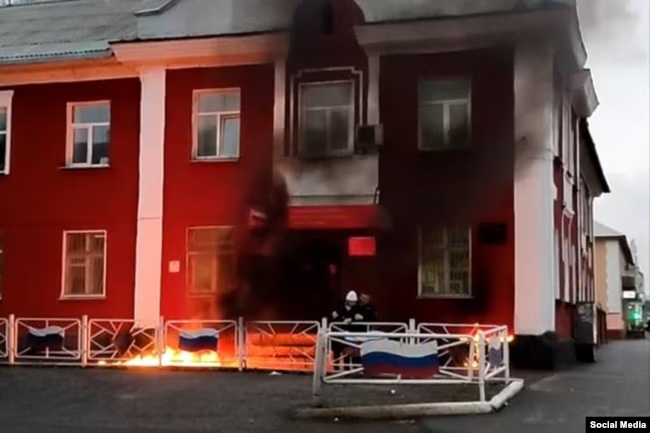
Aftermath of an arson attack on a military recruitment center in Kemerovo

We also search for information on detainees ourselves. If you have at least a first name and a surname, you can find the rest of the information in the public domain. But sometimes you cannot find out which thirty-year-old native of Voronezh has been detained. There are such case, unfortunately. Information can be obtained when a person is added to the list of “terrorists and extremists” via court filing. When a person is in the database, the locale of the pretrial detention center where they are held is identified as well. In many cities there is only one pretrial detention center, so we can dispatch a lawyer there to offer assistance to the arrestee and get their take on the case.

Some argue that publicity is not always beneficial to defendants in political criminal cases given the current conditions. Does Solidarity Zone not take this approach?

Our opinion is that publicity is beneficial in most cases. Despite everything, the security services still don’t like their lawlessness to become public. This still entails inspections, which, although they are formal procedures, are still unpleasant for them.

Publicity is a defense against torture and coercion. Also, you cannot raise money to pay a lawyer if there is no publicity. Without publicity, a person will not receive letters from supporters and well-wishers, but letters are very important. Publicity has practically no effect on the sentence nowadays, neither positively nor negatively.

So the lawyer is the prisoner’s link with the outside world? If a person ends up in this situation, they will still get a brutal sentence of ten, fifteen or twenty years or more, won’t they?

The lawyer is the only person who can visit someone in pretrial detention centers and penal colonies without limits on the number and length of visits. During the investigation phase of a case, relatives usually do not have visitation rights, especially if the individual has not pleaded guilty. So the support of a lawyer is very important.

As time goes on, this is less and less the case, but what the lawyer does can still affect the sentence. If a person has a court-appointed defense lawyer, they often tell them to agree to every deal offered by the prosecution and to sign every paper they ask them to sign, so the sentence will be shorter. Ultimately, however, the investigators and prosecutors add new charges, and the sentence is huge. But if there is a lawyer who really defends their client, they at least make sure that no new charges are filed.

A lawyer can go after the gross violations on the part of the state. Take Ivan Kudryashov: there was no evidence in his case, and so he should have been acquitted. But there are no acquittals in Russia, so he was sentenced to six years for “planning a terrorist act.” This is a short sentence by today’s standards, but his lawyer got it reduced on appeal to four years and ten months.

Although Ilya Baburin was just sentenced to twenty-five years in prison for violating six articles of the Criminal Code. For one incident—planning to torch a military recruitment center—he was charged with violating four different articles, for one and the same thing! And the lawyer could do nothing.
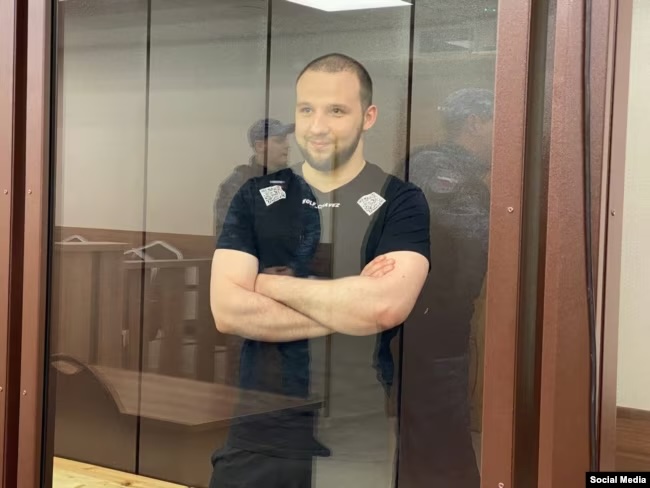
Ilya Baburin in court

There are news stories of phone scammers conning people into torching military enlistment office, of people being offered money on Telegram to torch railway signal relay boxes. Do you handle these cases?

We have been approached about such cases. Those people shouldn’t be in jail, of course. It is doubly cynical that the pensioners who were conned have also been charged with terrorism, although in terrorism cases what matters most is the person’s intent. We have limited resources, however, so we only assist people who take an anti-war stance, which is an important criterion for us.

You also have the criterion that the defendant not testify against anyone else. Whether they pleaded guilty or not doesn’t matter.

What matters is that they didn’t willingly testify against others. Anything can happen under torture.

The number of people who go down the road of torching military recruitment centers and railway relay boxes has not been decreasing, has it? Not all those who oppose the war and Putin have left the country or gone to jail, have they?

On the contrary. Whereas previously we tried to write about all arrests on such charges, we now realize that our small team cannot cover all the arrests because they occur almost daily. Often little is known about the detainees, but the news reports say that the person was on a mission for the Free Russia Legion, meaning that the person has an anti-war stance.

When a person engages in such actions, they seemingly first of all undergo an existential crisis because they live in a quasi-fascist empire that has also attacked its neighbors. Does this person want to do something even though they realize that their life may be in danger?

Yeah, that’s right. In the cases that are well known, the defendants say they wanted to do something, to take radical action by way of protesting.

In 2022, Navalny supporters were often detained for such actions, such as Igor Paskar, who threw a Molotov cocktail at an FSB building, or Vladimir Zolotarev, who set fire to a Russian National Guard building in Komsomolsk-on-Amur. People used to go to protest rallies, but then there were no more protest rallies. Another motive we can observe among such people (Zolotarev and the anarchist Alexei Rozhkov, who set fire to a military recruitment center in March 2022, spoke of it) is that they couldn’t tear themselves away from the news about Ukraine. At some point it was impossible for them to just read all of it: they had to do something as well.

When the military mobilization began, people realized that all of this was not happening somewhere far away, but could affect them. Many people realized that they would go to jail, but they went to commit arson because they thought it was better to go to jail than to go fight a criminal war. Roman Nasryev and Alexei Nuriyev were sentenced to nineteen years each for attempting to set fire to a military registration office in the Chelyabinsk Region. This phrase in Nasryev’s correspondence jumps out: “It’s time to start—or we’ll die as slaves.”

There are now people who are primed for a long-term confrontation with the military machine, for guerrilla actions, and for greater degrees of security. And if you look at the reports of sabotage, not every one leads to the capture of the perpetrators.

It is clear what could have prompted radical action in February 2022. In the autumn of 2022, it was the mobilization. But how can it be that someone tolerated the war for a long time and decides to act only now? Or are these just “guerrillas” who have avoided capture for a long time?

That is a good question, to which I have no answer. We know generally about those detained for radical protests in 2022, but there is still little data even for 2023. We can assume that some people went abroad in 2022, but had to return to Russia because they could not settle down here. Some people may not have resisted in 2022 because they hoped that everything would end quickly, but now they see that nothing ends by itself.

The case of Sergei Okrushko can be cited as an example. He is Ukrainian but has a Russian passport. In 2022, he went to Moldova, whence he wanted to enter Ukraine and work on humanitarian projects. But he was not allowed to enter Ukraine because of his Russian passport. He was forced to return to Russia. He got a job at an oil refinery (as an electrician) and set off an explosion there.

Are you also a wanted man in Russia? What are the charges?

The authorities have not yet responded to inquiries about what the criminal charges are, although my lawyer submitted a request over a month ago.


After this interview was recorded, Moscow’s Cheremushkinsky District Court published information that it had been petitioned to arrest Ivan Astashin in absentia on charges of “condoning terrorism.” Other details of the case are still unknown.

Source: Alexander Leonidovich, “Don’t Die Slaves: How Solidarity Zone Aids Anti-War Militants,” Radio Svoboda, 26 May 2024. Translated by Thomas Campbell. Thanks to Simon Pirani for the heads-up.
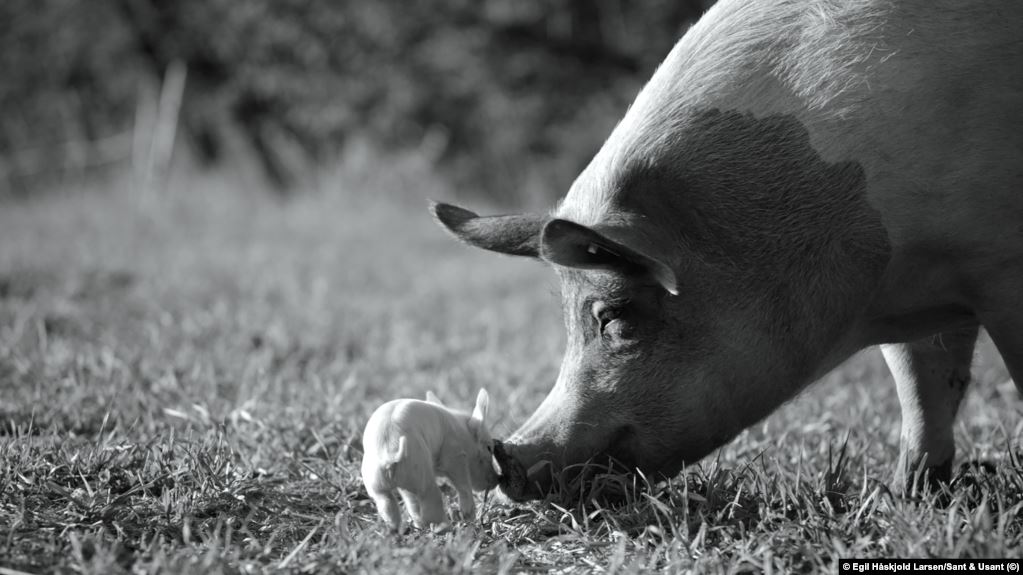
Gunda

gundaGunda and piglet. Photo courtesy of Radio Svoboda

“I Ask Animals for Forgiveness”: The Life of a Remarkable Pig
Dmitry Volchek
Radio Svoboda
March 4, 2020

Not a single human being appears on screen. We see only animals whose lives are run by people: a one-legged chicken, bulls, cows, and, as the main character, a sow named Gunda (more accurately, Günda, as her name is spelled in Norway, where she lives).

“The Russian-born director Victor Kossakovsky offers us not simply a film, but a stunning experience of life.” “A simple yet absolutely astonishing documentary picture.” “An unusual film, and a captivating poetic work of art.” That is how American and European film critics rated Victor Kossakovsky’s documentary film Gunda, which premiered at the 70th Berlin Film Festival.

One of the film’s producers was Joaquin Phoenix, who dedicated his acceptance speech at the Oscars, where he won the Best Actor prize for his role in the film Joker, to animal rights. Like Victor Kossakovsky, Phoenix sticks to a vegan diet. But Gunda isn’t simply activist cinema, urging that slaughtering animals and consuming their corpses is disgusting. Just like Kossakovsky’s previous work, Aquarela, Gunda is an innovative and impeccably made film: every frame resembles a Dürer etching.

After the film’s Berlin premiere, Victor Kossakovsky answered Radio Svoboda’s questions.

Is Gunda still alive?

— I know that art cannot save the world, unfortunately, but we did manage to save one pig.  She has become famous, and her owner said, “Now, of course, I won’t be able to kill her. Let her live as long as she’s supposed to.” Piglets live, on average, four to six months, while sows live two to three years. But now Gunda will live twenty-five to thirty years. My film saved one pig.

How did you meet her?

— That was very simple. We’d planned on about half a year for casting the animals, but I found her on the very first day, in the first minute. I arrived in Norway, dropped by my first farm, opened the door, and caught sight of Gunda. I said to the producer, “We’ve found our Meryl Streep — there she is!” The producer was in shock: “You’re probably joking. No doubt she is just a candidate.” I said, “No, we’ve found her. End of story.” It had dawned on me that I could look at her endlessly: she really was like Meryl Streep. I should say that for twenty years I could not find money for this film. In 1997, I showed my film Wednesday at the Berlinale. When I was awarded the International Federation of Film Critics Prize, a small press conference was organized for me. I was asked, “What will your next film be? What film do you dream of making?” I said, “I’d like to make a film about a pig, a cow, and a chicken.” From that time on, however, I was unable to find anyone who would agree to produce it, neither in Russia nor in any other country, until I found a Norwegian woman who took the risk. I lucked out: at last I’ve made the film that I’d wanted to make my whole life.

You mentioned Meryl Streep, but it seemed to me that, at the end, Gunda was transformed into Anna Magnani in the film Mamma Roma.

— Oh, how brilliant you are! That’s really the case. There is, of course, a turnaround at the end of the film, where she is Anna Magnani, an allusion to the film Mamma Roma. Thank you for noticing. Of course, in every film there’s a first plane, second plane, thirteenth plane — there are things that not everyone sees.

You filmed not only in Norway, but in England as well. Am I right that the cows live in different places?

— Yes, we filmed the cows in two places. The episode when they stand head to tail and help one another swat away flies with their tails we filmed in Spain, on the border with France. We filmed the main episode with cows in England, and the chickens were filmed in Wales. In England and Spain, compassionate people buy cows, chickens, and pigs from farmers who are taking the animals to the slaughterhouse and give them a second chance. Ordinary private citizens living in country homes buy cows and say, “There’s grass all around, live here as long as you like.” For that reason, those animals are so friendly: they weren’t afraid of the camera. A huge two-meter-high bull allowed us to walk right up to him. The chickens had never been outside: they’d been born and had stood, twenty to a cage, their whole lives. We found people who bought those cages and let out the chickens. It turned out that when the door was opened, the chickens would not come out for an entire hour. They didn’t know that it was possible to go out: they’d lived their whole lives in a cage, cramped, never once in their lives spreading their wings, never once in their lives catching sight of the sky. When they came out, they were even afraid of stepping on the grass, as if it were boiling water. They lifted their feet off the grass as if they’d been scalded. And those cows had never been outdoors. They didn’t even know that they should eat the grass: they went out and just sniffed it The bull walked up to a tree and only sniffed the leaves. How intoxicatingly beautiful it was when those cows began to dance and jump! Those chickens were shocked by their freedom: they looked around, not understanding where they were, and reacting to every sound. They opened their wings for the first time in their lives and then looked at themselves: how could this be?

I know that cinema won’t change the world, but I made a movie in order to say to animals, “Forgive me for not being able to do anything.” At least we saved one sow from being consumed. In my movie, for example, there’s a cow who is twenty-two years old. Have you ever seen a twenty-two-year-old cow? Cows are killed as soon as they stop producing enough milk. But in my film the cow lives. You look at her face, and you can see fate in her eyes. She’s a grandmother of sorts, even a great-grandmother. We permit ourselves not to think about the fact that we’re murderers. We allow ourselves to forget it.

_______________________

Victor Kossakovsky

The filmmaker Victor Kossakovsky was born in Leningrad in 1961. He lives in Berlin. His documentary films include Losev (1989), Wednesday 7/19/61 (1997), Quiet! (2002), and Long Live the Antipodes! (2011). He is a winner of the Triumph (1997) and Nika (1998) Russian film prizes, and of numerous international film festival awards. In 2019, his film Aquarela was shortlisted along with fourteen other films for the Academy Award for Documentary Feature.

“As a documentary filmmaker, I probably bear some responsibility for not shooting something about Russia, but it seems to me that there are more problems on earth. Because the very fact that there is Putin, the very fact that there is war, speaks to the point that something about us as biological creatures is not right. If Russians are fighting Ukrainians, something about us, not about Russians and Ukrainians, but about humankind, is wrong. So, I want to understand what this creature — man — is, and what his place on earth is.”

Source: Interview with Radio Liberty (2018)

_______________________

The festival catalogue said that everyone who saw your film would stop eating meat.

— Even the smartest people, even the most distinguished artists who’ve seen the picture, hugged me afterward while ordering hamburgers and citing the notion that, all the same, everything in nature is founded on the struggle for survival. We’ve been living for several centuries in the era of humanism. Many things helped us get rid of slavery, racism, and cannibalism. Now we’re starting to recognize the rights of people with untraditional sexual orientations.

It wasn’t so long ago, after all, that suffragettes were thrown in prison for demanding that women be given the right to vote.

— In my country, there was serfdom 150 years ago. Seventy years ago here, in Germany, and in my country, millions of people were murdered. We are unbelievably aggressive, we have to admit that. Our awareness lags behind our intellect. We’re capable of inventing cars, computers, cinema, rockets, Novichok, and atom bombs, and yet we’re incapable of understanding that killing is wrong. Killing not only people, but killing per se is wrong. But we’ve learned to block that out. Every one of us knows that at dinner, breakfast and supper, we’re consuming the meat of murdered creatures, but we allow ourselves not to think about that, we simply block it out. We know that murder exists, but we’ve come to an agreement that is doesn’t exist. Basically, murder is bad, but in the given instance, as far as dinner goes, it’s okay. That is, we split our intellect and our awareness. So, I wanted to title this film “My Apology.” I’m making an apology to animals for not being able to change the world. I can’t even convince my closest friends that this is crazy. Even the most distinguished cultural figures say to me, “It’s the law of nature.” Even they live with blinders on. They don’t really know the laws of nature: they’ve been told that predators are aggressive. They don’t know that animals are capable of self-sacrifice, love, and mutual aid. They don’t know that, but I do know it. I’ve seen it.

People live inside myths and justify their own ugliness and irrationality. Their hardheartedness is justified by the claim that supposed laws of nature exist allowing the strongest to kill the weak. They don’t exist — it’s a myth. In nature, there’s so much beauty that we’ve never even dreamed of. Every animal is capable of decency. It’s time for us, too, to remember it. Everyone knows that dogs and cats are intelligent animals. Everyone knows that your dog loves you. Everyone knows that it shares your emotions with you, that it’s ready to help you when you’re feeling bad. The same is true of cows, chickens, and pigs. They also have feelings, they are also intelligent, and they also have compassion. They’re ready to sacrifice themselves. But here we have the British Parliament, under pressure from farmers, passing a law that it’s supposedly okay to kill animals because they don’t feel pain. It’s not only our government of imbeciles. No, the willfully unseeing are everywhere.

_______________________

Joaquin Phoenix on Gunda:

“Gunda is a mesmerizing perspective on sentience within animal species, normally — and perhaps purposely — hidden from our view. Displays of pride and reverence, amusement and bliss at a pig’s inquisitive young; her panic, despair and utter defeat in the face of cruel trickery, are validations of just how similarly all species react and cope with events in our respective lives. Victor Kossakovsky has crafted a visceral meditation on existence that transcends the normal barriers that separate species. It is a film of profound importance and artistry.”

_______________________

— At a meeting with young filmmakers, you spoke about the fact that you’re outraged by Putin’s decision to sign the law on hunting captive animals.

— Yes, he has legalized the very basest thing that man can do. I would recommend that all of our women living with men who go and hunt captive animals refuse to have sex with them. They’ll come home from hunting animals in captivity and show photographs of how they killed a bear, and their wives will say to them, “Pardon me, dear, go live with the bears.” That’s the most shameful thing one can do — chase animals into an enclosure and shoot them dead point-blank using a carbine with an optical sight. Leonardo da Vinci said five hundred years ago that killing a human and killing an animal were one and the same thing. A hundred years ago, Tolstoy urged us to come to our senses, but we sign a law on hunting captive animals! Where are we headed, friends, where is our country being dragged? It’s being dragged into an ignorant, loathsome past, a vulgarian past armed with a carbine.

— In your movie there’s not a single human word, but the grunting of Gunda and her piglets seems like speech, music even.

— We recorded several times more quickly than usual, and then we looked at the diagram. We laid out these sounds and found that the cows have approximately 270 words, while the pigs have about 300 different words. They pronounce 300 words! That’s only what we managed to do with our technology. That’s not just one “moo”: our ears can’t perceive them in any other way, but these are various “moos.” An animal’s children react differently to her voice. We are blind and deaf. We simply don’t want to know that they suffer. Think for yourself. We live on this planet together. There are now twenty billion chickens on earth. We kill fifty billion animals a year.

— Then the other half are discarded because they weren’t eaten.

— There are one billion pigs on the planet right now, and we will kill them. They can live up to twenty years. There are one and a half billion cows, and we will kill one third of them this year. We’ll kill all of them, freeze them, and transport them on ships from Argentina, from Brazil. On average, each person eats 100 kilograms of meat [a year] – in Europe slightly less, in America slightly more. Look at what’s happening: there are seven billion of us, and each of us eats 100 kilograms of meat [a year]. Just think about the kinds of numbers I’m talking about. It’s a killing machine. You also have to have slaughterhouses and processing plants. You have to get rid of the waste. You have to freeze, transport, saw up, chop up, freeze, pack up, and sell the meat.

— Industrial animal husbandry is the same kind of system as the Gulag.

— And it’s causing huge pollution to the planet. Why do we think that they’re made differently from us, that we’re so privileged? To save our hearts we use pig organs. And yet we think that we suffer more than they do.

— There’s not a single human being in your film. Only in the final shot do humans appear, in the shape of a beastly iron machine.  Why did you exclude all people from the picture?

— Many films have been made on this topic. Many attempts have been made to capture the slaughterhouse, the blood. It doesn’t work. There’s a good documentary film on the subject, Our Daily Bread. There have been several artistically serious films, but they changed nothing about people’s lives. I thought that I needed to come at it from another direction completely. I tried to do it in such a way that people would see animals as they are, and not as we perceive them. I filmed them at such a distance in order to give them full freedom. And it’s not me who approached Gunda, but she who approached me. That’s a very important point. When they took her children away from her, she came up to me and looked right into my eyes, because there was no one else for her to talk to. She was left alone, suffered for fifteen minutes, and in the end came up to me. Basically, she said to me, “What are you all doing to me?” Then she turned away, glancing at me from afar: “What’s the point in talking to you?” And she walked away. That’s how empty we people are — even a pig could say that to us.

— How did you arrive at veganism?

— It was simple. At the age of four years, I found myself by chance in a small village where there was a pig. It was a cold winter. The pig was left alone, but its two-week-old piglet was brought into the house, and a little pen was made for him. When everyone left for work, he and I ran would run around the house, and afterward we would put things back together: I took the floor rug by one end, and he took the other with his teeth, and we straightened it out. He was the dearest creature to me: he loved me, and I loved him. He understood me and didn’t just run after me. He played with me, and I played with him. I worried about him, and he worried about me. When they slaughtered him, it was the end of the world for me. I couldn’t understand how my relatives could kill my best friend.

My mother later said, “Where does all this come from in you? What is this nonsense in your head? That’s the way the world is made, that one eats another.” I said, “Mama, you taught me this yourself.” One of my earliest memories from childhood was the two us walking down the street. It was a beautiful summer, and I tore a leaf off a bush. I looked at the light, at the setting sun. And I said to my mother, “Look, what a beautiful leaf.” She said, “Tear out one of your own tiny hairs. Does it hurt?” – “It hurts.” – “That’s how the bush hurt, too, when you tore off this leaf.” My mom had given me this immunity. Remember what Dostoevsky said: “I cannot understand how it’s possible to pass by a tree, see it, and not be happy, not feel happiness.” How is it possible not to be happy, seeing this improbably beautiful world? How is it possible to build bombs and frighten other people, instead of thanking your lucky stars that you were born? How is it possible to cut down trees instead of planting them? How is it possible to kill animals instead of giving them freedom and leaving them alone? We should just forget about them, leave them alone and not kill them. After all, they don’t take our children from us. They don’t put us in cages. Look, my pig spends most of its time digging in the dirt. But in point of fact, ninety-nine percent of pigs are born in small cages set on cement floors, and are never able, during their short lives, to root around in the dirt.

What do we do? We only yell: hey, people, what about human rights? Fine, human rights we’ve already grasped. What’s next? There’s no slavery. What’s next? We’re not murdering millions. What’s next? We recognize [the rights of] gays. What’s next? The next step is recognizing that animals have the same rights as we do to live in this world. The next step is admitting that we can choose not to kill.

— And we can get by perfectly well without meat.

— Look at the horse: it’s stronger than you are.

— Look at the elephant!

— The elephant is a hundred times stronger than you are, and it’s a vegetarian. My friends, what are these idiotic ideas you tell me, that, in order for me to work in a slaughterhouse, I need to eat a pig? You don’t need to eat a pig. I can only repeat what Tolstoy said: “Killing a human or killing an animal: it’s the same act of murder.” We live as creatures who allow themselves to kill — that’s the main thing. And we won’t budge forward an inch until we understand that.

Thanks to Dmitry Kalugin and Alexander Markov for the heads-up. Translated by Mary Rees

Dirty Linen

burdenkoBurdenko Neurosurgery Institute in Moscow. Photo courtesy of TASS and  Current Time

Moscow Doctor Summoned to Prosecutor’s Office over Interview on Shortage of Protective Equipment
OVD Info
April 7, 2020

The Agora International Human Rights Group has reported on the Telegram channel Coronavirus Legal Aid Headquarters that the Tverskaya Inter-District Prosecutor’s Office has launched a probe of the Burdenko Neurosurgery Institute.

The probe was prompted by a interview, published on the website Current Time, in which Vsevolod Shurkhay, a neurosurgeon at the institute, said that doctors lacked personal protection equipment. As part of the probe, Shurkhay himself was summoned to the prosecutor’s office for questioning.

Entitled “One Mercury Thermometer for Forty People, and House Calls Without Protection: Russian Doctors Talk About Lack of Protection Against Coronavirus,” the article was published on March 24.  In the interview, Shurkhay discusses the shortage of face respirators for doctors in his department and UV lamps for air purification. In addition, according to Shurkhay, doctors in the department were asked to take their own temperature and issued a single mercury thermometer for forty employees.

According to Current Time, Shurkhay sent a written request to institute management, asking them to solve the problem, but they advised him not to “escalate” the situation. It was then that the doctor contacted supervisory bodies and journalists.

According to Agora’s legal aid headquarters, on March 25, Shurkhay was asked by the institute’s head physician to give a written explanation for the Current Time article. The human rights organization writes that Shurkhay was given to understand he could be dismissed for washing the institute’s “dirty linen” in public and reproached for immediately contacting the media.

Translated by the Russian Reader. You can read all my posts about the coronavirus epidemic in Russia here.

Fatherlandish

I am going to break an unwritten rule today and publish a long videotaped interview with the Russian independent trade union organizer Dmitry Kozhnev without providing a translation in English.

Over the years, I have spent a lot of time covering the struggles of Russia’s independent trade unions, as well as the abuses of labor rights in the country and the grassroots pushback against these abuses.

I was alerted to the interview by my friend Comrade Moose who, when he posted it on Facebook, wrote that it was “perfect.”

I agree with him completely. Kozhnev provides an ideal primer on why we need trade and labor unions, and how to organize them into effective tools for advancing the interests of workers, not only in Russia, but anywhere else in the world.

In fact, the conversation between Kozhnev and his engaged, smart interviewer on the YouTube channel Station Marx is so exemplary of the other Russians and other Russias to whom I have been trying to give a voice to on this blog and its predecessor for the last twelve and half years, I would urge my readers who teach high school and university students Russian language, history, culture, and current events to use the interview to look at subjects such as labor rights and the fight to protect the interests of workers in Russia and elsewhere, and grassroots political and social movements in Russia today.

Station Marx‘s annotation to the video, which I have translated, includes a long list of the websites run by Russia’s independent trade unions and other good stuff. Maybe it would be worth your time and that of your students to take a break from Tolstoevsky and “There is no Russia without Putin” to see what some real Russians have been doing against incredible odds.

Sooner or later, the other Russias and the other Russians who exist in the subjunctive mood in this interview and on my blog will win the day. Why don’t we get to know them now? In a few years or so, they will be running Russia, while Putin and his gang of criminals will be rotting behind bars, utterly forgotten. {TRR}

Why Do Trade Unions Not Work in Russia? Dmitry Kozhnev
STATION MARX
March 15, 2019

Our guest today, Dmitry Kozhnev, is an activist with the Confederation of Labor of Russia (KTR), a trade union organizer with MPRA and Novoprof, and a member of the Marxist group Workers Platform. He came by for a cup to coffee and talked about Alexei Navalny’s program for a new-model trade union, the problems of the trade union movement, and how strikes are organized.

Our videos are made possible only through your support. You can donate money to us via:

Russia’s independent trade unions and other labor organizations:
Subscribe to Station Marx’s websites and channels:

Alexei Gaskarov: What Politics?

Alexei Gaskarov: Many People Ask Whether I Am Going to Take up Politics. But What Politics Are There Nowadays?
Olesya Gerasimenko
Snob
November 1, 2016

Anti-fascist Alexei Gaskarov has been released from prison after serving three and a half years in prison for alleged involvement in the Bolotyana Square riot in Moscow in 2012. Snob asked Kommersant special correspondent Olesya Gerasimenko to meet with Gaskarov to discuss the Bolotnaya Square case, life and education in the penal colony, and the death of the protest movement. 

Alexei Gaskarov. Photo courtesy of Tanya Hesso/Snob

“Why would they ask me about organizing a riot if they knew no one organized it?”

Was your trial fair?

I regret we agreed to be involved in it. Like Soviet political prisoners, we should have stood with our backs turned and kept our mouths shut, and not treated it as an attempt to get at the truth. I had illusions after Khimki. [In 2010, Gaskarov was arrested and charged with attacking the Khimki town hall during a protest in defense of Khimki Forest, but the court acquitted him. — Snob] Several videos showed clearly that the incidents involving me happened before the riot kicked off, according to police investigators themselves. In the end, I ticked off the evidence, the judge nodded her head, but there was no reaction. The entire trial looked as if the decision had already been made, the sentence written out, and let’s get this over as quickly as possible.

So did you push a policeman and pull a soldier out of the police cordon?

I never denied it from the get-go. A year had passed since the rally on Bolotnaya Square. I was working on an important project. I had a week to go, and it was uncool to have to go to jail. I had to go to work on the Sunday the cops came for me. I had gone to the shop to buy food for the cat, and the whole clown show was waiting outside my building: two jeeps and a van. Young dudes half dressed like boneheads stepped out of the van. I decided they were from BORN [a group of radical right-wing nationalists who carried out a series of murders and assaults — Snob]. I was pondering what moves to make, but they produced their IDs.

Did you feel relieved?

No, just the opposite. I could have run from BORN or done something else. So they detained me and kept mum about what the charges were for a long while. They made me lie face down in the van and  the whole works. There were lots of things they could have detained me for. We had been defending the tenants of the Moscow Silk (Mosshyolk) dormitories from eviction and the Tsagov Forest in Zhukovsky from logging by developers. And shortly before my arrest, people who are now serving in the Azov Battalion attempted to assault my wife and me. I tussled with them, and it ended up on camera. So there were different possibilities. I was not thinking about Bolotnaya at all. When it finally became clear why I had been detained, I stared at them.  It was total rubbish. I told them I agreed to admit what I had done. We had been walking amid the crowd, when a riot cop attacked this dude. A dogpile ensued, and people pulled them apart. I was accused of pulling a policeman’s leg. The evidence was a poor quality video and a forensic report that concluded it was not me. But I knew it was me. So I told them right away, Guys, let’s do this the right way. But they could not have cared less whether I admitted my guilt or not. It would have been a different story if I had confessed to violating Article 212 of the Criminal Code (organizing a riot) or testified against someone else.

Were you asked?

They didn’t even mention it. Why would they ask me about organizing a riot if they know no one had organized it, including from their own wiretaps? They kept the charges to the incident with the leg pulling. Then they found a second incident. A stampede started in front of the police line. People were falling on the ground, and I tugged one policeman by the shoulder to make room. The indictment said I had broken the police line so that everyone could get to the riot. But this line had been at the passage in the other direction.

OIesya Gerasimenko and Alexei Gaskarov. Photo courtesy of Tanya Hesso/Snob

Did you expect such a sentence?

They had already told me at the Investigative Committee they were going send me down. I said, Well, of course. Later, the Center “E” guys showed up and threatened me with ten years in prison, but I know that could not happen. The rules of the game are still followed, and punishment for a particular crime is usually consistent with ordinary practice.

How do you feel about the case of Udaltsov and his associates?

I have very negative feelings about it, of course. I ran into [Leonid] Razvozzhayev in the pre-trial detention facility, but I wasn’t really able to chat with him, because he was always in very bad shape. Udaltsov and his associates operated like real con men. Before May 6, 2012, they had no clue how the march would go, and there is no mention of sitdown strikes and rushing police lines in the wiretaps. But after everything had happened on Bolotnaya, they began acting in their meetings with Targamadze as if everything had gone according to their plans. Their initial excuse, that they had traveled to Georgia to talk about wine and mineral water, was pure idiocy. Naturally, it is not against the law to have meetings and discuss business. But there is a political ethic that does not let you behave this way. You go meet dudes from the government of another country, a country with whom [your country] recently had a conflict. You ask for money, and you take money. If these meetings had not taken place, the Kremlin would have failed to generate the image of the Bolotnaya Square case that it did. We should not have had to answer for things over which we had no control. The benefits to Udaltsov were personal, but everyone shared the risks.

So you received no money from Givi Targamadze?

Are you kidding? What money?

Who was the anonymous anarchist informer who testifed against you?

I didn’t even find out. I have had nothing to do with them for many years. The guys still have their little movement. Like Tolkien fans, they attend meetings and discuss for hours on end how they should make a revolution. They have been doing this for the last twenty years. It was of no interest to anyone. The FSB sent its people in. They went and had a look at it and said, Well okay, you have a cool club. When Center “E” was established, they went after them big time to push up their arrest stats. All anarchist meetings are open, anyone can come. So they are known to the authorities. The teenager from this scene who went to Bolotnaya and was involved in breaking through police lines was identified in this way. They put the squeeze on him: either we send you down or you tell us what we want to hear. I have no idea why this was necessary, because he just said I was a bad dude and the leader of the anti-fascists and anarchists. But nobody charged me with that.

“The rules of survival are simple: don’t do anyone harm”

Alexei Gaskarov. Photo courtesy of Tanya Hesso/Snob


Tell me about life in prison. Everyone is interested in that. You know, reveille at six, lights out at ten.

Yeah. As you understand, people who are drug addicts, people going through withdrawal, basically live at night. After lights out, they either smoke or brew chifir [a super strong tea brewed in Russian prisons]. You just set that aside. You have your routine, and basically it is good for you. No one limits the amount of exercise you do: there is a horizontal bar, parallel bars, and a few weights. You are either working or busy with your own things. I got into shape there like I never have before. The point is to come up with as many things to do as possible so you have no spare time at all.

What did you read?

The library there was okay, because everyone who does time gets books and then leaves them behind. They see who has been nominated for the Booker Prize and order their books. It’s not hard to find new releases in prison. I also subscribed to several pro-Kremlin publications, and I read lots of your articles, too. And I read The New Times and Novaya Gazeta. I wanted different viewpoints. Plus, there is a legal video link in there. It is limited to fifteen minutes a day, but in fact nobody keeps track of the time.

Who were your cellmates? 

I spent half my sentence in a pre-trial detention facility. The dudes in there had been charged under Article 228 of the Criminal Code [purchase, storage, production, and sale of narcotics — Snob]. Their stories were horrible. One group of teenagers had gotten hash in the mail from Holland, and they had been sentenced to fifteen years in prison. Or there were the dudes who decided to cook amphetamine using a recipe they found on the Internet. They got nineteen years in prison. I was even ashamed to explain what my case was about, because I was surrounded by people facing over ten years in prison.  When the trial began, we were kept in Butyrka Prison. They were thieves, crazies, teenagers, street kids, and Dagestanis in there. I also met defendants in the Rosoboronexport case, the APEC Summit case, and the Sochi Olympics case, and I went to the gym with Alexander Emelianenko.

The general population at the penal colony consisted of three hundred men. Eighty percent of them were local dudes from Tula Region who had attacked somebody while drunk, stolen things from dachas, and committed petty robberies. But what is the catch about the general population? That a homeless man who broke into someone else’s dacha to spend the winter got sent down to the penal colony, and his life there is better than on the outside, and he is in the same place as a big-shot businessman who has lost a billion rubles and used to go sailing on his yacht on the outside.

Does this lead to lots of conflicts?

There are lots of conflicts, but the instigator always takes the rap for a fight. That doesn’t mean there are no fights. They are criminals, after all, and they tend to take risks. But the rules of survival are simple: don’t do anyone harm. If you watch TV after lights out, turn down the sound. Don’t drag in dirt. It’s all basic.

Alexei Gaskarov. Photo courtesy of Tanya Hesso/Snob

Was it easy for you to understand them?

Yeah. In 2010, I was in a pre-trial detention facility with repeat offenders and learned the tricks. And during my early days in the penal colony I read Shalamov and Solzhenitsyn’s stories about the prison camps.

Like a set of rules?

Yes. The Center “E” officer who led the investigation in my case told me a lot and advised me what books to read. When I was on the inside, people asked my advice on how to behave.

When you got out you said the main thing had been to maintain contact with reality and your health. How did you maintain your health? Was the food there okay?

Due to the fact that support from the outside was good, I almost never ate in the cafeteria.

But what about hot meals?

There is a microwave there. The Federal Penitentiary Service (FSIN) now has taken the approach of not keeping you from improving your living conditions. They need to implement their strategy for improving conditions in the penal colonies, but their budget has been trimmed. When you arrive, everything is crappy. Water is dripping from the ceilings, and there is mold. But they don’t mind if you want to invest your own resources. You write everything up as humanitarian aid, and you get electric kettles and microwaves. We had a projector hanging in our cell for watching films.

Now everyone will want to roll back two years to read books and watch films on a projector.

We also purchased a bunch of armchairs from IKEA. So when the head office comes to make an inspection, they show them how cool everything is in their colony.

I think you wanted to get another degree in prison.

Unfortunately, it turned out the university with which the colony collaborates is just a degree mill that sells them for money. I did something else there. At work, I would often teach the basics of entrepreneurship and planning. There were people doing time in the colony with whom it was interesting to talk, bank chairmen and ministry officials. There was a space, an evening school. I brought around fifty people together and asked the wardens permission to run something like seminars. Everyone had to come up with his own project, and over eight months (my sentence was coming to an end) we would try and whip it into shape, with a business plan as the outcome. At first, they turned me down outright, saying I was in for the Bolotnaya Square case and would lead political discussions. But then there was a change in management at the penal colony, and they met us halfway. It was like a little piece of the outside world.

Generally, of course, the colony’s disciplinary and educational function has been tapped out. There are no resources. The majority of guys in there do not have the most basic skills. They cannot write a letter, but there is no one there at all to educate them. There is this option of watching films on the weekends. They show this rubbish, total nonsense. I went to the wardens and said, Let’s make a selection of good films; we can watch ordinary films in our cells. But they could not even decide to do that. They get their action plans from the head office, where the theorists work. They say, Let’s hold a sports day, even though athletic clothing is prohibited in the general population.

“They aren’t winning this game by turning to crackdowns”

Olesya Gerasimenko and Alexei Gaskarov. Photo courtesy of Tanya Hesso/Snob

While you were away, the Khimki Forest was cut down. The Moscow Silk tenants were evicted. Anti-fascists fell out over Ukraine. Many of the people who rallied on Bolotnaya have emigrated. When you all; were being arrested one by one, everyone said it would be the case of the century, that everyone would close ranks because of you and for your sake, but ultimately you have got out of prison, the Bolotnaya Square case is still underway, and there is no longer any interest in it. Maybe you went to prison for nothing?

What does that mean, “nothing”? I had no choice. It’s good that the anti-fascist thing is no longer on the front burner. Nowadays, there are no more clashes with neo-Nazis, who were killing people in the early 2000s. Back then, they really needed a counterweight. Our job was to point out the problem and make things decent on the streets. We succeeded in doing this. But the anti-fascist movement cannot defeat xenophobia in society.

What do you think about the split among anti-fascists, that one group went to Kiev, while the other went to Donbass? They were at each other’s throats.

I always assumed that very different people joined the anti-fascist movement, and that was fine. There were aspects that just did not make sense to me. For example, why were European leftists strutting their stuff in Donbass? It looks as if they were totally conned.

As for Bolotnaya, choosing to be involved in this movement was fraught with risks. If we draw an analogy with Ukraine (although many people don’t like to do this), I don’t think that if the events on Bolotnaya had gone further those people would have balked at shooting the crowd. A bunch of people were killed in Kiev, while here in Moscow we were supposed to be scared off by prison sentences. They randomly picked a group of people and put them in prison. The rationale is clear. Whoever you are, if you oppose the tsar, you will suffer. How can we respond to this? We have to debunk the myth that such crackdowns are effective.

But that is what happened. Everyone really was afraid of being hit once with a truncheon, to say nothing of prison. Many members of the opposition have said the fight against the regime is not a worth a centimeter of their personal comfort. You are practically the only who does not think this way. Don’t you feel lonely?

Most people haven’t been to prison, and they really imagine it is the end of world. If I go to prison, I can kiss my life goodbye, they think. I just dealt with it more or less normally. But this is how I see it. When the authorities crack down on dissent, people lower their level of activism. They lose the desire to invest themselves in something. Ultimately, the system falls apart, rather than becoming more stable, as the authorities imagine. The country becomes less competitive. In prison, I saw many people who were doing time for economic crimes, and they all said approximately the same thing. People who have satisfied their material needs develop political demands, and that is fine. Everyone wants to be involved in changing things. When this desire for change is blocked, they are blocking the segment of society that generates the most added value. They aren’t winning this game by turning to crackdowns. Especially because the system is not as terrible as it makes itself out to be.

But people need to remain minimally active. It is too bad that many people have chosen the passive way. I have just got out, and it really seems to me that a lot has changed, even in Moscow itself. Although, theoretically, I saw it all ten years ago, only in Europe. We can live this way a long time. Hence the complexity of the political arguments around Bolotnaya. Given the resources we have have, we could live better, but the way things are also suits lots of people. In this case, the system can survive for a long while. We should not get involved in direct confrontations. This was clear to me on Bolotnaya Square as well. We wanted to get the hell out of there, because it was obvious the sitdown strikes and so on were just what the authorities wanted. But there are other ways of doing things. We don’t have to limit ourselves to demonstrations and rallies.

Alexei Gaskarov. Photo courtesy of Tanya Hesso/Snob

What ways?

There are the demands made at Bolotnaya—fair elections and the transfer of power—but there is the option of engaging in specific targeted campaigns in order to develop one’s ideas under the existing regime.

You mean the theory of small deeds?

Among other things. For example, I read that many Bolotnaya activists have gone into charity work. In fact, that is not so bad. What matters is maintaining the energy. Or there is the successful fight against corruption, all those publications that impact the system, whatever you say. Or there are people in the leftist milieu who think there should be progressive taxation: they can also advance their arguments. Or form an anti-war movement given all the conflicts underway.

In prison, I realized how strongly the regime affects people’s brains. There are people who show up there who are not inclined to heavy discussions. Real peasants. All the myths that exist are in their heads. But when you are around them, you don’t even have to argue. Even the most impenetrable guys would change their minds just as a result of conversation. So any work aimed at disseminating information and minimal education is vital.

What did you change their minds about?

A variety of things, including their overall attitude to the opposition. In the beginning, it was even convenient for me, like there were only drug addicts at Bolotnaya, that they all had gone there to score heroin, and everybody would leave me alone [after I would say that]. But over time people see what you read, what films you watch on the Culture channel, that you can help draft a court appeal, and they understand you are not an idiot and would not have gone to a protest rally for a dose of heroin. There were lots of conflicts over Ukraine, especially because there were many people doing time who had managed to fight in Donbas, come back to Russia, and get sent to prison.

Olesya Gerasimenko and Alexei Gaskarov. Photo courtesy of Tanya Hesso/Snob

For what?

Disorderly conduct, theft, and armed robbery. They were typical soldiers of fortune. We even managed to talk about this most difficult issue and iron out our differences.

Is Crimea ours?

I have a simple position on this issue. People went out on the Maidan because they did not like the current regime. I think what happened to Crimea was Putin’s attempt to punish them for this. The Ukrainian people made their choice, Putin didn’t like it, and [Russia] acted like the interventionists during the Russian Civil War. It is not a matter of what the inhabitants of Crimea wanted. It was an action directed against all the values we tried to defend on Bolotnaya.

So it’s not ours?

I consider it a real violation of international law. It was unethical and wrong. Clearly they did this to stick an example in everyone’s face: see what protests have done to the country. But I don’t have an opinion about what should happen next.

To return it or not?

Well yes. Because it is clear that most people who live there want to be part of Russia.

You went to prison in one country, but came out of prison in another country. What was it like finding out on the news about the historic events that were happening on the outside? Did you feel sorry you were observing them from afar? Or, on the contrary, was it easier?

To be honest, the latter. It was often difficult to make up my mind. For example, when refugees left Ukraine en masse, they would come work in the penal colony. You communicate with them and realize there is ideology, and then there are people’s stories, and it was hard to make up one’s mind. I actually thought it was cool this was going on in the background.

Alexei Gaskarov. Photo courtesy of Tanya Hesso/Snob

What is your work situation? What are you planning to do?

Of course, I would like to do the work I was educated to do, as a financial systems analyst, as it says in my diploma. My old job did not survive the crisis. I will have problems, of course.  I have even asked acquaintances at several companies, but I was told no way, especially in offices that work on state commissions or state projects. So things are rough. I will have to start everything from scratch. But I am sure that the fourteen percent have some businesses. [Gaskarov has in mind VTsIOM’s polling data, showing that 86% of Russians support Putin — Snob.]

Earning money is my priority now. Many people have asked me whether I am going to take up politics. Everyone has so many expectations, but what politics are there nowadays? It is impossible to be involved in politics without having your own resources. Of course, I say you shouldn’t be afraid of prison, but it is a serious setback all the same: three and a half years. A lot of missed opportunities and a backlog of problems.

Translated by the Russian Reader. Thanks to Gabriel Levy for the heads-up

Daria Serenko’s Quiet Picket

Picketing the Everyday
Marina Simakova
OpenLeft.ru
May 7, 2016

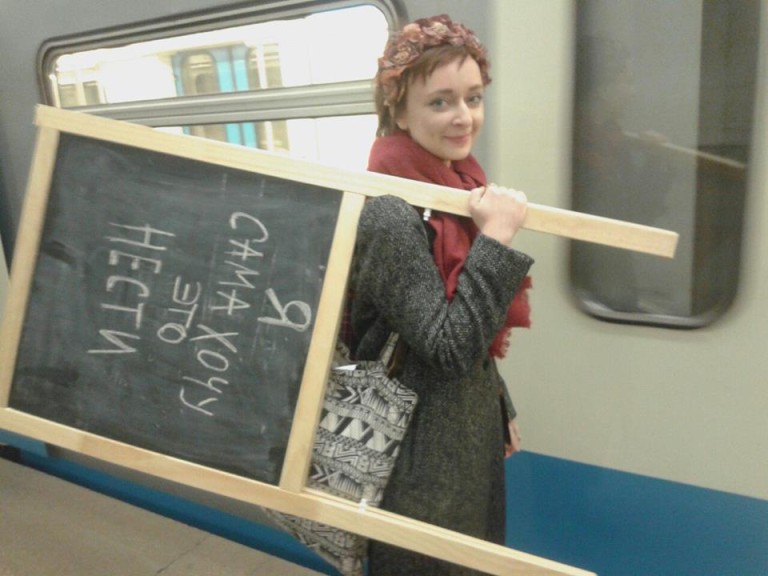
Quiet Picket, a recent initiative by Daria Serenko, teeters on the verge of artistic intervention and protest action. Every day, Serenko boards public transport (often, the subway) bearing a new placard inscribed with an extensive message. Its purpose is to invite people to engage in a discussion. Serenko thus explores the space of communication itself: the distance between placard and recipient, and how potential interlocutors navigate the distance. So far she has produced fifty-four placards, gone through six markers, and directly communicated with ninety-three people. Marina Simakova spoke with Serenko about the background of the action and its effects.

serenko-1
Daria Serenko: “I want to carry it myself.”

Tell us how and under what circumstances the idea for the action occurred to you. What was the occasion?

The action grows out of several occasions. On the one hand, the arrest of Ildar Dadin; on the other, the story with the itinerant exhibition {NE MIR}, when we artists were detained by police while carrying our artworks down the street. I had been contemplating a solo picket for quite a long time. I had a dream of doing an ordinary picket, holding a placard at chest level that would resemble the headings in children’s encyclopedias: “And did you know that…” But ultimately a kind of reformatting of the very principle happened in my head. My understanding of it changed.

And what defined its format?

I was riding the subway after the closing of a {NE MIR} exhibition. I had grabbed a small poster by the Lights of Eirene movement. It featured the famous photo of John Lennon and Yoko Ono during their Bed-In for Peace, and next to it, a current photograph in which similar looking people were lying in approximately the same poses. I was carrying the poster unfolded so it would not be crumpled, and I noticed that everyone in the subway car was looking at it. It dawned on me then and there this was the perfect form of communication. It was completely unobtrusive.

Why did you decide to do it alone, without friends? Did you ask anyone else to join you?

I said from the get-go that the format was open. Two young women joined me, but each has changed the format to suit her. One of them, Sasha, joined about ten days ago. She has attached a placard to her backpack (it comes out more static), and she has been traveling with the same placard for a week. On the other hand, she usually prints it out, and it contains references. The second young woman, Valeria, has also been doing a quiet picket on public transport. She wrote me to ask my permission, and of course I agreed. I have asked the young women to share photos of their placards and stories about what happened as they are able. In no way do I want my action to smack of a manifestation where “I, the performance artist, march forth and educate people.” That is not how it is. Although I do conceive of it as an educational project.

So your action could go viral?

It is difficult to talk about a virus when there are only three young women. But this format really is networked, simple, and palatable. It also functions without me.

How has it been documented?

On VKontakte and Facebook, and a bit on Instagram.  I have a small public page on Vkontakte, and I post a written report on my personal page on Facebook every afternoon or evening, when I have a free minute. I try and describe the situations, the conversations, and the behavior, both my own and that of the people with whom I interact. I also post photographs of the placards.

serenko-2
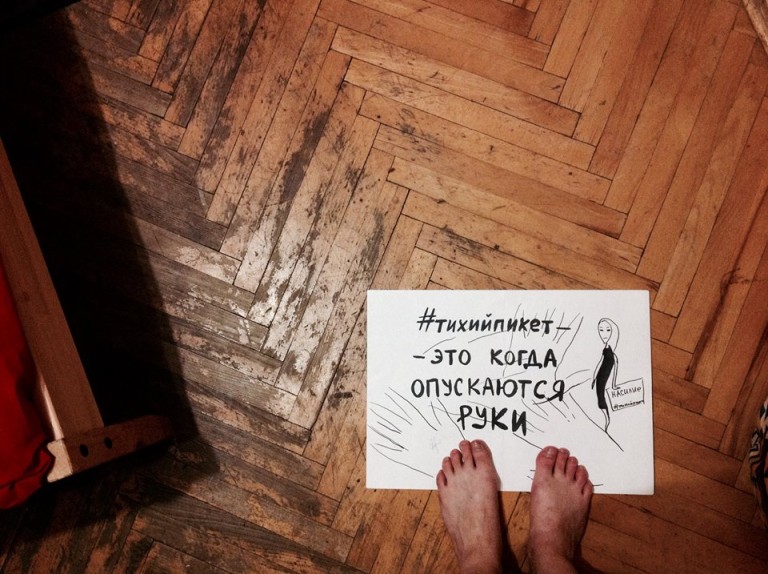
“#quietpicket is when you feel discouraged and your arms fall.” In Russian, the expression “[one’s] arms fall” means to “feel discouraged.”

And is someone watching and photographing you?

Yes, constantly. Stealthily, very politely. If people photograph at close range, they always ask my  permission. Actually, I have got used to thinking of my action as a tape. Today, something like two hundred people wrote me asking what the action was all about. They had not been following it, and I already find it hard to conceive it any other way and explain it all in a jiffy, because some things were improvised and then they caught on. The format of the action has been changing.

How has it changed?

Initially, I had planned to make a placard early in the morning or the night before, ride around with it for a day, and make a new one the next day. I could not imagine subsequent interventions into the placard. But then I sensed the need to alter it depending on the reactions, to write and draw something extra, to explain something on the back. First, the placards were one-sided, then they became two-sided, and then I started doing several narratives within a placard.

After hearing why I was doing this, one of my accidental interlocutors said, “Oh, I get it. You are making a social alphabet.”

Yes, you could say that as well, and so the alphabet format emerged in my action. I want to put together an entire alphabet. Yesterday, I traveled with Г, for gomoseksual’nost’ [homosexuality], and today it was Ш, for shovinizm [chauvinism].

There is also a storyline involving poems I write on the placards. They can be connected with the topic of the placard, as stated on the other side, or they might not be connected. For example, I have been riding around with texts by the poets of the Lianozovo School, the poems of Vsevolod Nekrasov and Igor Holin, and I have been telling people about poetry. And when people ask me whether I think they are poems, I say that of course they are.

Sometimes, the text on a placard is arranged like a dialogue. There is an enquirer of sorts and a respondent.  There was a photo stand-in placard with holes for the eyes and mouth on which I wrote about the social status of women. The allegory in this case was simple: almost any face could be placed on the placard. But, actually, each placard turns out different from the others.

The last few days I have been stitching the sheets of paper together with thread, because I have run out of tape. (I use A3 sheets, which I combine into one big sheet.) It is an excellent means of representing a placard, because while I am stitching it together, I can turn it over and still remain focused on some task.

Sometimes, I also sew a new placard to an old one. This is a palimpsest placard, and the one is visible through the other. The placards thus form strange seams and montages.

I now always have a pile of posters in my bag.  If I see a person is reacting to the placard I am holding, and realize that I want to say something to them, I take another placard from my bag and sew it to the first. When I was riding around with the placard “Our government is fabricating [in Russian, “stitching up”] yet another case against yet another political prisoner,” I sewed it as well I could, in several rows, with rough stitches. By the way, I have been stitching the alphabet placards into a single notebook so later you can flip through it.

serenko-3
Daria Serenko, Photo Stand-in Placard on Social Status of Women (Quiet Picket), 2016

How do you think up the texts for the placards? Do you take advantage of items in the news?

Everything is unstable when it comes to this, too. For May Day I made a topical placard, and after Pavlensky’s action [when the artist summoned sex workers to his court hearing as witnesses—OpenLeft] I made a placard about prostitution. But there are issues I simply have to cover, so I conceive of Quiet Picket as an educational project, albeit semi-ironically and semi-seriously.  Although it happens that I see my action as a kind of monstration. I ride in the subway, look at people, and think I would like to cheer them up.

Besides the fact that the project is educational, how do you define it for yourself? As a series of political art performances or as a civic initiative?

I see it as a continuation of my own work as a poet. In the poetry I have been doing, I spent a long time trying to achieve some kind of interaction: I took ready-mades and inserted them into poems. I think this know-how has influenced Quiet Picket. I am not saying that Picket is a purely poetic endeavor, but thanks to poetry the placard itself has greater opportunities for communicating. And the aspect I cannot keep track of in poetry, the aspect of reading [meaning the reader and her interaction with the poetic text—OpenLeft] is a process I can observe in this case. I see the person’s eyes running over the text, and at the same time she can address me, while I observe how her interpretative mechanisms function, and I can influence them. Quiet Picket takes place in this gap, in the distance between the person and the placard.

Have you thought about urban studies? After all, your action is nothing less than an intervention in one of the most important urban infrastructural spaces, an intervention that would let you get a feel for certain problems, study the behavior of passengers, do work on communications, and so on.

I might prove insufficiently competent as a researcher in this field. I have been trying to document everything I do, and perhaps the outcome will be an article or essay I write. I have not drawn any conclusions for the time being. My research involves collecting information and gaining the know-how of conversing with people on pointed topics that many of them find painful.

There is a rather glaring contradiction in your action. On the one hand, it lays claim to a certain intimacy. It summons a man in the crowd to have a private conversation; it invites him to a politicized discussion. On the other hand, it is very public and open to multiple counter-statements. Could you comment on this?

I don’t see a contradiction here. The fact is that the star of my action is the person who has brought herself to engage in reciprocal communication. She is the master of the situation, not me. She defines her own borders. She can approach me and whisper something in my ear, or she can holler at me from the other end of the subway car, aware that everyone will hear her and thus let other people get involved. It has also happened that a person has asked me to exit the car and have a chat. In that case, I obediently go with him and talk.

serenko-4
Daria Serenko in the midst of Quiet Picket on the Moscow subway

If we shift the focus from the action itself to its subject, meaning you, we can detect yet another problem. At first glance, you appear as a naïve angel in this action. Eyes downcast, silently but persistently, you broadcast your appeal to people. Prepared for any reaction, you throw yourself at the mercy of angry, tired subway passengers. There is a certain victimhood about all this, almost evoking associations with the holy apostles. At the same time, we can look at you in a different way, as an artist working in the aftermath of Situationism and rationally exploiting the temporal distance. So you are protected from the man in the crowd by theory and your own stance, which have found their own places on your placards, while your potential interlocutor, the so-called man in the street, simply has nothing to oppose to you. You thus possess a certain power from the outset.

First, the image of me as meek silent angel is not true. It has been conjured from a photograph of me that has become quite popular. Usually, I don’t look that way. Second, yes, I have a background in culture, a knowledge of manipulative devices, and a set of readymade arguments. There is no getting away from it, but in the process of communicating I still feel unarmed and naked. The things people say, their experience, and the situations they reference have often stumped me. It has happened that I have nothing ready to say to them.

You assumed this experience would change you, pose new questions, and, perhaps, even force you to undergo a kind of metanoia.  Or am I wrong?

I haven’t had the time to keep track of what has been happening to me. But as a woman and feminist, I do think about my own feminine subjectivity (and objectivity). The placard is an amazing agent. When I use the placard to broadcast a feminist agenda, which I do quite often, I am simultaneously the subject and author of the placard and its object.  When I have to dialogue with someone on the topic, I have to act as a subject. So I balance between these points like a pendulum, and this affects me. Of course, I know about the experiments of artists whose bodies, including social bodies, have become sacrificial bodies. But I am faced primarily by the task of a cultural worker. I really wanted and still want to tell people about certain facts. It pains me these facts are hushed up, many people don’t have access to them, etc.

And why should people believe what you tell them? The legitimacy of your claim to know the facts is supported by what? Are you appealing to the status of cultural worker?

Since my format is encyclopedic, I appeal to sources. You will have noticed the references on my placards. People and I often google something: they verify the information on the Internet. I realize that the informational field is infinite, and for various reasons people often deal with only a fragment of this field. I offer them an alternative.

serenko-5
Daria Serenko, “This is how our government has been fabricating yet another case against yet another political prisoner” (Quiet Picket, 2016)

The action has been running for five weeks, and you certainly have managed to collect the most incredible textured. Could you tell us about the most memorable, unexpected or personally important incidents during the picket? I will phrase my question even more openly. Tell us about whatever you would like.

For example, an elderly woman read my placard about political prisoners and thanked me. We were sitting opposite each other in the subway, and she told me about her life. She was a medical worker who helped athletes recover after injuries. On the back of my poster was an old poster, the May Day poster, on which the phrase “Thank you for your hard work” had been written.  She then asked me to exit the subway with her and offered to reward me for my work by having a look at my back and spine.

How long are you planning to continue the action?

For a year. I have a palpable dream that one day I will hit on the right phrasing, the right interactive possibility, and a person will want to make a placard in response right in front of me—as a creative act, as a statement, as an expression of contempt for me or, on the contrary, out of a desire to express agreement or disagreement.

Translated by the Russian Reader. Photos courtesy of OpenLeft.

Dr. Yekaterina Chatskaya: “Doctors Are Pushed to the Limit”

Dr. Yekaterina Chatskaya: “A Year Ago There Were Three of Us. Now There Are Six Times as Many”
Confederation of Labor of Russia (KTR)
May 20, 2016

Dr. Yekaterina Chatskaya

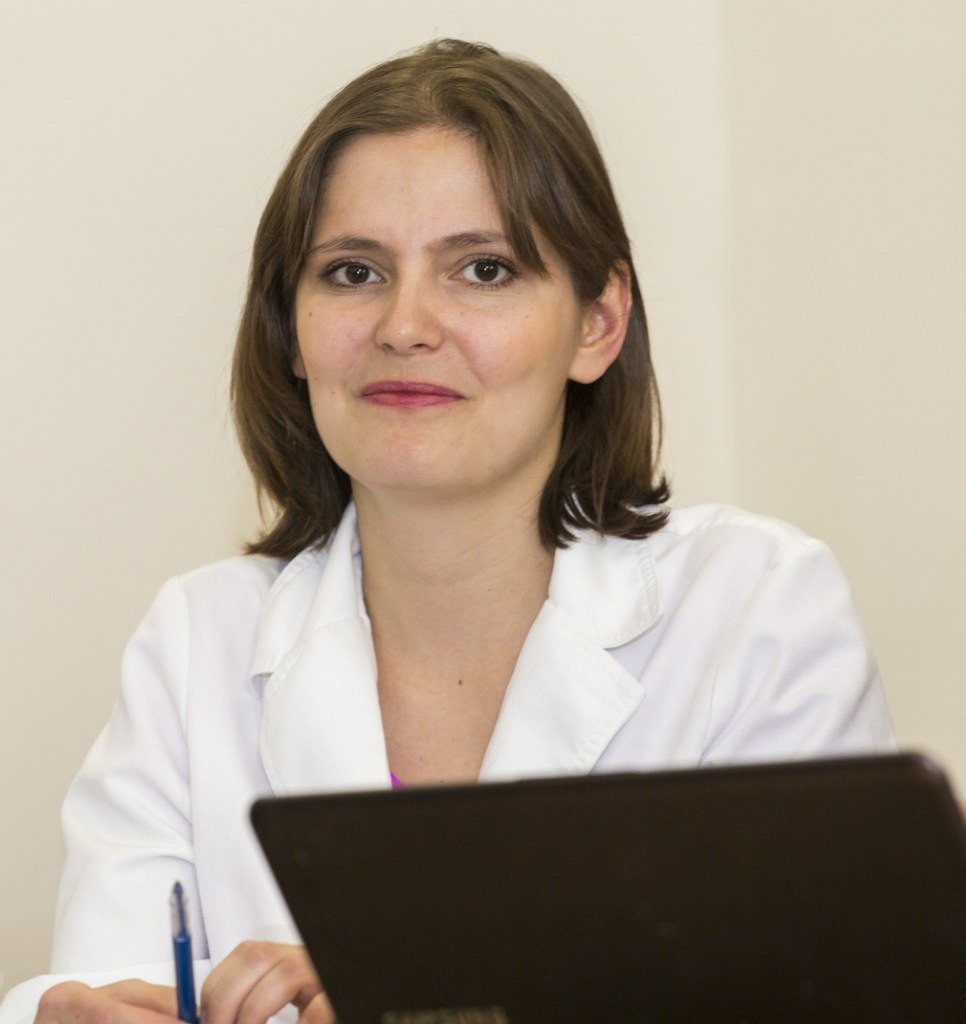
Dr. Yekaterina Chatskaya, a gynecologist at Moscow Municipal Clinic No. 180 and a leader of the Moscow local of trade union Action told Novaya Gazeta what it is like to be a trade unionist when Russia health care has entered an area of turbulence.

Yekaterina Chatskaya is a gynecologist at Moscow Municipal Clinic No. 180. In April 2015, she was involved in a work-to-rule strike by Moscow physicians, meaning that doctors spent as much time with each incoming patient as was necessary and ignored newly introduced, stringent patient-intake standards. Novaya Gazeta found out what happened with the strike and personally with Dr. Chatskaya over the past year.

How did last year’s work-to-rule strike end?

I kept a diary of my patient intakes. We analyzed the standards that took shape during the course of the strike and sent them to the head physician. It turned out our figures were similar to those issued by the Health Ministry. But the problem is that the Health Ministry’s standards are recommendations. They are not obligatory, meaning that they virtually don’t function in practice.

For example, in Moscow, a gynecologist’s standard intake time varies from twelve to fifteen minutes at different hospitals, but the federally recommended initial appointment time is twenty-two minutes. That is a fundamental difference.

In the blogs and appeals written by physicians, they say they are fighting to increase appointment times by three minutes. Do these minutes add up to something in actual practice?

Of course, they do. I have a fifteen-minute limit for seeing a single patient, and I see patients for six hours in a row without a break, meaning this limit does not include a lunch break or even a simple trip to the toilet. Over this six-hour period, according to the standards, I should be able to see twenty-four patients, who have registered in the electronic data base. But it is virtually impossible to keep up with this pace. There are complicated patients, and there are urgent cases. Old women dress slowly. They require a special approach. And you must not hurry pregnant women at all, whether someone is pregnant for the first time or has had a miscarriage in the past. But when the intake period lasts longer than six hours, it is inevitable that doctors make mistakes. Your concentration is reduced, and your eyes are tired.

You really feel by the end of the intake period that you are losing concentration and can make a mistake?

That is exactly why I started thinking about how long it takes to examine a patient in reality. Before the strike, my official intake period lasted seven hours, but in fact it came to eight hours without stopping. After the strike, we succeeded in getting six-hour schedules, while everything is still the same at other clinics.

Has what happened last year changed anything about your team?

At first, a lot of people wanted to support me, but when a group letter was drafted and we took it to other doctors for them to sign it, people got scared. The head physician called me into his office and said it was extremism, that I was going against the regime, although there were no political demands at all in the letter. Certain colleagues stopped speaking to me altogether.

But the turning point came. A year ago, we organized a local of the independent trade union Action (Deistvie). Initially, there were three of us. Now there are six times as many. We managed to stop the introduction of so-called effective contracts. One of the points in the contracts was that incentive pay would be based only on the decision of the clinic or hospital director. My pay consists of 20,000 rubles base salary and roughly the same amount in incentive pay. Under the so-called effective contracts, incentive pay would have included work assignments that are not part of my job description. Theoretically, if I had refused to mop the floors on the orders of the department head, I could have been stripped of my incentive pay. We wrote to the head physician and the prosecutor’s office. The prosecutor’s office acknowledged the decree facilitated corruption and ordered it abolished. This was a victory. But many clinics have switched to the so-called effective contracts.

Your latest protest campaign has targeted the Moscow Health Clinics Standard. What don’t you like about it?

The standard has led to a collapse at work, and not only at our clinic. During the flu epidemic, GPs were working over twelve hours a day. One doctor made a house call to a patient at one-thirty in the morning, and before that she had been seeing patients since eight in the morning, and then went out on house calls. Another colleague of mine worked three weeks without a single day off.

They have begun to drive away specialists. How? For example, a GP has to refer a patient to an endocrinologist. But to do this, he or she has to write up a full justification for the referral, get the chart and referral signed by the department head, and manage all this within the twelve-minute limit for the appointment. Management have been strongly advising GPs not to refer patients to specialists but to threat them themselves. Naturally, the endocrinologist sits there without any work. After some time has passed, management decides that since such a small number of patients come to see him, the clinic has no need of his services. Our clinic fired a mammalogist, a dentist, and an endocrinologist in this way. There is very big queue to see the gastroenterologist. But our clinic immediately set up paid appointments to see him. If you have the money, you will be served right way.

Getting an ultrasound appointment has become a disaster. In late 2014, one ultrasound specialist went on maternity leave, a second was cut, and a third resigned of her own accord. For several months, a single specialist examined pregnant women in the entire district of Mitino. It even came to blows at the terminal when two women fought over an ultrasound appointment voucher. Another big minus of the reforms has been the virtual abolition of the principle of neighborhood health care.

Now you can make an appointment with any primary care physician at a clinic. Is that a bad thing?

In our conditions, it is a bad thing, because it leads to the unavailability of medical care. For example, my primary care neighborhood covers six thousand people, although according to the standards I should be serving two thousand two hundred people. When my appointment bookings for fourteen days in advance open up at 7:30 on a Monday morning, the appointment vouchers are already gone by eight in the morning. Patients can now choose a doctor themselves, and naturally they choose doctors with good reputations. Inevitably, these doctors will be overbooked. Patients assigned to these doctors as their neighborhood doctors are simply unable to get an appointment to see them, although they will be seeing many patients from other neighborhoods.

An absurd situation has developed. The municipal health department monitors the availability of specialists. On our clinic’s overall chart, there is constantly a red light next to my name, meaning that I violate the norm, because patients sign up to see me two weeks in advance. A good doctor is not profitable to a clinic because she or he skews the statistics.

How much do you earn?

My take-home pay is between twenty-five and thirty thousand rubles a month. My last paycheck was 35,000 rubles [approx. 465 euros a month per the current exchange rate—TRR]. I have been working at this salary since April of last years. I am not paid a kopeck more, only the mandatory minimum.

Does the Moscow health department know about this situation?

Yes. We regularly appeal to them. The last appeal by primary care physicians was sent to them on March 31. After that, we got paid a little more.

Doctors are pushed to the limit. Seeing the shiny pictures on the TV, our patients imagine that everything is alright with medical care, and if something is wrong, it is the doctor’s fault. A patient can come and sit outside a doctor’s door for an hour: that means he is a bad doctor. It was that way at first, though now, it is true, patients have begun to realize that if there is a queue, it means the doctor is good. I was reprimanded when an urgent care patient got wedged into my schedule, and I was unable to see another patient before my lunch break. I asked her to wait, but when I came back fifteen minutes later, she was filling out a complaint in the department head’s office. I was reprimanded, even though the patient was seen the very same day after my break.

Would it be easier if the Health Ministry issued strict regulations rather than recommendations?

It would be ideal. We have written several times to the Moscow health department asking them to establish regulations in keeping with the Labor Code and the Russian federal government decree stipulating that a doctor should see patients for no more than thirty-three hours a week. The reply we received was meaningless, as always.

Meanwhile, our head physician issues orders that violate the recommended norms.  These two realities do not intersect at all.

For example, hardship pay has been abolished throughout Moscow.  Even our radiologists lost additional holidays and pay. But the federal decree clearly stipulates that medical workers who come into contact with HIV and tuberculosis should receive both additional pay and additional holidays.

Source: Novaya Gazeta

Translated by the Russian Reader. Thanks to Valentin Urusov for the heads-up

Pyotr Pavlensky: “The FSB Has Hammered an Iron Curtain Around Itself”

threatArtist Pyotr Pavlensky holding a petrol can in front of FSB headquarters in Moscow. Photograph: Reuters

Pyotr Pavlensky: “The FSB Has Hammered an Iron Curtain Around Itself”  
Elena Kostyuchenko and Ekaterina Fomina
December 10, 2015
Novaya Gazeta

An exclusive interview with the arrested artist

He stands accused of vandalism for setting fire to the door of the FSB building. Pavlensky himself has requested he be tried as a terrorist as a gesture of solidarity with convicted terrorists Oleg Sentsov and Alexander Kolchenko. Observing a vow of silence, Pyotr Pavlensky refused to answer the court’s questions. He did, however, answer Novaya Gazeta’s questions.

Pyotr Pavlensky’s Works

Seam, July 2012. Pavlensky sewed his mouth shut with a coarse thread and stood for an hour and a half in front of Saint Petersburg’s Kazan Cathedral holding a placard that read, “Pussy Riot’s performance was a reenactment of Jesus Christ’s famous performance.”

Carcass, May 2013.  Absolutely naked and not responding to anything, Pavlensky lay wrapped in barbed wired outside the Saint Petersburg Legislative Assembly. The artist attempted to show the new position Russian citizens had found themselves in after the adoption of repressive legislation.

Fixation, November 2013. Pavlensky nailed his scrotum to a cobblestone on Red Square and sat motionless looking at it. “It is a metaphor for the apathy and political indifference of Russian society,” the artist explained. Pavlensky timed his action to coinicide with Police Day.

Freedom, February 2014. Pavlensky and a group of activists burned around fifty tires on Malo-Konyushenny Bridge in Saint Bridge, thus reconstructing the Maidan in Kyiv.

Segregation, October 2014. Pavlensky cut off his earlobe while sitting naked on the fence of the Serbsky State Scientific Center for Social and Forensic Psychiatry. The action was a protest against punitive psychiatry.

Threat, November 9, 2015. Pavlensky set fire to the main entrance of the FSB headquarters on Lubyanka Square. The artist stood before the burning door holding a fuel canister.

What is fear?

I think fear is an animal instinct. You find an example of how fear itself turns into an immediate threat to life in Hannah Arendt’s book Eichmann in Jerusalem: A Report on the Banality of Evil. The question she returns to time and again there is, who was more to blame for the death to which a hundred concentration camp prisoners were led, the two guards who escorted them there or the prisoners themselves? Because they went willingly to their deaths, making no attempt to kill the guards or escape. Fear is dangerous because it suppresses free will. Without free will man becomes something like a domesticated beast of burden, which is not finished off and turned into food while there is the need to keep working it.

How and when did you conceive Threat?

[The answer has not been published in keeping with the requirements of Russian federal law.]

What did the preparation involve?

The choice of the site, the date, and time were the main things. When they have been determined, all that remains is the technical preparation, in which I try to do with the most minimal means.

Was Threat successful?  What constitutes success? Were the other actions successful?

I find it difficult to talk about, because my access to information is limited. But the fact alone that I managed to do it could be considered a big success.

Is there a common theme running through your works? Have your stance and objectives changed?

Yes, in all my works I talk about the prison of everyday life and the possibility of release from this prison. Seam, Carcass, Fixation, and Segregation are the prison of everyday life. Freedom is the possibility of release. But Threat is the power of coercion in this prison, meaning that it is the main threat to free will.

In most of your actions you haven chosen your own body as the object. Why did you decide to choose an external object this time?

This is not true. I have used my body when talking about the prison of everyday life. The statement about emancipation was constructed completely differently. Freedom was implemented by a collective subject. Now I have discussed the threat hanging over every member of society. This is a direct threat to the manifestation of everyone’s free will. I never said I was doing performance art or body art. I work with the tools of power, and what I do is political art.


Freedom.Photo: Pyotr Kovalyov / Interpress / TASS 

Whom are you addressing?

Society. I do not address people in power. I use them as material for undermining the scenery of power. My objective is to call into question the entire façade concealing the ruthless mechanics of control and administration.

Do you identify with the the society you previously depicted (Fixation and Carcass)? If not, where are you?

Well, now I am actually in jail. But if we talk about how much I feel myself to be part of society, then to the extent that we all are part of the same regime. I travel on the same public transportation, I watch the same news, and I hear the same advertisements. The informational field is the same,  and I have worked with elements of it. I take something from one context and transfer it to another context. The contexts collide and new meanings are produced. In this way I identify the discrepancy between the scenery and mechanics of power.

Do you know how people have responded to Threat? Can you follow events from jail?  How do you get the idea across when discussion of the action itself (the scrotum, the door) becomes primary?

No, I know very little about the reactions. But I did find out about the most interesting reaction: the entrance to Lubyanka was covered in aluminum. I have been told that “Lubyanka behind the iron curtain” is what the authorities called their action. The regime is erecting this curtain around itself with its own hands. No, it is still not easy for me to keep track of what is happening. I am partly cut off from communications. I get letters, and my lawyers can tell me some things. Other prisoners also tell me things, but generally the information is very sketchy.


Segregation. Photo: Oksana Shalygina / Facebook

Some say that the action could have caused harm to employees who were inside the building. Did you think about this?

No, I had no such fears. We could discuss such a threat if I had employed heavy artillery instead of a fuel canister.

You have called the FSB a “terrorist organization.” You see no difference between a suicide bomber at Domodedovo Airport and an FSB employee?

The FSB [excised in keeping with the requirements of Russian federal law] is a militarized, well-equipped, armed organization. And it combats its competitors, people who would like to take its place but who simply lack the resources. I think any state is a political institution that has formed as an outcome of long-term political terror.

Whic actionist artists (past or present) do you like?

There are quite a few artists, and not necessarily actionists. They include the Dadaists, Malevich and Suprematism, the works of Caravaggio, and many others. Chris Burden was one of the few good performance artists. If we talk about actionists, I would include Alexander Brener and the Moscow actionists of the nineties. Voina made a huge breakthrough, followed by Pussy Riot, including their last performance at the Sochi Olympics.

Can art exist separately from politics nowadays?

No, it cannot. Art was forced to served ruling regimes for many centuries. It was an effective apparatus for inculcating ideological paradigms. Art was able to free itself from functional obligations in the twentieth century. But regimes continue to exist, and every year they require thousands of new personnel: they make a lot of effort to produce these units. The very existence of these institutions for producing service personnel is already sufficient demonstration of the link between art and politics.


Carcass. Photo: Sergei Yermokhin / Interpress / TASS

Investigators have on several occasions asked psychiatrists to examine you. Have you ever doubted your own mental competence?

No, I have not yet had any reason to doubt it.

How do you understand the holy fool? Some have called you a holy fool. Can you agree with them?

No, I cannot. I am an artist who does political art. Political art involves methodical research of social responses and sets of codes. Aside from the actions, the work involves dealing with the many tools of the regime: law enforcement, psychiatry, mass media, etc. I do not think you can just call this a way of life. In this sense, early punk culture, the residents of psychiatric hospitals, and hippies like Charles Mansion bore a much greater resemblance to holy fools.

What happened after your arrest?

 Everything was fairly by the book: physical detention, handcuffs, searches, the first attempts at interrogation. Usually, during the first twenty-four hours, investigators try to get as much testimony as possible. That is exactly why you have to pay attention during the first twenty-four hours and say nothing at all. The same thing happens with psychiatrists, only they have more power. But much more important is what it means to me. For me, it is a process of defining the boundaries and forms of political art. And what the regimes calls arrest and paperwork procedures is nothing other than a bureaucratic ritual for producing criminals.

What are your conditions like now? Has pressure been brought to bear on you?

There was only one attempt to get me to sign a confession that I had not wanted to harm and threaten the lives of FSB employees. After an hour of back and forth conversation, they were unable to get what they wanted. I went to lockup to relax, and they left.

Why did you ask to be charged with terrorism?

 I thought about the action I had carried out and came to the rather interesting conclusion that the action of setting fire to a door was quite similar to what ultimately led to terrorism charges against the s0-called Crimean terrorists and the ABTO group. Only in those cases, the FSB added to these groups people who had made deals with investigators, and as a result of this cooperation, ringerleaders of terrorist organizations and their accomplices emerged. So I decided to demand coherent logic from the court and justice from the judiciary and law enforcement.

Are you going to remain silent in the court?

Yes, I am going to maintain my silence until the lawlessness of the judiciary and law enforcement comes to an end.

Does an action begin when it is actually implemented or afterwards? Is the action still under way now? Do you recognize the state as a co-author?

An act begins during its implementation and ends when the law enforcement system or psychiatrists detain me. But cessation of the action per se marks the beginning of the process by which the boundaries and forms of political art are defined. So we could say that it is not the action that continues but the process of political art.

What do expect from the future? Are you willing to continue living in a stagnated Russia? Have you thought about applying your energies somewhere else? Are you struggling for a better life for yourself or for the country? (And is it a struggle?)

Each of us is responsible for the situation of stagnation. And for this reason alone I do not want to live somewhere else. As for me and my life, it is not a struggle, but the only possible form of existence under state terror. Everything else is personal responsibility for the life of society within the bounds of border and passport control.

P.S. On December 10, Pavlensky was transferred to St. Petersburg, where the case of setting fire to the tires is being examined.

Photo courtesy of the Guardian. Translated by the Russian Reader

The Penguins Can Fend for Themselves

vechorka-penguin

“There will be no global warming. Russian expedition continues to uncover the secrets of Antarctica.” Front page of the March 13, 2015, edition of Vechernyi Petersburg newspaper.

Earlier today, my comrade Louis Proyect posted a link on his Facebook wall to a Reuters article on the crazy extent of official and grassroots climate change skepticism and ignorance in the world’s biggest country. Here is a short excerpt:

Wildfires crackled across Siberia this summer, turning skies ochre and sending up enough smoke from burning pines to blot out satellite views of the 400-mile-long Lake Baikal.

To many climate scientists, the worsening fires are a consequence of Siberia getting hotter, the carbon unleashed from its burning forests and tundra only adding to man-made fossil fuel emissions. Siberia’s wildfire season has lengthened in recent years and the 2015 blazes were among the biggest yet, caking the lake, the “Pearl of Siberia”, in ash and scorching the surrounding permafrost.

But the Russian public heard little mention of climate change, because media coverage across state-controlled television stations and print media all but ignored it. On national TV, the villains were locals who routinely but carelessly burn off tall grasses every year, and the sometimes incompetent crews struggling to put the fires out.

While Western media have examined the role of rising temperatures and drought in this year’s record wildfires in North America, Russian media continue to pay little attention to an issue that animates so much of the world.

The indifference reflects widespread public doubt that human activities play a significant role in global warming, a tone set by President Vladimir Putin, who has offered only vague and modest pledges of emissions cuts ahead of December’s U.N. climate summit in Paris.

Russia’s official view appears to have changed little since 2003, when Putin told an international climate conference that warmer temperatures would mean Russians “spend less on fur coats” while “agricultural specialists say our grain production will increase, and thank God for that”.

The president believes that “there is no global warming, that this is a fraud to restrain the industrial development of several countries including Russia,” says Stanislav Belkovsky, a political analyst and critic of Putin. “That is why this subject is not topical for the majority of the Russian mass media and society in general.”

_________

This reminded me of a dismal interview I had read this past spring in Vechernyi Petersburg, a now-defunct local rag. (The front page of that particular issue of “Vechorka” is depicted at the top of this post.) I had thought about translating it at the time, but since I prefer to push stories that, however bleak, have a positive hook (meaning they feature an underdog or underdogs fighting the powers that be, whatever the odds), I thought better of it.

Now, however, that the official line seems to be run the country into the dirt as quickly as possible, I am kicking out the jams (at least, tonight). After all, somebody out there might be wondering why a country that should have everything going for it in terms of human and natural resources is trying so hard to become a failed state. Interviews like the one that follows—with a gentleman not only purporting to be a scientist, but a scientist charged with running the Russian Antarctic Expedition—might give you a clue.

________

Global warming is a topic that bears no relation to reality
Valery Lukin, head of the Russian Antarctic Expedition, says Antarctica still holds many secrets
Sergei Prudnikov
March 13, 2015
Vechernyi Peterburg

The summer season of the Sixtieth Antarctic Expedition is coming to an end. The scientific research vessel Akademik Fyodorov is now making the rounds of the stations, supplying them with food, fuel, and materials for the coming eight or nine months. In early March, the ship left Progress Station. Its next stops are Molodyozhnaya Station, Novolazarevskaya Station, and Bellingshausen Station. In April, the Akademik Fyodorov will sail for the shores of South America, and on May 15, it will return to Petersburg. In anticipation of the completion of the latest stage of work, Vechernyi Peterburg met with Valery Lukin, head of the Russian Antarctic Expedition (RAE).

Valery Vladimirovich, what are the results of the 2014–2015 season? 

I must say right off the bat that employees of thirty-one organizations, representing ten federal agenices, are involved in the RAE. They include Roshydromet, Rosrybolovstvo (Federal Agency for Fishery), Roscosmos (Russian Federal Space Agency), Rosatom, the Ministry of Defense, and so. Work is underway on sixty-four projects, and each of them is significant. Nevertheless, I would note the drilling of a second borehole into the subglacial Lake Vostok and laying the foundations for installing new ground-based monitoring equipment for the GLONASS satellite navigation system. Interesting work has been done in the oasis of dry valleys,near the American McMurdo Station on the shore of the Ross Sea. They contain the most ancient varieties of permafrost on earth, thirty to forty million years old. Such polar caps exist in similar conditions on Mars. This gives us a unique opportunity for developing the technology to sample this material in the future. I should also note that the Russian Federal Ministry of Culture has implemented several of its own projects in Antarctica for the first time. One of them is the creation of the latest (the third) in a series of virtual branches of the Russian Museum for RAE personnel. The first was unveiled on board the Akademik Fyodorov; the second, at Novolazarevskaya Station; the latest, at Bellingshausen Station.

One of the priorities in Antarctica is the study of climate change. Why is it important? And how do things stand with global warming?

Indeed, it is extremely important. After all, what is the ice of Antarctica? It is compacted precipitation. By carrying out isotopic studies on it, we can track changes in temperature on earth, as well as the levels of methane and carbon dioxide that were in the atmosphere many years ago. Based on the research done on the ice core at Vostok Station, we have assembled a picture of climate change over the last 420,000 years. This included four complete climatic cycles: glaciation and warming with an average period of 100,00 years. We are now in an interglacial period, between peaks of cooling. But it is unclear how long this period will continue and whether it has reached its maximum. No one knows where we are headed. As for global warming, in my opinion, it is only a topic for speculation that is advantageous to businessmen, politicians, and journalists, and which bears no relation to reality.

But what about the movement of glaciers, which are, allegedly, melting furiously?

Glaciers are always moving. Near the Geographic South Pole, at Amundsen-Scott South Pole Station, they move at a speed of 11.5 meters a year. Near Vostok Station, they move at a speed of two meters a year. This is ordinary aerography: new ice forms, old ice flows. Now if it stopped moving, that would be something worthy of immediate attention. In the 1960s, Sovet scientists and their colleagues from Dresden took measurements of the glacier on a 100-kilometer segment of the track from Mirny Station to Vostok Station. Forty-four years later, the measurements were repeated. The ice had grown by forty-two meters! What melting are we talking about here?! As for speculation around a topic, let me remind you that, twenty years ago, all the media suddenly wrote about the growing hole in the ozone layer over Antarctica and the catastrophe it threatened. It was the owner of the large chemical company DuPont who had raised the issue. It was he who paid scientists to study the phenomenon. The scientists concluded that the reduction of the ozone layer had to do with Freon entering the upper atmosphere. Ultimately, this substance was banned. But Mr. DuPont created a new substance, Freon-141, which, by the way, is two and a half times more expensive than the “old” Freon. The problem of the hole in the ozone layer did not go away. But it has been forgotten: people with a stake in the matter performed the task assigned to them. The same thing is sure to happen with the topic of global warming.

Antarctica is an icy, barren continent. What is the practical benefit of researching it?

National security. The economic effects. Strengthening international prestige. With regard to safety, we are talking about ground support in the Southern Hemisphere for our space program. In Soviet times, this problem was solved by a special space fleet. A whole series of craft was built. Then they were scrapped. Using radar stations located in southern Russian, we can look into near-Earth space no farther than thirty degrees latitude south. If we talk about the economic effect, we could talk about developing fisheries in the Southern Ocean. One of the most valuable commercial fish in the world, the Patagonian toothfish, is found in these waters. It dwells at a depth of 600 to 1,200 meters, grows to a length of two meters, and weighs up 160 kilograms. The cost of one kilogram of this fish on the wholesale markets is sixty dollars. It is selling like hot cakes in Japan, South Korea, Hong Kong, and the US. From the 1960s to the 1980s, we were the leaders in catching it. In the 1990s, we virtually abandoned this field. The challenge now is to return. Finally, estimating the mineral reserves [in Antarctica] is an important taks. Our country’s economy is resource dependent. And if we do not keep up with the prospects of mining on earth, we have a lot to lose. We have to have our finger on the pulse.

The media periodically reports incredible events that are observed on the sixth continent. Either people disappear with enviable regularity or strange magnetic phenomena occur. What can you say about this?

These UFO publications cannot be taken seriously, of course. People have definitely not disappeared. Although there are a lot of mysteries. And we are going to encounter them again and again. Subglacial lakes, for example, were discovered a mere twenty years ago, and by chance. We were able to identify Lake Vostok due to a combination of seismic research, radar observations, and satellite measurements. It turned out that in the vicinity of Vostok Station the ice sheet was fairly smooth. There were hills all around, but here there was a flat slab, 250 kilometers long, 70 kilometers wide. Where does that happen? That is right: only on the water.

Valery Vladimorovich, many scientific programs are now feeling the pinch due to the difficult economic situation in the country. How has this affected the RAE?

Budget cuts to the expedition this year will amount to 10%. However, given the need to use foreign aircraft, sail into foreign ports, and pay with foreign currency, the real reduction in the budget will be 35%. Unfortunately, certain programs will have to be wound down. For example, we are planning no research and drilling work at Vostok Station. It is just too expensive. Boring into the subglacial lake and collecting water from it, something we have been so looking forward to doing, is not going to happen next season. In most other areas, research will continue.

Translated by the Russian Reader

___________

Valery Lukin, as it turned out, was much too sanguine about the effect of budget cuts on the RAE.

Russian Antarctic Expedition Halts Research Due to Lack of Funds
October 14, 2015
The Moscow Times

Russia’s state-funded Antarctic expedition has had to halt its research due to a lack of funding, the TASS news agency reported Wednesday, citing one of the scientists involved in the expedition.

“It’s not yet clear how long the research will be suspended for,” Ruslan Kolunin told TASS. He said that work on drilling a borehole in the ancient Lake Vostok has also been suspended. “The borehole is frozen at the moment, no work is under way there right now,” he was cited as saying.

The only research being carried out in the Antarctic as part of the expedition this year is a meteorite project by the Ural Federal University, Kolunin said. “That is financed by sponsors and the university, though,” he added.

Earlier this year, the expedition’s head Valery Lukin said that scientists wouldn’t be able to continue researching Lake Vostok during the next season, which lasts from December 2015 to February 2016, due to decreased funding, TASS reported.

The expedition, Lukin said, is financed directly from the federal budget. In 2015 it was allocated 1.18 billion rubles ($18 million), but in 2016 that will decrease to 1.061 billion rubles ($16 million), which he said was not enough to continue work at the lake.

Lake Vostok lies buried beneath a 3,769-meter layer of ice. Locating it and accessing its relict waters is considered one of the main discoveries of the expedition so far, the report said.

Addicted

Greg Yudin
Facebook
September 29, 2015

In his interview with CBS, Putin was asked how long he intended to remain in power.

Putinweb
Andrei Molodkin, Putin Fuck You, 2012. Image courtesy of a-political.org

“How long depends on the circumstances. Of course, there are rules stipulated by the Constitution, and they definitely will not be violated on my part. But I am also not sure I should take full advantage of these constitutional rights. It will depend on the specific situation in the country and the world, and on my own mood.”

Do you also feel something is missing in this response? I recall there should be something about voters, the people, and that kind of thing. But no, the old man is as honest as ever: it all depends on his “mood.”

The main problem with Putin is that he has usurped power. And all because if once, “by virtue of the circumstances,” the Constitution was adapted to a particular person, the next time round that person will forget about the Constitution altogether, firmly convinced there is only one law—his mood, his arbitrary will.

Incidentally, Putin is well aware that his entire reign amounts to the destruction of order on behalf of tyranny. Otherwise, he would not have led off his reply with something no one had asked him about: the fact his third term is unconstitutional. You can conjure away reality as much as you like, but you cannot hide the truth from yourself.

Greg Yudin is a research fellow and lecturer at The Higher School of Economics in Moscow. Translated by the Russian Reader