The Mote and the Beam

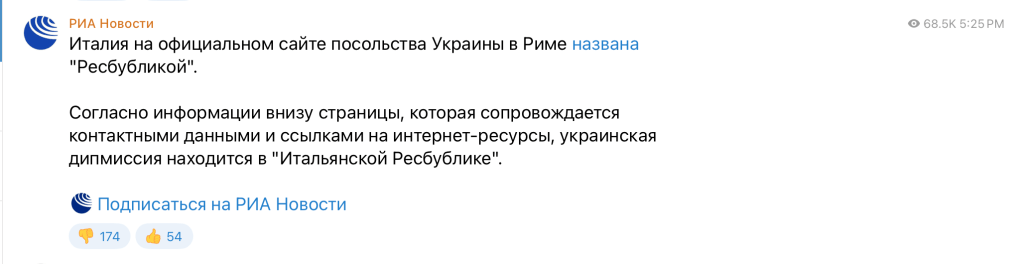
The same “gotcha!” news item (as below) on RIA Novosti’s Telegram channel

ROME, March 18 — RIA Novosti. Our correspondent has discovered that the Ukrainian Embassy in Italy has made a typo on its official website, misspelling the name of its host country.

According to the information at the bottom of the web page (which includes contact details and links to online resources), the Ukrainian diplomatic mission is located in the “Italian Rebublic.” The Italian word Repubblica is spelled with a b instead of a pRebubblica.

Source: “Italy referred to as ‘Rebubblica’ on official website of Ukrainian Embassy in Rome,” RIA Novosti, 18 March 2026. Translated by the Russian Reader


Anton, a 44-year-old Russian soldier who heads a workshop responsible for repairing and supplying drones, was at his kitchen table when he learned last month that Elon Musk’s SpaceX had cut off access to Starlink terminals used by Russian forces. He scrambled for alternatives, but none offered unlimited internet, data plans were restrictive, and coverage did not extend to the areas of Ukraine where his unit operated.

It’s not only American tech executives who are narrowing communications options for Russians. Days later, Russian authorities began slowing down access nationwide to the messaging app Telegram, the service that frontline troops use to coordinate directly with one another and bypass slower chains of command.

“All military work goes through Telegram — all communication,” Anton, whose name has been changed because he fears government reprisal, told POLITICO in voice messages sent via the app. “That would be like shooting the entire Russian army in the head.”

Telegram would be joining a home screen’s worth of apps that have become useless to Russians. Kremlin policymakers have already blocked or limited access to WhatsApp, along with parent company Meta’s Facebook and Instagram, Microsoft’s LinkedIn, Google’s YouTube, Apple’s FaceTime, Snapchat and X, which like SpaceX is owned by Musk. Encrypted messaging apps Signal and Discord, as well as Japanese-owned Viber, have been inaccessible since 2024.

Last month, President Vladimir Putin signed a law requiring telecom operators to block cellular and fixed internet access at the request of the Federal Security Service. Shortly after it took effect on March 3, Moscow residents reported widespread problems with mobile internet, calls and text messages across all major operators for several days, with outages affecting mobile service and Wi-Fi even inside the State Duma.

Those decisions have left Russians increasingly cut off from both the outside world and one another, complicating battlefield coordination and disrupting online communities that organize volunteer aid, fundraising and discussion of the war effort. Deepening digital isolation could turn Russia into something akin to “a large, nuclear-armed North Korea and a junior partner to China,” according to Alexander Gabuev, the Berlin-based director of the Carnegie Russia Eurasia Center.

In April, the Kremlin is expected to escalate its campaign against Telegram — already one of Russia’s most popular messaging platforms, but now in the absence of other social-media options, a central hub for news, business and entertainment. It may block the platform altogether. That is likely to fuel an escalating struggle between state censorship and the tools people use to evade it, with Russia’s place in the world hanging in the balance.

“It’s turned into a war,” said Mikhail Klimarev, executive director of the internet Protection Society, a digital rights group that monitors Russia’s censorship infrastructure. “A guerrilla war. They hunt down the VPNs they can see, they block them — and the ‘partisans’ run, build new bunkers, and come back.”

The app that runs the war

On Feb. 4, SpaceX tightened the authentication system that Starlink terminals use to connect to its satellite network, introducing stricter verification for registered devices. The change effectively blocked many terminals operated by Russian units relying on unauthorized connections, cutting Starlink traffic inside Ukraine by roughly 75 percent, according to internet traffic analysis by Doug Madory, an analyst at the U.S. network monitoring firm Kentik.

The move threw Russian operations into disarray, allowing Ukraine to make battlefield gains. Russia has turned to a workaround widely used before satellite internet was an option: laying fiber-optic lines, from rear areas toward frontline battlefield positions.

Until then, Starlink terminals had allowed drone operators to stream live video through platforms such as Discord, which is officially blocked in Russia but still sometimes used by the Russian military via VPNs, to commanders at multiple levels. A battalion commander could watch an assault unfold in real time and issue corrections — “enemy ahead” or “turn left” — via radio or Telegram. What once required layers of approval could now happen in minutes. Satellite-connected messaging apps became the fastest way to transmit coordinates, imagery and targeting data.

But on Feb. 10, Roskomnadzor, the Russian communications regulator, began slowing down Telegram for users across Russia, citing alleged violations of Russian law. Russian news outlet RBC reported, citing two sources, that authorities plan to shut down Telegram in early April — though not on the front line.

In mid-February, Digital Development Minister Maksut Shadayev said the government did not yet intend to restrict Telegram at the front but hoped servicemen would gradually transition to other platforms. Kremlin spokesperson Dmitry Peskov said this week the company could avoid a full ban by complying with Russian legislation and maintaining what he described as “flexible contact” with authorities.

Roskomnadzor has accused Telegram of failing to protect personal data, combat fraud and prevent its use by terrorists and criminals. Similar accusations have been directed at other foreign tech platforms. In 2022, a Russian court designated Meta an “extremist organization” after the company said it would temporarily allow posts calling for violence against Russian soldiers in the context of the Ukraine war — a decision authorities used to justify blocking Facebook and Instagram in Russia and increasing pressure on the company’s other services, including WhatsApp.

Telegram founder Pavel Durov, a Russian-born entrepreneur now based in the United Arab Emirates, says the throttling is being used as a pretext to push Russians toward a government-controlled messaging app designed for surveillance and political censorship.

That app is MAX, which was launched in March 2025 and has been compared to China’s WeChat in its ambition to anchor a domestic digital ecosystem. Authorities are increasingly steering Russians toward MAX through employers, neighborhood chats and the government services portal Gosuslugi — where citizens retrieve documents, pay fines and book appointments — as well as through banks and retailers. The app’s developer, VK, reports rapid user growth, though those figures are difficult to independently verify.

“They didn’t just leave people to fend for themselves — you could say they led them by the hand through that adaptation by offering alternatives,” said Levada Center pollster Denis Volkov, who has studied Russian attitudes toward technology use. The strategy, he said, has been to provide a Russian or state-backed alternative for the majority, while stopping short of fully criminalizing workarounds for more technologically savvy users who do not want to switch.

Elena, a 38-year-old Yekaterinburg resident whose surname has been withheld because she fears government reprisal, said her daughter’s primary school moved official communication from WhatsApp to MAX without consulting parents. She keeps MAX installed on a separate tablet that remains mostly in a drawer — a version of what some Russians call a “MAXophone,” gadgets solely for that app, without any other data being left on those phones for the (very real) fear the government could access it.

“It works badly. Messages are delayed. Notifications don’t come,” she said. “I don’t trust it … And this whole situation just makes people angry.”

The VPN arms race

Unlike China’s centralized “Great Firewall,” which filters traffic at the country’s digital borders, Russia’s system operates internally. Internet providers are required to route traffic through state-installed deep packet inspection equipment capable of controlling and analyzing data flows in real time.

“It’s not one wall,” Klimarev said. “It’s thousands of fences. You climb one, then there’s another.”

The architecture allows authorities to slow services without formally banning them — a tactic used against YouTube before its web address was removed from government-run domain-name servers last month. Russian law explicitly provides government authority for blocking websites on grounds such as extremism, terrorism, illegal content or violations of data regulations, but it does not clearly define throttling — slowing traffic rather than blocking it outright — as a formal enforcement mechanism. “The slowdown isn’t described anywhere in legislation,” Klimarev said. “It’s pressure without procedure.”

In September, Russia banned advertising for virtual private network services that citizens use to bypass government-imposed restrictions on certain apps or sites. By Klimarev’s estimate, roughly half of Russian internet users now know what a VPN is, and millions pay for one. Polling last year by the Levada Center, Russia’s only major independent pollster, suggests regular use is lower, finding about one-quarter of Russians said they have used VPN services.

Russian courts can treat the use of anonymization tools as an aggravating factor in certain crimes — steps that signal growing pressure on circumvention technologies without formally outlawing them. In February, the Federal Antimonopoly Service opened what appears to be the first case against a media outlet for promoting a VPN after the regional publication Serditaya Chuvashiya advertised such a service on its Telegram channel.

Surveys in recent years have shown that many Russians, particularly older citizens, support tighter internet regulation, often citing fraud, extremism and online safety. That sentiment gives authorities political space to tighten controls even when the restrictions are unpopular among more technologically savvy users.

Even so, the slowdown of Telegram drew criticism from unlikely quarters, including Sergei Mironov, a longtime Kremlin ally and leader of the Just Russia party. In a statement posted on his Telegram channel on Feb. 11, he blasted the regulators behind the move as “idiots,” accusing them of undermining soldiers at the front. He said troops rely on the app to communicate with relatives and organize fundraising for the war effort, warning that restricting it could cost lives. While praising the state-backed messaging app MAX, he argued that Russians should be free to choose which platforms they use.

Pro-war Telegram channels frame the government’s blocking techniques as sabotage of the war effort. Ivan Philippov, who tracks Russia’s influential military bloggers, said the reaction inside that ecosystem to news about Telegram has been visceral “rage.”

Unlike Starlink, whose cutoff could be blamed on a foreign company, restrictions on Telegram are viewed as self-inflicted. Bloggers accuse regulators of undermining the war effort. Telegram is used not only for battlefield coordination but also for volunteer fundraising networks that provide basic logistics the state does not reliably cover — from transport vehicles and fuel to body armor, trench materials and even evacuation equipment. Telegram serves as the primary hub for donations and reporting back to supporters.

“If you break Telegram inside Russia, you break fundraising,” Philippov said. “And without fundraising, a lot of units simply don’t function.”

Few in that community trust MAX, citing technical flaws and privacy concerns. Because MAX operates under Russian data-retention laws and is integrated with state services, many assume their communications would be accessible to authorities.

Philippov said the app’s prominent defenders are largely figures tied to state media or the presidential administration. “Among independent military bloggers, I haven’t seen a single person who supports it,” he said.

Small groups of activists attempted to organize rallies in at least 11 Russian cities, including Moscow, Irkutsk and Novosibirsk, in defense of Telegram. Authorities rejected or obstructed most of the proposed demonstrations — in some cases citing pandemic-era restrictions, weather conditions or vague security concerns — and in several cases revoked previously issued permits. In Novosibirsk, police detained around 15 people ahead of a planned rally. Although a small number of protests were formally approved, no large-scale demonstrations ultimately took place.

The power to pull the plug

The new law signed last month allows Russia’s Federal Security Service to order telecom operators to block cellular and fixed internet access. Peskov, the Kremlin spokesman, said subsequent shutdowns of service in Moscow were linked to security measures aimed at protecting critical infrastructure and countering drone threats, adding that such limitations would remain in place “for as long as necessary.”

In practice, the disruptions rarely amount to a total communications blackout. Most target mobile internet rather than all services, while voice calls and SMS often continue to function. Some domestic websites and apps — including government portals or banking services — may remain accessible through “whitelists,” meaning authorities allow certain services to keep operating even while broader internet access is restricted. The restrictions are typically localized and temporary, affecting specific regions or parts of cities rather than the entire country.

Internet disruptions have increasingly become a tool of control beyond individual platforms. Research by the independent outlet Meduza and the monitoring project Na Svyazi has documented dozens of regional internet shutdowns and mobile network restrictions across Russia, with disruptions occurring regularly since May 2025.

The communications shutdown, and uncertainty around where it will go next, is affecting life for citizens of all kinds, from the elderly struggling to contact family members abroad to tech-savvy users who juggle SIM cards and secondary phones to stay connected. Demand has risen for dated communication devices — including walkie-talkies, pagers and landline phones — along with paper maps as mobile networks become less reliable, according to retailers interviewed by RBC.

“It feels like we’re isolating ourselves,” said Dmitry, 35, who splits his time between Moscow and Dubai and whose surname has been withheld to protect his identity under fear of governmental reprisal. “Like building a sovereign grave.”

Those who track Russian public opinion say the pattern is consistent: irritation followed by adaptation. When Instagram and YouTube were blocked or slowed in recent years, their audiences shrank rapidly as users migrated to alternative services rather than mobilizing against the restrictions.

For now, Russia’s digital tightening resembles managed escalation rather than total isolation. Officials deny plans for a full shutdown, and even critics say a complete severing would cripple banking, logistics and foreign trade.

“It’s possible,” Klimarev said. “But if they do that, the internet won’t be the main problem anymore.”

Source: Ekaterina Bodyagana, “Inside the race to cut Russia off from the global internet,” Business Insider, 16 March 2026

Always Open for You

always for you

It is important, I guess, to make note of the Putin regime’s now innumerable crimes at home and abroad, although it is practically pointless.

At home, in Russia, the progressive intelligentsia is more interested in debating meaningless “issues” like the virtues or, alternately, the vices of Greta Thunberg than it is in doing much of anything about the regime that has happily trampled all of its real and imagined opponents and enemies scot-free for twenty years while also destroying the rule of law, the welfare state, the education system, medical care, the environment, etc., and, just for fun, has also brutally put down a rebellion in Russia’s hinterlands (Chechnya), invaded three countries (Georgia, Ukraine, Syria), assassinated numerous “enemies” on foreign soil, and recklessly meddled in the domestic affairs and elections of numerous other countries all over the world.

But who cares? My experience of writing about these things for twelve years is that most people (including most people in Russia itself, bizarrely) are keen to give the Putin regime a free pass whenever possible, meaning it has only gained more confidence in the “justice” of its perverted cause over the years.

What is this cause? Ensuring that Putin and his circle remain in power in perpetuity and thus, in control, of the country’s vast wealth, which they dispense of as if it were their personal property.

Public indifference has been most depressingly on display when it comes to Russia’s decisive and murderous military intervention, launched four years ago, in defense of Bashar Assad’s criminal regime in Syria.

Frankly, I have no clue why Russians would need unfettered access to the World Wide Web when they signally have failed to make any noise or, as far as I can tell, even find out anything about their government’s baleful role in the world today.

In fact, if they think about it at all, I imagine they kind of like it. It makes them feel important. [TRR]

Thanks to Harald Etzbach and Boycott Russia Today for the heads-up. Thanks also to Sheen Gleeson for her abiding support. Photo by the Russian Reader

_____________________________

Putin Begins Installing Equipment To Cut Russia’s Access To World Wide Web
Zak Doffman
Forbes
September 24, 2019

Earlier this year, Russian President Vladimir Putin signed the Russian Internet (Runet) [sic] into law to protect the country’s communications infrastructure in case it was disconnected from the World Wide Web—or so he said. Critics argued it was opening a door to a Chinese-style firewall disconnecting Russia from the outside world.

Now, Alexander Zharov, the head of the federal communications regulator Roskomnadzor, has confirmed to reporters that “equipment is being installed on the networks of major telecom operators,” and Runet [sic] would begin testing by early October. Such testing, reporters were told, is known as “combat mode.”

When the legislation was introduced there was some debate as to whether it would work in practice. The government claimed its objective was to deal with “threats to the stable, safe and integral operation of the Russian Internet on Russian territory,” by centralizing “the general communications network.” This would work by deploying an alternative domain name system (DNS) for Russia to steer its web traffic away from international servers. ISPs are mandated to comply.

The Moscow Times reported at the time that “Russia carried out drills in mid-2014 to test the country’s response to the possibility of its internet being disconnected from the web—the secret tests reportedly showed that isolating the Russian internet is possible, but that ‘everything’ would go back online within 30 minutes.”

As for this “combat testing,” Zharov has assured [sic] that everything would be done “carefully,” according to local media reports, explaining that “we will first conduct a technical check—affects traffic, does not affect traffic, do all services work.” The plan is for all of this testing to be completed by the end of October.

Although the regulator has been keen to emphasize that Runet [sic] is only for deployment when the system is perceived to be “in danger,” there is a clear question as to where and how such a decision would be taken. Such threats have been classified as “impacts to the integrity of networks, the stability of networks, natural or man-made impacts, or security threats,” all pretty wide-ranging classifiers.

Russia’s recent moves to shut down cellular data traffic to stymie anti-Putin protesters and government warnings that social media access may be curtailed have not brought much confidence to its tech-savvy citizens.

Runet [sic] is due to go live in November. According to Freedom On The Net, “Russian internet freedom has declined for the sixth year in a row, following government efforts to block the popular messaging app Telegram and numerous legislative proposals aimed at restricting online anonymity and increasing censorship.”

And there are no signs of that getting any better any time soon.

NB. “Runet” is a term that has long been used to denote the Russian or Russian-language segment of the Internet. Why Mr. Doffman thought it was something that would go online only in November or was “signed into law” is beyond me. But then I also do not understand why a respectable magazine like Forbes would not only fail to fact-check his article but also neglect to proofread it. I had to do the proofreading for them. [TRR]

Russia’s Bright Future (Putin 4.0)

Member of HRC Describes Putin’s New Term: Everything Under the Sun Will Be Banned
Alexei Obukhov
Moskovsky Komsomolets
October 10, 2017

Pavel Chikov argues Russia will become isolated internationally, and federalism and regional economies will be jettisoned.

Pavel Chikov, a member of the Russian Presidential Human Rights Council, has forecast what politics in Russia will be like if Vladimir Putin is re-elected to another term. According to Chikov, the situation in the country will deteriorate rapidly, and more and more areas of public life will be off limits.

1a1bb3f8a345889fc79a754c4ae35c6dPavel Chikov. Photo courtesy of Facebook/MK

Foreign mass media will be the first to be banned. This has been borne out, says the human rights activist, by the threat to shutter Radio Svoboda, which the media outlet received from the Justice Ministry last Monday.

Following the media, “the political arena will be mopped up: the current persecution of Alexei Navalny’s employees and Open Russia’s employees is a harbinger of this.”

In Chikov’s opinion, the country will also be stripped of religious freedom, as witnessed by “the huge criminal cases against and expulsion from the country” of members of various non-traditional religious movements, from Jehovah’s Witnesses, who have been declared “extremist” banned in the Russian Federation, to supporters of non-mainstream Buddhist and Muslim groups.

These measures, writes the human rights activist on his Telegram channel, will be paralleled by Russia’s renunciation of its international commitments. It will exit the Council of Europe and end its cooperation with the European Court of Human Rights. (Valentina Matviyenko, speaker of the Federation Council, said yesterday this was a probable scenario.) Russian’s relations with many European countries, from the Baltic states to Germany, will deteriorate, and their embassies will be closed. Restrictions will be placed on Russian nationals traveling outside the country, and the practice of stripping refugees and asylum seekers of their Russian citizenship and confiscating their property will be broadened.

Meanwhile, Russia will succeed in isolating its segment of the Internet and instituting a Chinese-style firewall to censor content.

Finally, Chikov writes, the country’s economy and domestic politics will deteriorate. The regions will lose the last remnants of their autonomy (Chikhov cites Vladimir Vasilyev’s  recent appointment as acting head of Dagestan, although the United Russia MP has no experience in the republic), and the assets the regions have left will be placed under the control of Putin’s inner circle.

Translated by the Russian Reader. Thanks to Vasily Zharkov for the heads-up

Another News Item about Russia That Will Brighten Your Day and Make You Smile

russian-smile-features-1
Vasya Lozhkin, “No Time for Smiling!” Pilfered by crypto-nationalist website russiatrek.org and not credited to the artist

I’ve had complaints in recent days that my Facebook news feed and Word Press-powered blog (the very blog you’re reading now) felt “tired” and lacked humor.

This news item, however, is sure to energize you positively while tickling your funny bone.

Russia’s Federation Council has approved a bill that would prohibit the use of Internet proxy services—including virtual private networks, or VPNs.

The bill approved on July 25 would also ban the anonymous use of mobile messaging services.

The bill was adopted in its final reading by the lower house of the parliament, the State Duma, on July 21.

It now goes to President Vladimir Putin to be signed into the law.

If signed by the president, the legislation would take effect on January 1, 2018. That is less than three months before a presidential election in which Putin is widely expected to seek and win a new six-year term.

Under the bill, Internet providers would be ordered to block websites that offer VPNs and other proxy services. Russians frequently use such websites to access blocked content by routing connections through servers abroad.

The legislation also would require messenger apps to verify users through their phone numbers and to send out compulsory text messages from government agencies on request.

Lawmakers who promoted the bill said it is needed to prevent the spread of extremist material and ideas.

Critics say Putin’s government often uses that justification to suppress political dissent.

Source: Radio Free Europe/Radio Liberty

It will also have the added effect, I’m sure, of making large numbers of professionals give up their lives in the perpetually decadent west and move to Russia.

Because in Russia it’s all about laughter and spiritual uplift.©

NB. This post is a paid advertisement for Re-Elect Putin 2018, a nonpartisan group of cash-hungry foreign turncoats working to keep the world’s largest country a dictatorship, because in an increasingly complex world only outright tyranny is capable of getting things done

Let’s Cancel the Party and Call It a Night

OLYMPUS DIGITAL CAMERA
Car parked in central Petersburg, 8 July 2017. Photo by the Russian Reader

Given the sheer numbers of reactionary/counterrevolutionary events and incidents happening in Russia every day, and the equally astronomical quantities of reactionary/counter-revolutionary statements and actions committed by Russian officials high and low (e.g. East Aleppo) over the past couple of decades, it seems a nasty farce to commemorate, much less celebrate, the centennial of the Russian revolution(s) this year.

Present-day Russia and Russians have no copyright on revolution, and this stricture applies equally to self-identified “revolutionary” or leftist Russians, who have nothing to teach or say to anyone about revolution.

Clear the current Russian built and symbolic landscape of all the post-revolutionary tat and kitsch (nearly all of it reactionary, because what could be more anti-revolutionary than a cult of personality like the one generated around the dead Lenin) that clutters it physically and nominally (e.g., Insurrection Square in Petersburg), and you would find the wildly reactionary country that actually occupies the vast expanse between the Gdansk Bay and Chukchi Peninsula.

It’s another matter that there are lots of Russians who, pluckily and smartly, individually and collectively, have been trying to overcome this black reaction in bigger and smaller ways over the “miraculous” years of the successive Putin regimes.

Unfortunately, however, their voices have mostly been muffled by the din of counterrevolution issuing from the Kremlin, the State Duma, and the post-Soviet Russian state’s ever-proliferating set of security forces and regulatory watchdogs, and by their own would-be allies among the brand-name liberals and leftists, most of whom have been concerned with promoting their own social and cultural capital, not making common cause with boring math instructors like “mass disorder stoker” Dmitry Bogatov or, more surprisingly, with the country’s endlessly resourceful independent truckers and other inspiring grassroots freedom fighters, none of whom have the time or the inclination to commemorate the famous revolution that, arguably, went counterrevolutionary more quickly than you could say Jack Robinson. TRR

Fighting the “Faggot Kids” in Russia

LGBT Teens Called “Faggot Kids” at Meeting with Russian Children’s Ombudsman
Ruposters.ru
November 2, 2016

During a meeting in Tula featuring children’s ombudsman Anna Kuznetsova, homosexual teens were called “faggot kids,”  reports Kommersant newspaper

Denis Davydov,  director of the Safe Internet League, made the statement. Speaking at the meeting, he talked about the harassment organized against psychologist Lydia Matveeva. Her expert opinion had contributed to banning the [online] community Deti-404 (Children 404), which had helped gay children.

“Maybe you remember the website where underaged faggot kids held up signs and promoted this lifestyle?” said Davydov.

The remark provoked laughter in the auditorium. Davydov continued his speech, emphasizing that sects, “psychocults,” promotion of dangerous behavior and alternative realities, computer games, and “aggressive information” posed the main risks on the Internet to children.

Kuznetsova suggested tightening Article 110 of the Russian Federal Criminal Code (“Incitement to Suicide”) by adding a paragraph to the article that would outlaw “inclining minors to suicide” by virtual means.

In turn, Nikolai Abramov, deputy head of Roskomnadzor‘s Tula office, proposed leaving Russia with three to five access points to the world Internet and filtering all data through these points.

On September 9, President Vladimir Putin dismissed Pavel Astakhov from the post of presidential envoy for children’s rights and named Anna Kuznetsova to the post.

Translated by a Sack of Potatoes. Thanks to Comrade Sergey S.  for the heads-up

The 501st: Russian Death

russian death
“Russian Death”

‘Sociologist Denis Volkov from Moscow’s independent Levada Center pollster, on the other hand, says the bill is unlikely to make Russians more wary about what they post on the Internet. “Most people are not aware of these laws,” he says.’

Ha-ha. It’s good that reporters are forced to turn to “sociologists” and “pollsters” for quotable quotes, and that the Putinist state decided at some point long ago it would pollocratize everyone and their cousin into submission, because otherwise the “independent” Levada Center would have had to pull up stakes long ago and move to Nevada to start calling odds on the trifecta at Santa Anita racetrack.

I have already seen the chilling effect that the bill and the generally malignant, soul-destroying climate of the last year or so have had on what people talk about politically (or not) in daily life, much more dare to post on the Internet, e.g., Russia’s role in Syria, which absolutely no one I know has discussed, publicly or otherwise, under any circumstances for a very, very long time now. And that is just the top of the list.

A fair number of Russians, young and old, know very well how to read signals coming from on high and when to keep their mouths shut. Or how to substitute abstract, self-important chatter or furious trivial pursuits for meaningful conversations about what is happening in their country and what to do about it. Now is one of those times, and it is absolutely depressing.

All it will take is a few more “light touches,” and the country will essentially be dead, that is, waiting for its Supreme Leader to kick the bucket (when? twenty years from now?) so it can rejoin the rest of the world and resume building “democracy,” “capitalism” or whatever it has been pretending to do the last twenty-five years.

Photo courtesy of the Facebook page of Russkaia smert’ (Russian Death)

General Bastrykin Teaches a Lesson in Democracy

This is the mouse, this is the cat.
This is the watch tower, this is the camp.
And this is Time that, on the sly,
Sentences Mom and Dad to die.

source

Participants of the national Miss Russia 2016 beauty pageant on the stage of the Barvikha Luxury Village concert hall. Courtesy of Sputnik/Iliya Pitalev

Greg Yudin
Facebook
April 18, 2018

I really like it when a big man in uniform speaks out with fanfare on perennial topics like the structure of society. You think it’s funny they all get Ph.D.s, but they really do consider themselves major theorists and are always willing to teach lessons in wisdom in their spare time. An entire genre has even emerged in Russian newspapers: lessons in political philosophy by generals.

For example, in today’s issue of Kommersant, General Bastrykin casually gives readers an unexpected lesson in democracy.

“For democracy or people power is nothing other than the power of the people itself, realized in its interests. It is possible to achieve these interests only by means of the common good, and not through the absolute freedom and arbitrary will of individual members of society,” he writes.

It must be admitted that this is the pure, unadulterated truth. We might rejoice that democracy in Russia has found a new supporter.

Then, however, Bastrykin the democrat’s argument takes an unexpected turn. He proposes setting things up so that he, Bastrykin, would decide himself what information should be considered extremist, and would limit Internet access without a court order! In addition, he would also decide in which cases providers are obliged to provide him with the personal information of their clients.

There are lots of other tasty tidbits in his article, including innovative tactics for fighting terrorism by confiscating property, but that does not concern us here.

So somebody comes and says, Now I am going to decide who is an extremist and who can read what. You will also be informing me everyone’s personal information. If this is not “absolute freedom and the arbitrary will of an individual member of society,” then what else would you call it?

I am going to have to upset Mr. Bastrykin. Democracy is, in fact, people power. Therefore, the main objective of democratic governance has been and will be preventing the usurpation of power, not defending the people from the machinations of external foes, not hunting down traitors, not surveilling unreliables, but combating usurpers. And so democracy’s main enemy is the guy who comes out and says he is going to decide who the extremists are round here.

The problem with these scholarly generals is that the only form of social organization they are capable of conceiving is the prison camp. And so whether they write about democracy, traditional values or economic progress, the same speech in defense of the prison camp always comes out.

* * * * *

“It’s time to erect an effective barrier against the information war”
Alexander Bastrykin, chair of the Russian Federal Investigative Committee, on methods of combating extremism in Russia 
Kommersant
April 18, 2016

Chair of the Russian Federal Investigative Committee, general of justice of the Russian Federation, doctor of juridical sciences, Professor Alexander Bastrykin, special to Vlast magazine, on the ways and methods of combating extremism in Russia 

In  2015, the Russian Federation witnessed negative trends in criminal extremism and terrorism.

1,329 extremist crimes were recorded, which was 28.5% higher than in 2014 (1,034 crimes). A growth in this type of crime was noted in fifty-six regions of the Russian Federation.

The numbers of such crimes as public calls to extremist activity (Russian Federal Criminal Code Article 280) and inciting hatred or hostility, and humiliation of human dignity has soared by nearly forty percent in comparison with 2014.

The crime of organizing an extremist organization was recorded 42 times (+2,4%).

A significant increase (+36.3%) in terrorist crimes committed in the Russian Federation has been noted. A total of 1,538 such crimes was recorded in 2015 (as opposed to 1,128 in 2014).

Seventy such crimes were prevented at the stage of planning or during the attempt. 133 terrorist crimes were committed with the help of the Internet network.

A particularly difficult situation has been observed in the North Caucasus Federal District, which accounts for the bulk of terrorist crimes: 1,168 crimes or 75.9% of all such crimes (leading to an increase of 32.3%). (In 2014, 883 such crimes were committed.)

Both external (geopolitical) and domestic political factors have contributed to the growth of this type of crime.

Over the past decade, Russia and a number of other countries have been living through a so-called hybrid war, unleashed by the US and its allies. The war has been conducted on various fronts, political, economic, informational, and legal. In recent years, it has moved into a new phase of open confrontation.

Professor Bastrykin
Professor Bastrykin

The main elements of economic pressure have been commercial and financial sanctions, dumping wars on the hydrocarbons market, and currency wars. Skillfully manipulating the huge number of dollars in circulation, the States have brought down the national currencies of developing countries. Russian organizations have had their access to channels of external long-term financing blocked, channels that formed the basis of investment for developing the real (productive) sectors of the economy. It is noteworthy that restrictions on the movement of financing have not affected short-term financing, which currently has been widedly employed to exert speculative pressure on our national currency. In many respects, the outcome of these measures has been the deep devaluation of the ruble, falling real incomes, a decline in industrial production, and economic recession. There has been a budget deficit and ensuing consequences in the form of cuts in expenditures, as well as an increasing fiscal burden to raise revenues.

Unfortunately, international law and the justice based on it have increasingly become tools of this war.

Obvious examples are the decisions in the Yukos cases, the decision in the murder case of former FSB officer Alexander Litvinenko, the report of the Security Council of Netherlands on the investigation into the crash of Malaysian Airlines Flight 17, the FBI’s investigation of the legitimacy of awarding the right to hold the World Cup to Russia and Qatar in 2018 and 2022, and the extradition of our citizens Victor Bout and Konstanin Yaroshenko to the US and their sentencing to long terms of imprisonment.

However, the information war has caused the most devastating effects. By supporting radical Islamists and other radical ideological tendencies, the US has completely destabilized the situation in the Middle East. The effects of artificially initiated coups, revolutions, and crises in this region are still being experienced by Europe, overrun by mobs of refugees who profess qualitatively alien sociocultural traditions and have displaced the local population. Islamic State, the Al-Nusra Front, Al Qaida, and other terrorist organizations involved in the armed conflict in the Syrian Arab Republic have also been an effect of this policy. Manpower for replenishing these organizations are recruited all over the world, including in Russia.

More than a thousand Russian citizens have gone to the Syrian Arab Republic to participate in the armed conflict. 469 criminal cases have been filed against these persons. 135 of them have been killed in armed clashes with Syrian government troops.

The main channels of entry for Russian citizens into areas of heightened terrorist activity have been Turkey and Egypt, where they travel both directly and through third countries (Georgia, Azerbaijan, Belarus, Ukraine, Moldova) under the pretext of holidaymaking, receiving theological education, doing business, etc.

The main technique of the information war is the manipulation of an ideology that a particular social group finds congenial by radicalizing it. It is clear that the system of religious, ethnocultural, and confessional values is the segment of social existence that defines the most significant feature of any nation (ethnic group) and other such social groups as self-identification. Many of these values were shaped,  preserved, and passed from generation to generation for centuries. Therefore, no nation is willing to give up its identity. Perhaps it is the only universal value it is willing to defend with arms and, as they say, until the last drop of blood is spilled.

Aware of the devastating effect of conflicts based on ethnic hatred, the US has bet on this informational element. At the current level of understanding of the issue, it is clear that the subversion of the Soviet Union’s ideological foundations, which were based on the principle of the brotherhood of nations, was also initiated from the outside and based on methods of ethnic strife. It was no accident that in the early 1990s numerous ethnic conflicts (Nagorno-Karabakh, Georgia-Abkhazia, Ossetia-Ingushetia, Transnistria) broke almost simultaneously. At this time, the first mass rallies of nationalist-minded citizens took place in Kiev. In addition, the subversion of state power was carried out by means of anti-Soviet agitation and financing of the political opposition in Latvia, Lithuania, Estonia, Georgia, and other countries.

Of course, in the minds of the local populace, those events were then regarded as local conflicts. However, it is now completely obvious that all these clashes were elements of the initial, as-yet-hidden phase of the information war.

Undoubtedly, the informational-ideological “weapon” will be deployed in the future. This is evidenced by the increase in US government spending on programs for the so-called development of democratic institutions in countries bordering on Russia and in the Central Asian states. The true meaning of these assets becomes clear from the name of this budget item, “Countering Russian aggression through public diplomacy and foreign aid programs, and the creation of stable government in Europe.”

About 4.3 billion dollars have been allocated under his item in 2017, and around a billion dollars will go to programs for the so-called fight against corruption and supporting democracy in countries neighboring Russia.

Funds already received under this program have been spent by by various non-governmental organizations under the guise of promoting education, developing civil society, and other seemingly useful purposes. The outcome has been the incitement of anti-Russian moods in neighboring countries, the shaping of the pro-American and pro-western so-called non-systemic opposition in Russia, and the spread of inter-confessional and political extremism within our country.

Recent events in Nagorno-Karabakh witness to the repeated attempts of forces opposed to Russia to undermine the peace between the Armenian and Azerbaijani peoples and establish yet another hotbed of war on Russian’s borders.

It seems it is time to erect an effective barrier against this information war. We need a tough, appropriate, and balanced response. This is especially relevant in light of the upcoming elections and the possible risks presented by the stepping up of efforts by destabilizing political forces. Enough of playing at pseudo-democracy and following pseudo-liberal values. For democracy or people power is nothing other than the power of the people itself, realized in its interests. It is possible to achieve these interests only by means of the common good, and not through the absolute freedom and arbitrary will of individual members of society.

The following measures can be proposed to counter extremism.

It is extremely important to establish a concept of state ideological policy. Its basic element could be a national idea that would genuinely unite Russia’s unified multinational people. The concept could stipulate specific long-term and medium-term measures, aimed at the ideological education of our younger generation. Conscious resistance to radical religious and other ideologies could knock out the foundations on which current extremist ideologies are constructed. With this protection in place, even the most generous outside financing of destabilizing the situation in Russia will prove useless.

It is also important that youth are regarded by terrorist groups as a natural reserve. From this it follows that everything must be done to seize the initiative, to include young people at risk in the development and implementation of programs for countering armed extremism.

It seems appropriate for the supervisory and regulatory authorities to organize a wide-ranging and detailed verification of the compliance with federal legislation of all religious, ethnocultural, and youth organizations, suspected of engaging in banned extremist activity.

Using the know-how of the Northern Caucasus, we should organize specific and narrowly targeted preventive work with members of informal youth associations in order to adopt measures aimed at procuring information about negative processes underway in the youth milieu and identifying the ideologues and leaders of radical organizations who involved young people in extremist activity.

The positive know-how of the Republic of Ingushetia is also worthy of support. They have established a military-patriotic club that unites the children of law enforcement officers who were killed in the line of duty and children of neutralized members of the bandit underground, which facilitates their rapprochement and shapes an atmosphere of mutual understanding among them.

The proposed concept sees it as expedient to define the limits of censoring the global Internet network in Russia, since at present this problem is causing a heated debate in the light of the stepping up of efforts by advocates of the right to the free receipt and dissemination of information. Interesting in this sense is the know-how of foreign states, opposing the US and its allies. Due to unprecedented pressure from information, they have taken steps to restrict foreign media in order to protect the national information space. Thus, for example, on March 10, 2016, China’s Ministry of Industry and Information Technology  introduced a ban on electronic media fully or partly owned by foreign residents. These media will no longer be able to disseminate information through the Internet and, in the best case, by means of print publications. Chinese media will cooperate with foreign online media only with the permission of the ministry. Only Chinese nationals will be able to work in the management of national media. Online media servers can be located only in the People’s Republic of China.

It seems this know-how could be employed in Russia to a reasonable extent.

Internet providers must be furnished with a integrated set of rules for storing the personal information of their clients and users in the right amount in the event that such information is required when investigating cyber security violations.

In public places (libraries, schools, and other educational institutions) with access to the World Wide Web, filters restricting access to sites containing extremist content should be established.

In addition, it seems appropriate to stipulate an extrajudicial (administrative) procedure for including information in the federal list of extremist content and blocking the domain names of sites that disseminate extremist and radical nationalist information. However, if the proprietors of this information do not consider it extremist, they can appeal the relevant actions of the authorized government agencies in court and prove their innocence there. This procedure will enable a faster and more effective response to the promotion of extremism on the Internet. It is necessary to step up work on introducing modern technology for the effective monitoring of the radio waves and the Internet.

It is necessary to expand the range of criminal law measures to stop the illegal actions of terrorist organizations committed on the Internet network involving recruiting. To this end, we should consider the criminalization of possessing such materials, collecting them or uploading them from a computer. Modern evidence technologies make it possible to present to the court and confirm technical elements of intercourse on social networks that testify to the connections between the accused and the relevant electronic messages.

To expose the real aims and intentions of Islamic extremists and establish the insolvency of their theoretical approaches, which contradict the realities of the modern world and the fundamental interests of Islamic countries, it would seem useful for the State Duma to regularly hold special hearings involving experts from the Federal Security Service (FSB), eminent Islamic scholars and authorities, and scholars of Islam. The hearings should be widely covered in the press.

Particular attention should be paid to the migration process. Migrants are often targets of espionage recruiting and radicalization. Many of them have overstayed their limit in Russia, dropping out of the sight of law enforcement. We must analyze the regulatory acts governing the presence of foreign nationals and persons without citizenship in the Russian Federation. Based on our analysis, we should take additional measures for improving the legislation.

It is necessary to improve the work of precinct police with foreign nationals in the realm of monitoring compliance with the established rules of residence in Russia (monitoring of persons letting and renting residential premises in the precinct, and obtaining information about the nature of these persons’ employment). The internal affairs departments of agencies should exclude possible corruption here. Full use of the public’s assistance should be made.

Certain features of extremist activity have taken shape in the Crimea Federal District, where attempts have been made to mold anti-Russian moods, by means of falsifying historical facts and distorting the interpretation of modern events, and call into question the outcome of the referendum on Crimea’s accession to the Russian Federation. This act of the legal expression of the Crimean population’s popular will has become an integral part of Russian constitutionalism. Considering the place of this act in the hierarchal system of values of Russian state and society, it is certainly in need of special legal protection, including by means of criminal legal coercion.

It should be noted that criminalizing the denial or falsification of historical events of particular importance to a state and society is a widespread practice. For example, in many countries, including Russia, criminal punishment is stipulated for promoting fascism. France and a number of other countries have introduced criminal liability for denying the Armenian genocide. The State Duma of the Russian Federal Assembly is considering a similar law bill, No. 938567-6 (“On Criminalization of Public Denial of the Genocide of the Armenian People in Western Armenia and Ottoman Turkey in 1915-1922”). In Israel, it is a crime to deny the Holocaust.

In view of the above, it seems necessary to supplement the notion of extremist activity (extremism) contained in the federal law “On Countering Extremist Activity” with such a manifestation as denial of the outcome of a national referendum. It is necessary to decisively counteract the deliberate falsification of the history of our state. In this connection, we might also propose that Russian Federal Criminal Code Article 280 (public calls for extremist activity) include an additional stipulation, which would qualify the falsification of historical facts and events as a call for extremist activity.

In addition to countering the ideological component of the information war being waged against Russia, it is important to step up efforts to combat financial support for this activity, including tightening control over cross-border capital flows. As experience has shown, terrorism is often financed by virtual cryptocurrency, which has no central issuer, no single point of transactional control, and features anonymous payments. In addition, as a result of their wide dissemination, these currencies can displace legal money from the market, which threatens the state’s financial stability. It is therefore suggested that criminal liability be introduced for the illegal issuance and circulation of cryptocurrency and other money substitutes.

We should also review social security legislation concerning the close relatives of persons involved in terrorism, entitlement to survivor’s pensions, and other benefits. A person who is going to commit such crimes should know that in the event of death not only will he be buried in an unmarked grave but he will also deprive his loved ones of support from the state.

Another measure that would contribute to the effective fight against extremism, terrorism, and other dangerous criminal manifestations is confiscation of property as a form of criminal punishment. As we know, the relevant legislative proposals have been prepared and are in need of speedy legislative implementation. Unfortunately, this process has been unduly delayed.

No less important is improvement of the legal mechanism of international cooperation among law enforcement and other state bodies empowered to counter terrorism and extremism.

Russian law regulates only the procedure for submitting an international request for legal assistance, whereas international acts in this field stipulate the possibility of closer integration, including the establishment of international investigative teams. Such cooperation would help in cases where Russian investigative authorities need to perform a number of investigative procedures or even perform a preliminary investigation in a foreign country and that country has agreed to provide such assistance. This gap became apparent during investigation of the armed conflict between Georgia and South Ossetia in 2008 and the terrorist act committed on board the Russian Airbus 321 over the Sinai Peninsula.

Translated by the Island of Misfit Toys. Thanks to Greg Yudin for his courage.