Yabloko supporters outside the Russian Supreme Court, which decided whether the party should be barred from upcoming parliamentary elections (10 August 2026). Photo: Yevgeny Messman/TASS/Picture Alliance via DW
Following a nine-hour hearing, the Russian Supreme Court sided with the suit brought by the Motherland (Rodina) party and disqualified the Yabloko party’s federal list of candidates in the upcoming State Duma elections. Most of the plaintiffs’ claims concerned alleged copyright infringements in Yabloko’s campaign materials. In addition to these allegations against Yabloko, suspicions of “extremist” activity and foreign funding were also raised.
The case was heard by Judge Vyacheslav Kirillov, who has previously been involved in high-profile political trials. In particular, he ruled that the human rights organization Memorial was “extremist” and dismissed Alexei Navalny’s suit against the Federal Penitentiary Service and the wardens at the penal colony where he was imprisoned.
At least five hundred people gathered outside the Supreme Court building. They handed out apples [because yabloko means “apple” in Russian] and sang songs in support of the party. After the hearing concluded, security forces threatened the protesters with arrest and told the young people amongst them that they would be sent to a military enlistment office. Yabloko’s chair, Nikolai Rybakov, stated that the party had not broken the law and would appeal against the court’s decision within the five-day period stipulated by law.
“Moscow, 10 August 2026. Hundreds of people came to support the Yabloko party. Party chair Nikolai Rybakov had called on supporters to come to the Russian Supreme Court’s hearing of a lawsuit to disqualify the party from the elections. The suit was filed by the pro-Kremlin Motherland party. Alexei Zhuravlyov, Motherland party chair: ‘Freedom of speech is a word that would be good to shut up.’ The Yabloko party supports ending the war. Nikolai Rybakov: ‘We support the signing of a ceasefire agreement so that people stop getting killed.'”
Yabloko’s co-founder Grigory Yavlinsky wrote on Telegram that the authorities were afraid of the party’s campaign platform, which urged voters “to vote for peace, life, and liberty without fear,” because it is supported by an ever-growing number of people from across the political spectrum.
“Disqualifying a party with precisely this manifesto from the elections without any real grounds is a clear demonstration of the political system’s true nature,” he said.
DW has rounded up reactions to the court’s decision and asked experts what Yabloko’s disqualification means for the elections to the State Duma, which are slated for 18–20 September 2026.
Navalnaya: The Kremlin got scared and switched to ‘Plan B’
Motherland filed suit against Yabloko in the Supreme Court just as exiled Russian opposition politicians and cultural figures had publicly called on Russians to support Yabloko in the State Duma elections. Amongst those who had joined this appeal were Yulia Navalnaya, Lyubov Sobol, Ilya Yashin, writer Dmitry Bykov, and human rights activist Oleg Orlov.
After the court’s ruling was made public, Yulia Navalnaya, the widow of Anti-Corruption Foundation founder Alexei Navalny and the organization’s current leader, said that the Russian authorities had originally planned to let Yabloko run in the elections but not let it garner more than two percent of the vote. [Parties need to clear a five-percent threshold to be seated in the Duma.] Later, however, “the Kremlin got scared” and “switched to Plan B,” disqualifying the party, she opined.
“They saw something happening that they didn’t want to see: people are beginning to unite. It wasn’t even a matter of support for Yabloko. The fact of the matter is that millions of Russians have a chance to say what they really think about Putin and about the war,” Navalnaya wrote on Telegram, adding that the Anti-Corruption Foundation had its own “Plan B.”
Exiled politician Andrei Pivovarov, coordinator of the Russian Antiwar Committee’s Consuls project, told DW that the opposition did not regard their support of Yabloko as a way of achieving instant political change or ending the war. Rather, they wanted to demonstrate the scope of antiwar sentiments in Russian society.
“There are a dozen parties on the ballot who support the war and one that supports peace. Even if Yabloko was seated in the Duma, the war wouldn’t end. But it would show that there are many antiwar Russians,” Pivovarov said. He argued that Yabloko had become the symbol of protest voting and the public’s antiwar sentiments wouldn’t vanish with the party’s disqualification from the elections.
Why did the authorities want to let Yabloko stand in the elections?
Political analyst Ivan Preobrazhensky, speaking to DW, suggested that Yabloko’s removal from the race could have been the result of “Kremlin bungling” or a power struggle amongst various influential factions. One of his theories is that a security forces bloc linked to the FSB may have backed Yabloko as a counterweight to New People, which is seen as the pet project of Sergei Kiriyenko, the first deputy head of the presidential administration. According to another theory, Kiriyenko himself was attempting once again to generate the appearance of political competition, but underestimated the strength of antiwar sentiment.
According to Preobrazhensky, the authorities have underestimated the number of antiwar Russians who are willing to rally behind any political force advocating an end to the war. He noted that even official opinion polls point to significant support for this. He believes that Yabloko’s eligibility to stand in the elections had been agreed in advance, but the rise in support for the party alarmed the authorities.
Political analyst Ilya Grashchenkov wrote on his Telegram channel that the Supreme Court’s ruling could lead to a rise in the poll ratings of the mainstream opposition parties. According to him, Yabloko was initially allowed to stand in the election to act as a spoiler for New People: the assumption was that the votes of antiwar voters would be split between the two parties and thus would not go to a single political force calling for an end to the war.
“We’re expecting VTsIOM’s poll results in a week’s time. I reckon part of the opposition will see a bump again,” he wrote.
Political analyst Mikhail Vinogradov also expressed surprise at Yabloko’s removal from the ballots. In his view, the party’s presence would have enabled the authorities to announce a modest outcome at the polls for it, present this as evidence of public support for the war, and provoke fresh disillusionment amongst antiwar Russians. Furthermore, the campaign would have helped to single out new politically engaged citizens. Even if Yabloko had secured a mandate in the State Duma, Vinogradov believes, this could have been used to demonstrate to voters the futility of the party’s presence in parliament.
“There are certainly advantages to Yabloko’s not being registered. But the authorities are keeping this under wraps for the time being,” he concluded.
What does Yabloko’s ouster from the elections mean?
Yabloko’s ouster will complicate matters for independent election observers since the party loses the right to dispatch its own representatives to polling places, Roman Udot, an expert on elections in Russia, argues. In the past, Yabloko eagerly provided passes to independent observers, although they can still get accreditation from other parties, including the Communists, New People, and even United Russia, Udot adds.
“Besides, it’s not a certainty that a schoolteacher who back in the day would help to rig elections because she was told that this was how her school would get moneys for repairs will behave the same way when her husband or son could be called up for combat. People’s interests are at stake here: it’s every man for himself, especially with all the talk about a mobilization,” says Udot.
Udot argues that the involvement in the campaign of New People, with its proposal to end the war in Ukraine, is significant, even if the party is controlled by the Kremlin: politicians are forced to respond to public sentiment.
“We may see a shift from hawks to lesser hawks, and then to doves,” says Udot.
Furthermore, in rigged elections, it is not only the official result that matters but also the public’s impression of the election campaign, he says.
“It all depends on the mood of the populace. If the people show that the wind is changing and that there is a certain desire, and people start casting their votes for a particular stance, then some politician will catch the wind and capitalize on it.”
Do the authorities have a grip on the situation?
Elections to the Duma are taking place amidst growing anxiety in Russian society, Margarita Zavadskaya, a senior researcher fellow at the Finnish Institute of Foreign Affairs, reminded DW in an interview. She pointed out that FOM (Public Opinion Foundation) reported that 57% of the Russians it polled in late July were anxious about the state of affairs in their country, the highest percentage recorded by the pollsters since the military mobilization of autumn 2022. Although FOM’s polls should be treated skeptically, an uptick like this at the height of summer testifies to the fact that “something is out of whack,” Zavadskaya argues.
Zavadskaya sees a connection between the public’s dour moods and the increasingly frequent Ukrainian drone attacks, the deaths of civilians and warehouse fires caused by these attacks, and rumors of a new military mobilization. According to her, the summer of 2026 has been the most anxious since Russia’s full-scale invasion of Ukraine in February 2022. At the same time, the numbers of the most bellicose pro-war Russians have likely been dropping.
Anxiety is mounting in the Kremlin as well, since it is the authorities who have the most at stake in the election results, the political analyst argues.
“The ideal scenario for the Kremlin is boring elections with a sparse turnout in which nothing happens. But we can see that this scenario is now unlikely to materialize, because what’s happening on the eve of the elections doesn’t look normal, nor does it suggest that the authorities have a grip on the situation,” Zavadskaya told DW.
Statement of (partial) interest: Ages ago, in another life, I took part in a protest rally led by Ilya Yashin, then head of Yabloko’s youth wing, on Nevsky Prospekt in Petersburg. Also, my boon companion is personallly well acquainted with current Yabloko party chair Nikolai Rybakov who, they fear, will soon be arrested and imprisoned for his temerity. ||||| trr
“Russia’s Pride! Captain Sergei Korniyenko. RealHeroes.rf,” Moscow, 2026. Photo: Igor Stomakhin
KYIV, Ukraine — In the early 2000s, I was still a kid. Every summer, my grandma and I would travel to visit her relatives in Tuapse, a city in southern Russia on the Black Sea’s coast.
We took the ‘platzkart,’ the cheapest sleeper train where strangers shared one open space with no compartments, and always brought our own bed linen because it cost us less that way. The train stopped at what felt like every small town along the way. With a border crossing, the journey stretched well past twenty-four hours.
My grandma Lilia looked forward to every summer, as the children had a holiday from school. She skimped on everything just to save up for this trip. Soon, she would see her sister, and they would spend the whole summer together, just like they used to when they were kids.
I had no idea that twenty years later, I would watch that same city burn and feel nothing but satisfaction.
Today I woke up to news that Ukrainian long-range drones had attacked Russian oil refineries in Tuapse for the third time in the past two weeks — the latest in a campaign that has shut down the plant, destroyed the majority of its storage tanks, and left Russia’s only Black Sea refinery incapacitated with no signs of recovering
Volodymyr Zelenskyy has already said that Ukraine’s partners asked him to halt strikes on Russian oil refineries during the war in the Middle East. In their view, these strikes could further drive up the prices of oil and other energy resources, which have already reached record highs in recent months. The Ukrainian side, however, believes the impact on prices is limited because Russia still has restricted capacity to export its oil. So it will continue striking Russian oil, as this is one of the most effective ways to put pressure on Moscow.
At first glance, mockery and gloating over destruction deep inside Russia may seem cruel to many. But for me, it is the logical conclusion of a shattered identity — and a story about how war destroys not only homes but the very possibility of remembering anything good about the enemy.
Until my teenage years, I would spend the entire summer in a village called Nebug in Russia. It was just 17 kilometers from Tuapse, where our relatives owned a huge plot of land with several small houses, some of which they rented out to vacationers. From there, we often made trips to Tuapse, wandering between the nearby towns and soaking up every bit of the coast.
My relatives’ property in Nebug was massive. The house was located at the foot of a mountain, and if you headed down the stone steps, you would find yourself right by the river, which led you straight to the Black Sea. My distant cousin and I would come back inside at lunchtime to eat and then head right back to the water. Sunburned, skinny, and exhausted.
The best part was escaping to the wild beach to snorkel and explore the underwater world. When you’re ten, there’s nothing more captivating than that. Or we’d tie bits of sausage to a stick to bait crabs. The kittens living under the bridge got a share of that sausage, too. We had to smuggle it out in our mouths at breakfast so the grandmas wouldn’t scold us.
I still remember when Putin was elected president for the first time in 2000.
My relatives were overjoyed, and my grandma celebrated along with them. I was still too young to understand much, but from their conversations, I gathered that Russia was a “better” country than Ukraine. For the first time in my life, I felt ashamed of where I was from.
I was still holding on to those memories. They were my happy place. But in 2014, when Russia annexed Crimea, the last thread connecting me to my grandmother was gone, and communication with our relatives dwindled to almost nothing.
In 2022, they called and told us not to worry, promising that “Russia will save you very soon.” They were sincerely convinced that we were trapped in the clutches of ‘Ukro-Nazis.’
We’ve never picked up the phone since then.
Over the past two weeks, black smoke has stretched for dozens of kilometers from Tuapse. The city has seen ‘oil rains,’ coating it in black soot and ash. Russian authorities asked residents not to leave their homes and even announced an evacuation on several streets near oil refineries.
Ukraine has struck this facility multiple times. The recent strikes were the most devastating — waves of drones, fires that burned for days, 28 out of 47 storage tanks destroyed or seriously damaged. The port stopped functioning.
The consequences are felt across Russia. Production cuts, refineries shutting down one after another, gasoline prices up over 20 percent. Russia is losing around $100 million every single day, which means $100 million that will not be spent on shells, missiles, or soldiers killing Ukrainians.
The Tuapse refinery is the region’s main oil export hub. When it functioned properly, it processed 240,000 barrels a day, most of it shipped to China, Malaysia, Singapore, and Turkey. With Middle Eastern oil supplies disrupted, major buyers like China and India dramatically increased their imports from Russia, thereby massively boosting Russia’s fossil fuel revenues. In the first quarter of 2026, 90 percent of Russia’s crude exports went to China and India alone.
Russia found its window of opportunity in the chaos of the Hormuz crisis — oil prices up, buyers desperate, and sanctions suddenly weakened. But Ukraine is closing that window.
When I saw the news about Tuapse burning, I felt nothing for the people there. No grief, no worry about my relatives there. Just satisfaction.
I found a term — ‘schadenfreude.’ It’s a German word made up of two parts: Schaden — ‘damage’ and Freude — ‘joy.’ Literally, pleasure from someone else’s misfortune. Researchers at Emory University identify three forms of this emotion. Aggression-based is the satisfaction of seeing someone you actively hate suffer. Rivalry-based is the pleasure of watching a competitor fail. And justice-based, where a person feels that someone’s misfortune is a deserved consequence of their own actions.
What I feel is the third one.
Living in circumstances you can’t control, like war, people often feel a deep sense of powerlessness. But when Ukrainians see Russians also facing the consequences of their country’s actions, it creates a sense of reclaiming at least some control over the situation. It feels well-deserved, like finally, Russians are experiencing at least a fraction of what Ukrainians go through every day.
For twelve years — since the occupation of Crimea — my relatives chose not to notice the war in Ukraine, posting Russiaʼs propaganda on their social media. Not the war in Donbas, not the missile strikes, not the mass graves.
They went to the beach. They drank beer. They posed for photos in occupied Crimea.
The environmental disaster unfolding in Tuapse, with water, soil, and air polluted, seems to go unnoticed by Russian officials. Neither Putin nor other high-ranking officials have reacted to the catastrophe.
The only ones I pity are the animals. They have no part in this war. They are being widely contaminated by fuel oil from the ‘oil rains.’ Water from puddles or troughs, where stray cats and dogs might drink, can be dangerous for animals.
So, do I have the right to feel joy when my family i[n] Russia suffers? I think I do. Not because I hate them for who they are. But because for twelve years they chose not to see.
I can remember the smell of the sea in my childhood, and still know exactly what is on fire: the war machine that kills my people.
26-year-old Ukrainian sentenced to 22 years for alleged ‘plan to kill’ a Russian occupation prison chief (Kharkiv Human Rights Protection Group, April 24th)
Russian occupation court sentences 66-year-old doctor to 14 years for supporting Ukraine through war bonds (Kharkiv Human Rights Protection Group, April 24th)
Mission Discusses the Situation of Women’s Rights in Temporarily Occupied Crimea (Crimea Platform, April 24th)
Russia stages fourth ‘trial’ of 67-year-old Crimean political prisoner to ensure he dies in captivity (Kharkiv Human Rights Protection Group, April 23rd)
Russia abducts Crimean Tatar trying to see dying aunt and accuses her of ‘treason’ for donations to Ukrainian Army (Kharkiv Human Rights Protection Group, April 22nd)
Ukrainian ex-military man sentenced to 18 years in Russian-occupied Crimea on surreal ‘treason’ charges (Kharkiv Human Rights Protection Group, April 21st)
Sunday 17 May: premiere of Try Me For Treason, the film. In-person premiere in London: 6.30pm, Upstairs room, the Lucas Arms, 245a Grays Inn Road, London WC1X 8QY (arrive for drinks from 6.0pm). Youtube premiere at 8.0pm. Information at trymefortreason.org.
The combat posts will be erected during May exercises of the Finnish Coast Guard, the Finnish Navy’s press office announced on Wednesday, 29 April.
“The fortifications built will remain in place after the exercises. Due to the construction work and the exercises, construction equipment will be present in and around the port of Klamila, checkpoints will be set up, and public access will be restricted,” the statement said.
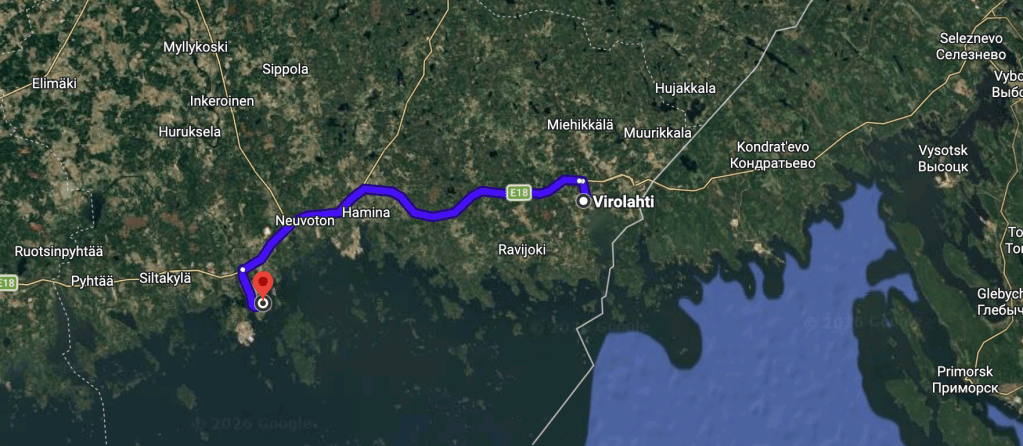
The exercises will take place across a vast area of the Finnish coastline, including Kotka, Hamina, and Virolahhti.
The “vast” area in question can be traveled by car in 45 minutes. Snapshot of Google Maps by the Russian Reader
The exact locations of the combat positions have not been disclosed.
It is understood that they will be constructed from reinforced concrete modules, and some of the fortifications will consist of underground bunkers.
Finland has been building a fence along its border with Russia and plans to complete the bulk of the work by early autumn this year.
Estonia is fortifying its border with Russia with bunkers. The country’s Ministry of Defense has announced plans to construct 600 concrete structures by the end of 2027. They are modular structures that are buried underground.
In April, the Estonians began digging a twenty-kilometer-long anti-tank trench in Setomaa Parish, which borders the Pskov Region’s Pechora District.
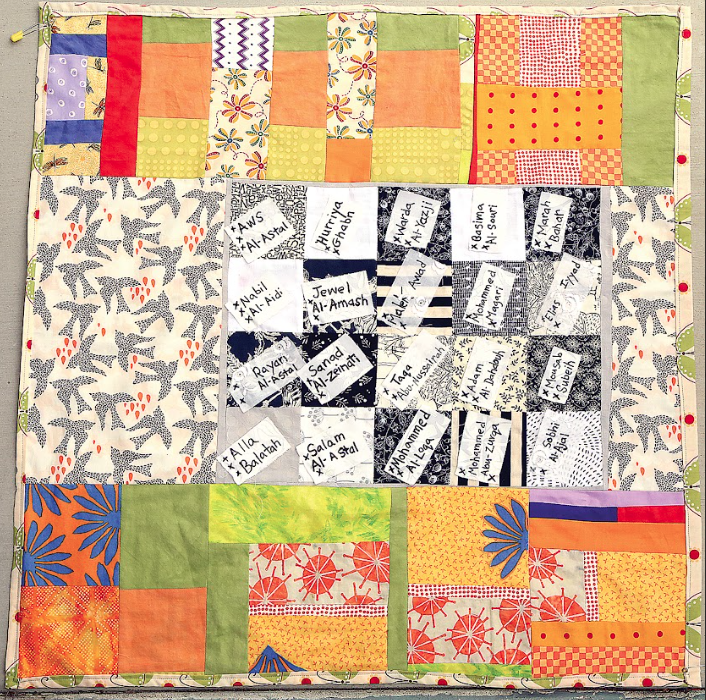
LOCAL INSPIRATION of the day. This quilt by Joleigh Kambic is part of a larger quilt titled “Babies in Gaza Who Never Made It To Their First Birthday.” The quilt is composed of smaller quilts created by nearly 40 quilters from across the Monterey Bay, commemorating the children who were killed in the Israel-Hamas war. It is on display through Oct. 3 at the Unitarian Universalist Church of the Monterey Peninsula, 490 Aguajito Road in Carmel.
“A Russia without profanity. The word mom is sacred! Speak without swearing.” Photo: Igor Stomakhin, Moscow, 2025
What can serve as the basis for new Russian post-war identity? What sort of patriotism can there be in a country which has lived through an aggressive war? Of what should the people of this country be proud? What should they associate themselves with? Republic Weekly presents a programmatic text by the sociologist Oleg Zhuravlev and the poet and activist Kirill Medvedev on how the so-called Russian nation came to 2022 and what its prospects are in 2025.
How can Russia get beyond being either an embryonic nation-state or a vestigial empire? People have been talking about this for three decades now. Does it require years and years of peaceful development? A national idea painstakingly formulated by spin doctors in political science labs? A bourgeois revolution? Or maybe just a small victorious war? The so-called special military operation in Ukraine, which has grown into a global military and political conflict, poses these questions in a new light.
In our view, large-scale social changes are happening inside Russia today, changes which could help shape a new national project.
These changes are not always so easy to spot.
According to the social critique prevalent in the independent media, wartime Russian society is organized roughly as follows. Its freedom-loving segment has been crushed and disoriented, while its loyalist segment is atomized and under the thumb of government propaganda, which preaches xenophobia, imperialism and cynicism. Society is fragmented and polarized, suspended somewhere between apathy and fascism. But these tendencies, which are certainly important — and therefore visible to the naked eye, as well as exaggerated by the liberal discourse — are nevertheless not absolute and probably are not even the most important. Society lives its own life, meaning that different groups within it live their own lives and move in their own directions. When you analyze the trajectories of that movement you get a better sense of the major pathways along which these groups might in the future coalesce into a new nation.
Despite the official rhetoric about unity during the war years, the regime has not managed to consolidate a nation, but it has laid the groundwork for its formation in the future. This has been significantly aided by the west’s anti-Putin policies and the information war waged by the new Russian emigration’s radical wing, which speaks of the collective guilt of all Russians, of their culture and language. Consequently, the only alternative to Putinism and war has seemed to be the disenfranchisement of all Russianness, and the only alternative to official government patriotism has been the “fall of the empire.” Meanwhile, there have been and continue to exist images of the country and modes of attachment to it which cannot be reduced to either of these two options.
THE NEW RUSSIAN PATRIOTISM
The idea of a new Russian identity was expressed succinctly by Boris Yeltsin on 22 August 1991, when he said that the attempted coup had targeted “Russia, her multi-ethnic people” and her “stance on democracy and reform.” The new modern Russian identity was supposed to be the result of choosing Europe, overcoming the archetypes of slavery and subjugation, and transcending the legacies of the October Revolution, interpreted as a criminal conspiracy and lumpenproletarian revolt, and of the Soviet nation as a grim community of “executioners and victims.”
Ultimately, though, it was the reforms themselves, along with the trauma of losing a powerful state, that generated Soviet nostalgia and a new version of Stalinism. [Yeltsin’s] shelling of the [Russian Supreme Soviet] in 1993 and the dubious 1996 presidential election, which many initially regarded as a triumph for the liberal project, proved to be its doom.
Despite the fact that advocates of the radical anti-liberal revanche were momentarily defeated and exited the scene, widespread disappointment and depoliticization was a barrier for further democratization through people’s involvement in politics. The story of 1991 spoke clearly about what the new Russians could take pride in: victory over the revanchists, for which they had taken to the streets and sacrificed the lives of three young men. Subsequently, amid the chaos and bloodshed of 1993, two ideological projects of Russian identity took shape which were mostly in competition with each other, splitting civil society in the period that followed.
LIBERALS VS. THE RED-BROWN COALITION
Vladimir Putin was nominated to strengthen the new capitalism and prevent a “Soviet revanche.” But his most successful project, as was quickly revealed, actually lay in the Soviet legacy’s partial rehabilitation. Putin managed to bridge the gap of 1993: he drew in part of the pro-Soviet audience (by using patriotic rhetoric, bringing back the Soviet national anthem, and taking control of the Communist Party) and drove the most intransigent liberals and democrats into the marginal opposition. The grassroots yearning for a revival of statism, which had taken shape in the early 1990s, was gradually incorporated into the mainstream. Many years later, this enabled things that would have been impossible to imagine even during the Brezhnev era, let alone during perestroika: the erecting of monuments to Stalin, the creeping de-rehabilitation of Stalinism’s victims, the normalization of political crackdowns as the state’s defense mechanism, and, consequently, a greater number of political prisoners than during the late-Soviet period.
Today’s ideal Russians, in Putin’s eyes, are those who identify themselves with all of Russian history from Rurik to the present, see that history as one of continuous statehood, and regard the periods of turmoil (the early sixteenth century, post-revolutionary Russia, the 1990s) as instances of outside meddling which should never be repeated.
The ideological struggle over Russia’s image during the Yeltsin and Putin years was thus rooted in the opposition between the liberal narrative (based on Yeltsin’s reforms) and the Stalinist great power narrative. Putinism, which is institutionally rooted in the Yeltsin legacy, acted as a kind of arbiter in the argument between the Shenderovich and Prokhanov factions, but gradually dissolved 1993’s great power Stalinist and White Russian imperial legacy into semi-official rhetoric.
But was this semi-official rhetoric part of the national identities of ordinary Russians? Or were their national identities not so thoroughly ideologized?
Did most of the country’s citizens even have national identities during early Putinism, which deliberately atomized and depoliticized society?
THE ESCALATION OF NORMALITY
Amid the relative prosperity, socio-economic progress, and apoliticality of the 2000s we see the emergence of a new, rather de-ideologized, “normal” everyday patriotism, involving a decent life, good wages, and an image of the country which made one proud rather than ashamed. Research by the sociologist Carine Clement has shown that this brand of patriotism could be socially critical and emerge from the lower classes (who criticized the authorities for the fact that far from everyone enjoyed good wages), but could also be more loyal to officialdom and come from the middle classes (who believed that the country had on the whole achieved a good standard of living, or had created conditions for those who actually wanted to achieve it).
In any case, early Putinism depoliticized and individualized society, neutralizing the civic conflict between the liberals and the “red-brown coalition,” but one outcome of this ideological neutralization was that it brought into focus something given to citizens by default: their connection to the motherland. This connection is not conceptualized through belonging to one ideological camp or another. It is grasped through one’s sense of the value possessed by a normal, decent life, a life which all the country’s citizens deserve individually and collectively.
This value was politicized after 2011. The Bolotnaya Square protests launched a peculiar mechanism: the escalation of normality. One author of this article recently decided to go back and re-analyze the interviews PS Lab did with people who protested in support of Navalny in 2021. The analysis showed something interesting: the most “radical” protesters, the people most willing to be detained and arrested, who wanted to go all the way and topple Putin, turned out to be the most “normal.” They were middle-class people whose demands were measured and respectable.
They did not dream of building utopias or radically restructuring society, but of a parliamentary republic and combating corruption. Both the Bolotnaya Square and post-Bolotnaya Square democratic movements, including the Navalny supporters, transformed the reasonable demand for a normal, bourgeois, prosperous country into the battle standard of a heroic revolutionary struggle against the Putin regime. Navalnyism, meanwhile, also integrated a measured social critique of inequality into its agenda.
The “normal patriotism” of the lower and middle classes thus became a stake in a fierce political struggle.
The new patriotic pride might have said something like this: “We can expose and vote out corrupt officials, push back against toxic waste dumps and insane development projects, vote in solidarity, and hit the streets to protest for the candidates we support whom Moscow doesn’t like. We have people who look to the west, people who miss the USSR, and people who defended the White House in 1991 and in 1993. We face Putin’s truncheons and paddy wagons together, and together we demand democratic freedoms and social justice.” This was how a civil society made up of Navalny fans, radical communists, and regional movements might have fought together for a “normal” country, how they might have shaped the political project of a vigorous nation pursuing solidarity. They might have done it, but they didn’t have time. They did manage to piss off the Kremlin, though.
In response, the regime launched its own escalation of normality. On the one hand, it responded to the protests with radically conservative counterrevolutionary propaganda and crackdowns. On the other hand, behind the façade of radical conservativism, Putinism erected its own edifice of “normality,” which would prove to be truly durable. Beginning in 2011, the Kremlin appropriated part of the Bolotnaya Square agenda not only in its slogans but also in practice by improving the quality of the bureaucracy, raising living standards, technocratically upgrading public amenities, and advancing technological progress. Sobyanin’s Moscow was the testing ground and façade of a new normalization which involved no democracy at all.
But the real escalation of normality on the Putin regime’s part occurred when the special military operation kicked off in 2022.
WAR, (AB)NORMALITY, AND PATRIOTISM
The war has been something profoundly abnormal for many people. It has meant a break with normal life and with any hopes for a normal country. This is what the war has meant for many people, but not for all of them.
PS Lab’s research has shown that a segment of the Russian populace, the middle-class economic beneficiaries of the new wartime economic policy, argue that Russia is now approaching the image of a normal country, even if they do not support the war. According to them, it is not the war per se but the concomitant economic progress (visible, for example, in the growth of wages and the creation of jobs) and the strengthening of national identity which have finally put paid to the period of crisis and launched a stage of growth.
Their argument goes like this. They do not know the reasons behind the tragic special military operation, which has taken tens of thousands, maybe hundreds of thousands of lives, but in trying to cope with this tragedy, they have strengthened the Russian economy and become more patriotic.
What matters is that the idea of growth is firmly separated, in the minds of such people, from the official “goals and objectives” of the special military operation and its ideological framework. It transpires that heavyweight official patriotism is digested by a significant part of society in a milder form. PS Lab’s respondents claim that they do not support violent methods of resolving foreign policy conflicts and are indifferent to the annexation of new territories, but that it has been a good thing that they have begun to think more about the motherland.
Wartime Putinism has two faces, in other words. On the one hand, we see war, increasing crackdowns, and spasms of neo-imperialist ideology. On the other, Russians are not overly fond of those things. They value other things more, such as economic growth and the strengthening of national identity, which unites the segment of society who feel alienated by the state’s ideological and foreign policy projects. When thinking about their own patriotism, many Russians underscore the fact that it is not defined by imperialist ideology. The country is going through a difficult moment, so would it not be better for Russia to take care of itself, rather than worry about acquiring new lands? This has been a leitmotif in many interviews done by PS Lab.
Economic nationalism in the guise of military Keynesianism and the sense of community experienced by citizens going through trials (in their everyday lives, not in terms of ideology) have thus laid the foundations less for an imperial project, and more for the formation of a “normal” nation-state.
Nor is the issue of democracy off the table: it has been missed not only by the opponents but also by the supporters of the special military operation. We welcome the growth of a sovereign economy, but if Putin strangles civil society and lowers the Iron Curtain, we will be opposed to it, say the quasi-pro-war volunteers. For them, however, Putin remains the only possible guarantor of a “normal” future. Many Russians who want an end to the war and a future life without upheaval have pinned their hopes on the president for years.
This focus on gradually developing and civilizing the country is nothing new. Since the 1990s, part of the intelligentsia and, later, the new middle class, pinned their hopes first on the reforms of the pro-market technocrats, then on the successes of a then-still-liberal Putinism, then on Kudrin’s systemic liberals, then on Sobyanin’s policies, and so on.
Something went wrong, and many of these people are now in exile, but it is quite natural that images of a normal life and a normal country, albeit in radically altered circumstances, continue to excite Russians. Normality can be politicized, however, as it was between 2011 and 2022.
The social movements and the independent opposition which emerged after the Bolotnaya Square uprising have been virtually destroyed by the regime: the last bright flashes of this tradition faded before our eyes at the 2022 anti-war rallies. Nevertheless, the tradition of democratic protest continues. As before the war, the latter can grow from the demand for normalcy.
Moreover, the demand for normalcy can sound particularly radical in wartime.
The hardships of war have given rise to movements such as The Way Home, whose activists, wives of mobilized military personnel, have evolved from human rights loyalism to collective protest as they have demanded a return to normal life. Starting with individual demands for the protection and return of their loved ones from the front, they then arrived at a national agenda of fighting for a “normal” and even “traditional” country in which every family should have the right to a dignified, happy and peaceful life.
After a period of struggle between the two versions of patriotism born in the 1990s, liberal and neo-Soviet, the time for everyday “normal” patriotism has thus dawned. Initially, it existed as a public mood which was not fully articulated, but subsequently we witnessed a mutual escalation of normality on the part of warring protesters and the Kremlin.
The “post-Bolotnaya” opposition, led by Navalny, launched a revolutionary struggle with the regime over the project for a “normal” bourgeois country, attempting to create a broad movement that would reach far beyond the former liberal crowd. In response, the Kremlin unveiled its neo-imperialist militarist project with one hand, while with the other hand it satisfied the public demand for normality on its own after the opposition had been defeated.
TWO SCENARIOS FOR A NORMAL RUSSIA
The above-mentioned contradictions of the Putinist discourse and the complex realities of wartime (and the postwar period?) allow us to imagine two scenarios for society’s growth, the realization of two images of Russian patriotism. In other words, we see two scenarios for a socio-political dynamic which could culminate in the creation of a new nation.
Military Putinism, contrary to its radically imperialist image, has in terms of realpolitik and public sentiment put down certain foundations for the formation of a nation-state in Russia.
If economic growth, redistributive policies, and the strengthening of everyday patriotism continue after the end of the war and captivate the majority or at least a significant segment of society, the project of turning Russia into a nation-state from above will have a chance.
Whether it materializes depends on many unknowns. Will the government be able to maintain economic dynamism after dismantling the wartime economy? Will everyday patriotism turn into a solid ideological edifice? Will the end of the war be followed by a liberalization of political life? (Is this possible at all?) Will the current pro-war and anti-war volunteerism serve as the basis for an industrious, widespread civil society? Will there be a change of elites?
Russia’s transformation into a nation-state under these circumstances would constitute a serious paradox. It would thus emerge not after a lost imperialist war or a war of national liberation, but in the wake of a partly successful war, which evolved from an imperialist war into a nationalist war. What would hold such a society together?
It is easiest to envision an identity based on Russia’s opposition to the west on the basis of geopolitical confrontation or economic and technological competition, especially if a fierce struggle between newly emerging geopolitical blocs lies ahead. This confrontation with the west, which we allegedly have pulled off with dignity (even if we are willing to recognize the special military operation itself as a dubious event), will be accompanied by various practices and emblems of cultural uniqueness.
But will this new nation be capable of producing a powerful culture, as in the nineteenth and twentieth centuries? Or will this future Russia be doomed to cultural and intellectual degradation as presaged by Dugin’s philosophy and pro-war poetry?
There are serious doubts that the grounds listed above would be sufficient for a multi-ethnic and multicultural entity like the Russian Federation to turn into a national community united by an understanding of a common destiny and values. The USSR as a community was based on the complex mix of the new Soviet individual and Russocentrism that took shape in the Stalinist period. The roles of this dynamic duo are currently played by the adjective rossiyskiy, which is a designation of civic membership in a multi-ethnic community, and the similar-sounding adjective russkiy, which is a grab bag of several easily manipulated meanings.
Putin is responsible for regular messages about multi-ethnicism, while numerous actors in the government and the loyalist media are charged with sending signals about Russian ethnicism. In this bizarre system, ethnic Russians, on the one hand, constitute a “single nation” with Belarusians and Ukrainians; on the other hand, they vouchsafe the coexistence of hundreds of other ethnic communities, supposedly united by “traditional values” (and, no matter how you look at it, the most important of these values is the rejection of homosexuality); while, on the third hand, they have a special message for the world either about their own humility, or about the fact that they will soon “fuck everyone over” again.
This complex edifice has been looking less and less persuasive. The zigzags and wobbles of the political top brass — Russia has swerved from alliances with North Korea and China to newfound friendship with the United States; from casting itself as a global hegemon to posing as an aggrieved victim — do nothing to help Russians understand who we are. They have, however, stimulated the growth of local, regional, ethnic narratives and identities which are much more reliable and comfortable. Ethnic brands, music and art projects involving folkloric reconstructions, the vogue for studying the languages of the peoples of the Russian Federation, and the plethora of Telegram channels about ethnic cultures and literatures are all outward signs of the new ethnic revival. Although they do not seem as provocative as the forums of radical decolonizers, they correspond less and less with a vision in which ethnic Russianness is accorded a formative role, while “multi-ethnicity” is relegated to a formal and ceremonial role.
When we draw parallels with the Soviet identity, we should remember that it was based not simply on a set of ideological apparatuses (as the current fans of censored patriotic cinema and literature imagine), but on a universal idea of the future, on the radical Enlightenment project of involving the masses and nations in history (including through “nativization” and the establishment of new territorial entities). The project had many weaknesses from the outset, and it was radically undermined by the deportation of whole ethnic groups and the anti-Semitic campaign (for which the current regime has less and less desire to apologize), but as the British historian Geoffrey Hosking has argued, the fundamental reason for the Soviet Union’s collapse was the lack of civil institutions in which the emerging inter-ethnic solidarity could find expression.
If an ethnic cultural and regional revival really awaits us amid war trauma, confusion, possible economic problems, and the deficit of a common identity, how would Moscow handle it? Would it try to control or guide the process? Or maybe it would focus on loyal nationalists and fundamentalists in a replay of the Chechen scenario? This may turn out to be a prologue to disintegration, or it may serve as the field for establishing new community. The radical democratic opposition, once it has a chance, would simply have to combine local, regional, and ethnic cultural demands with general social and democratic ones.
It is for the sake of this that we must rethink the imperial legacy, the Soviet project with its complex mix of colonialism, federalism and modernization, the way communities have lived together for centuries on this land, sometimes fighting and competing, sometimes suffering from each other and from Moscow, sometimes evolving, and sometimes coming together to fight the central government (as during the Pugachev Rebellion).
This combination of civil struggle and intellectual reflection can not only generate a fresh political counter-agenda but also reanimate the worn-out leitmotifs and narratives of Russian culture.
It can reintroduce the productive tension and contradiction, the universality inherent in a great culture, which the regime, while oppressing and exiling critical voices, has been trying to replace with an emasculated, captive patriotism.
***
We want a quiet private life without upheaval, the life which generations of Russians have dreamed of; we want to be independent, stick to our roots and remain who we are, says one group of our compatriots.
We want to overcome dictatorship, political oppression, inequality, corruption and war; we want to live in a society based on freedom and solidarity, says another group of our compatriots.
Interestingly, both of these scenarios are revolutionary. The first scenario, despite its adoration of technocracy and the petit bourgeois lifestyle, is the result of an anti-democratic revolution from above, during which the authoritarian regime has been transformed from a predominantly technocratic to a counter-revolutionary one and has challenged both the world order and the domestic political order. The abrupt transition to a redistributive military Keynesian macroeconomic policy, which was unthinkable ten years ago, and which fuels the current workaday patriotism, has emerged as part of the war. The war itself has been the decisive event of Putin’s counterrevolution, which, like any counterrevolution, always bears certain revolutionary traits.
But while the first scenario (albeit with a new, rather sinister twist) epitomizes the long-standing dream of a bourgeois life based on comfort and tradition, the second draws on a more grassroots and rebellious vision of social progress and related practices. It hearkens back to the defenders of the Russian White House in 1991 and 1993, the protesters against the monetization of benefits and the Marches of the Dissenters, the radical segment of the Bolotnaya Square movement, and the street movements in support of Navalny and Sergei Furgal. History, including Russian history, knows many such examples of new national communities emerging in radical joint struggles for democracy and justice.
Both scenarios could be generated by the current catastrophic reality, and both are fraught with fresh dangers: the first with the threat of a new descent into fascism, the second with violent civil conflicts. In our opinion, though, it is these two scenarios which shape the field for analyzing, discussing and imagining the country’s future.
Faithful to its avant-garde nature, Noise Cabaret premieres the immersive series Dialogues, based on the philosophical works of Plato, on December 25. Alexander Khudyakov turns ancient Greek philosophy into a lively, witty and provocative dialogue with the audience.
Along with his partner Ivan Wahlberg, Khudyakov, who not only acts in the project but directs it, will guide the audience through the labyrinths of Plato’s thought. What is justice? Where is the line between existence and non-existence? What is the true nature of love? These and many other fundamental philosophical questions will serve as starting points for reflection and debate.
Dialogues is a series of interactive performances in which each viewer is involved in a philosophical discussion consisting of adapted texts by Plato and actorly improvisation, meaning that the way the performance goes depends on the audience’s involvement. Each new performance is a separate chapter dealing with a specific philosophical problem, so you can join the series at any stage. The first episode deals with the concept of justice.
Noise Cabaret plans to invite Petersburg celebrities to enrich the conversation with the audience with their own opinions and views.
Khudyakov shared the idea behind the project.
“We wanted to do a story related to people talking in a bar. But just people talking to each other is not interesting. There has to be a big focus. When I studied Plato, I was interested in several aspects of his philosophy. It would have been wrong to limit ourselves to a single topic. So the idea to make a series arose: take Plato, read him, and discuss the themes he raises in the Socratic dialogues.
“We plan to produce a new episode every two or three months. There’s no pretense here that we’re serious scholars of Plato’s philosophy: it’s more of an excuse to talk to people about difficult topics, to air the Dialogues and reflect on them. And a bar is a place where you can talk about all sorts of things, including philosophy.”
Russians spent almost 6 billion rubles on Ozempic generics in 2024
Semaglutide-based drugs are commonly used for weight loss
In the first ten months of 2024, Russians spent 5.9 billion rubles [approx. 52 billion euros] on over one million packs of generic versions of the drug Ozempic (semaglutide), according to DSM Group, as reported by Vedomosti.
Among the most popular generics are Geropharm’s Semavic and Promomed’s Quincenta. The original drug Ozempic stopped [sic] official supplies to Russia in December 2023, opening the market to domestic analogues.
2024 was a record year for drugs in this category. By comparison, in 2023, Russians spent only 297 million rubles on Ozempic, buying 20 thousand packs. In 2022, they spent 1.9 billion rubles (256 thousand packs); in 2021, 758 million rubles; and in 2020, 76 million rubles.
Semaglutide-based drugs are used to treat diabetes but have recently been gaining popularity as weight loss drugs, which has also contributed to their sales growth in Russia.
St. Petersburg will open a new metro station this week, Governor Alexander Beglov announced Thursday, marking the former Tsarist capital’s first new metro station in five years.
The Gorny Institute metro station, located on Vasilievsky Island, will extend the fourth (or “orange”) line westward. It will begin operations at 9:00 a.m. on Friday, with its vestibule open for both entry and exit, Beglov said.
“The opening of Gorny Institute is a milestone,” the governor wrote on Telegram, noting that the city had overcome “significant challenges” during the station’s construction.
Beglov thanked President Vladimir Putin, metro builders, engineers and residents of St. Petersburg for their patience and support, calling the station’s completion the “first results” of sustained efforts to advance the city’s metro system.
The station’s opening comes after years of delays. Initially scheduled for completion in 2015, its opening was postponed to 2018 and later to 2022. Construction efforts were further overshadowed by a fatal scaffolding collapse in June 2020 that killed one worker and injured another.
Gorny Institute is the first station to open since 2019, when three others — Prospect Slavy, Dunayskaya, and Shushary — were inaugurated.
St. Petersburg’s metro is currently made up of five lines and 72 stations. However, it has expanded slowly over the years, in stark contrast to Moscow’s burgeoning metro system, which this year opened eight new stations.
In trying to grasp the tonality of the film [Anora], I am reminded of a line from Francis Bacon: “You can be optimistic and totally without hope.” The situation the characters find themselves in, being at the mercy of the rich, is totally without hope. The “hopeful” version of the script would be one in which Vanya does stand up to his parents and runs off with Ani, even at the price of losing his wealth—this is the film’s narrative lure. Or maybe another where the ruthless capitalist mother gains a grudging respect for her tough daughter-in-law, like in the last season of Fargo. But despite its grim closure, the impression the film gives is far from dreary or pessimistic. The hopeless optimism of Baker’s cinema lies in the sheer life that seems to almost burst out of the filmic frame, and, especially, his deep care for his characters, even Vanya.
In the fall of 2023, with the goal of understanding what is really happening with Russian society during wartime, the Public Sociology Laboratory team went on ethnographic research trips to three Russian regions—Sverdlovsk, Krasnodar and Buryatia. Over the course of a month, PS Lab researchers observed how people talk about the war and how it affects daily life in cities and villages. In addition, they recorded sociological interviews with local residents. PS Lab has compiled three detailed ethnographic observation diaries (more than 100,000 words apiece) and conducted 75 in-depth interviews. Overall, it has managed to collect truly unique data that provides an idea of what people say and think about the war in everyday situations, and not only when answering researchers’ questions.
The full text of the report is book-length and written in a book-style format: it consists of seven chapters, introduces many characters, and allows readers to be fully immersed in contemporary wartime Russia. The following summary, meanwhile, highlights the main analytical conclusions.
Russian society remains politically demobilized and deideologized. Despite the prevailing opinion that it is strictly militarized, we see that the war has become routine and therefore a disregarded part of reality. For example, compared to the first years of the war, the amount of prowar symbolism in public spaces has decreased in all three regions. The war has neither become a source of new ideas in the cultural life of cities or villages nor been integrated into familiar and already-established cultural formats. The war is not discussed in public places, including, with rare exceptions, local online communities.
In spontaneous conversations, Russians rarely discuss the overall goals and causes, criminality, or justifications of the war. They are concerned with the impact of the war on their everyday lives. When they talk about the war, they mostly talk about the same things they discussed before the war, for example, everyday difficulties, money, or ethics. Men more often discuss topics that are considered “masculine” in society, such as the technical side of the war, and women usually talk about “feminine” topics, such as how war destroys families.
Participation in various types of prowar volunteering and organized assistance for the military, which are often cited as an example of the mobilization and militarization of Russian society, is rarely motivated by people’s firm support for the “special operation.” It is usually associated with pressure from the administration, community moral norms (concerning mutual assistance), and/ora desire to help loved ones, rather than a wish to make victory for Russia more likely. Observation of volunteers’ activities show that while working, they do not discuss the war or politics, rather choosing topics that are personable and relatable to them: prices, pensions, families, and/or stories related to the volunteer centers.
Despite all these similarities, the war is perceived slightly differently in different regions. The peculiarities of each region’s view owe to factors like the number of military units and penal colonies from which prisoners are recruited, proximity to the combat zone, the prosperity of the region and the availability of decent jobs, the density of social ties, the circulation of news transmitted by friends on the front lines, etc. In other words, the differences in perceptions of the war are attributable mainly to the peculiarities of life in the regions before the invasion of Ukraine.
The conflict between opponents and supporters of the war is gradually subsiding, while the rift between those who stayed in Russia and those who left is growing. This is happening both because the shared experience of living through a difficult situation within the country is becoming more important for many Russians than any differences in viewpoint, and also because people are discussing the war less.
At the same time, the waning conflict between opponents and supporters of the war does not always mean more social cohesion. Since people are trying to live as if the war is nonexistent and the government does not talk about any losses or problems associated with the war, all negative consequences of the war are either normalized or pushed into the realm of “personal problems” that are not discussed with anyone and that everyone must deal with on their own.
Overall, many people do not feel able to influence political decisions. Therefore, they are increasingly distancing themselves from the war. They understand that they cannot change government policy, but they retain at least some control over their private lives—and therefore they are immersed in them. Over time, not only apolitical Russians but even sure opponents of the invasion experience this powerlessness and, as a result, some of them accept the new reality while continuing to condemn the war internally.
Consequently, many Russians are increasingly distrustful of political news from a broad range of sources. Instead, they put their trust in local media. Local problems and news seem much more important and relevant to them. Moreover, they feel that, unlike the war, local issues are at least sometimes within their ability to influence.
At the same time, the war is weighing people’s emotional state. Many of our interlocutors admit that they experience anxiety, tension, uncertainty, fear, even if these things are not usually spoken about openly. The departure of sons and husbands to war makes women “scream at the top of their lungs.” However, people rarely share such emotions with others, and if they do, they do so in groups with close friends.
Many Russians who are not interested in politics may justify or condemn the war depending on the communicative context.
They tend to non-emotionally justify the war through normalization (“there are always wars”) or rationalization (“it was necessary”) when asked about it directly in more formalized settings, such as research interviews.
They are more likely to criticize the war when prompted to think about how it negatively affects them as ordinary Russians. This criticism differs from that of war opponents. For opponents, the war is a moral crime against Ukraine, whereas for apolitical Russians, the war is seen as something that destroys Russian society and harms ordinary people. However, this criticism does not lead apolitical Russians to question the war’s necessity or inevitability, nor does it extend to criticizing the Russian government.
They tend to emotionally justify the war when confronted with traditional anti-war narratives. When Russia is accused of committing moral crimes against the Ukrainian people, they often take such accusations personally and attempt to defend their own dignity.
Some people have experienced a strengthened sense of national identity, and sometimes a demand for greater solidarity arises. It’s important to note that this increased sense of national identity does not lead Russians to adopt the official imperial brand of nationalism. Unlike the Kremlin, ordinary people live in a world of nation states, not in a world of imperial fantasies (according to which Ukraine is not a real state and Ukrainians are an inferior people).
A feeling of uncertainty is what truly unites Russians today. Despite the fact that people choose various strategies to cope with this feeling, it still significantly complicates the ability to plan one’s life and plunges Russians into pessimism.
Thus, on the one hand, the formerly extraordinary nature of the war is giving way to normalization: the war is gradually becoming something ordinary, another unremarkable part of the surrounding world. In a sense, many Russians resist both the Kremlin’s attempts to turn ordinary citizens into ideological supporters and the attempts of the anti-war liberal opposition to force society to actively experience guilt and fight. On the other hand, the war constantly reminds us of its existence, creating new threats, new anxieties, and new reasons for discontent in Russians.
Dear readers! Times are tough, and the key in this case is holding on in every sense. No one says it’s easy. But it’s not so hard either. The other day I asked Vladimir Putin whether he expected anything more from himself in the outgoing year. But I want to ask you: do you expect anything more from yourself in the coming year? We need to expect things. We need to want things. It’s a way of holding on to ourselves. Of looking after ourselves. Of not losing ourselves. And even of finding ourselves. A hard sign (“Ъ”) will never be a soft sign (“Ь”)! Happy incoming New Year! Let’s not be on the defensive!
Andrei Kolesnikov, Special Correspondent, Kommersant Publishing House
Source: Email from Kommersant, 31 December 2024. Translated by the Russian Reader. The so-called hard sign, which the Bolsheviks dropped from the Russian Cyrillic alphabet in 1918, has been the logo of Kommersant since the newspaper’s relaunch in January 1990. Andrei Kolesnikov has been the newspaper’s special Kremlin correspondent — that is, its chief Putinversteher — for many years. Of course he’ll deny it all when push comes to shove and Putin goes, and he’ll point of course to the cynical, jocular (but ultimately loyal) way he’s written about the Russian dictator and war criminal all these years.
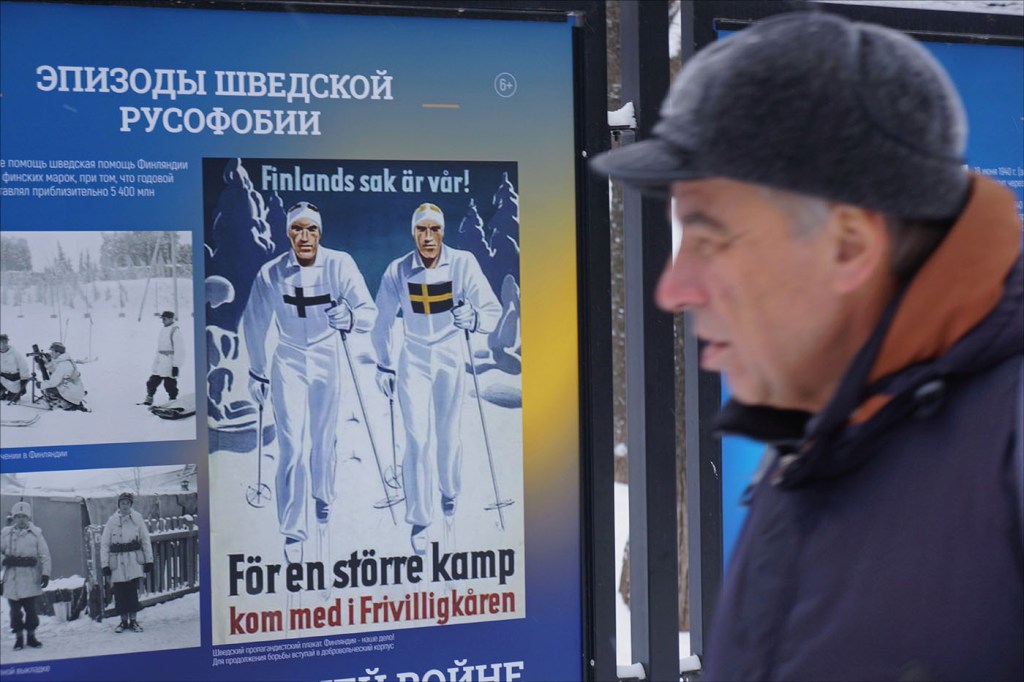
Igor Stomakhin, “Episodes of Swedish Russophobia.” It is part of the informal series Moscow, 2023, posted on the extraordinary photographer’s essential Facebook page periodically throughout the past year
Russia’s Interior Ministry has proposed requiring foreigners who visit Russia to adhere to an “agreement of loyalty,” the state-run TASS news agency reported Wednesday, citing a draft law prepared by the ministry.
According to the draft law, foreigners staying in Russia would be prohibited from “hindering the activities of public authorities of the Russian Federation [or] discrediting in any form the foreign and domestic state policy of the Russian Federation, public authorities and their officials.”
They would also be prohibited from “denying traditional family values and distorting the contribution of the Soviet people to the victory over fascism,” according to TASS.
In addition, foreigners would need to agree that they will not “show disrespect for the diversity of regional and ethnocultural ways of life of the Russian population, traditional Russian spiritual and moral values.”
Valentina Kazakova, who heads the Interior Ministry’s migration department, said the draft proposal for an “[agreement of loyalty] was being discussed” and would “soon be sent to the [lower house] State Duma” for consideration, according to TASS.
She did not provide a more specific timeline.
At the same time, it was not clear from TASS’s report whether the Interior Ministry’s proposal would require foreigners to sign a physical agreement form upon entering Russia.
In 2021, the Interior Ministry suggested introducing a similar loyalty document for visiting foreigners, but the proposal never reached the State Duma, according to the Kommersant business daily.
“Retarget Washington. RS-28 Sarmat. Sarmatmobile. For a sovereign Russia.” The Sarmatmobile is, apparently, the work of NOD, the National Liberation Movement, who were profiled in this recent VICE News video.
Does it make sense to torch military enlistment offices? The short answer is no. And here’s why not.
From the outset of the mobilization in Russia, military enlistment offices have been targeted by arson attacks. We realized that this appears striking and effective and may seem like a good way to voice your protest. But is this really the case? Let’s unpack it.
1. It is ineffective. Most often, arson does not damage individual records in any way — the fire is either put out in time, or there is no fire at all. There are no exact statistics here, but an analysis of news reports about the arson attacks confirms that in most cases they didn’t accomplish anything.
Moreover, the authorities have now started digitizing conscript databases, which will soon render the destruction of paper files meaningless.
2. It involves very (!) high risks. Statistics show that arsonists are very often tracked down by the police: 48% of activists involved in arson attacks have been detained.
If you are caught, a criminal case and a hefty prison sentence are virtually inevitable. Moreover, these arson attacks are most often charged as “terrorism” — and the people charged face up to fifteen years in prison if convicted.
3. It endangers others. Military enlistment offices are often guarded, which means that the watchmen may suffer. In addition, military enlistment offices are sometimes located in or near residential buildings, and the fire can spread to them.
4. There are other ways to resist that are safer and more effective. Considering all of the above, simply talking to friends and relatives (and writing on social media) about how to avoid mobilization seems to be a much more effective and safer means of resistance.
We have compiled a complete list of methods of online and offline resistance here.
What protest methods you choose is your decision alone, of course. But we urge you to be aware and prudent in this matter and not to give in to emotions. Much more good comes from activists who aren’t in jail.
“Russian Army: A Time of Heroes Has Chosen Us.” Source: Igor Stomakhin, Facebook, 5 January 2023
On January 11, Vesna surprised me more than ever. Have you already read the post [translated, above] with (almost) the same name?
I’ll admit that I didn’t even know about this movement until February 24. But after the start of they full-scale invasion, they proved their mettle, unlike other public movements. From the earliest days of the war, they spoke out against the invasion and urged people to protest. Vesna announced mass protests while other liberal democratic organizations took no decisive action. Neither [Alexei Navalny’s] Anti-Corruption Foundation nor [opposition liberal party] Yabloko, for example, supported the call for mass street protests then. Vesna called for and was involved in the protests themselves, for which its members were persecuted and the movement was designated “extremist” by the authorities.
I try not to criticize methods and approaches to anti-war protests: everyone has the right to protest and resist as they are able and see fit. Today, however I want to speak critically about Vesna and respond to the piece, entitled “Does it make sense to torch military enlistment offices? The short answer is no. And here’s why not.”
Let’s analyze the arguments made in the post.
1. Ineffectiveness. Vesna claims that torching military enlistment offices makes no sense, since military enlistment records are not destroyed as a result of these actions. Indeed, many arson attacks on military enlistment offices have caused quite superficial damage: the flames did not spread into the offices where the paper files of conscripts might have been stored. However, this has not always been the case. For example, as a result of the actions taken by Ilya Farber (a village schoolteacher), the room in a military enlistment office where official documents were stored was destroyed by fire, as was a room at a recruiting office containing the personal belongings of employees. Moreover, we should bear in mind that the authorities and propagandists have a stake in downplaying the damage from such attacks.
When analyzing direct actions, it is also important to take into account what the guerrillas themselves say, and not to talk about the abstract results of possible actions. Did they want to destroy records at all? Moreover, it is not only military enlistment offices that are set on fire. For example, Bogdan Ziza, who threw a Molotov cocktail into a municipal administration building in Crimea, explained his motives as follows: “[I did it] so that those who are against this war, who are sitting at home and are afraid to voice their opinion, see that they are not alone.” And Alexei Rozhkov, who torched a military enlistment office on March 11, argues that the actions of guerrillas forced the authorities to withdraw conscripts from the combat zone.
If we talk about effectiveness in terms of direct action, then Vesna’s criticism is patently ridiculous: the movement has never proposed direct action tactics. If the railway saboteurs, for example, argued that torching military enlistment offices was “ineffective,” that would be a different conversation.
As for the digitization of draftee records, at the moment there is no information that it has been successfully implemented, except for claims by the authorities about staring the process. On the basis of the first wave of mobilization, the Moscow Times explained why rapid digitization of the Russian draft registration system is impossible under present conditions.
2. High risks. Indeed, people are persecuted for torching military enlistment offices. But anything else you do to counteract the Russian military machine is also fraught with high risks. You can now get a long stint in prison for the things you say. Not only Moscow municipal district councilor Alexei Gorinov (7 years) and politician Ilya Yashin (8.5 years) but also Vologda engineer [sic] Vladimir Rumyantsev (3 years) have already been handed harsh prison sentences for, allegedly, disseminating “fake news” about the army. To date, these sentences have been even harsher than those already handed down for anti-war arson. It is impossible to assess in which case it would be easier for the state to track you down and persecute you — after you torched a military enlistment office, or after you publicly posted the truth about the war. It all depends, primarily, on the security precautions you take.
3. Endangering lives. Vesna’s arguments on this score completely echo the wording of pro-government media and prosecutors’ speeches: allegedly, when a military enlistment office is torched, people could get hurt. Attention! Since the beginning of the full-scale invasion, guerrillas have carried out more than eighty anti-war arson attacks and not a single living being has been harmed! The guerrillas carry out their actions at night and plan attacks so that people do not get hurt. This is how they are discussed on the direct action Telegram channels, and the guerrillas themselves say the same thing.
4, Unsafe and ineffective. As an alternative to arson, Vesna suggests educating friends and relatives about how to avoid mobilization. Educating is, of course, an important and necessary thing to do. However, it alone is not enough to stop the war. They mention no other effective methods of resistance in their post.
I would suggest that you draw your own conclusions.
Finally, I have a few wishes. If you are planning any action that the state may regard as a criminal offense — a guerrilla action or an anti-war statement — please assess the risks and take all possible security precautions. To do this, use the guides that have been compiled online and study the know-how of forerunners. Keep in mind that even this may not be enough. Recommendations on physical security from the Combat Organization of Anarcho-Communists (BOAK) can be found in this article published DOXA. And to learn the basics of digital security, take a look the website Security in a Box.
You can find even more guides to security on the internet: don’t neglect perusing them and follow the rules they establish daily. The time you spend working through questions of security will in any case be less than the time spent in police custody in the event of your arrest after a protest action or a careless statement on the internet.
Study the safety guides mentioned in the introduction, if you thought it was not so important or had put it off for later.
How сan you take your minds off things?
Listen to the 10th edition of the podcast Zhenskii srok (“Women’s Prison Stint”) about how women revolutionaries fought the good fight and how they did time in Tsarist Russia. Among other things, the podcast explains what was mean by the term “oranges” back then and why officials and security forces were afraid of “oranges.”
For many years the Russian opposition propagandised a particular manner of protest: clean, peaceful protest of the urban class, not dirtied with violence or even any pretension to violence. I was politicised at that time. I am 25, and I first went to a street demonstration when I was 17, in the second year of study at university. And I learned the lessons conscientiously: when somebody urges people to free a demonstrator who is being detained – that’s a provocation. If someone proposes to stay put on a square and not leave, or to occupy a government building – that’s a provocateur, and that person should be paid no heed.
We are better than them, because we do not use violence, and they do. Let everyone see us and our principles as unarmed, peaceful protesters, who are beaten by cosmonauts [Russian riot police] in full combat gear. Then they will understand what is going on. Why go on a demonstration? To express our opinion, to show that we are here. And if there are enough of us, that will produce a split in the elite.
Evidently, this strategy didn’t work. Whether it worked at one time is probably not so important now. I am convinced, by my own life experience, that it has failed. A year and a half ago, I recorded an inoffensive video to support student protests – and for that got a year’s house arrest. [Reported here, SP.] And in that year, the Russian authorities succeeded in destroying the remains of the electoral system, and invading Ukraine. No peaceful protest could stop them.
During that time, as the anti-Putin opposition de-escalated protests and adapted to new prohibitions — you need to give advance notice about a demo? OK. You need to set up metal detectors on site? Very good — the authorities, by contrast, escalated the conflict with society. They pursued ever-more-contrived legal cases — for actions ranging from throwing a plastic cup at a cop, to liking stuff or joking on Twitter.
We have been retreating tactically for a long time, and finally wound up on the edge of a precipice —in a situation where not to protest would be immoral, but where, at the same time, the most inoffensive action could result in the most serious sanctions. The neurosis in which a large part of Russian society now finds itself — all those arguments about who is more ethically immaculate: those who have left, those who have stayed, those who have half-left or one-quarter-stayed; who has the moral right to speak about something and who doesn’t — all this is a result of living in a paradox.
For the first few weeks after the invasion, this logic of conflict — that the opposition de-escalates and the state escalates — reached its limits. Peaceful protests came to an end. Resistance didn’t stop: several hundred people, at a minimum, set fire to military recruitment offices or dismantled railways on which the Russian army was sending arms, and soldiers, to the front.
And when this started to happen, a big part of the opposition had nothing to say. Our editorial group was one of the first to try to report on these actions, despite the shortage of information. We were even able to speak to some of the railway partisans in Russia. But much of the independent media and opposition politicians were silent.
The silence ended on 4 October, when [Alexei] Navalny’s team announced that it would again open branches across the whole country, and support different methods of protest, including setting fire to recruitment centres. A month before that, in an interview with Ilya Azara [of Novaya Gazeta, SP], Leonid Volkov [a leading member of Navalny’s team, SP] answered a question about radical actions in this way:
I am ready to congratulate everyone who goes to set fire to a recruitment office or derail a train. But I don’t understand where these people have come from, where to find them, or whether it’s possible to organise them.
Evidently, in the course of a month, something changed. In October, the branches began to collect forms from potential supporters, and on 23 December a platform was set up on the dark web, which could only be accessed via a TOR browser. Navalny’s team stated that the platform will not retain any details of its supporters. [In an interview with DOXA, Navalny’s team clarified that the branches would be clandestine online “networks”, SP.]
For some mysterious reason, news of the reopening of the branches, and of the setting-up of the platform, went practically unnoticed in the Russian media. In October, we were apparently the only (!) publication that talked with members of the Navalny team about the reopening of the branches. Organised antiwar resistance did not make it to the top of the news agenda.
It seems to me that, notwithstanding the mass of questions that political activists want to ask Navaly’s team about this, organised resistance is the only way left to us, out of the war and out of Putinism.
I have had many discussions with antiwar activists and journalists lately, about how they assess their work, nearly a year after the start of full-scale war. The majority of them (of us) are burned out: they don’t see any point in what we are doing. I think part of the problem is that a big part of our activity concerns not resistance, but help and treatment of the symptoms — evacuation and support for refugees. Our activities don’t bring the end of the war nearer, they just alleviate its consequences.
You can count the initiatives focused on resistance on the fingers of two hands. And alas, they are not very effective. A comrade of mine, with whom at the start we put together guides about how to talk to your family members about the war, joked, bitterly:
The Russian army killed another hundred people while we were thinking about how to change the minds of one-and-a-half grandmas.
To get out of this dead end, we must together think of the future that we can achieve by our collective efforts. It’s time to reject fatalism: stop waiting for everything to be decided on the field of battle and putting all our hopes in the Ukrainian armed forces (although much will of course be decided there); stop relying on the prospect that Putin will die soon, that the elite will split and that out of this split shoots of democracy will somehow magically grow. We will not take back for ourselves freedom and the right to shape our own future, unless we ourselves take power away from this elite. The only way that we can do this, under conditions of military dictatorship, is organised resistance.
Such resistance must be based on cooperation between those who have remained in Russia and those who have left. And also those who continue to come and go (and there are many of them). Such resistance can not be coordinated by some allegedly authoritative organisation. It has to be built, by developing cooperation with other antiwar initiatives —especially the feminists and decolonising initiatives, that is, with organisations that have done a huge amount of activity since the all-out invasion and who bring together many thousands of committed supporters.
Most important of all, resistance must expand the boundaries of what we understand by non-violent protest and the permissibility of political violence. We can not allow the dictatorship to impose a language that describes setting fire to a military recruitment office, with no human victims, as “terrorism” and “extremism”.
Political struggle has always required a wide range of instruments, and if we want to defeat a dictatorship we have to learn how to use them; we need to understand clearly what each of them is good for. For many years we have paid no attention to methods of resistance that, although they are not violent, require much more decisiveness and organisation. It is to these methods that we need now to return.
There is no other way of building democracy in Russia (any democracy — liberal or socialist) without a grassroots resistance movement that can win widespread support. If the majority of opposition politicians in the pre-war period hoped that democracy could fall into their laps as a gift from the elite (as a so-called gesture of goodwill), then this year it has become completely clear: we will never have any power, if we can not ourselves take it in to our own hands.
Ulrike Meinhof [a leader of the Red Army Faction in Germany, 1970–72, SP] once quoted the words of a Black Panther activist [probablyFred Hampton, SP], spoken at a conference in February 1968 against the war in Vietnam:
Protest is when I say I don’t like this. Resistance is when I put an end to what I don’t like. Protest is when I say I refuse to go along with this anymore. Resistance is when I make sure everybody else stops going along too.
This comment was published by DOXA, an independent Russian web site that has grown out of a student magazine to become a prominent voice against the war. Translation by Simon Pirani
Berlin-Friedrichshain, January 2019. Photo by the Russian Reader
There is an interesting controversy on Twitter between DOXA (a left-wing media outlet) and the Vesna Movement (liberals) about violence.
Vesna wheeled out a text arguing that torching military enlistment offices is bad, and DOXA and other leftists responded by explaining why there is no way to do without such tactics now.
In response, the liberals and the publication Kotyol (“Boiler”), which took their side, have deployed a super argument: so why don’t you go to Russia and torch these places yourself, instead of advising others to do it? They also claimed that DOXA embraces Putin’s way of thinking by sending others to get killed instead of themselves.
I’ll join in the fray and answer for myself. First, it’s none of your damn business where I go or don’t go and why.
Second, waging an armed struggle requires financing, training, experience, support bases, and much more. Now of this exists now.
Third, if you liberal assholes had not consistently advocated against every form of illegal resistance for all Putin’s years and decades in power, if you had not demonized “radicals,” just as you are doing now, if you had not readily dubbed “terrorists” all those at whom the authorities pointed a finger, the situation in paragraph 2 would have been different.
Yes, it was you who shat your pants, soiling not only us, but everyone, including the Ukrainians.
The leftists are “talking shit” about violence, but are not traveling to Russia to torch things? Well, at least we’re talking shit!
Look at yourself. The bravest of you, and there are relatively few of those, raise money for the Armed Forces of Ukraine so that Ukrainians will fight and die on your behalf. But you yourselves advocate nonviolence, my ass. Which of us are the hypocrites? Who has embraced Putin’s way of thinking?
If you have at least a drop of conscience, you’ll recall what the liberals wrote in the late nineteenth century about the Decembrists and Narodniks and at least shut your traps on the question of violence.
Source: George Losev (Facebook), 17 January 2023. Translated by Thomas Campbell
In twenty regions of Russia, a school pupil’s start-of-the-year supplies costs more than the average monthly per person income. This schematic map of the country show how much of the average per capita income has to be spent to ready a pupil for the school year. Source: Unified Interagency Statistical Information System (EMISS), Russian Federal Statistics Service (Rosstat); calculations by iStories
About one hundred thousand Russians have signed a petition to the president demanding that they be paid 10 thousand rubles [approx. 163 euros] for children’s school expenses as was the case in 2021.
But instead of Russian families, this year parents of schoolchildren from the parts of Ukraine occupied by the Russian army will receive 10 thousand rubles each, while Russian citizens are being expressly told to go to war so that they can afford to send their child to school.
We calculated how much it would cost to send off a pupil to school in Russia’s regions, and we talked with the parents of schoolchildren.
What we learned:
In twenty regions of Russia, buying everything needed for school costs more than the average per capita income for a whole month. For example, in Tyva, one family member has an average income of 15.5 thousand rubles [approx. 253 euros] per month.
This money is usually spent on the bare necessities: food, clothing, medical treatment, transport and other needs. A schoolchild’s kit in Tyva costs almost 24 thousand rubles [approx. 393 euros] — money that parents don’t know where to get. In another fourteen regions, more than ninety percent of income will be spent on school-related expenses.
Parents toldiStories that many goods, especially clothes and notebooks, have risen in price twofold or more. And yet, wages have not increased, and some parents have lost their jobs altogether due to sanctions.
Many parents have had to take out loans for everyday needs (this is corroborated by the data: before the start of the school year, the number of applications for consumer loans increased by 20%) and scrimp on vacations.
Prices have increased by thirty percent, but I have no salary, so I’ve felt the difference enormously. The option that I found this year is credit cards. And we scrimped on vacation, of course. It has become quite expensive to take the children somewhere and liven up their leisure time. Whereas earlier I could afford to spend the weekend with my children somewhere in a holiday home in the Moscow Region, now we choose places without an overnight stay, and we take food along with us.
[…]
You take shoes for physical education, light sneakers. The kids hang out in them all day [anyway], so you save money on school shoes.
[…]
I tried to tell [the children] that war is always a very bad thing, that you should aways try to negotiate.
On average, I spent around 35-40 thousand rubles [approx. 660 euros] on everything. Clothes have become much more expensive compared to last year, and the quality has become worse. […] I am now on maternity leave, raising the girls alone. I get alimony. We have spent all the new allowances for children between 8 to 17 years old on school expenses. […] I think we will cope with it all. Everything will end and be fine — [the war] will not affect us in any way. I think that everything is being done here [in Russia] so that we do not feel the effect of special military actions.
In which regions of the country does a schoolchild’s kit cost more than the average per capita monthly income?
Could the Russian state afford to cover the expenses for all 15 million Russian schoolchildren?
Source: iStories, email newsletter, 29 August 2022. Translated by the Russian Reader
Igor Stomakhin, from the series When we leave the schoolyard… Moscow, 1980s
My street exhibition will open on the fence of Danilovskaya Alley on September 4 at 1 p.m. as part of the project #SundayKhokhlovskyStandoffs. Photos from my Moscow cycle of the 1980s–1990s will be presented. At 2 p.m., I will give a tour of the show beginning with an account of the capital in that vivid period when Soviet stagnation was replaced by Gorbachev’s perestroika. The defenders of Ivanovo Hill will treat guests to tea from a samovar, so you can bring sweets to share. Address: Kolpachny Lane, between house no. 7 and house no. 9.
Source: Igor Stomakhin, Facebook, 1 September 2022. Click the link to see a dozen more photos from Mr. Stomakhin’s poignant perestroika-era Moscow school series. Translated by the Russian Reader
“It’s not scary to die for the Motherland.” “Conversations about what matters” — mandatory lessons on love for the Motherland — have been introduced in Russian schools. During these lessons the war in Ukraine will be discussed.
The lessons will be held every Monday before first period after the raising of the flag and the national anthem. The first “conversation about what matters” will take place on September 5.
Pupils in the first and second grades will be told about nature in Russia. Pupils in the third and fourth grades will be told about how it is necessary to defend the Motherland. The teaching manuals cite proverbs that can be used to explain this to children: “It’s not scary to die for the Motherland,” “Loving the Motherland means serving the Motherland,” and “The happiness of the Motherland is more precious than life.”
On September 12, pupils in grades 5–11 will be told about the war in Ukraine. “We also see manifestations of patriotism nowadays, especially in the special military operation,” it says in the course packet.
And to pupils in the tenth and eleventh grades, the instructors, as they conclude the conversation about the “special operation,” should say the following parting words: “You cannot become a patriot if you only spout slogans. Truly patriotic people are ready to defend their Motherland under arms.”
Attending the “conversations” is presented as mandatory. If pupils skip them, instructors are advised to have a talk with their parents. If talking to them doesn’t do the trick, instructors are advised to cite the law, which states that the school curriculum consists of lessons and extracurricular activities.
By law, pupils may skip extracurricular activities at the request of their parents. Teachers are afraid, however, that in the case of the “conversations about what matter” school administrators will be keeping a close eye on attendance.
“We find ourselves in a reality in which you have to keep your own opinion to yourself to avoid losing your job, at best, or ending up behind bars, at worst,” says a teacher in one Moscow school. “There are those [teachers] who actively support state policy. If a teacher diverges from the subject matter of the ‘conversations,’ he might find himself in a dangerous situation.”
Source: Current Time TV (Radio Svoboda), Instagram, 1 September 2022. Translated by the Russian Reader