What should you look for in terms of fire safety at a shopping center? I decided to call the Emergencies Ministry and find out everything firsthand.
“What, I’m supposed to reread you the whole booklet?”
The man on the other end of the line, whom I had reached after a couple of transfers, was not very happy to hear from me.
“What’s your district? You need to talk to your own fire inspector.”
I waited again to be transferred.
“You realize we now have these temporary reprieves for small businesses. It’s now impossible for us to carry out a normal fire inspection. We need a court order. We can, of, course, call a facility and find out what’s happening there. But beyond that . . .”
The fire inspector told me it was absolutely normal and legal to ask a shopping mall’s security guards and employees about their fire safety system. If doors are locked, why is that? How do they work? What would happen during a fire? If shopping mall staff and, especially, security guards had the least bit of training, they would easily be able to answer any and all questions.
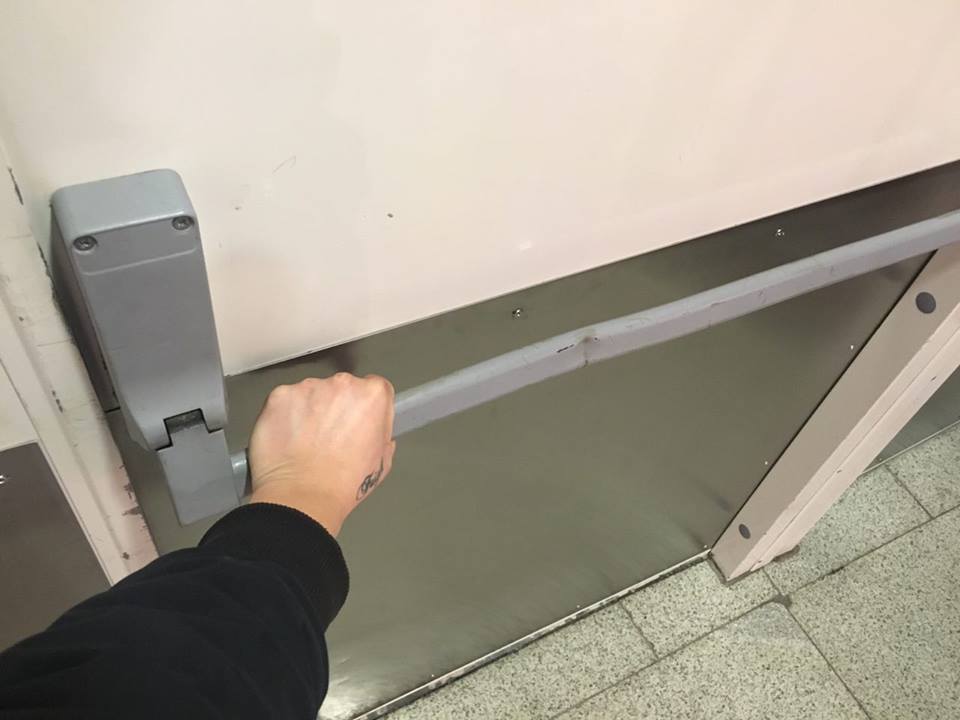
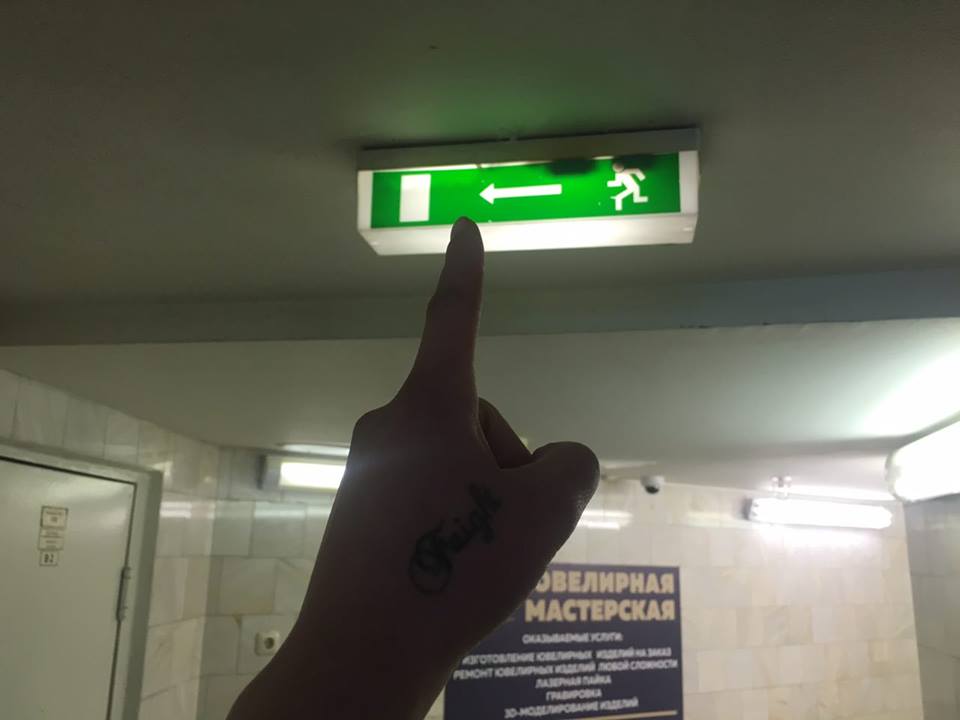
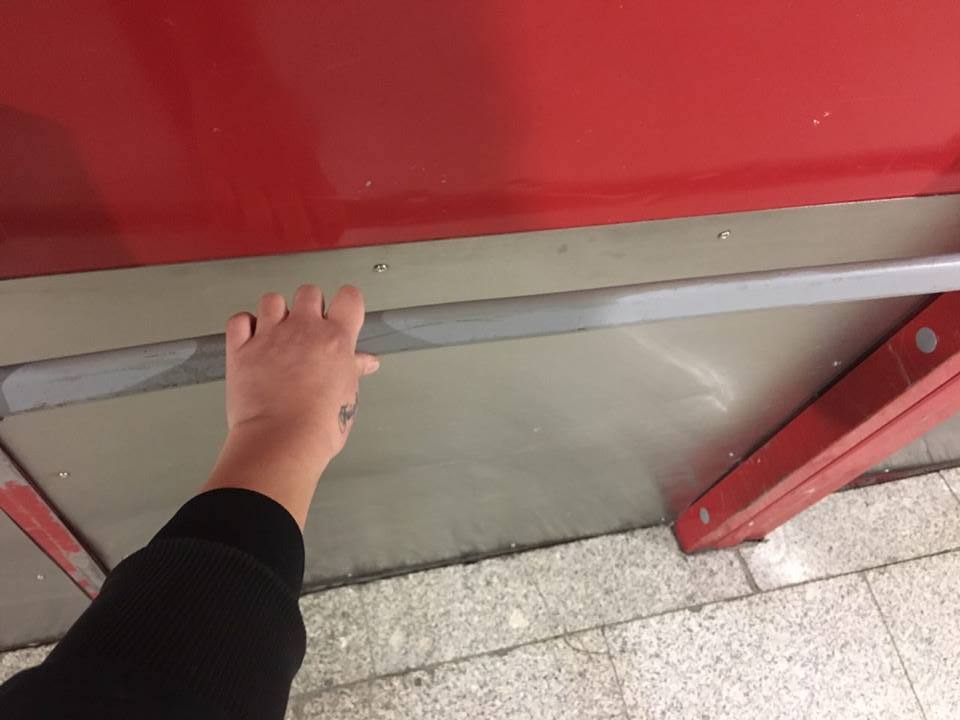
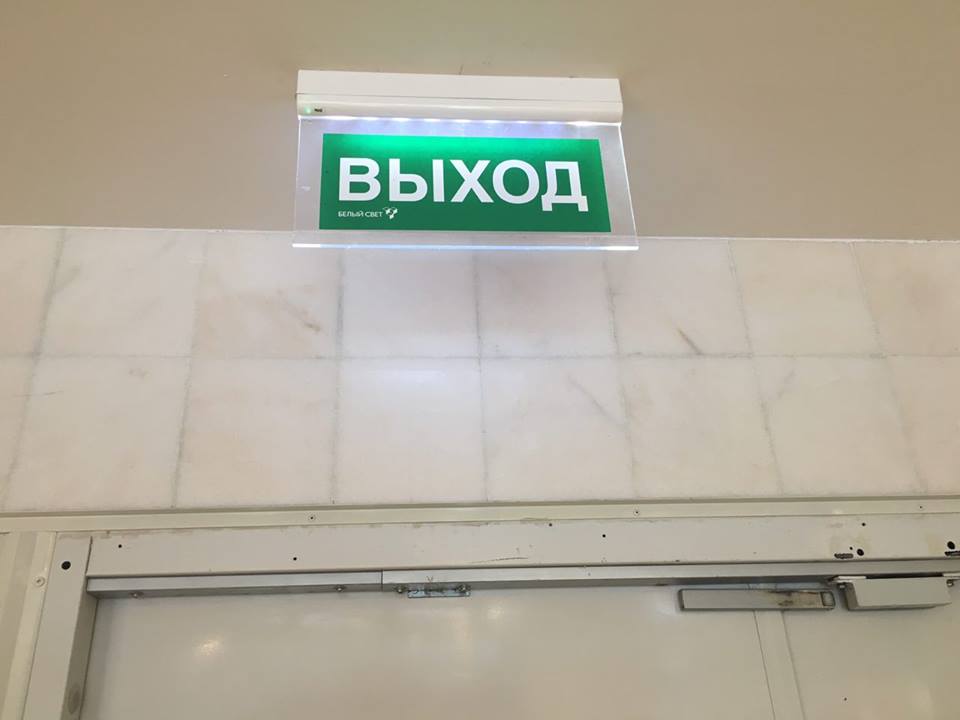
The guys and I headed to Okhotny Ryad Shopping Mall in Moscow. We immediately located the evacuation plan, which made it easier to find the emergency exits. The funny thing about the emergency exits at Okhotny Ryad is the plan says they exist, but in reality the doors are marked “Staff Entrance” and “Keycard Access Only.” Naturally, all of these doors are locked. All of them.
“We don’t have any exits,” said a guard, “only entrances from the outside.”
“I don’t know anything. Go ask that policeman over yonder,” replied another guard.
“What have I got to do with it?” the policeman wondered, laughing.
“Look, we have emergency exits in every shop. Got it?” replied a third guard, who had a mustache.
“Can we go and take a look at them?”
“No, you can’t. You know what? If something happens, we’ll save you. Got it?”
We could not understand how we would be rescued by guards who still did not know how the emergeny exits in their shopping mall worked. We went to pull on the other doors on the upper floors. We found ourselves outside the restrooms. A female cashier explained she did not know what exactly was beyond the door, but you could only get through it with a magnetic key. If there were a fire, she would exit the shopping mall via the regular entrance to the mall.
“What’s the big deal? You grab your stuff quickly and take off.”
Wherever we went, a mustached guy in a gray blazer would come running. He sweated and was out of breath. He had obviously hurried. He would stand off to one side and stare at us.
“Did you forget something? Well, what? What do you want?”
After asking his questions, the man would turn around and slowly walk away from us.
“Everything works here. Everything. The doors operate on magnetic keys, but in a fire they open automatically.”
“How does that happen?”
We were nearly chasing him in an attempt to continue the conversation.
“The guards line up in the corridors, and the emergency . . . begins.”
The dude swallowed half his words.
“Who the heck are you guys? Should I really be talking to you?”
Irriated, the mustached Mr. Suit vanished. Now we were certain the guards would save us.
So, what conclusions can we draw?
1. Shopping mall staff and security are obliged to know how the emergency exits function, and how the fire safety system is organized. It is our right to ask them about it. The staff at Okhotny Ryad Shopping Mall are completely ignorant about the building’s layout, where the exits are, and how they work. Meaning that the guards, who are supposed to save us, have had no training whatsoever and have not even bothered to take a glance at how the building is laid out. Can we trust such people in an emergency? No.
2. The doors in the shopping mall are kept firmly locked. Neither staff nor security know how they work. Can we trust a safety system like this? No.
3. The evacuation plan does not always synch with reality. Where the plan says there are exits, there are always signs saying, “Staff only.” The signs pointing to the emergency exits are confusing and could lead you into a dead end. This is scary. Given a system of signage like this, would you be able to escape if a fire slightly less ferocious than the one in Kemerovo broke out? No.
The Okhotny Ryad Shopping Mall is a prime candidate for the #InsecurePlacesList. In addition, we encountered another problem: a total ignorance of fire safety rules on the part of mall employees. Therefore, I demand employees fix the problem. I will no longer be patronizing the Okhotny Ryad Shopping Mall. Sure, it’s a local fix, but I will #boycott the mall. I also plan to relate our adventures to the Emergencies Ministry.
Do you go to Okhotny Ryad often? How do things stand in terms of fire safety at the shopping mall you frequent?
I am still proposing we do inspections of shopping centers right away. Sure, we are not professionals, but it’s enough to reach out to to mall employees and find out whether they know the rules. If they don’t, it is a clear violation of the law.
1. Go to your local shopping malls. Look and see what is going on with the emergency exits. Study the evacuation plan. Ask security guards and mall management about their arrangements. Record your findings by snapping pictures and making videos.
2. Write up the results of your spot checks and post them on social media. Identify and tag the shopping malls in your posts and tag the posts with the hashtags #KemerovoIsNotAlone, #InsecurePlacesList, and anything else you can think of.
3. Don’t hesitate to call the Emergencies Ministry and report violations, rude behavior, etc. It all helps.
After launching spot checks like this and expanding the list, we can think about filing class-action complaints against the shopping malls and continuing to publicize the issue on social media.
I regard posts about insecure places, like shopping malls, in which fire safety rules do not function, as an elementary tool of self-defense and a means of protecting my friends and loved ones.
Currently, any and all information and all spot checks are truly important. Unfortunately, no one else will do this work for us. So join us!
P.S. Dmitry Gudkov and his Open Elections team are organizing training sessions for people who want to learn how to conduct fire safety inspections professionally.
Translated by the Russian Reader. All photos courtesy of Ekaterina Nenasheva
“I’ll Go All Out to Ensure Putin Loses”
Yelizaveta Mayetnaya Radio Svoboda
December 5, 2017
“Citizen Putin! If there is a clampdown on public liberties under the pretext of terrorists attacks, it will be clear to everyone who is behind them!”
“Putin is war. Say no to war!”
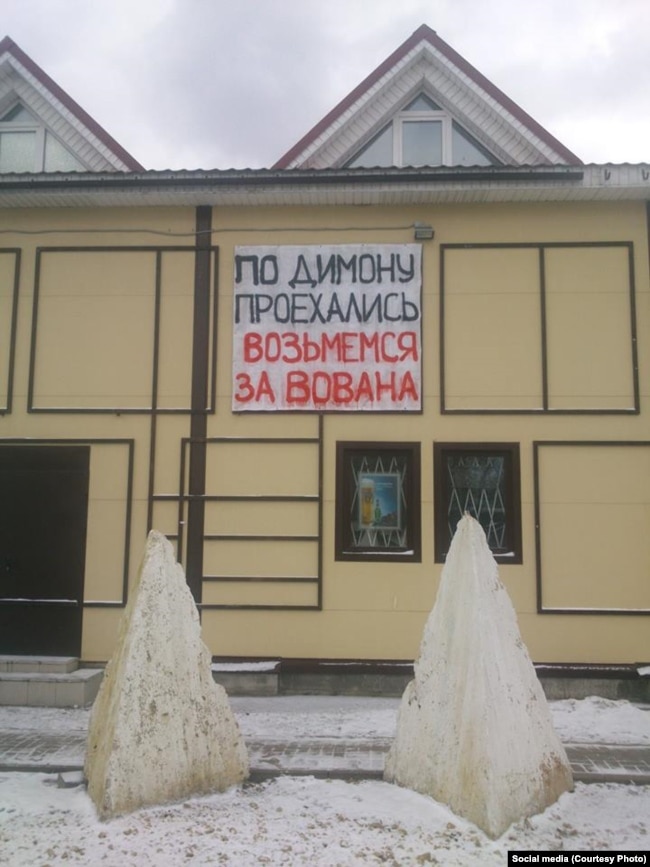
“Dimon got what was coming to him. Let’s go after Vovan.”
“We live the way we vote.”
Dmitry Skurikhin, owner of a store in the village of Russko-Vysotskoye, near Petersburg, reacts immediately and visually to every political event in Russia.
Skurikhin immediately hangs each new poster on the front of the store, a small, two-storey building, so it is readily visible from the nearby bus stop. They usually do not stay up for long, however. The record is held by the slogan “Peace to Ukraine,” which stayed up for two weeks.
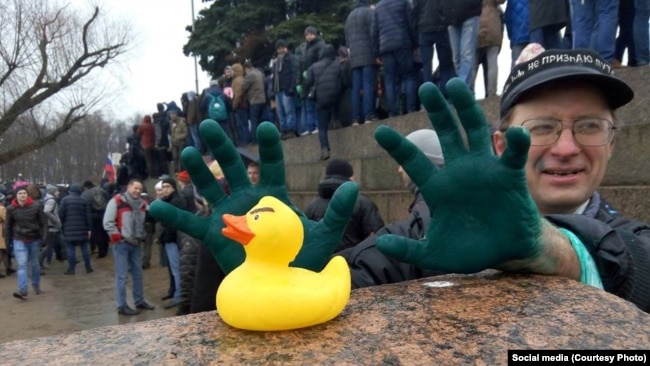
Skurikhin at a pro-Navalvy rally on the Field of Mars in Petersburg
43-year-old Dmitry Skurikhin is a local businessman, whose family owns three village shops. By local standards, he is well off. His family owns several cars, and they have everything they need. However, Skurikhin says the incomes of villagers have taken a nosedive in the past year: “They buy almost nothing, because they barely have enough for food.” Around six thousand people live in Russko-Vysotskoye. Very few of them are holiday cottage dwellers. The majority commute to work in Petersburg. Skirukhin was the first businessman in the village to open self-service stores, but “then the Pyatyorochka and Magnit chains moved in, and we croaked, of course.” He now sells toys, newspapers, clothings, and sundries.
He has been hanging political posters on his store, situated along a road, for almost four years. Before that, he pasted homemade bumper stickers on his car. Skirukhin recalls that the first bumper sticker read, “No new taxes!” The year was 2005.
Skurikhin: They had decided to raise taxes on us local businessmen then. It was one of those taxes you couldn’t avoid paying. Either you worked and paid the tax or you didn’t work and didn’t pay the tax. We businessmen realized they were clamping down on us. We joined forces and beat back the tax. It made such an impression on me that since then I haven’t been able to stop going. There are at least some improvements in our lives, specifically in our village. I’m a local grassroots activist, not even a region-wide activist, but a village-level activist. I was born here, and I live and work here. My kids go to school and kindergarten here. I think I have helped improve life in our village.
Radio Svoboda: How exactly have you improved life in the village?
Skurikhin: As they call it now, I was a municipal district council member from 2009 to 2014. At the time, our district authorities were running this interesting scam. They were “milking” the villages. They would buy heat from the producer and sell it to residents. They marked up the price one hundred percent. When the situation had reached a deadlock, it transpired they were charging residents, but not paying the producer anything. They were getting heat for free. The chair of the district council was mixed up in the scam. Thanks in part to my efforts, the gentleman was conveyed directly from the district chairman’s office to prison. That was in May 2012. Since then we haven’t had any disasters with our supply of heat and water.
We still have problems sometimes, but we are now longer in that disastrous state when a group of people affiliated with district officials were just robbing people by latching onto the flow of payments for housing and utilities. Then we had problems with the road. I organized a decent protest rally. A lot of folks turned out for it: 165 people, which is a huge number for our village. We demanded the road be repaired. The road was repaired. So, by starting with small changes like that, stirring people up, I have been trying to bring them round to the idea that fair elections, free speech, and democracy mean improving the welfare of society. On May 1, we had a rally that wasn’t about the roads (we’ve had the roads fixed), but was about healthcare, fair elections, and responsible authorities. Those were the topics of our rally. 45 people showed up. The rally was authorized. I always try and authorize events with the authorities, but we rallied at the skating rink on the edge of the forest.
“Dimon got run over. Let’s go after Vovan.” This is a reference to Alexei Navalny’s film documentary exposé of Prime Minister Dmitry Medvedev and his untold riches, Don’t Call Him Dimon. “Vovan” is a humorous reference to Vladimir Putin.
In 2014, my time as district council member ended for a simple reason: our team doesn’t pay for votes. If you don’t buy yourself votes, meaning if you don’t pay off the right people during early voting, then you’re out of the race, because your opponents do pay for votes. United Russia paid 1,500 rubles per vote! All the other candidates lost.
Radio Svoboda: Did you prove in court they paid for votes?
Skurikhin: It’s impossible to prove in court, because the scam is quite competently organized. They don’t buy votes, but pay for the services of fake campaign workers, meaning they contract out their campaign. United Russia has a team of between ten and fifteen people, depending on the number of seats that are up for grabs in a specific municipal district, and they hire canvassers. But the canvassers don’t have to canvass. They just need to show up and vote ahead of time, for which they are paid 1,500 rubles a pop. That’s it. It’s perfectly legal. All the evidence is circumstantial. When I tried to get hired as a canvasser in a neighboring village, I was told I would not do, because I wasn’t registered in that precinct.
“How’s that?!” I said. “I’m a local resident. I have a store here. I know everyone in the village, and they all know me. I’ll canvass for you like nobody’s business.”
“No, no, you don’t fit us.”
“What’s the deal?”
“You’re registered somewhere else.”
It’s all clear, guys! You don’t need canvassers: you need voters, whom you buy off for 1,500 rubles apiece. I dubbed the technique “bribing a voter under the guise of paying a canvasser.” It works like a charm in all the villages, where the populace is not too savvy. The populace in general is not very savvy, but in the countryside it’s just unbelievable. The salary in these places is commonly 1,000 rubles a day [approx. 14 euros a day]. People who get a 1,000 rubles a day don’t suffer. I ran a counter-campaign against this.
When the villagers were going to vote, I would say to them, “Guys, are you really unaware that when they get seats on the council, they’ll shake a hundred times more out of your pockets?”
“I toss manure on a farm with a pitchfork for a 1,000 rubles a day. But here I’m getting 1,500 rubles for five minutes of my time. Maybe you’d like to go and pitch manure for me?” one guy told me.
That’s their whole rationale! There’s nothing more to say.
Radio Svoboda: When did you hang the first political banner on your store? How long did it stay up?
Skurikhin: It was the spring of 2014. My fifth daugther was born then. I decided to give my wife a present by building a politicized bus stop opposite the store. I fashioned the frame and the foundation. We didn’t have a stop there. People would always stand outside there, and the buses would stop to pick them up. I built a bus stop and draped it with posters. This was when the annexation of Crimea was happening. We had a couple of posters about Crimea: I demanded an end to the disgrace. Then there were posters demaning pay rises for ordinary doctors and school teachers. I was still a council member. I gathered information on how much doctors were paid in Russia. President Putin had literally just claimed that there were no doctors in Russia who were paid less than the average monthly salary in their regions. That was an outright lie. I wrote it on my poster, because I knew how much our doctors were paid. I had gathered the information in my capacity as a municipal district council member.
Radio Svoboda: How much did doctors really make then?
Skurikhin: The ophthalmologist in our village was paid 14,000 rubles, while the average monthly wage in Leningrad Region was 35,000 rubles. I think this as an absolutely proven lie. I hung it up on the bus stop. The local authorities were completely shocked by it. The stop had been turned into a shelter and was hung with banners and pasted with posters. They didn’t know what to do, so the posters stayed up for three weeks or so, I think. Then a major from Center “E” [the so-called anti-extremism police] in Petersburg came and had a long chat with me. That was April 1, 2014. I remembered the date, because it was the day the Russian State Duma issued a resolution condemning restrictions on freedom of speech in Ukraine. And I was sitting there chatting with this little vampire who was directly threatening me and my business.
“We will shut you down if you don’t stop it!” he told me.
The bus stop stood for a month, and then it had to be demolished. All that’s left is the concrete slab, where locals still wait to catch the bus.
Radio Svoboda: Who demolished it?
Skurikhin: I did, on orders from the local authorities. They told me either I had to demolish it and haul it away or they would do it themselves. Since then I have been hanging posters on the store.
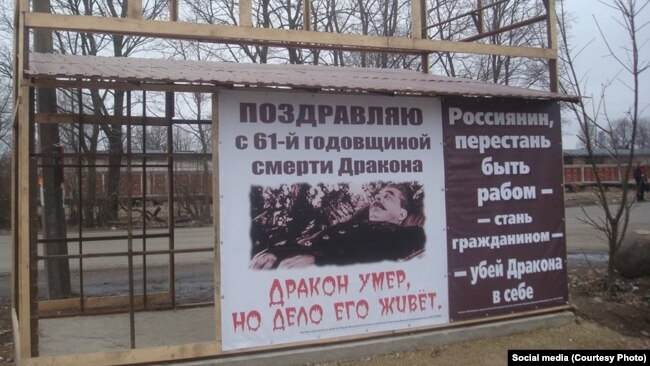
I hung up the poster “I congratulate you on the 61st anniversary of the Dragon’s death. The Dragon is dead, but his cause lives on. // Russian citizens, stop being slaves. Become citizens. Kill the dragon inside you.” The poster, which showed Stalin in his casket, used to be coupled with the second part, about citizens, which was swiped by the polizei. The poster “Peace to Ukraine” broke all the records: it hung for two weeks.
The second part of this poster, featuring a dead Stalin and a call to “kill the dragon inside you” and “become citizens” was “swiped by the polizei.”
The local authorities, by the way, didn’t know how to react. The poster was hanging on my building. It’s my property and my land, and the poster belongs to me. It hung there for quite a long time. Other events took place, for example, the 2014 elections. I hung my campaign posters there. As a municipal district council member, I was competing for votes. I would hang up a poster. It would become stale, and I would hang up a new one. And then, when I clearly campaigned against Putin. . . For example, I had posted a banner reading, “Putin should resign.” It was 9.4 meters by 2 meters. The banner caught everyone’s eye: my store stands next to the road. Well, they just came and swiped the banner. I decided to hang up another banner. Since it was forbidden to demand Putin’s resignation, I demanded Putin be freed. Since he considered himself a galley slave, I wrote, “Free Vladimir Putin! Let’s free this galley slave. Otherwise, he and his pals will row [rake in] too much.” This banner was also 9.4 meters by 2 meters.
Radio Svoboda: It was probably removed immediately, no?
Skurikhin: I don’t know why, but it stayed up for nearly two weeks. I saw policemen come and look at it. Maybe they didn’t get it? I can’t say how the authorities make decisions. But then they removed it anyway. I have been doing this on purpose. My goal is to ensure President Putin loses this election. During the last election, in 2012, I printed flyers and ensured that Putin got the least number of votes in our district in our precincts, although he won anyway, of course. Our precinct was among the ten worst precincts in Leningrad Region. Numbers decide everything in a democracy. I worked on the electorate the best I could.
Radio Svoboda: Do the security services often summon your for talks and try to reason with you?
Skurikhin: Earlier they did, but recently they have left me alone for some reason. I think they just realized, probably, that they should be talking to me in handcuffs, whereas talking to me just for the heck of it, what’s the point? Besides my chat with the major from Center “E,” a major from the FSB, a colonel from the FSO (Federal Protective Service), and the Investigative Committee summoned me. Each of my posters has been sent off for a forensic examination. Policemen photograph them, and the photos are sent to Center “E” and Saint Petersburg State University for analysis: they have this forensics examination center there. Their forensics experts study my posters and render their findings. If the findings are neutral, the posters are returned to me, accompanied by an official ruling refusing to file criminal charges against me. I’ve had around a hundred such posters. Each one is also accompanied by a description. The police also try to do everything by the book. In Nazi Germany, they incinerated Jews by the book. Here in Russia, they have been trying to shut me up by the book, to put it crudely.
Radio Svoboda: What grounds do the police have for removing posters from private property? How does it usually happen?
Skurikhin: First, they get a complaint either from the local council or from a resident: someone is unhappy with the poster hanging on my store. The police arrive and write me up for violating the regional law that all posters must be vetted with the local council. This little law was invented in Leningrad Region. I disagree with it, so I simply say it wasn’t so. They write me up, then they bring a slave from the local housing authority, whom they force to climb up and remove my poster. Then they leave. After which the situation proceeds as I’ve described it. Unfortunately, the forensics experts have concluded that two of my posters insulted the honor and dignity of the president and incited social discord. I try not to insult anyone. I think through all my posters and make sure that they are worded as properly as possible, because you don’t help things by insulting people. I want to persuade people to vote against Putin, persuade them we need democratic values, freedom, and liberalism. Yet two of my posters have been deemed insulting to Putin. They were the reason I was summoned to the Investigative Committee to talk with an investigator.
Radio Svoboda: Have criminal charges been filed in connection with the two posters?
Skurikhin: You know, I haven’t asked the police about it. But they did get me summoned to the Investigative Committee, where I was asked for an explanation. I was shown the findings of the forensics experts. The poster in question was “Putin is war. Say no to war.” As you remember, it was Anna Politkovskaya who said, “Putin is war.” The slogan was written with bloody smudges, so there was nothing in particular to interpret. It was clear as clear could be. The poster was deemed to have insulted Putin’s honor and dignity. I don’t think I insulted him, but the Investigative Committee does.
Radio Svoboda: What war did you have in mind when when you wrote the slogan?
Skurikhin: Any war. Because Putin is, in fact, war. We were flattening Ukraine at the time.
Radio Svoboda: Have they threatened to close your business?
Skurikhin: The major from Center “E” threatened me, but no one else has. It’s just I’ve been in business for twenty-one years, and all the agencies they could sick on me, I’ve been working with them for a long time. I have a good relationship with them. Most important, all of them are on my side. As they’re tearing down the posters, the policemen say to me, “Damn, what you write is true.” But they’ve taken an oath, they have their orders, they would immediately get hell from their commander, so they can’t say it that way. I can because I don’t have a commander. Firefighters, the guys at Health Inspection Services, they all understand what is happening in Russia. Most of them are smart people.
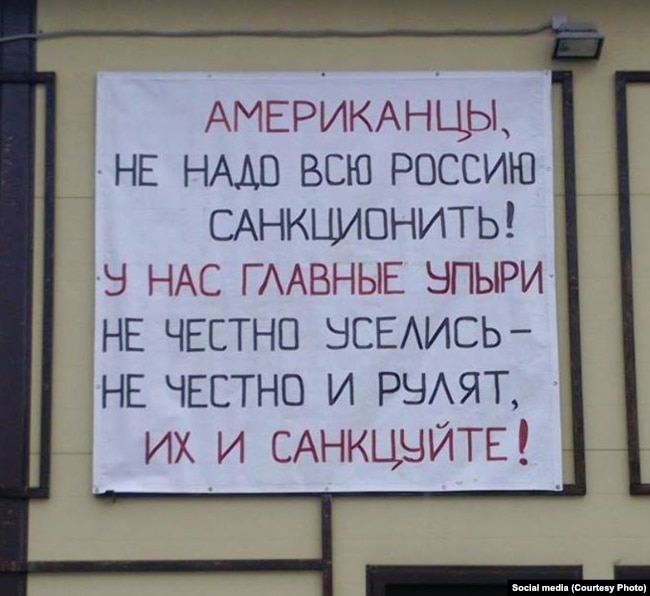
“Americans, don’t sanction all of Russia. Our head vampires got their jobs dishonestly and run things dishonestly. Sanction them!”
Radio Svoboda: Does your family support you?
Skurikhin: Yes, of course. Sure, they worry about me. The situation in Russia is such that the most active dissenters are shot down. My kids are aged nineteen, fourteen, seven, and four. All of them are girls: I live in a flower garden. If I’m arrested, my wife will feed the family: she’ll be like Vassa Zheleznova. I hope it doesn’t come to that, but we’ve talked it all throgh, of course. So that’s why I try and write slogans that are legal. I have studied a ton of material on the subject. What is an insult? It’s when you compare someone with an animal. The rest can be offensive and unpleasant, but it is not insulting in the criminal sense. You can say, “Skurikhin, you’re an idiot.” Yes, it’s possible for you to have this opinion. But I think differently. But if you say, “Skurikhin, you’re a jackass,” that is an insult.
Radio Svoboda: Have other businessmen put up similar posters?
Skurikhin: There were elections to the State Duma in 2016. As a member of Parnas (People’s Freedom Party), I ran in them in my own electoral district, the southwest district of Leningrad Region. Sergey Naryshkin, now our top spy, ran in the same district. I made the rounds of all my businessmen friends and asked them to support me. I made banners that read, “Skurikhin and Parnas are your only worthy choice.” In our part of the world, most of the shops are village shops, and they are on private property, so I was able to hang them up for free. No other candidate got that kind of support. The rest had to pay for billboards. I spent 150,000 rubles on my election campaign. My wife later gave me a piece of her mind about that. I took second place in the elections in my own village. Only Naryshkin got more votes. I got support for my posters and ideas, for saying “Putin should resign.” My fellow villagers gave me the number two spot. In my native Lomonosov District, I took sixth place, and I took eighth place in the entire electoral district, which has a population of 500,000. What does that tell you? I would argue the outcome shows that liberal and democratic ideas are popular in society, but they simply never get conveyed to the voters, since the media are totally blocked. I have no other way of telling people Putin should have been dismissed from the Kremlin long ago. I only have my posters. But, generally speaking, it’s very hard for a Parnas member to get around United Russia on the first try.
Radio Svoboda: Do you attend all protest rallies?
Skurikhin: Yes, I try to go to all of them. At the last pro-Navalny rally, in June, I was wearing a “Sick of Him” t-shirt and carrying a flag. I was taken to a police station, but I escaped. This year there were also primary elections—Naryshkin gave up his seat in the Duma when he was appointed head of the SVR (Foreign Intelligence Service) in October 2016—and this year there were reelections. We also held events that, in my opinion, were meaningful to our district. I couldn’t let my people down, so I had to hightail it from the police station.
Radio Svoboda: Are you following the presidential campaign?
Skurikhin: Yes, of course. I’ll go all out to ensure Mr. Putin loses the election, at least in my precinct. I support Navalny’s registration as a candidate and Ksenia Sobchak’s candidacy, because we need as many candidates as possible in the first round just to take votes away from Putin and get a second round. If there is a second round, that will be a significant victory in itself.
Thanks to Comrade Uvarova for the heads-up. Translated by the Russian Reader
Football fans! You might want to know that this past Saturday, the monthly neighborhood collections of recyclables, organized by the Razdelnyi Sbor environmental movement, an entirely volunteer-run organization, were cancelled, apparently by the police or higher powers, in four of Petersburg’s districts (Central, Admiralty, Krasnoye Selo, and Kalinin), allegedly, because they were a “security threat” to the ongoing FIFA Confederations Cup.
Ironically, this same grassroots movement, which poses such a (non-)threat to national security in neighborhoods many kilometers away from the brand-new stadium on Krestovsky Island where some of the cup’s matches are being played, including the final—a stadium that was built at the cost of unbelievable cost overruns (i.e., kickbacks) and completion delays, precarious migrant labor (including slave laborers shipped in from North Korea, one of whom was killed in an accident on the site), and the demolition of the old Kirov Stadium, a nationally listed architectural landmark designed by the great constructivist architect Alexander Nikolsky—made a deal with cup organizers and FIFA to collect and process recyclable waste at the stadium after matches.
Meaning that, at the stadium itself, this same grassroots movement was seen not as a threat, but as a cynical means of showing fans that FIFA and the Russian government were all about “international best practices.”
This is a ridiculous, telltale story that someone other than lowly unread me and my crap blog should be reporting.
By the way, under normal circumstances, readers of my Facebook news feed would have got a message from Razdelnyi Sbor about Saturday’s collection points, a message I cut and paste and disseminate faithfully every month, because I want everyone I know to go the one-day collection points in their neighborhood with their recyclables, and because my partner and I go to our neighborhood spot in the Central District every month ourselves.
Last year, I even bought a Razdelnyi Sbor t-shirt, to support the cause and occasionally serve as a living, breathing, walking, talking advertisement for it.
I guess I’ll have to think hard about whether I want to wear the t-shirt again. I don’t understand how you can serve the authorities at their Big Event while letting down the ordinary people who support you in their neighborhoods with their volunteer labor and their recycling month in and month out.
A friend of mine was arguing on Facebook just yesterday that VK, the homegrown Russian social media where Razdelnyi Sbor has its community page, was where it was at, as opposed to snobby Facebook. But in the relevant recent posts on Razdelnyi Sbor’s VK page about the cancelled collections you won’t find word one criticizing the authorities for acting in such a brutal, stupid way towards a completely beneficial grassroots campaign. I would imagine the page’s moderators hastily scrubbed any such complaints, if there were any. I’m sure there were some.
This is the real Russia, about which I almost never read anything in the western media and, sometimes, in the Russian media, either. It’s a country where recycling enthusiasts (just like cycling enthusiasts, for that matter) are imagined as a threat to national security and as “agents of the west,” except in the one instance where they can make the authoritarian state’s Big Event seem more PC to foreign football fans, dishing out big euros for tickets, merchandise, food and drinks, and rooms. TRR
Ekaterina Schulman. Photo courtesy of Andrei Stekachov and The Village
Political Scientist Ekaterina Schulman on Why You Should Vote
Anya Chesova and Natasha Fedorenko The Village
September 16, 2016
This Sunday, September 18, the country will vote for a new State Duma, the seventh since the fall of the Soviet Union. The peculiarity of this vote is that it will take place under a mixed electoral system for the first time since 2003. 225 MPs will be elected to five-year tears from party lists, while the other 225 MPs will be elected from single-mandate districts. Several days before the elections, The Village met with Ekaterina Schulman, a political scientist and senior lecturer at the Russian Presidential Academy of National Economy and Public Administration (RANEPA). We talked with her about why you should vote if United Russia is going to win in any case, as well as about the changes in store for the Russian political system in the coming years.
The Upcoming Elections
The Village: On Sunday, the country will hold the first elections to the State Duma since 2011. The social climate in the city and the country as a whole has changed completely since that time. Protests erupted in 2011, and the people who protested on Bolotnaya Square and Sakharov Avenue believed they could impact the political situation. Nowadays, few people have held on to such hopes. What should we expect from the upcoming elections? And why should we bother with them?
Ekaterina Schulman: Everything happening now with the State Duma election is a consequence of the 2011–2012 protests, including changes in the laws, the introduction of the mixed system, the return of single-mandate MPs, the lowering of the threshold for parties to be seated in the Duma from seven to five percent, and the increased number of parties on the ballot. These are the political reforms outlined by then-president Dmitry Medvedev as a response to the events of December 2011. Later, we got a new head of state, but it was already impossible to take back these promises. The entire political reality we observe now has grown to one degree or another out of the 2011–2012 protest campaign, whether as rejection, reaction or consequence. It is the most important thing to happen in the Russian political arena in recent years.
The statements made by Vyacheslav Volodin, the president’s deputy chief of staff, on the need to hold honest elections, Vladimir Churov’s replacement by Ella Pamfilova as head of the Central Electoral Commission, the departure of someone more important than Churov from the CEC, deputy chair Leonid Ivlev, and the vigorous sacking of chairs of regional electoral commissions are all consequences of the protests. If they had not taken place, nothing would have changed. We would still have the same proportional voting system, the same seven-percent threshold, the same old Churov or Churov 2.0. Continue reading ““We Have a Surrogate Democracy”: An Interview with Ekaterina Schulman”→
On this bright Saturday evening, when the sun has finally come out in the former capital of All the Russias after a week of nonstop rain, I want to offer you two tales of two completely different modern Russias, situated unhappily side by side, but God only knows for how long and at what cost.
Both stories have their fictional and literary precedents, as is often the case in this overly verbalized country.
The hero of the first tale, Valery Slesarev, will remind you of the characters and real-life heroes and victims in nineteenth-century writer and human rights activist Vladimir Korolenko’s fictional sketches and muckracking newspaper articles, while the nearly unbelievable promises and high-powered wheeler dealers in the second tale will conjure up Ilf and Petrov’s world of con men and grifters during the NEP period. TRR
____________________
Smack Them Upside the Head Tired of waiting for a promised natural gas tie-in pipeline from local authorities, the Yegorevsk Urban District in the Moscow Region asked Obama for gas
Ekaterina Fomina Novaya Gazeta
June 5, 2016
Valery Slesarev. Photo by Ekaterina Fomina
After collecting 531 signatures in support of his effort, pensioner Valery Slesarev called the US Embassy and asked a specific question.
“How can I get a hold of Barack Obama?”
The embassy promised him to call him back and make an appointment.
Lots of people in Yegorevsk know Valery Slesarev. First, he has tuned and fixed TV sets his whole life, and that is deemed a vital service. Second, he has an artificial skull.
As a child, Slesarev was involved in Pavel Popovich’s Young Cosmonauts Club. One of the activities at the club was parachute jumping from towers. During one such jump, the carabiner from a pull rope slammed Slesarev hard in the head. A year later, a tumor was discovered in his brain, and it was decided to operate. Popovich himself got involved by asking for help from America, where an artificial bone was grown personally for the sixteen-year-old boy. The doctors told his mother he would not survive, but the bone up and took hold.
As the years passed, it transpired that, along with the bone, the doctors had implanted something Soviet people were not supposed to have: a faith in justice and the strength to fight for it.
Initially, the life of the young cosmonaut with the artificial skull rolled down different tracks than it might have, like in a small town in West Virginia: steady, nothing out of the ordinary.
“Maybe the Lord in fact saved me then. Eighty percent of my group at the Young Cosmonauts Club died in Afghanistan. We were all combat ready, you see, and those boys were sent straight to the front,” he says today.
Slesarev studied to be a radio technician, but went to work as a TV repairman. The celestial expanses no longer appealed to him, and he had enough to do down on earth as it was. He drove from village to village fixing TV sets and occasionally chopping firewood for old women.
In the nineties, the business where Slesarev worked fell apart, and he started a small business of his own, a tire repair shop. He called it Autocupola, and indeed the blue, two-storey building housing his shop is crowned by conical metal cupolas. The cupolas, he explains, are in honor of his artificial skull. He is proud of the black swans, carved from tires, out in front of the shop and a gingerbread boy with a painted mug.
Slesarev lives in amazing house, also topped with cupolas, only they are in the shape of little bulbs. The local council has even hung a sign on the house designating it a cultural landmark.
For a time, then, Slesarev was an amusing local landmark. In 2005, however, the Moscow Region began installing natural gas mains in the villages of Yegorevsk. The mains were quickly installed in all public buildings, but ordinary people, those selfsame old women for whose sake the whole program was undertaken, were left without gas. Slesarev says he simply could not look at old women swinging wood mauls anymore. Thus began his fight.
Vladychino
Only twenty-eight people are officially registered in Vladychino, a village in the Yegorevsk Urban District, but around a hundred people live there permanently, most of them people the natives have contemptuously dubbed “summerfolk.” Slesarev is one of the summerfolk too. He has land there, inherited from forebear, and his grandmother’s house, which he has managed to restore and preserve. The entire village stopped by to admire it.
As in the neighboring villages, people in Vladychino buy natural gas in cylinders. A fifty-liter cylinder, which costs a thousand rubles to refill, lasts a month. Arranging privately to have a gas line connected to your house costs at least 500,000 rubles [approx. 7,000 euros].
A spontaneous assembly of local residents has been taking place on the bench in front of Slesarev’s house. You might say he mobilized them.
Grandma Valentina, Grandpa Nikolai, Kolya, who has no front teeth and wears a leather jacket, Nikolai Alexandrovich, and Tatyana have formed a semi-circle. They occasionally get sidetracked and swat a mosquito. It is the height of the season.
“Please forgive my appearance. I came from the garden,” says Tatyana, apologizing as it were for her apron.
“TV Rain came to film, and we all dressed like peasants,” says Valentina, dangling her rubber-slippered feet by way of proof.
“Why are we appealing to Obama? We hope that, if not Obama, some other president will respond,” says Valentina.
“I’ll tell you why,” says Nikolai Alexandrovich, who steps forward, dressed in builder’s overalls. “He is a winner of the Nobel Peace Price, and he is on his way out of office in any case. Let him do one good deed at the end of his term by getting gas installed for us.”
The locals gossip. The village of Rakhmanovo got gas when an MP from the Moscow Regional Duma and a member of the Yegorevsk Board of Deputies moved there. Actually, according to the paperwork, gas lines have been laid to Vladychino and all the other villages too: 300 million rubles [approx. 4 million euros at current exchange rates] from the regional budget was spent on the program. A presidential commission even came looking for the gas, but they did not find it. To be hooked up to gas lines under the regional program, a village must have no less than one hundred residents, so Vladychino was lumped together with neighboring Parykino. Now, according to the schedule for gasification, Vladychino and Parykino should get gas lines no later than 2018. But no one believes it will happen, because dates for gasification of the villages have been postponed annually since 2005. Last year, the residents of Vladychino wrote a letter to Putin, but half has many people signed it as did the letter to the US president.
“He’s not going to help. His term is never going to end. He’s president for life,” says Nikolai Alexandrovich.
“God willing he will be president for life!” responds Valentina. “He lifted the country up! As for gas, well, we need it. Maybe he just has not been told about us. Our board of deputies should be the ones helping us, but they don’t do anything for us. This year, they didn’t even spray the bushes for ticks.”
“This writing to Obama thing is all a joke, a way of getting us riled up and forcing us to think,” explained Nikolai Alexandrovich. “But what do you think? Is America Russia’s enemy? I knew you’d say that! I’m not going to try and educate you or persuade you. Who is threatened by Russia? The Americans, however, are already in Estonia. Those are facts, Katya, facts!”
By local standards, Nikolai Alexandrovich is also one of the summerfolk, although he has lived in Vladychino for four years, since retiring. He worked for twenty-six years in security at the Kremlin. Nowadays, he is an elder at Nativity of Christ Church.
“That is war,” continues Nikolai Alexandrovich. “Was it necessary to drop the bombs on Japan? This is a continuation, just as today’s Russia is a continuation of Soviet life in many ways. Your colleagues from TV Rain were spooked. They were worried lest we go to jail for what we said. We won’t go to jail: we speak the truth!”
“The mosquitoes have already devoured us,” a bored Valentina chips in.
“It’s time for me to milk the cows,” says Kolya.
“Why was she caterwauling yesterday from lunchtime on? She was probably thirsty?”
“She has been yelling because of the bull. I haven’t been putting the pull in with her. He’s been laid low. I called the vet, and he told me over the phone to give the bull vodka. I gave him vodka. Then he told me to give it sunflower oil. I did it: same damn nonsense! Now he tells me to go and buy lactic acid.”
Slesarev outside his Autocupola tire repair shop. Photo by Ekaterina Fomina
“Sufferings, Trials, and Humiliations” Since 2005, when Valery Slesarev began his fight to have the villages gasified, he has kept a list entitled “My Sufferings, Trials, and Humiliations.” It includes such entries as “Arrest, searches of homes and shops. Bombing of Autocupola. Arson at Autocupola.”
In 2010, unknown men in masks armed with crowbars broke into his tire shop. They methodically and cold-bloodedly beat up Slesarev and his daughter. A criminal case was opened, of course, but to no avail. The police wrote off the incident as a “workplace fight.”
Slesarev wrote to Vladimir Zhirinovsky that he was being prevented from doing business. Zhirinovsky promised to look into the case. Apparently, he is still looking.
Moscow Region Governor Boris Gromov once visited Yegorevsk. Slesarev was going to the meeting when he was pulled over by traffic cops, allegedly, for driving with dirty license plates. He spent the whole day in the detention center and was released without having to pay any fines.
Governors have come and gone, but the story has not changed. Slesarev had to fight his way into a meeting with current Moscow Region Governor Andrei Vorobyov at the House of Culture. In the auditorium, he was surrounded by police officers in plain clothes.
“When I stood up to ask a question, they made me sit down. They actually grabbed me by the pants and pulled me down, and everyone was laughing,” Slesarev recalls.
Governor Vorobyov noticed the strange man and asked to speak with him personally after the meeting. As Slesarev tells it now, the governor was so outraged that he promised to dismiss the head of the district the very next day. And he did, in fact, dismiss him. Only, at the next elections, Mikhail Lavrov, ex-head of the district, was elected chair of the Yegorevsk Board of Deputies, a position he occupies to this day.
“Vorobyov left, and the bathhouse we guys in the village had built for the gals burnt down. There was a criminal investigation, of course. But they didn’t catch anyone.”
“The Gas Has Come”
This time, it was the head of the Yegorevsk District and his deputies who were meeting with constituents. Slesarev did not know about the meeting, and so we arrive in the village of Yurtsovo a bit late: the event has ended. But we do find Nina Morsh, head of Yurtsovo Area, surrounded by female assistants, next to the Soviet war memorial. Slesarev knows everyone by sight, all the more so because Morsh was previously head of the Yurtsovo Rural Settlement. But late last year, all the municipalities were abolished when when the Yegorevsky District was redesignated as an urban district. The now-abolished Yurtsovo Rural Settlement included thirty-eight villages. Last year, only four of them had gas mains.
Morsh’s assistants immediately cut us off.
“You’re a little late. The head of the district was at the meeting, and he answered everyone’s questions. Residents who wanted to ask questions got definitive answers. You can ask them yourselves.”
Dressed in a suit with a rose on the chest, Morsh drags me along with her.
“Since 2005, a lot of work has been done on gasification,” she tells me, as if she were reading a report. “First, the central village of Yurtsovo and the main municipal institutions, then, in 2010, the entire residential sector.”
She speaks of natural gas affectionately.
“The gas has come,” she says.
The gas has come to Pochinki, Barsuki, Leonovo, and Polbino. And so it will arrive in Vladychino and Parykino, too, Morsh reassures me. The design plans and specifications are already being drafted.
“You cannot jump higher than the budget lets you,” says Morsh by way of explaining why gasification has taken so long. “This has been explained repeatedly to that man, who doesn’t even live in our area. Whatever emotions he may or may not be experiencing, the program has been well implemented. Just look at our governor.”
It is clear as day the village needs gas, but people have been living without it, getting by with cylinders. Some people even stoke wood stoves. Ninety-year-old Grandma Panya, another resident of Vladychino, signed the petition to Obama, but she is afraid of gas.
“That one woman of ours in Moscow, the one who left to be with her lover, was home alone once, but forget to turn off the gas. She died from carbon monoxide poisoning!”
If it had not been for Slesarev, no one would have the heard the voice of the people of Yegorevsk. But that is how his brain operates under his American skull. If the law says people are supposed to have gas piped into their homes, then that is the way it should be, even it means his having to fight hopelessly for it on his lonesome. Slesarev has lived his whole life this way.
Translated by the Russian Reader
___________________
Will Russia Be First to Build Elon Musk’s Hyperloop?
Peter Hobson The Moscow Times
July 6, 2016
In mid June, Shervin Pishevar, co-founder of Hyperloop One, sat under the high, decorated ceiling of a palace in St. Petersburg.
Men in suits lined the large, rectangular table.
“Eighteen heads of sovereign [wealth] funds and President [Vladimir] Putin. $10 trillion in the room,” Pishevar wrote alongside a photo posted on Facebook. “Then Putin called on me.”
So Pishevar, a burly, bearded Silicon Valley entrepreneur, began to speak. He talked about the Hyperloop trains his company plans to build: Transportation pods levitated by magnets inside an airless tube that could travel at speeds 300 kilometers per hour faster than a passenger aircraft, thanks to the low air resistance. Pods that could whisk goods through Russia from China to Europe in the space of hours, or turn St. Petersburg into a suburb of Moscow.
Putin listened attentively. Then, according to Pishevar, he said, “Hyperloop will fundamentally change the global economy.”
By the time Pishevar left Russia, Hyperloop One had signed its first deal with a foreign government, a partnership with Moscow’s City Hall. It had also been asked by Russia’s transport minister to design a 70-kilometer Hyperloop track in the Russian Far East.
With that kind of support, perhaps the first Hyperloop won’t be built in California, but in Russia.
Dreaming of Innovation
At first sight, all that seems strange. Russia, after all, is suffering its deepest economic crisis for nearly two decades. Much of its infrastructure is hopelessly backward. It is a country in which passengers in slippers shuffle between bunk beds in overnight trains that travel at average speeds of just over 50 kilometers an hour. Freight trains, meanwhile, move at a little over 10 kilometers per hour.
But there are a few things working in Hyperloop’s favor.
First, innovation has once again become a buzzword in government. Officials are, at least in theory, keen to diversify away from the oil and gas industry on which the country currently relies. And they are paranoid that Russia could fall so far behind the technological innovation happening elsewhere that it will never catch up.
That fear has sprouted strategic plans for major infrastructure investment and research into the technology of the future. These plans think big: On the agenda are things like quantum computing, neural interfaces and teleportation. Hyperloop, with its science-fiction-movie tube trains, fits perfectly into that vision.
From Moscow to St. Petersburg in 1.5 Hours
Source: Hyperloop One. View in higher resolution here.
Second, Hyperloop has a powerful Russian investor lobbying its interests, a Dagestani tycoon called Ziyavudin Magomedov.
Tall, handsome and worth $900 million, Magomedov is a true techie. According to Forbes, for his 47th birthday party last year, he hosted a robot-themed ball and gifted each guest a book about Elon Musk, the billionaire inventor who in 2013 launched the Hyperloop concept.
Like Putin, he is emphatically excited about the idea.
“It will kill truck and air transportation at a minimum,” he told Forbes.
Magomedov is also supremely well connected. His investment company, Summa Group, spans businesses from real estate to logistics and has handled orders from state companies worth billions of dollars. He has advised the president and allegedly paid for Putin’s press secretary to honeymoon last year on a super yacht in the Mediterranean. One of Russia’s deputy prime minsters, Arkady Dvorkovich, is an old university friend and, conveniently, oversees the country’s policy on transport, innovation and industry policy, though the two deny any favoritism.
Magomedov invested in Hyperloop One through his $300 million venture capital fund, Caspian VC Partners, and set about bringing it to Russia. Bill Shor, the Russian-speaking American who runs Caspian for him, describes him as “very hands on.”
Magomedov has played the role of Hyperloop One’s deal broker. His Summa Group was a co-signatory on the agreement between Hyperloop One and the Moscow Government, which will create a working group aimed at fitting Hyperloop technology into Moscow’s transport system.
He likely also played a major role in pushing for a Hyperloop to span the 70 kilometers between the Chinese industrial center of Jilin and Zarubino, south of Russia’s Vladivostok, where Summa is investing in port facilities.
Both projects have been billed as revolutionary. In heavily congested Moscow, which is currently ploughing huge sums into expanding its transport infrastructure, Hyperloop One says its technology could potentially “give capital region commuters weeks of their lives back.”
The link with Jilin, meanwhile, would carry 10 million tons of cargo a year, zipping containers to port in minutes, says Russian Transport Minister Maxim Sokolov. He wants Hyperloop One to present a design for the track at an investment forum in Vladivostok in September.
Tapping Into China
The third thing playing in Hyperloop’s favor in Russia is that it could unlock vast amounts of Chinese investment.
The Jilin-Zarubino spur is just the beginning. In the longer term, Hyperloop could create “the heart of the transport infrastructure for the Eurasian landmass,” says Shor. The technology will likely be used for freight before it begins to transport passengers. And the route between China and Europe is one of the world’s busiest trade arteries.
The distance between China’s eastern edge and Central Europe is some 7,000 kilometers. Freight currently navigates that distance by train in around three weeks and by sea in roughly two months. In theory, a Hyperloop could span it in six hours.
Beijing has committed tens of billions of dollars to its “One Belt-One Road” plan to create new infrastructure between it and Europe. Russian authorities have their eyes on some of that money.
“It’s like a tube with an air-hockey table. It’s just a low-pressure tube, with a pod in it that runs on air bearings […] I swear it’s not that hard,” said Elon Musk in 2015. Photo: Patricj T. Fallon / Reuters
Sokolov says he will discuss the Jilin Hyperloop with China’s transport minister at a meeting in August and hopes “we’ll take the next step [in this project] together with our Chinese partners.”
Also, the Russian Direct Investment Fund (RDIF), a $10 billion state-backed investment vehicle, invested in Hyperloop One earlier this year. The amount was “very modest,” according to its chief, Kirill Dmitriev. But the RDIF also happens to run a joint investment fund with China worth $2 billion.
China is already helping to pay for a planned trans-Siberian high-speed rail line that could cost more than $200 billion. Hyperloop’s advocates say their technology be cheaper. According to Sokolov, the Jilin-Zarubino line will cost around 30 billion rubles ($450 million)—almost one-third less than a high-speed rail equivalent.
“We must be serious about this idea,” he insists.
Where’s the Money?
But for all the enthusiasm, few in Russia are prepared to put down real investment just yet.
Hyperloop One is working “very closely” with the Transport Ministry, as well as local governments and “some of the largest Russian corporates,” says Shor. These reportedly include Russian Railways and Gazprom, two giant state corporations. But these partners are contributing expertise and access, not money. All the cash is coming from Hyperloop One and Magomedov’s Summa, which Shor says has “invested quite a bit of resources, financial and otherwise.”
Even Putin, who in St. Petersburg promised support to Hyperloop One, wasn’t talking about financial support, his spokesman later clarified.
The problem is that while the Hyperloop concept is compelling, no one has yet worked out how to build one. Russia seems content to wait for the technology to prove itself with other people’s money.
The Local Contender
It might come as a surprise to discover that one of those working on the technology is Russian. Indeed, it turns out that Russian scientists were on to Hyperloop long before Elon Musk.
A century ago, before it was derailed by World War I, scientists in Siberia began working on a similar scheme, says Sokolov. Now, at St. Petersburg’s University of Transport and Communications, the project has been reborn.
Anatoly Zaitsev is an engineer who was briefly transport minister in the 1990s. At his lab on the Baltic coast, his team of around 20 people have equipment that can levitate transport containers. He says he could “absolutely” build a levitation track to Moscow, 650 kilometers away, if you give him $12-13 billion—significantly less than the cost of high-speed rail.
The only part of Musk’s plan Zaitsev says he hasn’t figured out is how to put his levitating pods in a tube. But that’s the simple part, he insists, “like dressing [the train] in a dinner jacket.”
Zaitsev thinks his technology is more developed than that of his rivals, whose plans remain mostly on paper. Both Shor and Sokolov praise his work. But despite that, Zaitsev is largely ignored by the ministers and local governments now courting Hyperloop One.
The reason why ultimately comes down to money. Hyperloop One has raised more than $100 million to fund research, pilot projects and investor outreach.
Another California company, Hyperloop Transportation Technologies, is also rubbing shoulders with big investors. One of its executives has said it is talking with a Russian private investor and is looking at Hyperloop projects in Russia. Its chief, Dirk Ahlborn, also met Putin in St. Petersburg in June.
Elon Musk proposed the Hyperloop concept in 2013 as a mode of transportation between Los Angeles and San Francisco, California.
These companies can fund relentless global expansion, and they benefit from Silicon Valley’s sheen of success. Russian officials can engage with them at no cost to themselves. No wonder, Zaitsev laughs, that “when a foreigner shows up in Russia at the invitation of a resident billionaire, the music and dances start.”
“The Americans are better at getting money,” he says. “I tip my hat to Musk and his followers who so boldly and aggressively offer the world unfinished technology.” By contrast, Zaitsev has enough money to keep his lab operational, and not much more. If Hyperloop is eventually built, it is unlikely to be Russian-made.
Revolution?
But if Hyperloop really is the future of transport, and Putin jumps on board early, it could be a visionary move.
“Russia has a very good chance [of being the first place to develop Hyperloop],” says Shor. If the government acts quickly on regulation, he says it could happen in the next few years. That could put the country at the forefront of a transport revolution.
On the other hand, the whole thing could be a pipe dream. No one knows if the technology can be made cheaply enough to implement.
Russia, meanwhile, still lacks both money and many basics of a modern transport system, says Mikhail Blinkin, head of the transport institute at Moscow’s Higher School of Economics and an advisor to the Transport Ministry.
Fifteen years discussing high-speed rail has led to a single line between Moscow and St. Petersburg that travels less than 200 kilometers per hour. The country has only 5,000 kilometers of modern expressways, says Blinkin—less than tiny South Korea and not even enough to span Russia from east to west.
The government should focus more on practical improvements to the transport infrastructure and less on visions of Hyperloop tubes criss-crossing the country, says Blinkin. Otherwise, he adds, the officials cheerleading Hyperloop are just the latest versions of Marie Antoinette, the aristocrat who saw French peasants without bread, and supposedly said, “Let them eat cake.”
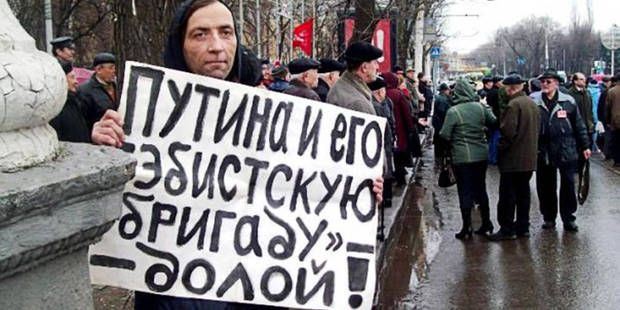
Dmitry Vorobyovsky holding a placard that reads, “Down with Putin and his KGB gang!”
How Quiet Peace Activist Vorobyovsky Wound Up in a Mental Hospital: His Lawyer’s Story
Alla Chernyshova Activatica
May 11, 2016
On May 6, someone rang the door of Voronezh grassroots activist Dmitry Vorobyovsky. The people at the door said they were from the municipal gas company. However, as soon as they entered the apartment, it turned out they were psychiatric hospital orderlies. They suddenly restrained Vorobyovsky, despite his sister’s protests, and took him to the Voronezh Psychiatric Hospital in the city’s outlying Tenistyi neighborhood. Vorobyovsky is currently at the hospital, where he has been injected with unknown drugs.
At 2:15 p.m. on May 12, the Soviet District Court in Voronezh will hear Vorobyovsky’s case. The psychiatric hospital wants to get a legal seal of approval for his hospitalization. Civil rights activists have launched a campaign of support and have asked people to send letters to the Prosecutor General’s Office.
How legal and justified was the activist’s hasty hospitalization? To find out, I spoke with his lawyer, Olga Gnezdilova.
Was there any background or reason for what happened?
Theoretically, there is a background. The doctors cite the fact he was diagnosed in 1983, and he had been registered with the hospital. But he has felt absolutely normal for thirty years. He has not been aggressive. So now we have posed the question: if he needs treatment, then prescribe a course of treatment. He can undergo treatment at home. After all, he was not showing any signs of needing hospitalization or even treatment, meaning he interacted normally with other people and went to protest rallies. But of course he really irritated the local authorities. He has been detained by police on several occasions. But there are no grounds for subjecting him to compulsory medical treatment.
Were there incidents when he behaved aggressively?
No, Dmitry is generally a very calm person. He holds pacifist convictions. He is against violence, and he has protested the war in Ukraine. He is a very cultured, polite person. He has never had any aggressive outbursts his entire life, although formally, he had this diagnosis. On the other hand, even odd behavior is not cause in itself for forcible hospitalization.
He has been absolutely calm and living with his sister. They entered his home under false pretenses, by pretending to be city gas company employees. His sister objected to his being detained, since were no grounds for it at all. When I spoke with him, he told me the whole story himself.
Why do we have to go to court now? Because there we can voice an alternative stance. We need a platform where we can voice our arguments. Currently, he is basically being held against his will, but by law a court hearing has to verify the validity of the claims against him. In court, we can petition to conduct an alternative forensic examination as to whether he is a danger or not. Generally, being a danger to society or oneself is grounds for involuntary hospitalization: for example, if a person beats his head against the wall or plans to kill someone. This does not apply to anyone and everyone whose health is a bit quirky.
What, in your opinion, was the real reason for the hospitalization?
At first, we thought it had to with the May 9 celebrations, which were attended by various officials. Dmitry often takes to the street with placards. It is usually one and the same placard. [See the photograph, above — Editor.] They probably thought he would spoil the “view” for them.
But now it is May 11, and he still has not been released. So, basically, it is hard to say. Maybe it has something to do with the [nationwide parliamentary] elections [in September]?
Some dispatched an ambulance to his house. The hospital won’t say who it was. We think it was the work of our secret service.
How is Vorobyovsky now? Are they giving him shots of some kind?
Yes, they are injecting him with drugs. We don’t know what they are. The doctors are not telling either us or him what they are, claiming it is confidential medical information.
But have they affected his condition?
Basically, he feels okay right now. He is not sluggish or sleepy. I have spoken with him: he conversed with me normally. It is another matter how long this will last.
Tell me, how does the whole situation appear from a legal point of view? They gained entry to his home disguised as municipal gas company employees, restrained him, and took him away.
From a legal point of view, they should have put the issue to the court within forty-eight hours. We really expected a hearing on May 8. We spent the whole day running around to the on-duty prosecutor, to the court, to the hospital. Everywhere we went, we told them that since they had detained him right before the holidays, on a business day, at five in the afternoon on May 6, then be so kind as to put the issue to the court, find an on-duty judge. But we were told that on-duty judges do not rule on such matters, only on arrests. There is a law that allows judges five days to review the hospital’s petition. But at the same time, this provision had already been ruled unconstitutional a bit earlier. Generally speaking, according to the Constitution, any detention must be authorized by a court within forty-eight hours. Even if a person is considered violent, and they grabbed him and tied him up, be so kind as to put the question of his hospitalization to the court.
That did not happen, and we believe this is a serious violation. We have already obtained authorization from Vorobyovsky for an appeal to the European Court of Human Rights, at least in connection with his being detained for forty-eight hours without a court order and his being tied to the bed.
He was tied up?
Yes, for the first three hours after he was brought to the hospital, he lay tied up. His hands and feet were tied. His body went numb, of course. It is a very painful procedure. We are going to file a complaint.
Where is he now?
Vorobyovsky is at the Voronezh Municipal Psychiatric Hospital, in the Tenistyi neighborhood.
Do you think he ended up there because of his public activism?
We think someone instigated the call due to his public activism.
What protest rallies was Dmitry involved in?
Practically in everything that took place. For example, he was involved in a picket in defense of [imprisoned environmentalist] Yevgeny Vitishko, in a rally against the war in Ukraine, in a rally against proposed nickel mining in Voronezh Region. Basically, he has always joined in every opposition event. And yet on his part there have never been any conflicts or aggression, any reason to isolate him from society, like now.
But there were arrests?
Yes, there were administrative detentions. But that is a common occurrence at such events. A few people are always detained by police.
What are your next moves for getting him out?
We are now mostly waiting for the court’s decision. We cannot go any further without it.
On May 8, we appealed to the prosecutor’s office to intervene. They forwarded our appeal to the Investigative Committee. It now must make a decision within three working days, beginning yesterday. However, under these circumstances it is the prosecutor’s office and the court that will primarily be making the decision.
As soon the court’s ruling is rendered, we will be contacting the European Court of Human Rights. It cannot be done earlier.
In addition, Amnesty International has now launched a campaign for people to bombard the prosecutor’s office and the municipal health committee with requests to comment on Vorobyovsky’s case.
Journalists in Voronezh have told me that all day yesterday people were calling the city health authorities and mental health clinic. However, citing medical confidentiality, the officials refused to comment even on the fact that Vorobyovsky has been detained too long without a court hearing. Meaning they will not even answer questions have nothing directly to do with medical issues. The prosecutor’s office has been telling callers they can complain to the Investigative Committee, that they are not planning to do anything.
At the moment, we are hoping the campaign will ultimately make them start giving people answers.
How are the doctors behaving under the circumstances?
Differently. The on-duty doctor who was there when I visited the hospital and asked Vorobyovsky to come out of his room and meet me, basically agreed with me when I said he was completely normal and behaving well. Yet she said that was because he had already been receiving treatment. The deputy chief physician, with whom I spoke on the phone, told me quite confidently they would definitely file suit, and that there were grounds for compulsory treatment and confinement in the hospital. But he considers Vorobyovsky’s diagnosis such grounds. Yet the doctor could not tell me the reason for the hospitalization and said the hospital did not know who called the ambulance.
I gather that who called the ambulance is the big secret?
Yes. And the hospital also believes that Dmitry is having a relapse. But the question is what this relapse consists of.
So a man is sitting at home, not bothering anybody, and an unknown person calls the ambulance for some reason. So the next event is the court hearing on May 12?
And the devil today, unfortunately, increasingly appears to us in the guise of the civic activist.
This is Saint Petersburg Legislative Assembly Member Vitaly Milonov, as quoted on page 5 of the July 13, 2015, edition of local weekly newspaper Smena, on apparently thwarted plans to build a Russian Orthodox church in Malinovka park, in the eastern part of the city. The project has been opposed by a vigorous grassroots campaign on the part of local residents.
The newspaper also continues, for the second issue running, its wild denunciation of local supporters of improved conditions for bicycling in Petersburg. As things stand now, only the extremely bold or the recklessly suicidal would ride a bike on Petersburg’s mean streets, which are nearly totally bereft of bike lanes or other safety amenities for cyclists.
Darya Tabachnikova, recently appointed by city hall as its advisor on cycling issues, is denounced by the former local Communist Youth League newspaper as follows (on page 3):
Firstly, the modest cycling advisor Tabachnikova has worked in the past at the World Bank (an international organization headquartered in Washington, DC) and a branch of the major American company PriceWaterhouseCoopers. In general, when it comes to “Europeanization,” is probably an old hand.
You cannot make this stuff up, which is why I would suggest Smena should be adopted as classroom material by all progressive centers of Russian language pedagogy abroad such as Middlebury College and so on.
Because this is more and more the guise in which the Russian language is appearing to us today (to paraphrase the estimable Milonov): as an instrument for deliberately and cynically attempting to turn white to black, disrupting the critical faculties altogether, and turning the populace into a quivering, paranoid bowl of jelly. TRR