Vegan meals issued to prisoners at the Special Detention Facility on Zakharyevskaya Street, where the detainees sentenced to short jail terms for their involvement in the September 9, 2018, anti-pension reform protest rally in Petersburg are serving their time. Photo courtesy of the Telegram channel ONK SPB 16%(16% of the Petersburg Public Monitoring Commission)
Yekaterina Kosarevskaya Facebook
September 13, 2018
A court in Penza has extended the time in police custody of the suspects in the Network case.
Formal indictments have been filed, and the case will soon be handed over to the prosecutor. Dima and Ilya [Dmitry Pchelintsev and Ilya Shakursky] have been indicted violating Article 205.4 Part 1 of the Criminal Code [“organizing a terrorist community”]. Dima chose Part 1 himself. Dima has refused to admit his guilt.
I imagine, if there were total knowledge of human nature, this knowledge could be attained by simultaneously understanding Konstantin Bondarev, who went sleepless for two nights as he gave the commands to administer electrical shocks to the suspects in the case, and Dima Pchelintsev, who after spending a year in a remand prison, had to choose between two pieces of paper, one promising him five to ten years in prison, the other, fifteen to twenty, and he chose the one promising him fifteen to twenty years (or is that life in prison?), but which did not contain the phrase “I admit my guilt, and I am sorry for what I did.”
There is no such thing as total knowledge.
Meanwhile, Petersburg had a week chockablock with jail sentences for some of the people who attended two different anti-pension reform rallies. Around a hundred protesters were sentenced to jail time, for a grand total of five hundred days in jail for all convicts. That comes to a year and a half in jail, which is a cushy sentence even for people sentenced under Criminal Code Article 205.6, i.e., failure to report a terrorism-related crime. And what is there to report? This is not a comparison. Comparisons are invidious.
I wanted to be in Penza, of course, but for some reason I returned to Petersburg.
The palliative functions of my civil rights work are still with me, but now they have been turned inside out. Temporary relief is now brought not by the presence of a civil rights defender, but things are made present to the civil rights defender. Before my very eyes hot meals and bed linens appear at police stations, people are released from police stations where they cannot be held, and government-issued dinners marked “VEGAN” are handed out at the Special Detention Center. The only things we cannot handle are bedbugs and violations of the freedom of assembly, and this also gives us peace of mind.
A certain Telegram channel writes that the whole business of rescinding the go-ahead for the September 9 protest rally and the subsequent detaining of six hundred people boils down to a feud between the United Russia faction in the Petersburg Legislative Assembly and Petersburg city hall. (Aren’t they United Russia party members, too?) The channel does something incredible: it attempts to figure out Petersburg politics.
I’m amazed, but I’m afraid to go down that rabbit hole. I had better keep trying to figure out Petersburg’s prisons.
Yesterday, after the protest rally, for several hours I made the rounds of different police precincts where detainees had been taken: Lenin Square, Prospekt Bolshevikov, Rybatskoye, and General Khrulov Street. It was night when I got home.
Today, I defended people who were involved in the rally and people who weren’t involved in the rally at the Primorsky District Court. I have just left the court building.
Total legal nihilism prevailed in the court. People were tried not individually, but in bunches. The judge said outright to the defendants that if they refrained from making any appeals she would go easier on them. Many defendants were not allowed to go to the bathroom all day. A police officer ate the food intended for the detainees from the 25th Police Precinct. Most of my defendants were convicted and sent off to jail for four to seven days.
But there were a number of important victories.
I managed to get one defendant’s charge changed from Article 20.2 Part 8 of the Administrative Offenses Code (“repeated violation”) to Article 20.2 Part 6.1 (“involvement in an unauthorized assembly, rally, demonstration, march or picket”). We were able to convinced the judge there were was nothing in the case file proving the repeated violation charge. Instead of fifteen to thirty days in jail or a fine of 150,000 to 300,000 rubles, he was sentenced to five days in jail.
The case of another defendant was completely dismissed. However, since I was removed from the hearing, it was hardly my doing. But the defendant thinks it was crucial I told him to tell the judge about his chronic illness.
The judge wrote in the sentence she handed down to ten guys that the length of their jail terms took effect today, not yesterday, when they were detained, but I convinced her to correct this mistake, and consequently they got back one day of freedom lawfully owed to them.
It went something like that. I wish all of you would go to the court hearings the day after a big protest rally at least once. Your world would never be the same again.
Max Stropov on his way to September 9, 2018, anti-pension reform demonstration in Petersburg. His placard reads, “Life is hard, but happily it’s short.” Photo courtesy of his Facebook page
Today [September 9], I was detained at a protest rally for the first time. I had lucked out at previous demos. The protest rally was against the pension reform, and it took place at Lenin Square [in Petersburg]. The event had been authorized by the authorities, but by a happy coincidence, a pipe near the square had burst a couple of days before the rally. Who knows whether it burst under its own power in such a timely fashion or not.
Whatever the case, it would have been a waste not take advantage of it, and so the entire square was cordoned off. The rally on the square was thus still authorized, but it was now impossible to hold it on the square. Antinomy is the modus operandi of the current Russian regime. What is permitted is impossible, and vice versa.
As I rode the escalator up from the subway, I met a colleague from my previous, academic life, Georgy Chernavin. We stood for a while and had a nice chat.
I was one of the first protesters detained since I was made up like a dead man and holding a placard that read, “Life is hard, but happily it’s short.” That is a title of a song by the band Communism, by the way, but the title is also a quotation, attributed to Varlam Shalamov and Yuri Nikolayev. Basically, the quotation is communist. It belongs to everyone.
Communism, “Life Is Hard, But Happily It’s Short”
I did not see the rest of the rally. There were a total of seventeen people in the first group of detainees, including one dead man (ho-ho-ho). We were put on a large articulated bus. It was spacious inside.
In the paddy wagon, a forgettable looking Center “E” or NKVD officer was in our faces the whole time filming us with a video camera. It was hard to say what secret service he was from. The police could not tell us who he was, and the forgettable looking guy pretended he was not there. When we spoke to him directly, he kept on filming us.
There was also a rather burly major, who never did tell us his name. We later learned from our administrative offense reports that his surname was Golodnyi [“Hungry”].
We cruised around town for a long time. Finally, we were delivered to Dybenko Street. First, the women and children who had been detained were left at one police precinct, and then six of us were taken to another precinct. The rest of the detainees were taken somewhere else, but I don’t know anything about them.
Our group included three young men from the Navalny Team, an older dude carrying a “Putin, resign!” placard, and an elderly man who had lost his telephone and glasses at the rally.
At the police precinct, we hung out in the hallway the whole time. The police told us that we had not been arrested, as it were, but at the same time, they would not let us go.
Antinomy is the modus operandi of the current Russian regime.
Varya Mikhaylova came to the precinct bearing care packages for vegans. At first, the police did not want to take any of the things she had brought for us, arguing we were not locked up in cells. She chewed them out, and they threatened to charge her with disobeying police officers, but finally and suddenly they took all the packages she had brought.
It was a really joyous moment. Everyone wanted to join the Party of the Dead. The old dude drank Agusha fruit puree, saying it was “Agusha from the next life.”
Max Stropov and his fellow detainees. The young man on the right holds a placard that reads, “Putin, resign!” Photo courtesy of Max Stropov’s Facebook page
We had hung out in the hallway for around three hours when the police set about writing us up for our alleged offenses. Everyone’s arrest report was worded exactly the same. It was apparently a boilerplate arrest report issued by police brass. In particular, there was a bit claiming the crowd had yelled, “Putin, skis, Magadan,” as if the boilerplate report had been drafted back in 2012.
The police threatened to keep me at the precinct until my court hearing because I would not sign a paper obliging me to appear in court at ten in the morning, but then I signed it, noting in writing I had done it “under threat of continued detention.” In fact, I had read the form is innocuous and does not oblige anyone to do anything.
The court hearing is tomorrow. The Nevsky District Court is located on Olga Bergholz Street.
Translated by the Russian Reader. According to Mediazona, more than five hundred protesters were detained by police at yesterday’s anti-pension reform rally in Petersburg. At the link, above, you will find a stunning photo reportage of the showdown between protesters and police, produced by photographer David Frenkel.
UPDATE. Petersburg news website Fontanka.ru, which can often be believed when it comes to these things because it is published and edited by former cops, reports that 603 protesters were detained by police during an anti-pension reform protest rally in the vicinity of the Finland Station and Lenin Square in Petersburg yesterday afternoon. Today, many or all of these protesters will be tried in the city’s district courts for their alleged administrative offenses. The calls for help coming over social media from members of the Aid to Detainees Group suggest that many of these people will have no legal representation, neither lawyers nor so-called social defenders, so they will have to fend for themselves. In any case, whether they get the book thrown at them or not will most likely have already been decided elsewhere.
A Female Pensioner in the Nizhny Tagil Area Invited Neighbors to Tell a National TV Channel about Their Village’s Problems: Now She Will Be Tried for Holding an Unauthorized Protest Rally Mezhdu strok
22 August 2018
A 63-year-old resident of the village of Pokrovskoye in the Gornouralsky Urban District warned neighbors a TV news crew would be coming to cover utilities problems in the village. She now faces a court hearing, charged with holding a public event without the consent of the authorities.
Irina Kutsenok. Photo courtesy of Mezhdu strok
Due to a hot water outage in the village that had lasted two months, pensioner Irina Kutsenok turned to the news program Vesti Ural for help. When she found out a news crew would be coming to the village on August 1, she posted announcements about their visit in the entryways of residential buildings, asking villagers to come and speak to the news crew. Subsequently, the head of the village council filed a complaint against Kutsenok with the prosecutor’s office, accusing her of “organizing a public event without filing a notification in the prescribed manner,” a violation of Article 20.2 Part 2 of the Russian Federal Administrative Offenses Code.
“The water was turned off on June 1. The council said it would be off for a mere two weeks, but two months had passed since then. I then contacted Vesti Ural. They had helped us last year with garbage removal. After a segment aired on their program, the council started picking up the garbage. The people at Vesti Ural said they would send a news crew on August 1, and on July 31 I posted flyers in the entryways of residential buildings saying regional reporters were coming to cover the hot water outage so residents would know about it. At the bottom of the flyer, I wrote, ‘Residents should meet outside the club.’ But the editors at Vesti Ural told me the crew would not be coming, because the council had promised them that on August 3 our hot water would be turned on,” Kutsenok told Mezhdu strok.
Irina Kutsenok’s flyer, announcing an upcoming visit by a news crew from the program Vesti Ural and asking village residents to gather outside the village club at twelve noon on August 1 to speak with the reporters about ongoing problems with the village’s hot water supply. Courtesy of Mezhdu strok
According to Kutsenok, the flyers were taken down almost immediately, on August 1. They were replaced with leaflets claiming water pressure tests would be conducted in the village on August 3.
Nevertheless, Kutsenok went to the village club on August 1 in case residents of Pokrovskoye had questions about the hot water outage. She was met there by Marina Selskaya, head of the Pokrovskoye village council, and Alla Semyonova, a member of the Gornouralsky City Duma.
“They yelled at me, accusing me of holding an unauthorized meeting. Later, it transpired Selskaya had also filed charges against me with the prosecutor’s office, accusing me of organizing and holding a public event without notifying the council, of organizing protest rallies. Subsequently, the neighborhood beat cop came to my house and informed me I had to go to court. But I hadn’t made any speeches anywhere, nor had the TV reporters shown up. This means I am going to court for turning to the media, to a TV news program for help. What, now we don’t have the right to turn to the media, either, and we should be fined if we do turn to them? I just wanted to give our council a little nudge. I cannot get them to do anything about the water, preventive medical exams or metering devices for utilities. How much can a person take?” asked an outraged Kutsenok.
The magistrate of Sverdlovsk Region’s Suburban District will hear the charges against Kutsenok on August 30. Article 20.2 Part 2 of the Administrative Offenses Codes stipulates a fine of up to 30,000 rubles [approx. 380 euros] or up to fifty hours of community service.
UPDATE. After this article was published, the press service of the Sverdlovsk Region Prosecutor’s Office informed Mezhdu strok the charges against Kutsenok had not been filed with them, but with the police.
Thanks to OVD Info for the heads-up. Translated by the Russian Reader
“They Are Trying to Destroy Us for Daring to Speak Up” Rural Pensioners Threatened with Fines for Rally against Police Inaction in Investigating Fatal Road Accident
Nadezhda Andreyeva Novaya Gazeta
August 4, 2018
Residents of the village of Tersa in Saratov Region’s Volsk District have sent an open letter to the president asking him to take charge of investigating road accident in which 30-year-old Alexander Lopasteysky was killed. According to the letter’s authors, the local police have tried to cover up a crime. A criminal case has not yet been opened, although the fatal accident occurred more than two months ago. Over three hundred people, every tenth resident of the village, signed the letter. The residents then held an assembly where they discussed the inaction of law enforcement agencies. The police immediately sprang into action—but not to investigate the accident. The next night, the police made the rounds of the village, threatening residents with huge fines for attending an unauthorized public event.
“To: The Kremlin, Moscow. From: Your Voters”
Railroad Street has never been paved or lighted. On the side of the road stands a black metal cross, fenced off with a chain.
“We didn’t bother to attach a plaque. Everyone knows who it’s for anyway.”
In the early hours of May 28, 2018, 30-year-old Tersa resident Alexander Lopasteysky died here while riding a motorcycle. According to his relatives, he was knocked off his bike and run over by Alexander Letov, driving a VAZ 2108 car.
Alexander Lopasteysky. Photo by Matvei Flyazhnikov for Novaya Gazeta
An investigation of the fatal road accident was not opened. Villagers claim an investigator from the district Interior Ministry office came to Tersa to question witnesses forty-two days after the accident.
“The police probably thought they could dillydally, and the collective farmers would forget the whole thing,” argues Tersa resident Viktor Konstantinovich.
“I can’t say the police have been paid off. They have just been negligent in this case. A man accidentally fell off a motorcycle and died through his own fault. It’s convenient. They don’t have to make any effort,” says Valentina Vasilyevna, mother of the dead man, shuffling through photos of her son.
Lopasteysky’s relatives wrote to the district council and prosecutor’s office, asking them to take charge of the investigation. They received formal but meaningless replies to their requests. The only thing left to do was write the president.
“To: The Kremlin, Moscow. From: Your voters in the village of Tersa, Volsk District,” reads the opening of their appeal to the president, which was signed by over three hundred residents of the village, whose total population is approximately three thousand.
As the letter’s authors note, “There has been an attempt to cover the crime up, since Letov’s father is an officer in the Volsk District Police.”
Dream’s Backyard
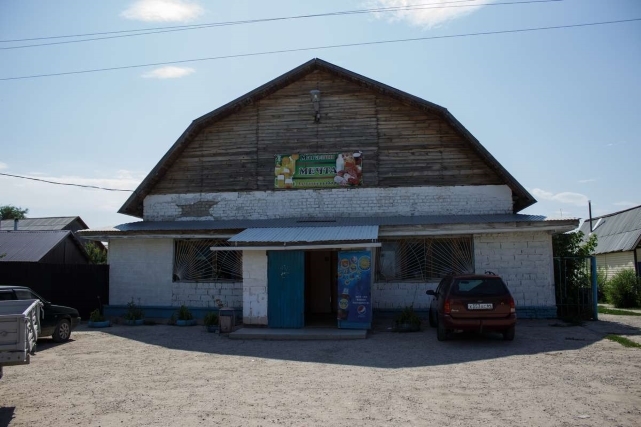
The shop Dream is in the middle of the village, a one-storey brick box crowned with a tall wooden attic. Manufactured goods are through the door on the right, while groceries are through the door on the left. Dream’s backyard was the site of the “unauthorized public event” at nine in the evening on a Sunday.
“The entire village waited for the investigation to begin. We were patient for two months. We sent letters to all the relevant authorities. What was left for us to do? People said we should raise a ruckus,” says Lyudmila Lopasteyskaya, the dead man’s sister.
Lyudmila Lopasteyskaya, Alexei Lopasteysky’s sister. Photo by Matvei Flyazhnikov for Novaya Gazeta
On the social media website Odnoklassniki [“Classmates”], Lyudmila asked everyone concerned about the tragedy to meet by the entrance to the village shop. Around one hundred people came.
Half a dozen police officers from Volsk also came to the meeting, including one armed with a video camera.
“They said it was forbidden to gather near the porch, that it was a public place. We went into the backyard. We wanted to find out what stage the investigation was at. But the police commander from Volsk turned his back on us and chewed out Lyudmila,” recounts pensioner Lydia Nikolayevna, a former schoolteacher.
“I said to him, ‘You’re treating people with disrespect, turn around and face us. He wouldn’t tell us his name. He only ordered the cameraman to film everyone who opened their mouths and told the other officers to write down people’s license plate numbers,” says pensioner Nadezhda Ivanovna, a former college employee.
People dispersed after village council head Vyacheslav Mokhov promised he would go with the dead man’s relatives to meet with the district police chief.
The next day, five Tersans went to Volsk.
“We were allowed to enter the police building in twos. Alexander’s daughter and the village head went in, then Alexander’s friends. I wanted to go last. But the police said to me, ‘No, that’s enough,'” says Valentina Vasilyevna.
Dream, the village shop. Photo by Matvei Flyazhnikov for Novaya Gazeta
“We told them what evidence had been seen at the accident site. But the police weren’t really interested. They kept asking whether the village council had authorized the protest rally, and why the shop owners had agreed to let us in,” Viktor Konstantinovich recounts.
A 20,000 Ruble Fine on an 8,000 Ruble Pension
The police returned to the village a day later.
“They made the rounds of the houses yesterday and the day before yesterday. It was our village beat cop and some officers from Volsk. They knocked on the doors of old women at eleven, eleven-thirty at night. They told people to come outside, shoved papers in their faces, and told them to sign them. They told my wife that by six in the morning they had to get the signatures of the people who had gone to the meeting,” say Viktor Konstantinovich.
He nervously twirls a phone in his hands.
“Dont mention my surname in the newspaper,” he adds.
“He didn’t even get out of the car. I asked where he’d got my name and address. That stopped him short,” recounts Nadezhda Ivanovna.
“He said fines for protest rallies range from 10,000 to 20,000 rubles. My monthly pension is 8,000 rubles. I worked as a lab assistant for thirty-nine years. I spend my entire pension on the gas and light bills, and medicines. We’re frightened.”
“The police are not protecting us. On the contrary, they are destroying us for daring to speak up. Don’t take a picture of me. I have a grandson I’m raising.”
The village beat cop served Lopeystskaya with a notice of initiation of administrative proceedings under Article 20.2 of the Administrative Offenses Code (“Violation of the Rules for Holding a Public Event”), as filed “against an unknown person,” along with an official warning from the Interior Ministry’s district office.
The police informed Lopeystskaya that “in case of a public event, planned by you in the village of Tersa, you could face administrative and criminal sanctions.”
The warning was followed by list of six articles from the Administrative Offenses Code and Criminal Code, including the article that stipulates “organization of an extremist community” as a felony.
A box marked “Information about Incidents of Corruption” at the local police department. Photo by Matvei Flyazhnikov for Novaya Gazeta
The neighborhood police precinct is in the village council building. It is quiet and hot in the hallway, and flies are buzzing. The beat cop’s office hours are glued to a window: two hours on Tuesdays and Saturdays, one hour on Fridays.
I call the mobile phone listed there.
“There was an unauthorized protest rally on my beat, ninety-seven people. I’ve been ordered to gather evidence,” says Lieutenant Alexander Bakanov.
Lieutenant Bakanov does not specify who gave the orders and why. He cuts the conversation short.
The village council head’s office. A United Russia party flag covers the window on the right. Photo by Matvei Flyazhnikov for Novaya Gazeta
The door to the office of village council head Vyacheslav Mokhov is open. A blue United Russia party flag covers a crack in a window. There are framed photos of the president, the region’s governor, and the district head on the wall. The Volsk coat of arms features a sleeping bear.
The ladies in the office next door chime in unison that the boss has left the village.
“He’s gone to Volsk. No, he’s gone to Shikhany.”
Pointing at each other, they argue about who should replace Mokhov when he is out of the office.
Mokhov hangs up on me twice, but then he arrives at the office anyway.
“Don’t you photograph me. I’m scared of everything. This thing can be spun the wrong way,” he says.
“That was the first unauthorized protest rally in the Volsk District ever,” he adds, lowering his voice.
P.S. The press’s attention to this story has been reflected in the surprising speed with which local law enforcement has reacted. While this issue was going to press, a criminal case was opened under Criminal Code Article 264 (“Violation of Traffic Rules”), and the Volsk District Court placed Alexander Letov under house arrest. Volsk District Deputy Prosecutor Andrei Shevchenko refused to comment on the case when asked by Novaya Gazeta.
Meanwhile, the Volsk District Court has begun hearing the matter of Lyudmila Lopasteyskaya’s alleged violation of Article 20.2 of the Administrative Offenses Code. The Tersans summoned to testify have told the court that what happened was not a protest rally, but a meeting of villagers concerned about the tragedy. The next court hearing in the case has been scheduled for August 9.
Thanks to Valentin Urusov for the heads-up. Translated by the Russian Reader
Varya Mikhaylova (center, with megaphone), carrying {rodina}’s 9 Stages of the Supreme Leader’s Decomposition as she marched with the Party of the Dead bloc in this year’s May Day demo in Petersburg. Photo by Elena Lukyanova. Courtesy of Novaya Gazeta
On Friday, June 8, 2018, a Petersburg district court sentenced local feminist and democratic activist Varya Mikhaylova to a fine of 160,000 rubles (approx. 2,180 euros) for carrying a picture at this year’s May Day demonstration, during which she was detained by police.
The court also ordered the picture in question, 9 Stages of the Supreme Leader’s Decomposition, by the Petersburg art group {rodina} (“motherland”), burned.
{rodina}, 9 Stages of the Supreme Leader’s Decomposition. A Petersburg judge has ordered this artwork torched.
How can you show your solidarity with Varya Mikhaylova? By helping her pay the hefty fine. It would be exorbitant anywhere, but it is purposely burdensome (that is, designed to discourage people from protesting by impoverishing them) in a city where the average monthly salary is around 500 euros.
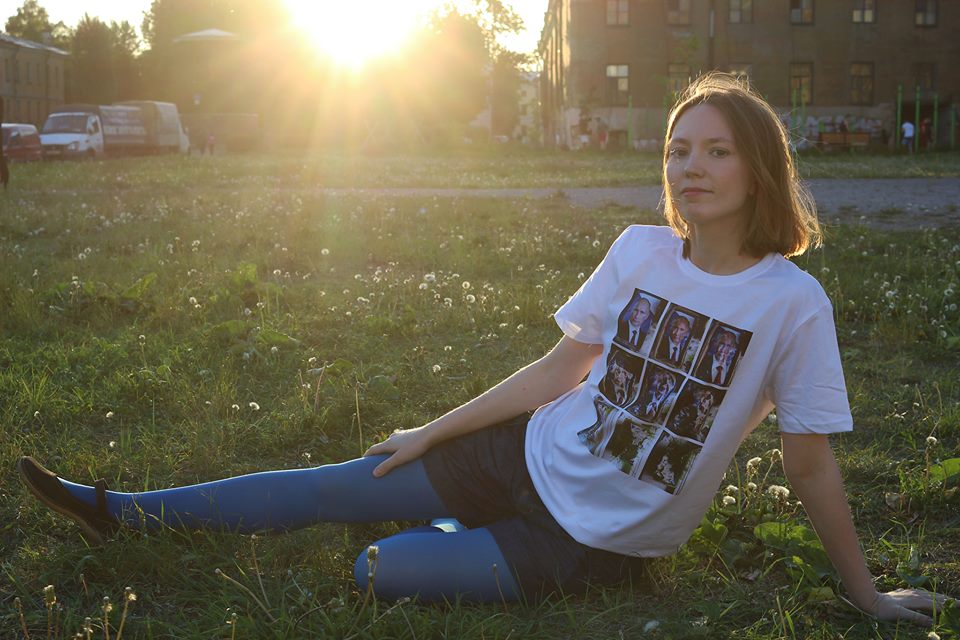
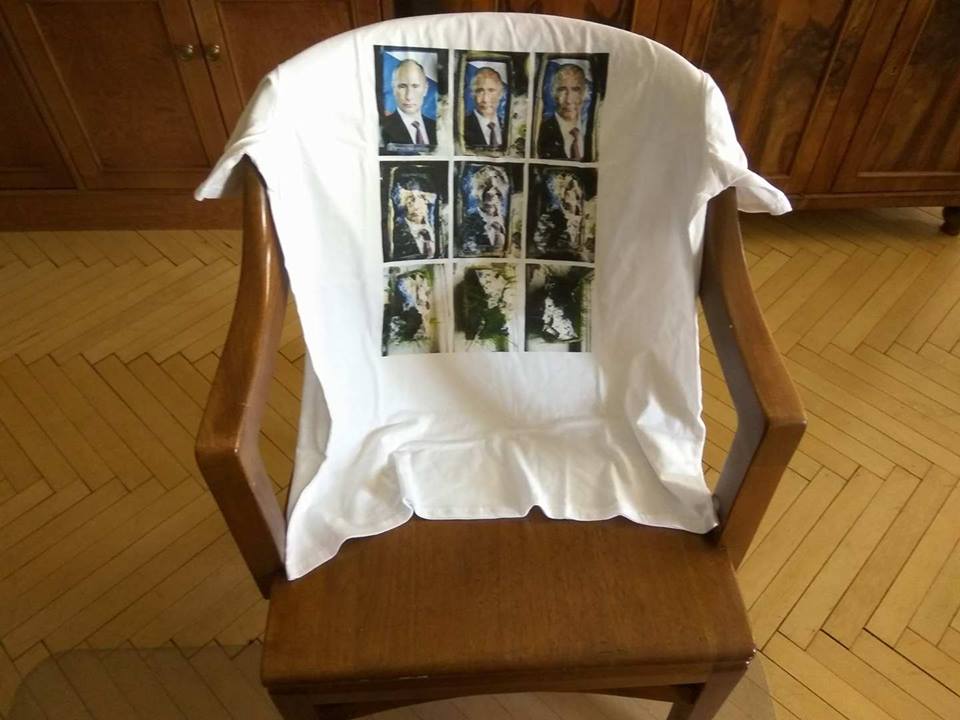
How can you show your solidarity with {rodina}, whose artwork faces the fiery flames of censorship? By ordering a t-shirt, poster or postcard embossed with 9 Stages of the Supreme Leader’s Decomposition. Proceeds from the sales of these mementos will go towards paying Varya’s fine. Any money left over will be used to make more revolutionary art.
You can order a postcard for 100 rubles (approx. 1.30 euros), an A3-sized poster for 500 rubles (approx. 6.80 euros), and a t-shirt for 1,500 rubles (approx. 20.40 euros).
The cost of shipping your order anywhere in the world via Russian Post is 500 rubles.
Place your orders on {rodina}’s merch page. When you go there you will need to click on the “Message” button and chat with someone who can help you with your order.
I was so taken with the 9 Stages t-shirt I already ordered and took receipt of mine. Now I’ll have to wear it on the mean streets of Petrograd while also avoiding sudden arrest.
You can also send money directly to Varya via her PayPal account (bukvace@ya.ru). The proceeds will also go towards paying her fine. // TRR
Thanks to Comrade KB for the final photograph and taking delivery of my t-shirt.
At €2.50, the official licensed sticker album of the 2018 World Cup is a steal. Russian officials also plan to steal the civil rights of their own citizens during the month-long tournament. Photo by the Russian Reader
Restrictions on Movement and Freedom of Assembly during the 2018 FIFA World Cup
Denis Shedov and Natalya Kovylyayeva OVD Info
May 25, 2018
Russia welcomes the 2018 FIFA World Cup with Presidential Decree No. 202, which places restrictions on the movements of people and the staging of public rallies in cities hosting the matches. According to the decree, “enhanced safety measures” will be enforced from May 25 until July 25 (although the first match, between Russia and Saudi Arabia, will not be played until June 14). Denis Shedov and Natalya Kovylyayeva studied the decree specially for OVD Info.*
The restrictions will be introduced on May 25, 2018. They will be enforced in the cities and regions hosting 2018 World Cup matches: Moscow, Petersburg, Volgograd Region, Sverdlovsk Region, Nizhny Novgorod Region, Samara Region, Rostov Region, Kaliningrad Region, Krasnodar Territory, the Republic of Tatarstan, and the Republic of Mordovia. Additionally, the decree also applies to certain neighboring regions where, in particular, competing teams will be accommodated: Moscow Region, Leningrad Region, Kaluga Region, Voronezh Region, Stavropol Territory, and the Republic of Chechnya.
It is worth noting Decree No. 202 applies absolutely to everyone who is located in the regions listed during the period the decree is in force. In this light, OVD Info felt it was vital to discuss these changes.
Monitored and Restricted Areas
The decree introduces “monitored and restricted areas,” which will either be entirely off limits to people or will have restricted access. These areas include training grounds (including at other stadiums), team headquarters, hotels where teams and referees are staying, cargo inspection points, the broadcast center at Crocus Expo in Moscow, fan festival venues, press centers, and parking lots for special transport. You will be able to enter these “monitored areas” only after security guards have conducted a thorough inspection of all your belongings.
In addition, there will be special pedestrian security zones, so-called last miles, consisting of areas of one to two kilometers in radius around the stadiums where the matches will be held. Aside from World Cup transport, only residents of nearby buildings, equipped with special passes, will have access to these zones. To obtain the passes you need your internal passport and the papers for your car and your flat. Information about these zones has been posted on the official municipal websites of the cities hosting matches and published in local periodicals.
During the 2014 Winter Olympics in Sochi, the city was off limits to cars from other cities, i.e., cars not registered in Sochi, with the exception of vehicles owned by the secret services and vehicles that had received accreditation as municipal maintenance and 2014 Winter Olympics support vehicles. Vehicles registered in Sochi were restricted from traveling in “monitored areas.”
Mandatory Registration for Everyone
Upon arrival in a city, you must register with the local immigration authorities within three days. This rules applies to everyone except those who are registered to live permanently in the particular city. Additionally, special rules for registering domiciles and temporary stays will be introduced in the cities where World Cup matches are scheduled.
Russian nationals and foreign nationals must register with the police within 72 hours of arriving. Usually, during “normal” times, Russian nationals have the right to spend up to 90 days in another Russian region without registering, while foreign nationals have seven days to register. Decree No. 202 specifies that the party hosting the visitor, i.e., the hotel, spa, holiday home, etc., must notify the proper authorities of the arrival of foreign nationals within 24 hours, as stipulated by Russian federal law.
Immigration authorities in the regions mentioned in the decree will be open for business daily during the World Cup, including weekends and holidays. There are several ways of registering your stay in another city:
Submitting an application to the management of the hotel, hostel, camping ground or youth hostel where you are staying, or the management company, proprietor or landlord, if you are staying in a private flat.
Reporting to the local immigration authorities yourself.
Foreign nationals must personally present their papers to the regional office of the Interior Ministry (i.e., the police) or a multi-service center, or their official hosts must do it for them. It is forbidden to register via the post office or a government services website.
Arriving foreign nationals are obliged to provide notification of their arrival, a copy of their identity card (e.g., passport or either ID), a copy of their Russian visa, and a copy of their migration card. This rule applies to all foreign nationals, regardless of their nationality and status in Russia. If the host party is a legal entity, this organization must supply the authorities with a complete set of documents.
Private individuals who act as hosts need only present their Russian internal passports, proving they are permanent residents, a copy of their passports, and a copy of their ownership deed to the dwellings where they will house foreign nationals.
If these rules are violated, Russian nationals will be obliged to pay an administrative fine. In Moscow and Petersburg, the fine will range from three to five thousand rubles, while in the regions it will range from two to three thousand rubles. Foreign nationals who violate these rules can be expelled from Russia.
Restrictions on Freedom of Assembly
According to the decree, from May 25 to July 25, 2018, assemblies, rallies, demonstrations, marches, and pickets that have nothing to do with the 2018 FIFA World Cup can be held only in places, along routes, and at times approved by the authorities. The authorities can also determine the number of attendees and the duration of the event.
Decree No. 202 was first enforced during last year’s Confederations Cup, also hosted by Russia. A large number of activists involved in group protests and solo pickets were apprehended at that time. Some of the people detained during solo pickets were subjected to “explanatory discussions” by the police, while others were written up for violating the rules for holding public events and fined as much as 20,000 rubles.
In May 2017, five activists from the local headquarters of opposition leader Alexei Navalny were detained for setting up a campaign booth on the main square in Kazan. Law enforcement said the action had not been authorized by the authorities. All the detainees were sentenced to ten to twelve days in jail, as well as 35 hours of community service.
During the Navalny-inspired anti-corruption rallies that took place in a number of cities on June 12, 2017, including Petersburg, Moscow, and Sochi, police detained protesters on the basis of Paragraph 11 of the decree, as paraphrased above. Although in Krasnodar, where the rally against corruption had been authorized, no one was apprehended, despite the special security regime.
During the protest rally “Farewell to the Communications Ministry,” in Moscow in June 2017, a teenager was detained when he tried to leave flowers outside the ministry due to restrictions on freedom of speech in Russia, including the possible blockage of the Telegram messenger service. The arresting officer cited the presidential decree restricting rallies during the Confederations Cup and the 2018 World Cup when he detained the boy. The teenager was taken into a police station for questioning before being released.
In mid-June 2017, fifteen people holding solo pickets against Moscow’s massive “renovation” program were detained outside the entrance to the State Duma.
Solidarity Party activist Mikhail Lashkevich was detained on July 4, 2017, while holding a solo picket demanding the people behind opposition leader Boris Nemtsov’s assassination be found. The police admitted he had a right to carry out a solo picket and released him from Basmanny Police Precinct in Moscow without writing him up. Subsequently, Roman Petrishchev, another Solidarity Party activist, was detained for a solo picket.
In early July 2017, five activists of Protest Moscow were detained in different parts of the city while they held solo pickets against censorship. All of them were charged with violating the rules for holding public events, punishable under Article 20.2 Part 5 of the Administrative Offenses Code.
On July 5, 2017, the well-known democracy activist Ildar Dadin was detained during a solo picket outside FSB headquarters in Moscow, since his protest had not been authorized by law enforcement. On July 7, 2017, the Meshchansky District Court found him guilty of violating the “rules of solo pickets” and fined him 20,000 rubles.
In May 2017, Alexander Pomazuyev, a lawyer with Navalny’s Anti-Corruption Foundation (FBK) asked that Paragraph 11 of the decree be declared null and void in a suit he filed with the Russian Supreme Court. Pomazuyev claimed he had been denied the right to hold a solo picket. He also argued the presidential decree infringed on civil liberties guaranteed by the Russian Constitution, including the right to free speech and freedom of assembly. The court threw out Pomazuyev’s suit, thus rubber-stamping the restrictions on rallies and pickets during the Confederations Cup and the 2018 FIFA World Cup.
In February 2018, organizers of the Boris Nemtsov Memorial March in Nizhny Novgorod wrote an open letter to FIFA president Gianni Infantino asking him to protect freedom of assembly in Russia in the run-up to the World Cup. The football functionary did not react to the letter, apparently.
“Although the decree restricts certain rights only from May 25 to July 25, 2018, even the smallest pickets have been turned down by the authorities on the grounds of the terrorist threat,” the march organizers wrote on their Facebook page.
Commentary by Lawyer and Human Rights Activist Alexander Peredruk Yes, Presidential Decree No. 202, dated May 9, 2017, definitely violates people’s constitutionally guaranteed rights to freedom of assembly in Russia.
If you want to hold a public rally from May 25 to July 25, 2018, at a venue of your choosing, there is no guarantee you will pull it off. The authorities could turn you down on the grounds the venue you have chosen was not vetted by the Interior Ministry and the FSB.
As last year showed, when several applications to hold rallies were filed simultaneously, the authorities would reject all the applications. However, when the applications were filed, the authorities had not yet determined what venues could be used. They drew up a list of permissible venues only after looking over the first applications. It was thus a “complete coincidence” that the venues indicated in the applications that were submitted to the local authorities were not on the list of permissible venues.
In other words, the rejections were perfunctory and practically groundless. The authorities were not interested in conducting a proportionality test, in striking a balance between public and private interests.
In addition, questions are raised about the legitimacy of the division between public sporting events, which are permitted during this period, and public political events, which are virtually banned. Russian citizens are thus subject to discrimination.
During the 2014 Winter Olympics in Sochi, a local man, David Hakim, was detained while holding a solo picket in defense of the convicted environmentalist Yevgeny Vitishko. (Hakim was jailed for four days for his “crime.”) Agora used his case to challenge the president’s Olympic decree in the Russian Constitutional Court. However, the court refused to examine whether the decree complied with the Constitution, since it had expired by the time the complaint was examined.
* If you are worried about how Presidential Decree No. 202 will affect foreign fans traveling to Russia for the World Cup, you shouldn’t be. They are required to purchase special “fan IDs” that will exempt them from most if not all of the decree’s strictures. // TRR
Denis Shedov is a lawyer with the Memorial Human Rights Center in Moscow. Natalya Kovylyayeva is a journalist. Translated by the Russian Reader
Russian riot police paddy wagon parked in downtown Petersburg, 11 November 2016. Photo by the Russian Reader
Putin Calls for Assessing Police Actions at Protest Rallies
Natalya Demchenko and Pavel Kazarnovsky RBC
October 30, 2017
The president argued that instead of organizing protests, critics of the authorities should ensure their presence [sic] on the internet and in the media. He also said that “disrupting life in big cities” was wrong, but that freedom [sic] must be guaranteed.
During a meeting of the Presidential Human Rights Council, Vladimir Putin suggested analyzing the actions of law enforcement agencies vis-à-vis protesters, noting that freedom must be guaranteed. The president’s address was broadcast live by TV channel Rossiya 24.
“Freedom must be guaranteed. I completely agree with you. We must always analyze established practices in our country,” he said in reply to a question from council member Nikolai Svanidze.
According to Putin, however, “some groups of protesters” and rally organizers deliberately aggravate the situation “in order to attract attention,” whereas in order to “state their position and criticize the authorities” it suffices to secure a presence on the internet and in the media [sic].
“I can imagine that the authorities drive these protests over the hill since they have no desire whatsoever to show them up and close. But deliberately interfering with life in the big cities, deliberately triggering aggression, is also wrong. We must work with both parties to this process,” said Putin.
According to him, hysterical outbursts occur from time to time in Russia due to protest rallies.
“Outbursts happen. Look at what has been going on in the US. There are hysterics there,” noted the president.
According to him, these outbursts are a natural phenomenon. There is no need to expect complete calm.
“There never was such a thing and there never will be.”
It is necessary, however, to minimize the negative aftermath of the outbursts.
A series of anti-corruption rallies, organized by Alexei Navalny’s Anti-Corruption Foundation, were held this past March in Russia. The events were authorized [sic] by the authorities in 24 cities, although organizers advertised events in a hundred cities across Russia. The best attended rallies took place in Moscow, St. Petersburg, Novosibirsk, Yekaterinburg, Chelyabinsk, and Vladivostok.
In Moscow, a protest on Tverskaya was not agreed by the authorities, who did not propose an alternative venue to the organizers [as required by law]. Navalny thus announced that, in according with a Constitutional Court ruling, he considered the protest rally authorized and encouraged his supporters to come to Tverskaya. Consequently, according to OVD Info, over a thousand people were detained by police. (According to official police figures, the number was around 500.)
Presidential spokesman Dmitry Peskov later said the Kremlin respected people’s civic stances and the right of Russians to voice them in a manner agreed with the authorities, but the March protest rally on Tverskaya had been a provocation.
When asked why the national TV channels did not cover the anti-corruption rallies in Moscow and other Russian cities, Peskov said the TV channels showed what they considered “important and meaningful.”
Translated by the Russian Reader
There is actually no evidence the Russian authorities have any respect for such basic human freedoms as freedom of speech and freedom of assembly, as guaranteed by the Russian Constitution and the international conventions to which Russia is a signatory.
Here are the highlights of my coverage of the recent clashes between Russian protesters, many of them young people, and Russia’s “lawlessness” enforcers, encouraged by the “legal anarchy” on display once again in President Putin’s remarks earlier today, as quoted above. TRR
Vadim F. Lurie, from the series “Russia Day in Petersburg,” June 12, 2017
Ekaterina Prokopovich
July 4, 2017
Saint Petersburg, Russia Facebook
I finally must tell you about the events of June 12. Otherwise, I will lose their thread altogether.
Navalny announced another round of anti-corruption rallies nationwide. The first rallies were on March 26. I wrote about it. I was detained at the rally [in Petersburg]. I was also detained during a rally on April 29. I wrote about that as well. You all know I have a ton of gripes against Navalny, but I think it’s important to demonstrate publicly.
On June 12, my son and I arrived at the Field of Mars. We walked several meters. There were a lot fewer people than in March. Somewhere, people were shouting, “Russia will be free!” and stuff like that. I saw the Russian National Guard lining up. I said to my son, “Let’s get the heck out of here.” I really did not want to get arrested again. We turned around and were leaving. I suddenly saw that the Russian National Guard had kettled us. That was all she wrote.
People next to me asked what was happening. I told them I’d been through it before. I said we would be taken to different police precincts, charged with violating Article 20.2 of the Administrative Offenses Code (“violating the rules for holding a public event”), and go home late in the evening. I said that, by law, the police had three hours to do this, but they violate the law. What I didn’t realize then was that our arrest would last not three hours, but several days.
Now I understand we should have broken out of the kettle and left. We cannot let them treat us like sheep and illegally detain us. I had already talked to people who had managed to break through another kettle and with a man who had given the slip to a Russian National Guardsman who had grabbed him. That’s the way to do it.
Skipping ahead, I’ll say that a young man who interrogated me about what would happen to us, a young man who had come to the Field of Mars simply to hang out, was sentenced to fourteen days in jail. Everyone got the same sentence, no matter why they were there.
We were thrown onto buses and taken to police precincts. Once there, we were initially charged with violating Article 20.2, but in the evening, the police got orders to charge us with violating Article 19.3 (“disobeying a police officer’s lawful request”) as well. We know this, because the police dicussed it in front of us. One female officer was even outraged. “Why charge them with 19.3?” she wondered. The precinct deputy commander replied, “Do I need to explain why? Let’s go and I’ll explain it to you!” So we spent the night in a cell. We were taken to court only in the evening of the next day. Personally, I was convicted and sentenced in the dead of the night, around two in the morning. The women generally got five days in the slammer. For some reason, I got seven. On the other hand, I’m a recidivist. My son got a lighter sentence: his defender, Yevgeny Pirozhkov, argued his case for several hours, trying to get him off. In short, the district courts were operating round the clock. Around six hundred people were detained. Around two hundred or so were sent to the slammer. The temporary detention center could not have handled any more. Everyone’s charge sheets were identical down to the last comma. The police faked the charge sheets, and the judges had gotten word from up top that people should be sent to jail for several days based on the trumped-up charge sheets.
We were taken to the temporary detention center twice. The first time was on June 14 at six in the morning. We waited, but they had run out of mattresses. We were shipped back to the precinct. They brought us back in the afternoon and put us in our cells in the evening.
In short, they tormented us for two days, but everything was decent at the detention center, both in terms of the staff and the conditions. I have no gripes against the detention center. I’ll write about it separately, because this text is too long as it is.
Translated by the Russian Reader. Thanks to Alexei Kouprianov for the heads-up. Please read my other postings on the events of June 12 and their horrendous (il)legal aftermath:
“The Regime Is Making New Enemies with These Arrests”
Irina Tumakova Fontanka.ru
June 22, 2017
The arrestees who served ten days in jail after Russia Day shared their plans for the future. They once again included the Field of Mars, and Navalny, and the special detention center on Zakharyevskaya Street they had just left.
Ksenia Morozova, holding a placard that reads, “Freedom is within.” Photo courtesy of Sergei Mikhailechenko/Fontanka.ru
A new group of prisoners, who had finished serving the jail sentences they were given after Russia Day, was released on Thursday, June 22, from the Interior Ministry’s special detention center on Zakharyevskaya Street in central Petersburg. They had been sentenced to ten days in police custody, meaning they had committed violations of “moderate severity.” The die-hard violators, who were sentenced to fifteen days in jail, will not be released until next week. The least malicious violators, who had already been released, greeted their recent cellmates with soda pop, flowers, and rounds of applause. The former prisoners were cheerful and praised the prison food. They came out of jail with the same clear conscience they had when they left the Field of Mars in paddy wagons.
The Interior Ministry’s special detention center on Zakharyevskaya is a historical landmark. Vladimir Ulyanov (Lenin) and Felix Dzerzhinsky had done time there prior to 1917. In June 2017, people who attended an anti-corruption rally on Russian Independence Day were jailed there.
Around 10,000 people had gone to the Field of Mars on the national holiday. Some people celebrated, while others were arrested. Nearly six hundred hundred left the celebrations in paddy wagons, headed to police precincts round the city. From June 13 on, the city’s district courts worked like a conveyor belt for meting out punishment. The arrestees were sentenced for going to the anti-corruption rally and for failing to obey police orders to leave the rally, i.e., they had violated two articles in the Administrative Offenses Code. The majority of those detained at the event got off with 10,500-ruble fines [approx. 158 euros], but a hundred and fifty people were sent to jail, sentenced to terms of three to fifteen days.
The release of the prisoners whose time in jail ended on June 22 was due to start at two o’clock in the afternoon, when the lunch break ends on Zakharyevskaya. At the very same time, as recorded in their arrest records, exactly 240 hours had passed since the first of the “ten-dayers” had been detained. In fact, they had been detained and hauled to the courts wholesale. But the law enforcement machine was carefully counting off the minutes. One prisoner could be released at 2:30 p.m., but another had to be released at 4:00 p.m.
The Support Group
At a quarter to two, people holding plastic bags form a semi-circle at the exit from the detention center. Two vehicles are cruising nearby. One, emblazoned with Open Russia’s logo, is ready to give the released detainees a lift to the courts, where lawyers are waiting to appeal their fines. The other, emblazoned with the police’s logo, is also ready to take them somewhere.
“I’m going to detain you for jaywalking,” a policeman standing on the sidewalk warns me.
“Please arrest me for jaywalking,” I smile back at him, standing on the same sidewalk. The policeman goes back to his car.
The bags of the people waiting outside the detention center are stuffed with bottles of soda pop. There is also a bunch of pink chrysanthemums. Later, the chrysanthemums will be divided and given to the liberated comrades. Everybody knows who nice it is when people are waiting for you with chrysanthemums when you get out of jail. And you are also really thirsty when you get out. The greeters know all of this from personal experience.
“I was in for five days and got out last week,” says a man standing near the gates of the detention center. “And today the guy I shared a cell with is getting out.”
The man’s name is Oleg Maksakov. He is forty-three. He doesn’t know why he was sentenced to five days, while his young cellmate got ten days. They didn’t know each other before they were jailed, but they made friends in the cell.
“The propaganda has no effect on the people aged eighteen to twenty-five who came to the Field of Mars,” Maksakov says of his “accomplice.” “What matters even more is that they’re not afraid. They’re not downtrodden. They have no experience of the Soviet repression machine. I mean, now they are finding out, of course. But it doesn’t scare them. It only makes them mad.”
Another person who celebrated Russia Day at the Field of Mars approaches us. In terms of age, Pavel Ilatovsky is one of the “non-downtrodden.” You could say he lucked out. He got off with a 10,500-ruble fine and spent two days at police precinct while he waited for his court hearing.
“Yeah, I was lucky,” Ilatovsky agrees. “I had my hearing at the Krasnoye Selo District Court, and the judges were okay. They said right off the bat there was no room in the cells, and so they were going fine us.”
The figures assembled by volunteers back up what Ilatovsky says. The Krasnoye Selo District Court heard 59 cases, and no one was sentenced to time in jail. The Kalinin District Court proved to be the most cruel and greediest. Among the 44 cases it heard, around three fourths (the volunteers don’t know for certain) resulted in fines alone, while the rest resulted in fines and jail time. The same court handed down the harshest sentence: fifteen days in jail plus a 20,000-ruble fine.
Ilatovsky volunteers with the detainees assistance group. The group brought care packages to Zakharyevskaya all ten days and raised money to pay the fines. And now they have brought a vehicle, soda pop, and chrysanthemums. This system of assistance improves with every series of arrests. It has started working like a well-oiled machine.
“There are lots of us,” says Ilatovsky. “And we know that if someone wasn’t detained this time round, he or she could be detained next time. When I was at the police precinct, they brought us water and helped out with food. They even brought us shawarmas.”
We are chatting next to the prison’s entrance. Everyone’s mood is upbeat, even joyful. Finally, the iron door opens and a young man exits holding his passport. He is carrying a backpack, and a container of liquid soap pokes out from the pocket. A yellow-and-blue ribbon is pinned to his jacket.
“Oh!” says Oleg Maksakov, rushing towards him. “I spent five days in a cell with that guy!”
“I Hung Out with Interesting People”
Denis Uvarov went to the Field of Mars with a purpose. He wasn’t celebrating the holiday, but combating corruption.
“This dude was walking around with a bullhorn and ordering everyone to disperse, but no one dispersed. Therefore, they did not obey [the police’s orders],” he says by way of explaining why he was convicted of disobeying the police.
Besides, Uvarov chanted slogans offensive to our president, and what is worse, waved the flag of Ukraine, with which he sympathizes. He caught flak for it: ten days in the slammer. He admits it could have been worse. He twice received care packages of food from complete strangers, and that amazed him most of all.
“Of course, we didn’t really need anything in the cell, but it’s nice knowing that you’re in there, and somebody cares,” says Uvarov.
In the two-person cells in which the June 12 arrestees were held, they really did not need anything. Uvarov compared it to a hospital, adding, only, that he couldn’t go into the hallway. But they were taken out for walks every day.
“The biggest problem was not being able to wash up,” he says. “They let us take a shower only once over the ten days. Well and, excuse me for mentioning it, but going to the toilet when you’re not alone in the cell, is, you know . . . Otherwise, it was okay. There was nothing to do, so I read a pile of books, slept in, studied English a bit, and hung out with interesting people.”
The interesting people were other prisoners sentenced to jail for June 12. Uvarov says it was the first protest many of them had attended. Some of them ended up there by accident and were not interested in politics.
“Now they say they’re going to be more active and angrier,” Uvarov continues. “So the regime is deliberately making new enemies with these arrests, as it were. You can do fifteen days in jail, after all. As long as there is a point.”
“What about twenty?” I ask. “That’s nearly a month.”
“Twenty?” says the young man thoughtfully. “Yes, I could probably do it.”
“Yeah, but don’t you need to be arrested twice in six months,” Uvarov asks uncertainly. “I’ll probably need to take that into account. I’ll think it over.”
“I’ll Go to Jail Again”
Ivan Gerasimyuk is one of the young people who collided head on with politics at the special detention center. He looks about twenty years old.
“I was just hanging out on the Field of Mars,” says the young man. “There was a celebration of four eras taking place there. I looked at pre-revolutionary tanks, and then I went to eat kasha in the field kitchen. That’s where the police grabbed me. In court, I said I wasn’t interested in politics, but the judge didn’t believe me and gave me ten days in jail. It turns out you cannot attend celebrations in our country.”
Gerasimyuk thought jail was awful, especially the fact the prisoners were fed not according to schedule, but whenever. And his cell was very dirty.
“I don’t want to go back there,” Gerasimyuk frowns. “But I’ll definitely go to a protest rally now. We have to combat this lawlessness. Well, so I’ll go to jail again. But then other people won’t have to go.”
Alexander, who refuses to tell me his surname, works in a school. He won’t say what he does there, but he deals with young people like Gerasimyuk, only a bit younger.
He shakes his head.
“I don’t talk with the kids about politics at all. I don’t need to. They know it all anyway. They read about Navalny and Putin in the internet. Although what gets them hot and bothered is memes and all, not politics. But their teachers propagandize them, and they see it doesn’t synch with what is happening around them. That generates distrust in them.”
Alexander went to the Field of Mars knowing a rally was supposed to take place there, but he had no plans of taking part in the protest. He only wanted to watch.
“The numbers of true believers who were arrested were small, in fact,” he grins. “It was the rubberneckers like me who got caught. After doing time in jail, some of them are now true believers. But I’ve also spoken with other people, who say they would never do it again. As for me, I’m definitely going next time.”
Vladimir Drofa, who is released right after Alexander, has become a true believer. Or, at least, he says so.
“Until my arrest I was a sympathizer,” he says, looking at my dictaphone. “But now I’m a convinced revolutionary. I will devote the rest of my life to making sure I change places with the people who put me in here.”
“You want to sentence them to ten days in jail?” I ask.
“I’d start with ten at least.”
Drofa knows that, before him, his namesake Vladimir Ulyanov was imprisoned in a nearby cell.
“Let Them Bust Me!”
The convicts opened the iron door one after another. The young women who were released were mobbed by other young women, who gave them bouquets and squealed in delight, as if they were greeting movie stars. The female arrestees who were the last to be released wearily thanked the public and refused to talk to the press, because they wanted to go home. Ksenia Morozova, a social media marketing manager for Sobaka.ruwho had become famous over the last ten days, set her bags on the pavement. She held up a placard reading, “Freedom is within.” She did not hold it up very high, only as high as her own neck
“This is my first picket on the outside!” she yelled. “Let them bust me if they want!”
She was not busted. Her girlfriend grabbed her bags, and the flock of young women ran off towards the subway.
The young people were applauded as they left the jail. They were also given flowers, the very same pink chrysanthemums, until the entire bunch had been divvied up and was gone. The press drifted away. The bus emblazoned with Open Russia’s logo left, taking with it those who wanted to appeal their sentences to meet with lawyers. The last of the dozen and a half “ten-dayers” emerged from the jail after four o’clock, saying almost exactly the same things their special detention center cellmates said. None of them broke their toothbrushes at the doors of the prison.
Translated by the Russian Reader. Thanks to Comrade Uvarova for the heads-up

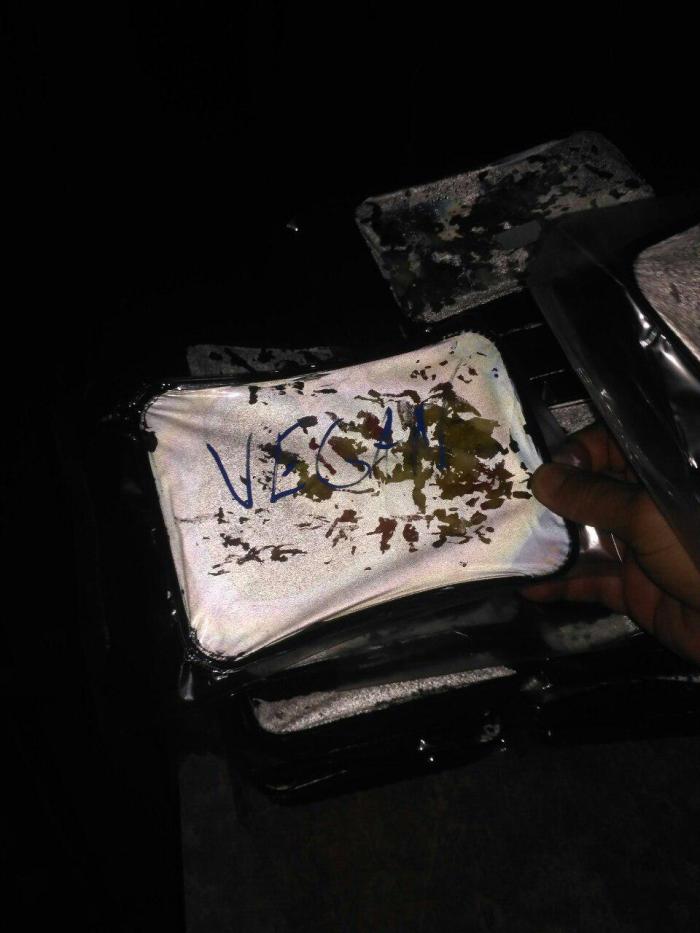 Vegan meals issued to prisoners at the Special Detention Facility on Zakharyevskaya Street, where the detainees sentenced to short jail terms for their involvement in the September 9, 2018, anti-pension reform protest rally in Petersburg are serving their time. Photo courtesy of the Telegram channel ONK SPB 16% (16% of the Petersburg Public Monitoring Commission)
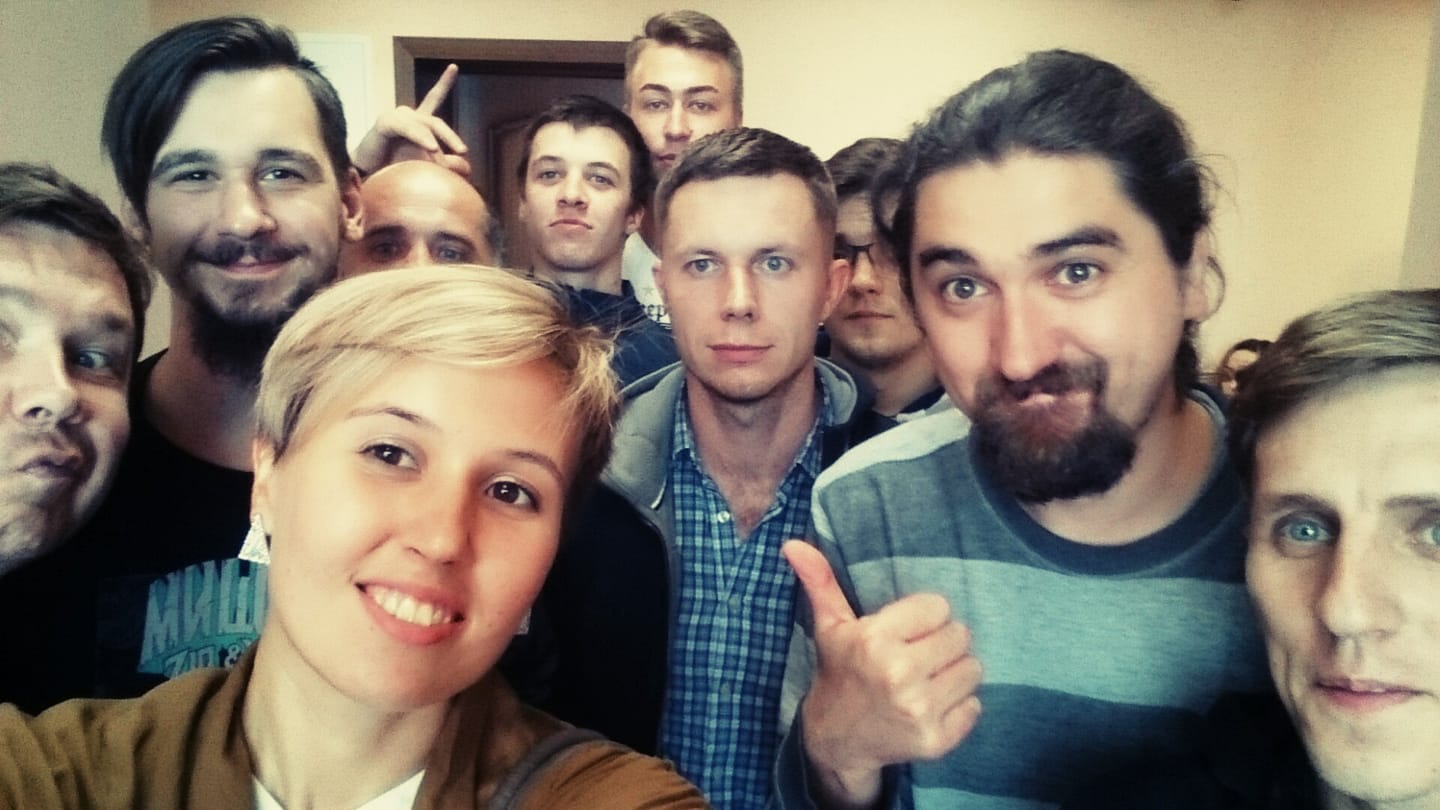 Varya Mikhaylova and her defendants. Photo courtesy of Ms. Mikhaylova’s Facebook page
 Max Stropov on his way to September 9, 2018, anti-pension reform demonstration in Petersburg. His placard reads, “Life is hard, but happily it’s short.” Photo courtesy of his Facebook page
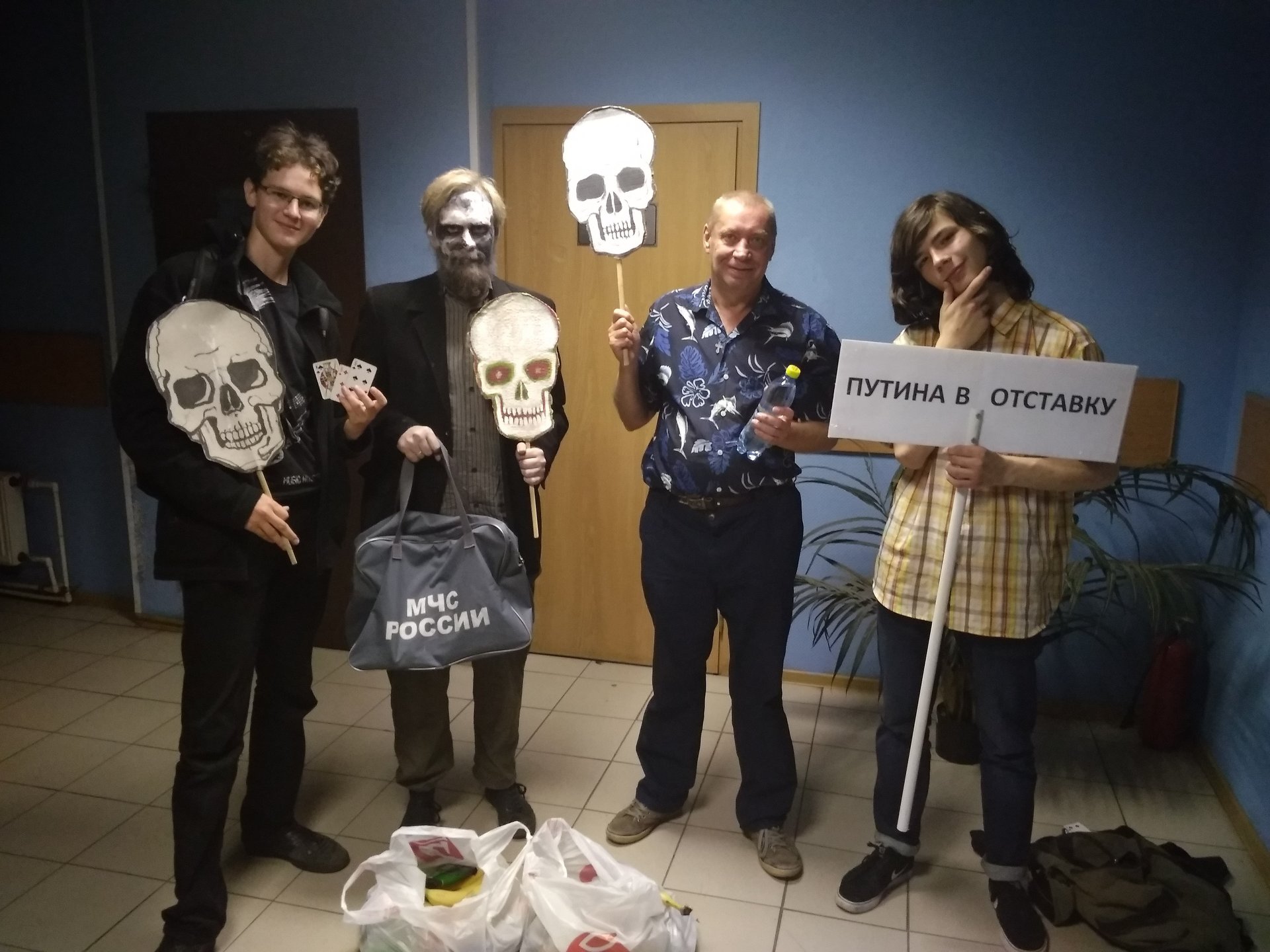 Max Stropov and his fellow detainees. The young man on the right holds a placard that reads, “Putin, resign!” Photo courtesy of Max Stropov’s Facebook page
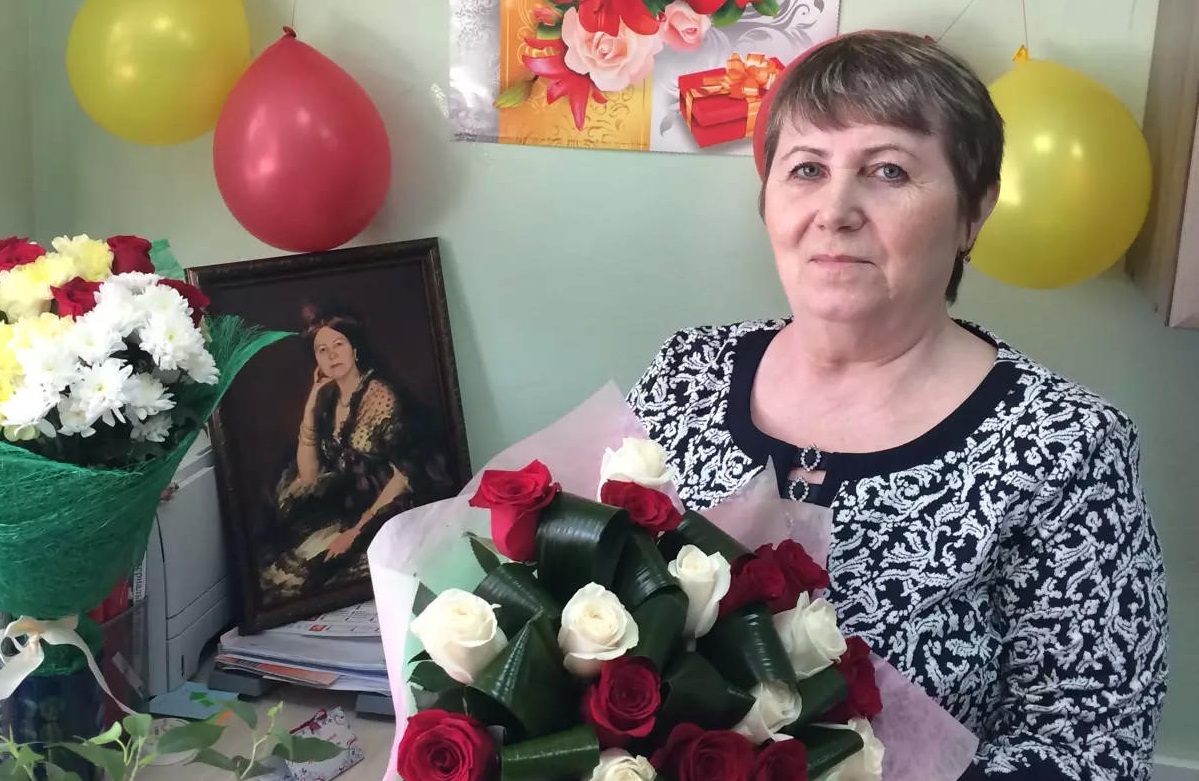 Irina Kutsenok. Photo courtesy of Mezhdu strok
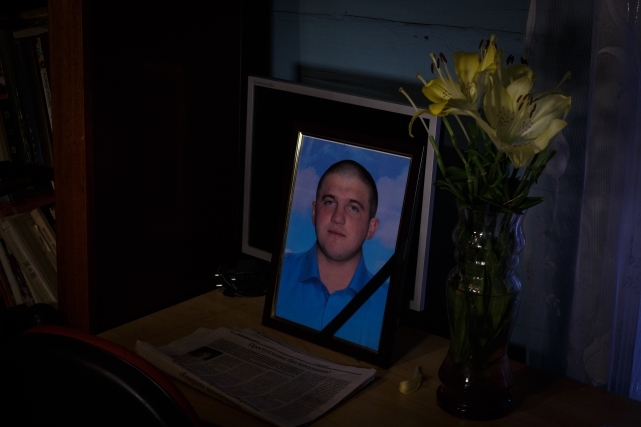 Alexander Lopasteysky. Photo by Matvei Flyazhnikov for Novaya Gazeta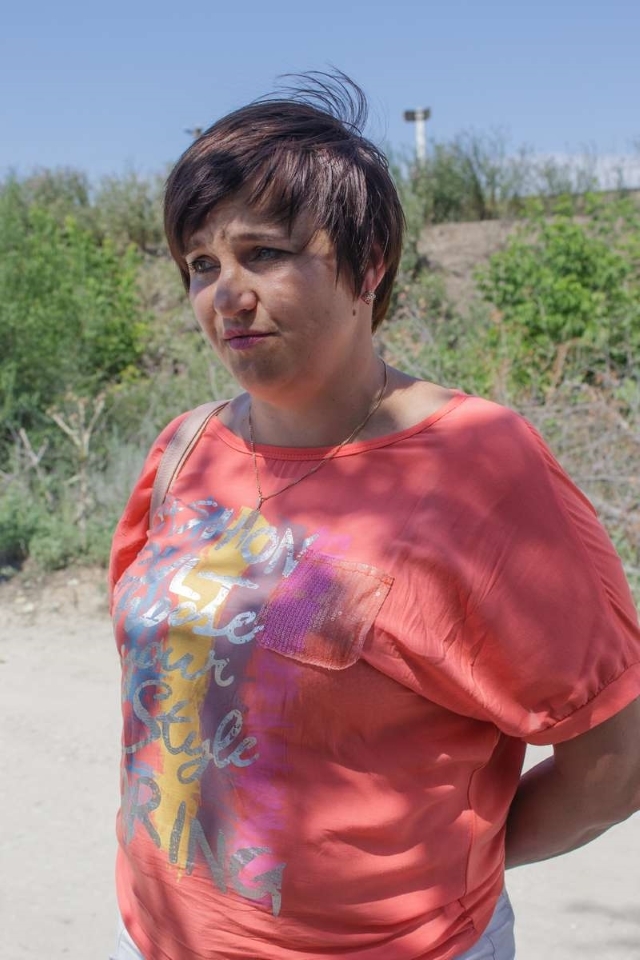
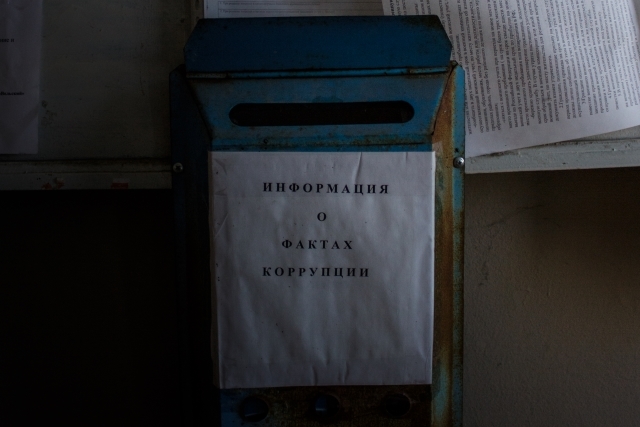
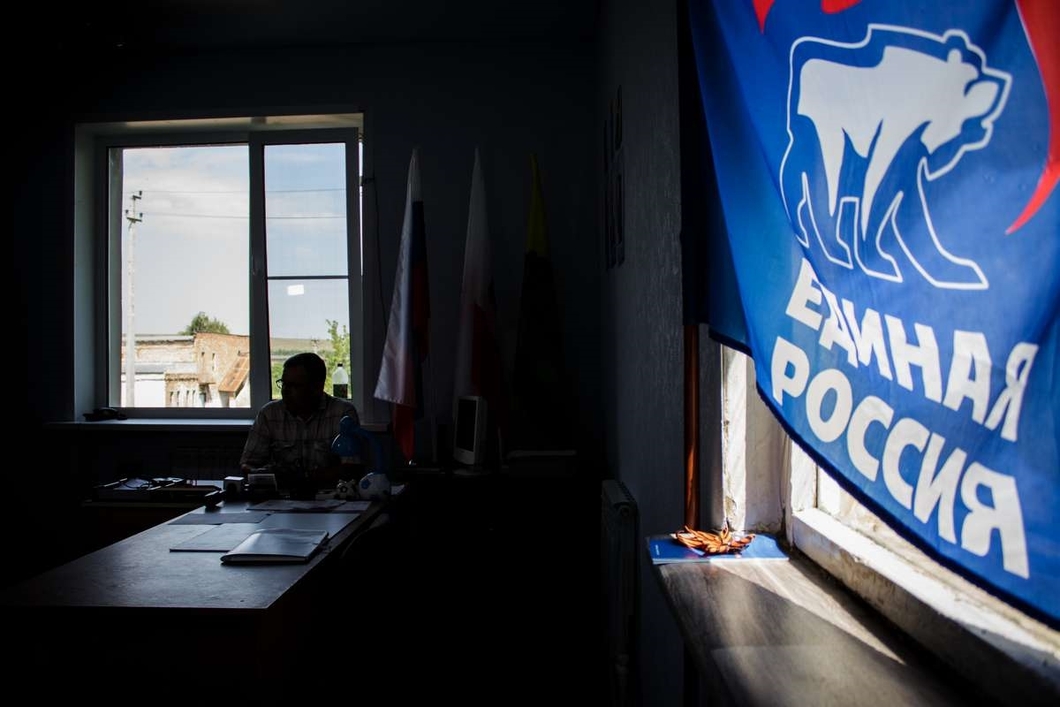 The village council head’s office. A United Russia party flag covers the window on the right. Photo by Matvei Flyazhnikov for Novaya Gazeta
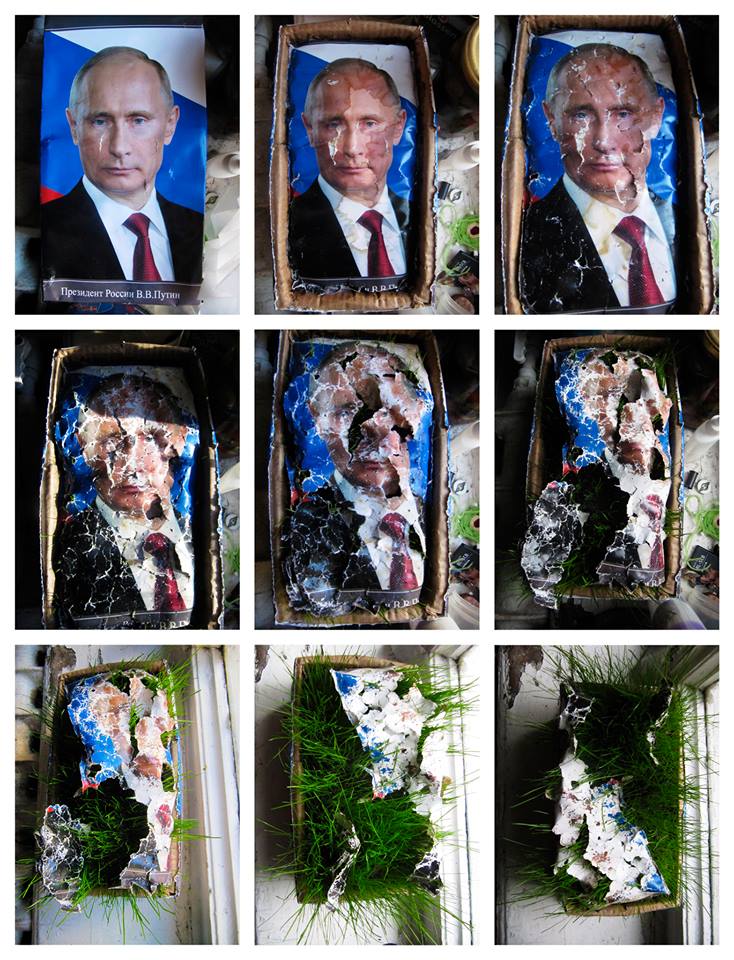 {rodina}, 9 Stages of the Supreme Leader’s Decomposition. A Petersburg judge has ordered this artwork torched.

 At €2.50, the official licensed sticker album of the 2018 World Cup is a steal. Russian officials also plan to steal the civil rights of their own citizens during the month-long tournament. Photo by the Russian Reader

