Petersburg’s Kangaroo Courts

890x675_T8nxqwOE8jPpy4x4RTAY
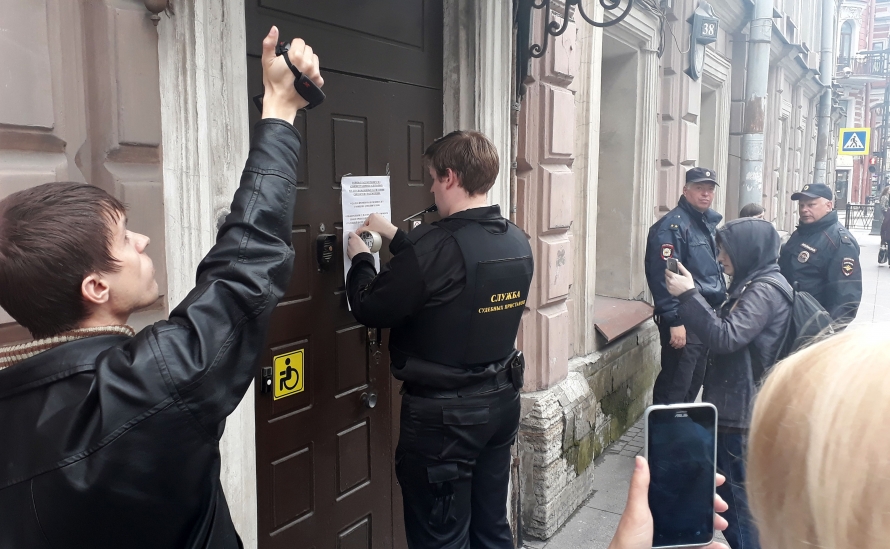
Court bailiff posting a notice outside courthouse in downtown Petersburg. Courtesy of Novaya Gazeta

Petersburg Observers
Facebook
June 20, 2017

On June 13 and 14, 2017, emergency courts, expressly forbidden by the Russian Constitution, were set in motion in St. Petersburg.

What were the peculiarities of the court hearings that took place on June 13–14, 2017, in St. Petersburg?

— The unprecedented scale. On June 13 and 14, 2017, 943 administrative cases were heard by 123 judges in sixteen of St. Petersburg’s twenty-two district courts. The defendants had been charged with violating Article 19.3, Part 1 (“Disobeying the lawful order or demand of a policeman, military serviceman, penal system officer or Russian National Guard member in connection with the performance of their duties to protect public order and ensure public safety, as well as obstructing the performance of their official duties”) and Article 20.2, Part 5 (“Violation, by a participant of a public event, of the established procedure for holding a meeting, rally, demonstration, procession or picket”) of the Russian Federal Administrative Offenses Code (KoAP). The overwhelming majority of those detained on the Field of Mars on June 12, 2017, were simultaneously charged with both offenses, regardless of the circumstances of their arrests.

— The unprecedented speed with which cases were heard: zero minutes (eleven district courts), one minute (seven district courts),  etc.

— The unprecedented numbers of cases heard by individual courts in a single twenty-four-hour period: 95 (Kalinin District Court), 106 (Krasnoye Selo District Court), 110 (Frunze District Court).

— Violation of territorial jurisdiction. All the administrative cases should have been heard by the Dzerzhinsky District Court, in whose jurisdiction the Field of Mars is located. At the request of the persons charged with administrative offenses, their cases could also have been transferred to the courts in the districts where they are registered as residebts. In the event, the detainees were bused from police precincts to sixteen district courts. Their cases were assigned to judges regardless of territorial jurisdiction.

— Violation of the right to a defense. No more than a quarter of the defendants enjoyed the services of a lawyer or public defender. Some judges rejected appeals for adjournment so that defendants would be able to secure defense counsel. Some judges gave defendants a ridiculously short amount of time to secure defense counsel. Defense attorneys and public defenders were physically unable to get into the majority of the courthouses, especially after six o’clock in the evening.

— Violation of the right to a public trial. Information about the court hearings on June 13–14, 2017, was posted on the courts’ official websites only several days after the hearings themselves.  People who might have wanted to attend the hearings had no way of finding out what cases were being heard, nor when or where they were being heard. Judges’ rulings have not been published in full. Currently, only 26 of the 943 rulings, which have already taken force, have been published on the courts’ websites.

— Violation of the principle of adversarial proceedings. There were no prosecutors or police officers present at any of the hearings, and the judges essentially acted as prosecutors.

— Night courts are forbidden. But even on official court websites the starting times of hearings are listed well past midnight, e.g., 12:23 a.m. (Krasnoye Selo District Court), 12:45 a.m. (Kalinin District Court), 5:00 a.m. (Kolpino District Court), 5:20 a.m. (Frunze District Court).

Despite the violations, listed above, the St. Petersburg City Court has rejected all appeals filed, moreover, in the very same fashion as the district courts. This means the people who organized and launched the conveyor belt of emergency justice in St. Petersburg have direct control not only of the police and the Russian National Guard but also the of district and city courts.

P.S. The mass trials that occurred on June 13–14, 2017, in St. Petersburg, differed from extreme justice only in the sense that they were executed by regular judicial entities, rather than by specially instituted extraordinary courts with distinct powers.

Translated by the Russian Reader

____________________

Are you wondering how you might react to this nastiness, especially if you live far from Petersburg? Here’s one simple suggestion. FIFA’s Confederations Cup is currently underway at four venues in Russia (Kazan, Moscow, Sochi, and St. Petersburg). Take a gander at the match schedule and the list of corporate sponsors (which includes Adidas, Coca-Cola, Visa, McDonalds, and Bud). Give them a call or send them an email saying that, because of the way the Russian leadership treats its own people when it comes to the freedoms of speech and assembly, and the right to a fair trial, you won’t be buying their products anymore, since they make common cause with flagrant tyrants.

You can also get in touch with the TV channels broadcasting the Confederations Cup matches in your city or country and tell them you won’t be watching the matches and why you won’t be watching them.

These are simple ways to show your solidarity with the six hundred and sixty some people who were arrested on Petersburg’s Field of Mars for no good reason on Russia Day, a national holiday celebrating the country’s independence from the Sovet Union, and then put through the kangaroo courts, as described above and elsewhere.

These are also effective ways of showing the Russian leadership, who set great store by their power to win bids to host major global sporting events like the Winter Olympics and the Football World Cup that we are not impressed by their prowess, especially when our Russian sisters and brothers live in conditions of such rampant unfreedom and poverty. TRR

No Protest Is Illegal

taubinskaya-moscow protest
Anti-corruption protester detained on Tverskaya Street in Moscow, June 12, 2017. Photo courtesy of Mayorova.net and Irina Taubinskaya

Below, you will find a brief, eyewitness account of the rough custom to which people detained at the anti-corruption protest rally on the Field of Mars in Petersburg on June 12, 2017, have been subjected by police as the have been slowly “processed,” sometimes with no legal representation and in gross violation of their rights as detainees, by the police and courts.

The Russian “legal and law enforcement” systems are shambles, for the simple reason they don’t exist at all. They are fictions.

What does exist is the supreme will of the blood monkey who answered questions all day yesterday on TV or something like that, and the lesser wills of his cronies and satraps.

Those exist.

So when asking the question of who exactly ordered the arrests of the six hundred and fifty some arrestees of June 12, 2017, and the harsh sentences of five to fifteen days in the hoosegow and fines of up to 15,000 rubles most of them were handed by the city’s district courts (again, in conditions where many of them were dehumanized constantly, despite the best efforts of Petersburg’s wonderful Aid to Detainees Group and other volunteers and well-wishers to support them) you need look no farther than the head blood monkey in the Kremlin and his precious “power vertical.” They are the ones who gave the orders to treat the protesters this way, not anyone on the ground.

I was irked to hear the BBC’s Moscow correspondent refer, the other day, to the concurrent protests on Tverskaya, in Moscow, where a similarly large number of people were arrested, as “illegal.” Setting aside for a second the rights to free assembly and free speech enjoyed by all Russian citizens, as enshrined in the 1993 Russian Federal Constitution, the Petersburg authorities several years ago designated the Field of Mars as the city’s “Hyde Park,” the place where city dwellers could go, supposedly, to air their grievances without making a special application to the authorities. (This need to apply for permits is itself a mostly unconstitutional practice, backed, of course, by the country’s kangaroo higher courts, who are also a part of its so-called telephone justice system).

In reality, Petersburg authorities have let their so-called Hyde Park be used the way it was intended only when the numbers of protesters or their particular grievances have not been threatening enough, although, of course, police are still always on hand to photograph, videotape, and ID the protesters, and even copy down the slogans on their placards, which they immediately radio to their superiors. Just in case, you know, and to make sure the protesters know the state is monitoring them

When, on the other hand, the topics raised and/or numbers of protesters have not been to the liking of the powers that be, local or otherwise, Petersburg’s “Hyde Park” has instantly been deemed yet another no-go zone, the protests declared “illegal,” and the protesters and, sometimes, the counter-protesters, dragged off into paddy wagons and taken to police precincs.

Sometimes, the protesters are merely held in police custody for a few hours or overnight, and then released scot-free. But when the regime wants to teach them a lesson about how much freedom they really have in the world’s largest “sovereign democracy,” they get the book thrown at them, as we have seen over the past several days in Petersburg. That is, for one and the same legal/illegal act, either nothing will happen to you or your life will be scuttled for two weeks or a month (as in the case of “ringleaders” like Alexei Navalny, who was arrested at the door to his block of flats before he could get to the “illegal” protest and sentenced to thirty days in the slammer), and your already meager finances will have a nice dent put into them.

So, if I were a BBC or other foreign correspondent, I wouldn’t be so quick to dub any protest in Putinist Russia “illegal.” That’s tantamount to saying that the police and courts have the right to do with Russians detained for real or imaginary offenses what they will.

It’s also an admission on the part of these foreign correspondents that, in the case of the protesters, they don’t understand the offenses are wholly imaginary, i.e., trumped-up, that they are, in fact, a little bit of the ultra-violence, meted out in smallish doses to discourage the kids from coming out again. TRR

* * * * *

16% of the St. Petersburg Public Monitoring Commission
Facebook
June 15, 2017

I am deciphering my conversations with arrestees:

“We were driven to the courthouse in handcuffs, and tied to each other. We arrived, they untied us, and took us upstairs to the courtroom. We had no defense counsel. The court sentenced us to five days in jail and a fine. We were driven back to the police precinct, where we cuffed to chairs and each other. (The cuffs immediately caused pain to the second person.) The guy with the keys to the handcuffs went off somewhere. We were cuffed for two and a half hours. We asked to go to the toilet, to uncuff us, but our requests were ignored. This happened next to the cells. The cells were not locked.

“Then they uncuffed us from the chair, cuffed us to each other, put us in a van, and took us to [the temporary detention center at] Zakharyevskaya Street, 6.”

This incident occurred on June 13, at the 78th Police Precinct, in St. Petersburg’s Central District

Translated by the Russian Reader. Thanks to Jenya Kulakova for the heads-up on the link and Sasha Feldberg for the photo.

It Was a Good Week in the Supah Powah, or, The Return of the Green Lanterns (OVD Info)

‘In 2016, Donald Trump rode a wave of popular discontent to the White House on the promise that he would “make America great again.” As Russia’s presidential election, scheduled for March 2018, draws nearer, President Vladimir Putin may try a similar tactic — by contending that he has already restored Russia’s greatness.’

Blogger Norwegian Forester

The authorities have been using every trick in the book to counteract the plans of Alexei Navalny’s supporters to hold events against corruption on March 26 in scores of cities. Authorities have been refusing to authorize the protests under different pretexts. Rally organizers in different regions have been arrested on trumped-up changes, summoned to the police, fined for inviting people to rallies on the social networks, and written up for holding meetings with activists. Volunteers have been detained for handing out stickers.

More Navalny

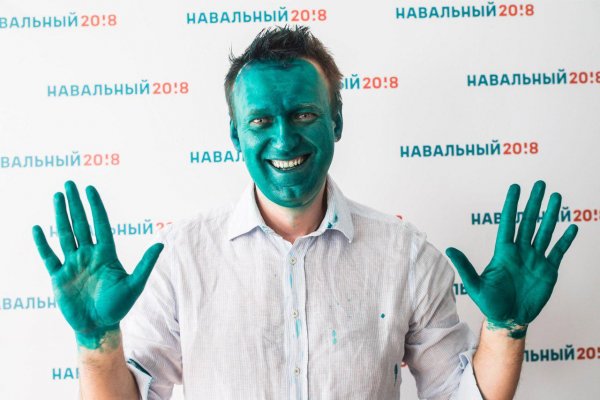
At the same time as he has been getting ready for the anti-corruption protests, Navalny has been opening election campaign headquarters in different cities. These events have also been subject violent attacks. In Barnaul, Navalny was doused with Brilliant Green antiseptic (zelyonka). In Petersburg, the door of his headquarters was set on fire. In Volgograd, Navalny was dragged by his feet and nearly beaten.

Alexei Navalny

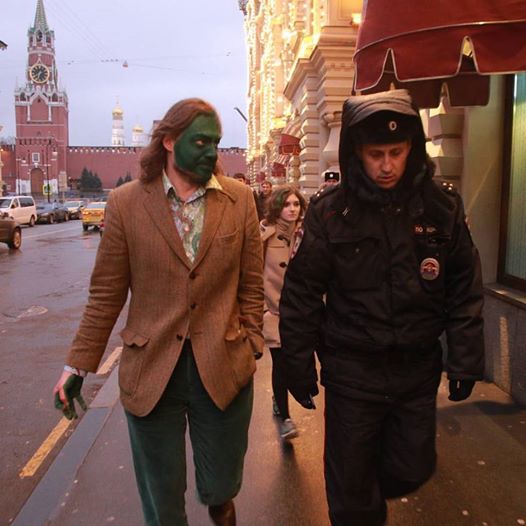
In Bryansk Region, a schoolboy was sent to the police for setting up Navalny support groups on the social networks: the police demanded he delete the accounts. In Krasnoyarsk University, a lecturer was fired for showing Navalny’s exposé of PM Dmitry Medvedev, Don’t Call Him Dimon. In Orenburg, a coordinator of the Spring youth movement was summoned to the rector, who asked him questions about Navalny. In Moscow, famous blogger Norwegian Forester was detained for going onto Red Square, his face painted green, in support of Navalny.

Not Only Navalny: Crackdowns on Freedom of Assembly

Long-haul truckers have planned a nationwide strike for March 27. Around twelve people were detained during a meeting of truckers in Vladivostok. Police claimed they had received intelligence on a meeting of mafia leaders. In Krasnodar Territory, an activist got three days of arrest in jail for handing out leaflets about the upcoming strike.

Krasnodar farmers have planned a tractor convoy for March 28. However, organizer Alexei Volchenko was arrested for twelve days for, allegedly, not making alimony payments. Another tractor convoy participant, Oleg Petrov, had his internal passport confiscated by police.

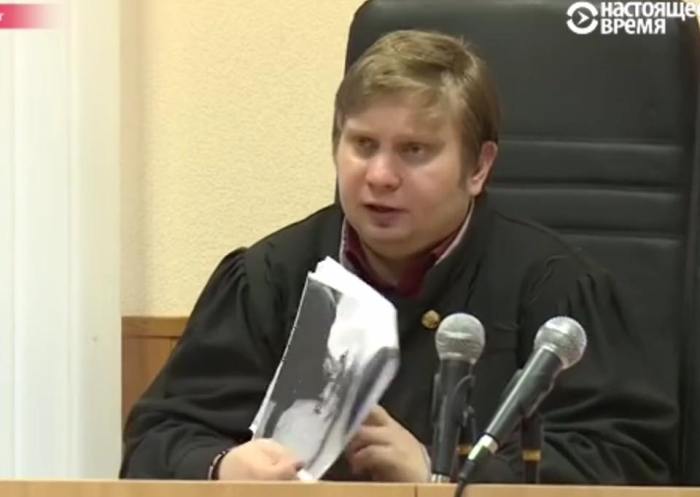
Judge Vladimir Vasyukov

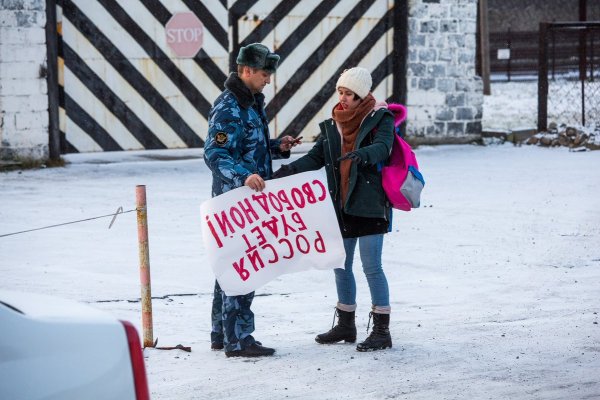
In Petersburg, Dzherzhinsky District Court Judge Vladimir Vasyukov during the past week imposed fines of 10,000 rubles [approx. 160 euros] each on three women, involved in a feminist protest on International Women’s Day, March 8, 10,000 rubles [approx. 160 euros], elderly activist Igor “Stepanych” Andreyev, accused of walking along a building during a solo picket, and activist Varvara Mikhaylova for picketing outside the Segezha Men’s Penal Colony in Russian Karelia in support of civic activist Ildar Dadin, who was recently released.

Varvara Mikhaylova. Photo courtesy of David Frenkel

In Murmansk, the authorities refused to authorize three marches against inflated utilities rates, food prices, and public transportation costs, while Moscow authorities refused to authorize a protest rally against the planned massive demolition of five-storey Soviet-era apartment buildings. In addition, Moscow police demanded a party at Teatr.doc be cancelled.

Moscow City Court ruled that meetings of lawmakers with their constituents should be regarded as the equivalent of protest rallies.

The Constitutional Court ruled the police can detain a solo picketer only if it is impossible to ensure security. The very next day, two solo picketers bearing placards on which Vyacheslav Makarov, speaker of the St. Petersburg Legislative Assembly, was depicted as a demon were detained by police.

Criminal Prosecutions and Other Forms of Coercion

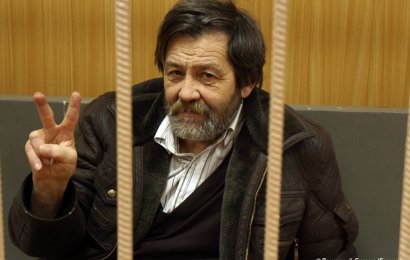
Sergei Mokhnatkin, whose spine was broken in prison, was sentenced to two years in a maximum security penal colony for, allegedly, striking a Federal Penitentiary Service officer.

Sergei Mokhnatkin

As for talk of a new Thaw, two Ufa residents, accused of involvement in Hizb ut-Tahrir, had their suspended sentences changed to four years in a penal colony.

In Stavropol, Kirill Bobro, head of the local branch of Youth Yabloko, was jailed for two months, accused of narcotics possession. Bobro himself claims police planted the drugs on him.

Kirill Bobro

A graduate student at Moscow State University was detained and beaten for flying a Ukrainian flag from the window of his dormitory. In addition, he was forced to sign a paper stating he agreed to be an FSB informant. Ukrainian journalist Roman Tsymbalyuk was detained while trying to interview the graduate student.

What to Read

LGBT activist Dmitry Samoilenko describes how he has been persecuted in Kamchatka for a brochure about the history of gender identity in the Far North. Activist Rafis Kashapov, an activist with the Tatar Social Center, who was convicted for posts on the social networks, sent us a letter about life in a prison hospital.

Rafis Kashapov

The Week Ahead (March 26—April 1)

Closing arguments are scheduled for March 27 in the trial of Bolotnaya Square defendant Maxim Panfilov, who has been declared mentally incompetent. Prosecutors will apparently ask the judge to sentence him to compulsory hospitalization.

On March 29, an appeals court is expected to hear the appeal against the verdict of Alexander Belov (Potkin), co-chair of the Russians Ethnopolitical Movement.

Thanks for Your Attention

We continue to raise money for our monitoring group, which collects information on political persecution and takes calls about detentions at protest rallies. Thanks to all of you who have already supported us. You can now make monthly donations to OVD Info here.

Translated by the Russian Reader

Where Is Ildar Dadin?

"Where is Dadin?" Photo courtesy of Gradus TV
“Where is Dadin?” Photo courtesy of Gradus TV

Activists Picketing in Support of Ildar Dadin Detained in Moscow
RBC
January 4, 2016

Police in Moscow detained six activists [Pavel Kuznetsov, Mikhail Lashkevich, Leonid Dubrovo, Tatyana Tarvid, Elena Zakharova, and Maria Ryabikova — TRR] who had been holding solo pickets in support of Ildar Dadin, according to OVD Info.

The activists had been picketing on Zhitnaya Street, where the Federal Penitentiary Service and Justice Ministry are located. Several of the picketers held placards that read, “Where is Dadin?”

The detainees were taken to Yakimanka police precinct.

Later, activist Sergei Ozhich reported on his Facebook page that all six detainees had been released. They have been charged with misdemeanors under Article 20.2.5 of the Russian Federal Administrative Offenses Code (violation of the established rules for holding assemblies, rallies, demonstrations, marches, and pickets by a participant of a public event).

In early November 2016, Dadin wrote in a letter that he had been severely beaten and threatened by the staff at the penal colony where he was imprisoned. The Federal Penitentiary Service, the Investigative Committee, the Presidential Human Rights Council, and civil rights activists took an interest in his case.

Members of the Presidential Human Rights Council recommended that the Federal Penitentiary Service transfer Dadin to another penal colony. In early December, he was transferred to another colony. Anastasia Zotova, Dadin’s wife, filed an inquiry with the Federal Penitentiary Service’s Karelian Directorate asking about his whereabouts. His whereabouts are still unknown, however. By law, the inmate should have informed a relative of his whereabouts within ten days.

Dadin is serving a sentence for violating the law on [“unauthorized” political] rallies. In December [2015], he was sentenced to three years’ imprisonment, but a court later reduced the sentence to two and and half years. Dadin was the first person sentenced to an actual prison sentence under the new law.

Translated by the Russian Reader

Smolensk: Rehearsing the Revolution

In Smolensk, Riot Police Train to Disperse Rebellions by Residents Fed Up with High Utilities Bills
Znak
April 23, 2016

In Smolensk Region, the security forces have been training to disperse unauthorized rallies of local residents fed up with high utitilies bills. As reported by the local news website Smoldaily, law enforcement units, OMON (Special Task Police Squad) units, and SOBR (Rapid Deployment Task Force) units held training exercises on the campus of the Professional Training Center in Smolensk. According to the legend of the exercises, disgruntled residents in the village of “Zvyozdny” (Starry), having received excessively high bills, took to the streets for an unauthorized rally that turned into a riot.

Initially, officials of the district administration and local beat cops tried to explain the situation to the residents and call them to order, but no arguments could pacify the raging crowd.

Ultimately, the residents threw bottles and smoke bombs at the officials and policemen. To pacify the troublemakers, the special forces spread barbed wire around the perimeter of the site and split the crowd in two before kettling them.

The instigators of the riot were taken to a police station for further investigation, while an investigative team proceeded to seize material evidence and conduct an investigation.

It is reported that senior security forces officials present at the exercises noted the high level of training of the police officers in liquidating the riot and even suggested presenting awards to the most outstanding officers.

Translated by Stinky Shoes. Video and photos courtesy of Znak and SmolDaily.

It’s Been a Quiet Week in the Motherland (The News from OVD Info)

Maxim Panfilov
Maxim Panfilov

Hello! One of the main events of the past week for us was not Putin’s “Direct Line,” but the arrest of a man who spoke with Putin a year ago. Anton Tyurishev, a construction worker at the Vostochny Cosmodrome in the Russian Far East, complained to the president that he and his mates were not being paid their wages.  Putin promised to get to the bottom of it, but a year on nothing had changed. Tyurishev promised that in response protests would kick off. Later, he was summoned to the police station, where the “Law on Rallies” was read out to him. The day before the “Direct Line” broadcast, he was detained and sent to jail for five days, allegedly, for swearing in public.

Criminal Prosecution

The new defendant in the Bolotnaya Square Case, Maxim Panfilov, who suffers from Tourette’s syndrome and yet was taken into police custody, is not getting the medicines he needs. Instead, he is being administered substitutes that do not alleviate his condition. Panfilov has been appointed an outpatient psychiatric examination. The investigator has agreed to let defense attorneys attend it.

Ildar Dadin, convicted of “multiple violations of the rules for holding public events,” was convoyed from Moscow to Petersburg right on his birthday, which means he will serve his sentence in Leningrad Region.

Ildar Dadin
Ildar Dadin

Last week, it transpired that Magomednabi Magomedov, imam of the Eastern Mosque in Khasavyurt, had been arrested, accused of incitement to terrorism and inciting religious and ethnic hatred. Magomedov, who was transported from one place of confinement to another over several days, complained he had been tortured. Pretrial detention facility officers had beaten him and forced him to kneel, demanding that he confess to the charges.

Euromaidan participant Alexander Kostenko, convicted of harming a Berkut riot police officer, was transferred to solitary confinement shortly before a hearing where his request for parole was to be examined. Naturally, Kostenko’s parole request was rejected.

Alexander Kostenko
Alexander Kostenko

It seems soon Alexei Navalny will have no allies who are not undergoing criminal prosecution. Ivan Zhdanov, head of the Anti-Corruption Foundation’s legal service, and a candidate for the council of deputies in the Moscow suburb of Barvikha, has been charged with evading conscription.

Freedom of Assembly

In Ulyanovsk, police diligently searched for activists who had blocked a road in connection with construction of a residential complex. They visited one activist at work, and telephone another and asked him to report for questioning. When he demanded an official summons, they threatened him with criminal charges. Administrative charges have been filed against three people.

In Volgograd, the leader of the regional Union of Entrepreneurs and Freight Haulers has been slapped with three administrative charges for calling people to a protest rally before the rally was authorized. The court threw out two of the three charges, while the third resulted in a fine.

The confrontation continues in Moscow’s Dubki Park. Defenders of the park, who oppose construction there, are fined for disobeying the police. A female journalist’s arm was injured when an assembly of defenders was dispersed. When he was detained, one of the activists, Dmitry Boinov, was beaten so badly that he has been in hospital for a week recovering from fractures.

Beatings

In Podolsk, three men attacked Maxim Chekanov, a past participant of protest rallies. The incident began when they called Chekanov by name, asked him questions about the “Kiev junta,” called him a “Banderite scumbag,” and then invited him to go round the corner. During the ensuing fight they smashed Chekhanov’s face.

Popular Chechen singer Hussein Betelgeriev, who disappeared in late March, has returned home beaten. It is unknown where he was all this time. Relatives and friends suggest he was abducted, and connect the abduction with his comments on social networks and the fact he ignored the call to attend a pro-Kadyrov rally on March 23.

Reading

Olga Sutuga, mother of anti-fascist Alexei Sutuga, currently serving time at a penal colony in Irkutsk Region, talks about the international aid project Political Prisoners University.

Thanks for your attention!

_________

OVD Info is an independent human rights media project dedicated to political persecution in Russia. We are engaged in daily monitoring of detentions at public events, and publish information about other kinds of political persecution. We believe that information liberates and protects, and analyzing the data we collect can help change the situation for the better in the future.

Editor’s Note. OVD Info sends out a weekly email news roundup, in Russian, to its supporters. I thought that, despite its brevity, this week’s roundup provided a fairly eloquent picture of the state of affairs in this country at present and not just this particular week. You can sign up to the mailing list by going to the bottom of any page n the OVD Info website and entering your email address where you see the phrase ПОДПИСАТЬСЯ НА РАССЫЛКУ.

The Crime of Speaking Up in Russia: Solidarity with Dadin and Polyudova

Vadim F. Lurie
Facebook
March 23, 2016

The people’s assembly [to publicize an appeals hearing in the case of Ildar Dadin, sentenced in December 2015 to three years in prison for the heretofore unknown offense of “repeat unauthorized protesting”] did not come off. [Nor did Dadin’s appeals hearing in Moscow City Court: it was postponed to a later date.] There were fewer people in attendance than the day before yesterday, the day Nadiya Savchenko was sentenced. But the picketers decided to spread out along the Nevsky, and members of the National Liberation Movement (NOD) wandered around searching for them, trying to pester and troll them.

The most successful at this was a bearded specimen, who yelled, “Look, a real live national traitor! A Maidanite, a Banderite, funded by the State Department!

The passerbys, who usually do not pay much attention to people standing holding placards, mostly regarded them sympathetically thanks to this spiel.

lurie-skhod-1
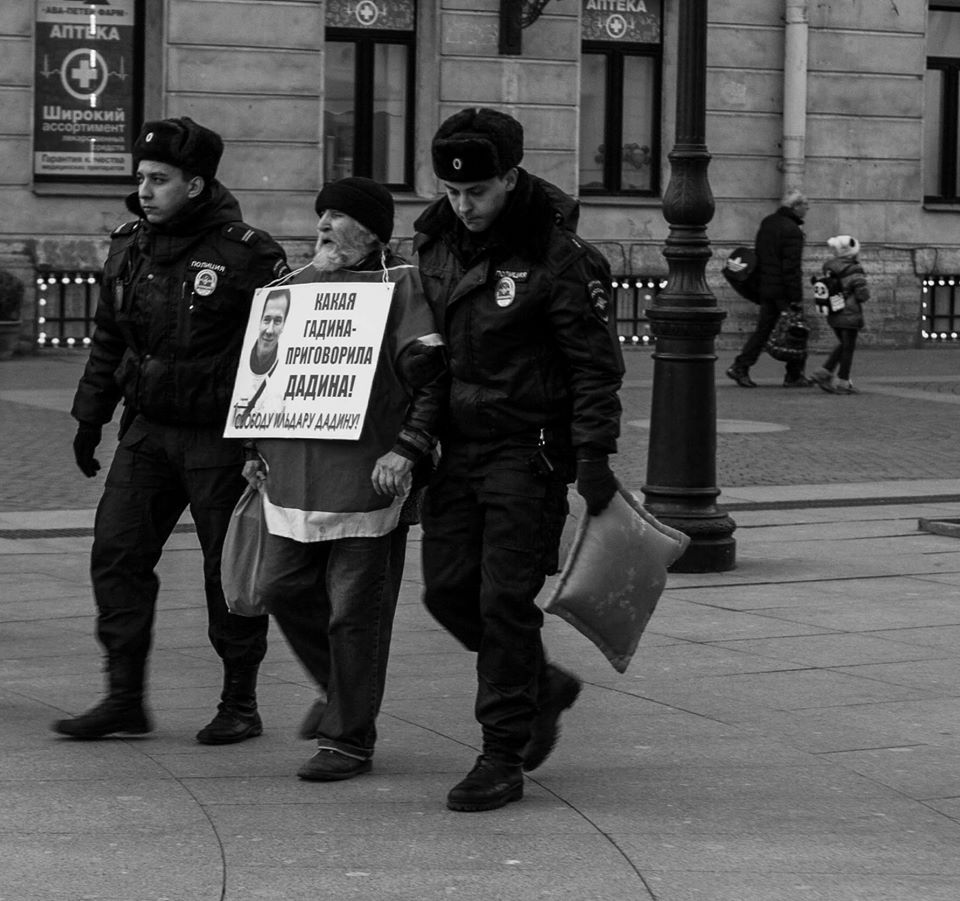
“What a viper sentenced Dadin! Free Ildar Dadin!” Local police detain veteran democratic activist Igor “Stepanych” Andreyev. Petrograd, March 23, 2016. Photo by Vadim F. Lurie
lurie-skhod-2
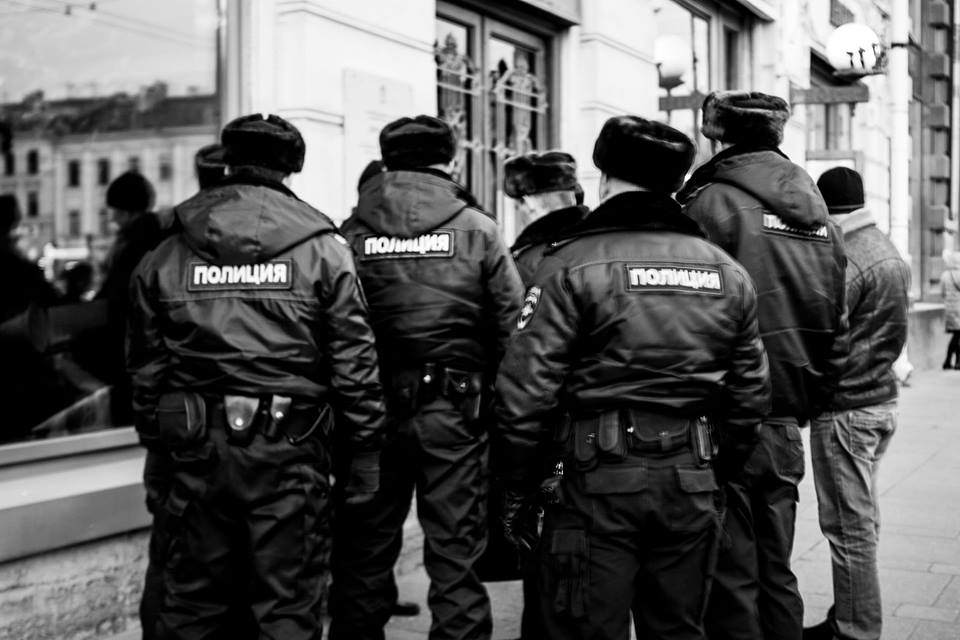
Petersburg police surround a picketer, demanding he produce his documents. Petrograd, March 23, 2016. Photo by Vadim F. Lurie
lurie-skhod-3
A member of the so-called National Liberation Movement (NODS) scans the Nevsky for “national traitors.” Petrograd, March 23, 2016. Photo by Vadim F. Lurie
lurie-skhod-4
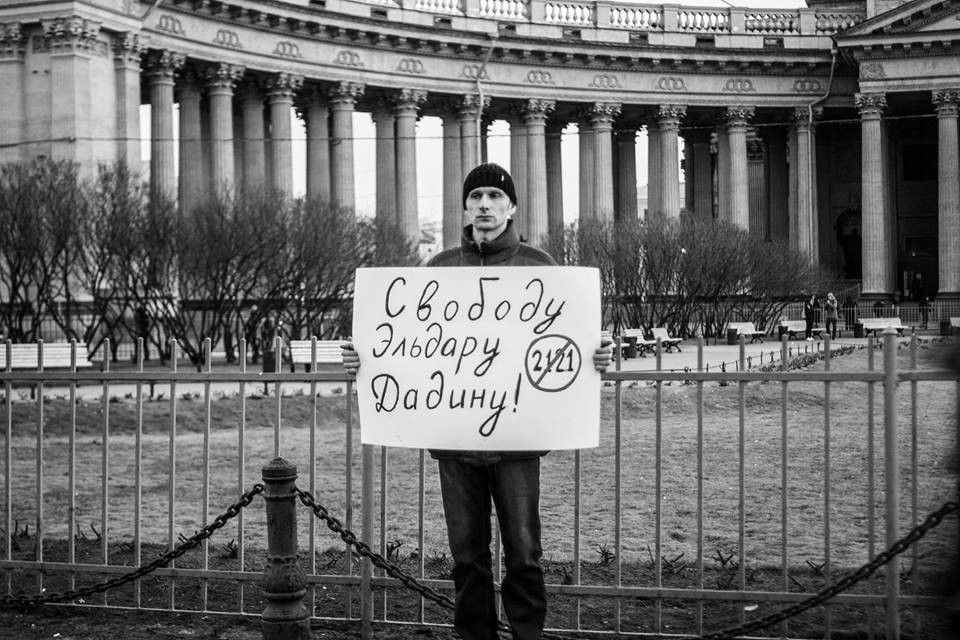
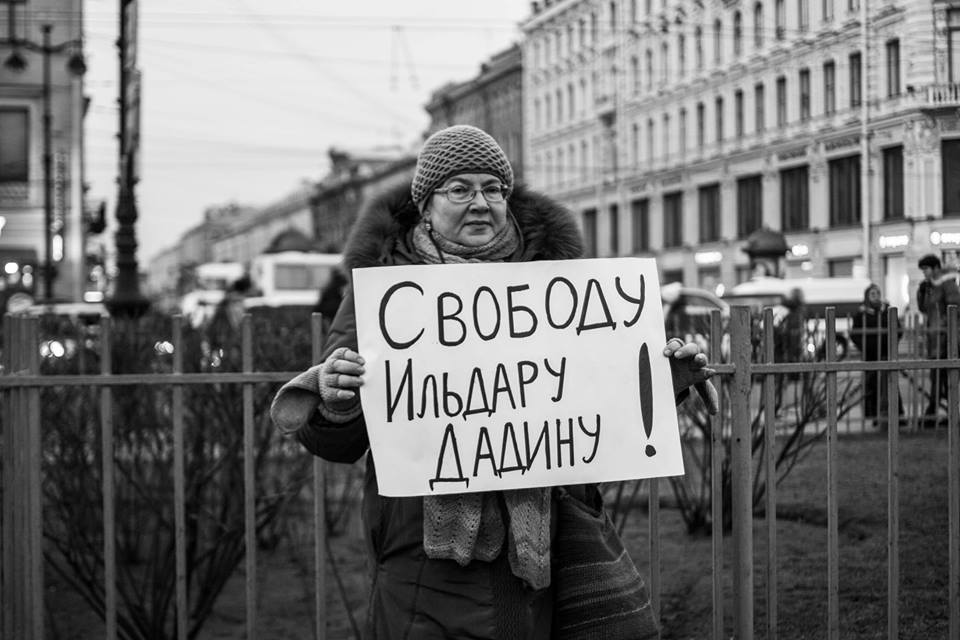
“Free [Ildar Dadin! No to Article 212.1!” A picketer stands in front of Our Lady of Kazan Cathedral. Petrograd, March 23, 2016. Photo by Vadim F. Lurie
lurie-skhod-5
“Free Ildar Dadin!” Petrograd, March 23, 2016. Photo by Vadim F. Lurie
lurie-skhod-7
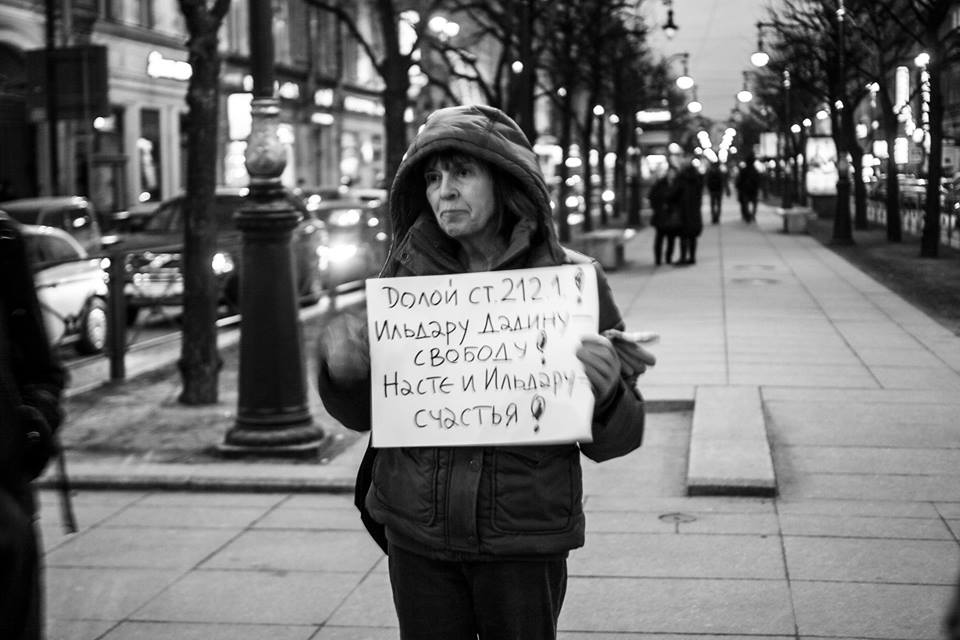
“Down with Article 212.1!* Free Ildar Dadin! Congratulations, Nastya and Ildar!” Petrograd, March 23, 2016. Photo by Vadim F. Lurie
lurie-skhod-8
“Free Darya Polyudova,** sentenced to two years in a work-release prison as an extremist for a repost on Vkontakte.” Image of Polyudova with placard: “Ukraine, we are with you.” Petrograd, March 23, 2016. Photo by Vadim F. Lurie

Translated by the Russian Reader. Thanks to Vadim F. Lurie for his kind permission to republish his photos here.

*Despite the obstacles, Russia’s opposition continued to organize protests. So last summer in 2014, the Kremlin effectively criminalized all peaceful protests and assemblies. Article 212.1, which went into effect in January 2015, amends the previous law in a considerably more punitive manner, carrying up to 5-year criminal prison terms for repeated protests. This law has a “3 strikes” feature, stating that anyone who has been convicted 3 times for the administrative offense of ‘violating the regulations governing public rallies,’ within a six month period is subject to criminal liability. With these laws and their particular application against political critics, the Putin regime is sending a powerful message heard throughout Russia of a repressive new reality unseen in decades: If you dare to speak out against government policies or leadership, the authorities will ruthlessly treat you as a common criminal and send you away for years in penal colonies. [] A young protester named Ildar Dadin became the first person to be convicted under Article 212.1 for having protested 3 times within a 6-month span. Ildar Dadin engaged in a completely benign peaceful protest, mostly standing alone holding a sign expressing his opinions, specifically about releasing political prisoners, the need to change power in the Kremlin, and to end the war in Ukraine. Until his trial in December, Dadin had been confined to house arrest. But on December 7, Dadin was sentenced to 3 years of actual prison time in a penal colony for simply exercising his constitutional right to express his opinion. Yes, Russia’s Constitution under Articles 29, 30 and 31 guarantees freedom of expression and freedom of assembly. But the new laws make those guarantees not worth the paper they’re written on. (Paula Chertok, “New Normal in Russia: Putin Critics Punished with Harsh Prison Terms,” Euromaidan Press, January 6, 2015)

**Dispatches: The Crime of Speaking Up in Russia
Tanya Lokshina, Russian Program Director
Human Rights Watch
December 22, 2015

A left-wing political activist has been convicted of inciting separatism and extremist activities, the latest in a series of criminal prosecutions in Russia against people who dare speak their minds online.

Unless the December 21 ruling by a court in Krasnodar in southern Russia is quashed on appeal, the accused, Darya Polyudova, 26, will spend the next two years behind bars. The charges against her derived from three posts she published on her page in VKontakte (VK), Russia’s most popular social network.

All three posts had to do with Ukraine. The one that triggered the incitement to separatism charge – in Russian law, making “public, online calls aimed at violating the territorial integrity of the Russian Federation” – was not even written by her. It was a flippant comment by another user, which Polyudova shared on her page, about supposed demands by local ethnic Ukrainians of the Krasnodar region to be incorporated into Ukraine.

The second post, deemed by authorities as “public calls to extremist activities,” was a photo of Polyudova with a poster that said, “No war in Ukraine but a revolution in Russia!” The slogan did not include any advocacy of violence.

The third one was a commentary about how the situation in Russia was intolerable and Russians needed to follow the example of Ukraine’s Maidan activists, take to the streets, and bring down the government. These are strong words, but didn’t include any specific action plan.

Polyudova’s VK page has all of 38 followers, and most of her posts draw very few comments. Her words can’t be taken as inciting violence, and they certainly didn’t pose a “danger to the public,” as Russian law requires for criminal prosecution.

Polyudova’s prosecution is one in a growing number of cases where Russians are being punished for speaking their mind. This autumn, a court in Tatarstan sentenced an activistto three years in prison on very similar charges. Since the return of Vladimir Putin to the Kremlin in 2012, the Russian government has instituted an unprecedented and sweeping crackdown on critics of the government, and one of its tools has been overbroad and vague anti-extremism legislation. As the space for freedom of speech in the traditional media narrows, the government is now going after the Internet and targeting individuals who try to stir public debate about sensitive issues, especially Ukraine.

Until her trial, Polyudova was relatively unknown. But by criminally prosecuting her, the government is sending a chilling signal to Internet users across country – if you think you can speak your mind online, think again.

No Peace for {NE MIR}

Police Detain Participants of Itinerant Anti-War Exhibition in Moscow
Mediazona
March 13, 2016

Police in downtown Moscow have detained participants of the itinerant pacifist exhibition {NE MIR} (NO PEACE), artist Ekaterina Nenasheva reports on her Facebook page.

According to Nenasheva, paddy wagons accompanied the artists from Kurskaya subway station to the Winzavod Centre for Contemporary Art.

{NE MIR} marchers pose with works before boarding police paddy wagon

“The exhibition ended at Baumanskaya subway station and continued in a paddy wagon,” the artist wrote.

12814400_1689312864656474_73356850244173103_n
Artist Ekaterina Nenasheva inside a police paddy wagon

She said it was the third {NE MIR} exhibition, featuring artists from Moscow, Petersburg, Murmansk, and Krasnodar, as well as Ukraine, Finland, and Austria.

OVD Info reports that fifteen people were detained outside Winzavod, including Nenasheva, Anna Bokler, Mikhail Oskarin, Ksenia Tretyushina, Alexandra Lavrova, Andrei Darklight, Angelina Trinten, Elvira Komarova, Tatyana Sushenkova, Ivan Karamnov, and Nikita Rasskazov.

The participants of the itinerant exhibition have been taken to Basmanny police precinct, where their papers are being checked. In addition, police are examining the artworks.

Nenasheva later informed Mediazona that thirteen artists are being held at the police station.

The police have not given any reasons for the arrests. According to Nenasheva, the artists will likely be charged with violating the rules for holding a public event (Article 20.2 of the Administrative Offenses Code).

Update. Nenasheva has informed Mediazona that the police have formally charged twelve artists with violating Article 20.2 of the Administrative Offenses Code. Their case will be heard in administrative court on March 16.

__________

Darja Serenko
Facebook
March 16, 2016

The judge refused to give my public defender access to the case file, forbade Gerchikov (who introduced himself as the head designer of the city of Moscow) from sketching in the courtroom (“if you don’t respect the court, then at least respect yourself”: how can you talk that way with the head designer of the city of Moscow), and found me guilty of unauthorized marching with photographic works from house no. 4 to house no. 8. The fine was 20,000 rubles [approx. 260 euros].

The whole day I was working on totally blacking out a little book called the Russian Federal Criminal Procedure Code: I discovered something almost therapeutic about this practice. The hearing was scary and I kept on shading in the book. I felt calmer that way. I did my best blacking out right when the sentence was announced. I am really grateful to everyone who came to draw and to support me (Vanya Simonov, Masha Menshikov, Marja Klinova, Dima the head designer of the city of Moscow, and everyone else), and I thank my civil rights defender.

1384359_998264126876221_5871183740003878684_n
Darja Serenko, Blacked-out page of the Russian Federal Criminal Procedure Code, March 16, 2016. The remaining words produce the phrase “Freedom / is conducted in Russian / or another language / depending on the character.”

Although there was nothing really scary about our case and now it has turned into a bloated media blip that will survive for a week in opposition media, I think it was worth it. And our self-existent exhibition inside the courtroom was also lovely and reminded me of Harald Szeemann and his exhibition project, in which everyone brought their works literally right off the street into the gallery, and the curator found a place for the works. Because of all the noise made by the media, everyone forgot about the pictures. In this case, they are only EVIDENCE. Everyone is interested in the court hearing and certain heroic artists. I am not an artist. I am a mini-curator, and I was stunned by certain works and their power. I would organize an exhibition like this in the well-known spaces where I work. The exhibition {NE MIR} is the best work with space (in the broad sense of the word) I have seen. I hope we will get our hands on the work and be able to show it.

What matters is not whether it is an anti-war exhibition or a protest rally or not, but the fundamental fact that in our country the classic format of the outdoor exhibition is still imagined almost as a terrorist act. In my opinion, everyone should have already had their fill of the format: the outdoor exhibition should be an art object invisible to everyone. But a renewed political discourse has updated the format as well.

After the court hearing, I took the subway and found myself in an exhibition car: the Russian Geographical Society and Miklouho-Maclay were on display. I laughed hysterically. It was also basically an itinerant exhibition. It moved almost by itself, wonder of wonders.

When we were still outside the courthouse smoking, a man came up to us. He said he had just been freed and asked us for money. When we gave him some, he told us our fortunes and recited psalms. I am going to have two husbands. The first one will cheat on me, the second will cheat on me, but the third won’t cheat on me, despite the fact that I am going to have two husbands all the same. While he was telling our fortunes, a policeman who worked at the courthouse came up to us and asked what sort of gathering we were having. I think someone known as the Director of the City of Moscow orchestrated this day.

Translated by the Russian Reader. Video courtesy of Radio Svoboda. Images courtesy of OVD Info, Ekaterina Nenasheva, and Darja Serenko. Thanks to Vadim F. Lurie for the heads-up.

{NE MIR} Dialogues (Riga)

Vadim F. Lurie
Facebook
February 21, 2016

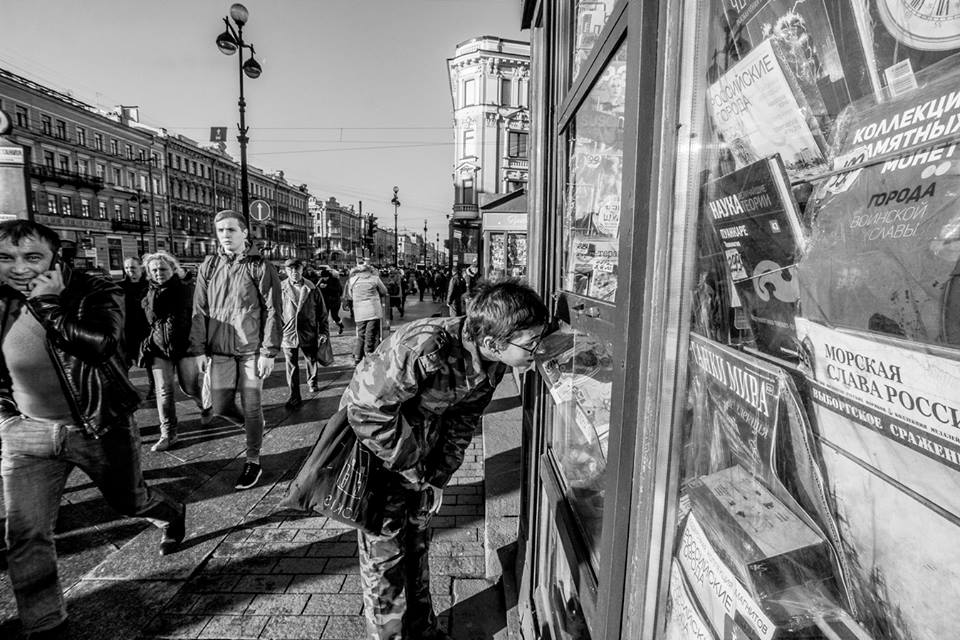
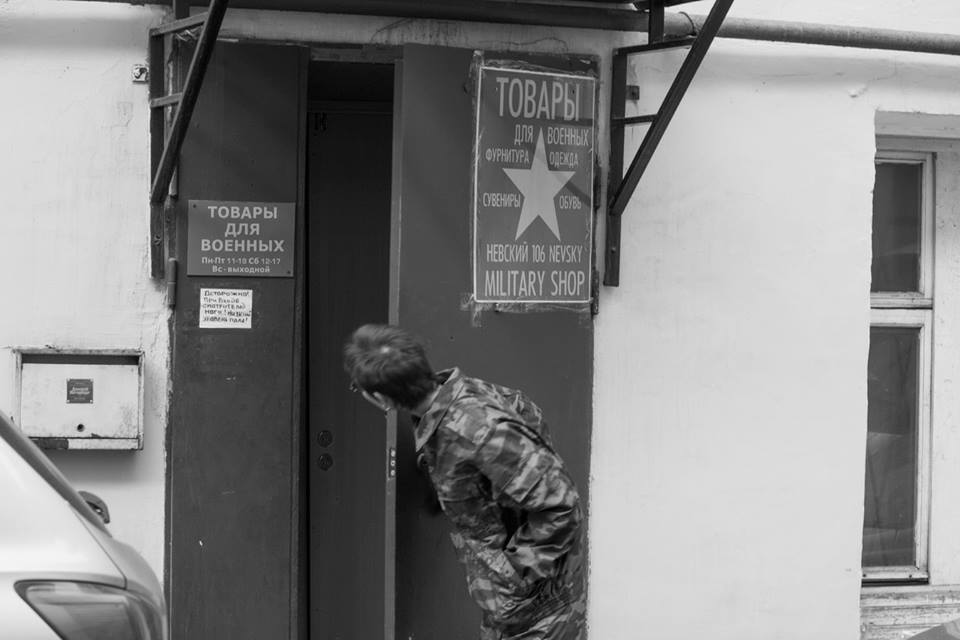
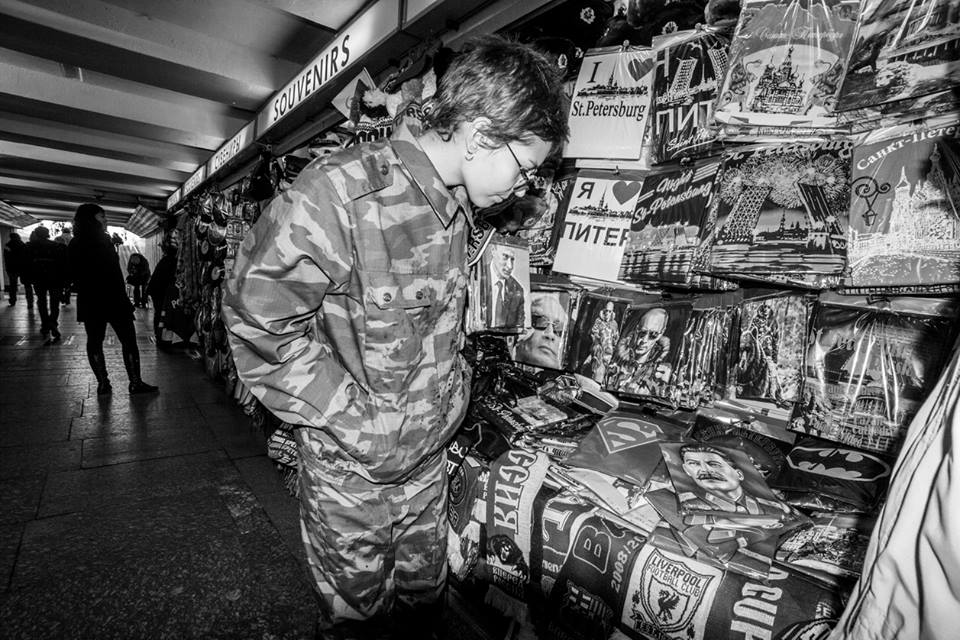
The exhibition {NE MIR} (NO PEACE), a sequel to and an elaboration on the itinerant exhibition/performance that recently took place in Petersburg, opens today in Riga. I sent my photographs of Antiwar Weekend, a walk around the city made by Ekaterina Nenasheva. She strolled around Petersburg in a blood-stained, camouflage uniform. We looked for places in one way or another connected with war, aggression, the army or the memory of them. Actually, we didn’t have to love for them: they were everywhere. Our city is traumatized. Aggression and the memory of wars are offered to tourists as souvenirs, and I see this as an attempt not only at self-assertion but also at conveying this feeling to everyone. As we walked round the city, passersby paid no special attention to the young woman in camouflage. She had become yet another military artifact, a customary sight here. Thirteen photographs, Petersburg, a sunny day in 2015.

Translated by the Russian Reader

12717180_10205713548746516_5004147964005267285_n
Ekaterina Nenasheva, Antiwar Weekend, 2015. Photograph by Vadim F. Lurie. Items for sale in the far right of the kiosk include “Cities of Military Glory,” “Russia’s Naval Glory,” and “The Battle for Vyborg.”
12715679_10205713548426508_695270159562902442_n
Ekaterina Nenasheva, Antiwar Weekend, 2015. Photograph by Vadim F. Lurie.
12742264_10205713548706515_5009893401106894565_n
Ekaterina Nenasheva, Antiwar Weekend, 2015. Photograph by Vadim F. Lurie.

__________

12705378_560104237485253_5926362963602784144_n

{NE MIR}: Dialogues in Riga
Opening: February 21, 2016, 7 p.m.
BOLDERĀJA, AVOTU, 29, RIGA

{NE MIR} is a series of antiwar street exhibitions launched by a group of artists from Moscow and Petersburg. The project’s objective is to discuss war in its different forms, make a collective artistic statement on the relationship between the individual and the state, and investigate the borders of street art in today’s Russia.

The first {NE MIR} exhibition took place in Petersburg on December 27, 2015.

In Russia, there is a law prohibiting marches and rallies (in fact, any political or public gathering of more than two people) without obtaining permission from the authorities ten days beforehand. Moreover, these rallies can be held only in specific places, which are usually situated on the outskirts of cities or are difficult for the public to access. The Russian authorities have the right to prohibit any rally, and in that case it will be considered illegal.

Since their request was turned down three times by local authorities, the artists who launched {NE MIR} had no other choice than to make mobile banners and wander the city under the watchful eye of regular police and riot police.

The urban environment, which dictated the form of protest (wandering round the city), thus functioned as the exhibition’s curator.

This interactive format raised many questions both in terms of art and civic involvement.

How should Russian artists act in the current situation when any statement is deemed disorderly conduct or even a crime? What is the visual code used by police and random passersby, and what are the circumstances under which dialogue is possible? How are absolutely defenseless artists regarded by viewers when they display their artworks in such an aggressive environment?

We intend to look for answers to these questions both inside and outside Russia.

{NE MIR}: Dialogues is a series of itinerant exhibitions and discussions held outside Russia in free art spaces and galleries. It is an attempt to promote dialogue among citizens, artists, and activists, and spark cultural and social interaction between people from different societies and countries.

The exhibition of the {NE MIR} project in Riga will include paintings, graphic art, installations, photographs, and video works by artists from Russia, Ukraine, Denmark, and Chile.

A discussion entitled “The Image of War: The Mass Image and the Private Image” will be held at 7 p.m. on February 21 at Bolderāja Bookshop and Cafe (Avotu 29, Riga), with the exhibition opening to follow at 8 p.m.

Adapted and edited from the original event notice in English on Bolderāja’s Facebook page

Ildar Dadin: “When I Get Out, We Will Change the Country for the Better”

The Prison Blog of Ildar Dadin’s Fiancée: First Visit, January 14
Zekovnet.ru

Nastya Zotova and Ildar Dadin had agreed to get married in January 2015, when Ildar was detained. Imprisoned Russia continues its publication of his fiancée’s blog.

nastya & ildar
Nastya Zotova & Ildar Dadin. Photo courtesy of openrussia.org

I got permission to meet with Ildar from Judge Natalya Dudar on December 30, and I went for my first short visit on January 13. A short visit is not like a date at a cafe or the movies. There is no hugging and kissing. You see each other only through the glass, and there is also a metal grille on top of the glass.

Getting a “date” was not as difficult as I thought. I went to the pretrial detention facility at nine in the morning and handed over the authorization from the judge and the application form, which was printed on the same piece of paper. Then I waited until eleven for one of facility’s wardens to come. He collected everyone’s internal passports and took us to the fifth floor, where there were about fifteen cubbyholes with glass in the middle.

The visit lasted two hours. You can discuss a lot in that time, both life in prison and personal affairs. Apart from me, nine other people had come for visits. Most were women, some of them with children in tow.

Before the visit, a little boy showed me a drawing.

“I drew this for Dad. This is me, this is Mom, and this is Dad. And this is our home.”

Ildar was finally led in. The feelings provoked by such visits are mixed. On the one hand, there he was, my beloved one, whom I had not seen for five weeks. He was safe and sound, without a bruise on his face. The first few minutes we stared at each through the glass and smiled like fools. On the other hand, it was hard. I wanted to hug and kiss him. But talking with him through the glass was still better than nothing.

I quizzed him about prison life. It turned out that the inmates were often worried about the simplest problems, which were hard to solve imprison. For example, your socks are torn. If you were at home, you would grab a needle and thread and darn them. But there are needles and thread in the detention facility. You might be able to borrow a needle, but thread is totally inaccessible and is not allowed in care packages.

Or you have run out of toilet paper. You will have to wait until someone buys it in bulk through the Federal Penitentiary Service store. Toilet paper is not allowed in care packages. According to Ildar, the wardens should issue toilet paper to inmates, but in Pretrial Detention Facility No. 4 it is “not done.”

Or you need to write complaints and appeals in triplicate or quintuplicate. There is no printer, so you have to write everything by hand. You could use carbon paper, but for some reason it is also not allowed in care packages.

The inmates entertain themselves in peculiar ways. Whereas Oleg Navalny caught pigeons, Ildar and his cellmates catch mice. They are ordinary gray mice that run under the bunks at night.

To catch a mouse you need an empty milk carton. You cut a little hole and plant the bait inside. When the mouse enters the cartoon, you close the hole with your hand and then transfer the little beast to a plastic ice cream pail.

They managed to catch two mice in this simple way. Ildar’s cellmates decided to put them on trial and “sentenced” them to four days in prison. They were to serve their sentence in the plastic ice cream pail. Afterwards, they planned to “release” the rodents by throwing them out a third-floor window. But the prisoners escaped by gnawing a hole in their cell.

Smoking is another serious issue. There are eleven men in Ildar’s cell. Five of them are smokers, and they smoke right in bed. The others, who are nonsmokers, are not happy, to put it mildly.

There are only eight beds for the eleven inmates. They take turns sleeping. According to Ildar, however, this is even a good thing, because you can borrow a second blanket from someone. Otherwise, it is too cold to sleep. It got cold in the cell on January 1, so the thermal underwear that I bought on the advice of Alexei Polikhovich, who was convicted in the Bolotnaya Square case, was a real godsend. But Ildar is warm in it only if he sleeps under two blankets. And he still has to survive the transfer to the penal colony where he will serve his sentence—in winter in a cold train car!

After sleep, the second most important issue is food. Ildar admits the food is better than at the special detention center. However, the portions per inmate are not very big. It is not that he is completely hungry, but he would like more. He says that some cellmates eschew the prison food, and so the other prisons divvy up their helping among themselves. They can even warm the food up. A boiler is placed in a pot with water, and a plate with the food on it is place over the pot. The food is thus heated over a water bath.

I have been trying to figure how best to fatten up my inmate through care packages. Ildar already rejected hot meals ordered through the FPS website, and then canned buckwheat kasha with meat. I don’t feel like sending him instant mashed potatoes and noodles (which in prison are called “steamers”).

“Maybe you’d like more cheese? More sausage?”

Ildar frowned.

“I look at the prices in the FPS store and feel offended at how these thugs prey on us. I would rather eat the regulation hundred grams of soup, then shop there,” he said.

This is especially because, according to Ildar, all the care packages are put in the “kitty,” to which everyone has access, so Ildar himself does not end up with so much.

Ultimately, we agreed that I would cooperate with the relatives of other inmates, and that together we would buy food in bulk at ordinary stores and then pass it on to the lads in the cell, since there was a common pot there anyway. Regard the FPS store, Ildar nevertheless admitted that sometimes he wanted something sweet: chocolate, sweetened condensed milk or soda. He was very grateful to Olga Romanova for the garlic she sent him. Garlic was the best thing for you, he said, because it was full of vitamins! All his cellmates were ill, but he wasn’t.

There is no shower in the cell. The inmates are taken once a week to the shower room. But there is a sink, so they can wash up and launder their clothes. As Ildar put it, the toilet is “luxurious”: there are walls on two sides, and a door on the third up to the waist.

I asked Ildar how he spent his time at the detention facility, whether he had been writing complaints. Ildar admitted that he had stopped for the time being. The wardens had hinted to him as it were that if he continued, they could take it on his cellmates.

“However, maybe I’ll soon have to make an important decision: to be a living scoundrel or die,” he said.

Ildar did not explain what was the matter: our conversation was bugged. But he did promise in any case to send a letter, written in his own hand, indicating that under no circumstances was he planning to commit suicide. He believed this would protect him from the “accidents” that happen in Pretrial Detention Facility No. 4.

Despite this eerie message, Ildar was more or less optimistic and was planning to read books.

“I have a lot to learn: political science, economics . . . When I get out, we will change the country for the better,” he said hopefully.

Before his arrest, Ildar said he wanted to be a lawyer and specialize in human rights.

UPDATE
On the night of January 14, it transpired that immediately after our visit, Ildar was removed from his cell along with his things. According to the tentative information we have, he has been transferred to another cell in the same pretrial detention facility.

UPDATE: January 15
As it turned out, Ildar has been transferred to a special cellblock in the same facility. (Meaning greater scrutiny from the wardens and better living conditions.) Meanwhile, our marriage application is ready to submit to the registrar.

Ildar Dadin and Nastya Zotova's marriage application. Image courtesy of Imprisoned Russia
Ildar Dadin and Nastya Zotova’s marriage application. Image courtesy of Imprisoned Russia

Translated by the Russian Reader

__________

Russia: Peaceful activist sentenced under repressive new law must be released
Amnesty International
December 7, 2015

Russia’s jailing of a peaceful opposition activist for violating the country’s new law on public assemblies is a shocking and cynical attack on freedom of expression, Amnesty International said today.

Ildar Dadin was sentenced to three years in jail by a Moscow court for repeated anti-government street protests. He is the first person to be jailed using the law, which was introduced in 2014 and punishes repeated breaches of public assembly rules.

“The shocking sentencing of Ildar Dadin shows that the Russian authorities are using the law on public assemblies to fast-track peaceful protesters to prison,” said John Dalhuisen, Europe and Central Asia Director at Amnesty International.

“This cynical move shows that compared to the drawn out criminal proceedings against peaceful protesters in the past, the authorities have now created a shortcut for imprisoning activists. It is more dangerous to be a peaceful activist in Russia than at any time in recent years.”