Victory Day 2025

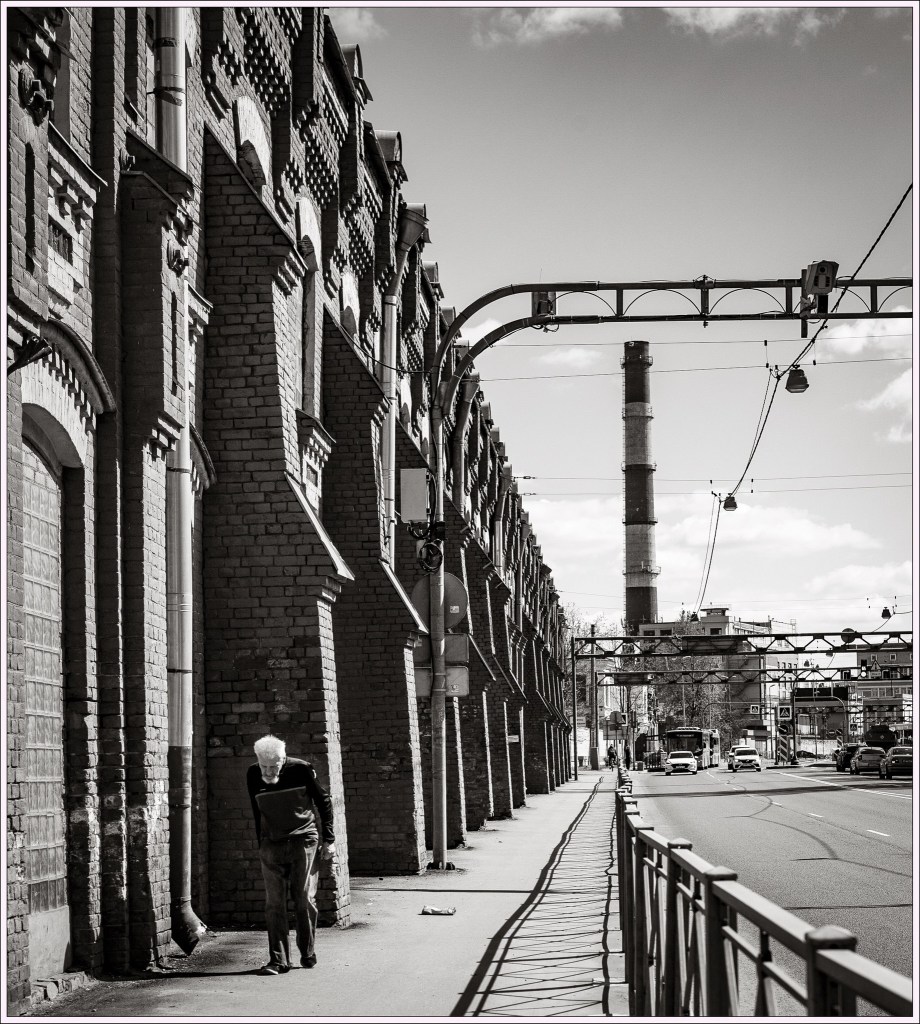
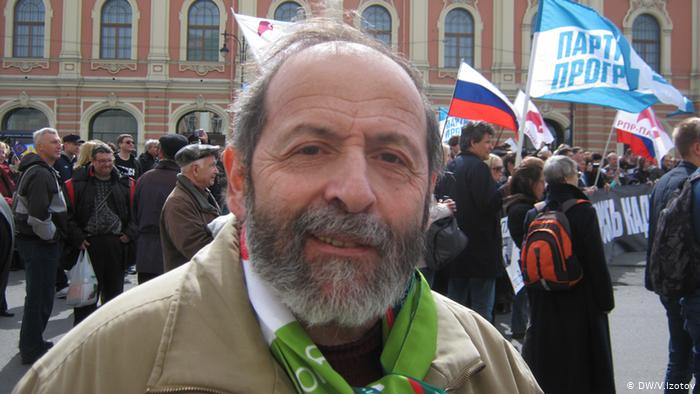
Sergei Podgorkov, Outside the Obukhov Factory (St. Petersburg), 9 May 2025

Source: Sergei Podgorkov (Facebook), 9 May 2025


On Friday, May ninth, Treptow Park was perhaps the most heavily guarded place in Berlin. Hundreds of police officers kept the peace at Germany’s most famous memorial to Soviet soldiers on the day Russia marked the eightieth anniversary of the end of the Second World War in Europe, known as the Great Patriotic War in the Soviet tradition. Because Russia has employed symbols of that earlier war in its current war against Ukraine, visitors were banned from displaying or wearing Soviet and Russian flags, military uniforms, and St George’s ribbons at the Berlin memorial this year. An exception was made for veterans and diplomats.

Soviet May ninth traditions and German pacifists

At about half past ten in the morning, a wreath was laid at the monument to the Soviet soldier by Russia’s ambassador to Germany, Sergei Nechayev. The day before, when Germany remembered the Wehrmacht’s surrender and the end of the war, Nechayev and the Belarusian ambassador were not invited to the memorial event at the Bundestag. In his speech, German President Frank-Walter Steinmeier thanked the Allies for liberating his country and recalled the Red Army’s sacrifices, but harshly criticized Russian attempts to justify the war in Ukraine in terms of the fight against the Nazis in the Second World War.

The flood of people in Treptow Park seemed endless: hundreds were there at any one time, and thousands came and went over the course of the day. Many brought scarlet carnations, while some bore wreaths. Russian and German were heard. Most of the visitors were elderly—immigrants from the former USSR living in Germany and Germans. There were also many leftist and ultra-leftist German political activists brandishing placards opposing NATO and calling for “peace with Russia.”
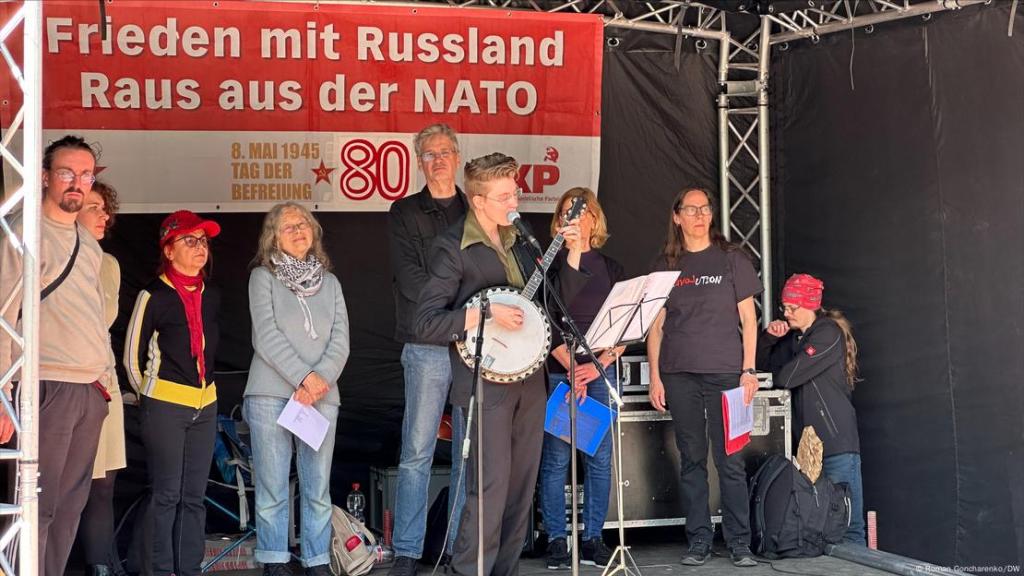
German ultra-leftists rally for “peace with Russia” and Germany’s exit from NATO, 9 May 2025.
Photo: Roman Goncharenko/Deutsche Welle

Against this backdrop, the scene resembled a mixture of a traditional Russian May ninth celebration and a political protest by German pacifists, many of whom had clearly lived most of their lives in the GDR.

“I was a policeman in the GDR,” said a man in his sixties who held a placard that read “Thank you” in Russian. The policemen asked him to doff his Soviet cap, which sported a red star and a St. George’s ribbon.

“All people want peace, so the politicians should don their own military uniforms and crawl into the trenches,’ the man said.

Soviet wartime songs sounded from loudspeakers and were played live. One man, aged forty-five, climbed atop a mound to get a better view, but a policeman asked him to get off the lawn, explaining, “This is a grave.” The man cursed in Russian but climbed off the mound.

Another man played played “Arise, Great Country” on his clarinet. When he began quietly playing the melody of the Soviet and Russian national anthem, the police literally took him aside, after which he returned to the group of people who had gathered. They were outraged at the restrictions that had been adopted. From time to time, someone chanted “Russia, Russia!” and many other people would join in.
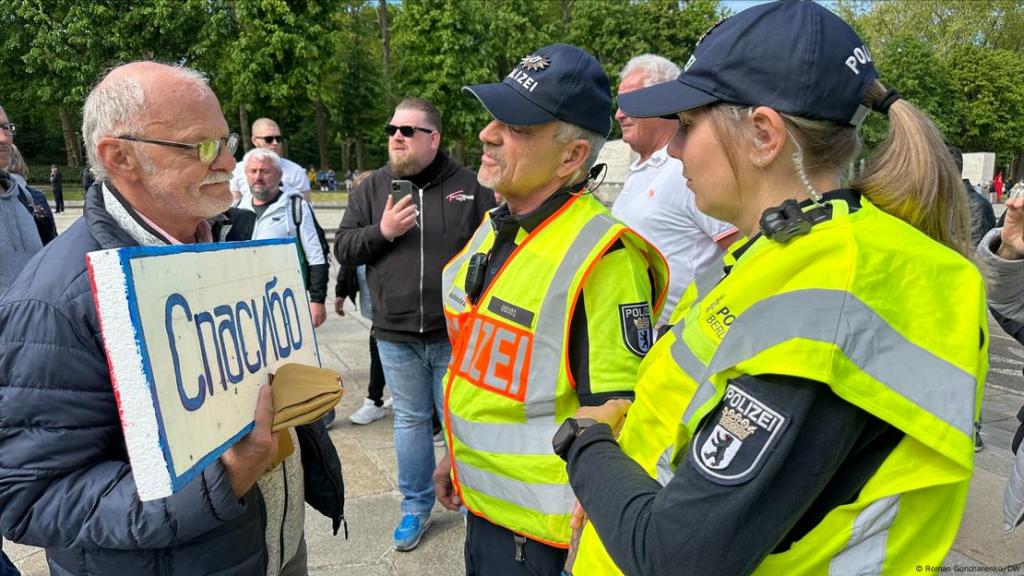
An ex-East German police office (holding a sign that says “Thanks!” in Russian): “All people want peace.”
Photo: Roman Goncharenko/Deutsche Welle

Bikers in Treptow Park

Your correspondent saw men and a woman in leather jackets who looked like bikers from the Russian motorcycle gang Night Wolves. They were in small groups and were escorted by a large number of police officers. They posed for pictures in front of the wreaths and left. They could have been someone from a local “support group.” The Berlin press had written that only a small group of bikers made the trip to Berlin to visit the Soviet memorials this year. No incidents had been reported as this article went to press.

Treptow Park, 9 May 2025. The crimson and gold banners at the back of the crowd are inscribed with the names of the various “fronts” in the Red Army’s campaign against the Wehrmacht. Photo: Roman Goncharenko/Deutsche Welle

For the first half of the day, at least, things seemed relatively calm. Your correspondent had the impression that most people had come to Treptow Park not for political reasons, but to commemorate the war. And yet the atmosphere was tense. To the right and left of the monument to the Soviet warrior stood a dozen and a half activists holding placards and the flags of Ukraine and NATO.
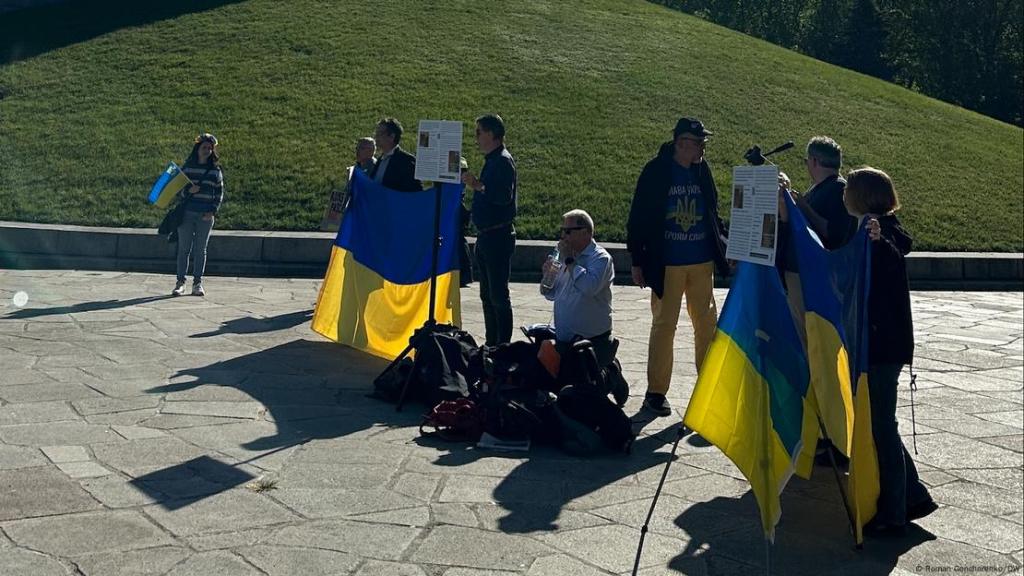
Activists with placards and Ukrainian flags at the monument to Soviet soldiers in Treptow Park, 9 May 2025.
Photo: Roman Goncharenko/Deutsche Welle

They said they wanted to draw attention to the Ukrainian Red Army soldiers who had perished in the Second World War, as well as to Russia’s war against Ukraine.

“I am here to prevent this event from being turned into a Russian propaganda stunt,” said a woman, aged thirty-five. According to her, insults had been hurled at her and the pro-Ukrainian activists.

“Some people regard our presence here as a provocation,” said the woman. “We are not here to change anyone’s mind, but to make Ukraine visible.”

One of their posters read: “Russia has usurped the memory of May eighth and ninth. But it was not Russia who liberated us from the yoke of National Socialism eighty years ago in Berlin. It was the Red Army, in whose ranks many Ukrainians served.”

The poster tells the story of Ukrainian soldier Fyodor Karpenko, who left his name on the walls of the destroyed Reichstag building in May 1945.

Source: Roman Goncharenko, “May Ninth in Berlin’s Treptow Park: A War of Words,” Deutsche Welle Russian Service, 9 May 2025. Translated by the Russian Reader


Since the Maidan uprising and Russia’s illegal annexation of Crimea in 2014, Kremlin propaganda has consistently portrayed Ukrainian leaders as Nazis or fascists. Russia also accused the Ukrainian authorities of “genocide” of the population of Donbass. On 24 February 2022, while announcing the full-scale invasion, the “denazification” of Ukraine was presented as the primary goal of the war, which is itself portrayed merely as a continuation of the Great Patriotic War: a conflict embedded in a cyclical conception of time in which Russia, eternally under threat from a Western enemy, fights for its very survival — on Ukrainian soil.

On the ground, there is no evidence to support Moscow’s accusations: nobody has ever documented a “genocide” against ethnic Russians or Russian speakers, whether in Ukraine or elsewhere. As for the Ukrainian far-right, its political influence remains minimal: in the 2019 parliamentary elections, the main ultra-nationalist parties, running together on a joint list, received just over 2% of the vote, well below the threshold required to enter Parliament. In short, the image of a “Nazi regime” in Kyiv is based on a glaring mismatch between rhetoric and reality.

So why do the Russian authorities repeatedly invoke references to the Second World War — or, in Russian parlance, the “Great Patriotic War” — when speaking about Ukraine? Understanding this memory dynamic is essential to grasp the power of a rhetoric that, despite lacking any factual basis, continues to shape the official Russian worldview.

The Soviet and Russian insistence on using the term “Great Patriotic War” to refer exclusively to the period from 1941 to 1945 erases the twenty-one months that preceded Nazi Germany’s invasion of the USSR. Between the Molotov–Ribbentrop Pact of August 23, 1939, and Operation Barbarossa on June 22, 1941, Moscow and Berlin were de facto allies: they engaged in extensive economic cooperation, diplomatic coordination, jointly invaded and partitioned Poland in September 1939, and the Soviet Union proceeded to annex the Baltic countries and wage war against Finland. By reducing the war to the period 1941–1945, the USSR and Russia could deny any responsibility in the outbreak of the Second World War and present itself solely as the victim of Nazi aggression and the primary liberator of Europe.

The Great Patriotic War — and especially the victory in 1945 — became the founding event of Soviet history and the cornerstone of collective memory. Yet this memory, often portrayed as monolithic and universally shared, is anything but uniform. A Ukrainian from the west, who endured two successive occupations between 1939 and 1944, remembers a war very different from that of an eastern Ukrainian, whose experience was shaped primarily by Nazi destruction. The memory of a Russian bears little resemblance to that of a Crimean Tatar, who was deported along with his entire community and denied the right of return for decades. As for Soviet Jews, whose families and communities were annihilated in the Holocaust, they were long forced to remain silent — official narratives left no room for the specificity of their suffering.

The collective experience of the war and the official discourse surrounding it deeply reshaped the Soviet population’s understanding of “fascism” and “antifascism.” Rather than referring to a specific political doctrine of the inter-war period, the term “fascism” had become a catch-all label for the ultimate enemy. Trotsky or the British Conservatives could just as easily be branded as “fascists,” as well as domestic and international opponents after 1945 — including even the Chinese Communists. The word “Nazi” itself was rarely used. In everyday life, calling someone a “fascist” served more as the gravest possible insult rather than as a statement of ideological substance.

Under Vladimir Putin, the cult of the Great Patriotic War has been revived. Following the pro-democracy protests of 2011 and Putin’s bid for a third presidential term in 2012, the regime instituted a deliberate policy of historical narrative construction, aimed at grounding its legitimacy in a vision of the nation as under siege. The glorification of the 1945 victory also allowed the regime to purge collective memory of its specifically socialist elements: by retaining only the narrative of national triumph, the Soviet period could be seamlessly integrated into a continuous national history without any revolutionary rupture. At the same time, the rehabilitation of Joseph Stalin as a legitimate victor served to validate autocracy. The mass repressions and genocidal policies that claimed millions of lives were reframed as a tragic but necessary step: they had made the USSR a global superpower, capable of defending civilization against the “brown plague.”

The Kremlin has multiplied its legal instruments to enforce this narrative. Since 2020, the Russian Constitution mandates “respect for the memory of the defenders of the Fatherland” and prohibits “diminishing the importance of the heroism” of the Soviet people. In April 2021, Putin signed a law increasing penalties for “insults” or “false claims” about the Second World War and its veterans. In December 2019, Putin himself gathered some leaders of post-Soviet states around a pile of archival documents that he said proved historical truths long ignored in the West — selectively quoting them to justify, in retrospect, the USSR’s annexation of Poland and the Baltic states. In this way, Putin has weaponized history, which has become inseparable from national interest. To challenge his interpretation is tantamount to treason.

Every year on May 9, Russians march in the Immortal Regiment carrying portraits of relatives who fought between 1941 and 1945. Increasingly, the faces of those who fought — or died — in the war against Ukraine are added to these ranks, as though both wars were part of a single, endless struggle. Past and present warfare are merged, and the victory of 1945 becomes the lens through which all events — past, present, and future — are interpreted in a continuous historical timeline. This symbolic fusion also explains the surreal images of Russian occupation forces who, in recent weeks, have placed propaganda banners in destroyed Ukrainian cities. An uninhabitable Bakhmut was transformed into a stage for celebrating the 80th anniversary of Russia’s victory in the “Great Patriotic War.” 

The cult of victory is not only a central element of the Putinist imaginary — it functions as an operating system for both domestic governance and external aggression, with all of Russia’s actions on the international stage framed as part of an eternal war against fascism. A telling example of this is the installation of a giant screen on the Estonian border, broadcasting Victory Day celebrations in a loop — an attempt to remind Estonians, as well as Latvians and Lithuanians, that the Soviet victory represents an unassailable moral superiority. In the Russian collective imagination, the word “fascism” has lost all connection with a specific political ideology and now refers only to an abstract, absolute threat: the desire to destroy Russia. It has become synonymous with “enemy” or “Russophobe,” always denoting the Other, never a historically defined movement. This separation between word and meaning allows the regime to simultaneously glorify the antifascist victory and openly promote xenophobic, homophobic, or ultraconservative rhetoric, without any perceived contradiction.

The word “denazification,” used by Vladimir Putin on February 24, 2022, to justify the invasion, initially puzzled many Russians, most of whom were unfamiliar with the term in this context. Shortly afterwards, the state news agency RIA Novosti published an article by Timofey Sergeytsev — “What Russia Should Do with Ukraine” — aimed at clarifying its meaning: “denazification” was described as a “total cleansing,” targeting not only alleged Nazi leaders but also “the popular masses who are passive Nazis,” deemed guilty of having supported the “Nazi government.” According to Sergeytsev, modern Ukraine is able to hide its Nazism behind aspirations for “independence” and “European development.” To destroy this Nazism, he argues, is to “de-Europeanise” Ukraine. In this logic, denazification becomes synonymous with eliminating all Western influence from Ukraine and dismantling the country’s existence as a nation-state and a distinct society. Incubated on official state platforms, this narrative reveals the true scope of “denazification”: a large-scale project aimed at erasing any trace of Ukrainian singularity, a blueprint for the genocide.

The article recently published on the official website of the Russian Foreign Intelligence Service (SVR), entitled “Eurofascism, Today as 80 Years Ago, Is a Common Enemy of Moscow and Washington,” strikingly illustrates the expansion of the “denazification” discourse far beyond Ukraine. The accompanying image depicts a grotesque hybrid monster: its body is shaped like a black swastika with the EU’s circle of stars in the centre, while its head is a caricature of Ursula von der Leyen. The creature, with its blood-stained claws outstretched, is caught between two bayonets — one American, the other Russian/Soviet. This grotesque image is not merely a provocation: it reflects a narrative deeply entrenched in Russian state propaganda, where “Eurofascism” becomes an operational concept encompassing all European societies.

“Eurofascism, Today as 80 Years Ago, Is a Common Enemy of Moscow and Washington.” Screenshot courtesy of Meduza

The 2022 tipping point revealed these discourses for what they truly are: the ideological foundation of a large-scale invasion, long prepared within the informational sphere. Today, part of European society — particularly elements of the pacifist left — is falling into the same trap: underestimating or ignoring the ongoing propaganda dynamic. But the machine is already in motion. The language of fascism is being broadened daily to include new designated enemies, and the ideological war is shifting: it is no longer stopping at Ukraine — it is now targeting all of Europe. In the face of this brutal reconfiguration of the official Russian narrative, complacency or passivity have themselves become forms of strategic blindness.

Source: Hanna Perekhoda, “From Kyiv to Brussels: The Great Patriotic War as Putin’s Propaganda,” in “Victory Day: Three Interventions from the Left,” Posle, 7 May 2025. Ms. Perekhoda is a Ukrainian historian, researcher, and activist.


Russia’s consolidated military registration registry website, Reestrpovestok.rf, is fully operational. On Friday, 9 May 2025, the human rights project Get Lost, which helps Russians avoid conscription into the army, reported that the notifications that it was operating in test mode had disappeared from the website, and the online resource appeared to have been fully launched.

Upon arrival on the website, users can log in to their personal accounts, check summonses, and obtain copies of records. Earlier, the website indicated that it was functioning in beta mode only in three regions—Sakhalin, Ryazan, and the Republic of Mari El. This notification has now disappeared.

“So far no one who has received a summons through this site or faced automatic restrictions has contacted us,” the human rights activists added. The registry’s launch has not been officially announced.

Recipients of summonses to face restrictions if they fail to report to military recruitment center

The law establishing a consolidated registry of persons subject to conscription and introducing electronic summonses was signed by Russian President Vladimir Putin in April 2023. The text of the document, in particular, states that conscripts who do not report to a military enlistment office within twenty days of receiving a summons may be prohibited from registering as an individual entrepreneur, registering vehicles and real estate, driving a vehicle, and getting a bank loan. In addition, they will not be able to leave Russia until they report to a military enlistment office.

A screenshot of the military enlistment summons website, outlining the penalties imposed on Russians who fail to respond.

The full-fledged launch of the electronic summonses registry was planned for last autumn, but was subsequently postponed.

The registry contains data on all Russian nationals who are already registered and are subject to military registration, as well as those who are not yet registered but are obliged to do so. Lawyers stress that the law and the decree apply to the delivery of any summonses, both for compulsory service and to clarify military registration status, and as part of the wartime mobilization, which Putin has not yet signed a decree to end.

This data will be collected from military enlistment offices. The decree digitizing their databases was signed by Putin back in November 2022. As Defense Ministry officials told the Federation Council, various databases are used for this purpose, including those of the Interior Ministry, the Federal Tax Service, civil registries, and pension funds.

Source: Daniil Sotnikov, “Electronic summonses registry fully operational in Russia,” Deutsche Welle Russian Service, 9 May 2025. Translated by the Russian Reader

Twenty-Five Years

25 years ago, on March 26, 2000, Vladimir Putin won the Russian presidential election, making him the official successor of Boris Yeltsin, who had resigned three months earlier. Putin, who was prime minister at the time and had served as acting president after Yeltsin’s resignation, won 53.4 percent of the vote in what is widely considered the last truly competitive presidential election in Russia to date. Over the next 25 years, Putin would only tighten his grip on power. To comply with the constitutional limit of two consecutive terms, he switched to the role of prime minister in 2008 while his ally Dmitry Medvedev occupied the presidency. After amending the constitution to extend presidential terms from four to six years starting in 2012, Medvedev made way for Putin to run in the 2012 presidential election. Putin won 63.6 percent of the vote, securing a third term in Russia’s highest office.

After winning re-election again in March 2018, Putin once again faced hitting the constitutional term limit in 2024. To address what became widely known as “the 2024 problem”, Putin proposed wide-ranging amendmen[t]s to the constitution in January 2020, which included a change to presidential term limits. While making the rules stricter on paper by limiting Russian citizens to two presidential terms in their lifetime — disallowing the shuffling between positions that Putin had employed in 2008 and 2012 — the amendmen[t] was designed to disregard past or current terms, effectively erasing Putin’s first four terms. The new rule paved the way for Putin to run again in 2024 and to seek re-election in 2028 if he so chooses, which could keep him in power until 2036.

If Putin remains in power beyond 2030, he would become Russia’s longest-serving leader, surpassing Joseph Stalin, who led the Soviet Union for 29 years between 1922 and his death in 1953.

Source: Felix Richter, “Putin’s Grip on Power,” Statista, 25 March 2025


Tequilajazzz frontman Evgeny Fedorov explains to Konstantin Eggert, the presenter of DW’s #Trendy, why Putin is a genuinely grassroots president, what Fedorov’s wealthy fans asked him to play at company parties, and how Russian chanson masqueraded as Russian rock.

Konstantin Eggert: You and I are speaking in Vilnius, where your manager had to look for quite a long while for a venue for your gig because many people turned him down. Does this bother you?

Evgeny Fedorov: Of course it makes me sad. We realize that, in our case, it is unfair. There are artists playing both sides of the fence who are traveling around the world to make money. We are vocal opponents of the war and everything that has been happening in Russia. So it’s a little bit offensive to us, but we realize that this is the price the times make us pay and nothing can be done about it.

— How easy is it for an artist in exile to survive?

— It’s gotten harder. I can’t say that we were a big box-office band. Our music is specific: we’ve always had a fairly modest audience, and we’re used to it. Business wise, we are now cut off from the Russian market and can’t tour Siberia and the Far East. It’s not a big deal, because on 25 February 2022 I personally announced on social media that we would stop doing concerts in the Russian Federation. It was a deliberate (not hysterical) step on our part. We have been coping with these difficulties. We have a small but very loyal, attentive, smart fan base. As it turned out, a significant number of them left the country with us, and so I see in the audience the same people who used to come out for our concerts in St. Petersburg and Moscow.

— In one interview, you spoke about the muteness that overcame you when the full-scale invasion began. Is that muteness completely gone now?

— No, it’s not gone. It has become obvious that I have to reinvent myself, to devise a new language, both creatively and literally. It’s just inappropriate even to remember now some of the things I wrote songs about. I have to change a lot, and this applies to all areas of my life.

Konstantin Eggert interviews musician Evgeny Fedorov, Deutsche Welle Russian Service, 26 March 2025 (in Russian)

— What do you mean that you have to change? You once said that writing protest songs wasn’t your thing.

— I’m not good at it. I tried to voice my rage and grief, all the emotions that were overwhelming me, but it sounded stupid and unnatural. Despite the fact that they were my emotions, I couldn’t express them adequately in songs. We wrote only one [protest] song, “A Machine Full of Evil.” These were the first lines I wrote down in a notebook after the war started. I was watching a war newsreel from Ukraine, and this line came to my mind: “A machine full of evil was crawling.” It’s the only song on the subject where it’s quite obvious to everyone what it’s about. We don’t use any Aesopian language in it.

— Do you think that most people in Russia are just running this “evil machine”?

— No, of course not. I see a huge number of people who were not able to leave [Russia] for various reasons. Some of them deliberately stayed behind to try and destroy the system and to help each other survive. But I’m still horrified to see what a humungous number of people wholeheartedly support this crap.

Tequilajazzz, “A Machine Full of Evil” (2023)

— Among them are people with whom you have collaborated — [Vyacheslav] Butusov, [Konstantin] Kinchev, and a considerable portion of today’s Z-patriots from the cultural realm. Did you already feel at that time that this could happen? Or are those people just interested in the money?

— Almost none of them was a surprise to me. They had obviously been drifting in that direction. You could see that they were going over to that side, they had got their own personal confessors. […] The guys were fusing with the regime, it was out in the open for everyone to see, and nobody surprised me. You know, I had a dream a couple of times that Putin and I were in an office. He says, “Zhenka, sit down, I’m going to take care of business and then we’ll go fishing.” Something like that. I remember the nasty delight I felt in the dream. How cool, I’m hanging out with Putin himself! That courtier’s joy of being near power. I woke up, horrified to discover that I had it in me too, that no one was immune.

The more popular an artist is, the more often they are in the regime’s domain. I have friends who played at ex-President Medvedev’s dacha. I realize that if my music had suddenly appealed to Putin and I had been invited, I cannot rule out that a metamorphosis would have happened to me, and that I would suddenly have been possessed by this despicable joy of being around powerful people. I thank God and our firmness, which we have maintained all these years, and our aesthetic commitments and our ethical commitments, too, that we escaped the danger.

We played company parties three times in our lives. Each time it was a former fan of ours who, as a university student, used to pogo at our gigs, but then had struck it very rich, and so for his birthday or for his company’s birthday he had engaged our band and asked us to play our most hardcore alternative songs. It was always quite funny, because it was obviously the wrong music for a company party. It was just that the guy had bought himself the kind of hardcore show which he couldn’t permit himself to attend now, because he was a “big man,” surrounded by security guards, and so on. But God spared us from all those parties organized by the presidential administration and all those people who were trying to craft the new imperialist mindset.

— Is Putin a people’s president?

— I wish I could joke about it, but I look at people, how they relate to him, and everything that is happening now, and it seems that he is in fact a people’s president, because this type of president did not “go viral” for nothing and enjoys such popularity. It means that he resonates with the people, so that means he is a people’s president.

— What resonates?

— The jokes, the quips, the anecdotes. The man thinks in memes from Soviet movies. He knows how to speak this language and this appeals to people. I remember that my normal, sane friends, when Putin started making all those jokes, squealed with delight: “What a great joke he made!” I said, Guys, what’s wrong with you, it’s a purely cop joke, filled with contempt for people and the belief that no one is without sin, that “everyone shits somewhere,” that everyone is dirty, and if they aren’t, they should be made dirty. I think his practice is based on that.

— And even the war, all the Cargo 200s coming home, doesn’t change that?

— Those people are certain they are fighting for a just cause, they have been convinced of it. We all grew up completely convinced we were the kindest and most generous [people in the world], that we couldn’t be wrong. It’s a very cozy room from which it’s hard to escape and realize that we [do not do] the most magnanimous things. And when we save nations, we are just saving a lane for business.

— In January 2000, when Radio Liberty journalist Andrei Babitsky was abducted in Chechnya, I realized the new regime were the enemies of the media, and therefore the enemies of everything else that was decent. Did you have a moment when you realized that this was a catastrophe?

September 1999, the apartment building bombings. It was quite obvious this was regime change, that [the bombings] had been necessary to bring that person to power. I lived with that horror for twenty years, trying to resist, not allowing myself to flirt with Russian chanson, with underworld things, with what Russian rock later turned into — this fusion of the guitars, the image, and the courtyard songs of Russian chanson with all the paraphernalia of chthonic values — with vodka, herring, the banya, and so on.

— You once said that the need for protest songs ended in the 90s and the bourgeois era of just being creative dawned. Was it a good time for you?

— It’s generally normal for people to do creative work and sing love songs. The need to write protest songs is not normal. We liked the fact that rock and roll was no longer a genre persecuted by the KGB and that it was safe to play. We sang about ugly things, often without delving into lofty matters. Our music is about different aspects of human life, both lofty and absolutely ordinary, even shameful. That’s normal. What is happening now is not normal.

— If you look at the last thirty years, what Russian music, literature or cinema has stuck with you?

— A few Boris Grebenshchikov albums for sure. Now I’m just cut off. I can’t listen to anything that I liked three years ago. I turn on my favorite album and realize I can’t listen to it because it takes me back to a life which no longer exists. I’ve become an “anti-old fart.” Because old farts listen to the music of their youth and choose to stay in their time bubble. My bubble has burst. I’m listening to the stuff teenagers and young adults listen to, to weird experimental stuff that doesn’t sound like what I used to enjoy.

I’m reading a lot of hundred-year-old émigré prose right now, which has suddenly become timely. It’s interesting to compare [my experiences with] the experiences of people who left [Russia] between 1918 and 1920. There is this sense of horror at the darkness that surfaced and deluged everything, the mundane details, the executions, the horror at this outbreak of self-righteous darkness, spewing saliva, blood, and shit… The horror is quite comparable.

— Let’s imagine that tomorrow Putin falls, we make peace with Ukraine and give them back the occupied territories, and the political prisoners are released. Would you be willing to go home?

— I don’t want to see those mugs. Where will all these cops, FSO officers, and the people who are in league with them go? A huge number of my friends in Russia are in a terrible situation. What is it like for those people who are on our side, but who are [in Russia]? How do they survive? How do they each struggle in their own way, often just on an aesthetic level? I have a quite pessimistic view of the future. I don’t believe that any of this will change quickly, if it didn’t change in the few years of freedom that Russia had, which people didn’t savor, but decided to go back to the Brezhnev-era twilight.

Source: Konstantin Eggert, “Fedorov: People in the Russian Federation have been convinced they are fighting for a just cause,” Deutsche Welle Russian Service, 26 March 2025

Tequilajazz, One Hundred Fifty Billion Steps (LP, 1999)

Evgeny Fedorov is a Russian musician, composer, and producer. Having played and composed music from a young age, he is a well-known and highly regarded figure in the Russian alternative rock scene. Since late August 2024, he has been in ICORN residence in Stockholm after openly criticising Russia’s war in Ukraine.

Evgeny Fedorov joined his first band Объект Насмешек (‘Object of Ridicule’) in 1986 and became very popular in the final years of communism, touring and performing across the USSR until the band broke up in 1991.

In 1993, Fedorov formed another band Tequilajazzz for which he continues to be the lead singer and bass player. The band has recorded and released numerous critically acclaimed albums and has toured all over the world.

In addition to Tequilajazzz, Fedorov has been involved in several other music projects, including Optimystica Orchestra and Zorge, and has composed music for Russian films and TV series.

After openly criticising Russia’s full-scale invasion of Ukraine in February 2022, Fedorov was harassed and threatened with legal action by the Russian government. He was publicly condemned on state-controlled Russian television.

At the end of August 2024, Evgeny Fedorov began an ICORN residency in Stockholm. He continues his work from Kulturhuset Stadsteatern.

Stockholm ICORN City of Refuge

Stockholm has hosted writers and artists at risk since 1998 and has been an ICORN City of Refuge since the network was established in 2006. Since 2012, Kulturhuset Stadsteatern has been managing Stockholm’s ICORN programme, so far hosting 12 ICORN residents, including Faraj Bayrakdar, Arya Aramnejad, and Zahra Hussaini.

Currently, Stockholm offers three ICORN residences simultaneously. Alongside Evgeny Fedorov, music artist Mun Mun from Myanmar and poet and short story writer Raafat Hekmat from Syria are also continuing their work from Stockholm and Kulturhuset Stadsteatern.

Source: “Musician Evgeny Fedorov in ICORN residence in Stockholm,” International Cities of Refuge Network, 17 March 2025


Russia ranks poorly in transparency, corruption, and democracy in many international indexes. Researchers at The Economist ranked it 150th out of 167 countries in its Democracy Index last year, highlighting the country’s lack of political diversity and frequent election manipulation. Russia also received a worrying score for corruption in NGO Transparency International’s most recent annual report, where it ranked 154th out of 180.

The Kremlin regime’s repression and journalistic censorship are also reflected in a ranking on global press freedom, with Reporters Without Borders placing the country 183rd out of 208 last year—a score that is hardly surprising, considering that Russia still regularly imprisons journalists, including on the grounds of “espionage.” The government also restricts access to the internet and critical content online.

Source: Anna Fleck, “Freedom, Corruption, Democracy: Russia’s Poor Record,” Statista, 26 March 2025

Julia Stakhivska: Books in the Firing Line in Ukraine

Julia Stakhivska

After talking to relatives in Kharkiv, once again shelled by Russia, and hearing news of the missile strike on one of Ukraine’s largest printing plants, I touch the bindings of the books on my shelves. I think about how many of them were printed in that same city, now very much on the frontlines again. This time it was not only transport and urban infrastructure that were targeted but books as well.

Factor Druk is one of the largest full-cycle printing plants in Europe. It is part of the large Factor holding, which includes, among other companies, Vivat, one of the top Ukrainian publishing houses, which has its own network of bookstores. Factor’s customers include not only Ukrainian publishers but also such global publishers as Penguin Random House, Simon & Schuster, Hachette, and Macmillan.

I look at the kaleidoscope of photos—the burnt-out shop floors, the waves of pages, the scattered covers (one—oh, the bitter irony!—bears the title “The Club of the Rescued”)—and wonder how much a Russian missile costs. The internet, for example, reports that an Iskander runs for around three million dollars. Instead of “liberating” us from twenty thousand books a week before Book Arsenal, Ukraine’s most important book fair, the aggressors could, say, print themselves a few more copies of books by their own classic authors. This is not the first such strike, by the way. On 20 March of this year, Russian forces hit another printing plant in Kharkiv where many Ukrainian publishers also had their books printed.

The Factor Druk printing plant, damaged by a Russian missile strike on Kharkiv.
Photo: Nicolas Cleuet/Le Pictorium/MAXPPP/dpa/picture alliance

Solidarity in response to terror

But the further away they are from Ukraine, the less people in the rest of the world understand the symbolism of these events. As the well-known Ukrainian journalist Kristina Berdynskykh wrote on her Facebook page, “Three days ago, I bought the diary of Volodymyr Vakulenko, as published by Vivat. [Vakulenko’s] shot corpse was found in a grave in a forest outside Izium in autumn 2022. The diary was found by Ukrainian writer Victoria Amelina, who unearthed it in a courtyard near the house where he lived during the occupation. Amelina died [from the wounds she suffered during] the missile strike on Kramatorsk in 2023. The plant where this book was printed was destroyed by a Russian missile strike today, in 2024. ‘Volodymyr Vakulenko kept a diary during the occupation, hoping that you, the world, might be able to hear him. If you are holding this book in your hands, the writer Vakulenko has won,’ Victoria writes in the foreword. Hold books printed in Ukraine in your hands. The world will never understand all the way anyway.”

Ukrainian social networks have been overflowing with solidarity and sympathy. Thousands of people have simply gone and ordered books by their favorite publisher, Vivat, and so for a while, due to the number of orders, the publisher’s website was down, and long queues formed in some bookstores. This is probably the least that can be done now. It is the constructive fact that gathers us every day, in the midst of worries and threats, when just being is a victory in itself.

Bookshops opening in Ukraine during the war against all odds

Against all the odds, new bookshops have been opening in Ukraine amidst the war. Literary events, festivals and book fairs have been taking place. In Kyiv, one major book fair ended a month ago, another is due to start in a week, and two more are planned for the next few months. There are many reports about the growing demand for books. The other day, a bookshop manager I know commented, “People are just jumping on books. This not only furthers the culture but also helps to maintain some level of normality.”

I take one of my favorite Vivat books from the shelf—Lazarus, a novel by Svitlana Taratorina, a Ukrainian author originally from Crimea. It’s a contemporary fantasy set in an alternative magical Kyiv in the early twentieth century. The city is inhabited by both ordinary people and various “impure” creatures such as water sprites, ghouls, and werewolves. Although the book presents an interesting, intriguing and self-contained world of magical adventure, it is not hard to see its political aspect. The human beings in Lazarus come to Kyiv from the Empire. They try to impose their centralized way of life on the city, seeking to neutralizing its peculiarities and nuances, to level anything outside the imperial framework, anything “impure,” that is. This clampdown eventually and inevitably leads to an explosion. Sounds familiar, doesn’t it?

Everything can be restored but people cannot be brought back to life

It is a day of mourning in Kharkiv. Ukrainian President Volodymyr Zelensky has visited the site of the attack.

“The production facility was destroyed, and tens of thousands of books were burned by this strike. A lot of children’s literature, manuals, and textbooks…. Russian terror should never go unpunished,” he said.

Seven workers were killed at the printing plant: five women and two men who were printing children’s books that day. Twenty-one people were injured. As Elena Rybka, editor-in-chief of the publishing house, wrote, “Everything can be restored. It is impossible to bring people back to life. We sympathize with the families of the victims. We pray for the wounded. We support Ukrainian culture, because it will never be beyond politics.”

Julia Stakhivska is a Ukrainian writer who has published books of poetry and fantasy stories for children and co-edited anthologies of Ukrainian poetry.

Source: Julia Stakhivska, “War Diary: Books in the Line of Fire,” Deutsche Welle Russian Service, 25 May 2024. Translated by the Russian Reader


Russia’s strike on the Factor Druk printing house killed seven workers and left 16 wounded, according to Suspilne. The company estimates that 20,000 books were destroyed, of which 40 percent were schoolbooks. 

Factor Druk printed around half of Ukraine’s schoolbooks, CEO Serhii Polituchniy said in an interview with Radio Liberty.

“I don’t know how we will print tomorrow,” he added. The strike on the company’s printing facilities stands to reduce the volume of Ukraine’s publishing industry by 40 percent, according to Polituchniy’s estimates.

Three out of 10 leading publishing companies in Ukraine are located in Kharkiv which is constantly under Russian missile assault. Factor Druk did not evacuate its facilities from its location, around 40 kilometers from Russia’s border, due to the complexities and costs involved.

Polituchniy stated that most publishing professionals have chosen to stay in Kharkiv rather than move westward, where the right skills and knowledge are believed to be harder to find. “One should teach a professional for 4-5 years minimum,” Polituchniy said.

Industry leader

Factor Druk became a founder of Vivat Publishing House, one of the most prominent and popular book brands in the country, printing non-fiction and fiction books in the Ukrainian language. In 2023, Vivat became the seventh largest in Ukraine’s book publishing industry, with Hr. 191 million in revenue (almost $5 million), according to Pro-Consulting estimates provided to Kyiv Post.

Ukraine’s honey exports amounted to almost a third of the commodity’s imports to the EU in the last year, with China taking the leading position.

Vivat’s two bestsellers include Winston Churchill’s biography written by ex-UK prime minister Boris Johnson (50,000 books sold) and “Stus’s Case” – a novel about how the KGB arrested and tried Vasyl Stus, Ukraine’s poet, translator, literary critic, journalist, and an active member of the Ukrainian dissident movement. Around 120,000 copies of the book have been sold.

In addition to books, Factor Druk prints newspapers and magazines, booklets, catalogs, as well as stationery products such as calendars, notebooks and school diaries according to the company’s website.

The company also prints for other publishers, including:

  • Industry leaders KSD and Folio (both also Kharkiv-based)
  • Schoolbooks publishing company Ranok
  • Faith books publishing house Svichado
  • Children’s publishing house Zelenyy Pes

Vivat forms the majority of Factor Druk’s revenues. Overall, between 2017 and 2023, Factor Druk generated Hr. 230 million ($5.7 million) as an annual average, according to the company’s financial statements on Vkursi big data platform. The enterprise did not generate losses even during the first year of Russia’s full-scale invasion of Ukraine. 

Ukraine’s publishing industry includes 385 publishing enterprises of different sizes, 200 of them each generating more than Hr. 1 million (£25,000) in revenues in 2023, according to Pro-Consulting’s data provided to Kyiv Post.

Source: Olena Hrazhdan, “Russian Strike on Major Printing House Jeopardizes Industry Capacity,” Kyiv Post, 25 May 2024


Trampled by Turtles, “The Outskirts” (2004)

Well I turned around in time to see the clouds fade
Running back could only make them stay
Forward now I run down a winding road
Try to pay back everything that I have ever owed

And when your money runs, will you buy a friend?
And when your guns don’t fire, will that be the end?
With no land left to burn, and nowhere left to run
Where then can we stand when it’s all said and done?

Well I hear the thunder roll, I feel the cold winds blowing
But you won’t find me there, ’cause I won’t go back again
While you’re on smoky roads, I’ll be out in the sun
Where the trees still grow, where they count by one?

Well you take from our schools to build a bigger bomb
You tell us fiery lies about the course we’re on
And you’ll kill all the world, and you’ll reverse the sun
And which would you sell first, your soul or your gun?

But I hear the thunder roll, I feel the cold wind blowing
But you won’t find me there, ’cause I won’t go back again
While you’re on smoky roads I’ll be out in the sun
Where the trees still grow, where they count by one?

Source: LyricFind

Sergei Chernyshov: “It Is Impossible to Run a Normal College in an Abnormal Country”

Novocollege, a private educational institution in Novosibirsk, will close, its founder Sergey Chernyshov announced in a video posted on YouTube on Saturday, 27 April. According to him, the college and its subsidiary projects—Novoschool and Inotext Foreign Language School—will close in July 2024, immediately after the academic year is over and all paperwork has been completed.

Explaining the motives behind the decision, Chernyshov said that the college remained the only educational institution in Russia where “there had never been a single propaganda event” and where “[people] spoke openly about their attitude to what was happening.”

“I believed and still believe that my colleagues [at other colleges and schools — editor, DW] bear a huge blame for normalising the war in our country: for [holding] Important Conversations, [making students write] letters to the front, handing out [military draft] summonses, for engaging in propaganda and celebrating former murderers and rapists as heroes. None of this has ever occurred at Novocollege,” he said.

A screenshot of Novocollege’s website

“It is impossible to run a normal college in an abnormal country”

According to Chernyshov, over the past year the college has been subjected to constant inspections from various government agencies, which have made it almost impossible to keep the college running. Meanwhile, many of the college’s lecturers and students would be willing to take part in “patriotic” events in exchange for accreditation and state-issued diplomas, the former head of the institution said.

Under such conditions, Chernyshov sees only two options for Novocollege. The first is to turn it into “a typical Russian college with propaganda that is ingratiating to officials, a beautiful cover, and what they want to hear from it.” The second is to recognise that “it is impossible to run a normal college in an abnormal country.”

In June 2023, Novocollege was denied government accreditation, despite the fact that the college had scored the necessary number of points and fulfilled other formal requirements. Chernyshov himself was placed on the list of so-called foreign agents by the Justice Ministry in May of last year, after which he resigned his administrative duties at the educational institution.

Source: Jean Roffe, “Novosibirsk’s Novocollege announces closure,” Deutsche Welle, 28 April 2024. Translated by the Russian Reader


Sergei Chernyshov, “‘It’s impossible to run a normal college in an abnormal country’:
Novocollege is shutting down” (in Russian; no subtitles)

For a modern and free college to run well, modern and free people are a vital prerequisite.

If we now polled the students and teachers at [Novocollege] about whether they would be willing to hold Important Conversations, invite veterans of the so-called special military operation to visit, applaud the speeches of propaganda ministers, and march to patriotic songs in exchange for accreditation and government-minted diplomas, how many people would vote in favour? I am quite bitter to admit it, but I think it would be a majority.

We acknowledge that it is impossible to run a normal college in an abnormal country. Neither I nor my colleagues (many of whom have left [Russia] due to the threat of mobilisation or arrest; many of whom have had family and friends arrested or killed) can pretend that everything is normal. No, everything is not normal. Even if all our colleagues in education pretend that things are normal, I repeat: no, things are not normal.

Therefore, I am announcing that Novocollege, Novoschool, and Inotext Foreign Language School will cease operations as of July 2024, immediately after the end of the academic year, graduation, and [completion of] all paperwork.

And yet, there are unique teams of students and teachers at Novocollege who have voiced their willingness to continue working, knowing that the external pressure will only increase, that the college will increasingly not resemble the country in which it operates, and that there will most likely never be any accreditation. They are primarily at the Tomsk branch and in the distance learning department. Perhaps there will be other teachers and their students who are willing to continue to live and study with a team of free normal people—and we will help them organise their work.

Source: Sergei Chernyshov (YouTube), 27 April 2024. Annotation translated by the Russian Reader

Oleg Sentsov: “Don’t Believe Putin”

sentsovOleg Sentsov and David Sassoli at the Sakharov Prize award ceremony. Photo courtesy of Deutsche Welle

“Don’t Believe Putin,” or, What Advice Sakharov Prize Winner Sentsov Gave the European Union
Yuri Sheyko
Deutsche Welle
November 26, 2019

Andrei Sakharov, Nelson Mandela… Oleg Sentsov could never have imagined his name would be on a par with these people.

“This is a great honor and a great responsibility,” the Ukrainian filmmaker said during his appearance at the European Parliament.

It was there on November 26 that he was finally given the Sakharov Prize he had been awarded in 2018. This was the second award ceremony. There was an empty chair in the plenary hall in Strasbourg a year ago because Sentsov was still being held in a Russian penal colony. After the exchange of prisoners between Ukraine and Russia in early September, the European Parliament held a new ceremony in which the Ukrainian was able to participate.

Sentsov Warns EU Politicians
The ceremony on Tuesday was simple. The president of the European Parliament, David Sassoli, spoke before yielding the floor to the prizewinner. Sentsov briefly mused about what the Sakharov Prize meant to him before quickly segueing to his main message.

“There is a lot of talk nowadays about reconciliation with Russia, about negotiations. I don’t believe Putin, and I would urge you not to believe him. Russia and Putin will definitely deceive you. They don’t want peace in Donbass, they don’t want peace for Ukraine. They want to see Ukraine on its knees,” Sentsov said.

His words were in stark contrast to the high expectations for the summit of the so-called Normandy Four, scheduled for December 9 in Paris, as well as French President Emmanuel Macron’s desire to normalize relations with Russia. Sentsov thus had advice for all EU politicians.

He said that every time one of them thought about extending the hand of friendship to Putin over the heads of Ukrainians, they should also think about every one of the thirteen thousand people who have perished in the war in Donbass, about the Ukrainian political prisoners still held in Russia, about the Crimean Tatars, who face arrest at any minute in annexed Crimea, and about the Ukrainian soldiers “in the trenches, risking their lives for our freedom and your freedom.”

Laconic as usual, Sentsov spoke for less than five minutes, but it was enough to elicit applause from both MEPs and visitors. The balcony was nearly full with visitors and journalists. Most MEPs were also present for the ceremony. There were only empty seats on the edges of the assembly hall, where left and right populists sit. Members of both groupings took their places several minutes after Sentsov left the dais so they could take part in voting.

Sentsov: “No Happy Ending”
The ceremony lasted less than half an hour: no speeches by or questions from MEPs were on the program. Many of them thought this was not enough, however, so the day before the ceremony, on the evening of November 25, the foreign affairs and development committees, along with the human rights subcommittee, which are responsible for the Sakharov Prize, hosted a conversation with Sentsov.

When Sentsov arrived at the event, MEPs lined up to greet him or have their picture taken with him. The session was thus delayed for five minutes or so.

Many of the MEPs who spoke at the meeting praised Sentsov’s courage.

“I admire and respect you not only for your courage, but also for your perseverance. You emerged a winner. And so we are very happy that you are free. By your example, you can inspire people to fight for freedom not only in Ukraine and Europe, but also around the world where there are dictatorships,” observed Sandra Kalniete, a Latvian MEP for the European People’s Party.

However, the praise did not make a big impression on the Ukrainian. He thanked the MEPs for supporting Ukraine in the struggle against Russian aggression, but reminded them the struggle was not over.

“There was no happy ending when I was released,” Sentsov said, reminding the MEPs that over one hundred Ukrainian political prisoners were still behind bars in Russia, and Russian-backed separatists in Donbass held over two hundred captives.

Sentsov’s Creative Plans
Kalniete’s voice was filled with emotion, and she even apologized for being so flustered. Perhaps it was emotion that made foreign affairs committee chair David McAllister mistakenly identify Sentsov as a “Russian” filmmaker, but he immediately corrected himself.

“As a Ukrainian filmmaker and writer, you have been a very harsh critic of Russia’s illegal annexation of Crimea,” McAllister said.

The MEPs peppered their guest with questions and requests for political advice, but after the first round of speeches by representatives of all the factions who wished to attend the event, Sentsov had nothing more to say.

McAllister decided to take a creative approach.

“There is a second round [of speeches] in this ‘movie.’ You’re a director, and I’m an actor, but this time it’s the other way around. You can say whatever you want, especially about your experience with the Russians,” he said.

After a few more questions, Sentsov no longer refrained from comment.

Speaking about the 1994 Budapest Memorandum, under which Ukraine relinquished the world’s third largest nuclear arsenal in exchange for assurances regarding its territorial integrity, Sentsov said, “Since they [Russian] took Crimea from us, they can return our bombs.”

If the MEPs had reacted enthusiastically to many of the Sakharov Prize laureate’s statements, there was a heavy silence in the room after he said this. Subsequently, he had to explain what he meant more than once. In an interview with Deutsche Welle, he assured us it had not been an “actual” proposal.

“It’s not a call to return [our] nuclear weapons, but an argument in negotiations: where it all began and what we need to get back to,” Sentsov underscored.

He believes negotiations in the Normandy and Minsk formats are a dead end, and sees the possibility of a real solution to the problem of Donbass and Crimea when Vladimir Putin ceases to be the president of Russia.

“And then Ukraine, Europe, and the whole world should be ready to take a tough stance on the return of those territories,” he said.

The MEPs also asked Sentsov about his plans for the future. The director confirmed he intends to finish shooting the film Rhino first. He interrupted work on the film when the Euromaidan protests, in which he was involved, kicked off. The director has written screenplays for five films, which he would like to shoot in five years. Sentsov warned, however, that he did not mix creative work with public life, so we should not expect him to make films about his time in prison, Maidan or Crimea.

Translated by the Russian Reader

“Foreign Agents”: Official Fearmongering Runs Amok in Russia

foreign agents piechartA pie chart, using information from November 2017, showing the numbers and kinds of NGOS designated as “foreign agents” by the Russian Justice Ministry. Moving clockwise, the chart shows that 24 Russian human rights organizations have been registered as “foreign agents,” along with 4 NGOs working on healthcare issues, 2 trade union associations, 6 analytical and social research organizations, 3 women’s organizations, 10 civic education organizations, 9 media support organizations, 3 ethnic minority organizations, 7 NGOs involved in defending democracy and democratic principles, 11 humanitarian and social welfare organizations, and 8 environmental organizations. Courtesy of Deutsche Welle. As of November 15, 2019, there were ten media outlets listed as “foreign agents” by the Russian Justice Ministry, including Voice of America (VOA), Radio Free Europe/Radio Liberty (RFE/RL), and eight RFE/RL affiliates.
Russian Duma Adopts Law on Designating Individuals “Foreign Agents”
Olga Demidova
Deutsche Welle
November 21, 2019

The Russian Duma has passed a law bill on designating private persons as “foreign agents” in its third and final reading. On Thursday, November 21, the bill was supported by 311 of the 315 MPs who voted. No one opposed the bill, although four MPs abstained.

Two days earlier, the Duma’s committee on information policy approved amendments to the bill in its second reading. The amendments make it possible to designate individuals as “performing the functions of a foreign agent” and thus on a par with legal entities. They can be deemed “foreign agents” if they create content for media outlets that have been designated “foreign agents” or distribute their content while receiving foreign funding.

Media outlets already registered as “foreign agents” will have to establish Russian legal entities in order to operate in the Russian Federation. In addition, they must mark their content as having been produced by a “foreign agent.” Leonid Levin, chair of the Duma’s information policy committee, promised the law would not been used against bloggers and current affairs commentators. Individuals would be designated “foreign agents” by the Justice Ministry and the Interior Ministry, which Levin argued would prevent “unreasonable” rulings.

In July 2012, the Duma amended several laws regulating the work of NGOs. The amendments obliged NGOs that engaged in political activities and received foreign funding to register as “foreign agents.” The NGOs were to indicate this designation on their websites, for example, and provide regular financial reports. There are currently over seventy organizations in Russia registered as “foreign agents.”

Thanks to Marina Bobrik for the heads-up. Translated by the Russian Reader

_________________________________

Grigorii Golosov
Facebook
November 24, 2019

The law on individual foreign agents is innovative in the sense that the people who drafted it and pushed it have not disguised the fact it is meant to be enforced selectively. Certain critics have even remarked that this is a good thing: only a few people will be affected. I think they are wrong, but I wanted to talk about something else. It is no secret that laws are enforced selectively in Russia, but so far none of the laws that have caused a public stir has been meant to be enforced selectively. Now that has changed. A law that is selectively enforced is clearly no law at all, but a specimen of lawlessness, and so the new law is anti-constitutional. Unfortunately, it is pointless to challenge the law in the Constitutional Court, and not only due to the court’s peculiarities. After all, the authorities have not hidden their intentions and motives, but nor have they admitted them aloud. It is their usual M.O., the old “you just try and prove it” gambit. In fact, a good response would be a barrage of lawsuits petitioning the authorities to designate as “foreign agents” public loyalists they would have no wish to hurt, but who are 100% guilty if the letter of this law were obeyed. However, the human rights movement, which could take up this cause, has been defeated, in particular, by the previous laws on “foreign agents.” The way to lawlessness is thus open.

Translated by the Russian Reader

A “Political Hit Job” in Petersburg

vishnevskyBoris Vishnevsky. Photo courtesy of Deutsche Welle

Petersburg City Councilman Boris Vishnevsky Accuses Prigozhin Media of Slander
Deutsche Welle
November 14, 2019

On Friday, November 14, Boris Vishnevsky, a Yabloko Party deputy in the St. Petersburg Legislative Assembly, filed a complaint with the Primorsky District Internal Affairs Department, requesting it open a criminal slander investigation into articles published by Patriot media holding company, whose board of trustees is headed by businessman Yevgeny Prigozhin, as reported by Vishnevsky himself on his Facebook page.

Novaya Gazeta has reported that, beginning on November 7, Patriot’s media outlets have been running stories claiming that, in his capacity as a professor at the Herzen Russian State Pedagogical University (RGPU), Vishnevsky had sexually harassed first-year female students.

The basis of the charges is, allegedly, an email from a young woman named Kristina, who identified herself as an RGPU alumna and claimed Vishensky harassed her and other female first-year students in 2014.

On November 12, the national TV channel Rossiya 24 told viewers there had been “widespread complaints” against Vishnevsky, and students had been holding solo pickets against him outside the Legislative Assembly.

Meanwhile, RGPU has issued a press release. It stated there were no first-year students named Kristina enrolled at the university in 2014, Vishnevsky had never taught courses to first-year students there, and no allegations of sexual harassment had ever been made against him.

Vishnevsky has called the scandal an obvious “political hit job.”

“This is the regime’s revenge for my political activities and political stance, for exposing fraud involving the city budget and utilities rates, for fighting to save the city, for defending political prisoners, and for Yabloko’s victories in the municipal district council elections in the Central District,” he wrote.

Translated by the Russian Reader

Entweder Gehst Du oder Ich Gehe!

friedrichshain police state.JPGGermany has begun implementing the Putinist police state in parts of Berlin to make its Russian partners feel less lonely in their pursuit of absolute tyranny. Photo by the Russian Reader
Council of Europe and Russia Reach Tentative Compromise
Deutsche Welle
May 17, 2019

Russia said it had no desire to leave the Council of Europe and was ready to pay its dues following an apparent breakthrough between Moscow and Western nations. Russia’s delegation had faced sanctions over Crimea.

France and Germany pushed through a compromise that would allow Russia to return to the Council of Europe (CoE), as foreign ministers from the 47 member states resumed their two-day summit in Helsinki.

The Russian delegation has faced sanctions at the CoE over the annexation of Crimea by Russia in 2014. One of the measures included stripping Russia’s representatives of their voting rights, which in turn prompted them to boycott CoE plenary sessions.

On Friday, the body adopted a declaration saying “all member states should be entitled to participate on an equal basis” in the CoE. The declaration also states that its members “would welcome that delegations of all member states be able to take part” in the assembly next June.

“We do not intend to leave the Council of Europe, as some rumors would have you believe,” said Russian Foreign Minister Sergey Lavrov. “We are not evading any of our commitments, including the financial ones.”

Germany’s top diplomat Heiko Maas previously met with Lavrov on Friday. Maas said it was “good that we have agreed that Russia should stay in the CoE Parliamentary Assembly—also to give millions of Russians the protection of the European Court of Human Rights.”

Berlin has actively supported Russia’s full reinstatement into the council, but that did not come without conditions, Maas told DW.

“We have also agreed on a mechanism by which it will be possible in future to sanction members of the CoE who violate fundamental legal provisions.”

In 2017, Russia stopped its financial contributions, leaving the CoE with an annual budget hole of some €33 million ($37 million). Russia could be suspended from the body next month for not paying its membership fees.

Activists Want Russia in CoE
Human rights activists were concerned that suspending or expelling Russia from the assembly, which is a non-EU organization to uphold human rights, could have a disastrous effect on civil society in Russia. The watchdog body is in charge of electing judges for the European Court of Human Rights (ECHR) and the largest percentage of ECHR cases comes from Russia. Others worry that revoking Russia’s membership could eventually bring back capital punishment in the country.

Ukraine Warns of “Normalizing” Russia’s Actions
Ukraine responded angrily to the reconciliatory signals between Russia and France and Germany. In protest, Ukraine’s Foreign Minister Pavlo Klimkin decided to send his deputy to Helsinki.

In a Facebook post, Klimkin also said that ending sanctions would start the process of “normalizing” everything Russia has done.

“And if some people in Europe respond to Kremlin blackmail and hide their heads in the sand, very soon there might be nothing left of the Council of Europe and ultimately of all European values,” he said.

Thanks to Jukka Mallinen for the heads-up.

_____________________________________________

When you make endless compromises with gangsters, you end up pulping your own principles.

The Russian Federation does not honor or observe the European Convention on Human Rights in any way, shape or form, and it knows it.

Keeping it in the Council of Europe at all costs will, ultimately, ensure the collapse of democracy and the rule of law all over Europe.

Kicking it out would speed up the Putin regime’s collapse and finally spark a crisis among Russia’s elites and grassroots in which Russians would have a chance to get rid of Putin and his thugs.

But it is a job they have to do themselves. The dicey argument that human rights defenders in Russia need the European Court of Human Rights to defend human rights in Russia only postpones what has to happen sooner or later.

On the contrary, diplomatic victories like this tell the Putin regime in no uncertain terms to ratchet up the crackdowns at home and the neo-imperialist military adventures abroad, because both its own people and European democracies are too weak to call it on the carpet.

Europe doesn’t want to deal with Putin’s twenty-year-long war against democracy and human rights in Russia, despite the fact that ordinary Russians in faraway places like Yekaterinburg and Shiyes are fighting the regime tooth and nail.

But who cares about them? Who in Europe has ever heard of Shiyes? How many European officials can find Yekaterinburg on a map?

This compromise gives the Kremlin the green light to crack heads in both places, if push comes to shove, knowing it has Europe firmly on its side. {TRR}

How Russia Treats “Compatriots”: The Case of Tatyana Kotlyar

A residence permit on Lermontov Street: why a human rights activist from Obninsk violates the laws of the Russian Federation
Julia Vishnevetskaya
October 3, 2015
Deutsche Welle

Human rights activist Tatyana Kotlyar, who has registered over a thousand immigrants at her home, is on trial in Obninsk. DW got to the bottom of the case.

0,,18759229_403,00
Human rights activist Tatyana Kotlyar

The latest hearing in the case of human rights activist Tatyana Kotlyar, on Friday, October 2, at the Obninsk Magistrate Court, began with a surprise. It transpired that the judge hearing the case had resigned a mere two days earlier.

“I wonder if there is an article in Criminal Code for causing a judge to resign?” joked defense counsel Illarion Vasilyev.

He does not rule out that the resignation was connected to the Kotlyar case. Earlier, 43-year-old Judge Svetlana Baykova sent the case back to the prosecutor’s office because new circumstances had come to light: the list of immigrants the defendant had been accused of having registered in her “rubber” flat had changed. Along with the new circumstances has come a new judge, Dmitry Trifonov. Now everything has to begin again, complains Vasilyev, although, during the previous phase, examination of the witnesses alone lasted two months. Since none of the witnesses was present at the October 2 session, a substantive consideration of the case was postponed until October 12.

The substance of the case
Former Obninsk City Assembly deputy Tatyana Kotlyar does not deny that she has registered over a thousand people in her three-room flat on Lermontov Street. She registered them deliberately and made no secret of the fact, even mentioning it in an open letter to President Putin. Former residents of such different countries as Kazakhstan, Ukraine, Tajikistan, Germany, Israel, and even Brazil are registered in Kotlyar’s flat.

“There were Old Believers from Brazil, who had decided to return to Russia seventy years later,” recounts Kotlyar. “They sold everything  and left. When they showed up on my  doorstep in their old-fashioned caftans, I thought a folk music ensemble had arrived. Now they have received land in rural areas, they have received Russian passports, and they are fine.”

Most of Kotlyar’s wards arrived in Russia under the state program for the resettlement of compatriots. In operation since 2006, the program involves a simplified procedure for obtaining Russian citizenship for people “brought up in the traditions of Russian culture, [and who] speak Russian and do not wish to lose touch with Russia.” Kaluga Region is one of the regions participating in the program. In these regions, new residents of the Russian Federation are supposed to get full support from the state, including assistance finding employment and even relocation expenses.

“But no one warned them that the first thing they would need to do would be to register themselves at their place of residence,” complains Kotlyar. “Without registration [propiska] it is impossible to draw up documents, send children to school, and register for care at a local health clinic.”

“She didn’t take a kopeck from us”
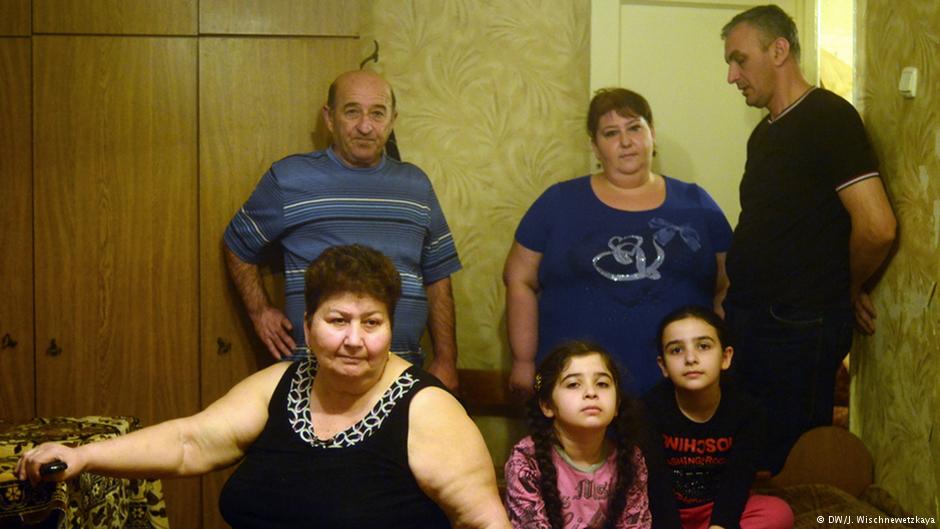
This was the problem faced by Diana Tigranyan, who moved with her family from Yerevan to Obninsk.

“At the Russian consulate in Armenia they promised us mountains of gold! No one said we would need a residence permit,” recounts Tigranyan. “But here it turned that the owners of the flat we rented were afraid to register strangers. There are firms that charge 15,000 rubles a person for this service. But I have a husband, parents, and two children. Where would I get this money?”

0,,18759230_403,00
Diana Tigranyan and family

It was not just anyone who advised Tigranyan to turn to Kotlyar, but the Federal Migration Service itself.

“The female employee who was processing my documents said, ‘I cannot help you in any way, but out in the hallway there is a woman. Try approaching her.'”

At first, Tigranyan thought Kotlyar also made money from residence permits.

“I offered her money, and she turned it down. When we told about this in court, no one believed it. But she really is a saint. She didn’t take a kopeck from us.”

Criminal case
Tatyana Kotlyar became an offender on January 1, 2014, when the so-called law on rubber flats came into force. It makes registering a person somewhere other than their place of residence a criminal offense. Criminal charges were filed in March 2014. Kotlyar was charged under Article 322.2 of the Criminal Code (“Fictitious residence registration of foreign citizens in residential accommodation in the Russian Federation”) and Article 322.3 (“Fictitious local registration of a foreign citizen in residential accommodation in the Russian Federation”). Interestingly, on the list of twelve names entered into evidence by the prosecution, there are two people whom Kotlyar has never seen herself.

“Apparently, some woman at the passport office or post office who handles registration knew about my flat and just registered some more people there, for money or as a favor.”

In recent months, Kotlyar has registered several hundred Ukrainian citizens.

“They come to see me every day. They include both refugees from hot spots and men from other regions who are threatened with being drafted into the army in Ukraine. The Russian government has promised to help, but ultimately these people face the same problem as all immigrants.”

Kotlyar is certain that the law on rubber flats violates human rights.

“This did not happen even under Stalin. Then they sentenced people to camps for residing without a passport or residence permit, but at least they didn’t punish the landlord.”

According to Kotlyar, the government is trying to fight the effect rather than the cause.

“Where there is demand, there will always be supply. The problem is not rubber flats, but the very institution of the residence permit. It should be a matter of simple notification, and its presence or absence should in no way affect the provision of civil rights.”

0,,18759231_403,00
Illarion Vasilyev, Tatyana Kotlyar’s defense attorney

She helped solved the crime
Illarion Vasilyev, Kotlyar’s attorney, understands that the human rights activist has deliberately put herself in the way of the new law to draw attention to the problem.

“Yes, it’s her civic stance. She knows she will be held liable, and she has issued a challenge,” says Vasilyev in an interview with DW. “Has she harmed anyone? Yes, she probably has. The service of legalizing compatriots costs a lot of money, and Kotlyar constitutes competition for the firms that make money on this. But the people who are questioned as prosecution witnesses at the trial bow at her feet and say thank you.”

Article 322.2 of the Criminal Code stipulates a fine of 100,000 to 500,000 rubles or imprisonment for up to three years for fictitious registration. The article, however, contains an important proviso.

“A person who commits an offense under this article shall be exempt from criminal liability if he helped solve the crime and if his actions do not constitute another crime.”

According to Vasilyev, no one has helped solve the crime as much as Kotlyar herself has.

Translated by the Russian Reader