The New Serfs

kozyrev-muscovitesPhoto by Yuri Kozyrev for the project Muscovites. Courtesy of Novaya Gazeta

The New Serfs
On July 9, Millions of Migrant Workers and Foreign Students Will Be Stripped of the Right to Freedom of Movement in Russia in a Single Bound. What Has Happened?
Vyacheslav Polovinko and Tatyana Vasilchuk
Novaya Gazeta
July 6, 2018

On June 28, Vladimir Putin signed Federal Law No. 163-FZ, which clarifies the guidelines for immigration registration in Russia. According to the amended law, such notions as a foreign national’s place of residence and the party hosting the foreign national have been defined more precisely. The majority of media outlets have described the new law as making the lives of migrant workers less burdensome, since the new law says foreign workers can be registered as dwelling in construction site trailers. This has provoked grumbling among “tolerant” Russians, who have complained migrant workers will arrive in even greater numbers and occupy all the country’s trailers.

In fact, the situation is quite different. The new rules are a blow to all law-abiding migrant workers and nearly all foreign students. Any legal entity that attempts to hire foreign nationals to work or study in Russia could find itself in violation of the law.

Even people who have all the papers and permissions for staying in Russia could be deemed lawbreakers.

The July Eighth Law
When a foreign national arrives in Russia, she is obliged to present herself to the immigration authorities and register her place of residence. However, she cannot register herself: the people or entities who invited her are obliged to do this. If she has come on a private visit, this would be the owner of the flat she has rented or the hotel where she is staying. If she has come to Russia to study, the university where she will be studying is obliged to register her. If she has come to Russia to work, the company in which she is employed must register her. (The last instance is more flexible, because her company is obliged to register her with the immigration authorities, but they may or may not register her place of residence as they wish, apparently.) Private landlords are a separate topic, but legal entities would take the easy way out. The law used to permit them to register the university or the company’s main address as a student’s or employee’s domicile. However, the foreign national could actually live somewhere else. It was understood, however, that if the police or other competent authorities were looking for her, they could do so at the address where she was officially registered.

The old system had its advantages and its shortcomings.

“There are companies that have five or six thousand foreign nationals on staff. It is convenient for them to register people at their business address to oversee whether their employees are paying for work permits and extending their residence permits on time,” says migration expert Svetlana Salamova.

The other side of the coin has to do with the poor living conditions of some foreign workers. This is most often the case among migrant workers from Central Asia.

“Employers would sometimes accommodate fifteen people at a time in trailers, in which the living conditions were rough. Besides, finding people via their legally registered domicile was often quite complicated,” explains human rights defender Andrei Babushkin.

To solve these problems, the definitions of key notions in the immigration laws have been amended. Actually, however the circumstances of migrant workers and their Russian employers have been considerably worsened, not improved. The amendments signed into law on June 28 stipulate that the place where the foreign national stays cannot be a normal domicile, but it can be other premises where the foreign national or stateless person actually resides, i.e., regularly uses for sleep and relaxation. If she is registered by a Russian organization, the foreigner must live for all intents and purposes in premises belonging to the organization. However, the premises must be equipped as a dwelling space.

In other words, if a foreign worker wants her company to register her with the authorities, she is obliged to reside full time in the company’s living accommodations.

The catch is that most legal entities simply do not having living accommodations. Construction companies will have the easiest time of it. They will now actually be able to register workers as legally residing in trailers and makeshift barracks at construction sites. All other companies have nowhere to accommodate their employees from other countries. A sofa and a microwave are not sufficient conditions for turning a room into a legal residence.

“Legally speaking, a domicile is a place that has been registered as such,” says Salamova. “An office with a sofa in it is not a domicile, but if your company lets you keep your suitcases there and install a stove and refrigerator, theoretically you could be registered as dwelling there. In this case, however, the employee from the personnel department who registers you with the Russian Interior Ministry [i.e., the police] will have to supply the immigration authorities with paperwork showing the room has been registered as a domicile.”

Will Russian companies be willing to turn their offices into bedrooms? The answer is obviously no.

Large auditing and consulting agencies, a field in which many foreign nationals are employed in Russia (not only expatriates but also graduates of Russian universities who are nationals of the former Soviet republics) have started to warn their employees about the need to look for a place where they can be registered as residing. Victoria Plotinskaya, marketing and public relations director at AT Consulting, told us that foreign employees at her company must register at their actual addresses before July 9. Previously, AT Consulting registered them at its business address, but now it is willing to provide them with legal assistance. Plotinskaya assumes their employees will have no difficulties, since registering oneself as residing in a rented flat is not a problem,  she claims.

We, however, have learned that several employees of major companies have been thinking about quitting their jobs or transferring to their home countries because their landlords have no intention of registering them.

“Companies will lose the ability to keep track of the immigration registration of their foreign national employees, while  foreign nationals who live in rented flats will have to negotiate with their landlords about registering them,” says Roman Gusev, director of Ernst & Young’s taxation and legal services department. The company does not plan to lay off any employees.

“In practice,” Gusev continues, “we see that many landlords refuse to deal with this procedure, because they don’t want the added administrative burden. In such cases, foreign nationals will have to urgently look for new accommodations. On the other hand, landlords who agree to meet the new requirements will have to keep close watch over their foreign tenants’ arrivals in the Russian Federation, since they have to be registered with immigration authorities after each such arrival.

“There are also risks for conscientious landlords. If their foreign national tenants arrive in the Russian Federation and fail to inform them, the landlords will be breaking the law without knowing it. On the other hand, foreign nationals could also find themselves in a pickle if their landlords suddenly refuse to register them with the immigration authorities or are simply unable to do what the law requires of them because they happen to be out of town,” concludes Gusev.

Unfortunately, the new rules are also retroactive, apparently, meaning everyone who is registered as residing at a business beyond July 8 will be in violation of the law come this Monday—unless, of course, they are unable to swiftly persuade their landlords to register them. In this case, however, no one can vouch that landlord will supply this service for free. Rental agreements presume that landlords pay taxes on the rent they charge. Verbal agreements to rent someone a flat and register them while not paying taxes could lead to a rise in the price of flats let to foreign nationals in Russia.

Formally, nothing has been said about the retroactive force of the amendments to the law, as signed by Putin. However, human rights activists have already been getting reports of attempts to deport migrant workers for dwelling in places where they are not registered to reside. In fact, the Interior Ministry already has the power to deport a non-Russian national if an inspector discovers him somewhere other than his registered domicile, say, at another flat in the evening.

This was what happened to Uzbek nationals in Omsk Region, says human rights activist Valentina Chupik. The Uzbeks went to a immigration center with registration papers obtained from a middleman, and they were sent off to be deported, allegedly because they did not live at their registered domicile.

In other words, under the new law, migrant workers no longer have the right to spend the night somewhere other than their legally registered, actual residence.

Under Article 54 of the Russian Constitution, laws cannot be applied retroactively. This was underscored by the specialists at Alliance Legal Migration, a firm based in Petersburg. In theory, then, all registrations issued before July 8 should be valid for their full terms. This can be proven only in court, however. Yet Russian courts rarely side with migrant workers.

Dormitory Hostages
Foreign nationals employed by Russian companies are only half of the problem. If push comes to shove, they can pay landlords extra money to register them. All foreign students in Russia are now at risk as well. Previously, universities would register their main buildings as the legal domiciles of their foreign students, but now they will be obliged to register all of them in university dormitories. However, the number of rooms in the dorms does not match the number of foreign students, and out-of-town Russian students have to live in dorms as well. Besides, there are students who do not want to live in dorms and can rent flats, students who have children, for example. Previously, they could count on their universities registering them, but now they will have to take care of their own registration.

The new law also applies to students who left for summer holidays not knowing they would return to Russia in the autumn on new terms. In addition, students who are registered in dorms are virtually their hostages.

Any violation of university regulations or, for example, attendance at an opposition rally gives university deans the chance to opportunity to revoke the registration of “troublesome” foreign students, which automatically means they are in violation of immigration laws and can be deported. Considering the fact that many international students have never experienced serfdom, they behave like free women and men. Their freedom will now be harshly restricted by the hours when the dorm’s main entrance closes.

Universities themselves seemingly have not yet figured out yet what they are going to do. The new rules have been a big surprise to most of them. The main issue they face is how they will now enroll international students if registering all of them legally has become impossible.

The Peoples’ Friendship University of Russia (RUDN) refused to comment on the amended rules. We were told by a spokesperson at the Higher School of Economics (HSE) that they were in the process of working out a way of dealing with the new rules. However, we have in our possession correspondence between students and the HSE’s immigration department, who categorically informed the students they could be registered only at their actual places of residence.

At Moscow State University (MGU), we were told, “The issues of timely migration registration and visa extensions for foreign students residing in rented flats is currently being examined by university management in order to find the optimal solution.”

“The university has not contemplated any limitations to enrolling foreign students due to the adoption of Federal Law No. 163-FZ, dated June 27, 2018,” a MGU spokesperson added.

Other universities failed to respond to our inquiries before this issue of the newspaper was sent to the presses.

“If a university does not have a dormitory or does not have enough room in its dormitories, students can ask for a written request from the university to landlords, asking them to register the students at their actual domiciles. And then the landlords can register them if they want to do so,” explains Salamova.

Closely Watched Flats
You should not imagine that all of the above is a headache for foreigners, but has nothing to do with you.

According to the new rules, Russian nationals who let flats to foreign nationals are automatically regarded as “hosts,” meaning they are obliged to register them as residing in their dwellings and are responsible for them.

“There will also be increased check-ups and fines in the case of noncompliance with the laws for people who let flats to foreigners,” predicts Salamova.

In all fairness, such fines also existed earlier, but they were almost never issued. We have been informed that as soon as the World Cup ends, the police will make an extra effort to inspect all residential buildings and search for unregistered foreigners living in them.

Moreover, Russians are currently responsible for foreign nationals, even if they have left the country but their immigration registration is still valid. A law bill, sponsored by Irina Yarovaya and on the verge of its second reading, has been tabled in the State Duma. If passed, it would make it possible to remove foreigners from the immigration registry instantly and on one’s own via the web. This means landlords would also be able to remove tenants from the registry whenever they wanted, claiming, for example, that they had lost touch with the migrant workers in question. Foreign tenants would thus be subject to the whims of landlords, who could raise their rent at the drop of a hat, threatening to remove them from the immigration registry if they failed to pay. Besides, if a migrant worker does not live in the flat where she is officially registered, she can find herself without papers at any minute because, according to yet another amendment, she can be stricken from the rolls as residing in a particular flat without her knowledge. This means that beat cops can stop her on the street and automatically fine and deport her.

In mid June, the State Duma approved yet another law bill in its second reading. If passed, it would make organizations that invite foreigners to Russia wholly responsible for their actions. For example, if a foreign national works somewhere else than the organization that invited him or “is up to no good,” as MP Viktor Karamyshev has put it, the authorities will pay a call to the foreigner’s primary host organization. In addition, companies would have to make sure that when an employment contract ends, the migrant worker leaves the country instantly. Otherwise, the companies would be fined.

At the same time, the State Duma approved a new list of fines for noncompliance with all these rules on the part of organizations and ordinary Russians.

Under the new regulations in the Administrative Offenses Code, individuals will pay fines of up to 4,000 rubles for violations involving migrant workers, while officials will pays up to 50,000 rubles, and legal entities will pay up to 500,000 rubles [approx. 6,700 euros].

Beneficiaries  
By and large, the batch of laws that have been adopted or are still under consideration (the Interior Ministry, for example, has launched an expert group to draft a Migration Code) should at least be sent back to the relevant committee for revision, since, as Babushkin says, “The harm they do outweighs the good.” But the way the new rules have been drafted and adopted behind the scenes—they did not warrant a single public hearing nor, as far we have ascertained, did their authors consult with independent migration lawyers—suggests their oppressiveness is advantageous as they currently stand.

Who stands to gain, however? MP Irina Yarovaya, for example, argues that certain changes, such as the ability to remove migrant workers from the registration rolls on one’s own, are in the interests of ordinary Russians. She states her case in a clarification to the law bill that the MP’s aides sent to us in reply to a request for comments. On the contrary, human rights activists argue the Interior Ministry, which now has complete oversight over immigration, has received yet another tool for extorting bribes. Any migrant worker can be stopped on the street by the police and threatened with deportation: he will find it easier to pay them off. Any landlord can be intimidated with fines.

The threat of deportation is a convenient tool for dealing with troublesome individuals.

Our newspaper published the story of Gulchekhra Aliyeva and her family. She and her son were locked up for five days without food and water at the Ramenki District Police Station in Moscow. They were let out of their cells twice a day to go to the toilet. According to the Aliyevs and human rights advocates, the police tried to extort them, promising to deport them if they did not pay up. The ostensible cause was the tightening of security on the eve of the World Cup. After human right defenders intervened, the Aliyevs were released, and a criminal investigation into allegations of torture was launched.

“However, when the Aliyevs were summoned for questioning, it transpired  the police planned to deport them for being registered at their place of work rather than where they actually lived,” says Chupik.

Moreover, this happened before the new law had taken effect.

“We basically saved them by escaping the police station,” recalls Chupik.

The special services also stand to benefit from the new law. As we have learned from a source with ties to the academic world, special services officers have connections to the immigration departments in several Russian universities.

This is tantamount to reviving the Soviet system of “working” with international students at universities. Given that they inevitably violate the rules, they can be inclined to “friendship” and “cooperation” when necessary.

Besides, foreigners per se will now be unable to take the slightest step in Russia without official registration. Nationals of our allies Kyrgyzstan and Kazakhstan will also be punished, but that is collateral damage.

Finally, fly-by-night fake migration registrars stand to gain from the law, since their entire business will disappear into the shadow economy. Even now, migrant workers who travel to the Multi-Purpose Migration Center (MMTs) in Sakharovo, in the far southern outskirts of Moscow, cannot have their domiciles registered while other papers are being processed, including their work permits. Human rights activists say the MMTs has lost this right due to the new law.

“Everyone mobs Kazan Station, getting registered by people who give them counterfeit papers,” claims Chupik.

As far as we know, the neighborhood around the Kazan Railway Station, in central Moscow, has the largest number of people offering such dubious services. Moreover, these deals are made more or less in plain view of law enforcement officers, who do nothing about them: maybe they know something important we do not know or know more thane we. The price of counterfeit registration papers is between seven and eight thousand rubles [approx. 95 to 110 euros], a hefty sum of money for migrant workers.

The Interior Ministry stubbornly persists in saying nothing about how the new law will be enforced: it has not published any official clarifications. We have sent the ministry a request to comment, but when this newspaper went to the print, the ministry had not yet responded.

Thanks to Sergey Abashin for the heads-up. Translated by the Russian Reader

“The Presidency Is a Monarchist Atavism”: Sevastopol Security Forces Crack Down on Local Anarchists

Balaklava Bay, Sevastopol

Sevastopol Security Services Search Homes of Leftist Activists Planning Rally Calling for Presidential Election Boycott
Mediazona
1 March 2018

Security services showed up at the flat of the Vorobyov family in Sevastopol, members of the VK community group Anarchists of Sevestapol, activist Alyona Vorobyova has reported to OVD Info. According to Vorobyova, she and Artyom Vorobyov were not home when the search took place. Only their seven-year-old child and relatives were at the flat. It is not known which Russian security service conducted the search and in connection with what case.

Another Sevastopol activist told Mediazona a search was also probably underway at the home of anarchist Alexei Shestakovich: a large number of police officers had gathered outside his house. The activist surmised searches could also be underway at the homes of the Anarchists of Sevastopol group’s admin, Alexei Prisyazhnyuk, and leftist activist Igor Panyuta. The two men were currently incommunicado.

Shestakovich, Prisyazhnyuk, and Panyuta had planned today to submit a notification for a protest rally calling for a boycott of the March 18 Russian presidential election. The rally was to be entitled “The Presidency Is a Monarchist Atavism,” said Mediazona‘s source.

Shestakovich announced plans to submit the notification on the Anarchists of Sevastopol VK page.

“The event’s aim is to remind people of their constitutional right not to take part in election, to inform the populace about the rules for conducting a robust boycott, and to have a public discussion of self-government in society,” he wrote.

In addition, the local online news website Krymskie Novosti reported that Republic of Crimea Center “E” and FSB officers carried out a “mopping up of the republic’s anarchist cell.” As the website’s sources reported, searches had been carried out today at the homes of the cell’s leaders and members both in the Republic of Crimea and and the Federal City of Sevastopol.

“According to available information, this group of people planned provocations during the Russian federal presidential election, scheduled for 18 March 2018,” wrote Crimean news website Informer.

Informer claimed the Crimean cell had “kept in touch” with other radical leftist groups operating in Russia. Without identifying its sources, Informer also claimed the Crimean anarchists were financed by persons residing in Ukraine.

Update. OVD Info writes that masked men armed with machine guns came to the home of Anarchists of Sevastopol admin Alexei Prisyazhnyuk, confiscated his computer equipment, and took him to a police station. Mediazona has also been informed of a police search at the home of activist Ivan Markov.

Translated by the Russian Reader. This article has been lightly edited to eliminate several minor errors regarding local media sources. Thanks to Egor Skovoroda for the heads-up. Photo courtesy of Wikipedia

Solidarity with Persecuted Russian Antifascists and Anarchists in NYC and Minneapolis

27540850_322877634890103_3528138355329883641_n

Metropolitan Anarchist Coordinating Council – MACC
As part of the week of solidarity with Russian anarchist political prisoners there will be a demo at the Russian Consulate, 91st Street, today, February 7, 2:30 PM–4:00 PM.

#Antifa #Antifascism

More information on the recent arrest and torture of anarchist and antifascist political prisoners here:

https://freedomnews.org.uk/russia-arrests-and-torture-of-anarchists-and-antifascists/

•••••••••••

Solidarity with Russian Anarchists
The Base
1302 Myrtle Avenue, Brooklyn, New York 11221
7 PM–10 PM, February 8, 2018

Six anarchists have been arrested in Penza, Saint Petersburg, and Crimea, from October 2017 to February 2018, by officers of the Russian Federal Security Service (FSB) on charges of involvement in a terrorist group. During this period, there have been raids on the homes of anarchists and antifascist all over Russia. The arrested anarchists have been tortured into falsely confessing their involvement in the imaginary network. This is clearly a state-fabricated conspiracy being used to eradicate the anarchist movement.

As the support team says, “These repressions can only intimidate people and crush the anarchist movement. In this case it’s necessary to show that we are not afraid and we can’t be destroyed by their force. Otherwise, the repressions will be used every time when the anarchist movement attracts the notice of the FSB. We must show them that the stronger their crackdowns are, the more furious our resistance is.”

We are hosting a movie and information session about the broader anarchist and antifascist movement in Russia, and talking in more detail about this particular case.

About the movie
Antifascist Attitude is the first-ever documentary film on the emerging Russian antifascist movement made by activists themselves. The movie features moderate NGO activists and radical grassroots activists and anarchists from three cities: Moscow, St. Petersburg, and Irkutsk. It also features the antifascist lawyer Stanislav Markelov, murdered by neo-Nazis in Moscow on January 19, 2009.

Come and learn about what’s happening and ways to support our comrades in Russia!

•••••••••••

Solidarity Dinner with Russian Antifascists
Twin Cities IWW General Defense Committee Local 14
5:30–8:00 p.m., Saturday, February 17, 2018
2101 Hennepin Ave, Minneapolis, MN, United States

Join the General Defense Committee for a dinner, discussion, and letter writing to support antifascists targeted by the FSB crackdowns in Penza and St Petersburg.

The far right rises in the US, in Russia, and across the world, attacking oppressed peoples, immigrants, and working class revolutionaries. Antifascists are fighting against nationalist hate across borders, and facing attacks from the ruling class’s governments. In Russia, the FSB (Federal Security Service) are hard at work arresting, torturing, and framing antifascist activists in Penza, St. Petersburg, and elsewhere.

The Anarchist Black Cross in Moscow and St. Petersburg has asked for international solidarity with the Russian anarchists facing repression. We will be holding a dinner in the IWW offices at 2101 Hennepin Avenue South, Suite 101, Minneapolis, on Saturday, February 17, 2018, from 5:30 p.m. to 8:00 p.m.

We’ll discuss the situation in Russia as well as the repression faced by anarchists in Belarus, Ukraine, and other countries. We’ll collect donations, provide a space for letter writing to the defendants, and facilitate discussion on further international solidarity work with political prisoners, labor organizers, and anti-authoritarians.

https://libcom.org/news/support-anarchist-antifa-prisoners-stpetersburg-penza-31012018

https://itsgoingdown.org/call-international-days-solidarity-russian-anarchist-political-prisoners-feb-5th-12th-2018/

https://avtonom.org/en/news/how-stability-has-really-been-achieved-russia

Offside: Number of Migrant Workers in Petersburg to Be Reduced Ahead of World Cup

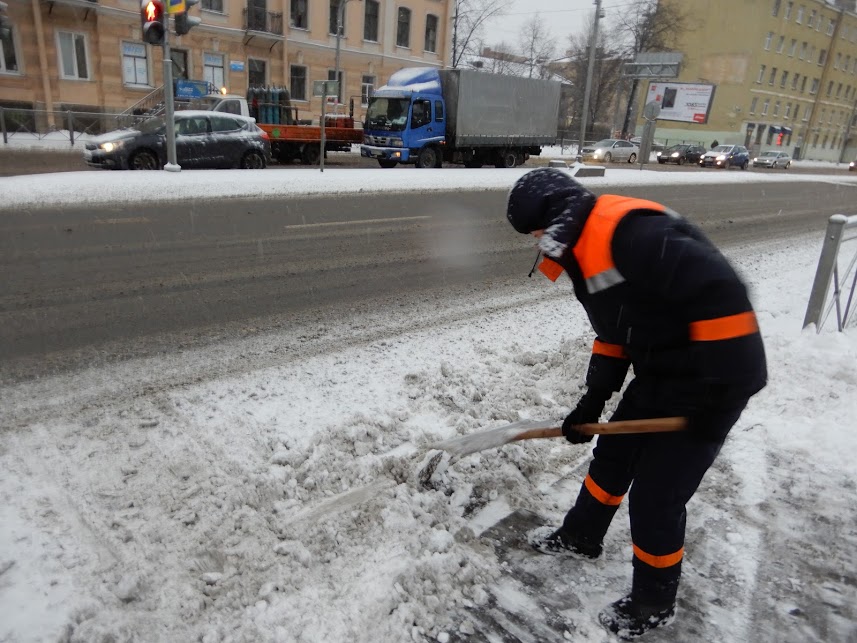
DSCN2000A migrant worker shovels snow and ice in central Petersburg, December 21, 2017

Offside: Number of Migrant Workers in Petersburg to be Reduced Ahead of World Cup
Yelena Dombrova and Marina Vasilyeva
Delovoi Peterburg
January 11, 2018

Petersburg is preparing for the World Cup by tightening the residence rules for migrant workers. New federal laws could prevent restoring the flow of migrant workers, without whom the city’s economy is still unable to manage.

This year might prove critical for migrant laborers working in Petersburg. The flow of workers from other countries, which had picked up again last year after devaluation of the ruble, will be subject this year to legal restrictions, including restrictions occasioned by the World Cup.

Petersburg is one of the Russian cities where, from May 25 to July 25, 2018, the registration of foreigners at place of stay or place of residence will be executed within twenty-four hours from the date of arrival, rather than within seven days, as now. Such measures are stipulated by Presidential Decree No. 202, dated May 9, 2017, says Olga Duchenko, senior lawyer in the corporate and arbitration department at the firm Kachkin and Partners. People who violate the law in Petersburg will face fines between 5,000 rubles and 7,000 rubles [between 70 and 100 euros, approximately]. Foreigners can also be expelled from Russia.

The World Cup will be held in Russia between June 14 and July 15 of this year. The matches will be played at twelve stadiums in eleven Russian cities, including Petersburg. Our city will host matches between Morocco and Iran (June 15), Russia and Egypt (June 19), Brazil and Costa Rica (June 22), and Argentina and Nigeria (June 26). In addition, the city will host a second round match, a semi-finals match, and the third-place match.

This year, a number of laws on the registration of migrant workers will be tightened. The Russian parliament is thus currently discussing a law bill, now at the amendments stage, that would toughen criminal liability for fictitious registration of a foreigner or stateless person, says Duchenko. At the preliminary review stage are changes to the law on immigrant registration that would permit employers to cancel the registration of dismissed migrant workers.

The Recovery Will Become More Difficult
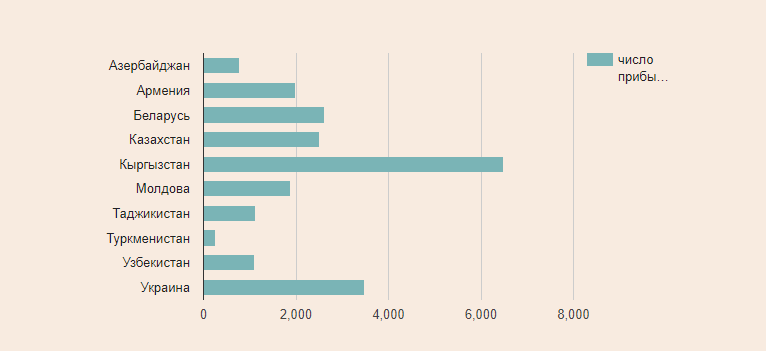
The number of migrant workers in Petersburg grew last year Thus, Petrostat, which relies on place of stay and place of residence registration data, has reported on the first nine months of 2017. 22,300 migrant workers from the CIS countries registered in Petersburg during this period, which is 71.5% more than during the same period the previous year. 10,300 migrant workers left the city, which is 20% fewer than the previous year.

Influx of Migrant Workers from CIS Countries to Petersburg, January–September 2017 

migration flows graphic-dp
The list of countries is as follows: Azerbaijan, Armenia, Belarus, Kazakhstan, Kyrgyzstan, Moldova, Tajikistan, Turkmenistan, Uzbekistan, and Ukraine. Courtesy of Petrostat and Delovoi Peterburg

This year’s figures could prove to be exactly the opposite. Russia has already reduced the quota for temporary registrations issued by nearly 20% compared with 2017. Only 90,400 permits are planned for 2018. The reduction has affected the Northwestern Federal District as well.  The quota for obtaining temporary residence permits in 2018 will be 6,600 permits, as opposed to 9,300 permits in 2017. This is the most noticeable decline in recent years. In 2016, the quota was 10,000 permits; in 2015, it was 11,100 permits.

Nevertheless, a shortage of workers in Petersburg and Leningrad Region is not anticipated [sic].

“The overall number of migrant workers never exceeded five percent in the Losevo Group of Companies,” says Valeriya Ivanova, a development specialist with Losevo. “They are most employed at the dairy and on the farms as unskilled workers in accordance with immigration law.”

Ivanova stresses the group’s main production facility is located in Leningrad Region, far from Petersburg. Therefore, Losevo’s management is keen on employing local residents, i.e., the residents of the town of Svetogorsk and the village of Losevo, in the region’s Vyborg District.

Fire Them Just in Case
Changes to quotas could prove more palpable in the Petersburg labor market. Now, according to Russian Federal Government Decree No. 1467, as of January 1, 2018, employers can hire no more than 15% foreigners to work in retail alcohol and tobacco shops, and no more than 28% in companies engaged in passenger and freight transportation. As of January 1, migrant workers are forbidden to work in street trading and produce markets altogether. The proprietor, in possession of a license, should be the only person behind the counter.

“On the other hand, the quota for migrant workers in agriculture has been raised to fifty percent of jobs,” notes Chermen Dzotov, founder of the legal firm Dzotov and Partners.

Yuri Ragulin, owner of a chain of trading pavilions, is indignant.

“What is this? Tolerance or something? The fact is that, historically, Azeris have worked in the vegetable trade, for example. Why clamp down on this? What does it do for us? People have been in the business for eleven generations, they know what they’re doing. What I don’t understand is how I’m going to go out tomorrow and sell vegetables by myself.”

Ragulin believes that quotas in the retail trade will cause many people to go underground, leading to an increase in expenses, including bribes, and this will be reflected in the prices of goods.

“As for the World Cup, first, it lasts a month, and second, I have no clue why my shop at the train station in Zelenogorsk, for example, should be affected by the World Cup,” Ragulin concludes.

Petersburg human rights activists who deal with migrant workers note that many city policemen know how to say “Pay me 5,000 rubles” in Uzbek.

Ashot Efendiyev, owner of Monolith LLC, says that hiring foreigners to work behind the counter of a shop, market stall or kiosk has already been forbidden since May 2013.

“We don’t do it, because it’s simple dangerous. The fines run as high as 800,000 rubles [approx. 12,000 euros],” says Efendiyev. “The ban deals specifically with retail trade work behind a counter. If a person has a license, he can be hired for other work. So we have employed foreign electricians and stevedores. But now I’ve fired them just in case.”

Our sources in private universities that enroll foreigners say document checks of migrant workers have become more frequent. Paid enrollment is one way migrant workers from the near abroad use to stay in Russia legally.

“I think everyone will be expelled now, and our center will soon be shut down altogether,” says a female employee at one such university.

She says their students have always attended classes irregularly, but document checks began in the last several months, and the university administration has started expelling students who have missed several lectures in a row.

Photo and translation by the Russian Reader

Impotent

DSCN1619

And [Putin] just stands there and watches them destroy each other, and doesn’t interfere. Because then, on the one hand, he gets to maintain his position above the fray and watch all these ministries mutually weaken each other and become incapable of monopolizing power (which he’s afraid of). But on the other hand, he’s afraid even to give an order, because he senses that his orders have no weight anymore, that he can’t do anything. It’s a hideous situation, and as a result everyone turns into these trembling slaves who have no idea what will befall them, because there’s no one to appeal to, there’s no ordering principle to appeal to anymore. There’s no law, Putin is absolutely impotent, he can’t do anything.

I am sorry for writing what I am about to write, because I have a decent amount of admiration for the man who wrote the passage I have quoted, above, but if there is anything nuttier than thinking that Putin (or any other dictator) is absolutely powerful, it is thinking that Putin has no power at all.

The “impotency” heresy seems to be all the rage these days, because Putin was, allegedly, persuaded by his ex-finance minister and ex-Petersburg city hall colleague Alexei Kudrin to write not one but three official letters telling whoever has been hassling the European University at St. Petersburg to back off and leave it alone, and all three times these sinister forces (whom no one has yet properly identified, because no one believes federal education watchdog Rosobrnadzor and the courts could arrange this sick nine-ring circus on their own) willfully ignored Putin’s instructions.

The explanation, given by Fontanka.ru investigative reporter Irina Tumakova in the latest edition of Novaya Gazeta v Petersburge—that the mess kicked off due to four complaints filed with the prosecutor’s office against the university by non-entities who now cannot even remember why they filed the complaints and have lost all the paperwork—may be factually true, but it will have the effect of reinforcing the “impotency” camp’s convictions.

In reality, there are as many ways to exercise power as there are ways to be impotent, and so it is easy to confuse the two, especially if you are naive enough to believe that when Vladimir Putin says or writes something, he always means what he says or writes.

Let’s suppose Putin really is not averse to handing over the two mansions on the corner of Gagarin Street and the Kutuzov Embankment to his arch-crony Gennady Timchenko or whomever else Tumakova mentions in her article, and, in the process, getting rid of the European University, towards which he, plausibly, only feels antipathy, since in the past it was involved in using European Union funds to study election monitoring, something Putin, who has stayed in power this long only by rigging elections on a massive scale, would hardly approve.

(Putin even publicly said as much at the time, in late 2007 or early 2008, and soon afterwards, fire inspectors showed up at the European University and shut it down for two months.  It was reopened after a loud, noisy, vigorous public campaign by its faculty, its students, and its numerous supporters in the local and international community. I took part in that campaign.)

More generally, the Putin regime has been engaged in a long-term, deliberate program of clamping down on any and all independent forces and entities in Russia, from small and medium businesses and NGOs of all stripes (even ones not mixed up in politics and without financial or other connections to foreign partners) to independent religious groups (e.g., the Jehovah’s Witnesses) and independent educational institutions such as the European University. Unsurprisingly for a regime chockablock with “former KGB officers” at all levels and led by another “former KGB officer,” it has increasingly come to regard everyone trying to operate beyond the Russian government’s overweening oversight as extremely suspicious at best, “national traitors,” at worst.

Putin could make large numbers of people loathe him more than they already do by openly issuing a decree closing the European University and turning over its building and the neighboring building to his buddy Timchenko. Or he could play it smart and make clear through all the hundreds of channels he has at his disposal that he wants to shut down the university and hand over the building to Timchenko, all the while feigning to Kudrin and his liberal fans that he is worried enough about that fine little university to write the “back off” letters Kudrin asked him to write.

But the fix is already in, because Rosobrnadzor, the courts, Timchenko, and everyone else who needs to know, know that Putin’s letters of “support” for the university are meant to be roundly ignored. They know this because he has somehow indicated they should ignore them. How he did this exactly is immaterial and, ultimately, uninteresting.

So, in reality, this is yet another example of Putin’s exercising his rather considerable power, not evidence of his impotence. Of course, like any reasonably smart dictator or just plain leader, he wants to appear to be above the fray, but that does not mean he really is above the fray. He is right in the midst of it, whatever “it” is: making peace among the made men in his mafia empire, awarding them for their loyalty, slapping them on the wrists for their lapses, and adjudicating their conflicts between each other as they arise.

A real example of impotence are tenured and celebrated academics who persuade themselves, after being suckered by one of the oldest cons and mythologemes in Russian history (the powerless tsar surrounded by perfidious boyars), that since the allegedly powerful Putin is, in fact, impotent, they can be excused from empowering themselves and their students, and mobilizing them and the rather large community of people in Petersburg and around the world who are sympathetic to the European University to fight the power and get the university’s full rights as a research and teaching institution reinstated, while also forcing the powers that be to have the university’s grand old building restored to it and let it go ahead with renovating the building, as the university had carefully been preparing to do for several years.

That would be a real cause to rally round, but instead we have been treated, in turn, to long bouts of radio silence, various implausible conspiracy theories, and self-defeating disempowerment sessions, disguised as the worldly-wise acceptance of defeat and the lowly station of academics in Russian life.

But we have not seen the slightest hint of a coherent, militant public campaign to save the university, most of whose seemingly feeble supporters have the temerity to call it the “best in Russia.”

If it is really the best, it should be worth fighting tooth and nail for, no? Even and especially if you think the emperor has no clothes. ||| TRR

Photo by the Russian Reader

Russia’s Bright Future (Putin 4.0)

Member of HRC Describes Putin’s New Term: Everything Under the Sun Will Be Banned
Alexei Obukhov
Moskovsky Komsomolets
October 10, 2017

Pavel Chikov argues Russia will become isolated internationally, and federalism and regional economies will be jettisoned.

Pavel Chikov, a member of the Russian Presidential Human Rights Council, has forecast what politics in Russia will be like if Vladimir Putin is re-elected to another term. According to Chikov, the situation in the country will deteriorate rapidly, and more and more areas of public life will be off limits.

1a1bb3f8a345889fc79a754c4ae35c6dPavel Chikov. Photo courtesy of Facebook/MK

Foreign mass media will be the first to be banned. This has been borne out, says the human rights activist, by the threat to shutter Radio Svoboda, which the media outlet received from the Justice Ministry last Monday.

Following the media, “the political arena will be mopped up: the current persecution of Alexei Navalny’s employees and Open Russia’s employees is a harbinger of this.”

In Chikov’s opinion, the country will also be stripped of religious freedom, as witnessed by “the huge criminal cases against and expulsion from the country” of members of various non-traditional religious movements, from Jehovah’s Witnesses, who have been declared “extremist” banned in the Russian Federation, to supporters of non-mainstream Buddhist and Muslim groups.

These measures, writes the human rights activist on his Telegram channel, will be paralleled by Russia’s renunciation of its international commitments. It will exit the Council of Europe and end its cooperation with the European Court of Human Rights. (Valentina Matviyenko, speaker of the Federation Council, said yesterday this was a probable scenario.) Russian’s relations with many European countries, from the Baltic states to Germany, will deteriorate, and their embassies will be closed. Restrictions will be placed on Russian nationals traveling outside the country, and the practice of stripping refugees and asylum seekers of their Russian citizenship and confiscating their property will be broadened.

Meanwhile, Russia will succeed in isolating its segment of the Internet and instituting a Chinese-style firewall to censor content.

Finally, Chikov writes, the country’s economy and domestic politics will deteriorate. The regions will lose the last remnants of their autonomy (Chikhov cites Vladimir Vasilyev’s  recent appointment as acting head of Dagestan, although the United Russia MP has no experience in the republic), and the assets the regions have left will be placed under the control of Putin’s inner circle.

Translated by the Russian Reader. Thanks to Vasily Zharkov for the heads-up

Alexei Malobrodsky: Speech in Court

21314625_10210167764566670_399178550936906940_n
Alexei Malobrodsky, former director of Moscow’s Gogol Center theater, in Moscow City Court on September 6.

Zhanna Zaretskaya
Facebook
September 6, 2017

Alexei Malobrodsky is awesome. I am speechless. He is tough as nails.

What follows is the speech Malobrodsky made in Moscow City Court on September 6, 2017. Everyone who considers himself or herself a decent person in this fucked-up country, which destroys the best people and supports thieves and scoundrels, should read this.

“Today is the seventh court hearing in which I have taken part. Your honor, honor has a place in court. All parties to the proceedings should be guided by the law. So the police investigators should follow these rules. How long can they make do with false accusations and false facts? The team of investigators has been mocking the law. They have not carried out any investigative actions. They have only been busy with lies and intimidation. I refuse to take part in any investigative actions in handcuffs. I have a right to be treated decently and presumed innocent. When the investigators suggest I ‘confess to something or other,’ I refuse to reply. Except for the ridiculous story about [Gogol Center’s production of] Midsummer Night’s Dream, I have not been suspected of anything. I have been denied visits from and communication with my wife; my property has been arrested, our things and dishes; my and my wife’s work and home computers have been confiscated. What is this, if not coercion? I am ready to cooperate with the investigators and answer their questions, but don’t force me to bear false witness against my colleagues.”

Over thirty people agreed to stand surety for Alexei Malobrodsky, including Chulpan Khamatova, Lev Rubinstein, Vladimir Mirzoyev, Vasily Sigarev, Andrei Moguchy, Marina Davydova, Elena Koreneva, Ksenia Larina, and Yevgenia Shermeneva. But he was left behind bars.

I ask you to repost this text and Alexei’s speech so that as many people as possible find about Alexei Malobrodsky, who has been behind bars since June 21, although no charges have been filed against him.

Thanks to Comrade AK for the heads-up. Translated by the Russian Reader

Ekaterina Prokopovich: Independence Day

19030354_10209358320303527_3194052814088911328_n
Vadim F. Lurie, from the series “Russia Day in Petersburg,” June 12, 2017

Ekaterina Prokopovich
July 4, 2017
Saint Petersburg, Russia
Facebook

I finally must tell you about the events of June 12. Otherwise, I will lose their thread altogether.

Navalny announced another round of anti-corruption rallies nationwide. The first rallies were on March 26. I wrote about it. I was detained at the rally [in Petersburg]. I was also detained during a rally on April 29. I wrote about that as well. You all know I have a ton of gripes against Navalny, but I think it’s important to demonstrate publicly.

On June 12, my son and I arrived at the Field of Mars. We walked several meters. There were a lot fewer people than in March. Somewhere, people were shouting, “Russia will be free!” and stuff like that. I saw the Russian National Guard lining up. I said to my son, “Let’s get the heck out of here.” I really did not want to get arrested again. We turned around and were leaving. I suddenly saw that the Russian National Guard had kettled us. That was all she wrote.

People next to me asked what was happening. I told them I’d been through it before. I said we would be taken to different police precincts, charged with violating Article 20.2 of the Administrative Offenses Code (“violating the rules for holding a public event”), and go home late in the evening. I said that, by law, the police had three hours to do this, but they violate the law. What I didn’t realize then was that our arrest would last not three hours, but several days.

Now I understand we should have broken out of the kettle and left. We cannot let them treat us like sheep and illegally detain us. I had already talked to people who had managed to break through another kettle and with a man who had given the slip to a Russian National Guardsman who had grabbed him. That’s the way to do it.

Skipping ahead, I’ll say that a young man who interrogated me about what would happen to us, a young man who had come to the Field of Mars simply to hang out, was sentenced to fourteen days in jail. Everyone got the same sentence, no matter why they were there.

We were thrown onto buses and taken to police precincts. Once there, we were initially charged with violating Article 20.2, but in the evening, the police got orders to charge us with violating Article 19.3 (“disobeying a police officer’s lawful request”) as well. We know this, because the police dicussed it in front of us. One female officer was even outraged. “Why charge them with 19.3?” she wondered. The precinct deputy commander replied, “Do I need to explain why? Let’s go and I’ll explain it to you!” So we spent the night in a cell. We were taken to court only in the evening of the next day. Personally, I was convicted and sentenced in the dead of the night, around two in the morning. The women generally got five days in the slammer. For some reason, I got seven. On the other hand, I’m a recidivist. My son got a lighter sentence: his defender, Yevgeny Pirozhkov, argued his case for several hours, trying to get him off. In short, the district courts were operating round the clock. Around six hundred people were detained. Around two hundred or so were sent to the slammer. The temporary detention center could not have handled any more. Everyone’s charge sheets were identical down to the last comma. The police faked the charge sheets, and the judges had gotten word from up top that people should be sent to jail for several days based on the trumped-up charge sheets.

We were taken to the temporary detention center twice. The first time was on June 14 at six in the morning. We waited, but they had run out of mattresses. We were shipped back to the precinct. They brought us back in the afternoon and put us in our cells in the evening.

In short, they tormented us for two days, but everything was decent at the detention center, both in terms of the staff and the conditions. I have no gripes against the detention center. I’ll write about it separately, because this text is too long as it is.

Translated by the Russian Reader. Thanks to Alexei Kouprianov for the heads-up. Please read my other postings on the events of June 12 and their horrendous (il)legal aftermath:


Grassroots Recycling as a Threat to Russian National Security and International Football

confedcup-31_sm

Football fans! You might want to know that this past Saturday, the monthly neighborhood collections of recyclables, organized by the Razdelnyi Sbor environmental movement, an entirely volunteer-run organization, were cancelled, apparently by the police or higher powers, in four of Petersburg’s districts (Central, Admiralty, Krasnoye Selo, and Kalinin), allegedly, because they were a “security threat” to the ongoing FIFA Confederations Cup.

Ironically, this same grassroots movement, which poses such a (non-)threat to national security in neighborhoods many kilometers away from the brand-new stadium on Krestovsky Island where some of the cup’s matches are being played, including the final—a stadium that was built at the cost of unbelievable cost overruns (i.e., kickbacks) and completion delays, precarious migrant labor (including slave laborers shipped in from North Korea, one of whom was killed in an accident on the site), and the demolition of the old Kirov Stadium, a nationally listed architectural landmark designed by the great constructivist architect Alexander Nikolsky—made a deal with cup organizers and FIFA to collect and process recyclable waste at the stadium after matches.

Meaning that, at the stadium itself, this same grassroots movement was seen not as a threat, but as a cynical means of showing fans that FIFA and the Russian government were all about “international best practices.”

This is a ridiculous, telltale story that someone other than lowly unread me and my crap blog should be reporting.

By the way, under normal circumstances, readers of my Facebook news feed would have got a message from Razdelnyi Sbor about Saturday’s collection points, a message I cut and paste and disseminate faithfully every month, because I want everyone I know to go the one-day collection points in their neighborhood with their recyclables, and because my partner and I go to our neighborhood spot in the Central District every month ourselves.

Last year, I even bought a Razdelnyi Sbor t-shirt, to support the cause and occasionally serve as a living, breathing, walking, talking advertisement for it.

I guess I’ll have to think hard about whether I want to wear the t-shirt again. I don’t understand how you can serve the authorities at their Big Event while letting down the ordinary people who support you in their neighborhoods with their volunteer labor and their recycling month in and month out.

A friend of mine was arguing on Facebook just yesterday that VK, the homegrown Russian social media where Razdelnyi Sbor has its community page, was where it was at, as opposed to snobby Facebook. But in the relevant recent posts on Razdelnyi Sbor’s VK page about the cancelled collections you won’t find word one criticizing the authorities for acting in such a brutal, stupid way towards a completely beneficial grassroots campaign. I would imagine the page’s moderators hastily scrubbed any such complaints, if there were any. I’m sure there were some.

This is the real Russia, about which I almost never read anything in the western media and, sometimes, in the Russian media, either. It’s a country where recycling enthusiasts (just like cycling enthusiasts, for that matter) are imagined as a threat to national security and as “agents of the west,” except in the one instance where they can make the authoritarian state’s Big Event seem more PC to foreign football fans, dishing out big euros for tickets, merchandise, food and drinks, and rooms. TRR

A huge thanks to Comrade Darya A. for the heads-up. Photo courtesy of Razdelnyi Sbor’s website

Read more on this topic:

Showdown in Kazan between Officials and Angry Depositors

tatfondbank
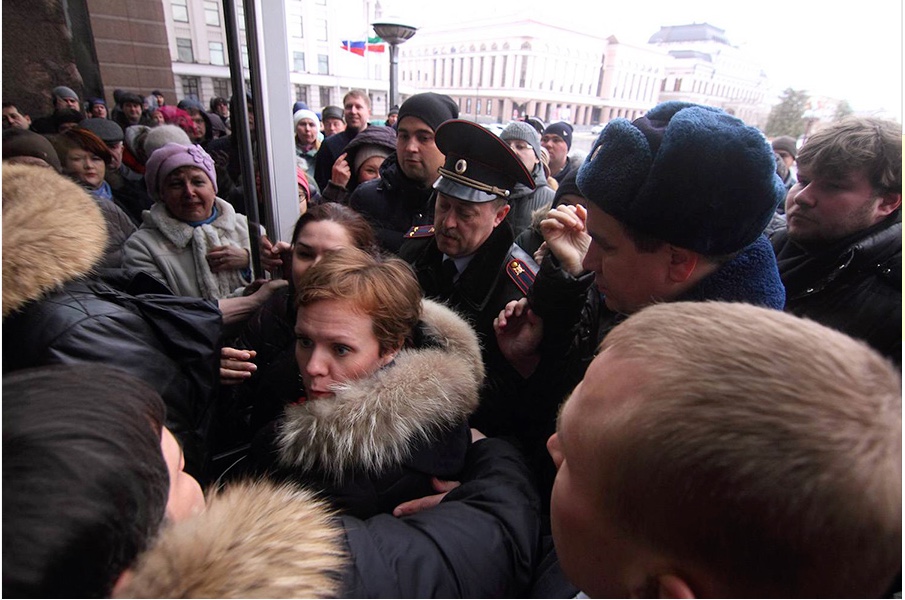
Photo courtesy of Mikhail Zakharov/Kazansky Reporter

Tatfondbank Depositors Protest in Kazan
RBC
March 4, 2017

On Saturday, March 4, depositors of Tatfondbank, whose license has been revoked, held a protest rally outside the Republic of Tatarstan’s government house. The protesters presented Ildar Khalikov, the republic’s prime minister, with a petition demanding the government challenge the Russian Central Bank’s decision to revoke the bank’s license and compensate depositors for their losses. The depositors gave the authorities three days to think it over. Otherwise, they will call for the republic’s president and cabinet to resign. Tatfondbank’s license was revoked on March 3.

Translated by the Russian Reader. See the rest of Mikhail Zakharov’s photoreportage here. For more information on the Russian Central Bank’s recent crackdown on insolvent banks, see Evgeniya Pismennaya and Gregory White, “Russia’s Central Banker Is on a Tear,” Bloomberg Markets, February 14, 2017. Thanks to Sean Guillory for the heads-up on the Bloomberg article