“Are You Freezing?”: Police Crack Down on Protesting Russian Truckers Again

Protesting Truckers Make Political Demands
On Anniversary of Anti-Plato Protests, Police Were Lying in Wait for Activists at Famous Parking Lot in Khimki and Quickly Detained Them; Ambulance Summoned to Courtroom
Dmitry Rebrov
Novaya Gazeta
November 12, 2016

The problems with the “anniversary”—it was exactly a year ago, on November 11, 2015, that Russian truckers kicked off their protest against the newly introduced Plato road tolls system—started long before the D-Day designated by the Association of Russian Carriers (OPR). On November 9, it transpired that the Khimki mayor’s office would not permit them to gather at their old spot under the MEGA sign, the place where trucks had stood parked for nearly six months.

The truckers responded by decided to replace the rally with a series of solo pickets, but problems arose in this case as well. First, the truckers, who had been going to the parking lot and checking it out over the course of the year, were not admitted to the site of their former camp. Arriving twenty-four hours before the start of the pickets, Mikhail Kurbatov, one of the movement’s leaders, discovered signs saying, “Truck traffic prohibited,” and a police squad who forcibly removed him from the parking lot. A video showing the police twisting his arms has already been posted on the web. And on the morning of the eleventh, it was discovered that maintenance services had managed to pile the spot itself with snow, given that the weather was forthcoming.

However, a genuinely cold reception lay in store for the activists.
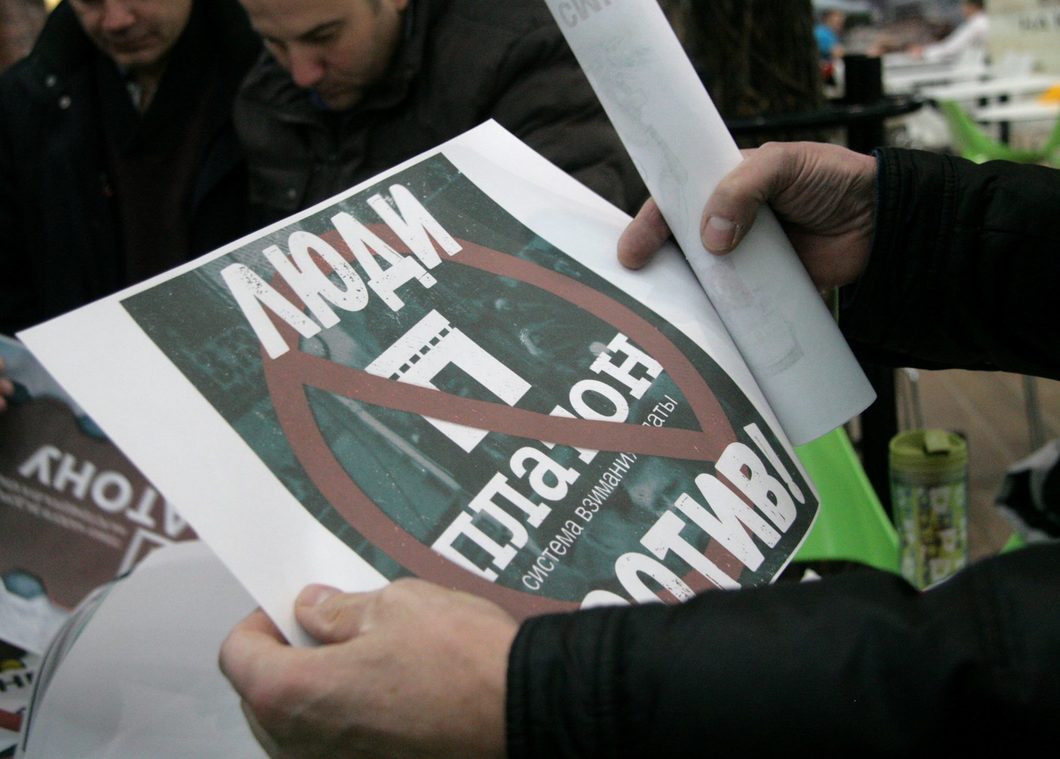
“People versus Plato!” Photo courtesy of Dmitry Rebrov/Novaya Gazeta

“There will be protest rallies today in twenty-two regions, so there aren’t so many people here. All the activists have gone to their home regions to rock the boat. But Muscovites have bitten the bullet and installed Plato, because it costs to protest, and we are not a united group,” said activist Igor Melnikov, standing next to a blue truck emblazoned with the OPR logo.

He was trying to explain why no more than a dozen people had assembled for the rally.

Melnikov is a Muscovite himself, just like the five regular volunteers who have been helping the Khimki protesters since last winter.

“Not everyone would choose to travel to Khimki in this weather,” Melnikov continued. “That is partly why, in place of the banned rally, it was decided to hold a big rally on Suvorov Square in Moscow on November 12, and restrict ourselves to a small detachment here in Khimki.”

The rally in Moscow has been supported by the Communists.

“What of it? I know who the Communists are, that they destroyed my country. I grew up under them. But that is okay. They can hold the microphone. We’ll live through it!” Yekaterina Bolotova, a perky brunette, put in her five kopecks.

Bolotova, a private entrepreneur, lives in Lyubertsy. She has been in business since the 1990s.

While we were chatting, a grader kept shoveling dirty snow towards the MEGA sign as freezing rain fell.

“There is already more than three of you. What are you doing here?”

A delegation from the Moscow Regional Criminal Investigative Department had arrived to test the waters. Two gloomy figures, both dressed in black, approached us, obviously reluctantly. The larger of the two men showed us his ID: “Oleg Nikolayevich Kuznetsov.” The second man did not show us his badge, but explained the reason for the visit.

“The bosses sent us.”

“Speaking frankly, we’re expecting certain people,” the cops said in a roundabout way. “The people who are going to protest Plato.”

“We are those people. What else do you want?” the truckers unceremoniously informed them.
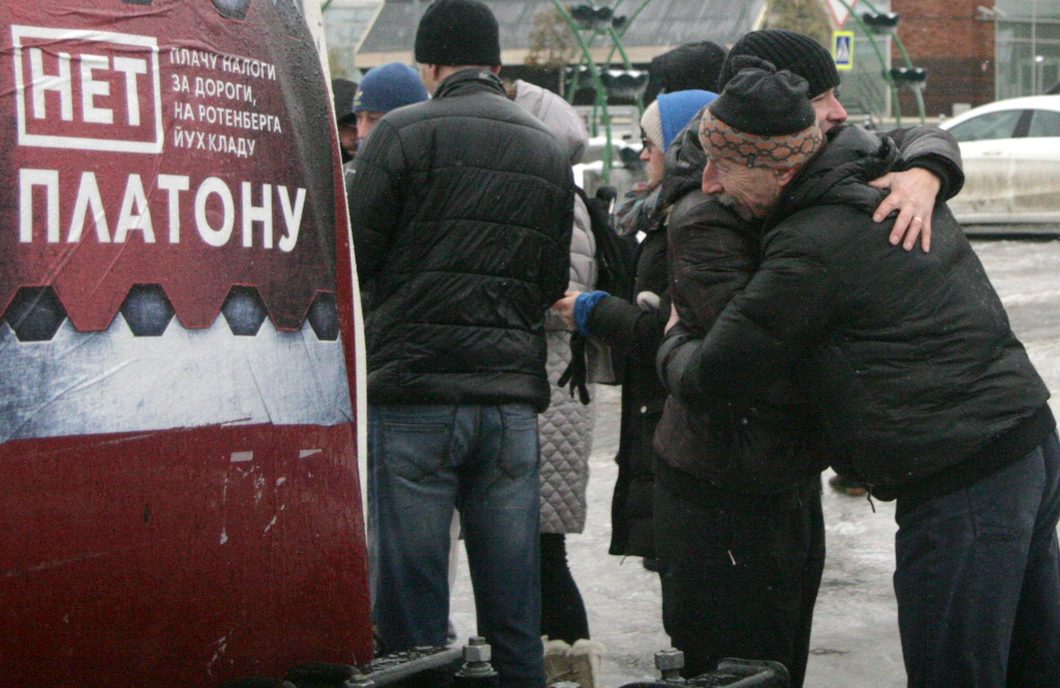
“No to Plato. I pay taxes for roads. I could give a flying fuck about Rotenberg.” Photo courtesy of Dmitry Rebrov/Novaya Gazeta

The police then withdrew, asking us not to photograph their faces.

“I’m a secret agent. My face cannot be published!” said “Oleg Nikolayevich Kuznetsov” self-importantly.

“Well, if you’re so secret, why don’t you stay at home, since we can’t look at you?” a trucker retorted.

Meanwhile, a paddy wagon and reinforcements were pulling up at the impromptu checkpoint behind them.

“We now have political demands. In addition to abolishing the Plato system, we want transport minister Maxim Sokolov to resign, Prime Minister Medvedev to resign, and the repeal of Article 20.2 of the Russian Federal Administrative Offenses Code, which covers violations at political rallies, because it is insanity. People are no longer able to voice their opinions,” said Kurbatov.

According to the OPR’s official website, the truckers propose leaving only the fuel excise tax intact and scrapping the transport tax. They support judicial reform, including the recertification of all judges. And they want “all embezzlers to face criminal charges.”

Some of these demands are a natural response to the endless jail terms and arrests the once apolitical truckers have faced.  Other demands have emerged in the aftermath of discussions with political activists who regularly visited the protest camp last winter.

Looking for the “Core” Activists

“Are they making arrests?”

“He raised flags on his trucks!”

We dashed through the snowdrifts to the other end of the parking lot, where a dozen cops were packing Sergei Einbinder, an activist with the Interregional Trade Union of Professional Drivers, into a car.

Led by Alexander Kotov, the Khimki protesters had managed to come to an agreement with police spokespeople about joint actions for the first time in a long time. Kotov had once led the resistance, but quickly surrendered, as the Khimki protesters explained, causing general annoyance among the striking truckers. Instead of blocking the Moscow Ring Road and driving a convoy into downtown Moscow, under Kotov’s leadership the protest had bogged down in attempts to slow down the “radicals” and in endless negotiations with federal MPs. Now, apparently, the irritation with Kotov had passed.

“The security forces had pressured Kotov back then,” explained Bolotova,  a Kotov supporter.

She had come to Khimki to establish contacts, but unlike Eibinder, she had immediately gone over to her colleagues.

Bolotova had also been dragged in for interrogations by the Lyubertsy police and Center “E.”
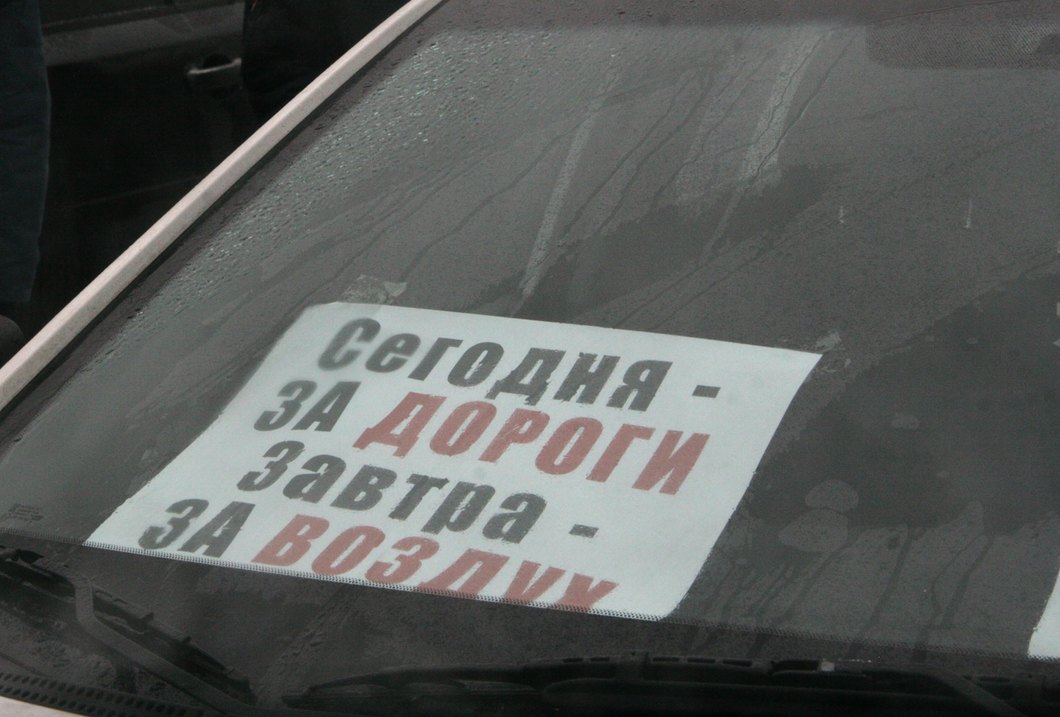
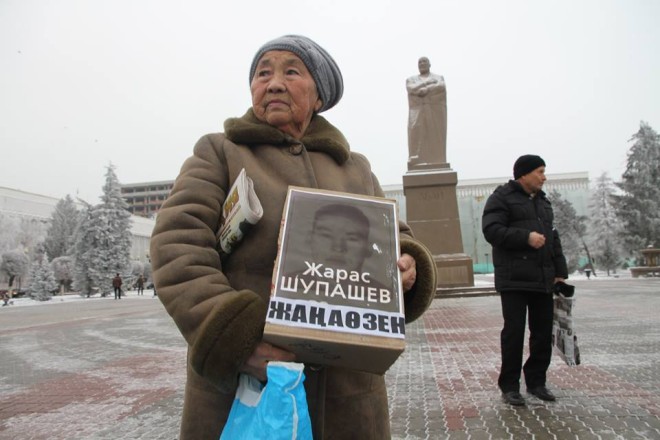
“Today [they’re making us pay] for the roads. Tomorrow, it will be for the air.” Photo courtesy of Dmitry Rebrov/Novaya Gazeta

Similar coercion had led to a break with the group of activists who had fought the Rotenbergs most fiercely, the Dagestanis. None of their members was present at Friday’s rally.

“At the moment, we have lost contact with Dagestan,” admitted Kurbatov. “All our work there was tied to Rustam Mallamagomedov, but after he was beaten up while we were waiting for the [Krasnodar] farmers in a camp near Rostov and then sentenced to administrative arrest in absentia, he was basically forced to give up the cause and go to ground. Currently, we are not even in contact with him.”

Kurbatov added that security forces coerced and terrorized the Dagestani truckers the most harshly.

“Are You Freezing?”

When, an hour later, the truckers emerged from the MEGA mall, where they had gone to get out harm’s way and discuss strategy, to take up their solo pickets, the police amassed in the parking lot reacted almost instantly.

The first to be sent to the precinct were Yekaterina Bolotova and Igor Melnikov. By midday, the security forces had managed to cram all the truckers, all their volunteer helpers from Khimki, and even the journalists, including a crew from TV Rain, into the paddy wagon.

“What we predicted last year has happened. As soon as [parliamentary] elections had taken place, the moratorium on raising rates was lifted. In fact, the government did not even keep its own promise of freezing prices until July 2017. So we decided there was no time to lose, and we have hit the streets, although we were not very well prepared,” said Kurbatov.

By six in the evening on Friday, all the detainees had been delivered to Police Precinct No. 1 in Khimki. But it proved difficult to find out what the truckers had been charged with.

In the morning, the truckers’ attorneys informed us that Sergei Einbinder, who had been detained first, had cut his hands and face to protest the police’s actions.

“After twenty hours at the precinct, they hadn’t even allowed me to see a lawyer or explain what I was being charged with, so I decided to take extreme measures,” Einbinder told Novaya Gazeta by phone.

Earlier, Einbinder had tried to leave the police station on his own after surrendering his internal passport, but police responded by detaining two lawyers that had been provided for him by the Anti-Corruption Foundation (FBK). The two lawyers, Vitaly Serukanov and Artyom Khemelevsky, have already been released. The journalists taken down to the precinct with the truckers were released the same day. No arrest reports were filed against them nor were they subjected to additional questioning.

By Saturday, it had transpired the truckers involved in the protest had been charged with disobeying the police (Article 19.3 of the Administrative Offenses Code) rather than for violating the rules of public rallies (Article 20.2).

Elena Filippova, press secretary for the truckers, who was detained along with them, related what conditions have been like for the activists at the police station. According to her, the female activists who have been helping the truckers and the truckers themselves slept in separate cells.

“In the women’s cells, the three of us were given one dry mattress, which we could sleep on, and two wet mattresses. We have now just thrown out the wet mattresses. Apparently, they had long been waiting their turn, and such an occasion had presented itself. Girls had shown up at the station: why not torment them a bit? In the morning, one of the cops gleefully asked, ‘Are you freezing?’ We have been allowed to use the toilet only twice in twenty hours, and we had to demand to be given food, which was brought only six hours later.”

Court hearings commenced only at two in the afternoon, and they looked likely to run until Saturday evening.

After numerous requests, Sergei Einbinder was transported from the courthouse by an ambulance crew.

Currently, truckers Mikhail Kurbatov, Vladimir Sinitsyn, Dmitry Lazar, and Igor Melnikov, their assistants Ivan Gushchin and OPR press secretary Elena Filippova, and activist Olga Reznikova, who also was involved in Friday’s protest, are still in police custody.

Translated by the Russian Reader
Krasnodar Farmer Kills Himself after Land Seized

uborka-1-pogoncev-viktor_d_850

Kuban Farmer Shoots Himself over Illegal Seizure of Land
Gella Litvintseva
Proved.rf
October 1, 2016

A farmer in Krasnodar Territory has committed suicide because he was unable to get back a thousand hectares of land that had been illegally seized from him, according to Alexei Volchenko, organizer of the August 2016 tractor convoy and a farmer from the Kalininskaya Distrist.

“Nikolai Gorban, a farmer in the Timashyovsk District, shot himself. It happened three days ago. A thousand hectares of land were confiscated from him by court order. The man wrote a suicide note in which he named the people he blamed for his death. Prior to this, gangsters came to his place, threatening him and promising to do away with his family. His loved ones are now preparing for the funeral,” says Volchenko, head of the Kalininskaya District Peasant Farm Enterprise.

According to Volchenko, the victim received the land plot after buying the shares from the land’s owners. After the court ruled the land confiscated, he tried to get it back, but failed.

“The farmer had his own land. He had bought it from other shareholders, like himself, and had it marked off and registered. But later the meeting of shareholders [at which they had decided to sell the land to Gorban — TRR] was declared null and void by the courts, and the land was returned to the collective farm, which Oleg Makarevich has been trying to get his hands on. The farmer went to see Natalya Kostenko, of the Russian People’s Front [a pro-Putin astroturfed “civil society” organization — TRR], to ask for help. He went personally to see her twice, and he called her. He went to see Andrei Korobka, deputy governor of Krasnodar Territory, and asked him for help. He met with me. He said, ‘I’ve lost everything. I’m going to put a bullet in my head.’ I told him not to do anything, that all was not lost, that in the end it wasn’t worth his life. I told him we would tough it out, we would beat them come what may. But he said, ‘I don’t want to live.’ I tried to dissuade him, but now we’ve found out it’s all over,” recounts Volchenko.

On September 23, convoy participants were in Moscow. Scheduled meetings with the president and the agriculture minister did not take place. They only managed to have a small get-together with Kuban officials. At the beginning of the week, Volchenko announced the farmers would be meeting with a presidential envoy in Yeysk on September 28, but ultimately this meeting did not take place, either.

“We got ready and went to Yeysk. I went into the hotel where the event was going to take place. They looked at me like I was an idiot. ‘Young man, are you smoking something or popping pills? What presidential envoy? What journalists? We have nothing scheduled.’ I went outside and saw cars with tinted windows, FSB officers walking around, and Vyacheslav Legkodukh (the Krasnodar governor’s envoy for farmer relations) sitting in a cafe and eating. I got the picture. I went to the farmers and said, ‘This is a setup. Let’s leave for home on the sly.’ They wanted us to gather outside the hotel so they could arrest us again for holding an unauthorized assembly,” recounts Volchenko.

Earlier, the protesting farmers met with Alexander Chernov, chair of the Krasnodar Territorial Court, who promised he would review all the cases the farmers requested. For now, he is their only hope.

“All the judges say Chernov is a very decent man, and keeps his word. Currently, farmers have won some of the cases that were before the courts. There are positive results, but it’s not clear whether this will be enough, because right now several farmers are under tremendous pressure, Nikolai Maslov, for example. Certain media outlets have been writing that he is a raider, that he has been trying to grab land from Shestopalov and his honest Dmitriyevskoye Agricultural Enterprise. But people just want to mark off and purchase their own land, 200 bloody hectares. Tremendous pressure has been exerted through the press. Andrei Koshik, a Kuban journalist, went to Novaya Gazeta newspaper in Moscow and tried to get the journalists to publish this garbage. They refused and wrote about it on Facebook,” says Volchenko.

The problems of Kuban’s farmers became widely known in the spring, when they decided to travel to Moscow by tractor to tell the president about illegal land seizures in Krasnodar Territory and about corruption in the local courts and district councils. To capture the president’s attention, over the course of seven months the farmers released doves with messages for him, held several rallies in a field, set off for Moscow in tractors, and wrote to the president’s public relations office. Their tractor convoy in August ended on day two in Rostov-on-Don, when the farmers were jailed and fined. Subsequently, convoy participants have been subjected to continual pressure from local authorities and law enforcement agencies.

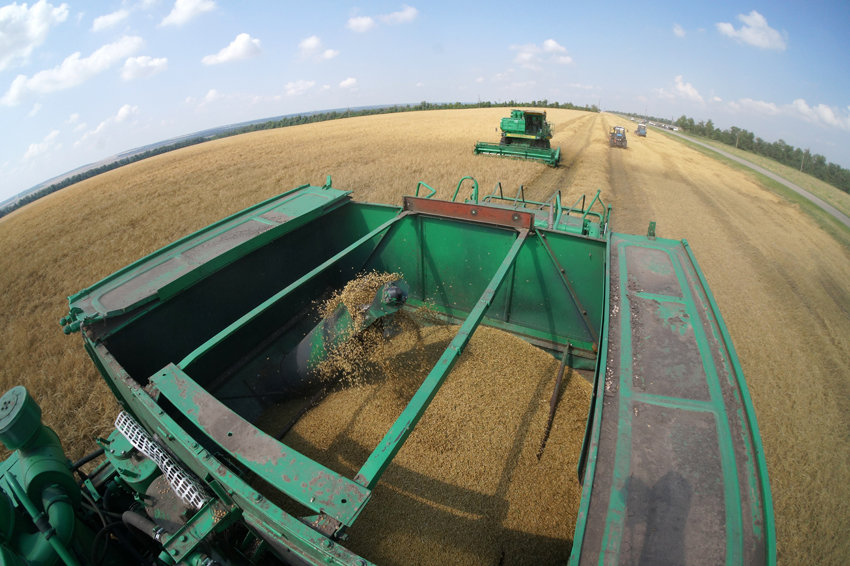
Translated by the Russian Reader. Thanks to Comrade Anatrrra for the heads-up. Photo courtesy of Viktor Pogontsev and Rossiyskaya Gazeta, where the caption to the photo reads, tellingly, “Record grain harvests in the Kuban region in recent years have bothered certain local farmers. They have been demanding a new redivision of the land.” Rossiyskaya Gazeta is the Russian government’s daily newspaper of record.

Regime Cracks Down on Protesting Krasnodar Farmers

“They Have Really Gone After Us”
After returning to Krasnodar Territory, participants of tractor convoy feel the heat from the very people against whom they complained
Anna Bessarabova
Novaya Gazeta
August 28, 2016

The farmers after their tractor convoy was dispersed. They have been sentenced to three to ten days in jail. Not a single independent human rights activist came to their court hearings in the village of Kazanskaya. Photo courtesy of Anna Artemieva/Novaya Gazeta

The farmers were threatened during the convoy. We will stage a second Novocherkassk massacre for you and dice you like cattle in a slaughterhouse, they were told by security officers, who after the protest was dispersed have been zealously carrying out checks of their homes and farms.

Around thirty FSB officers raided Nikolai Borodin’s farm in the village of Kazanskaya, which they turned upside down. The tax inspectorate has been looking into property owned by the relatives of protest leader Alexei Volchenko. Other men have been interrogated by the prosecutor’s office. Nina Karpenko escorted her driver Seryozha Gerasimenko, a young fellow with three small children, to the detention center. He has been jailed for three days. The other men were also issued misdemeanor charge sheets: the authorities even went to the trouble of delivering the documents to their homes. The hearings took place on the weekend (Saturday) in the Kavkazsky District. Sergei Gorbachev was jailed for five days, Slava Petrovsky, for four days, Andrei Penzin and Semyon Smykov, for three. The rest of the protesters are waiting their turn.

“Nearly everyone in the villages has been paid visits by prosecutors and police,” farmer Ludmila Kushnaryova told Novaya Gazeta. No one knows what they are looking for. Or what the charges will be, either. The pressure has not stopped.”

“I cannot believe this is happening to us, in our country. We had no idea it would be so frightening,” said Nina Karpenko. “They have really gone after us. The deputy chief of the district traffic police escorted my tractor drivers and me to the hearings. He followed us for 250 kilometers. Whatever for? There were two people working in the courthouse on Saturday: the judge and the chairman. Didn’t they have anything else to do?”

Nikolai Maslov and Oleg Petrov, two convoy participants jailed for ten days, have been transferred to Novocherkassk.

“Dad called early this morning. He said everything was alright. But who knows. Maybe he just didn’t want to scare us?” said Igor Maslov, worried about his father. “We still haven’t found lawyers for them. How much do you think they’ll gouge us?”

Alexei Volchenko’s colleagues and friends have been looking for him. He has not been answering calls to any of his phones. He is not to be found in his home village. He has disappeared. The last thing the farmers heard was that Volchenko had been fined in Rostov Region. He made it back to Kuban, where he was detained again and sentenced to ten days in jail in Ust-Labinsk. The authorities are now, allegedly, preparing to charge him with extremism.

The Russian government, the Prosecutor General’s Office, and the Russian Investigative Committee have been pretending nothing is happening in Kuban. The official TV channels have been airing election campaign spots about the ruling party’s ability to listen to people, but they have not aired any stories about the events in Krasnodar Territory.  They have maintained their silence for a week.

Alexander Popkov, a lawyer with the Agora International Human Rights Group, Boris Titov, federal commissioner for the rights of entrepreneurs, former Federation Council member Ivan Starikov, and Russian Federal Public Chamber chair Georgy Fyodorov have promised to help the participants of the tractor convoy.

“Obviously, the farmers have committed no offenses, and the wild imitation of law enforcement involving riot police and arrests for a ‘rally’ in a cafe are aimed at suppressing a peaceful and reasonable protest campaign,” said lawyer Alexander Popkov. “The first thing we are going to do is file appeals, and then we are going to see whether there is any point in beating our heads against the courts in Russia or whether we should immediately file a class-action complaint with the European Court of Human Rights.”

“I have been in contact with the farmers, their wives, and their children. They are drafting an appeal, and next week we plan to hold a big press conference in Moscow,” Ivan Starikov informed Novaya Gazeta. “Their problem needs to be solved systemically. People’s land shares are being confiscated, and there are around 300,000 victims of this practice nationwide.”

According to Valentin Pyshkin, attorney for convoy participants Nikolai Maslov, Oleg Petrov, and Sergei Vladimirov, the farmers have filed an appealed against the court decisions that sentenced them to ten days in jail.

“But we won’t get an answer earlier than Monday,” the lawyer explained. “On August 26, I was not admitted to the Novocherkassk detention center and allowed to talk with my clients, because, you see, according to their internal regulations, prisoners are entitled to representation by a lawyer only from two to four in the afternoon. It is an odd rule. But at four o’clock I had a court hearing in Aksai. Rustam Mallamagomedov from the Association of Russian Carriers (OPR) was on trial. On August 24, he had gone to the police station on his own to find out what had happened to the detainees, and the police didn’t let him back out of the station.”

Truckers Ready to Fight for Farmers 

Andrei Bazhutin, chair, Russian Association of Carriers (OPR):

“We arrived from Petersburg to Moscow, where we were getting ready for a car convoy through Siberia. We learned about the arrest of the tractor convoy on the morning of August 23 and changed our plans. We went to support the tractor drivers. We were stopped by police for eight hours on the Moscow Ring Road, and eight hours in Voronezh Region. Along the way, we were written up for violating Article 20.2 of the Misdemeanors Code [“Violation of the established rules for organizing or holding an assembly, rally, demonstration, march or picket”  — Novaya Gazeta], but they did not stop us from traveling further.

“By the time we got to Rostov, two of our activists [who had been with the tractor convoy from the beginning — Novaya Gazeta] had been sentenced to ten days in jail, while another two had been fined 10,000 rubles. Now we are here in Rostov: we have four big rigs and some cars. We are working with the lawyers and human rights activists and trying to help the guys out. We think it is necessary to gather journalists and advance on Krasnodar Territory to draw attention to these court hearings. Center ‘E’ [the Interior Ministry’s Center for Extremism Prevention — TRR] has intimidated everyone here.

“We have also contacted the miners on hunger strike in Gukov and agreed to support each other. Our demands will be voiced at their next picket too.”

Translated by the Russian Reader. Read my previous postings about the protest by Krasnodar farmers and the regime’s crackdown against it.

The People versus the Package

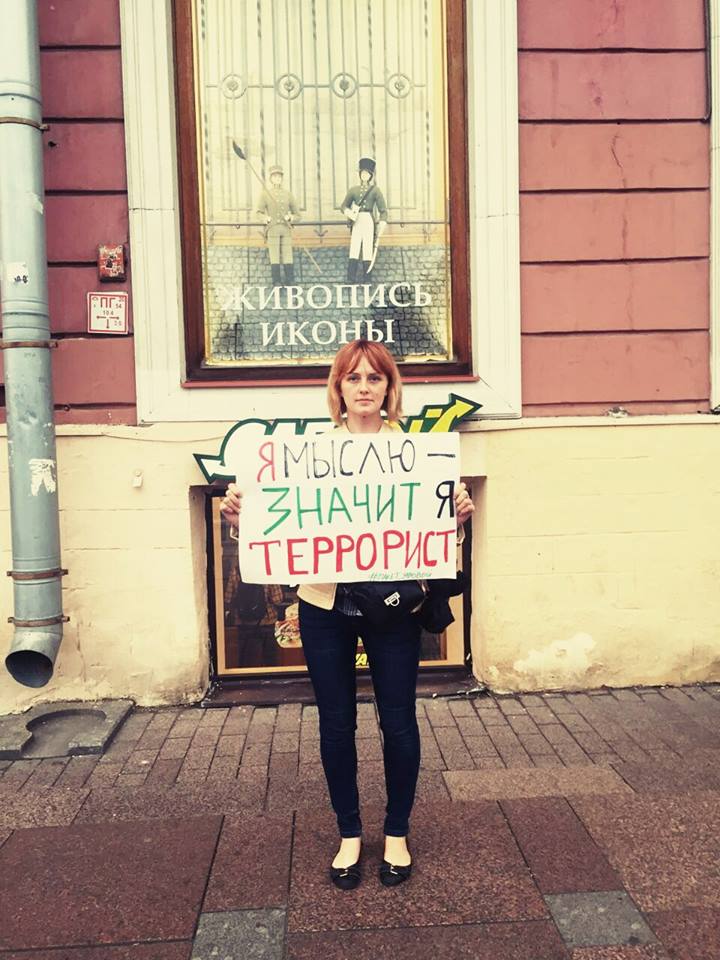
"I think therefore I'm a terrorist." Solo picket on Nevsky Prospect, Petersburg, July 22, 2016
“I think therefore I’m a terrorist.” Solo picket on Nevsky Prospect, Petersburg, July 22, 2016

Varya Mikhaylova
Facebook
July 23, 2016

It doesn’t matter whether you come to the people’s assembly against the so-called Yarovaya package at 7 p.m. on July 26 in front of the arch of the General Staff Building on Bolshaya Morskaya or not. There is already enough evidence to put you away.

***

On July 7, 2016, President Putin signed the so-called Yarovaya package, a series of flagrantly repressive amendments to the Russian Federal Criminal Code. The official objective of the amendments is to combat terrorism.

IF YOU DON’T INFORM YOU’LL GO TO JAIL
An article on non-informing has been added to the Criminal Code. “Failure to report a crime” will entail a sentence of up to one year in prison. This law applies to such crimes as terrorism, seizure of power, and attempts on the life of a public official.

ALL YOUR COMMUNICATIONS WILL BE SAVED AND READ
Monitoring of correspondence has been toughened. Records of all your telephone calls, SMS messages, and emails will be saved for six months, and the security forces will be provided with the means to decode encrypted communications.

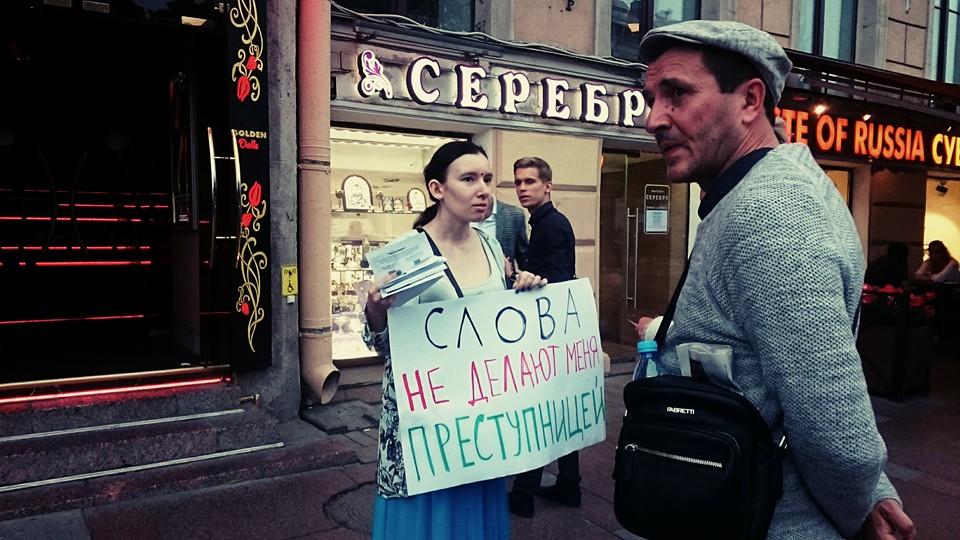
"Words don't make me a criminal." Solo picket on Nevsky Prospect, Petersburg, July 22, 2016
“Words don’t make me a criminal.” Solo picket on Nevsky Prospect, Petersburg, July 22, 2016

YOUR PACKAGES WILL BE VETTED
Postal workers will now be obliged to search vigorously for prohibited items in our packages: money, narcotics, weapons, explosives, and “other devices that pose a threat to human life and health.”

YOU INVITED A FRIEND TO A PROTEST RALLY, YOU GO TO JAIL
The Criminal Code will now include an article on “inducing, recruiting or otherwise involving” someone in organizing a “riot.” The law stipulates a penalty of 300,000 to 700,000 rubles or a prison sentence of five to ten years.

YOU REPOST THE “WRONG” THING, YOU GO TO JAIL
The punishments for “extremist” entries, reposts, and comments on the web have been toughened. Despite the fact that freedom of speech is guaranteed by the Russian Constitution, you can now be fined from 300,000 to 500,000 rubles or sent to prison for two to five years for making certain statements. By the way, 369 people were convicted of “enciting hatred by means of the Internet” in 2015.

YOU’RE STILL A KID? YOU’RE GOING TO JAIL ANYWAY
14-year-olds will now be tried as adults not only for serious crimes but also for involvement in riots and non-informing.

At 7 p.m. on July 26, a people’s assembly on behalf of liberty and against the Yarovaya package will be held on Bolshaya Morskaya in the pedestrian area near the arch of the General Staff Building. The people’s assembly format does not permit the use of political symbols and placards. But no one can forbid us from going outside, talking about the Yarovaya package, and hoping the voice of peaceful protest will be heard.

More on the Yarovaya Package:

"Inform on me and maybe  you won't go to jail." Solo picket on Nevsky Prospect, Petersburg,  July 22, 2016
“Inform on me and maybe you won’t go to jail.” Solo picket on Nevsky Prospect, Petersburg, July 22, 2016

I’ll Show You the Life of the Mind

the life of the mind
Screenshot of a virtual tour of the Spiridonov Mansion (1895-1896) aka the Baby Palace (since 1965), located at Furshtatskaya Street, 58, in central Petrograd. The room depicted here is known as the Oriental Room. Thanks to Comrade KK for the heads-up

___________________

The Man Behind Dialogues: The FSB Are Listening to Us Now 
The creator of the project Dialogues, which has been shut down, explained to Fontanka.ru why he wants to start it up again at another public venue and why he is not leaving Russia
Elena Kuznetsova
Fontanka.ru
June 27, 2016

Nikolai Solodnikov. Photo courtesy of Open Library

Nobel Laureate Svetlana Aleksievich, musician Diana Arbenina, animator Garri Bardin, Deacon Andrei Kurayev, journalist Yulia Latynina, and poet Vera Polozkova are just a few of the celebrities who have been guests of the project Dialogues at Petersburg’s Mayakovsky Library. Hundreds of Petersburgers have attended the discussions in person, while even more have watched the live broadcasts on various media websites.

The project, which was run by Nikolai Solodnikov, former deputy general director of the Mayakovsky Library, on a voluntary basis, was shut down yesterday, June 26, after the FSB came to the library and carried out searches. One hypothesis is that the security forces were interested in the political activism of Dialogues. Another hypothesis is it was Solodnikov’s frequent visits to Latvia that bothered them. Fontanka.ru contacted the man behind Dialogues to set the record straight. 

Nikolai, if they were in your shoes, many other people would be in Latvia by now. Where are you now?

For reasons of safety, I cannot answer the question.

Meaning you are not in Russia?

All I can say is that I am not in Latvia. [In the background, a voice announcing flights can be heard—Fontanka.ru.]

After the incident with the FSB did you have thoughts of leaving the country?

I am Russian. I do my projects in Russian for Russians. I cannot imagine myself as a political émigré, and I have no plans to leave Russia.

You have said the FSB had been putting pressure on Dialogues for a year and a half. Why did you decide to shut the project down only yesterday?

Different things overlapped. The elections and the fact we had been spending a lot of time in Latvia, where Katya [Solodnikov’s wife Katerina Gordeeva, journalist and co-organizer of DialoguesFontanka.ru] had our fifth child. It is not the children who bother them, of course. They are annoyed by the Open Lecture project we have been doing in Riga, Tel Aviv, and Odessa. And they had been combating Dialogues, in fact. So now things boiled over and exploded.

Meaning that if there had been no searches, Dialogues would have continued?

Of course. I hope it will continue, only not at the Mayakovsky Library. Because what is it like for the elderly ladies who make up the core of the library’s employees to go through interrogations and seizures of equipment? That would be incredibly heartless.

Surely after yesterday’s announcement you have already received proposals to move the project to another location.

Private organizations have had some ideas, but I haven’t considered them yet. I am still hoping we can gather in a space where very different people in terms of views, age, and social status can come.

Are you implying the next venue for Dialogues will also be public?

I really hope so. I am a citizen of the Russian Federation, and the people who attend our events are citizens of the Russian Federation. We are, in fact, the Russian people, who have the right to gather in public cultural institutions.

Public institutions have a hard time accepting the opposition agenda, which Dialogues, in particular, supported.

I am not an opposition activist. I am someone who deals with education and awareness. Teaching was my first occupation. I taught for a long time, and I hope I will teach again in the future. The only thing I can do is teach people to talk to each other while maintaining different points of view.

We are speaking via Skype now. Before that you called from a new number.

Tell me straight that the Federal Security Service (FSB) is eavesdropping on us. When you call me, something clicks and hums on your end.

Before yesterday, did you have any sense that the security forces were following you personally?

Since May of last year [when Ukrainian politician Mustafa Nayyem was supposed to speak at Dialogues, but the trip was canceled—Fontanka.ru] I have had no doubt that all my phones have been tapped. Although I think they have not been following me. I have no documents or evidence, but I do have the sense they have been listening in on me.

“Aside from land we have no real estate in Latvia”

You resigned from the Mayakovsky Library yesterday. How will it affect the career of the library’s director, Zoya Chalova?

I really hope things will be a bit easier for her.

We tried to call her, but to no avail. There is no sense that Chalova supports you at all.

She is the director of a public institution. That says it all. I am very grateful to her for the entire time we worked together. She is one of the bricks in the wall who helped deter the people who carried out the search on Thursday and interrogated the librarians.

Cultural functionaries, including Konstantin Sukhenko, head of the Petersburg Municipal Culture Committee, have said that Zoya Chalova did not know what the sources of financing for Dialogues were, and she was very worried about it.

She knew what they were from day one of the project.  I have always said this, and I have said it repeatedly to Fontanka.ru: Dialogues is financed solely by Katya and me, meaning the salary I earned at the Mayakovsky Library, 43,000 rubles a month, and what Katya earns. Together, we have tried to combine what we have, borrow money here and there, and ask friends to pay for our guests’ tickets and accommodation. No oligarchs have been involved.

Can you name at least a few of the friends who have supported the project?

Nikolai Solodnikov and Katerinia Gordeeva. That is quite enough.

In addition to financing, the FSB were interested in your links to Latvia. Apparently, the Chekists [sic] assumed that you were not merely spending time there, but living there as well.

We have five children, aged six years to one and half months. We left in late 2015, because Katya was going to have our fifth child.  The heating main opposite our house on Chaikovsky Street was turned off. In November, the hot water and light were being turned off every other day. It was impossible to live with small children in a flat with no water and electricity. We decided to temporarily relocate to Riga so that Katya could finish her pregnancy in peace and give birth.

Do you have a residence permit or property abroad?

Everybody knows that three or four years ago Katya bought a small plot of land in Latvia to obtain a residence permit. We did this and, in accordance with the law, immediately informed the Russian Federal Migration Service about it.

You haven’t built a house yet?

No, except for the land, we have no property in Latvia.

How did you feel working at a public library? After all, it is almost like the civil service, but at the same time you had a residence permit in another country.

I felt great. My wish is that all other worthy people had a residence permit while not parting with their Russian passports for any reason. A residence permit makes it easier to get around the world: you don’t have to apply endlessly for visas.

But the FSB sees this as a certain duality and contradiction.

There are some not very healthy people working there, but there are also normal people. Just as there are more people than Sukhenko working in the municipal culture department. By the way, many Petersburg municipal officials also have resident permits abroad.

Getting back to Dialogues, if the project would have continued in the old format, what would have its future been?

We thought we would do Dialogues monthly at least until the end of 2016. We worked like bees, regularly inviting new guests.

What did you feel yesterday when you were told the project was over?

A huge amount of work has been done, and it is sad when it ends this way. But we are going to go forward. There are people who support us. We will cope.

Our conversation is now being constantly interrupted by other calls. Who is calling?

Your journalist colleagues.

You have probably been getting many expressions of support. What matters most?

What matters most is that Katya and I really support each other in these circumstances.

Translated by the Russian Reader

The Package

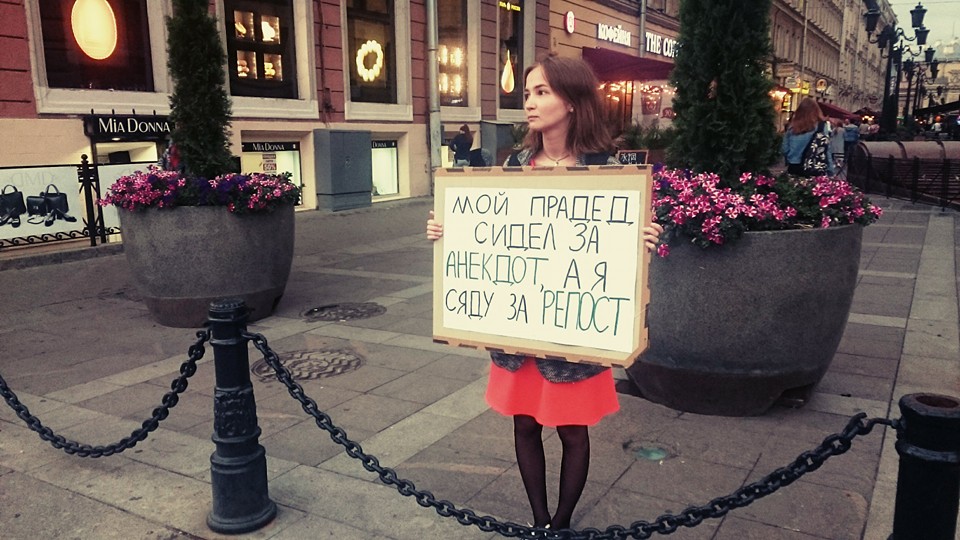
"My grandfather was imprisoned for a joke, while I'll go to jail for a repost."
“My grandfather was imprisoned for a joke, while I’ll be going to jail for a repost.”

Varya Mikhaylova
Facebook
June 24, 2016

As you know, the so-called Yarovaya package, a series of flagrantly repressive amendments to the Russian Federal Criminal Code, whose official aim is combating terrorism, was passed today by the State Duma in its third and final reading.

You can read here why this is bad:


Aleksandra Ermilova and I summarized the worst things about these amendments and went to Nevsky Prospect to hand out leaflets. Or rather, I handed out the leaflets, while Sasha stood holding a remarkable autobiographical placard [pictured, above].

This is what we wrote in the leaflets:

IF YOU DON’T INFORM YOU’LL GO TO JAIL
An article on non-informing has been added to the Criminal Code. “Failure to report a crime” will entail a sentence of up to one year in prison. This law applies to such crimes as terrorism, seizure of power, and attempts on the life of a public official.

ALL YOUR COMMUNICATIONS WILL BE SAVED AND READ
Monitoring of correspondence has been toughened. Records of all your telephone calls, SMS messages, and emails will be saved for six months, and the security forces will be provided with the means to decode encrypted communications.

YOUR PACKAGES WILL BE VETTED
Postal workers will now be obliged to search vigorously for prohibited items in our packages: money, narcotics, weapons, explosives, and “other devices that pose a threat to human life and health.”

YOU INVITED A FRIEND TO A PROTEST RALLY, YOU GO TO JAIL
The Criminal Code will now include an article on “inducing, recruiting or otherwise involving” someone in organizing a “riot.” The law stipulates a penalty of 300,000 to 700,000 rubles or a prison sentence of five to ten years.

YOU REPOST THE “WRONG” THING, YOU GO TO JAIL
The punishments for “extremist” entries, reposts, and comments on the web have been toughened. Despite the fact that freedom of speech is guaranteed by the Russian Constitution, you can now be fined from 300,000 to 500,000 rubles or sent to prison for two to five years for making certain statements. By the way, 369 people were convicted of “enciting hatred by means of the Internet” in 2015.

YOU’RE STILL A KID? YOU’RE GOING TO JAIL ANYWAY
14-year-olds will now be tried as adults not only for serious crimes but also for involvement in riots and non-informing.

Translated by the Russian Reader
When the Masks Come Off

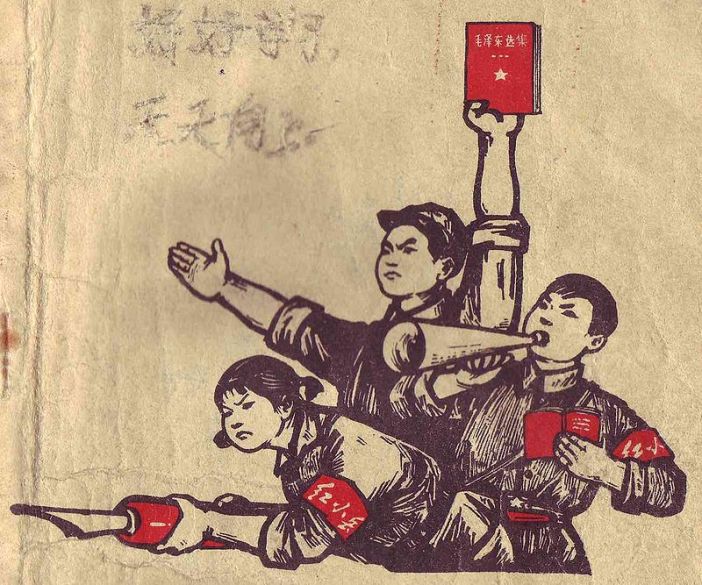
800px-Red_Guards

Alexander Skobov
Don’t Underestimate the Enemy
Grani.ru
May 14, 2015

Igor Yakovenko has questioned the sanity of those MPs who supported Red Guardist Irina Yarovaya’s latest amendments to the anti-extremism laws. At issue is a ban on travel abroad for people whom the FSB has issued a warning about the inadmissibility of activities that, in the FSB’s opinion, are potentially fraught with terrorism, war, and genocide. Under the current rules for issuing warnings, no formal grounds are needed except the opinion of the agency issuing the warning. Meaning that if it wishes, the FSB can crank out warnings to anyone whose activities the authorities simply do not countenance.

Yakovenko asks, why not let the undesirables leave the country if you cannot stand them? Let them leave and thus reduce the ranks of the so-called fifth column. These measures will not stop an increase in protests, and if protests do kick off, they will only add fuel to the fire. Yakovenko’s conclusion is that the folks on the other side of politics are completely off their rockers. But I would not underestimate the enemy’s intellectual capacities. Yes, they suffer from an acute totalitarian itch to ban and restrict. But they know what they are doing.

In my opinion, Yarovaya’s notorious amendment to ban travel for “warnees” is absolutely rational and quite precisely calculated. It is targeted at the segment of Russian society that,  according to Yakovenko himself, suffers from pathological anemia and dystrophia of the will. These are successful and well-off people who still believe that if they have done nothing unauthorized, they will get off scot-free for their not entirely loyalist public activism. They have become accustomed to the fact that one can be involved in not entirely loyalist but quite respectable and moderate media, cultural, and human rights projects without especially risking one’s own comfort. Our stunted civil society largely rests on such lovers of performing  “small deeds” in their spare time.

And now take a guess at what percentage of these outstanding people would be willing to sacrifice travel abroad for the sake of continuing their outstanding social activism, who would be willing to sacrifice the principal attribute of the post-Soviet lifestyle, without which life would be unthinkable? Anyone like Yarovaya would realize that the majority of them will choose either to give up their activism or leave the country before receiving a warning. To predict these people’s future behavior it suffices to recall Ksenia Sobchak’s recent philosophical musings about the lives of frogs.

And where will all these popular newsmakers find themselves if they are banned from leaving the country for the piquant statements they occasionally permit themselves in public? This is not to mention the fact that many civic initiatives will simply be paralyzed if the people involved in them cannot take numerous business trips and attend various international clambakes.  The current regime is quite consistently pushing for the complete suffocation of not only the independent but even the semi-independent civic organizations that have managed to stay afloat. The period when Putin’s clique had a stake in maintaining a legal oppositional ghetto on the margins of public life, thus imparting a certain seemliness to its own image, has come to an end. In recent years, this image has become so disfigured the Kremlin has lost interest in touching it up. It has realized it no longer has anything to lose.

And so there will no longer be any legal bounds vouchsafing the opposition from crackdowns. Any public organization that violates the informal ban on discussing issues the regime finds touchy will be crushed. All the Kremlin’s recent significant steps, beginning with Moskalkova’s appointment and ending with the latest round of purges of semi-independent media, have been focused on this. In this long series of steps, however, the ability to ban any undesirable from traveling abroad is a symbolic step. It finally undermines the social milieu whose entire life strategy was built on the proposition that however disgusting Putinist authoritarianism was, it was better than Soviet totalitarianism because the freedom to travel abroad existed. That meant one could live with it, adapt to it, and come to terms with it. By obeying certain rules imposed by the regime, one could maintain a minimal amount of freedom.

This slightly dissatisfied milieu has become used to living high on the hog. Our consumptive civil society must come to its natural biological end. It must be replaced by professional revolutionaries who will have no such problems since their activism conforms with the law as interpreted by people who have arrogated to themselves the exclusive right to interpret it. For them, Yarovaya’s fascist laws will be neither more nor less than a profound insult to their moral sensibilities.

Alexander Skobov, a left-liberal writer and activist, is a former Soviet dissident and political prisoner. Translated by the Russian Reader. Thanks to Comrade AM for the heads-up. Image courtesy of Wikipedia

No Canaries in the Coal Mine: The Demise of RBC

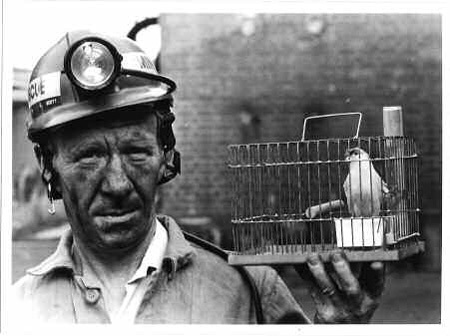
CanaryInACoalMine_2

Vasily Gatov
Canary in a Coal Mine: RBC and the Public Interest in the Counterintelligence State
Carnegie Moscow Center
May 14, 2016

Authoritarian regimes have seemingly learned how not to stifle freedom of speech completely, using censorship or administrative strictures to send signals about the acceptability or unacceptability of criticism on specific topics. In the peculiar circumstances of the counterintelligence state, however, an interest in how the state functions can itself be regarded as dissent.  

Over the past few years, it has become popular among political scientists, analysts, and the military to dub any complicated and complex process “hybrid.” Complex military operations are now “hybrid wars,” electoral authoritarian countries, “hybrid regimes,” and mass media distributed on multiple platforms, “hybrid media organizations.”

The news for Friday, May 13, fully reflected the clash between different hybrids in the Russian public space. The dismissal of the top editors at RBC, a hybrid mass media organization that had become the main public affairs outlet under a hybrid regime engaged in a hybrid war with the western world, was a practical manifestation of the strange realm that has taken shape in our country and a continuation of its logical evolution or degradation.

Common Sense as a Measurement
RBC’s top editors, Elizaveta Osetinskaya, Roman Badanin, and Maxim Solyus, who left the company “by mutual agreement,” had done the impossible in the space of two years. Along with the team they assembled, they turned an important, major media outlet with serious image problems into an exemplar of high-quality, ethically motivated, high-impact journalism.

Moreover, writers and editors with different views peacefully coexisted at RBC. I never once heard the term “liberal terrorism,” which conservatives and patriots love to mention, applied to RBC. High-quality editorial work means just this: maintaining high standards in news production while fulfilling one’s mission to the community by supporting investigative reporting and representing a spectrum of opinions through individualized public affairs, op-ed journalism and personalized, presenter-driven TV programs.

It is difficult to maintain academic objectivity when the latest round of “personnel changes” has put an end to yet another media outlet that was faithful to its professional mission. It is difficult but necessary: the emotional or partisan mode of reacting inevitably exaggerates the weight of momentary, politically motivated explanations of events. Yes, the easiest way of interpreting the firing of RBC’s editors (and, apparently, the exodus of its editorial staff) is as the consequence of their having published articles and investigative reports that directly violated Putin’s strictures on the privacy of his family life. However, this explanation, even if the editors themselves proudly accept it, is neither exhaustive nor sufficient for understanding the full complexity of hybridity.

Over the past sixteen years, journalists and their workplaces, media outlets, have been the key enemy of the system of political power emerging in Russia: not only “opposition” and “liberal” journalists but basically all journalists who approached their work with at least a minimum of regard for professional and ethical standards. Media organizations are the only segment of business (and politics) towards which the Putin administration has applied, with varying intensity, a scorched earth policy from day one to the present day.

Since the days when Walter Lippman wrote his treatise Public Opinion, the bible of ethical journalism, we know that the basis of the journalist’s profession is serving the public interest through the opportunities provided to journalists by the specific status accorded to them by law. In all societies, except totalitarian dictatorships, the public interest is always diverse and multifaceted. Some people need confirmation that the course set by their leaders is the right one. Others find it vital to take a critical, analytical approach to current policy. Still others want the salacious details and shabbiness that enables them to affirm their overall contempt for the authorities. And this is not the full range of interests. The public interest and the work of media to satisfy it are, in a way, a means of measuring reality against common sense. It is this simple principle that explains the presence of freedom of speech and self-expression among the basic civil and political rights.

The greater the discrepancies between political and economic reality and common sense, the more critically and meticulously journalists and the media should treat such aberrations. This is a means of subjecting societies (true, only democratic societies) to self-reflection and self-cleansing. (I have in mind the term “self-questioning,” which is hard to translate into Russian). Although, in recent decades, even authoritarian regimes have learned from the mistakes of their predecessors not to stifle free speech entirely. The growing criticality of the media has become a signal to them that they need to correct, mitigate or change policy; it has been a kind of canary in a coal mine. In turn, as Haifeng Huang, a professor at University of California, Merced, has argued in his paper “Propaganda as Signaling,” authoritarian regimes make vigorous use of censorship or administrative strictures (such as firing editors) as a tool to signal society about the acceptability or unacceptability of criticism on certain topics.

It is now utterly clear the Russian regime that took shape between 1999 and 2015 has no need of any “canaries.” Vladimir Putin, who, ironically, was speaking at the anniversary of VGTRK (All-Russia State Television and Radio Broadcasting Company) literally when the news of the firing of RBC’s editors was reported, expressed his basic expectations for the media. He spoke of the media’s role of “communicating our […] work” several times. Moreover, the current Russian state has nothing to signal anymore. It really is tired of the fact that journalists have the desire to explore and investigate something other than the alleged treason of opposition figures.

Independence Is Worse than Opposition
The fate of RBC (as well as all the other onshore Russian media that have attempted to have an editorial policy independent of the need to “communicate our work”) was preordained not in 2011, when Vladimir Putin, concerned about the weakness of his handpicked successor, decided to return to the presidency, nor even in 2002, when the Law on Media, which until then had been preserved in its original 1991 redaction, was opened up for amendments on direct orders from the president.

The expulsion of dissent in any shape and size from the public mind was preordained when Vladimir Putin was appointed head of the Russian Federal Security Service (FSB) [in 1998] and the restoration of Andropov’s counterintelligence state was launched. The difference is that dissent, in this concept of the state, does not consist in criticizing the regime’s political practices, as Soviet dissidents did. Dissent now consists in the selfsame public interest in why and how the state functions, as described above. Dissent now consists in shaping an interest in the personal lives and personal businesses of state officials, including those of the head of state.

Robert Pringle, a professor at the University of Kentucky and one of the CIA’s principal specialists on the late Soviet Union, described this model in two significant articles (Robert W. Pringle, “Andropov’s Counterintelligence State,” International Journal of Intelligence and CounterIntelligence 13.2 (2000): 193–203; Robert W. Pringle, “Putin: The New Andropov?” International Journal of Intelligence and CounterIntelligence 14.4 (2001): 545–558). Andropov was himself an ascetic and an opponent of corruption, but he consistently and quite harshly took on anyone who had the courage to focus on the late Soviet regime’s corruption and moral decay.

Yuri Andropov’s construction of the counterintelligence state between 1967 and 1984 was dictated by the need for total control over all “mass information processes.” The KGB’s Fifth Directorate saw no difference between a single copy of a seditious text and an attempt to mimeograph a dubious work. Both were regarded as unambiguous challenges to the CPSU’s monopoly on power. Perhaps what lay at the heart of the counterintelligence state was the animal fear experienced by Andropov in Budapest in 1956, when the future KGB chief and Soviet leader watched from the Soviet Embassy as the Rákosi regime collapsed.

Reinforced by the Arab Spring, “orange revolutions” took the place of Budapest 1956 in Putin’s worldview, while dissidents were replaced by journalists, who did not swear allegiance to the regime and did not take its money. (The Fifth Directorate saw the former as voluntary assistants, and the latter as paid agents, who could always be blackmailed by producing signed receipts for their “fees.”). Even the political opposition, whose size and and impact, except for the brief period from 2011 to 2012, the Kremlin has always understood and monitored, has not been such an unambiguous, despised target as independent, mission-driven journalism.

The mystical “Revision Number Six” (2000) describes journalists and the media as equal, if not greater, enemies of a regime that would turn Putin into the permanent and irremovable “leader of the country, thus enabling a long-term policy for consolidating and strengthening the state.” Among the possible secret areas of operations to be pursued by the Russian Presidential Administration, “Revision Number Six” lists not only gathering information on all journalists who cover Russian domestic and foreign policy but also subjecting them and the media to direct and indirect pressure, including forcing bankruptcies, generating organizational difficulties, and issuing threats to owners unable to control the editorial process.

Step by step, consistently and steadily, the Putin administration has squashed all more or less large-circulation, mass-audience media, not even because they were in opposition to it, but because they were independent of the Kremlin’s direct and indirect guidance on what could and could not be brought up for public discussion. Alternatives remain, of course, from Vedomosti to Slon, from TV Rain to Meduza. But looking back at yesterday, literally and figuratively, we can say with certainty that journalism, as an organized process based on editorial independence and a sense of public mission, is politically doomed in today’s Russia.

The regime’s hybridity is rapidly short-circuiting, a process described by Hannah Arendt.

“Totalitarian propaganda can outrageously insult common sense only where common sense has lost its validity. Before the alternative of facing the anarchic growth and total arbitrariness of decay or bowing down before the most rigid, fantastically fictitious consistency of an ideology, the masses probably will always choose the latter and be ready to pay for it with individual sacrifices—and this not because they are stupid or wicked, but because in the general disaster this escape grants them a minimum of self-respect.”*

Until yesterday, RBC’s editorials boldly and recklessly challenged (at least, outwardly) this circle of silence and emptiness around common sense. RBC’s investigative reports, analytical articles, and expert publications were the quintessence of common sense, not acts of information warfare or the intrusion of a “flu-stricken nose” into healthy public space. They manifested the quixotic desire to be the agent of public, civic interest in how the state is organized, and why and where it must change.

It is really pointless for the counterintelligence state to fight suspicion and thievery, official lawlessness and the use of power for personal gain, not because it does not want to improve, but because when someone points out where things must be improved, the counterintelligence state regards it as an act of aggression, as something more dangerous than current shortcomings.

Vasily Gatov is a Visiting Fellow at the USC Annenberg Center on Communication Leadership & Policy. Translated by the Russian Reader. Photo courtesy of TænketankenThanks to Comrade MT for the heads-up

* Hannah Arendt, The Origins of Totalitarianism (Cleveland & New York: Meridian Books, 1962), page 352

The Zhanaozen Massacre: Four Years Later

Kazakhstan: who ordered the killings and tortures?
People and Nature
December 13, 2015

Who ordered police to shoot down oil workers demonstrating for fair living standards? Who organised the torture of activists in police cells?

Four years after police killed at least 16 demonstrators and injured 60 more in the oil city of Zhanaozen in western Kazakhstan, trade unionists and human rights campaigners are demanding answers.

They will spell out their calls for justice again on Wednesday this week, the fourth anniversary of the massacre, on December 16, 2011.

After the killings, some rank-and-file police officers who opened fire were jailed, and some local officials punished for corruption offences. But those who organised and instigated the crackdown have so far escaped justice.

Demonstrators in Uralsk, Kazakhstan, on the third anniversary of the Zhanaozen massacre last year. Photo: R. Uporova/ Uralskaya Nedelya newspaper

Demonstrators in Uralsk, Kazakhstan, on the third anniversary of the Zhanaozen massacre last year. Photo: R. Uporova/ Uralskaya Nedelya newspaper.

The well-documented use of torture against trade union activists after the massacre has gone unpunished.

Demands for an independent international enquiry, by the United Nations and international trade union federations, have not been met.

In the Kazakh oil fields, workers have been told they will be sacked if they dare to mark the anniversary on Wednesday. Activists in Ukraine, Russia and elsewhere will demonstrate at Kazakhstan’s embassies. If you live in another country, you can mark the anniversary by sending a message of support or taking any other type of solidarity action. (See links at the end.)

Here is an update on the campaign for justice for those killed, injured and tortured while fighting for workers’ rights.

Justice for those killed and injured on 16 December 2011

Statements about the Zhanaozen killings by the Kazakh authorities contradict each other, contradict accounts by other witnesses, and are difficult to reconcile with video and audio recordings made on the day.

Trade unionists and international campaign organisations supporting the oil workers’ families fear that, by jailing a small number of officers – all of whom have now been released – the government hoped to cover up the chain of command that led to the killings.

Journalist Saniya Toyken, who is based in the Mangistau region (which includes Zhanaozen), this month explained in an article (link to Radio Azattyq site here, Russian only) that:

■ On 18 December 2011, two days after the Zhanaozen killings, Kazakh internal affairs minister Kalmukhanbet Kasymov denied that anyone had ordered police officers to open fire on peaceful demonstrators. He claimed that police were unarmed, but went to fetch Kalashnikov rifles and ammunition after disorder broke out.

■ On the same day, the Kazakh general prosecutor admitted that 15 people had been killed in the course of the forcible response to the oil workers’ demonstration. Ten days later, on 27 December 2011, the prosecutor announced that five officers would be charged for “exceeding their legal powers.” At a trial in April-May 2012, five officers were found guilty of “exceeding their legal powers with the use of firearms.” The indictment against one, police colonel Kabdygali Utegaliev (who received the heaviest sentence, of seven years), referred to him “giving an order to use weapons.”

■ At the trial it was stated that police lieutenant-colonel Bekzhan Bagdabaev, former head of the department for combating extremism of the department for internal affairs, had killed Zhanar Abdikarimova, a peaceful resident of Zhanaozen – and that the same bullet that killed Abdikarimova had also struck Rakhat Tazhmivanov and Rzabek Makhambet. The

Oil workers at Munaifildservis in the Mangistau field at a meeting in February 2014. Photo: Saniya Toiken

Oil workers at Munaifildservis in the Mangistau field at a meeting in February 2014. Photo: Saniya Toiken

charges against three other officers (colonel Erlan Bakytkaliuly, senior lieutenant Rinat Zholdybaev and police captain Nurlan Esbergenov) mentioned deaths of, and injury to, specific victims.

■ Another victim, Bazarbai Kenzhebaev, died as a result of injuries received in police detention after the demonstration. Zhenisbek Temirov, who had been the officer in charge, was also jailed – again on charges of “exceeding his legal powers” – and made to pay 1 million tenge (about $5000) to Kenzhebaev’s family.

■ The verdicts were publicly questioned by Bagdabaev’s wife, Gulzhikhan, who in a media interview said that her husband had not opened fire and had been unjustly punished, whereas those who had used their weapons – and could be clearly seen doing so on videos – had not been brought to justice.

Relatives of massacre victims expressed dissatisfaction with the trial’s outcome, and demanded that charges of murder – rather than “exceeding legal powers” – be brought. In August 2012 they took an appeal to the regional cassation court (which re-examines legal issues, but not evidence). Judge Doszhan Amirov confirmed the trial decision but said that the question of murder charges “remained open.”

The relatives, and human rights organisations who supported them, reacted fiercely to a statement made during the officers’ trial that “unknown police officers used unregistered weapons without permission.”

Asel Nurgazieva, the legal representative of victims’ families, said: “How can police officers be described as ‘unknown’? This would mean that the whole state does not know who it employs and in whose hands it places weapons.”

Max Bokaev of the human rights campaign group Arlan, who acted as a trial observer, said in a recent interview with Toyken that while police officers’ faces were not visible in videos – which were in any case not used as evidence – their voices could be identified from sound recordings. “Now it will be complicated to ascertain who concretely shot and killed people, but those who gave the orders could be identified,” he said.

Ninel Fokina of the Helsinki committee in Almaty pointed out that there was no provision in Kazakh law for civil society to monitor the use of weapons by state agencies.

In addition to the shootings at Zhanaozen, firefighter Serik Kozhaev was killed, and 11 people injured, when police opened fire on demonstrators at the nearby railway station of Shetle on November 16, 2011. A week later, a local internal affairs ministry official, Serik Kozhaev, told journalists that police officers had fired on the crowd.

“That firefighter was on the other side [i.e. the demonstrators’ side]”, Kozhaev said. “Who opened fire? We did! We have the right to use service weapons in life-threatening situations.” Kozhaev claimed that some of the demonstrators were armed, but no evidence of this was brought to court.

One day, hopefully, our campaign efforts will lead to a genuine investigation of the killings. Then, a list of the senior security services officers responsible for the police action – compiled by Saniya Toyken, and reproduced below (“Officials with questions to answer”) – will come in useful.

Justice for trade unionists who were imprisoned and tortured

Security services officers who tortured trade unionists and their supporters  imprisoned after the Zhanaozen events have gone unpunished. These crimes have not even been investigated by the Kazakh authorities.

Thirty-seven Zhanaozen residents were tried in April-May 2012 for their part in the oil workers’ struggle, and 13 of them jailed. (More details here.) The trial judge passed numerous claims of torture, made in court, to the Mangistau district prosecutor’s office, which declined to open a criminal case, citing a lack of evidence. The office did not explain why it chose not to exercise its investigative function.

Kazakh human rights campaigner Erlan Kaliev, who acted as an observer at the oil workers’ trials, wrote on this site last year:

In court, the accused started publicly to deny the testimony that they had given during the investigation. They argued that they had been compelled to give that testimony under the strongest psychological and physical pressure from police officers. They spelled out concrete examples of how torture had been used against them.

The most common methods were suffocation with plastic bags; soaking with cold water at a temperature of minus 20 or minus 30 degrees; and hanging by the hair from the ceiling, as was the case with Roza Tuletaeva. The accused were made to stand for many hours, to sleep on the bare, or even iced-over, floor. They threatened to rape underage children, as became clear from the statements [in court] of Tanatar Kaliev and Roza Tuletaev. [Aleksandr] Bozhenko spoke of how they beat him mercilessly with switches [sheafs of branches] and jumped on him.

What’s more, all the victims gave the names of those who had treated them so brutally. They said that the perpetrators – police officers, prison staff or Committee of National Security operatives – very often made no attempt to cover up their identities. Their first names and surnames are in the court record. But there has been no investigation.

Victims of torture, listed in another recent article by Saniya Toyken (link here, Russian only), include:

■ Maksat Dosmagambetov, oil worker and trade union activist jailed at the 2012 trial and given conditional early release in February this year. He has cancer of his facial bones, apparently caused by the beating he received in police custody. In March, after his release, he travelled to South Korea for treatment. Dosmagambetov had pointed to a police officer and

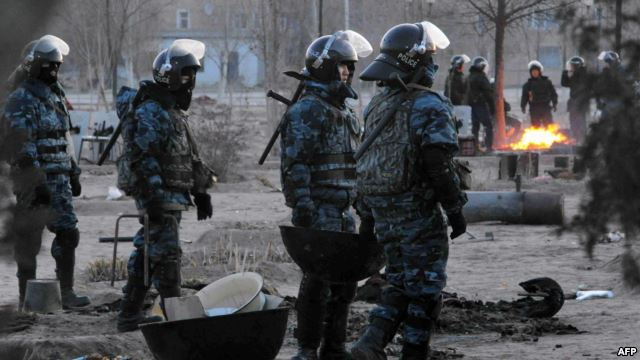
Police at Zhanaozen on 16 December 2011

Police at Zhanaozen on 16 December 2011

said: “You saw with your own eyes how they beat me and punctured my ears with a staple gun.” Another defendant, Tanatir Kaliev, repeated the claim. (Activists have not published the name of the officer, who has not been charged.)

■ Yesengeldy Abdrakhmanov, an unemployed man from Zhanaozen who was sentenced to three years’ imprisonment but released via an amnesty, told the court that he had contracted tuberculosis as a result of police torture. “I was stripped naked. They poured freezing water over me and beat me.”

■ Shabdol Otkelov, sentenced to five years, said in court that a security services officer “put a cellophane bag over my head and, stuffing it in to my mouth, forced me to confess to the preparation of explosives and to sign papers prepared by an investigator based in Astana [the capital of Kazakhstan].”

■ Roza Tuletaeva, a trade union activist who told the court she had been suffocated and hung by her hair, demanded that the tortures be investigated.

■ Kairat Adilov, sentenced to three years, told how an investigator put a gun to his head and threatened to shoot if he did not confess guilt.

■ Allegations of torture by police, prison officers and other security personnel were also made to the court by Ergazy Zhannyr, Serik Akzhigitov, Islam Shamilov, Bauyrzhan Telegenov, Zharas Besmagambetov, Samat Koyshybaev, Ertai Ermukhanov, Sisen Aspentaev, Zhenis Bopilov and Rasul Mukhanbetov.

■ Trial observers from Open Dialog say that, furthermore, six trial witnesses made allegations of torture in court. One, Aleksandr Bozhenko, who repeated the claims in television interviews, was murdered in unclear circumstances ten days later.

In 2013, Amnesty International accused Kazakhstan of “routinely” using torture, including in the Zhanaozen cases. (Amnesty report downloadable here.) Now some campaigners are calling for a “Zhanaozen list” of officials to be compiled, similar to the “Magnitsky list” drawn up by human rights activists in Russia, which led to the USA sanctioning security services officers involved in the ill-treatment and death in prison of lawyer Sergei Magnitsky.

Lyudmyla Kozlovska of the international campaign group Open Dialog, that has championed human rights cases in Kazakhstan, said in an interview with Saniya Toyken that putting together a list would take time. “The question of tortures is not being raised [by the authorities] in Kazakhstan, because it involves people at the highest levels of government.”

The UK connection

There are strong business links between the UK and Kazakhstan. BG Group (former British Gas, now merging with Shell) and other oil companies work there; Kazakh companies raise money through the London markets. Tony Blair, former prime minister, advised Kazakhstan’s government – including specifically encouraging them to hush up the Zhanaozen issue – and UK government ministers, together with Prince Andrew, keep the relationship sweet. GL, 13 December 2015.

■ Send solidarity messages via the Confederation of Labour of Russia (email ktr@ktr.su) and/or via the Justice for Kazakh oil workers facebook page, and/or via gabriel.levy.mail@gmail.com.

Kazakh oil workers information page

Kazakhstan: oil companies threaten activists

Officials with questions to answer

►Kalmukhanbet Kasymov, minister of internal affairs at the time of the Zhanaozen massacre, has twice been reappointed to that position. In 2014 he was awarded the Order of Honour, and in 2015 was given the rank of general-colonel.

►Amanzhol Kabylov, who was head of the department of internal affairs of Mangistau region, and was appointed commandant of Zhanaozen when the state of emergency was declared there after the massacre, has been promoted. He now works as the deputy chairman of the criminal investigation committee of the Astana police.

►Abkrasul Oteshov, former deputy head of the directorate of internal affairs in Zhanaozen, who was accused of torture at the oil workers’ trial, is currently deputy head of the directorate of internal affairs of Munailinsky district of Mangistau region. 

►Former head of the directorate of internal affairs of Zhanaozen, Mukhtar Kozhaev, has been promoted to a position as head of criminal police in Astana.

►Another deputy head of the directorate of internal affairs in Zhanaozen, Nuraly Barzhikov, who has said “I was on the square [where the shootings took place] and I used firearms,” remains at his post.

►Officer Marat Kyzylkuluky, who admitted using firearms, now works with the migration police in Zhanaozen.

►Colonel Ulykbek Myltykov, who said in court that he had not fired on fleeing demonstrators – and after being showed video vidence, said he “did not know why [officers] fired” – is currently head of the administrative police of the department of internal affairs of the Mangistau region.

►Former deputy head of the department of internal affairs of Mangistau region Erzhan Sadenov currently works as the head of the department of internal affairs transport division in Astana.  

__________

Kazakhstan: oil companies threaten activists
People and Nature
December 13, 2015

Oil company managers have warned workers not to demonstrate on the fourth anniversary of the Zhanaozen massacre, Kazakh opposition news sites reported last week.

A fresh wave of unrest is brewing in the oil field after the announcement of redundancies, caused by the falling oil price and company cutbacks. A Kazakh-Chinese drilling company laid off 200 people in August.

Activists jailed after the 2011 strikes – which ended with police killing at least 16, and wounding 60, when they opened fire on protestors on 16 December 2011 – are under special scrutiny. “The security services have

Roza Tuletaeva. Photo: Saniya Toyken

Roza Tuletaeva. Photo: Saniya Toyken

been active, and have carried out ‘preventive discussions’ with activists, especially those who have been released from prison,” Respublika newspaper reported.

“They have promised [the activists] that they will again be put behind bars, especially if they try to influence trade union elections, as happened on 21 November in Zhanaozen.”

Akzhanat Aminov, one of the activists who was jailed and conditionally released, has been given an additional one year suspended sentence. That was a response to his election in June this year as chairman of the trade union committee of Ozenmunaigaz, the largest state-owned oil production company, the socialismkz.info site reported.

Roza Tuletaeva, a prominent trade union activist who was jailed at the Zhanaozen trial, said last month in a telephone interview with Radio Azattyq that she is back at work in the well drilling division of Ozenmunaigaz. She expressed concern for the condition of Maksat Dosmagambetov, her fellow activist who is seriously ill following torture in detention. Roza added that she remains in touch with the 12 other workers jailed at the Zhanaozen trial.

While the Zhanaozen prisoners have now been released, the politician Vladimir Kozlov of the democratic movement Alga was last week denied conditional release terms. He was jailed in a general crackdown following the oil workers’ strikes, of which he was a prominent supporter. GL, 13 December 2015.

Editor’s Note. My profound thanks to Gabriel Levy for his permission to reproduce these articles here.