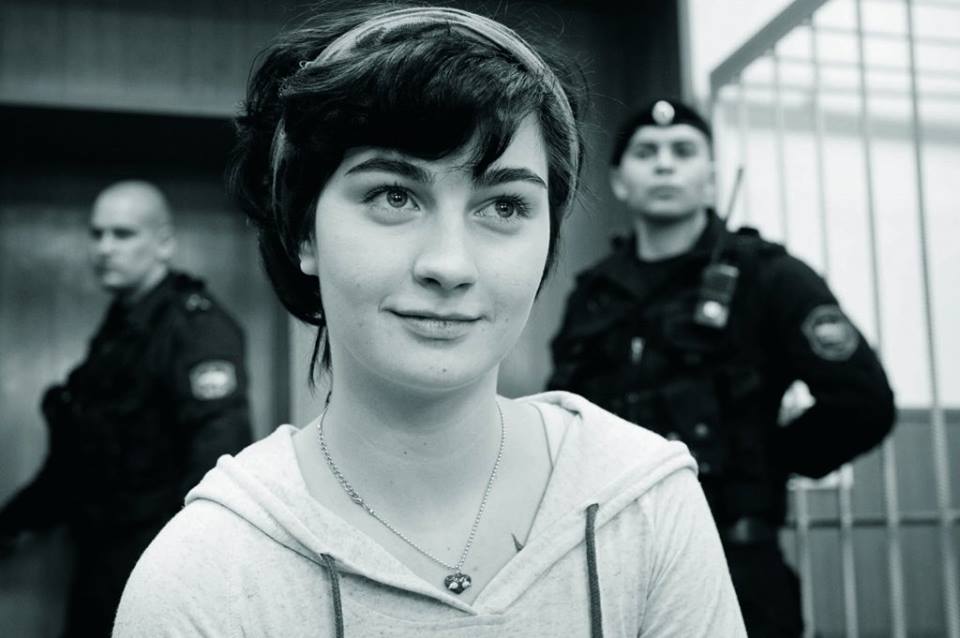
Nadya Tolokonnikova: The Year in Review

6_bottle

Nadya Tolokonnikova
The Year in Review, or, An Eternal Russian Winter in Solitary Confinement
December 29, 2015
Facebook

We rang in 2015 seeing Oleg Navalny sent off to a penal colony for three and a half years for the fact his brother was involved in politics.

Pyotr Pavlensky rang in 2015 by starting a bonfire on a Moscow quay.

“You spend the year the way you ring it in,” said Pavlensky as he left the Guelman Gallery, where we were seeing in 2015, and went off to an icy quay on the River Yauza to start a fire.

In November 2015, Petya pulled off the biggest art action of the year by torching the doors of the FSB. Pavlensky will greet the New Year in a cell at Butyrka remand prison.

In 2015 we found out you cannot only be imprisoned for political activism but also gunned down for it in the center of Moscow.

As 2015 ended, arrests in the Bolotnaya Square case continued. Anarchist Dmitry Buchenkov was arrested on December 3. The defense claims he was not at Bolotnaya Square on May 6, 2012.

Gallerist Guelman held a charity auction at his gallery in support of the Bolotnaya Square prisoners. The result was that the Guelman Gallery was no longer Guelman’s gallery. He was not forgiven by the powers that be for the auction, and the gallery was wrested away from him.

But the government also made humane decisions in 2015. After sentencing Vasilyeva to five years in prison, the court let her out on parole two months later.

In 2015, the government also destroyed embargoed produce, because they had no fucking clue what to do about falling oil prices. Russians were weaned off the notion of stability and tightened their belts as the Russian economic crisis made $400 a month a serious, substantial salary, as in the early noughties. In a number of Russian cities, the critical debts owed by municipal governments to fuel suppliers have led to stoppages of public transport, and electric companies have turned off the lights in the stairwells of apartment blocks.

The myth of stability has been destroyed, the state is the new punk, a rifle is a party, and everything is going to fucking hell in a hand basket. The New Year’s meal, by the way, will cost on average 5,790 rubles this year, which is 28% more than a year ago. So it is better to save money on December 31 and take a nap.

And, while you are sleeping, to dream of Pyotr Pavlensky, Oleg Navalny, and Bolotnaya Square political prisoner Alexei Gaskarov celebrating the New Year in their prison cells and pouring Duchesse, a domestic carbonated beverage, into recycled plastic instant mashed potato cups.

Amen.

Translated by the Russian Reader. Image of Duchesse soda bottles courtesy of Frutto

Alexei Polikhovich: “I Had Begun to Feel I Was Born in Prison”

“I had begun to feel I was born in prison and just had been released for a short time”
Alexei Polikhovich talks about spending three years behind bars for the right to think freely 
Ekaterina Fomina
November 5, 2015
Novaya Gazeta

Alexei Polikhovich after his release from prison. Photo: Ekaterina Fomina/Novaya Gazeta

Alexei Polikhovich, one of the few defendants in the Bolotnaya Square case who had actually been politically active before the ill-fated protest rally of May 6, 2012, has been released from prison. (We now understand this was the reason people were jailed: on suspicion of having vigorous civic stances.) Before Bolotnaya Square, Polikhovich, for example, had defended the Tsagovsky Forest and been involved in the antifascist movement. Some of those now spending their fourth year in prison after being convicted in the case had ended up on Bolotnaya Square by accident, but Polikhovich had chosen this way of life, a life of open struggle, consciously. It is a dangerous way of life to lead in our country, even if the way you fight your cause is ten times within the law. But Polikhovich consciously chose this way of thinking, and marched to Bolotnaya Square in the antifascist column.

However, on Bolotnaya Square on May 6, 2012, Polikhovich caught hell just as randomly as other protesters. Police pulled them from the crowd in the heat of the moment without looking .

Polikhovich insisted on his innocence at his court hearings. He knew he was being tried for his convictions.

Three years in prison were supposed to reform what? Polikhovich’s beliefs? He remained, however, true to his beliefs throughout his imprisonment. If reform meant betraying them, then Polikhovich has not been reformed, as he himself says. But he still learned something.

After his release, Polikhovich talked about the lessons he learned in prison.

__________

I have not seen people in color for three years. I have forgotten what it was like to have women and children around. Simple things seem new right now. After being in the penal colony, I think Moscow is quite beautiful.

When I got to Petrovka [38, Moscow police HQ], I did not understand how serious things were. I took everything as an excursion, a rough excursion, but an excursion nonetheless.

The wording “actively involved in destructive youth organizations” was included in my arrest sheet. The Center “E” officers [“anti-extremist” police] did not have a clear opinion about me, whether I was a rightist or leftist. What group should they assign me to? What mattered was that it should sound terrible.

The police investigators found us interesting. They had been used to dealing with Islamists and neo-Nazis. But leftists, social democrats, and liberals, everyone who had been arrested on trumped-up political charges, were something unfamiliar to them. The investigators enjoyed chatting with us. I remember one such conversation. A crowd of investigators was standing before me, and I was telling them why I was in jail. I explained I had not wanted to hit anyone, that had not been the objective. Well, I expressed it simply.

They immediately tensed.

“What was the objective? Who set the objective?” they asked. They think crudely.

Other inmates knew about our case, and I never encountered flagrantly negative attitudes towards us in this connection. On the contrary, sometimes they would see articles about us and come running with the newspaper: “Oh, it’s about our rock star.” I also encountered not very well-educated people who thought that since I had been jailed for a protest rally that meant I was a nationalist. Several times, I quite seriously cussed people out for saying this: it offended me.

I had expected remand prison would involve total isolation, but it was like a rural village in there: everyone was connected with everyone else. It was its own society. In Butyrka remand prison, they explained to me how to “spur the horses.” In prison, “the horses” is the rope that connects cells and works like an intercom. Books were soaked with narcotics and passed on to those who needed them. Because of this, by the way, the flow of regular books into the prison slowed down. According to the internal code of inmates, formal channels for getting groceries and cigarettes into the prison should not be compromised.

The penal colony, where you are not locked up in eight square meters, seems like the regular world compared to the remand prison. You can see the sky. You can spot newcomers to the colony immediately: we all arrived looking pale. We had almost turned into mushrooms after two years of hearings and trials. I drank up the sunshine with my skin. I got a dark tan right away.

At one point, I even thought I had been born in prison. It was just that I had been let out. I had quickly found myself friends, a wife, and parents. I had screwed up somehow and gone back to prison.

Alexei Polikhovich and his parents. Photo from family archive

In the colony, you can learn to be a tailor, a lathe operator, an electrician or an auto mechanic. The phrase “Labor liberates” is written on the gates of the manufacturing zone. I studied sewing for six months, then I studied to be a lathe operator while also working as a sewing machine operator. Convicts sew sheets, pillowcases, suits, blankets, and bags.  In anticipation of my release, I sewed a rucksack for myself and Tanya, my wife. I had also sent her an apron and some bags.

In prison, people have no way of filtering incoming information. They mainly read bad newspapers. They also would take out the [philosophical and] literary journal Logos, which has no pictures, have a gander at it and be amazed. If you put convicts on a diet of [the national newspapers] Novaya Gazeta, Vedomosti and even Moskovsky Komsomolets for a month, they would catch on to something. But they would watch TV constantly, then would come to me and dump on me about how bad things were in Ukraine and what a trooper Putin was. They particularly liked all the trash on REN TV about reptilians and conspiracy theories.

Few people read good books in prison. They mainly read fluffy stuff, detective novels and bad sci-fi. Books from the outside are rarely “reeled in.” Falanster bookstore and I organized a book fair of sorts: beginning with my time in the remand prison, they sent me an endless stream of books. They sent so many books I would have had to serve another sentence just to finish reading them! When I was released, I took only a single rucksack with me, containing only books and letters. When you leave prison, you have to leave as much behind as possible. Not everyone in there has two pairs of warm socks. I took the books I was certain would interest no one: William Zinsser’s On Writing Well and [Ditmar] Rosenthal’s Russian language textbook. I thought I should finally learn Russian properly, so I would not be ashamed to print what I wrote. I also brought out an anthology of lectures from the Priamukhino Readings.

These three years have happened. I cannot cut them off or cross them out. I probably would not have wanted to spend them in prison, but I spent them there. This foundation, this experience on which I now stand, I cannot push it out from under my own feet. Not because I would fall, but because I just cannot do it physically. It is difficult. It is a rock.

Am I angry at anyone? I did not suffer catastrophically over these three years. I can be angry at the system on behalf of my loved ones. They certainly did not deserve it and are not guilty of anything.

I probably have become angrier over the last three years. And a little weary.

Translated by the Russian Reader. Thanks to Gabriel Levy for the suggestion

Anna Gaskarova: What the Bolotnaya Square Case Will Leave Behind

What the Bolotnaya Square Case Will Leave Behind
Anna Gaskarova
May 26, 2015
Snob.ru

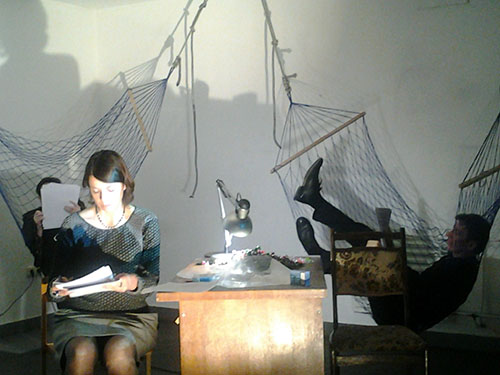
My husband, who has been behind bars for over two years as a suspect, defendant, and convict in the Bolotnaya Square case, and I have long had a tradition of giving theater tickets to our parents on birthdays, New Year’s, and other holidays, nearly always to productions by Teatr.doc. Our favorite, by the way, is Two in Your House, about the house arrest of Belarusian opposition leader Uladzimir Nyaklyaeu. It is one of the theater’s rare productions in which there are more laughter-inducing scenes than frustrating ones.

Six months ago I was contacted by the playwright Polina Borodina and asked to help collect material for a production about the Bolotnaya Square case for the theater that I loved so much. All that was required of me was to give an interview. At the time I thought that Polina would find it hard to write the play: there was nothing impressive about being the relative of a prisoner. It is very boring. I didn’t think she could manage to put together a story about the Bolotnaya Square case that would be interesting to anyone besides those involved in it.

pict2883506107

The premiere took place on the anniversay of the events on Bolotnaya. Policemen gathered outside the theater, and plainclothes officers sat in the audience. I saw the third performance of the production, and police were again standing on duty outside. It was raining, and Elena Gremina, the theater’s director, asked the officers to come inside.

“It is warm in here, and the play is quite good,” she told them.

They would not come in.

I fidgeted, giggled, and fretted, because I could not remember a thing I had said to Polina in the interview. It was scary to hear myself. And every time I recognized my own words in the lines of the actors, I cringed, buried my face in the shoulder of my sister, who was sitting next to me, and thought to myself with relief that it was a good thing I had not put my foot in my mouth.

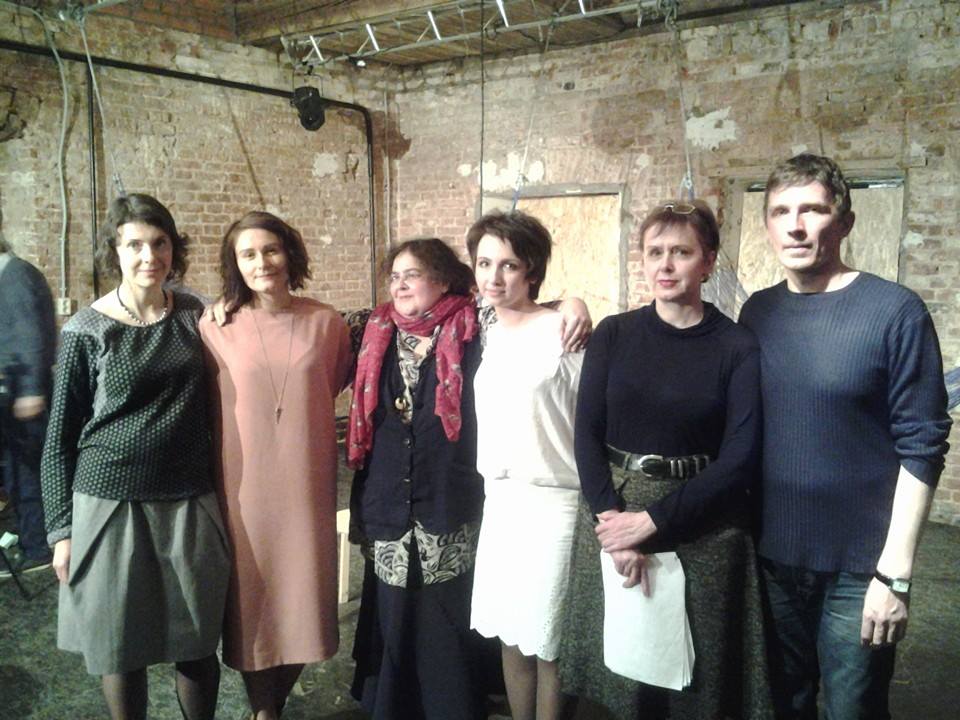
The boring trials, the red tape of the remand prisons, the monotony of putting together food parcels, and the terrible anguish of the relatives in the Bolotnaya Square case has been turned into a very interesting story told by four actors in the words of the mothers, fathers, wives, fiancées, and friends of the arrestees. There are no exaggerations and distortions; only quotations from interviews with loved ones. They talk about how visits go, how to get married in a remand prison, how the defendants entertained themselves during the boring trials—and how to inform a defendant that his mother has died.

I had always wondered whether anything except shame, three and a half lost years, and painful memories would remain after the the Bolotnaya Square trial, something decent and instructive—not for us relatives but for those were there with us on Bolotnaya Square on May 6, 2012, and for those who were not.

I think this question has stopped vexing me. Stalin’s purges have left us Solzhenitsyn’s Gulag Archipelago and Shalamov’s Kolyma Tales. The Bolotnaya Square case will leave behind Teatr.doc’s The Bolotnaya Square Case.

ee61b2c98d7567978852636630bb38f2Many thanks to Polina Borodina, Elena Gremina, Konstantin Kozhevnikov, Anastasia Patlay, Varvara Faer, and Marina Boyko.

Photos courtesy of Snob.ru

Alexei Gaskarov: The Robin Hood of Zhukovsky

Alexei Gaskarov: The Robin Hood of Zhukovsky

Three years have passed since the opposition March of the Millions on Bolotnaya Square in Moscow ended in a physical confrontation with riot police, hundreds of arrests, and, later, dozens of criminal cases brought against protesters, who had engaged, allegedly, in “rioting” and “violence” against the police.

Although more than thirty defendants have been tried as part of the Bolotnaya Square Case, police investigators and prosecutors continue to unearth new suspects to this day.

This is the story of leftist social activist and antifascist Alexei Gaskarov, a 29-year-old economist from the Moscow suburb of Zhukovsky, as told by his family and close friends. Gaskarov, who is also an elected member of the Opposition Coordinating Council, was sentenced to three and a half years in prison on August 18, 2014.

gaskarov2_0
Alexei Gaskarov. Photo courtesy of avtonom.org

The Bolotnaya Square Case: The Third Anniversary

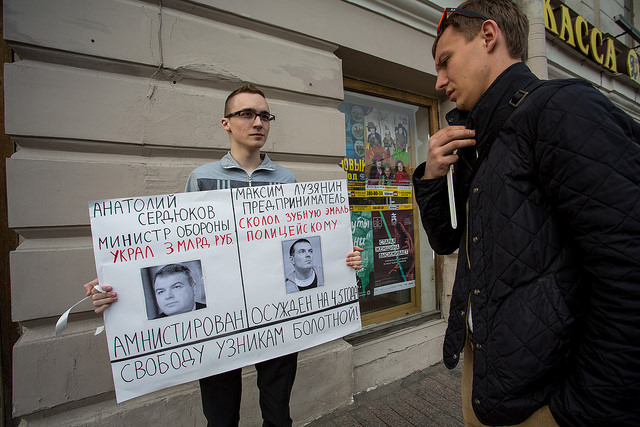
Here are a few photographs, from a longer, excellent photo reportage by David Frenkel, of pickets in Petersburg held this past Wednesday, May 6, in support of the political prisoners now serving time in prison as part of the Bolotnaya Square case.

Three years ago, on May 6, 2012, a peaceful, permitted anti-Putin demonstration in Moscow was blocked and partly kettled by police, resulting in a scuffle between some marchers and police, hundreds of arrests and, in the years after the “riot,” dozens of convictions of people who were there that day.

Some of the defendants have been recognized by prisoners of conscience by Amnesty International, and many observers have argued that the police attack on the peaceful march was Putin’s deliberate revenge on those freethinking Russians who had the temerity to protest his “electoral victory” on the eve of his re-inauguration.

Bizarrely, three years later, the investigation and the arrests continue. Less than a month ago, for example, civil rights activist Natalya Pelevina was questioned as a suspect in the case and had her apartment searched.

frenkel-2“Renat Fatkhutdinov was a [Kazan] policeman who threatened to rape and torture arrestees. He got a three-year suspended sentence. Denis Lutskevich was a student who was beaten by the riot police for trying to defend a young woman. He got three years and six months in prison.”

frenkel-3

“Ten people are still serving prison terms for the fact that on May 6,  2012, they went to a peaceful demonstration that had been permitted by the authorities.”

frenkel-4

Anatoly Serdyukov, the defense minister, embezzled 3 billion rubles and was amnestied. Maxim Luzyanin, an businessman, scratched the enamel on a policeman’s tooth an was sentenced to four and a half years in prison. Release the Bolotnaya Square prisoners!”

frenkel-5

Igor Aranson, head of the local council of deputies [in the Moscow Region town of Uvarovka] [and member of the ruling United Russia party] severally beat up two men he did not know [because they had crossed in front of his car on a crosswalk], but the court declared that Aranson had been the victim of the crime. Sergei Krivov, a Ph.D. in Mathematics and Physics, grabbed a police officer’s truncheon. He was sentenced to three years and nine months in prison. Release the prisoners of May 6!”

Thanks to David Frenkel for permission to reproduce these photographs here.

Alexei Gaskarov: “The Desire for Justice Has Not Faded”

“The Desire for Justice Has Not Faded”
Alexei Gaskarov (as reported by Maria Klimova)
29 December 2014
MediaZona

On August 18, 2014, the Zamoskvoretsky District Court in Moscow sentenced four defendants—Alexei Gaskarov, Ilya Gushchin, Alexander Margolin, and Elena Kokhtareva—in the so-called second wave of the Bolotnaya Square Case. Judge Natalya Susina found each of them guilty of involvement in rioting (Article 212, Part 2 of the Russian Federal Criminal Code) and using violence against authorities (Article 318, Part 1). Gaskarov was sentenced to three and a half years in prison. On November 27, the Moscow City Court dismissed an appeal against the sentence filed by all four defendants.

Antifa: “We Were Able to Tell Good from Evil”
There are different people in prison. The majority are not the same people we are used to interacting with on the outside. There are different sorts: junkies, criminals, and outright riffraff. But I still find myself thinking I had seen a number of these characters in the yard of my building back in the day. I have flashbacks when I encounter these people. So when you ask why my friends and I became antifascists, you have to imagine the environment we come from.
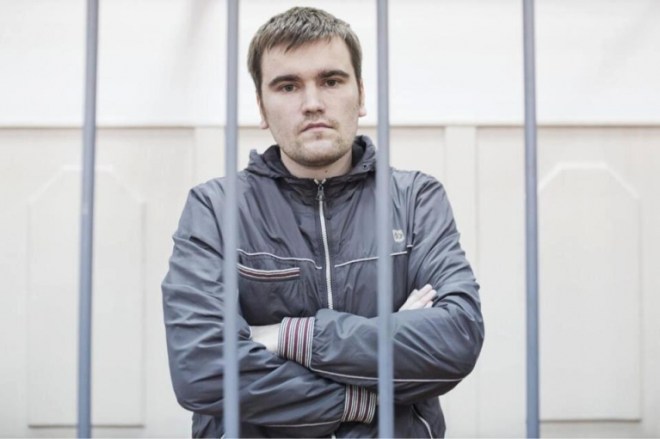
Photo_Gaskarov_behind_barsAlexei Gaskarov

I remember well what was happening on the streets in 1998–1999. The first skinheads and football hooligans had appeared, ethnically motivated killings were becoming more frequent, and rabidly fascist ideas were gaining popularity. A reality emerged that was invisible to the majority of people. With each passing year, the situation worsened, and the violence increased. We wanted to oppose it. We were able to tell good from evil. The neo-Nazi scene, on the contrary, attracted people not blessed with intellect, frankly. Most of them were up to nothing more than wasting their time on inciting racism and making fake videos of racist attacks. People like Artur Ryno and Pavel Skachevsky, the White Wolves, and other asinine teenagers bought into this.

Society has paid no mind to the killings of migrants, because it is quite xenophobic itself. Its attention has been drawn when Russians square off against Russians, when neo-Nazis murder antifascists in stairwells. But, in fact, at least one hundred ethnically motivated murders occurred in 2008–2009, and this should have been cause for concern.

BORN and Donbas: “They Have Been Hoodwinked”
I have tried as much as possible to follow the trial in the BORN case. It is complete nonsense that the accused are now pretending their actions were motivated by concern for the Russian people. This crazy fascism has nothing to do with defending ethnic Russians.

The boneheads (neo-Nazi and white power skinheads) were a product of society as it existed then. Maybe if Russia had been a democratic country, as it is on paper, the right-wingers would have had the chance to realize themselves in the political arena. In fact, all they had was street politics. The question is whether all those murders would have been committed had they been able to register their own political parties officially.

As we see from the testimony given at the trial by Nikita Tikhonov and Yevgenia Khasis, the neo-Nazis tried to get their own political party, but to create it they needed a combat organization. By creating BORN (Combat Organization of Russian Nationalists), they were hoping to force the regime’s hand, to show they were capable of violence, but that there would be no violence if they had legal means of pursuing their ends.

The antifascists never had the goal of killing anyone. It was the neo-Nazis who first embarked on the path of violence, but this was because there was a certain political will for this. It is important to realize that, despite the street battles, until the mid 2000s the ultra-rightists did not see the antifascists as people whom they needed to shoot first. However, after Maidan 2004, the regime clearly tried to find support within society, including among potentially loyal young people. The nationalists were regarded as just such young people. There were lots of them, and they could be organized around football. This was when the first Russian Marches took place, and nationalists were allowed to set up semi-militarized training camps.

The neo-Nazis were supposed to oppose the so-called threat of orange revolution, the people dissatisfied with the current regime. Antifascists and anarchists were then considered part of this threat. This was when the turning point occurred: it was now considered a priority to destroy us.

Ilya Goryachev and Nikita Tikhonov, BORN’s ideologues, were apparently able to get the message to the presidential administration that they could confront left-liberals on the streets. And they would tell rank-and-file members of their gang that, for example, Pavel Skachevsky’s sister had been attacked by antifascists. This is complete nonsense: I know for a fact that antifascists Ilya Dzhaparidze and Koba Avalishvili didn’t do it. I don’t know whether Skachevsky’s sister was actually attacked at all. At the time, the website of DPNI (Movement against Illegal Immigration) was active, and it would publish information that was untrue, and simply meant to incite people. The fact remains that Dzhaparidze, who was murdered by the neo-Nazis, had nothing to do with this business. But the morons from BORN just believed it and did not even bother to verify the information. The same goes for why Ivan Khutorskoi was killed. It is, of course, complete rubbish that he broke the arms of underage nationalists. He might have talked to them and given them a slap upside the head, but no more than that.

The people from the far-right groups are no nationalists, of course. We know that many of them have gone off to Kiev to fight with the Azov Battalion, for example. This is not the same segment of nationalists that protested on Bolotnaya Square, but the marginal part of the movement, which took advantage of the fact that young people often go into denial when they see society’s existing problems.

I have the feeling that the BORN case, the case of neo-Nazis who sincerely believed they were defending the Russian people, has not taught anyone anything. We now see how this anti-Ukrainian hysteria has been whipped up. It is largely due to this hysteria that Russian citizens have been going off to Donbas to fight. They sincerely imagine they are going there to defend the interests of the Russian people. But in fact they have been hoodwinked. Like Vyacheslav Isayev and Mikhail Volkov, two of the defendants in the BORN trial.

Ukraine and Television: “Discrediting the Very Idea of Protesting”
Many people are too susceptible to television, to what they hear said on it. We have returned to 2004, when Maidan was a threat to the Russian regime. As then, our country’s authorities are trying to discredit the very idea of protesting against an existing regime.

We all remember the invasion of Crimea by “polite people.” It is clear that Ukraine has the right to resist—not their own populace, of course, but the armed men who entered their country and occupied government buildings. They entered the country, occupied cities, cut off access to information from the outside world, and pumped people full of propaganda.

Russia has done much to ignite chauvinist attitudes in eastern Ukraine, but neither have the Ukrainian authorities used all the means they have for negotiating. They should have introduced institutions of political competition and made their arguments with words. It would have been much better if they had tried to use democratic levers.

I know what European integration is fraught with. In Ukraine, all the political forces got behind integration with Europe. And then Russia suddenly adopted an antiglobalist stance. Yet it was obvious that being in a customs union with Russia would not have brought Ukraine any benefits. It needed reforms: hence the decision to unite with Europe. I do not agree with this decision, but I understand the arguments in its favor. At any rate, the choice for European integration was democratic. It is also telling that Maidan did not go massive when integration was being discussed, but only after the police forcibly dispersed a student demonstration.

I have much less access to information than people on the outside, but I believe the referendum in Crimea was held in such a way that it is impossible to say whether it was conducted properly or not. It is not possible to determine this right now, because even the current mood is largely shaped by propaganda that is broadcast in the absence of an alternative viewpoint. I cannot imagine holding a fair referendum at the moment, unless, perhaps, Ukrainian TV channels were allowed on the air there.

The question is who, exactly, will bear responsibility for its having happened this way.

Outcomes and Know-How: Why Be Involved in Russian Politics Today?
The verdict in our case, the closure of independent media, and all the hypocrisy around events in eastern Ukraine point to the fact the Kremlin has adopted a policy of self-preservation. This entire authoritarian system has begun to rot, but there are things allowing it to remain afloat. That is why it has to nurture the oligarchic elite, cops, and FSB officers.

This year has shown that banking on a majority consolidated at Ukraine’s expense and shutting out the twenty per cent who are dissatisfied with current policies is impossible without the loss of economic prosperity. Everyone has now been talking about restructuring our country’s resource-based economy. But why was this impossible to do over the past fifteen years?

You cannot constantly tighten the screws without the public welfare’s deteriorating. I have no illusions about violent revolution: however many people take to the streets and whatever it is they might oppose, there will always be more people from the security forces. So people have two ways of making an impact now: the first is going out and voicing their concerns, while is the second is quiet sabotage—leaving the country, not investing in anything. I know there are many people in business who are leaving because they cannot breathe here. The authorities can, of course, use the same scheme as they did on Bolotnaya Square, but that will trigger another outflow of people and capital; even more money will be taken out of the country. There will be fewer and fewer resources, but the salaries of the cops will still have to be paid. This, in turn, will lead to a split within the elite.

The current power structure is similar, in some sense, to the structure of BORN: it is just as completely opaque. Because of this, complete morons can be wind up at any point in the decision-making chain.

My sense is that the authorities will soon be forced to liberalize, to back off a bit. There will be breaks for businesses. For some, this will be enough to continue developing them. We will return to the old, slow path of growth. Maybe in some ways this is better than this crackdown and gradual slide into hell. They might stop dispersing opposition rallies or not jail Alexei Navalny, for example. The regime has many ways of avoiding a deplorable sequence of events.

Ukraine has shown that this pro-government crowd, who occupy niche positions, can just up and disappear one fine day. A year ago, no one knew that there would be tours of Yanukovych’s residence. When this happens, the old system has to be replaced with something.

The difference between federal and local politics in Russia is still not very great. This was shown well by the recent elections in my hometown of Zhukovsky, where local activists ran for city council and got half the votes, but in the end only two of them won seats.* This is not a good outcome. It has been impossible for activists to have an impact on anything. It did not work out when they wanted to defend a forest. The authorities shut down all such grassroots pressure campaigns.

It is not the outcome that matters nowadays, however, but the process of being involved, because what remains is a community with experience of solving problems. That community is not going away. And if certain changes suddenly begin in the country, then it is certainly a good thing such communities will already be there at the local level and can be the basis of new institutions. Yes, many people are now demoralized, but the desire to get justice and resist thievery has not faded.

Jail, Bolotnaya Square, and Me
I am certain that nothing would have changed had I not gone to the May 6, 2012, opposition protest on Bolotnaya Square, for example. No matter what I did, strange criminal charges would have been filed against me anyway. This is evident even from the news, where everything is presented in such a way that even popular TV presenters Tatyana Lazareva and Mikhail Shats, who were on the Opposition Coordinating Council [along with Gaskarov], are depicted as criminals.

The point is not Bolotnaya specifically, but the fact that if you are involved in activism, criminal investigations will be opened against you. That rubbish with Navalny and the stolen picture is a specific story stemming from Bolotnaya Square. I did foresee that this might happen.

I have no particular hopes for another amnesty. I have the sense the authorities might go for an amnesty for people convicted of economic crimes, because there is a theory that they could help improve the current economy, that the businessmen will one way or another add a fraction of a per cent to economic growth. The authorities could decide to do this. As for us, I have huge doubts. In prison, though, people always pin great hopes on amnesties. In reality, all the prisons are overcrowded: in violation of all European standards, there are two and half meters of living space per prisoner. And when Putin said, recently, that amnesties need not happen too often, he cannot but have known that practically no one got out under the first prisoner amnesty.

You can survive in the pre-trial detention facility, of course. There are no rats running around in the cell or moldy walls in here. And they take us out for a walk every day. True, the courtyard here is bare, and you cannot even see the trees. It is hard to keep track of the seasons: time flows differently on the inside. In short, they do not let you forget you are not at a health spa.

In terms of building relationships, the experience I gained while jailed for two months in the case of the attack on the Khimki town hall has come in handy here. I am used to the fact that people come and go at the pre-trial detention facility. You come across different characters. Recently, there was a guy in here who had lived in the woods for two months. He had been working in construction when he got screwed out of his pay. He didn’t know what to do and went into the woods. He drank hawthorn berry tincture there and had become something like a vagrant. He was nicked for stealing a bike.

I really want all political prisoners released as quickly as possible. And not only released, but released into a free country. I would like the space in which we all have to live to be freed up, to be less gloomy. This is my wish. That a thaw finally comes.

* City council elections took place in Zhukovsky, a town of 105,000 residents forty kilometers southeast of Moscow, on September 14, 2014, Russian general election day. Observers reported massive vote rigging, ballot box stuffing, and tampering with vote tally reports by polling station officials. A month later, members of the Presidential Council on Civil Society and Human Rights brought the matter to the attention of Vladimir Putin. The president promised to order the prosecutor’s office to investigate the election violations in Zhukovsky, but the outcome of the election has still not been officially challenged or amended.

Editor’s Note. This translation was previously published, with an excellent introduction and afterword by Gabriel Levy, on People and Nature. Translated by The Russian Reader.

Anna Karpova: My Wedding Night

My Wedding Night
Anna Karpova
August 7, 2014
Snob.ru

tumblr_inline_n9y746ltjl1si8br2

“And now, the newlyweds can seal their union with a kiss.”

Lyosha and I had long ago stopped listening to the young woman from the registry office and were already sealing our union.

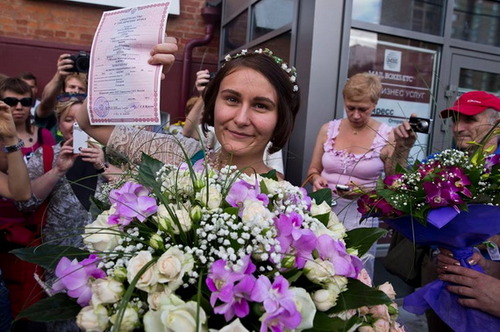
I reluctantly let go of Lyosha’s hands so he could hug my parents and his parents. Our mothers were hiding faces moist with tears behind bouquets.

“Let’s leave the young people alone for a few minutes.”

Everyone left, closing the transparent door of the room where prisoners meet with lawyers. The guard peeked shyly through the glass, and the smell of fresh bread wafted in from the corridor: there is bakery on the first floor of Butyrka prison.

“You’re so cool when I touch you, so . . . real.”

“I love you very much.”

“I love you more.”

We didn’t talk much. We cuddled each other and winced at every rustle, afraid the guard would come in to take my husband away.

I clung to Lyosha as if it would slow down time.

“What should I do tonight when I leave and you stay here? How should I finish this day?”

I had been tormented by this question since we had set the date for the wedding.

“Go out with someone, but if you’re tired, go home to the cat.”

“And what will you do?”

Lyosha laughed.

“You all ordered me a festive meal, so I’m going to eat.”

There was a guilty knock at the door. A prison officer informed us our time was running out.

“When we get out of prison—I mean, when I get out—I will hold you for days on end.”

I cried and buried my head in Lyosha’s shoulder. My husband had been calm all this time.

“My heart is going to leap from chest now,” he suddenly said.

We embraced our parents and the staff from the Public Oversight Commission who had come to the jail to congratulate us. Thanks to them we have photos of the wedding ceremony. Lyosha was being led away—without handcuffs, but under guard.

Now I was going to leave the place, but Lyosha was staying here. A chill emanated from the walls, and behind me countless doors slammed shut. The sound was like the sound of a guillotine’s blade falling.

Now I was going to get out of there and bawl. I would not go out with anyone. I would not go home to the cat. I would sit down on the steps of the remand prison. Better yet, I would lie down on the steps, and I would wallow there until they let Lyosha go. The leaves would fall from the trees, then it would snow, then it would melt, and the branches on the trees would bud, but I would still be lying there, because my life was over.

Everything turned out exactly the opposite. Rather than lying down and dying, I came to life. Despite the period of mourning I had declared, the people who came were so sincerely happy for me that I started to feel happy for myself. I went out, and then I went home to the cat, and I wasn’t left alone for a minute, because everyone knew and understood I was horrified by the fact I didn’t know to how end this day.

At home, the first thing I did was hug Jean-Paul, the huge teddy bear that Lyosha had given me for my twenty-third birthday. If you pinch his paw, he says clever things. On the day of my wedding, he said, “Love means conceding the person you love is right when he’s wrong.”

I had imagined my wedding night differently. Anya, one of my future bridesmaids at my future, real wedding on the outside, was falling asleep on a nearby couch.

“Hey, what do I do with my ‘wedding’ dress? I was wearing it when the guard led my husband away down the corridors of Butyrka prison.”

“Nothing terrible happened today. I haven’t seen you so happy in a long time. Put that dress on more often.”

blog_entry_621251

Anna Karpova married antifascist activist Alexei (“Lyosha”) Gaskarov on August 6 in the Butyrka remand prison in Moscow. Tomorrow, August 18, Gaskarov is scheduled to be sentenced with the second group of defendants in the Bolotnaya Square case. Read his closing statement at their trial here. Images courtesy of Snob.ru and Gaskarov.info.

UPDATE. On August 18, Alexei Gaskarov was sentenced to three and half years in prison.

Alexei Gaskarov: “If the Way to Freedom in This Country Runs through Prison, We Are Ready to Go”

The verdicts on the second group of defendants in the Bolotnaya Square case will be announced in Zamoskvoretsky Court in Moscow on August 18. The prosecutor asked the court to sentence Alexander Margolin and Alexei Gaskarov to four years in prison; Ilya Gushchin, to three years and three months in prison; and Elena Kokhtareva, to three years and three months suspended, with four years of probation. All four defendants have been accused under Article 212 Part 2 (involvement in rioting) and Article 318 Part 1 (use of non-threatening violence against a public official) of the Russian Federal Criminal Code.

On August 4, 28-year-old antifascist Alexei Gaskarov made his closing statement in court. This is the complete text of his speech.

gaskarov-Feldman-3-600x400Alexei Gaskarov

The so-called Bolotnaya Square case has been symbolic in the sense that through it the public sees how the authorities interact with the opposition, with those people whose viewpoint differs from the general line.

The first thing I wanted to talk about is something that was not addressed in the trial, but which I think is important: why on May 6, [2012,] despite everything, so many people decided to be involved in certain events, rather than simply stand another two or three hours in queues, and ultimately did not permit themselves to be beaten with impunity.

The May 6 demonstration was the seventh major event staged by the opposition [during the 2011–2012 fair elections protest movement]. Whereas earlier, before December 2011, a few thousand people attended protest rallies I had witnessed, when you-know-who said the idea of rotating governments was not the best thing for Russia, the core group of protesters increased significantly. And these people did not go organize riots, but went to observe elections in order to understand and record the way the political processes that occur in our country are legitimated.

kohtareva-11-600x400Elena Kohtareva

Everything fell into place on December 4[, 2011, when parliamentary elections were held in Russia]. Despite the fact that the institution of elections had been destroyed much earlier, the large group of people who went to the polls as observers saw how the legitimacy of the current government was shaped. I myself was an observer at those elections, and what we saw was quite straightforward. Indeed, it is a strange situation when you are trying to find at least one person among your acquaintances who would say they voted for United Russia. In fact, such people did not exist: there was no mass support for the government. When they tried to counter the Bolotnaya Square protests with an event on Poklonnaya Hill in support of the current government, they could not gather more than a thousand people.

This subject itself was extremely important, but unfortunately it was not sufficiently popular with the authorities. Fair elections are still the only legal way of changing the political system, and once it has been changed, you can solve social and economic problems. A huge number of people took to the streets. There was almost no reaction on the part of the authorities. The protests were peaceful, the protesters were numerous, and it was obvious the demands they made and the problems they talked about were real, but instead we saw only a reluctance to engage in dialogue and, at some point, flagrant mockery.

A lot of people now do not like what thuggish characters in Ukraine are calling people from Southeast Ukraine. But here in Russia the same thing happened: when people came out on Bolotnaya Square, the country’s president called them Bandar-log and made many other unflattering comparisons. We were told we amounted to only one percent, that only one hundred thousand people in a city of ten million came out to protest, that it meant nothing at all. But later, when they actually allowed a fair poll, as happened during the [September 2013] mayoral election in Moscow, it turned out it was not one percent, but forty percent, a significant segment of society. And I would like to say that we should be glad on the whole that the events on Bolotnaya Square happened as they did.

In all developed democratic countries, protest rallies, the opportunity to express points of view that differ from that of the authorities, generate political competition, which enables countries to find the best way of developing. By the way, certain problems in the Russian economy began precisely in the third quarter of 2012, because it is impossible to build a stable economic and social system when you completely demotivate and exclude such an essential part of society. And it was obvious that this part of society was essential.

The first signal that comes from our case: does the right to protest, which exists in all developed countries, exist at all in Russia? As we see now, Russia has been deprived of this right.

And the second signal, which it is impossible to ignore: has the rule of law survived in Russia? Individuals must be protected from the actions of the authorities not only by a system of checks and balances but also by the possibility of appealing directly to the law in the way in which it is worded. I think this can be seen in our case. There is Article 212 of the Criminal Code: it may be poorly worded, but it is worded the way it is. And it is wrong, I think, to raise such obvious questions at the trial stage, because the law is worded quite clearly. We read a lot of commentaries to the Criminal Code and nowhere did we find that the corpus delicti of “rioting” could be defined alternatively, based on the evidence listed in the charges. Nevertheless, this has been consistently ignored. Even in those decisions entered into the case file, this subject was roundly rejected.

In and of itself, the rule of law is the most important of the institutions that protect the rights of individuals from the state. And, of course, we cannot ignore the selective application of the law to citizens. I realize that Russian law is not based on precedent, but it is impossible not to notice that if, for example, you are a nationalist, block roads, and set fire to shops, but refrain from speaking out against the actions of the authorities, you are only guilty of disorderly conduct. If you go to protest rallies where people shout, “Putin is a thief!” you are, accordingly, liable to serious criminal charges.

guschin-Feldman-3-600x400Ilya Gushchin

There is one last point following from our case to which I would also like to draw attention. I think a signal is being sent: if you are loyal to the authorities, you will enjoy the most favorable conditions; if you are disloyal, you will go to jail. This concerns the evaluation of the actions of demonstrators and the actions of police. It is too obvious that not all the police behaved as they should have behaved. I understand this was not specifically the matter in dispute in our case, but not a single criminal case has been opened against the police. Practically speaking, they have tried to turn the police into a caste of untouchables as part of our case. When there was a public debate on the Bolotnaya Square case, the same phrase always came up: “You cannot hit police.” Even in our group of thirty people charged in the Bolotnaya Square case, only three people actually struck police officers. And yet the whole complexity of this situation was primitivized through a single phrase: “You cannot hit police.”

margolin-svoboda.org-3-600x400Alexander Margolin

But it seems to me this way of posing the question dismisses and completely destroys any criticism of the government. We cannot forget that many terrible things have happened in our country (for example, during the Great Terror [under Stalin in 1937-38]), that people in uniform committed all these crimes, and everything they did was legal for all intents and purposes. But now they tell us there should be no critical rethinking of this situation, that it is necessary to stupidly obey the thesis that was endlessly repeated during discussion of our case.

The main thing I would like say, your honor, is that I really would not want it to happen that, after our trial, speaking of the law as an expression of the principle of justice became a sign of bad taste. I would hope that our trial did not pursue any other political objectives that have been imposed on it, that have been set for it—and all that is in the case files—but that we be judged for the things we really did. But if, in this country, the way to freedom runs through prison, we are ready to go. That is all.

Originally published, in Russian, at Grani.ruPhotos courtesy of Bolotnoedelo.info.

Afterword (copied from People and Nature‘s first publication of this translation)

On July 24, two other defendants in the Bolotnaya Square case, the left-wing activists Sergei Udaltsov and Leonid Razvozzhayev, were each sentenced to four and a half years in prison on charges arising from the May 6 demonstration. Supporters of Alexei Gaskarov and the other three defendants being sentenced this month fear similarly harsh penalties on August 18.

Solidarity makes a difference in such cases. While the Russian government claims to be championing “antifascism” in Ukraine, it is sending antifascists and other oppositionists in Russia to jail for long periods. The more support for these activists from antifascists internationally, the better.

Please copy and republish this article; demonstrate or protest however you can; write to the Russian embassy; and look on the Free Alexei Gaskarov site and the May 6 Committee site.

Update. On August 18, Alexei Gaskarov and Alexander Margolin were sentenced to three and half years in prison; Ilya Gushchin, to two and a half years; and Elena Kokhtareva, to a suspended sentence of three years and three months including three years’ probation.

The International Socialist Press

statia-2-ing8
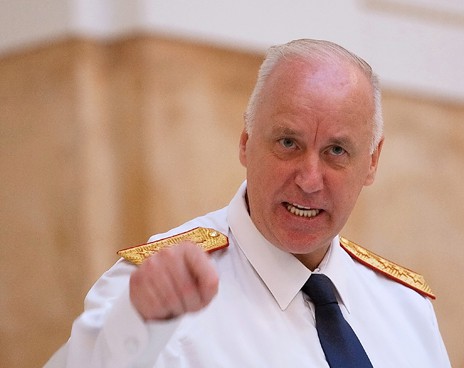
Alexander Bastrykin, Russian NGO head and friend of international socialists

One thing I love about the international socialist press is that it opens my eyes to problems and things I never even suspected existed, even in places I thought I knew well. For example, this morning, reading the World Socialist Web Site (no less!), I found out about a new NGO (apparently), “the Russian-based Investigative Committee”:

Vladimir Markin, spokesman for the Russian-based Investigative Committee, said Monday that at least seven bullets were fired into Russian territory. The committee suspected those responsible were “soldiers of the Ukrainian Armed Forces, members of the National Guard and of Right Sector.”

Imagine my surprise when, a few minutes later, reading a non-socialist web site (I read those too, sometimes!), I learned the Petersburg branch of the same NGO, “the Russian-based Investigative Committee,” had just arrested a member of the liberal opposition party Yabloko, accusing him of sodomy.

Intrigued by this broad spectrum of the NGO’s work, from monitoring Ukrainian fascists to rounding up Russian sodomites, I did a Google search on the Committee. What I discovered only increased my admiration for their work. It turned out its employees had recently been threatened by some very bad people who had started a riot in Moscow in 2012:

Officials investigating a 2012 anti-government protest that led to the sentencing of eight activists this week have been on the end of threats, the head of the country’s main investigative agency said Thursday.

Investigative Committee chief Alexander Bastrykin said, apparently responding to criticism of the case, that investigators had not only shown steady resolve and integrity in pursuing the matter, but had done so in the face of intimidation.

Bastrykin did not elaborate on the nature of the threats or which individuals had been targeted.

On Monday, seven activists were sentenced to prison terms of between 2 1/2 to four years for participating in rioting and violence at a rally on Moscow’s Bolotnaya Square in May 2012, a day before Vladimir Putin was sworn in for a third term as president.

An eighth activist received a suspended sentence.

More than 400 people were detained at the demonstration, one of several large-scale street rallies in Moscow and other Russian cities that had taken place since December 2011 to oppose Putin’s return to the presidency.

I hope to learn more about the truly great work of “the Russian-based Investigative Committee” from the international socialist press in the coming weeks and months.

Image courtesy of newsworldrussia

On Monday, the Regime Will Sentence Itself

This is Alexandra Dukhanina (aka Alexandra Dukhanina-Naumova and Alexandra Naumova, since she was married after her arrest), one of the eight people declared guilty by a Moscow court, yesterday, February 21, 2014, of “rioting” and “assaulting police” during a sanctioned opposition demonstration on May 6, 2012, in central Moscow.
1609989_671244502921563_1873186658_nAlthough Dukhanina and her fellow dangerous criminals were found guilty on Friday, the court has “cleverly” delayed the sentencing hearing until this coming Monday, that is, until after the closing ceremony of the Sochi Olympics, President Putin’s lavishly expensive celebration of his allegedly triumphant reign. It is entirely likely that on Monday Dukhanina and her co-defendants will be sentenced to five or six years in prison. This is the punishment that prosecutors have asked the court to impose on them.

Dukhanina’s real “crime” is that she dared to challenge — peaceably and legally — President Putin’s triumphant “re-election” the day before his inauguration. She did this along with tens of thousands of other people, but she and her co-defendants were seemingly randomly picked out from this great mass of folks and arrested, held interminably in pretrial detention (or, in Dukhanina’s case, under house arrest), and over the past few months, subjected to a senseless show trial. The authorities, apparently, wanted to make examples of them, to show the greater public that this is what happens to “ordinary” people when they oppose supreme political power and get mixed up in the “dirty” business of politics.

As anyone who has been following the Bolotnaya Square case can tell you, however, Dukhanina and her co-defendants are anything but ordinary people. They’ve consistently shown themselves to be courageous, intelligent, funny, and indomitable folks, extraordinary models of solidarity, and an inspiration to their fellow citizens and other “ordinary” people everywhere. More than anything, Dukhanina and her comrades show us what Russia could look like, what it will look like, when the Putinist tyranny has ended.

But don’t believe us. Read the closing statement Dukhanina made to the court earlier this month.