Sergei Krivov: “It Is Not Recommended to Live in This Country”

The other day, a friend of mine who works with kids complained to me that kids in Russia had no real heroes. Like kids most everywhere, they are in love with the wretched, hyper-commercialized Spider-Man and Harry Potter, not with homegrown heroes.

It might be a bit of a reach (because how do you explain this stuff to kids?), but from where I sit there are lots of heroes in modern Russia. Prominent among them are all the people convicted as part of the shameful sham known as the Bolotnaya Square case.

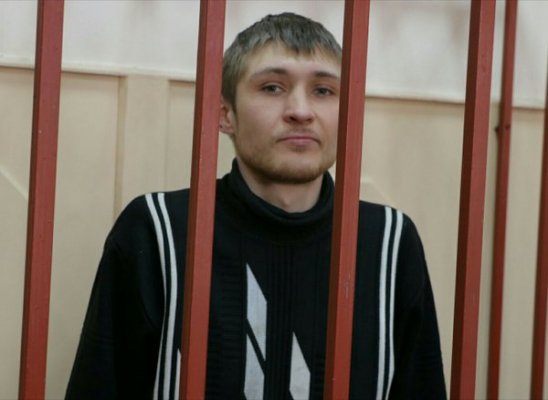
One of those heroes is Sergei Krivov, recently released after serving over four years in prison for the nonexistent crimes of being beaten over the head with a truncheon by a policeman and attempting nonviolently to prevent policemen from doing the same to other peaceable demonstrators in Moscow on May 6, 2012.

In the country I would like to live in, I would go outside and see dozens of people wearing t-shirts with Krivov’s totally ordinary but heroic face emblazoned on them. Krivov’s birthday would be a minor holiday, celebrated with a rousing march down every town’s main thoroughfare, followed by hearty little picnics, to celebrate the fact that Krivov undertook two hunger strikes, nearly dying in the attempt, in order to defend the freedom of speech and assembly in Russia.

Needless to say, Krivov’s would be a household name. Kids would read comics about the adventures of Sergei Krivov, where the hard facts would be mixed with a light helping of fantasy to make them more palatable to childish fancy.

If you have never heard of Sergei Krivov or don’t understand why he is a modern-day Russian hero, you need to read this interview with him. TRR

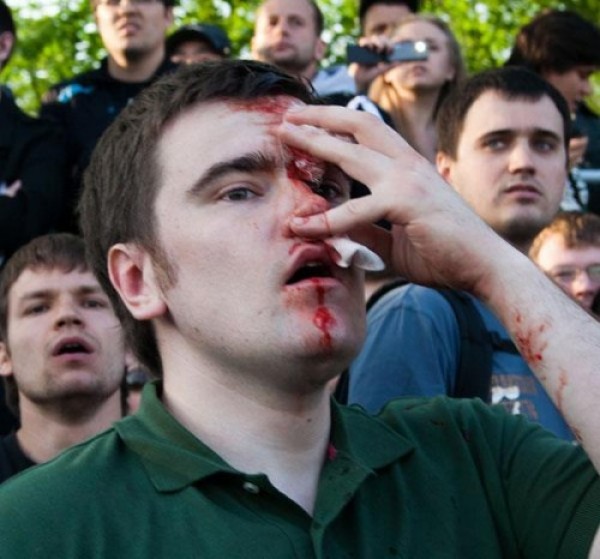
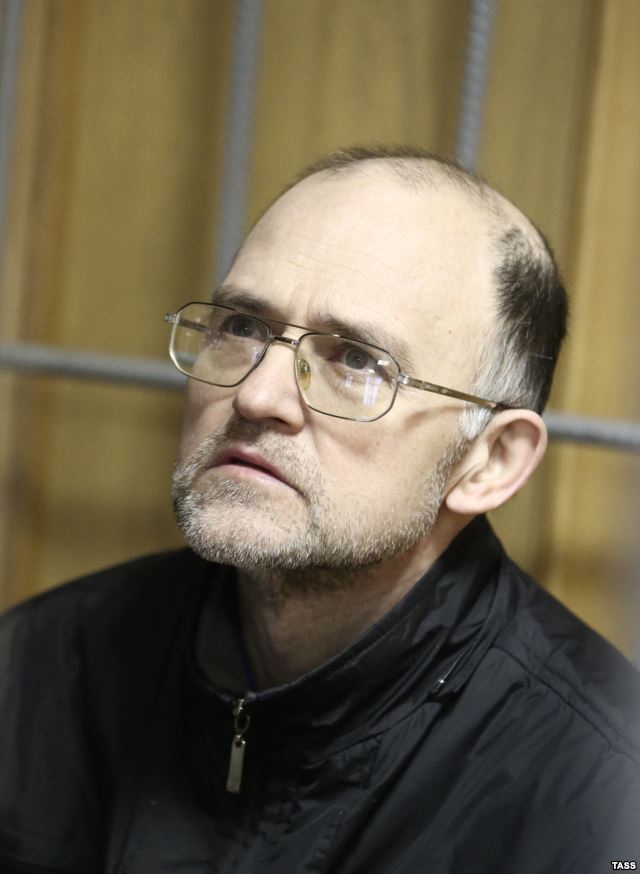
Sergei Krivov, Nikulinsky District Court, Moscow, December 23, 2013
Sergei Krivov, Nikulinsky District Court, Moscow, December 23, 2013. Photo courtesy of Radio Svoboda and TASS

“It Is Not Recommended to Live in This Country”
Natalia Dzhanpoladova and Nikita Tatarsky
Radio Svoboda
July 26, 2016

Yet another person convicted in the so-called Bolotnaya Square case, Sergei Krivov, a 54-year-old with a Ph.D. in physics and mathematics, has been released. Krivov was released from a prison colony in Bryansk Region, having served his sentence in full. In 2014, a court found him guilty of involvement in rioting and using force against police officers during a May 6, 2012, opposition rally on Bolotnaya Square in Moscow.

Krivov received one of the harshest sentences in the case, three years and nine months imprisonment.

His allies explained this was because the authorities avenged Krivov for the uncompromising stand he had taken throughout the trial. Krivov went on two lengthy hunger strikes. The first, to protest his arrest, lasted over forty days. During the second, he did not eat for sixty days in order to secure transcripts of the court proceedings. Krivov suffered two heart attacks during the second hunger strike.

Krivov was arrested as part of the Bolotnaya Square investigation several months after the events, in October 2012. According to police investigators, on May 6, 2012, when the crowd broke through police lines, Krivov seized a rubber truncheon from a policeman and used it to deliver several blows to police officers. Krivov himself repeatedly claimed he had been beaten by police on Bolotnaya Square, but the Investigative Committee refused to investigate his complaint.

Krivov served his sentence in two penal colonies in Bryansk Region, first at a correctional facility in Starodub. He was then transferred to a penal colony in Klintsy. The wardens put him in solitary, because they felt his life was in danger.

In an interview with Radio Svoboda, Kriov admitted his sentence might have been shorter had he “kept [his] mouth shut.” He spoke in detail about the reasons for his uncompromising stance, what happened on Bolotnaya Square, and how much Russia has changed since 2012.

The changes have been quite huge, and for the worse, although I still cannot say I have figured out what is what. I had been gradually following these changes by watching TV and reading Novaya Gazeta newspaper and New Times magazine, so they did not happen all at once for me and were not news. Nevertheless, I am perfectly aware the country as it was in 2012 and the country as it is in 2016 are two fundamentally different countries. There are far fewer freedoms, naturally, and It is nearly impossible to do anything within this framework.

Do you feel you have changed over these years?

In fact, after I got out, changed my clothes, and bathed, I had the feeling everything was as it had been. Although I did have big problems during the middle of my sentence: lots of things happened. But when it is all behind me, when I have come back to the “free” world, I cannot say I have changed. I think I am the same person I was.

Have you managed to meet with friends and relatives since your release? What are your impressions from these meetings and conversations?

Of course I have managed to meet with them. Let me put it is this way: almost no has chewed me out, except my wife, of course. In general, the feelings have been positive, because everyone has been friendly. They all congratulate me and wish me the best.

Naturally, anyone would find this pleasant. I want to say thank you to all the people who wrote me letters, held pickets, and collected money through the Internet, and to the leaders of the PARNAS Party, who paid my lawyers and sent me care packages: Boris Nemtsov, Mikhail Kasyanov, Vladimir Ryzhkov, and Ilya Yashin. In addition, Lyudmila Alexeyeva was involved. Despite her age, she attended the court hearings. A big thank-you to everyone for their support.

Last Wednesday, you also met with activists in Sokolniki Park. You mentioned you had no hope of being paroled. [In March, the court turned down Krivov’s parole application — Radio Svoboda.] Did you pin any hopes on the court in this case, that is, the trial court that heard the Bolotnaya Square case?

No. We had no chance from the get-go. What would have been the point of cooking all this up and then releasing us later? Obviously, the authorities conceived a quite definite plan, and they have been carrying it out. From my point of view, there was no reason to change anything, and nothing changed. I had been detained on misdemeanor charges several times., and I knew perfectly well how such matters were decided. There were no doubts in this case.

And yet your tactics in court were quite different from those of the other fellows. You were one of the most active participants in all the court proceedings.

Yes, I was, because I felt it could not make things any worse. That is how it happened, if you look at the sentences handed down. Naturally, my sentence would have been shorter if I had kept my mouth shut. But here, you know, six months more, six months less do not matter.  Naturally, we had to defend ourselves to the hilt. After all, we did not take to the streets only to snitch on the protest movement, to put it crudely. We did not do what we did to make the court rule in our favor. It was a continuation of the protest. Pavlensky said it: court is a continuation of my protest action. For me, it was simply a continuation of the opposition’s fight. It can happen anywhere: in court, outside of court, on Bolotnaya, away from Bolotnaya. It is like a way of thinking. It is as Solzhenitsyn put it: “Not living a lie.” Every single moment you do what you think is right. The situation changes, but the individual does not change in the situation.

Were your fairly long, serious hunger strikes also a continuation of this same story?

Basically, yes.

What prompted you to do it? Do you remember what you felt when you decided there were no other methods left?

During both hunger strikes, I was perfectly aware my demands would not be met. I got carried away with the second hunger strike: let’s put it that way. But retreating? Chapayev never retreated. So the only way was forward. The main objective was to attract attention, to shake up the situation somehow. Because getting results, especially in the first case, when it was a matter of custody measures, was totally unrealistic. All I was charged with (not what I did, but what I was charged with) was causing the bruise on the back of the hand of a policeman who in fact assaulted me. The policeman’s name is Alexander Ivanovich Algunov. He completely flagrantly hit me over the head with a truncheon. I had three lumps on my head, one of which clearly visible on my temple. It was both videotaped and photographed. And there were eyewitnesses who saw everything.
Sergei Krivov during a hunger strike, Nikulinsky District Court, Moscow, November 2013. Photo courtesy of TASS and Radio Svoboda

But when it was matter of conducting a judicial review or investigatining this conflict… The bruise I allegedly caused the policeman was investigated by the Investigative Committee of Russia, meaning the country’s top investigative body. But what he did to me (and they believe that these actions took place at the same time) has been investigated by another committee. When I filed a written complaint against the officer, the case was not just dropped down to the municipal level, but to a neighborhood precinct, where an investigator wrote there was nothing to investigate. The bruise on the policeman’s hand was investigated by the Investigative Committee of Russia, while beating a person with a truncheon was investigated by a completely different division, the lowest on the totem pole, and it said there was nothing to investigate. I am simply a victim in the Bolotnaya Square case. But I was really visible in the video footage. I was in a confrontation with a policeman who was assaulting me. I grabbed the truncheon with which he was beating me, because at one point I nearly fainted. He hit me so hard on the head it felt like I had been hit with a sharp nail, not a truncheon.

You were not the only victim on Bolotnaya Square, and yet the authorities investigated these incidents so unfairly. How do you explain this?

In the trial documents, for example, there is this bit of evidence. There were two ambulance crews on duty on Bolotnaya Square. They kept a record of injuries in which they wrote down the names and addresses of everyone whom they examined. As far as I remember, there are forty-eight civilians in this list, who suffered something like seventeen concussions and thirteen head injuries and injuries to the soft part of the skull, meaning they had mainly been beaten on the head. There were three policemen who sought medical attention on the square. Of the forty-eight civilians, only two people were deemed injured parties by the authorities. One was hit in the back with a stone, while the other person’s trousers caught fire, and he suffered burns on his leg from a Molotov cocktail. We do not know who threw the bottle or the stone. The authorities assume it was the protesters, so only two individuals were deemed victims. The rest were not recognized as victims, because these forty-six individuals were victims of the police. Who the heck is going to investigate injuries caused by the police? That is not how things are done.

The public commission who investigated the events on Bolotnaya Square came to the conclusion it was the Moscow authorities and police who provoked the confrontation? Do you share this point of view?

I also came to the same conclusion. Only I think it was not the Moscow authorities, but the federal authorities [who provoked the conflict]. Moscow, in this case, did not have the authority to decide these questions. There were provocateurs there. I saw a man in a mask step forward, chunks of asphalt in both hands. At the time, I wondered what was so black, because I was looking into the light. At first, I thought he was throwing black earth, because the asphalt everywhere was so clean. This guy stepped forward and tossed one stone. Then he shifted a second stone [to his throwing hand] and threw the second stone. A policeman was standing there. I was standing there looking back and forth between the two. Either I should have said, “Why are you tossing stones?” or I should have gone up to the policeman and said, “Why are you just standing and watching?” The policeman saw what he did, and then turned around and walked away. The police were completely uninterested in the people who were actually throwing stones, just as the people throwing the stones knew the police were not going to do anything to them.

Yes, and the most interesting thing is the authorities alleged the protesters shouted things about attacking the Kremlin and Red Square, and overthrowing someone. I was there. I heard no such cries. There are twenty-six hours of video footage in the case file. There are no such appeals in that footage. When the police cordon fell apart, people did not run to the bridge. This is clearly visible in the footage. People who were squeezed out of the crowd ran ten or fifteen meters away, because there was a crowd behind them and the danger of being crushed. Then, at a leisurely place, these people fixed their clothes or tied their shoelaces or something, and headed towards the square. This, too, is visible in the footage. Yet the investigators continue to claim, and the courts have not refuted it, but take it as a proven fact, that people were shouting to run across the bridge somewhere and were, allegedly, trying to escape.

So it transpires the whole thing was a planned provocation. How do you explain it? What goals was the regime pursuing via this case? Has it achieved them?

It was the first [opposition] rally after the elections. All the major protest rallies had taken place between the December [parliamentary] elections and the March [presidential] election. May 6, 2012, was the eve of the presidential inauguration: the regime no longer had anything to fear. If they had used force before the elections, naturally, it could have turned against them. But there was nothing to fear after the elections, so they were going to put the heat on people and arrest them. This was followed by the adoption of a series of repressive laws and amendments to the laws on elections, and pickets and demonstrations, not to mention the fact they introduced Criminal Code Article 212.1, which they used to put away [Ildar] Dadin.

You were not detained immediately after the events of May, but around five months later. Did you follow what was happening to the guys who were arrested first? Were you afraid you might become a defendant in the case?

Of course, I followed what was happening. I went and picketed outside the Investigative Committee building. I had this routine: one evening at home with the family, the next evening I would go picketing, and so on. At first, I did not take it very seriously. Why did they take so long to arrest me? First, they checked out everyone who had been detained on Bolotnaya. Despite the fact I had been detained, there was no arrest sheet on me; I had refused to sign some of the pages. They tossed out my arrest documents, and so it turned out I had not been detained. So, apparently, this was the reason it took so long to track me down. But the problem was that I was all over the footage. Despite the fact I inflicted no blows—I would like to emphasize I inflicted no blows, and I am absolutely certain I caused no physical pain to any policeman—I did try and prevent them from assaulting other people. I used my hands to restrain the police. Afterwards, when I found footage of myself on the Internet, I thought to myself: yeah, that was me in action.  My emotional sense was that I had prevented beatings without resorting to violence. But when I watched the videos, I did think I had reasons to be worried. But I decided what was the point of worrying now? I should have thought about it then.

Sergei Krivov picketing the Investigative Committee, Moscow, Summer 2012. His placard read, "Prisoners of May 6: Russia will be free!" Photo courtesy of Natalia Dzhanopoladova (RFE/RL)
Sergei Krivov picketing the Investigative Committee, Moscow, summer 2012. His placard reads, “Prisoners of May 6: Russia will be free!” Photo courtesy of Natalia Dzhanopoladova (RFE/RL)

Four years have passed, but the authorities are still prosecuting people [as part of the Bolotnaya Square case], people whose cases have not even gone to trial, for example, Dmitry Buchenkov and Maxim Panfilov. Do you think this will go on for a long time?

No, I don’t think it will go on for long. They are just running on momentum. The case is not so interesting nowadays. There are many new, interesting articles [that have been added to the Criminal Code]. The authorities can charge people to their heart’s content: for slander, for incitement to hatred. The amended laws have now given them such possibilities they can put away any person who says anything the least bit negative or critical.

The latest cycle of elections has kicked off. Considering all the new legislation and the overall climate in the country, what should we expect from these elections?

Basically, the alternatives are this: either just one opposition party will be seated in the parliament or it won’t. There are also the single-mandate districts, which also helps. A party might not get its list into parliament, but someone can get into the Duma by winning a single-mandate district. I have read that [Alexei] Navalny is inclined to boycott the elections. I understand his resentment: his party was not registered, and he himself was not admitted as a candidate. But there are other parties besides his, and they are also opposition parties. I think all fourteen percent [of Russians who, according to the country’s extremely problematic opinion polls, disapprove of President Putin’s performance] definitely have to go and vote. Anyone who can do it should be an election observer, because it is not enough just to go and vote; we also have to monitor the vote. In the current circumstances, the authorities just cannot do without electoral fraud. Maybe we have few opportunities to stop the fraud, but we have to record the incidents and talk about them. Of course, it is very unpleasant the Democratic Coalition was not able to pull it together, but the law is such that for this to happen, people would have had to join another party. Unforunately, the majority was unwilling to do this. I think they should have come to an agreement whatever the conditions, but they didn’t.

As I understand it, this is part of the old conversation about attempts to unite democratic forces, which have been going on since the 1990s.

First, the law is wrong, because it does not allow electoral coalitions. Second, in my opinion, there should be no minimum barrier [for being seated in the Duma] at all. Democracy is a regime in which decisions are taken by the majority, but the problem is the majority is quite often mistaken. For example, on the stock exchange, the majority always lets the big money get away. The minority turns out to be on the money. The majority differs from minorities in the sense that there is one majority, but there can be two, three, four, five minorities, and so on. The minority has to be allowed to speak its mind, and then, perhaps, the majority will reorient itself. So there should be no barriers. The only barrier should be each physical person. The current laws, naturally, are designed to monopolize power, which is convenient to those currently in power. So they have no need of any competitors. Competitors are harassed, persecuted, and forced off the road.

As far as I know, you were educated as a physicist and worked in science for a long time. How did it happen that you switched from science to grassroots activism and began following political events? What prompted you to do this?

A profession is a profession, but one’s own opinion is something else. I first served as an elections observer in 1989.  I was still working at MEPhI (Moscow Engineering Physics Institute) then. One thing did not interfere with the other, and it even helped. I left science, because salaries in the field had completely dried up, and I completely lost interest in what I was working on at the time. There was no future in it. In 1989, I was a member of an election commission for the first time. I went and found the election commission myself. It was perestroika. People had serious doubts and asked what perestroika was all about. They said perestroika would rearrange everything, but everything would be the same, [the Soviet Communist Party] would again get 99.9% of the vote, and so on. Those were the first actual elections, when Sakharov was elected [to the All-Union Congress of People’s Deputies].

What pleasantly surprised me was that there was no electoral fraud at all. In the evening, MEPhI’s Communist Party organizer came to check out the polling station, to see how we were doing. I tensed up, thinking that now they would come up with something. Nothing of the sort! I kept my eyes peeled. Everything was clean. But in 2011, when I also worked as an observer, everything was dirty, beyond dirty. It so dirty that, for example, there was an old woman, an observer from United Russia, working at our polling station. She did not get up to any tricks herself, but she would come up to us and say, “What is she doing?! Imagine the insolence!” She was referring to the woman who chaired our election commission. The old woman was indignant, her blood was boiling, but it did not go beyond that. She was already quite old, but [the electoral fraud] itself was too much for her. I was very glad a United Russia party member was outraged by our chairwoman’s behavior.

During the four years you spent in custody, how hard was it to get information about what was happening in Russia? How did you find out about events?  What events during this time amazed you the most?

I was given subscriptions to Novaya Gazeta and New Times, although they only started to come regularly when I was in the penal colony. I would read these periodicals and try and watch the news. In some places, this was easier; in some places, harder. For example, the last three months, I was basically without TV, because the guys did not want to watch any news. They would turn on MUZ-TV, which would be spinning a popular music video for the hundredth time. I could not stand to listen to it. But the TV, as you know, is a biased source of information. As for events, of course, the annexation of Crimea and the war in Donbass. Incidentally, there were lots of Ukrainians in the penal colony, because the border is nearby. There was a guy in there who was himself from Russia, but his wife was from over there: he had got married in Ukraine. There was fighting in Kramatorsk. I asked him, “When were you there last?” He said, “Five years ago. Everything there was fine.” “Are Russians harassed there?” I asked. “Are you kidding?” he said, “Everyone lived in perfect peace. There were no problems at all.” Meaning no one discriminated against anyone, neither Russians nor Ukrainians. Where did this all come from? Why does the TV tell us that certain people are in danger there, that there is hostility? Russian TV has been kindling hostility between two sister nations. You cannot just go to war for their “bright future,” if everything in their country is okay. They have to say that everything there is bad.

You served your sentence in two penal colonies. Is it true that there are totally different rules depending on the colony?

The rules are different. That is why they say there are “red” colonies and “black” colonies. But those are the extremes, as it were, because the spectrum is continuous. The penal code is one thing, the laws are another, and if they were all obeyed, then it would make no difference where you did your time, but in reality the differences are fundamental. There is constant trench warfare between the convicts and the wardens over wrestling themselves more rights or forbidding more things. Figuratively speaking, for example, in one colony, the convicts march in formation, while in another they don’t. Even on this primitive level, marching in formation or not, there is constant conflict. The convicts try not to march in formation, while the wardens try to force them to march. It turns out different in every colony. And that applies to everything else.

Considering you were convicted as part of the Bolotnaya Square case, how were you treated in these colonies? Was there any talk about the fact you were basically a political prisoner?

The majority could care less. But some talked about it, especially in the pretrial detention facility, where I would come across sensible people. We would talk about who had been convicted and was doing time for no reason at all. When I was in the pretrial detention facility, it seemed there were many such prisoners. First, this was Moscow. Second, I was told, roughly speaking, that the accountants were on that floor, members of some other profession were on some other floor, and so on. Seemingly around thirty percent of the prisoners were in there for nothing. But when I got to Bryansk Region, this figure was no longer thirty percent, but much lower, somewhere between five and ten percent. A lot of guys were in for petty theft and drugs. Over a third were doing time for drugs. Realistically, a maximum of ten percent were doing time for nothing, or even five percent. As for how I was treated, well, I was repeatedly on the verge of a conflict. There were conflicts.

With the convicts or the wardens?

With both the wardens and the convicts. It is just that the wardens foist their rules on you, and the convicts foist theirs. You are a free man, and you realize you cannot abide by either set of rule.s So you don’t want to carry out either set of orders, and you start weaving and dodging. I was involved in several conflicts of that sort. My age was my salvation. Basically, there are all sorts of kids in there, and they could not bring themselves to hurt old people. Or rather, they could: I saw sixty-year-olds get beaten up in there, but it was still much more complicated. They also look at what you have been sent down for, although I cannot say it is so meaningful. But in this case it was a factor that worked in my favor; it was meaningful. I did not conceal the fact I had not assaulted any policemen, but a conviction is a conviction.

Now you are free and in Moscow. What are your plans? Do you see a future for yourself in Russia? Have you had thoughts of leaving the country?

By and large, I realize it is not recommended to live in this country. If a person has the opportunity and the desire, it is in his or interests to emigrate. But I somehow feel inherently Russian. I am afraid in any other country I would feel like an immigrant, an alien, if not like a guest worker. I cannot imagine living somewhere else. I feel it is okay to emigrate, and some people should emigrate, but I am afraid I am incapable of it.

Sergei Krivov is the twelfth person convicted in the Bolotnaya Square case to have been released from prison. A total of thirty-five people were prosecuted as part of the case. Thirteen of them were amnestied. Eight people remain in prison or under investigation.

Translated by the Russian Reader
In No Mood for Songs and Dialogues (OVD Info)

In No Mood for Songs and Dialogues
OVD Info
July 2, 2016

Hello. We continue to raise money for the work of our monitoring group. Watch the following video, in which Artyom Loskutov, co-founder of the annual Monstrations, talks about what champs we are.

You can donate money to us by heading to this page.

Last week, Moscow courts left two suspects in the Bolotnaya Square case, Dmitry Buchenkov and Maxim Panfilov, in police custody, along with Petersburg architect Sergei Akhmetov, accused of tearing epaulettes from a policeman’s uniform during a gathering in support of Alexei Navalny and Pyotr Ofitserov. Curiously, police investigators have been unable to produce convincing evidence that Buchenkov and Akhmetov were actually at the scene of the crimes of which they have been accused.

Maxim Panfilov. Courtesy of OVD Info

Other Criminal Prosecutions

No less predictable was the rejection of Oleg Navalny’s petition for parole, especially considering the fact that, a week before his court hearing, he received three reprimands for poor conduct at the penal colony where he has been imprisoned.

Totally unpredictable, however, was the return to Moscow of Ildar Dadin, sentenced to two and a half years in a prison colony for “repeated violations” at public protests.  Dadin had been held for over two months in a Petersburg remand prison, and it was anticipated that sooner or later he would be transferred to a penal colony. For some reason, however, this has not happened.

News came of the first criminal charges filed for “willful refusal” to obey the law on “foreign agents.” Charges were filed against Valentina Cherevatenko, chair of Women of the Don Foundation.

Valentina Cherevatenko. Courtesy of Frontline Defenders
Valentina Cherevatenko. Courtesy of Front Line Defenders

Shapi Biyakiyev, a Petersburg trucker involved in the recent nationwide protests by truckers against the new Plato toll system, was charged with using violence against a police officer.

The week would not be complete without news of more “extremism” cases. Yuri Yekishev, a support of Colonel Vladimir Kvachkov, was arrested. He has been accused of having incited hatred with a video recording. Perm resident Vladimir Luzgin was found guilty of rehabilitating Nazism and fined 200,000 rubles for reposting an article about collaboration between “communists and Nazis” during WWII. But the case of Stavropol resident Viktor Krasnov, accused of offending the feelings of religious believers, has been suspended, because the court has expressed its doubts as to the legitimacy of the forensic examination of Krasnov’s statements, taken out of context from an online discussion.

Detentions

In Hurzuf, Crimea, residents upset that a local beach had been transferred to the Artek Young Pioneers Camp were detained by police.  Meanwhile, in Moscow, tempers flared around construction of the so-called Northeast Chord highway. First, a cyclist was detained for protesting the felling of trees in Kuskovo Park, and then people opposed to the felling of trees on Krasny Kazanets Street in Veshnyaki were detained.

“Murder of 200-Year-Old Oak in Kuskovo Park,” posted July 2, 2016, by Ecowalker First

Moscow police also detained people in a hunger strike organized by the Moscow Queue Waiters [i.e., ocheredniki, people on a waiting list for affordable housing—TRR] twice in a single day outside the constituent reception offices of the ruling United Russia party. When the detainees were released from a police station after the first detention, they went back to the reception offices and were rearrested. But Makhachkala outdid everyone: around eighty believers were detained after Friday prayers outside a Salafist mosque.  Meanwhile, Dagestan public figure and parliamentary candidate Rasul Ismailov was detained in Khasavyurt.

Cellist Semyon Lashkin, detained last week while busking in Moscow, was fined 10,000 rubles for “deliberately creating a crowd and preventing pedestrian movement.”

Other Forms of Persecution

An unnamed 23-year-old resident of Salekhard was sentenced to five days in jail for posting “extremist” music, presumably songs by Krovostok and Kolovrat, on a social network.

Daniil Alexandrov, a freelance correspondent for online newspaper Meduza, was ticketed for working without accreditation in Karelia, where he gone to cover the story of the children who died on Lake Syamozero.

FSB agents raided the Mayakovsky Library in Petersburg in connection with the fact that it served as the venue for Dialogues, monthly public discussions of political topics. The project’s founder, Nikolai Solodnikov, resigned his post at the library, which will no longer host the events.

In Krasnodar, people involved in solo pickets against the policies of current Mayor Vladimir Yevlanov and in support of Communist Party MP Sergei Obukhov were assaulted, while in Kemerovo, local opposition activist Stanislav Kaliniсhenko was detained, taken to a police station, and, allegedly, beaten up by police.

Opposition activist Stanislav Kalinichenko after his alleged beating by police in Kemerovo. Courtesy of his blog

Karelian village council member Vladimir Zavarkin, sentenced to a fine for calling for a referendum to decide whether the republic should secede from Russia, was stripped of his mandate.

Read

Two plus two does not always make four: how Russian courts calculate prison terms in criminal cases and jail terms in administrative cases.

Translated by the Russian Reader

Anna Karpova: The Unstable Prisoner, the Exclusion Zone, and Infinity

Alexei Gaskarov and Anna Karpova. Photo courtesy of Anna Karpova and PRI

Anna Karpova
The Unstable Prisoner, the Exclusion Zone, and Infinity
Snob.ru
June 18, 2016

“Gaskarov has had reprimands both at the pretrial detention facility and the penal colony. There have been commendations, too. He works hard, studies well, and runs economics seminars for the inmates. But now he gets reprimands, then he gets commendations He is unstable somehow, unstable.”

Lieutenant Colonel Plaksin (I now always pay attention to such things) stared at the table. He was trying to explain to the judge why the wardens of the penal colony were opposed to paroling my husband.

I remember how I was invited to the studios of TV Rain the day the second wave of Bolotnaya Square defendants was sentenced to talk about we would do next. I put on a brave face and said the heck with the sentence. We would get everyone out on parole. But who knew Plaksin would be staring at the table?

There really is an outstanding reprimand in convict Gaskarov’s personal file: for not greeting an employee of the prison administration. When the judge was reading out the report on this terrible incident, I got goosebumps myself. Was this the man I had married?!

In short, the request for parole was denied.

The handful of people to whom the Bolotnaya Square case still matters send us rays of supports and remind us that, in the worst circumstances, we have a little less than four and a half months to wait.  They assure me the time can be done “standing on one leg.” It is nothing compared to the three years already served.

But that is not how it works.

Maybe I have been playing Fallout 3 (a video game about life on earth after a nuclear war) way too much, but I will say this. The trials and hearings, the pretrial detention facilities, and the penal colonies are like exclusion zones, places with elevated radiation levels that (I will tell you a secret) poison and destroy the individual. The more time you spend there, the worse the consequences are. Everyone involved in the process is irradiated. The prisoner and his family have it the worst of all, of course. Friends, acquaintances, and sympathizers are also affected, albeit on a lesser scale. The impact of the “radiation” does not end when the sentence ends.

The radiation sickness caused by the Russian penitentiary system can manifest itself in very different ways. For example, when it is quite hard to admit your absolute helplessness before court and prison functionaries, you might think there was “that one piece of paper” that could have fixed everything, but you fools did not bother about it. The thought eats into your brains and prevents you from working, sleeping, and communicating with each other. Worst of all, you look for someone to blame. Who messed up? The lawyer? The prisoner? His wife? His parents? The incident then comes up in every stressful situation, most likely, after release as well. The gulf between what prisoners have gone through and what their families went through fighting on the outside can be bridged only by the most patient and wisest. The former will never fully understand what it was like for the latter, and vice versa.

Each week spent there, behind the penal colony’s dilapidated fence, means the risk of sustaining all the major injuries and traumas that will make themselves felt in the most unexpected situations for a long time to come. Not to mention the fact that if you suddenly have the most ordinary appendicitis on the inside, you are probably a goner.

When I am asked whether everything is okay, whether there have been problems at the penal colony, it is enough for everyone to hear that my husband has not been transferred to maxim security, and that neither the wardens nor the inmates have been messing with him, but that amounts to only ten percent of possible problems. The other ninety percent have to do with how inmates and their families digest what has happened to their lives. And it not the done thing to talk about it, but an additional four and a half months feel like an infinity and keep on poisoning the lives of those who wait.

This means there is no “only” when we are talking about the remainder of a prison sentence. And it means we must fight for every month of freedom, even for a single month. By the way, that is how it is going to be with us.

Translated by the Russian Reader

Alexei Gaskarov Denied Parole

Alexei Gaskarov on Bolotnaya Square, Moscow, May 6, 2012

Alexei Gaskarov Denied Parole
Grani.ru
June 17, 2016

Novomoskovsk City Court in Tula Region has denied Bolotnaya Square case convict Alexei Gaskarov’s request of parole, Gaskarov’s wife Anna Karpova [sicreported on Snob.ru.

“Novomoskovsk City Court Judge Irina Sapronova turned down the request. The spokesman for the penal colony also testified against the request, because Gaskarov had been reprimanded for not greeting a penal colony employee in March,” wrote Karpova.

According to Karpova, the penal colony gave Gaskarov a negative character report. The report noted that the convict had been issued two disciplinary reprimands in solitary confinement and two in the colony for violating the daily routine and not greeting wardens.

And yet the report states that Gaskarov has not violated the internal code of conduct or the terms of his sentence, has been working at the colony and taking part in social activities, has qualified as an electrician, and has been studying to be a welder. Gaskarov has received two commendations for hard work and good behavior. He is polite with the wardens, neat, has a positive effect on new inmates, attends events, and has no outstanding writs of enforcement, the report states.

Gaskarov was arrested in late April 2013. On August 18, 2014, Judge Natalia Susina of the Zamoskvorechye District Court in Moscow sentenced the activist to three and a half years in a medium-security penitentiary facility under Criminal Code Articles 212 (involvement in rioting) and 318.1 (use of non-threatening violence against a state official).

Gaskarov was found guilty of tugging police officer Pavel Bulychev’s arm and police officer Igor Ibatulin’s leg. Gaskarov claimed he tugged Bulychev’s arm to break a police chain that was causing the crowd to stampede. He attempted to pull Ibatulina away from a detainee lying on the ground.

Gaskarov himself was severely beaten at Bolotnaya Square on May 6, 2012, sustaining lacerations to his head. And yet the Russian Investigative Committee refused to file criminal charges in response to his complaint.

On November 27, 2014, a panel of judges at the Moscow City Court (with Tatyana Dodonova acting as reporting judge) left the antifascist’s verdict unchanged.

On June 24, 2015, Novomoskovsk City Court Judge Elena Gorlatova denied Gaskarov parole, citing an outstanding reprimand he received while still in custody at Pretrial Detention Facility No. 5 in Moscow.

Alexei Gaskarov was born in 1985 in Zhukovsky, Moscow Region. A graduate of the Government Finance Academy, he worked at the Institute of Sociology of the Russian Academy of Sciences. In 2010, he was arrested and charged during an investigation of the campaign to defend the Khimki Forest but was acquitted the same year.

Translated by the Russian Reader. No thanks to anyone for letting one of Russia’s finest young men rot in prison for the crime of acting like a decent human being in a horrible situation deliberately provoked by the police. Photo courtesy of bolotnoedelo.info. Read my previous reports on Alexei Gaskarov’s case and the futile efforts to free him.

Railroading Dmitry Buchenkov

How the Investigative Committee Interrogated Me in the Buchenkov Case (Bolotnaya Square Case)
Yaroslav Nikitenko
April 27, 2016
yaroslavn.livejournal.com

Yesterday, I went to the Investigative Committee for questioning in the Dmitry Buchenkov case (part of the Bolotnaya Square case).

Dmitry Buchenkov is one of the recent defendants in the case. He was arrested on December 2, 2016. The investigation has been plagued by gross violations from the get-go. Buchenkov’s attorney, Svetlana Sidorkina, was not allowed to see the accused. She was thus unable to defend him not only at his pre-trial custody hearing but was also unable to establish his whereabouts for several days. During this time, investigators were subjecting him to psychological pressure. Dmitry has been accused of involvement in rioting (Criminal Code Article 212.2), the rioting that, allegedly, took place on Bolotnaya Square in Moscow on May 6, 2012, and of using non-life-threatening violence against officials. Dmitry and his loved ones have claimed he was not at Bolotnaya Square that day. He was visiting relatives in Nizhny Novgorod, and so could not have committed the crimes of which he has been accused. I am a witness in the case, because I have known Buchenkov for many years and was at Bolotnaya Square on May 6, 2012.

On December 11, 2015, a photograph of a “man in black,” whom investigators believe to be Dmitry Buchenkov, according to activists, appeared on the Internet.

I am the man in the white t-shirt standing next to the “man in black.”

I do not know the man in the black hoodie in this photograph or whether he inflicted a great deal harm on the policeman in body armor and helmet, but it is obvious to me he is not Dmitry Buchenkov.

When I saw the photograph and realized the man was not Dmitry, I contacted Svetlana Sidorkina and told her I could act as a witness in Dmitry’s case.

Later, I learned that the same man in black has been accused of upending port-a-potties on Bolotnaya Square on May 6. I can also testify that during this incident I was in the vicinity of the port-a-potties from the very beginning and nearby until the police finally dispersed everyone. Dmitry Buchenkov was not there.

Between the public garden and the embankment. I am in the middle in the white t-shirt. Photo courtesy of martin.livejournal.com
This is a bit closer to Bolotnaya Square. I am the person left of center in the white t-shirt. Photo courtesy of Yevgeny Feldman

The general sequence of events was as follows. I arrived at the Oktyabrskaya subway station, where the march started, approximately at the beginning of the event (i.e., 3 p.m.). I marched with the bloc of Pussy Riot supporters, and I was wearing a pink balaclava (which is dangling from my chest later in the photographs). On Malyi Kammenyi Bridge, our group and the LGBT bloc were attacked by provocateurs, who tried to snatch a flag. Then there was a sit-down strike near the Udarnik movie theater. I thought about sitting for a while too, but I didn’t like it very much. I could not get through to Bolotnaya Square, although I wanted to make it to the rally, because, it seemed, they were not allowing anyone to enter. Subsequently, closing the entrance to the square has been regarded as one of the numerous police provocations at the rally. Then someone seemingly decided to try and break through the police cordon. I am not sure whether I saw it myself or read it about later on the Internet, but the idea seemed pretty silly to me then and still seems that way now, because there were really a lot of police, and the people who broke through the first cordon probably went straight to the paddy wagons. At some point, stones started flying at the police. What I remember most of all was how the police split the crowd outside the Udarnik theater into several sections, and a huge column of cops ran through the empty space wielding batons and indiscriminately hitting the people standing along the sides.

Gradually, I moved closer to Bolotnaya Square. There, I stood for a while in a human chain with people who thought it might be an effective self-defense. But it wasn’t. Policemen armed with batons constantly attacked these people, hitting them and dragging individuals out of the crowd to arrest them. Then I remember that someone who looked a bit wild-eyed suggested we overturn the toilets, as if it were really important and could protect us from the mobs of police. Then everything [the contents of the port-a-potties? — TRR] spread out over the pavement, and even more police came running from the direction of Bolotnaya Square to disperse the group of people there as well. (This was between the public garden in Bolotnaya Square and the embankment.) I went back over Malyi Kammenyi Bridge around 8 p.m.

I also do not remember this tent being set up. (Although I cannot vouch for the fact it is the same tent I saw.) Photo courtesy of Yevgeny Feldman and Novaya Gazeta

The man in the photos bears no resemblance to the real Dmitry Buchenkov.

Dmitry Buchenkov. Photo courtesy of ad-sr.info
The man in black (left) and Buchenkov. Their noses and chins are shaped completely differently.

Read Dmitry Borko’s analysis for a detailed comparision of photographs of Buchenkov and the man in black. A criminal expert, cited by Borko, is certain that Buchenkov and the man in black are different people. Borko also lists psychological and political inconsistencies. Indeed, why did it take the police three and a half years to find an activist whose identity had long been know to them if photos and videos of him at Bolotnaya Square were, allegedly, plastered all over the Internet? I would remind you that Maxim Luzynanin, who was wearing a mask the whole time on May 6 and was virtually unknown within the protest movement, was located by police in May 2012.

The man in black felt quite at ease on Bolotnaya Square. He hit policemen, threw them on the pavement, tossed glass bottles at them, sprayed them with pepper spray, and overturned toilets. He clearly sensed his own impunity.

Photo courtesy of Yevgeny Gurko and OpenSpace.ru

As someone who has long been involved in protests and grassroots movements, I can say such behavior is virtually impossible for a very experienced activist. Anarchists and anti-fascists quite often cover their faces even at authorized rallies where nothing illegal is happening. Approximately half of civil society’s work involves defending unjustly accused comrades and political prisoners. Every longstanding activist (such as Buchenkov) is well aware that if activists with no ties to the authorities give them the slightest excuse, they will be jailed instantly, while even if they give them no excuse, the authorities will fabricate a case against them. It is obvious to me that no opposition activist could have behaved with such flagrant impunity. That means he could have been someone linked to the authorities, whose safety had been ensured in advance and who was handsomely remunerated. I do not believe he was a random person, because he was clearly well trained to do what he did. He avoided arrest and was armed with a pepper spray can. (For some reason, however, he did not wear a mask.) Civic activists clearly have nowhere to go where they could do such training. I think the man could only have been a specially trained intelligence officer, and this explains why he could not be found (probably because no one looked for him). It is another question why Buchenkov had to take the man in black’s place. It is quite possible the authorities want to put pressure on protest movement activists in the run-up to September’s parliamentary elections. (They are ready to jail anarchists and anti-fascists any time.) Besides, it is quite possible the security agencies do not always coordinate their actions, and arresting another man was a clear miscalculation on their part.

Compared to other protest rallies, there were a great number of provocations at Bolotnaya Square. Moreover, the authorities initially knew about them but did nothing to prevent them. In all likelihood, they took advantage (and set up many of them themselves).

The fact that the man in the photographs is not Dmitry Buchenkov is obvious to me and other people who know Dmitry personally.

Moreover, I did not see Dmitry Buchenkov on Bolotnaya Square at any point on May 6, 2012.

I was right next to the man in black during the incidents of which he has been accused (as listed above). Of course, my memory of the man has now faded. But if an acquaintance of mine had been next to me and the police had tried to beat him, and he had done the things the man in black did, I could not have failed to remember it.

It is impossible not to recognize an acquaintance who is at arm’s length from you. Besides, during the incident with the toilets there were many fewer people there; the crowd was considerably thinner. So not seeing and not recognizing an acquaintance of mine there (especially one who stuck out so much in terms of clothing and behavior, and was demonstratively at the very center of events) would also have been impossible.

Would the above-mentioned facts be meaningful in an objective investigation? In my opinion, they would be of primary importance. But my testimony proved fairly uninteresting to the actual investigation. On January 11, I wrote a letter to the Investigative Committee. I explained I was personally acquainted with Buchenkov, had been at Bolotnaya Square, and could act as a witness in the case. I received a formal reply from Major General R.R. Gabdulin of the major cases division.

“The information related in the letter will be taken into account during the investigation of the criminal case in question,” he wrote.

The investigators have probably already found policemen who probably had never seen Dmitry Buchenkov in their lives but have already testified they saw him, just as their higher-ups wanted them to do. Why would they need more witnesses? I believe this shows clear bias on the part of the investigation and an unwillingness to establish the truth. Policemen committed many crimes on Bolotnaya Square, but none of them has been punished. Where there is obvious bias there can be no justice.

The Investigative Committee’s reply to my letter

Suddenly, last Monday, April 24 (i.e., three months after I wrote my letter and four months after Buchenkov’s arrest), Investigator Uranov telephoned me and asked me to come to the Investigative Committee for questioning. Buchenkov’s attorney, Svetlana Sidorkina, had no longer been counting on my being summoned to the Investigative Committee as a witness and had put me on the list of defense witnesses. In this case, an investigator was obliged to question me.

Yesterday [Tuesday, April 26], my attorney and I arrived at the Investigative Committee at 12:30 p.m. (The investigator had initially scheduled us for 1 p.m., but an hour and a half before our meeting, he called and said the building’s security checkpoint closed at 1 p.m. and we had to be there earlier.)

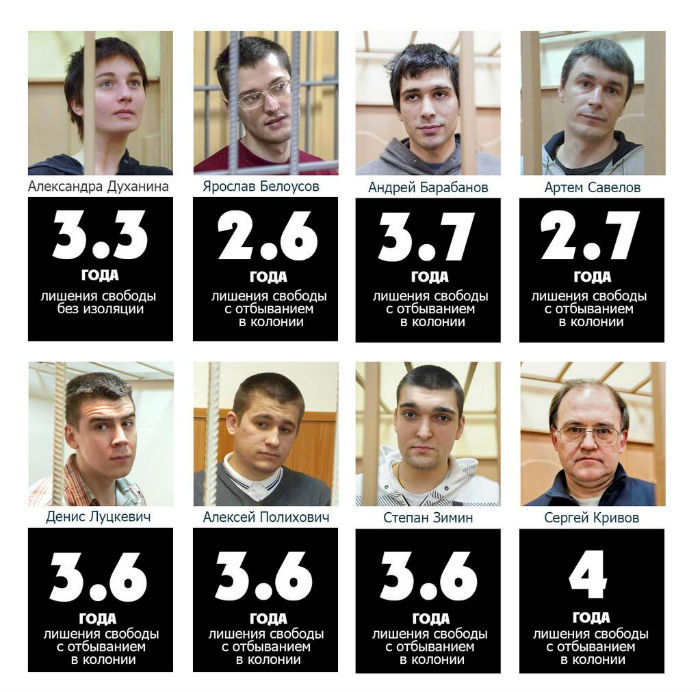
There was a huge Saint George’s Ribbon (two hands’ long) hanging from Investigator Uranov’s desk lamp, and a picture of people convicted in the Bolotnaya Square Case, published on the website of the May 6 Committee, hung above his desk.

74182
Some of the people convicted in the Bolotnaya Square Case: Alexandra Dukhanina, Yaroslav Belousov, Andrei Barabanov, Artyom Savyolov, Denis Lutskevich, Alexei Polikhovich, Stepan Zimin, and Sergei Kriov, along with their sentences. Image courtesy of May 6 Committee. TRR

When we finished, the investigator made me sign an agreement not to disclose information from the preliminary investigation. He explained I could talk about what had happened on Bolotnaya, but I could not talk about what I had been asked during questioning and what testimony I had given. He also warned me I would be held criminally liable if case information were disclosed.

So I have not written here about what happened during the interrogation yesterday, and everything I have written in this post is either publicly available on the Internet or is my own personal knowledge and opinions and has nothing to do with the investigation’s classified information.

Just in case, I asked another lawyer friend whether I could write this.

“You know what the times are like now yourself. If they want to get you, they will find a crime to charge you with, so it’s better not to write,” he replied.

However, according to Article 161.2 of the Criminal Procedural Code, “The investigator or interrogating officers warns those involved in criminal proceedings of the inadmissibility of disclosing information from the preliminary investigation without proper authorization.”

So I decided to act in keeping with what the investigator himself had said, and another lawyer confirmed I could write about it. I think it is very important to testify publicly about what I saw at Bolotnaya Square and why Buchenkov had nothing to do with it, especially because I don’t know whether I will be able to do it in the future.

When I wrote that I had been summoned to the Investigative Committee in the Bolotnaya Square Case, very many friends of mine were worried. Many of them wrote that one could go from being a witness to a suspect almost in an instant. Many wrote that I had better not go. Everyone advised me to be careful. I can vouch for myself that I did nothing illegal on Bolotnaya Square on May 6, 2012, but it is clear they can easily fabricate a case and find a whole platoon of “witnesses,” as they have done many times before. I would only note that in a country that has the rule of law and where law enforcement agencies work to administer justice and protect the rights of citizens, this attitude on society’s part to the status of witnesses in criminal cases would be impossible.

And today, investigators began putting real pressure on me. The day after my questioning, the investigator suddenly telephoned and asked me to report to him tonight. Unfortunately, my attorney could not come with me tonight, so I offered to come with him tomorrow. Uranov (the man who, after Dmitry’s arrest, searched his parents’ flat in Nizhny Novgorod and did not inform his lawyer of his whereabouts) replied that this did not bother him very much.

“You can come with another lawyer or without a lawyer,” he said, adding, “You are a witness, after all.”

During his next call, Uranov informed me that my lawyer could not come at the time tomorrow I had just scheduled with him, because another investigator in the same case had summoned him. But then my lawyer told me he was not going on another case and was willing to go with me to questioning even at ten in the morning.

This entire conversation was conducted with me acting as the intermediary for some reason, and the investigator said several times I could find another lawyer. Uranov also insisted I not write about this on Facebook, but that I look for another lawyer and come to see him today: it was extremely urgent. Obviously, this way of doing things was illegal, because the impossibility of having a lawyer present during question is a legitimate excuse for failing to appear for questioning. Fortunately, realizing he would not be able to persuade me, the investigator agreed to reschedule the questioning to tomorrow, but he reminded me about administrative responsibility [for failing to respond to a summons — TRR] and repeated several times I could be forcibly brought in for questioning.  In any case, I would have filed a written statement that I would not take part in the investigation without a lawyer and would remain silent. But I would like to note that when investigators behave this way with witnesses, they are signaling to the public that witnesses in political cases will have problems.

My lawyer and I had met before in another case, and he had been at his best then. He is now also involved in the Bolotnaya Square case, and so it was quite important to me that he come with me. However, when I called him to say the investigator could question us tomorrow at ten in the morning, it transpired that all his papers had just been stolen and he would not be able to come tomorrow. I hope it has nothing to do with this case.

Many people have been quite demoralized by the Bolotnaya Square case, but I am not pessimistic. I have also found it painful over the last few years to see this injustice and hear that my acquaintances have been convicted or have been forced to leave the country. Society, however, is a complex system, and the political situation changes rapidly. Many of the prisoners of May 6 were convicted despite massive protests against the case. But that is no reason to give up. People who do not give up always have a chance of winning, and this is especially true in politics. I can see that the case against Dmitry Buchenkov has obviously been grossly fabricated. It is a complete failure on the part of the Bolotnaya Square case investigators, and whether or not you support Dmitry’s political views, you must talk about the case as much as possible.

We must fight back against the obviously unfair and unjust charges against Dmitry Buchenkov.

Translated by the Russian Reader. Thanks to Comrade AK for the heads-up

Ilya Budraitskis: Putrefaction as the Laboratory of Life (The 2016 Elections)

Nikolai Yaroshenko, Life Is Everywhere, 1888. Image courtesy of Wikipedia

The 2016 Elections: Putrefaction as the Laboratory of Life
Ilya Budraitskis
OpenLeft
April 29, 2016

How do the upcoming Duma elections threaten the regime?

Today, it would seem that the upcoming September elections to the State Duma are a cause of growing concern only in the Kremlin. While polls continue to record a low level of public interest in the event, and the tiny number of parties allowed to run in the election wanly prepares to fulfill their usual roles, the president and his entourage are increasingly talking about possible threats.

The rationale of radicalization
At a recent meeting with activists of the Russian People’s Front, Putin noted that external enemies would preparing ever more provocations to coincide “with elections to the State Duma, and then with the presidential election. It’s a one hundred percent certainty, a safe bet, as they say.”

Regardless of their real value, the upcoming elections have been turning right before our eyes into a point of tension on which the state’s repressive apparatus has focused. Beginning with the establishment of the National Guard, the process has been mounting. Each security agency has now inaugurated its own advertising season, designed not only to remind the president and public of its existence but also to show off its unique capabilities, inaccessible to other competing agencies, for combating potential threats.

Prosecutor General Yuri Chaika has uncovered a plot by the Ukrainian nationalist group Right Sector, while in his programmatic article, Investigative Committee head Alexander Bastrykin essentially suggested canceling the elections since holding them could prove too dangerous. He made a direct appeal to stop “playing at pseudo-democracy” and provide a “tough, appropriate, and balanced response” to the country’s enemies “in light of the upcoming elections and the possible risks presented by the stepping up of efforts by destabilizing political forces.” With the appointment of Tatyana Moskalkova, even the previously neutral office of the human rights ombudsman has, apparently, been turned into yet another bastion of the fight against conspiracies.

This nervousness is certainly due to the fact that the growing economic and social crisis has had no visible political fallout for the time being. There have been no mass spontaneous revolts or sectoral strikes, although there has been an overall uptick in isolated labor disputes.  The political realm has long ago been securely purged of any uncontrollable opposition, while the president’s personal rating has remained phenomenally high. Nothing, it would seem, portends serious grounds for political destabilization this autumn. The absence, however, of real threats itself has become a threat to the internal stability of the state apparatus.

Where does the threat lie? In recent times, it has become obvious that decision-making at all levels and whatever the occasion has been subjected to a rationale of radicalization. Its principle can be described roughly as follows: no new decision can be less radical than the previous decision. Bureaucratic loyalty is measured only by the level of severity. MPs must propose more sweeping laws against latent traitors. Law enforcement agencies must expose more and more conspiracies, while the courts must hand down rulings that are harsher than the harshest proposals made by the security officials and MPs. Permanently mounting radicalism enables officials to increase budgets, expand powers, and prove their reliability, while any manifestation of moderation or leniency can cost them their careers. This radicalization, whose causes are rooted in the political psychology of the Russian elite (which suffers from an almost animal fear of uncontrollability), has set off an extremely dangerous bureaucratic momentum. Its main problem is the inability to stop. It is not only unclear where the bottom is, but who is ultimately interested in reaching that bottom and leaving it at that.

All this generates a strange situation vis-à-vis the elections, which have generally functioned primarily as a political balancing mechanism for the Putinist system, and even now function in this way. Elections have always been a reminder—not to voters, but to the elite itself—that varying opinions within a clearly defined framework have not only been possible but have also been encouraged. This reminder has been important not out of faithfulness to an abstract principle, but as confirmation that political bodies (first of all, the presidential administration) have had the monopoly on deciding domestic policy, not a military or police junta.

Fixing the broken mechanism?
For the Kremlin, the upcoming elections are overshadowed by the political trauma of 2011, when the smoothly functioning system of managed democracy suffered a serious breakdown. The current chief political strategist Vyacheslav Volodin has more or less consistently focused on making sure the failure of five years ago is not repeated. Volodin’s mission is to fix the broken mechanism with political methods, not by force.

It is worth remembering that, for the greater part of the Putin era, parliamentary and presidential elections were parts of a single political cycle, in which the same scenario was played out. The triumphal success of the ruling United Russia party was supposed to precede and ensure the even more resounding success of Vladimir Putin. In December 2011, however, the cycle’s unity backfired against the Kremlin’s plans. The interval between elections enabled the protest movement to maintain its grassroots energy for several months.

The political rationale of Putin’s third term is now aimed not only at technically but also at conceptually disrupting this cycle. Amidst a sharp drop in confidence in the government, the Kremlin decided last summer to move parliamentary elections up from December 2017 to September 2016, and, on the contrary, postpone the presidential election from March 2017 to March 2018. The point of the maneuver is obvious. The presidential and parliamentary elections must now represent not two parts of the same script but two completely different scripts. In the first script, a limited number of parties, which make up the symphony of the Crimean consensus, will criticize the government and each other, thus competing for the sympathies of the dissatisfied populace. In the second script, the natural patriotic instinct of voters should leave no doubt as to the need to support Putin unconditionally.

The new ideological content was embodied by Volodin’s famous statement: “There is no Russia today if there is no Putin.” This personification virtually means that, as a symbolic father, Putin transcends everyday politics. You can be a liberal or a nationalist, a proponent of greater intervention in the economy or a fan of the free market. You can choose not to like the government or government officials. But the nexus Putin-Crimea-Russia is beyond any doubt. Those who fundamentally disagree with it are simply removed from the Russian political spectrum and branded “national traitors.”

In keeping with this rationale, responsibility for the sharp drop in living standards and the consequences of the neoliberal “anti-crisis” measures has been borne by ministers, MPs, and governors, by anyone except the president. Even now, when the propaganda effect of the “reunification” of Crimea has obviously begun to fade, the president’s personal rating remains high. Thus, according to the latest opinion polls, 81% of respondents trust Putin, while 41% do not trust Prime Minister Dmitry Medvedev, and 47% do not trust his government overall.

Within the new-model Crimean consensus, United Russia will no longer play the role of the backbone it played in the noughties. Untethered from the non-partisan figure of the president, it will take on the burden of unpopularity borne by its formal leader, Dmitry Medvedev, and his government. The mixed electoral system will enable candidates from local “parties of power” in single-member districts to dissociate themselves from United Russia, presenting themselves as “non-partisan Putinists” criticizing the soulless federal authorities. Volodin’s scheme involves loosening United Russia’s grip on power and slightly increasing the value of the pseudo-opposition as represented by the Communist Party and A Just Russia.

It is worth noting that the very existence of a bureaucratic mega-party previously played a stabilizing role by dampening intra-elite conflicts. Now they will inevitably come out into the open, including in the shape of inter-party struggles. Of course, the presidential administration counts on being able to effectively ensure compliance with the clear rules of this competition, but there are no guarantees. The managed multi-party system with the “father of the nation” towering over it consummates the new architecture of the Putin regime as a personalistic regime, and becomes more and more vulnerable.

In the new reality of the crisis, Putin’s depoliticization also facilitates a more intensive “natural selection” among bureaucrats at all levels by culling those who have not mastered the art of maintaining the conservative sympathies of the populace while simultaneously implementing what amount to aggressively anti-social policies. The September campaign is supposed to go off without a hitch, culminating in a predictable outcome. Having given a human face to the Central Elections Commission, which was seriously discredited by the previous leadership, Ella Pamfilova is meant to increase this manageability and predictability. It turns out that the upcoming elections are the primary pressure test of the new, post-Bolotnaya Square design of managed democracy. The future of Vyacheslav Volodin and his team, as well as Putin’s willingness to trust them with the extremely important 2018 presidential campaign, probably depends on how smoothly they come off.

From the foregoing it is clear that the objective of reestablishing the rules of managed democracy is directly at odds with the above-mentioned rationale of radicalization, whose standard-bearers are the competing law enforcement agencies. Their individual success in the internal struggle is vouchsafed by the failure of the political scenario, which would give rise to the need for a vigorous intervention by force. After all, the National Guard’s value would be incomparably increased if it put down real riots instead of sham riots, and Bastrykin’s loyalty would all the dearer if, instead of the endless absurdity of the Bolotnaya Square Case, he would uncover real extremists. To scare someone seriously, the ghosts have to take on flesh and blood.

Life is everywhere
Marx said that putrefaction is the laboratory of life. Now we see how Putinist capitalism has embarked on a process of gradual self-destruction. The upcoming elections provide a clear picture of how this has been facilitated by two opposing rationales, the political rationale (Volodin and the presidential administration) and the law enforcement rationale. Thus, the first rationale, in order to generate the necessary momentum and expand the range of opinions, must respond to social discontent by providing United Russia’s managed opponents with greater freedom to criticize. Restoring the internal political balance will inevitably lead to the fact that topics related to the crisis and the government’s anti-social policies will become the centerpiece of the entire election campaign. On the other hand, the security forces will destabilize the situation outside parliament. Together, they will do much more to undermine an already-flawed system than the long-term, deliberate efforts of any western intelligence agency.

Of course, Russian leftists should in no way count on events following an automatic course. But it is absolutely necessary to take into account the conflicts of interest within the elite and understand their decisive influence on the shape of the upcoming elections. These elections have nothing to do with the real struggle for power or traditional parliamentarianism in any shape or form. But they are directly related to the internal decomposition of an authoritarian, anti-labor, and anti-social regime. So our policy vis-à-vis these elections should be flexible and remote from all general conclusions. That means we can and should support certain leftist candidates in single-member districts. We must use all the opportunities provided by the leftist, socialist critique of the Medvedev government’s so-called anti-crisis policies. We must be ready to go to the polls. Or we must be ready to reject them, taking to the streets when the time comes.

Ilya Budraitskis is a writer, researcher, and editor at OpenLeft. Translated by the Russian Reader


Tomsk Residents Demand Release of Political Prisoners

Picketing Tomsk Residents Demand Release of Political Prisoners
Novosti v Tomske
April 23, 2016

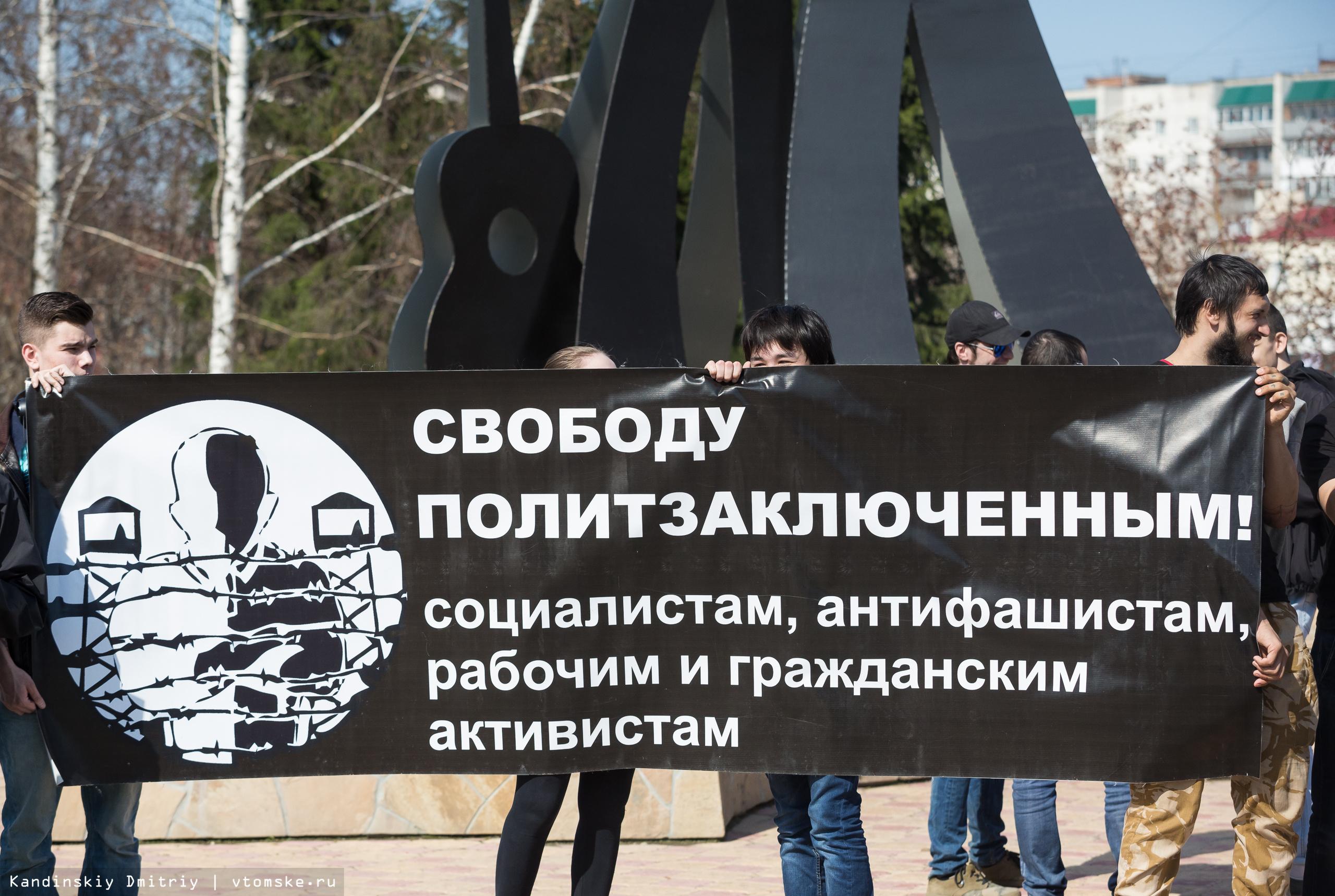
“Free the political prisoners: Sergei Udaltsov, Alexei Gaskarov, Sergei Vilkov, Alexei Sutuga.”

The rally was held today at the Monument to the Construction Brigades, reports vtomske.ru’s correspondent.

According to our correspondent, around fifteen people were involved in the picket. One of the participants, Anton Sharypov, said that its main aim was to draw attention to the problem of political prisoners.

“In Russia today, there are many people who are subjected to illegal arrest, to what amounts to political repression, for their civic and political stances. We demand the release of those who are in prison and an end to torture and crackdowns so that people can live freely, grow, and help their country. None of these people are terrorists, which is how they are presented. They are ordinary people who work and study, and in their free time they are socialists and anti-fascists. They lend a helping hand to trade unions and grassroots groups. They are not criminals and murderers,” he explained.

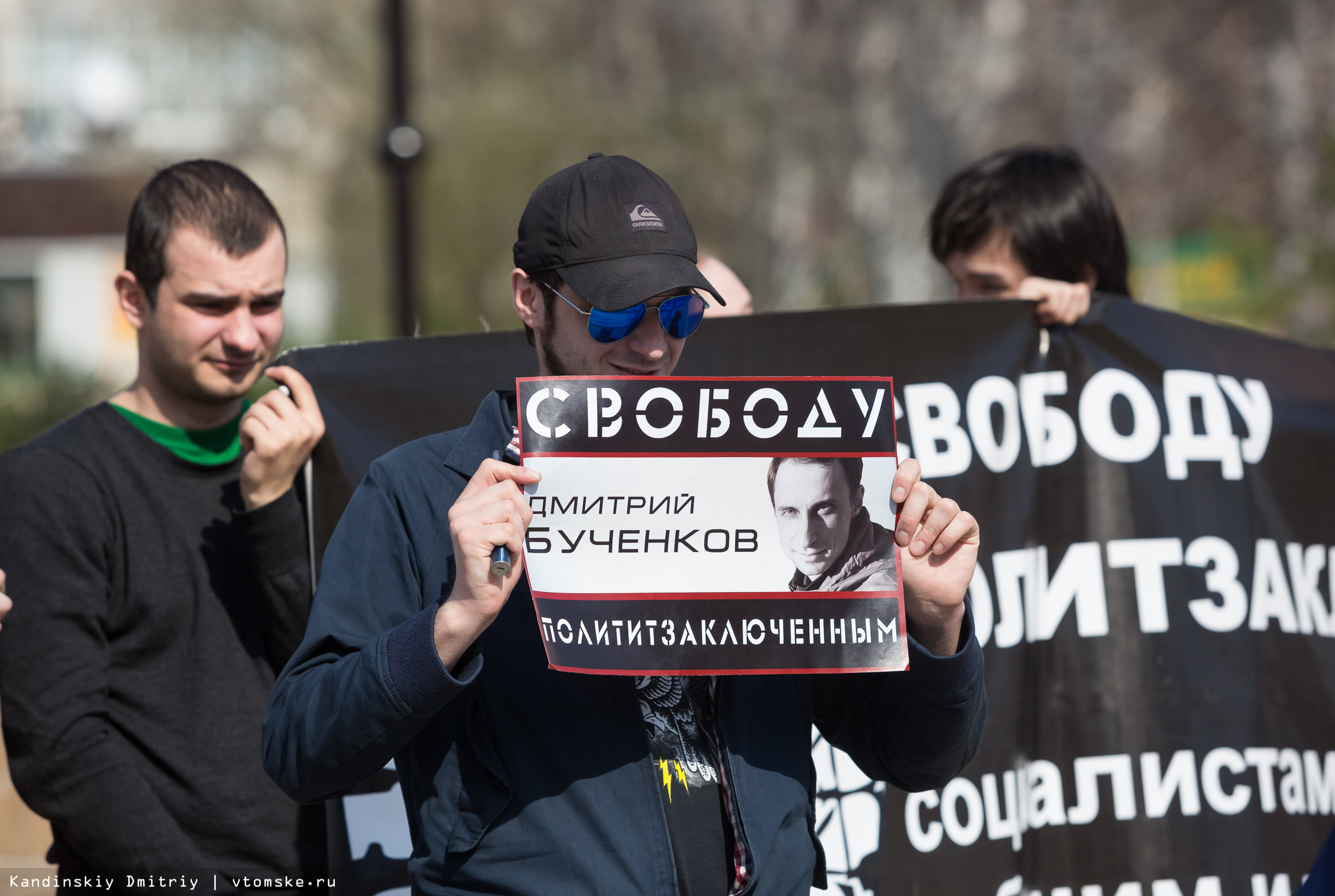
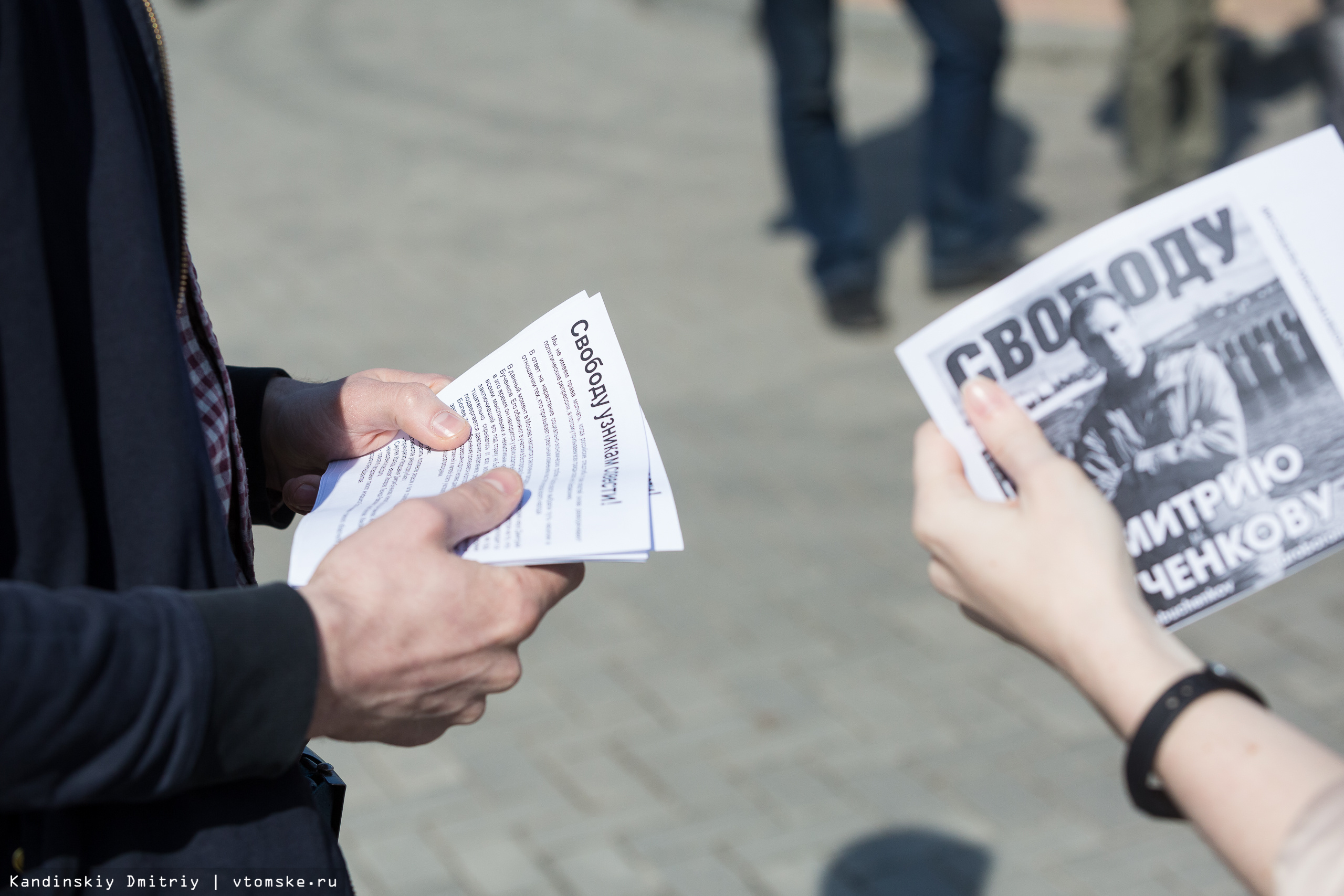
In particular, the Tomsk residents at today’s picket supported Dmitry Buchenkov. According to federal media, Buchenkov has been accused of a resisting a riot police officer during the riot on Bolotnaya Square in Moscow on May 6, 2012. He was arrested on December 3, 2015.

“We believe this is a provocation on the part of the security forces. There are witnesses who have testified that [Buchenkov] was in Nizhny Novgorod, his hometown, that day. However, he was basically abducted. His lawyers were not allowed to attend his pretrial custody hearing, and his relatives did not know his whereabouts for a long time. Now he is in police custody. They are going to try him on the basis of a photograph of another person. We believe this is political repression,” said Sharypov.

The picketing Tomsk residents also showed their support for Sergei Udaltsov, Alexei Gaskarov, and Tomsk activist Yegor Alexeev, who is suspected of posting extremist videos on the VKontakte social network, and collected donations for an aid fund for victims of political repression.

“Free political prisoners: socialists, anti-fascists, labor and civic activists!”

“Free political prisoners: Dmitry Buchenkov”
“Free Dmitry Buchenkov”

Translated by the Russian Reader. Photos courtesy of Dmitry Kandinsky and vtomske.ru. Thanks to the May 6 Committee for the heads-up

It’s Been a Quiet Week in the Motherland (The News from OVD Info)

Maxim Panfilov
Maxim Panfilov

Hello! One of the main events of the past week for us was not Putin’s “Direct Line,” but the arrest of a man who spoke with Putin a year ago. Anton Tyurishev, a construction worker at the Vostochny Cosmodrome in the Russian Far East, complained to the president that he and his mates were not being paid their wages.  Putin promised to get to the bottom of it, but a year on nothing had changed. Tyurishev promised that in response protests would kick off. Later, he was summoned to the police station, where the “Law on Rallies” was read out to him. The day before the “Direct Line” broadcast, he was detained and sent to jail for five days, allegedly, for swearing in public.

Criminal Prosecution

The new defendant in the Bolotnaya Square Case, Maxim Panfilov, who suffers from Tourette’s syndrome and yet was taken into police custody, is not getting the medicines he needs. Instead, he is being administered substitutes that do not alleviate his condition. Panfilov has been appointed an outpatient psychiatric examination. The investigator has agreed to let defense attorneys attend it.

Ildar Dadin, convicted of “multiple violations of the rules for holding public events,” was convoyed from Moscow to Petersburg right on his birthday, which means he will serve his sentence in Leningrad Region.

Ildar Dadin
Ildar Dadin

Last week, it transpired that Magomednabi Magomedov, imam of the Eastern Mosque in Khasavyurt, had been arrested, accused of incitement to terrorism and inciting religious and ethnic hatred. Magomedov, who was transported from one place of confinement to another over several days, complained he had been tortured. Pretrial detention facility officers had beaten him and forced him to kneel, demanding that he confess to the charges.

Euromaidan participant Alexander Kostenko, convicted of harming a Berkut riot police officer, was transferred to solitary confinement shortly before a hearing where his request for parole was to be examined. Naturally, Kostenko’s parole request was rejected.

Alexander Kostenko
Alexander Kostenko

It seems soon Alexei Navalny will have no allies who are not undergoing criminal prosecution. Ivan Zhdanov, head of the Anti-Corruption Foundation’s legal service, and a candidate for the council of deputies in the Moscow suburb of Barvikha, has been charged with evading conscription.

Freedom of Assembly

In Ulyanovsk, police diligently searched for activists who had blocked a road in connection with construction of a residential complex. They visited one activist at work, and telephone another and asked him to report for questioning. When he demanded an official summons, they threatened him with criminal charges. Administrative charges have been filed against three people.

In Volgograd, the leader of the regional Union of Entrepreneurs and Freight Haulers has been slapped with three administrative charges for calling people to a protest rally before the rally was authorized. The court threw out two of the three charges, while the third resulted in a fine.

The confrontation continues in Moscow’s Dubki Park. Defenders of the park, who oppose construction there, are fined for disobeying the police. A female journalist’s arm was injured when an assembly of defenders was dispersed. When he was detained, one of the activists, Dmitry Boinov, was beaten so badly that he has been in hospital for a week recovering from fractures.

Beatings

In Podolsk, three men attacked Maxim Chekanov, a past participant of protest rallies. The incident began when they called Chekanov by name, asked him questions about the “Kiev junta,” called him a “Banderite scumbag,” and then invited him to go round the corner. During the ensuing fight they smashed Chekhanov’s face.

Popular Chechen singer Hussein Betelgeriev, who disappeared in late March, has returned home beaten. It is unknown where he was all this time. Relatives and friends suggest he was abducted, and connect the abduction with his comments on social networks and the fact he ignored the call to attend a pro-Kadyrov rally on March 23.

Reading

Olga Sutuga, mother of anti-fascist Alexei Sutuga, currently serving time at a penal colony in Irkutsk Region, talks about the international aid project Political Prisoners University.

Thanks for your attention!

_________

OVD Info is an independent human rights media project dedicated to political persecution in Russia. We are engaged in daily monitoring of detentions at public events, and publish information about other kinds of political persecution. We believe that information liberates and protects, and analyzing the data we collect can help change the situation for the better in the future.

Editor’s Note. OVD Info sends out a weekly email news roundup, in Russian, to its supporters. I thought that, despite its brevity, this week’s roundup provided a fairly eloquent picture of the state of affairs in this country at present and not just this particular week. You can sign up to the mailing list by going to the bottom of any page n the OVD Info website and entering your email address where you see the phrase ПОДПИСАТЬСЯ НА РАССЫЛКУ.

Ildar Dadin: “When I Get Out, We Will Change the Country for the Better”

The Prison Blog of Ildar Dadin’s Fiancée: First Visit, January 14
Zekovnet.ru

Nastya Zotova and Ildar Dadin had agreed to get married in January 2015, when Ildar was detained. Imprisoned Russia continues its publication of his fiancée’s blog.

nastya & ildar
Nastya Zotova & Ildar Dadin. Photo courtesy of openrussia.org

I got permission to meet with Ildar from Judge Natalya Dudar on December 30, and I went for my first short visit on January 13. A short visit is not like a date at a cafe or the movies. There is no hugging and kissing. You see each other only through the glass, and there is also a metal grille on top of the glass.

Getting a “date” was not as difficult as I thought. I went to the pretrial detention facility at nine in the morning and handed over the authorization from the judge and the application form, which was printed on the same piece of paper. Then I waited until eleven for one of facility’s wardens to come. He collected everyone’s internal passports and took us to the fifth floor, where there were about fifteen cubbyholes with glass in the middle.

The visit lasted two hours. You can discuss a lot in that time, both life in prison and personal affairs. Apart from me, nine other people had come for visits. Most were women, some of them with children in tow.

Before the visit, a little boy showed me a drawing.

“I drew this for Dad. This is me, this is Mom, and this is Dad. And this is our home.”

Ildar was finally led in. The feelings provoked by such visits are mixed. On the one hand, there he was, my beloved one, whom I had not seen for five weeks. He was safe and sound, without a bruise on his face. The first few minutes we stared at each through the glass and smiled like fools. On the other hand, it was hard. I wanted to hug and kiss him. But talking with him through the glass was still better than nothing.

I quizzed him about prison life. It turned out that the inmates were often worried about the simplest problems, which were hard to solve imprison. For example, your socks are torn. If you were at home, you would grab a needle and thread and darn them. But there are needles and thread in the detention facility. You might be able to borrow a needle, but thread is totally inaccessible and is not allowed in care packages.

Or you have run out of toilet paper. You will have to wait until someone buys it in bulk through the Federal Penitentiary Service store. Toilet paper is not allowed in care packages. According to Ildar, the wardens should issue toilet paper to inmates, but in Pretrial Detention Facility No. 4 it is “not done.”

Or you need to write complaints and appeals in triplicate or quintuplicate. There is no printer, so you have to write everything by hand. You could use carbon paper, but for some reason it is also not allowed in care packages.

The inmates entertain themselves in peculiar ways. Whereas Oleg Navalny caught pigeons, Ildar and his cellmates catch mice. They are ordinary gray mice that run under the bunks at night.

To catch a mouse you need an empty milk carton. You cut a little hole and plant the bait inside. When the mouse enters the cartoon, you close the hole with your hand and then transfer the little beast to a plastic ice cream pail.

They managed to catch two mice in this simple way. Ildar’s cellmates decided to put them on trial and “sentenced” them to four days in prison. They were to serve their sentence in the plastic ice cream pail. Afterwards, they planned to “release” the rodents by throwing them out a third-floor window. But the prisoners escaped by gnawing a hole in their cell.

Smoking is another serious issue. There are eleven men in Ildar’s cell. Five of them are smokers, and they smoke right in bed. The others, who are nonsmokers, are not happy, to put it mildly.

There are only eight beds for the eleven inmates. They take turns sleeping. According to Ildar, however, this is even a good thing, because you can borrow a second blanket from someone. Otherwise, it is too cold to sleep. It got cold in the cell on January 1, so the thermal underwear that I bought on the advice of Alexei Polikhovich, who was convicted in the Bolotnaya Square case, was a real godsend. But Ildar is warm in it only if he sleeps under two blankets. And he still has to survive the transfer to the penal colony where he will serve his sentence—in winter in a cold train car!

After sleep, the second most important issue is food. Ildar admits the food is better than at the special detention center. However, the portions per inmate are not very big. It is not that he is completely hungry, but he would like more. He says that some cellmates eschew the prison food, and so the other prisons divvy up their helping among themselves. They can even warm the food up. A boiler is placed in a pot with water, and a plate with the food on it is place over the pot. The food is thus heated over a water bath.

I have been trying to figure how best to fatten up my inmate through care packages. Ildar already rejected hot meals ordered through the FPS website, and then canned buckwheat kasha with meat. I don’t feel like sending him instant mashed potatoes and noodles (which in prison are called “steamers”).

“Maybe you’d like more cheese? More sausage?”

Ildar frowned.

“I look at the prices in the FPS store and feel offended at how these thugs prey on us. I would rather eat the regulation hundred grams of soup, then shop there,” he said.

This is especially because, according to Ildar, all the care packages are put in the “kitty,” to which everyone has access, so Ildar himself does not end up with so much.

Ultimately, we agreed that I would cooperate with the relatives of other inmates, and that together we would buy food in bulk at ordinary stores and then pass it on to the lads in the cell, since there was a common pot there anyway. Regard the FPS store, Ildar nevertheless admitted that sometimes he wanted something sweet: chocolate, sweetened condensed milk or soda. He was very grateful to Olga Romanova for the garlic she sent him. Garlic was the best thing for you, he said, because it was full of vitamins! All his cellmates were ill, but he wasn’t.

There is no shower in the cell. The inmates are taken once a week to the shower room. But there is a sink, so they can wash up and launder their clothes. As Ildar put it, the toilet is “luxurious”: there are walls on two sides, and a door on the third up to the waist.

I asked Ildar how he spent his time at the detention facility, whether he had been writing complaints. Ildar admitted that he had stopped for the time being. The wardens had hinted to him as it were that if he continued, they could take it on his cellmates.

“However, maybe I’ll soon have to make an important decision: to be a living scoundrel or die,” he said.

Ildar did not explain what was the matter: our conversation was bugged. But he did promise in any case to send a letter, written in his own hand, indicating that under no circumstances was he planning to commit suicide. He believed this would protect him from the “accidents” that happen in Pretrial Detention Facility No. 4.

Despite this eerie message, Ildar was more or less optimistic and was planning to read books.

“I have a lot to learn: political science, economics . . . When I get out, we will change the country for the better,” he said hopefully.

Before his arrest, Ildar said he wanted to be a lawyer and specialize in human rights.

UPDATE
On the night of January 14, it transpired that immediately after our visit, Ildar was removed from his cell along with his things. According to the tentative information we have, he has been transferred to another cell in the same pretrial detention facility.

UPDATE: January 15
As it turned out, Ildar has been transferred to a special cellblock in the same facility. (Meaning greater scrutiny from the wardens and better living conditions.) Meanwhile, our marriage application is ready to submit to the registrar.

Ildar Dadin and Nastya Zotova's marriage application. Image courtesy of Imprisoned Russia
Ildar Dadin and Nastya Zotova’s marriage application. Image courtesy of Imprisoned Russia

Translated by the Russian Reader

__________

Russia: Peaceful activist sentenced under repressive new law must be released
Amnesty International
December 7, 2015

Russia’s jailing of a peaceful opposition activist for violating the country’s new law on public assemblies is a shocking and cynical attack on freedom of expression, Amnesty International said today.

Ildar Dadin was sentenced to three years in jail by a Moscow court for repeated anti-government street protests. He is the first person to be jailed using the law, which was introduced in 2014 and punishes repeated breaches of public assembly rules.

“The shocking sentencing of Ildar Dadin shows that the Russian authorities are using the law on public assemblies to fast-track peaceful protesters to prison,” said John Dalhuisen, Europe and Central Asia Director at Amnesty International.

“This cynical move shows that compared to the drawn out criminal proceedings against peaceful protesters in the past, the authorities have now created a shortcut for imprisoning activists. It is more dangerous to be a peaceful activist in Russia than at any time in recent years.”

Andrei Barabanov: The Bolotnaya Square Case Destroyed Everything I Had

Andrei Barabanov: The Bolotnaya Square Case Destroyed Everything I Had
Sobesednik.ru
January 5, 2016

Sobesednik.ru spoke with Andrei Barabanov, a prisoner in the Bolotnaya Square case who was released before the New Year. The 22-year-old Barabanov was handed one of the longest sentences in the case, three years and seven months. On December 25, he was released and answered our correspondent’s questions.

What plans do you have for your first days of freedom?

I plan to get my health back in order and rest. Before I was arrested I had just finished college. Now I plan to get a higher education and, in the future, if it works out, start my own business.

Do you have any desire to continue your involvement in politics or public life?

I wasn’t involved in them as it was. I went to the rally on Bolotnaya Square on May 6, 2012, as an ordinary citizen. It was the second rally I had attended. I didn’t know the organizers or anyone else there. I was there with my girlfriend. Later, another friend of mine joined us. Of course, I could not imagine it would end that way.

The riot policeman who were you accused of assaulting had no beef with you. Why, then, were you put away for three and a half years?

There was a video that, allegedly, showed me kicking the riot policeman from behind. In fact, I didn’t kick him. On May 6, the police roughly detained people, grabbing them and throwing them, and we ended up at the very heart of the action. I don’t understand myself why I acted that way: it was a spontaneous reaction in a thorny situation. When I was in the remand prison I wrote a letter of apology to the riot policeman. He even wrote me back, saying he accepted my apology. At the trial he did not make any demands. He had not suffered any injuries, and had not sought medical attention. But none of that mitigated the sentence.

11_145
Andrei Barabanov in the courtroom. Photo courtesy of RosUznik

I think the authorities wanted a criminal case to emerge from the Bolotnaya Square incident, a case with tangible prison sentences. So in my case there was a striking video showing me “kicking” a riot policeman.

On May 6, I was jailed for twenty-four hours, and then let go. I was rearrested three weeks later. Ultimately, I was convicted of rioting and violence against a law enforcement officer at a show trial. It transpired that I was, as it were, a malicious bully and instigator, which personally I had a hard time getting my head around. I had always been considered a pacifist, and I was opposed to violence against anyone else. I think I was sentenced not for violence but so that people would think ten times before taking to the streets and protesting.

Has the sentence greatly changed your life?

You could say it has destroyed what I had. Before May 6, I had a girlfriend with whom I lived, a hobby I loved, aerography, which I dreamed of turning into a business. Then all of it was gone. All that was left was the support of my closest loved ones, my mom and my friends. By the way, several complete strangers wrote me letters and sent me care packages, and this was also a huge moral support.

What health problems have you had?

The standard problems after several years in prison: the effects of inactivity, an eye injury I got in the remand prison, and problems with my stomach and teeth.

Would you now take part in protest rallies if they were to happen in Moscow?

Not now. I am not planning on going to protests. I also do not believe that elections are the way. Now I need to recover, relax, and learn to live again on the outside.

Translated by the Russian Reader