Stop the Show Trials! Free Political Prisoners in Russia!
While the Russian government celebrates the closing of the Olympics in Sochi, in Moscow, eight arrested activists are found guilty after two years of show trials. Pressure from the international community has already helped to amnesty several people. Let’s show our solidarity with political prisoners! Let’s stop the show trials and persecution of activism in Russia!
We will meet near the Russian Embassy on the day of the Olympics closing ceremony, 23 February, Sunday, 2 PM. Come and join us!
Background:
Following mass demonstrations in 2011-12, Russian police arrested dozens of activists – socialists, anarchists, human rights campaigners, ecologists, as well as ordinary citizens who oppose the Putin regime. This is exemplary punishment aimed against a wave of social movements that has been energising a new generation of post-Soviet activists. The demonstration on 6 May 2012 was a legally sanctioned rally that took place on Bolotnaya Square in Moscow. However, it ended with brutal police violence and mass arrests. Of thousands who protested against mass election forgeries, hundreds were kettled by police. More than a dozen of them have been kept in pre-trial detention for over a year.
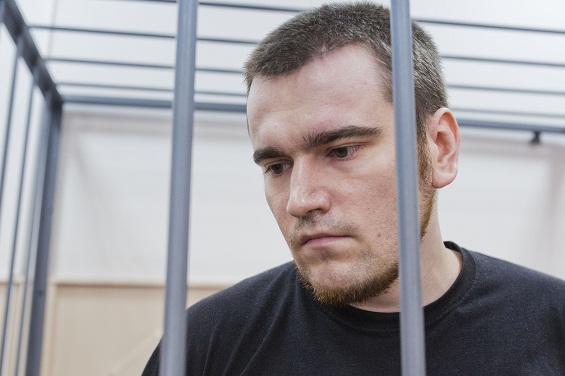
Alexandra Naumova (née Dukhanina, usually referred to as Sasha Dukhanina), born 1993, was the first person to be arrested in the Bolotnaya Square case, launched by the Russian authorities after a sanctioned opposition march in downtown Moscow on May 6, 2012, the day before President Putin’s re-inauguration, ended in clashes with police. Dukhanina-Naumova was detained at the Occupy Arbat protest camp in Moscow in late May 2012 and has been under house arrest since that time.
Dukhanina-Naumova and her co-defendants Sergei Krivov, Alexei Polikhovich, Artyom Savyolov, Denis Lutskevich, Andrei Barabanov, Stepan Zimin and Yaroslav Belousov are charged with involvement in mass riots and assaulting police officers. At the January 22, 2014, hearing in the case, prosecutors asked the presiding judge, Natalya Nikishina, to sentence each of them to between five and six years in prison.
Dukhanina-Naumova is specifically accused of throwing chunks of asphalt, one of which, allegedly, struck a police officer, slightly bruising him, and splashing a soft drink (kvass) from a liter-size bottle.
A photograph of a riot cop dragging Dukhanina-Naumova away by the neck on May 6, 2012, taken by famed opposition blogger and photographer Rustem Adagamov (aka Drugoi), himself now in exile, has become, perhaps, the most famous image of the “riots” that took place in Moscow that day. Many opposition activists and independent observers have claimed that what happened was in fact a provocation on the part of the authorities aimed at demoralizing the opposition and selectively punishing those who had tried to spoil Putin’s repeat “coronation” by publicly protesting.
Before her arrest, Dukhanina-Naumova was a student at Moscow State University, where she majored in translation and interpretation. An anarchist, she had been involved in such causes as the defense of the Tsagovsky Forest, near Moscow, and Food Not Bombs.
On December 19, 2013, four other defendants in the case, Maria Baronova, Vladimir Akimenkov, Nikolai Kavkazsky and Leonid Kovyazin, were released under an “amnesty” that has been regarded by many as a gesture meant to defuse domestic and foreign criticism of the Putin regime’s concerted attacks on human and civil rights, NGOs, gays and lesbians, migrant workers, and opposition activists.
In any case, this amnesty did not fool the several thousand people who marched in Moscow on February 2, 2014, demanding the release of Dukhanina-Naumova and the other Bolotnaya Square defendants.
Dukhanina-Naumova made the closing statement, below, during the final hearing in the trial, on February 5, 2014, in Moscow.
After Dukhanina-Naumova and her co-defendants had finished making their closing statements, Judge Nikishina announced she would read out the verdict in the trial on February 21, 2014. This is two days before the end of the Sochi Olympics, President Putin’s wildly expensive showcase of his personal triumph over man, nature, and budgetary common sense.
__________
Closing Statement by Alexandra Dukhanina-Naumova at the Bolotnaya Square Trial, Zamoskovoretsky District Court, Moscow, February 5, 2014
At first I thought that this whole trial was a crazy mistake, the result of some mix-up. Now, after hearing the prosecutor’s speeches, and considering the length of the prison terms they are asking for us [Bolotnaya Square defendants], I’m starting to see that what the authorities want is revenge. They want revenge because we were there and saw how things really were. We witnessed who instigated the stampede, how people were beaten, and the unjustified violence. They are getting revenge on us for not bowing down to them and repenting for our nonexistent crimes, neither during interrogations nor here, in the courtroom. They are also avenging me for not helping them further their lies, for refusing to answer their questions.
These are serious crimes that carry a penalty of six years in a penal colony. There is no one else who has earned such a severe punishment, just us. They’re afraid of the real criminals—they imprison the strangers who get in their way while they wouldn’t lift a finger against their own. It is up to you, Your Honor, to decide whether to pay for furthering their happiness—promotions, stars, and medals—with our lives.
Why six years? What are these “no fewer than eight targeted throws” I supposedly dealt? Where did they come from? Whom was I aiming at and whom did I hit? Eight different police officers? Or did I hit the two men they’ve painted as the victims eight times? If so, how many times did I hit each of them? Where are the answers to these questions? Isn’t it up to them to describe the attack in detail and prove their case before putting me in prison? After all, this isn’t fun and games; it’s six years of my life at stake. Otherwise, it isn’t even lies, but mendacious demagoguery unsupported by facts, a game played with a human life in the balance. And if they had 188 videos and not eight, would they allege that there were 188 throws?
You’ve seen the two riot police officers who were my so-called victims. Each one of them is two or three times my size, and on top of that, they were in body armor. One of them felt nothing, and the second one was not injured by me at all and has no grievances. Is this the “rioting” and “violence” that have earned me six years of incarceration?
I almost forgot about the kvass. The bottle alone gets me five years, and the eight targeted blows get me the last one. At least let them say so, that way at least I’ll know the price of kvass. They should also tell me where my “mass rioting” ends and my “violence toward the authorities” begins. What’s the difference between the two? I still haven’t understood the charges against me: what did I burn? What pogroms? What destruction of public property? What does any of this have to do with me? What did I blow up? What did I set on fire? What did I destroy? Whom did I conspire with? What’s the evidence? Am I getting four years in accordance with Article 212 just for being there? Is my mere presence at what began as a peaceful demonstration the “rioting” that I was involved in? All I did was show up.
Take a look at these people. They’re not murderers, thieves or con artists. Putting us all in prison is not only unjust, it’s criminal.
Many people have given me the opportunity to repent, apologize, say what the investigators want me to say, but you know, I don’t find it necessary to repent, let alone apologize, to these people. In our country, it’s widely accepted that they are absolutely untouchable despite the well-known cases of their involvement in drug trafficking, prostitution, and rape. Just a few days ago, that happened in the Lipetsk Region.
The narrative of the charges pinned on us isn’t just funny; it is absurd and based solely on the testimony of the riot police officers. What does this mean, that if a person has epaulettesthey’re a priori honest and holy?
Your Honor, in the course of the past eight months of this trial, you’ve received such substantial evidence of our innocence that if you send us all to the camps, you will be ruining our lives and futures for nothing.
Is the government really so determined to make an example of us that it is willing to take this step? Letting a pencil pusher, rapist or policeman off for [inaudible] is a matter of course: they’re untouchable, one of your own. We, on the other hand, can handle a prison term. Who are we, after all, we’re not even rich? For some reason, I am convinced that even in prison I will still be more free than any of them because my conscience will be clear, while those who remain on the outside continuing their so-called protection of law, order, and freedom will live in an unbreakable cage with their accomplices.
I can admit to making a mistake. If I were truthfully presented with facts and it were demonstrated to me that I had done something illegal, I would confess to it. However, no one has done any such thing: all I’ve witnessed are lies and brute force. You can suffocate someone with force, drag them [inaudible] and all of this has already been done to me. But lies and violence can’t prove anything. Thus, no one has proven my guilt. I am sure that I am right and that I am innocent.
I’d like to close with a quotation from Gianni Rodari’s Cipollino:
“My poor father! They’ve thrown you in the pen with thieves and bandits.”
“Hey now, son,” his father tenderly interrupted him. “Prison is chock full of honest people!”
“Why are they in prison? What have they done wrong?”
“Absolutely nothing, son. That’s why they’re in here. Decent people rub Prince Lemon the wrong way.”
“So getting in prison is a great honor?” he asked.
“That’s how it seems. Prisons are built for people who steal and kill, but in Prince Lemon’s kingdom, it’s all topsy-turvy. The thieves and murderers are in his palace, while honest citizens fill the prisons.”
Translated by Bela Shayevich. Originally published, in Russian, on Grani.Ru. Photograph of Alexandra Dukhanina-Naumova courtesy of Dmitry Bortko
You should study philosophy, at best,
After fifty. Build a model
Of society, all the more so. First you should
Learn to make soup, fry (if not catch)
Fish, make decent coffee.
Otherwise, moral laws
Smack of dad’s belt or a translation
From the German. You first should
Learn how to lose rather than gain,
Loathe yourself more than the tyrant,
Shell out half your measly paycheck on rent
For years on end before holding forth
On the triumph of justice. Which always comes
At least twenty-five years too late.
You should study a philosopher’s work through the prism
Of experience or wearing glasses (which nearly amounts to the same thing),
As when the letters run together and
The naked dame on the rumpled sheets is once again
A photograph for you or a reproduction
Of an artist’s painting. Genuine love of
Wisdom does not insist on reciprocity
And ends not in marriage
To a hefty tome published in Göttingen
But in indifference to oneself,
In the blush of shame; sometimes, in an elegy.
(Somewhere, a streetcar clangs, eyelids droop,
Soldiers return from a brothel, singing;
Only the rain is reminiscent of Hegel.)
The truth is there is no
Truth. This doesn’t exempt us
From responsibility. On the contrary:
Ethics is the selfsame vacuum, filled by human
Behavior almost continuously;
The selfsame universe, if you like.
And the gods love the Good not for its eyes,
But because they wouldn’t exist were it not for the Good.
And they in turn fill the vacuum,
Perhaps even more systematically
Than we do, for we are
Unreliable. Although there are more of us
Than ever before, this is no Greece:
We are undone by low cloud cover and, as mentioned above, rain.
You should study philosophy when
You have no need of philosophy. When you have a hunch
The chairs in your living room and the Milky Way
Are interconnected, and more closely than causes and effects, than you
And your relatives. And that what constellations
And chairs have in common is insensibility, inhumanity.
This a bond stronger than copulation
Or blood! Naturally, you shouldn’t try
To resemble things. On the other hand, when
You’re ill, you don’t necessarily have to convalesce
Or worry how you look. This is what
People over fifty know. Hence, when they
Look into a mirror, they sometimes confuse aesthetics with metaphysics.
A Russian emigrant student in France yelled at Russia’s top investigator Alexander Bastrykin this week during a panel at the Sorbonne, calling him a murderer and accusing him of launching politically motivated criminal probes.
An unidentified male student was apparently angered with Bastrykin’s evasive replies to questions about the prosecution of Greenpeace activists from the Arctic Sunrise and participants at the opposition rally on Bolotnaya Ploshchad in May 2012, French media and eyewitnesses reported on the Internet.
An eyewitness of the incident, Lolita Gruzdeva, posted a video on her Instagram account late Wednesday in one of which an unidentified male student yells at Bastrykin in French.
In another video posted by Gruzdeva, the same young man yells at Bastrykin in Russian, “You are a criminal!”
The student’s outburst happened after Bastrykin, replying to questions from participants of the meeting, said that the fate of Greenpeace activists would be decided by the court system and that the denial of medical assistance to a hunger-striking suspect in the Bolotnaya trial, Sergei Krivov, was not his business, Gruzdeva wrote on her Twitter account Wednesday.
On Tuesday, the Zamoskvoretsky District Court in Moscow convicted Mikhail Kosenko, recently declared a prisoner of conscience by Amnesty International, of involvement in “mass riots” and use of force against police officers during clashes between police and protesters after a sanctioned opposition march was prevented by police from reaching its end point, on Bolotnaya Square, in Moscow on May 6, 2012, the day before President Putin’s inauguration for his third presidential term. At the request of prosecutors, Kosenko, who suffers from a post-traumatic mental illness that previously required no hospitalization, had been declared mentally incompetent by the court, which has now sentenced him to compulsory psychiatric treatment, thus apparently reviving the state’s punitive use of “psychiatry” against dissidents during the late Soviet period.
During Tuesday’s court hearing, Mr. Kosenko made the following statement, which was recorded by Novaya Gazeta reporter Yulia Polukhina and published in the original Russian on the newspaper’s web site. My translation is illustrated with sketches by artist Victoria Lomasko, who was also present at the hearing. I thank her for permission to reproduce them here.
__________
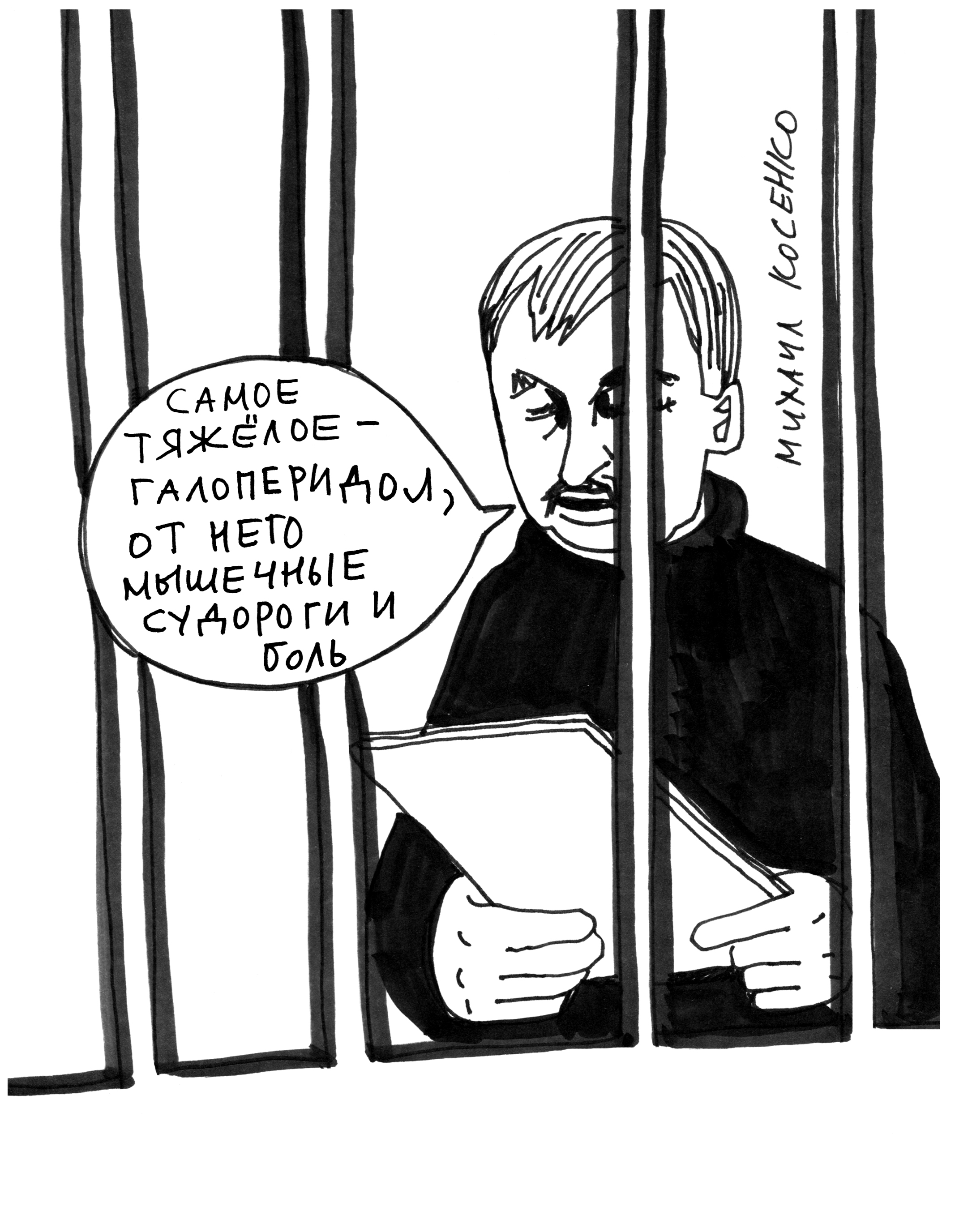
The most valuable thing in the country is freedom. This is what the majority of our population is deprived of to one degree or another. This applies in particular to prisoners. A huge number of people are in prisons and camps for no reason, and no one will help them. And those who are there for crimes they have committed do not deserve the conditions [in which they are imprisoned]. As the prisoners themselves say, no one [is] able to recover after imprisonment. The plight of the mentally ill in incarceration is hard; the most difficult thing for them is haloperidol, a banned substance. There are side effects from it and many fatalities. It causes muscle cramps, rigidity, and pain.
Mikhail Kosenko: “The hardest thing is halperidol. It causes muscle spasms and pain.”
Our people are used to suffering. An eastern model of society is being built in Russia—lack of freedom in exchange for a sated life. The authorities base their propaganda on material measures—money spent and its results. That happiness doesn’t lie in money is an ancient idea, although one now challenged. Happiness lies in people’s freedom. There are many countries where the material standards are lower than in Russia but the level of satisfaction with life is much greater. Our people are used to living in poverty, and they imagine that a little prosperity is a big achievement.
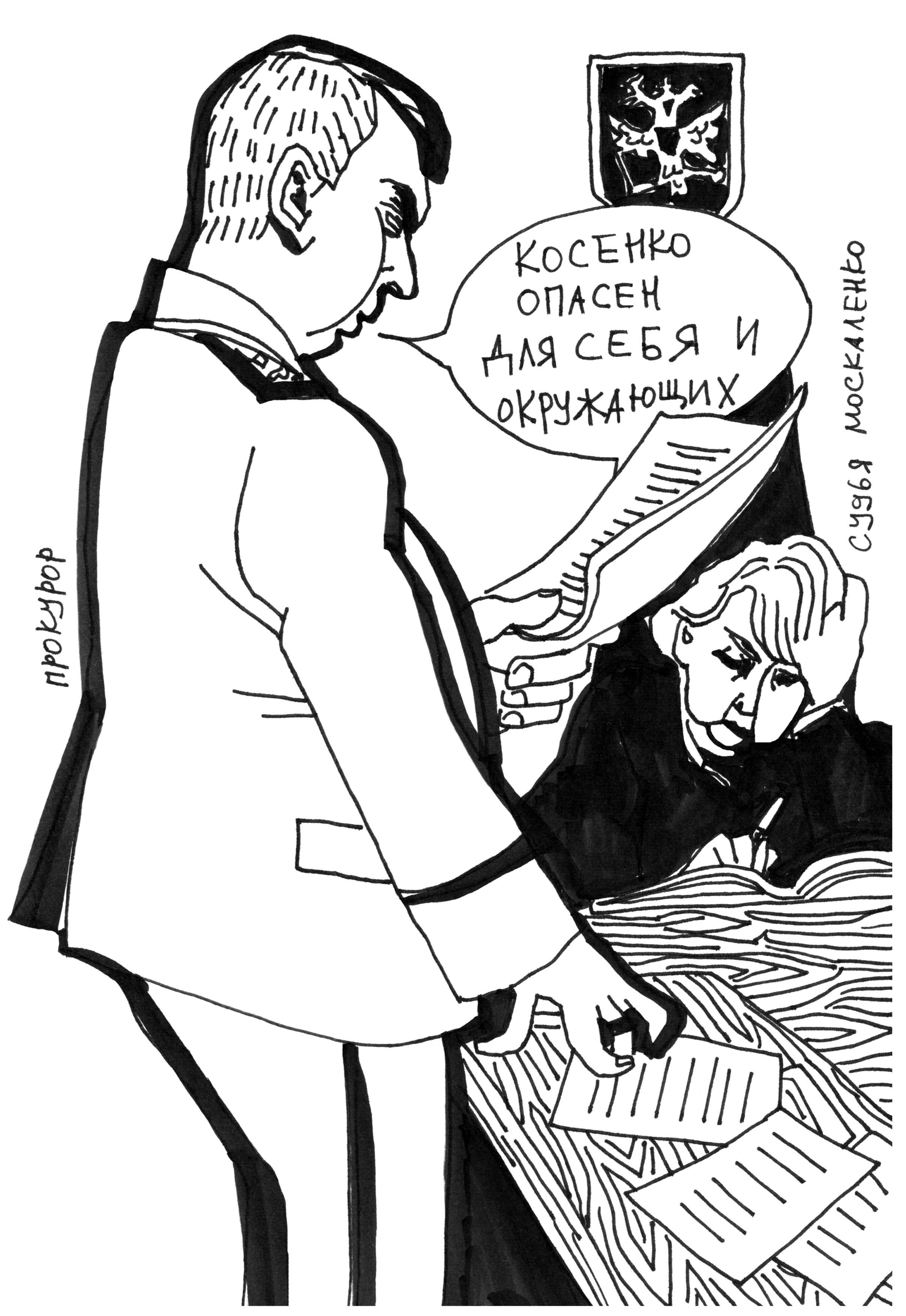
Prosecutor: “Kosenko is a danger to himself and others.” (Judge Ludmila Moskalenko, who found Kosenko guilty, is seated on the right.)
Freedom is freedom from evil. Real opportunities… Our country has great potential, and different kinds of freedom are needed to realize it, but they either do not exist or are restricted. Freedom of the media… The most important medium is television, but there is censorship on [Russian television], which is prohibited [by law].
The authorities impose their strategy on television reporters. That is why pickets, rallies and marches are so important for the opposition. It was on this ground that the authorities decided to tussle with the opposition. Rallies and marches organized by the authorities are underwhelming, so they took the routе of creating all kinds of obstacles [for the opposition]. The authorities decided it was they who determined the location of rallies, even though the law says otherwise. The opposition wants to hold a rally on one square, and the authorities force a different square on them. Our society, accustomed to laws being violated, was not much bothered by this. Then the authorities have used obstacles, nuisances and coercion to make rallies ineffective and to limit the area where they are held, as happened on May 6, 2012.
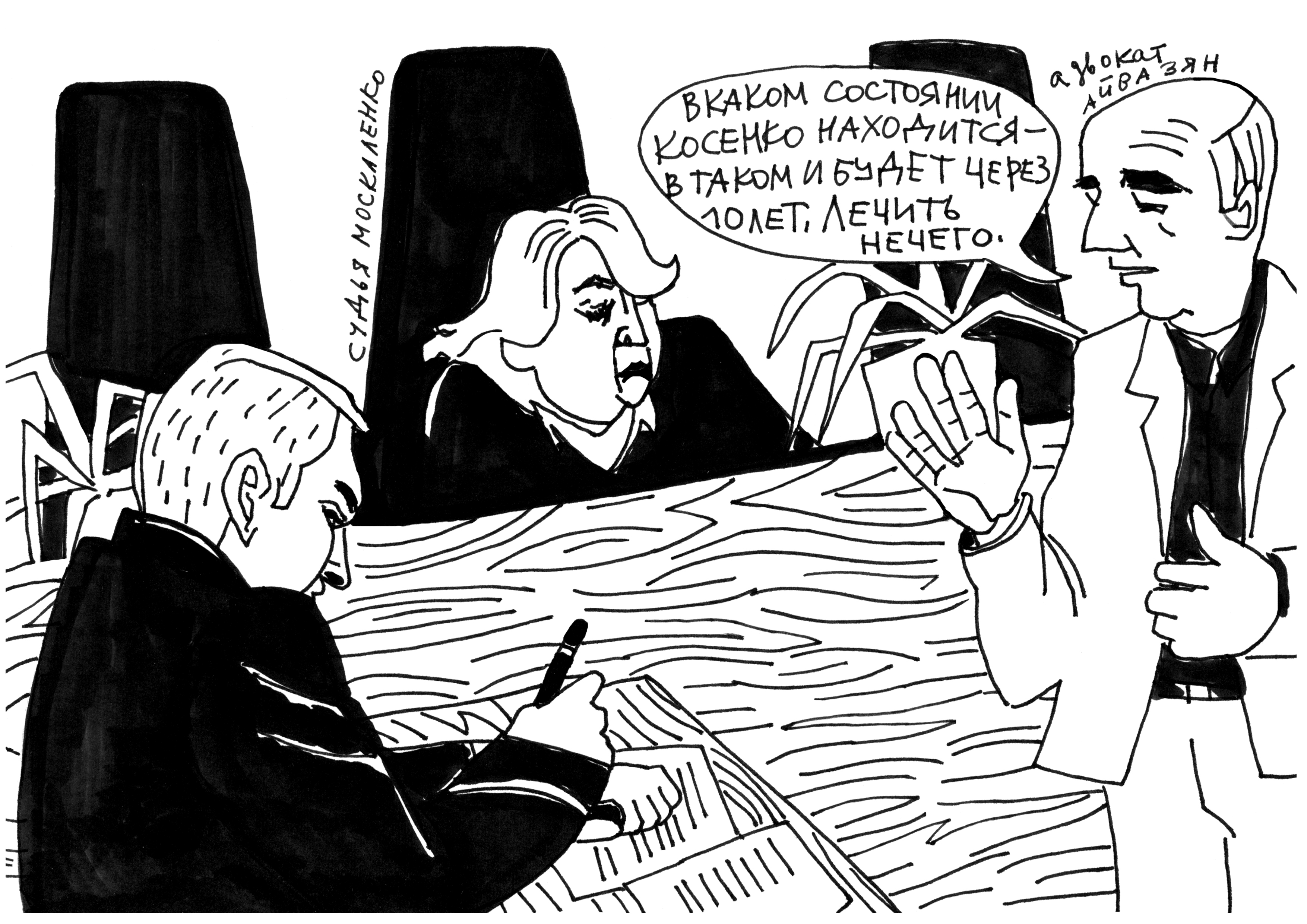
Defense lawyer Dmitry Aivazyan: “Kosenko will be in the same condition ten years from now. There is nothing to treat.”
While drastically limiting the area of the rally, as opposed to what had been agreed, the authorities considered its illegal demands the law. Because the authorities think they are the law. When, amidst the crush [on May 6, 2012, on Bolotnaya Square], dozens of people broke through police lines, the authorities decided they now had the right to disperse the tens of thousands of people who had come to the rally. With their tactics and politically motivated actions, the authorities constantly irritated people, who stood up to these illegal actions. The authorities break the law, but when they are rebuffed, they pretend to be legalists themselves, what with their Article 318 [use of violence against authorities – Editor] Riot policemen perceived the demonstrators as their enemies, meaning that they had been coached ahead of time to act so harshly, to react so harshly. The riot police on Bolotnaya Square obviously were not the law. Their superiors had politically encouraged the actions of the riot police on Bolotnaya Square. It was a political confrontation. The demonstrators were protesting against unfair elections. The demand for fair elections is the most just demand. The authorities oppose fair elections, because [if fair elections are held], they will have to resign. The regime consists largely of incompetent people, of the people who break the law. What we need is rotating governments, not the everlasting tenure of a single regime. With the current regime, Russian will be unable to deal the major challenges that will be inevitable in the future.
Defense lawyer Alexei Miroshnichenko: “No one can be held liable for the same crime twice.” Seated to his right is Kosenko’s sister Ksenia.
Combined with low efficiency, the huge exertions the authorities sometimes display lead to significantly poorer results than could be otherwise. In our country’s history, power has never passed to the opposition legally. The current regime has set many anti-records: the highest consumption of heroin in the world, and it is the same thing with alcohol. And such a regime is competent? And should remain in power forever? The people protesting against it are wrong?
Supporters of the government say there is no one else to run the country. This is doubtful. Russia has huge numbers of talented and strong-willed people, and they can get into power only through honest and fair elections. I want to thank everyone who has supported me—my lawyers, my sister, and everyone who has come to these hearings. As for my sanity, I ask the court to consider me sane.
“One Must Serve the Motherland, I Say!” Basmanny District Court Extends the Arrest of Bolotnaya Case Suspect and Anti-Fascist Alexei Gaskarov
October 3, 2013
Yegor Skovoroda Russkaya Planeta
Alexei Gaskarov in court, June 26, 2013. Photo: Ilya Pitalyov / RIA Novosti
On Tuesday, October 1, Moscow’s Basmanny District Court extended until February 6, 2014, the arrest of Alexei Gaskarov, whom police investigators suspect of involvement in the “mass riots” on Bolotnaya Square on May 6, 2012. Gaskarov has been charged with violating Article 212, Section 2 (participation in mass riots) and Article 318, Section 1 (use of violence against authorities) of the Russian Federal Criminal Code.
February 6, 2014, is the date to which the investigation of the events on Bolotnaya Square has now been officially extended. Earlier this week, the court extended the arrests of the other defendants whose cases have not yet been submitted to the court. Ilya Gushchin, Alexander Margolin, Dmitry Rukavishnikov, Sergei Udaltsov and Leonid Razvozzhayev will also remain in pre-trial custody until February 6.
Another defendant, pensioner Elena Kokhtareva, has been released under her own recognizance. The case of Udaltsov and Razvozzhayev, whom investigators have accused of organizing the “mass riots” (a violation of Article 212, Section 1 of the Criminal Code), has been separated from that of the other defendants.
Investigator Alexei Chistyakov asked the Basmanny District Court to extend Gaskarov’s arrest for another four months, as the investigators have established that Gaskarov “used violence” against Igor Ibatulin, an officer with the Second Tactical Regiment of the Moscow Police, and a soldier by the name of Bulychev.
“In defiance of society’s moral norms, Gaskarov committed the crime in the presence of a significant number of people, taking advantage of numerical and physical superiority, and showing a clear disregard for the authorities. Moreover, his role in this case was particularly active and most aggressive,” Chistyakov read aloud to the court.
According to Chistyakov, Gaskarov presented a flight risk, since before his arrest “he did not live at his registered domicile, led a secretive lifestyle, spent the night at different locations and used various conspiratorial techniques.” Gaskarov should, therefore, be kept in a pre-trial detention facility.
During the hearing, Svetlana Sidorkina, Gaskarov’s lawyer, asked the court to enter character references submitted by the newspaper Zhukovskie Vesti and the Zhukovsky People’s Council into the record, as well as screenshots of a video recording from the case file. These stills show a police officer kicking Gaskarov in the face as Gaskarov lies on the ground.
Chistyakov and the prosecutor, Karasev, did not object to the character references being entered into the record, but they strongly objected to the shot breakdown of the video.
“The actions of law enforcement officers are not at issue in this hearing,” said Chistyakov.
Judge Artur Karpov, a man with a bald skull, agreed with their arguments and refused to enter the images into the record.
“And why is that you were found only partly fit for military service?” Judge Karpov asked, suddenly digressing from the tedious review of the case file.
“For medical reasons, but I can’t remember what exactly,” Gaskarov replied.
“How is it you don’t remember? Everyone remembers the reason they didn’t go into the army, but you don’t?”
“It was ten years ago. It had something to do with my eyesight, with intracranial pressure and something else. But now I just—“
“You just got over all those things? When did that happen? Before you turned twenty-eight?”*
“I wasn’t keeping track.”
“You weren’t keeping track. . . You should have served the Motherland,” the judge muttered.
“I wouldn’t object to serving in the army in exchange for being released from jail,” the defendant laughed.
“In exchange for working as a journalist?” After reading the character reference from the Zhukovskie Vesti newspaper, Judge Karpov had for some reason decided that Gaskarov works there. “One needs to serve in the army. Anyone can be a journalist, but probably not just everyone can serve the Motherland. Why this ‘in exchange for’ right off the bat? One must serve the Motherland, I say!”
Judge Karpov was unrelenting.
“Down in Dagestan, there is a waiting list to get into the army. Being a journalist is easy. You get up when you like, go to sleep when you like, go to work when you like.”
After this emotional outburst, lawyer Svetlana Sidorkina moved that the court change Gaskarov’s measure of restraint to one not involving deprivation of liberty—to house arrest or release on bail.
“Yes, I think this would be possible,” Gaskarov replied, smiling, to the judge’s question about what he thought about the motion.
Karasev and Chistyakov categorically stated that only if Gaskarov were in a pre-trial detention facility could the investigation proceed unhindered. Judge Karpov agreed with the prosecution on this point as well and, after a recess, ordered Gaskarov’s arrest extended until February 6.
When Gaskarov spoke to the court arguing against his arrest, Chistyakov sat motionless, his hands folded in front of him, like a sphinx.
_____
Alexei Gaskarov’s argument in the Basmanny District Court:
I do not agree with the extension of my arrest and wanted to draw attention to the following things. First, I am being charged with violating Articles 212 and 318. Article 318 belongs to the category of moderately severe crimes for which the period of pre-trial detention may not exceed six months. Article 212, which criminalizes “involvement in mass riots,” stipulates more stringent sanctions, up to a year in pre-trial detention. I have a copy of my indictment, dated April 28. As of today, there has been no other indictment. According to this indictment, all the [criminal] actions that the investigator has just listed were then deemed violations of Article 318 by him.
Since the extension the investigator is now requesting means that I will have spent nine months in detention, that is, more than the statutory period of six months, I do not agree with this extension.
With regard to Article 212, I would like to return to the question of the grounds for charging me with violating it. Because even if you go by my indictment in the case file, it turns out I am accused of participation in mass riots. However, if you look at Article 212 itself, it covers mass riots “attended by violence, pogroms, arson, the destruction of property, the use of firearms, explosives, or explosive devices, and also armed resistance to government representatives.”
There is also Article 8 of the Criminal Code, which clearly states that a deed can be deemed criminal if it is fully consistent with “all the elements” of a crime, as described in one or another article in the Code. Accordingly, not all the elements of the crime, as indicated in Article 212, are included in my indictment. The article does not say that only one element or half the elements are enough. “All the elements” must be present.
Furthermore, the investigation finds that there was violence, arsons, and pogroms there [on Bolotnaya Square on May 6, 2012], but I have not been charged with arson and pogroms. I have been charged only with violence against police officers. But Article 318 already covers these actions, and it is unclear how one and the same action can be deemed to constitute now one crime, now another.
On the other hand, if you look at the article dealing with mass riots, it does indeed say that resisting police officers is a constituent element of the crime, but there it stipulates that this must be armed resistance. But there is nothing in the charges brought against me indicating that I used a weapon or objects that could be used as a weapon.
I ask the court to take note of this indictment, because it serves as the grounds for the decision to extend or change the measures of restraint.
There are different sorts of evidence in the indictment and the criminal case file, but they only touch on Article 318, not Article 212. There is no clear indication there which of my actions could be deemed a violation of Article 212.
Moreover, why did we want to enter these photographs [of Gaskarov being beaten by riot police on May 6, 2012 — Russkaya Planeta] into the record? They simply indicate that the situation was quite complicated. The way the indictment is worded implies that if you see a uniformed police officer, he is absolutely within the law and cannot do anything illegal. By entering these photographs into the record, we want to show that the situation was complicated.
As for the actions committed there, I don’t even deny that I pulled one officer by the leg, and another by the arm. But only Article 318 covers all these actions. And so I ask the court not to extend [my arrest] for more than six months.
That is all I have to say.
* In Russia, men are subject to military conscription between the ages of eighteen and twenty-seven —Translator.
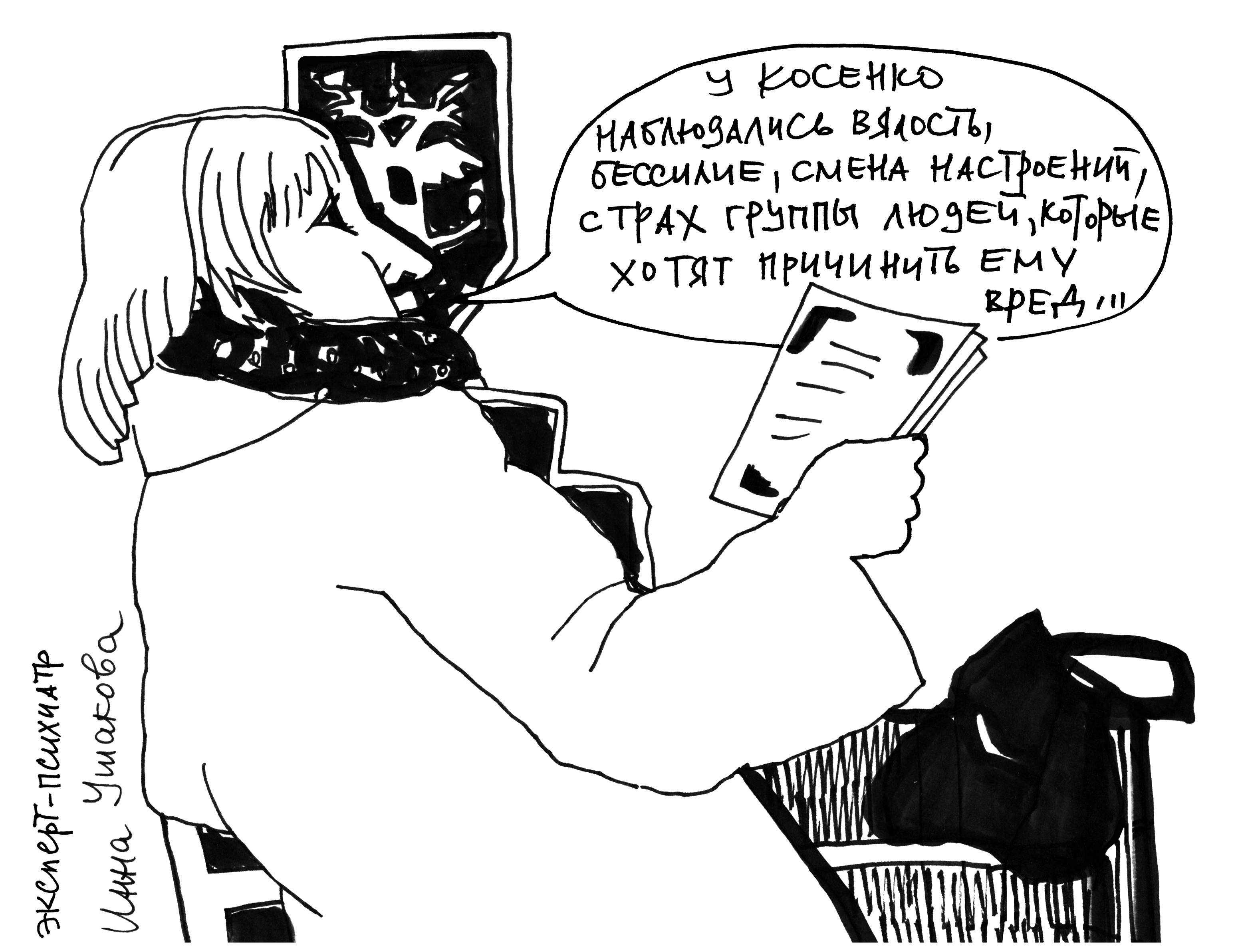
Expert witness psychiatrist Inna Ushakova: “Kosenko exhibited lethargy, flaccidity, mood changes and fear of people wanting to harm him…”
Psychiatrist Inna Ushakova, an expert witness, lists for the court the symptoms of paranoid schizophrenia exhibited, allegedly, by Bolotnaya Square defendant Mikhail Kosenko. I am sure that anyone else caught up in this situation would present the exact same “symptoms.”
Mikhail Kosenko had asked that the court hearing be held in closed chambers.
Ushakova was part of a panel of doctors who changed Kosenko’s diagnosis from “sluggish schizophrenia”* to paranoid schizophrenia. Ushakova says openly that the diagnosis was changed, among other things, on the basis of documents sent to the doctors by a major case squad investigator. Kosenko faces a sentence of compulsory medical treatment if convicted.
On September 10, the court refused to grant Mikhail Kosenko a temporary release to attend his mother’s funeral. Letters sent to inform Kosenko about her illness were not handed over to this “prisoner of May 6”: the prison censor failed to pass them.
Victoria Lomasko September 24, 2013
* Sluggishly progressing schizophrenia or sluggish schizophrenia (Russian: вялотеку́щая шизофрени́я, vyalotekushchaya shizofreniya) is an independent diagnostic category that is characterized by a slowly progressive course and included in the systematics of schizophrenia developed by Soviet psychiatrist Andrei Snezhnevsky and his Soviet colleagues. This diagnostic concept was limited to the USSR and some other East European countries.
Sluggish schizophrenia is not included in the 10th revision of the International Statistical Classification of Diseases and Related Health Problems (ICD-10) used in western countries; however, its Russian version adds sluggish schizophrenia to schizotypal personality disorder in section F21 of chapter V.
[…]
Psychiatric diagnoses (such as the diagnosis of “sluggish schizophrenia” in political dissidents) in the USSR were used for political purposes; the diagnosis of sluggish schizophrenia was most frequently used for Soviet dissidents. Critics implied that Andrei Snezhnevsky designed the Soviet model of schizophrenia (and this diagnosis) to make political dissent a mental illness. According to American psychiatrist Peter Breggin, the term “sluggish schizophrenia” was created to justify involuntary treatment of political dissidents with drugs normally used for psychiatric patients.
According to Robert van Voren, the political abuse of psychiatry in the USSR arose from the concept that people who opposed the Soviet regime were mentally ill (since there was no logical reason to oppose the sociopolitical system considered the best in the world). The diagnosis of sluggish schizophrenia (a concept developed by the Moscow School of Psychiatry and its chief, Andrei Snezhnevsky) furnished a framework for explaining this behavior.
Although a majority of experts agree that the psychiatrists who developed this concept did so under instructions from the Soviet secret service KGB and the Communist Party (and understood what they were doing), this seemed to many Soviet psychiatrists a logical explanation why someone would be willing to abandon his happiness, family, and career for a conviction so different from what most individuals believed (or made themselves believe). Professor Snezhnevsky, the most prominent theorist of Soviet psychiatry and director of the Institute of Psychiatry of the USSR Academy of Medical Sciences, developed a novel classification of mental disorders postulating an original set of diagnostic criteria.
During oral arguments in the Bolotnaya Square case, the federal prosecutor requested that Mikhail Kosenko be subjected to compulsory psychiatric treatment, reports RAPSI Legal News Agency.
The prosecutor asked that the defendant be found guilty of violating Article 212 (involvement in mass riots) and Article 318 (use of violence against a representative of the authorities) of the Russian Federal Criminal Code and sentenced to compulsory psychiatric treatment. According to the prosecution, Kosenko “heeded appeals [sic] and took part in mass riots,” thus slightly injuring a riot police officer.
Kosenko suffers from sluggish schizophrenia [sic], but his relatives argue that he does not require compulsory treatment. They have asked that he undergo another psychiatric examination. Previously, he was found mentally incompetent.
Earlier, two riot police officers summoned by the court to testify in the Kosenko case were unable to identify him. One of them, complainant Alexander Kazmin, testified that during the clashes on Bolotnaya Square, he had been thrown to the ground and could not remember his attackers. Kazmin added that even if Kosenko had injured him during the riots, he would not want the accused to go to prison. Kazmin’s testimony was corroborated by his colleague Roman Puzikov. However, Kosenko was identified by two other complainants, riot police officers Maxim Sanayev and Sergei Lukyanov.
In early September, the court refused to grant Kosenko a temporary release to attend his mother’s funeral, arguing that he suffers from a mental disorder and could present a danger to society.
Mikhail Kosenko’s case was separated from that of the other defendants in the case of the May 6, 2012, riots on Bolotnaya Square, because he was declared mentally incompetent. Along with him in the dock are twelve other defendants, who face hefty prison terms. Two defendants in the case have already been sentenced to prison after making deals with investigators. Around thirty people have been detained or charged in the Bolotnaya Square case, and most of them are still under investigation.
Our thanks to Victoria Lomasko for permission to reproduce her sketch here.
UPDATE. Amnesty International has just declared Mikhail Kosenko a prisoner of conscience, along with two other Bolotnaya Square defendants, Vladimir Akimenkov and Artyom Savyolov. More details here.
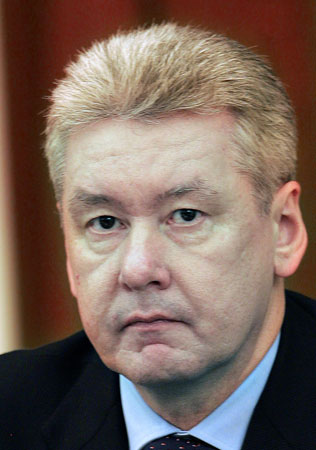
grani.ru Relatives of the Bolotnaya Square Prisoners Write to Moscow Mayor Sergey Sobyanin
May 6 Committee
October 1, 2013
Dear Sergey Semyonovich:
We are friends and relatives of the defendants in the so-called case of the riots of May 6, 2012, currently being tried in the capital’s Zamoskvoretsky District Court.
Nearly all of us are Muscovites, and many of us received a personally addressed election campaign letter from you containing many warm words. “Moscow is the city to which you’ve given your strength, talent and soul,” you wrote. And it is true: we have years of work on behalf of our city’s and our country’s welfare, safety and defense under our belts.
And we really would like, as you rightly noted, “to feel secure in Moscow and confident in the future.” Unfortunately, however, no one can feel “safe and confident in the future” in Moscow nowadays. No matter how Moscow is modernized and prettified, this has no effect on the security of Muscovites if civil rights are not respected.
It has become apparent to us during the court hearings that the main cause of the events of May 6, 2012, on Bolotnaya Square was the Moscow police’s sudden alteration of the arrangements [for the planned opposition march and rally], which had earlier been approved at a meeting with the Moscow Department of Regional Security. This change provoked confusion among the crowd and led to riot police pushing people back, thus exacerbating an already unbearable crush. Police brutally beat protesters in an attempt to clear the streets. But no criminal proceedings were instituted in connection with these incidents. Our relatives ended up in police custody instead of the real culprits of the clash. The trial against most of them began in June 2013 and is likely to take a very long time.
On trial days, our relatives get up early (at five or six in the morning), return to their cells late (around midnight or later), spend long hours waiting in a cramped holding cell, eat poorly soluble dry rations for lunch and endure lengthy court proceedings. These conditions would cause even healthy people to experience a significant deterioration of health. Among the defendants, however, is the Class 2 disabled person Mikhail Kosenko (whose mother recently died, although he was not informed about her illness or death, and was not released to attend her funeral) and Vladimir Akimenkov, who is threatened with blindness.
Sergey Semyonovich, we hope that we, Muscovites, are not a faceless mass to you, but individuals with their own lives and needs. And we want an answer: why, for over a year, have our relatives suffered without any proof of their guilt, while police officers who beat people are at large and serving as complainants in the case, although they often do not remember the accused and have no relation to them? Some of these police officers had a finger cut by persons unknown, making them “experience severe physical suffering,” while others had their clothes pulled or were bruised.
There were no riots—meaning massive destruction, arson and use of weapons—on Bolotnaya Square on May 6, 2012. The matter could simply be put to a rest right there, but the “riots” are, in fact, the cause of the whole trial. It is clear that the level of such legal proceedings does not stand up to scrutiny.
In your letter, you invited us to vote in the [mayoral] election, implying, of course, that it should be an honest election. It was fair elections that our children, brothers and husbands demanded: that is why they are in custody, and why they face hefty prison sentences. Judging by your letter, you want to make our city a better place, and Muscovites happier. But what can be said if here, in Moscow, in plain view, innocent people—young people, academics, and journalists—are on trial, if the country’s future is on trial?
If you are really worried about Moscow’s image, then you will certainly pay attention to the ugly spectacle being played out in the Moscow City Court, which is a disgrace to the city and the country. We appeal to you to come to the trial, which convenes every Tuesday, Wednesday and Thursday in the Appeals Wing of the Moscow City Court, Room 635. (As of October 1, the trial will be held at the Nikulinsky District Court, Room 303 – Editors.) You yourself will be convinced that the judge is working with the prosecution, that the evidence presented by the prosecution does not withstand scrutiny, and that the prosecution witnesses—police officers—are forced to lie under oath. Come and see for yourself that the presumption of innocence does not apply at this trial and that to impartial observers the court looks like a total circus. Or rather, it would look that way to us if our children were not behind the glass cage in this court.
We ask you to get to the bottom of this “court case” and help to ensure that in the future not a single Muscovite or visitor to the capital will be beaten with police batons at a peaceful, sanctioned rally, charged with “rioting” and thrown into prison.
We ask you, Sergey Semyonovich, to do everything to save our relatives.
We look forward to your reply.
Sincerely,
Natalya Kavkazkaya (mother of Nikolai Kavkazsky)
Yuri Kavkazsky (father of Nikolai Kavkazsky)
Viktor Savyolov (father of Artyom Savyolov)
Alexei Polikhovich (father of Alexei Polikhovich)
Tamara Likhanova (wife of Yaroslav Belousov)
Stella Anton (mother of Denis Lutskevich)
Artyom Naumov (husband of Alexandra Dukhanina-Naumova)
Ekaterina Tarasova (mother-in-law of Leonid Kovyazin)
Vasily Kovyazin (brother of Leonid Kovyazin)
Olga Ignatovich (mother of Ilya Gushchin)
Ksenia Kosenko (sister of Mikhail Kosenko)
Maria Baronova (defendant)
Tatyana Barabanova (mother of Andrei Barabanov)
Alexandra Kunko (fiancée of Stepan Zimin)
Anna Karpova A Fiancée’s Diary: “The defense’s question is disallowed since it is irrelevant to the case”
August 30, 2013
I already find it trying either to write or read about the Bolotnaya Square case. The trial began in early June. The court hearings are held three times a week, Tuesday through Thursday, from eleven-thirty in the morning to six or seven in the evening, but each new hearing is a repeat of the previous ones, the same combination of utterances by the judge and state prosecutor, except in a different order. “The defense’s question is disallowed a) as stated; b) since it is irrelevant to the case; c) as repetitive.”
I would not be following these events so closely myself did they not concern me personally. But my fiancé, Alexei Gaskarov, is under investigation and in police custody, and I have no choice but to monitor the “Trial of the Twelve” carefully in order to gauge my chances of seeing Alexei freed as soon as possible.
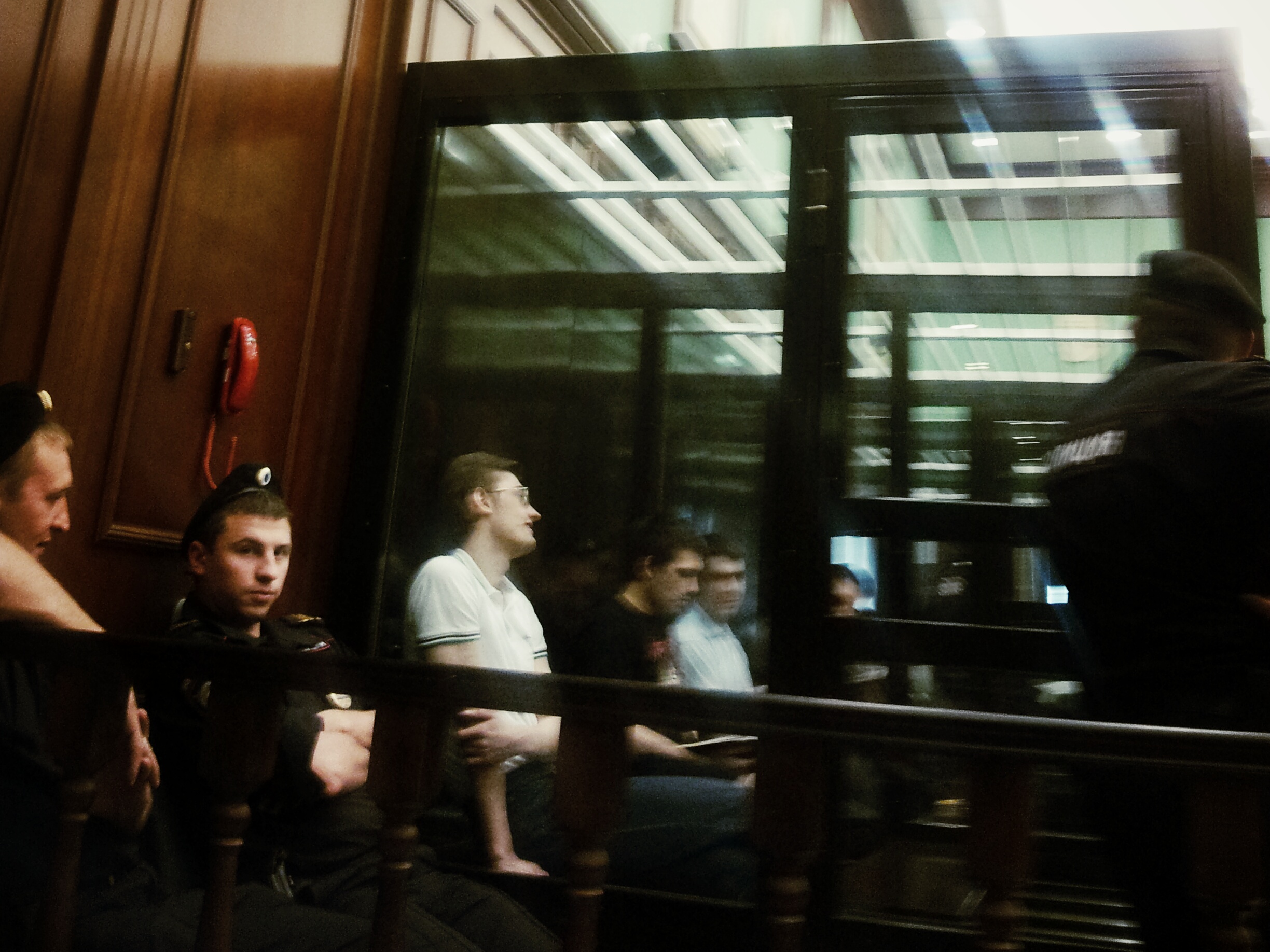
All this time I have deliberately avoided going into the courtroom at the Moscow City Court where the Bolotnaya Square case is being heard, preferring to watch the live broadcast in the court hallway or observe the circus from the press balcony. If I had the chance not to go to the court hearings in Alexei’s case, I would skip those as well. It is one thing to talk with the emotional parents of the prisoners outside the courthouse and see photos of the defendants in the press, but quite another thing to see relatives and loved ones silently communicating through the glass of the “aquarium” in which the defendants are caged during the hearings, and realize they have had no other means of supporting each other for over a year now.
Yesterday, August 29, I went to the trial to keep Tanya Polikhovich company. It was the birthday of her husband, Alexei Polikhovich, one of the twelve defendants. Alexei’s dad, Alexei Polikhovich, Sr., happily greeted us in the hallway of the court.
“Alexei already celebrated his birthday with the guys in the cell as best he could. They drank soda pop from the pretrial detention facility store, and he blew out three lit matches. Why three? Because he has turned twenty-three!”
A bailiff opened the door and ushered relatives into the courtroom. Although Alexei Gaskarov is not among the first twelve defendants, Alexei Polikhovich, Sr., put his arm around my shoulders and led me to the seats near the dock. The guys in the dock pressed themselves against the glass and waved to their loved ones, smiling. Stepan Zimin was particularly glad to see his girlfriend Sasha. She had come to the trial for the first time: she was no longer considered an official witness in the case, something that had prevented her from attending the hearings. Sasha and Stepan made eye contact and kept their eyes on each other until the very end of the hearing, which would be disrupted by people in the gallery. (But more on that later.)
Yaroslav Belousov, Andrei Barabanov and Denis Lutskevich were seated in the dock closest to where I was sitting. Alexei Polikhovich sat in the farthest section of the dock. Tanya attracted his attention by waving to him. Then she unfolded a t-shirt with Dandy the Elephant emblazoned on it. Polikhovich gave a two thumbs-up sign: the t-shirt was a birthday present for him. Lutskevich kept his eyes glued on his lovely mother, Stella. Throughout the hearing they would surprise me with their amazing ability to hold a conversation merely by glancing at each other. Andrei Barabanov was looking at other people in the gallery, because his girlfriend, Katya, is unable to attend the hearings: she is an official witness in the case.
While I was examining the animated faces of the guys in the dock, Judge Natalya Nikishina entered the courtroom. As always, defendant Sergei Krivov addressed her.
“I have a motion I haven’t been allowed to enter for two days running!”
“Shut up, Krivov,” the judge cut him off.
“No, listen, you have to hear my motion!”
“I am cautioning you for causing a disruption in the courtroom, Krivov!”
“And I’m cautioning you for not hearing my motion!”
Then the testimony of the sixth “victim” in the case, riot police officer Alexander Algunov, began: the case file contains a medical certificate stating that his right hand was injured during the alleged “riots” on May 6, 2012, in Moscow, during a sanctioned opposition march. I stopped listening to Algunov’s monotonous, muddled testimony and looked back to the dock, making eye contact with Lutskevich. Denis smiled broadly, and I wrote the phrase “Gaskarov says hi!” in big, block letters in my notebook. I tried to quietly raise my postcard so the guys would see it, but the bailiffs noticed it as well. “Well, now they’ll kick me out of the courtroom,” I thought, and a bailiff, dressed in black, moved towards me. I put the notebook away and got a warning. The bailiff took up a spot next to the glass cage, blocking my view of the guys, but they leaned forward and, peering from behind him, waved at me and smiled.
While this was going on, the state prosecutor was asking to hold a police lineup right in the courtroom, despite the fact it violated court rules.
“Do you see the person or persons who assaulted police officers among those present in the dock?”
The lawyers jumped up from their seats. Defense attorneys referred to the sections of the law under which the procedure could not be carried out in court. Chin propped on her hand and smiling, Judge Nikishina slowly said, “Algunov, answer the prosecutor’s question.”
Algunov “recognized,” as he put it, “the man in the t-shirt,” nodding towards Krivov, then he also pointed out the two female defendants, Alexandra Naumova (née Dukhanina) and Maria Baronova. After which he told the court how protesters had, allegedly, shouted “Let’s go to Red Square!” and “Let’s take the Kremlin!”
As always, Makarov, who is defending Krivov, was completely prepared to cross-examine the victim, but as the hearing entered its sixth hour, people in the court gallery interrupted his cross-examination. Two young women jumped up on their seats and began singing “Bella Ciao,” the Italian Anti-Fascist Resistance song. But they did not succeed in unfurling a small banner congratulating Alexei Polikhovich on his birthday: six men in plain clothes grabbed them and removed them from the courtroom, along with everyone else in the gallery, including the relatives. Artyom Naumov, husband of Alexandra Naumova, recognized two of the men as people who had carried out a search at Alexandra’s apartment.
Everyone was now standing in the hallway, and the parents were upset. It would have been better to stage the unsuccessful performance after the hearing was over. Alexandra Naumova left the courtroom, and the judge announced a recess until next Tuesday.
Before leaving, Judge Nikishina remarked, disgruntled, that come September, hearings should be held five days a week to get this over quickly.
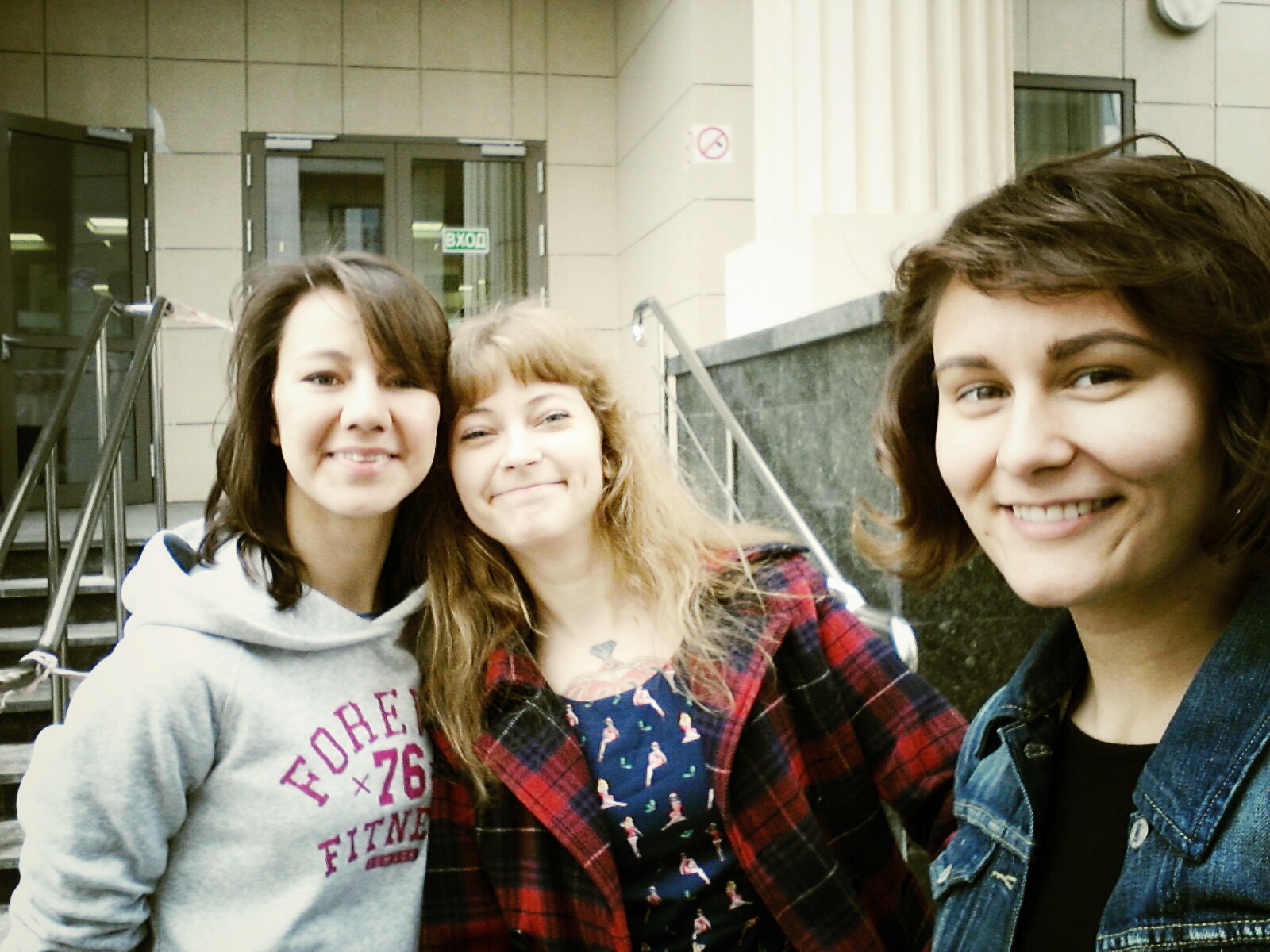
From left to right: Sasha (Stepan Zimin’s girlfriend), Tanya Polikhovich, Anna Karpova
Alexei Gaskarov, Civic Activist, Opposition Coordinating Council Member, and Anti-Fascist, to Remain in Police Custody until October 6
Natalya Zotova Novaya Gazeta
June 25, 2013
“Phones on vibrate mode, keep your comments to yourself. Young woman, don’t talk to him!” a bailiff interrupts a young woman in a “Free Alexei Gaskarov” t-shirt (Gaskarov’s fiancée Anna Karpova). Gaskarov himself stands behind bars and peers into the courtroom. Today is a hearing on whether to extend his detention in police custody and thus one of the few days when family and friends can see him.
Defense counsel Svetlana Sidorkina motioned for several pledges to stand surety, including those made by Novaya Gazeta editor-in-chief Dmitry Muratov and Rain TV owner Alexander Vinokurov (who came to court in person), to be entered into the record, as well as positive character references of the defendant submitted by the Opposition Coordinating Council (to which Gaskarov was elected with twenty-two thousand votes) and its local analogue, the Zhukovsky People’s Council. Igor Volk, a cosmonaut and Hero of the Soviet Union, and Vladimir Kondratenko, a distinguished Soviet test pilot, also honored Gaskarov with positive letters of reference. Sidorkina likewise motioned for a petition, signed by five hundred residents of Zhukovsky (where Gaskarov was born and lives), calling for less severe pre-trial restrictions, and media articles detailing Gaskarov’s activities as an anti-fascist and public figure, to be entered into the record. “Would someone hiding from the law be engaged in social activism?” she asked.
Investigator Alexei Bykov predictably asked the court not to admit most of this into the record: “The main character reference for Gaskarov—that he was part of a group of people that attacked police officers—is quite sufficient.” From his cage, Gaskarov reiterated to the judge that he had pulled a police officer away from a demonstrator whom the officer was attempting to detain, but that he did not regard this as a violent confrontation: he had no intention of hurting the policeman and caused him no physical harm. Gaskarov himself was beaten on Bolotnaya Square on May 6, 2012, and soon afterwards he filed a complaint against the riot police who had attacked him, along with a medical report on his injuries. “This shows I had no intention of going into hiding,” he explained to the judge in the quiet, calm voice one uses to pacify a child.
Bykov read, it seems, from the same document as during Gaskarov’s arrest hearing in April, because the language was the same: “[Gaskarov] led a secretive life, changed places of residence, and planned to go into hiding abroad.” Except before it had simply been “abroad”; now the record also contains “countries with anti-Russian sentiments,” where, according to the investigation, Gaskarov often traveled.
Yegor Ozherelyev, a colleague of Gaskarov’s from the consulting company Expert Systems, came to court in person to deny that Gaskarov had been in hiding before his arrest. He showed that Gaskarov was a responsible employee who successfully coped with any task and came to work punctually, being absent only when he had been met outside the office by members of the security services and taken away for a “chat.”
Sidorkina moved that Gaskarov be released on bail: his mother had pledged her apartment, which is valued at 3.5 million rubles [approx. 81,000 euros] and where her son is officially registered. “He owns no apartment. The mom is a different person,” said the prosecutor in his objection to the motion.
A new witness has emerged in the Gaskarov case. His identity is classified, like that of the previous two witnesses, but unlike them, he is not a police officer but someone who identifies himself as a member of the anarchist movement. According to his testimony, he fears for his life, because “activists don’t like cooperating with the police.” He claims that the goal of the anarchists is confrontation with the state system, and their ideology centers on violent action.
“They’re following the Khimki scenario. When they don’t have enough evidence, they put together false testimony. I think this person doesn’t exist,” says Gaskarov’s girlfriend Anna Karpova.
At the conclusion of the hearing, Svetlana Sidorkina delivered an impassioned speech.
“Since I have gotten to know him better, I have begun to respect my client five times more. I have never met a person with such ideal character references: everyone, young and old, speaks of him as a remarkable man. If he were freed, he would be of far greater benefit to the country. The investigator has not specified how Alexei could hinder the investigation [were he released from police custody].”
“Sufficient grounds have not be adduced for not extending the arrest,” the prosecutor said laconically in closing. People in the courtroom laughed helplessly.
Judge Skuridina extended Alexei Gaskarov’s arrest for three month and eight days, until October 6.
Today Alexei Gaskarov’s detention in police custody was extended until October 6, that is, until the official conclusion of the Bolotnaya Square investigation. I no longer have the strength to describe all the shit that went down at the Basmanny district court. The only thing worth noting is the expanded version of the report issued by Center “E” [the “anti-extremism” police], which was read aloud by Judge Skuridina. Autonomous Action and “other radical leftist groups” are now openly identified as sources of permanent anti-state violence, and the motive for keeping Alexei in custody is his “authority within that milieu.” This in fact is the answer to a frequently asked question. How does Gaskarov’s case stand out from the Bolotnaya Square case as a whole? By its clear, no longer merely political, but ideological orientation. We are dealing here with a show trial aimed specifically against the radical left, publicly recognized as a potential threat. And disrupting it is a matter of our common future. So follow the campaign at gaskarov.info. Make suggestions, participate and, most important, don’t lose heart.
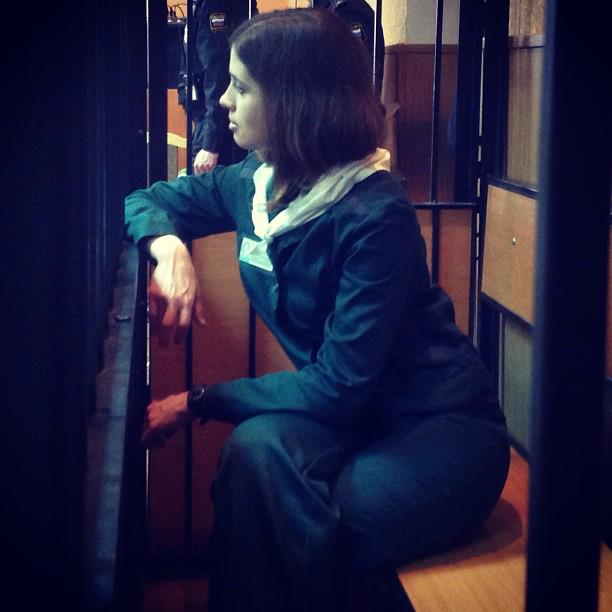
Yesterday, April 26, 2013, a district court in Zubova Polyana, Mordovia, denied imprisoned Pussy Riot activist Nadezhda Tolokonnikova’s request for parole. According to Radio Free Europe/Radio Liberty, Judge Lidiya Yakovleva agreed with arguments made by prison authorities that it would be “premature” to release Tolokonnikova given that she “had been cited for prison rules violations and expressed no remorse,” and had not participated in such prison activities as the “Miss Charm Prison Camp 14 beauty contest.” Judge Yakovleva made her ruling without allowing the defense to make a closing argument, thus allegedly violating the Criminal Procedure Code. Tolokonnikova had written her statement out in advance. The translation below is of the Russian original as published in full on the web site of RFE/RL’s Russian Service (Radio Svoboda). Photos courtesy of the Free Pussy Riot Facebook page.
_____
“Has the convict started down the road to rehabilitation?” This is the question asked when a request for parole is reviewed. I would also like us to ask the following question today: What is this “road to rehabilitation”?
I am absolutely convinced that the only correct road is one on which a person is honest with others and with herself. I have stayed on this road and will not stray from it wherever life takes me. I insisted on this road while I was still on the outside, and I didn’t retreat from it in the Moscow pretrial detention facility. Nothing, not even the camps of Mordovia, where the Soviet-era authorities liked to send political prisoners, can teach me to betray the principle of honesty.
So I have not admitted and will not admit the guilt imputed to me by the Khamovniki district court’s verdict, which was illegal and rendered with an indecent number of procedural violations. At the moment, I am in the process of appealing this verdict in the higher courts. By coercing me into admitting guilt for the sake of parole, the correctional system is pushing me to incriminate myself, and, therefore, to lie. Is the ability to lie a sign that a person has started down the road to rehabilitation?
It states in my sentence that I am a feminist and, therefore, must feel hatred towards religion. Yes, after a year and two months in prison, I am still a feminist, and I am still opposed to the people in charge of the state, but then as now there is no hatred in me. The dozens of women prisoners with whom I attend the Orthodox church at Penal Colony No. 14 cannot see this hatred, either.
What else do I do in the colony? I work: soon after I arrived at Penal Colony No. 14, they put me behind a sewing machine, and now I am a sewing machine operator. Some believe that making political-art actions is easy, that it requires no deliberation or preparation. Based on my years of experience in actionism, I can say that carrying out an action and thinking through the artistic end-product is laborious and often exhausting work. So I know how to work and I love to work. I’m no stranger to the Protestant work ethic. Physically, I don’t find it hard to be a seamstress. And that is what I am. I do everything required of me. But, of course, I cannot help thinking about things while I’m at the sewing machine (including the road to rehabilitation) and, therefore, asking myself questions. For example: why can convicts not be given a choice as to the socially useful work they perform while serving their sentences? [Why can they not chose work] in keeping with their education and interests? Since I have experience teaching in the philosophy department at Moscow State University, I would gladly and enthusiastically put together educational programs and lectures using the books in the library and books sent to me. And by the way, I would unquestioningly do such work for more than the eight hours [a day] stipulated by the Russian Federation Labor Code; I would do this work during all the time left over from scheduled prison activities. Instead, I sew police pants, which of course is also useful, but in this work I’m obviously not as productive as I could be were I conducting educational programs.
In Cancer Ward, Solzhenitsyn describes how a prison camp detective stops one convict from teaching another convict Latin. Unfortunately, the overall attitude to education hasn’t changed much since then.
I often fantasize: what if the correctional system made its priority not the production of police pants or production quotas, but the education, training, and rehabilitation of convicts, as required by the Correctional Code? Then, in order to get parole, you would not have to sew 16 hours a day in the industrial section of the colony, trying to achieve 150% output, but successfully pass several exams after broadening your horizons and knowledge of the world, and getting a general humanities education, which nurtures the ability to adequately assess contemporary reality. I would very much like to see this state of affairs in the colony.
Why not establish courses on contemporary art in the colony?
Would that work were not a debt, but activity that was spiritual and useful in a poetic sense. Would that the organizational constraints and inertia of the old system were overcome, and values like individuality could be instilled in the workplace. The prison camp is the face of the country, and if we managed to get beyond the old conservative and totally unifying categories even in the prison camp, then throughout Russia we would see the growth of intellectual, high-tech manufacturing, something we would all like to see in order to break out of the natural resources trap. Then something like Silicon Valley could be born in Russia, a haven for risky and talented people. All this would be possible if the panic experienced in Russia at the state level towards human experimentation and creativity would give way to an attentive and respectful attitude towards the individual’s creative and critical potential. Tolerance towards others and respect for diversity provide an environment conducive to the development and productive use of the talent inherent in citizens (even if these citizens are convicts). Repressive conservation and rigidity in the legal, correctional, and other state systems of the Russian Federation, laws on registration [of one’s residence] and promotion of homosexuality lead to stagnation and a “brain drain.”
However, I am convinced that this senseless reaction in which we now forced to live is temporary. It is mortal, and this mortality is immediate. I am also certain that all of us—including the prisoners of Bolotnaya Square, my brave comrade in arms Maria Alyokhina, and Alexei Navalny—have the strength, commitment, and tenacity to survive this reaction and emerge victorious.
I am truly grateful to the people I have encountered in my life behind barbed wire. Thanks to some of them, I will never call my time in prison time lost. During the year and two months of my imprisonment, I have not had a single conflict, either in the pretrial detention facility or in prison. Not a single one. In my opinion, this shows that I am perfectly safe for any society. And also the fact that people do not buy into state media propaganda and are not willing to hate me just because a federal channel said that I’m a bad person. Lying does not always lead to victory.
Recently, I got a letter containing a parable that has become important to me. What happens to things different in nature when they are placed in boiling water? Brittle things, like eggs, become hard. Hard things, like carrots, become soft. Coffee dissolves and permeates everything. The point of the parable was this: be like coffee. In prison, I am like that coffee.
I want the people who have put me and dozens of other political activists behind bars to understand one simple thing: there are no insurmountable obstacles for a person whose values consist, first, in her principles and, second, in work and creativity based on these principles. If you strongly believe in something, this faith will help you survive and remain a human being anywhere.
I will surely use my experience in Mordovia in my future work and, although this will not happen until completion of my sentence, I will implement it in projects that will be stronger and politically larger in scale than everything that has happened to me before.
Despite the fact that imprisonment is a quite daunting experience, as a result of having it we political prisoners only become stronger, braver, and more tenacious. And so I ask the last question for today: what, then, is the point of keeping us here?