Putinism has triumphed not because the majority of Russians have become convinced “Putinists,” whatever that would mean, or have been persuaded by the man’s notorious “power vertical” system of governance, which in reality is an inefficient, irresponsible literal disaster waiting to happen somewhere nearly every single day (witness the fires in Rostov-on-Don).
It has triumphed because people have, seemingly, lost the will to eject, by whatever means would work best under the circumstances, the entire noxious, corrupt, incredibly expensive, and utterly futureless non-system that Putin and his clique have erected over eighteen long years of conspicuous consumption in a few happy oases, mixed with criminal wars, “legal nihilism,” an incredible gap between the super wealthy and the super poor, the destruction of all the things the Soviet Union did right or, at least, not terribly badly, in terms of education, social provision, healthcare, and housing, and the most inconsistent, frighteningly hilarious “national ideology” ever devised anywhere, which pretends to be “conservative” and “authentically Russian,” but mostly looks as if it had been dreamed up one night by three or four Kremlin spin doctors on a bender, as a bad-spirited practical joke.
At worst, people either pretend, especially in the two capitals, to be incredibly busy and content with their lives. At best, they argue about the particulars—say, about the details of the trumped-up case against director Kirill Serebrennikov, arrested in Petersburg yesterday, and temporarily sentenced to house arrest pending trial on embezzlement charges today in Moscow—as if the system didn’t have the power to turn literally anyone except the members of Putin’s inner circle (and maybe even them) into a “vicious criminal” literally overnight, as if Serebrennikov has made some particular fatal mistake that nearly everyone else would never be so stupid to make. Or that they would never be so stupid to get close to so much money or power and end up in the pickle the feckless Serebrennikov got himself into.
The idea that the country could go on being itself, that is, being mostly messed up and weird and not like any other country, because you cannot be like any other country when you’re the biggest country in the world, but a billion times more productive and easier to live in simply by ditching the crappy, greedy junta that will certainly kill it off in the next few years is a thought that either literally everyone is thinking right now or everyone has forbidden themselves to think at all.
Unfortunately, I’m afraid it’s the latter.
So it doesn’t matter whether you call the reactionary regime currently in power authoritarian, post-authoritarian, fascist, post-fascist, post-truth or pre-truth because, eventually, it will go down in flames, taking with it, alas, the magnificent country that has had the misfortune to engender it. TRR
Ekaterina Schulman Compulsory Love InLiberty
July 27, 2017
When we examine the campaigns, events, and public manifestations that might be dubbed signs of creeping re-Stalinization, the rehabilitation of Stalin, his emergence in the public space amid public approval, we see that each such instance was obviously organized directly or indirectly by the state, rather than by private individuals.
The monuments that have been erected recently and whose numbers have, indeed, been growing, have usually been installed under the auspices of local branches of the Communist Party of the Russian Federation (CPRF). This hardly makes them popular or grassroots endeavors. I would imagine everyone knows what the CPRF’s network of regional branches and our parliamentary parties amount to in reality, the extent of their loyalty to the regime, and the degree to which they coordinate all their moves with local and federal authorities.
It’s Even a Good Thing
Way back in 2002, a street in a city in Dagestan was named Stalin Avenue at the mayor’s behest. It did not happen because the locals came and surrounded town hall, threatening to set it ablaze if the mayor didn’t agree to their demands.
In 2009, in another political era, a line from the Soviet national anthem, “Stalin raised us to be true to the people,” was restored to the visual design of the Moscow subway’s Kurskaya station. Medvedev was then the president. The authorities responded to the indignation then voiced by arguing it was historically accurate. They had simply restored the station to its original appearance.
“Stalin raised us to be true to the people.” Kurskaya subway station, Moscow. Photo courtesy of Lenta.ru
Since then, the Moscow subway has been rendered a powerful tool of pro-Soviet and Stalinist propaganda: there are the trains in which we encounter portraits of Stalin, and campaigns like this year’s “Times and Eras.” The pretext is sometimes stills from a film or historical memoirs. But you realize none of this comes from the grassroots, from ordinary folk, but from subway top brass or Moscow and federal authorities.
In Mari El, a life-sized monument to Stalin (one of the few; busts are usually erected instead) was erected on the premises of the local meat processing plant. As the town’s main employer and a major local business, the plant naturally could not afford to be in opposition to the regime, so it provided the venue for the monument.
Unveiling of a monument to Stalin in the village of Shelanger, Marii El Republic, September 9, 2015. Photo courtesy of Mariiskaya Pravda
2015 saw the opening of a Stalin Hut Museum in the village of Khoroshevo. It was something of a scandal, because the museum was sponsored by the Culture Ministry and personally approved by the culture minister.
A bust of Stalin was erected in Pskov Region in 2016, also with the knowledge and approval of local authorities.
Art exhibitions featuring images of Stalin in paintings of his era, paintings glorifying him and other Communist leaders, opened in Moscow in 2014, 2015, and 2016—for example, a show of works by Stalinist court painter Alexander Gerasimov, who authored the painting popularly known as “Two Leaders after a Rain.” These cultural treasures were shown in the Tretyakov Gallery not at the request of the art community or the museum’s staff.
Alexander Gerasimov, Stalin and Voroshilov in the Kremlin (“Two Leaders after a Rain”), 1938. Image courtesy of s-t-o-l.com
What is important to understand is the following. It does not follow from the things I have listed that there are no people in Russia who would, at their own behest, erect a bust of Stalin at their dacha or even be willing to donate money to restore a monument to him. Because we see a video of ordinary people in Sevastopol standing and applauding during the performance of a song about Stalin by a strange man in white trousers does not mean they were all specially dispatched there by the local authorities.
Sergei Kurochkin, “Bring Back Stalin,” August 2015, Sevastopol
What is the function of state propaganda? Speaking from a hierarchically superior stance, it establishes norms. It informs its audience about what is correct, normal, and permissible. It generates the ambience that lets people know that gadding about with a placard depicting Stalin is, at very least, safe, if not commendable generally. It lets them know that numerous books rehabilitating Stalin’s regime, which pack the shelves of bookstores throughout Russia, will not be deemed “extremist,” that their authors, publishers, and distributors will not face criminal charges under Article 282 of the Russian Federal Criminal Code, unlike other books that someone might think to display prominently in a bookstore. People are given to understand this is normal and not punishable, that it is permissible and encouraged.
When television presenters and state officials tell us there is no need to demonize anyone, that we can take a look at the Stalin era from different viewpoints, but whatever we want to say, the war was won, this is a signal that those who actually feel positive feelings in this regard and those who felt nothing in this regard should suddenly have them, that those who had no opinion on the matter should suddenly have an opinion, because they have been told it is permissible, normal, and even a good thing.
“They Want Their Own Stalin”
Theoretically, conformism is a psychological norm. We can rue the fact, but it is nevertheless the case. Individuals are inclined to join majorities. Individuals are inclined to compare their opinions with opinions they imagine are generally accepted. Maybe this is not the noblest manifestation of our human nature, but it is a sign of a mental health. We people, who are social animals, behave in this way for our own safety and to adapt successfully to society. This endows those who speak on behalf of the state, on behalf of generalized authority, with responsibility. Russia’s national TV channels are not considered sources of information and news, but voices of the powers that be. People consume TV in this way.
Let me remind you that such a sweet, innocent New Year’s TV holiday special as Old Songs about What Matters was first aired on January 1, 1996. The first program imitated the Stalin-era film Cossacks of the Kuban (1950). The film was the frame for the star-studded cast’s song and dance routines. 1996 was a presidential election year. Even the hazards of competing with the Communists in a relatively free election did not intimidate Russia’s ideologists and spin doctors. It did not stop them from organizing such a pretty, funny, sly rehabilitation of one of the most terrible periods in the history of the the terrible Soviet regime. This is what we call normalization. Look, they say, it was not terrible; it was pleasant, even. You can make fun of it and smile a good-natured smile when contemplating it. That was when the process kicked off.
Let me remind you of another early public campaign of this kind. In 2008, which, again, seems like an utterly different political era, there was a TV program, Name of Russia, which purported to pick the one hundred greatest Russians. The idea had been borrowed from the BBC program 100 Greatest Britons (2002), but was done completely in its own way. TV viewers were asked to select the one hundred most outstanding figures in Russian history, leading ultimately to the selection of a single finalist. Huge, persistent efforts were made to persuade viewers that Stalin had “really” won the popular vote, but since this would have been disgraceful, [TV channel Rossiya, known until recently as Channel Two] made the necessary adjustments, and Alexander Nevsky emerged the victor.
Name of Russia: Joseph Stalin, Rossiya TV, 2008
How did this vote really go? Now, with the know-how and knowledge we have amassed since then, we can more or less imagine how the so-called people’s will was determined, especially on television. But Name of Russia was, perhaps, the first time we saw this model fully deployed. The implied message was: they want their own Stalin, but we, the powers that be, are still shielding them from this on the sly. We still need to rein them in a bit.
A similar story involving alleged popular voting occurred in 2013, when Rossiya TV had to pick ten views of Russia, ten pictures, landscapes or historical buildings that exemplified the country. Then, as you remember, an ambitious regional leader organized the voting in such a way that the Heart of Chechnya Mosque would win. Federal officials found themselves in an uncomfortable position, and once again adjustments had to be made to the vote count so the Kolomna Kremlin would win. The ambitious regional leader got pissed off at the cellphone companies Beeline and Megafon, and they were shut down in the Chechen Republic; one of their offices was even pelted with eggs, such was the great indignation over the defeat. I mention this to illustrate how such things are organized and what their real purpose is.
A picture taken on April 14, 2012, shows the high rises of the new skyscraper complex Grozny City (right) and the Akhmad Kadyrov Mosque, known as the Heart of Chechnya (left,) dominating the skyline in the Chechen capital Grozny. Photo courtesy of Agence France-Presse
We must face the truth and realize we are dealing with state propaganda, with notions of what is normal, acceptable, good, glorious, great, and outstanding that have been defined and imposed by the state. These notions strike a chord because they are voiced on the regime’s behalf and because they draw their power from actually existing needs.
A Nationwide Need for Authoritarianism Has Not Been Observed
How can we encapsulate these needs, the reality behind Stalin’s “high” rating?
I was first asked this question at an event sponsored by the Böll Foundation in Berlin.
“How can people in Russia love Stalin?”
When a question like that is tossed right into your face, you start to understand the grassroots need for justice, as understood in a peculiar way, the need for a paradoxically anti-elitist Stalin, the Stalin people have in mind when they say, “If Stalin were around, he’d settle your hash.” This Stalin was the scourge of the nomenklatura, foe of the strong and rich, and champion of poor, simple people. The degree to which this conception is mythologized and savage is beside the point, but it does exist. Many people who utter this phrase mean to appeal to strict law and order, to equality, to a primitive apostolic simplicity.
It is a sin, especially for academic researchers, to quote conversations with taxi drivers, but I too have been forced to listen to tales of how Stalin had one greatcoat and one pair of boots, but look at the way folks today live as they please and can afford everything. Meaning that the anti-elite demand is clearly encapsulated in this rhetoric. But the very idea that there is something to which one can appeal, that it is permissible, normal, and safe, was planted in people’s minds by the machinery of state propaganda.
Let’s see how successful this state propaganda machine has been over the course of several decades. Here is the simple, most basic question, as posed by pollsters at the Levada Center: “How do you personally feel about Stalin?” Look at the pattern of responses from 2001 to 2015. It would be wrong to say that any radical changes—sharp increases in respect, admiration, and sympathy—occurred. There is no evidence of this.
“How do you personally feel about Stalin generally?” Surveys conducted in April 2001, April 2006, October 2008, February 2010, October 2012, March 2014, March 2015. Possible answers: 1. I admire him. 2. I respect him. 3. I like him. 4. I could not care less about him. 5. I dislike him. He irritates me. 6. I fear him. 7. I find him revolting. I hate him. 9. I don’t know who Stalin is. 10. Undecided. All figures given in percentages of respondents.
“Do you agree or disagree with those who say Stalin should be deemed a state criminal?” Polls conducted in February 2010 and March 2015. Possible answers: 1. I completely agree. 2. I rather agree. 3. I rather disagree. 4. I completely disagree. 5. Undecided. Figures given in percentages of respondents.
What emotions have decreased? Dislike and irritation. As part of the same trend, there has been a sharp increase in those would could not care less. What do we call that? The natural course of time. Indeed, Stalin is a quite heavily mythologized figure. When we are told that “our grandfathers fought in World War Two,” we must realize the grandfathers of the current generation of thirty- and forty-somethings saw no combat. Their grandfathers and grandmothers were children during the war years, meaning that for the currently active segment of the populace, the war happened a very long time ago. Stalin has been gradually fading into the pantheon of historical characters in which Napoleon is a beloved Russian cake rather than a French emperor, and Hitler is a meme from the cartoons shared on the VK social network.
Without discussing whether this attitude is moral and good, we do acknowledge it is inevitable, because living historical memory gradually fades away, and the symbolic field remains. So, we see that Stalin is not universally loved. Love of Stalin has not grown, and neither has the need to admire or like him increased. It would be wrong to say that the common folk adore Stalin more and more. It’s simply not true.
How do young people evaluate these distant historic periods? Here is the outcome of a survey on historical events of which we might be proud or ashamed. It was conducted among Russian and American students in 2015.
“Historical events of which students are proud.” Russia: World War Two, 63%; Gagarin’s space flight, 30%; War of 1812 (Fatherland War), 20%; Annexation of Crimea, 10%; Abolition of serfdom, 8%. USA: 1960s civil rights movement, 21%; War of Independence (1775-1783), 17%; World War Two, 16%; Space exploration, 13%; Constitution and Bill of Rights, 10%. Source: Higher School of Economics, 2015
“Historical events of which students are ashamed.” Russia: Stalinist terror, 18%; Collapse of Soviet Union, 11%; 1917 October Revolution, 9%; Execution of the Tsar’s family, 6%; Russo-Japanese War (1904-1905), 5%. USA: Slavery and Jim Crow laws, 46%; military interventions (Iraq, Vietnam, Afghanistan), 36%; Genocide of local (Native American) population), 27%; Discrimination in today’s US (violation of women’s and minorities’ rights), 25%; Internment of Japanese Americans during WWII, 17%. Source: Higher School of Economics, 2015
The correlation between the primary source of pride, victory in the Second World War, and the primary source of shame, the Stalinist terror, illustrates the ambivalence that invariably entangles attempts at complete de-Stalinization, which is impossible as long as “victory” and “Stalin” are fused in the national imagination. Nevertheless, we see that young people have a quite healthy moral focus.
Let’s look at a slightly more realistic question. It does not have to do with a person that neither you nor your grandfathers have never seen, but with the period in which you would have rather lived.
“During the past 100 years, there have been different regimes in our country. The peculiarities of each of them had a marked influence on life in our country. When do you think life in Russia was best? (Mark one answer.)” Surveys conducted in June 1993, October 1994, and January 2017. Possible answers: 1. Before the 1917 Revolution. 2. During the Stalin regime. 3. During the Brezhnev regime. 4. During perestroika. 5. During the Yeltsin regime. 6. During the Putin regime. 7. Undecided. Figures given in percentages of respondents.
The outcomes in this instance are indeed interesting. For some reason, after 2014, there was sharp decline in popularity of the reply that the best time to live was before the 1917 Revolution. I don’t know why, but for some reason the amazing effect of the so-called Crimean consensus came down to the fact that this happy time “before tsarlessness,” as the saying goes, has lost its popularity for some reason. Very few people chose the Stalin era, as we see, and there was no change in this case: its popularity was low and has remained low. Meaning that maybe people “respect” Stalin, but no one is especially keen to live in the period during which he actually ruled.
The Brezhnev era is regarded as a more or less comfy, calm, peaceable time, but its popularity has been decreasing. No one likes perestroika or Yeltsin, for that matter. A good number of respondents were undecided, and since the time span from 1994 to 2017 is quite large, people decided that, given this paltry choice, our own time, perhaps, looked okay after all.
How do these figures—this attitude to Stalin and his era, which, as we have seen, are not at all one and the same thing—correlate with people’s overall socio-political views? I have borrowed data from Kirill Rogov’s research study “Proto-Party Groups in Russia: 2000–2010s,” for which I am extremely grateful to him. The data in question are the outcome of a so-called meta poll, meaning a summary of public opinion polls, conducted over the past eighteen years by the Levada Center.
Here is a survey on a topic most closely bound up with Stalin: “Does our country need a strong hand?”
“The Strong Hand: The Authoritarian, Leader-Centered Model. Are there situations in the country’s history when the people need a strong, authoritative leader, a ‘strong hand’?” Sixteen polls conducted from November 1989 to November 2016. Figures given in percentages of respondents. Possible replies: 1. Our people constantly need a ‘strong hand’ (dark brown); 2. Power should be concentrated in one set of hands (green); 3. We should never allow power to be surrendered completely to one man (light blue); 4. Undecided (beige).
Look at the darkest line, which matches the number of replies that a “strong hand” has been “constantly needed.” The second line represents the opinion that “sometimes this has been necessary, but not always” [sic], while the [light blue] line represents the opinion that it is not necessary in any case. Look at the right side of the chart. Here we also observed the quite strange turning point, as yet unexplained by researchers, that occurred after 2014. Perhaps five or seven years from now we will say the effect of 2014 and its impact on public opinion was not as it was described to us on TV. Look at the upward tendency of the third [light blue] line: after 2014, people suddenly began to say that in no case should all power be handed over to one person. The second line (“It’s sometimes possible, but generally not a very good thing”) has taken a nose dive. The upper line was headed downward, but starting in 2011 it climbed a little, before falling again after 2013. In 2014, it experienced a sustained, short-lived upturn.
What rights do Russians value the most? Let’s look at the trends of recent years.
“What rights Russians value.” The results of sixteen polls conducted between August 1994 and October 2015. Possible replies: 1. Property rights (light blue); 2. Free speech (darker green); 3. Access to information (light beige); 4. Freedom of religion (lighter green); 5. Right to leave Russia and live in another country (crimson); 6. Right to elect one’s own representatives to government bodies.
Here we also see the mysterious, counter-intuitive post-Crimea effect, when, in the wake of 2014, Russians gave access to information and freedom of speech a hard look, while experiencing a certain disenchantment in property rights.
Such are the interesting conclusions that Russians make from what they observe. However you look at this character, it clearly follows that we do not observe either a national yearning for authoritarianism оr the longing for a strong hand. Meaning we are dealing with an idea imposed on society about what it is like. Why is this done? Why are people told they long for the return of capital punishment when don’t particularly long for it? Why are they told that the whole lot of them want to resurrect Stalin? Why are they told they enjoy large-scale crackdowns?
European but Weak
The political regime, which wants, on the one hand, to concentrate power and resources in its hands, remain in power, and yet is not a full-fledged autocracy, does not have a well-developed machine of repression. It does not have a ruling ideology and the capacity for imposing it, and it does not want to be subjected to the procedures of democratic rotation. In fact, it finds itself in quite complicated circumstances.
It holds onto power by a whole series of pretty tricky tools. A considerable number of these tools relate to the realm of propaganda and represent different kinds of imitative models and patterns. Democratic institutions and processes are imitated, for example, elections, political parties, and a variety of mass media, which for all their variety report the same thing. Elections are seemingly held, but power does not change hands. Political parties exist, as it were, but no one opposes anyone. (This applies to the CPRF and the other so-called systemic or parliamentary parties.) This is on the one hand.
On the other hand, it is necessary to imitate autocracy’s rhetorical tools, meaning, roughly speaking, trying to appear in the public space as scarier than you are. Second, it is necessary (this is a subtle point, which is often not fully understood) to present oneself not as a terrible dictator, a bloody tyrant, but, on the contrary, as a civilizing, deterring force who is compelled, ruling over such a savage people with authoritarian tendencies, to keep it reigned in all the time, to constantly moderate its thirst for blood.
Meaning that it is necessary to transmit such ambivalent signals as “Let’s not demonize [e.g., Stalin], but let’s consider the issue from all sides.” It is necessary to pretend you are conceding and, simultaneously, resisting constant public pressure, which demands archaization, clampdowns, fire, and blood. If you didn’t resist the pressure, then everyone would have probably already been hung from the highest tree. Yet you are the selfsame power actor who generated the demand. You organized this entire normalization, to which you subsequently respond reluctantly, as it were.
Why is it necessary to fashion such a terrible reputation for one’s own people? To have an excuse for the crackdown on political rights, primarily voting rights, a crackdown in which you constantly engage. If people are savage, bloodthirsty barbarians, it makes sense to prevent them from electing the people they like at elections. For the time being you, a more or less civilized European, rule them, but if you let them have their way, they would immediately elect “Hitler” (the nationalist scarecrow) or Stalin (the left-wing étatist scarecrow). Both are arguments for limiting the rights of Russians to defining their own lives. Hence, the need for Stalin’s popularity.
What is my thesis? Filling society’s heads with false ideas about itself is meant to paint the government as the only “European” in Russia. Given the current social reality, this has long been untrue, to put it mildly. No, the dichotomy of the “civilized regime” versus the “savage society” does not exist, is not borne out by any reality, and cannot be measured by any instruments.
Our society is complex, multifaceted, and diverse. If we try to single out a public opinion, a common idea of values, as shared by the inhabitants of Russia (something that has been confirmed numerous times in research papers), we would see something like the following picture. We would see a society that espouses the values customarily identified as European. We would see a society that is individualist, consumerist, largely atomized, very irreligious, predominantly secular, and fairly intolerant of state violence, again, contrary to what is usually argued. It would be even more accurate to say that those who are intolerant of state violent are much better at joining forces and much more vigorously express themselves than those who put up with it.
We would see a society with values that researchers ordinarily describe as “European but weak.” We would see a society that is basically conformist, relatively passive, not terribly willing to express its opinion, and inclined to weaving the spiral of silence, which consists in people saying what is expected of them. Nevertheless, this society is not aggressive, not bloodthirsty, and does not long for the establishment of an authoritarian regime in Russia.
To govern a society like this with undemocratic methods, of course it has to be represented in a false manner. Of course you have to screw a little flag with Stalin embroidered on it into its head so as then to point at it and say, “See what they’re like.”
I urge everyone not to get involved in this game and not play up to those who engage in it much more seriously than we do, because these ideas about a wild and terrible people, first, do not capture the fullness and complexity of our reality, and second, hinder us, blocking our way to progress and development.
Ekaterina Schulman is a political scientist at the Russian Presidential Academy of National Economy and Public Administration (RANEPA). Translated by the Russian Reader. Thanks to Sergey Abashin for the heads-up
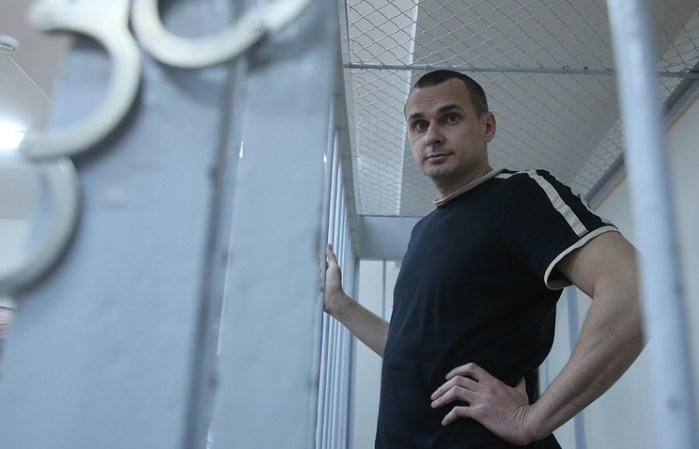
On Friday, Vladimir Putin met with artists and cultural figures at a joint session of the Council for Culture and Art and the Council for the Russian Language in St. Petersburg. He added in his response to entreaties for filmmaker Oleg Sentsov’s freedom that Sentsov, one of the subjects of The Voice Project’s “Imprisoned for Art” campaign, was “convicted not for art, but for taking other functions, as investigative and court bodies say, and particularly in fact he devoted his life to terrorist activity,” that “no one convicted him for his views or his position.”
He went on to say, “We should rely on that we live in a state governed by the rule of law and such issues should be of course decided by the court system,” but that “officials who interpret works of arts may take action” because “we don’t want what happened in Paris [at Charlie Hebdo] to be repeated here.” He speculated that “maybe the artists didn’t intend to offend anybody, but they did,” and that “we must bear that in mind, and not allow that, not split the society.”
President Vladimir Putin
23, Ilyinka Street,
Moscow, 103132, Russia
Dear President Putin:
Authoritarians around the globe almost always use the same playbook—the same tactics to stifle dissent, the same type excuses to imprison those who speak out against them, even the same words. It is not original and it is quite predictable when you see enough of it, as we do in our work.
A common play is that outspoken dissidents, especially known figures such as artists, are arrested on spurious charges and imprisoned following show trials. The tactic is to make an example of the individual dissident in order to stifle dissent more widely, and it is most easily efficacious when applied to those already in the public eye, well known for their art or activism or leadership in another field. Notoriety of the target, though, is not a sine qua non, as the act of persecution and the proceedings of prosecution can themselves be heavily publicized, especially with the aid of a compliant state controlled media. The pretense for prosecution is often laughable, but the absurdity as well sends a message: that the authoritarian and the authoritarian system are not bound by rule of law, but rather rule through systemic power, and that one’s safety and well-being within the society depend on compliance, conformity and loyalty to the ruling power.
We see these tactics employed the world over and throughout history, and often now in Russia under your leadership. Pussy Riot were imprisoned not for singing a song that called you and your cronies “shit”, but rather for “hooliganism motivated by religious hatred”; Maria Baronova was arrested not for yelling at Bolotnaya Square, but for “inciting mass riots”; Sergei Magnitsky was arrested, tortured and killed not for exposing the pervasive corruption of a kleptocracy, but for “colluding with a tax evader.” And Journalist Kieron Bryan of the “Arctic 30” evidently ran afoul of your piracy laws? No, of course not, and likewise, as Heather McGill at Amnesty International has noted, the “fatally flawed” trial of filmmaker Oleg Sentsov, a figure well known because of his art, “was designed to send a message. It played into Russia’s propaganda war against Ukraine and was redolent of Stalinist-era show trials of dissidents.”
As Ms. McGill alludes to, you are far from the first to use this tactic on dissidents. Arseny Roginsky was arrested for forgery, Gunārs Astra for spying, Andrei Amalrik for pornography, Nikolay Gumilyov for conspiracy, Ephraim Kholmyansky for possession of ammunition, and Alexander Lavut for possession of a book. The tactic is not new and it is not region specific. Mussolini had Gramsci arrested in Italy not for his writings, but for supposed involvement in an assassination plot. Muhammadu Buhari imprisoned Fela Kuti in Nigeria not for being a singer of truths, but for being a smuggler of currency. As the biblical saying goes, “There is nothing new under the sun.” Oleg Sentsov’s views and activism made him a target; the notoriety from his art made him a good one.
In regard to your comments that you have not the power to free Oleg, you are right, in ways you don’t understand. You so graciously let Pussy Riot out just two months before the completion of their two-year term, but Nadya’s right here and says, “You can shove your amnesty up your ass.” Similarly, Oleg does not want us to beg for your clemency, but would rather we parade your glib hypocrisy. You misunderstand us if you think we ask for his freedom through your benevolence, rather, we demand it from your discreditation. That is what we mean by #FreeOlegSentsov.
In regard to your comment that freedom of expression requires the responsibility not to offend, you pretend to not understand that freedom requires the ability to do so. We hear this from your kind all the time, it is an old song to a bad tune—the authoritarian pretending to be a champion of freedom that is not freedom.
Your doublespeak attempts to engender doublethink. You are not the first and you are not alone in this either. You have your political technologists, your state media, and your embarrassing troll factories, the US has its think tanks, corporate media and its own embarrassing trolls, sometimes disguised as clowny demagogues who spray tan on ephemeral ideologies and syllogistic hyperbole of various offensive hues. Orwell predicted that the very concept of objective truth would fade from the world, and your kind seem hard at work to make it so, but many of us believe that in the end the truth does out because it is existentially, ontologically superior to lies. You’ve heard this before, but it doesn’t sink in. You think that imprisoning artists silences them, but each speaks more loudly because of it, loud enough for the world to hear. You think repression and brutality invoke fear, but they inspire courage and embolden action. Russia has one of the greatest traditions of dissidents of any nation on earth, you and your predecessors did that. These lessons your kind seldom learns.
As for those of us here in the States, we’ll likely have our own taste of authoritarianism before long, but we are not afraid. We have many warriors here. They are standing right now in the snow, unbroken, on the Great Plains of North Dakota. And luckily, we have learned the lessons from those like you, so we’ll act accordingly. In the meantime, we’ll abide by, and learn from the words of Oleg himself:
There is no need to pull us out of here at all costs. This wouldn’t bring victory any closer. Yet using us as a weapon against the enemy will. You must know: we are not your weak point. If we’re supposed to become the nails in the coffin of a tyrant, I’d like to become one of those nails. Just know that this particular one will not bend.
Sincerely,
Hunter Mora Heaney
Executive Director
The Voice Project
My thanks to Mr. Heaney for his kind permission to republish this letter here. TRR
Escape from Freedom
Vladimir Gel’man Vedomosti
August 15, 2016
The twenty-fifth anniversary of the August 1991 coup is a sad one for supporters of democracy. In twenty-five years, Russia has not only failed to draw closer to political freedom, but has grown ever more distant from it. According to Freedom House, immediately after the collapse of the Soviet Union, Russia was a “partly free” country with an average of 3.5 on the scale of the political and civil liberties (Finland rates a 1, while North Korea rates a 7), whereas the 2015 rating described the country as a consolidated authoritarian regime with an average rating of 6. A return to the good old days of the “good” Soviet Union, a political and economic regime resembling its Soviet counterpart but lacking its inherent fatal defects, has become the slogan of the day for the Russian ruling class and society at large. The fall of the communist regime seemingly gave Russia the chance to move towards democracy. Why was it frittered away?
From Dictatorship to Dictatorship
The twenty-five post-communist years in Russia and elsewhere have taught us the fall of authoritarianism does not lead to democracy by default. An alternative to the success stories is the transition from one authoritarian regime to another. The American political scientist Barbara Geddes has calculated this turn of events happens much more often than democratization. Most often, the failure of democratization is ascribed to structural causes such as low levels of social and economic development or strong ethnic and religious fragmentation. Sometimes, however, the most capable and cynical politicians, seeking to maximize their own dominance, seize power amid the ruins of autocracy. Regime change often goes hand in glove with considerable upheaval, and the stabilization that succeeds it tends to favor potential new dictators. As Adam Przeworski has noted, “Since any order is better than any disorder, any order is established.”
In some cases, however, the new autocrats have managed to achieve their goal, while in other cases they have not. Democracy emerges only if and when politics are faced with insurmountable barriers, forcing them to play by the rules, which involve losing power if they are defeated in elections. In turn, these barriers are the side effect of other phenomena: an inherent conflict among elites, a standoff among various social groups, including class conflicts, influence on post-authoritarian countries on the part of the west, and the ideological preferences of political leaders. In countries from Eastern Europe to Latin America where one or more these factors came into play, democracies were able to take root, although not immediately. But events have taken a different turn in Russia and a number of other post-Soviet countries.
Russia: Building Authoritarianism
In the recent book Authoritarian Russia: Analyzing Post-Soviet Regime Changes, I wrote that post-1991 Russia can serve almost as ideal case study of the successful building of authoritarianism. The objective conditions in no way condemned Russia to an authoritarian trajectory. The level of the country’s social and economic development, and the scale of its fragmentation were, by international standards, quite sufficient for successful democratization. But no barriers arose to prevent the emergence of a new authoritarianism in Russia. Indeed, all the conflicts among elites (between Russian and Soviet authorities in 1991; between the president and parliament in 1993; among the various clans hoping to succeed Yeltsin in 1999) were resolved as zero-sum games. The victors completely destroyed or absorbed their opponents. Popular politics (with the exception of the brief outburst of protests in 2011 and 2012) have played a secondary role since the fall of the Soviet Union. At best, ordinary Russians have been tools in the hands of elites struggling for power; at worst, they have been passive spectators. The west’s influence on domestic politics in Russia has been insignificant for the entire post-Soviet quarter of a century, and it has only waned over time. Finally, since the fall of the Soviet Union, all political ideas have been subordinate to the vested interests of pragmatic politicians, which has made our country quite different from many post-authoritarian countries, ranging from late-19th century France to Weimar Germany.
In the 1990s, political leaders were prevented from maximizing power by a long and deep economic recession and the weakness of the Russian state in the wake of the Soviet Union’s collapse. Boris Yeltsin aphoristically stated his vision of power in Russia: “Someone has to be in charge of the country, and that is that.” Under these circumstances, he was forced to behave not like a full-fledged autocrat, but as the leader of a rather motley ruling coalition, maneuvering among his allies, including oligarchs, federal officials, and regional officials. In the 2000s, amid economic growth and the strengthening of the law enforcement and security agencies, Vladimir Putin was able to enlist the support of the elites and the masses, and free himself of the restrictions imposed during the “wild” nineties. By reformatting the ruling coalition and introducing institutional changes (which included abolishing gubernatorial elections and transforming the system of political parties), he succeeded in consolidating a new Russian regime and earning an A+ in the global college for autocrats. So, in each of the critical moments of post-Soviet political history, Russia has retreated further and further from freedom. The rejection of political reforms immediately after the coup was crushed in 1991, the dissolution of the Congress of People’s Deputies in 1993, the 1996 presidential election, the systematic restriction of political competition in the 2000s, and the repressive politics of fear since 2012 have been the milestones on the road to Russian authoritarianism. A quarter-century after the collapse of the communist regime, the illusion of democratization in Russia has been completely dispelled.
Can the Authoritarian Balance Be Maintained?
At first glance, today’s Russia is an example of a sustainably balanced personalist authoritarian regime. Neither political protests, international conflicts and foreign policy isolation, or economic slowdown have so far seriously challenged it. But unavoidable risks are inherent even to Russian authoritarianism. First, it is threatened by palace and military coups. It is they, not popular uprisings, that are the most common cause of the fall of such regimes. Not surprisingly, changes in the ruling coalition (including shuffles in the security agencies) and promotion of officials on the basis of personal loyalty are meant to lower such risks. Second, and more important, personalist regimes usually survive as long as their leaders. It is possible the political status quo in Russia can be maintained as long as the current generation of leaders is alive. But the likelihood they will successfully transfer power to their chosen successors is statistically insignificant, and that means Russia is likely to live through another regime change, perhaps more than one. However, these changes need not necessarily take place in another quarter of a century. Indeed, the Soviet regime seemed unshakeable for a long time, and the prospects of its collapse, about whose inevitability sagacious observers warned us, were not taken seriously for years. Sooner or later, a regime change may (though not necessarily) open up new chances for democratizing Russia. The future will show whether these chances will be seized on or once again, like twenty-five years ago, they will be squandered.
Alexander Skobov Don’t Underestimate the Enemy Grani.ru
May 14, 2015
Igor Yakovenko has questioned the sanity of those MPs who supported Red Guardist Irina Yarovaya’s latest amendments to the anti-extremism laws. At issue is a ban on travel abroad for people whom the FSB has issued a warning about the inadmissibility of activities that, in the FSB’s opinion, are potentially fraught with terrorism, war, and genocide. Under the current rules for issuing warnings, no formal grounds are needed except the opinion of the agency issuing the warning. Meaning that if it wishes, the FSB can crank out warnings to anyone whose activities the authorities simply do not countenance.
Yakovenko asks, why not let the undesirables leave the country if you cannot stand them? Let them leave and thus reduce the ranks of the so-called fifth column. These measures will not stop an increase in protests, and if protests do kick off, they will only add fuel to the fire. Yakovenko’s conclusion is that the folks on the other side of politics are completely off their rockers. But I would not underestimate the enemy’s intellectual capacities. Yes, they suffer from an acute totalitarian itch to ban and restrict. But they know what they are doing.
In my opinion, Yarovaya’s notorious amendment to ban travel for “warnees” is absolutely rational and quite precisely calculated. It is targeted at the segment of Russian society that,according to Yakovenko himself, suffers from pathological anemia and dystrophia of the will. These are successful and well-off people who still believe that if they have done nothing unauthorized, they will get off scot-free for their not entirely loyalist public activism. They have become accustomed to the fact that one can be involved in not entirely loyalist but quite respectable and moderate media, cultural, and human rights projects without especially risking one’s own comfort. Our stunted civil society largely rests on such lovers of performing “small deeds” in their spare time.
And now take a guess at what percentage of these outstanding people would be willing to sacrifice travel abroad for the sake of continuing their outstanding social activism, who would be willing to sacrifice the principal attribute of the post-Soviet lifestyle, without which life would be unthinkable? Anyone like Yarovaya would realize that the majority of them will choose either to give up their activism or leave the country before receiving a warning. To predict these people’s future behavior it suffices to recall Ksenia Sobchak’s recent philosophical musings about the lives of frogs.
And where will all these popular newsmakers find themselves if they are banned from leaving the country for the piquant statements they occasionally permit themselves in public? This is not to mention the fact that many civic initiatives will simply be paralyzed if the people involved in them cannot take numerous business trips and attend various international clambakes. The current regime is quite consistently pushing for the complete suffocation of not only the independent but even the semi-independent civic organizations that have managed to stay afloat. The period when Putin’s clique had a stake in maintaining a legal oppositional ghetto on the margins of public life, thus imparting a certain seemliness to its own image, has come to an end. In recent years, this image has become so disfigured the Kremlin has lost interest in touching it up. It has realized it no longer has anything to lose.
And so there will no longer be any legal bounds vouchsafing the opposition from crackdowns. Any public organization that violates the informal ban on discussing issues the regime finds touchy will be crushed. All the Kremlin’s recent significant steps, beginning with Moskalkova’s appointment and ending with the latest round of purges of semi-independent media, have been focused on this. In this long series of steps, however, the ability to ban any undesirable from traveling abroad is a symbolic step. It finally undermines the social milieu whose entire life strategy was built on the proposition that however disgusting Putinist authoritarianism was, it was better than Soviet totalitarianism because the freedom to travel abroad existed. That meant one could live with it, adapt to it, and come to terms with it. By obeying certain rules imposed by the regime, one could maintain a minimal amount of freedom.
This slightly dissatisfied milieu has become used to living high on the hog. Our consumptive civil society must come to its natural biological end. It must be replaced by professional revolutionaries who will have no such problems since their activism conforms with the law as interpreted by people who have arrogated to themselves the exclusive right to interpret it. For them, Yarovaya’s fascist laws will be neither more nor less than a profound insult to their moral sensibilities.
Alexander Skobov, a left-liberal writer and activist, is a former Soviet dissident and political prisoner. Translated by the Russian Reader. Thanks to Comrade AM for the heads-up. Image courtesy of Wikipedia
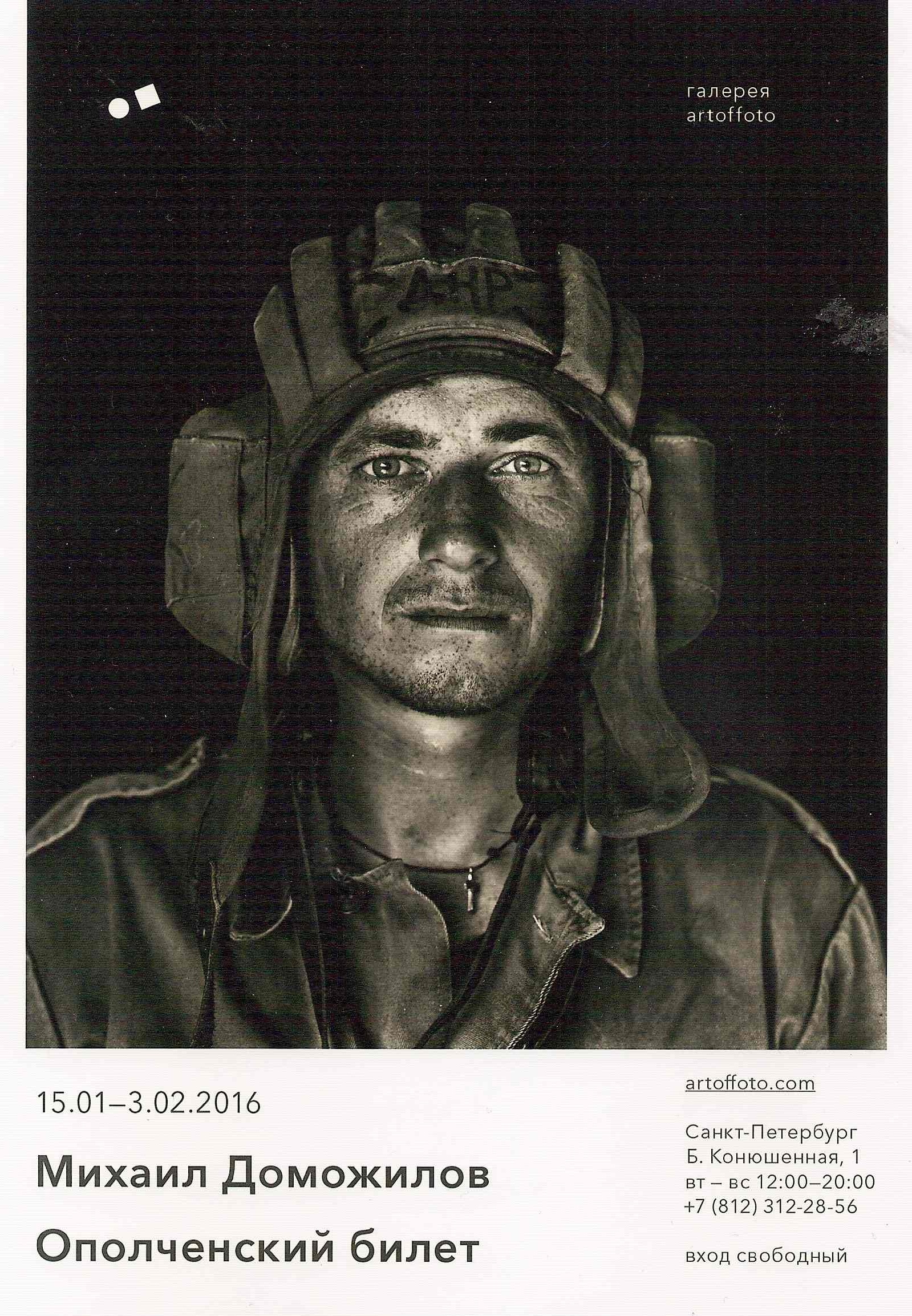
Promo flyer for the exhibition Mikhail Domozhilov, Militiaman’s Pass, ARTOFFOTO Gallery, Saint Petersburg, January 15-February 3, 2016. Courtesy of the gallery
This morning I got an urgent message from a friend, alerting me to the fact a funny sounding exhibition of photographs was underway at a downtown photo gallery I had never heard of.
It was true, as my friend pointed out, that the announcement for the show, an exhibition of portraits of Eastern Ukrainian pro-Russian separatist fighters (opolchentsy), taken by Petersburg photographer Mikhail Domozhilov, sounded quite dicey politically, as posted on the website of the exhibiting gallery, ARTOFFOTO.
It sounded a little less outwardly partisan when translated into English and printed on the flyers I would later find lying on a windowsill in the gallery:
“The self-proclaimed and still unrecognized state [of the] Donetsk People’s Republic appeared as a result of a civil war in Ukraine in April, 2014. The Donbass People’s Militia became the driving force of the new republic. In the year that passed after the declaration of the DPR, its militia transformed from an anarchic group of super activists [sic] divided into small groups and willing to go weaponless and die for an idea into a regular army with all its necessary attributes—[a] code [of military conduct], subdivisions [sic] and their chiefs, headquarters and machinery.
“This episode is about transition and transformation, about a shaky equilibrium between belonging to one country and to another, utopic in its essence. And also about the self-identification of the participants throughout the conflict. In several months former miners, builders, mechanics have become professional warriors, and a new, extreme reality has replaced the ordinary one. With major destruction[], artillery shelling and [a] non-continuous front, these people suddenly found themselves in the middle of historical events and news reports.
“This episode includes several close-up portraits of militia members in mobile studios at military and training bases, as well as on [the] frontlines.”
(English-language flyer for the exhibition Mikhail Domozhilov, Militiaman’s Pass [Opolchenskii Bilet], ARTOFFOTO Gallery, Bolshaya Konyushennaya, 1, Saint Petersburg, January 15–February 3, 2016)
It was also true that the photographer, Mr. Domozhilov, had shown a penchant in his career for subjects that might be characterized as rightist, such as this fascinating series on the ultras for Petersburg’s Russian Premier League side, FC Zenit.
The ultras series featured virtuosic albeit historically and aesthetically coded works such as this.
Mikhail Domozhilov, From the series Ultras, 2010. Courtesy of the photographer’s website
On the other hand, Mr. Domozhilov’s tearsheets included portraits, just as compelling, of pro-Ukrainian fighters on the Maidan in Kyiv.
But I did not think it fair to pronounce judgement on the work on the basis of a couple of websites, so I set off into the winter wonderland that Petrograd has become in the last week to see the show for myself.




#/media/File:Red_Guards.jpg)