Give Them Want They Want

Putin: “Give me what I want!” Trump: “Hang on!”

Trump: “There’s a better way!” Trump: “Give him what he wants!”

Source: Moscow Times Russian Service weekly newsletter, 30 November 2025. Original by Michael de Adder. Translated by the Russian Reader


Following the shooting that claimed the life of a National Guard member last Wednesday in Washington, the Trump administration has announced it will be halting all asylum decisions and paused issuing visas for people travelling on Afghan passports. The suspect in Wednesday’s shooting that killed Specialist Sarah Beckstrom, 20, and critically wounded Staff Sgt. Andrew Wolfe, 24, is Rahmanullah Lakanwal, a 29-year-old Afghan national who worked with the CIA during the Afghanistan War and had been living in the U.S. since 2021. He applied for asylum during the Biden administration under a program that resettled Afghans after the U.S. withdrawal from the country, and was granted it this year under President Trump.

As seen in our infographic, based on data released by the U.S. Department of Justice, Afghanistan was not one of the 10 most common countries of origin for people who received asylum in the U.S. in the fiscal year 2024. Only 508 Afghans were granted asylum in the country that year, while 61 were refused. By comparison, the U.S. granted asylum to 3,605 Russian nationals, making Russia the most common nationality to get asylum in the country during that time period. This was followed by China, with 2,998 Chinese nationals receiving asylum, and Venezuela, with 2,656 successful asylum applications.

Source: Valentine Fourreau, “Who Is Granted Asylum in the United States?” Statista, 1 December 2025

Judging Them by How They Look

A Russian National Guard serviceman checks residency documents during a raid outside the Apraksin Dvor clothing market, in St. Petersburg, Russia, Friday, July 4, 2025. (AP Photo/File)

The immigrant worker from Uzbekistan entered the bank in Moscow, but when he reached the teller, she refused to serve him and she wouldn’t say why.

For him and others from impoverished countries across Central Asia who seek better lives in Russia, such hostility is woven into everyday life. Sometimes it bursts into outright violence.

“Mostly you notice it when you go to the hospital, a clinic, a government office: You stand in line and everyone shoots you dirty looks,” said the man, who spoke to the Associated Press on condition of anonymity because he feared repercussions.

Such xenophobia clashes with economic realities at a time when Russia has a labor shortage, primarily due to its war in Ukraine. In the first quarter of 2025, over 20% of Russian businesses said they were hindered by a lack of workers, according to the Central Bank. 

But rather than welcoming laborers, Russian officials are fomenting anti-migrant sentiment and increasing restrictions on immigrants, which the government says number 6.1 million, but is probably higher. The government is tracking their movement, clamping down on their employment and impeding their children’s rights to education.

A massacre and a backlash

The continued crackdown comes as a trial began this month for four Tajik nationals who are accused of the shooting and arson attack at a Moscow concert hall in March 2024 that killed 149 people. The four were arrested within hours of the attack and appeared in court with signs of being severely beaten. An Islamic State group claimed responsibility but Russia sought to blame Ukraine for the bloodshed.

Anti-migrant rhetoric had been growing in Russia since the early 2020s. But the massacre in particular launched a wave of “terrible violence” against immigrants, said lawyer Valentina Chupik, who has worked with the immigrant community for over 20 years. In the eight days after the killings, she received 700 reports of injuries to immigrants, including “faces smashed against the doors of police stations,” she said.

Parliament speaker Vyacheslav Volodin captured the public mood after the massacre, saying “migration control is extremely important” to ensure foreign nationals carrying out “illegal activity” could be deported without a court order.

The violence drew concern from human rights groups.

“Central Asian migrants seeking work in Russia due to dire economic conditions in their countries of origin today face ethnic profiling, arbitrary arrests, and other harassment by police in Russia,” Human Rights Watch said in a report on the anniversary of the attack.

“The heinous massacre cannot justify massive rights abuses against Central Asian migrants in Russia,” said its author, Syinat Sultanalieva.

Raids, roundups and restrictions

While some violence has subsided, it hasn’t disappeared. In April, police raided a Kyrgyz-run bathhouse in Moscow with video showing masked men forcing half-naked bathers to crawl across the floor and deliberately stepping on them before covering the lens of a security camera.

Police also reportedly rounded up immigrants in raids on warehouses, construction sites and mosques, then coerced them into joining the military to fight in Ukraine. Some are threatened with having their residency documents withheld, while others are recently naturalized citizens who failed to register for military service. In such cases, serving in the military is presented as the only alternative to prison or deportation. For others, a fast track to Russian citizenship is offered as an incentive for enlisting.

Speaking in St. Petersburg in May, Alexander Bastrykin, head of Russia’s Investigative Committee, said “20,000 ‘young’ citizens of Russia, who for some reason do not like living in Uzbekistan, Tajikistan (and) Kyrgyzstan” were serving in Ukraine.

Those immigrants who have avoided violence still are subject to new anti-migrant laws. Much of this is targeted specifically toward workers from Central Asia.

In 2024, 13 Russian regions banned immigrants from certain jobs, including in hospitality, catering and finance, and even as taxi drivers. A pilot program starting in September in the Moscow region requires migrants who enter Russia without a visa to be tracked via an app. Those failing to comply are added to a police watchlist, impeding access to services like banking, and subjecting them to a possible cutoff of cellphone and internet connectivity.

A nationwide law banned children of immigrants from attending school unless they could prove they could speak Russian. Less than six weeks after the law came into force, officials told local media that only 19% of children who applied for the language test were able to take it, and the most common reason for rejection was incomplete or inaccurate documents.

Another man from Uzbekistan who has worked in Russia for almost two decades and lives in St. Petersburg said he’s had to wait in line for over seven hours to get needed residency documents. The man, who also spoke to AP on condition of anonymity for fear of reprisals, hopes to stay in Russia but says the climate has worsened.

“It’s hard to get paperwork,” he said. “There just isn’t the time.”

The oppressive laws sometimes force immigrants to resort to paying bribes. Chupik, the lawyer, believes that Russia’s system results in “violations that cannot be avoided.”

“This is exactly what this mass regulation is striving for: not for all migrants to be here legally, but for everyone to be illegal,” she said. “That way, they can extract bribes from anyone at any moment and deport anyone who resists.”

Encouraging anti-migrant sentiment

Anti-migrant sentiment is unlikely to diminish anytime soon, mostly because it’s encouraged by authorities like the Investigative Committee’s Bastrykin, who said immigrants “physically occupy our territory, not just with their ideology but with specific buildings” — referring to sites such as mosques.

Ultra-nationalist lawmaker Leonid Slutsky said foreign workers “behave aggressively, causing conflicts and potentially dangerous situations.”

Migrants are an easy scapegoat for many social ills, and not just in Russia, said Caress Schenk, an associate professor of political science at Nazarbayev University in Kazakhstan.

“Closing borders, conducting migrant raids and tightening policies are all tools that are easy go-tos for politicians the world over,” she said. “It goes in cycles that are sensitive to geopolitical pressures, as we’re seeing now, but also things like election campaigns and domestic political rivalries.”

A surge of “anti-migrant propaganda” has dwarfed previous rhetoric of recent years, according to the Moscow-based Uzbek immigrant who was ignored by the bank teller.

“If every person paying attention to the TV, the radio, the internet is only told that migrants are ‘bad, bad, bad,’ if they only show bad places and bad people, of course, that’s what people are going to think,” he said.

Such anti-migrant rhetoric has become part of the nationalist narrative from President Vladimir Putin and others used to justify the 2022 invasion of Ukraine — that Russia is under constant threat.

“Russia has started lumping together all of ‘the external enemies’ that it’s created over the years for itself: the migrants, the Ukrainians, the West,” said Tajik journalist Sher Khashimov, who focuses on migration, identity and social issues. “It all becomes this part of this single narrative of Russia being this castle under siege, and Putin being the only person who is on the lookout for ordinary Russians.”

The Uzbek immigrant in Moscow said Russia has created conditions “supposedly to help people, to help migrants.”

“But the rules do not work,’ he added. ”Special barriers are created that migrants cannot pass through on their own.”

Source: Katie Marie Davies, “Immigrants from Central Asia find hostility and violence in Russia,” Associated Press, 22 August 2025


Source: SEIU California (Facebook), 8 September 2025


A prominent nonviolent activist from Moroccan-occupied Western Sahara has been detained by federal immigration officers. Jamal Fadel was seized by masked ICE agents at Manhattan’s notorious federal building at 26 Federal Plaza on August 25 after a routine immigration hearing — an arrest that was caught on video.

Fadel is from the occupied city of Boujdour in Western Sahara. He’s been protesting nonviolently against Morocco’s occupation since he was a high school student, and was threatened by Moroccan authorities so many times that he left to seek political asylum in the United States.

Fadel is currently being held by ICE at the Moshannon Valley Processing Center in Pennsylvania. His attorney expects ICE will move for an expedited removal hearing. If deported, Fadel faces lengthy imprisonment, torture — or worse.

Source: Democracy Now (Facebook), 9 September 2025


I spotted some of the Trump administration’s wanted men on Tuesday, the day after the U.S. Supreme Court granted immigration agents virtually unchecked permission to continue the “largest Mass Deportation Operation” in America’s history.

The wanted stood outside of a U-Haul truck rental outlet in the San Gabriel Valley. They polished other people’s BMWs and Range Rovers at a Pasadena car wash. I saw the wanted women too, walking to jobs as nannies and housekeepers.

They looked suspicious, all right, by the definition outlined Monday by Supreme Court Justice Brett M. Kavanaugh. They were natives of Mexico and Central America, seeking “certain kinds of jobs, such as day labor, landscaping, agriculture, and construction.”

They were suspect to many Californians too, but only of wanting to work, wanting to earn a little cash, wanting to pay their bills and feed their families. One hundred and seventy five years to the day after land that once belonged to Mexico became the 31st American state, California felt to many people Tuesday like it had reverted to a kind of frontier justice, where racial profiling had become the law of the land.

“I am just working hard and paying taxes,” said Mario, 50, between sips of coffee on the sidewalk outside the U-Haul station. Even before the Immigration and Customs Enforcement raids began three months ago, the Honduran immigrant said, life for street-corner workers was not easy.

“People are just looking for work. Some of them are even homeless,” said Mario, who declined to give his last name. “But some people are showing them hate, sometimes even hitting or kicking the homeless. We see it out on the street.”

At the Pasadena car wash where six workers were carted away in late August, those left behind continued their buffing and polishing Tuesday.

“It feels like we have come down low, really low,” said Cesar, between checking in customers. Though he was born just blocks away at Pasadena’s Huntington Hospital, he said he does not feel immune from the raids.

“If now they are just going to judge you by how you look, or maybe how you talk, I can get pulled over. Anyone can get pulled over,” said Cesar, who did not give his last name. “It’s gonna be harder for people to live a normal life. They’re gonna just have to deal with harassment. That’s not something I would want anyone to have to go through.”

Earlier raids by Trump immigration agents have spread far beyond snagging the criminals and drug traffickers the president and his allies claimed to be after. With 10 million Latinos living in the seven Southern California counties covered by the court’s order, a rights group said the high court’s action cleared the way for “an extraordinarily expansive dragnet, placing millions of law-abiding people at imminent risk of detention by federal agents.”

“We should not have to live in a country where the Government can seize anyone who looks Latino, speaks Spanish, and appears to work a low wage job,” Justice Sonia Sotomayor wrote. “Rather than stand idly by while our constitutional freedoms are lost, I dissent.”

The action offered portentous echoes of the mistreatment and greater violence unleashed on Chinese immigrants in the late 1800s. Today, it had U.S.-born citizens, such as The Times’ Gustavo Arellano, feeling they will have to carry their passports to prove their citizenship.

Outside the U-Haul, Mario said he holds a green card. So he will continue waiting on the sidewalk for his next job.

“I believe in God,” he said. “We might think different things, but we all have the same heart. There should be the same heart for everyone. Everyone.”

Source: James Rainey, “Essential California” newsletter (L.A. Times), 10 September 2025


The United States deported 39 Uzbek nationals on a charter flight to Tashkent, the U.S. Embassy confirmed in what it described as part of ongoing efforts to remove migrants without legal status. Earlier this year, more than 100 Central Asians, mostly Uzbeks, were repatriated in a similar U.S.-funded operation. The deportations attest to close cooperation between Washington and Tashkent on migration enforcement. That partnership has been accompanied by political overtures. Last week, Presidents Shavkat Mirziyoyev and Donald Trump held a phone call in which they pledged to broaden their strategic partnership ahead of an expanded dialogue session this autumn. U.S. officials have pointed to investment opportunities in Uzbekistan, particularly in critical minerals, while both sides also highlight cooperation on security and migration.

Source: Peter Leonard, “Central Asia’s week that was #70,” Havli, 10 September 2025

Navalny Supporter, Deported to Russia from U.S., Detained on “Condoning Terrorism” Charges in Perm

Leonid Melekhin. Source: XSovietNews

Man repeatedly detained at protest rallies in Perm deported from U.S. to Russia

Today, 25 July, Perm activist Leonid Melekhin, who had been wanted by law enforcement authorities for several years and is on the Russian federal list of “terrorists and extremists,” was remanded to custody in a pretrial detention center, Properm.ru’s correspondent has learned. Melekhin had attempted to emigrate to the U.S. via Mexico, a process about which his friends had written extensively on social media.

Melekhin tried to cross the border between Mexico and America in August last year and spent several months in detenshen (immigration prison in the U.S.), but lost his legal bid to remain in America. This entire time he was wanted by the Russian authorities for his cooperation with the Navalny Headquarters (an organization deemed “extremist” that has been banned in Russia).

According to our correspondent, Melekhin was turned over to the Russian authorities [sic!] before being deported to Russia and detained on suspicion of “condoning terrorism.”

As their source at Perm’s Lenin District Court confirmed to our correspondent, Judge Oksana Korepanova today granted the motion filed by an FSB investigator and remanded Melekhin to a pretrial detention center until 25 September.

Before leaving Russia in late 2023, Melekhin was repeatedly detained by the police for his involvement in unauthorized protests.

Source: “Perm man deported to U.S. remanded to pretrial detention center,” Properm.ru, 25 July 2025. Translated by the Assessment Scene, which always puts in quotation marks the fanciful thought crimes (such as “condoning terrorism”) dreamed up by the Putinist police state to terrorize the Russian populace.

The Cardiff Album

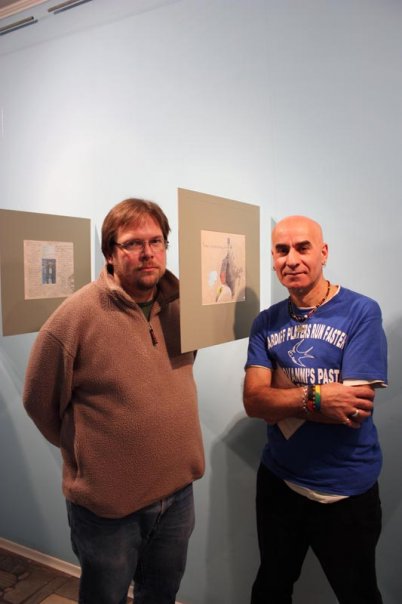
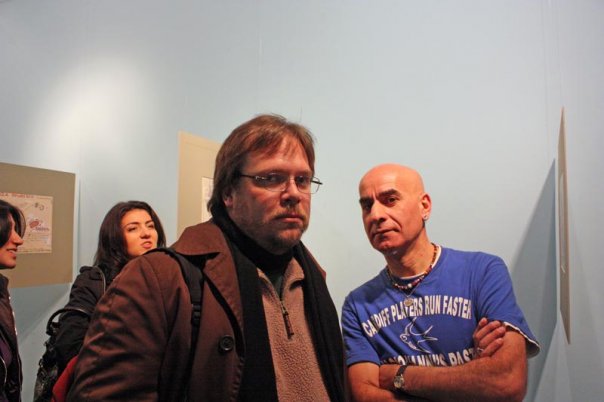
These are two of my favorite snapshots. I’m pictured here with the phenomenally brilliant Babi Badalov at the opening of his show The Cardiff Album at the Freud Museum of Dreams in Petersburg on November 3, 2008. The pictures were taken by the equally phenomenal Sergey Chernov. Below the second photo is the intro I wrote for the show. ||| TRR

Born in Lerik, Azerbaijan, in 1959, Babi (Babakhan) Badalov is a living embodiment of cosmopolitanism’s dark and spontaneously convivial underbelly. In his world, people do not travel from one country to another with polished ease, flashing their passports to the guards as they pass effortlessly through frontiers and effecting the shift from one language to another with fluency and grace. On the contrary, when you are a refugee, exile, migrant worker or itinerant artist, you manage these transitions as best you can, mangling the new idioms you learn and fusing them with half-remembered tongues you picked up along the way, mingling them with memories of a mother tongue that never matured into adulthood because at a tender age you left your mountain village for the capitals, where encounters with countrymen were few and furtive and somewhat beside the point. In the provincial capital, you learned the official language of artificial nationhood along with the (un)official language of the anti-imperial empire, neither of them your own, both of them suspicious (of you and of themselves). This was violence to be sure, but you turned this violence back upon itself, never fully learning any of these codes well enough to pass for a native. Nativity, after all, is naïveté, an identification both outwardly enforced and grimly self-willed. For an artist, whether of life or the brush, submitting to too many of these identity checks means submitting to kitsch and cliché.

Of course you submit to these as well—you cannot help but submit: you are an artist, not a fighter—but when you succumb you always go too far, giving the lie to the endlessly tautological chains of self-identity that pass for human speech, which, as Lacan and others tell us, is the inhuman machinery that undergirds and overdetermines our visibly silly search for selfhood. You do not need Lacan to tell you this, though, because you are confronted daily with its external effects, masked as real people in real lifeworlds, who are kind or cruel or indifferent but rarely anything other than language machines. In your poems, you disassemble these machines, heap their parts into great, disorderly piles, and then begin putting them back together in defiance of common sense and good taste and the rules of art. It is worse than that. You get the words all wrong: you pronounce them with the wrong accent; you confuse tenses, case endings, conjugations, and registers. You use, illicitly, the Latin alphabet when you write in Russian, and most of your Russian texts are chockablock with English. When you declaim your poems, whether aloud, in a smoke-filled room crowded with alcoholic crypto-nationalists, or with paste and scissors, as in your collages, it is hard not to escape the impression that a faulty robot has arrived from the island of misfit toys to tell us something we would rather not hear—that all our projects of empire- and nation-building have failed.

Your art is political, personal and politically (in)correct. This is what Adorno meant by the autonomy of art, but if he had met you he probably would have turned away in horror, as he did when his well-meaning German students enjoined him to join them on the barricades.

You ask us to join you on the barricades, but what does solidarity look like from there? It looks like this. For years, you live in wretched conditions in a magnificent squat in the middle of Petersburg. Outside, in the square, stands a monument to the greatest African-American poet of them all, Alexander Pushkin. Your comrades-in-arms are artistic scapegrace outlaws, and their ambitiously unambitious version of conviviality will finally lead to their tiny island’s recuperation by the new powers that be, for whom art is just window dressing for real estate and financial speculation. So when this experiment in direct democracy goes awry, you are induced by your family to return to your “homeland” of Azerbaijan and live the straight life. This is almost too much for me to imagine: for me you are the gayest man on the planet, in all senses of the word. When this becomes unbearable, you use the second half of a double-entry visa to make your way to England, that green and pleasant land that would have been a much duller place throughout its history without adventurers like you.

But you plan this particular adventure all wrong, just as you write poetry the wrong way. You declare asylum as soon as you arrive, but in the New Labour UK—in the midst of a war on terror that has also opened a front running straight down the middle of the country—you are treated both as a potential combatant and an obscure object of bureaucratic desire. At the first asylum center (prison) to which they send you, a riot—complete with helicopters, media coverage, and armored police—breaks out. When you tell the story later, it is quite funny, though of course there is nothing funny about it. After a grand tour of Britain with brief sojourns in another few such oases, your case is officially accepted for review and you are dispatched to Cardiff, where you are given a tiny stipend and a council flat. It is all very civil, except for the weekly check-ins with the UK Border Agency, the more or less constant threat of deportation, and the grinding poverty. That does not faze you, however; or rather it does, but you turn that fazing into art. What kind of art? Dolls made from scraps of fabric; dogs fashioned from Wellington boots; and “visual poems” patched together from clippings and other printed detritus, embroidered with whorls of off-kilter, ham-fisted linguistic ravings, and asylumed on the pages of an old photo album you pick out of a rubbish bin.

This is the Cardiff Album, the diary of your journey through the underside of UK immigration policy. You are the Persian Ambassador (a role you played at an evening in solidarity with Salman Rushdie held in the former Persian embassy in Petersburg in 1995), but the marvels you record on your visits to strange lands look like nothing so much as the end of history having its revenge on the last romantics. Your ambassadorial credentials are recognized only by a ragtag band of Welsh anarchists who make your case their cause célèbre, even though you are a celebrity only in the minds of the people you have stitched together in your wanderings and in “alternative” Azeri news outlets starved for news. When it looks certain that you will be deported, the first half of this inoperative community begins bombarding bureaucrats, parliamentarians, and airline officials with faxes, letters, and e-mails. I have not seen you in years, but I would rather not see you again in such circumstances, so I spend half an hour on the phone telling a Pakistani (or was he Bangladeshi?) call center operator that he should not be party to this horrible crime against human freedom that his airline is about to commit. I tell him to get up from his desk and leave work. What right did I have to tell him that? Rights are not given, they are taken. (Did Bakunin say that? Or was it Kropotkin? Or perhaps it was Gorky? Or maybe no one said it?)

Much as I would rather not seen you again, see you I do a couple days after my stupid conversation with your cleverer immigrant non-brother. You and I have nothing in common, just as no one really has anything in common with anyone else. It is too bad that more people do not realize this sad, happy fact. If more people did, they might actually be able to begin making something in common.

NB. The full Russian version of this text was published in Viktor Mazin, ed., Kabinet Iu: Kartiny mira III (Saint Petersburg: Skifiya, 2010). An abridged English version was published in Babi Badalov, Menilmontant Book (Murcia, Spain: Manifesta 8 & transit.cz, 2010). The Cardiff Album was exhibited in full at the Freud Museum of Dreams (Saint Petersburg) in November–December 2008. Parts of the album have also been exhibited in the group shows Monument to Transformation (City Gallery Prague, 2009); On Geekdom (Benaki Museum, Athens, 2007); Progressive Nostalgia (Centro per l’arte contemporanea Luigi Pecci, Prato, 2007); and The Return of Memory (Kumu Art Museum, Tallinn, 2007).

Source: Chtodelat.org

Making Women Visible: Russian Language Classes for Immigrants and Refugees in Petersburg

apa-1
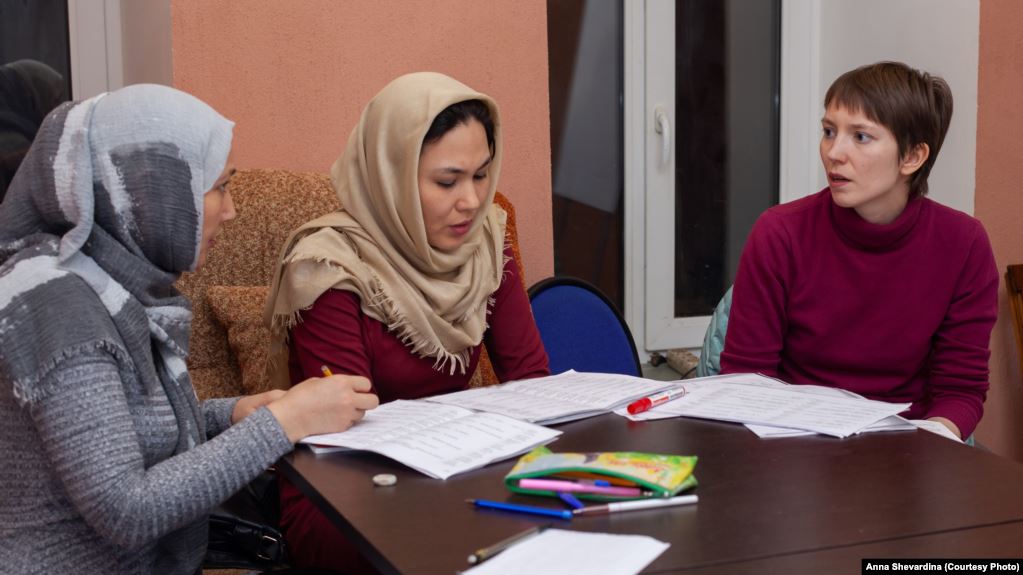
Darya Apahonchich with students during class. Photo by Anna Shevardina. Courtesy of Radio Svoboda

“Making Women Visible”: Why Female Immigrants Stay at Home for Seven Years
Karina Merkurieva
Sever.Realii (Radio Svoboda)
March 7, 2020

“My husband and children and I came to Russia from Afghanistan over eight years ago. At first, I had no time to learn the language: I had to help the children and work at home, and then I was unable to find suitable courses. So this is only my second year studying Russian,” says Suraya.

Since she is shy about speaking Russian, she agrees only to a written interview. She has been studying Russian for a second year at courses for female immigrants and refugees in Petersburg. Classes are held at Open Space, a co-working space for social activists, and at two libraries. Groups are divided into several levels according to how well the students speak Russian.

In February, project organizer Darya Apahonchich announced the launch of a new group for beginners. According to her, she saw the need for such courses in 2018, when she worked for a similar project run by the International Committee of the Red Cross.

“There were classes for children and adults. I taught Russian as a foreign language. The only problem was that only those who had official immigrant or refugee status could attend. In Russia, not everyone obtains this status. Another thing was that the course was limited in time. Not everyone was able to get the necessary minimum of Russian under their belt in this time,” Apahonchich says.

The group she led mostly consisted of women over the age of thirty.

“Young women who come to Russia at an earlier age and go to university have one set of opportunities. As soon as a woman becomes a mother, her set of opportunities decreases dramatically,” Apahonchich adds.

At one of the classes, a new student from Syria decided to join the group. In order for the students to get acquainted, Apahonchich suggested that everyone introduce themselves by telling what country they had come from, how long they had lived in Russia, and how long they had been studying Russian. It transpired that nearly all the women in the class had lived in Russia around seven years, but had only begun to study the language. According to them, they had no opportunity to study Russian before: they had to raise children. Working outside the home was not the custom in their native countries, so their husbands had not allowed them to take language classes.

apa-2A lesson in Darya Apahonchich’s group. Photo by Anna Shevardina. Courtesy of Radio Svoboda

“I was very shocked at the time. These women’s children have basically grown up in Russia: they know Russia on the level of native speakers, and make jokes more easily in Russian than in their native languages. The women have found themselves linguistically and culturally isolated, however. They stayed at home all those years. They didn’t even have a place to learn the language,” says Apahonchich.

When the Red Cross courses were coming to an end, Apahonchich suggested to the women that they should not quit their studies, but continue studying Russian elsewhere. They leapt at the suggestion.

“I realized that those woman would go back to their families, and that would be the end of their introduction to the Russian language. I didn’t want to let that happen,” she recalls.

Other groups and new teachers have subsequently emerged. The project currently encompasses four groups at different levels of proficiency. Classes are taught by eight volunteer teachers. Some of them, like Apahonchich, majored in Russian language pedagogy at university, while others are native Russian speakers with humanities backgrounds and experience teaching history or Spanish, for example.

“I wanted to create a horizontal structure in which each teacher could organize their own groups and take responsibility for the learning process,” says Apahonchich.

As a result, the teachers work autonomously: they find venues for holding classes on their own, and decide with their groups what topics would be interesting to discuss in class.

In her group, for example, Apahonchich focuses not only on teaching the Russian language, but also on the legal aspects of life as an immigrant in Russia. During classes, her students read brochures on how to behave if you are faced with aggression from the police, how to get a job, and how to rent an apartment without falling victim to fraud.

“Our all-female collective discusses issues related to health and doctor visits,” says Apahonchich.

According to Suraya from Afghanistan, this is one of her favorite topics.

“I also like to read texts about Russia and Petersburg, and discuss the weather and family. I really need this vocabulary when I pick up my daughter from kindergarten or go to the clinic. In the clinic, however, I often encounter aggression. The people at reception shout at me if I don’t immediately know what to say,” Suraya explains.

While the courses are more aimed at teaching Russian, the instructors sometimes also talk to the female immigrants about women’s rights.

“Right now, the easiest way, I think, to get women out of linguistic and cultural isolation is to get them into the world of work. That way they could learn Russian more quickly, adapt socially, and make new friends. At the same time, we have before our very eyes the example of women from Central Asia who come to Russia to work and eventually find themselves separated from their families. That is the other extreme. For the time being, I just want these women to stop being invisible. Currently, the majority of the Russian populace doesn’t even suspect how many female immigrants live in cultural isolation in their country,” says Apahonchich.

According to the UNHCR, about 220,000 refugees and persons with temporary asylum status were registered in Russia in 2019. Most of those people came from Afghanistan, Ukraine, Syria, and Yemen.

Thanks to Darya Apahonchich for the heads-up. Translated by the Russian Reader

A Putin-Trump Bot and Shill for Lyndon Larouche Has Something to Say to You

maga man.pngThis is what I look like in real life. Photo by Jonathan Ernst. Courtesy of Reuters and Business Insider Deutschland

Throughout the last presidential election campaign, I was verbally abused by a young art historian who was so determined to see Hillary Clinton win the race he attacked everyone who expressed the slightest uncertainties about her sterling character, political record, etc.

He did this to me on countless occasions, despite the fact I had already said I would vote for Clinton to prevent Trump from becoming president.

My ex-art historian friend pursued this social media campaign of abuse right up until election day. Although I tried several times to persuade him that verbally abusing people is not a very good way of making them do anything, he persisted in his vicious attacks on specific doubters like me and people who weren’t crazy about Clinton in general.

I’m not sure where he got his marching orders or whether he got them at all. Our political culture is suffused with violence, abuse, aggression, and stupidity, so it’s possible he set out on his perilous and, ultimately, futile course without any explicit prompting from the obnoxious Clinton campaign and the even more obnoxious Democratic National Committee (DNC).

Whatever the case, I’m already seeing signs the DNC faithful have started abusing doubters well in advance of the primaries, the convention, and the election.

Just today, in fact, one such fanatic labeled me a “Putin-Trump bot” and a “shill for Lyndon Larouche.”

Why did he attack me in this way? Only because I suggested—plausibly, I think—that there is no guarantee that if a Democrat grabbed the White House in January 2021, she or he would move to prosecute Trump.

I think it is likely that, instead, the new president would pardon Trump and only Trump in order to smooth the transition and also receive carte blanche to go after everyone else in Trump’s administration.

Two tenured professors who know for a fact I am neither a “Putin-Trump bot” and “Larouche shill” let this abusive comment stand without comment.

So, if that is how it’s going to be, I am going to make a promise to all of you.

I will not vote for the US Democratic Party in the 2020 US presidential election. They have broken their promises to working-class people, minorities, people of color, and pretty much their entire so-called base for as long as I have been following politics.

What our country needs is not a Democrat in the White House but a lot more democracy. It is clear the two “legal” parties have very odd ideas about democracy. One party has abandoned its conservative and liberal roots in pursuit of fascism. The other party does almost nothing to stop them while rapping the knuckles of the inspiring congresswomen of color who were elected in 2018 and are willing and able to take on a bully like Trump.

In short, if the Democratic Party could run an Ocasio-Cortez/Omar ticket in the 2020 presidential election, I would consider voting for it (and I’m sure millions of other people would, too), but the DNC would never let such a ticket make it onto the ballots even if Rep. Ocasio-Cortez were not too young to run, and Rep. Omar had not been born in another country.

What our country really needs, as an interim step toward real democracy, is a multi-party parliamentary republic without a president. I would argue this form of governance would make the nightmare of the last two and a half years a lot less feasible by diffusing power among parties more narrowly defined by class, ideological, and regional interests.

I don’t encourage anyone else to follow my example. After all, I have it on good authority that I am a Larouchian shill and a Trump-Putin bot.

I would, however, encourage you not to succumb to the “unity at any cost” campaign the DNC will unleash on the nation, using its millions of dupes around the country to viciously attack anyone who wavers from the party line.

When you’re verbally abused by a DNC fanatic, as I was today, explain as calmly as you can that this style of campaigning turns people off and encourages them to stay home rather than vote.

The latest issue of the Economist (July 6, 2019) had an interesting piece summarizing some research done by the newspaper itself. It claimed that, if everyone had voted in 2016, Clinton would have won.

In other words, if the US had mandatory voting like Australia has, for example, passive Clinton supporters would have been more or less forced to vote for her and she would have easily beaten Trump.

The Economist also argued Republicans would have to soften their hardline fascist message to appeal to fence-sitters, who also have a tendency not to vote.

What the article failed to point out is that the real Australia recently returned the governing Liberal-National coalition to power despite the fact all of the polls had predicted victory for the Australian Labor Party.

This means Scott Morrison was returned to his job as the country’s PM, despite the fact he presided belligerently over Australia’s own asylum-seeker concentration camps on Manus Island and Nauru before mounting a leadership challenge and taking over as the Liberal Party chair and, hence, the PM.

Scott Morrison is only slightly less odious than Donald Trump, by the way.

So, mandatory voting is no guarantee of happiness and sunshine in Australia, America or anywhere else.

The DNC is even less inclined to produce happiness and sunshine for ordinary Americans than the Australian Labor Party or even the Australian Liberal Party, not all of whose members are fascist pigs.

Don’t take the DNC’s abuse. I understand the desire to get rid of Trump, but it can’t happen at any price. If the price is Joe Biden, I would place a bet in any establishment willing to take it that he would pardon Trump the day after the inauguration.

If you must vote, then, a) don’t vote for a “compromise” ticket, and b) don’t take abuse from the DNC-inspired unity-at-all-costers.

When someone is willing to rain such mendacious filth on the head of a person he has never met and knows nothing about, this alleged unity is worthless.

All of you are smart and strong enough not to buckle under such pressure.

Who knows? If millions of you made pledges like the one I am making now it might make the DNC sit up and listen. {PUTIN-TRUMP BOT}

Aliyah

aliyah

Canadian professional wrestler Aliyah. Photo courtesy of WWE

It’s really unpleasant to discover that, for no apparent reason and unbeknownst to you, you have been unfriended long ago by someone you really did think of as a friend,

The funny thing is that, two years ago, I translated a dozen or so pages of essays and other documents this particular friend needed for their Fulbright application. I did all of this work literally overnight, with almost no advanced warning.

The friend didn’t think to offer me any money or anything else for my work, but when they did, in fact, get the Fulbright, they suddenly popped up again to ask for free English lessons.

Since I haven’t heard word one from them since then, I assume they and their family stayed in the States.

What happened to the film I had been helping them make for several years is for me to wonder alone about, too.

This is a lesson I should have learned the hard way when A.S. and I held what proved to be a truly savage and unpleasant “solidarity evening” for our old friend the artist B. in 2008 after he was deported from Brexitland, where he had applied, quite sincerely and on impeccable legal grounds, for asylum as a gay man whose life was threatened in his home country.

All three of us were roundly denouced by the rather odd audience in attendance at the erstwhile artists squat Pushkinskaya 10 (now a municipally subsidized arts center) for advocating the international human rights approach to asylum seeking.

The thing to do, we were told in no uncertain terms, was to trick your way into the promised land of your choice by hook or by crook, not to openly apply for asylum and get mixed up with the allegedly politically dodgy types (i.e., anarchists and other No Borders activists) who support asylum seekers in other countries.

Meanwhile, my wife’s cousin M., who up until a few months ago showed no interest in their late grandfather and his Jewishness, has suddenly decided to make Aliyah. The only problem is that his cousin, my wife, is the only living member of the family who knows anything about their grandfather, his Jewishness, and Jewishness in general, and who has kept anything she could pertaining to her grandfather’s life, because she loved him, and because she finds her fascinating multi-ethnic family’s history fascinating.

I am going to go out on a limb here and say that politics in Israel has been badly skewed  to the hard right by the huge influx of “Russian Jews” who emotionally, religiously, philosophically, and technically speaking had about as much business making Aliyah as I, a third-generation Scandinavian American, would have.

Naturally, since they have no real business being there or, rather, since they know they fudged their way into the country, they are even more resentful of the Palestinians, the natives brutally shunted aside to make room for their illegitimate millions.

This has been borne out by Likud’s strangehold on power in alliance with Avgidor Lieberman and the other radical right politicians heavily supported by immigrants from the former Soviet Union.

The only way out of this impasse is to declare Zionism a “triumphant failure” that did the job it set out to do when circumstances for Jews in the world were desperate. Now that they are much less desperate, Zionism, like “communism” in its own time, can phase itself out, giving way to a single Israeli-Palestinian state where everyone would learn Arabic and Hebrew at school, and to which anyone in the world would be eligible to immigrate if they chose to do it.

Of course, it would be a big mess, but it would also be a lot more fun than the current US tax payer-subsidized disgrace in Israel-Palestine.

But what to do about the alleged right of Russians to immigrate anywhere they choose by any means necessary when, in their majority, they themselves refuse to acknowledge the same rights for non-Russians? Spend enough time in these parts and you will realize that really large numbers of Russians do think quite sincerely and distressingly that Muslim, Asian, and African riffraff should not be allowed to live in their precious spiritual homelands of North America, Western Europe, and Israel, and certainly not in their beloved-and-hated Motherland itself.

I have no cheeky pie-in-the-sky solution to this racist silliness. I do know, though, that it had something to do (minus the racism) with why I lost a real friend. {TRR}

Smile! You’re on Hidden Camera

sure we can

Center “E” Surveilled Belgorod Family or Nine Months via Camera Hidden in Flat
OVD Info
August 24, 2018

In Belgorod, officers of the Center for Extremism Prevention (aka Center “E”) watched a married couple for nine months using a camera hidden in their flat, reports TV Rain, citing defense attorney Anton Omelchenko.

The couple was suspected of involvement with the Jehovah’s Witnesses. A court gave Center “E” permission to use the camera for three months on three occasions.

“Law enforcement agencies put hidden cameras in homes to record people playing. Criminal charges were filed as a result. One of the cases in Belgorod simply slayed me: a married coupled in a one-room flat who were under surveillance for nine months round the clock. Everything was really noted in the case files. The couple would watch TV and say something negative about the regime, and the field officers would immediately write down, ‘Criticized regime.’ There was a complete transcript of the entire surveillance. I also found this shocking,” Omelchenko told the TV channel.

Since their case has not yet been heard in court, Omelchenko did not name the couple who were under surveillance. It is known they have left Russia.

Photo and translation by the Russian Reader

Dean Gloster: We Are Doing Evil

immigrant childPictured: A two-year-old Honduran asylum seeker about to be taken from her mother and placed in a facility where the staff (according to an interview) “is not allowed to comfort her.”

Dean Gloster
Facebook
June 16, 2016

[…]

We are now essentially torturing parents who legally seek asylum in the United States (and their children), by taking away their minor children, caging those children, and telling the parents they may never be reunited—all to “deter” them (and those like them) from exercising their legal rights under U.S. law. This new Trump “zero tolerance policy” (announced and implemented April 6, 2018 by Jeff Sessions) is evil and not based on our laws.

As some of you know, I used to be a lawyer, and in the 1980s I used to do pro bono political asylum work for Salvadorans fleeing death squads. U.S. law allows you to claim political asylum here if you have a “well-founded fear of persecution” in your home country that fits within specified categories. You can either present yourself at a point of entry and claim asylum (risky—you aren’t afforded a lawyer and most asylum claims are turned down) or you can claim asylum as a defense to deportation.

Now on our southern border, the U.S. is (contrary to law) refusing to admit those legally claiming asylum. They are forcing immigrants to cross into the U.S. illegally, and then arresting them and (even if they have a defense to being deported because of a potentially valid asylum claim) taking their children to be housed in a concentration camp—an abandoned WalMart filled with cages or a new tent camp in 100 degree Texas heat on a military base. This is being done, per Jeff Sessions and Mitch McConnell, to “deter” them from seeking asylum—that is, as a punishment to them, to deter others from doing the same thing. Even though that thing (claiming asylum) is completely legal under U.S. law.

Accounts from Congressional Representatives and pro-bono attorneys reveal that parents are told that their children are being taken away “to get a bath” and then the children are not returned. When asked how they’ll be reunited, parents are being told “your families do not exist anymore.” Parents have been deported and they don’t know where their children are. Because there are at least four federal bureaucracies involved (CBP, DHS, ICE, ORR in addition to private prison corporations and the DOJ) and there was no planning for implementing the policy none of attorneys representing them, the Customs and Border Patrol, nor U.S. Congressional Representatives can get confirmation that the children are even being kept track of by family.

Not surprisingly, one man, after learning that his child had been taken away, recently killed himself.

Jeff Sessions announced the new policy on April 6, 2018, but Trump now (1) claims, inaccurately, that it’s “the Democrats'” prior law (a complete lie) and (2) tweeted today that he won’t change the new policy unless Congress agrees to fund the wall and end political asylum and end “catch-and-release.”

Today, DHS revealed that almost 2,000 children have been taken from their parents in the last 6 weeks under the new policy. Children are housed in cages on concrete floors. Many of the children don’t have access to anyone who speaks their language. The staff has no training to deal with the children’s trauma, and a whistle-blower recently explained that both the staff and the children are traumatized, while the CEO of the private prison company has been paid $1 million.

Today, three medical organizations announced their unanimous denunciation of this new policy because separating young children from their parents and incarcerating them is permanently traumatic.

So here we are, friends. This is a violation of the Fifth Amendment guaranty of due process of law. It’s a violation of the Eighth Amendment prohibition against cruel and unusual punishment. It is a violation of international law. I would hope that any of those who continue to assist the implementation of this new policy are shunned by their congregations of faith until that changes. (Catholic bishops have already discussed assessing Canonical penalties to ICE agents ranging from refusing the sacrament of communion to excommunication.) I would hope that our courts ultimately order them to cease and desist, and if they fail to do so, that they are jailed for contempt of court. I hope they are ultimately prosecuted as international war criminals and they can never travel outside the U.S. In the meantime, every single one of them has violated his or her oath to uphold the U.S. Constitution, and they deserve our horror and our contempt.

I’ve spent today in a funk, knowing that I needed to write this, and hating that fact. I have, despite every horrible thing up until the last nineteen months, been proud to be an American, choosing to concentrate on our lofty aspirations (equal protection, freedom of speech) rather than our tragic failings (slavery, segregation, white supremacy, McCarthyism.)

But this is simply unmitigated evil. And refusal to face it or to acknowledge it or to own it, is cowardice and a deliberate choice to enable evil. (Yes, friends, this is America, today. This is exactly who we are, until we change it.)

We are terrorizing families. We are traumatizing children. We are violating our principles and our laws to further a racist ideology of our misguided rulers. We are doing evil. We need to do everything in our power to stop that. Now.

Thanks to Jose Alaniz for the heads-up. I supplied the links and videos based on cues in the original text.

The Same Old Tapes Spin Round in Our Heads

kom

We don’t ever think. We just have a small collection of tapes we stick in slots in the back of our heads when the need to say something “smart” arises.

* * * * *

Russian speakers living in Finland are not a homogeneous group, but one thing unites them strongly: a large number of them regard asylum seekers with a grain of salt.

“I relate to the phenomenon negatively. I think the people coming here do not have the necessary information on how people live here. They are trying to come here with their own traditions and customs, and at the moment this hinders their adaptation,” say Gleb Ulanov, who lives in Helsinki.

[. . .]

Despite the fact that the Russians themselves are immigrants, they do not want to compare themselves to the people now arriving from the Middle East. Russian speakers are of the view that they do not have similar adaptation problems.

“The biggest difference is the mentality. Most Russian speakers adapt, find work, and respect Finnish customs and celebrations. In my experience, only a small minority of people from the east does this. They prefer to form their own communities,” says Grigory Berkinfand, who lives in Helsinki.

[. . .]

Many Russian speakers fear that Finns have a naive attitude toward the asylum seekers, and do not properly distinguish those who are genuinely in need of protection.

Just like Finns, Russians are primarily concerned about safety. Many say that traditionally peaceful Finland is changing at a rapid pace.

Gleb Ulanov, who in Soviet times lived for about a year in the Caucasus, is of the opinion that merely integrating the refugees is not enough. In addition to telling the asylum seekers about Finnish customs and laws, Finns should also tell the refugees about culture and how they should behave around them.

[. . .]

Even a man from Russian Karelia who is living in a reception center and applying for political asylum questions the motives for coming to Finland of many of the people living with him. The man wished to remain anonymous.

“I can see what is happening here. They do not appreciate either the local culture or the help they receive. The majority are of the opinion that the Finns are obliged to help them. Many of them say that one can live here without working, and everything is given free of charge. They are quarrelsome if they notice they have not been given something and they complain about conditions. For example, I am really satisfied with everything here. I have not received such a warm reception in my own country,” he said.

* * * * *

Excerpted from “Suomen venäläiset varoittavat: Ei kannata olla liian sinisilmäinen turvapaikanhakijoiden suhteen” [Russians warn Finland: do not be too gullible with regard to asylum seekers], YLE, January 30, 2016. Image courtesy of nashehobby.narod.ru. Translated, from the Finnish, by the Russian Reader