Russia Shoots Down Santa Claus

“Happy New Year, Russians!”: Santa Claus Shot Down Over Moscow by Russia’s Ded Moroz (Grandfather Frost)

Source: Kolokol XXI (Telegram), 27 December 2024 + Yandex Video. Thanks to Sergey Abashin for the heads-up.


Pro-Kremlin Telegram channels on Friday circulated a New Year’s video depicting Russian air defense systems shooting down Santa Claus’ reindeer sleigh.

The video, first shared by the Pul N3 Telegram channel, begins with Santa flying over central Moscow to the tune of “We Wish You a Merry Christmas.”

“Hi, Russians! Here are your presents,” says Santa Claus, sipping a Coca-Cola as the camera zooms in on his sleigh, which is loaded with rockets bearing NATO logos.

“Happy New Year,” Santa says before a missile shoots into his sleigh, causing it to explode mid-air.

Ded Moroz and Russian airpower. Image courtesy of Moscow Times

The scene then shifts to a military control room where a Russian serviceman and Ded Moroz — Russia’s version of Santa Claus — monitor the action on a screen as a traditional Russian folk tune plays.

“Is it done?” Ded Moroz asks the headset-wearing serviceman.

“Yes, it’s done. The target was destroyed,” the serviceman replies.

“Good. We don’t need any kind of foreign stuff [in our skies],” Ded Moroz says, embracing the serviceman. “Happy New Year!”

The video’s release comes just days after an Azerbaijani passenger plane crashed in western Kazakhstan, with reports suggesting it was shot down by a Russian surface-to-air missile.

Source: Pro-Kremlin Media Share Video Showing Russian Missile Shooting Down Santa’s Sleigh,” Moscow Times, 27 December 2024

Good Clean Fun

Photo: Pelagiya Tikhonova/Moskva Agency (via Moscow Times)

All modern entertainment that “undermines” traditional values should be banned in Russia, conservative philosopher and “Russian World” ideologue Alexander Dugin has said.

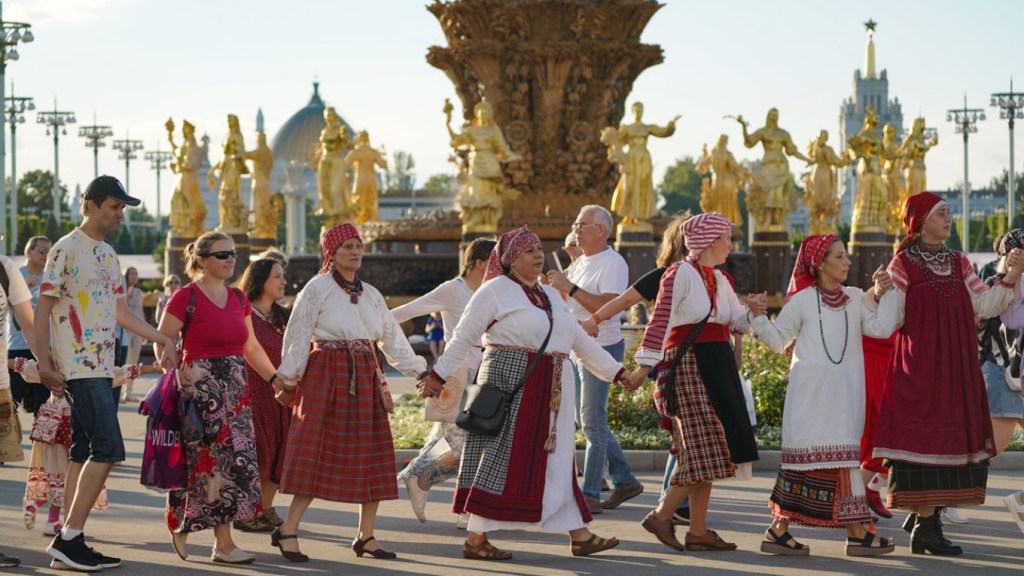
“Only morally healthy entertainment should be allowed — first of all, round dances and traveling around one’s native land, and even better, pilgrimages to holy places. Everything else should be banned,” Dugin wrote on his Telegram channel.

According to Dugin, a healthy nation should have wholesome leisure activities, “and not all of that stuff.” As a negative example of entertainment, he cited KVN, which has become, he claims, “a poisonous matrix of degeneration.”

“The sinister nature of this pernicious phenomenon is now clearly visible. [Ukrainian President Volodymyr] Zelensky, [comedian Maxim] Galkin, and all the rest,” Dugin said.*

Earlier, the philosopher claimed that the West regards Russia as its principal foe because Russian President Vladimir Putin has been reviving traditional values and liberating the country from global influence. This, in his opinion, is what provoked the disgust of Western “progressive elites” with Putin.

Dugin has also argued that Russia has neither a parliament nor democracy, but a de facto monarchy headed by Putin, who can do whatever he wants. The philosopher noted the irrelevance of certain laws in Russia, as well as the people who propose or support them. In his opinion, all of this is “boyars dancing for the time being,” that is, until the sovereign pays attention to the antics of these “selfish and thieving bastards.”

Dugin has argued that Russia itself is the Katechon — the last bulwark against the Antichrist, who today reigns in a West “totally perverted” by LGBT+, postmodernism, relativism, and transhumanism.

The philosopher has dubbed the war in Ukraine “the most important event in history.” In his opinion, it is being waged on behalf of a multipolar world, with many superpowers. Consequently, according to Dugin, Russia will free other countries of the world from Western liberal imperialism, in whose grip they are trapped. And yet, Dugin acknowledged that Russia would lose a great many people in the course of the war.

* Zelensky was captain of the Kryvyi Rih KVN team Kvartal 95 from 1998 to 2003.

Source: “Dugin suggests banning all forms of entertainment in Russia except round dances,” Moscow Times Russian Service, 23 July 2024. Translated by the Russian Reader


[...]

Enter Thoughts of Days to Come, dressed to the nines in khaki blouses.
They are lugging atom bombs, ICBMs, a launching pad.
O, how they reel, dance, and caper: “We are warriors and carousers!
Russians and Germans will fall together; for example, at Stalingrad.”
And like old widow Matryona, cyclotrons are dumbly howling.
In the Ministry of Defense a nest of crows is loudly cawing.
Look at the pillow. What do you know!
Shiny medals all in a row.

“Where there’s a will, there’s a way.”
“A pint of vodka, they say,
Soon’ll be a ruble a pop.”
“Mom, I really don’t love Pop.”

Enter a certain Orthodox, saying: “These days I’m number one.
I’m pining for the sovereign, and in my soul the Firebird flares.
Soon Igor will reunite with Yaroslavna and have his fun.
Let me make the benediction or else I’ll box you on the ears.
Worse than evil eye or herpes is the plague of Western thinking.
Sing, accordion, and drown out the saxophone, jazz’s vile offspring.”
On the icons they plant a kiss,
Sobbing victims of circumcis—

[...]

Source: Lib.ru. Translation by the Russian Reader

It Takes a Village

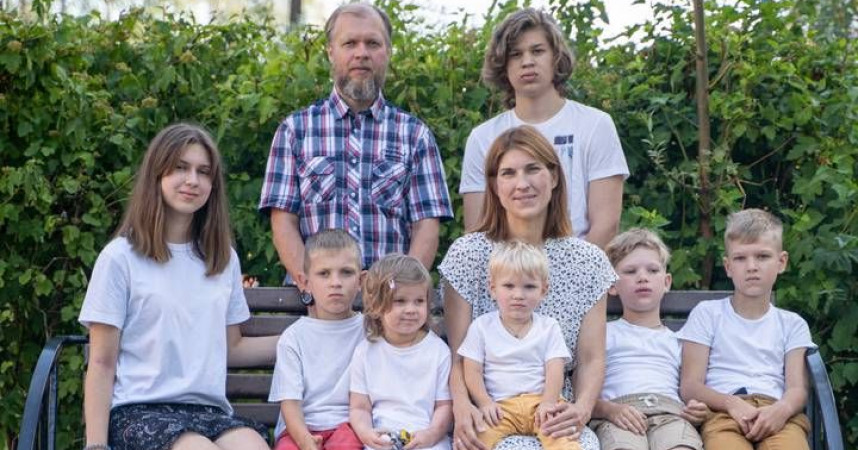
A portrait of the perfect Russian family, per Global Orthodox

State Duma drafting law that would prohibit the promotion of childlessness

The State Duma is drafting a law that would prohibit the “promotion of childlessness,” according to an RIA Novosti interview with Irina Filatova, a member of the Duma’s cross-party working group on the defense of traditional values. The MP emphasized that the draft law does not touch on the personal beliefs of individuals, explaining that it specifically targets destructive propaganda in the information space. In the autumn of 2022, lawmakers in Bashkortostan introduced a similar draft law. The bill’s author described the consciously childless lifestyle as a “foreign ideology” and accused its supporters of causing population decline. They argued that it degraded public institutions and eroded traditional values. At the time, the authorities had decided to investigate why, despite financial subsidies and campaigns to prohibit the “propagation of the childfree ideology,” Russians were unwilling to have children.

[…]

Russians will be taught to resist western influence beginning in kindergarten

The Federation Council’s committee on the defense of state sovereignty held a hearing on countering interference in Russia’s internal affairs “through youth policy.” The senators [sic] came to a unanimous decision about the need to give the younger generation a “vaccination” against foreign influence from an early age. Alexei Chesnakov, the head of the research council at the Center for the Political Climate, proposed creating a “registry of negative phenomena” and incorporating sovereignty protection into “children’s political education programs.”

Source: Moscow Times Russian Service, daily newsletter, 12 December 2023. Translated by the Russian Reader

Spiker vs. Speaker

Why bother to find the right word in Russian when the wrong word in English will do?

Текст «К каким последствиям для общества приводят войны» автор Лиза Шапатина писала долго, потому что нужно было найти хороших спикеров [spikerov], нужно было составить хорошую рыбу и нужно было структурировать текст так, чтобы было понятно, просто и интересно. И ей это удалось!

Author Liza Shapatina took a long time to write the text “What consequences wars have for society,” because she had to find good speakers, she had to make a good outline, and she had to structure the text so that it was clear, simple and interesting. And she succeeded!

Source: Liza Tyurina, Help Needed Foundation email newsletter, 1 March 2023. Translation by TRR

The right Russian word in this case would have been собеседник [sobesednik] — meaning, “source,” “informant,” “interlocutor” — instead of the now absurdly overused Anglicism спикер [spiker], which not so long ago, in the 1990s, referred only to the chairs of the UK House of Commons and the US House of Representatives, and occasionally, by analogy, the chair of the Russian State Duma. Now it used not only to denote parliamentary chairs the world over, but also, absurdly, “speakers” at conferences and other public events, and now, apparently, anyone who speaks or with whom one speaks, although the implied corresponding verbal form спикить (instead of, depending on the context, говорить, выступать, беседовать, докладывать, etc.) has not yet come into use, thank God. ||| TRR


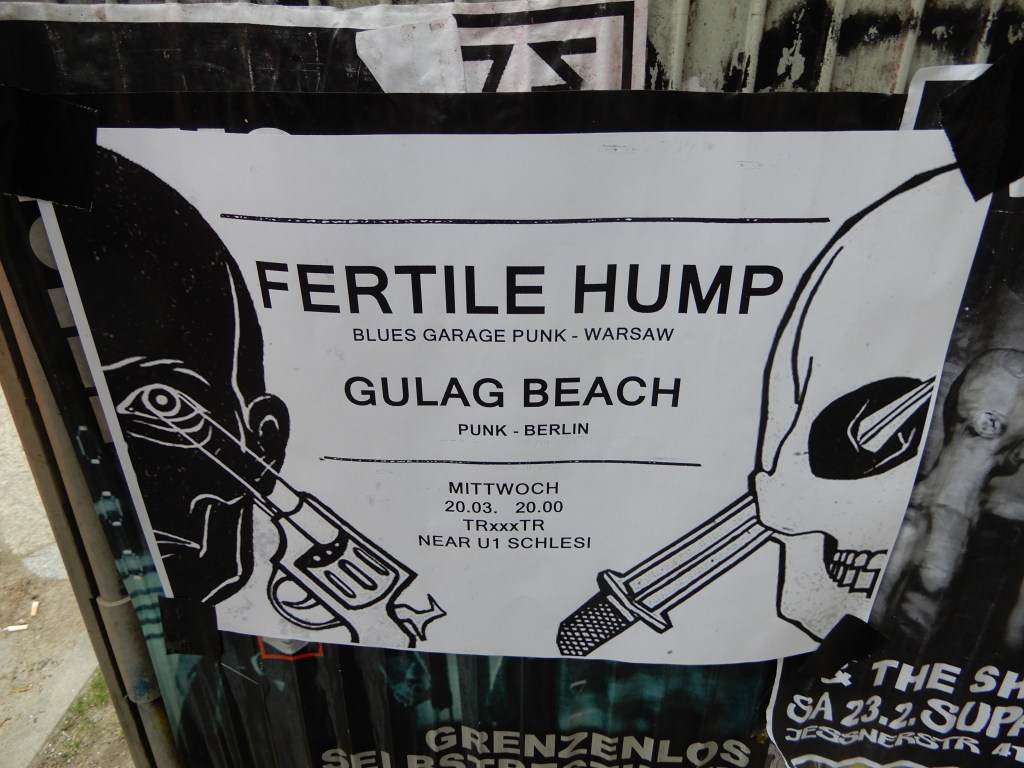
Berlin-Friedrichshain, 1 March 2019. Photo by the Russian Reader

Russian President Vladimir Putin has signed legislation that bans government officials from using foreign words in official documents and correspondence as well as while carrying out their duties.

“When using Russian as the state language of the Russian Federation, it is not allowed to use words and expressions that do not correspond to the norms of modern literary Russian language,” the law published Tuesday said.

The exception, according to the law, is the use of “foreign words which do not have widely used corresponding equivalents in Russian.”

A list of foreign words that can be used will be compiled by a government commission and will be published separately, the Kommersant business daily reported.

A number of Russian political figures vowed to protect the Russian language from Western influence due to what they called “Russophobia” and “attacks on everything connected with Russia.”

Source: “Putin Signs Law Banning Officials from Using Foreign Words,” Moscow Times, 1 March 2023

It Does Hurt to Dream

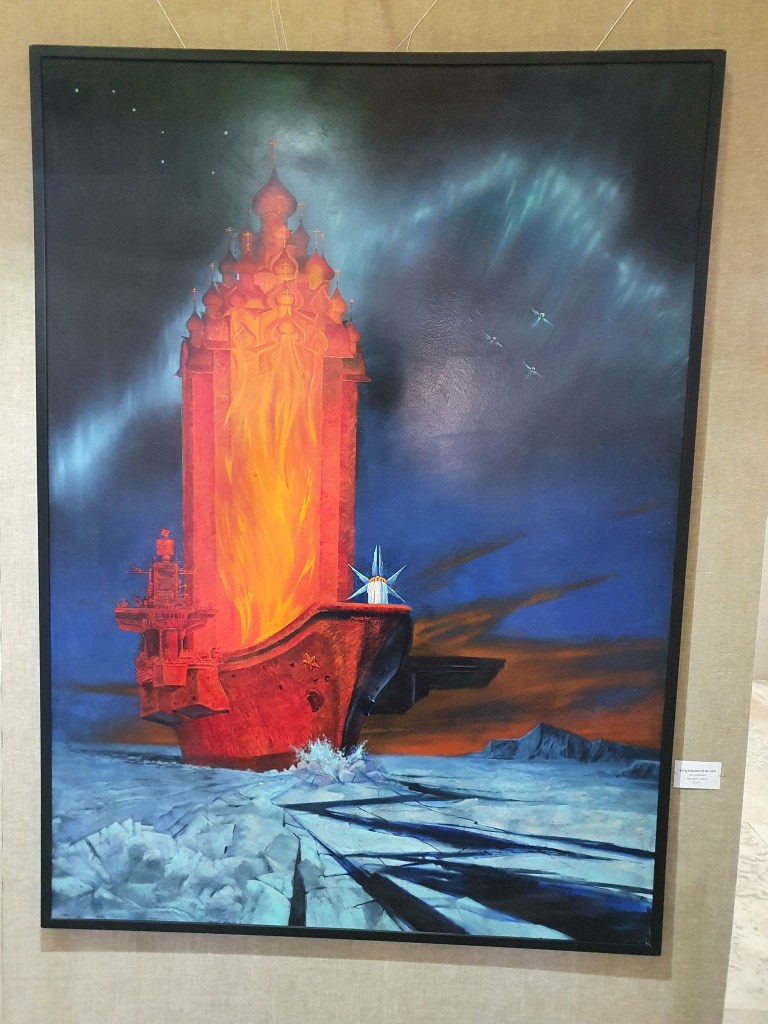
“Russian angel carrier, Artillery Museum, Saint Petersburg.” Source: Pavel Pryanikov, Facebook, 6 November 2022

Alexander Kharichev, head of the Presidential Department for Supporting the Work of the State Council, and three other experts have published a scholarly article entitled “Perception of basic values, factors, and structures of Russia’s socio-historical development, as based on research and testing.” As part of the study, seventy people from the student bodies of Moscow State University and the Higher School of Economics and the teaching staff of a conference in Sevastopol [sic] were interviewed. Among the metaphors of the future they proposed was the burnt second volume of Dead Souls; among the concepts of the modern state, “the Motherland with a laser sword”; among the concepts of the future, “Russia as the world’s ‘guardian of good” and “Pasty” [sic: “Pirozhok”]. The authors concluded that the dominant value for the Russian family is the people of Russia, which itself is a “family of families.”

Mr. Kharichev’s co-authors were Andrei Shutov, dean of the faculty of political science at Moscow State University; Andrei Polosin, doctor of political science and head of Rosatom’s regional interaction department; and Ekaterina Sokolova, deputy executive director for strategy and forecasting at the Expert Institute for Social Research. The article was published in October in the Journal of Political Studies.

The study was conducted by means of group discussions from March to May. The seventy participants answered questions about what Russian statehood is, what would happen to the country in ten years, what our future is, and a number of others.

Based on the discussions, the researchers formed a five-level “pentabasis”: person—family—society—state—country. Dominant values were formed for each level. For the country, [this dominant value] is patriotism; for the state, it is trust in the institutions of power; for the family, it is the people of Russia; for society, it is harmony; for the person, it is creativity. “The thesis was voiced that European society is individualistic, whereas our main value is family + family with friends, which leads to the emergence of the thesis ‘family as a level.’ The dominant value: the people of the Russian Federation as a family of families. Stimulating the birth rate and the concept of a ‘big family,’ the article says [just as incoherently in the original as in this translation].

  • Metaphors of Russia’s future. “The state as a novel” (written collectively by citizens, it has alternative endings); “the Russian future as the second part of Dead Souls, burned by Gogol,” “the state as the Firebird.”
  • Concepts of the modern state.[The] Motherland with a laser sword” (a source of pride for the Russian spirit and a guide to the future), “the friendly service state.”
  • Messianic concepts of the future state. “Russia as a ‘prophet country’ (opposed to the Grand Inquisitor), “Russia as the world guardian, the ‘guardian of good.'”
  • Idealistic concepts of the future state. “Wondrous City” ([i.e., promoting] inclusivity, coexistence, acceptance of others as equals; “in no case to be confused with the term ‘tolerance'”), “Pasty” (harmoniously combines different things).
  • Mechanistic concepts of the future state. “Kaleidoscope” (a multifaceted future), “a medium-sized magnet state” (generates a field for a particular community).

The study participants concluded that the person in the “Russia of the Future” is “proud of his country, influential and highly employable, financially secure, [and] free within certain community rules.” According to the authors of the article, the ideas of self-realization in the Russian Federation are very different from those common in the Western world.

“In the Russian case, self-realization or mission means that an individual contributes to the country’s development. Capitalizing [on one’s] mission is an optional stage,” the authors write.

Source: Leonid Uvarchev, “Alexander Kharichev from the presidential administration wrote an article about imagining Russia’s future,” Kommersant, 7 November 2022. Translated by the Russian Reader

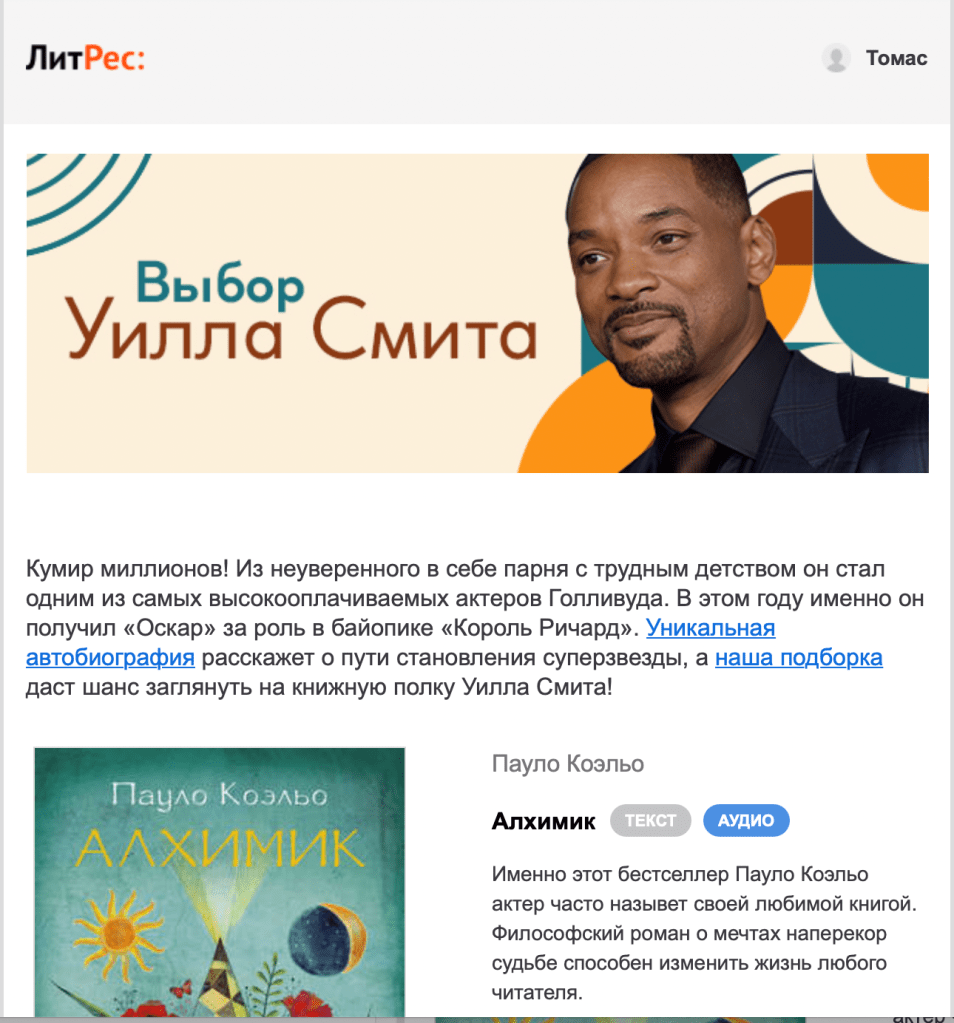
Will Smith’s Choice

Will Smith’s Choice

The idol of millions! He went from being an insecure guy who had had a difficult childhood to being one of the highest paid actors in Hollywood. This year it was he who won the Oscar for his role in the biopic King Richard. His unique autobiography will tell you about his road to becoming a superstar, and our selection will give you a chance to look at Will Smith’s bookshelf!

Paolo Coelho, The Alchemist

It is this bestseller by Paulo Coelho that the actor often calls his favorite book. This philosophical novel about dreams that defy fate can change the life of any reader.

Source: screenshot of “What Will Smith reads (and recommends you read),” an email newsletter from LitRes, a popular Russian ebook service, 12 April 2022. Will Smith’s other alleged recommendations are Richard Kiyosaki’s Rich Dad Poor Dad, Malcolm Gladwell’s David and Goliath: Underdogs, Misfits, and the Art of Battling Giants, and Richard Matheson’s I Am Legend. Translated by the Russian Reader, who has purchased and downloaded a good number of ebooks from LitRes over the last several years.


Putin’s is a regional politics: it is aimed at defending a particular region and its alleged ethno-cultural identity. Iran and the Islamist movements in general have served as the model for those seeking to banish all things Western in the hope that when you remove them, your true cultural identity (for example, an Islamic identify) will shine forth with its natural light. The same thing is gradually happening now in China and India. Cultural identity is discovered by purging the “Western abominations” that have accumulated like a dense layer on its surface. Russia has repeatedly evinced the desire to purge itself of the West—of Facebook, McDonald’s, modern art, rock music, of everything that the Russian does not need and can do perfectly well without. The belief is that if this stuff is removed, the divine wisdom of the Russian spirit will shine with its own light.

The only problem is (and it is an old problem that has been around since the nineteenth century) that this process of stripping and purging Russia of everything Western can never end. There is a non-European cultural substrate in Iran, India, and China. So, when you purge everything European, something homegrown, something originally non-European, does emerge. I am not saying whether this exists in Russia or not. I can only say that all attempts to find it have proved futile and suicidal. That is, the movement back to origins and the Russian World have proved completely suicidal.

In this sense, Russia has reproduced a well-known trope of German culture. In the nineteenth century, Germans also argued that German culture was inherently different from Western civilization, that German culture should be purged of Western civilization to be manifested in all its might. Upon closer examination, however, it transpired that this power was purely negative. German thinkers reflected on this, even glorifying these suicidal, self-destructive tendencies to some extent. Russian culture did this to some extent, too. We can read about the suicidal search for one’s foundations in Dostoevsky’s works, for example. From a cultural perspective, the new paroxysm to purge things Western and get back to Russianness, which we are now witnessing, is a purely suicidal operation.

Source: Boris Groys (in conversation with Liza Lazerson), “Putin: Restoration of Destruction,” E-Flux Journal, no. 126 (April 2022). Translated by Thomas H. Campbell

Patriots

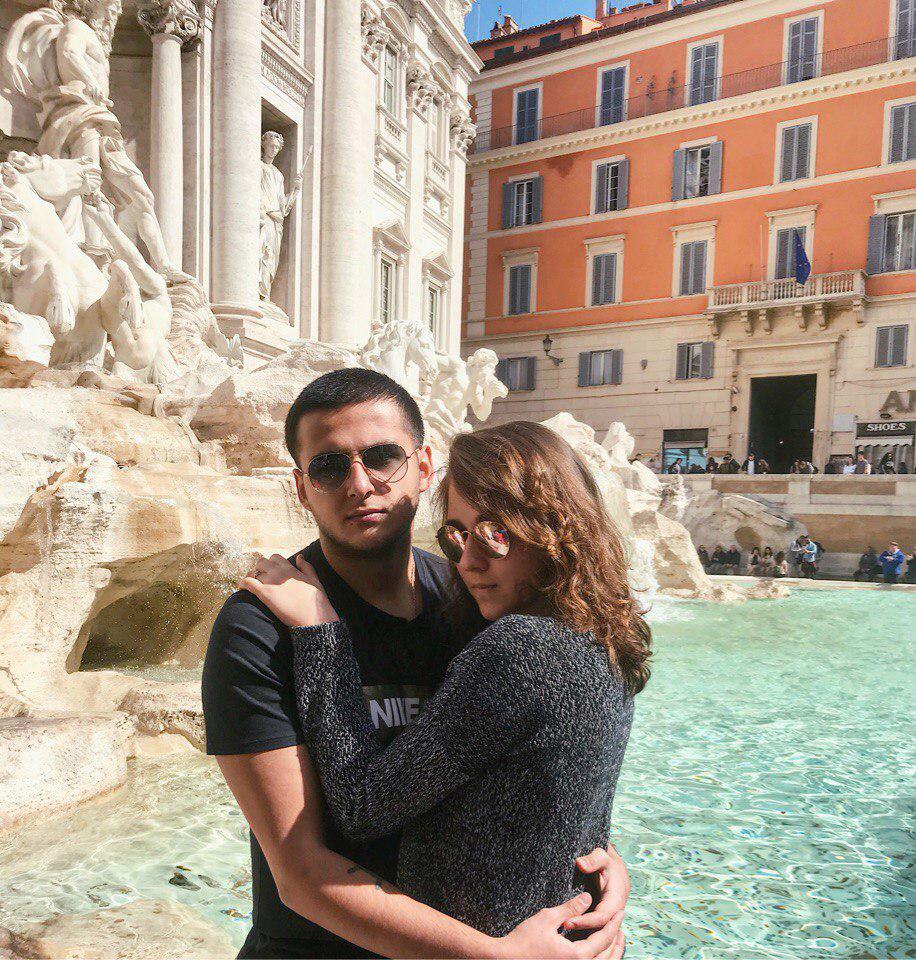
pyotr tolstoy's daughter“While Pyotr Tolstoy, deputy speaker of the State Duma, battles the treacherous West and discusses labeling journalists ‘foreign agents,’ his daughter is on vacation in Crimea and Suzdal. (In fact, she is in Rome.)” Miracles of OSINT, July 5, 2018

__________________________________

Russian Duma Committee OKs Legislation to Label Individual Journalists “Foreign Agents”
Committee to Protect Journalists
July 3, 2018

The Committee to Protect Journalists today called on Russian authorities to refrain from labeling individual bloggers and journalists as foreign agents. The State Duma’s information and communication committee today approved legislation that would allow authorities to label private persons as foreign agents if they work for organizations the Justice Ministry labels as foreign agents or receive funding for producing content for these organizations, according to media reports.

The proposed legislation would require individuals to go through annual audit, submit a bi-annual report on their work activities, and put a “foreign agent” label on all produced content, according to the reports.

“Labeling journalists, including bloggers, as foreign agents is the latest step in the Russian authorities’ systematic policy towards obstructing the free flow of news,” said CPJ’s Europe and Central Asia research associate, Gulnoza Said. “We call on Russian authorities to reverse course and allow its citizens to receive information and opinion from a wide range of sources.”

The Duma, the lower house of parliament, initially passed a related bill in January. The parliament’s upper house, the Federation Council, is yet to vote on the legislation, which also requires presidential approval before becoming law.

The information and communication committee’s chair, Leonid Levin, who co-authored the latest proposals, told the state news agency Interfax that the Foreign Ministry and State Prosecutor’s office, two separate entities, would be responsible for labeling private persons as foreign agents “for additional protection of individuals from accidental decisions” from the Justice Ministry. Those bloggers who “simply repost information of foreign agents” will not “suffer,” Levin said. The Justice Ministry will still determine which groups fall into the category of foreign agent.

The latest legislation also includes provisions that would prevent websites or other media being blocked without a court ruling, according to news reports.

Today’s action came after the Kremlin-funded television station RT, formerly Russia Today, said in November that it had complied with a U.S. Justice Department order to register under the Foreign Agents Registration Act (FARA).

The Justice Ministry has already used the newly expanded laws to designate nine U.S.-funded news outlets, including the U.S. Congress-funded Voice of America (VOA) and Radio Free Europe/Radio Liberty (RFE/RL), as foreign agents, according to reports.

How to Be a Useful Idiot

DSCN5264

1.  Jump on the “Putin is genuinely popular” bandwagon.

“Putin will eventually leave power, but it is not Washington’s place to facilitate this, nor is it an inherently desirable outcome. No one knows what will follow in Putin’s wake, or who could fill his role after nearly two decades and counting in the Kremlin. And no one doubts that Putin is genuinely popular, although support for him in the capital and among younger educated Russians has slipped.”

Putin is not genuinely popular. As in other pseudo-populist dictatorships and autocracies, the alleged popularity of Russia’s president for life is the product of a thoroughgoing war against all dissenters, dissidents, and free thinkers, and an ever-evolving personality cult, produced by carpet bombing the populace with TV, radio, social media, and print propaganda twenty-four hours a day seven days a week.

The mental carpet bombing is periodically punctuated by two rituals, designed to confer “popular legitimacy” on the rampantly undemocratic regime: massively rigged, unfair “elections,” and plainly hokey and methodologically unreliable “public opinion polls.”

Nor is there any empirical evidence that “young educated Russians” are more critical of Putin than cranky old ladies in Petrozavodsk and Perm. My educated guess would be that, in fact, the opposite is true.

Finally, it is sheer insanity to argue that Putin’s departure is not an “inherently desirable outcome.” Every day Putin is in power is a decisive step backwards in the country’s political and social progress.

Not even the most milquetoast progressive reforms have been possible while Putin and his clique have been in power (i.e., the last eighteen years), and there is every sign that, during his next term, things will go from very bad to incomparably worse.

By the way, why is the writer so certain “Putin will eventually leave power”? If he means Putin is a mere mortal, like the rest of us, and will die sooner or later, this is a factually correct but politically vacuous claim. If the writer means Putin is planning to leave office in the foreseeable future, he must have psychic gifts that most of us do not have. There is no evidence whatsoever Putin is planning to go anywhere in the next twenty years.

But it is easy to engage in free verse exercises like this one when you live and work in Brooklyn. You just make up the facts as you go along, because you will never have to face the consequences of your irresponsible, shambolic analysis.

2. Blame the US government for everything that has gone sour or wrong in Russia, the world’s largest country, a land blessed with natural resources and human resources beyond measure, and thus certainly capable of making its own fortunes and forging its own destiny, which nothing whatsoever prevents from being democratic and progressive except the current regime and its mostly pliable satraps and timeservers. “Genuine popular support” for Putin would vanish in a second if his regime were ever challenged by a strong, broad-based, grassroots democratic movement determined to remove him from office and steer the country towards a different path.

“Putin will eventually leave power, but it is not Washington’s place to facilitate this, nor is it an inherently desirable outcome. No one knows what will follow in Putin’s wake, or who could fill his role after nearly two decades and counting in the Kremlin. And no one doubts that Putin is genuinely popular, although support for him in the capital and among younger educated Russians has slipped.

“The United States should not ignore human-rights abuses in Russia. But principled criticism is only undermined by the perception that civil-society groups in Russia serve as fronts for US intelligence, and Russia has become increasingly hostile to such groups. The next administration should make clear that the United States is not trying to bring Putin down, and that its support for human rights is genuine. It should be wary of directly supporting opposition figures, who are easily tarred as American puppets. And it should lead by example and hold its allies accountable for their human-rights abuses and elite corruption as well.

“Ultimately, the best way the United States can help civil society in Russia is by normalizing relations enough that private civil-society groups from the United States and other countries can more effectively work in tandem with Russian counterparts. It is hard to argue that the US-Russia tensions following the failure of Obama’s reset have done Russian civil society any favors.”

What real evidence is there that civil society groups in Russia serve as “fronts for US intelligence”?

None.

Who has actually been working day and night to generate this “perception”?

The Putin regime and its media propaganda outlets.

Why has “Russia” become “increasingly hostile to such groups”?

Because the Kremlin perceives them as direct threats to its authoritarian rule. It has thus declared them “enemies,” “national traitors,” “foreign agents,” and “undesirables,” and gone to war against them. This blog has published numerous articles detailing this “cold civil war” between Moscow and Russian civil society.

What evidence is there that any US administration has “[tried] to bring Putin down”?

There is no such evidence.

What Russian opposition figures have US administrations “directly supported”?

None.

Aren’t civil society groups “private” by definition?

Yes.

Was Obama’s so-called reset the only or even the primary reason that tensions between the US and Russia increased?

No. Even before Putin went ballistic, invading Crimea, Eastern Ukraine, and Syria, shooting down passenger planes (e.g., Flight MH17) and gunning down opposition leaders right outside the Kremlin (i.e., Boris Nemtsov), his minions were harassing the then-US ambassador to Moscow, Michael McFaul, the co-author of the miserable “reset,” whose purpose was to decrease tensions with Russia, not stoke them. There was no chance of this happening, however, when the Kremlin had long ago made rabid anti-Americanism the centerpiece of its public foreign policy.

Why do I call it “public” foreign policy? Because nearly everyone in the Russian ruling elite has made numerous junkets and trips to the US and other western countries over the years and has lots of personal and business connections to their boon enemies. They have extensive real estate holdings in the west. They educate their children in the west. They park their ill-gotten lucre in the west. In some cases, their families live in the west permanently, while they shuttle between the west and Moscow like some less fortunate people commute between Gary, Indiana, and Chicago.

The Russian elite’s anti-Americanism and anti-westernism, therefore, is a put-on, a hypocritical pose mostly meant for public consumption.

Has the Putin regime done Russian civil society “any favors”?

No, it has done its utmost best to destroy independent Russian civil society and co-opt the remnants it has not killed off. If you want some of the particulars, read what I’ve been posting on this blog for the last six years and, before that, on Chtodelat News, for five years.

Why did the guy who wrote the passage quoted above write what he did?

It is hard to say. The article is a very clever whitewash job for the Putin regime, all of whose high crimes and misdemeanors against the Russian Constitution and the Russian people are passed off as understandable reactions to the alleged predations of the US government against the Putin regime.

Where was this article published?

In The Nation, of course. Who else would print such crypto-Putininst tripe with a straight face?

Why all the needless hyphens, e.g. “civil-society groups,” “human-rights abuse”?

Sheer snobbery, meant to intimate to the magazine’s hapless readers they are dealing with real smart cookies, not tiresome neo-Stalinist windbags.

3. Publish wholly misleading articles about Russia, like the one quoted above. If you cannot manage that (because your readership would notice), publish wholly misleading headlines. They are even more effective than longwinded articles in The Nation, a pro-Putin magazine no one in their right mind has read in the last ten years or so.

People scan headlines, however. It is much easier than reading the fine print.

“US Drastically Reduces Visa Services in Russia after St. Petersburg Consulate’s Closure”

This is exactly the headline Russian Foreign Minister Sergei Lavrov would want to appear in the Moscow Times, because it places the onus for his government action’s and his own actions on the US government.

How could visa services not be drastically reduced if the Russian Foreign Ministry closed the US consulate in Petersburg and gutted the staff at the US embassy in Moscow once again?

But let us by all means imply, because this IS the message the Putinist tyranny wants its own people to hear, that the US did everything on its own as a way of punishing ordinary Russians. Sadly, a fair number of Russians will believe this.

4. Join a so-called leftist group in the west. Most of them behave as if the Comintern still existed and they were taking their orders from the Kremlin.

Most western so-called leftists these days are boring, uneducated morons. The most boring thing about them is their unshakeable reverence for the Soviet Union, a country about which they do not have the slightest clue, and for its woebegone “successor,” the Russian Federation, which has literally nothing in common with the long-dead Soviet Union.

So, they are just as defensive of Putin’s shambolic hypercapitalist despotism as they are of the country that killed off socialism once and for all by going on a murderous rampage in the 1930s.

The really hilarious thing is that most of them manage to maintain these cultish attitudes without ever having set foot in either country and without speaking a word of Russian. Star Wars fans have a more down-to-earth and coherent ideology than the post-Stalinists who pop up to crush you with their Anand Sheela-like rhetorical flourishes (i.e., truckloads of vehement slander and furious personal insults) if you so much as mention as their imaginary Motherland in a slightly untoward light.

I want to live long enough to see the influence of these dead-enders on progressive, anti-capitalist, anti-imperialist politics die off altogether. That would make me really happy, if not genuinely popular, like Vladimir Putin. ||| TRR

Photo by the Russian Reader

Astroturf on Ice

23316596_10155825317583908_4356074932732108074_n
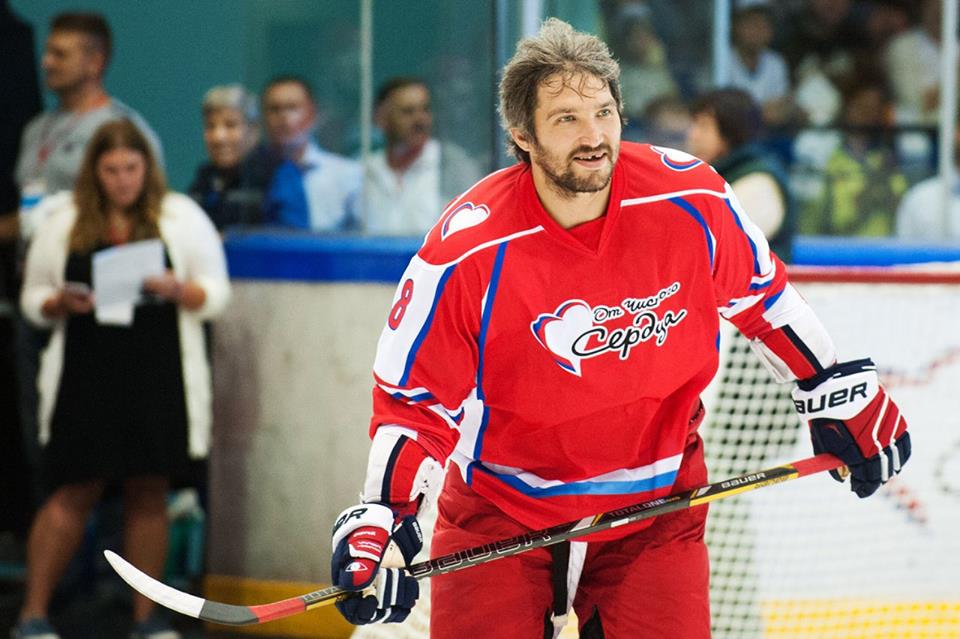
Washington Capitals star player Alexei Ovechkin. Photo courtesy of A. Gordeyev/Vedomosti

Alexander Ovechkin’s Movement Could Be Part of Putin’s Election Campaign 
Svetlana Bocharova
Vedomosti
November 9, 2017

Putin Team, a movement launched last week by Washington Capitals hockey star Alexander Ovechkin, is meant to unite celebrities and could be part of the campaign of Vladimir Putin, who is expected to announce he will run for re-election in 2018. Vedomosti was given this information by a source close to the Kremlin, and it was corroborated by another source. The idea for the movement was not generated by the Kremlin, but nor did Ovechkin come up with the idea himself, our two sources claimed. According to them, the idea was conceived by IMA Consulting (a subsidiary of IMA Group). The Kremlin signed off on the idea after it was launched, one of our sources added.

Ovechkin announced he was establishing Putin Team on November 2.

“I am sure there are many of us who support Vladimir Putin. So let’s unite and show everyone a strong and united Russia!” Ovechkin wrote on Instagram, adding he had never hidden his attitude to the president and had always openly supported him.

Ovechkin’s appeal was supported by NHL Hall of Fame inductee Pavel Bure, Ilya Kovalchuk, a player with the Petersburg side SKA, and the governors of Tula and Moscow regions, Alexei Dyumin (Putin’s ex-aide and a Night Hockey League player) and Andrei Vorobyov. Ovechkin’s announcement has not been followed by any formal actions or explanations. Ovechkin’s agent Gleb Chistyakov told Vedomosti he had nothing to say about the movement for the time being, and he also refused to comment on who had come up with the idea.

When asked by Vedomosti whether it was IMA who had come up with the idea for Putin Team, Vartan Sarkisov, general director of IMA Consulting, said, “It’s not true.”

In August, IMA Consulting won a tender from the Central Election Commission to develop the concept for a campaign raising awareness of the presidential election. IMA will be one of the key players in everything the Kremlin has planned for the election, we were told by our source close to the presidential administration, and Ovechkin’s movement could become part of Putin’s campaign. The idea behind the undertaking is that “celebrities support Putin,” our other source close to the Kremlin told us.

Russian has been no stranger to such organizations. Thus, in December 2007, as Putin’s second term as president came to a close, the Movement for Putin emerged, advocating Putin retain power as the “national leader.” In 2009, a co-leader of For Putin, Pavel Astakhov, was named the national children’s rights ombudsman.

Ovechkin’s movement would mainly be useful to Kremlin as a means of shaking the western stereotype that Russia’s finest people [sic] do not support Putin, but back the opposition, political scientist Yevgeny Minchenko said. According to Minchenko, the emergence in Putin’s camp of a figure popular in the west, such as Ovechkin [sic], would increase the president’s legitimacy in the eyes of the west [sic]. Minchenko has seen with his own eyes how Ovechkin is regarded in Washington, DC, where he has a “quite large fan club.” In Russia, however, the movement will be considerably less effective and will not significantly increase the number of votes Putin wins in the election, argues Minchenko.

Such movements are always needed on the international stage, and not just in the run-up to elections, argues pro-Kremlin political scientist Andrei Kolyadin.

“A person who has found the courage to speak up for a national leader whom some American politicians regard as an incarnation of pure evil, and defend the interests of a country not liked in the US, can cause a wave of similar actions by people forced to hide their respect for Russia.”

The movement is also capable of producing extra votes for Putin in Russia, argues Kolyadin. Very many people regard Ovechkin as an opinion leader [sic], and finding opinion leaders who sincerely support you requires great talent on the part of spin doctors running any politician’s election campaign.

Translated by the Russian Reader

On the Warpath

21616160_10155926858106842_5598854945675305387_n

Andrey Kalikh
Facebook
September 19, 2017

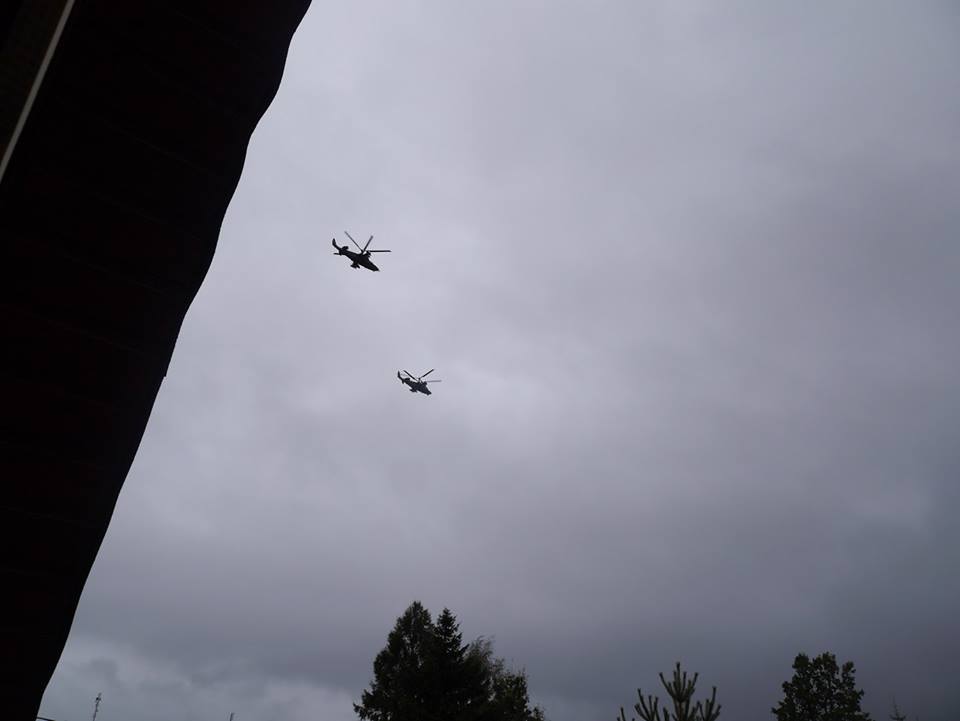
They are f***ed in the head. They are flying in droves over our house. They are launching rockets at random. They are Soviet rockets and they might fall on somebody. The wife urgently wants us to insure the house and wonders whether insurance would cover a chopper crashing in the garden.

Rusty jet engines are now roaring at the long-mothballed airfield in Siversky.

The roar of explosions is audible forty kilometers from the Luga Firing Range.

The apotheosis happened on the afternoon of the fifteenth, when Pavel Antonov and I were having a round table on Skype with European prosecutors. (A little cheeky, of course.) Suddenly, the house shook with a roar, black shadows flashed on the ground, and a multi-gunned monster flew out of the Mshinsk Marshes. Our sons counted twenty-four fully-equipped battle helicopters.

You in the west are quite right to be tense. But hang on. This country will destroy itself. That is how it has always been.

Translated by the Russian Reader. Photos courtesy of the author

21752583_10155926858131842_1066546113740130728_o