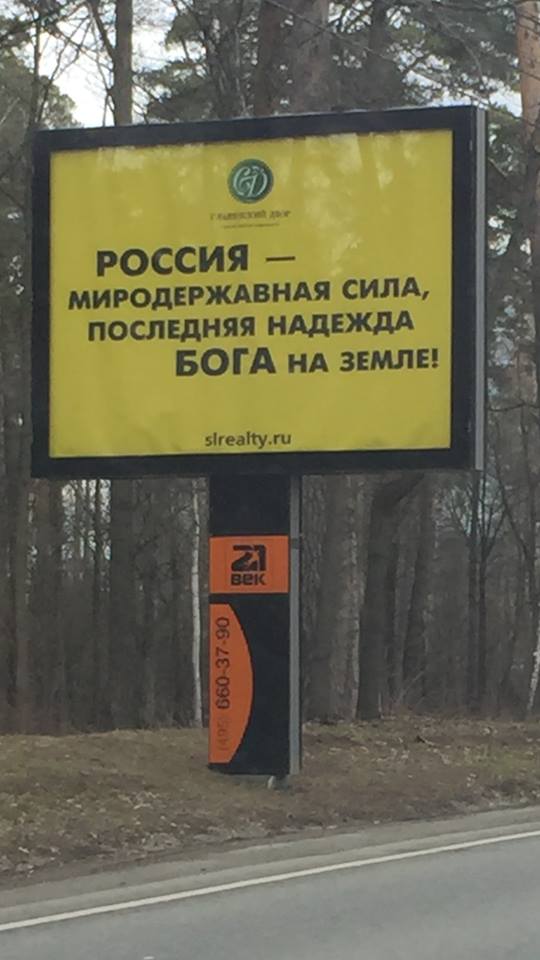
Glengarry Rublyovka, or, God’s Last Hope on Earth

12987130_1239037492774847_8624195761789202557_n
“Russia is an imperial power, and God’s last hope on Earth!” Billboard for Slavic Yard, a self-described elite real estate company. The billboard was photographed by artist Aidan Salakhova on the Rublyovo-Uspenskoye Highway, in suburban Moscow, in April 2016.  Thanks to Comrade DP for the heads-up

_________

April 1, 2016
THE DECLINE OF EUROPE AND SLAVIC YARD
Irina Volina: The Story of Slavic Yard Real Estate Agency’s Advertising Campaign on the Rublyovo-Uspenskoye Highway (April 2016) 
slrealty.ru

“The Russians are coming: this is not Hollywood.” The striking, slightly provocative slogan, reminiscent of the movie where Russian sailors come ashore in America, has stuck in the minds of many residents of the prestigious Rublyovo-Uspenskoye Highway.

The person who inspired the unusual advertising campaign is Irina Volina, head of the elite real estate agency Slavic Yard, is the same beautiful woman in the luxurious boyar costume whose photo is featured on the billboard bearing the renowned slogan.

“The Russians are coming: this is not Hollywood.”

Irina Volina has a reputation not only as a successful broker but also as a media figure who openly voices and defends her civic stance. She heads the Russian Heir Foundation for the Promotion of Enlightenment and Education, and she has authored patriotic appeals to the Russian elite. Irina Volina appears at important social events in unique Russian costumes designed by the Valentina Averyanova House of Russian Clothes.

In 2012, when part of the Russian intelligentsia stood at the crossroads, wondering whether to exert themselves to strengthen the state or leave for abroad to wait out the time of political chaos, Slavic Yard reminded [ethnic] Russian people of their civic dignity: to serve Russia. So billboards bearing the slogan “The Russians are coming: this is not Hollywood” appeared on the Rublyovka. Their gentle humor dissolved people’s fears and made it possible to think of a solid civic position.

The same year, as part of an advertising campaign for Slavic Yard, an interview with Irina Volina was published in the magazine StrongMen. The article was entitled “Irina Volina’s Sensible Choice,” and her photo graced the magazine’s cover. In the interview, Irina Volina reminded the Russian social elite of an ancient wisdom: “If you do not take up politics, politics will take you up and then it will be too late to run.” The dictum belongs to Aristotle, who held that politics involved building the state. Irina Volina also stressed that the cause of modern Russia’s problems was the promotion of Russophobia, for the time had come for [ethnic] Russians to occupy their rightful place in the life of the state and society.

The advertising campaign was spectacular and, basically, prophetic. Soon we experienced the feeling of nationwide joy over Crimea’s reunification with Russia. Slavic Yard was the first Russian company to put up billboards in Crimea. “The Russians are coming!” was the slogan on the billboards.

“Happiness is having a home and family in Russia.”

In April 2016, Slavic Yard erected new billboards on the Rublyovo-Uspenskoe Highway. They feature Irina Volina in a spectacular Russian costume sharing new political maxims [with motorists] in the hope that her counsels will go from being edicts [sic] to habitual norms of life.


“Russia is an imperial power, God’s last hope on Earth.”

“Beauty is faith’s sword in the hands of the wise.”

“The seeker of wisdom marches eastward; he who loves vanity runs to the west.”

“Happiness is having a home and family in Russia.”

“I was born and baptized in Russia; I pray for the Russian tsar and God.”

Irina Volina’s latest appeal could not help become the subject of numerous discussions and arguments. Let us try and get to them to the bottom of them, with help from Irina Volina herself.

Irina Volina: “The Decline of Europe and Slavic Yard”

Slavic Yard’s advertising campaign is hardly typical of a real estate agency. It contains none of the usual appeals to buy housing. There is no information about discounts or any reference to commerce at all. Rather, it resembles a social project, for the information is real food for thought.  It really forces you to think. Why did you decide to choose this format?

Irina Volina: I should immediately note that Slavic Yard’s advertising campaign was not designed to reach a maximum audience. Our market segment is quite narrow, buyers of elite real estate, and that enables us to go for non-standard solutions. Non-standard solutions are always a plus. Advertising shouldn’t be boring: everyone is tired of appeals to buy things and discounts. Besides, boring ads are ineffective.

I am convinced that always being one step ahead is an important ingredient of success. It makes sense to focus not only on business. You also have to keep track of the political and economic situation in the country, and respond quickly to social change. That’s what we do.

Does the fact that standard advertising no longer works testify to changes that have occurred in the market?

Irina Volina: Definitely. The difference between what the market was in the early 2000s and what it is today is colossal. Alas, not all businessmen are ready to accept this. Many of them prefer to operate according to the old schemes, focusing on consumer marketing and western economic models. But they do not function today in modern Russian society. And there is every reason to believe that very soon these methods will join the category of business atavisms.

What is consumer marketing, in your understanding?

Irina Volina: Simplifying, we can describe it as follows. You invest money, quickly earn more money, invest it again, earn more, buy a little house in Europe—

In recent years, that is how it has been.

Irina Volina: Yes, and what has been happening to the Homeland has been of little interest to those who have been buying up real estate in Europe.

Meaning you think buying real estate in Europe is impractical? Many brokers would not agree with you. Even today they regard purchasing real estate abroad as a good investment.

Irina Volina: Yes, I am convinced it is impractical, and from every point of view. The most sensible thing you can do now is sell your overseas property, if you have it, and invest the money in housing in your native land. I say this not only as a patriot of my country but as an expert. And I emphasize that now there are excellent opportunties for selling foreign real estate. But this will not last long, and a delay in making a decision could be costly. Owners of property in Europe might end up holding the bag.

Extremely favorable conditions for acquiring real estate in Russia are now taking shape. There might not be another such chance.  The prices are in flux, and even properties that just yesterday were inaccessible to well-off people are today being put up for sale at an acceptable, reasonable cost.

Tell us more, please, about Slavic Yard’s new slogans? What is the idea behind them?

“Slavic Yard: Beauty is faith’s sword in the hands of the wise.”

As attempts to build kingdoms of universal welfare, perestroika in the USSR and the creation of the European Union have been complete failures. Goethe wrote, “GOD will be forced to destroy everything, to began Creation anew.” “Beauty is faith’s sword in the hands of the wise,” and today we can say the destruction has begun with [Goethe’s] beloved Germany, due to the unification of both its parts, as paradoxical as that sounds. Gorbachev and Yeltsin erected Germany on a shaky pedestal (and that, by the way, is why they did not take reparations from the Germans), which was a step into the abyss.

The twenty-first century rightly belongs to Russia. The axis mundi is located in Russia. Russia is the spiritual tie that binds, an imperial force based not on power but on spiritual discipline, which enables man to prevail on the elements of the world by means other than technology. Thus, “Russia is an imperial power, God’s last hope on Earth.”

“Slavic Yard: Russia is an imperial power, God’s last hope on Earth.”

Marxism and capitalism were finished when scientists realized that technology enslaves rather than liberates man. The fight against infectious diseases has led to the increase of diseases, vascular diseases and others. When it rains, it pours. Russian ideology today is meant to push its slavish, imaginary fascination with the west to the edge of its spirit, but here we must take into account the old theatrical principle: if a gun appears in the first act it will go off in the last. It is the same thing with the large numbers of members of the Russian intelligentsia who have been educated in the west. We should recall that Old Rome abducted the children of vassal kings and held them as hostages. Of course, these children were educated “so it would not be repugnant to be served by savages.” Much later, the nimble English established their own industry for educating the children of foreigners.

Here we should also note the colossal tragedy of current church apparatchiks, who were educated in the west, and whose minds have been tailored to serving the western financial and other aristocracies. By virtue of their customary intellectual bondage, they are incapable of comprehending Europe’s collapse, of comprehending that their king is not only naked but also dead. “The seeker of wisdom marches eastward; he who loves vanity runs to the west.”

“Slavic Yard: The seeker of wisdom marches eastward;  he who loves vanity runs to the west.”

“Eastward” means home, while “he who loves vanity” is the person accustomed to providing services. The balance between the spirit and the customary service environment has been lost forever.

Russia is meant to play its own prominent role in the history of the modern world thanks to the spiritual capital that the family of its nations has amassed, but only if it returns to its historical form of governance, monarchy. All the brilliant, God-fearing sons and daughters of our Fatherland will take up their rightful places around the throne.

“I was born and baptized in Russia, and I pray for the Russian tsar and God.”

“The tsar will come when we are able to defend him,” a spiritual man told me. And when I deal with my clients I make a point of asking them whether their sons have served in the Russian Army. So, continuing the tradition of our great forebears, we say, “I was born and baptized in Russia; I pray for the Russian tsar and God.”

As an expert, what forecasts for 2016-2017 would you give to Russian entrepreneurs?

Irina Volina: It is now obvious that the fashion for everything European—lifestyle, housing, education for children of the elite—is passing. Fascination with the west is a thing of the past, and it was not the most glorious past. Let me remind you that it was in past years that Russia exited the political arena, becoming a raw materials appendage for wheeler-dealers who had no sense of honor. Happily, today we can talk about it as something really past. Gradually, the awareness has been dawning that any business in Russia must have a social focus and facilitate the strengthening of our state. You cannot plunder the land forever. Everything has its limit. The past is yielding to the present and future, the period of the New Russian Empire’s Renaissance. It will not be easy, of course. A renaissance is always a time of work. Despite the complexity and length, this period is joyful.  It is impossible not to rejoice, feeling the ground beneath one’s feet, watching the construction of a successful, happy future for children, and realizing this future is inextricably bound up with Russia. It has begun in Russia.

Your convictions and your stance are all reflected one way or another in the Slavic Yard advertising campaign? But for whom are the slogans on the billboards intended?

Irina Volina: Perhaps my answer will seem unusual, but they are primarily a sign to Heaven that we Russian entrepreneurs, residents of Rublyovka and elsewhere, are ready to create a Native Land. It is evidence of devotion to our profession and to our state. A sign that we remember who we are.

Our slogans are a message to [ethnic] Russian people, to Russian citizens, to members of the Russian elite. The slogans are reminders that the time of “windows to Europe” has passed, that delight with the European lifestyle has become a thing of the past. It is time to strengthen our families and beautify the state. It is time to settle in our native land by buying homes for our families and children in Russia. And Slavic Yard is ready to help. Happiness is having a home and family in Russia.

Translated by the Island of Misfit Toys. Images courtesy 0f Slavic Yard

Home Sweet Home

Vasya Lozhkin, "Abroad / Motherland," 2015. Source: Facebook
Vasya Lozhkin, “Abroad / Motherland,” 2015. Source: Facebook

[…]

Enter the Abroad, lamenting, with the Forbidden Hemisphere,
And with the Horizon, debased, dangling from her evening gown.
She calls our simple Yermolai names like François, Jacques or Jean-Pierre,
Carps on and on about the law. Unfair tariffs get her going.
She blurts out, “How are things!” Raphael and Buonarotti
Disturb our gaze with flesh’s gloss, but on the back there’s not even a jot.
Workers of the world
March into a bar and grill.

“In those jeans you look like a Yank.”
“Popped her cherry when I was drunk.”
“I was just a simple worker.”
“By the by, we all are wankers.”

Enter Thoughts of Days to Come, dressed to the nines in khaki blouses.
They carry in atom bombs, ICBMs, a launching pad.
Oh how they reel, dance and caper: “We are warriors and carousers!
Russian and German will fall together; for example, at Stalingrad.”
And like old widow Matryona, cyclotrons are dumbly howling.
In the Ministry of Defense a nest of crows is loudly cawing.
Look at the pillow. What do you know!
Shiny medals all in a row.

“Where there’s a will, there’s a way.”
“A pint of vodka, they say,
Soon’ll be a ruble a pop.”
“Mom, I really don’t love Pop.”

Enter a certain Orthodox, saying, “These days I’m number one.
I’m pining for the sovereign, and in my soul the Firebird flares.
Soon Igor will reunite with Yaroslavna and have his fun.
Let me make the benediction or else I’ll box you on the ears.
Worse than evil eye or herpes is the plague of Western thinking.
Sing, accordion, and drown out the saxophone, jazz’s vile offspring.”
On the icons they plant a kiss,
Sobbing victims of circumcis—

“Me? Steak, Director’s Cut, of course.”
“Barge haulers in Severomorsk,
Wasted thin by radiation,
Drag the cruiser to its station.”

[…]

original

Vlad Kolesnikov: A Real Russian Hero for Russia Day

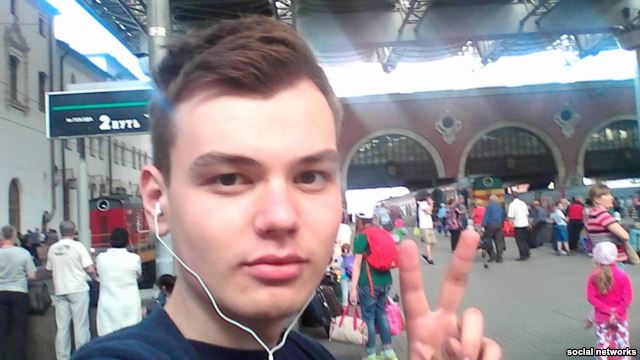
“At the military enlistment office, I turned on the Ukrainian national anthem”: 17-year-old Vlad Kolesnikov talks about his decision to combat Putin’s propaganda
Dmitry Volchek
June 10, 2015
svoboda.org

Vlad Kolesnikov

Hundreds of people have been writing to Vlad Kolesnikov, a 17-year-old technical college student from Podolsk. They have been writing with offers of assistance and shelter, and to thank him and advise him to be more careful.

“I cannot express in words the emotions I feel reading Facebook,” says Vlad, his voice trembling with emotion. “There has been so much support from strangers, it is simply incredible.”

Vlad has acquired a lot of friends on the Internet, but his own grandfather, a former KGB officer, has condemned him. At the technical college where he studied he was assaulted. (Vlad asked not to write that he had been beaten up: “It was only a split lip, a couple of bruises, a couple of blows to the head, and three drops of blood.”) And now the police have taken an interest in him.

And all because Vlad Kolesnikov not only does not hide his political views but has also decided to declare them openly.

​​Vlad Kolesnikov: Putin sits with his pack of criminals and runs the country with the aid of powerful propaganda. This is my subjective opinion. Maybe I am wrong, but I believe it is true. You know the Russian media have been vigorously promoting the image of khokhly [a Russian term of abuse for Ukrainians] and pindosy [a Russian term of abuse for Americans] as enemies. I also supported this until I watched a video on YouTube. It was 2014, and I will probably never forget it, because the video changed my life. The content of the video was completely banal. It was just an American family. The wife is Russian, the husband, American. He gives her a gift, they go to a shooting range. And instead of the propaganda we get—that it is a fascist regime where everyone is obsessed with sex and money, and everyone betrays each other—I saw people like myself. The only difference was that they smiled more. Since then I have been digging more, looking for different kinds of information, and reading the western press. I have realized the Russian media makes lots of mistakes, exaggerates, and in most cases just blatantly lies.

Radio Svoboda: And your relations with your relatives have been complicated because of the fact they do not share your views?

Vlad Kolesnikov: Yes. And not only my relations with relatives, but with everyone, you could say. I know only two people who more or less share my views: my friend Nikolai Podgornov and one other person whom I won’t name. But all the people I know—my whole college, all my relatives—they are all against me. It is just Nikolai and me,

Radio Svoboda: You and Nikolai decided to hang up a banner in Podolsk that read, “Fuck the war”?

Vlad Kolesnikov: Yes, it all started when I was at the military enlistment commission and told them I did not want to serve in the army and did not want to fight against my brethren. Maybe that sounds sentimental, but that is the way it is. We decided we could not tolerate it anymore and would voice it openly. First, we wanted to hang a banner in Moscow, but then we thought it would be torn down quickly, and so we looked for a good place in Podolsk. We walked around for a long time and found a building with an accessible rooftop in the middle of town and decided to hang the banner there. We went to a fabrics shop. We bought a five-meter-long piece of cloth. We spent a long time picking out cloth that would be sturdier. We bought paint. This is expensive for a college student, but it was worth it. We spent all night making the banner and sitting on the rooftop. We fastened the banner to iron cables so that it would hang longer, and we locked the door [to the rooftop] so that it would take the police longer to get in. They had to summon the Emergency Situations Ministry guys. I think we gained two or three hours more time on them that way.kolesnikov-2

Radio Svoboda: You told the military enlistment commission straight out that you did not want to fight?

Vlad Kolesnikov: I don’t have very good eyesight, so I am not fit for military service. I went through the medical examination, and there was I before the draft board. There were tables shaped like the letter П set up there, and the people who did the assessments were seated at these tables. I had the Ukrainian national anthem recorded on my telephone. I don’t like the Russian national anthem, because I consider it mendacious. Everything it says about freedom and so on is just pure rubbish. Before entering the room I decided to turn on the Ukrainian anthem, because I do not support the Russian army at all and consider serving in it disgraceful. So I turned on the Ukrainian anthem and said, “Guys, I’m not going to fight in the Russian army.”

Radio Svoboda: Vlad, you would agree that you are a very unusual young man. You are immune to propaganda, and are fearless to boot.

Vlad Kolesnikov:  In fact, I was just lucky. I just did not have a TV for a certain time, and I did not watch the news. And when I got a TV, I turned it on and saw the nonsense that was going on there. I turned right to that program where [TV journalist Dmitry] Kiselyov fiercely argued that the hearts of gays should be burned. I was sitting there and thinking, Is this a comedy show? Then I realized that a new kind of news had emerged in Russia. It is hardcore, and produced in keeping with all of Goebbels’s principles of propaganda: enemies surround us, the country has been occupied. Total drivel.

Radio Svoboda: So, you turned on the Ukrainian national anthem at the military enlistment commission. The members of the draft board were probably stunned when they heard it, no?

Vlad Kolesnikov:  It was something incredible. Some people were dumfounded. Others jumped up and shouted, “What are you doing? Do you know where you are?” After a while, a man came running in. He took me to a separate room and laid two certificates in front of me. One said that I had problems with my eyesight, which is true. The other said that I had a personality disorder and something else. In short, the military enlistment commission had assigned me to the loonies, because I had gone in there playing the Ukrainian anthem and expressed my opinion. That was a turning point. When that certificate was put in front of me, I realized I would not put up with this anymore. I had simply gone in there, and I was immediately classified as a loony.

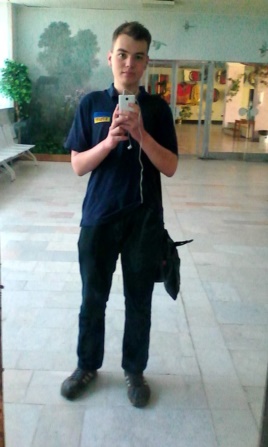
Radio Svoboda: And there is your latest feat. You came to school in a t-shirt with the Ukrainian flag on it.

Kolesnikov arrived at school with an Ukrainian flag on his chest

​​

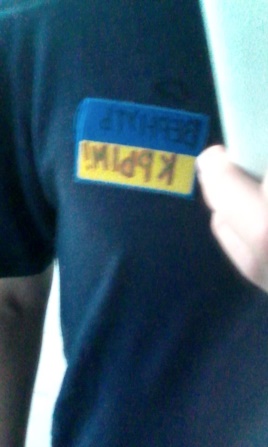
Vlad Kolesnikov: Yes. I had voiced my political views earlier at the college, and had often argued with the teachers on this score. As you can imagine, nothing good had come of this, but neither did anything super bad, except lowered marks and other trifles. But then it got fun. Near the college, I immediately met the class teacher. At our college, they are called professional masters. I will never forget that look. At first, he looked at me like a normal, decent person. Then he saw what I had on my t-shirt. He looked up at me, and I saw this hatred! Then I went upstairs and walked into the classroom. Within five minutes, the people sitting in front of me turned around (I was sitting in the back row) and said, “Kolesnikov, should we smash your face in now or later?” Well, just you try, I said. As you know, they kept their promises, not that day, however, but a few days later, after I had published my posts, when they had heard a lot of interesting things about themselves. I can argue my position, why I think Crimea was annexed, why Donbas was occupied. I have arguments, I have facts, and I know people who served there. On TV, they say there are no Russian troops there. In reality, of course, it is the other way round. They could not come up with convincing arguments. It all came down to my being a disgrace to the country, and I should tear the flag from my shirt. It is an interesting policy, actually. It turns out if you express your opinion you are disgrace to the country.

The inscription on the flag reads, “Give Crimea Back!”

Vlad Kolesnikov was forced to leave college (he was immediately expelled) and leave Podolsk. His grandfather, with whom he lived, also did not share his political views and sent his grandson to his father in Zhigulyovsk. It was just in time. Kolesnikov called his grandfather to say he had arrived safely and heard the disturbing news that two police officers had come and asked where he had got the Ukrainian flag and where his t-shirt was now.

“All democrats in Russia were sent into exile, and that is how I feel now, as if I am in exile. Many people are now advising me to go to Kiev. But that is the most extreme option. If someone thinks I will sit this out, get a foreign travel passport, leave for Ukraine, and that will be the end of it, they are mistaken. For now, I am planning after Zhigulyovsk to return to Moscow and do a couple of protest pickets,” promises fearless Vlad Kolesnikov.

Translated by the Russian Reader

UPDATE. Vlad Kolesnikov was found dead on December 25, apparently from an overdose of prescription drugs.

* * * * * *

Russia Day (Russian: День России, Den’ Rossii) is the national holiday of the Russian Federation, celebrated on June 12. It has been celebrated every year since 1992. The First Congress of People’s Deputies of the Russian Federation adopted the Declaration of State Sovereignty of the Russian Soviet Federative Socialist Republic on June 12, 1990.

Dmitry Kozhnev: Anyone Defending Their Rights Is Branded a Fifth Columnist and Agent of the State Department

“Anyone who tries to defend their rights is a fifth columnist and agent of the State Department”
A trade union leader talks about pressure from the security forces and badgering from the National Liberation Movement
Darina Shevchenko
March 24, 2015
Yod

The automotive industry has been laying off employees around the country. Since the beginning of the year, the demand for cars has fallen 20-30%. Management has forced workers to quit, shift to part-time work or agree to significant pay cuts. The Interregional Trade Union Workers Association (ITUWA) has countered with strikes and pickets. Center “E” (Center for Extremism Prevention) has responded by taking measures against union members. Last weekend, Center “E” officers detained members of the ITUWA Kaluga local. They demanded that the activists confess to working for western secret services and acting to destabilize the situation in Russia. Dmitry Kozhnev, leader of the ITUWA Kaluga local, told Yod that the trade union has long had a difficult relationship with the local security forces, and more recently, members of the National Liberation Movement (NOD) have targeted workers for persecution.

The ITUWA was founded in 2006 by members of trade union organizations from the Ford plant in the Petersburg suburb of Vsevolozhsk and the AvtoVAZ plant in Togliatti.*** The trade union unites workers from more than fifteen companies. Its chair, Alexei Etmanov, was elected to the legislative assembly of Leningrad Region in 2011. The ITUWA’s motto is “Don’t cry, organize!”

On what grounds were trade union members taken in by Center “E” over the weekend?

Under the pretext that a robber who had hit a passerby with a bottle and stolen something had dashed into the room where we had gathered for a routine meeting. About forty security forces officers arrived. They detained fifteen of us, took us to a police station, and asked us about our activities, what protests we were planning. They told us that, under the guise of defending workers’ rights, we were spying for the US, destabilizing the regime, and engaging in provocations. We hear this song from Center “E” constantly. Apparently, law enforcement officers find it difficult to believe that an organization can be independent and act on its own.

Have Center “E” and the FSB showed interest in your activity before?

Our union emerged in 2008. During this time we have become stronger and our actions have gotten results. In [2012], a strike at the Benteler Automotive plant led to the workers signing a collective agreement that we drafted. We got the bonus included in the salary and a ban on duties other than those stipulated in the contract. At the Volkswagen plant we forced management to increase salaries by almost four times, from seven to thirty thousand rubles a month.

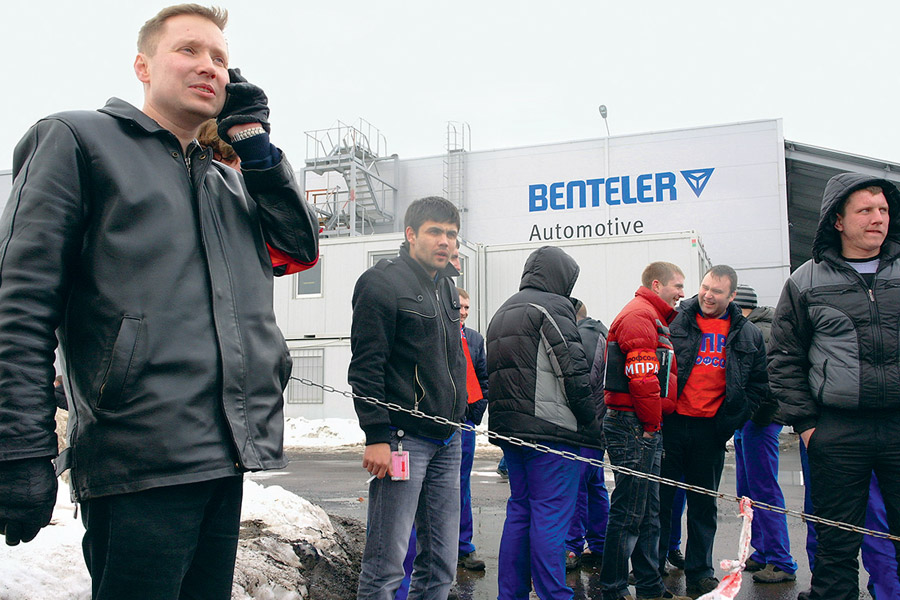
rep_242_016
Dmitry Kozhnev (left) on the picket line during the 2012 strike at Benteler Automotive

In the summer of 2013, Volkswagen management was changing equipment. They wanted to let the workers go for a week, and then have them work off the missed days on weekends. By law, management has a right to do this, but plant workers opposed it. They were furious at the prospect of working weekends in the summer, when every day off is worth its weight in gold. We told management they should pay the missed week as down time, while the workers would go to work voluntarily and at double the pay. Management stood their ground, and then we began to prepare for a strike. By the way, according to Russian law, it is almost impossible to strike. Management must be notified seven days in advance. During this time, management can succeed in appealing the strike in court and then the strike cannot start on time. So we start the strike and notify management simultaneously. That is what we did back then at Volkswagen. We also picketed dealerships and informed consumers that we could not vouch for the quality of the cars assembled during the strike. We got what wanted.

Now our trade union has influence at different plants and can exercise control over the situation. After the number of union members went over four hundred at Volkswagen in 2009, and we began doing street protests, Center “E” got on our case.

And as soon as relations between workers and management would heat up, Center “E” would show up and put pressure on us, including arrests, harassment, and surveillance. But pressure and persecution have only strengthened the organization.

Give an example of persecution by Center “E”.

As soon as our work started to produce results, we began getting summons to Center “E” and were threatened with criminal prosecution. Once they blocked my car on the street and took me down to the station. They tried to catch several comrades with allegedly faked sick leave forms, threaten to take them to court, and force them to inform on trade union leaders. One worker and trade union member had a weapon planted on him. He got into a car with security officials. They handed him a bundle, said it contained a gun used to commit a crime, and now he would either rat on his colleagues or be convicted for the crime. The comrade refused to be an informant and took the story public big time, and they left him alone. Another comrade of ours was press-ganged into the army. Because of a serious leg injury, the guy had been declared unfit for military service. During a routine medical exam at the draft board, he was suddenly declared healthy. He insisted on an independent medical examination. The guy was then abducted on the street and sent to the army. He served his term, and came back angry and able to use weapons. And he is working in the trade union again. The ranks of our trade union’s foes continue to swell. Recently, the National Liberation Movement (NOD) joined them.

How come? You don’t participate in opposition rallies, do you?

NOD considers us Banderites because anarchists carrying flags with anarchist symbols attend our rallies. They think that since the Banderites have black-and-red flags, and anarchists use the same colors, they are in cahoots. It is ridiculous, of course. It is useless to ask the NODites questions; it is better not to talk with these cartoon characters. Anatoly Artamonov, governor of Kaluga Region, has also called us agents of the West. And this is a guy who has built his region’s economy on cooperation with companies from NATO countries and has awards from NATO countries! This is the trend now. Anyone who defends their rights is a fifth columnist and agent of the State Department.

The security forces’ interest in you has to do with the crisis in the automotive industry and presumed activism on the part of trade unions. At what plants is the situation the most tense?

It is easier to say which plants have no problems: the plants that produce luxury-class cars. They are the only ones where everything is all right. All the other plants are undergoing layoffs, which are hidden for the time being. Workers are being persuaded to quit voluntarily, to accept part-time schedules and pay cuts. But I think the crisis will continue, and the actions of management will become harsher. But we will vigorously defend the interests of workers.

Translated by the Russian Reader. Photo courtesy of Russian Reporter

*** Editor’s Note. The ITUWA was originally known as the Interregional Trade Union of Autoworkers (ITUA). It changed its name in 2013, although the union’s well-known abbreviation in Russian (MPRA) has remained the same.

Ilya Matveev: A Word to the Wise (On Putin’s “Leftism” and Solidarity with Russians)

I have been banned on Facebook by Mark Sleboda, and for the most innocuous of comments. For those of you who don’t know this guy, he is an American who voluntarily came to Russia to work with Alexander Dugin, the conservative “Eurasianist” imperialist/traditionalist circus clown who went from hanging out, in the nineties, with the likes of politically dicey counter-culturalists like musician Sergei Kuryokhin and writer Eduard Limonov (with whom he co-founded the National Bolshevik party) to being a “respected” media commentator, “academic,” and Putin loyalist, in the noughties.

I’m writing in English in order to warn my Anglophone friends. There is a whole network of expats in Russia working on the “ideological front” defending Putin, frequently portraying him as an anti-Atlanticist battling NATO and EU hegemony. Many of these people pose as “leftists.” Basically, they are bought-and-paid petty ideologists, no better than our own homegrown Russian journalists and Kremlin think tankers. However, many of them, like Sleboda, sincerely believe Dugin’s “theories” and willingly support the Kremlin propaganda machine. What they offer is propaganda pure and simple: that is why I was banned for modestly questioning Sleboda’s position on Euromaidan. Different views are not tolerated, because the purpose of propaganda is to overwhelm a person with a stream of repeated buzzwords, not to discover the truth.

However, I am writing not just to warn you about the work of guys like Sleboda. Some political considerations are in order.

Apparently, the Putin regime’s “external” propaganda makes Putin out to be a “leftist” somehow. There are three key points in this portrayal. First, geopolitically, Russia is presented as an alternative to NATO and the EU. Second, politically, Russia is said to be against the neoliberalism imposed by the Atlanticist bloc. Third, culturally, Russia is combating “decadent perversions” such as the LGBT movement (which, again, has been imposed by the west).

In some respects, this is different from what we get here in Russia. Our “internal” propaganda does not focus on Putin’s alleged anti-neoliberalism, since very few people here are receptive to such “leftist” claims. Not so in the west: many people there sincerely believe that Putin is an anti-neoliberal.

What I want to do here is to refute all three points of the Kremlin’s “external” propaganda.

First, geopolitically, Russia is weak and only masquerades as an enemy of the west. It constitutes no regional bloc against western imperialism, as Latin America does. To be a genuine counter-power, you need to have an alternative set of values and an alternative model of the future. Putin’s Russia is far from possessing any real ideological commitments. It engages only in pure opportunism.

Second, politically, Russia is neoliberal through and through. There are neoliberal reforms in the public sector underway, Prime Minister Medvedev’s “technocratic” government is planning more privatizations (!), and not a single person within the government’s financial/economic bloc is an anti-neoliberal, even a moderate one. They are all neoliberal experts trained in the Chicago school of economics.

Third, culturally, Russia might be against “decadent perversions,” but such “perversions” are not what defines the west culturally. LGBT rights are the result of a brave struggle over many generations, not an organic part of western culture. However, if we can speak of “western culture” at all (which is very doubtful), we might very cautiously say that consumerism, a private sphere inhabited by atomized individuals, and the degradation of public virtues (in short, Guy Debord’s “spectacle”) are what define western capitalism. All these things are prevalent here in Russia, even more than in the west itself. Russia is more immersed in private life, and more consumerist than many western countries, and Putin fully supports that. So culturally speaking, he offers no opposition to capital’s creeping influence, and that is the most important thing.

Don't get into bed with Putin, comrades!
Don’t get into bed with Putin, comrades!

Okay, now that this has been said, should a western observer be a Russophobe, like the notorious blogger La Russophobe, who frequently writes for conservative US media outlets? No. The point is not to attack Russia as such, not to express solidarity with the Russian “people” against the Russia “government.” That is an empty formula used by the likes of John McCain. The point is to educate yourself about alternative political and social forces here in Russia—social movements, independent unions, leftist groups, and the opposition movement as a whole (in all its complexity, with its neoliberal and anti-neoliberal currents). As a leftist, I feel responsible for refuting the crazy idea that Putin is somehow a leftist. However, I also feel responsible for fighting against one-sided Russophobia, which essentially supports the US and EU agendas. Solidarity is very much needed here in Russia, but it should be solidarity coupled with political awareness. It should be against Putin, against neoliberalism and imperialism, but for genuine solidarity with the international left and with social movements across the globe. That is what I was wanted to explain here.

Ilya Matveev is an editor of OpenLeft.Ru, a member of the PS Lab research group, a lecturer in political theory at the North-West Institute of Management (Petersburg), a PhD student at the European University (Petersburg), and a member of the central council of the University Solidarity trade union.

Editor’s Note. Readers who enjoyed Ilya’s comments might be also interested in this recent blog post by Anton Shekhovtsov, “The pro-Russian network behind the anti-Ukrainian defamation campaign.”