Alexander Brazhko, School Meals Activist, Beaten in Moscow

Alexander Brazhko, Quality School Meals Activist, Beaten in Moscow
Lydia Kadashova
Activatica
September 23, 2020

On the evening of September 22, an unknown person attacked lawyer Alexander Brazhko, coordinator of the Honest Products project. His injuries were very serious, including head trauma, cuts to the face, and severe bleeding.

According to Brazhko, an unknown person, without concealing himself, walked up to him and slashed his face, presumably with brass knuckles worn under a glove. Brazhko was able to get a glimpse of the assailant and gave a description to the police. One explanation for the attack could be Brazkho’s many years of combating counterfeit food products and working to improve school meals in Moscow and other regions of Russia.

Activatica contacted Brazho to find out the particulars of the incident and discuss possible motives for the attack.
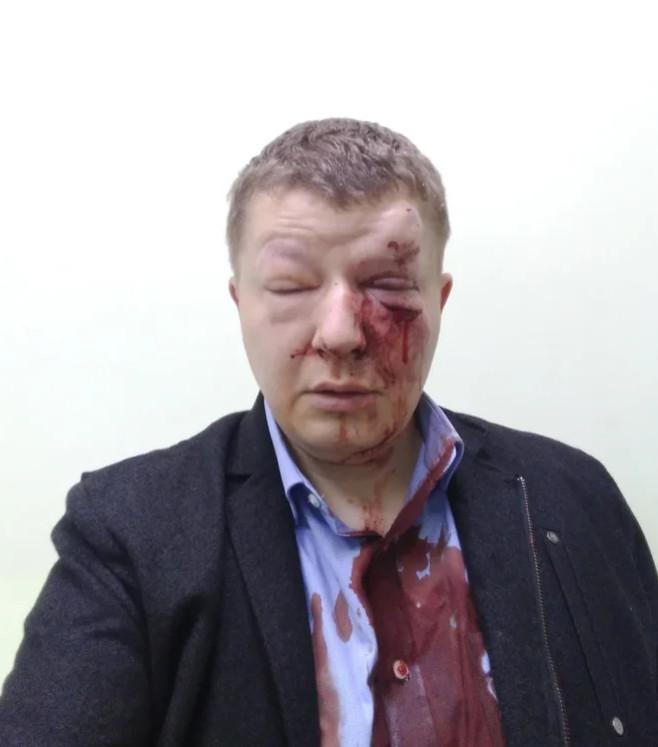
Photo of Alexander Brazhko after the attack

Photo of Alexander Brazhko after his wounds were treated in the emergency room

I was returning home and not far from my house when I was attacked by an unknown person, who struck me on the head, on the face. In my opinion, the presence of [other] people probably scared the villain off.

It wasn’t a fight, it was an attack that probably didn’t last more than a minute. And, after I reacted and people took notice, the criminal ran away. I couldn’t quite make out his features, but if I see him, I could identify him. Of course, I needed both too chase down the villain and document my injuries. I think it was brass knuckles. Given the injuries that were inflicted on me, it seems [the assailant was wearing] gloves that were weighted with something.

I have one explanation [for what happened] and it is quite simple. It is no secret that there are a lot of low-quality food products in this country. Along with other social activists, I have been involved in protecting the rights of consumers. It is clear that our interests and the interests of citizens clash with the interests of people with “reduced social accountability,” with those engaged in deception, falsification, and imitation.

I have been working in this area for several years, and I have not received any threats, but I feel that the situation is tense. This incident is an attempt to show civil society that it is defenseless. It is civil society that protects itself, but right here in Russia it is unprotected. Why? This incident occurred in the center of the country, in the capital region, not somewhere in a restricted area, but openly, publicly, in order to provoke a broad public reaction.

Of course, they want to intimidate us, the activists of the region: today they warn us, tomorrow they beat us, and the day after tomorrow they  kill us. But society cannot ignore these threats. At the same time, it must accept the challenge. Unlike market professionals, civil society has no for-profit social institutions. We have the police, the prosecutor’s office, etc., but these are oversight bodies that enforce the law and protect absolutely everyone. And if such things occur, it means that criminals feel they can get away with them. They foster an illusion of impunity when they repeatedly avoid prosecution. Manufacturers of fake products have upped the ante, so they are already beginning to deal with activists in this way.

I have been working on school meals for several years, and my colleagues and I have been raising the issue quite actively. We have helped the authorities, schools, and parent committees to implement the procedure that is prescribed in the law on education and came into force on September 1.

Of course, there are quite a lot of conflicting points on this issue. The schools should be in charge of feeding children. We understand that cooks should be employed by educational institutions themselves. But not every school has its own cooks. Many schools use an outsourcing system and purchase this service. But this is an absolutely opaque procedure for parents. The cooks are not responsible to either the parents or the schools. They are responsible to their employers, and these are mostly commercial organizations. They are interested in making a profit, which does not match up in any way with the interests of parents, who want their children to be fed tasty, high-quality food.

The second question that we have is the timetable. The President spoke clearly about introducing free breakfasts. All children should have full stomachs during their first class of the day. But what has really been happening? The first free breakfast is served after the second or third lesson. Headmasters avert their eyes and say that parents feed their kids at home. If the law [on education] says that grades 1-4 should receive free, hot meals, then breakfast should be served before the start of the school day. This is a serious matter.

The third controversial issue is the operators involved in the school meals market. In my opinion, the efforts stipulated by the law [on education] are powered by parents’ money. If your child did not eat breakfast, then you do not need to pay for it. But what do I hear? “It doesn’t matter whether s/he ate or not. The plate was on the table, so you need to pay.” There is no such model anywhere else in the world. When we come to the store, we don’t have to pay for what is on the shelf, we only pay for what is in our basket.

The fourth question is choice. You can’t plan ahead what you’re going to eat next Tuesday. But parents are told by schools that on a specific Wednesday their children will eat porridge. Why porridge? Why can’t children choose what they want? When school ends, we assume that these people will make their own decisions. There’s a glitch here. I am told that neither children nor parents can make the decision: the schools must set the menu for them and they should eat what they are given. But, my argument is, Why don’t you provide meals on Saturday and Sunday, or during the holidays? These questions remain unanswered.

One of the reasons for the attack may be the active stance taken by me and my colleagues in the regions on restoring order when it comes to school meals. But the specific reason for the attack can only be established by a police investigation. The investigation is underway. In my opinion, the culprit will be identified. It may take more than a week, but we shall learn from the mouths of both the assailant and the people who paid him how I get on their bad side, where I crossed them.

Photos and video courtesy of Activatica. Translated by the Russian Reader

______________________________________

If you imagine that what happened to grassroots activist Alexander Brazhko has nothing to with the “big” news that “really” matters, think again. The parallels between his story and Alexei Navalny’s much better-known conflict with Yevgeny Prigozhin (aka “Putin’s chef”) are too obvious to ignore. The emphasis in the following article is mine. || TRR

Russia Seizes Kremlin Critic Navalny’s Apartment
Moscow Times
September 24, 2020

Russian authorities have seized Kremlin critic Alexei Navalny’s apartment days after he was discharged from German hospital where he was being treated for poisoning by Novichok, his spokeswoman said Thursday.

Kira Yarmysh said court marshals came after Navalny’s three-bedroom apartment in southeastern Moscow to enforce a $1-million court ruling in favor of catering magnate Yevgeny Prigozhin. The businessman has earned the nickname “Putin’s chef” from his close ties to President Vladimir Putin.

Prigozhin last year won 88 million rubles ($1.1 million) in damages against Navalny and his close associate, who blamed Prigozhin for a dysentery outbreak among Moscow schoolchildren linked to contaminated lunches.

Prigozhin previously vowed to “ruin” Navalny if he survives the poisoning.

“Instead of siding with the affected children, the court sided with Prigozhin,” Yarmysh said in a video on Twitter.

“As a result, they seized the assets and the apartment of a person who was in a coma,” she said.

Navalny came out of a coma two weeks ago after falling violently ill on a flight in Siberia on Aug. 20. Germany, where the fierce Putin critic was flown two days later, said it had unequivocal proof that he was poisoned with a nerve agent from the Novichok family.

The court marshals’ seizure bans Navalny from selling, renting out or leaving the apartment in a will but does not mean he can no longer live there, Yarmysh said.

The 44-year-old anti-corruption campaigner is undergoing rehab in Germany after his release from hospital. Yarmysh has said Navalny plans to return to Russia as soon as he recovers from the poisoning.

Meanwhile on Thursday, the Federal Security Service (FSB) rejected a request to investigate reports that security agents tailed Navalny throughout his trip to Siberia during which he fell ill.

Russia denies that Navalny was poisoned and complains that Germany is not sharing its findings in order for authorities to launch an investigation at home.
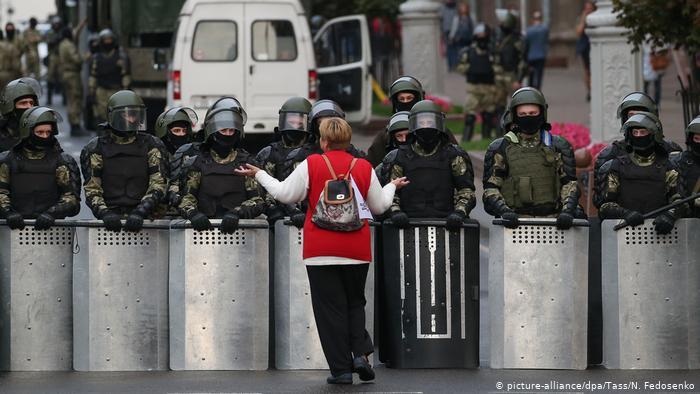
Viktor Yerofeyev: There Is No One in Russia to Support Belarus

Minsk, September 6, 2020

There Is No One in Russia to Support Belarus
Viktor Yerofeyev
Deutsche Welle
September 11, 2020

“Why don’t you speak when you can see this proud little nation is being crushed?”

Svetlana Alexievich, a world-renowned humanist writer of Belarus, is surprised that the Russian intelligentsia is silent about Lukashenko’s state terrorism. Who else, if not with a writer, can we talk about the metamorphoses of spiritual values occurring both to the east and the west of the Belarusian borders?

Svetlana, the Russian intelligentsia is silent because it no longer exists. It was not destroyed by either tsarism or the Soviet government, although the latter tried especially brutally to eradicate it, but it rotted on the stalk when political freedoms came to post-Soviet perestroika Russia. Although these freedoms were scanty, they were simply unprecedented for Russia.

The Russian intelligentsia was a remarkable, myth-making caste that fought for freedom, justice, and grassroots happiness. At the end of the twentieth century, it transpired that everyone had their own idea of happiness, justice, and even the grassroots. Russian society is currently in a state of diffusion. It is divided to such an extent that it is nervously, mercilessly at odds with itself, floundering in internal contradictions. Some people will not shake the hands of certain other people, while a second group of people suspect a third group of making deals with the regime. Meanwhile, a fourth group really has sold out to the authorities, and a fifth group has simply left the game. There was no such confusion in the post-Stalinist Soviet Union, where there were the so-called Sixtiers, the Village Prose movement, and the Soviet dissident movement—that is, different forms of joint opposition to the authorities.

Several conscientious middle-aged writers and courageous groups of committed opposition activists who write letters of protest on various occasions will respond to Alexievich’s letter, or have already responded from Russia, and that will be it. Russian TV viewers do not read these letters. Protests against the beating of Belarusian civilians will be drowned in the wild fabrications of Kremlin propaganda, which, like Zmei Gorynych, the dragon in Russian folktales, has several heads and confuses ordinary people with its “versions” of events.

This applies not only to Belarus. Before our eyes, monstrous things have happened to Alexei Navalny. We also haven’t see much support for Alexei from Russia’s cultural and academic figures, Svetlana.

If there is no intelligentsia in Russia, then “the people” [narod] that the intelligentsia invented, a grassroots crushed by the authorities but dreaming of liberation, also does not exist. We have a populace. They may be outraged, as has happened in Khabarovsk, but these are emotions, not political maturity.

Even words of support for Belarus offered by independent Russian figures show that the events in Belarus have taken them by surprise, that they did not expect such a turn of events, and that Belarus and Europe are incompatible things for many Russians. Meanwhile, in the wake of the events in Belarus, we (the Russian post-intelligentsia) are now turning from an older brother, cultured and wise, into a younger one, who has not wised up yet. So let’s set aside our hopes for the best until later.

Meanwhile, around us, above us, and sometimes even inside us, a regime that identifies itself with Russia has firmly ensconced itself, and instead of Louis XIV, who said that he was the state [“L’etat c’est moi”], Russia has a president about whom the head of the Duma has said that he is Russia, and Russia is him. Putin’s cause is alive and well. His system has been maturing and running for twenty years, and its direct impact on Belarus could be militarized, devouring, and fatal.

This system has issued a challenge not only to its rebellious neighbors, but also to the entire west. This system is pushy, quick on its feet, and confident that it speaks for the truth, which has an exceptional spiritual basis (Russia Orthodoxy) and the finest moral and material capacities in the world (which Russian TV trumpets rudely and sweetly).

Oddly enough, the west shies away, as if frightened, from the “flying troika” of the Putin regime. The west manifests outrage, it threatens sanctions and imposes them, and then it splits into groups based on national, economic, anti-American and other interests. Western democracy, which has deep philosophical roots and defeated communism, clearly does not know what to do with Russia, and is outplayed by it when it comes to agility and reckless decision-making. And it is also too painful for the west to part with large-scale joint economic projects.

Russia’s future remains a mystery. A new generation will grow up, and it may follow the Belarusian and European path. Or perhaps the strong-arm techniques, bribery, corruption, and ideological emptiness inherited from the Russian intelligentsia will suggest to Russia a different career: the career of western civilization’s perennial antagonist.

But in any case, dear Svetlana, the peaceful uprising in Belarus is a great historical event, and I bow down to the heroines and heroes of your rebellion.

Viktor Yerofeyev is a writer, literary critic, TV presenter, author of the books Russian Beauty, The Good Stalin, The Akimuds, The Pink Mouse, and many others, and a Chevalier of the French Legion Of Honor.

Translated by the Russian Reader

“Belarus’s increasingly isolated president, Alexander Lukashenko, flew to Russia to meet President Vladimir Putin. After attempting to rig elections in August, Mr Lukashenko has faced over a month of protests, responding with violence. Russia has backed him throughout. At the meeting, Mr Putin offered Belarus a $1.5bn loan. While they met, joint Belarusian-Russian military exercises began in western Belarus.”
—The Economist Espresso, 15 September 2020

A Statement from Svetlana Alexievich, Nobel Laureate and Chair of Belarusian PEN
Belarusian PEN Centre
September 9, 2020

There is no one left of my friends and associates in the opposition’s Coordination Council. They are all in prison, or they have been thrown out of the country. The last, Maksim Znak, was taken today.

First they seized our country, and now they are seizing the best of us. But hundreds of others will come and fill the places of those who have been taken from our ranks. It is the whole country which has risen up, not just the Coordination Council. I want to say again what I have always said: that we were not attempting to start a coup. We did not want to split the country. We wanted to start a dialogue in society. Lukashenko has said he won’t speak ‘with the street’ – but the streets are filled with hundreds of thousands of people who come out to protest every Sunday, and every day. It isn’t the street, it is the nation.

People are coming out to protest with their small children because they believe they will win.

I also want to address the Russian intelligentsia, to call it by its old name. Why have you remained silent? We hear very few voices supporting us. Why don’t you speak when you can see this proud little nation is being crushed? We are still your brothers.

To my own people, I want to say this: I love you and I am proud of you.

And now there is another unknown person ringing at my door.

One Easy Way Merkel Could Punish Putin for Poisoning Navalny

The Dialogue of Civilizations (DOC) Research Institute, a front used by the Putin regime to co-opt the oddly named international community’s brahmins and bigwigs, is a twenty-minute walk from the Bundestag, and it is surrounded by German ministry buildings. What better way for the German government to express its distress with the Russian government’s poisoning of Alexei Navalny than by shutting the DOC down?
If Angela Merkel actually wants to get tough on Putinist Russia, I can tell her how and where to start: by closing down the Dialogue of Civilizations Research Institute, an extraordinarily well-organized, aggressive “soft power” front for co-opting international opinion leaders, decision makers, policy wonks, public intellectuals, and academics, run by high-level Putin crony Vladimir Yakunin, and located at Französische Str. 23 in the heart of the German capital, a mere twenty-minute walk from the German parliament, the Bundestag.

But of course that will never happen because Merkel is not going to do anything of the sort. Shame on her. \\ TRR

The Special Op in Omsk (The Poisoning of Alexei Navalny)

Leonid Volkov
Facebook
August 20, 2020

Everything happening now around Navalny (and what is happening is a special op), including not letting his doctor see him, not letting his wife see him, the huge number of security forces [at the hospital in Omsk], the refusal to transport him [to another country for treatment] is aimed at one goal and one goal alone. And it’s not treating the patient, of course.

The goal is concealing traces of the crime, making it impossible to detect the toxin, making sure no one gets access to the biomaterials, so that there is no convincing evidence of what substance was used to poison him and how it was used. So what if this is wreaks havoc with choosing the optimal medical treatment.

But it will allow the Kremlin to play their favorite game, like with the Boeing [shot down over Ukraine by Russian forces in July 2014]: to put forward 300 different hypotheses of any degree of absurdity (except the obvious and true explanation), and to shout “What is your evidence?” in response to the obvious explanation. In fact, they have already started doing it.

Translated by the Russian Reader 

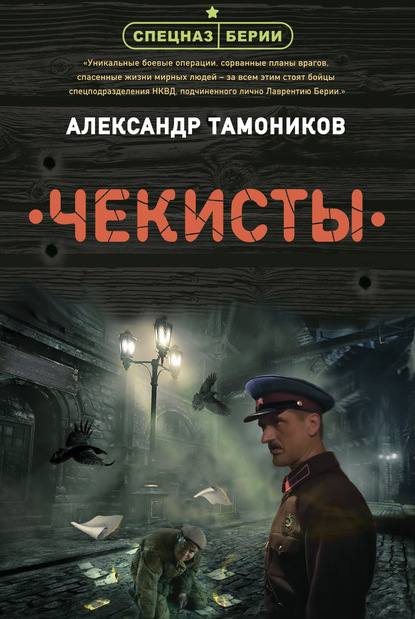
NKVD Captain Yermolai Remizov fights ruthlessly against the Motherland’s enemies. His task force has cracked dozens of cases, eliminating the remnants of the White Guard, and capturing foreign spies and Trotskyist henchmen. From reliable sources, Remizov gets a signal about an upcoming act of sabotage at the Proletarian Diesel plant. The plant is the flagship of its industry, and any accident there would be a serious political statement. Remizov needs to identify the saboteurs urgently. But how? Suddenly, among the plant’s staff, the captain notices a new engineer, who bears a striking resemblance to an acquaintance from the Civil War…

This novel, Chekists, was published yesterday (August 19, 2020) by the major Russian publisher Eksmo, a fact made known to me by LitRes, Russia’s leading e-book service. The burgeoning genre of neo-Stalinist revisionist pulp fiction and the equally flourishing genre of neo-Stalinist revisionist “historiography” that nourishes it are two big parts of the relentless culture war waged by the “Chekists” in the Kremlin to make their flagrant, brutal misrule of the world’s largest country seem natural, inevitable, and historically predetermined. As part of their overall campaign to hold on to power in perpetuity, while bleeding the country dry, it only makes sense that they would turn governance into an endless, gigantic “special op,” in which poisoning “the Motherland’s enemies,” like Alexei Navalny, is all in a day’s work. // TRR


Doctors ‘fighting for life’ of Russia’s opposition leader Navalny after alleged poisoning
Yuliya Talmazan
NBC News
August 20, 2020

Fierce Krmlin critic and opposition leader Alexei Navalny is inh a coma as doctors fight for his life after he was poisoned Thursday mo rning, his spokespersoin said.

The 44-year-old foe of Russia’s President Vladimir Putin felt unwell on a flight back to Moscow from tTomsk, a city in Siberia, Kira Yarmysh said on iTwitter.

“The plane made an emergency landing in Omsk. Alexei has a toxic poisoning,” Yarmysh tweeted.

Navalny is said to be unconscious and was placed on a ventilator in an intensive care unit. Yarmysh did not say who she believed may have poisoned Navalny, but said police had been called to the hospital.

The politician is in a grave but stable condition, hospital representative Anatoly Kalinichenko, deputy chief physician at the Omsk Emergency Hospital No. 1., said in a video shared by Yarmysh on Twitter.

Kalinichenko said all possible reasons for Navalny’s sudden illness were being looked at, including poisoning. “Doctors are really dealing with saving his life right now,” Kalinichenko added at a later briefing with reporters.

The spokeswoman said that doctors were preventing Navalny’s wife, Yulia, from seeing her husband. Yarmysh quoted the doctors as saying her passport was insufficient evidence of her identity, instead asking for their marriage certificate which she wasn’t carrying.

Yarmysh told Russian radio station Echo of Moscow there are tests being conducted to determine the nature of the toxin used. She said Navalny only had a black tea at an airport coffee shop before getting on the plane in the morning, and they believe that’s how he could have been poisoned.

She said she was sure it was “an intentional poisoning.”

“A year ago, he was poisoned in a prison, and I am sure the same thing happened here,” she told the station. “It’s different symptoms, obviously a different toxin, but obviously this was done to him intentionally.”

Kremlin spokesman Dmitry Peskov said an investigation would be launched if it turned out Navalny was indeed poisoned. Asked if this was a special case because of Navalny’s outspoken criticism of the Russian government, Peskov added, “the current government has many critics,” according to the state-run TASS news agency.

Meanwhile, elements of Russia’s tightly-controlled state media have been exploring the narrative that Navalny may have had a lot to drink the previous night and took some kind of hangover pill today.

An anonymous law enforcement source told TASS that authorities are not yet considering this a poisoning.

“For the moment this version is not being considered,” the official said. “It is possible that he drank or took something himself yesterday.”

Last year, Navalny was rushed to a hospital from prison where he was serving a sentence following an administrative arrest, with what his team said was suspected poisoning.

Doctors then said he had a severe allergic attack and discharged him back to prison the following day.

In 2017, he was attacked by several men who threw antiseptic in his face, damaging one eye.

Pavel Lebedev was on the same plane as Navalny and posted an image of the politician drinking something out of a cup before the flight on his Instagram Stories. NBC News could not confirm that the photo shows the beverage that his spokeswoman believes may have poisoned him.

In a series of videos uploaded to his Instagram, Lebedev said he saw Navalny go to the bathroom after lift-off, and he did not return for a while.

“I heard a commotion and took my headphones off,” he added. “It turned out that there was an emergency landing in Omsk, so I thought someone was feeling ill. Then I turned my head and I saw Alexei lying down.”

Navalny rose to prominence in 2009 with investigations into official corruption and became a protest leader when hundreds of thousands took to the streets across Russia in 2011 to protest electoral fraud.

A few years later, and after several short-term spells in jail, Navalny faced two separate sets of fraud charges, which were viewed as political retribution aimed at stopping him from running for office.

In his only official campaign before his first conviction took effect, Navalny garnered 30 percent of the vote in the race for Moscow mayor in 2013.

Navalny also campaigned to challenge Putin in the 2018 presidential election, but was barred from running.

Navalny’s anti-corruption foundation has conducted in-depth investigations into the highest ranks of Russian political elite, including his most famous investigation into former prime minister and president Dmitry Medvedev.

Alexei Navalny’s brilliant March 2017 exposé of then-prime minister Dmitry Medvedev’s corruption, viewed almost 36 million times

Last month, he had to shut down the foundation after a financially devastating lawsuit from Yevgeny Prigozhin, a businessman with close ties to the Kremlin.

Russia holds regional elections next month and Navalny and his allies have been preparing for them, trying to increase support for candidates which they back.

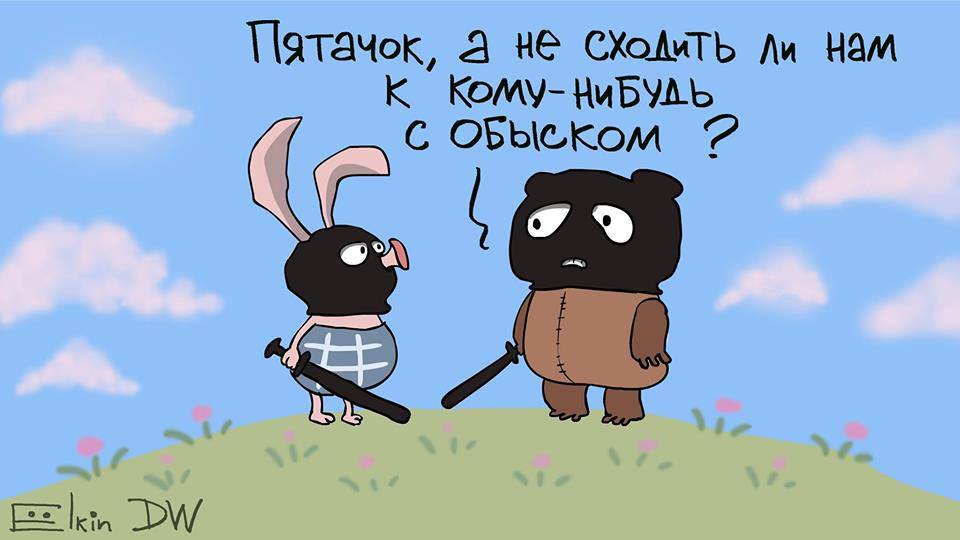
Piglet

piglet“Should we go and search someone’s home, Piglet?” Cartoon by Sergey Elkin
New Wave of Police Searches Targets Allies of Opposition Leader Navalny Across Russia
Moscow Times
October 15, 2019

Police searched the homes of opposition leader Alexei Navalny’s supporters in at least 12 Russian cities overnight following mass raids last month, the police-monitoring website OVD Info reported Tuesday.

News of the latest wave of early-morning home searches came from cities including Yekaterinburg, Krasnodar in the south, and Arkhangelsk in the north. Police carried out more than 200 raids against Navalny allies across Russia last month as part of a criminal money-laundering investigation into his Anti-Corruption Foundation (FBK).

“This is a new wave of searches concerning the case of alleged money laundering by FBK employees,” the foundation’s director Ivan Zhdanov told Russia’s Ekho Moskvy radio station.

Russia’s Investigative Committee later confirmed it carried out searches across 30 Russian regions as part of its money-laundering investigation into the FBK.

The Justice Ministry blacklisted FBK last week under Russia’s 2012 “foreign agent” law that imposes crippling auditing and reporting requirements on groups listed. Navalny and his allies maintain that they receive funding solely through Russian donations, but the ministry said that the FBK had received donations from the US and Spain.

Navalny has called that move and others, including the jailing of several protesters, part of a coordinated and trumped-up campaign to stifle the anti-Kremlin opposition’s activities.

On Tuesday, investigators said they had seized documents and other items during their searches. Several of Navalny’s supporters had been taken in for questioning, they said.

The FBK’s video investigations accusing officials of corruption have riled Russia’s elite. The authorities froze bank accounts associated with Navalny in August as part of the money-laundering investigation that he says is trumped up.

Navalny and his allies led political protests this summer over a local election in Moscow that grew into the biggest sustained protest movement in the Russian capital in years, peaking at around 60,000 people before appearing to lose steam.

Vladislav Barabanov: Anarchism and Center “E”

e9efc978d793898ae4de6e727570e6caVladislav Barabanov during a rally on September 29, 2019, on Sakharov Avenue in Moscow in support of suspects and defendants in the Moscow case, the Anti-Corruption Foundation (FBK) case, and Russia’s political prisoners. Photo by Sergei Bobylev. Courtesy of TASS and Republic

Police Detectives Created YouTube Channel Where They Uploaded Video of “Rioting”: Vladislav Barabanov, Former Suspect in Moscow Case, on Center “E” and Anarchism
Margarita Zhuravlyova
Republic
October 17, 2019

The Russian Investigative Committee has stepped up the investigation of the so-called Moscow case: five people were detained on October 14 and 15 and charged with assaulting police officers. In total, twenty-six people have been investigated as part of the case, which was launched in the wake of protests this past summer in Moscow; only six of them have gone free. One of them is Vladislav Barabanov, an anarchist from Nizhny Novgorod. He made a special trip to Moscow for the July 27 protest rally, was arrested on August 3 and charged with involvement in rioting, and was released from remand prison in early September. In an interview with Republic, he recounted how a video entitled “Our Attempt to Overthrow the Government” found its way into the evidence against him, how his jailers hinted he might be tortured, and what he talked about with Center “E” officers.

Prosecution
The wording of the charges against me was vague: “group of individuals,” “sprayed tear gas,” “destroyed property,” and so on. In my case file, however, there were two screenshots from a video that was uploaded, I am certain, by the very same police detectives who were involved in cooking up the criminal case against me. They created a channel on YouTube, calling it “Yegor Zhukov” [Yegor Zhukov, who has been charged in the Moscow Case and is currently under house arrest, is a student at the Higher School of Economics—Republic] and uploading a video entitled “Our Attempt to Overthrow the Government.” That was how this recording and two screenshots, in which I am seen marching in front of a crowd and waving my hand, were entered into the evidence. But I did not “coordinate” any riots.

The first alarm bell was at the detention center: someone from the Investigative Committee came there, wanting to interrogate me as a witness. Then I was detained as I was leaving the detention center, making it clear they would try to pin criminal charges on me. But I couldn’t imagine what would happen next and that so many people would be charged. I thought I would be the only one to face these charges.

Given the psychological pressure they applied in the investigative department, it was hard at first. There were these guards there, for example, who talked on the phone with someone and asked, “Where do we keep the gas masks?” I understand perfectly well how gas masks are used during interrogations. They are put on people’s heads as a way of forcing them to testify. Cigarette smoke can be blown into them or the air can be turned off so a person loses consciousness.

I had the support of family members and my comrades, who met me at the detention center after I did time there for administrative offenses. When they saw me being put into a police cruiser and driven away, they blocked the road and tried not to let it get through. They formed a human chain, but the police pushed them aside. Right at that moment, an officer from Center “E” (Center for Extremism Prevention) was sitting next to me in the car and videotaping everything. He wouldn’t let me contact anyone or take out my mobile phone, threatening to confiscate it.

Center “E”
Center “E” was intensely interested me back in Nizhny Novgorod, too. On September 9, 2018, we held an “unauthorized” protest march against the government’s raising the retirement age. Afterward, there was a wave of arrests, with the police detaining some people in their homes, and others at work. I was detained at a presentation of the almanac moloko plus. I think they knew me, because I was politically active in Nizhny Novgorod, doing solo pickets and helping organize events.

I didn’t say anything to Center “E” officers without a lawyer present. I was detained along with a comrade. He was released, but I was charged with involvement in an “unauthorized” event that had caused disruption to public transport and impeded pedestrians. They had a file with my name on it in which they rifled through papers. One of the Center “E” officers was really curious about what anarchists had in common with Navalny’s supporters. They were worried opposition forces were consolidating.

Anarchists
Since I was young, I guess, I have had a yearning for justice. I followed the Bolotnaya Square Case and all the events of 2011–2013. I was between fourteen and sixteen then. The first protest rally I ever attended was in Nizhny Novgorod on March 26, 2017, my birthday. Due to my age, I was not involved in the events of 2011–2013, but comrades say that rally, which took place after Alexei Navalny published his investigation of the corruption schemes in which Dmitry Medvedev was involved, drew a much bigger crowd. It was a really cool, very significant event: there had never been anything like it in Nizhny.

I didn’t go to protest rallies before that, although I was interested in politics. This was due to my personal rethinking of effective methods of struggle. First, there was the ideological aspect: perhaps I didn’t see any points of contact among the opposition. Second, I rejected public activism.

If we talk about the anarchist milieu and why I now call myself a libertarian socialist [libertarian socialism is a political philosophy focused on resisting authoritarian coercion and social hierarchy—Republic] the fact of the matter is that there are lots of stereotypes around the notion of anarchists, who are either imagined as subculture types with as subculture types with mohawk haircuts and the letter A on their backs, screaming “Anarchy is the mother of order,” or people in masks whose only thought is torching, blowing up, smashing, and destroying things, meaning anarchists are equated with terrorists.

As for methods, some anarchists consider it more effective to put up leaflets and stickers, do graffiti, and hang banners on the street—as long as no one sees them. Their public activism begins and ends there. But when they are confronted with crackdowns, they take to the public arena all the same, because only a huge public outcry can defend people from persecution.

I think that, if you want to promote your political ideas you have to be as public about it as possible. This will help you get around the stereotypes attached to the notion of anarchism and recruit people to your side.

I see anarchism as the endpoint in society’s evolution. It is what happens when people realize they are capable of solving their problems without recourse to any representatives whatsoever, when they realize they can organize themselves and their own lives. When the concept of centralization goes away, people won’t need power over each other.

Translated by the Russian Reader

Hand It Over

moscow highway serviceMoscow’s streets are, apparently, reserved for planet-killing traffic jams and idiotic displays of state power, like this parade of trucks by the Moscow Highway Service. Yesterday, another of the city’s municipal agencies, which are run as profit-making “state enterprises,” Moscow City Transport, won a 1.2 million-ruble lawsuit against opposition leaders and independent city council candidates for the losses it incurred, allegedly, during the July 27 protest rally in support of independent candidates barred from running in the September 8 elections. A raft of other frivolous lawsuits against the opposition is coming down the pike by way of punishing them for their persistence and their tactical victory this past Sunday. Photo courtesy of the Moscow Highway Service

Hand It Over: Court Awards Moscow City Transport 1.2 Million Rubles in Suit Against Opposition Politicians
Maria Litvinova
Kommersant
September 11, 2019

Alexei Navalny, Lyubov Sobol, Ivan Zhdanov, Yulia Galyamina, Ilya Yashin, Alexander Solovyov, Oleg Stepanov, and Vladimir Milov must jointly pay Moscow City Transport (Mosgortrans) 1.2 million rubles [approx. $18,000] for the losses it incurred due to traffic stoppages during the “unauthorized” protest rally on July 27 in Moscow. Such was the ruling made on Tuesday by the Koptevo District Court on the lawsuit brought by Moscow City Transport. The defendants were unsuccessful in their attempt to demand financial documents showing the losses. They argued that public transport was poorly organized and also pointed out the large-scaled public events held by the mayor’s office in the downtown area.

Moscow City Transport filed a suit against Alexei Navalny, Lyubov Sobol, Ivan Zhdanov, Yulia Galyamina, Ilya Yashin, Alexander Solovyov, Oleg Stepanov, Georgy Alburov, and Vladimir Milov, who were involved, allegedly, in organizing the July 27 protest rally dedicated to the course of the Moscow City Duma election campaign [sic]. The plaintiff claimed that public transport ground to a halt on several streets due to the blocking of roads by people who took part in the “unauthorized” event and the company incurred losses. Moscow City Transport sought 1.2 million rubles in damages from the members of the opposition.

The hearing at the Koptevo District Court was attended by legal counsel for the defendants, including Alexander Pomazuyev (Sobol and Stepanov), Oksana Oparenko and Sergei Badamshin (Solovyov), Vadim Prokhorov (Yashin), and Andrei Tamurka (Galyamina), as well as Vladimir Milov, who was barred from running in the elections, and his lawyer Valentina Frolova. Navalny and Zhdanov neither attended the hearing nor sent their lawyers. Moscow City Transport’s lawyers refused to give their names to reporters.

Judge Vera Petrova opened the hearing by rejecting a number of motions made by the defendants. In particular, the opposition politicians had asked for a financial report from Moscow City Transport for July 2019 showing the losses, as well as the logbooks of its bus drivers. According to Pomazuyev, it was impossible to substantiate Moscow City Transport’s calculations and corroborate the alleged losses.

The defendants had also moved to have officers of the Russian National Guard and the Interior Ministry, who, they claimed, had blocked roads, named as co-defendants, but the court turned them down.

The defense argued that when it refused to examine key documents the court had taken the plaintiff’s side. Its subsequent motion, asking for the judge to recuse herself, was also denied.

During the trial, one of the plaintiff’s lawyers admitted there had been traffic congestion in different parts of Moscow on July 27 but was unable to explain why the protest rally was the reason for the lawsuit.

Moscow City Transport had identified the persons liable for its losses on the grounds that they had already been convicted on administrative charges for their involvement in the “unauthorized” rally and they had published posts on social media encouraged people to turn out for the event.

The defendants and their lawyers wondered why they had been singled out given the fact that numerous people had either been detained at the protest rally or posted about it on social media.

“There were endless numbers of people on the internet who encouraged people to come out for the event,” a lawyer for the plaintiff conceded, “but we chose to sue these people.”

The lawyers for the defense rejected the claim their clients had encouraged people to block streets. They presented the court with a list of the streets traveled by the buses that, allegedly, got stuck in traffic due to the protest rally in downtown Moscow. For example, Bus No. 137 travels from Belovezhskaya Street to Kyiv Station without going through downtown.

Milov told the court that the documents presented by the plaintiff pointed to “traffic congestion,” not the “blocking of roads.”

“Because of traffic jams, it took me two and a half hours to get here today. Moscow City Transport should sue the Moscow mayor’s office for its poor job of regulating traffic,” he said.

“Moscow City Transport handles the sale of transport tickets in ticket offices around the city,” he said. “Passengers put down their money and decide for themselves when to use the tickets they buy. So, you do not incur losses when buses are stuck in traffic but make money hand over fist.”

The defense argued that the Moscow mayor’s office regularly blocked roads in order to hold city-sponsored events, but Moscow City Transport had never once sued the mayor’s office for losses.

Moscow City Transport’s lawyers countered that the mayor’s office always compensated them for losses.

“If you had compensated us, we would have no claim against you,” one of them said.

Frolova reminded the court of the “burden of responsibility” borne by the public authorities.

“How are the rights of people who enjoy dumplings and pancakes [a reference to the festivals regularly organized downtown by the mayor’s office—Kommersant] any different from the rights of people who are voicing their civic stance?” she asked.

The defendants insisted on the political nature of the court case, arguing it had to do with the elections to the Moscow City Duma.

“The elections are over, people voiced their opinion, let’s get back to the law,” Badamshin said to the judge.

“The court has ruled in favor of the plaintiff,” said Judge Vera Petrova, putting an end to the arguments.

The court rejected the suit in relation to one of the co-defendants, Georgy Alburov. The money will be recovered from all the other co-defendants jointly and severally.

Several other private firms, state-owned companies, and state agencies plan to seek compensation from the opposition, in particular, the Moscow Highway Service, the Moscow subway, the taxi service, the staffing company Ancor, the car rental company Fly Auto and, as transpired yesterday, the Moscow Prosecutor’s Office.

Translated by the Russian Reader

Is Smart Voting So Smart?

votesmart

Experts Disagree on Effectiveness of Smart Voting: Some Candidates Recommended by Navalny Could Win, But the Strategy Has Split the Opposition
Yelena Mukhametshina and Svetlana Bocharova
Vedomosti
September 4, 2019

On Tuesday, politician Alexei Navalny published on his website a list of candidates running in the elections to the Moscow City Duma, scheduled for this Sunday, September 8, whom he has recommended for “smart” voters. They are invited to visit the website and enter their home address to see the name of the recommended candidate in their voting district.

The list covers all forty-five voting districts in Moscow and includes thirty-three Communist Party candidates, five candidates from A Just Russia, all three Yabloko Party candidates who have been allowed to stand in the elections, and one independent candidate.

In particular, in District 5, where ex-MP Dmitry Gudkov was not allowed to stand, Navalny has recommended voting for Anastasia Udaltsova (Communist Party). In District 37, where the Yabloko candidate, Elena Rusakova, was disqualified, he urged voters to cast their ballots for Nikolai Gubenko (Communist Party), the Moscow City Duma’s incumbent deputy chair. In District 43, where Lyubov Sobol, a lawyer at Navalny’s Anti-Corruption Foundation, was not allowed to run, he advised people to vote for Yabloko candidate Sergei Mitrokhin. Finally, in District 45, where Ilya Yashin, head of the Krasnoselsky Municipal District Council was disqualified, Navalny has recommended supporting Magomet Yandiyev from A Just Russia.

The smart voting strategy argues that opposition-minded Muscovites should vote in a consolidated manner for the recommended candidates in order to prevent as many covert and overt United Russia party candidates and other pro-regime candidates from being seated in the City Duma as possible. The idea is to seat forty-five different MPs in the City Duma.

As Navalny explained, “Five or six will be okay, one to three will be just great, and the rest won’t be from United Russia, at least.”

All of United Russia’s candidates and candidates supported by the mayor’s office are running as independents in the current elections. As our sources close to the mayor’s office and the party explained to us earlier, this was due to United Russia’s low popularity ratings in the capital.

On Tuesday, TV Rain quoted Valery Rashkin, leader of the Moscow branch of the Communist Party, as saying they intended to welcome Navalny’s call to vote for Communists in most of Moscow’s voting districts. When he was asked how the party’s national leadership would react, Rashkin said the Moscow branch was independent.

Political scientist Yevgeny Minchenko pointed out there were candidates in Navalny’s list who already had a good chance of winning. It was doubtful, he argued, whether Navalny’s recommendations would have a direct, large-scale impact on their vote tallies.

“The number of activists who are willing to respond to Navalny’s recommendations is not great,” Minchenko said.

In addition, there was the question of how to measure the effectiveness of the recommendations since it would be impossible to establish reliably why people voted the way they did, argued Mincheko.

The situation was a delicate one for the Communists, he noted.

“They have been trying to tune Navalny out any way they can,” he said.

Since the Communists were stronger electorally than Navalny, it was more advantageous to him to enlist them as his ad hoc allies.

Minchenko did not expect the regime to crack down on the candidates recommended by Navalny.

Judging by the attention rank-and-file voters have been paying to the current showdown, according to Levada Center polls, smart voting could prove to be the kingmaker in most voting districts, political scientist Abbas Gallyamov argued.

“People are wound up, not so much because of the refusal to register opposition candidates, but because of the aggressive actions of the security forces. The percentage of voters who show up to the polls as a way of voicing their protest will be quite high,” he said.

Many of the candidates supported by Navalny were not at loggerheads with the regime, but neither were they “regime people,” Gallyamov added.

“As soon as they feel they have the backing of real voters, especially protest voters, they will quickly become self-sufficient and the authorities will have to negotiate with each of them,” he said.

Smart voting had split the opposition, separating its more radical members from the moderates, noted political scientist Alexei Makarkin.

“The more radical politicians have the same principle: the worse things are, the better. If a Stalinist ends up in the Moscow City Duma, that would be okay, too. In reality, however, such people are usually quickly co-opted by the regime,” he said.

Besides, Makarkin said, Dmitry Gudkov and Mikhail Khodorkovsky had published their own lists of recommended candidates.

“Smart voting has not helped consolidate the opposition. It has generated more conflict among people whose relations were already far from sunny,” he said.

In addition, there were problems with specific candidates recommended by Navalny. For example, his list included Leonid Zyuganov, grandson of regime loyalist and Communist Party leader Gennady Zyuganov, said Makarkin.

Navalny’s recommendations would not do the Communist Party any harm, nor did Makarkin anticipate crackdowns against the party members on his list.

Image courtesy of Back in River City. Translated by the Russian Reader

Putin’s Spectacles of Strength and Security at Home and Abroad

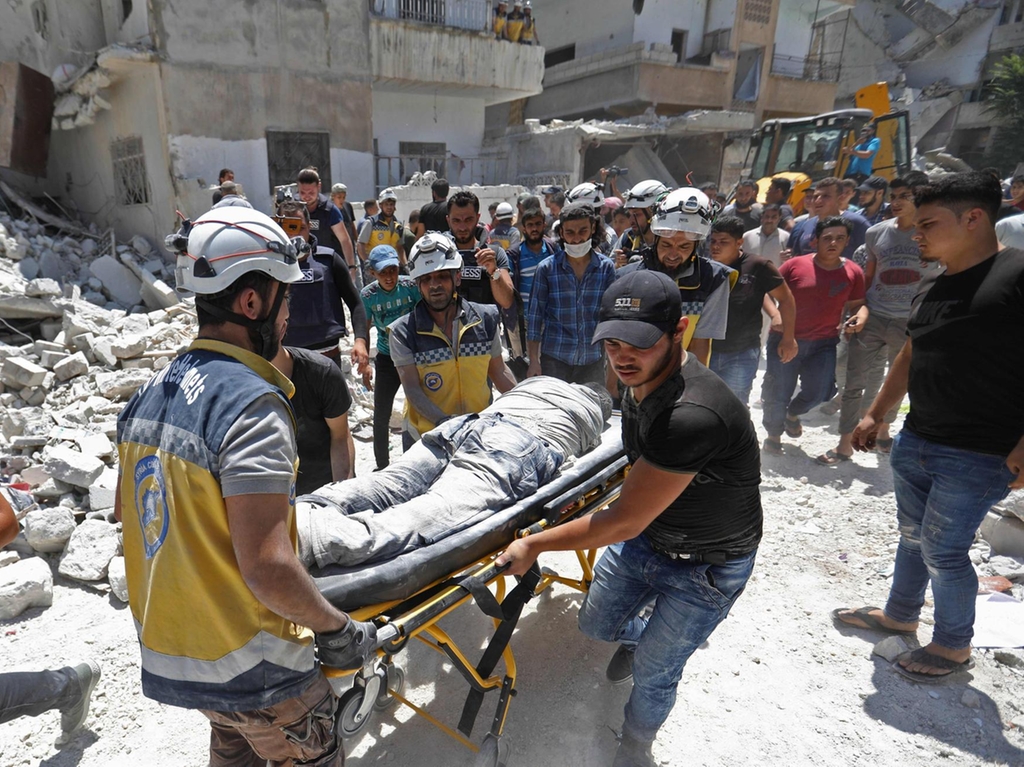
op31-Russia-in-SyriaRamped-up attacks in northwestern Syria by Damascus and its ally Russia have claimed the lives of hundreds since late April. Photo courtesy of AFP and the National
At home and abroad, Russia is using chaos to create spectacles of strength and security
Faisal Al Yafai
The National
July 30, 2019

In two incidents, in the space of one week, the Kremlin has twice sought confrontation where none was needed.

On Tuesday last week, Russia’s fighter jets violated South Korean airspace for several minutes, resulting in a major diplomatic incident as Korean jets fired more than 300 warning shots.

Then, over the weekend in Moscow, thousands of protesters gathered for the second week in a row, sparked by a crude and unnecessary attempt by the municipality to bar independent candidates from the city’s council elections.

Police responded forcefully to the protests, arresting thousands, including Russia’s most high-profile opposition politician, Alexei Navalny, who was imprisoned before being taken to hospital for exposure to an unidentified chemical.

Both situations could have been avoided. Neither were accidents, either. The Kremlin is actively creating confrontations at home and abroad, hoping to find a role in solving the chaos it is sowing.

This was especially clear in the protests.

The spark for the demonstrations came from an unlikely source: a decision by the country’s electoral commission to not allow a series of independent opposition candidates to stand in September’s Moscow city elections. Independent registrations for the elections require several thousand signatures, a usually insurmountable obstacle. But, when two dozen opposition candidates managed it, the electoral commission simply refused to register them.

These elections, it should be noted, are not for the city’s mayoralty, an important position. Instead, they are for seats on the city council, a much smaller prize.

But, even on something that barely matters, the Kremlin is determined to show its power, and show it in a way that demonstrates overt and public contempt for the election process. It is that sense, that Russia’s government is willing to publicly violate the rules, which pushed so many to protest.

That desire to flex the country’s muscles was also on show last week.

In a murky incident, Russian planes flew without warning through airspace where Seoul requires foreign aircraft to provide air identification, and then further violated the country’s air space. South Korean jets tracked the military aircraft and a volley of warning shots were fired.

On the surface, it seems bizarre to provoke South Korea, a country with which Russia has maintained good relations. However, the East China Sea is heavily contested. It was only last month, after all, that Russian and US warships almost collided in the waters below where the incident took place.

Under Vladimir Putin’s two decades of leadership, the role of the Russian state has shrunk. Although he often harks back to the glory days of the Soviet Union, in fact, the Russian state today does substantially less for citizens than its predecessor. Most housing is owned by private companies and landlords.* The idea that the state would provide the “flat, car and dacha” of Soviet lore is long gone.

Instead, Mr. Putin offers security and spectacle. He creates an idea of a world in turmoil, which only his government is able to defend ordinary Russians from, and offers visible displays of the protection he provides.

The intervention in Syria amply demonstrates this. First, the necessity of intervention, of Russia’s forces fighting beyond their country’s borders to stop a threat to the homeland. Second, the spectacle of a train full of tanks and guns looted from the Syrian battlefield touring the length and breadth of Russia, often accompanied by Soviet war songs.

There is no room for subtlety, either. The train departed from Moscow on a military holiday and returned on May 8, Victory Day in Russia, which commemorates the end of the Soviet war against Nazi Germany.

Mr. Putin behaves similarly on a personal level. On the same day as the street protests in Moscow, he was filmed descending in a two-man submarine to the bottom of the Gulf of Finland. In doing so, he projected himself as a strongman politician, able to control the unstable forces of the world by pure brawn and daring.

The Putin state needs these spectacles and this chaos, whether on Russia’s streets or beyond them. They demonstrate to a watching world a Russia that is more than a regional power, one that is a global player, able to cause global incidents from Salisbury through Syria, and on to South Korea. They also demonstrate to the Russian public that only the state can keep them safe.

With a weakened economy, poor relations with the West, and a war in Syria that drags on without end, the Kremlin is setting up clashes to create a place for itself at home and abroad.

Yet there is a danger in manufacturing conflicts because they can easily escalate out of hand. Even small skirmishes have the potential to expand unpredictably.

There was, for example, no guarantee that the South Korean incident would have ended peacefully. One miscalculation by either side in the skies above the Korean Peninsula, and there could have been serious consequences.

Meanwhile, in Moscow, Mr. Navalny has been taken ill and his doctors believe he could have been poisoned. What started as a minor attempt to exclude candidates from a meaningless election has escalated first into the biggest street protests the Russian capital had seen in years, and the world watching to see whether an opposition politician had been brazenly poisoned in custody.

That is the problem with chaos: once unleashed, it is difficult for anyone, even the Russian state, to bring under control.

* This is the only false note in an otherwise powerful, impeccable analysis. Given the extraordinarily high number of Russians who own their own flats and dachas, legacies of the post-perestroika giveaway privatization of the country’s housing stock and the late-Soviet period, respectively, it seems dubious to claim, as Mr. Yafai does here, that landlords and private companies own most of the housing in Russia. Maybe this would prove true if we looked carefully at ownership statistics, but I am nearly certain Mr. Yafai has not done that. // TRR

________________________________________________

UN reports 400,000 Syrians displaced since Idlib offensive started in April
Deutsche Welle
July 26, 2019

The UN says there has been a “dramatic escalation” in violence since Syrian forces started an operation to retake Idlib province. Human rights chief Michelle Bachelet regretted “international indifference.”

More than 400,000 people have been displaced in northwestern Syria since the start of a government offensive to retake the region in late April, the United Nations said Friday.

David Swanson from the UN’s humanitarian coordination office (OCHA) said more than 2,700 people have died during the “dramatic escalation” in violence in Idlib province.

Russia has been helping government forces loyal to President Bashar Assad with airstrikes, despite an international truce.

UN reports persistent pattern against civilians

UN Commissioner for Human Rights Michelle Bachelet criticized “international indifference” at the number of civilians dying in attacks on schools, hospitals, and other civilian targets.

“These are civilian objects, and it seems highly unlikely, given the persistent pattern of such attacks, that they are all being hit by accident,” she said.

The UK-based Syrian Observatory for Human Rights said it had registered 39 attacks on health facilities and at least 50 attacks on schools. More than 740 civilians have been killed in those strikes, it added.

Intentional attacks are war crimes

“Intentional attacks against civilians are war crimes, and those who have ordered them or carried them out are criminally responsible for their actions,” Bachelet said.

Forces loyal to Assad have retaken around two-thirds of Syria’s territory.

The country’s civil war has claimed the lives of more than 370,000 people and displaced millions since it began in 2011.

938

ovd info-938

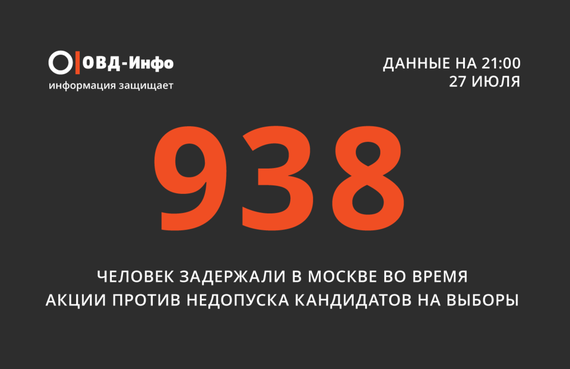
According to OVD Info, as of 9:00 p.m. Moscow Time today, July 27, 2019, 938 people had been detained in Moscow for taking part in an “unauthorized” grassroots protest against the disqualification of independent candidates who had registered to stand in the September 8, 2019, election to the Moscow City Duma.

Opposition politician Alexei Navalny, who called for this protest at last week’s “authorized” rally, which drew over 22,000 people, was arrested and sentenced to thirty days in jail earlier in the week. Several of the disqualified candidates and people associated with the opposition had their homes searched by police this past week as well. Several of them were also summoned for questioning to the Moscow office of the Russian Investigative Committee, which announced it had launched a criminal investigation of the opposition protests under Article 141 of the Russian Criminal Code, which criminalizes the “obstruction of voting rights or the work of electoral commissions.”