WordPess AI-elicited image: “Mongolia, as imagined by Russian liberals”
Political scientist Andrei Nikulin writes on his Telegram channel: “If even Mongolia can be progressive and democratic, then all the more so can Russia be progressive and democratic.” Claims to the contrary are just neurolinguistic programming, he argues.
I am unironically aware that, from the Moscow intellectual’s lofty vantage point, Mongolia is a backward, third-rate country. The whole semantics of Nikulin’s turn of phrase says so. Since those nomads were able to do it, why can’t we, cultured Europeans, have a normal future?
I generally salute positive affirmation. But before we are cheered up by a sense of superiority, let’s face reality. Here are just a few facts about Mongolians today.
Yes, forty percent Mongolia’s population is made up of nomads who, like their ancestors, live in yurts and travel with their livestock. Yes, there are only three paved roads for a population of three and a half million people.
But since 1990, the Mongolian people have elected six presidents, never once allowing any of them to exceed their rightful term in office. The Mongolian constitution gives a leader only one six-year term without the right to re-election, and this norm has never been violated. The average turnout in elections at all levels of government is seventy percent. By comparison, turnout in progressive Moscow barely exceeded thirty percent when Navalny ran for mayor.
Further, while Russians were seizing Crimea and “nullifying” Putin’s previous terms as president, the humble Mongolian nomads forced their government to resign at least twice, in 2017 and 2021. In 2012, a former president was arrested and jailed on charges of bribery.
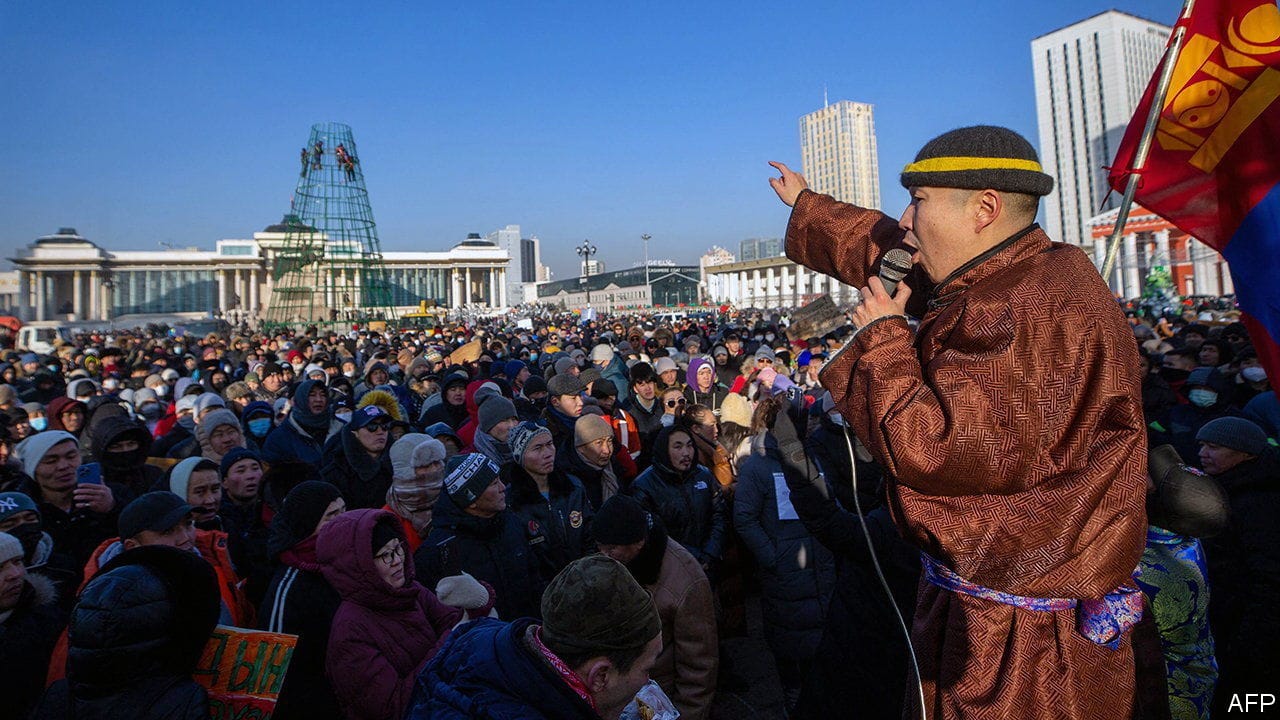
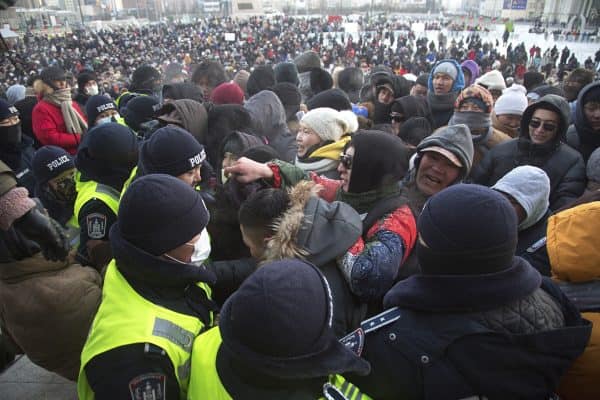
The real, democratic Mongolia, as seen in the photos selected by the author to illustrate her post
More recently, in the winter of 2022, Mongolians staged large-scale protests in Ulaanbaatar over a corruption scandal. It transpired that when exporting coal to China, customs officials had “diverted” six and a half million tons of the cargo, according to the paperwork. Mongolians considered this a theft of national revenues and marched on the capital’s square demanding that the theft be investigated and the names of those involved be made public. Eventually, the protesters stormed government house and demanded the government’s resignation.
Remind me again what Muscovites stormed in Moscow after Navalny’s investigations, of which there were dozens?
But Mongolians protested in the cold for three weeks until they forced the government to arrest the corrupt officials and reform the coal industry.
In April, the protests resumed. This time, Mongolian youth blamed the government for its poor performance and rising prices.
And lastly, let’s talk about the culture. Mongolians do not shout at their children or punish them. You will not hear from a Mongolian mom say to her child “I told you to shut your mouth” or “The more you cry, less you piss.” How should I put it? Mongolians love their children. There are only 924 orphaned children the entire country—that is less than 0.03% of the population. By comparison, there are 391,000 children living in Russian orphanages—that is 0.3% of the Russian population. In other words, children in Russia are left parentless ten times more often.
You can remain trapped in the old optics, looking down on everyone and denying reality. This will not bring social and political change any closer. If you want to go on living, but your body is rotting and falling apart, you need an accurate diagnosis. And the more honest it is, the greater the chances of your recovery.
Bizarre Beasts, “Tenrecs Will Not Stay in Their Lane”
If all crustaceans “want” to look like crabs, then tenrecs “want” to look like basically any other small mammal. These weird little guys are endemic to Madagascar—they’re native to nowhere else on Earth.
Новый культурный (или мультикультурный?) код Европы (если это правда Финляндия). https://t.co/ktnP1D1fp0
— Геннадий Гудков Gennady Gudkov (@gudkov_g) July 7, 2024
Prominent Russian liberal in exile Gennady Gudkov wrings his hands over what the “coloreds” are doing to his Russian liberal fantasy “Europe”: “Europe’s new cultural (or multicultural?) code (if that really is Finland).” ||| TRR
We can build and work. We have been creating many new things — from cleaning firms [kliningovykh firm] and journalism projects to organizing impressive professional conferences and medical services the likes of which have never been seen!
We can overcome animosities and help one another! We have built outstanding platforms on the internet to help those who have it worse than we do. (However, it is still difficult to say this about the Russian opposition.)
Sciences Po and its Provost Sergei Guriev, a world-renowned Russian academic and economist who had to flee his country in a day in 2013, were honoured to welcome @Ekaterina_Schulmann for a very exclusive conference on 20 April, 2023. This political scientist and social media sensation guest speaker addressed the serious matters of the Russian regime stability and the dynamics of public opinion.
Source: Sciences Po (YouTube), 8 May 2023. My question, had I been in the auditorium for this fascinating lecture, would have been to the audience: how many of you are neither Russian nationals nor speak Russian? I suspect that the numbers of such non-Russian nationals and non-Russian speakers were quite low. And why was this lecture delivered in English, not French?||| TRR
Source: unsolicited ad on Facebook
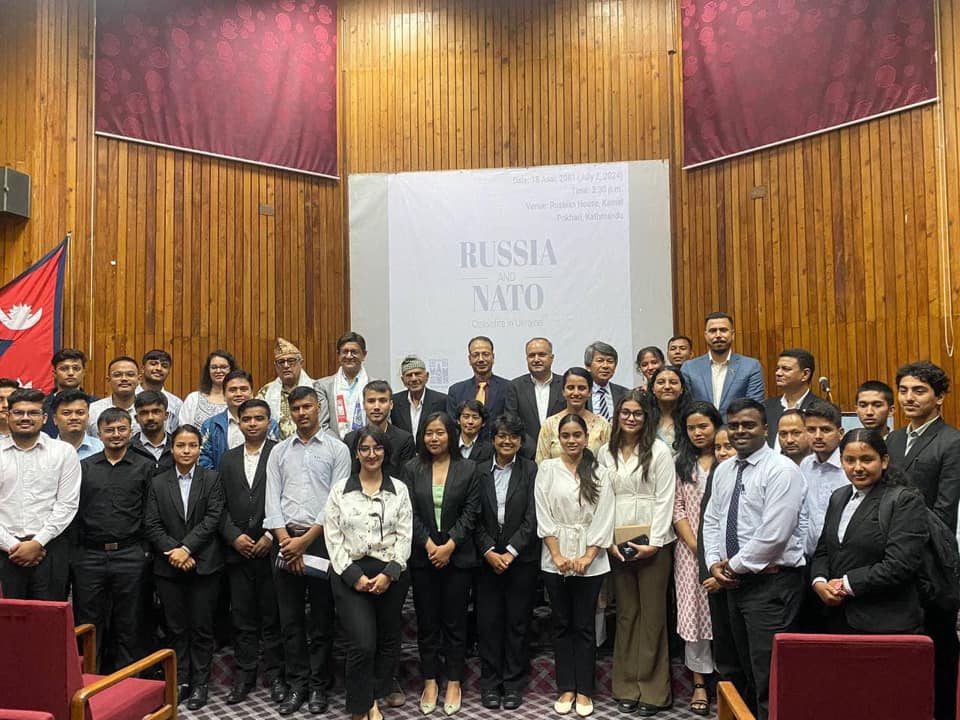
On 2 July 2024, International Law Club successfully organized an academic discourse entitled “Russia and NATO: Ceasefire in Ukraine.”
The speakers for the program included Dr. Yubaraj Sangroula (Professor of International Law), Dipak Gyawali (Former Minister of Ministry of Water Resources, Nepal), Dr. Govind Kusum (Former Secretary of Ministry of Home Affairs), Prem Chandra Rai (From Himalayan Development Affairs Council, Nepal), Yugichha Sangroula (Masters in International Humanitarian Law from Geneva), Dmitry Stefanovich (From IMEMO RAS, Moscow)
The welcoming remarks for the discourse were delivered by Anton Maslov, First Secretary and Director of the Russian House. The distinguished Chief Guest of the program was Seniormost Advocate Krishna Prasad Bhandari.
Dr. Dipak Gyawali provided valuable insights into the historical context of the Russia-Ukraine conflict, emphasizing its longstanding nature within the framework of NATO-Russia dynamics.
Professor Dr. Yubaraj Sangraoula shed light on the hegemonic influences and Western interference in global affairs, highlighting the concept of a rule-based international order that has been divisive.
Assoc. Prof. Yuggichhya Sangroula emphasized the importance of interpreting international law in a balanced manner, noting the significant contributions of Asian nations to its development alongside European nations.
Assoc. Prof. Prem Chandra Rai advocated for adherence to the UN Charter as the foundation of international law, stressing the need for inclusive peace initiatives that engage all relevant parties, including Russia.
Dr. Govind P. Kusum underscored the disproportionate impact of global conflicts on developing nations and emphasized the urgent global need for peace and security.
Mr. Dmitry Stefanovich discussed the inadequacy of mere ceasefires and called for sustainable solutions and increased global cooperation, particularly from the Global South, to address ongoing conflicts.
The subsequent question and answer session facilitated critical discussions on ceasefire strategies and institutional reform. Speakers analyzed geopolitical dynamics, and Western dominance, and proposed measures for achieving global peace and security, with a focus on strategies applicable to third-world nations.
Overall, the seminar provided a platform for robust dialogue and strategic insights into resolving international conflicts and fostering a more peaceful world order.
We sincerely express our gratitude towards the speakers, guests, and participants for their involvement.
The Club would like to thank the Russian House, especially the Director of Russian House, Mr. Anton Maslov for supporting us in organizing this academic discourse and acknowledge the presence of Ms. Alena Danilova, Press Secretary from the Russian Embassy at this program of ours.
I see that I’m quoted on the web all the time in connection with Shaman and other bastards. Yes, I have had to write a lot about them in the line of duty. But it would be a shame if I were to die tomorrow and be remembered for only this. I want to share something more interesting with you, music I’ve been listening to lately. Oddly enough, there’s very little outward political protest in this music.
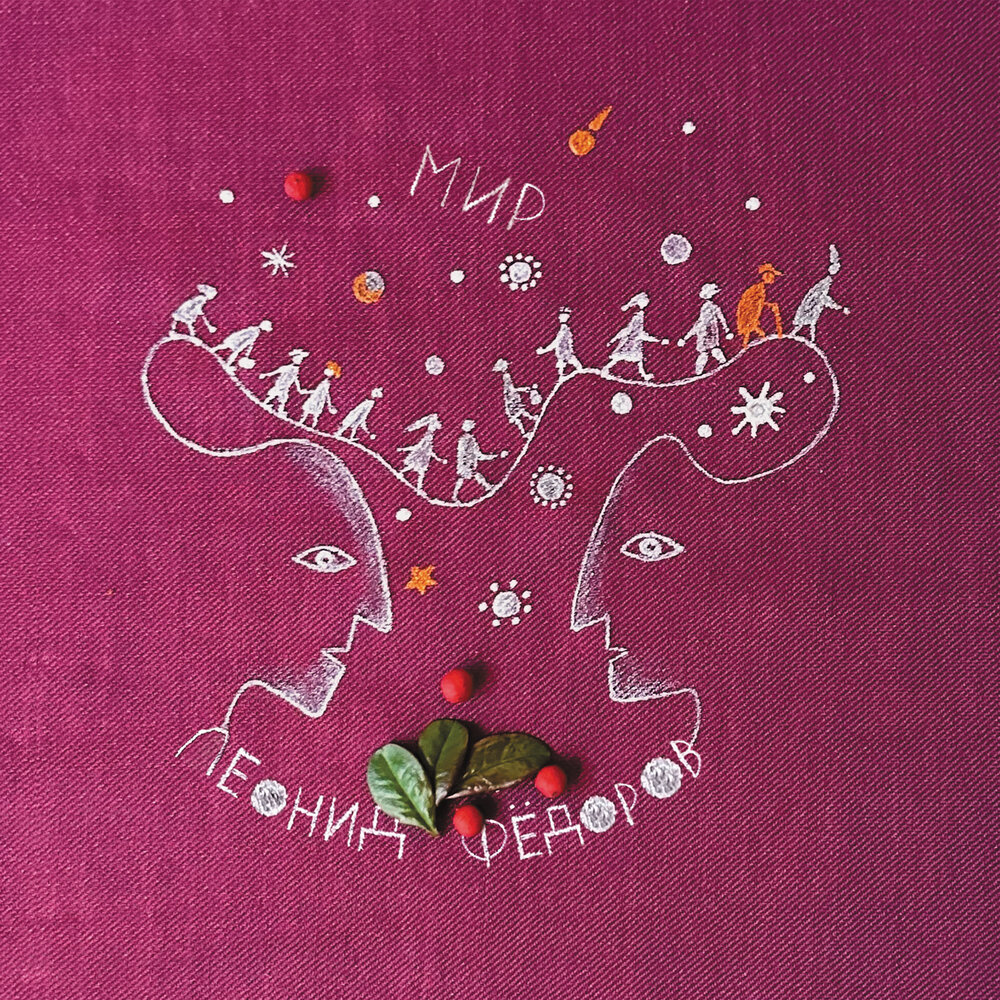
Leonid Fyodorov has released an album entitled Mir [which means both “peace” and “world” in Russian]. Yes, I do recall that it [peace? world?] is a forbidden word. We understand what Fyodorov’s stance [on the war?] is, although he doesn’t say anything outright, but then again he is not a person who can be measured in terms of his [political] stance — his music is much more interesting. His music is always strange, chockablock with dissonances, avant-garde twists, noises, and sudden pauses. He doesn’t write songs that are not odd.
And this is despite the fact that Fyodorov is an amazing melodist, one of the best in Russia. But he creates melodies of astonishing beauty, sings them in his magical voice, and in the middle of the melodies he inserts unbearable guitar scrapes or something of the sort, as if he wanted to show that he didn’t believe in the very possibility of harmony. I once asked him about it, and he said something like, “It’s the times, I guess. I feel it’s the right thing to do.”
I got so used to it that I was expecting the same thing from every new album. Yes, the album was going to be great, but it was clear in advance exactly how it would be great. Even weirdness can become familiar and predictable.
Suddenly, over the last few years, I see that something has changed. I listen attentively: almost ubiquitously in Fyodorov’s songs there’s a perfectly even, constant rhythm and repetitive bits in the arrangements. In our country, however, even when I was at school, this has been considered a sign of bubblegum pop. There is nothing to it, in point of fact: you turn on a simple drum machine track and out comes fucking “White Roses” or “Svetka Sokolova.” There’s no creativity involved.
But a craftsman of Fyodorov’s stature doesn’t do anything for no reason. If he had wanted to make the rhythm more complicated, he would have made it more complicated. So he has to do it: he’s trying to say something.
I close my eyes and suddenly I see a river flowing. It flows swiftly, swiftly, and birds of prey circle above it. They are shrieking, trying to scare it, but it cannot be stopped. But they are really trying to scare it with all their might, and at times the music is quite scary.
And the lyrics have become different. Fyodorov used to employ lyrics (most often penned by Dmitry Ozersky) like a musical instrument. He had little interest in their meaning: he was mainly interested in how they sounded, how they fit the music. There was a lot of cosmic absurdity, a lot of onomatopoeia and, again, a lot of weirdness. They were lyrics, not poems.
What do we hear now? Almost the entire album consists of perfectly regular couplets with proper rhymes. The lyrics are eminently intelligible and designed to be listened to carefully.
На вопросы есть ответы. Бедный мальчик, где ты, где ты? Сам как будто маленький, Но как будто старенький. Было грустно, стало пусто. У меня такое чувство, Что зачем-то, почему-то Мы не нравимся кому-то.
[Questions have answers. Poor little boy, where are you, where are you? You look like you’re little yourself, But you look kind of old. I was sad and now I’m empty. I have this feeling: For some reason, for some reason Somebody doesn’t like us.]
The strange thing is that the music is quite sad, restrained, and expressionless. [Fyodorov] sings as if the jig is up and there’s no point in trying. But the music goes on anyway, and you can’t stop it. Fyodorov’s strange fluidity gives hope for life and peace. You can defeat man, beast, and the state, but you cannot defeat water.
The video for “Mir” (“Peace” or “World”), the title track of Auktyon frontman Leonid Fyodorov’s 2024 solo LP
Следите за нами, смотрите за нами, Идём в путешествие между мирами, На лестнице странной находится вход, Чтоб прыгать обманно, ногами вперёд. Дверь спрятана в мире 134, Здесь люди похожи на крем на зефире, Мы здесь никого ни о чём не попросим, А спрячемся в мире 178. И тут же ныряем в созвездие Звон, Здесь звон геликоновый с разных сторон, И мы принимаемся сразу за дело, Чтоб громко гремело и звонко звенело. Приятно орудовать палкой железной — И звук интересный и опыт полезный. А в мире 14 дяди и тёти. Они сразу спросят: «А где вы живёте? А как вас зовут? А конфетку хотите? Уходите? Ладно, тогда уходите… У нас здесь не любят врунов и смутьянов! Здесь мир тараканов и мир хулиганов!» Планета 15, и смотрим мы на… Здесь нет ничего, здесь одна тишина. На это приятно смотреть и занятно, Что нет ничего, лишь какие-то пятна. Есть мир номер 8 и мир номер 3, Здесь 5 человек заблудились внутри, У них не осталось ни воли, ни мнений, И скорбно блуждают в тени отражений. И плачут во сне, и глаза прикрывают, Кричат: «Нам противно, таких не бывает», Кричат: «Уходите!», и машут руками, А это они отражаются сами. Планета 14-76! Здесь что не придумаешь — всё уже есть. Приятно девчонкам, приятно мальчишкам, Здесь весело — очень! Но, тоже, не слишком. Есть Розовый Штрудель и Мир Голубой. Где люди бессмысленно спорят с собой. Они отрицают, что есть и что будет, И спорят с судьбой. Интересные люди. На лестнице странной, в созвездии странном, В краю безымянном, в щели под диваном, Есть радостный мир, под названием «Где-то», Здесь море и солнце, и вечное лето, А рядом, конечно, находтится «Что-то», Здесь только дремота, тоска и зевота, И петь неохота, и лень веселиться — Я чувствую: что-то должно приключиться… Бежим — нас преследует Мир Сорок-дыр! Он ловит детей — это призрачный мир! Здесь только часы, и нельзя оставаться, Здесь можно в себе навсегда потеряться Здесь всё забываешь, и сны и мечты И сам не узнаешь, что ты — это ты! И будешь ходить и дрожать еле-еле… Успели, наверное… Если успели. Есть мир Вычислитель и Чёрная Кошка. Приятно, что каждый из них понарошку. Есть мир Колесо и созвездие Спящий. Ужасно, что каждый из них настоящий… Есть мир Крокодил и вселенная Горе. Пожалуй, заделаем дырку в заборе.
Follow us, watch us, We’re going on a journey between worlds. On a strange staircase the entrance is such That you leap deceitfully, feet first. The door is hidden in World 134, Where the people are like the fluff in a marshmallow. We won’t ask anyone here for anything, But we’ll hide in World 178. And then we dive into the Ringing Constellation: There’s heliconic ringing from every corner, And we get right down to business Loudly rattling, jingling and jangling. It’s nice to wield a rod of iron — It’s an interesting sound and a rewarding experience. There are uncles and aunties in World 14. They’ll ask you right off the bat, “Where do you live? And what’s your name? Would you like some candy? Are you leaving? Okay, then go away… We don’t like liars and troublemakers here! It’s a world of cockroaches and a world of bullies!” Planet 15, and we’re looking at — There’s nothing here, there’s only silence. It’s nice to look at and entertaining That there’s nothing, just spots and specks. There’s World No. 8 and World No. 3, There are five people lost inside, They have no will, no opinions, And wander mournfully in the shadows of reflections. They cry in their sleep and cover their eyes, They shout, “We’re disgusted, such people don’t exist.” They shout, “Go away!” and wave their hands, And that’s them reflecting themselves. Planet 14-76! Whatever you can think of, they’ve got it all. It’s nice for the girls, it’s nice for the boys. It’s a lot of fun! But it’s not too much fun either. There’s Pink Strudel and Blue World, Where people argue senselessly with themselves. They deny what is and what will be, And argue with fate. Interesting people. On a strange staircase, in a strange constellation, In a nameless corner, in a crevice beneath a sofa, There’s a joyful world called Somewhere, There’s sea and sunshine and eternal summer. And next door, of course, there’s Something. Here, there’s only slumber, languor and yawning: You don’t feel like singing, you don’t feel like having fun. I feel something’s going to happen. Come on, we’re being chased by World Forty-hole! He catches children, it’s a ghostly world! There’s only hours and you can’t stay here. Here you can lose yourself forever. Here you forget everything, your dreams and your hopes, And you’ll never know you’re you! And you’ll walk around shivering. They must have made it. If they did make it. There’s the world of the Calculator and the Black Cat. It’s nice that each of them is made-up. There’s the world of the Wheel and the Sleeper Constellation. The terrible thing is that each one is real…. There’s the world of the Crocodile and the universe of Woe. Let’s patch up the hole in the fence.
Source: Leonid Fyodorov (YouTube), 14 April 2024. Music: Leonid Fyodorov; lyrics: Dmitry Ozersky; video: Lydia and Leonid Fyodorov. Translated by the Russian Reader
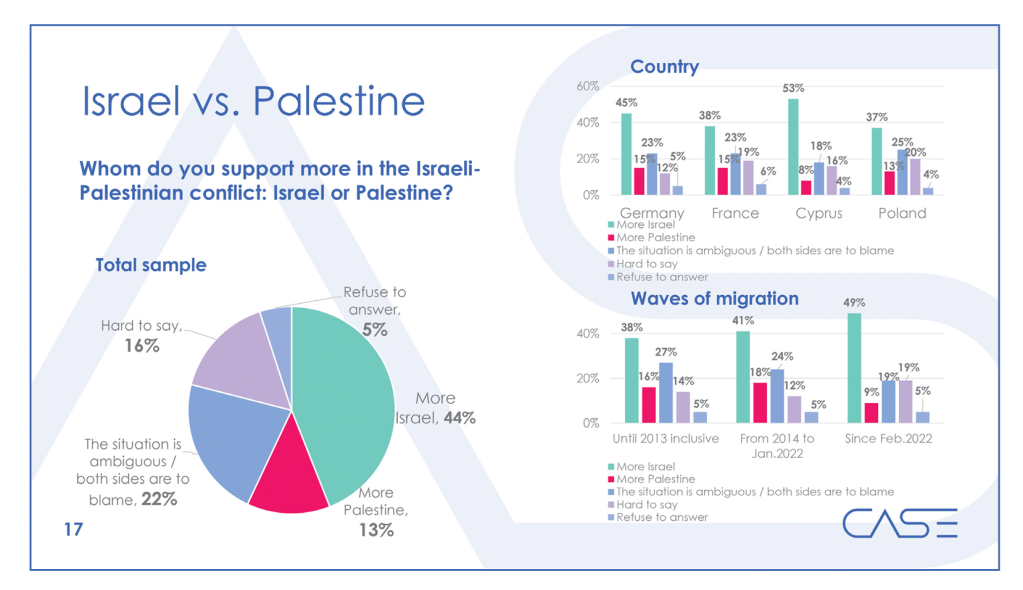
Russian opposition forces will discuss with European officials the possibility of expanding opportunities for immigration from Russia to the EU countries. One of the measures they propose is a “relocatee card”: the bearer of this document would be able to freely obtain a residence permit in one of the EU countries, open a bank account, rent real estate, and get a job. The authors of the idea argue that the outflow of educated and well-off Russians can weaken Russia’s economic health while also “creating serious challenges to the Putin regime.” They argue this in a study on Russian relocatees in the EU, published on Tuesday, 11 June 2024.
The report was prepared by a new think tank, the Center for Analysis and Strategies in Europe (CASE), whose advisory board members from Russia are Dmitry Gudkov, Sergei Aleksashenko, Vladislav Inozemtsev, Andrei Movchan, and Dmitry Nekrasov. The study will be presented in Paris at the French Institute of International Relations (IFRI), which commissioned it. In the coming days, the report will also be presented at the PACE, the German Foreign Ministry, and the Bundestag, Gudkov said.
Portrait of Russian immigrants: good education, high income, anti-war views
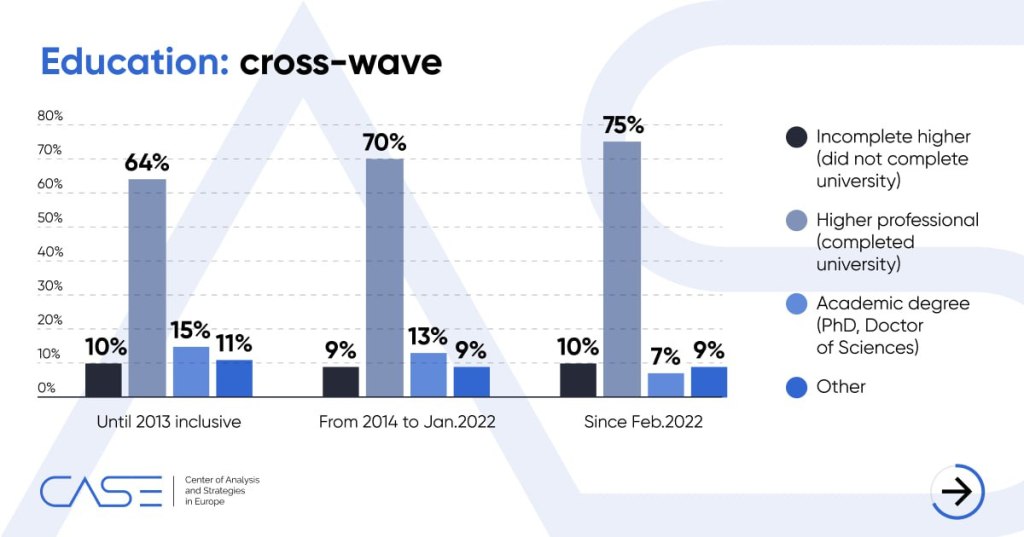
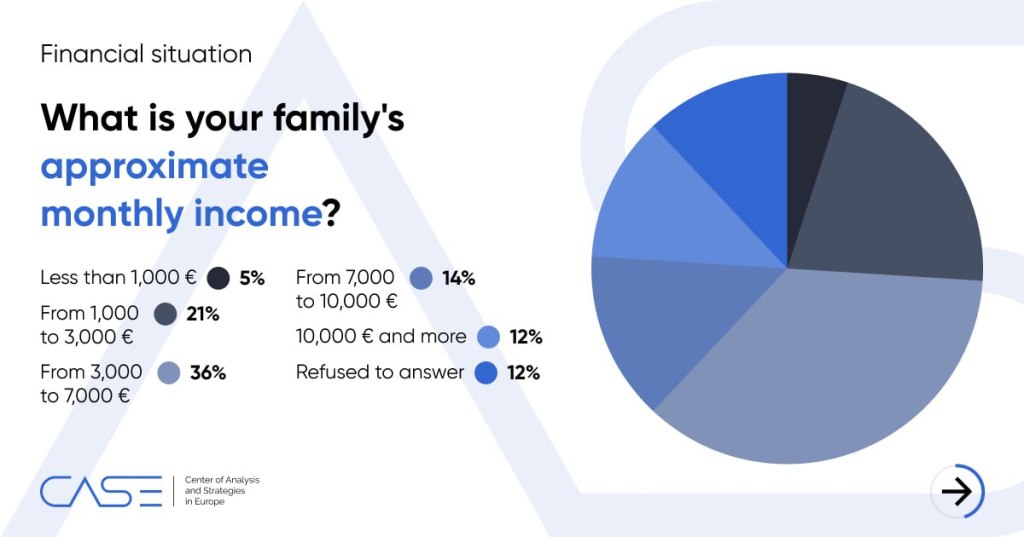
As part of the study, researchers surveyed three and a half thousand Russian nationals residing in France, Germany, Poland, and Cyprus. The results showed that most of those who left Russia after the start of the war in Ukraine — eighty-two percent — have a higher education or an academic degree. Sixty-two percent of those surveyed reported monthly earnings of three thousand euros or more. This category of people, Gudkov said, not only does not require benefits [sic], but also makes a significant contribution to the EU economy.
Among Russians who have relocated to the EU in the past two years, the vast majority oppose the policies of Russian President Vladimir Putin (79%) and support Ukraine (64%). Gudkov emphasizes that most relocatees are well-off, educated people with anti-war views.
“It is important that this is the work of European researchers confirming our long-standing argument that new immigrants from Russia hold European [sic] views. They oppose the war, and can rightly be called ‘Russian Europeans’. They are not a threat and represent an economic and social resource for European societies,” Gudkov told DW.
Report’s authors propose “relocatee card” for Russians
The study’s authors suggest that the authorities in the EU countries develop legal norms for the large-scale migration of Russian nationals to the EU, Gudkov said. According to him, Russian nationals now face restrictions in some European countries, including, for example, problems with obtaining residence permits and opening accounts in European banks.
The study proposes a new mechanism for attracting “economic migrants” from Russia to the EU: a “relocatee card,” whose holder could easily open a bank account, rent real estate, and get a job in one of the EU countries. The document, as stated in the report, could be valid for a year with the possibility of renewal. During this “trial period,” the cardholder would have to confirm that they are employed or opened their own business, lived three quarters of the time in the country which issued the residence permit, have a higher education, know one of the European languages, and also own a home or rent one in the EU. Moreover, the study proposes providing evidence of the relocatee’s liquid assets in Russia as proof that they have the means to pay for their stay.
“Today, the strategy for undermining Putin’s regime must include a staged ‘bloodletting’: stimulating the outflow from Russia of both skilled professionals and money from Russian businesses not involved in the war,” the report says. The emerging new diaspora from Russia has political potential: it can play an important role in the transformation of Russia in the event of the fall of Putin’s dictatorship, and thus this community would see “a close and understanding ally, not an enemy” in Europe and the west as a whole, the study emphasizes.
The oppositionists believe that the approximately 300,000 Russians who left their homeland after the start of the war in Ukraine but who want to live in the EU would be willing to apply for the program.
The authors paint a portrait of these Russians: “They are not activists or oppositionists, but are driven by a search for options for a professional career, a risk-free place to live and a country in which their children could be raised outside the culture of hatred that is being created in Russia today.”
The authors of the report also suggest issuing “relocatee cards” inside Russia through European embassies, thus shifting the focus away from tourist visas.
“Relocatee card” not the same as “good Russian passport”
“That idea, which has been perverted, has already lost its relevance,” the politician explained.
The opposition politician also stressed that, in parallel, the study’s authors also propose that European authorities expand the program of issuing humanitarian visas, for which there is now a waiting list.
“But ninety-five percent of those who have left Russia do not need humanitarian visas. They are ready to work, earn money, and pay taxes. They don’t need welfare checks. We are highlighting them and suggesting various options for resettling them in the EU, which may not necessarily involve a relocatee card,” Gudkov concluded.
Otherwise, he argues, some of the relocatees will continue to return to Russia and restore the country’s economy, while another segment could become disillusioned with the west, “which makes no distinction between the Putin regime and people of modern liberal views who have become its hostages.”
The “relocatees” are indeed the very models of modern major generals:
The Russians who have left also differ in their value system from those who decided to stay. They are much less religious, aligning more with the general sentiments of Europeans; they find it much easier to engage in collective, volunteer and non-profit projects; they display significant empathy — including towards Ukrainians who have become victims of Russian aggression — and are more often inclined to respect other ethnic groups and cultures, as well as showing a willingness to learn the languages of their new countries of residence, regardless of how long they intend to stay there.
The Russian Justice Ministry has once again designated Republic a “foreign agent.” This happened for the first time in 2021, but at that time a legal entity with which we soon severed ties was placed on the register of foreign agents. Now the publication itself has been put on the register. We are charged with “shaping a negative image of the Russian Federation,” as well as publishing “inaccurate information about the decisions taken by Russian federal officials and the policies they pursue.” I would like to remind you that Republic has always been financed solely by subscriptions, and Justice Ministry’s unjust ruling is a great reason to subscribe (if you are not subscribed already) or to renew your subscription.
And now, as usual on Saturdays, here are links to our latest articles and the best stories of the past week.
In “Power,” Ivan Davydov attempts to explain the psychology of Russians who have taken a position neither for nor against the war, but are “unopposed” to it. They probably make up the majority, but what explains their stance? A habitual mindset that regards political power as a force of nature, with which nothing can be done and which is better to ride out. “This stance is ethically vulnerable, but it is warranted by the know-how of several generations and supported by the self-preservation instinct,” argues Davydov.
[…]
Dmitry Kolezev, Editor-in-Chief, Republic
P.S. This is my last newsletter as editor-in-chief of Republic. I am leaving the post of my own free will. I announced my resignation a week ago: it has nothing to do with the Justice Ministry’s decision. I thank the authors, editors, and readers of Republic for the three years we have spent together. As they say in such cases, take care of Republic. And take care of yourselves, too.
Source: Republic Saturday newsletter, 1 June 2024. Translated by the Russian Reader, who has (mostly) happily subscribed to Republic for several years running. I will definitely be renewing my subscription later today to show them my support.
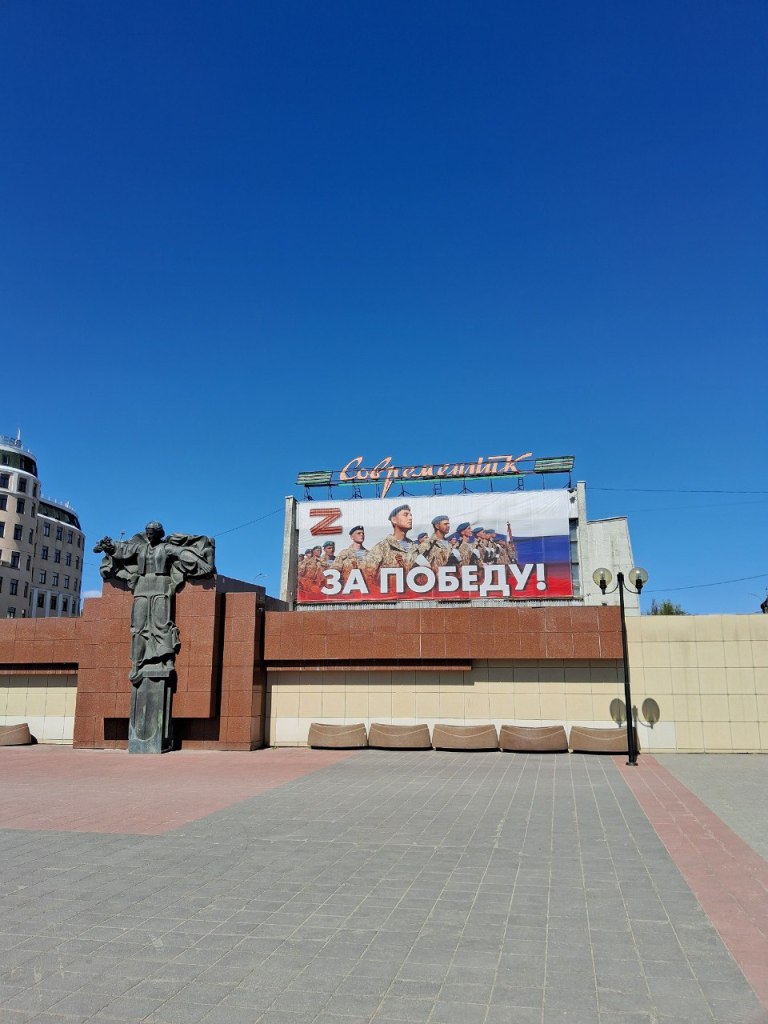
A “For Victory!” banner on the facade of the Contemporary, a long-shuttered movie house in Ivanovo, Russia. Photo: Ivan Davydov/Republic
Since the death of public opinion polling, people who are professionally obliged to speculate about Russian politics and make predictions about the future have been looking for signs literally everywhere, gradually turning from analysts into soothsayers.
For example, a respected opposition political scientist based in Europe recently wrote that “General Popov’s arrest may generate serious friction between society and the authorities.” By the way, this same political scientist has also been trying to gauge the mindset of Russians by counting the poop (excuse me!) and other unpleasant emojis that Russians (presumably) post as comments on the Telegram channels of Russian government officials and pro-regime propagandists.
He is an optimist, of course, confident that the regime is about to collapse. Poop emojis don’t lie!
Another political scientist, a pessimistic lady, on the contrary, gazes at Russia from her distant American vantage point, but does not even condescend to comment—she simply reposts a photo from a certain bookstore where Darya Dugina’s works are displayed on a separate shelf.
And really, what good are words? One glance at the photo is enough to get the whole point, to forget forever about terrible present-day Russia and wave it goodbye.
Nor am I an insider, alas. I’m not endowed with secret knowledge, and it has been a long time since I perused the “real polls” said to be commissioned by the presidential administration and other important agencies. Frankly speaking, I’m not even sure that such studies are still being conducted.
But there are still some advantages to being a participant observer, a person looking at Russia from the inside. In any case, I will risk sharing my own observations.
Has the Russian state been expanding into the cultural realm (since we mentioned bookstores)? Does it seek to reshape culture for propaganda needs? Yes, undoubtedly. It would be foolish to deny the obvious. And it has been invading more and more realms, where, until recently, it seemed one could sit back and wait out the storm. It has finally gone after “bad” books in a big way, it seems. Museums have also been toeing the line. Right now, for example, there are two exhibitions related to the special military operation underway in Moscow: Behind the Lines, a large-scale project at the Russian State Historical Museum, in whose launch [pro-war TV presenter] Vladimir Solovyov personally had a hand; and War Correspondents, at Zaryadye Park, in which the work of today’s TV correspondents is shown as a continuation of the work of journalists during the Second World War, in full compliance with the basic propaganda narratives. Regional museums have not been lagging behind the capital’s museums either.
Although television has indeed reduced the number of programs dealing with the ins and outs of the special military operation, even now they take up most of the airtime on the major channels.
The information warriors have been firing all guns. The only question is their firepower’s effectiveness.
In February and March 2022, the special military operation was undoubtedly the main topic of all conversations, from television studios to kitchens. Emotions were voiced in a variety of ways (and I wouldn’t say that enthusiastic support prevailed in the kitchens and subways), but rather quickly it all shifted to the outskirts of public opinion. There has been a “normalization” (that’s the accepted term, it seems) that has equally outraged both the vocal pacifists and the supporters of an immediate nuclear strike on Washington, the latter, perhaps, even more so. Complaints that no one on the home front cares about the war front are the leitmotif of many posts on the social media channels of the Zeds [Russian pro-war activists].
The zed (since we are on the subject of signs) is also an important sign. Nowadays you can find this letter in ordinary Russian cities, but it is no longer as prolific as it once was. There is, as a rule, one, big, main zed (Z) somewhere on a government building in the city center, but that’s all. And even that one is faded, mounted there long ago and thus overly familiar to the point of invisibility.
There are, of course, the Defense Ministry posters for recruiting contract soldiers. But they seem out of context as it were, speaking as they do about the chance to “join up with people just like you,” solve your financial and social problems, and, ultimately, rake in hefty paychecks. They are outside of time and devoid of specifics, of references to reality. We see a rugged-looking man in soldier’s kit, the Russian tricolor flag, tantalizing numbers….
If we speak, as is fashionable, of the current Russian regime as restorationist, we can argue that the country’s masters have succeeded in restoring only one thing—total depoliticization, the leadership’s fear of any doings that might be unwieldy and thus regarded as political. This was typical of the late-period Soviet Union (and ended overnight, we should note, when Gorbachev loosened the screws a bit). Cities that are like enclaves, people who are like atoms, the plight of the Russian opposition in the twenty-teens, and the isolated (yes, as yet isolated) crackdowns have vividly reminded the doubters what happens to eager beavers.
In this sense, nothing has changed in recent years. Perhaps the intensifying propaganda shows that the authorities have new ideas in this regard, that they have decided to make their words about the nation’s unprecedented unity mean something. It is unclear why, though: the regime will get nothing but problems by politicizing the populace. So far all these efforts have failed, however. The Master and Margarita and 1984, not the works of the Dugin family, are still atop the Russian bestseller lists. Brought to museums by their teachers, schoolchildren yawn and poke at their smartphones, while adults are almost absent. The escalating propaganda makes people neurotic rather than political, but since Soviet times the populace has had a remedy—an effective remedy—for countering this neuroticization.
It’s all the business of the folks in power. As long as it doesn’t directly concern you, don’t make a move, nothing good will come of your flailing. Political power is a force of nature, an element beyond human control, so try to have as little contact with it as possible. When asked whether you are for or against something, answer evasively, “I’m unopposed to it.” Better yet, hang up immediately if pollsters call you. The times are such that they can be even more dangerous than bank fraudsters.
Talking to crooks may make you poorer, but it certainly won’t get you sent to prison.
This stance is ethically vulnerable, but it is warranted by the know-how of several generations and supported by the self-preservation instinct. This stance poses obvious problems for the future—for any future, both the one cherished by fans of rights and freedoms and the one imagined by armchair slayers of Washington.
Open Space is a project that supports grassroots activists. It has two sites, in Moscow and St. Petersburg, with co-working spaces, a human rights center, and a psychological center. The Moscow site is at odds with the pro-government movement SERB, known for its provocations against the opposition. Republic correspondent Nikita Zolotarev is often at Open Space, sometimes as a volunteer. That was how he found himself at the Moscow co-working space last Saturday, where he was detained along with other visitors on the basis of a complaint filed by the “Serbs,” who were assisting the police, and then spent several hours at the Basmannoye police precinct. Here is how it went down.
“It’s showtime,” SERB leader Igor Beketov said on his movement’s video stream before knocking on Open Space’s door. He and another SERB activist, Pyotr Rybakov, were able to get inside after the police arrived.
SERB’s video recap of the SERB-assisted police raid on Open Space Moscow, as posted on their Telegram channel on 19 May 2024
“A circus is about to kick off,” a young woman sitting across from me named Thiya texted a friend at 6:09 p.m. A knock on the door distracted her from solving a strength of materials problem. Nine minutes later, she sent a new message, writing that “the Serbs and the police” had come in.
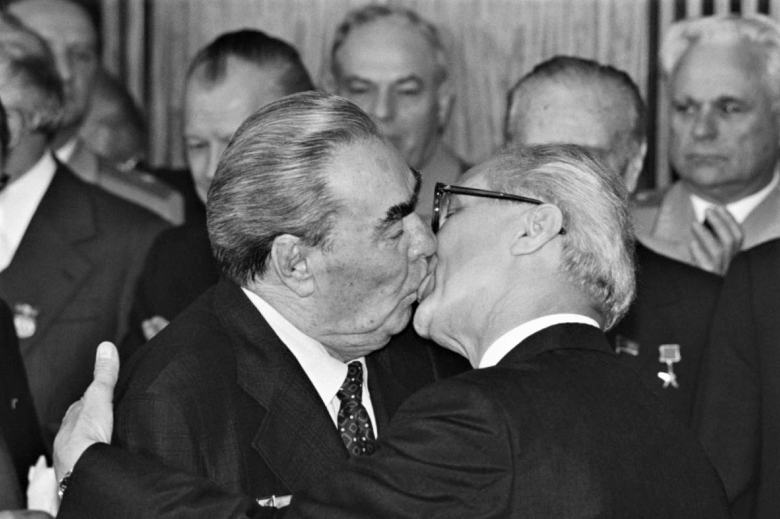
The [pro-regime] activists walked around filming anything they saw as “extremist propaganda” and drawing the attention of police officers to it. Thus, halting near a painted copy of “The Brotherly Kiss,” the famous photo of Brezhnev kissing [East German leader Erich] Honecker, Pyotr and Igor began explaining something to a policeman. “What does this mean?” Rybakov asked, pointing to the drawing. “Since Soviet leaders could do it, it turns out that…,” he answered his own question uncertainly. The police officer remained expressively silent and photographed the image just in case.
The photograph known as “The Brotherly Kiss” was taken in 1979 at a meeting between Leonid Brezhnev and Erich Honecker in Berlin during the GDR’s thirtieth anniversary celebrations. Source: Regis Bossu/Sygma/Corbis
Then they went looking for members of Left Socialist Action (Levoe sotsialisticheskoe deistvie, or LevSD, for short), having prudently abbreviated the name of the organization to “LSD,” because, after perusing “the page of this movement, [they] saw that it does not smell of any left-wing movement.” What exactly they did not fancy about “LSD” on a day when the latter were holding “an evening of letters from some political prisoners” remains unclear.
“They came and almost broke down the door,” recalls Anastasia, who organized the event. The SERB activists asked her why her movement was holding an event in support of Ukraine, a conclusion at which they arrived after seeing a couple of posts with Ukrainian flags on Lev SD’s Telegram channel. Anastasia tried to persuade them that such “flags are posted after the massive shelling of Ukrainian cities to express condolences.” A brief discussion ensued, whose acme was the following question from Pyotr Rybakov: “Did you see Soviet people publishing posts in support of Germany during the bombing of Dresden?”
This discussion was witnessed by Anastasia’s friend Andrei, a expert on the history of Yugoslavia. He was surprised that Pyotr “probably didn’t know that there was no Telegram back then” and asked what, in Pyotr’s opinion, “equates the Great Patriotic War [World War Two] with current events.” The “Serb” responded by comparing Zelensky’s regime to Hitler’s, dubbing it “absolutely fascist.” After mentioning NATO, they smoothly segued to the bombing of Yugoslavia. This discussion did not last long: Pyotr soon ran out of arguments against the facts Andrei presented. The culmination of their conversation was when Andrei asked whether the SERB activist had read Kurt Vonnegut’s Slaughterhouse Five, to which Pyotr replied that he had “never read Bunin.” Andrei recalls this conversation with a little annoyance: he says that if they had more time, he would have tried to wheedle some “less cannibalistic” information out of this “ideologically charged man” and “make him think.”
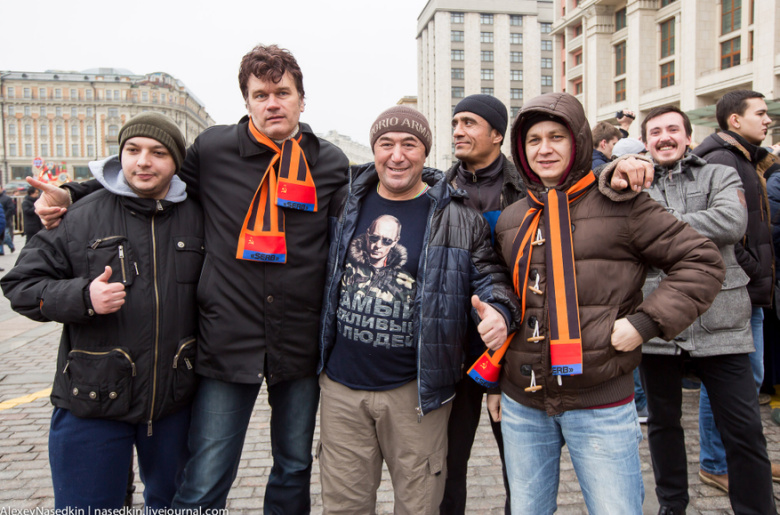
SERB leader Igor Beketov (aka Gosha Tarasevich) and his associate Pyotr Rybakov, both wearing black-and-orange scarves. Source: theins.ru.
At 6:32 p.m., a police officer let some of the people who wanted to smoke out by going out with them. It was as if he knew what the visitors were going to experience a little later.
In addition to writing letters to political prisoners event, a session of board games under the auspices of the Libertarian Party of Russia was being held in the basement of the co-working space. As organizer Vladislav tells it, the libertarians were having a quiet time when Open Space volunteer Sasha suddenly appeared and said, “We’ve got a situation: the police have showed up, the ‘Serbs’ have showed, but so far everything is fine.”
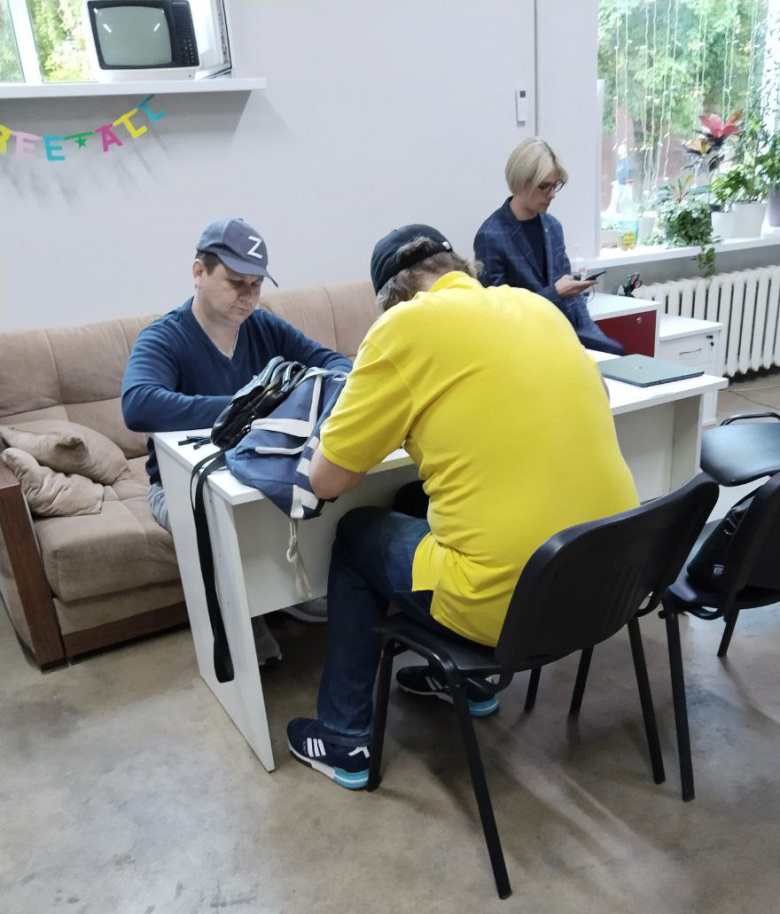
“We took note. I won at Jenga: my buddy had happily wrecked the tower,” recalls Vladislav. After that, he went to make coffee on the first floor of Open Space—where he saw the “Serbs” writing a complaint to the police.
At that moment, Andrei, the expert on Yugoslavia, made a terrible blunder for which he repented long afterwards: he offered the provocateurs Roshen caramels, a Ukrainian brand. On the table with the tea bags there was a metal box, where volunteers put sweets that keep for a long time. The ill-fated caramels were in this box on the day in question.
“You can’t get these candies so easily in Moscow—you have to make an effort to find them,” the SERB leader noted.
Forgetting about their complaint to the police, the “Serbs” paced the room talking about Roshen candies. Everyone else in the room was silent, listening attentively to their arguments. But since the entire candy argument consisted of no more than five sentences per two people—Beketov and Rybakov kept repeating the same thing—their listeners could barely contain themselves from laughing. “Sometimes candy is just candy,” Open Space volunteer Sasha finally told them and suggested they taste the caramels, adding that they were delicious. The activists resisted. “Roshen is good quality, no one is arguing about that. But they are Ukrainian candies!” they said. The conversation about candy was interrupted only by the advent of a paddy wagon.
Rybakov and Beketov writing their complaints to the police during the raid on Open Space, 18 May 2024: Source: social media
The people at the board game event hastily made to leave, but a police officer soon came down to them, and, according to Vladislav, “it was clear [we] would spend the next few hours in a less comfortable place.” The moment the policeman stepped away, Vladislav “snuck through a window.” The policeman shouted after him, summoning his partner, but Vladislav managed to escape to a subway station. Not knowing what to do, he wrote on the Libertarian Party’s Telegram channel that the police had begun detaining attendees at their event.
First, the attendees of the two events and several visitors to the space who were just minding their own business were dispatched to the police bus. One of the detainees calmly recalled how she went to the police bus: “Going to the police station isn’t the same as digging a ditch, and I was so tired anyway I wasn’t about to resist. It was a comfortable ride, but it’s a pity they didn’t bring me back.”
Anastasia, who for some reason was transported to the station separately from the others, recalls how she “snapped at the policemen while dying inside.” When asked if she had any sharp objects for stabbing or cutting, she “blurted out that only her tongue was sharp.” The policeman was amused, and a small exchange of pleasantries ensued, but he stopped laughing at her jokes as they neared the Basmannoye precinct.
Ten Open Space visitors went on the first trip to the station. I was among the second batch of six detainees. There were five seats on the Ford Transit bus, not counting the seats reserved for officers, and between the seats was a table, which Thiya occupied by placing the worksheets with the strength of material problems on it.
“More comfortable than in a economy class sleeping car,” said one of the detainees.
The “Serbs” stood by the police vehicle, taking turns proclaiming “Open Space is closed!” They seemed to enjoy the play on words. They too headed to the police station to file their complaint.
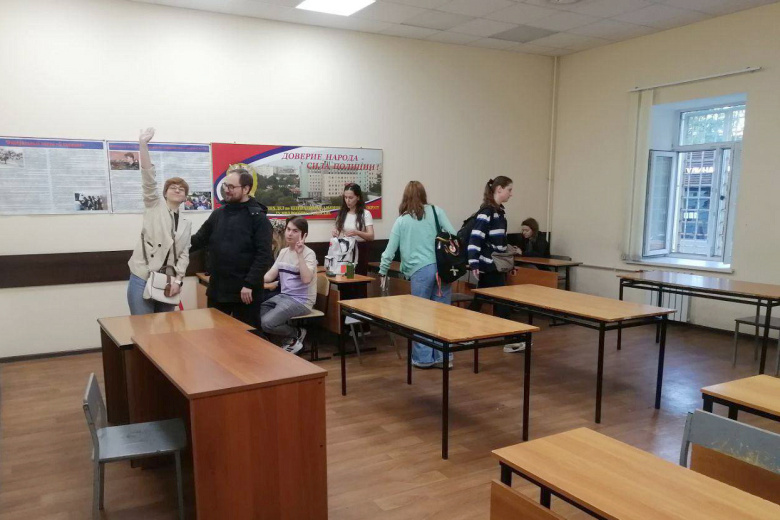
The Open Space detainees in the educational classroom at Basmannoye police precinct. Source: social media
We were taken to an educational classroom, where some of the people detained earlier were already located, as well as a couple of people who had been brought to the precinct independently of us—a young man detained for brawling and a woman who had attempted to strangle her sister. Some of the Open Space people were in another office. As transpired later, the officers wanted to take their fingerprints, and several people consented.
As one of the detainees recalls, when the officer “was taking our prints he referred to some order issued by [Interior Minister Vladimir] Kolokoltsev, dated such-and-such a day in July 2023, that all those brought to police precinctd must be fingerprinted.” There is no such order. Moreover, according to Article 13, Paragraph 19 of the Federal Law “On the Police,” an officer has the right to fingerprint a detainee only if their identity cannot be ascertained in any other way. Since almost all the detainees had [their internal] passports with them, they were used to establish their identities. And those detainees who refused to be fingerprinted and later signed statements that they refused to undergo the procedure, left the precinct even earlier than those who had been fingerprinted.
The key question we were all asked by the interrogators was whether we had anything to do with LGBT and whether we were involved in any activities related to this movement. Yevgeny, a lawyer who aid the LevSD detainees, recounted that all the police officers with whom he spoke were convinced that “this was some kind of LGBT gathering, a gay bar and so on.”
“When I told them about the event to aid political prisoners, they started telling me, ‘Come on, stop pitching us a yarn,'” the defense lawyer recalled. In response to the flyer for the event, which Yevgeny showed them, the officers told him, “That’s how they encrypt themselves.”
Around 8 p.m., we were given water and food, and journalists and a support group gathered under the windows of the classroom. At that time we were called out of the classroom to make our statements. It was my turn.
“You’ll tell me all about LGBT. I’ll tell you something too.”
With these words the interrogator started lazily looking for the copy of my passport and preparing a blank form for my statement. At that moment someone called him—probably some supervisor giving additional instructions. The interrogator mostly agreed with what the caller was saying, only at one point he uttered, “They’re mostly came to play board games, that’s all.”
Our conversation flowed smoothly, albeit with a few, brief lyrical digressions.
“What were you doing there?” the interrogator asked in a tired voice.
“I was helping Thiya do her homework, on strength of materials, as it turns out. She still has those strength of materials worksheets with there.”
“No, I forgot most of that stuff a long time ago.”
Another officer passed behind me, and my interrogator seemed to come to life.
“Listen, wait! There should be a broad in red pants out there. You cannot let her go!”
His colleague shared his worries.
“Everyone refuses to be fingerprinted.”
“The hell with them. What matters is the woman in red pants…. Don’t let anyone go at all!”
He was talking about Sasha, the Open Space volunteer.
“Nobody’s going anywhere.”
“That’s fucking great.” After a little silence, he added, drawling his words again, “The journalists haven’t arrived yet for some reason. But never mind.”
“Are you expecting them?” I asked with hope in my voice.
“They already filmed me.”
And then he complained me about how he wanted to get home, how he had already “one foot in [my] slipper, and then your gang arrived.” Suddenly, in an animated voice, he asked the key question of the evening:
“What’s up with LGBT?”
“I don’t know anything, I haven’t seen anything, I don’t belong to LGBT.”
“You getting married soon?”
“I am getting married soon,” I said, and showed him my engagement ring.
Trying to guess what material the ring was made of, he let me read the statement. When I asked him if I could get a copy of it just in case, he waved me off, saying, “Don’t even think about it.” I quotedThe Heart of a Dog, the passage about the “ultimate in certificates,” but it transpired that the interrogator had not “waded through” the novella. And he had not watched he movie version, either, because it was, from his point of view, a “cheesy farce.” He and I parted on these words.
Inside Basmannoye police precinct
While I was giving my statement, an officer came into the educational classroom and asked whether there was a “competent person” among those present, meaning someone legally literate, apparently, someone whou would write a refusal to be photographed and fingerprinted, so that everyone could write their own refusals using his as their model. Such a “competent person” was found, and the question itself provoked laughter among the detainees.
After my return to the “waiting area,” Thiya went to her interview, her strength of materials worksheets in tow. She returned twenty minutes later with a look of bewilderment on her face. The fact is that she is getting married soon—but not to me—and in the process of making her statement, the interrogator, after finding out that Thiya also had nothing to do with LGBT and was also getting married soon, assumed that she was getting married to me. Thiya wasn’t about to argue with him.
The interrogator reread her statement aloud: “I am getting married. I am not inviting the chief of police.”
“The above is an accurate record of my statement,” Thiya added in writing to the end.
One of the detainees who heard this conversation saw my surprised face—I was planning to marry someone else after all—and gave me a piece of advice.
“When questioned later, you answer that it was dark, and that’s why you mixed up [the fiancees].”
“Uh-huh. I was drunk, I don’t remember!” I joked back, and we laughed together.
“Seryoga, did you count the number of [detainees]?” one of the officers asked my interrogator in the meantime.
“I don’t fucking know. How many are there supposed to be? There’s a whole fucking busload of them, a whole fucking classroom of them. Count them as a pack,” Seryoga the interrogator replied. At some point he took the worksheets from detainee Thiya, scrutinized them, and pointed out a flaw in the diagram to her.
Meanwhile, Vladislav the libertarian was walking towards the police station—he wanted to support his comrades. His fellow party member Georgy Belov was signaling to him from the window: fearing that Vladislav would be detained by the police, he waved his hand at him, telling him to get away. One of the officers at the Basmannoye police department did head toward Vladislav, but he managed to escape again. He then went to the store to buy food to give to his fellow party members and, as he put it, “our buddies from LevSD.” Some time later, LevSD and LPR agreed to hold joint events, primarily debates.
At 8:30 p.m., the officers at the station detained Vladislav all the same. When he and the other libertarians at large brought the care package, the policemen noticed him standing under the windows and took him inside.
Vladislav the libertarian is detained outside Basmannoye police station. Source: Rus News
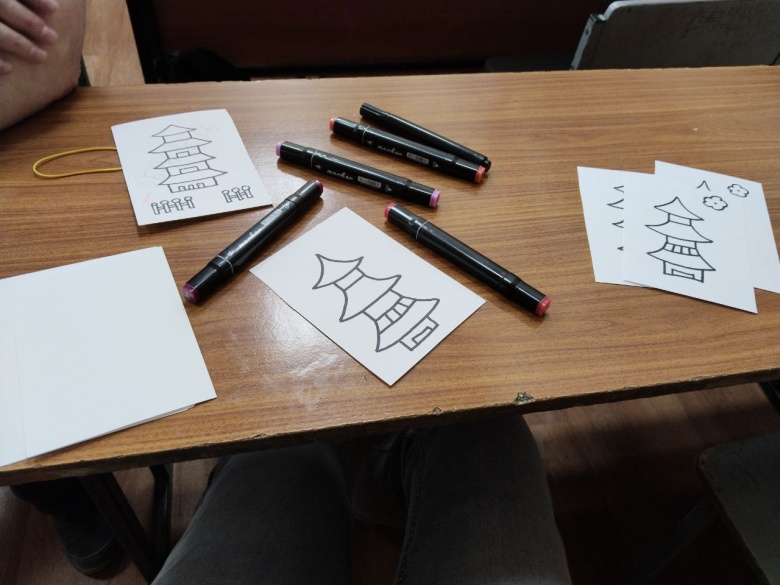
My attention was drawn to a female detainee who at some point started making postcards for political prisoners. She said that she would send them with the note “A postcard from Basmanny police station.” Someone wanted to work, but since there was no free Internet in the department, they were unable to. “I’m giving them a negative rating for not having wi-fi,” a young woman joked.
Anastasia was indignant.
“We are locked up here, a group of people who were not involved in anything criminal at all, while locked up here as well are a young man who was nicked for brawling and a woman who tried to strangled her sister. Instead of dealing with these people, the cops are dealing with political activists.”
This made her so angry that she stopped being afraid.
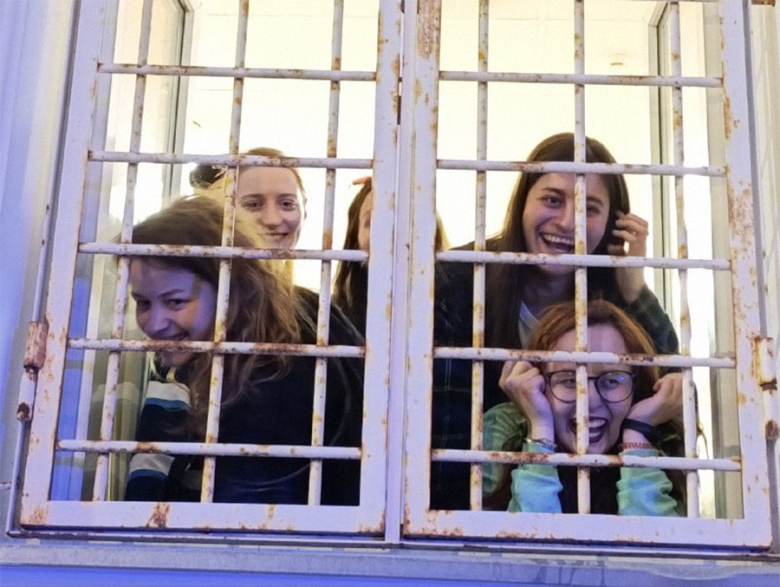
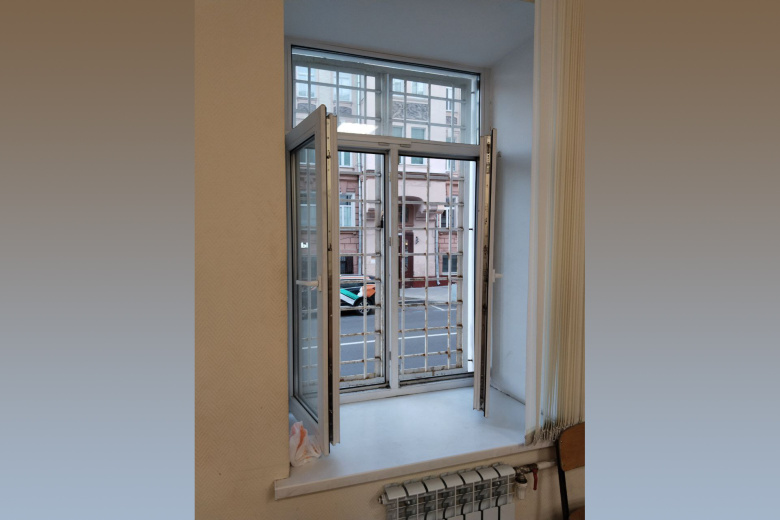
At some point, all the officers in the precinct left our part of the department. The metal door leading to the officers opens with a key card, so we had no communication with them. For a little over an hour we had “free time.” Everyone socialized, joked, and planned where they would go to drink beer after we were released, while some of the detainees chatted with the support group outside since the windows were open. And if it were not for the bars on those windows, it might have seemed that the detainees had not even left the co-working space.
From Open Space to Basmannoye police precinct. Source: social media
At around 10 p.m., the interrogator and another officer (the head of the department, probably) brought all the paperwork. They caloled the detainees by name, collecting their papers—the copies of their passports, fingerprinting refusals, and statements—and handing back their passports and escorting them to the queue for release.
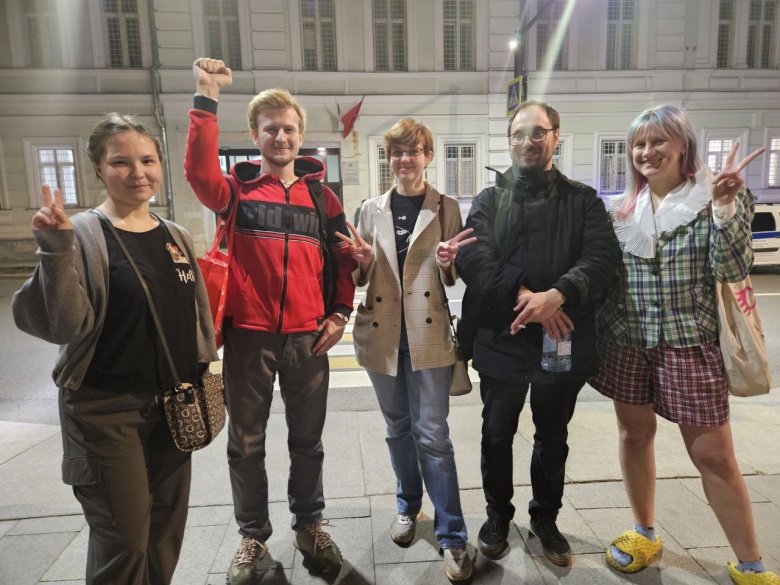
At first, those who had not been fingerprinted were released, because “the staff had lost their fingers” [sic]. At 10:07 p.m., I found myself outside with a group of detainees. We waited for the others to be released. Journalists taped our commentary for their news dispatches. At that time, Sasha, the Open Space volunteer in the red pants, was driven away by the Basmannoye police officers for an inspection of the “crime scene,” during which they confiscated several stickers and posters. The last detainee, libertarian Georgy Belov, was released at 11:34 p.m.
Activist Alexandra (“Sasha”) Kalistratova on the seizure of stickers and posters in Open Space by law enforcers. Source: Rus News (Telegram)
“I feel like we had an interesting, productive time, but it was complete fucking rubbish per se,” said one of the female detainees. “Saturday night was unforgettable,” concluded Andrei.
Impact of Discrimination on Integration of Emigrants From the Aggressor Country (with Ivetta Sergeeva)
Following the full-scale invasion of Ukraine in 2022, up to one million Russians fled their homeland, marking the most significant brain drain since the Soviet Union’s collapse. While some host countries view the highly educated and politically active migrants as an asset, integrating nationals of the aggressor state has presented challenges. Many migrants face institutional restrictions aimed at sanctioning Russia, alongside varied experiences of discrimination from local populations. This study delves into the effect of discrimination on the assimilation intentions of Russian migrants, focusing on language learning as a key indicator. Laitin’s model of identity building suggests that migrants’ willingness to assimilate depends on the perceived benefits, including acceptance by the host society. Following the model, Sergeeva assumes that discrimination signals to migrants that the host country’s society does not accept them, making learning the local language a less rational choice.
Utilizing a cross-sectional panel survey, the study establishes a link between discrimination and integration, differentiating between the effects of discrimination experienced from local citizens and local institutions on language acquisition. Findings reveal that societal discrimination significantly dampens migrants’ willingness to learn local languages and diminishes their trust in and attachment to host societies, unlike institutional discrimination, which shows no such effect on language learning. These insights contribute to an understanding of the impact of nationality-based discrimination, highlighting the role of societal acceptance in the successful integration of political migrants.
This event will be hosted in person and virtually on Zoom. Register for the Zoom meeting here. Non-NYU affiliates must RSVP for in-person campus access.
Ivetta Sergeeva is a PhD candidate at the European University Institute in Florence. She specializes in political behavior, civil society, and Russian emigration. She is a co-founder and co-principal investigator of OutRush and ViolenceMonitor (a series of surveys on intimate partner violence in Russia). She also has eight years of experience supervising projects in civil society and human rights organizations in Russia. Website: www.ivettasergeeva.com. Email: ivetta.sergeeva@eui.eu.
Date: 29 April 2024 4:00 PM – 5:30 PM
Speaker: Ivetta Sergeeva
Location: Jordan Center, 19 University Place, New York
Professoressa on the Pole* is the result of Polina Kanis’ investigation into the perceptual transformation of the female body in Russia following the onset of the full-scale invasion of Ukraine and subsequent ideological shift within Russian society. As part of this investigation the artist trained as a pole dancer and worked at a strip club.
The exhibit includes photographs documenting Kanis’ three-month stint at a strip club, the club’s rules of conduct for strippers, and a video re-enactment of the artist’s stage performance. The project marks the latest chapter in Kanis’ ongoing research into the changing role of a female teacher in Soviet and post-Soviet Russia, where limitations imposed by the state can only be counter-balanced by imagination.
*Professoressa (Italian: female teacher) refers to the 1967 manifesto Letter to a Teacher (Letters a una Professoressa), which harshly criticizes the power structure and classism of the educational system in 1960s Italy.
location: Expo
price: €5, tickets for a performance of the CARTA ’24 festival give free admission
duration: 5h
extra info: wed – sun: 14:00 – 19:00, evening performances until 22:00
Nadya Tolokonnikova, an artist who is founder of the feminist collective Pussy Riot, has long been persecuted in Russia for her conceptual performances and artistic protest against the Putin regime. Her performance Punk Prayer in the Christ the Savior Cathedral in Moscow, recognized by The Guardian as one of the most important artworks of the twenty-first century, ended for her and her colleagues with imprisonment for “hooliganism motivated by religious hatred.”
OK LINZ is bringing Nadya Tolokonnikova’s art to the museum, presenting her haunting works dealing with resistance, repression, and patriarchy for the first time to the European public.
Tolokonnikova’s oeuvre encompasses objects, installations, and performative works in which she processes her traumatic experiences during her life under Putin. Out of a state of repression, she has developed a visual language that rebels against aesthetical and political realities: anarchic and radical, yet also moving and witty.
“Being from Russia brings me pain. Most of my life, even after 2 years imprisonment following my art protest, I chose to stay in Russia, even though I had plenty of opportunities to immigrate, I tried to change Russia, make it a country that I would be proud of—peaceful, prosperous, friendly, democratic, loving, a country that values human life, art and happiness. First with Voina Group, later with Pussy Riot, I’ve been in performance art since 2007, for 17 long years—years filled with joy of protest and comradery, harassment, arrests. I watched my friends being murdered and revolutions suffocating under Putin’s boot.“ —Nadya Tolokonnikova
An oversized blade hangs like a sword of Damocles over visitors to the OK. “Shiv” is the title, American prison slang for an improvised knife. It stands for the precarious situation of artists and activists in Russia who, like Tolokonnikova herself, live in constant fear of persecution by the Russian judiciary. The exhibition will spotlight a selection of Situatioinist actions by Pussy Riot. At the center is Tolokonnikova’s 2022 performance Putin’s Ashes in which she joined forces with twelve women from Ukraine, Belarus, and Russia who experienced repression and aggression at the hands of the Russian president to burn a portrait of Vladimir Putin in a desert, collecting the ashes in small bottles.
“This art is a weapon,” says Tolokonnikova of her works, analyzing and exploring in this way the role that her art and she herself can play in the context of international power structures.
Curators: Michaela Seiser / Julia Staudach
Source: e-flux mailing list, 22 April 2024
Akhmatova’s Orphans International conference Princeton University 3-5 May 2024
May 3
4:00 pm–5:00 pm. Location: Firestone Library
The Anatoly Naiman Papers. Visit to the Special Collections
Presentation by Thomas Keenan-Dormany, Slavic Librarian
5:00 pm–6:30 pm. Location: McCosh 50
Rock. Paper. Scissors (2023)
Documentary film screening
Q&A with the co-author Anna Narinskaya
7:00 pm
Reception at the Levings’ residence (Shuttle provided)
May 4
Location for all talks: 245 East Pyne
9:30 am
Breakfast at East Pyne
Session 1
10:00 am–12:00 pm
Veniamin Gushchin, Columbia University
Late Akhmatova and Philology: Intertextuality, Interpretive Communities, and Effective History
Evgeny Soshkin, Free University / Brīvā Universitāte (Latvia)
Akhmatova’s Dead Orphans: Toward the History of a Paradox
Gleb Morev, Independent researcher
Akhmatova and Brodsky
12:00 pm–1:00 pm
Lunch
1:00 pm–1:40 pm
Keynote speech
Roman Timenchik, The Hebrew University of Jerusalem / PrincetonUniversity
Akhmatova’s Orphans and the Literary Orbit of the 1960s
Session 2
2:00 pm–4:00 pm
Dmitry Bobyshev, University of Illinois Urbana-Champaign [via Zoom]
On the so-called ‘Akhmatova’s Orphans’
Emily Lygo, University of Exeter
Dmitry Bobyshev’s Poetry of the Turn of the Century
Marco Sabbatini, University of Pisa
“Out of the Magic Choir”: Viktor Krivulin and the Leningrad Underground Poetry on Akhmatova and her Orphans
4:00 pm–4:30 pm
Coffee break
4:30–5:50 pm
Sofia Guerra, Princeton University
Anatoly Naiman’s Translations from Giacomo Leopardi
Benjamin Musachio, Princeton University
Estrada as a Fault Line: Akhmatova and Company vs. Evtushenko
6:00 pm–7:30 pm
Location: East Pyne 010
Akhmatova’s Orphans. Disassembly (2024)
Documentary film screening
Q&A with the director Yuri Leving
7:30 pm
Dinner
May 5
Location for all talks: 245 East Pyne
9:30 am
Breakfast at East Pyne
Session 1
10:00 am–12:00 pm
Maya Kucherskaya, Jordan Center, New York
Solo in a ‘Magic Choir’: The Case of Joseph Brodsky
Michael Meylac, StrasbourgUniversity [via Zoom]
An Enchanting (!) Chorus (?): Different Poets of Dissimilar Fortunes
Alexander Dolinin, University of Wisconsin-Madison
Brodsky’s Poem “Darling, I left the house today…” in the Context of Poetic Tradition
12–1 pm
Lunch
1:00 pm–1:40 pm
Leningrad Poetic Circles of the 1960s Through the Camera Viewfinder
Roundtable devoted to photography of Boris Shwartzman, Mikhail Lemkhin and Lev Poliakov
Session 2
2:00 pm–4:00 pm
Polina Barskova, Berkeley University [sic!]
Depiction of Links and Ruptures of Time in Evgeny Rein’s Poetry
Oleg Lekmanov, Princeton University
On Evgeny Rein’s Poem “In the Pavlovsky Park”
Anna Narinskaya, Independent researcher, Berlin
The Orphans and Jews
4:00 pm–4:30 pm
Coffee break
Session 3
4:30 pm–6:45 pm
Translating Poetry of “Akhmatova’s Orphans” into English
An Open Workshop: Kathleen Mitchell-Fox, Emma George and Ilya Kaminsky, Princeton University
Lev Oborin, Berkeley University
Anatoly Naiman’s “Vegetation”: Towards Poetology of Branching
Maria Rubins, University College London
Is Brodsky a Poet for Our Time?
6:45 pm
Dinner
Organizing Committee:
Yuri Leving, Chair
Ekaterina Pravilova, Ilya Vinitsky and Michael Wachtel
Sponsored by REEES, PIIRS, and Department of Slavic Languages and Literatures, Princeton University
“Adios, America! Now it’s only this way (tacos). End of story.”
This ultra-patriotic gem was just beamed to me by my fellow Petersburg psychogeographer V., who found it forlornly pasted up in the former “party zone” on Dumskaya and Lomonosov streets in downtown Petersburg, a quarter which was thoroughly purged last year by the local powers that be for no good reason.
A quick scan of the QR code leads to the now-equally shuttered website El-Chapo.rf. According to the restaurant review site Restoclub, El Chapo is “closed indefinitely.” But what it must have been back in its heyday, during the first year of Russia’s glorious war against fascist Ukraine and its Western puppet masters!
Dance bar with Mexican cuisine on Lomonosov Street. El Chapo serves Mexican cuisine: quesadillas with oyster mushrooms, burritos with shredded beef and shrimp in coconut. To try the spicy chimichanga tortillas with meat, you have to sign a special contract. Here they mix cocktails based on tequila, rum and house-made tinctures. At the bar you can have your photo taken with local star Frida the Pig. El Chapo hosts DJ sets and parties, and plays Mexican rap, funk, and sometimes disco.
The once lively (and, in the early 2000s, avowedly ethnically and internationally tolerant) Dumskaya bar district is indeed now a ghost town, as witnessed by another snapshot which V. sent to me. ||| TRR
After breathing a sigh of relief, this was the first question that popped in my head:
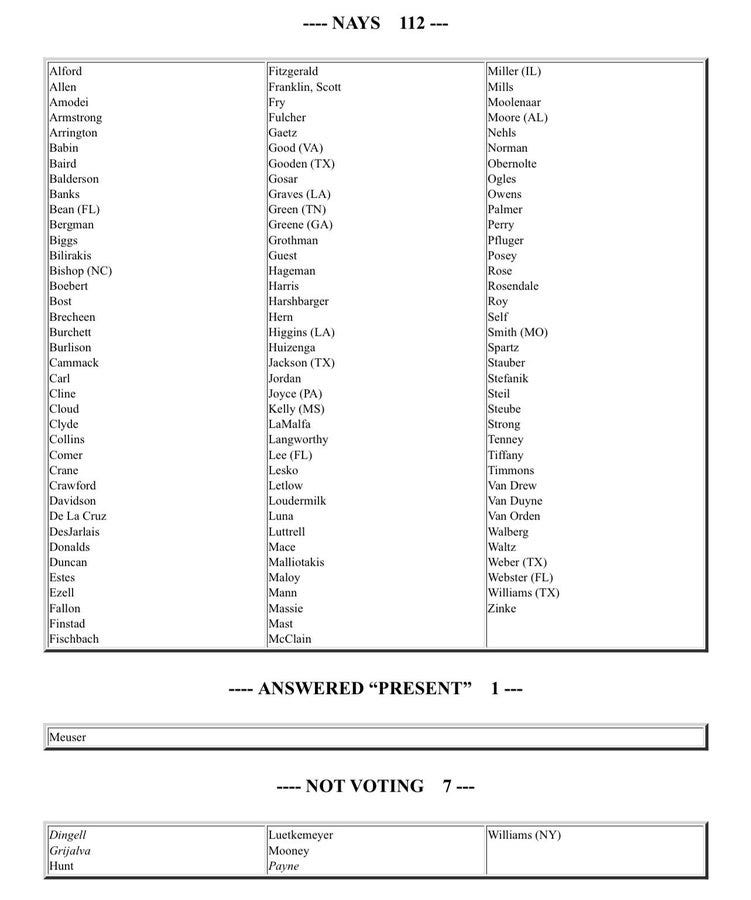
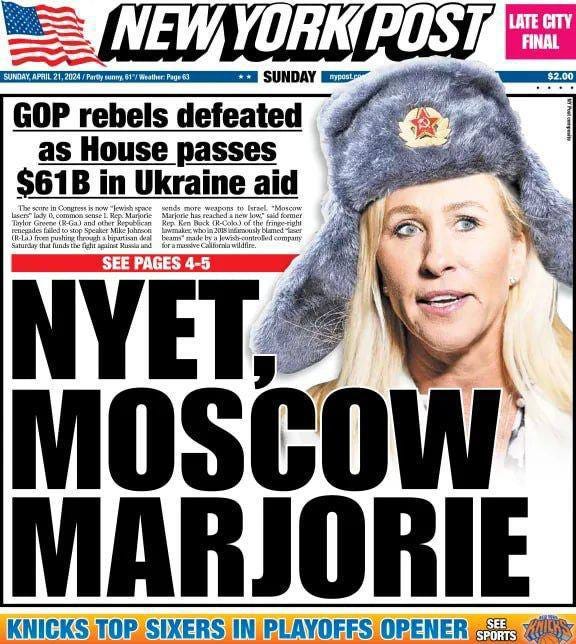
Who are the 112 U.S. representatives who thought it was a great idea to unilaterally disarm Ukraine, an ally that is fighting for its survival against a U.S. adversary?
The list was published almost immediately.
My reflection is not about these particular people in particular, but the fact that in Washington, and in capitals across Europe, a hefty number of our democratically elected representatives are brazenly siding with Russia, a totalitarian state which has the aim of not only weakening our democracies but bringing defeat to our entire system and the international rules based system. They are siding with the destruction of a sovereign state, Ukraine, and the occupation of its territory and citizens.
Marjorie Taylor Greene is in the company of Matteo Salvini (head of the League), Giuseppe Conte (former Italian PM), and so many other European politicians who may be motivated to side with Russia for a variety of reasons. It speaks to the penetration of Russian capture in some cases, or industrial and commercial interests influencing our political base. Since Russia has no ideology at the present time, I’m assuming they agree with the neo-realist worldview which would see large states eat up smaller ones by force simply because they can, throwing out the entire concept of state sovereignty.
If they have been captured and are working for a foreign adversary, there is no indication that any of them (at least in Italy) are under investigation. The only way we can rid our system of elected representatives working openly in the interests of an adversary to the detriment of our national interests is to vote them out. In Italy, that isn’t possible because even if a head of a party loses an election, he/she can still remain in their place and continue working in the interests of Russia: see Salvini and Conte.
This is why I am overjoyed that the House has belatedly passed the aid to Ukraine bill, but unspeakably frustrated with our inability to rid ourselves of people who are ready to throw our security, and Ukraine, under the bus.
Dmitri Medvedev meltdown: He’s hoping for a civil war in the U.S.
No one doubted that American lawmakers would approve “aid” to a gang of neo-Nazis. It was a vote by the joyous bastards of the state:
a) in favour of continuing the civil war of the divided people of our formerly united country;
b) for maximising the number of victims of this war.
We will win, of course, despite the 61 billion bloody dollars that will mostly go down the throats of their insatiable military-industrial complex. Strength and Truth are behind us.
But in view of this Russophobic decision, I cannot but wish with all sincerity that the United States would plunge into a new civil war as soon as possible. Which, I hope, will be cardinally different from war of the North and the South in XIX century and will be conducted with application of planes, tanks, artillery, MLRS, all kinds of missiles and other weapons. And which will finally lead to the ignominious collapse of the vile evil empire of the XXI century – the United States of America
Russian President Dmitry Medvedev became the first Russian to get the brand new iPhone 4, which are to go on sale on Thursday.
The Russian leader received the smarthphone [sic] as a present from Apple CEO Steve Jobs during his visit to the company’s headquarters in Cupertino, California.
At 9.3 mm the iPhone 4 is 25 percent thinner than its predecessors and the thinnest smartphone on the market. The gizmo also boasts a state of the art battery, with seven hours of talk time and 300 hours of standby.
According to the Russian mobile operator Beeline, the brand new device may appear on the Russian market no earlier than September.
During his visit to the Silicon Valley the Russian leader also visited the U.S. office of the Russian search engine Yandex.
The Yandex Labs center, based in Paolo Alto, California, is involved in scientific projects concerning mainly the optimization of online search technologies and other advanced research activities.
The president was accompanied by Yandex CEO Arkady Volozh and the chief technology officer of the Silicon Valley-based Yandex Labs, Arkady Borkovsky.
I think that most of us have not yet understood that the world of Russia has once again, like a century ago, split in two, like an iceberg, and its two halves, the bigger and the smaller, are rapidly drifting apart. It’s just that the split happened less dramatically, without the crowding onto the last steamship, without the “we departed from Crimea amidst smoke and fire” [lines from a poem by White émigré Nikolai Turoverov]. The split has been dragged out in time, and the crack wasn’t so wide at the beginning. Some people are still hopping from one iceberg to the other.
“Endless War”
And yet—that’s it. There are two Russias again. Many people—in both halves—cannot or are afraid to recognize this. It’s time to stop hopping, otherwise you’ll leap to one side and won’t be able to hop back again.
Hopes for the swift fall of the rotten regime (also just like one hundred years ago) have been disappointed. It’s plenty rotten but rot, as everyone knows, spreads.
Last time it took seventy years to root it out. This time it probably won’t take as much time; time moves more quickly in the twenty-first century, but you still have to unpack the suitcases and settle in for a long wait.
“Anticipation of White Nights”
What will happen with the ‘little’ Russia, scattered across different countries, is pretty clear. [Russians] who are younger or more active or more professionally cosmopolitan will assimilate with varying degrees of success. [Russians] who are older and professionally tied to the language and culture will sadly sing “while the light has not gone out, while the candle burns” [a line from a famous Mashina vremeni song] and will support that little flame as long as they have the life and strength for it. This work of theirs is not pointless or in vain, because in ‘big’ Russia there are still a great many people for whom that light will be precious and necessary.
In the mother country—goddamn déjà-vu—things will soon be utterly unbearable. In the longstanding two-hundred-year struggle between the Asiatic state and European culture the Horde has triumphed once again, now zealously working to asiatize the culture. (There is nothing malign about Asia and its culture, which of all people I, a specialist in Asian studies, should know; I am talking about political Asia, in which the state is everything and the individual is nothing.)
The culture of the mother country will be censored, hollowed out, thrust onto all fours and taught to wag its tail. We’ve seen it, we remember. Later, of course, a counterculture will take shape, [yielding] virtuosos of Aesopian language and furtive rude gestures. We remember that too: we had plenty of it. The emigres will coo condescendingly over any vivid manifestations of censored culture—like Nabokov did over Okudzhava. Those in Russia will secretly pass around tamizdat editions. And publish in the West using pseudonyms.
How dreadful and boring this all is, ladies and gentlemen. Russia’s national anthem: “We sowed and sowed the grain, we will stomp and stomp the grain” [lines from a Russian folk song].
For some the price will be their profession, for others poverty or emigration. The most noble will give up their freedom. And even their lives. The higher quality the person, the greater the cost.
And it is all worth it. This is what I’ve been thinking and why I wrote this text, not at all because I wanted to drive you into even greater despondency.
More so than all of us together, each of us individually is facing a big test. We can’t flunk.
Stop referring to “Asia” and “the Horde.” Why insult millions of people in the world and in Russia itself? You are not helping the “little” Russia” in any way.
I see that Akunin has again written something about Asia (where “the state is everything and the individual is nothing”) defeating European values in one particular country.
The point is that Russian intellectuals are, historically, not so fond of anything as repeating German vulgarities. And “Asian” metaphors are the favorites of Germans, and there is no degree of blatant idiocy at which they would stop.
For example, Adenauer explicitly claimed that the “Asian steppes” begin east of the Elbe. (He considered Prussia to be Asian, and so Bismarck’s triumph was an Asian conquest of Germany. Adenauer added the steppe by association.)
No matter how many decades have passed, the pre-war German spirit cannot be taken out of the Russian pamphleteer, and the fear of appearing ridiculous is as alien to them as it was to their mentors.
Quite correct thoughts in general, but there is one big catch.
How does Akunin (Chkhartishvili) differ from those Sieg Heiling in Russia when he starts using “Asia” in such a context, in such a comparison, even with a caveat? Maybe someone will say that I am wrong to try and compare him with the Sieg Heilers. Let me put it another way, then. How does a very good writer differ from those who are called white supremacists in the west?
I recently listened to a very interesting lecture on racism. The lecturer made a rather loose, but interesting ranking, singling out the racism of Soviet people as a separate species.
For some reason, some Europeans, when speaking about Asianness, “forget” about the Inquisition, concentration camps, and many other terrible events in history. Or are these also manifestations of Asianness?
We should also not forget that the current world order is also largely a product of European civilization with all its pros and cons.
One last thing, about why I decided to react in this way to Akunin’s statement, which are quite congenial to my own thoughts. It seems to me that a respected public figure should always think about the consequences of their words and deeds.
[…]
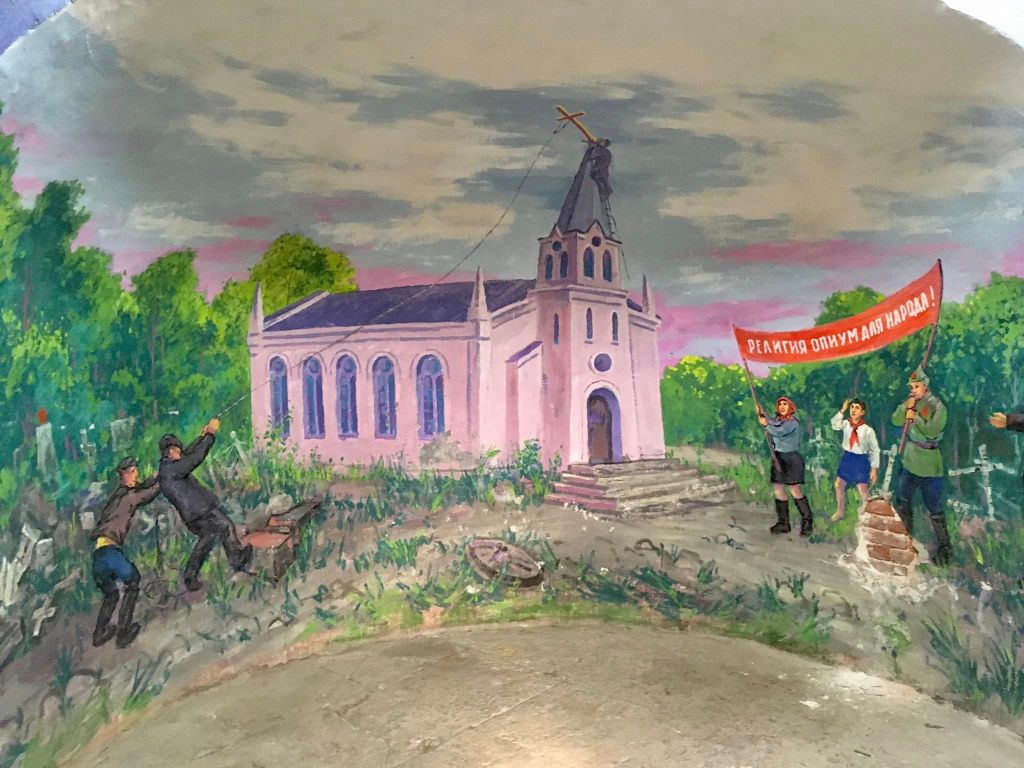
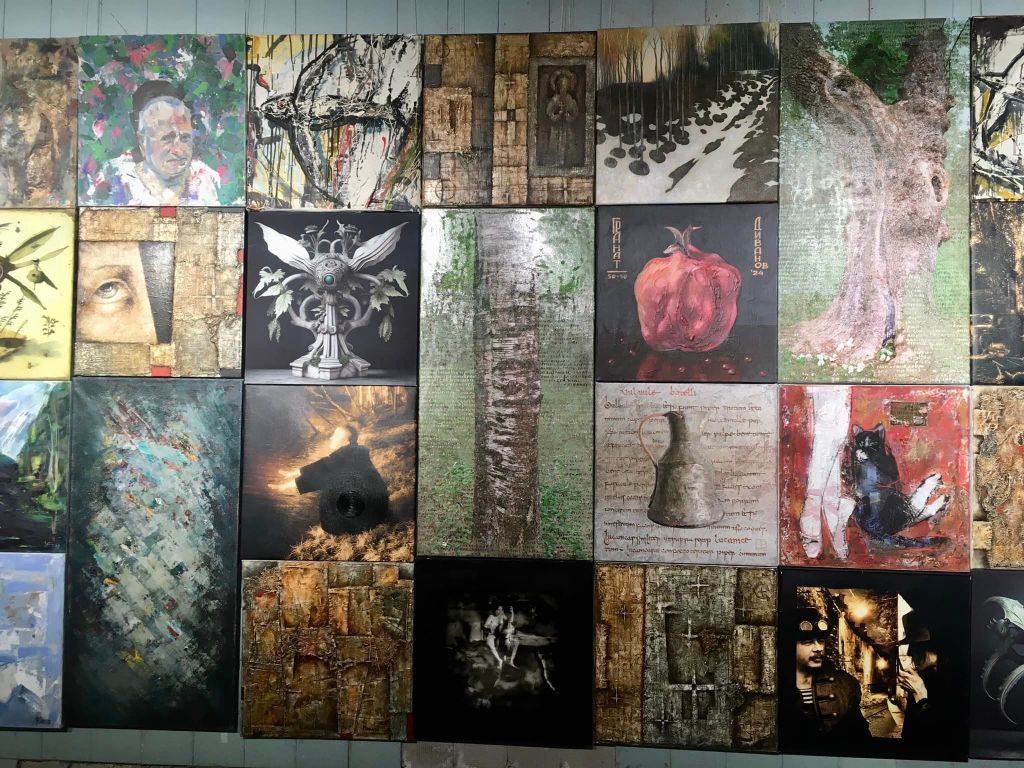
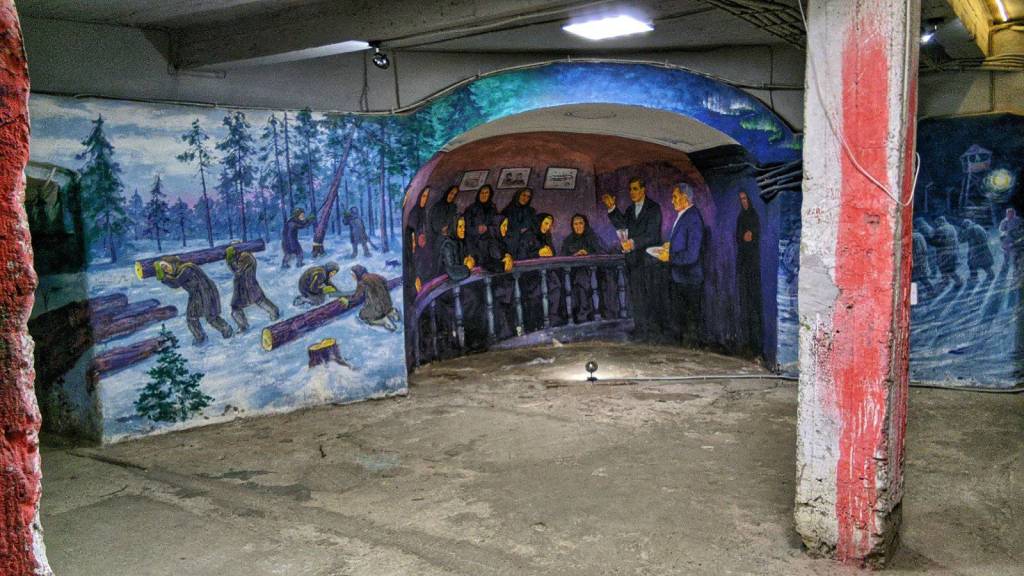
Source: Asya Rudina, “‘The world has split in two:’ the Runet discusses Akunin’s post about the two Russias,” Radio Svoboda, 1 April 2024. Translated by the Fabulous AM and the Russian Reader. The reactions, above, to Akunin’s outburst were not typical. Most of the best-selling author’s fans echoed his sentiments. The photos, above, by our friends V and M, were taken today at an exhibition currently on view in the former swimming pool and catacombs in the so-called Petrikirche on Nevsky Prospekt in downtown Petersburg. They suggest, I think, that the reality on the ground in “big Russia” (and “little Russia” as well) is slightly more complicated than Akunin would have us believe.||| TRR
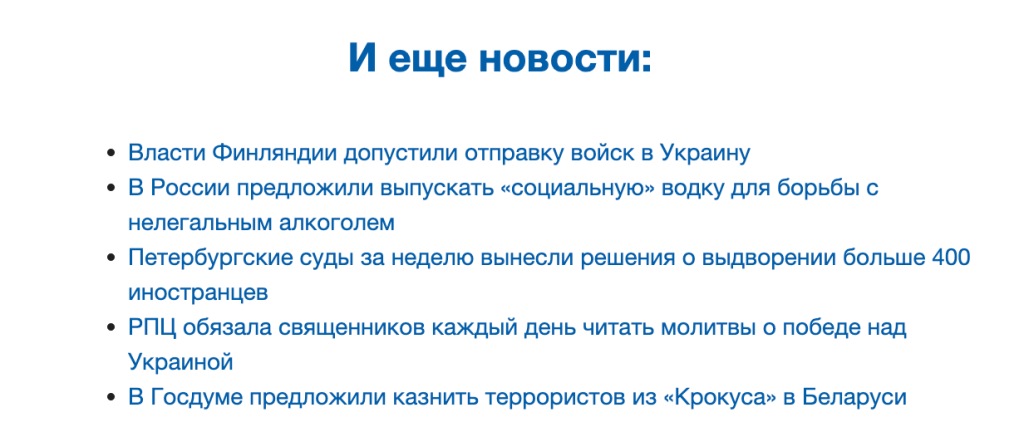
Source: Moscow Times Russian Service daily newsletter, 1 April 2024. Translated by the Russian Reader. Unfortunately, none of these headlines is a joke.
State Duma (Russia’s lower chamber of parliament) Maria Butina has proposed an option that would allow the Russian authorities to implement the previously voiced threat to execute those involved in the Crocus City Hall terrorist attack. Agenstvo news agency says she has proposed to extradite the Crocus City Hall terror attack suspects to Belarus, which maintains the death penalty.
“Unfortunately, the tragedy has become common to us, because citizens of Belarus also died there. I am quite knowledgeable about your legislation, including the death penalty, which is maintained [in Belarus]. In this case, it is the murder of two or more persons, therefore you have exactly the same right to try these people as the Russian Federation,” MP Butina was quoted as saying.
“I think that discussions are already underway among the competent authorities. If they count on the fact that, since Russia has imposed moratorium on the death penalty they will be able to escape this type of punishment, then let’s wait and see, because negotiations are underway,” Butina was cited as saying in an interview with Belarus 1 TV Channel.
Pervy Otdel (First Department) lawyer Yevgeny Smirnov told Agenstvo that “indeed, the Russian legislation allows, on the basis of an international agreement, to extradite people who committed a crime in the territory of Russia to another country.”
According to him, “if a request arises from Belarus, the agreement with it will have priority over Russian norms.”
“However, in the case of at least one accused — Alisher Kasimov, who rented out the apartment to other defendants – it is impossible, because he has Russian citizenship,” Smirnov noted.
Belarus still maintains the death penalty.
Capital punishment is a legal penalty in Belarus. At least one execution was carried out in the country in 2022. Also known as an Exceptional Measure of Punishment it has been a part of the country’s legal system since gaining independence from the Soviet Union on August 25, 1991. The current national constitution prescribes this punishment for “grave crimes.” Later laws have clarified the specific crimes for which capital punishment can be used. The death penalty can be imposed for crimes that occur against the state or against individuals. As of 2021, Belarus is the only country in Europe that continues to carry out the death penalty.
Maria Butina (born November 10, 1988) is a Russian politician, political activist, journalist, and former entrepreneur who was convicted in 2018 of acting as an unregistered foreign agent of Russia within the United States.[
While residing in Washington, D.C., Butina was arrested by the FBI in July 2018 and charged with acting as an agent of the Russian Federation “without prior notification to the Attorney General.” In December 2018, she pleaded guilty to felony charges of conspiracy to act as an unregistered foreign agent of Russia. In April 2019, a federal judge sentenced her to 18 months in prison. She served around five months at Tallahassee Federal Correctional Institution. Her 9-month pretrial prison term was counted towards her sentence. She was released and deported back to Russia in October 2019. She publicly denied being a Russian spy. In 2021, she was elected to the State Duma as a member of United Russia.