Basurka

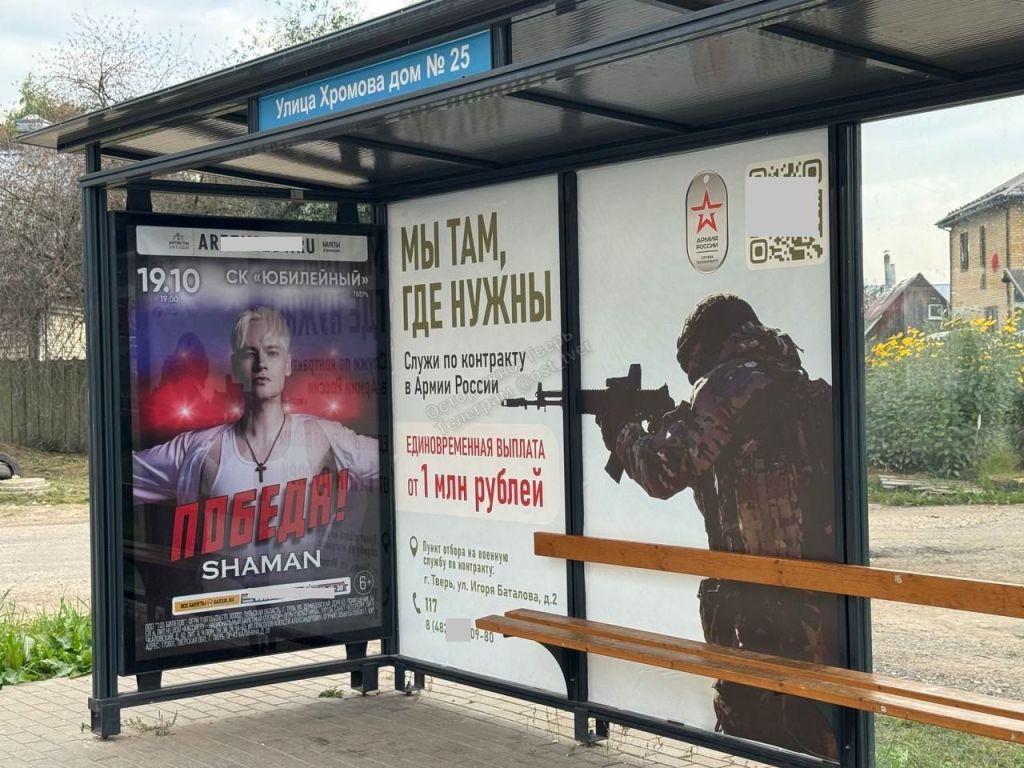
Top: “25 Khromov Street.” Left: “Shaman: Victory!” Right: “We are there where we need to be. Serve as a contract soldier in the Russian Army and get a one-time payment starting at one million rubles.”

Source: Caution, Tver! (Telegram), 1 September 2024. Thanks to Andrey Anissimov for the heads-up. “Basurka” is the faux-Russian nonce word I coined for this distressing post. It was suggested to me by our building’s bilingual garbage bin. ||| TRR


Many acquaintances from Russia condemn me for calling for the bombing of Russian factories and supporting the Ukrainian army’s Kursk offensive. They genuinely don’t get how one could wish defeat on one’s own country. Some have quietly unfriended me, while others continue to read my posts but are perplexed and perhaps even offended by them.

They are often the same people who “love (their) country no matter what.” This is where you all and I part ways. You REFUSE to look at reality—you turn away from it in order to love your country without breaking a sweat, as if love were a chain and you’ve been chained to a radiator since childhood. It works differently for me. I make my own decision about whether I like this scene or not. And, if my country jumps from one bloody shitstorm to another like a maniac running in circles, it’s not worthy of my love and I rescind its right to be my country. People are another matter, especially the unborn. It makes sense to fight for them. But it’s secondary to me what the country they’ll live in will be called and how big it will be. If they’ll have a better chance for a decent and safe life in a small country, then we should choose a decent and safe life for them.

Russia is an anti-human phenomenon. It is a threat to the entire world and to the people within the country. Like any rabid macaque with a grenade, it must be stopped. Look reality in the eye at last. Don’t look away. It’s happening right now, and you, with your unadulterated love, are a part of it.

Image number one. A fourteen-year-old girl dressed in white sneakers and a white tank top, sitting on a bench in the yard of her house on an ordinary summer day. It all looks ordinary, but there is one catch: the girl is dead. A fragment of a cluster bomb, which the Russians dropped on Kharkiv on 30 August, tore off the child’s head. Everything happened instantly; no one had time to hide. The girl’s body remained seated on the bench. Perhaps her last thoughts were of her father, who had gone missing in action in the war with Russia. The family knows he was killed, but they can’t get his body back. The worst part is that he gave his life thinking he was protecting his daughter. Russia got to her, though, and so the family’s story is over. Father and daughter are not alive because they were born near Russia. Other Kharkiv residents who were killed in that senseless attack are also “guilty” in this sense.

Image number two. A girl again, but from another city. She is fifteen years old and has come to Novosibirsk from the Altai to enroll in the Olympic reserve school. She is quite beautiful, gentle, kind, and has great hopes. She doesn’t understand why her fellow students call her a “dirty, slant-eyed pig.” They secretly pour waste into her backpack and mock her appearance in public. After two years of this terror, which was encouraged by coaches and school officials, the formerly cheerful girl will come to realize that this life is not for her. In her seventeenth year, she will kill herself and leave a suicide note on her Telegram channel. She will say in the note that the unbearable racist bullying was her reason for leaving this life.

The school will then post a touching obituary on their Vkontakte page. They won’t specify the cause of death, of course. All comments expressing outrage over the bullying will be assiduously deleted. Only the wishes of “soft clouds” and broken heart emojis will be left untouched.

Incitement to suicide is a criminal offense, actually. But no one will answer for the death of Ksenia Cheponova because it is not the custom in Russia to punish one’s own kind for a crime against outsiders. “You’re not my brother, black-ass louse,” says the immortalized Russian movie hero. These words are much more than a mere insult: this is how millions of people in Russia understand justice. Moral rightness is not based on your deeds, but on whether you are an insider or an outsider. It doesn’t matter what you did. What matters is whether you are stronger than me at the moment.

Ksenia Cheponova

Image number three. Beslan. September first marked the twentieth anniversary of the mass murder of children by Russian security forces in that ill-fated school. For twenty years, the perpetrators have never been held accountable for lying about “350 hostages.” There were 1,100 hostages, as we know. No one has been held accountable for firing from a tank at the building where the children were. Three hundred and thirty-four people were killed during the assault, including one hundred and eighty children. This terrorist attack might not have happened if Russia hadn’t started a war in Chechnya. The hostages might have lived if the security forces had actually tried to save them. But they were killed and twenty years on their sacrifices are still covered in lies and impunity.

All of those people could have lived if it weren’t for their country, sick with messianism and aggression. And the “it’s like this everywhere” ploy doesn’t work. No country in the world has 60 million lives lost in wars, gulags, and famines under its belt.

The time for saying “no war” has passed. It is clear that where there is a “great Russia,” there will be perpetual war. That’s why we should say no to Russia, and yes to independent Ukraine, Ichkeria, Buryat-Mongolia, and all free nations.

Or is the idea of a united Russia dearer than the lives of your children?

Source: Julia Khazagaeva (Facebook), 3 September 2024. Translated by the Russian Reader


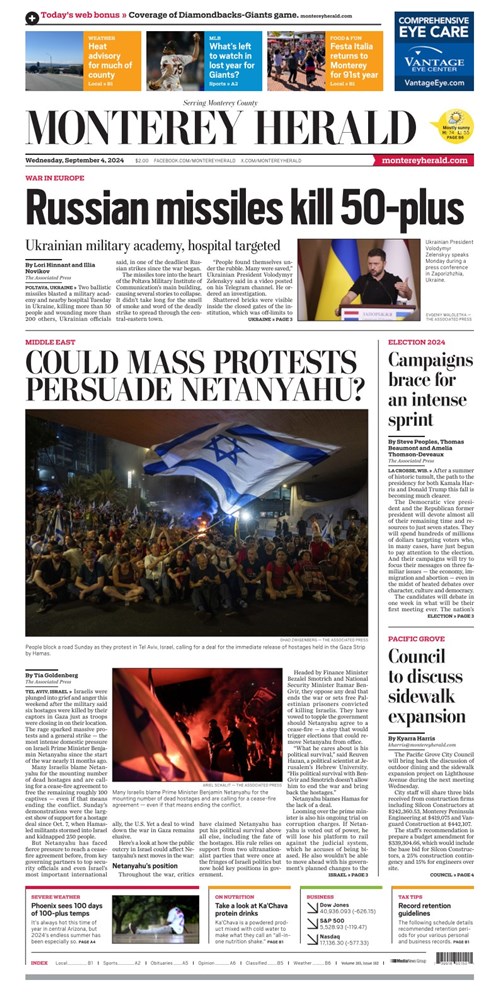
Two ballistic missiles blasted a military academy and nearby hospital Tuesday in Ukraine, killing more than 50 people and wounding more than 200 others, Ukrainian officials said.

The missiles tore into the heart of the Poltava Military Institute of Communication’s main building, causing several stories to collapse. It didn’t take long for the smell of smoke and word of the deadly strike to spread through the central-eastern town.

The strike appeared to be one of the deadliest carried out by Russian forces since the war began more than 900 days ago, with Russia’s Feb. 24, 2022, full-scale invasion.

“People found themselves under the rubble. Many were saved,” Ukrainian President Volodymyr Zelenskyy said in a video posted on his Telegram channel. He ordered an investigation.

Shattered bricks were visible inside the closed gates of the institution, which was off-limits to the media, and small pools of blood could be seen just outside hours later. Field communications trucks were parked along the perimeter. Roads were covered in glass from shattered apartment windows.

“I heard explosions … I was at home at that time. When I left the house, I realized that it was something evil and something bad,” said Yevheniy Zemskyy, who arrived to volunteer his help. “I was worried about the children, the residents of Poltava. That’s why we are here today to help our city in any way we can.”

By Tuesday evening, the death toll stood at 51, according to the general prosecutor’s office.

“My deepest condolences to the families of those killed and injured in the Russian missile attack on Poltava,” Ukraine’s first lady, Olena Zelenska, posted on social media Tuesday. “This is a shocking tragedy for the whole Ukraine.”

Filip Pronin, governor of the region that bears Poltava’s name, announced on Telegram that 219 people were wounded. Up to 18 people may be buried under the rubble, he said.

Ten apartment buildings were damaged, and more than 150 people donated blood, Pronin said.

He called it “a great tragedy” for the region and all of Ukraine, and announced three days of mourning starting Wednesday.

[…]

The academy trains officers in communications and electronics, honing some of the most valued skills in a war where both sides are fighting for control of the electronic battlefield.

“The enemy certainly must answer for all (its) crimes against humanity,” Pronin wrote on Telegram.

The Kremlin offered no immediate comment on the strike. It was not clear whether the dead and wounded were limited to Ukrainian military personnel, such as signal corps cadets, or if they included civilians.

Since it embarked on its full-scale invasion in early 2022, the Russian military has repeatedly used missiles to smash civilian targets, sometimes killing scores of people in a single attack.

Some of the deadliest such assaults included a 2022 airstrike on a theater in Mariupol that killed hundreds of civilians sheltering in the basement and a strike that same year on the train station in Kramatorsk that killed 61. Apartment buildings, markets and shopping centers have also been targeted.

Poltava is about 350 kilometers (200 miles) southeast of Kyiv, on the main highway and rail route between Kyiv and Ukraine’s second-largest city, Kharkiv, which is close to the Russian border.

The attack happened as Ukrainian forces sought to carve out their holdings in Russia’s Kursk border region after a surprise incursion that began Aug. 6 and as the Russian army hacks its way deeper into eastern Ukraine.

The missiles hit shortly after an air-raid alert sounded, when many people were on their way to a bomb shelter, Ukraine’s Defense Ministry said, describing the strike as “barbaric.”

Rescue crews and medics saved 25 people, including 11 who were dug out of the rubble, a Defense Ministry statement said.

The strike came on the day that Russian President Vladimir Putin visited Mongolia. There was no indication that his hosts would heed demands to arrest him on an international warrant for alleged war crimes.

Zelenskyy repeated his appeal for Ukraine’s Western partners to ensure swift delivery of military aid. He has previously chided the U.S. and European countries for being slow to make good on their pledges of help.

He also wants them to ease restrictions on what Ukraine can target on Russian soil with the weapons they provide. Some countries fear that hitting Russia could escalate the war.

“Ukraine needs air defense systems and missiles now, not sitting in storage,” Zelenskyy wrote in English on Telegram.

“Long-range strikes that can protect us from Russian terror are needed now, not later. Every day of delay, unfortunately, means more lost lives,” he said.

Ukraine’s air force said Monday that Russia had launched an overnight barrage of ballistic and cruise missiles and drones at Kyiv as children prepared to return to school. Multiple explosions echoed across the capital early Monday morning as Ukraine’s air defenses shot down many of the weapons, causing damage and fires as the debris fell onto the capital. 

Source: CBS News, 3 September 2024


Ufa’s Kirov District Court has remanded 20-year-old university student Makar Nikolayev in custody to a pretrial detention center for a month on charges of “promoting terrorism.” The court issued its ruling on 30 August, but it was made public only on Monday, 2 September, as reported by the Telegram channels of Baza and Idel.Realities, who cited sources. The court confirmed Nikolayev’s arrest to news website Ufa1.ru.

In 2020, Nikolayev, then a prep school student, designed an information retrieval method for creating a Russian national archive on the history of the Great Patriotic War. The boy wanted to recover information about his great-grandfather and in the process designed an entire system. His project, “Methodology for Creating a Family Archive,” won the Russian national contest “My Country — My Russia,” one of the projects of the Russia Is a Land of Opportunities presidential platform.

Later, Nikolayev went to Germany to study. According to Idel.Realities, Nikolayev had been studying at a university in Frankfurt am Main in recent years. In August 2024, he came home on holiday to Ufa, where he was detained.

According to police investigators, during his time abroad, Nikolayev wrote comments on social networks supporting Ukraine and urging people to join the Russian Volunteer Corps. The stipulated punishment for violating Russian Federal Criminal Code Article 205.2.2 (“Public calls to carry out terrorist activities; public justification of terrorism or promotion of terrorism, committed using mass media or electronic or telecommunication networks”) is five to seven years in prison.

Source: Sergei Kuprikov, “Winner of ‘My Country — My Russia’ contest detained in Ufa,” Deutsche Welle Russian Service, 2 September 2024. Translated by the Russian Reader

French Kiss

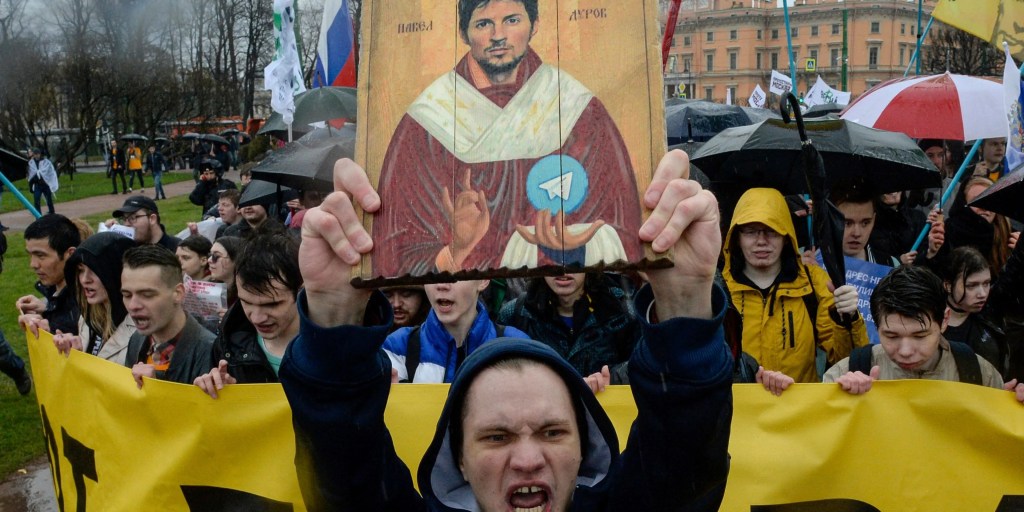
Saint Pavel? A scene from a march protesting the blocking of Telegram, St. Petersburg, 1 May 2018.
Photo: Olga Maltseva/AFP, via Important Stories

French Kiss is an enchanting cabaret show in the style of the Moulin Rouge, as performed by the world-famous Bize Lisu Show Ballet.

The ballet dancers have already conquered the whole world with their performances. They have garnered roaring applause at the birthday of the Prince of Monaco and in the Kremlin Palace, at Europe’s oldest theaters in Malta and the largest modern concert halls in China.

The unique hand-sewn costumes, the sensual dances, the expressive vocals and the compère’s unsurpassed humor are all part of the grandiose performance.

Duration: 2 hours (with 1 intermission)
Age limit: 18+

Performers:
Bize Lisu Show Ballet
Vocals – Yana Radion, Maria Mantrova, Anastasia Radion
Compère – Denis Groshev

*Seat numbers 200 to 220, at the buffet tables in the second row of the balcony.

“French Kiss, the Show”

The venue
The show French Kiss will take place in one of the most entrancing places in St. Petersburg— the cultural space Gaika Space. And it will be held in LUXURY format [sic], in which the audience is able to choose festive board tables for two to four people.

The original menu, featuring delicious appetizers and exquisite drinks from the bar, will help you not only to enjoy the show, but will plunge you into a world of gastronomic discoveries. Our show will make your evening unforgettable!

Secure free parking is provided to guests of the show for the entire duration of the performance.

Source: Bileter.ru. Translated by the Russian Reader


A very cold welcome awaited Pavel Durov in France, but it increasingly seems this is exactly what Durov was aiming for.

Did he come clean? No, it’s just business

Only a week into the discussion of the Pavel Durov case did commentators begin recalling what kind of person he was, and several stories emerged about his life, which, incidentally, has involved support (including financial support), from the “authoritative” Petersburg entrepreneur Mikhail Mirilashvili. Without this support, Durov’s main business venture, the social network VKontakte, might perhaps not have taken off. (Formally, Mikhail’s son, Vyacheslav, was involved in the business, but the money belonged to Mirilashvili père.) To complete the picture, it should be remembered that Mikhail Mirilashvili “developed” (as they say) Petersburg’s casinos, for licensing of which the then-deputy mayor of St. Petersburg Vladimir Putin was responsible.

Vladimir Putin (left) and Mikhail Mirilashvili (right)

Vkontakte rose and flourished on pirated content, which is still abundant on the network, despite the fierce efforts to combat it. Business journalists relish recalling how Durov fought for Vkontakte—not in the sense of freedom of speech, but in the sense of the value of his stake in the social network—and won, pocketing 400 million dollars.

For an interpretation of Durov’s arrest and persecution by the French authorities, see Baruch Taskin and Aaron Lea’s column. I would like to reiterate that Durov is first and foremost a businessman, and a very cynical one at that. It suffices to recall [the time Durov threw money out of a window] in Petersburg and Durov’s reaction [to the crowd’s reaction and the public and media backlash]. He laughed, before summarizing his mockery in philosophical terms:

“We refuse to accept a world where people can betray their humanity for money. If there are people who agree to do it, their behavior should be severely ostracized.”

We know nothing about Durov’s involvement with the FSB—all our assumptions are based on circumstantial evidence—but the left-wing albeit decent newspaper Liberation has written about his cooperation with the French security services, quoting Durov’s own statements.

Pavel Durov (center) may even benefit from his arrest in France:
the court ruling will be an excuse for Telegram’s transition from a media platform to a crypto-business.

Source: Moscow Times Russian Service weekly newsletter, 1 September 2024. All images and captions were included in the original publication. Translated by the Russian Reader


“Pavel Durov launched money from a window (Vesti report)”

Pavel Durov launched paper airplanes with five-thousand ruble bills on board into a crowd on 26 May 2012, which was St. Petersburg City Day. How the crowd lunged for the five-thousand ruble bills can be seen on the footage recorded by the Kazan Cathedral superview webcam. About ten banknotes were thrown, after which the crowd finally became furious and the amusement was stopped.

The webcam continues to follow the events as bloggers give Pavel Durov a bloody nose on 31 May at 6pm (GMT+4). Watch http://vpiter.com/web-camera-kazan/ for the live stream.

Source: Mobotix Webcams Russia (YouTube), 29 May 2012


The webcam is installed on Nevsky Prospekt. The webcam offers a view of the Kazan Cathedral. On the left in the frame is the house of the Singer company. On the days of city holidays, Nevsky Prospekt in this section becomes pedestrian. Live 24/7 we broadcast the life of our metropolis.

Kazan Cathedral (Cathedral of the Kazan Icon of the Mother of God) is one of the largest churches in St. Petersburg. It was built on Nevsky Prospekt in 1801–1811 by architect Andrey Voronikhin in the style of Russian classicism to store a revered list of the miraculous icon of the Mother of God of Kazan. After the Patriotic War of 1812, it acquired the significance of a monument of Russian military glory. In 1813, the commander Mikhail Illarionovich Kutuzov was buried here and the keys to the captured cities and other military trophies were placed.

Source: Taxi Crew (YouTube), accessed 1 September 2024. Happening upon this livestream of Kazan Cathedral and environs, the neighborhood where I lived for my first two years in Petersburg, was oddly reassuring, and so I left it on in the background as I worked on this “collage” of news and views and images. It was only now, as I was finishing the piece, that I realized that Kazan Cathedral itself is a monument to the centuries-long profound misunderstanding, sometimes tawdry, sometimes violent, that goes by the name of “Franco-Russian relations” in polite society. ||| TRR

New Trumped-Up Criminal Charges Against Soviet Dissident and Russian Opposition Activist Alexander Skobov

Alexander Skobov. Photo courtesy of V. Izotov/Deutsche Welle

A new criminal case, on charges of “involvement in a terrorist community,” has been opened against former Soviet dissident and Russian political journalist Alexander Skobov, who has been detained for over a month on charges of “condoning terrorism.” This news was reported on Saturday, 18 May, on Skobov’s official Facebook account by his wife, Olga Shcheglova.

Shcheglova said that she visited her husband on 14 May in the pretrial detention center in Syktyvkar, where he had been transferred from St. Petersburg. During a conversation with him, his lawyer and local police investigators, she learned that Skobov has also been charged with “condoning terrorism” and “involvement in a terrorist community.” The dissident’s wife is convinced that these two charges stem from her husband’s affiliation with the Free Russia Forum.

According to Shcheglova, on 21 May, Skobov will be sent to the regional psychiatric hospital in Komi for a forensic psychiatric examination. Skobov himself has stated that he would not participate in the investigation and forensic expertise, and he would appear in court only if his mother were present at the hearings. Skobov’s defense has filed an appeal, which will be heard by the court on 22 May.

Skobov’s Persecution in the USSR and Russia

On 22 March 2024, Russian authorities designated Skobov a “foreign agent.” According to the Justice Ministry, he had “disseminated unreliable information” about the decisions of public officials, opposed the war, “identified the Russian Federation with a terrorist organization,” been involved in the work of an “undesirable organization,” and produced and distributed “foreign agent materials” [sic], the human rights project OVD Info reports.

In 1978, Skobov was arrested over his active involvement in the Left Opposition group and the samizdat publication of an anti-government magazine. He was later sentenced by the court to undergo treatment at a psychiatric hospital, from which he was released in the summer of 1987.

This time around, the political journalist was arrested on charges of “condoning terrorism.” Skobov was detained in St. Petersburg on 2 April 2024. In protest, the dissident refused to take with him to jail his diabetes medication and his glasses, despite his poor eyesight. According to the Telegram channel Memorial Support for Political Prisoners, the real reason for his arrest was “a [social media] post condoning the bombing of the Crimean Bridge.”

Source: Asya Miller, “New criminal case opened against dissident Skobov,” Deutsche Welle Russian Service, 18 May 2024. Translated by the Russian Reader


In early April, 66-year-old dissident Alexander Skobov was arrested for allegedly “justifying terrorism” in his posts online. For his friends and family members, the arrest came as no surprise.

Skobov, a long-time dissident who was made to spend seven years in a psychiatric ward after taking part in protests against the Soviet authorities in the 1970s, had published multiple posts condemning Russia’s actions in Ukraine since 2014. In March he was named a “foreign agent”, and since then people close to him said his arrest had seemed inevitable.

“He and I talked a hundred times about the fact that he would be arrested — if not today then tomorrow,” said Skobov’s friend Yuly Rybakov, a human rights activist and former deputy in the State Duma, Russia’s lower house of parliament. “People have been imprisoned for much less.”

Skobov’s 90-year-old mother, whom he lives with and cares for, said she had been having nightmares about his arrest for months before it happened, and Rybakov recalled that Skobov himself said he “didn’t understand” why the authorities hadn’t come for him yet.

Skobov’s children, who moved abroad long before Russia’s invasion of Ukraine, urged their father to flee the country when they saw him in Istanbul in early March. Other friends have also tried to convince him to leave and avoid arrest, citing his many health issues, including severe diabetes, hepatitis C, chronic obstructive pulmonary disease and near blindness.

But, Rybakov said, Skobov was resolute, telling him that he “wanted to be part of his own judicial process” when he was inevitably arrested.

Rybakov said that Skobov had been “driven to despair” by what had been happening in Russia in recent years and “felt that someone had to be radical”.

Another friend, Mikhail Sedunov, said that trying to convince Skobov to change his course of action was like “grabbing the wing of a plane that was already accelerating down the runway”.

On 2 April, masked policemen arrived at Rybakov’s flat, where Skobov had been staying. When Rybakov left to take the dog for a walk, the police reportedly entered the property, threw Skobov to the ground, twisted his arms and handcuffed him. According to Rybakov, Skobov “defiantly” refused to take either warm clothing, his diabetes medication, or his glasses with him, intending these gestures as an “act of protest”.

Skobov’s wife, Olga Shcheglova, managed to buy him replacement medication and glasses, which she brought to him ahead of his interrogation by Russia’s Investigative Committee. But Skobov refused to accept them — a reaction Shcheglova said she had “expected” from her husband.

Resistance to the authorities and a fight for justice had defined Skobov’s life for more than four decades. His first foray into political activism was in 1976, when he and other university students in St. Petersburg scattered leaflets calling for the “establishment of true humane socialism” and the “overthrow of the tyranny of officials” ahead of a meeting of the Communist Party of the Soviet Union. The students were expelled from university and brought before a court, and some, like Skobov, were then sentenced to compulsory treatment in psychiatric hospitals because, according to Rybakov, it was believed that “only crazy people could dislike the Soviet regime”.

Skobov’s radical spirit remained unquelled when he was finally released from hospital in 1981, however, and he immediately joined the Free Inter-Professional Association of Workers, a dissident group that led the first attempt to create an independent trade union in the USSR. In 1982 he was arrested for his involvement with the group and sent back to hospital, where he spent another three years.

In the early 1990s Skobov taught history at a secondary school for gifted students, writing and publishing his own award-winning textbooks. But later in the decade political activism again became the focal point of his life as he took part in protests against the Chechen wars.

When Russia annexed Ukraine in 2014, Skobov took to social media to rail against the regime, openly supporting Ukraine and condemning Russia’s military action. The same year, two unidentified men armed with knives attacked him outside his home in what his friends and family members say they are sure was retribution for his criticism of the regime.

Even this did not deter him, however, and his friends said his statements opposing Putin’s rule became “even sharper, more unrestrained, and more radical”. Speaking last year at the Free Russia Forum, an opposition conference held biannually in the Lithuanian capital Vilnius, Skobov condemned the regime more harshly than any of the other attendees, despite being one of the only participants still living in Russia.

Another friend of Skobov, Nikita Yeliseyev, said he doubted Skobov would survive the 7.5-year sentence that he is almost certain to receive.

“He is an old man,” Yeliseyev said. “And he has a number of very serious illnesses.”

Sedunov said all of Skobov’s actions stemmed from a desire to “struggle, as vigorously as possible, against the obvious evil represented by the current Russian government”.

“This is the way he was brought up: he wanted to fight evil any way he could. And this was the only way left,” Sedunov said.

Source: Dmitry Tsyganov, “‘Someone has to be radical’: Former Soviet dissident Alexander Skobov is determined to defend his beliefs — even if it means dying in prison,” Novaya Gazeta Europe, 8 May 2024


Aleksandr Skobov has been a thorn in the side of authoritarian governments for more than four decades, from the Soviet era to President Vladimir Putin’s long rule. And now, in pretrial detention in St. Petersburg and facing prison, he is in no mood for compromise.

“On principle I refuse to comply with fascist laws,” he told RFE/RL late last month, shortly after the Russian government designated him a “foreign agent” on March 22. “I don’t intend to get into debates with the government. I will not try to prove my innocence. I will not label my writings, and I will not write any financial reports for them.”

“A criminal case could be launched at any moment,” he concluded.

He was right: On April 3, the 66-year-old was arrested and charged with “justifying terrorism” for a social-media post about the Ukrainian attacks that damaged the Crimea Bridge that links Russia with the Ukrainian region of Crimea, which Moscow occupied in 2014. The following day, a St. Petersburg court ordered Skobov held in pretrial detention for at least two months.

“If you take any of my articles or YouTube videos, you can find a whole bouquet of possible charges,” Skobov said in the March 31 interview. “Discrediting the army. Inciting hatred and enmity. Justifying terrorism. The rehabilitation of Nazism. I directly equate the actions of the Stalin regime with those of Hitler’s during World War II.”

Another reason for Skobov’s prosecution, his supporters believe, is his leadership role in the Free Russia Forum, a group of mostly exiled opposition figures founded by former world chess champion Garry Kasparov and activist Ivan Tyutrin in 2016 that has been declared “undesirable” in Russia. If he is charged with participation in an “undesirable” organization, he could face up to six years in prison.

“I am a member of the forum’s council, and I regularly participate in its broadcasts,” Skobov told RFE/RL. “I help write its statements and official pronouncements. Several of them I have written myself. I am actively involved, and I do not intend to stop.”

Skobov said he was drawn to the group because “it was the only opposition organization that categorically rejected the idea of the peaceful transformation of Putin’s dictatorship toward democracy using the procedure established by that dictatorship.”

“It was the only organization that, beginning with the annexation of Crimea, unambiguously stood by Ukraine as a victim of aggression,” he added. “We try to help the Ukrainian Army and the Russian volunteer formations that are fighting with them.”

Writing on Facebook after Skobov’s arrest, writer and critic Mikhail Berg said Skobov suffered from “an unbearable fear of being afraid.”

“And that is why he chooses the most painful forms of criticizing the authorities,” he wrote. “He shouts even though the authorities have long been destroying people for whispering or even for just opening their mouths.”

Parallel Lives

Born in Leningrad, as St. Petersburg was called then, in 1957, Skobov participated in his first anti-government protest when he was 19. He and other members of an underground organization threw about 100 flyers calling for “humanistic socialism” from the roof of a downtown building on the eve of the 25th congress of the Soviet Communist Party. Several of the protesters were kicked out of their universities, but Skobov — a first-year history student at Leningrad State University — got off with a disciplinary meeting of the Komsomol youth group.

In October 1978, he was arrested for publishing an underground, anti-government magazine called Perspectives. He spent half a year in a KGB prison before being sentenced to forced psychiatric treatment.

“In the late 1970s and early 1980s, political prisoners in Soviet psychiatric hospitals were rarely forcibly medicated, although there were such cases, of course,” Skobov said. “But I was treated more or less OK. Most of the doctors that I encountered tried to avoid playing the role of executioners or stranglers.”

He spent three years in confinement.

In 1982, he was again sentenced to psychiatric treatment, this time for a samizdat article he wrote defending Chile’s former socialist president, Salvador Allende, who died in unclear circumstances in 1973, and criticizing the rightist dictator General Augusto Pinochet. That article was deemed “anti-Soviet propaganda.”

This time, Skobov spent five years in the hospital before being released in the summer of 1987 during the initial phase of Soviet leader Mikhail Gorbachev’s liberalization campaign.

In many ways, Skobov and Putin led parallel lives during this period. Putin was born in Leningrad almost exactly five years before Skobov and studied at Leningrad State University just before him. But as Skobov became drawn into a life of opposition to authoritarianism, Putin joined the KGB secret police.

The president’s official biography insists that Putin always worked for the KGB’s First Directorate, which carried out counterintelligence operations. However, rumors have persisted for years that he worked for some time in the Fifth Directorate, which was responsible for suppressing internal dissent and prosecuting political dissidents. At the time, a senior figure in that department was Viktor Cherkesov, a longtime member of Putin’s inner circle who served as his deputy when he headed the Federal Security Service — the KGB successor organization — in the 1990s and who died in 2022.

In 2022, journalist and researcher Konstantin Sholmov published a photograph of a KGB archival document from 1976 that he said was on display at the Political History Museum in St. Petersburg. The document, a protocol of a search of the residence of Leningrad artist and dissident Oleg Volkov, named “Lieutenant Putin” as one of the officers carrying out the search.

In 2013, a series of photographs emerged showing a 1989 Leningrad protest during which KGB operatives roughly detained dissident Valery Terekhov. One of the men in the photograph resembles Putin. The Kremlin later denied that the man was Putin, saying the future president had already been sent to East Germany by 1989.

Prominent human rights activist Aleksandr Cherkasov of the banned rights group Memorial told the news outlet Agentstvo earlier this month that he believes Putin was involved in the investigation of Skobov. He said Skobov had told him Putin staked out his Leningrad apartment in November 1982 when prominent dissidents gathered to celebrate Skobov’s birthday.

Despite the danger growing around him after he was designated a “foreign agent,” Skobov refused to consider emigration.

“I’m not going to quit,” he said.

“Today anyone in Russia who disagrees with Putin’s Nazi regime is taking a risk,” he added, “even if he doesn’t really stick out or act publicly. Since the regime has already made the transformation from ‘hybrid totalitarian’ to totalitarian, it demands not just silence from its loyal subjects, but active participation. And even avoidance can be dangerous.”

Opposition leader Aleksei Navalny’s suspicious death in prison on February 16 was “to be expected,” Skobov said.

“Navalny constantly laughed in [Putin’s] face, and a dictator cannot stand that,” he added. “Unfortunately, I don’t think it will be the last death of a political prisoner in Putin’s Russia.”

Source: Robert Coalson & RFE/RL’s North.Realities, “‘I’m Not Going To Quit’: Facing Prison, Soviet-Era Dissident Skobov Speaks Out Against War, Repression,” RFE/RL, 10 April 2024

Punitive Psychiatry for a Dissident Janitor in Northern Russia: The Case of Igor Yakunichev

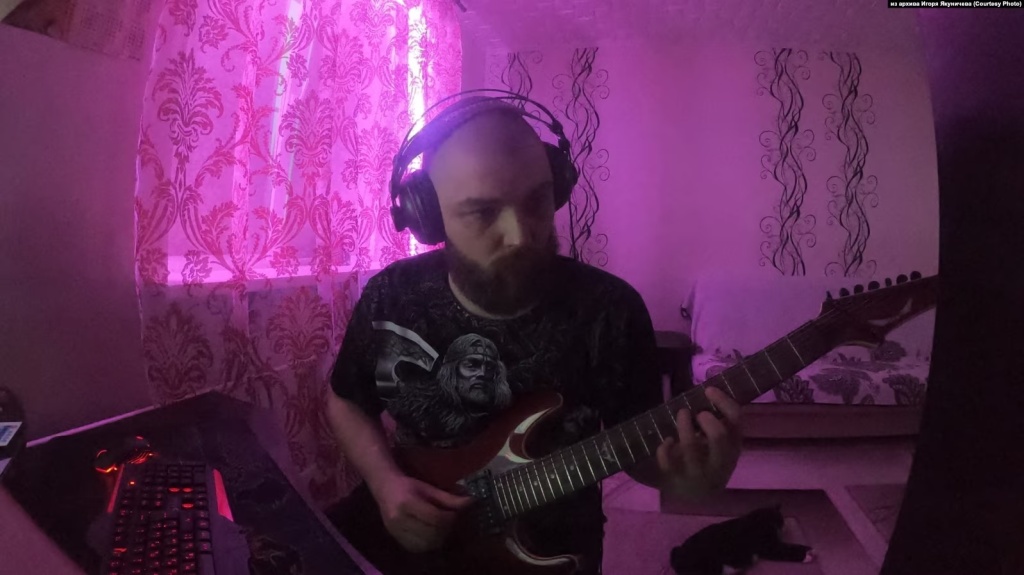
Igor Yakunichev

Five criminal cases have been launched against Igor Yakunichev, a resident of the Yamalo-Nenets Autonomous District. In addition to three cases on charges of “disseminating fake news” about the Russian army and “condoning terrorism,” the security services added two more cases on the same charges. On 1 April, Yakunichev, who started the YouTube channel Infinity Is Not the Limit (about the lawlessness of the police and the courts), was forcibly hospitalized in a psychiatric clinic in the Tyumen Region.

Yakunichev’s relatives are convinced that he has been subjected to punitive psychiatry because of his consistent criticism of the current regime. For more than a year, investigators in Yamalia have tried to put Yakunichev in jail on charges of “disseminating fake news” about the military and “condoning terrorism.” However, even a court-appointed defense lawyer could not induce the 35-year-old Yakunichev to “admit everything and mitigate his plight” When the criminal cases began to fall apart, the defendant, who had no psychiatric diagnoses, was shipped off to a mental hospital.

“The police broke into our house twice”

The police started calling Igor Yakunichev and coming to his home (he lived with his mother and father in Pangody, a settlement in Yamalia with a population of 11,000) in early 2023.

Pangody, a village in Yamalia. Photo courtesy of Igor Yakunichev and Radio Svoboda

“They would bring a ‘warning’ for him to sign, or they would summon him for an ‘interrogation’ and question him about his videos and posts. He started the [YouTube] channel when his family was cheated out of their housing,” says Igor’s relative Tatyana (whose name has been changed for security reasons). “Mother and father and son had lived for many years in two rooms in a barracks. Under the dilapidated housing resettlement program they were given a one-room flat. Igor fought against this lawlessness for many years, and he and his mother traveled many kilometers going to the courts. All to no avail. Then he began not only to take an interest in the state system but also to make and post videos about what is going on in Yamalia. He had come head to head with the injustice of the system back in 2015, when he worked at the property management company Our House. Another property management company controlled by them, Garant, was going bankrupt at the time, but for some reason all the employees at Our House were forced to apply to work shorter days (apparently, the whole business was being optimized). Igor refused [to sign], and after three months they up and fired him. He sued them and was reinstated, but he was pressured into leaving anyway.”

The local administration disliked the fact that Yakunichev fought for his own and other people’s rights. Consequently, despite his specialized secondary education, he could only find work as a janitor.

“He helped other residents get their cases through the courts. He became very adept in these matters: he knew all the laws well, especially the Housing Code. But there was no work in Pangody. (Yakunichev graduated from a technical college and worked as a mechanic — Sibir.Realii.) He was promised a job at Gazprom—he is a good mechanic—but then they admitted that they had hired ‘one of their own people,’ meaning somebody’s relative. And that’s how everything goes here. At the time, the cronyism made Igor quite angry, not the fact that he didn’t get the job: his janitor’s salary was enough for him. And in fact, he was already a blogger: he had bought a good camera and set up a studio for editing,” says Tatyana.

All of the Yakunichevs’ expensive electronic equipment was taken away by the police during their first “hard visit.”

“In the summer of 2023, [the police] broke into [the Yakunichevs’ flat] for real and slammed Igor onto the floor. His mother screamed, ‘His spine is broken! Don’t throw him on the floor!’ But what they did care, they hit him as hard as they could. Igor has had an implant instead of one vertebra since he was a student. When he was studying at Omsk University, he lost his keys and climbed through the window in the dormitory. The balcony was dilapidated: it broke off and he fell on his back. Since then he has had a bunch of diagnoses: cervical, thoracic and lumbar osteochondrosis. And when he is worried, he can have a seizure, and it’s like impossible for him to breathe. And so they wrestled this very unwell man, who is practically disabled, and threw him on the floor. Interestingly, the camera that Igor turned on continued to record even after his fall and almost the whole ‘wrestling match’ was captured. Igor later returned from the police station, restored the recording, and posted it on [his YouTube] channel. It made the police squeal to the high heavens!” says his buddy Ivan (whose name has been changed for his own safety). “In the background you can hear them yelling wildly, ‘Hands! Hands on your head!’ Who are they yelling at? A disabled man. And [you hear] Igor asking, ‘The cats! Watch out for the cats!’ so they don’t trample his pets. It’s just brutal!

Igor Yakunichev’s video of the police raid on his family’s flat

After the police’s visit, Yakunichev learned that a criminal case on charges of “disseminating fake news” about the Russian army (per Article 207.3.1 of the Russian Federal Criminal Code) had been launched against him as early as late March 2023. He has published his first social media posts against the war at the very beginning of the war in February 2022.

“He reacted very harshly when someone would voice support for the war in his presence. He would not get into a fight, but he could try and persuade [the person] and talk [to them] until he achieved understanding or until he got tired himself. He was one of those people who never got used to the war. He understood the risks, but he still would stick his neck out. He vented everything to the policeman after [the latter] accused him of disturbing the peace at the [Russia Day] celebrations in June 2023. After [he said] these words about the unjust war with Ukraine, which he threw directly in the face of the ‘representative of the authorities,'” they targeted him specifically,” says Ivan. “They accused him of spreading ‘fake news’ about the army, threatening him with fifteen years in prison for posts on VKontakte about the Russian military’s crimes in Bucha. He and his mother filed complaints about the violations [of his civil rights], about how he had been roughed up during the arrest, how all their electronic equipment, even his mother’s computer and phone, had been cleaned out. Can you imagine, they still haven’t returned it!

As part of the first criminal case, the court banned Yakunichev from performing certain actions. In early March 2024, this case came to court. That was when it transpired that at least four more criminal cases had been launched against Yakunichev. Even prior to this, in the summer of 2023, Igor had been charged with an administrative offense for “discrediting” the army and fined thirty thousand rubles [approx. 300 euros]. Yakunichev and his family were notified about it.

“The grounds [for the charges] were ‘funny’: a video about a memorial featuring a T-54 tank in the village of Pangody. Local vatniks had drawn the letter Z on it. And Igor said in the video[‘s annotation] that it violated the law on the protection of cultural heritage objects,” says Tatyana.

Igor Yakunichev’s silent video condemnation of a WWII memorial in Pangody turned into a pro-war Victory Day display.

Then, in November and December 2023, according to Tatyana, two more criminal cases were brought against Yakunichev under the same article of the Criminal Code (Article 205.2.2, “condoning terrorism”). He faces up to seven years in prison if convicted on these charges.

“The grounds [for the charges] were videos about the Free Russia Legion ([in which a Legionnaire expresses] gratitude for donations in the fight against ‘Putinist Russia’) and about the Kakhovka hydroelectric power plant. They weren’t even his own videos, but reposts of other media on his VKontakte page,” says Tatyana. “Later, we learned of the case launched under the article on repeated ‘discrediting’ of the army (Article 207.3.1), and then they seemingly merged it with one of the cases under Article 205 into a single proceeding. But the number of cases is frightening, don’t you agree? He regularly received notifications that one video or another had been removed from his page ‘by decision of the prosecutor’s office.’ He did not restore them: although he is a principled man, he was just tired and fed up.”

Free Russia Legion, “The Legion Returns Home” (2023)

His relatives are certain that Igor was deliberately driven to distraction with the interrogations and the notifications so that he would “blurt something out.”

“In June, the local beat cop showed up and made a completely delusional accusation. Allegedly, at the celebrations of Russia Day in June, [Igor] had been seen drunken in a public place and a complaint was filed against him. (That day, by the way, many people had seen him and testified that he was sober and orderly, so eventually the prosecutor’s office canceled this humiliating fine.) He videotaped this wannabe policeman, but he did not hold back and said everything he thought about this unjust war against Ukraine,” says a relative of Yakunichev’s. “I believe that this cop was the one who contributed testimony against him in the first case. Now it has gone to court, and Igor has been put away in a mental institution. Because they couldn’t put him under arrest: there was too little evidence of his guilt and ‘danger to society.’ But for some reason [the police] can take him to the madhouse themselves and obtain the court ruling retroactively. His mother has worn herself out filing complaints about such violations. It is urgent to replace the court-appointed lawyer with a normal one. Although [his mother] works as a cleaner, she is ready to pay all the money she has to a decent lawyer. Because the current one is a disaster: he hasn’t even been able to obtain a meeting with Igor once all month. [His family] receive paperwork about the cases against Igor months later, so they don’t know anything about the new cases against Igor.”

Igor Yakunichev’s confrontation with the local beat cop who showed up at his home to hassle him.

According to relatives, Yakunichev’s family is disappointed with the work of the court-appointed defense lawyer and now fears that Igor’s testimony will be extracted from him by torture in the psychiatric clinic, located in the village of Vinzili, Tyumen Region, a thousand kilometers from home.

“Read the reviews of the institution: former patients write such things it makes your hair stand on end—abuse and ill treatment by staff, medication administered without explaining to family and friends what the drug is and what it is used for,” says Ivan. “I think we need to get him out of there as soon as possible. Only a normal lawyer will help. By the way, this is not the first time [the authorities] have tried to subject him to punitive psychiatry. After his anti-war reposts, they were going to mobilize Igor. Yes, with his twisted spine and numbness in his chest! [Yakunichev’s family] went to the courts, got an independent forensics report, confirmed all the diagnoses, and it seemed to go away. And now this. I’m really afraid [the authorities] are not going to give up on this psychiatric hospitalization thing.”

Yakunichev’s relatives fear that the forensic psychological examination at the psychiatric clinic in the Tyumen Region will not be limited to the case and Igor will be kept there “indefinitely”.

The evidence in the last two criminal cases against Igor Yakunichev (on charges of violating Articles 280.1 and 207.3.2 of the Criminal Code) have still not been made available to his family.

“We found out from independent human rights activists—we don’t really know what he’s accused of,” says the relative. “Now they can’t even send you copies of previous cases, because during the search in April [the police] cleaned the Yakunichevs out: [they confiscated] their computer, which his mother had replaced, the telephone, even the TV set! They virtually robbed them so that they could do nothing at all, neither find a lawyer, nor send an electronic complaint.

Source: “Five criminal cases against a janitor: how the security services have been putting pressure on a dissident in northern Russia,” Sibir.Realii (Radio Svoboda), 30 April 2024. Translated by the Russian Reader. Thanks to Comrade Koganzon for the heads-up. Thanks also to Nanny Kim for generously continuing to support this website with her monthly donations.

Russian Bus Plunges into River, Killing Passengers

Security camera footage shows a bus in St. Petersburg, Russia, veering across the road and off a bridge into the Moika River. At least three people were killed, with several others in serious condition in hospital.

Source: NBC News, 10 May 2024. Thanks to Marina Varchenko for the heads-up.


“Multipolarity Forum”

While the international far right was busy meeting in Washington, D.C., for the CPAC 2024 conference in late February, on the other side of the world, a grab bag of “anti-Western” groups, including a handful of far-right leaders from Europe, North America, and South America, gathered in the Lomonosov innovation cluster in Moscow for two conferences held in parallel. One was the Multipolarity Forum (Форум многополярности) and the other, the Second Congress of the International Russophile Movement (Второй конгресс Международного движения русофилов, МДР). 

The two meetings, which centered on support for Russia’s invasion of Ukraine, attacking the LGBTQ+ community, opposition to “Western hegemony,” and opposition to the “russophobia” of the West, brought together an odd assortment of leaders. There were representatives from the Global South, National Bolsheviks, acolytes of far right Russian ideologue Alexander Dugin, European neo-fascists, revolutionary leftists, and leaders of various religious denominations. All in all, the gathering included more than 300 representatives from 130 countries.

While Moscow has hosted large conferences attended by significant far-right groups in the past, these two events mark a shift towards official institutional support as high-ranking government officials officially sanctioned the gathering. Present were two members of Putin’s cabinet, Maria Zakharova, the director of the information and press department of the Russian Ministry of Foreign Affairs, and Sergey Lavrov, the Russian foreign minister, who presented opening remarks from Putin. 

Other foreign state officials were invited to the congress as well. They included Darko Mladić, the son of General Ratko Mladić, convicted war criminal for genocide and former general of the Republika Srpska (RS), Zhang Weiwei, an ideologue for the Chinese Communist Party (CCP), Syrian diploma and current ambassador to Russia Bashar Al Jaafari, former Prime Minister of the Slovak Republic Jan Czarnogursky, and South African MP for the African National Congress (ANC) and grandson of Nelson Mandela, Zwelivelile “Mandla” Mandela. Pierre de Gaulle, the grandson of former French President Charles de Gaulle, who has expressed pro-Russian sympathies throughout the war, noted his grandfather’s alleged support for relations with Russia.

“Russophobia,” the “racism” of the West, and the “canceling of Russia” were common themes at the event. Tsargrad TV founder Konstantin Malofeev claimed that the current wave of alleged xenophobia and racism against Russians was comparable to what happened in Nazi Germany. Going further, he underlined that, “we understand that this is the hatred of the globalist elite, not the people.” However, at times, some speakers revealed that the “russophobia” they were referring to was not simply a perceived xenophobia towards Russians, but the West’s insistence that LGBTQ+ people simply not be discriminated against. In fact, one of the three thematic sections for the International Russophile Movement Congress included a section on “traditional values.” In his speech, Alexander Dugin mentioned the following: 

“The West has racistly and imperialistically identified itself with humanity. There was a time when Britain claimed all seas and oceans as its own. Western civilisation declared all of humanity its property — primarily its consciousness. This led to the formation of a unipolar world. In this world, there are only Western values. Only one political system — liberal democracy. Only one economic model — neoliberal capitalism. Only one culture — postmodernism. Only one conception of genders and family — LGBT. Only one version of development — technological perfection up to post-humanism and the complete displacement of humanity by AI and cyborgs.”

Dugin, the leader of the International Eurasian Movement (Международная евразийская движения, MED), and theorist of “Eurasianism,” and the neo-fascist “Fourth Political Theory” which aims to unite far right and far left groups around the world to destabilize Western democracies, was a key speaker at the event. He received widespread attention from conference attendees and Russian propaganda outlets RT, Sputnik, and Tsargrad. Other followers of the “Fourth Political theory” present at the conference included Raphael Machado, leader of the far right Brazilian group Nova Resistência (New Resistance), which the U.S. State Department recently classified as a source of “Pro-Kremlin Disinformation” in Brazil. According to Machado, the conferences, which were first organized in 2023, are the brainchild of he and Dugin, with support from the Thinkers Forum in China and the International Movement of Russophiles. Following the 2023 conferences, Machado was named the Latin American coordinator for the event. During Machado’s trip to Moscow, he met with many of the speakers, including Maria Zakharova, the President of the Eurasian Youth Union (Евразийский союз молодежи) chapter in Russia, Pavel Kiselev, and Leonid Savin, the longtime editor of Dugin’s website Geopolitika.ru.

Another individual with whom Machado had contact while on his trip was a member of the ultranationalist Two-Headed Eagle movement (Всероссийский съезд общества “Двуглавый Орел”), led by Malofeev, and which Machado claims has a formal partnership with Nova Resistência and is currently fighting in Ukraine. The Two-Headed Eagle movement was created by Malofeev in 2017 with the objective of supporting Putin, ridding the country of secularism and returning the Orthodox monarchy to the country, as well as the demolition of Lenin’s mausoleum.

Malofeev, the director of Russian Christian nationalist and conspiracist media platform Tsargrad (Царьград), and wealthy financier of anti-LGBTQ+ causes around the world, who has paid millions of dollars to separatists in the Donbass region of Ukraine, was another star speaker. During his speech, he made the following comments directed at the LGBTQ+ community: 

“I think everyone in this room is well aware that the World Health Organization was created with Rockefeller money, and now its main sponsor is the Bill Gates Foundation. Therefore, transnational corporations and international organizations have long merged and serve the interests of the globalist elite. WHO recently adopted the International Classification of Diseases No. 11 (ICD-11), which excluded perversion from mental disorders and pedophilia ceased to be a disease, but became just a disorder. This is not the imposition of new social norms, but rather it is the abandonment of God and the embodiment of Satanism.”

Formally, the Russian Ministry of Foreign Affairs and the head of the International Movement of Russophiles (MDR) Nikolai Malinov, a former Bulgarian politician who was once accused of spying for Russia and sanctioned by the United States, organized the events. In practice, however, it is understood that Malofeev was the primary financier of the congresses.

Italian far right leader Roberto Fiore, acting as a representative on behalf of his neo-fascist political party Forza Nuova (New Force, FN) and the EU parliamentary far-right coalition Alliance for Peace and Freedom (APF), made up of the Die Heimat (DH)Parti Nationaliste Français (PNF)Democracia Nacional (DN) and other far-right parties, was also an invited attendee of the conferences. Fiore presented a proposal for “a Russian intervention of 50 billion euros to regenerate the agriculture of our territory and consequently its social fabric, eroded by years of capitalism and policies distant from the earth.” This would apparently “allow Italy to gradually move away from the diabolical Western world that is leading our country to the abyss.”

Another attendee was Belgian Kris Roman, a Russian propagandist with ties to both Russian intelligence, and various groups on the international far right. Roman, who considers himself a “reformed racist,” has a history steeped in Nazism and white supremacist politics, which later led him to make connections with the Russian far right in the early 2000s and build bridges with Russians over the years through his organization Euro-Rus. During the event, Roman met with Maria Zakharova. Other far-right attendees included Zmago Jelinčič Plemeniti, the leader of the far right, anti-LGBTQ+, anti-Roma party Slovenska Nacionalna Stranka (Slovenian National Party, SNS), Mitsuhiro Kimura, the leader of the Japanese ultranationalist and anti-American group Issuikai (一水会), and Kemi Seba, a French-Beninese, pro-Russian activist against French colonialism in Africa with a history of holding strongly antisemitic beliefs.

A number of pro-Russian journalists, who frequently speak on air on Russian propaganda channels such as RT and Sputnik, were present for the event. Brazilian journalist for the Asia Times Pepe Escobar, who commonly appears on Russian media channels, was invited to speak alongside Maria Zakharova. Another attendee was conspiracist and Syrian dictator Bashar Assad propagandist Maram Susli, AKA “Syrian Girl,” known for her television appearances on Russia Today (Россия Сегодня, RT) and the American conspiracy outfit Infowars, who has ties to white nationalist identitarian groups in Austria and the US. Other influencers present at the conferences were Peruvian war correspondent and Russian propagandist Carlos Mamani, American MMA fighter and RT host Jeff Monson, and Russian-American television host for Channel One Russia (Первый канал) Dimitri K. Simes. A representative from the far right conspiracist website Counterspin New Zealand was present to cover the event.

A cohort of representatives from religious movements were invited to the conference, including the Archbishop Savva of Zelenograd, the Catholic Cardinal ViganòSheikh Iman Hussein, and Archpriest Tkachev. The Duginist outlet Geopolitika’s summary of the event described their speeches as follows: 

“In the speeches of Cardinal Viganò and Archpriest Tkachev, a verdict was made on the hegemony of Western elites, a condemnation of their diabolical roots and the closed club of Satan worshipers. They openly criticized the hatred of traditional biblical man, dotting the i’s and calling a spade a spade.”

The Portuguese commentator Alexandre Guerreiro, was also present to give a speech on multipolarity. Guerreiro was previously named in a report by Portuguese news outlet Sábado to be a part of the “far-right network spreading Russian propaganda in Portugal,” and has appeared several times on the podcast of Nova Resistência. From Poland, Tomasz Jankowski, previously the general secretary of the pro-Russian Zmiana political party (Change), and the magazine Myśl Polska, made an appearance. CIA veteran Larry Johnson was another popular guest who claimed in his speech that the United States had become a country like the Soviet Union that “restricted free speech, jailed political opponents, and had elderly leaders.”

Finally, testifying to the Red-Brown alliance (between far left, far right, and nationalist groups) that the Russian government has done so much to help foster in recent years, members of the traditional radical left also sent representatives to the conferences. Chief amongst them was Jesus Salazar Velásquez, the Venezuelan ambassador to Russia who voiced his support for “Russia and the country’s fight for a just world without the hegemony of the ‘collective West.’” From the U.S., the pro-Russian communist Haz Al-Din, and the German communist Liane Kilinc, president of the “Peace Bridge – War Victims Aid,” met with other pro-Russian influencers outside of the event. Two attendees coming from Latin America, Elier Ramírez Cañedo, the Deputy director of the Fidel Castro Ruz Center, and the Argentinian sociologist Atilio Boron, were in attendance. Jackson Hinkle the “MAGA Communist” from the United States, was another attendee who met with many of the speakers including Alexander DuginMaria ZakharovaSergey Lavrov, and Kris Roman.

Source: “Russia Hosts Large Far Right Conference Attacking LGBTQ+ Rights, ‘Russophobes,’ and ‘Globalists,'” Global Project Against Hate and Extremism, 5 March 2024


Crimean pensioner Maria Zamyrailo-Levytska has been jailed for five days and fined 35 thousand roubles over ‘liked’ posts on the social network Odnoklassniki, including one containing the Ukrainian trident.  The 64-year-old is one of a huge number of Ukrainian men and women who have been ‘denounced’ by so-called ‘Crimean SMERSH’ vigilantes working closely with the Russian occupation enforcement bodies to hunt down those expressing pro-Ukrainian views or opposition to Russia’s war of aggression against Ukraine. 

Judging by the material shown on the Crimean SMERSH Telegram channel, Zamyrailo-Levytska may well have only ‘liked’ the posts of others, with this on Odnoklassniki meaning that the posts appear on her page also.  All of the posts which Crimean SMERSH and the Russian occupation regime found ‘incriminating’ demonstrate support for Ukraine, as well as gratitude and deep respect for Ukraine’s defenders.

The occupation enforcement bodies came up with two charges.  She was accused of ‘discrediting’ the Russian armed forces, under Article 20.3.3 of Russia’s code of administrative offences.  This was one of four charges hastily added to Russian legislation following the full-scale invasion of Ukraine and it is standardly used in occupied Crimea to prosecute for Ukrainian patriotic songs, the Ukrainian flag or for expressing opposition to the war.  She was, however, also charged under Article 20.3 § 1 because of the Ukrainian Trident on posts.  Although the ‘court press service’ typically reported this as being a conviction for “publicly demonstrating Nazi symbols”, it went on to explain that it was, in fact, because it was considered to be a symbol of the Organization of Ukrainian Nationalists, one of many Ukrainian organizations banned in Russia and in parts of Ukraine while they remain under Russian occupation.   There were, seemingly, two separate ‘hearings’ on 7 May 2024, with both under ‘judge’ Georgy Davidovich Tsertsvadze from the occupation ‘Kirovske district court’.  It is likely that she received the five-day term of imprisonment over the Trident, and the 35-thousand rouble fine over posts claimed to ‘discredit’ the invading country’s armed forces. 

‘Crimean SMERSH’ do not appear to have extracted one of their standard videoed ‘confessions’ which are normally shot in occupation ‘police’ offices.  It is clear from the part of the ‘court’ hearing that Crimean SMERSH, or the latter’s most notorious collaborator Aleksandr Talipov, posted, that Zamyrailo-Levytska was clearly terrorized, and can be seen ‘admitting guilt’ and promising not to do it again. 

The original SMERSH was active in the Soviet Union during World War II and immediately afterwards.  While supposedly created to hunt down those working for the Nazis, it is most notorious for having targeted opponents of the communist regime. The term SMERSH was, apparently, coined by Joseph Stalin as an abbreviation for ‘death to spies’.  As in Stalin’s USSR, the victims of the modern day ‘Crimean SMERSH’ are those who oppose the current occupation regime.  Russia originally used ‘videoed confessions’ as part of its terror in Chechnya, however the Russian human rights monitors OVD.info reported in June 2023 that two thirds of these alleged ‘confessions’ now come from occupied Crimea. 

If, in occupied Crimea, Talipov & Co. carry out their denunciations and use torture or terror to extract ‘confessions’ in obvious, yet not officially stated collaboration with the occupation authorities, that may well be about to change.

In December 2023, Russian Duma deputy Andrei Gurulev, a lieutenant general on the Duma defence committee, announced the creation of SMERSH in occupied parts of Ukraine.  The aim of SMERSH, he claimed, was “to fight saboteurs and spies” and he called for SMERSH to be revived throughout Russia.  While the security service is working all out, he wrote, they could miss something, and claimed that there are internal enemies acting against Russia’s interests “with the help of Western security services”.  Although both Russian-installed Crimean leader Sergei Aksyonov and Yan Gagin from the Russian proxy ‘Donetsk people’s republic’ were cited as having called for such units, this was seemingly the first time that a Russian official said that SMERSH was already functioning in occupied parts of Donetsk, Luhansk, Kherson and Zaporizhzhia oblasts.

Source: Halya Coynash, “64-year-old pensioner jailed in Russian-occupied Crimea for social media posts of a Ukrainian Trident and thanking Ukraine’s defenders,” Human Rights in Ukraine, 10 May 2024


The Russian capture of Avdiivka and its military’s slow subsequent advance this spring has come at the cost of thousands of deaths of its own servicemen, to say nothing of Ukrainian losses. Since the summer of 2022, Russian commanders have repeatedly sent their soldiers on suicidal assaults, essentially using them as cannon fodder. Deprived of proper support, sapped of motivation, denied medical aid, and left with no route of retreat that does not involve the high risk of being shot by their own side, Russian soldiers are dying in droves for every kilometer of uninhabitable territory “liberated” by Kremlin forces.

Survivors of these “meat grinder” assaults supplied The Insider with harrowing accounts. They took cover behind the corpses of their former comrades during shelling. They were tasked with collecting the shredded remains of blown apart bodies. They were trapped in trenches for days with no food, water, ammunition, or hope of evacuation.

[…]

Source: Victoria Ponomareva, “‘Shreds of bodies hung from the branches’: Confessions of ‘meat grinder’ assault veterans,” The Insider, 8 May 2024

Sergei Chernyshov: “It Is Impossible to Run a Normal College in an Abnormal Country”

Novocollege, a private educational institution in Novosibirsk, will close, its founder Sergey Chernyshov announced in a video posted on YouTube on Saturday, 27 April. According to him, the college and its subsidiary projects—Novoschool and Inotext Foreign Language School—will close in July 2024, immediately after the academic year is over and all paperwork has been completed.

Explaining the motives behind the decision, Chernyshov said that the college remained the only educational institution in Russia where “there had never been a single propaganda event” and where “[people] spoke openly about their attitude to what was happening.”

“I believed and still believe that my colleagues [at other colleges and schools — editor, DW] bear a huge blame for normalising the war in our country: for [holding] Important Conversations, [making students write] letters to the front, handing out [military draft] summonses, for engaging in propaganda and celebrating former murderers and rapists as heroes. None of this has ever occurred at Novocollege,” he said.

A screenshot of Novocollege’s website

“It is impossible to run a normal college in an abnormal country”

According to Chernyshov, over the past year the college has been subjected to constant inspections from various government agencies, which have made it almost impossible to keep the college running. Meanwhile, many of the college’s lecturers and students would be willing to take part in “patriotic” events in exchange for accreditation and state-issued diplomas, the former head of the institution said.

Under such conditions, Chernyshov sees only two options for Novocollege. The first is to turn it into “a typical Russian college with propaganda that is ingratiating to officials, a beautiful cover, and what they want to hear from it.” The second is to recognise that “it is impossible to run a normal college in an abnormal country.”

In June 2023, Novocollege was denied government accreditation, despite the fact that the college had scored the necessary number of points and fulfilled other formal requirements. Chernyshov himself was placed on the list of so-called foreign agents by the Justice Ministry in May of last year, after which he resigned his administrative duties at the educational institution.

Source: Jean Roffe, “Novosibirsk’s Novocollege announces closure,” Deutsche Welle, 28 April 2024. Translated by the Russian Reader


Sergei Chernyshov, “‘It’s impossible to run a normal college in an abnormal country’:
Novocollege is shutting down” (in Russian; no subtitles)

For a modern and free college to run well, modern and free people are a vital prerequisite.

If we now polled the students and teachers at [Novocollege] about whether they would be willing to hold Important Conversations, invite veterans of the so-called special military operation to visit, applaud the speeches of propaganda ministers, and march to patriotic songs in exchange for accreditation and government-minted diplomas, how many people would vote in favour? I am quite bitter to admit it, but I think it would be a majority.

We acknowledge that it is impossible to run a normal college in an abnormal country. Neither I nor my colleagues (many of whom have left [Russia] due to the threat of mobilisation or arrest; many of whom have had family and friends arrested or killed) can pretend that everything is normal. No, everything is not normal. Even if all our colleagues in education pretend that things are normal, I repeat: no, things are not normal.

Therefore, I am announcing that Novocollege, Novoschool, and Inotext Foreign Language School will cease operations as of July 2024, immediately after the end of the academic year, graduation, and [completion of] all paperwork.

And yet, there are unique teams of students and teachers at Novocollege who have voiced their willingness to continue working, knowing that the external pressure will only increase, that the college will increasingly not resemble the country in which it operates, and that there will most likely never be any accreditation. They are primarily at the Tomsk branch and in the distance learning department. Perhaps there will be other teachers and their students who are willing to continue to live and study with a team of free normal people—and we will help them organise their work.

Source: Sergei Chernyshov (YouTube), 27 April 2024. Annotation translated by the Russian Reader

2 Russia Problem

Boris Akunin

I think that most of us have not yet understood that the world of Russia has once again, like a century ago, split in two, like an iceberg, and its two halves, the bigger and the smaller, are rapidly drifting apart. It’s just that the split happened less dramatically, without the crowding onto the last steamship, without the “we departed from Crimea amidst smoke and fire” [lines from a poem by White émigré Nikolai Turoverov]. The split has been dragged out in time, and the crack wasn’t so wide at the beginning. Some people are still hopping from one iceberg to the other. 

“Endless War”

And yet—that’s it. There are two Russias again. Many people—in both halves—cannot or are afraid to recognize this. It’s time to stop hopping, otherwise you’ll leap to one side and won’t be able to hop back again. 

Hopes for the swift fall of the rotten regime (also just like one hundred years ago) have been disappointed. It’s plenty rotten but rot, as everyone knows, spreads.

Last time it took seventy years to root it out. This time it probably won’t take as much time; time moves more quickly in the twenty-first century, but you still have to unpack the suitcases and settle in for a long wait. 

“Anticipation of White Nights”

What will happen with the ‘little’ Russia, scattered across different countries, is pretty clear. [Russians] who are younger or more active or more professionally cosmopolitan will assimilate with varying degrees of success. [Russians] who are older and professionally tied to the language and culture will sadly sing “while the light has not gone out, while the candle burns” [a line from a famous Mashina vremeni song] and will support that little flame as long as they have the life and strength for it. This work of theirs is not pointless or in vain, because in ‘big’ Russia there are still a great many people for whom that light will be precious and necessary.

In the mother country—goddamn déjà-vu—things will soon be utterly unbearable. In the longstanding two-hundred-year struggle between the Asiatic state and European culture the Horde has triumphed once again, now zealously working to asiatize the culture. (There is nothing malign about Asia and its culture, which of all people I, a specialist in Asian studies, should know; I am talking about political Asia, in which the state is everything and the individual is nothing.)   

The culture of the mother country will be censored, hollowed out, thrust onto all fours and taught to wag its tail. We’ve seen it, we remember. Later, of course, a counterculture will take shape, [yielding] virtuosos of Aesopian language and furtive rude gestures. We remember that too: we had plenty of it. The emigres will coo condescendingly over any vivid manifestations of censored culture—like Nabokov did over Okudzhava. Those in Russia will secretly pass around tamizdat editions. And publish in the West using pseudonyms.  

How dreadful and boring this all is, ladies and gentlemen. Russia’s national anthem: “We sowed and sowed the grain, we will stomp and stomp the grain” [lines from a Russian folk song].

And the number-one national poem: “Everyone chooses for themselves.”

It’s time to choose again: shield and armor, walking stick and patches, a religion, a road, to serve the devil, a measure of final reckoning—and so on down the list.

For some the price will be their profession, for others poverty or emigration. The most noble will give up their freedom. And even their lives. The higher quality the person, the greater the cost. 

And it is all worth it. This is what I’ve been thinking and why I wrote this text, not at all because I wanted to drive you into even greater despondency. 

More so than all of us together, each of us individually is facing a big test. We can’t flunk.

“To the Barricades”

Sergey Abashin

Stop referring to “Asia” and “the Horde.” Why insult millions of people in the world and in Russia itself? You are not helping the “little” Russia” in any way.

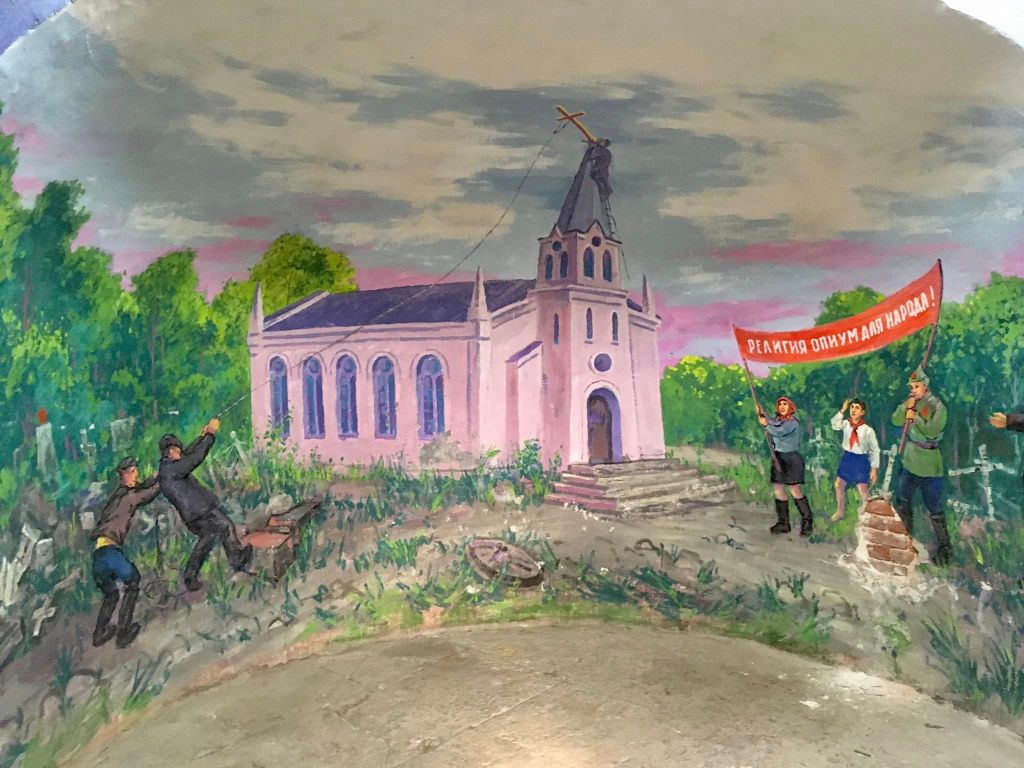
“Religion is the opium of the people!”

Ivan Babitski

I see that Akunin has again written something about Asia (where “the state is everything and the individual is nothing”) defeating European values in one particular country.

The point is that Russian intellectuals are, historically, not so fond of anything as repeating German vulgarities. And “Asian” metaphors are the favorites of Germans, and there is no degree of blatant idiocy at which they would stop.

For example, Adenauer explicitly claimed that the “Asian steppes” begin east of the Elbe. (He considered Prussia to be Asian, and so Bismarck’s triumph was an Asian conquest of Germany. Adenauer added the steppe by association.)

No matter how many decades have passed, the pre-war German spirit cannot be taken out of the Russian pamphleteer, and the fear of appearing ridiculous is as alien to them as it was to their mentors.

Pavel Sulyandziga

Quite correct thoughts in general, but there is one big catch.

How does Akunin (Chkhartishvili) differ from those Sieg Heiling in Russia when he starts using “Asia” in such a context, in such a comparison, even with a caveat? Maybe someone will say that I am wrong to try and compare him with the Sieg Heilers. Let me put it another way, then. How does a very good writer differ from those who are called white supremacists in the west?

I recently listened to a very interesting lecture on racism. The lecturer made a rather loose, but interesting ranking, singling out the racism of Soviet people as a separate species.

For some reason, some Europeans, when speaking about Asianness, “forget” about the Inquisition, concentration camps, and many other terrible events in history. Or are these also manifestations of Asianness?

We should also not forget that the current world order is also largely a product of European civilization with all its pros and cons.

One last thing, about why I decided to react in this way to Akunin’s statement, which are quite congenial to my own thoughts. It seems to me that a respected public figure should always think about the consequences of their words and deeds.

[…]

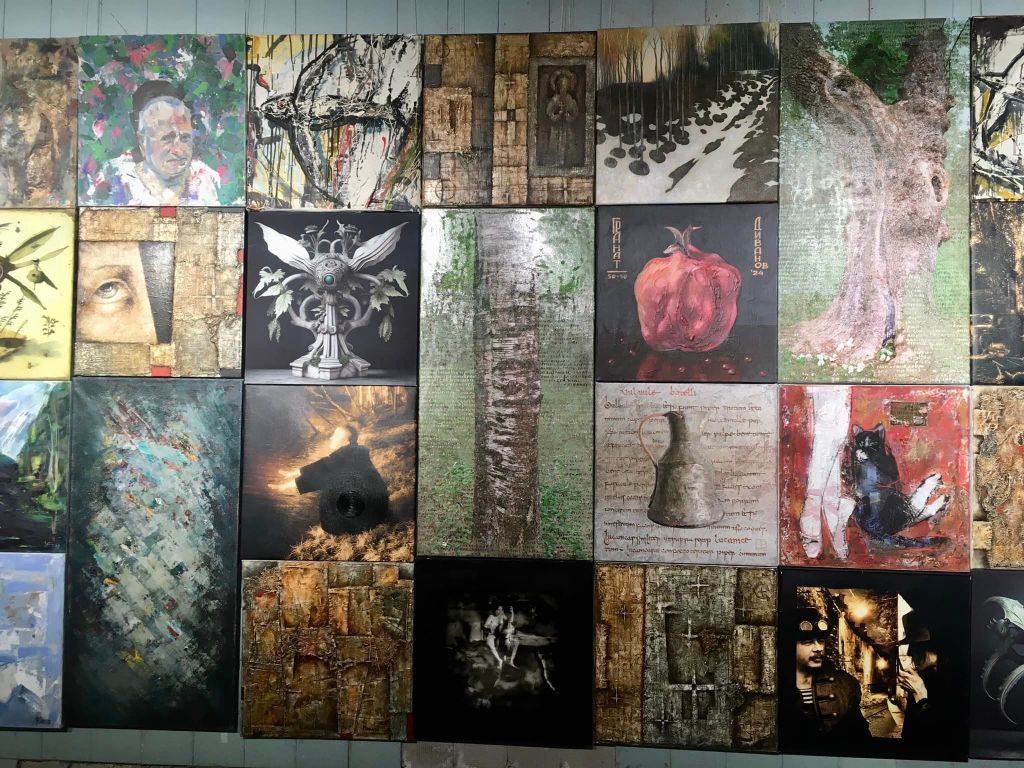
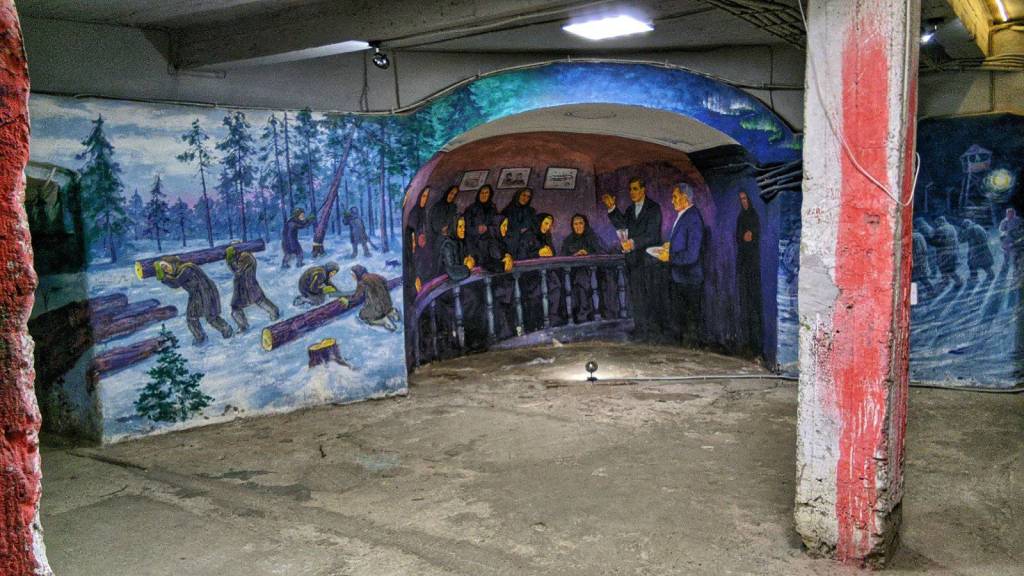
Source: Asya Rudina, “‘The world has split in two:’ the Runet discusses Akunin’s post about the two Russias,” Radio Svoboda, 1 April 2024. Translated by the Fabulous AM and the Russian Reader. The reactions, above, to Akunin’s outburst were not typical. Most of the best-selling author’s fans echoed his sentiments. The photos, above, by our friends V and M, were taken today at an exhibition currently on view in the former swimming pool and catacombs in the so-called Petrikirche on Nevsky Prospekt in downtown Petersburg. They suggest, I think, that the reality on the ground in “big Russia” (and “little Russia” as well) is slightly more complicated than Akunin would have us believe. ||| TRR

“Our characters find themselves trapped in confined spaces where both physical and emotional tensions escalate.”

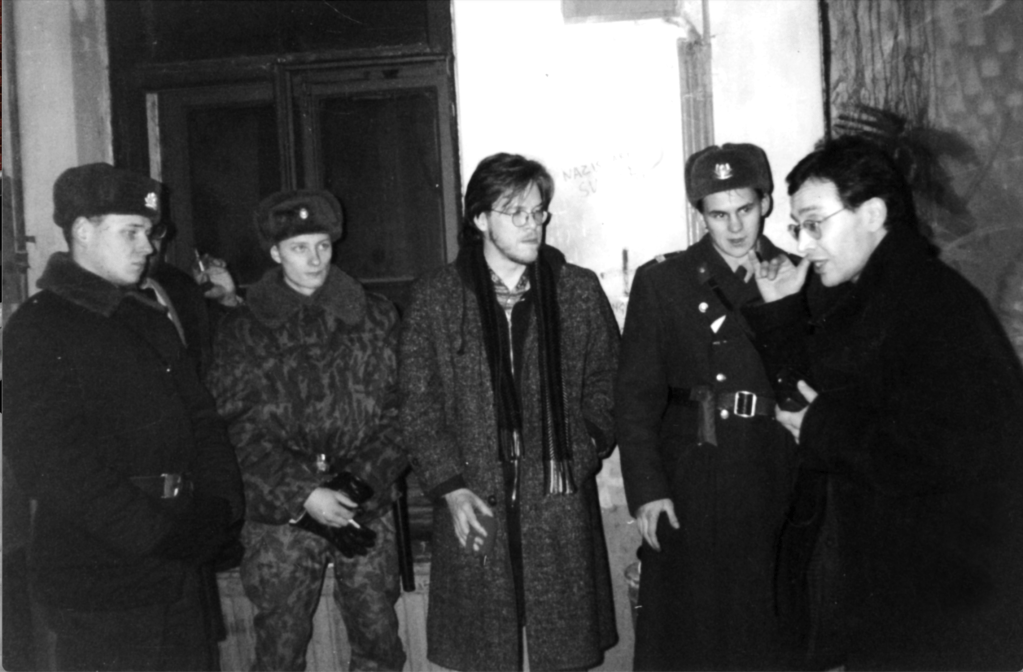
“The Cop Party,” an early edition of The Russian Reader, which started life as a series of happenings.
Pushkinskaya 10 artists’ squat, Petersburg, circa 1995

What’s the point of this flash mob? The nostalgia of aging people for their own youth? The illusion of normality in a situation of growing abnormality? The illusion of solidarity in a situation where all sociability is disintegrating?

Source: Sergey Abashin (Facebook), 6 February 2024. Translated by 21 Jump Street


Hundreds of thousands of Instagram users responded to a recent prompt asking them to post pictures of their younger selves. Photo quality varies.

Most of the photos are slightly faded. The hairlines fuller. Some feature braces. Old friends. Sorority squats and college sweethearts. Caps and gowns. Laments about skinny jeans and other long lost trends.

This week, Instagram stories the world over have been awash with nostalgic snapshots of youthful idealism — there have been at least 3.6 million shares, according a representative for Meta — as people post photos of themselves based on the prompt: “Everyone tap in. Let’s see you at 21.”

The first post came from Damian Ruff, a 43-year-old Whole Foods employee in Mesa, Ariz. On Jan. 23, Mr. Ruff shared an image from a family trip to Mexico, wearing a tiny sombrero and drinking a Dos Equis. His mother sent him the photo, Mr. Ruff said in an interview. It was the first time they shared a beer together after he turned 21.

“Not much has changed other than my gray hair,” he said. “I see that person and go, ‘Ugh, you are such a child and have no idea.’”

Mr. Ruff created the shareable story template with the picture — a feature that Instagram introduced in 2021 but expanded in December — and watched it take off.

“The amount of people that have been messaging me and adding me on Instagram out of nowhere, like people from around the world, has been crazy,” Mr. Ruff said.

[…]

Source: Sopan Deb, “‘Let’s See You at 21’ Puts Fun Spin on the Unrelenting March of Time,” New York Times, 1 February 2024


Maybe it’s not all so bad, and millions of people just wanted someone to see them as young and hot 21-year-old guys and girls who had everything ahead of them, all doors were open, and there were no obstacles to achievement. It’s good if these photos amuse them, rather than drive them to despair, if the person in the photo hasn’t achieved what he or she dreamed of at 21.

On the other hand, by scrolling through their Facebook feed with the “I am 21” flash mob, users see hundreds and thousands of photos of unknown people in foreign cities that mean nothing to them. What is the practiccal point of this flash mob? For users of Facebook, who have been posting numerous photos for years, there is no point.

Psychologists have long ago explained why people dump so many photos, including selfies, onto social networks: they have a need for constant approval and a desire to escape from unpleasant reality into a beautiful and easy virtual world where everything is fine. They’re also a means of communicating, showing off, and flirting. And if the “retro,” “things used to be better,” or “how young we were” option is enabled, nostalgic group sobs, likes, and reposts are guaranteed.

“We don’t think about artificial intelligence when we post our photos on social media, simply because the vast majority of us have no idea how neural networks are trained, or how algorithms work. We just wonder why topical ads jump out at us immediately when we think of something, but then we forget about it. Artificial intelligence isn’t Skynet from the Terminator movies at this point, but it’s something we’re going to be dealing with more and more. And protecting our personal information should worry us more than before,” says data science expert Yevgeny Galin. “Putting personal photos in the public domain is no toy or form of entertainment. We don’t know who could use them and for what purposes. I have no doubt that those purposes are illegal. And I wouldn’t count on social networks being conscientious about privacy policies. There’s nothing private on the internet. Facebook is already pretty good at recognizing faces and tagging people in photos.”

Training AI to recognize faces even in poor-quality black-and-white photos from the last century is proceeding by leaps and bounds. In many countries, identifying individuals with street surveillance cameras is already almost permitted by the constitution. And artificial intelligence is dependably replenishing the database of inhabitants of cities, countries, and continents. After all, it is so easy, especially if people post info about themselves on the World Wide Web.

Public figures who post their photos may well be involved in some kind of scam using deepfake technology.

Yes, we may be once bitten, twice shy, but caution in this case can’t hurt.

Source: Dina Vishnevski, “I’m 21: Facebook’s nostalgic flash mob is just a simulator for AI,” kp.ua, 7 February 2024. Translated by 21 Jump Street

NUMB3RS (Wages of War)

Illustration by Danny Berkovskii for Mediazona. Source: New Tab

Aided by a team of volunteers, journalists at Mediazona and the BBC’s Russian Service have identified 41,731 Russian soldiers killed in the war in Ukraine using open sources. This number includes employees of the Wagner mercenary group, but it does not include those who fought on Russia’s side in military units fielded by the self-proclaimed Donetsk and Luhansk “people’s republics,” the BBC noted in an article published on Friday, 12 January.

According to the article, more than 1,100 Russian military personnel killed in the war were under 20 years of age. Since the State Duma approved amendments to the relevant laws, in April 2023, thus permitting 18-year-old high school graduates to sign military service contracts, 48 Russians born in 2004 and five born in 2005 (who were thus “barely 18 years old” when they enlisted) have perished in the war.

As of 11 January, 2,377 airborne troops, 913 marines, 537 members of the Russian National Guard’s special forces, 450 members of the GRU’s special forces, 206 military pilots, and 77 FSB and FSO officers have been killed in combat operations.

The BBC points out that the number of casualties among those who voluntarily signed a contract to serve in the Russian armed forces has increased in recent months. Thus, volunteers, prisoners, and private mercenary company “recruits” now account for 37 percent of all confirmed losses 0n the Russian side. Another 12 percent of the identified casualties were draftees (of whom 5,005 died in Ukraine and 62 in Russia).

Source: Yevgeny Zhukov, “Journalists have confirmed the deaths of 41,700 Russian soldiers in Ukraine,” Deutsche Welle Russian Service, 13 January 2024. Translated by the Russian Reader


According to Ukrainian intelligence, the Russian forces in Ukraine currently consist of 462,000 military and 35,000 National Guard troops, responsible for the functioning of the occupation regime. This number of troops allows the Russians to carry out rotation — to withdraw units and subdivisions and bring them to the front line.

Source: Monique Camarra, “Jan 13: E-Stories,” EuroFile, 12 January 2024


When looking for a new advertising/PR agency in Ukraine in autumn 2023, PepsiCo made it a condition for a potential partner to exclude any mention of the war, or support for Ukraine and its army in future communications, according to a brief seen by B4Ukraine.

“NO: mention of war, hostilities, aggression, military personnel (from Brand side), Armed Forces of Ukraine. NO: support Ukraine and the army. NO: negative connotation, creating a feeling of ‘unsafe,’” states the “Pepsi restrictions” section of the brief.

The B4Ukraine Coalition contacted Pepsi offices in Ukraine and the US to ask for comment on this article but at the time of publication had not received any response.

In the meantime, the October 17 message on PepsiCo’s Instagram page announced that “PepsiCo volunteers distributed food kits to 1,200 families in the city of Borodyanka, whose homes were destroyed.” The message does not specify who exactly brutally destroyed the homes of these people.

Perhaps because PepsiCo’s Russia net profit increased by 333% to $525 million last year and the company paid about $115 million in taxes to the Kremlin? Treating such contributions as support for the economy of the aggressor state, Ukraine’s National Agency on Corruption Prevention (NACP) in September included PepsiCo in the list of international sponsors of war.

PepsiCo produces soft drinks, juices, chips, snacks, dairy products and other food products under the main brands Chester’s, Chipsy, Lay’s, Mirinda, Pasta Roni, Pepsi, Propel, Sandora, 7Up, Simba, Snack a Jacks, Sonric’s, Tropicana, etc.

The company has 19 factories, about 20,000 employees, 40,000 agricultural workers, and 600 open vacancies in Russia, according to the NACP.

The company announced the cessation of advertising activities and the production of some beverages in Russia in March 2022, while still allowing other products, such as infant formula and baby food to be sold, in order, as PepsiCo put it, “stay true to the humanitarian aspect of its business.” Yet in fact, the company continues the production and distribution of chips, snacks, and soft drinks. According to Bloomberg, PepsiCo’s revenue rose 16% in Russia and profits quadrupled, and the soda maker said operations in Russia accounted for 5% of consolidated net revenue for 2022, up from 4% a year earlier.

Now the iconic Pepsi cola is sold under the Evervess-Cola brand, although regular Pepsi Cola is still easy easily purchasable in Russian supermarkets due to the so-called parallel imports, when goods are imported without the manufacturer’s permission.

At the beginning of September last year, PepsiCo came under fire over its Russian business when the firm’s products were dropped by the Finnish parliament and Scandinavian Airlines’ operator SAS, and already on September 21, ironically, [a] Russian missile damaged a PepsiCo plant near Ukraine’s capital Kyiv.

A global [c]oalition of civil society organizations, B4Ukraine, is calling on PepsiCo to exit Russia ASAP and for the US government to issue a business advisory, warning US businesses of the growing legal, reputational, and financial risks of doing business under military control in Russia.

Source: “‘No support for Ukraine and its army’: PepsiCo restricts mentions of war in its PR,” B4Ukraine. Thanks to Monique Camarra (EuroFile) for the heads-up.


The war has markedly changed the Russian economy. Moscow has had to adjust its policy to fund its armed conflict against Kyiv, maintaining its military apparatus and police force, and integrating the territories it has annexed from Ukraine. These priorities have necessitated significant spending commitments that collectively threaten Russia’s economic stability. The Kremlin will spend six percent of GDP (more than eight percent when combined with spending on national security) on the war in 2024. This is more than the 3.8 percent of GDP that the United States spent during the Iraq war, although it falls short of the prodigious sums the Soviet Union allocated during the years of stagnation and its invasion of Afghanistan (18 percent of GDP).

Military spending has even eclipsed social spending—currently less than five percent of GDP—for the first time in Russia’s post-Soviet history. This pivot toward a militarized economy threatens social and developmental needs. The four annexed regions of Ukraine have already received the equivalent of $18 billion, and in 2024 almost $5 billion is expected to be transferred from the federal budget to regional budgets. No other regions in Russia receive this level of investment, which only increases interregional inequality. Rather than restore dilapidated housing in Russia, the Kremlin prefers to spend money on building houses and roads in annexed territories, to replace the houses and roads that Russian troops destroyed during their brutal invasion.

Russian industry has been transformed, with defense sectors now overshadowing civilian industries. The defense sector’s enterprises are now operating at a fever pitch and, as a consequence, any surge in demand is likely to force prices to rise because of the sector’s inability to increase supply. The military sector is receiving a disproportionately high amount of government spending, and it is also siphoning off labor from the civilian workforce, leading to an abnormally low unemployment rate of 2.9 percent. Before the war, Russia’s unemployment rate typically stood at around four to five percent. The military and public sectors now employ 850,000 more people than in late 2022–23. The invasion of Ukraine also prompted about 500,000 Russians to emigrate in 2022, driving shortages of qualified specialists and blue-collar workers.

Meanwhile, living standards have risen across Russia, and the percentage of Russians living below the poverty line has dropped to 9.8 percent, the lowest since 1992. Naturally, there are regional variations, and areas that have sent a significant number of their men to fight in Ukraine—including Altai Krai, the Altai Republic, Buryatia, Chechnya, and Dagestan—have witnessed the fastest income growth in low-income groups. This relative increase in prosperity can be expected to continue as Moscow disburses funds to the families of the deceased and wounded.

Overall, the Kremlin wishes to maintain an illusion of normality and even increasing prosperity for its citizens. The distortions in the labor market have pushed up salaries in military industry, as well as in civilian manufacturing, because of the need to compete to attract workers from well-paying military plants. Moscow is, meanwhile, making high payments to soldiers and people mobilized to fight in Ukraine, which are driving consumption. At the same time, thanks to a supply of cheap credit, the government is handing out subsidized mortgages, that are, for the moment, shielding families from economic reality.

Source: Alexandra Prokopenko, “Putin’s Unsustainable Spending Spree: How the War in Ukraine Will Overheat the Russian Economy,” Foreign Affairs, 8 January 2024


Elsewhere there are signs that the invasion of Ukraine may have disrupted the Russian economy more severely than the frothy party scene suggests. The Olivier salad, a mayonnaise-drenched confection of root vegetables, sausage and boiled eggs, is a staple at every table during the holidays. This winter the price of eggs suddenly rocketed (no one is quite sure why, but it may have been because farms were short of labour since so many workers have been conscripted or left the country). In some regions people cannot afford a box of six eggs and have to buy them individually. One pensioner even raised this with Putin during the president’s annual end-of-year call-in with the public. Putin promised to look into it.

Source: Kate de Pury, “Gucci is cheap and eggs are pricey in Russia’s surreal economy: War spending has Russians partying like it’s 2021. But some are also stockpiling dollars,” 1843 Magazine (The Economist), 10 January 2024


In the two years that have passed since the start of Russia’s large-scale invasion of Ukraine, residents of Ukraine have become less likely to use the Russian language, according to a press release on the outcome of research done by the Ludwig Maximilian University of Munich in cooperation with the University of Bath and the Technical University of Munich, which was published on Wednesday, 10 January.

Language plays a leading role in the identity of post-Soviet Ukraine, the authors of the study say. Many Ukrainians are fluent in both Ukrainian and Russian. And yet, only a few years ago, 50 to 60 percent of the country’s residents called Ukrainian their principal language of communication. After the Maidan protests in late 2013, sparked by then-Ukrainian President [Viktor] Yanukovych’s refusal to sign an association agreement with the EU, and Russia’s subsequent  annexation of Crimea in 2014, more Ukrainians abandoned Russian.

[…]

The researchers explore this trend in a study published in the journal Communications Psychology. Using artificial intelligence and statistical analysis, they examined more than four million messages posted by 63,000 Ukrainian users on the social network X (formerly Twitter) between January 2020 and October 2022.

According to the study’s authors, users began switching from Russian to Ukrainian even before the large-scale Russian invasion, but this trend increased dramatically after the war began. In their opinion, this change in user behavior was a political reaction to events. Users wanted to distance themselves from both support for the war and Russia as such, so they started using Ukrainian en masse.

Source: Sergei Gushcha, “Ukrainians use Russian less since war began,” Deutsche Welle Russian Service, 10 January 2024. Translated by the Russian Reader


The full-scale war in Ukraine, which began almost two years ago, has led to increased violence in Russia itself. Military personnel with PTSD and criminals recruited into combat return from the front and maim and kill people in civilian life. Sometimes conversations about the war even end in violence. Mediazona and New Tab have uncovered over thirty criminal convictions for assaults and murders that occurred during quarrels about the “special military operation.” (The courts use the official wording for the war as mandated by the authorities.)

In Berdsk, Novosibirsk Region, draftee Khuler Mongush stabbed Nikolai Berezutsky, a passerby. The latter had asked Mongush why he was going to Ukraine. Saying that he was going there “to defend the Motherland,” the mobilized man attacked Berezutsky. Mongush was sentenced to eight years in prison for murder.

In the Irkutsk Region, farmer Maxim Khalapkhanov was drinking with an acquaintance, who began ridiculing the state of the Russian army during the war. Khalapkhanov eventually got angry and killed the acquaintance with a knife, whose handle was decorated in the colors of the Russian flag, and drew the letter Z on his stomach with a fireplace poker. Khalapkhanov was sentenced to seven years in a high-security penal colony.

Anton Rakov, a resident of Orenburg, was drinking with a new acquaintance. They began arguing about the war. Rakov did not like what his interlocutor was saying and killed him. While his victim breathed his final breaths, Rakov recorded a video with the dying man in the background, shouting, “This is what will happen to anyone who disagrees with me!”

Viktor Konnov of Zlatoust beat up a friend who said something nice about Ukraine, while Ivanovo resident Mikhail Vitruk received two and a half years in a penal colony for beating up his girlfriend, who allegedly called him a “Nazi” while they were watching the news.

In 2020, Mikhail Taskin attempted to shoot three people over a parking space and was sentenced to nine years in a penal colony, whence he was freed by the Wagner Group. Taskin spent several months in combat, where he lost a leg, eventually returning to his native village of Nerchinskiy Zavod in the Transbaikal Territory. In August 2023, he got into a fight at a local cafe. Taskin mocked the waitresses and promised to “hump all of them.” The incident ended in a brawl, and the police detained five people, but not Taskin was not among them. His sister and the local authorities argued that the disabled man had been assaulted by “opponents of the war.” But the news website Regnum discovered that two of the detainees were certainly not against the war because they had been involved in patriotic campaigns in the region.

It is not only drinking buddies and casual acquaintances who quarrel and fight over the war. Mediazona and New Tab turned up no less than seven court rulings in cases where the defendants and the victims were members of the same family. Vladimir Tofel from Petropavlovsk-Kamchatsky killed his nephew during an argument about the war. Yuri Makarkin stabbed his son, while Anna Cheremnova, a resident of the Altai Territory, stabbed her husband.

The experts asked for comment by Mediazona and New Tab argue that these are signs of a deep split within society, and the policy of the authorities does not help society to overcome this fissure. On the contrary, the hysterical rhetoric of propaganda only heightens the degree of intolerance, and people are increasingly willing to maim and kill each other.

Source: WTF (Mediazona) newsletter, 10 January 2024. Translated by the Russian Reader

I Apologize

Once upon a time, apologizing on camera was a Chechen and Belarusian practice. Since the outbreak of full-scale war, the Russian authorities have also adopted this method of putting pressure on dissenters, especially in music and pop culture. Here are some examples from the last year.

Underdog and La Virgen bars

To whom: the police.

For what: for holding a charity event to aid Ukrainians.

Quote: “We apologize, including to all law enforcement officers who had to be involved in these events because of us and waste their time.”

Did it help: Yes, the security forces have left the bars alone.

Rapper Scally Milano

To whom: Yekaterina Mizulina, head of the Safe Internet League.

For what: for mentioning drugs in his songs.

Quote: “We have to be role models, but ones with the right values. I urge all performers to be responsible. The moment has come to change everything for the better, and I want to have an impact on this.”

Did it help: Yes, Mizulina gave the rapper another chance: he had his a picture taken with her and deleted some of his songs from streaming services. The security forces stopped disrupting his concerts.

Rapper Loqiemean

To whom: to everyone.

For what: for protest songs.

Quote: “I spent time in prison. More precisely, I spent five days under arrest in a pretrial detention center. On this occasion, I have to shore up my opinion about the complaints about the pots.* I was wrong: I should not wish harm to my army, because the army is inseparable from the people. And I am an inseparable part of this people.”

Did it help: yes, apparently. Roman Khudyakov (which is the rapper’s real name) has stopped making public appearances, however.

*[In a video recorded on 23 March 2022, Loqiemean is shown baking meat in clay pots and saying that he would like those who bombed an apartment building in Odessa to be cooked in clay pots. On 1 May , Yekaterina Mizulina posted this video on her Telegram channel, captioning it as follows: “But we definitely do not need such concerts in Russia. Let him perform at home in his kitchen.”]

Singer Charlotte

To whom: the police.

For what: for anti-war statements and burning his passport.

Quote: “I was mistakenly obsessed with false information [voice-over: “Why were you brought here?”] I had a misfire in understanding what was happening.”

Did it help: no. Charlotte has been charged on four criminal counts, including “disseminating fake news about the Russian army” and “discrediting the Russian army.” He’s now under arrest in a pretrial detention center.


Charlotte, “Posh or Not” (2019):
“When I see a person, I look into their eyes
It doesn’t matter what you look like
It’s important what you’re talking about
When I don’t see a person, I look up at the sky
It doesn’t matter what I look like
It’s important what I’m talking about”

Blogger Nastya Ivleeva, singer Philip Kirkorov, rapper Vacìo, and others

To whom: everyone.

For what: for an “almost naked” party, at which the guests were dressed scantily; Vacìo even came wearing only a sock over his penis.

Quotes:

Vacìo: “I want to say that I don’t support LGBT people in any way and didn’t want to make any propaganda about it. I condemn LGBT supporters. I apologize for offending the feelings of other people and for being involved in such a terrible video at such a difficult time for our country.”

Philipp Kirkorov: “I went through the wrong door. Yes, I knew about the event, had received an invitation, promised to come and came, but I didn’t know about the nature of the events that would take place behind that door. And so I left.”

Ksenia Sobchak: “I can tell you for sure for myself, my friends, I definitely did not want to offend anyone. If someone is offended by my appearance, I apologize for it.”

Did it help: We don’t know yet. It seems that the backlash against Ivleeva and her guests is still underway.

Source: WTF (Mediazona) email newsletter, 28 December 2023. Translated by the Russian Reader


Hüsker Dü, “I Apologize” (1985)

MOSCOW, Dec 28 (Reuters) – A rapper who attended a celebrity party with only a sock to hide his modesty has been jailed for 15 days, sponsors of some of Russia’s best known entertainers have torn up their contracts, and President Vladimir Putin is reported to be unamused.

An “almost naked” party at a Moscow nightclub held at a time when Russia is engaged in a war with Ukraine and the authorities are pushing an increasingly conservative social agenda, has provoked an unusually swift and powerful backlash.

A video clip of Putin’s spokesperson listening to an explanation from one of the stars who attended has been circulating online. Baza, a news outlet known for its security services contacts, has reported that troops fighting in Ukraine were among the first to complain after seeing the footage and that photographs of the event reached an unimpressed Putin.

Dmitry Peskov, Putin’s spokesperson, on Wednesday asked reporters to forgive him for not publicly commenting on the burgeoning scandal, saying: “Let you and I be the only ones in the country who aren’t discussing this topic.”

Maria Zakharova, a spokesperson for the Russian Foreign Ministry, said that the event had “stained” those who took part, but that they now had a chance to work on themselves, according to the Ura.ru news outlet.

The fierce backlash from the authorities, pro-Kremlin lawmakers and bloggers, state media, and Orthodox Church groups has been dominating the headlines for days, displacing stories about rising egg prices and allowing people to let off steam by railing against the show-business elite instead.

The party, in Moscow’s Mutabor nightclub, was organised by blogger Anastasia (Nastya) Ivleeva and attended by well-known singers in their underwear or wearing skimpy costumes who have been staples on state TV entertainment programmes for years.

DOUBLE APOLOGY

Ivleeva, who has since become one of Russia’s most recognised names, is seen in one clip showing off an emerald-studded chain around her backside worth 23 million roubles ($251,000) at a time when some Russians are struggling to get by.

She has since issued two public apology videos for the event which spanned Dec. 20–21.

In the second tearful apology, released on Wednesday, Ivleeva said she regretted her actions and deserved everything she got but hoped she could be given “a second chance.”

Nastya Ivleeva’s second social media apology for the “almost naked” party, posted on Wednesday

Her name has since disappeared as one of the public faces of major Russian mobile phone operator MTS, the tax authorities have opened an investigation that carries a potential five-year jail term, and a Moscow court has accepted a lawsuit from a group of individuals demanding she pay out 1 billion roubles ($10.9 million) for “moral suffering.”

If successful, they want the money to go to a state fund that supports Ukraine war veterans.

“To hold such events at a time when our guys are dying in the (Ukrainian) special military operation and many children are losing their fathers is cynical,” said Yekaterina Mizulina, director of Russia’s League for a Safe Internet, a body founded with the authorities’ support.

“Our soldiers on the front line are definitely not fighting for this.”

Many of the party’s famous participants have recorded apologies, including journalist Ksenia Sobchak whose late father Anatoly was once Putin’s friend and boss.

SOCIAL CONSERVATISM

The scandal comes at a time when Putin, who is expected to comfortably win another six-year term at a March election, has doubled down on social conservatism, urging families to have eight or more children, and after Russia’s Supreme Court ruled that LGBT activists should be designated as “extremists.”

Nikolai Vasilyev, a rapper known as Vacio who attended wearing only a sock to cover his penis, was jailed by a Moscow court for 15 days and fined 200,000 roubles ($2,182) for propaganda of “non-traditional sexual relations.”

Other more famous names have had concerts and lucrative state TV airtime cancelled, contracts with sponsors revoked, and, in at least one case, are reportedly being cut out of a new film.

The scandal has angered those who support Russia’s war in Ukraine.

Standing outside the Bolshoi Theatre on Thursday, Nadezhda, one Moscow resident, told Reuters she was outraged and thought those who took part should be punished and not shown on TV anymore.

“If you’re partying at least don’t film it,” she said. “At such a difficult time (for Russia), they should at least be ashamed. Aren’t they ashamed before those who are fighting for us?”

Alexander, another Muscovite, said those who attended had not broken any law and were free to do as they pleased at what was a private event.

But one woman who said her nephew had lost both legs in combat wrote in a post to the League for a Safe Internet that the stars should pay for prosthetic legs for her relative and others to make amends.

“That would be a better apology,” the unidentified woman wrote.

($1 = 91.6205 roubles)

Source: Andrew Osborn, “Russian stars’ semi-naked party sparks wartime backlash,” Reuters, 28 December 2023


In her first social media post about the scandalous party, released five days ago, Nastya Ivleeva wasn’t apologetic or teary-eyed at all. ||| TRR


The situation around the “naked party in Moscow,” in the course of which the Russian patriotic crowd has canceled many quite pro-regime figures, quite tellingly illustrates the degradation of Russian society. Previously, there were two realities: the reality of official propaganda, and a parallel reality in which there was “contemporary art,” “kinky parties,” and Knife magazine.” In exchange for symbolic loyalty to the regime, one could gain comparative individual freedom.

Now that time has come to an end. There will be no individual freedom even for the chosen ones. The only freedom that remains for Russians is the freedom to vote for Putin and the freedom to apologize to Kadyrov.

There is something incredibly funny about the fact that Russian culture, after all its sobbing about imaginary [culture] “cancellation” [on the part of the west], has finally joyfully taken the plunge and canceled itself.

Source: Aleksandr Wolodarskij (Facebook), 28 December 2023. Translated by the Russian Reader