In the wee hours of Sunday, 4 May, Russian security forces raided concerts in St. Petersburg and Yekaterinburg, at which, among other things, they asked attendees about their attitude to the war, local media have reported.
In Yekaterinburg, law enforcement officers interrupted a concert at the club Syndrome. As the musicians were performing, people in uniform came on stage, halted the concert, and asked the concert organizers to turn on the lights, concertgoers told the Telegram channel Svet. Ekaterinburg.
“People were ordered to stand facing the walls and told that there would be a document check. [The police] checked everyone’s documents, tattoos, and elbows, asked about their attitudes to left-wing radical movements and to the SMO (the war in Ukraine—ed.), and they checked the messenger apps on their phones. After the check, people were taken outside and ordered to scram,” said one of the guests.
Another clubgoers told the news website E1.RU that police locked him in a paddy wagon, confiscated his phone, and checked his contents. Police insulted the detainee and refused to explain the reasons for the check. According to eyewitnesses, police and Russian National Guard officers took part in the raid. Those agencies declined to comment on this report.
Regular raids by law enforcers in Russia
In St. Petersburg, law enforcers raided a rave party at the [underground] club Kontrkult. A source close to the police told Ren TV that the reason for the raid was that the event had not been “sanctioned.” According to the news website 78.ru, partygoers had their documents checked and were searched for banned substances. The publication adds that the event’s organizers were detained. This has not been officially confirmed.
Footage of the raid on Kontrkult, as posted on the Telegram channel SHOT
Similar raids on various establishments have happened regularly in Russia in recent months. Law enforcers have carried out several raids on fitness centers, in which people were issued military conscription board summonses. Similar raids have been carried out against migrant workers, who also had their documents checked and summonses handed to them, along with members of the LGBT community, who have been declared “extremists” in Russia.
💬 Student from Nizhny Tagil fined 120,000₽ in criminal “defaming” case
In Nizhny Tagil, 21-year-old student Yekaterina Sergeyenko has been sentenced for “defaming” [the Russian army]: she was fined 120,000 roubles [approx. 1,280 euros]. According to the news agency Mezhdu Strok (“Between the Lines”), criminal charges were filed over the young woman’s comments in the “Incident Nizhny Tagil” group on the social network VKontakte.
Vechernye Vedomosti reports that at the time she posted the comments, Sergeyenko had a prior administrative conviction for painting sixteen pacifist slogans on buildings in the city. This fact influenced the decision to file criminal rather than administrative charges against her.
Judge Oksana Belkina of the Tagilstroy District Court found Sergeyenko guilty. Although the verdict has not yet entered into legal force, the fine, according to Mezhdu Strok, has already been paid.
On 22 April 2025, Voronezh police raided the homes of activists believed by Center “E” [Russia’s “anti-extremism” police] to be connected to the Telegram channel Free People of Voronezh. The searches also involved severe beatings and threats, and some of the activists were forced to record videos supporting Putin and the war in Ukraine. Almost all the activists had previously been prosecuted on political charges, but now they feel so intimidated that they are afraid to file a torture complaint against the police.
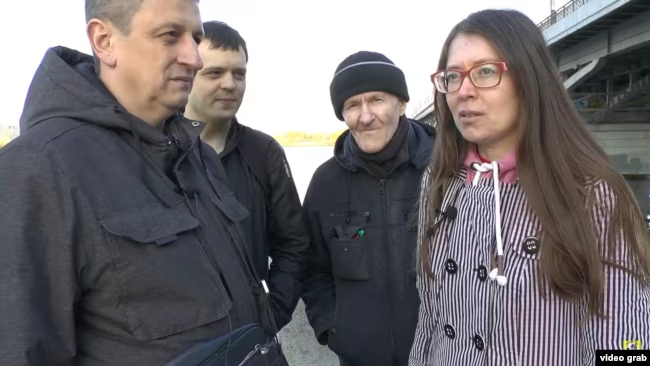
A 38-minute video was posted on the Free People of Voronezh channel on 16 April 2025. The video itself was viewed by less than three hundred people. In the video, four activists—Grigory Severin, Nadezhda Belova, Yuri Avsenyev, and Alexander Zheltukhin—discuss the news before jogging along an embankment of the Voronezh River. The genre is the “coffee klatch”: using the news as a springboard, the friends talk about the problem of alcoholism, apathy in society, increasing drug use, and the overall sense of doom and gloom.
Activists of the Telegram channel Free People of Voronezh: Grigory Severin, Alexander Zheltukhin, Yuri Avsenyev, and Nadezhda Belova
Nadezhda Belova sums up the video’s content at the very beginning.
“To cut it short, everything is bad, but it will get worse. To put it in a nutshell, the situation in this place is at the terminal stage,” she says.
She argues that Russia is inevitably moving in the direction “North Korea”—toward a mothballed, rotten dictatorship, because Russians “somehow still support it and want to live in it.” Belova has reason to be pessimistic: even before the war, the state had charged her with “condoning terrorism” for comments she had made on social media in the wake of Mikhail Zhlobitsky‘s [suicide] bombing of the Arkhangelsk FSB. in 2020, a military court sentenced Belova to pay a fine of 400,000 rubles. She was on Rosfinmonitoring’s list of “terrorists and extremists” for several years, and her family had to leave their home village and rent a flat in Voronezh, as their fellow villagers did not support Belova in her fight against the unjust charges.
The video posted on the Telegram channel Free People of Voronezh on 16 April 2025
“Again, the whole of Voronezh is covered with drug adverts. The law enforcement agencies run protection for [the illegal drug trade], and if they didn’t run protection for it, there wouldn’t be these adverts. At my neighborhood Pyaterka [convenience store], right at the entrance, there is a graffito painted in color on the doorstep: ‘Buying a stash is like going out for bread,'” says Alexander Zheltukhin. In previous years, Zheltukhin was fined for picketing against Belova’s persecution and arrested for protesting in support of Navalny. “And if it was not protected, I would argue, by the selfsame FSB, who probably take a percentage from it—”
“Watch out! You are discrediting the FSB,” Belova says, interrupting him. “I don’t agree! It cannot be!”
Caveats and omissions run through the entire conversation. The activists know that any free speech is potentially dangerous in today’s Russia, and they try to cover their bases whenever possible. (Spoiler: it didn’t work).
“They say it’s impossible not to confess”
A few days later, on 22 April, police raided the homes of all four people involved in the run, as well as those of other Voronezh activists. Searches were done at eight locations, allegedly connected with Free People of Voronezh. In most cases, the law enforcers acted extremely harshly. They used handcuffs and stun guns, beat people, intimidated the activists and their families, and emotionally abused them.
A photo posted by Nadezhda Belova
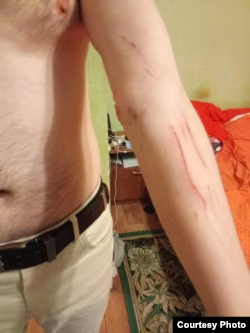
All the members of Belova’s family were shot with a stun gun. Belova later posted photos of her own bruises and the bloody marks on the bodies of her husband and son on Facebook. The police confiscated all their electronic devices and turned upside down their rented flat, which the landlady demanded that the Belovs vacate immediately after the search. The police threatened to send the son, a university student, to the war, and after the search, a policeman recorded a repentant video featuring Belova.
“Off camera, the [policeman beating Belova’s husband] says, ‘Do you support the [special military operation]?’ I say, ‘Yes.’ He says, ‘Do you support Putin?’ I say, ‘Yes.’ It’s light fare, but disgusting, especially when I saw a stun gun pressed against my son’s leg,” Belova told Okno.
The police recorded similar video “confessions” by several other people [caught up in the raids].
After the searches, Zheltukhin ended up in hospital with five broken ribs and several damaged vertebrae. He told OVD Info that he had tried to escape from the “punitive operation” and fell from the roof of a village house: “I broke my ribs when I fell, apparently, and they hit me [on those ribs]: it hurts a lot.” The police put a bag over his head and shocked him with a stun gun. His friends later photographed Zheltukin at hospital: his face was covered with bruises.
Fyodor Orlov, 36, was also beaten; after the experience, he says that he “did it all to himself.” He inflicted all the bruises and abrasions on himself, blindfolded himself with a scarf and sat like that for two hours, and fell into a briar bush on his own; there are photos of his back, entirely covered with flecks of blood. “Then someone—that is, I—drew a sex organ on my bald head just for fun,” he told OVD Info. The law enforcers also threatened to cut off one of his fingers, leaving behind telltale scratches.
Fyodor Orlov’s finger
“It was quite rough. As rough as possible, to the point that they say that now they understand why people confess to crimes they did not commit. Because, they say, it’s impossible not to confess. Orlov has several hundred stun gun marks [on his body]. Several hundred! They drove him into the woods. He thought they were taking him there to kill him,’” says Pavel Sychev, 38.
Sychev is a Voronezh activist and political consultant. He knows the administrators of the Free People of Voronezh channel from his past work as an activist: they crossed paths at pickets, but do not keep in close contact. Sychev’s home was also searched on 22 April, but there was no violence.
“[The police] search my home, as a rule, without breaking the law, and they never use force against me or my family. They have been coming to my home every year since 2022. These are just routine searches. I have always been searched as a witness in criminal cases to which I don’t even have an indirect connection,” says Sychev. “There is a federal case [for example, the case against Grigory Melkonyants and other activists of the Golos movement—Okno], and they do a series of searches all over the country, and they come and search my house for good measure.”
“Evil loves silence”
It is unlikely that the new series of searches was occasioned by the latest video posted on the Telegram channel. Our sources suggest, rather, that the reason for the raids was that Free People of Voronezh constantly writes and speaks about people convicted on charges of high treason and terrorism (for sabotaging railroad switch boxes, cell towers, etc.). The channel admins treat these people as anti-war resisters. For law enforcers, on the contrary, they are criminals convicted of violent crimes.
The formal pretext for the series of searches on 22 April was the criminal case, on charges of repeated discrediting of the army, brought against Grigory Severin. As follows from the indictment, while serving his sentence in a penal colony [he had been sentenced to two and half years in prison for “publicly calling for extremism”; he served his time and was released last autumn—Okno], Severin discredited the Russian armed forces. After the search, he was detained and placed under arrest.
Sychev believes that this criminal case was “canned.”
“You see, in Russia we have the practice of ‘desk drawer cases.’ Meaning you already have a criminal case against you: the entire case file is ready in advance, and it is lying in a desk drawer, waiting for its day to come. In the case of Severin, his first case was also ‘in a desk drawer.’ When he was arrested, it transpired that the entire case file had been readied a year earlier.”
It is not known what prompted the police to pull the case file from the drawer right now. But the fact that Severin faces prosecution does not surprise Sychev in itself.
“Everyone who knows Grigory, even in passing, realizes that he is a man who will not stay quiet. If anyone asks him directly how he feels about this or that situation, he will answer directly, even if the answer risks criminal charges. He is a man who will always try to prove to everyone the viewpoint which he espouses and defends. As far as I know, the first ‘discrediting of the armed forces’ case against him came from his explaining his philosophy of life to traffic police officers who had pulled him over. The second charge came from telling his cellmates about his stance. This in the order of things for him: he does not keep silent; he speaks openly, directly. So it was a matter of time. When a person speaks openly about a very dangerous and sensitive topic—and in our country the ‘special military operation’ is a sensitive topic—there are many chances that sooner or later they will be prosecuted.”
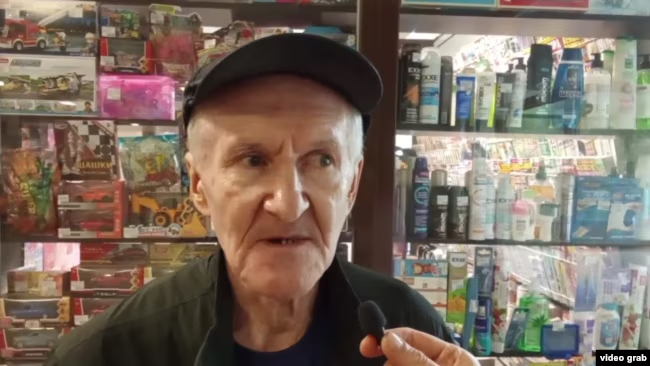
On the same day, a criminal case was opened against 65-year-old activist Yury Avsenyev, another person involved in the run along the Voronezh River embankment. His home was also searched on 22 April, but he was released on his own recognizance. Avsenyev is suspected of “publicly calling for extremism.”
Yuri Avsenyev
The Voronezh activists who fell victim to the police brutality have not yet worked up the courage to file complaints, and they fear excessive publicity.
“They are really spooked,” says Pavel Sychev. “The information I have now is that they will not file torture complaints, but I don’t know, maybe someone will persuade them to do it. They are very much afraid that if they do it, the law enforcers won’t be reprimanded in any way, but will just come and take revenge on them. They are all convinced that they will be killed. I told them that evil loves silence, and if you don’t react now, there is a greater chance of a repeat than if you do. But they said it’s very easy to judge from the outside when you haven’t been tortured. ‘We are afraid that they might do something to us,’ [they say].”
Our sources note that such official lawlessness had not previously occurred in Voronezh. Usually, searches at the homes of political activists and arrests were carried out by the book, without violence. The only widely known case of official lawlessness ended in criminal charges against the police officers involved and monetary compensation for the victims. In May 2018, criminal investigators Sergei Kosyanenko and Oleg Sokolovsky tortured university students Maxim Grebenyuk and Sergei Troyansky, hoping to force them to confess that they had stolen a mobile phone. The students were held at Police Station No. 4 in Voronezh’s Comintern District for six hours in handcuffs and strangled with a plastic bag. They refused to incriminate themselves, and afterwards they documented their injuries and filed a torture complaint with the Investigative Committee. In 2021, Grebenyuk was awarded one million rubles, and Troyansky, 500,000 rubles, in compensation for their suffering.
The Voronezh police’s current brutality may be due to the proximity of the front, suggests a source who requested anonymity. The fact is that, since the start of the full-scale invasion, Voronezh law enforcers have regularly been seconded to the so-called new territories, the occupied Donetsk and Luhansk regions.
“There are quite big problems with the law in those ‘new territories.’ And the practices that are used there are inhuman, I think. When they come back here, to their native land, they simply do not reconfigure themselves,” says our source, who is not connected with the Free People of Voronezh Telegram channel. “They consider themselves above the law. They think that they are involved in a good cause, and they can torture bad people for the sake of the good cause. When a person has tried their hand at it once, when they realize that they can get away with it absolutely scot-free, then it is quite difficult to put the brakes on, and it will grow.”
Olga Menshikh. Photo: Alexandra Astakhova/Mediazona
A panel of three Moscow City Court judges, chaired by Irina Vasina, upheld the verdict in the criminal case against anesthesia nurse Olga Menshikh on charges of disseminating “fake news” about the Russian army: eight years in prison for two posts on the Russian social media network VKontakte, per Article 207.3.2.e of the Criminal Code. This is the longest sentence on these charges handed down to a woman. The following is an abridged version of Menshikh’s statement at today’s court hearing.
You and I understand everything quite well: we are all adults here. You shall say that this is not a frame-up, that it’s the norm. Nevertheless, we understand that there is a more serious organisation* which has ordered this [verdict], and they do things as they see fit regardless of these frame-ups.
Here, for example, is a quotation from my case file: “Olga Sergeyevna Menshikh causes her fellow citizens to feel anxious, afraid and worried, to feel undefended by the state’. I cause that!? I am an absolute loner with a mum who is eighty-six years old, and I have no other interests in life. What can I say? These words in no way apply to me. I completely deny them and consider them slander.
But these words perfectly describe the well-known organisation, known as the FSB, which I have just outlined for you. […] Back in the day, serious conclusions were not drawn about the architecture of the seventy-year utopia, which murdered millions of its own citizens and citizens of other countries and collapsed during an attempt to repair it, but then suddenly rose up and went at it again. Crush what was not crushed earlier! ‘Crush them!’ is the watchword of the day.
Who should be crushed, I want to ask you, your honours? The peasants, whom you destroyed long ago? The hegemon [i.e., the proletariat], whom you long ago turned into a drunkard? Do you want to crush the intelligentsia? Do you want to crush business? How do you plan to live? What have I been observing in Detention Centre No. 6 right now? I just sat for four hours with the nicest businesswoman. You have been clamping down on businesspeople of all stripes.
I have seen all kinds of people here. Lawyers and doctors serving long sentences, mothers with many children, with three or four children, incarcerated here without verdicts. And just now I came in from the corridor, where a disabled woman in a wheelchair was being sent off to a penal colony. Pensioners and young people are held here on completely trumped-up charges. Do you want to crush them, to trample on their lives so as to make others afraid? Is that what you want to do? You want to crush them so that everyone is afraid because you were ordered to do it? Have them be afraid, have them sit in prison.
Well, this is what I want to tell you calmly. A society sick with fear cannot create, cannot be happy, cannot live, cannot love to the fullest, cannot reproduce. You consider it quite necessary for us to reproduce. But [society] cannot reproduce amid this fear. A wild goose never laid a tame egg. This fig tree will die out, you shall kill it off.
This entire fear machine has only one aim: destroying all of us. So many people, so many civilised people were destroyed, that I cannot list their names. I will only quote a great novel. Having worked in the medical field myself, as someone who took patients quite seriously, I will quote the great novel Doctor Zhivago, about Doctor Yuri Andreyevich Zhivago. By the way, he dies before he reaches the age of forty.
Here is what the great diagnostician Yuri Zhivago says: “Microscopic forms of cardiac hemorrhages have become very frequent in recent years. […] It’s a typical modern disease. I think its causes are of a moral order. The great majority of us are required to live a life of constant, systematic duplicity. Your health is bound to be affected if, day after day, you say the opposite of what you feel, if you grovel before what you dislike and rejoice at what brings you nothing but misfortune.”**
Yuri Andreyevich uttered these words exactly a hundred years ago. And so, concerning this organisation, which we all know quite well: a dead man coming back to life cannot make anyone happy. Even when he was alive, he brought happiness to no one. He turned a lot of folk into dead people, and now he is raising another generation suffering from PTSD, post-traumatic stress disorder, which is quite hard to treat.
What can I say? I am sorry. I feel sorry for you, I feel sorry for me. I feel sorry for the people in this detention centre. I feel sorry for the women, for the children. Dear honourable judges and prosecutors, we are all in the same boat. I rest my case.
* In the first part of her statement, Menshikh talks about how she believes the FSB was behind her criminal case from the beginning — Mediazona.
** Translated by Max Hayward and Manya Harari — TRR.
A court in Moscow on Thursday sentenced a 59-year-old nurse to eight years in prison for social media posts opposing Russia’s invasion of Ukraine.
Olga Menshikh was accused of spreading “fake” information about the military with two VKontakte posts that condemned Russian strikes on Vinnytsia, Ukraine, that killed 28 people in July 2022 and Russian troops’ mass atrocities against civilians in the Kyiv suburb of Bucha.
Menshikh denied her guilt, with Mediazona reporting she had 15 followers and that her account may have been breached.
Moscow’s Dorogimolovsky District Court found Menshikh guilty of spreading “fake news” about the Russian military’s actions abroad and handed her an eight-year sentence in a prison colony.
Menshikh was an anesthetic nurse at the Pirogov National and Medical Surgical Center, where Mediazona said she had treated Russian soldiers wounded in Ukraine.
The outlet said Menshikh had faced several administrative arrests and fines for anti-war social media posts and her support for the late Kremlin critic Alexei Navalny.
Russia has cracked down on anti-war protests, the independent press and social media platforms since launching what it calls its “special military operation” in Ukraine in 2022.
The statements about the war made by Muscovite political exiles cause public indignation because what they say is at odds with the horror of the situation. Instead of taking to European podiums and demanding decisive action to defend Ukraine, they ask [European officials] to lift sanctions against Russians and mumble helplessly about “one nation.”
It is obvious that, for the fourth year running, Russia has been waging not just a war against Ukraine on the front lines, but a bloody, boundless campaign of terror. Nearly every day Russian missiles kill [Ukrainian] civilians, including children. Ukrainian soldiers who surrender unarmed are executed on the spot by the Russians, or are even ritually beheaded. But you continue to talk about Russia’s “democratic future,” ignoring the fact that the entire country, including schoolchildren, has been slaving away at destroying the Ukrainians.
I am not a politician, just a microblogger who cares about current events. But even I remember InformNapalm’s OSINT investigation which showed that the Russian fighter planes bombing Ukraine are still equipped with French avionics. Without this unique equipment, Russia’s Su-30SM fighter planes are blind and cannot fly. Russia obtains this equipment through Kazakhstan, thus bypassing sanctions. The report came out a year ago. I don’t know what the situation is like now, but warplanes are still taking off from Russian airfields.
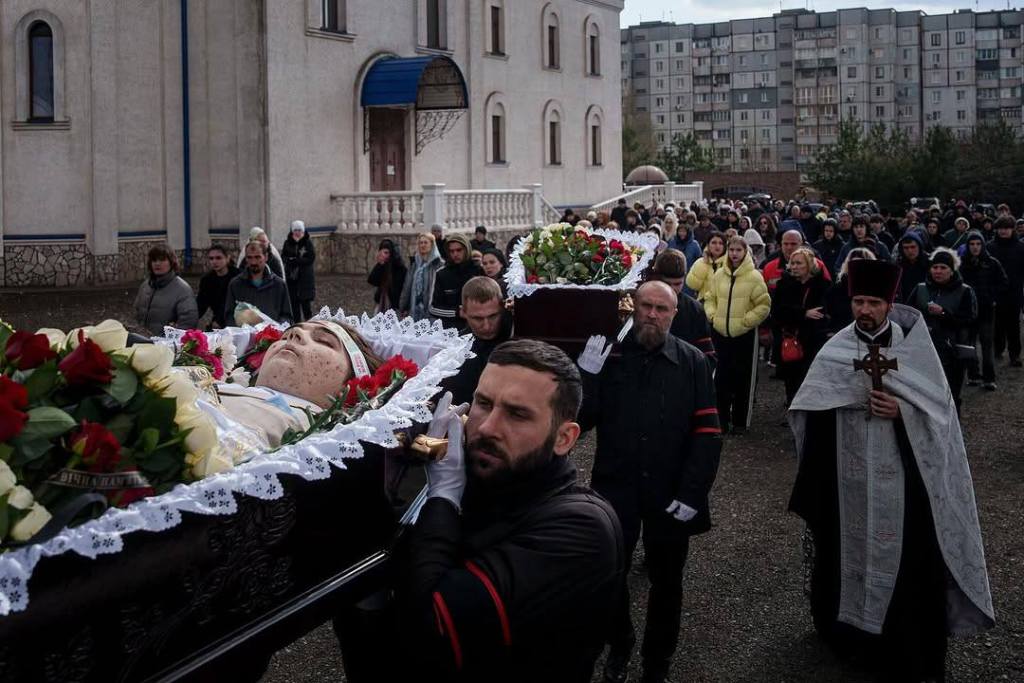
Why couldn’t you have talked about that in the French Senate? Especially since, a week earlier, a Russian missile fired from a fighter plane and packed with shrapnel killed twenty people, including nine children, in Krivyi Rih. The photo of a young [boy] in a coffin, whose face had been riddled by the tiny metal shards, is impossible to forget.
The coffins of 15-year-old Nikita Perekrest and his cousin, 16-year-old Kostiantyn Novik. Nikita’s father serves in the Ukrainian Armed Forces, and his mother took Kostiantyn in after his parents were killed. The two boys were outside in the yard when the Russian army struck Kryvyi Rih. Photo: Evgeniy Maloletka/AP/Scanpix/LETA, via Meduza
I realize that none of Moscow’s so-called opposition activists have the courage of political prisoner [Vladimir] Bukovsky and demand that Ukraine be given missiles to target Lubyanka. But you could launch investigations into the schemes by which Russia circumvents sanctions and obtains not only components for its fighter planes but also foreign chips for its missiles. You could demand that the Bosphorus be closed to Russia’s shadow fleet, which brings Putin the revenue to produce new missiles. Finally, you could show solidarity with Ukraine at least in word [if not in deed] and stop embarrassing yourself by repeating the impersonal and irrelevant slogan “No War.” You could do a lot of things in your safe havens. But instead you just wait for Putin to die and are not even ashamed to say so. Meanwhile, it is not so much the Ukrainians or the decolonizers who are waiting for you to act as it is your own fellow Russian citizens, who have not yet lost their minds and are basically living under occupation in Russia.
///
As for the ridiculous claim that it is easier for non-Russians to go to war and that is why they make up the majority [of soldiers] in the [Russian] army, according to the analytical resource buryatmemorial.org, a total of 2,425 people from Buryatia have been killed in the “special military operation” as of March 2025. And you’ll pardon me, but hardly half of them are ethnic Buryats (as you can see from the photos). This is due to the fact that ethnic Buryats constitute no more than 31% of the republic’s entire population. According to Ukrainian figures, Russian losses have already lost 933,000 men in the war. Even if we multiplied the figures for Buryatia by ten, its war dead would still roughly amount to two and a half percent of the total. I emphasize that the Buryats are an ethnic minority in their own land.
A screenshot of the website buryatmemorial.org, showing the names and faces of Buryatia’s war dead
According to Caucasian Knot, as of March 2025, 233 men from Chechnya, 121 from Ingushetia, 104 from Karachay-Cherkessia, and 112 from Kalmykia have been killed in the special military operation. Again, we can multiply this figure by ten for the sake of statistical rigor, but we still get hundredths of a percent of the total losses.
To put an end to the topic of Vladimir Kara-Murza’s ridiculous misinformation drop, yes, I saw yesterday’s post by the activist Anastasia Shevchenko, from which it follows that she was the mysterious “colleague” who shared with Kara-Murza the “observation” that it may be easier for non-Russians to go to war, while Russians find it psychologically difficult to kill Ukrainians due to their cultural affinity. Anastasia writes that the source of this hypothesis was not even her, but a third party who voiced this conjecture in a private conversation. Do you realize what has happened? This was not a scientific observation; no studies or surveys of Russian POWs were done that would indicate such a trend. This “information” came from the bush telegraph and was repeated by a [Russian] opposition politician in the French Senate, where decisions are made on the basis of the words people utter. And even after the ruckus that this delusional phrase caused among the public, no apology or explanation has been forthcoming from the politician.
Again, I am just a mom with three kids who left Russia to avoid supporting the war. In exile, I wash floors and clean other people’s houses so that I can send at least thirty dollars [a month] to the Ukrainians so they can buy drones. At night I write social media posts and read decolonial literature. I try to do anything I can to stop my former country from murdering innocent people. In my opinion, I have the right to demand that those who call themselves politicians, who have the bully pulpits and the opportunities, do something meaningful to ensure that Russia can no longer wage war.
Social anthropologist Alexandra Arkhipova conducted an investigation and concluded that Anna Korobkova, renowned for her numerous denunciations of people advocating anti-war stances, is probably a pseudonym of Ivan Abaturov, a journalist from Yekaterinburg. The BBC Russian Service has published the results of Arkhipova’s research.
Arkhipova assembled more than seventy letters, addressed to various institutions and agencies, in which Korobkova accused doctors, teachers, human rights activists, and journalists of “discrediting” the Russian army and called for them to be brought to justice. Among the denouncer’s victims are a doctor at a clinic who made a comment to [banned opposition channel] TV Rain, the mother of an enlisted soldier killed in the war, and Arkhipova herself. In one case, a student was expelled from a university after it received a denunciation alleging that he had been involved in “unauthorized protest rallies.”
In early December 2024, Arkhipova found a page about Korobkova on Wikipedia. With the assistance of linguists, she did a comparative analysis and found that the author of the Wikipedia article was probably the same person who had written the denunciations signed by Korobkova.
Arkhipova and the investigative journalists were able to identify the author of the Wikipedia article. It turned out to be a journalist from Yekaterinburg, Ivan Abaturov.
Abaturov, as the article points out, had already been at the center of a whistleblowing scandal. In the summer of 2022, Sergei Erlich, director of the publishing house Nestor History, said that Abaturov had allegedly detected “false information about the USSR’s actions during the Second World War” in one of his company’s books. Consequently, law enforcement officials visited Nestor History’s offices.
Abaturov himself has never concealed his attitude to denunciations. In 2019, he wrote on social media that “a journalist under Stalin was a walking prosecutor’s office” and that he wanted to be one too.
When asked by a BBC correspondent whether he had been writing denunciations under the name “Korobkova,” Abaturov replied on VKontakte: “Hello. You are mistaken.” Consequently, he stopped replying to messages, and the BBC was unable to reach him by phone.
Since the beginning of their country’s full-scale war with Ukraine, Russians have filed 2,623 complaints with law enforcement agencies about anti-war statements made by their fellow citizens, the investigative journalism website Important Stories (iStories) calculated in June on the basis of open source data. So-called LGBT propaganda (487 complaints) and Russophobia (250 complaints) ranked second and third, respectively, as grounds for denunciations.
According to Important Stories, seventy percent of the complaints were written by subscribers of the anonymous Telegram channel Mrakoborets, which specializes in tracking down anti-war activists. The channel’s daily norm is a minimum of three complaints on its pages on the social networks VKontakte and Odnoklassniki (“Classmates”). Yekaterina Mizulina, head of the Safe Internet League, had personally written 148 denunciations, while sixty were penned by pro-Kremlin activist Vitaly Borodin.
In the autumn of 2022, executives at the Russian Academy of National Economy and Public Administration (RANEPA) received a letter signed “Anna Vasilievna Korobkova.” It began as follows: “I fully support the special operation of the Armed Forces of the Russian Federation on Ukrainian territory. I am against all violations of the law.”
The letter concerned an interview that Alexandra Arkhipova, who had worked for many years as a senior research fellow at RANEPA, had given to the channel TV Rain, which had been designated a “foreign agent” by Russian authorities. (At the time of the interview, the TV channel had not yet been designated an “undesirable organization.”)
In her denunciation, “Korobkova” asked the university to dismiss Arkhipova for “immoral misconduct,” which, in her opinion, consisted in the fact that in the interview with TV Rain she had “disseminated false information discrediting the Special Military Operation [sic] on Ukrainian territory.” Korobkova also suggested that the university send the evidence against Arkhipova to the prosecutor’s office.
“Korobkova” was outraged that Arkhipova did not interrupt TV Rain presenter Anna Nemzer when the latter had called the “special military operation” a “war” (“thus showing she agreed with Nemzer’s false opinion”), mentioned Facebook without mentioning that it had been designated an “extremist organization” in Russia, and uttered the phrase “before the war I would ask.”
“This is a lie, as there is no war,” the letter said.
Upon seeing the text of the denunciation, Arkhipova was surprised by how long and detailed it was. Korobkova’s letter took up two pages, and even the time codes for the points in the interview at which Arkhipova had said certain things that angered Korobkova were noted. As a folklorist and social anthropologist who works extensively with different texts, Arkhipova was struck by the structure of the denunciation and the specific language in which it was written.
“I was reading this denunciation to friends, discussing it as a phenomenon of contemporary political culture, when one of my colleagues looked at me sadly and took a crumpled piece of paper out of his pocket. He unfolded it and read aloud a denunciation. It had the same wording, and was also signed ‘Anna Vasilievna Korobkova,'” Arkhipova tells the BBC.
Lev Schlosberg’s lengthy interview with Ksenia Sobchak, released last week, predictably kicks off with a discussion of his condemnation of his former allies. In August of this year, Lev Schlosberg lashed out on Facebook at the emigrant liberals who had welcomed the Ukrainian army’s offensive in the Kursk Region, calling writer Dmitry Bykov, journalist Sergei Parkhomenko, and politician Garry Kasparov comrades in the “someone else’s blood” party. His post sparked a freewheeling discussion, demonstrating once again to both onlookers and participants how far apart they were, even though they are still citizens of the same country. While the outcome of the Russian-Ukrainian military conflict will supposedly be determined by the newly re-elected Donald Trump, the Kremlin has long since won the war on the invisible front.
Caution: Sobchak, “Lev Schlosberg: Why is it important for a politician to stay in Russia?” (in Russian; no subtitles)
It was beyond the strength of the majority to resist the Kremlin’s propaganda. How fortunate for the minority, who had honestly declared before the war that they had no soul, only a paycheck.
Three months later, Schlosberg felt the need to continue the conversation, choosing as his interlocutor Ksenia Sobchak, about whose views on war and peace there can be no two opinions: what Vladimir Putin finds ambiguous also seems ambiguous to the breeding bulls in his herd. But the question is why the veteran democrat Schlosberg decided to hang a huge bell around his neck next to the “foreign agent” disclaimer. Was it vanity or fear? As becomes clear in the first half hour of the high-minded conversation, however, the cause, as always, is run-of-the-mill stupidity. Schlosberg really thinks what he says. It is even sadder to watch his rantings than it is to watch the criminal proceedings against him.
Explaining his stance as a compassionate fellow traveler (which, as we remember, can be summarized in Akhmatova’s famous line about one’s own people, on whose side one should be both in happy times and during the Special Military Operation), Schlosberg recalls Leo Tolstoy’s famous essay “Bethink Yourselves!,” published in 1904 after the outbreak of the Russo-Japanese War. According to Shlosberg, love for a fragile peace distinguishes the authentic Russian writer from the fake one. For this reason, Shlosberg has no hesitation in ejecting Dmitry Bykov from the company of engineers of Russian souls, and, it seems, from the human race altogether. A similar fate befalls the other participants of the Free Russia Forum. Typically, Sobchak, an experienced investigator-slash-provocateur, cajoles Lev Markovich into making public his entire list of traitors to the Motherland (probably to check it against the firing squad list, lest there be an extrajudicial error).
It is worth nothing that all the ideological opponents mentioned by Schlosberg* did not differ much from the great elder from Yasnaya Polyana in their appeals to the silent audience. Since then, however, much water (demagoguery) has flowed under the bridge, along with the lives of millions of people. No wonder that the cardboard humanism of the captive Yabloko Party now looks, if not ridiculous, then simply ugly. Schlosberg and Yavlinsky suggest that we still eat from the fruit of the tree of knowledge, which was chosen as the symbol of their so-called political association. And it seems to have been known for a long time that this fruit is a pure stage prop, a fruit plate from a Moscow Art Theater performance, but its contents continue to rot and to reek, frankly.
“Myth: that Ukraine remains a victim doesn’t fit the historical facts”: Lev Schlosberg, as featured on Ksenia Sobchak’s YouTube program (via Republic)
We are all victims of this war, Schlosberg claims. Vladimir Putin and Volodymyr Zelensky, the United States and Europe had the same opportunities to prevent the war. “But the mincemeat of history cannot be cranked backwards,” he continues, indulging in inventive parallels, “the cutlet will not turn back into the cow.” Yes, of course, the “Russian World” will never be the same again, but only because thinkers like Schlosberg, as Circe did to Odysseus’s companions, have been turning Russians into ungulates with their pseudo-Christian speeches. It is other people, of course, who have been leading them to the slaughter, but the Yabloko Party, alas, bears a considerable share of the blame.
Dubbing himself “the people,” Schlosberg wants to escort the popular masses on a journey to the end of the night, i.e., he suggests that they wander together until they are blue in the face in the pitch darkness and sprinkle the ashes of their ideals on each other’s heads, even though they should sprinkle “mother earth” on their heads. Schlosberg imagines collective euthanasia as a therapy in which there is no room for hatred. What’s the difference between dying with calls to love one another on your lips and dying while calling for violence? There is a difference, Schlosberg contends. In the first case, our church cemetery will finally become a true “brotherly” [i.e., mass] grave.
There used to be a Three Hierarchs Street in Kyiv. It was renamed after the October Revolution, of course. In 1919, it was called Victims of the Revolution Street in memory of the Bolsheviks who had been led down it to their executions. The street bore this tragic name until 1955, when someone competent finally showed up at city hall and explained to them how the name was ambiguous. City hall agreed and renamed it Heroes of the Revolution Street. But you can’t fool the people, and so the name “Victims of the Heroes of the Revolution” stuck to the street like glue. Old-timers still referred to it as they had in the old Soviet days. “Can you tell me how to get to the outpatient clinic?” “Go straight down Victims of the Revolution….” In the early 1990s, when the powers that be were getting rid of abominable “Red” place names, the street was given back its old name, Three Hierarchs Street.
I was reminded of this by the recent incident involving Lev Schlosberg, who explained in an interview with Ksenia Sobchak that Ukraine cannot be considered a “victim” [zhertva]. This has happened in the context of the Yabloko Party’s now-familiar cry “Both of you stop immediately!” Here is what Schlosberg said, verbatim:
Ukraine is resisting. State and individuals are victims [zhertva] until the minute, until the second they start resisting. Ukraine started resisting on the morning of February 24 [2022]. It is a resistance supported by dozens of foreign countries with their money, their equipment, their specialists, with everything they have. This had led to the fact that Ukraine has equalized the situation. Today, the military forces — the combined military forces of Ukraine (taking into account the allies, their weapons and their money) and the combined military forces of Russia — are roughly equal. Whoever resists is not a victim [zhertva]. A victim [zhertva] does not resist. A victim [zhertva] allows itself to be killed. The myth that Ukraine is a victim does not fit the historical facts. If Ukraine were a victim, Ukraine would not exist now. It would simply not exist.
Of course, we could go on at length about Shlosberg and the Yabloko applesauce* in his head, but he has gotten enough pushback. He has talked a load of nonsense and still goes on, so God be his judge. “Why do we listen to him? Let’s eat him.” I’m in favor of not listening to anyone at all, since there came a point when everyone started talking in commonplaces. Schlosberg is no exception: his leitmotif is well rehearsed and has long been familiar. But this paragraph about victims and non-victims is peculiar. Not politically peculiar (not at all), but it is quite peculiar as a mirror reflection of illiteracy.
Lev Markovich managed to cram a lot of nonsense into one paragraph, both about equalizing the situation and about western assistance. But that’s not what I have in mind. What I have in mind is the fact that even the well-spoken Schlosberg has no linguistic sense at all, as it turns out. And he’s not alone in having this handicap, although it is not remotely acceptable for him as a politician to have it.
The whole passage about the victim, I think, meant the opposite of what its author was been lambasted. He was rightly lambasted, generally, but he didn’t mean to strip Ukraine of its status as a victim of aggression. “Victim of aggression” and “sacrificial victim” are different things. The concept of the sacrificial victim is as old as sacrifice itself and is widely employed in the Old Testament as an inalienable part of the love for God. The Old Testament is chockablock with sacrifice, beginning with Abraham’s sacrifice of his son Isaac.
It would be odd, of course, to assume that Schlosberg was talking about biblical connotations in his conversation with Sobchak (and it is doubtful the interviewer has ever thoughtfully read the Bible), but it is almost certain that this was the notion of zhertva which he had in mind. A sheep to the slaughter is apparently Lev Markovich’s idea of a textbook victim. The sheep does not resist: that’s a fact. Ukraine has been resisting, and that’s also a fact. From Schlosberg’s point of view, it all makes sense. If he had said that Ukraine was not a victim of aggression, then he would have become a deserving punching bag forever. But he wanted to make a graceful compliment to Ukraine while not deviating from Yabloko Party’s twee “peace and good will to all — just stop shooting!” In the Old Testament sense of the word, Ukraine is truly not a victim: it is a heroic scrapper, a country as hard as nails. But what Schlosberg said was understood as it should have been understood.
A politician should know the value of words and the cost of his linguistic blunders. The Schlosberg incident is such an obvious example of linguistic deafness that it should be included in political rhetoric textbooks — someday, of course, not now. A politician should realize that words addressed to the public are always heard as they are commonly understood, and that few people will use zhertva [“victim”] in the Old Testament sense [of “sacrifice”].
Once upon a time, a rookie journalist was brought on at the newspaper where I worked. His first article was about a theater event that had turned out to be a chummy gathering at which only the in-crowd got the jokes. The article ended with the following sentence: “The result was an event only for those who could get to it through the box office window.” I immediately pictured a man trying to Winnie-the-Pooh his way through a tiny window. When the journalist noticed that I was editing the sentence, he was indignant.“Why?! It’s clear as it is,” he said, “it’s about the people who managed to get their hands on complimentary tickets.” “Yes,” I replied, “it is clear. But not immediately clear, like it should be.” The guy held a grudge against me for a long time, not understanding the point of my objection.
The feeling for language is an innate thing, like a sense of pitch. But if it is weak, it must be trained, just like the sense of pitch. Andrei Mironov, who sang countless songs on screen and on stage, had no ear for music, but he worked until the point of exhaustion, singing the same lines a hundred thousand times until he could hit the notes. Only the people close to him and the directors who worked with him knew that he lacked a sense of pitch.
When I hear an advertisement for “tonal cream” [foundation cream], I am amazed at how one could fail to anticipate that every other person would hear “anal cream.” We can attribute this to a common lack of linguistic pitch, of which there are countless examples. It is essentially a habitual neglect of language, of its purity. “Anal cream” is a harmless example. “Phyto tea for women with hog uterus” [i.e., Orthilia secunda, or wintergreen, whose common name is matkaborovaya] is basically harmless, too, just like most of the complete misunderstandings of “how our words will be heard” which we encounter at every turn.
The Schlosberg incident is a quintessential example of the damage which carelessness can do to a public figure. Lev Markovich already has a catastrophically dwindling number of allies, given his inappropriate Leopold the Cat-like appeals and dubious patriotic outbursts. After his latest musings, this number has precipitously plunged. “Alas, they didn’t understand me,” the annoyed Schlosberg must say, playing the victim.
* Although the Yabloko Party‘s name was derived from the surnames of its three founders (Grigory Yavlensky, Yuri Boldyrev, and Vladimir Lukin), the word thus formed, yabloko, means “apple” in Russian.|||TRR
Donald Trump’s stunning political comeback has created an opening for Russia to shatter Western unity on Ukraine and redraw the global power map, according to several influential members of the Russian elite.
In the corridors of power in Moscow, the win for Trump’s populist argument that America should focus on domestic woes over aiding countries like Ukraine was being hailed as a potential victory for Russia’s efforts to carve out its own sphere of influence in the world.
In even broader terms, it was seen as a victory for conservative, isolationist forces supported by Russia against a liberal, Western-dominated global order that the Kremlin (and its allies) have been seeking to undermine.
In his first remarks since the election, President Vladimir Putin said Thursday that the West’s post-Cold War monopoly on global power was “irrevocably disappearing,” before going on to praise Trump for behaving “courageously” during an attempt on his life this summer.
“His words about his desire to restore relations with the Russian Federation and to help resolve the Ukrainian crisis, in my opinion, deserve attention,” he said during his annual speech at the Valdai Forum in Sochi.
Members of Russia’s elite were more blunt in their response to Trump’s victory.
“We have won,” said Alexander Dugin, the Russian ideologue who has long pushed an imperialist agenda for Moscow and supported disinformation efforts against Kamala Harris’s campaign. “The world will be never ever like before. Globalists have lost their final combat,” he wrote on X.
This is the second in a series of posts in which I showcase some of the newsletters, blogs, Substacks, and websites — all of them produced by hardworking, passionate lone wolves or tiny, perpetually underfunded grassroots collectives — which inspire me to continue making the Russian Reader and inform me about parts of the world and communities about which otherwise I would be utterly clueless.
Erin Reed describesErin in the Morning as a place to “stay up to date on all of the most important pieces of trans and queer news and legislation for the week. I summarize it all complete with links to source documents. I hope to distill the information that you get from me in other places like @erininthemorn on TikTok and Twitter into a digest so that you can be sure you didn’t miss anything!”
Ms. Reed’s latest post on Erin in the Morning, endorsing Kamala Harris for U.S. president, could not be timelier, of course. More importantly, as a blogger who has chronicled the Putin’s regime ferocious war on Russia’s LGBT community and their rights, I cannot help but be inspired by Ms. Reed’s fierce, fact-driven defense of the transgender community and their rights in the U.S. I hope you’ll consider subscribing to Erin in the Morning and supporting it financially, as I have done. \\\ TRR
As one of America’s leading transgender journalists, I have reported on the wave of anti-transgender legislation sweeping across the United States over the past four years. These laws impact nearly every aspect of our lives: from using restrooms in peace to accessing essential medical care, from seeing our histories taught in schools to expressing our identities through art at Pride parades. I’ve listened to thousands of hours of testimony on these bills. Facing the 2024 election, I can’t stay silent on the dangers a second Trump term would pose to my community. For the long-term safety and dignity of transgender Americans, I believe there is only one viable path forward: electing Kamala Harris this November.
In some of my earliest reporting on anti-trans laws, many Republican elected officials were less fanatical than they are today. For instance, the first bill banning transgender healthcare in Arkansas was vetoed by Republican Governor Asa Hutchinson. In his veto statement, Gov. Hutchinson described the bill as “overbroad and extreme,” noting that it would “create new standards of legislative interference with physicians and parents.” In early 2022, Republican Gov. Spencer Cox vetoed a sports ban, making an impassioned plea: “I want them to live.” Many anti-trans bills failed early on, failing to gather enough Republican votes. Even Republican-nominated justices crossed party lines to side with Democratic-nominated justices, affirming that transgender individuals deserve protection under the constitution.
But soon after, the party began waging a fear campaign, leaving countless people in my community harmed in the process. I watched as one Republican-controlled statehouse after another, spurred on by far-right Freedom Caucus members, voted to enact some of the most draconian laws targeting transgender individuals ever seen. I listened as members of my community were labeled “dangerous,”“an infection,” and even “demons.” Gov. Cox no longer “wanted us to live,” and instead quietly signed the first bathroom ban to cross his desk.
I have seen transgender people forced to flee anti-trans states, seeking new lives in places where they are protected. Some of my earliest work involved families in Texas with transgender children who were targeted by Attorney General Ken Paxton, accused of child abuse simply for supporting their kids. Soon, other states followed with healthcare bans, bathroom bans, and more. I reported on these bills as families begged their state legislators for dignity, only to be ignored. I then helped these families raise funds, and I’m glad to report that many now lead fulfilling lives as valued members of their new communities.
I am keenly aware of which states transgender people are fleeing—and which ones they are fleeing to. Every state enacting extreme anti-trans laws has either a Republican trifecta or a Republican supermajority. Meanwhile, transgender people are finding refuge in states where Democrats have established safe havens. One of those havens is Minnesota, thanks to Governor Tim Walz. I know people whose lives were saved by his actions—people who can now live authentically and freely, without fear of government persecution.
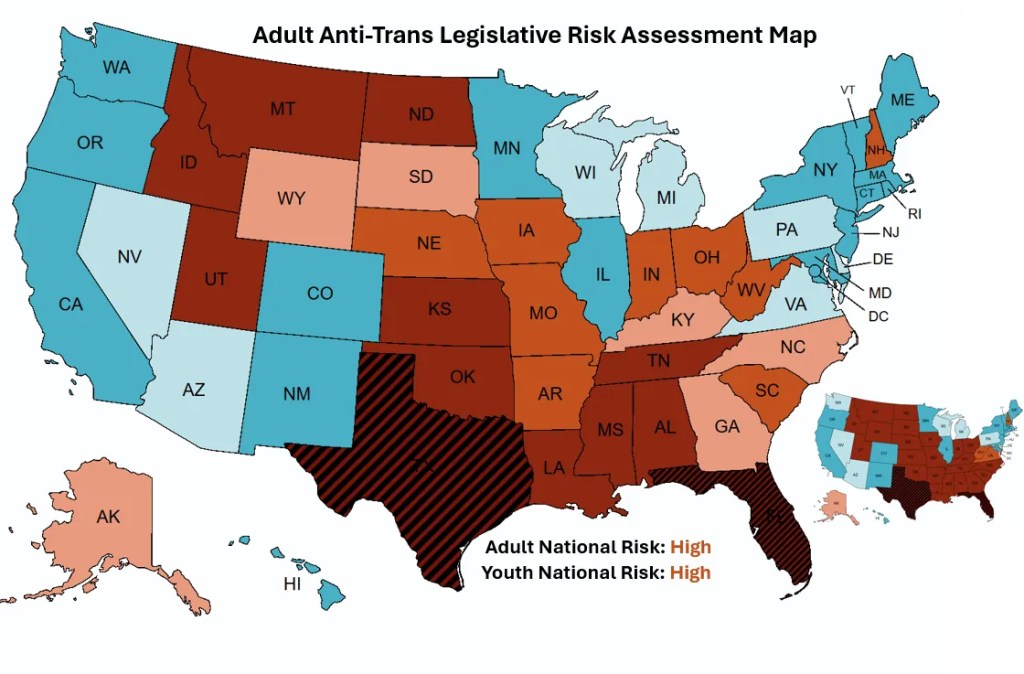
Erin Reed posted the latest edition of this periodically updated map yesterday. It was not included in her endorsement of Ms. Harris, but I’ve inserted it to show what is at stake in the upcoming election.
I have followed this election cycle intently and was among the first to report that transgender people would be a primary target of Trump’s 2024 campaign. In early 2023, Trump released a video outlining a dozen anti-transgender policies he would enact upon taking office, including national bans on trans care for youth, investigations into hormone therapy manufacturers, probes into affirming teachers, and eliminating funding for schools that treat transgender students with dignity and respect. These policies would take the harmful measures I’ve seen in Republican statehouses and nationalize them.
In 2024, it’s clear that the Trump campaign intends to follow through. If you’ve watched any sporting event or turned on the TV in a battleground state, you’ve seen the culmination of this fear campaign against transgender people, now led by Trump himself. Nearly$100million in anti-trans ads have blanketed the nation, with Trump spending more on these ads than on immigration, housing, and the economy combined. I have seen what other Republican leaders do when they center their focus on my community, and I know the end results are not pretty.
When Kamala Harris was chosen as the Democratic nominee, I watched her closely. While the Biden administration was not flawless on transgender rights—and I oftencriticized it for these shortcomings—no federal anti-trans laws passed during his presidency. I reported on the defeat of 50 anti-trans and anti-LGBTQ+ policy riders as Republicans threatened to shut down the entire government over transgender issues, and Biden did not back down. His nominees have overturned anti-trans laws and policies. Thanks to Biden, I was able to change my passport, even though my home state of Louisiana doesn’t allow birth certificate changes. I wanted to see if Harris would continue that commitment.
I’m convinced she will. One of Harris’s first moves that reassured me was selecting Gov. Tim Walz as her choice for vice president, fully aware of the Republican attacks against him for making Minnesota a safe haven for those fleeing anti-trans laws in other states. Walz, who campaigned on his record of starting his high school’s first Gay-Straight Alliance decades ago, has consistently been at the forefront of supporting LGBTQIA+ people. He brought that commitment with him to the Governor’s office, where he governed with a focus on making the state welcoming and inclusive for all.
Then in the final weeks of the campaign, she and Tim Walz were asked no less than three times about transgender people in interviews with Fox News, NBC, and Glennon Doyle’s podcast. I was encouraged to see Harris stand on her record of supporting transgender people when questioned. She had ample opportunity to throw us under the bus—as some other Democrats have done this campaign cycle—but she did not.
On Fox News, she criticized Trump for spending $20 million on ads targeting our community. On NBC, echoing her stance on abortion, she emphasized that transgender care is a decision to be made between doctors and patients. Her framework mirrored the approach used by many Democrats—and even some Republicans—to successfully push back against anti-trans bills in dozens of states. Meanwhile, that same week, Walz passionately defended transgender youth, stating that Donald Trump was attempting to “demonize a group of people for being who they are” and pledging that the administration would appoint justices committed to protecting our rights.
With over 1,000 bills introduced in the past three years targeting trans and queer people, undoing the harm they’ve caused will require sustained and strategic effort. The path forward depends on nominating justices who can help reverse these laws, while also protecting our rights in cities and states that offer refuge. For those living in oppressive states where their care, bodily autonomy, and right to exist freely have been threatened, we will continue organizing, supporting each other through mutual aid, and building the foundation to dismantle these discriminatory laws for good. The future rights of transgender people depend on electing Harris, uplifting Walz’s leadership, and securing the justices their administration will appoint.
If Trump wins a second term, we could be bound by his justices for an entire generation. Many transgender adults may never see the day when his court no longer controls our right to exist peacefully in public. Project 2025 could become a national reality, turning the same hateful bills and rhetoric shaping statehouses across the country into federal law. Schools could be defunded for allowing transgender youth to use restrooms in peace, and our very existence could be labeled obscene. There may be no return from the harm he intends to inflict on our community.
Transgender people are in a fight for our lives, and we are a powerful voting force, with millions of us across the United States. In an election that could come down to a few thousand votes in key swing states, we have the numbers to make a difference. In states like Georgia and Arizona, the transgender population is four times the size of the previous vote margins. We cannot afford complacency this election cycle. There is a path forward from the harm inflicted by Republican policies championed by Trump—a path that depends on us showing up and casting our votes for Kamala Harris.
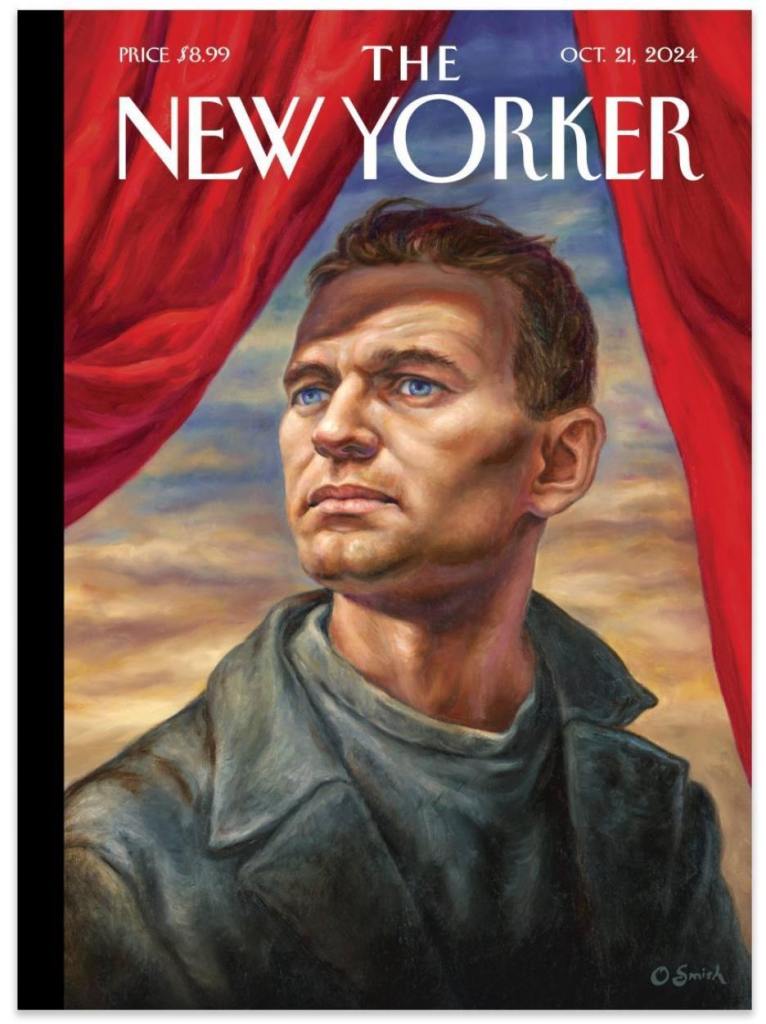
I wouldn’t want Navalny to be remembered the way he has been remembered this past year.
I haven’t read the book Patriot yet, but I was quite upset by Mikhail Zygar’s review of it. Zygar compares Navalny to Jesus and concludes that by dying, Navalny bequeathed us an idea that would rid future generations of cynicism and teach them to believe.
This is feeble sentimentalization, in my opinion. Navalny didn’t not dream up any particular ideas. He called for action, not faith. The meaning of his sacrifice, in my mind, is practical and political, not abstract and ideological. It can and should benefit the current generation, not some future generation.
Navalny didn’t dream up a new ideal. The “beautiful Russia of the future” is a feeble image, but Navalny understood better than anyone how tyranny operates on the mechanical level. I often complain that the FSB understands better how Russian society functions than do opposition politicians, sociologists and psychologists. Navalny couldn’t be accused of this shortcoming.
He was the only person in Russian politics who talked about power relations as a two-way street. He didn’t talk about the enormous resources Putin has, but about the fact that we give Putin power. It is not the security services, the army and the tanks that give Putin power. We give Putin power.
This view evolved over the course of Navalny’s career, becoming more and more central. As time went by, it separated Alexei more and more from his colleagues in the opposition. Toward the end of his life, Navalny’s writings centered on the idea that power consists in consenting to obedience, in “obeying in advance.” We say to ourselves: I cannot disobey, because if I don’t obey, they will (notice me/file administrative charges against me/fire me/banish me from my profession/send me to jail/kill me).
Only by obeying in advance can governing by unfulfilled threat be scaled up indefinitely, to a country of 140 million people, because this means of governing doesn’t require any resources. We obey without taking resources from the state. Putin’s estimates for the war in Ukraine include every dollar, euro, and pound spent on Ukraine’s defense. They are what counts against Russian budgets, not “faith in democracy” or “anti-war sentiment.” I understand Alexei’s decision to return to Russia in this sense; I see it as logical and unusually tenderhearted on the personal level. By returning to Russia, Alexei was able to provide Russians with one more example of tyranny’s limits: Putin never had power over Alexei. Had he stayed in Germany, Putin’s power would have extended to Navalny.
Navalny was concerned not with the thoughts in our heads, but with whether our deeds matched our thoughts. I appreciate Christian philosophy, but I could never accept the postulate that a second of faith can save a person, no matter their actions — “Now thou shalt be with me in paradise,” and so forth. The Russian opposition, for as long as I’ve been watching it, wants to get to democracy approximately the same way the thief gets to paradise — by believing in it. The notion that we are democrats and decent because we believe in democracy while all remaining Russians are slaves and awful because they don’t believe in it is the main obstacle to democracy in Russia, in my mind, and the Koshchei’s egg of tyranny. A “democracy” in which only “democrats” have a stake and which only they want is an oxymoron that makes democracy impossible and tyranny in Russia perennial. Democracy cannot be for Muscovites alone. It cannot be built via media outlets in which only Petersburg and Moscow have a voice. It cannot be built without equal representation of activists, issues, and interests from other regions and ethnicities.
Late in life, Navalny hated talk about the “freewheeling ’90s” and the good Chekists/bad democrats dichotomy, which doesn’t prevent his supporters from remaining stuck in this selfsame paradigm.
Alexei started his career in Russia’s faux democracy project, which was unfair from the get-go. He entered politics as a “democratic nationalist,” desiring greatness and a better elite for Russia. It was within this same paradigm that he pursued the most successful project of his life: “fighting the regime by legal means.” By the end of his life, however, he came to realize that Russian power is held by a hypocritical elite which justifies its obedience by talking about white coats, and is not willing to share power. It is not even willing to think about being the equals of other Russians, let alone the equals of Ukrainians, for example.
This, in my opinion, is what Navalny left behind. It pains me to see how the legacy he left at such a high cost is being frittered away by films about traitors, stupid speeches, and sentimental religious comparisons.
The story of Zakhar Zaripov, dying of cancer in prison while serving time for a social media post
Prison medicine is not known for its diligence. It can do little to help seriously ill people and plays on the side of the officials who run penal colonies and pretrial detention centres. The story of Zakhar Zaripov is a case in point. For a year doctors delayed doing analyses and making a diagnosis, even as he was writing things like this to his wife: “I feel bad, it hurts, I can’t eat, I can’t sleep, it’s hard for me to breathe, I’m dying.”
Zaripov is indeed dying: he has stage IV salivary gland cancer. According to the law, the authorities are obliged to release him, but the appeals court hearing on the matter has been postponed for over six months, says Zaripov’s defense lawyer Konstantin Bubon.
Zakhar Zaripov was born and lived in Sovetskaya Gavan, a town in the Khabarovsk Territory. He taught maths at evening schools in penal colonies. He was also fond of science fiction and wrote novels about popadantsy (accidental time travelers). Zaripov also wrote about politics at the LiveJournal account scribble_33. As the teacher himself says, many people had access to the account.
On 2 March 2022, a post was published on scribble_33 suggesting that Ramzan Kadyrov oust Putin and make Chechnya independent. It is not known who wrote it; Zaripov says it wasn’t him. Police investigators, citing indirect testimony by the staff at the penal colony where the teacher worked, decided that it was Zaripov.
The court agreed with the findings of the investigators and sentenced Zaripov to five years in a medium security penal colony. The teacher was arrested when his wife was in the last months of being pregnant with their second child. Zaripov has not seen his youngest daughter yet, as he is imprisoned in Khabarovsk, which is far away and expensive to visit. It is unclear whether he will see her at all.
In September 2023, Zaripov discovered a strange tumour in his mouth. He was able to see a surgeon only two months later. The doctors then began doing analyses and ultrasounds on him, but they failed to diagnose him and kept postponing his treatment. Because of the pain, Zaripov stopped sleeping on his right side, and because the tumor in his mouth has grown so large it hurts when he eats.
In July 2024, Zaripov was diagnosed with stage IV salivary gland cancer. But the final case conference did not meet until September. Prison officials plan to hospitalize Zaripov, but it is known whether he will have time to receive any treatment and whether he will be released home.
Russia’s best troops are now concentrated in another country. Moscow and Putin are completely defenseless. Hold back your troops. Do not send your best men to die in Kiev — send them to take Moscow!
Under current conditions, a limited contingent of a few thousand bayonets would easily take control of government buildings in Russia. You would declare that you have taken power, overthrow a dictator already condemned by the entire world, and stop the war.
This would allow Chechnya to gain independence and avenge all the deaths and humiliation inflicted by the Russian authorities over the past twenty-six years.
This is a perfect historical chance. There may not be another one in your lifetime.
Lenin took Russia with 1,500 men personally devoted to him. You have 40,000 top-notch fighters at your disposal. That’s quite enough.