
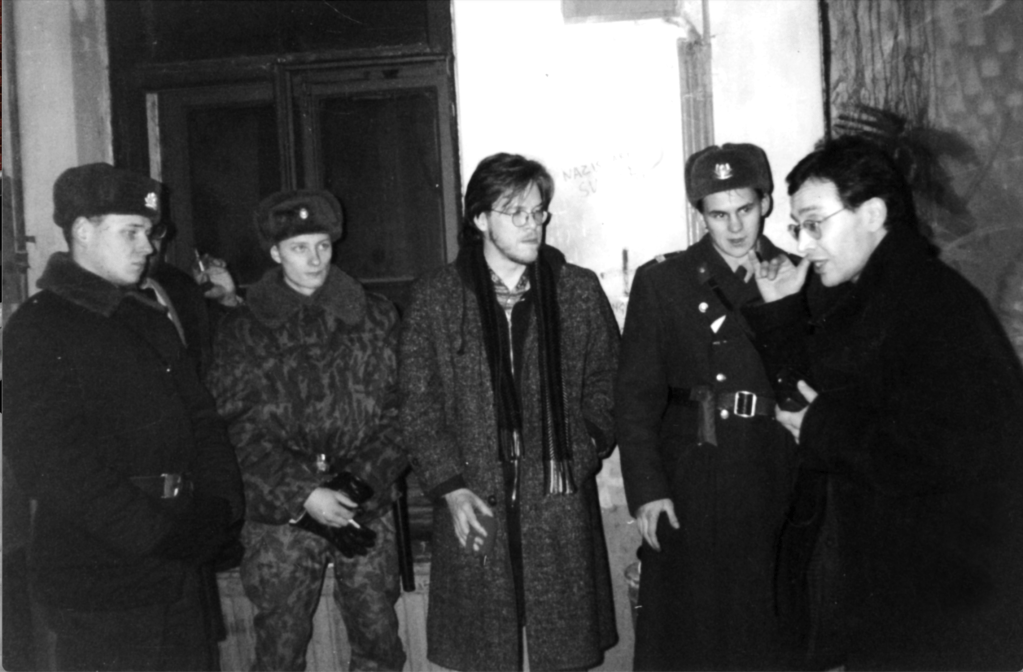
Pushkinskaya 10 artists’ squat, Petersburg, circa 1995
What’s the point of this flash mob? The nostalgia of aging people for their own youth? The illusion of normality in a situation of growing abnormality? The illusion of solidarity in a situation where all sociability is disintegrating?
Source: Sergey Abashin (Facebook), 6 February 2024. Translated by 21 Jump Street
Hundreds of thousands of Instagram users responded to a recent prompt asking them to post pictures of their younger selves. Photo quality varies.
Most of the photos are slightly faded. The hairlines fuller. Some feature braces. Old friends. Sorority squats and college sweethearts. Caps and gowns. Laments about skinny jeans and other long lost trends.
This week, Instagram stories the world over have been awash with nostalgic snapshots of youthful idealism — there have been at least 3.6 million shares, according a representative for Meta — as people post photos of themselves based on the prompt: “Everyone tap in. Let’s see you at 21.”
The first post came from Damian Ruff, a 43-year-old Whole Foods employee in Mesa, Ariz. On Jan. 23, Mr. Ruff shared an image from a family trip to Mexico, wearing a tiny sombrero and drinking a Dos Equis. His mother sent him the photo, Mr. Ruff said in an interview. It was the first time they shared a beer together after he turned 21.
“Not much has changed other than my gray hair,” he said. “I see that person and go, ‘Ugh, you are such a child and have no idea.’”
Mr. Ruff created the shareable story template with the picture — a feature that Instagram introduced in 2021 but expanded in December — and watched it take off.
“The amount of people that have been messaging me and adding me on Instagram out of nowhere, like people from around the world, has been crazy,” Mr. Ruff said.
[…]
Source: Sopan Deb, “‘Let’s See You at 21’ Puts Fun Spin on the Unrelenting March of Time,” New York Times, 1 February 2024
Maybe it’s not all so bad, and millions of people just wanted someone to see them as young and hot 21-year-old guys and girls who had everything ahead of them, all doors were open, and there were no obstacles to achievement. It’s good if these photos amuse them, rather than drive them to despair, if the person in the photo hasn’t achieved what he or she dreamed of at 21.
On the other hand, by scrolling through their Facebook feed with the “I am 21” flash mob, users see hundreds and thousands of photos of unknown people in foreign cities that mean nothing to them. What is the practiccal point of this flash mob? For users of Facebook, who have been posting numerous photos for years, there is no point.
Psychologists have long ago explained why people dump so many photos, including selfies, onto social networks: they have a need for constant approval and a desire to escape from unpleasant reality into a beautiful and easy virtual world where everything is fine. They’re also a means of communicating, showing off, and flirting. And if the “retro,” “things used to be better,” or “how young we were” option is enabled, nostalgic group sobs, likes, and reposts are guaranteed.
“We don’t think about artificial intelligence when we post our photos on social media, simply because the vast majority of us have no idea how neural networks are trained, or how algorithms work. We just wonder why topical ads jump out at us immediately when we think of something, but then we forget about it. Artificial intelligence isn’t Skynet from the Terminator movies at this point, but it’s something we’re going to be dealing with more and more. And protecting our personal information should worry us more than before,” says data science expert Yevgeny Galin. “Putting personal photos in the public domain is no toy or form of entertainment. We don’t know who could use them and for what purposes. I have no doubt that those purposes are illegal. And I wouldn’t count on social networks being conscientious about privacy policies. There’s nothing private on the internet. Facebook is already pretty good at recognizing faces and tagging people in photos.”
Training AI to recognize faces even in poor-quality black-and-white photos from the last century is proceeding by leaps and bounds. In many countries, identifying individuals with street surveillance cameras is already almost permitted by the constitution. And artificial intelligence is dependably replenishing the database of inhabitants of cities, countries, and continents. After all, it is so easy, especially if people post info about themselves on the World Wide Web.
Public figures who post their photos may well be involved in some kind of scam using deepfake technology.
Yes, we may be once bitten, twice shy, but caution in this case can’t hurt.
Source: Dina Vishnevski, “I’m 21: Facebook’s nostalgic flash mob is just a simulator for AI,” kp.ua, 7 February 2024. Translated by 21 Jump Street
