a Map of the Kyzylsu catchment. The names of the main glaciers are indicated in black. The elevation information is taken from the AW3D Digital Elevation Model (DEM), while the hillshade was derived from high-resolution Pleiades DEMs acquired in 2022 and 2023. Glacier outlines and debris extents are from the RGI 6.0 inventory. Lakes were manually delineated from a Pléiades 2022 ortho-image. The inset maps show the location of the study site in Central Asia with a base map from Esri, along with glaciers shown as blue areas and sub-regions outlines from the RGI 6.0 inventory. b Picture taken by Jason Klimatsas in September 2023 of the on-glacier automatic weather station, located on the debris-covered portion of Kyzylsu Glacier. Maidakul Lake can be seen in the background,as indicated by an arrow. c Pluviometer station photographed by a time-lapse camera in March 2022, with the snow-covered terminus of Kyzylsu Glacier visible in the background.
This week’s episode of the CAPS Unlock podcast opens with a discussion about a show of diplomatic unity in Central Asia. Following Israel’s strike on Qatar, all five governments of the region quickly issued statements of condemnation. Some went as far as calling the strike an act of aggression. We examine why these unusually swift and aligned reactions matter, how they highlight the region’s growing ties with Gulf states, and what they reveal about Central Asia’s selective application of principles such as territorial integrity.
Our interview segment features Achille Jouberton, visiting scientist at the Swiss Federal Institute for Forest, Snow and Landscape Research, and lead author of a major new study on the glaciers of Tajikistan’s Pamirs. Long thought relatively stable compared to the shrinking ice fields of the Himalayas and Tien Shan, the Pamirs are now losing mass at troubling rates. Jouberton explains how declining snowfall since 2018, measured through field stations, pressure sensors, and climate reanalysis, is reshaping water availability in the region. He discusses the role of large-scale climate systems, the combination of less snow and hotter summers, and the downstream implications for agriculture and hydropower.
We close by looking at President Kassym-Jomart Tokayev’s State of the Nation address in Kazakhstan. Among an eclectic mix of themes, including long passages on artificial intelligence, Tokayev floated the possibility of transforming Kazakhstan’s bicameral parliament into a single chamber. Though short on detail, the proposal hints at possible institutional re-engineering ahead of 2029, when Tokayev’s presidential mandate ends. We assess what this might mean for Kazakhstan’s political system and why even seemingly technical reforms can reshape the balance of power.
For years, the Pamir-Karakoram anomaly stood as a rare outlier in global climate trends: a region where glaciers remained relatively stable despite accelerating global warming. Now, new research from the Institute of Science and Technology Austria (ISTA) confirms that even these “last strongholds” have begun to lose mass at an alarming rate.
Snow Deficit and Rising Heat
Data collected from a climate monitoring station on the Kyzylsu glacier in the northwestern Pamirs, active from 1999 to 2023, reveals a sharp shift. According to an international research team led by Francesca Pelliccotti, the tipping point came in 2018, when a significant decline in snow cover and precipitation irreversibly altered the glaciers’ mass balance.
Once past this “point of no return,” glaciers began rapidly depleting their own reserves to compensate for the lack of new snowfall, a process accelerating their melt.
Since 2018, the region has experienced a persistent snow deficit. Snow depth has fallen by approximately 40 cm, and annual precipitation has declined by 328 mm, about one-third of the historical average. Seasonal snow melts earlier, is less stable in spring, and is no longer sufficient to replenish glacier mass.
July 2022 was the hottest month on record, and during this period, the Kyzylsu glacier recorded unprecedented mass loss, melting at a rate eight times faster than the 1999-2018 average. Scientists identify increasingly hot summers and a lack of precipitation as the primary causes.
Even the intensified ice melt has not made up for reduced snowfall: water inflow into rivers dropped by roughly 189 mm in water equivalent. The contribution of glacial runoff to total river flow rose from 19% to 31%, but this increase was still insufficient to offset the overall decline in water volume.
The situation is most severe at altitudes above 4,000 meters, where solid precipitation has declined sharply. Snow from avalanches, which previously helped sustain the glaciers, has dropped nearly threefold from 0.21 to 0.08 m per year.
Implications for Central Asia
Experts warn that this is not a localized issue. The Pamir and Karakoram glaciers feed the Amu Darya and Syr Darya rivers, lifelines for millions across Central Asia. Diminishing glacial mass threatens freshwater availability, agriculture, hydropower generation, and overall socio-economic stability.
“Due to the lack of accurate forecasts, we cannot yet say definitively whether the Pamir glaciers have passed the point of no return. However, since 2018, the processes have changed dramatically, and the reduction in precipitation has had a critical impact on their stability,” said ISTA researcher Achille Joubert.
Data Gaps and New Monitoring Efforts
Following the collapse of the Soviet Union, glacier monitoring in the region was largely suspended for nearly two decades. Systematic observations resumed only in 2021, when international researchers reinstalled instruments on the Kyzylsu glacier, one of the Vakhsh River’s primary sources.
These new measurements confirmed a drastic drop in precipitation and snow thickness starting in 2018, with consistently unfavorable conditions persisting since.
Compared to the late 1990s, spring and summer snow now melts much faster, and the “cold reserves” that once preserved glacier stability are disappearing rapidly.
The study’s findings were published in Communications Earth & Environment, reinforcing that even the most resilient glaciers in Central Asia are succumbing to climate change.
“The disappearance of glaciers means not only a shortage of water, but also a threat to climate stability,” the researchers warn.
The loss of these natural freshwater reserves could trigger cascading effects from reduced electricity generation to ecosystem degradation.
The end of the Pamir-Karakoram anomaly is not just a regional alarm bell. It signals the urgency of coordinated international climate action. Without it, scientists say, the process may already be beyond reversal.
For Central Asia, this carries profound geopolitical and economic implications. Water stress is already a driver of tension between upstream and downstream states, and shrinking glaciers will exacerbate disputes over allocation and dam construction. Governments are under pressure to accelerate adaptation strategies – modernizing irrigation, investing in alternative energy, and expanding regional cooperation on water-sharing agreements.
Researchers also stress the importance of filling data gaps with sustained monitoring. Long-term, high-resolution observations are critical for forecasting river flow and planning infrastructure. International support, they argue, could help countries like Tajikistan and Kyrgyzstan upgrade their hydrological networks, while linking local data into global climate models.
Ultimately, the fate of the Pamir and Karakoram glaciers will not be decided in the mountains alone. Their survival, or disappearance, depends on global emissions trajectories and the political will to implement serious mitigation measures. What happens here, at the heart of Asia’s water towers, will ripple far downstream into the lives of millions.
Three years ago, one man saved my family and me. He knew nothing about us except that I was a journalist, that I had left Russia because of the war, that I had children, and that we had nowhere to go. Kyle and his wife Katie decided to take us in and give us shelter. We finally had a dot on the map where we were welcome. That was how we ended up in the United States, after traveling through five or six countries in the first three months of the war.
We still live in the house into which Kyle and Katie welcomed us. All these three years, I have felt the kind of care and involvement from them which you don’t normally expect from strangers. A few days after we arrived, Katie’s mom sent us a dinner consisting of food to which we were accustomed. And Kyle was always trying to help. He paid our utilities for a long time, and he gave my husband odd jobs.
Yesterday, Elon Musk fired Kyle and two hundred other employees at the research institute where they work.
“DOGE struck like a thief in the night. Too cowardly to fire us in person, virtually everyone at NIOSH learned they were laying us off via a summary overnight email,” Kyle writes on his Facebook page.
NIOSH is the National Institute for Occupational Safety and Health, which was established by Congress over fifty years ago. It researched health and safety hazards, recommended essential standards for occupational safety and health, and investigated workplace disease outbreaks. For many years, the Institute also monitored the health of 9/11 first responders and tracked occupational illnesses among firefighters and miners.
Kyle himself worked as pulmonary toxicologist at NIOSH. He studied the effects of inhaled toxicants on the lungs and other organs.
“Since 2017, I’ve studied the effects of micronized copper-treated lumber sawdust, Corian/alumina trihydrate, various 3D printer emissions, and, most recently, engineered stone dust. That last material, engineered stone, is currently responsible for a global outbreak of silicosis, a progressive and ultimately fatal lung disease. Truly a public health crisis with profound impacts on exposed workers,” Kyle writes in his post.
DOGE sent the institute’s employees a mass layoff notice at five a.m. Tuesday morning. The brief letter announced that NIOSH was being eliminated “to improve efficiency.”
“To be clear, nothing about these firings was efficient,” Kyle retorts. “This was not trimming the fat, or even a decimation, but a wholesale execution of the institute. Only a skeleton crew now remains, presumably to help sell off instruments and other assets before being fired themselves. Is it efficient to stop millions of dollars’ worth of studies in their tracks, never to be completed? The breadth of institutional knowledge lost is hard to fathom (not speaking of myself here; I have been lucky to be trained by true giants in the field). Were there inefficiencies at NIOSH? Of course, the same as with any large organization, and I would have been happy to see improvements in those areas. Unfortunately, the costs of what happened today will compound over the next several decades, yielding sick and dying workers—husbands, mothers, sons, and daughters. I hope it was worth it. For what? A billionaires’ tax break?
“Ultimately, I think I will be okay, although the prospect of job hunting in a field saturated with thousands of newly jobless scientists is daunting—especially as the current sole breadwinner and with a child on the way. What I know for certain is that somewhere today, a worker is being exposed to something that will eventually kill him, and there will be no one there to figure out why he died.”
///
On April fifth, people all across the United States will take to the streets in protest. Despite Trump’s threats to deport all disloyal people “to their country of origin,” I will be there too. What is more, I will be at a protest rally helping the organizers as a volunteer. Americans have been good to me, so I cannot fade into the woodwork when their accomplishments are under attack and their world is crumbling. I will stand with those who are willing to defend their values.
Source: Julia Khazagaeva (Facebook), 2 April 2025. Translated by the Russian Reader, who thanks the author for her kind permission to publish her text in translation on this website.
This week’s edition of BBC Radio 4’s obituaries program featured appreciations of the KGB defector Oleg Gordievsky and the composer Sofia Gubaidulina. ||| TRR
Oleg Gordievsky, Renee Goddard, Professor Richard Fortey, Sofia Gubaidulina
Matthew Bannister on Oleg Gordievsky, the KGB agent who defected to Britain and became a valued source of secret intelligence during the 1970s and 80s.
Renee Goddard, the actress and TV commissioner who fled Nazi persecution only to be interned in Britain.
Professor Richard Fortey, the palaeontologist who used his expertise in trilobites to tell stories about the origins of life on earth. Bill Bryson pays tribute.
Sofia Gubaidulina, the composer whose large scale religious works attracted criticism from the Soviet authorities.
Nacimiento-Fergusson Road is a stunning drive located on the Pacific coast of the U.S. state of California, regarded as one of the best motorcycling roads in central California.
Where is the Nacimiento-Fergusson Road?
The road is located in Monterey County, in the US state of California, running across the eastern slope of the Santa Lucia range within Los Padres National Forest.
Elkhorn Slough, as seen from the Carneros Creek watershed. The Western Flyer is moored in the marina at Moss Landing, where the slough flows into Monterey Bay (near the smokestacks on the center right). Photo by the Russian Reader
I have never directly acknowledged the fact that, since May 2021, this weblog has come to you from Monterey-by-the-Sea, California, where I have happily found many things to do that have nothing to do with Russia and the heavy, steady flow of bad news from there. I want to share that happiness with you by way of saying goodbye to 2024 and thanking you for sticking with the Russian Reader this past year.
The distinctly Monterey story, told below in four short but fascinating videos, is a fascinating, inspiring, and happy one. I hope you enjoy it as much I did. See you next year! ||| The Russian Reader
Western Flyer Foundation Channel, “The Western Flyer with Nick Offerman”
The Western Flyer sails again! Come aboard with Emmy-award-winning actor and comedian Nick Offerman for a fun new look at the life, near-death, and resurrection of the famous old fishing boat in John Steinbeck’s The Log from the Sea of Cortez (1951). From the coast to the deep sea and from the tide pool to the stars, the nonprofit Western Flyer Foundation stirs curiosity using a blend of science and art inspired by John Steinbeck, Ed Ricketts, and their 1940 journey on the Western Flyer.
Learn more about the vessel’s history, adventures, and exciting future or marine science and education at http://www.westernflyer.org.
CBS Mornings, “John Steinbeck’s ‘Western Flyer’ gets brought back to life”
After writing “The Grapes of Wrath,” author John Steinbeck explored the Gulf of California in a famous boat called the Western Flyer. Since then, the boat has inspired adventurers and scientists for generations, but the original ship was nearly lost. CBS News’s Jeff Glor reports on the person determined to give it new life.
Western Flyer Foundation Channel, “The boat John Steinbeck and Ed Ricketts made famous. Western Flyer: The Next Chapter”
Almost lost forever, the iconic vessel that carried the acclaimed novelist John Steinbeck (who penned Of Mice and Men, Grapes of Wrath and more) and marine biologist Ed Ricketts to the Sea of Cortez on an epic scientific mission gets new life and a new mission.
Bizarre Beasts, “Tenrecs Will Not Stay in Their Lane”
If all crustaceans “want” to look like crabs, then tenrecs “want” to look like basically any other small mammal. These weird little guys are endemic to Madagascar—they’re native to nowhere else on Earth.
Новый культурный (или мультикультурный?) код Европы (если это правда Финляндия). https://t.co/ktnP1D1fp0
— Геннадий Гудков Gennady Gudkov (@gudkov_g) July 7, 2024
Prominent Russian liberal in exile Gennady Gudkov wrings his hands over what the “coloreds” are doing to his Russian liberal fantasy “Europe”: “Europe’s new cultural (or multicultural?) code (if that really is Finland).” ||| TRR
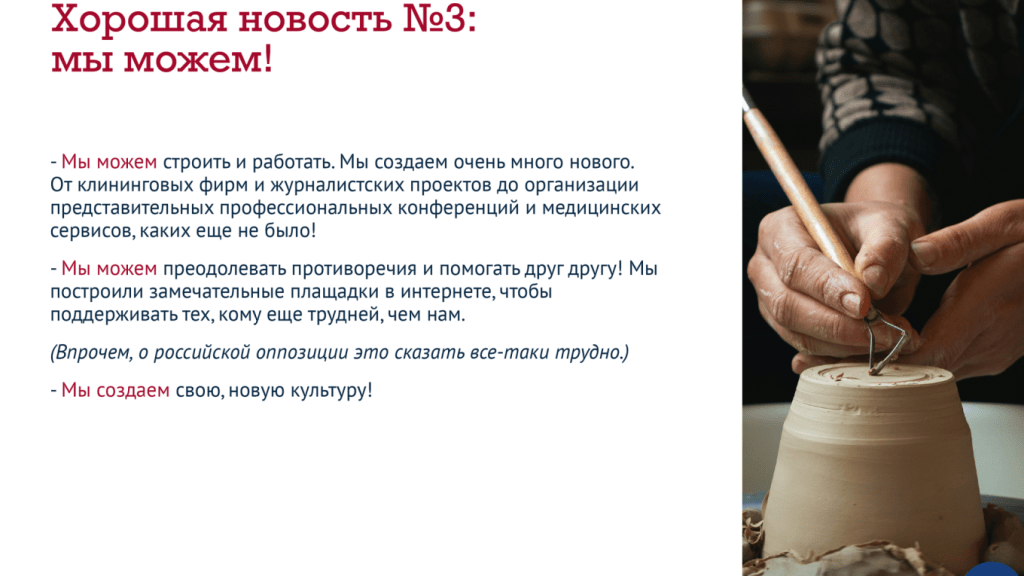
We can build and work. We have been creating many new things — from cleaning firms [kliningovykh firm] and journalism projects to organizing impressive professional conferences and medical services the likes of which have never been seen!
We can overcome animosities and help one another! We have built outstanding platforms on the internet to help those who have it worse than we do. (However, it is still difficult to say this about the Russian opposition.)
Sciences Po and its Provost Sergei Guriev, a world-renowned Russian academic and economist who had to flee his country in a day in 2013, were honoured to welcome @Ekaterina_Schulmann for a very exclusive conference on 20 April, 2023. This political scientist and social media sensation guest speaker addressed the serious matters of the Russian regime stability and the dynamics of public opinion.
Source: Sciences Po (YouTube), 8 May 2023. My question, had I been in the auditorium for this fascinating lecture, would have been to the audience: how many of you are neither Russian nationals nor speak Russian? I suspect that the numbers of such non-Russian nationals and non-Russian speakers were quite low. And why was this lecture delivered in English, not French?||| TRR
Source: unsolicited ad on Facebook
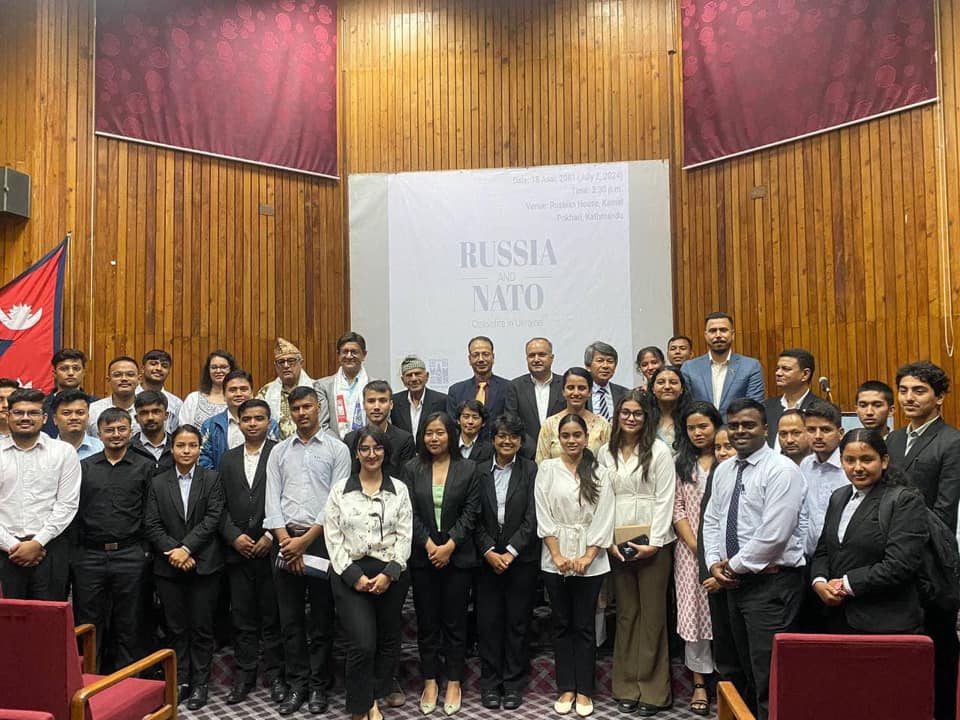
On 2 July 2024, International Law Club successfully organized an academic discourse entitled “Russia and NATO: Ceasefire in Ukraine.”
The speakers for the program included Dr. Yubaraj Sangroula (Professor of International Law), Dipak Gyawali (Former Minister of Ministry of Water Resources, Nepal), Dr. Govind Kusum (Former Secretary of Ministry of Home Affairs), Prem Chandra Rai (From Himalayan Development Affairs Council, Nepal), Yugichha Sangroula (Masters in International Humanitarian Law from Geneva), Dmitry Stefanovich (From IMEMO RAS, Moscow)
The welcoming remarks for the discourse were delivered by Anton Maslov, First Secretary and Director of the Russian House. The distinguished Chief Guest of the program was Seniormost Advocate Krishna Prasad Bhandari.
Dr. Dipak Gyawali provided valuable insights into the historical context of the Russia-Ukraine conflict, emphasizing its longstanding nature within the framework of NATO-Russia dynamics.
Professor Dr. Yubaraj Sangraoula shed light on the hegemonic influences and Western interference in global affairs, highlighting the concept of a rule-based international order that has been divisive.
Assoc. Prof. Yuggichhya Sangroula emphasized the importance of interpreting international law in a balanced manner, noting the significant contributions of Asian nations to its development alongside European nations.
Assoc. Prof. Prem Chandra Rai advocated for adherence to the UN Charter as the foundation of international law, stressing the need for inclusive peace initiatives that engage all relevant parties, including Russia.
Dr. Govind P. Kusum underscored the disproportionate impact of global conflicts on developing nations and emphasized the urgent global need for peace and security.
Mr. Dmitry Stefanovich discussed the inadequacy of mere ceasefires and called for sustainable solutions and increased global cooperation, particularly from the Global South, to address ongoing conflicts.
The subsequent question and answer session facilitated critical discussions on ceasefire strategies and institutional reform. Speakers analyzed geopolitical dynamics, and Western dominance, and proposed measures for achieving global peace and security, with a focus on strategies applicable to third-world nations.
Overall, the seminar provided a platform for robust dialogue and strategic insights into resolving international conflicts and fostering a more peaceful world order.
We sincerely express our gratitude towards the speakers, guests, and participants for their involvement.
The Club would like to thank the Russian House, especially the Director of Russian House, Mr. Anton Maslov for supporting us in organizing this academic discourse and acknowledge the presence of Ms. Alena Danilova, Press Secretary from the Russian Embassy at this program of ours.
The Hustle, “The Economics of Pickleball and the Sport’s Sound Problems”
MBARI, “Scientists solve mystery of why thousands of octopus migrate to deep-sea thermal springs”Sergei Okrushko
Solidarity Zone has begun supporting Sergei Okrushko
On July 28, an explosion occurred at the Kuibyshev Oil Refinery in Samara. The same day, 42-year-old Sergei Okrushko, who was born in Ukraine and worked as an electrician at the refinery, was detained at the border with Kazakhstan whilst trying to leave Russia. The FSB charged him with “sabotage” (per Article 281 of the Russian Federal Criminal Code of the Russian Federation “Sabotage”, and a court in Samara remanded him in custody to a pretrial detention center.
Okrushko confessed, and at his bail hearing he said that he held anti-war views and committed the action for political reasons.
It also transpired that Okrushko had earlier tried to enter Ukraine, but he was not admitted because of his Russian passport. During his stay in Moldova, he had repeatedly participated in anti-war protests.
No one was injured during the explosion at the refinery. According to the investigation, more than 30 million rubles in physical damage was caused, however.
The Kuibyshev Oil Refinery is the largest enterprise in the Samara Region, processing about seven million tons of oil per year. The plant specializes in the production of fuel for all types of transport from automobiles to ships.
On August 3, Okrushko refused the services of Solidarity Zone-affiliated lawyer Zakhar Lebedev, whom he had agreed to let defend him two days earlier. While Okrushko was writing the waiver of counsel, the lawyer noticed fresh injuries on Okrushko’s body: “I noticed that his left arm, namely most of his shoulder and forearm, was purple. It was clear that these were hematomas, which hadn’t been there on August 1 when I visited him at the pretrial detention center. When I asked Sergei where he had got such bruises, he said, without hesitating, “When they arrested me.” When I asked why they had not been there when I’d visited him at the pretrial detention center, Sergei hesitantly said that they’d shown up only now.”
We believe that the fresh bruises and his sudden and unmotivated waiver of counsel testify to the fact that Sergei Okrushko was tortured between August 1 and August 3.
Subsequently, the authorities stopped admitting any lawyers into the pretrial detention center, except for the court-appointed lawyer Vyacheslav Pavelkin. Later, it transpired that Okrushko was taken to the FSB several times without a lawyer.
Unfortunately, at this stage we have been unable to provide Sergei with defense counsel. But at the very outset of his ordeal, we sent him a care package and books, placed an order at the online Federal Penitentiary Service store, and transferred money to his personal account at the pretrial detention center. We recently learned that Sergei received all these things, which means that we were able to provide him with at least minimal humanitarian support. In the coming days, we will put together another care package for Sergei and continue to support him as much as possible.
Solidarity Zone’s mission is to support people imprisoned for anti-war direct-action protests and not let them face the system alone. We cannot always provide full-fledged support due to interference from the security forces, but we consider any reduction in the harm caused by the actions of the Russian state to be a decent outcome.
If you want to support us, you can find our details here.
Address for letters and parcels:
Okrushko Sergei Aleksandrovich (born 01.03.1981) 22 Sadovyi proyezd, SIZO-1 Samara 443021 Russian Federation
Source: Solidarity Zone (Facebook), 24 August 2023. Translated by the Russian Reader. People living outside of Russia will find it difficult or impossible to send letters to Russian prisons via Zonatelecom or regular mail. In many cases, however, you can send letters (which must be written in Russian or translated into Russian) via the free, volunteer-run service RosUznik. Mr. Okrushko has not yet appeared on their list of supported addressees, however. You can write to me (avvakum@pm.me) for assistance and advice in sending letters to her and other Russian political prisoners.
Recommended for ages 16 and up. This production contains sexually suggestive language, references to suicide, and depictions of drug use, extreme physical violence towards humans and animals, and self harm. This production also contains the use of herbal cigarettes, haze, and a brief flash of light.
Covid isn’t scary anymore: how the authorities stopped reckoning with the coronavirus when it suited them
Tatiana Torocheshnikova TV Rain
October 15, 2021
The Russian authorities are often criticized for ignoring the pandemic to the good of the political conjuncture. It was with an eye to politics, and not to the numbers for illnesses and deaths caused by covid-19, according to critics, that decisions were made to hold a referendum on amending the Constitution and lift covid restrictions in the run-up to the referendum last year. The same criticism was leveled against the Crimea annexation anniversary concert in March of this year at Luzhniki Stadium in Moscow, and the Euro 2020 matches and the Crimson Sails event held in Petersburg. How justified is this criticism? To answer this question, TV Rain studied the covid-19 task force’s official data on coronavirus infections and deaths, as well as Rosstat’s data on mortality from the spring of 2020 to the autumn of this year.
“A number of large shopping centers have already received a warning this week. And work on monitoring compliance with the mask mandate will be intensified and implemented even more vigorously,” Alexei Nemeryuk, head of the Moscow department of trade and services, said on Monday, September 27, a week after the elections to the State Duma. A week later, Prime Minister Mikhail Mishustin noted that the spread of the coronavirus caused “serious concern,” while the head of the consumer and public health watchdog Rospotrebnadzor said that the situation was “extremely tense.”
By this time, the decline in the number of new covid-19 cases, which had continued since late July, had stopped and an uptickd had begun. A similar surge in morbidity was observed in mid-June, when the more contagious delta variant began to sweep Russia. The two other waves of covid-19 epidemic occurred in the spring and autumn/winter of 2020.
How the authorities first reckoned with covid waves, then stopped
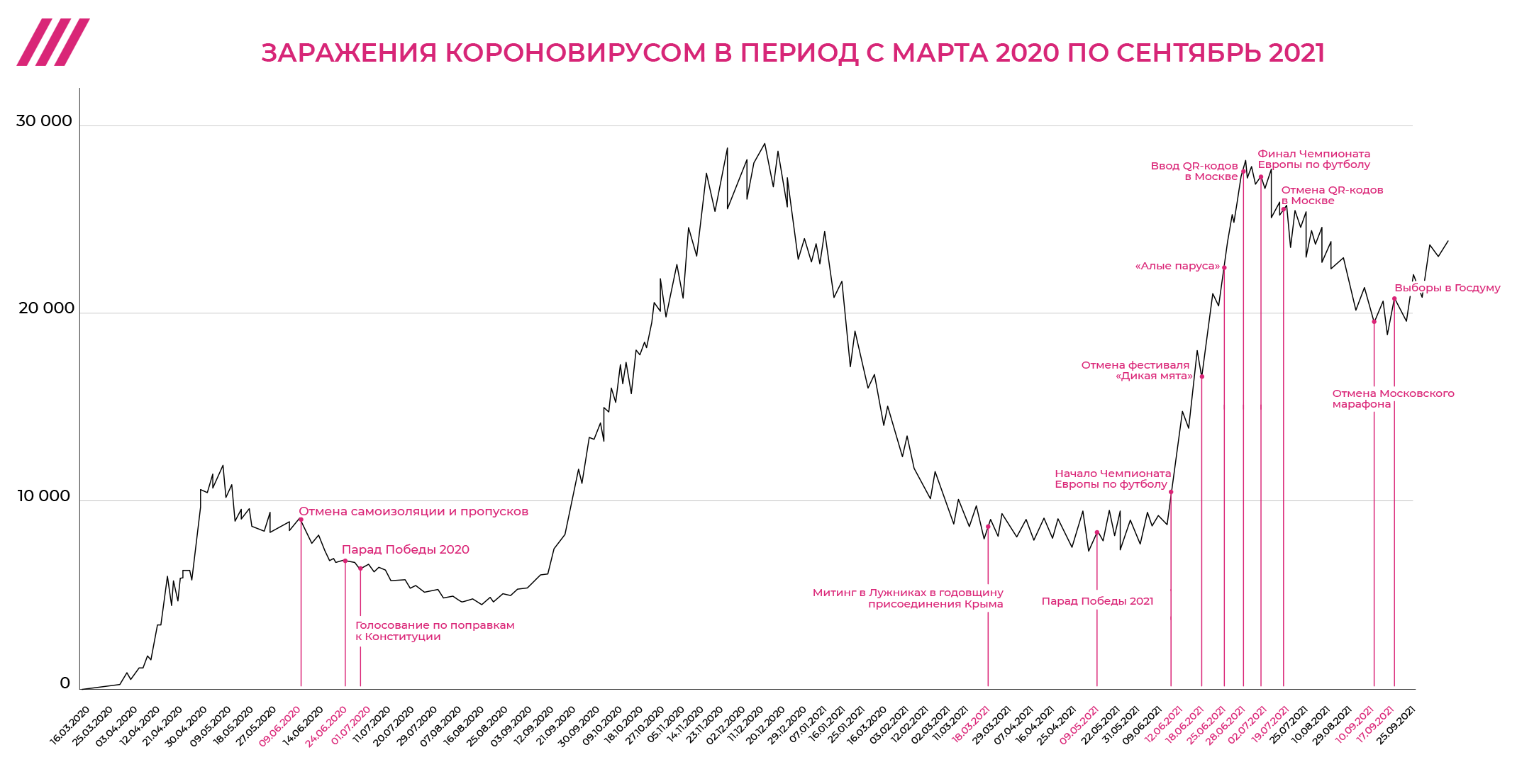
If we superimpose the most important events for the authorities in 2020 — the 75th Victory Day Parade and the vote on the Constitution — on the curve tracking incidence of the coronavirus, we can see that both events were held after the first wave of covid-19 had subsided. As this graph bears out, there was no increase in infections after these events either.
The situation was different this year. Only some of the Kremlin’s high-profile events took place in favorable epidemiological circumstances. The concert in Luzhniki, attended by Vladimir Putin, was held at a time when the increase in new cases of covid-19 was at the lowest level for this year. The same can be said about the 2021 Victory Day parade.
A new coronavirus wave kicked off in mid-June, but this did not prevent the authorities from holding UEFA Euro 2020 group stage matches, which ended on the crest of the wave of infections, in Petersburg. It would be difficult to call favorable the numbers of new infections during Petersburg’s Crimson Sails celebration for school-leavers. The cancellation of QR codes in Moscow in late July is also difficult to explain in terms of positive morbidity figures.
Coronavirus infections in Russia between March 2020 and September 2021. Key public events (and cancelled events) during this period are identified and marked in red, including the 2020 Victory Day parade in Moscow, the constitutional referendum in July 2020, the Crimson Sails celebration in Petersburg in June 2021, and parliamentary elections in September 2021. Courtesy of TV Rain
Can we trust official data on numbers of infections?
During the pandemic, demographers and epidemiologists have repeatedly drawn attention to the peculiar numbers issued by the covid-19 task force. “I always start the conversation like this: forget that there is a task force. It is pointless to discuss that today, for some reason, there were exactly one thousand fewer or more cases recorded than yesterday. Why? Because. Because the gladiolus. Because that’s the figure they thought up yesterday,” says independent demographer Alexei Raksha, one of the principal critics of the official figures. Back in July 2020, after the vote on amending the Constitution, he noted an unusual drop in the number of infections. “In late June [2020], we were told that there had been a certain decline in even symptomatic cases, and then the numbers went up again after July 1,” Raksha said.
The 2003 KVN skit by the Ural Dumplings that gave birth to the “Because the gladiolus” meme.
In his opinion, internet searches are the most accurate indicator of covid-19’s spread. “The incidence curve lags way behind. I use only Yandex searches — for example, searches for ‘sense of smell’ reflect the trends better than others,” he explains.
Trends for coronavirus-related searches on Yandex between March 2020 and September 2021. The searches tracked during this period included the following terms: “antibodies,” “second wave,” “call an ambulance,” “home food delivery,” “how to avoid infection,” “buy antiseptic,” “buy mask and respirator,” “coronavirus treatment,” “loss of smell,” “oxygen saturation monitor,” “get tested,” “coronavirus symptoms,” “what to do at home,” and “what to do if ambulance doesn’t come.” Source: Yandex/TV Rain
Experts have named several possible factors for distortions in the official statistics. “First, the counting is done differently in different regions, and the epidemic moves across the country from month to month. And second, even within a particular region, the local covid-19 task force sometimes starts to do a better job of counting over time — maybe they import more tests, or they start cheating less,” says Dmitry Kobak, a data researcher from the University of Tübingen in Germany. According to him, it is also possible that the covid-19 task forces in some regions report “retroactively” — that is, for example, they issue the stats for July deaths in August.
“No one knows what deaths, exactly, are reported by the task force,” adds Sergey Timonin, a researcher at the International Laboratory for Population and Health at the Higher School of Economics. “I am not aware of regulatory documents that would explain this.”
Kobak draws attention to the fact that since the regions have started publishing statistics, so-called plateaus have regularly appeared in the data, that is, when the number of deaths has remained the same for several days, or even weeks. In September, similar “plateaus” — with the daily number of deaths hovering around 800 — appeared in the overall statistics for the country. “Previously, they showed up only within individual regions. This is interesting: it means that if the stats used to be fudged at the regional level and were added up afterwards, now, apparently, someone has been adjusting the figures after or while summing them up [for the whole country],” explains Kobak.
Verifying official mortality statistics
To get an objective picture of the coronavirus pandemic, experts use the excess mortality rate, which is the difference between real deaths and Rosstat’s forecast (that is, the number of deaths that we would expect if there were no pandemic), which, in turn, is calculated based on mortality data from previous years.
Calculations made by Alexei Raksha specially for TV Rain show that, by the end of 2020, there had been nearly 360 thousand excess deaths in Russia. At this time, the covid-19 task force’s death toll was about six times less — around 57 thousand deaths. By September 2021, excess mortality figures exceeded 675 thousand, but the covid-19 task force reported 180 thousand deaths for this same period. Since there have been no other major factors that could have had a strong impact on the life expectancy of Russians in the last two years, experts concede that it was the coronavirus that caused the serious increase in mortality in the country.
If the excess deaths graph is superimposed on the infections graph, as based on the task force’s data, we can see that they are roughly comparable. Raksha confirms this: the morbidity statistics for Russia as a whole “to some extent reflect reality when squinted at from three meters.” However, Raksha draws attention to the fact that excess mortality has been running chronologically ahead of the task force’s morbidity statistics. This may indicate that the latter are being heavily fudged, the demographer argues.
The trends for excess mortality (in dark blue, as reported by Rosstat), deaths caused by covid-19 (light blue) and covid-19 infections (pink), as reported by the Russian covid task force, between May 2020 and August 2021
The situation is different with the official data on mortality due to covid-19. When the covid-19 task force’s date is combined with Rosstat’s figures, the two curves radically diverge.
At the same time, the “hump” on the excess mortality graph in July 2020 stands out amid falling numbers of infections. Raksha believes that part of the increase in excess mortality that month was caused by the heatwave in the Urals. In his opinion, however, this factor could have added no more than five thousand deaths across the country. The rest of the difference, according to Raksha, is explained by the deliberate “flattening” of the task force’s official data.
Nevertheless, the covid-19 task force’s figures remain the only official data source available to Russians on a daily basis. And as follows from the graphs, above, this year the Russian authorities finally stopped using even these numbers as a guide when making decisions on holding large-scale events.
Translated by the Russian Reader. Just as I was finishing this post, Mark Teeter brought to my attention this article on the same subject (also featuring Alexei Raksha) in today’s edition of the Washington Post.
Yefim Khazanov. Photo: Roman Yarovitsyn/Kommersant
Yefim Khazanov, Academician of Russian Academy of Sciences, Detained in Nizhny Novgorod
Roman Ryskal Kommersant
April 21, 2021
Yefim Khazanov, an academician of the Russian Academy of Sciences and laureate of the State Prize in Science and Technology was detained in Nizhny Novgorod on Tuesday, April 20. Presumably, the reason was his reposts of information about Alexei Navalny on Facebook.
As Mr. Khazanov reported to Kommersant, he was taken to the police department in the city’s Kanavinsky district. “I was detained in the afternoon at work and brought to the police station. They said that I had written [something] about Navalny on Facebook, but I believe that I did not write [anything],” the scientist said. He added that, for the time being, he was in the lobby of the station, and the police officers had not gone through any procedures with him. Lawyer Mikhail Lipkin had gone to the department to represent the physicist.
Mr. Khazanov’s page on the social network contains reposts of information from Alexei Navalny from the [penal] colony, an appeal by human rights defenders to Vladimir Putin about the convicted person’s [sic] condition, as well as posts by Leonid Volkov about the state of health of the founder of the Anti-Corruption Foundation (FBK, entered in the register of foreign agents). The police have not yet commented on Khazanov’s detention.
Yefim Khazanov is a Russian experimental physicist who specializes in creating laser systems. In 2008, he was elected a corresponding member of the Russian Academy of Sciences in the Department of Physical Sciences. In 2012, he was awarded the Russian Federation Government Prize for his work creating a petawatt laser system. In 2018, he was awarded the Russian Federation State Prize for establishing the basic foundations of and devising instrumental solutions to the problem of registering gravitational waves.
Thanks to EZ and others for the heads-up. Translated by the Russian Reader
A Russian environmentalist untangles a “ghost” fishing net. Such nets are deadly to wildlife, including the endangered Russian desman. Photo by V.I. Bulavintsev
The Russian Desman Hangs by a Thread
Yevgenia Volunkova Takie Dela
November 28, 2019
In Russia, the Red Book of Rare and Endangered Species is about to be reissued almost eight years late. Scientists fear that rare and endangered species of mammals and birds of interest to hunters will not be included. At this very moment (the commission’s final session will be held tomorrow, November 29, 2019), zoologists are fighting for the inclusion of more than a dozen species that are in dire straits. Among them are the Asian black bear (Ursus thibetanus), the reindeer (Rangifer tarandus), the greylag goose (Anser anser), the Siberian bighorn sheep(Ovis nivicola), and the killer whale (Orcinus orca).
What Went Wrong
The Red Book of the Russian Federation is supposed to be reissued every ten years, but the most recent edition dates to 2001. An updated version of the Red Book was planned for release in 2017. At the time, scientists had made lists of rare and endangered species for the new edition, and the lists had been approved by the Red Book’s commission, but then everything went wrong.
The Russian Federal Ministry of Natural Resources and the Environment (Minprirody) suddenly changed the roster of the commission that reviews and approves the book. Zoologists who could stand up for rare animals were, for all practical purposes, removed from the commission. As a result, many species in need of protection vanished from the list. The new commission for some reason decided not to include 23 species of animals that had previously been listed in the Red Book.
Scientists were publicly outraged, and the process of reissuing the Red Book was suspended. In October 2019, Minprirody tweaked the commission’s roster again. Of its 44 members, only 20 scientists have remained. The other 24 members are officials from Minprirody, subordinate agencies and institutions, and regional hunting departments.
“If you remove the scientists from the commission and put hunters and bureaucrats on it, it’s clear how they are going to vote,” says Sofia Rosenfeld, a biologist and member of the commission’s expert panel on geese. “People must be smart and objective in order to evaluate the scientists’ proposals. Hunters cannot be objective. Business interests are obviously trying to delist the species from which they profit. And yet the fact that these species are on the verge of extinction bothers no one.”*
The Leftover Principle
Alexei Zimenko, the director of the Biodiversity Conservation Center, and I are talking in his office. Located in a small old building on Vavilov Street in Moscow, the Center occupies several rooms off a corridor. It has not been remodeled in a long time, but inside it is a cozy as a biology classroom. Zimenko sets the most recent edition of the Red Book on the table. According to him, the book has not been updated for so long because there are “gigantic problems with the protection and study of wildlife” in Russia.
“Since 2000, the country’s main priority has been economic success. But environmental issues and nature conservation are considered obstacles to this success,” Zimenko says. “Biological research is financed on the leftover principle. For example, at one point Barguzin Nature Reserve, on Lake Baikal, had a powerful research base and material support up to and including its own airfield. But in the early 2000s, we gifted the oldest employee three freestanding lamps for lighting, so that he could scrape by somehow. And at another Far Eastern reserve, there is now just one scientist on staff, and three more travel there and stay for a month, at most.”
According to Zimenko, the delay in republishing the Red Book could be due in part to the fact that there are very few or no scientists researching many of the animal species in Russia.
“Due to insufficient data, several species may not make it into the Red Book. But this country has excellent researchers who are ready to work with limited resources. So, we do have information on many species. But, for example, when it comes to the Russian desman (Desmana moschata)—a rare Red Book species—we have three researchers total: two at the Oka Nature Reserve and one in Moscow. And we have just one person in the whole country who researches moles.”
Things Are Bad for the Russian Desman
Using the example of the Russian desman, Zimenko tells me about how scientists research Red Book species.
The small, semi-aquatic creature lives in bodies of water in central Russia and along their banks. Estimating its numbers is a job best done from August to September, when the water is not high. A group of researchers travels to the desman’s habitat and inspects the shoreline meter by meter. They wander the banks and the shallows in search of the animal’s burrows—it is the numbers of these that are counted. In point of fact, a similar “walking” count is made for all animals. Ground squirrels, for example, are counted by the numbers of their burrows, and tigers, by their paw prints. The “heel” of every print is measured with a ruler: it is a different size for every tiger. That way one can grasp how many tigers have passed through an area and whether they were males, females, youngsters, or adults.
There are not enough people for such a colossal amount of work: a small group cannot physically manage to inspect a huge area. So, there is little current data on the state of the Russian desman, as for many other species.
“In the early 2000s, we conducted a nationwide inventory of the desman with the help of hunting researchers who had previously been in charge of doing counts of the wildlife in their districts. Today, there are few such researchers, and their duties have been reduced, along with their funding. Furthermore, the desman is not a commercial species, so counting it basically is of no interest to anyone. Therefore, we can get current data on the state of the desman only after studying several sites and estimating its overall numbers. And it’s the same thing, unfortunately, with many species. How, for example, can we estimate the numbers of the polar bear, if it travels across the ice for half a year, and every trip to the Far North is terribly expensive? Back in the day, my fellow scientists lived right in the nature reserves and were able to make observations without gigantic outlays of money for flights. Today, there are very few scientists who work in the necessary fields.”
The Russian desman. Photo by V.I. Bulavintsev
According to Zimenko, things are bad for the Russian desman. Compared with Soviet times, the state of the species has deteriorated dramatically. Today, there are approximately 7,500 of them in the wild. For such a tiny animal, that is incredibly low—there should be tens of thousands. In the 1990s, the oversight of bodies of water decreased significantly, and people began fishing in droves, often using nets. If a desman gets caught in a net, it becomes entangled and drowns underwater. Things got even worse when Russian-made nets were replaced with ones made in China from monofilament fishing line. They are impossible to escape, and some of these nets are so cheap that fishermen often simply discard them. The nets are washed away by floodwaters, becoming conveyor belts for destroying aquatic life.
“We tried to ban the import of those fishing nets to Russia. They destroy not only the Russian desman, but fish and birds as well. Even moose were getting killed, as it happened. Consequently, the decision was made to ban the import of equipped (readymade) nets. But importing reels fitted with monofilament line to Russia is still permitted. A great country has been unable to solve a seemingly simple problem. It is shameful! And so the Russian desman is hostage to our troubles with the government management of natural resources and wildlife conservation. Among other things, the Russian desman reacts to climate change—drought and the lack of floods affect its reproduction. The desman is hanging by a thread.”
Cut Out and Shot
But if the Russian desman can at least be found in the Red Book, many other species on verge of extinction risk not even getting into it. For example, the Asian black bear (Ursus thibetanus), whose situation, according to researchers, is catastrophic.
The scientific community has long been in favor putting the Asian (white-chested) black bear in the Red Book. But the hunting community has prevented that in every way possible. At issue are the bear’s paws and bile, which are in great demand in China. The Asian black bear winters in the hollows of large trees. Hunters cut down the tree, chase out the bear sleeping there, and shoot it. Or they cut out an opening in the tree through which they can extract their “trophy.”
Female bears also give birth to their young only in tree hollows while they are hibernating. They give birth and feed their bear cubs in a semi-drowsy state. Hunters do not differentiate whom they kill, but the bear cubs are often left behind and usually die.
In the Maritime Territory (Primorsky Krai), where the white-chested bear lives, large trees are being intensively cut down. And this is the second problem: with every passing year, it becomes harder for the bear to find a place to winter. It is forced to winter among tree roots or burrows in the ground, like the European brown bear (Ursus arctos), but in such conditions it is more vulnerable to predators and hunters. If it does not find a place to winter, a bear cannot even lie down to hibernate. A bald bear in the forest that has not fallen asleep or managed to shed its fur, according to zoologist Nikolai Formozov, is a “heartbreaking sight.”
Formozov has a Ph.D. in biology and is a member of the Red Book commission’s expert group on mammals. He has advocated for the inclusion of the Asian black bear in the Red Book.
“The white-chested bear was in the Red Book of the USSR. Later it was removed, even though things had got worse for it. In the Soviet Union, its population was estimated at 7,000 individuals—fewer than the polar bears in the Arctic. Today, even by the hunters’ inflated numbers, pulled out of thin air, there are only 5,600. In fact, of course, there are fewer than that. And at the same time, the hunters say that it is safe to cross it out of the Red Book. That, in my view, is a crime!”
The Death Throes of a Species
Formozov calls what is happening with the white-chested bear the “death throes of a species.”
“The species is in bad shape, and some not-so-obvious signs make it easy to understand. When a species is on the verge of distinction, it often shows up in inappropriate places. Previously, the basic foodstuffs for the Asian black bear before hibernation were the acorns of the Mongolian oak and pine nuts. When the acorns weren’t ripe, the pine nuts came to the rescue, and vice versa. So, the bear alternated between acorns and pine nuts. But the cedars have been cut down. And now we see hunger driving them into the flood plains, to eat cherry trees. Right next to villages. In that situation we get the reaction ‘Oh, there are so many of them!’ But this is an illusion. It has happened that up to twenty white-chested bears have been killed by poachers during such forays. The same thing was written about Caspian tigers when they began showing up in inappropriate places—that there were a lot of them. But this was the very end of that tiger’s existence. It disappeared completely, remaining only in the form of taxidermic mounts. The same thing happened with the cheetah in Kazakhstan . . . These are its death throes.”
An Asian black bear cub at Safari Park, a park for predatory animals in Shkotovo District, Maritime Territory. Photo by Yuri Smityuk for TASS
Things are nearly as bad for the saiga antelope (Saiga tatarica). The saiga antelope lives in Kalmykia and the Astrakhan Region. In good times, there were 800,000 of them. By the early 2000s, only 5,000 remained. Among those 5,000 only about five percent are males, because poachers hunt the animal for its horns: like the paws of the Asiatic black bear, the saiga antelope’s horns are used in Chinese medicine.
“There are none of them left to reproduce,” says Formozov. “The situation is simply catastrophic. Alexey Yablokov proposed adding the saiga antelope to the Red Book back in August 2003, but at the time the hunting lobby would not stand for it. The situation for this species continued to worsen, and here we are, sixteen years later: we defended our position and got the saiga antelope listed in the Red Book.”
And then, at its last meeting, the commission did not even review the case of the Manchurian sika deer (Cervus nipponmantchuricus), whose situation is critical. In the 1930s, hardly any of them remained. Today in the Far East, where there is an extremely high level of poaching, the numbers of sika deer and of other hoofed animals are so low that tigers are not able to raise their cubs. There are almost no places where female tigers can catch prey and bring it back to their cubs. Therefore, the numbers of tigers have also been falling.
The Curlew That We Lost
By international standards, in order to be sure that a species has gone extinct, we must wait fifty years from the time it was placed on the endangered species list. However, even now, twenty years later, it is impossible to identify the species that we have nearly lost.
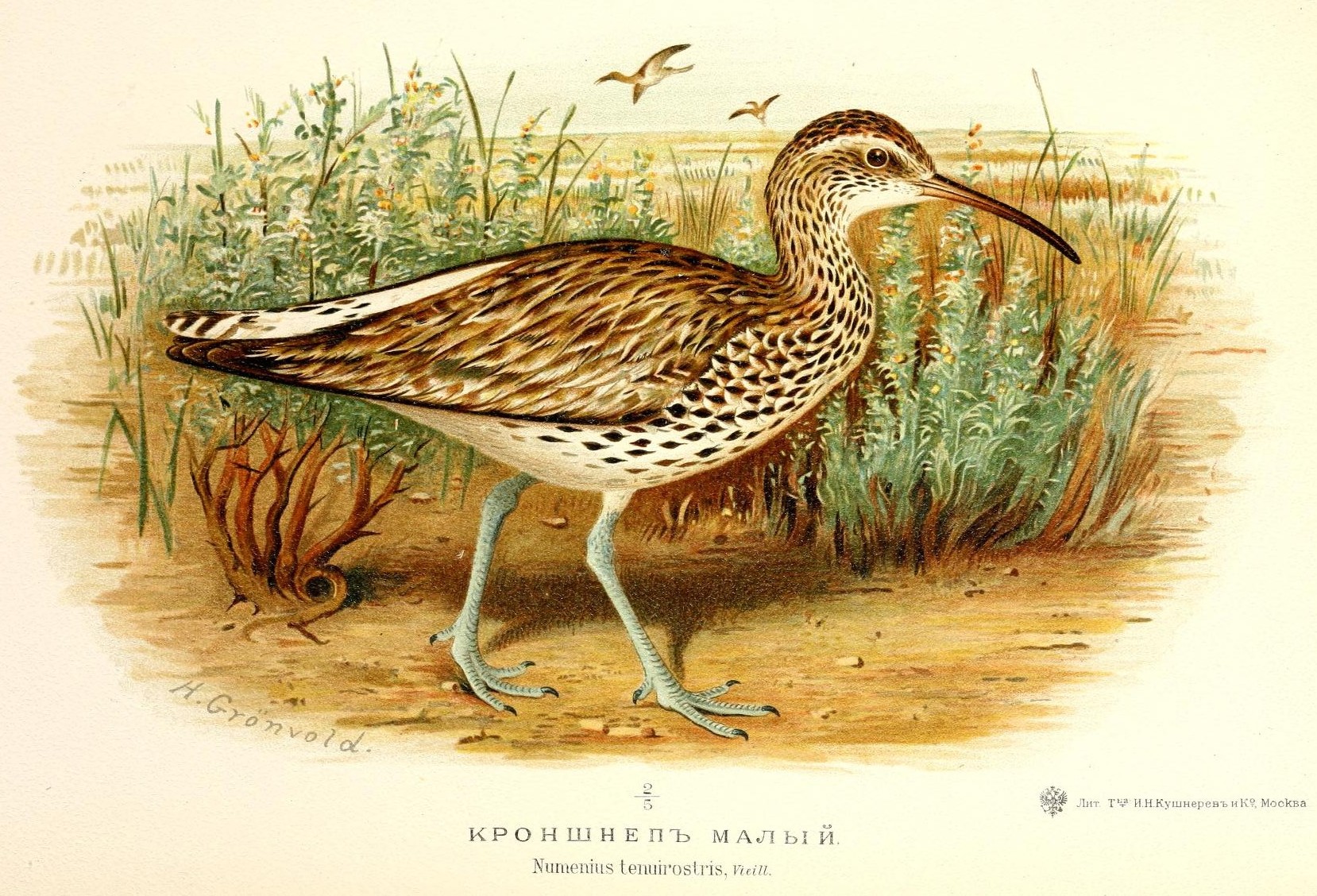
“The spoon-billed sandpiper (Calidris pygmaea) is very close to extinction,” says Formozov. “The sociable lapwing (Vanellus gregarius) is also close to disappearing. But the biggest loss in recent years is the slender-billed curlew (Numenius tenuirostris), which nested in Western Siberia. Nobody has been able to locate it for quite some time now. Its migratory routes and stopover sites are well known. It is a ‘tasty treat’ for birdwatchers, who have been looking for it a long time. In the 1990s, they spotted fifteen specimens, then seven, then three; several years ago, they spotted one. Now there are none.”
The slender-billed curlew. Drawing by Henrik Grönvold, as published in M.A. Menzbir, Hunted and Commercial Birds of European Russia and the Caucasus (Moscow: I.N. Kushnerev and Co., 1900–1902). Courtesy of Wikipedia
Formozov explains that while the commission argues over mammals and there is a chance to protect some of them, things are practically hopeless when it comes to birds.
“Not one of the birds was put on the endangered list, not even those for which there was impressive data,” laments Formozov. “Such is the situation, for example, with the European turtle dove (Streptopelia turtur). In my childhood, there were lots of them; they were found everywhere in the Moscow Region. Now the numbers of the turtle dove have fallen, at a minimum, by a factor of fifty, at a maximum, by a factor in the hundreds. This is due to the unfortunate situation in their wintering habitats: forest belts have been cut down in the steppe zone, while chemicals are used to fertilize fields. For these and other reasons, there is nowhere for the bird to winter.”
“The hunters, in response to our proposal to put the turtle dove on the list of protected species, say, ‘We’re not to blame for the reduction in numbers. Why do you want to forbid shooting them?’ They say that inclusion in the Red Book would be of no use because they will continue hunting them. Where’s the logic?”
“There is data on the decline in numbers. There are guidelines for compiling the Red Book: when there is a certain decline in numbers, you must put them on the list. Period! But, they say, ‘No, we’re not including them. Next question!’”
Again We Have Achieved Nothing
The commission met on November 1, for the first time since the public outrage of the scientists over their removal from the commission on rare and endangered species. This time it was a “correct” commission: the roster has been changed to include as many scientists as necessary. But even so, much of what happened at the meeting remains a mystery.
“First, the ministry came up with the idea of asking the regions’ opinion about the feasibility of listing the taxa we had proposed in the Russian Red Book,” recounts Sofia Rosenfeld. “We got their answers and were dumbfounded. Their responses show how bad things are in these regions! In the best case, they can write the name of a species without making mistakes; in the worst case, what they write is sheer nonsense.”
“For example, a region has a species in its regional Red Book, but they brag that everything is fine with it and that it is hunted! It’s obvious that they completely fail to understand what’s going on. And now, if one region is against listing a species, and eighty are for it, that’s it, we cannot list it! This is unprecedented. On November 1, we achieved nothing, and not one question was put to a vote. They threw out all of our geese again. We ended up drafting internal memos and petitions.”
The Battle over the Geese
On a Saturday afternoon, Rosenfeld is working at the Institute of Ecology and Evolution of the Russian Academy of Sciences. It is a dilapidated building, with plaster crumbling in spots, exposing the bricks. Inside there are signs of a renovation that took place ages ago.
“It is everything you wanted to know about the attitude towards scientists in Russia,” Rosenfeld says, smiling, in response to my remarks about the ruin.
Rosenfeld’s computer monitor shows an enlarged photograph of geese in flight. She has been counting birds on photos all day, entering the data into a separate spreadsheet.
“I have to examine 20,000 photographs and count up all the geese. And also determine where there is a swan, a brent goose, or a greylag goose,” Rosenfeld comments on her work. “But I’m also constantly monitoring everything that is happening with the Red Book, writing memos and substantiations, and giving interviews. My life is spent dealing with paperwork, and I’m unable to do real work!”
At the last meeting of the rare species commission, Rosenfeld represented geese.
“We proposed listing the greylag goose (Anser anser) in the Red Book: it has been doing poorly in Russia,” she recounts. “When spring hunting for geese was opened (in Soviet times, it was outlawed—Takie Dela), it was a real blow to the greylags, because that is right when the species is nesting. Spring hunting causes huge damage to all our geese. This is a horror and a disgrace for Russia, and no civilized country has it anymore. Imagine: geese fly across fifty regions to breed, and everywhere they are shot! And later the rest of them are shot at their breeding sites. A goose is sitting on her eggs, and hunters are running around the wetlands. A goose flies up from under a hunter’s feet—bang! Or the male tries to lead people away from the nest—bang! And geese are monogamous birds, after all. You kill its mate—that is it, it will no longer breed, at least this season. Or maybe not at all. Geese are like people: some grieve so much for their partner that they won’t form another couple for the rest of their lives. The whole world has understood this, but we in Russia have not! On hunting sites and forums, hunters talk about how cool it is to hunt geese when they are sitting on their eggs or have just flown into breeding sites, having traveled thousands of kilometers! They say things like, ‘They don’t fly off, they try and lead us away,’” explains Rosenfeld.
Rosenfeld recounts that in 2018, the website The Petersburg Hunter posted a photo with the results of the previous year’s spring goose hunting. One of the users reported that their team of three people had bagged 183 geese in a single day. In the Nenets Autonomous District, a group of hunters bagged 700 geese in the spring of 2017. And there are many such examples.
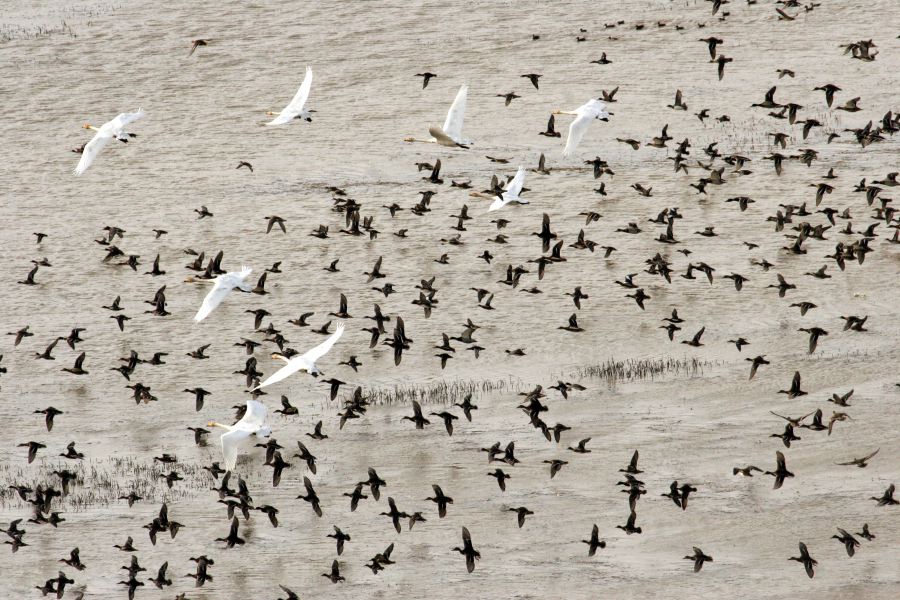
Autumn migration of birds in the Dvuobje Wetlands. Photo by Sofia Rosenfeld
“I have nearly lost my mind trying to fight this. Personally, I don’t understand how it is possible to have fun murdering another living being, but I am not a crazy Green. I am convinced that hunting has a right to exist as long as it does no harm to what is hunted. But what I am seeing now is terrible. Quick, quick, shoot, before they fly off to a neighboring region, or to Europe, or to China, quick, quick! The main thing is that our neighbor does not get it! It is obvious that current hunting regulations cannot cope: it is essential to make protective measures stronger. And the only way to save the birds that are disappearing right before our eyes is to list them in the Red Book,” Rosenfeld says.
When asked how many greylag geese are left today, Rosenfeld says that it is not a matter of numbers, but of speed. If the population has fallen by half in ten years, that is enough to list the species in the Red Book.
In addition to the greylag goose, scientists have proposed listing three subspecies of the bean goose (Anser fabalis) in the Red Book. In twenty years, the numbers of the taiga bean goose have fallen from 110,000 to 45, and this is a disaster.
“There are motorboats and good equipment nowadays. A motorboat sails by a spot where a female is sitting in her nest, and the male tries to lead the hunter away and is shot. The bean goose remains only in places impassable to boats. But there are no geese left where the rivers are navigable. All these arguments in defense of geese were rejected by the commission. I think that everyone is under the influence of high-ranked oligarchs who hunt. Do you know what birds will definitely be listed in the Red Book? Two subspecies of godwit. Because nobody wants them—they’re not hunted. The battle is over the geese, ducks, sheep, goats, and deer,” Rosenfeld explains.
Yamal Gets It
When Rosenfeld is not doing paperwork, she is doing field work. For many years, she and her colleagues have been doing air counts and ringing Anseriformes on the Yamal Peninsula, in the Nenets District, and on the Taymyr Peninsula. In some places, they go out into the field with telescopes and count birds. Where there are no roads, they use an airplane.
“Across our huge country, all of the data we get is the result of the incredible work of mad scientists,” says Rosenfeld, smiling.
Rosenfeld says that the attitude toward bird monitoring in the country’s northern regions should be an example to other Russian officials.
“In Russia, monitoring has been entrusted to bureaucrats who have no money, gasoline, or concept of what to do and how to do it. It is set up like this: the federal government subsidizes the monitoring of wildlife. Here are three rubles for you to spend on monitoring rare species, and for hunted species, here are three hundred rubles. Next, region, you can do as you like: if you want, you can count geese. Or deer. Or seals. There is no system. A region can spend money on monitoring from its own regional budget, but, in our country, there are few wealthy regions that want to monitor anything. We have established a system only in the Yamalo-Nenets Autonomous District,” Rosenfeld explains.
This year [2019], Rosenfeld was in the field from April to September. First, she counted moose and deer on the Yamal Peninsula from the air. Next, she did an aerial survey of waterfowl and hoofed mammals on the Yamal and Taymyr peninsulas and in Yakutia (from Taymyr through the Lena River delta). Then she counted waterfowl during their autumn migration in the Nenets Autonomous District.
“When the work is done,” Rosenfeld explains, “we say to the authorities, ‘Here’s where you have geese; there are the deer; here you need to make a nature preserve; forbid hunting here; there, oilmen are a danger.’ And they follow our recommendations. That is how it should be, but only the Yamalo-Nenets District and the Nenets District work with us in this way. They have realized the importance of waterfowl. The officials themselves admit it: ‘But we have no other hunting resources left—all the rest have been knocked out!’ And that is the case: the wild reindeer and moose have been knocked out, and if the geese are knocked out, what will you have left?”
Proper Monitoring and How it Works
When Rosenfeld explains how the work of protecting and monitoring wildlife is done in the west, she rolls her eyes.
“Europe understood long ago that in order to use something, you have to keep track of it. Understand what is happening with the resource—how it is doing, whether it is decreasing or increasing, and how much you can remove without harming the population. This thing was thought up in the U.S. in the 1800s, and ever since they have had the best system for monitoring hunting resources.
“The U.S. and Canada have government-funded fish and wildlife services, and their officials work in every state and province. For the management of waterfowl alone, there are special councils for every migratory route. And how many and which animals can be hunted and how to protect them are decided only after an annual report is submitted. The annual report includes data about the numbers, the success of breeding programs, and other population parameters. It is the result of a colossal amount of work by government teams!”
“If the monitoring data is off, they immediately give scientists the signal: ‘For some reason we have too few of this duck. Figure it out, and here is the funding!’ They spare no expense. In two or three years, the scientists figure it all out and say, ‘Here is what is happening, do this and that.’
“‘Good,’ says the government. ‘We did what the scientists told us, and everything is fine with the duck again.’
“That is what monitoring is for! When we were [in North America], looking at all this, my heart nearly broke!”
Routes of the field trips made by Sofia Rosenfeld and her colleagues in 2019. Image from Rosenfeld’s personal archive
Rosenfeld is sure that something can still be done to protect nature in Russia.
“We can save species that are going extinct and put everything back on track. However, we have to amend the legislation and the hunting rules, and adopt strategies for migratory birds. We need to free ourselves of xenophobia and cooperate with all countries. But the most important rule is not to push things to the point of no return, when a species is slowly dying out and nothing can be done about it,” she says.
At the next meeting of the commission, which will be held tomorrow, November 29, scientists expect a separate vote on “disputed species,” a list that includes the Asian black bear, the Yakutsk bighorn sheep, the Barguzin reindeer, the greylag goose, several types of bean goose, and others.
According to Rosenfeld, the natural resources ministry has been rushing to complete all of the procedures for adopting the final list for the Red Book’s reissue.
“We’re still battling for the geese and others, but I don’t know what will happen. At some point, they can bang their fists on the table and say, ‘This is how it’s going to be!’ Then we will rouse the public again. What do we have to do to save these poor birds and beasts? We will stop fighting only when Russia starts listening to scientists again,” says Rosenfeld.
Translated by Mary Rees. All photos courtesy of Takie Dela
*How the Red Book Works
The Red Book is an annotated list of rare and endangered species of animals and plants in need of total protection. Species listed in the Red Book are withdrawn from economic use: they cannot be hunted, caught, or sold. In Russia, the Red Book has legal force, and criminal or administrative liability is stipulated for causing harm to Red Book species.
In addition to the Red Book of the Russian Federation, each region in the country has its own Red Book. A species listed in a regional Red Book is not necessarily included in the federal Red Book. For example, a species in the Saratov Region may be threatened, but in the Tambov Region it is doing well, and its state nationwide is generally good as well. In this case, it will only be listed in the Saratov Red Book. On the other hand, a species included in the federal Red Book must be listed in all regional Red Books.
In the Red Book, animals and plants are divided into six categories: probably extinct; threatened with extinction; population is rapidly declining; rare species; undefined status; vulnerable species. Listing each species in the Red Book is the result of many years of work by botanists and zoologists across the country. Scientists study the numbers, dynamics, and state of a species to decide whether to include it in the Red Book or not, whether to re-categorize already listed species—for example, if there has been a positive trend over ten years, the species has spread its habitat or increased its numbers, scientists think about whether to change the category from rare species.
Scientists report the results of their research to a special commission, which consists of expert sections on birds, mammals, fish, higher plants, lower plants, fungi, and so on. Experts analyze and discuss the collected data and then submit their proposals for including species in the Red Book to the commission’s bureau, which consists of scientists (who constitute the majority of members) and officials from the hunting, fishing, agriculture, etc., authorities. Proposals made by scientists to include a particular species in the Red Book had always been approved, but this has not been the case since 2017, when things went awry.
Translated by the Russian Reader. In the spring of 2020, the Red Book of Russian Federation was officially amended and reissued. Forty-three mammals and birds were added to the new Russian federal list of endangered species, including the saiga antelope, the wild reindeer, the greylag goose, the Siberian bighorn sheep, and the bean goose.
Norilsk: Exposing the Lies and Appealing to Potanin
225,518 views • Jun 18, 2020 Ekologika
There has been an environmental disaster in Norilsk, but another one is about to happen. My measurements show that oil products are moving towards the Kara Sea, and all the “cleanup measures” are nothing more than a profanation, a pretty picture for journalists. This is a crime, and there is a specific criminal behind it.
I have two demands for Mr. Potanin:
1) Stop lying and concealing the real state of affairs from the public.
2) Take urgent measures to prevent the pollution of the Kara Sea.
To give the head of Norilsk Nickel more incentives to act, we will appeal not only to him, but also to the international community! Together, we can prevent a large-scale environmental catastrophe.
Don’t forget to click on the “subscribe” button and share this video! Watch the previous videos on this channel about the environmental disaster in Norilsk.
Thanks to Anastasia Shaboltas and Gabriel Levy for the heads-up. For more mainstream accounts of the environmental disaster in Norilsk, see the accounts published by the Moscow Times and the Norwegian-Russian environmental organization Bellona. YouTube video annotation translated by the Russian Reader







 Address for letters and parcels:
 Coronavirus infections in Russia between March 2020 and September 2021. Key public events (and cancelled events) during this period are identified and marked in red, including the 2020 Victory Day parade in Moscow, the constitutional referendum in July 2020, the Crimson Sails celebration in Petersburg in June 2021, and parliamentary elections in September 2021. Courtesy of TV Rain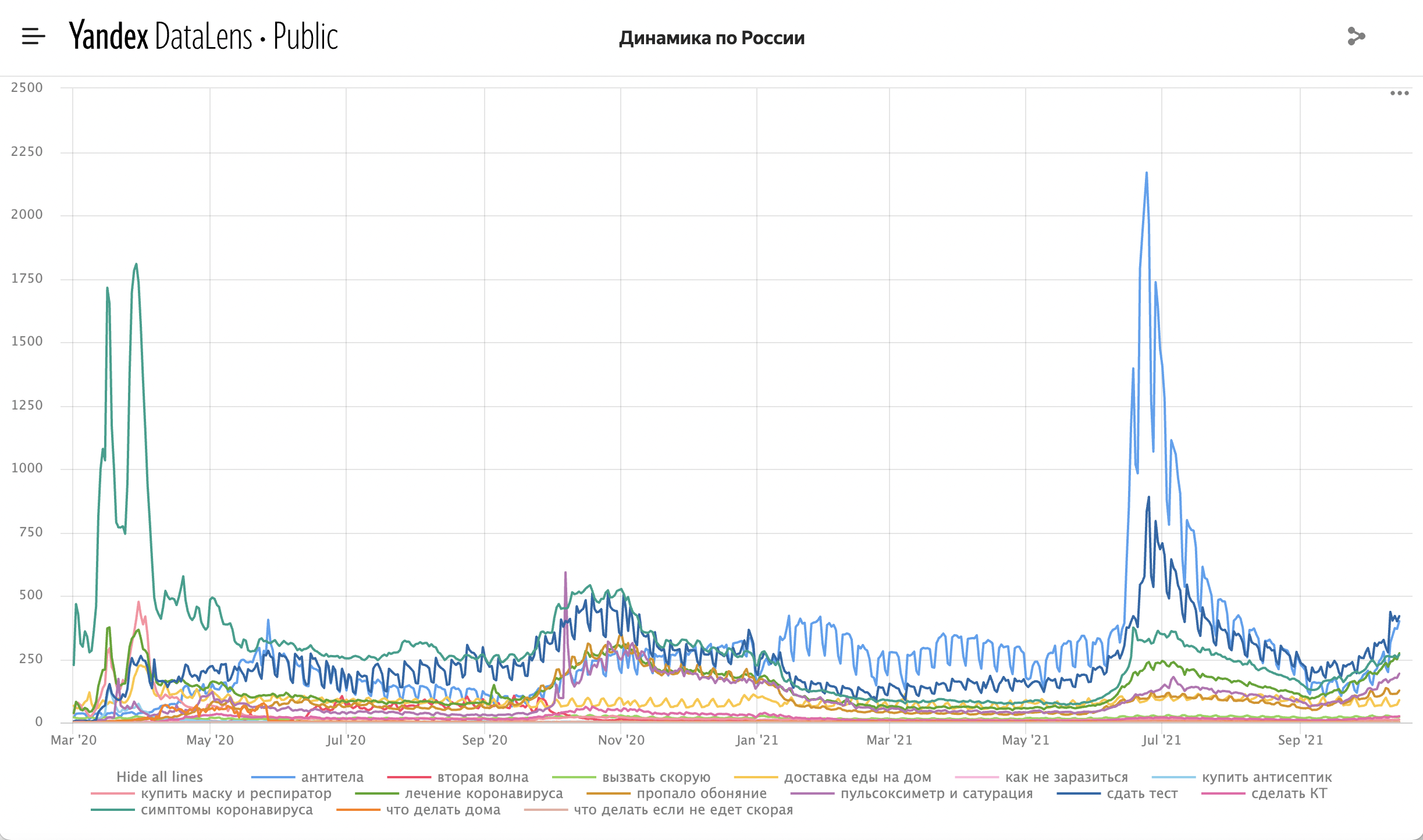
 The trends for excess mortality (in dark blue, as reported by Rosstat), deaths caused by covid-19 (light blue) and covid-19 infections (pink), as reported by the Russian covid task force, between May 2020 and August 2021
 A Russian environmentalist untangles a “ghost” fishing net. Such nets are deadly to wildlife, including the endangered Russian desman. Photo by V.I. Bulavintsev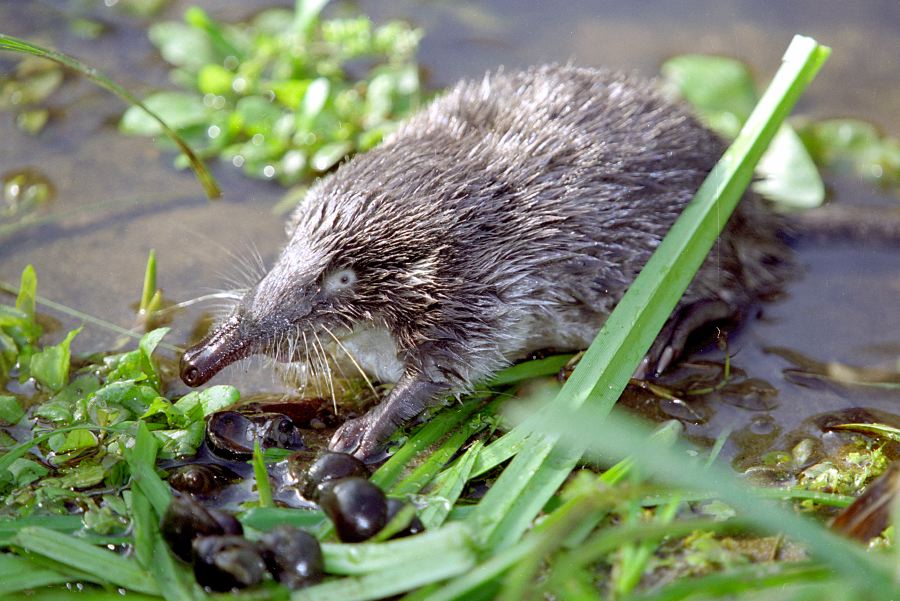

 The slender-billed curlew. Drawing by Henrik Grönvold, as published in M.A. Menzbir, Hunted and Commercial Birds of European Russia and the Caucasus (Moscow: I.N. Kushnerev and Co., 1900–1902). Courtesy of
  Autumn migration of birds in the Dvuobje Wetlands. Photo by Sofia Rosenfeld
 Wild reindeer on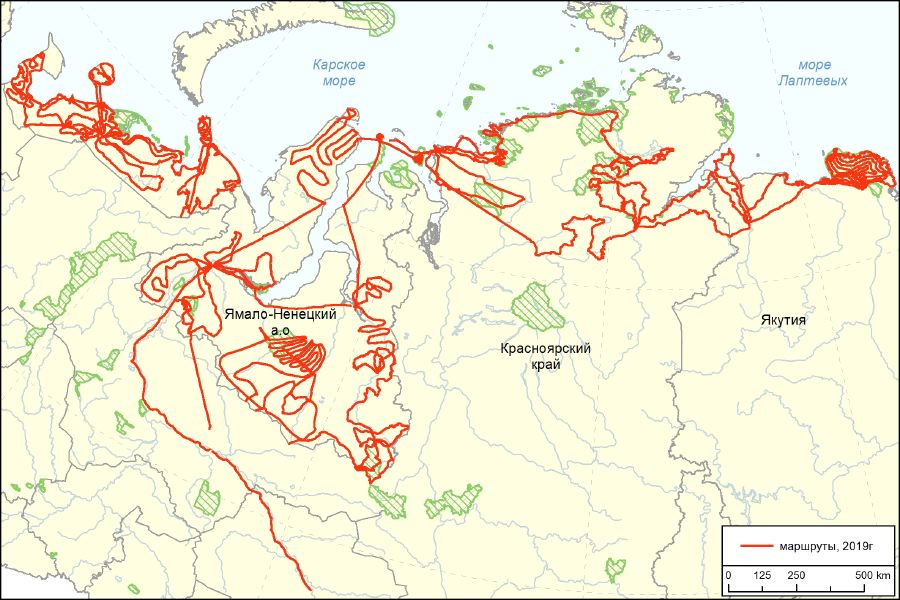

#/media/%D0%A4%D0%B0%D0%B9%D0%BB:Stamp_of_Russia_2012_No_1556_Killer_Whale.jpg)
