Ilya Shakursky. Photo courtesy of Elena Shakurskaya
Today, April 10, my son Ilya turns 27. This is the sixth birthday he has celebrated behind bars. But every year I wait, believe, and hope that he be released from captivity and be near us. I naively believe in justice and truth. A miracle must happen sometime and Goodness will triumph!
My son, the best in the world, I lovingly congratulate you on your birthday! You are a part of me, and from the bottom of my heart I want to wish you incredibly beautiful days and nights, the most wonderful emotions, and fulfillment of ambitious plans! You deserve everything wonderful; may sincere Faith, pure and devoted Love, and optimistic Hope always remain with you! I wish my son the brightest road today. After all, you are all I have. My mother’s heart very often worries about you. It hurts for every trial you go through. It hurts for everything! Know, son, that you are everything to me. You are my only man, for whom I am not sorry to give my life. You’re my rock.
Ilya’s payphones have been turned off, and at the moment there is no connection with him. Today the weather is as warm and sunny as it was in 1996 [on the day he was born]. May the sun’s rays give hope, faith, kindness, and most importantly freedom to Ilya and to all political prisoners!
All the swindlers are fleeing Russia:
They have property in the West.
The bandits and sodomites are fleeing
And all those killed by their conscience.

The Judases are running, all going there,
Where there is no love, where there is no Christ.
Where there are gay parades and Nazis,
Liberals and globalists.

God is cleansing Holy Russia,
He protects it himself like his own daughter!
He will not let the evil ones torment us,
May God grant that we keep our faith.
Only an ignoramus doesn't understand
Russia as the last hope.

Let the enemy shout that Putin is bad
And under him all in Russia is bad.
If the whole herd of fleas is mad,
Evidently our Putin has done everything right!
Ruslan Zinin is a real Russian hero, but you won’t find many Russians talking about his heroism or his current plight for the simple reason that they’ve convinced themselves that there is nothing more to be said or done about their country’s dreadful criminal invasion of Ukraine. It is now up to Ukrainians and the “collective West” to stop Putin, whatever the cost. The vast majority of Russians have better things to do, apparently. In the last few days alone, I’ve seen smart Russian friends of mine, people I definitely consider to be among the country’s best and brightest and even (in other circumstances) the most courageous, writing angrily about alleged government bank bailouts in the US and the supposed tendency of US “taxpayers” to vote for conservative politicians, or how they can’t talk about the things that matter to them on social media due to the war (about which they emphatically don’t want to write because enough has been said about it already), or wondering aloud why it took so long for “them” (i.e., the “international community”) to issue an arrest warrant for Putin.||| TRR
Ruslan Zinin
Ruslan Zinin transferred to solitary confinement
Ruslan Zinin’s mother Marina Zinina has reported that on March 21 [her son] was transferred to a solitary confinement cell without explanation.
“They came and took him away, saying, ‘Let’s go to another place.’ They put him in the basement in a solitary confinement cell. […] The conditions are terrible. It’s damp and cold and reeks of sewage, and rats are running around, and there’s nothing in the cell at all, except for a cot. There’s nowhere to store food, nowhere to get water, there’s no kettle, there’s nothing.”
Marina Zinina also said that Ruslan has not received any letters for two weeks, despite the fact that FSIN-Pismo [the Russian penitentiary system’s electronic correspondence service] has been sending people notifications that their letters had been vetted by the censor and handed over to Ruslan.
Solitary confinement is one of two forms of punishment for violating the rules in a pretrial detention center. (The second is a reprimand.) The warden of the pretrial detention center or his deputy can impose these penalties. But before imposing a penalty, the prisoner is given the opportunity to write an explanation about their alleged violation, and they must be notified of the penalty in writing.
Zinin was not charged with violating the rules of the pretrial detention center, and was not informed of any such decisions on the part of the warden.
We consider Zinin’s transfer to solitary confinement to be an escalation of pressure on the prisoner, an attempt to silence him and get him to consent to unfounded accusations of “terrorism.”
A logging truck driver from Ust-Ilimsk (Irkutsk Region), Zinin fired several shots from a sawn-off shotgun at the local military commissar in the midst of the mobilization announced in September of last year. He was incited to do this by the draft notice that had arrived for his brother. The military commissar survived the attack.
In early March, Zinin was charged with committing a “terrorist act” (per Article 205.2.b of the Russian Federal Criminal Code).
Despite the fact that letters are not being handed on to Ruslan at the moment, they remain an important support tool. A large flow of letters shows the wardens at the pretrial detention center that a lot of people are concerned about Ruslan’s plight. An even greater flow of letters and complaints in connection with their non-receipt has repeatedly been shown to be capable of breaking through the information blockade that the authorities impose on political prisoners.
Address for letters and parcels to Ruslan:
Zinin Ruslan Alexandrovich (born 1997)
63 ul. Barrikad, SIZO-1
Irkutsk 664019 Russian Federation
You can send letters electronically from anywhere in the world via the FSIN-Pismo service (subject to payment with a Russian-issued bank card) or the free, volunteer-run resource RosUznik (which allows you to remain anonymous).
❗️ If in the last two weeks FSIN-Pismo has sent you a notification of delivery, write to the service’s support team that your letter was not passed on to Ruslan. (You can say that you found about this in the media.)
You will also find sample complaints about non-receipt of letters on our Telegram channel.
Solidarity Zone has been providing comprehensive assistance to Ruslan Zinin and his family.
Source: Solidarity Zone (Facebook), 22 March 2023. Translated by the Russian Reader. People living outside Russia will find it difficult, if not impossible, to use the Russian Federal Penitentiary Service’s FSIN-Pismo service. It is also probably impossible or nearly impossible to send parcels to Russian detention facilities from abroad. But you can send letters — translated into Russian (if you don’t know a competent translator, you can use a free online translation service such as Google Translate) — to Ruslan Zinin (and many other Russian political prisoners) via RosUznik, as mentioned above. You can also ask me (avvakum@pm.me) for assistance and advice in sending letters.
A snapshot of the “voluntary” resignation letter Vitaly Blazhevich was forced to submit on February 17, 2023. Thanks for his kind permission to publish it here.
The firing was occasioned by a comment that Blazhevich had made to Radio Svoboda. He had said that the residents of Khabarovsk Territory who had supported its former governor, Sergei Furgal, had thus given a vote of no confidence to President Vladimir Putin. Blazhevich was forced to “voluntarily” resign from the institute.
Blazhevich’s comment concerned the plight of Furgal, in which connection he touched on the attitude of residents of Khabarovsk Territory toward Putin.
“Khabarovsk residents said quite clearly — also, by the way, in the midst of a crackdown by the authorities — that they had lost confidence in Putin specifically. When Putin withdrew his support from Furgal, Khabarovsk residents said loudly and clearly at one of the largest rallies that from now on, we have no confidence in Putin. That is the genuine law that people passed,” Blazhevich said at the time.
The lecturer was summoned to the office of Oleg Kulikov, the institute’s deputy director for organizational matters and digitization. It was Blazhevich’s remarks about Putin that had caused Kulikov’s concern. One of his arguments was that RANEPA had been established by the President of Russia. (The decree establishing the university was signed in 2010 by then President Dmitry Medvedev.)
Blazhevich was informed that the complaint about his comments to Radio Svoboda had come from the so-called Regional Management Center, which is engaged in “collecting, analyzing and processing complaints and reports from the populace.”
According to Blazhevich, he was threatened that if the complaint made it to the police, an administrative case against him could be opened. In addition to the police, Blazhevich was threatened with dismissal under labor law for “immoral behavior.”
“We are university lecturers: we have no right to speak badly about the president,” the institute’s deputy director told him.
“Their logic suggests it’s immoral to have an opinion,” remarked Blazhevich. He added that he had not discussed politics with colleagues or students during working hours, and that there had been no complaints about his academic performance. He thus does not believe that the denunciation originated within the university.
[…]
After Sergei Furgal, the former governor of Khabarovsk Territory, was arrested in the summer of 2020, numerous protest rallies took place in Khabarovsk in support of the politician over the course of the next several months. On February 10 of this year, the Moscow Regional Court sentenced Furgal to twenty-two years in a maximum security penal colony, finding him guilty of organizing assassination attempts on three business competitors.
If you didn’t get enough brains when they were handing them out, you can only learn to tell good from evil the hard way. The process is quite long and painful. It is very, very scary to stop being the consenting majority. It is very, very scary to discover you’re having the “wrong” thoughts without nipping them in the bud. It takes a lot of courage to go through withdrawal when your whole body wants another dose of what it’s used to: it’s like quitting smoking or drinking. When you get free of it you’re left one on one with the whole world until you get washed up on some other shore. I’m not making excuses for anyone. I’m just trying on someone else’s shoes.
A former governor from Russia’s Far East has been sentenced to 22 years in jail for murder and attempted murder in a controversial court case in Moscow.
Sergei Furgal insists he is innocent and says the trial against him was motivated by politics.
He was elected governor of Khabarovsk region in 2018, unexpectedly beating the Kremlin’s preferred candidate.
His detention in July 2020 caused widespread anger among locals.
The judge in Luberetsky Court near the capital ruled that Furgal, 52, must serve his sentence in a high-security prison after a jury found him guilty on two charges of murder and one of attempted murder.
The killings, said the prosecution, were linked to rivalry between Furgal and other businessmen in 2004 and 2005.
The ex-governor — who won office as a candidate for the ultranationalist Liberal Democratic Party of Russia (LDPR) — struggled to contain his emotions in the courtroom after the sentence was read out, shouting “Do you have no shame?” at the judge. His lawyers say they will appeal.
When he was first arrested, residents in the city of Khabarovsk took to the streets in huge numbers — some estimates put the figure as high as 50,000. Such demonstrations are rare in Russia and took the Kremlin by surprise.
Furgal’s supporters claimed that the criminal case against him was politically motivated — punishment for daring to beat the Kremlin’s candidate in elections.
Experts say his landslide victory was the result of a massive anti-Moscow vote. As governor, he was tough-talking, and some say more popular even than President Vladimir Putin.
Contract killings of business rivals were common in Russia, especially in the 1990s and the early 2000s, when Furgal was a successful businessman.
However, the case is more likely to be linked to his unique position — as a popular local politician who didn’t show absolute loyalty to the Kremlin.
“Furgal may well have been involved in shadowy business in the past, but so too were many of the other regional leaders whom Putin has been happy to support,” Russia expert Mark Galeotti told the BBC. “It seems clear that this was essentially a political move: once the Kremlin decided Furgal had to go, they looked for whatever excuse they could use.”
The Khabarovsk protest movement in 2020 was unusual for two reasons. Firstly, it was grassroots-based: meaning the authorities could not simply arrest the ringleaders.
Secondly, it was focused on a single local issue — the arrest of the governor — making it very difficult for the Kremlin to pin the blame on the West or on “foreign forces” — as is the usual tactic.
But in the weeks that followed, arrests were made, and the demonstrators were eventually silenced or pushed off the streets.
President Putin appointed a new governor, Mikhail Degtyaryov, who also represents the LDPR. Mr. Degtyarov, though, is a Kremlin loyalist and recently became a vocal supporter of Russia’s war in Ukraine.
Logging truck driver Ruslan Zinin grabbed a sawed-off shotgun when, in the wake of the “partial” mobilization’s annoucement, a summons arrived for his brother. On September 26, Zinin went to the military enlistment office in Ust-Ilimsk (Irkutsk Region). Military commissar Alexander Yeliseyev was giving a speech as he dispatched dozens of people to the slaughter. His disdainful attitude towards the mobilized men, as well as his remarks that they themselves were to blame, that they had “piled up loans” and “had heaps of children,” outraged Zinin to the depths of his soul. At that moment, someone in the room asked, “Where are we going?” “We’re all going home now!” Zinin shouted back and fired twice at the military commissar.
Consequently, Zinin’s brother was not mobilized (and, perhaps, the mobilization was temporarily suspended in the district), and military commissar Yeliseyev spent a month and a half in the hospital.
Zinin himself was remanded in custody and charged with “encroachment on the life of a law enforcement officer” (per Article 317 of the Russian Federal Criminal Code of the Russian Federation).
The charge was incommensurate with Zinin’s actions [and the circumstances]: the military commissar is not a law enforcement officer and was not performing tasks to protect public order.
However, police investigators went even further and reclassified the charge to “commission of a terrorist act” (per Article 205.2.b of the Criminal Code).
Formally speaking, this is a lesser charge since it does not stipulate life imprisonment, unlike the previous one. However, there cannot be a jury trial for those charged with “terrorism,” judges cannot impose sentences below the statutory minimum, and part of the sentence must be served in a closed prison [as opposed to a penal colony, in which inmates live together in open-plan barracks]. This is not to mention the mass of smaller infringements on the rights of a person convicted as a “terrorist.” Person convicted under this article must be sentenced to between twelve and twenty years in prison.
Currently, we do not know Zinin’s opinion on the matter, nor the specifics of the indictment, because the defense lawyer was forced to sign a non-disclosure agreement. However, the Solidarity Zone team in any case considers the accusation unfounded, regarding it as nothing other than lawlessness on the part of law enforcement agencies and an attempt to intimidate society. One of the main points of the criminal code article on “terrorism” is to terrorize the populace. In this case it is not Zinin’s actions that constitute “terrorism,” but, on the contrary, the actions of the authorities.
As before, you can support Ruslan by sending him a letter or parcel. If your letters are not passed by the censor or you do not receive a reply from Ruslan, let us know and file a complaint. Templates for complaints can be found on our Telegram channel.
Address for letters and parcels:
Zinin Ruslan Alexandrovich (born 1997)
63 ul. Barrikad, SIZO-1
Irkutsk 664019 Russian Federation
You can send letters electronically from anywhere in the world via the FSIN-Pismo service (subject to payment with a Russian-issued bank card) or the free, volunteer-run resource RosUznik (which allows you to remain anonymous).
Solidarity Zone is providing comprehensive assistance to Ruslan Zinin and his family.
Source: Solidarity Zone (Facebook), 9 March 2023. Translated by the Russian Reader. People living outside Russia will find it difficult, if not impossible, to use the Russian Federal Penitentiary Service’s FSIN-Pismo service. It is also probably impossible or nearly impossible to send parcels to Russian detention facilities from abroad. But you can send letters — translated into Russian (if you don’t know a competent translator, you can use a free online translation service such as Google Translate) — to Ruslan Zinin (and many other Russian political prisoners) via RosUznik, as mentioned above. You can also ask me (avvakum@pm.me) for assistance and advice in sending letters.
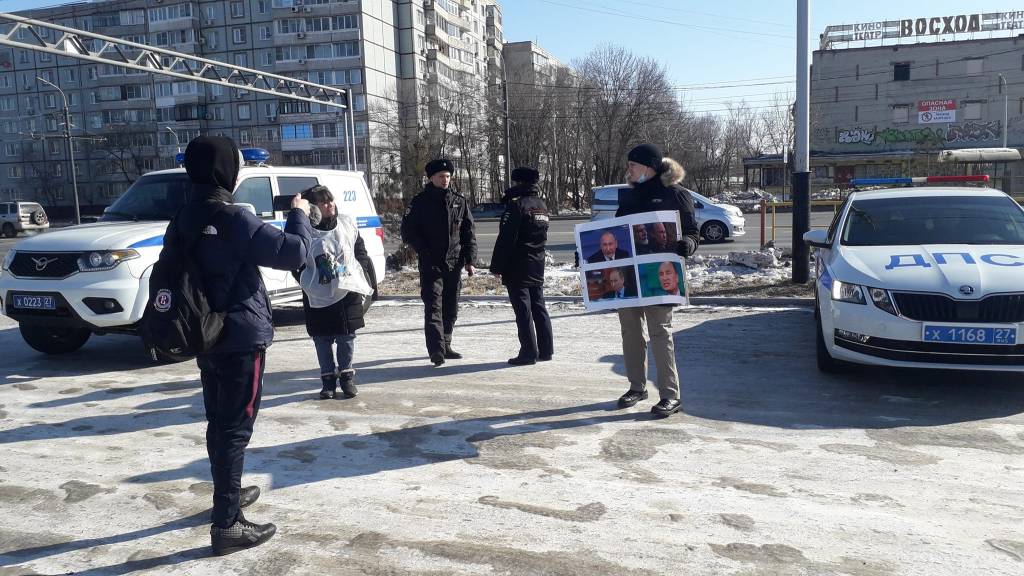
On February 23, Nikolai Zodchii was detained by police in Khabarovsk for appearing in public with these images of Vladimir Putin, which had originally appeared in broadcasts on state-run Channel One. Thanks to the indomitable VB for the snapshot and the heads-up, and for his personal fortitude in dismal circumstances. ||| TRR
When contacted by the media, the Kommunalnik health resort, located in the Omsk Region, refused to comment on reports of the death of a female Russian national during a speed pancake-eating contest.
Earlier, it was reported that a female contestant at a speed pancake-eating competition in the Omsk Region had choked to death. Currently, the exact cause of death is unknown, but the contestant’s death has been confirmed by law enforcement agencies. The 38-year-old female Russian national [rossiyanka] died before the ambulance arrived.
The celebration at which the pancake-eating competition took place was held at the Kommunalnik health resort in the Omsk Region on Saturday, February 25.
A spokesperson for the health resort refused to comment on reports of the death of the female Russian national and the absence of an ambulance team at the competition site.
In December 2022, it was reported that a 61-year-old resident of the Moscow Region had died after choking on a pancake.
Russians had been warned against overeating pancakes during Shrovetide. According to specialist Boris Mendelevich, overeating pancakes cooked with large amounts of oil is harmful to the body. In addition, heavy food can cause complications in the gastrointestinal tract.
Russia must ensure its security and maintain strategic stability.
President Vladimir Putin said this in an interview for the program “Moscow. Kremlin. Putin” on the TV channel Rossiya 1.
Source: Oleg Zubritsky, “Putin talks about the need to preserve the country and its security,” Kartoteka, 26 February 2023. Translated by TRR. Believe it or not, that was the entire article, which earned its author a well-deserved byline. See the last patch in this crazy quilt, below, for more detail about what Putin said.
Riot police officers in St. Petersburg detained 131 teenagers over a mass brawl that occurred in the Galereya shopping center, the media reports.
The publication [sic], citing police sources, indicated that the PMC Redan teenage subculture was involved in the incident.
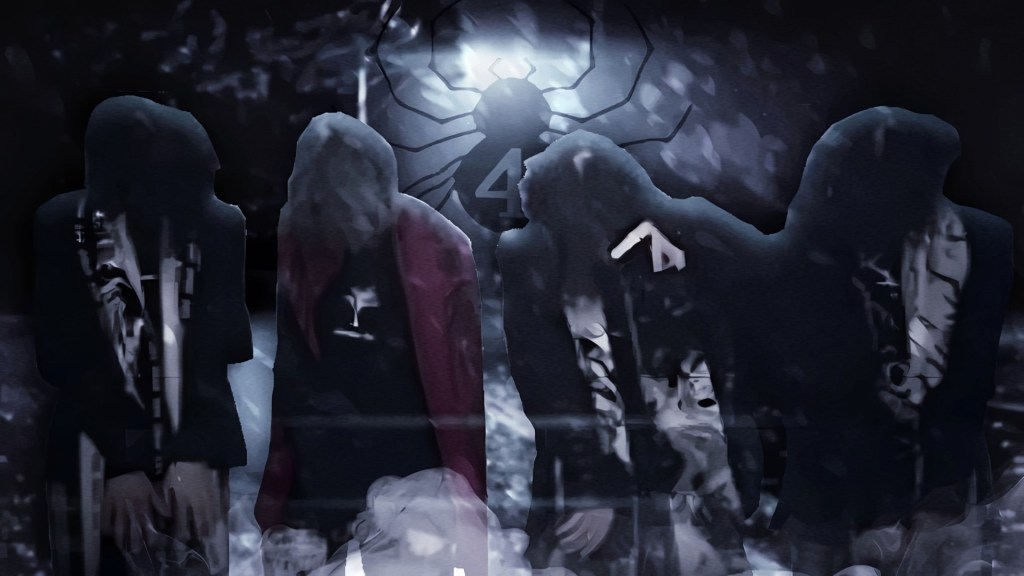
It is reported that other minors attacked a teenager in clothes embossed with a spider, which is the symbol of PMC Redan. One teenager was injured during the brawl.
Riot police arrived at the scene and detained 131 individuals. The Galereya shopping center was closed for entry, and shoppers were released only after police checked them.
Earlier, it was reported that Novosibirsk law enforcement officers had staged a dragnet to detain teenagers devotees of the PMC Redan subculture. The raid took place in the eponymous [sic] Galereya shopping center.
According to the head of the Safe Internet League, PMC Redan (as well as anime in general) is a “depressive-aggressive subculture,” and animeshniks themselves espouse violence and are willing to use it.
Such subcultures emerge, [Ekaterina] Mizulina argues, because teenagers have too much free time, as well as due to the manipulations of irresponsible bloggers and provocateurs who are encouraged by foreign states to engage in them.
In this regard, Mizulina suggests that “it is interesting to package the right meanings for children,” ideologically attack “all these spiders”, and also introduce control over social networks and the media — namely, to prohibit the coverage of “such topics.”
“No one has done more to popularize this local phenomenon than the media and social networks. […] Redan cells are growing like mushrooms after rain from Vladivostok to Kaliningrad,” Mizulina writes.
At the same time, it has been the state-run media that has written most about the activities of the so-called PMC Redan. Before them, information about teenage animeshniks strolling through shopping malls in telltale clothes appeared mainly on local community social media pages.
Source: Alexei Paramonov, “Ekaterina Mizulina urges media ban on PMC Redan,” Kartoteka, 26 February 2023. Translated by TRR. Fontanka.ru published this long, strange tirade-cum-report about the clash between riot police and teenagers at the Galereya shopping center in Petersburg (which is a stone’s throw from our house), on the one hand, and between “redans” and “ofniks,” on the other. If you donate one hundred dollars to this website, I’ll translate and publish that article here, although it left me hardly less befuddled about what happened in my old neighborhood this past weekend than before I’d read it.
The Cheryomushkinsky Court of Moscow placed house arrest on the leader of the Redan youth group
The Cheryomushkinsky Court of Moscow sent one of the leaders of the youth informal group “PMC Redan” under house arrest, reports TASS.
He is accused of attacking a teenager in the metropolitan metro – under part 2 of article 213 of the Russian Criminal Code (Hooliganism with the use of weapons or objects used as weapons), the court noted. The maximum penalty is imprisonment for up to seven years.
According to the agency, initially the investigators demanded that the accused be sent to a pre-trial detention center, but the court did not agree with this. Earlier, the Cheryomushkinsky court sent three more accomplices to the crime under house arrest.
On February 23, a teenager who was a member of the PMC Redan was beaten at the Lubyanka metro station. Teenagers wear long dark hair and spider badges on their clothes. They were inspired by the Genea Redan gang from the Hunter x Hunter manga. The symbol of this group is a spider with the number four. It is specified that young people oppose football fans, natives from the Caucasus and migrants.
Russian President Vladimir Putin has acknowledged the possibility of Russia facing a breakup in the future, with its population to be divided into separate nations, the country’s news agency TASS reported on Feb. 26.
Putin’s interview with Rossiya 1 TV channel marks the first time that the Russian dictator has publicly commented on the potential disintegration of Russia.
According to him, “if the West manages to make the Russian Federation collapse and to assume control of its fragments,” the Russian people may not survive as a nation.
“If we go down this path (of Russia’s collapse — ed.), I think that the fate of many peoples of Russia, and first of all, of course, the Russian people, may change drastically,” Putin said.
“I even doubt that such an ethnic group as the Russian people will survive as it is today, with some Muscovites, Uralian and others remaining instead.”
In addition, the Russian president claimed that “these plans are set out on paper.”
“But it’s all there, it’s all written, it’s all on a piece of paper,” Putin said.
“Well, now that their attempts to reshape the world exclusively for themselves after the collapse of the USSR have led to this situation, well, of course, we’ll have to respond to this.”
“They have one goal of liquidating the former Soviet Union and its main part, the Russian Federation. And later, [after liquidating Russia] they will probably admit us to the so-called family of civilized peoples, but only by parts, each part separately,” he said.
Ukraine’s National Security and Defense Council Secretary Oleksiy Danilov earlier said that the West has not yet made a final decision on what to do with Russia and does not understand how the full-scale war unleashed by Russia against Ukraine should end. However, the world should prepare for the collapse of Russia.
Previously, Ukrainian Defense Minister Oleksii Reznikov said that after the war is over, Russia will disintegrate into separate statelets, while Ukraine will retain its sovereignty and independence.
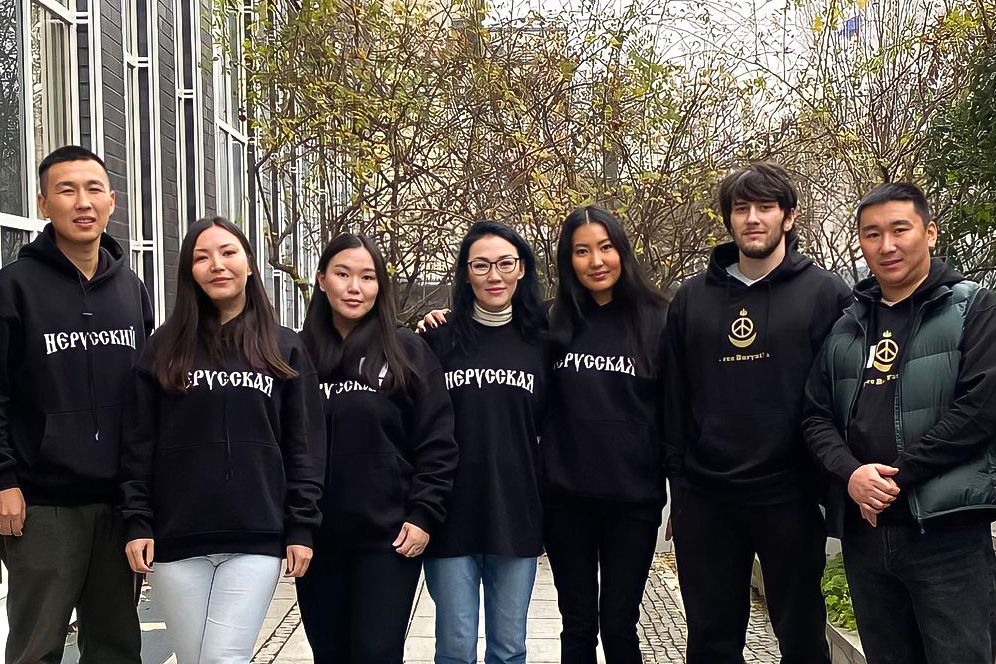
The Asians of Russia team at an anti-war congress in Berlin, most of them wearing sweatshirts identifying them as “non-Russians.” Photo: asiansofrussia (Instagram)
Pyl spoke with Asians of Russia cofounder Vasily Matenov about how the campaign has been helping people despite hounding from the Russian Interior Ministry, and why the residents of Russia’s ethnic republics are the most vulnerable to the Russian state.
How a social media page about ethnic cultures grew into a mutual aid project
Asians of Russia came into being five years ago. I am Buryat myself, and my wife is Tuvan. We lived in Novosibirsk for a while. It’s a city where there are many migrants from Central Asia, and yet the locals often have a negative attitude to this. When you say that you come from Irkutsk, they don’t understand how that could be. Five years ago, we decided to create a social media page that would promote the culture of different nations, so that people could see which nations live in Russia and what their lives are like.
Asians of Russia cofounder Vasily Matenov: “Asians of Russia Against the War.” Photo: Vasily Matenov/Pyl
At some point, our social media followers started contacting us for help. We began raising money to treat children with serious illnesses, or to pay for tours by ethnic children’s ensembles. The posts that hit home with the public were reposted thousands of times. We recruited volunteers and raised money to fight the forest fires in Yakutia. People began to trust us more and more.
We somehow got the idea to help manufacturers of local products: furniture, clothing, and jewelry. We began traveling to the regions, filmed stories about their enterprises, talked about what products they produce, and how production is organized. This went on for several months. They paid us small amounts of money, and so we earned a little. But we didn’t have any funding or grants at all.
An anti-war rally outside the Russian embassy in the Mongolian capital, as reported on Asians of Russia’s Instagram page
How Asians of Russia helped its followers after the war’s outbreak
On February 24, I immediately started posting photos from the war, images of soldiers and prisoners, on our Instagram page. At first, users wrote that none of it was true. Then people from the regions began to recognize their relatives among the soldiers. A panic arose.
Lawmakers and officials wrote to us and threatened us. Then the law on “fake news” about the military was passed. One follower telephoned us and said that an acquaintance of his at the Interior Ministry’s Department K (which deals with information technology) had told him that they were very interested in us.
After some time, unknown people started knocking on our door. We didn’t open it: we pretended that no one was home. This went on for three days. On the third day, we exited the apartment late at night and left the country. The Zimin Foundation offered us help in getting out of Russia and a little financial support. My wife and I now live in Poland.
We do crowdfunding campaigns as needed. We raised money to pay the fines people had to pay for making anti-war statements and going to anti-war rallies. These fundraisers raised the amounts of money needed in a matter of minutes.
When the mobilization began, we raised money for buses so that people could leave for Kazakhstan or Mongolia. We were able to evacuate a lot of people in concert with other organizations: we joined forces with with both ethnic movements and the Feminist Anti-War Resistance. Together, we looked for taxi drivers or private carriers who would take people to the border.
We also hired lawyers to help contract soldiers legally refuse to do military service, and we helped conscientious objectors and those whose requests to be dismissed from military service were not approved. Over the past year, we have raised fourteen thousand dollars to pay lawyers and get people out of Russia.
Hello dear ones! You can publish my letter, because a lot of people look at your page and the problem I want to write about is very dire for all of us right now!
We live in a small village, and my husband and I have two underage children. My husband and I were orphans, so we live in a private house that we received from the state. I will not describe what terrible quality these houses are: I hope everyone knows and understands this.
During the mobilization, they tried to take my husband to fight. They were not stopped even by the fact that he has a group-three disability.
After consulting with friends, we decided that it would be better for him to go to Kazakhstan than to go to kill and most likely get killed. Our children love Dad very much, they just wouldn’t survive it. We’d rather he be alive far away than dead in the neighborhood cemetery.
He and a friend quickly packed and left for Kazakhstan. Our little ones call him every evening by video link. Everything has gone well for them in Kazakhstan. They found a job that provides them with a room in a hostel, for which I am very grateful to the Kazakhs!
Our small household has now fallen entirely on my shoulders. We have chickens and a cow, which is about to bear offspring. The house is heated by a stove. We burn coal, which costs about three thousand rubles per ton with delivery. There is no water in the house: we have to go to the nearest water pump for water.
I take the children to school myself, because I’m afraid of dogs. We have had several cases of dogs attacking children, it is very scary. The temperature here is now minus thirty degrees. It was minus forty the previous two weeks.
Don’t get me wrong. We are not in the habit of complaining. We were taught that one must endure no matter how hard life is. But if you think about it, do we deserve such a life?
The children and I like to watch travel shows on YouTube and see how people in other countries live. Watching such programs, you begin to realize that we too could have better lives.
I look at the children and imagine what awaits them, what the future will be like, and I cry at night. 😭 I want to give up everything and leave, but where can I go with two small children and with no money? It’s very scary.
I want to appeal to all those who have not yet lost their minds: may you have strength and patience. Take care of yourselves.
How the authorities have been trying to divide the ethnic community
We have always tried to produce high-quality content, to shoot high-quality videos. So, we initially attracted a very high-quality audience: there were almost no supporters of the war among them. The average age of our audience is between twenty-five and forty-five, and it has been growing even since Instagram was blocked in Russia.
There were bot attacks on our public page. At the same time, there was an influx of followers who would disappear after a couple of hours. They could write racist comments, about which they themselves might file complaints so that our public page would be blocked, or so that it would be subject to a shadow ban and would not show up in the feed.
I know people who are mixed up in such things. First, they organize bot attacks, and then they become aides to lawmakers.
The purpose of these bots is not just to block our profile, but to divide society so that there is no consensus on any issue. You can write any old nonsense. One of our followers admitted that he had worked in such a troll factory. They were told that they could even write that they opposed the authorities. What mattered was that they avoided coming to a unified stance in the comments.
Why Russia’s ethnic regions are the most vulnerable
The authorities understand that if there were a unity of opinion and a common cause in the ethnic regions, everything could flare up like a match. Therefore, propaganda is stronger here: there is not a single independent media outlet. We were in Georgia, and the Georgians said that god forbid the authorities would do something that the people did not like: everyone would immediately go to the parliament to protest. This happens because there is a national cause in Georgia.
There are very close family and friendship ties in the ethnic republics. It is customary in our part of the world to be in touch with fourth cousins and go visit them . It is vital for us to stand up for each other. The authorities have been doing everything possible to destroy this unity in the regions.
That is why all discontent and all protest in Russia is nipped in the bud. For example, when Dmitry Trapeznikov, who had been among the leaders of the “Donetsk People’s Republic,” was appointed acting mayor of Elista, the capital of Kalmykia, the whole region rose up to oppose him. The residents of Elista packed the city’s main square every day for a month. Consequently, Russian National Guardsmen from Moscow were brought to Kalmykia to break up the protest, and then all the protest leaders were put on trial. Since then, people in other regions have simply been afraid to take to the streets in protest.
The residents of the Russia’s ethnic republics are the most vulnerable part of the country’s population. They don’t know their rights well. There is no internet in the villages, and people speak Russian poorly. If the authorities go to the villages to mobilize young men for the war, how can they protect themselves? So, we must develop democracy in Russia, starting with the regions.
I’m not a politician or a political scientist. I don’t know exactly how to restructure Russia after Ukraine’s victory, or whether the ethnic republics will secede and how to do that. But I do know that, without independence, nations perish. For example, there are fewer than ten thousand Shors left in Russia, although they are an ethnic group that has existed for two thousand years, since before there were ethnic Russians.
If Russia wins the war, it will only get worse. We must not just turn out for rallies for a free Russia. We must make sure that Ukraine wins. Only then can we take up the vital task of preserving the independence of the nations living now as part of Russia.
Source: “Asians of Russia: ‘Without independence, nations perish,'”Pyl, 13 February 2023. Thanks to Maria Kol’tsova for the interview and the heads-up. Translated by the Russian Reader. I edited the sentence about Dmitry Trapeznikov so that it better reflected the facts of the conflict.
Valeria Zotova is a new prisoner of Putin’s regime
19-year-old Valeria Zotova was detained in the wee hours of February 17. She is accused of planning to set fire to a warehouse from which supplies are sent to military personnel involved in the war against Ukraine. According to the security forces, the young woman has been charged with committing a “terrorist act” (per Article 205 of the Russian Federal Criminal Code).
You can support Valeria Zotova right now by writing her a letter!
Address for letters:
Zotova Valeria Igorevna (born 2003) 53 ul. Portovaya nab., SIZO-1 Yaroslavl 150001 Russian Federation
(It is possible to send letters via the electronic services FSIN-Pismo and Zonatelecom.)
Source: Solidarity Zone (Facebook), 21 February 2023. Translated by the Russian Reader. Thanks to Sergey Ogurtsov for the heads-up.People living outside Russia will find it difficult or impossible to use the FSIN-Pismo and Zonatelecom services. In many cases, however, you can send letters (which must be written in Russian or translated into Russian) via the free, volunteer-run service RosUznik. As of this writing, however, Ms. Zotova has not appeared on their list of supported addressees. You can also ask me (avvakum@pm.me) for assistance and advice in sending letters to Russian political prisoners.
The Yaroslavl District Court has remanded in custody 19-year-old Valeria Zotova, accused of attempted terrorism (per Article 30.3 and Article 205.1 of the Russian Federal Criminal Code), reports TASS, citing the press service of the Yaroslavl Regional Court.
A day earlier, Zotova’s mother told OVD Info that her daughter had left the house on the evening of February 16, saying that she was going for a walk with friends, but did not return home. At about one o’clock in the morning, security forces came to search the Zotov home. The officers did not identify themselves and did not state the grounds for their investigation.
The young woman was taken to Yaroslavl’s Pretrial Detention Center No. 1. On February 20, a Telegram channel linked to the local security forces posted a video of Zotova’s arrest. The report said that she had been charged with terrorism (per Article 205.1 of the Criminal Code). If convicted on this charge, she could face between ten and fifteen years in prison.
Following the footage of the detention, a “confession” appears on the video: Valeria Zotova says that she transmitted information, coordinates and photos of a building for a monetary reward. According to her, [the people who paid her the money] “wanted to set fire to this building,” in which “parcels for the mobilized are collected and sent to Donbas.”
Svetlana Zotova said that in October of last year she herself had been fined for “discrediting” the army (per Article 20.3.3 of the Administrative Offenses Code) over a “No war” message, graffitied on a local kiosk. During the search, the security forces threatened to make her a suspect in her daughter’s case, claiming that she had been involved in anti-war rallies. The woman stated that she was not involved in anti-war protests, despite her views. Before the invasion of Ukraine, she had picketed in support of politician Alexei Navalny and the Khabarovsk protesters.
The Golendras (Olendry, Holendry) of Siberia are a unique people. They originate from Germany or even Holland, to which their name alludes. In former times they lived in Poland, eventually ending up in the western part of the Russian Empire — approximately where the borders of Poland, Belarus and Ukraine now meet, near the Western Bug River.
The Golendras are Lutherans by religion, their prayer book is in Polish and they have German surnames. They adopted a mixture of Polish, Ukrainian and Belarusian as their language. Their songs are sung in this dialect. During the Stolypin agrarian reforms, a part of the Golendras moved to the Irkutsk Region in Siberia, where they founded settlements — Zamusteche (Zamóstecze, whose modern name is Pikhtinsky), Novyny (Nowyny, whose modern name is Srednepikhtinsky) and Dagnik (its name has not changed).
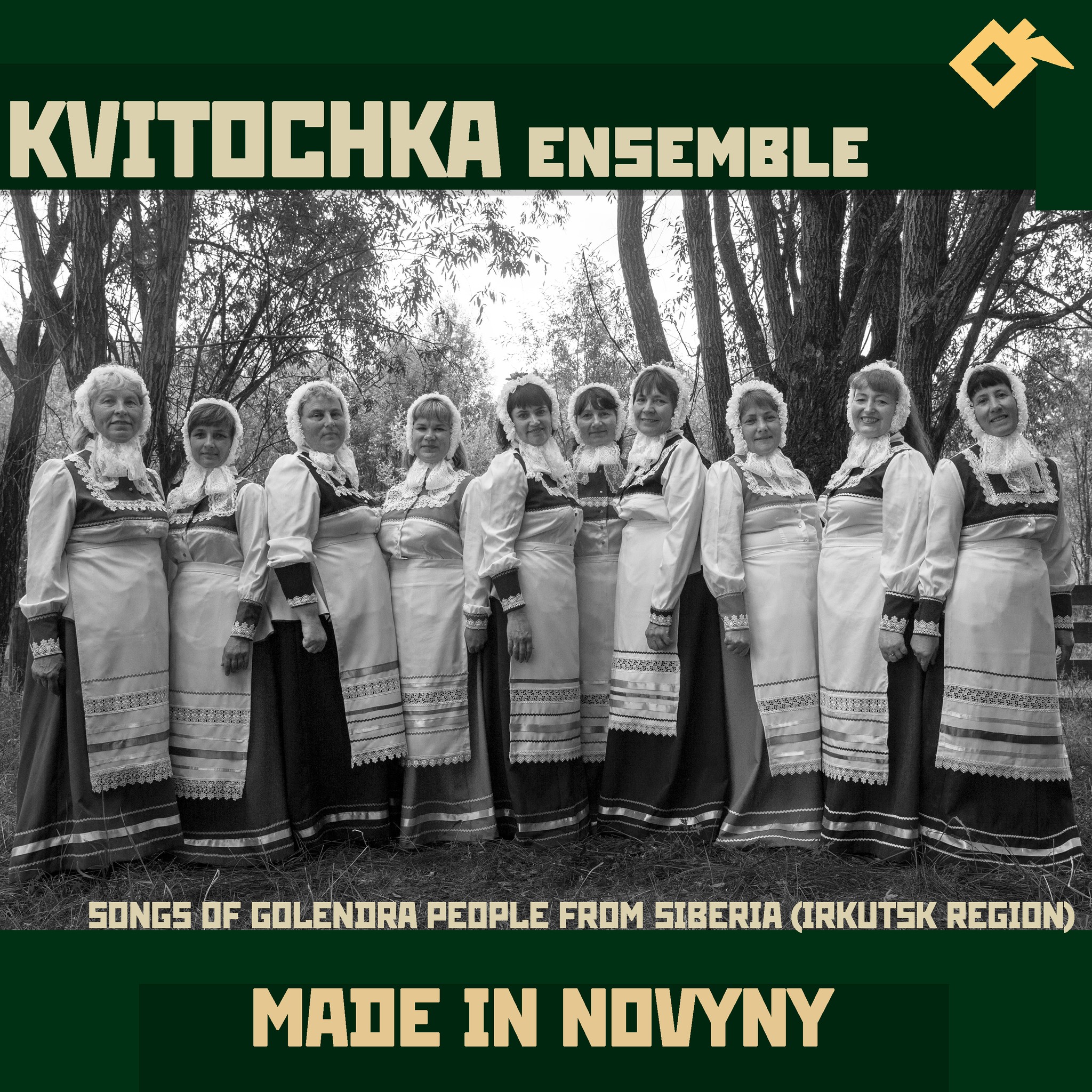
Kvitochka (Kwitoczka, “Little Flower”) Ensemble emerged in 2005 at the Srednepikhtinsky House of Culture. It has the status of a family band, since all the participants are relatives to various degrees.
The ensemble members (on the album cover photo from left to right):
1. Nina Kunz
2. Valentina Zelent
3. Irina Prokopyeva
4. Larisa Bendik
5. Svetlana Ludwig
6. Olga Kunz
7. Elena Vas. Ludwig
8. Vera Kunz
9. Elena Vlad. Ludwig (leader)
10. Natalya Ludwig
The original song titles are given in their Polish spelling.
The names of the older generation people, thanks to whom these songs have been preserved: Emma Pastrik, Anelia Gildebrant, Alvina Zelent, Natalya Kunz, Zuzanna Ludwig, Elizaveta Gildebrant, Adolf Kunz, Alvina Kunz, Bronislava Ludwig, Ivan Zelent.
Recorded at the Srednepikhtinsky House of Culture on July 7, 2022, except for tracks 1 and 26, which were recorded in Dagnik on July 8, 2022, and performed by Anatoly Ludwig.
Thanks to Elena Ludwig, the whole ensemble, Lyudmila Gerda, Natalya Dmitrieva, Lyubov Vasilchenko, and Iwan Strutynski.
Source: Antonovka Records (Facebook), 17 February 2023. I have lightly edited the original liner notes for clarity and readability. ||| TRR
THE BAIKAL DUTCH: WHO ARE THEY?
A people called the Golendry (translated presumably as “Hollanders,” “Dutch”) has been living in the remote Siberian taiga for more than a century. The people speaks a mix of Belarusian and Ukrainian, prays in Polish, and has German surnames. They live in the Zalari District of Irkutsk Region and are a true cultural phenomenon. Key to Baikal will tell you what kind of people they are and how they got here.
The History of the Golendry
Several dozen families of Golendry moved to Siberia from the Bug River basin at the beginning of the 20th century, during Stolypin’s agrarian reforms. Back then, the place of the people’s residence was a part of the Russian Empire, but now the territory encompasses the borderlands of Belarus, Ukraine and Poland. There are two explanations of the origins of the word golendry. This term emerged in the early seventeenth century: the Dutch identified themselves in similar fashion (hollandi in Latin). The other explanation is based on the word gautland, meaning a developed land (paseka in Polish), a settlement on deforested land, established by colonists who were called golendry (that is, “stumpers” or “woodcutters,” not “Dutch”). The researcher Eduard Byutov came up with a serious argument against the second explanation, saying that these people were the members of a Dutch community living under “Dutch law” and observing Dutch culture. Byutov emphasized the fact that, in medieval Poland, the social stratum of peasants were called golendry (olendry), and the settlers possessed a special social and legal status. Thus, the term olendry is derived from a lexeme with the same meaning as the ethnonym for “Dutch” in Polish. It was used to designate a special social group of mixed ethnic composition.
Perhaps the truth is somewhere in the middle, because the term golendry never served to designate any particular ethnic group. From the very beginning it meant a special social group of mixed ethnic composition. Nevertheless, the ethnic composition of this social group evidently included the Dutch, because many of their cultural elements point tto this.
By the beginning of the twentieth century the Golendry had retained their distinctive identity, which differed from neighboring peoples: despite the fact that they spoke local dialects, their religion was different from the surrounding population. They were Lutherans, unlike the Catholic Poles and the Orthodox Belarusians and Ukrainians.
A part of the Golendry migrated to Siberia, primarily due to the lack of land. The settlers gave old names to their new places of residence: Zamusteche, Novyna and Dakhny, in memory of those times when they lived on the Bug. The villages were renamed in Soviet times (now they are known as Pikhtinsk, Srednepikhtinsk and Dagnik).
It is curious that no one was particularly interested in the Pikhtinsk Golendry before the early 1990s. Only in the 1930s and during the Great Patriotic War did their obviously German names and surnames attract the attention of state authorities, which led to certain consequences. Luckily, however, the Golendry were not deported (because they already lived in the taiga) and were not shot. During peacetime, the Golendry were little different from other Soviet people, except that the two Pikhtinsk collective farms consistently produced high yields, year after year. In the 1970s they were doing so well that former residents of Pikhtinsk returned to their native villages from the cities: they built a branch of a clothing factory, a bakery, and a post office there. There were three large elementary schools for the three villages, a rural medical station, shops, and a kindergarten. After perestroika, their prosperity came to an end, however, and the residents of Pikhtinsk once again moved back to the cities. Nowadays, the number of people registered in the villages is larger than that of people actually living there, and the number of inhabitants of these settlements decreases every year.
“The Home of the Golender Gimborg, 1912”
Emptying villages are a widespread phenomenon in Russia, with only one difference: the Golendry are famous now; they will not disappear into obscurity. By the way, the Golendry were “discovered” by scholars by pure accident, thanks to their houses. In 1993-1994, the Irkutsk Central Commission for the Preservation of Historical and Cultural Heritage visited these remote taiga villages and paid due attention to the unconventional architecture of the buildings in Pikhtinsk, Srednepikhtinsk and Dagnik. The architecture entailed an exploration of the rest of their culture, and the Golendry were declared a “sensation.”
Customs and traditions
Two museums were established in Srednepikhtinsk: these let people have a look inside a real Golendry house without disturbing their personal space. According to the Lutheran faith of the Golendry, they worship in Polish using the Bible and prayer books. The old people are more religious, while the young people are less so: the situation is common today. So, the holy books in Polish, exhibited in the museums, are now read only by old people, and even not all of those old people can read them. It is curious that the Golendry use the Julian calendar, just like Orthodox people.
The Lutheran Golendry do not have a tradition of regularly visiting cemeteries and taking care of graves. However, the Russian traditions have gradually come to predominate: elaborate headstones have been erected on some graves of the Pikhtinsk Golendry, and the relatives of the deceased can sometimes be seen at the cemetery. Nevertheless, you should not go to the cemetery of the Golendry out of idle curiosity: the residents of Pikhtinsk hate it when someone disturbs the peace of the dead.
The Lutheran Golendry never had any churches of their own in Siberia. They prayed at home in the old days, and still do so now. There is a Lutheran prayer hall in Irkutsk, and the local pastor periodically visits the residents of Pikhtinsk. However, the main rite — baptism — is conducted not by a pastor, but by a local resident. The residents of Pikhtinsk themselves find it difficult to answer why they chose that person exactly. Most likely, because he is a pious man and is respected by everyone. In addition, waiting for the pastor to come or taking the babies to Irkutsk is simply inconvenient.
The museums illustrate the wedding ceremony in great detail: The Golendry still celebrate their weddings in keeping with the old traditions. A cap, the most memorable detail of the local women’s attire, is also associated with the wedding. Women wear a cap instead of a veil on the second day of marriage. There is also a tradition of burying women with their cap on. During the rest of the time the capes are no longer worn, except that they can be worn for tourists.
If you want to get acquainted with the life and traditions of the Golendry, you will have to drive almost 300 kilometers from Irkutsk, or take a train to Zalari Station and then travel the remaining 93 kilometers to Srednepikhtinsk. After this people was “discovered,” it became much easier to get to the places where it resides, but one should book a tour and overnight stay in advance.
Source: Key to Baikal. I have edited the original article for clarity and readability. ||| TRR
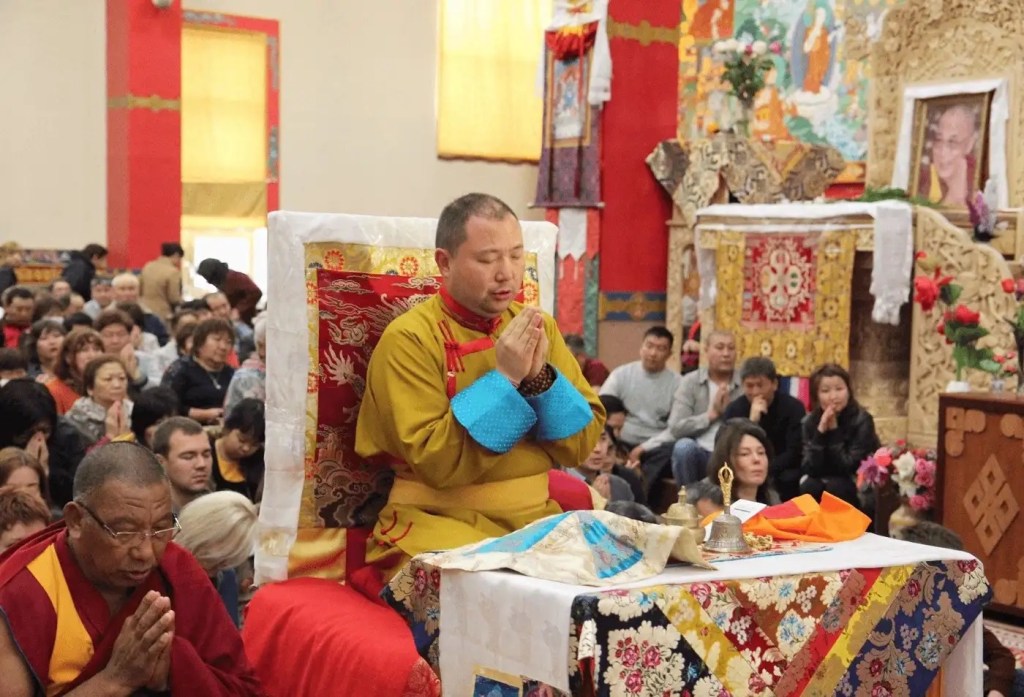
Telo Tulku Rinpoche, the now-former Supreme Lama of Kalmykia
On Friday, January 27, 2023, the Russian Justice Ministry placed Telo Tulku Rinpoche (Erdni-Basan Ombadykov) on its registry of “foreign agents.” Rinpoche is еру president of the Association of Buddhists of Kalmykia and the 14th Dalai Lama’s official representative in Russia, Mongolia and the CIS countries. The ministry’s press service said that the Buddhist leader had been placed on the list because he had “spoken out against the special military operation in Ukraine and openly spoken in support of Ukraine,” and also because he “is a US citizen and lives outside the Russian Federation.”
In addition to Rinpoche, the list of newly minted “foreign agents” that day included Little Big soloist Ilya Prusikin, journalist Fidel Agumava, Free Idel-Ural Movement co-founder Rafis Kashapov, and Feminist Anti-War Resistance coordinator Darja Serenko.
The following day, January 28, Telo Tulku Rinpoche announced that he had resigned his post as the Supreme Lama of Kalmykia.
“In the last two days, many people have expressed concern and sympathy over my inclusion in the registry of foreign agents. I am sincerely grateful to them for their involvement in and appreciation of my work. In these difficult times, I would like the people of Kalmykia and all followers of Buddhism to maintain courage, steadfastness and commitment to the ideals of compassion, love and nonviolence that form the basis of the Teaching of the Buddha that we profess. […] In my thoughts, deeds and prayers, I remain entirely with the Kalmyk people and Buddhists all over Russia, to whose service I have devoted my life,” the monk said.
Who Is Telo Tulku Rinpoche?
Telo Tulku Rinpoche (Erdni-Basan Ombadykov) was born in the United States in 1972 to a family of Kalmyk immigrants, according to the lama’s biography on the Kalmykian Buddhist community’s website.
In 1991, Rinpoche visited Kalmykia for the first time as part of a delegation led by the 14th Dalai Lama. Shortly after the visit, which the website refers to as “the starting point for the restoration of Buddhism in the republic,” Rinpoche was chosen as the supreme lama of the region, the Shajin Lama.
“While serving as the Shajin Lama, Telo Tulku Rinpoche has made great efforts to strengthen the religious and cultural ties that have existed for centuries between the traditionally Buddhist regions of Russia and the Tibetan community, led by His Holiness the 14th Dalai Lama XIV,” the website notes.
Another highlight of Rinpoche’s tenure as the Shajin Lama has been, according to the website, “comprehensive support for peaceful coexistence and cooperation among members of Kalmykia’s traditional confessions — Buddhism, Christianity and Islam.” In addition, under the lama’s leadership, more than thirty temples and prayer houses were erected in Kalmykia.
Rinpoche is a US citizen. He was applying for Russian citizenship, and was scheduled for an interview on February 24, 2022, but it was canceled due to the beginning of Russia’s invasion of Ukraine.
Russian Buddhists and the War
In an interview posted on the YouTube channel Alchemy of Soul on September 30, 2022, Rinpoche openly opposed the “special operation.”
“I think it’s wrong,” he said. “This war is needless. […] I think that the Ukrainian side is in the right. It is defending its country, its land, its rights, its Constitution, its people.”
The lama explained that he had not spoken out against the war earlier because he had been worried about the safety of Buddhists in Russia and their families.
“I didn’t want to spoil the relationship between the authorities and our Buddhists. I didn’t say anything, but nevertheless, every morning I always prayed for everyone, both Buddhists and non-Buddhists,” Rinpoche explained.
The monk said that he had left Kalmykia and was in Mongolia, where he was helping Russians fleeing the military mobilization. Rinpoche was negotiating an extension of the visa-free regime for Russian nationals and helping with their accommodation and the purchase of sleeping bags.
“American born Telo Tulku Rinpoche is a Buddhist leader in Russia. In this video Anzhela and Rinpoche discuss Buddhism’s philosophy on war, Russian mobilization of citizens to support the invasion of Ukraine, and steps Russian men are taking to avoid mobilization.” (In Russian, with English subtitles)
However, not all Buddhists share Rinpoche’s opinion about the “special operation.” Damba (Vasily) Ayusheev, head of the Buddhist Traditional Sangha of Russia, explained that the lama’s anti-war stance had to do with the fact that he is a US national.
Ayusheev himself voiced his own support for the war in Ukraine on February 28.
“We live in a single Russian state and defend the interests of our country, against which a dirty information war is being waged. […] We must have a strong and reliable home front. Our sahyusan [dharmapala] are on our side, our Great Khambo Lamas are on our side, and Buddha is on our side,” Ayusheev said on Buryad FM Radio on February 28, according to Infpol.
“It is a sacred duty. We Buddhists must defend our homeland. […] In our system, in Buddhism, the man must defend [the homeland, and] if necessary, go to war, be victorious, and return to his family, to his homeland,” Ayusheev said on September 30 in a conversation with Izvestia. The Buddhist added that he was proud of his co-religionists’ involvement in the war, and called the annexation of the Ukrainian regions to Russia a “historic moment” and a “great event.”
Jampa Donied (Buda Badmayev), the deputy head of the Buddhist Traditional Sangha for Russia’s Northwestern Federal District, also argues that Buddhists are involved in the “special operation” to defend their spiritual values.
On March 16, 2022, an “initiative group of Buddhists and sympathizers of Buddhism” published an open letter in support of [the Russian government’s] military actions in Ukraine on a VK group page.
“Buddhism — which is undoubtedly a peaceful doctrine — teaches us to calm the mind, maintain internal balance and find peace in all worlds. But Buddhism is not a doctrine of non-resistance to evil, if evil is ready to destroy everything its midst. […] In response to evil, we must not trigger negative emotions of anger and malice in ourselves, but we should be able to resist aggressive attacks from external forces in a calm state of mind. We must defend ourselves without letting evil into our hearts.”
The activists called upon people to sign the letter to “express solidarity with the President of Russia’s decision to pacify Ukraine, making it possible to establish peaceful and neighborly relations with this country.”
As of March 26, 2022, forty-two people from different regions of Russia had signed the letter. Three more people have signed it since then.
According to Alchemy of Soul presenter Anzhela Kalsynova, Rinpoche is the only [Russian] Buddhist leader who has publicly condemned Russia’s invasion of Ukraine. And yet, the lama himself suggests that his co-religionists do not support the war, but are not openly opposing it due to concerns for their own safety.
The law on “foreign agents” in Russia is discriminatory and is used to combat those who have fallen out of favor with the authorities. All “foreign agents” are required to report their activities, income and expenses to the Russia Justice Ministry. They are restricted in their ability to disseminate information and find sources of funding. They face increased official oversight and lose their working partnerships. Like Rinpoche, they are deprived of the opportunity to continue their life’s work.


 Ruslan Zinin transferred to solitary confinement

 Address for letters and parcels to Ruslan:
 You can send letters electronically from anywhere in the world via the


 Ruslan Zinin charged with terrorism
 As before, you can support Ruslan by sending him a letter or parcel. If your letters are not passed by the censor or you do not receive a reply from Ruslan, let us know and file a complaint. Templates for complaints can be found on