Conservative

DSCN1711

It is almost as funny to read that Putin and his fellow gangsters in the Ozero Dacha Co-op and its subsidiaries are “conservative” as it is to read that Putin is utterly powerless (“impotent”!) to reign in his underlings or do much of anything else.

Even in the frightening, undignified mess in which Russia now finds itself, people want to make more of the mess than saying that, when push comes to shove, it is a vast criminal conspiracy that can only be laid low by an equally vast popular resistance, if only because that might commit them to do something about it.

It sounds much more dignified to say the county’s elites, including two “former KGB officers,” President Putin and Patriarch Kirill, who were trained to lie through their teeth, gull the gullible every chance they got, and pretend to be “communists” and “internationalists” and “democrats” and “conservatives” and “Russian Orthodox” and “nationalists” as the situation demanded, have taken a “conservative turn,” than to say the country has been taken over by a band of greedy, unprincipled liars who will not balk at any trick or power play to increase their dominion and grab more money, land, oil companies, yachts, real estate, and other goodies.

It is the same thing with my favorite bugbear, Russia’s completely nonexistent “senate.” Russia’s upper house of parliament is called the Federation Council, and its members are sinecured rubber stampers, not “senators,” but that was what they took to calling themselves (or a spin doctor like Vladislav Surkov told them they should call themselves) a few years ago, and so nowadays almost everyone, including the entire domestic and foreign press corps, part of the leftist commentariat, and even some perfectly sensible, educated people call them that, too.

But they are not senators, if only because there is no senate in Russia. More to the point, Russia’s unsenators are well-connected, highly paid sock puppets who could no more act independently than I could fly to the moon under my own power.

Likewise, a perpetual, self-replicating mafia dictatorship has about as much to do with real conservatism as my dog has to do with the Shining Path. And that is the thing. Given its sovereign wastefulness, major league legal anarchy, hypercorruption, and sheer absurdity, the Putin regime is an exercise, mostly improvised, in a new kind of radical governance by “former KGB officers” and their gangster friends, not in conservatism.

The “conservatism” is a put-on, just as Putin’s public support of democracy was a put-on when he worked as Petersburg Mayor Anatoly Sobchak’s deputy in the early 1990s. Then he was the Smolny’s bag man. Nowadays, he has moved up in the world considerably, but he has basically not changed his profession. TRR

Photo by the Russian Reader

There Are No Condoms in Russia

360521

Developing a Moral Immunity to HIV
The Education and Science Ministry doesn’t want young people to talk about condoms
Anna Makeyeva and Valeriya Mishina
Kommersant
November 3, 2017

As Kommersant has learned, a scandal has erupted in the Education and Science Ministry over an online HIV prevention lesson for high school and university students. The people responsible for the internet project have refused to fulfill demands by officials to vet answers to users’ questions in advance, as well as their recommendations to “talk about morality in order to get away from slippery topics” and avoid such words as “condom.” It is still unclear how the lesson, scheduled for December 1, will be taught.

The Nationwide Internet HIV Prevention Lesson, timed to coincide with World AIDS Day on December 1, has been held by order of the Education and Science Ministry since 2015. On the eve of the lesson in 2016, Education and Science Minister Olga Vasilyeva noted that the issue of countering the spread of the HIV infection among children and adolescents, given the complicated epidemiological circumstances, had long been a focus of the Education and Science Ministry, and occupied a vital place in a set of measures for preserving and strengthening the health of children and young people.

“The use of such innovative methods as open internet lessons at preventive events in educational institutions will help us cope more effectively with the existing problem,” Izvestia quoted the ministry’s stated position in 2015.

On November 2, a working meeting in preparation for the upcoming internet lesson was chaired by Larisa Falkovskaya, deputy director of the department for state policy on children’s rights at the Education and Science Ministry.

“For the first time in my life, a meeting at the Education and Science Ministry ended in scandal because of my fault. I refused to write the answers for those taking part in the online HIV prevention lesson,” said Sergei Bulanov, who is in charge of organizing the online lesson and heads the Center for Modern Education Technologies, a group of non-profit organizations engaged in educational and related projects.

According to Bulanov, the officials at the meeting deemed use of the word “condom” “unacceptable,” and consequently the meeting was adjourned.

Project organizers suggested to officials they give up the practice of using prepared answers in the video lesson and discuss issues of prevention in a playful way, for example, by arranging a rap battle between student teams from two regions.

“But we were told to talk about morality in order to get away from slippery topics,” complained Bulanov, adding, “The topic is ratherly widely represented in the school curriculum, but currently the Education Ministry has adopted a surprising stance, based on substituting HIV prevention, which is mostly a matter of personal hygiene, with lessons in moral values.”

Besides, Bulanov argues it is incorrect to equate the risk of infection only with antisocial behavior.

“Thirty percent of HIV-infected women were infected by the only sexual partner they ever had. Can we reproach them for antisocial behavior? HIV-positive teenagers who have been infected from birth did not lead an antisocial lifestyle.”

Vadim Pokrovsky, head of the Federal AIDS Center, argues the view it is better not talk to children about sex currently prevails in Russia.

“It is one of the reasons HIV has spread so widely in Russia,” he said.

According to Pokrovsky, twenty percent of young women are already having sex by the age of fifteen. He added that in Germany, for example, sex education is an obligatory subject in schools. Last year, only 3,500 cases of infection were registered there, while over 100,000 cases of infection were registered in the Russian Federation.

“We see two fundamentally [different] approaches and two different outcomes,” Pokrovsky concluded.

The Education and Science Ministry declined to comment on the situation when approached by Kommersant. The Russian Federal Health Ministry learned about the conflict from Kommersant. The ministry said the online HIV prevention lesson was an undertaking of the Education and Science Ministry.

“They did not come to us with this or consult with us,” our sources at the Health Ministry said.

Sergei Bulanov assured Kommersant preparations for the open HIV prevention lesson for young people would be continued.

“We will keep on working, focusing more on recommendations from specialists at the Health Ministry and Rospotrebnadzor [the Russian federal consumer watchdog] than on the client [i.e., the Education and Science Ministry].

The internet lesson will take place on December 1, 2017.

Translated by the Russian Reader. Photo courtesy of Pravda.ru

Kremlinsplaining and Its Discontents

755094446431775

Vladimir Putin Explains How to Debate the 1917 Revolution
Delovoi Peterburg
November 3, 2017

Discussion of the 1917 Revolution should be based on facts and documents, President Vladimir Putin emphasized in his greeting to participants of international events occasioned by the Russian Revolution’s centenary.

“The turbulent, dramatic events of 1917 are an inalienable, complicated part of our history. The revolution had a tremendous impact on the evolution of Russia and the world, and it largely defined the political, economic, and social picture of the twentieth centure,” noted the president, as quoted by TASS.

The president also said the interest of public figures, scholars, and the media in a deep and comprehensive interpretation of the era was legitimate.

“Yet I am convinced that even the most heated polemics must be based on facts and docoments, on an objective and respectful attitude to the past. I hope that your meetings, which shall bring together people from many countries, will contribute to this constructive discussion,” Putin said.

Earlier, Rossotrudnichestvo (Russian Federal Agency for the Commonwealth of Independent States, Compatriots Living Abroad and International Humanitarian Cooperation) reported it would be holding various events commemorating the centenary of the October Revolution at Russian Culture Houses in over eighty countries.

“Russian Culture Houses in more than 80 countries [will] host exhibitions, science conferences [sic] and seminars, which aim on delivering an objective approach to historical events to foreign audience,” the agency said.

__________________________

Attack of the Bio Samples
How Conspiracy Theories Flourish
Vladimir Ruvinsky
Vedomosti
October 31, 2017

Vladimir Putin’s story about the collecting of “bio samples” in Russia by persons unknown for unknown purposes has stirred up Russians. It is a telltale case of a double distortion and an example of society’s sensitivity to conspiracy theories, which flourish in an impoverished informational environment.

The president made his remarks at a meeting of the Human Rights Council. They were seemingly spontaneous. Council member Igor Borisov had complained to the president that, according to his information, certain people were using video surveillance systems in Russia to gather images of Russians for unknown purposes. That was nothing, responded Putin. Bio samples from different ethnic groups and regions were also being “deliberately and professionally” collected nationwide. The question was why.

The story took on even more dramatic overtones when the president’s press secretary tried to explain it.

According to Dmitry Peskov, “Certain emissaries conduct such work: employees of nongovernmental organizations and other entities.”

The Russian secret services had reported them to the president, Peskov claimed.

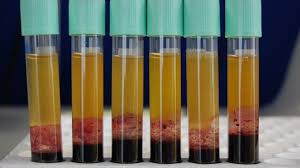
But you did not need the secret services to tell you this. The notion of “bio samples” is broad, including, for example, blood tests, which have been done in Russia for approximately 150 years, and performed by Russians and foreigners alike. Obviously, Putin had in mind genetic samples. Methods for rapidly deciphering DNA sequences were discovered in 1977. DNA became a research subject at approximately the same time in the Soviet Union, and nowadays genetic research is carried out worldwide. Genes and genetics are global phenomena, and the DNA of all human beings is 99% identical.

There are two main areas of research. Medical genetics, in which individual samples from sick and healthy people are studied to determine, in particular, predispositions to certain diseases, and population genetics, which studies samples from different ethnic groups in order to reconstruct the history of peoples [sic], notes biologist Mikhail Gelfand. Research objectives can overlap. Apparently, Putin had population genetics in mind, but data has long been collected in Russia for both medical genetic and population genetic research. This work has been done by pharmaceutical companies (as part of clinical trials), medical centers (as part of genetic counseling), and researchers (as part of their search for the genes that trigger diseases).

Russia has been actively involved in international genome projects. In 2015, the results of a multi-year study of the gene pool of Slavic and Baltic peoples were published. The study was done by Russian and international geneticists, and one question they explored was who the Slavs were. In the same year, the Genome Russian Project, supported by Putin, was launched. Its aim is to create an open-accesss database containing anonymous genetic information about 3,000 men and women, the indigenous people of Russia’s various regions. The project has been coordinated by an American, Stephen O’Brien. There have been no reports the secret service has any gripes with the project.

Perhaps it is a commercial conflict. Valery Ilyinsky, director of the company Genotek, told RIA Novosti that two research centers in Moscow and Petersburg had been collecting bio samples from different Russian ethnic groups and sending them to colleagues in the US for research studies, but these studies could have bee done in Russia as well.

In the absence of a foreword such as I have just provided (I wonder how much the president was told), what Putin said sounded ominous, of course. Ignorance generates feelings of fears and danger. It is one step from there to conspiracy theories about genetic weapons and a future biological war that would threaten to destroy Russians. (According to Gelfand, even theoretically, it would be possible to devise a genetic weapon only against an ethnic group that had been living in isolation for a thousand years, which does not apply to Russians.) Of course it was wrong to claim that Russians were being targeted for biological war, stipulated Federation Council member Franz Klintsevich, but one must be ready.

This was not the first time the president has been sold a pack of imaginary threats. In 2007, FSB director Nikolai Patrushev reported to Putin that bio samples were being sent from Russia to the US. They were being used, allegedly, in a program for developing a “genetic bioweapon” targeting Russians. Patrushev claimed the weapon would be capable of damaging the health of ethnic Russians to point of killing them or rendering them infertile (as reported by Kommersant). Consequently, the Russian customs service banned the export of all bio samples, including hair, blood, and clinical analyses, which threatened the lives of thousands of Russians, who needed to be paired with bone marrow donors in German clinics. The ban was lifted after public protests, but the notion has proven tenacious.

__________________________

Central Bank Says Russians Mistrust Low Inflation Figures
Yevgeny Kalyukov
RBC
October 31, 2017

A survey conducted by the Central Bank of the Russian Federation has shown that most Russians had noticed a price rise for goods that, according to official statistics, had become cheaper.

Most Russians do not believe Russia’s inflation rate has slowed to 3% per annum, according to the Central Bank’s report. Commissioned by the bank, the survey showed 56% of Russians were certain that by the end of 2017 the total rise in consumer prices would be “considerably higher than 4%,” and 75% of respondents claimed that over the previous twelve months prices had risen no more slowly or even more quickly than earlier.

“People are not yet ready to believe inflation really has slowed to such a low level. A considerable role in this discrepancy has also been played by the volatility of prices for individual goods and services,” the Central Bank report says.

Zoya Kuzmina, head of the review group in the monetary policy department at the Central Bank, noted that Russians’ subjective perception of changes in prices of goods they purchase regularly was at odds with official statistics.

“In reality, sugar prices have decreased nearly by 50% on the year. Fruits and vegetables have also become cheaper, while prices for tea and coffee have increased somewhat (by around 2%). But respondents said prices for all these goods had increased,” Kuzmina explained.

According to Kuzmina, the survey’s outcome confirmed Russians “would need a little more time to get used to low inflation.”

According to the Central Bank’s reports, inFom’s October 2017 assessment of Russians’ inflationary expectations for the next twelve months had risen to 9.9%. The Central Bank, however, was confident that conditions for decreasing the populace’s inflationary expectations would emerge as inflation became entrenched at around 4%.

In early August 2017, Alexander Morozov, director of the Central Bank’s research and forecasting department, advised Russians to think less about rapid price growth, since it was just such sentiments that facilitated increased inflation.

Earlier, Central Bank chair Elvira Nabiullina warned that excessively low inflation could generate new difficulties for Russia’s “emerging economy.”

See my previous posts on the subject of official economic statistics in Russia:

Articles translated by the Russian Reader. Photo courtesy of Yekaterina Kuzmina/RBC. The emphasis in the translations is mine.

 

Sovereign Xenophobic Biopower

download

Putin Talks about Collection of Biological Samples from Russians
RBC
October 30, 2017

During a meeting of the Presidential Human Rights Council, which took place in the Kremlin on October 39, Vladimir Putin claimed that “biological samples” were being collected from people living in Russia.  The meeting was broadcast on TV channel Rossiya 24.

The president’s remarks were preceded by remarks made by Igor Borisov, president of the Russian Public Institute for Voting Rights. He said that on the last nationwide election day, September 10, around a million views of video broadcasts from polling stations “were undertaken from foreign IP addresses.” Borisov asked, “Why are so many people interested in watching our elections and recording them, that is, in recording images of people? What will they be used for down the road?”

“I am personally concerned images of my fellow citizens have fallen into the wrong hands. It is unclear how and to what end they are being held there,” Borisov added.

Putin responded.

“Forget about the images. Do you know biological samples are being collected nationwide, moreover from the different ethnic groups and people who inhabit different parts of the Russian Federation. That is the question: why is it being done?”

The collection of biological samples has been implemented professionally, added the president.

“Russians are the focus of very great interest,” he said.

“Let them do what they will, and we must do what we must,” the president concluded.

When this article went to press, this exchange was missing from the transcription published on the Kremlin’s website. The Human Rights Council had discussed state policy on memorializing the victims of political repression and specific measures that have been taken in this regard, as well as environmental issues.

Igor Borisov told RBC that he had drawn the president’s attention to the “heightened interest not only in our elections but also generally in Russia citizens” on the part of foreign powers.

“During the last elections, just under a million views and recordings were undertaken from addresses located abroad, outside the Russian Federation. It’s clear this information was collected for some purpose,” he said.

According to him, interest in Russia and the Russian nation [sic] is heightened.

“Material that could be used in the future is being collected,” added Borisov.

________________________________

Onishchenko Urges Oversight of Invitro Biological Sample Collectors
Yevgeny Kalyukov
RBC
October 31, 2017

The MP talked about a draft law on the biological security of Russians, pointing to the dangers represented by collecting of their “fluids, organs, and tissues.”

Russian authorities must adopt laws dealing with the biological security of Russians and take oversight of foreign companies carrying out clinical studies in Russia, said Gennady Onishchenko, the country’s former chief sanitary officer and deputy chair of the State Duma’s education and science committee.

The MP noted that Invitro [it is not clear what company MP Onishchenko and RBC have in mind — TRR]  and foreign laboratories operating in Russia have access to “the most intimate things,” which threatens the country.

“They conduct research and do quality research, but they have huge opportunities for studying this matter in our country and sending the data overseas. I have on several occasions alerted the secret services to the fact this must be stopped or seriously monitored,” Onishchenko said on TV channel Rossiya 1.

The MP noted the needed to strengthen biological security at all levels, since the evolution of biotechnology paved the way to the production of genetic weapons.

“The fact that today the fluids, organs, and tissues of our fellows are being collected is nothing more than an indication that the US has not ceased its offensive military program,” Onishchenko explained.

The MP said that a law bill on Russia’s biological security, which is being drafted by the government, could be tabled in the State Duma as early as December.

RBC has sent a request for commentary to Invitro’s press service.

On October 30, during a meeting of the Presidential Human Rights Council, President Putin claimed that foreigners were “deliberately and professionally” collecting “biological samples” from people living in Russia.

“Do you know biological samples are being collected nationwide, moreover from the different ethnic groups and people who inhabit different parts of the Russian Federation. That is the question: why is it being done?” said the president

On October 31, presidential spokesman Dmitry Peskov explained that the collection of “biological samples from Russians” had been recorded by the secret services.

Translated by the Russian Reader. Photo courtesy of ITV

Dust in Our Eyes

OLYMPUS DIGITAL CAMERA

“A third country hostile to the United States may have been involved.”

You don’t say? And what country might that have been?

Meanwhile, some of the most respected political pundits I know in this country have adopted as an article of faith that Putinist Russia is an “ordinary authoritarian regime.”

Why have they adopted this article of faith? Did the Archangel Gabriel appear to them in a dream and tell them the good news?

No. They’ve persuaded themselves this is the case so they don’t have to think about things such as why their country’s operatives tried to cause permanent hearing damage to US diplomats at the US embassy in Havana; why their country has invaded and occupied parts of Ukraine; why an unidentified agent of their country’s security forces went to the grassroots memorial to Boris Nemtsov in downtown Moscow the other day and broke the nose of the activist standing vigil there, thus eventually killing him; why their country’s armed forces have aided the bloody dictator Bashar Assad in crushing the massive popular rebellion against his tyrannical regime, a war that has killed, according to some estimates, at least half a million people, not to mention the millions of people it has forced to leave the country; why the country’s most famous theater director, Kirill Serebrennikov, has been arrested on manifestly absurd trumped-up charges; why their country has tried, valiantly it has to be said, to mess with elections in several other countries, including the US; and so on.

My catalogue of ships could have been a hundred times longer. It could have spanned as many of the past eighteen years as I would have liked or been limited to the last week or two. But what’s the point? Do all or any of these behaviors strike you as typical of an “ordinary authoritarian regime”?

They strike me, at very least, as the actions of an extraordinarily aggressive regime, hellbent on pushing its way back to the top (of what?) on the cheap, risking all-out war in the process, and long engaged in a “cold civil war” with its own people.

And so, some of Russia’s hepcat political pundits have adopted this new article of faith so that, no matter what new hellish stupidity the Putin regime commits at home or abroad today or tomorrow (it does something of the sort almost literally every day; sometimes, ten times a day) they can remark dryly to their concerned foreign colleagues, “Don’t look so worried. It’s just an ordinary authoritarian regime.” TRR

Photo by the Russian Reader

A Certifiable Genius

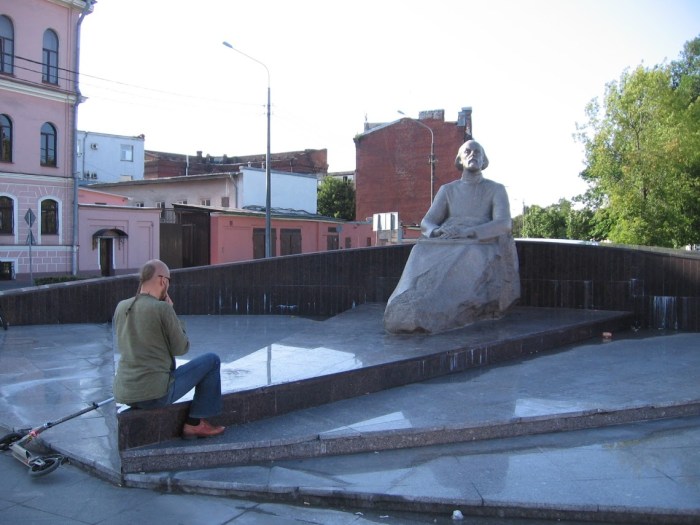
Monument to Konstantin Tsiolkovsky, Petersburg, July 18, 2015

The pioneering Russian rocket scientist Konstantin Tsiolkovsky was, undoubtedly, a certifiable genius.

The amount of carbon dioxide in the atmosphere is quite small (0.03%), which does not facilitate crop yields. Its quantity could be increased 30 times (to one percent) with great benefit to plants and no harm whatsoever to man. The gas is not poisonous, and an abundance of it in the atmosphere would only hinder its secretion from the lungs. One percent would cause almost no hindrance, even if we are talking about human lungs.
—Konstantin Tsiolkovsky, “The Future of the Earth and Mankind” (Kaluga, 1928)

Photo and translation by the Russian Reader

“The Delirium of Religious Reformism”: Punitive Psychiatry Makes a Comeback in Chelyabinsk

Alexei Moroshkin. Photo courtesy of Memorial
Alexei Moroshkin. Photo courtesy of Memorial Human Rights Center

Chelaybinsk Resident Alexei Moroshkin’s Stay in Mental Hospital Extended Six Months
OVD Info
January 11, 2017

On January 10, the Soviet District Court in Chelyabinsk extended Alexei Moroshkin’s forced confinement in a psychiatric hospital for another six months, according to his mother Tatyana Moroshkina. Moroshkin had been sentenced to compulsory psychiatric treatment after having been accused of calling for violation of the Russian Federation’s territorial integrity.

According to Moroshkina, the court paid no attention to any of the arguments made by the defense, neither that her son’s actions and statements did not pose a threat to others, nor that, according to his medical record and the opinion of his physician, he was not dangerous and there was no need to hospitalize him. In making its ruling, the court was guided by the unsubstantiated opinion of court-appointed experts that Alexei Moroshkin could be dangerous, said his mother.

Moroshkin was committed to Regional Clinical Mental Hospital No. 1 in Chelyabinsk in December 2015. Prior to this, a court had considered the charges of calls for separatism made against him in connection with texts, posted on the VKontakte social network, about the need to establish a Ural People’s Republic. In November 2015, a court absolved Moroshkin of criminal liability, declaring him mentally incompetent on the basis of opinions submitted by medical forensic examiners, who during the police investigation had diagnosed him with paranoid schizophrenia, adding that he suffered from the “delirium of religious reformism.” This diagnosis was occasioned, apparently, by Moroshkin’s online publications and interviews dealing with the virtual Church of the Chelyabinsk Meteorite, which he had invented. At present, acccording to his mother, the medical experts do not mention delirium, but nevertheless consider her son mentally ill and a danger to others.

Before criminal charges were filed against him, Moroshkin had never been under a psychiatrist’s care.

According to his mother, Moroshkin’s physical condition has deteriorated: he suffers from a heart disease. The court also failed to take this circumstance into account.

In October 2016, Moroshkin was suddenly transferred to a wing with worse living conditions than before. Shortly before this, the hospital’s head physician was fined for refusing to provide information about Moroshkin to his defense attorney.

Currently, another case involving Moroshkin is under investigation. He has been accused of painting a bust of Lenin in Chelyabinsk in the colors of the Ukrainian flag and charged under Article 214.2 of the Criminal Code (vandalism).

Translated by the Russian Reader

Loyalties

isip
Dmitry Yegorchenkov and Nikita Danyuk (right), assistant heads of the Institute of Strategic Studies and Forecasting (ISIP) at the Russian People’s Friendship University, after lecturing at the Russian Congress of University Vice Chancellors for Morale and Discipline, Moscow, October 21, 2016. Photo courtesy of the institute’s Vkontakte page

Ideological Underachievement
Russian universities to examine the loyalty of students and lecturers
Alexander Chernykh
Kommersant
October 24, 2016

Kommersant has learned that volunteers at Russian universities have been working to assess the “protest potential” of students and professors. The results will be “compiled as memorandums for official use by state authorities.” Attendees of the Russian Congress of University Vice Chancellors for Morale and Discipline, which took place this past weekend, discussed the assessment. The authors of the study have discovered that the “destructive promotion of anti-state ideas has been occurring” among the student bodies and faculties of the capital’s universities. On the eve of the presidential election, they intend to shift their focus to regional universities.

It was the sixth time the Russian Congress of University Vice Chancellors for Morale and Discipline had taken place in Moscow. Representatives of 642 educational organizations from eighty-one regions attended the congress. Prime Minister Dmitry Medvedev sent his greetings to the congress, and  guests of honor included Stanislav Sulakov, acting head of the Moscow Center for Extremism Prevention (Center “E”), Metropolitan Merkurii, chair of the Synodal Department for Religious Education and Catechesis, and Ernestas Mackevičius, presenter of the news program Vesti.

The meeting of the vice chancellors kicked off with a discussion of a sensitive issue.

“For twenty years, we have had to prove that the country needs discipline and morale in the universities,” complained Zinaida Kalinina, a vice chancellor at Tula Pedagogical University.  Even Pushkin said, ‘The university completes the soul’s education.’ Let them argue with Alexander Sergeyevich [Pushkin]!”

Alexander Stradze, former head of the Department of State Policy on the Education of Children and Youth, one of the first officials to be dismissed by Olga Vasilyeva, the new Minister of Education and Science, tried to define the vector of the discussion. He introduced himself as assistant head of Rossotrudnichestvo, but from force of habit he attempted to preach to the vice chancellors.

“The state’s educational ideology has moved away from paternalism,” he explained. “Yes, it’s easier, probably, to work with loyal subjects, with subordinates. But the country and the conditions are no longer the same today. Nowadays, we bring up children in terms of humanism, free choice, and support for individuality. This path is justified in any democratic society.”

Alexander Balitsky, vice chancellor at Izhevsk Technical University and a former lecturer in the department of scientific socialism, tore the ex-official’s speech to shreds.

“Everything we do has often been canceled out by sociocultural circumstances,” Balitsky began in a roundabout way. “And these circumstances even often originate  in our ministry.”

Mr. Balitsky casually, as it were, mentioned that the Ministry of Education and Science has been implementing a nationwide project entitled “Time to Act,” and read aloud a message from [ministry] officials to university students.

“Twelve of the country’s best entrepreneurs will share their know-how and teach you think in new ways. On September 22, entrepreneur Oskar Hartmann—” the vice chancellor underscored the entrepreneur’s [non-ethnic Russian] given name and surname,* while the audience applauded and laughed in support “—will talk about how you need to think to become a dollar millionaire by the age of thirty.”

“Nifty, eh? There’s an ideal for you. I have nothing against entrepreneurs, but these are not the core values we need. With all due respect to the Ministry of Education and Science.”

“But now there have  been changes in the ministry,” an audience member reminded him.

“Thank God,” the speaker replied.

“Yeah, and there won’t be anymore Soroses,” someone joyfully shouted from the crowd.

“I think the expert community understands the country is in a state of undeclared war,” said Nikita Danyuk, assistant head of the Institute for Strategic Studies and Forecasting (ISIP) at the Russian People’s Friendship University. “It is hybrid in nature, and there are many fronts.  One of them runs inside our country: it is the mental front.”

Complaining that “western planners” use the “practice of inspiring coups,” he acknowledged university students were one of the main “destructors.” To keep the country from “plunging into chaos and anarchy,” Mr. Danyuk’s team had drafted a special educational program, entitled “Scenarios of Russia’s Future,” a series of lectures on “combating politically destructive forces.” Over the past two years, Mr. Danyuk and his colleagues had visited over forty universities in Moscow and a dozen regional universities, where they had encouraged the students to openly express their own views on political issues “and even join in the discussion.” Surrounded by his colleagues, however, Danyuk admitted the real purpose of the trip had been to assess the “protest potential” of students and lecturers.

“The outcomes of the project were compiled as memorandums for official use, including by government officials and officers of certain specialized organizations,” Mr. Danyuk announced proudly. “Unfortunately, the destructive promotion of anti-state ideas has been occurring among professors and lecturers—not openly,  but without being shy about it.”

Danyuk said that society was “most exposed to destructive spin doctoring during the electoral  cycle.”

“Fortunately, our country negotiated the milestone of the parliamentary elections nearly without losses, but our project will be relevant until 2018, when the presidential election will be held. And from the viewpoint of prevention, it will be relevant beyond then.”

The Institute of Strategic Studies and Forecasting at the Russian People’s Friendship University is headed by Georgy Filimonov, a professor in the department of the theory and history of international relations. The university’s website relates that, from 2005 to 2009, Prof. Filimonov worked in the presidential administration as a foreign policy advisor. According to Mr. Danyuk, the “Scenarios of Russia’s Future” lecture series has been implemented with the involvement of the Anti-Maidan Movement, political scientist Nikolai Starikov, and “other media figures.”  The project has already been the source of controversy. In May 2015, students and lecturers at the Russian State University for the Humanities attempted to disrupt a lecture by Nikolai Starikov at their university. Mr. Danyuk confirmed to  Kommersant that he had been at the event. In his opinion, the protest had been organized not by students, but by lecturers at the university.

A series of books recommended for reading by Nikolai Starikov, on sale at a newstand in Pulkovo Airport, Petersburg, October 23, 2016. Photo by the Russian Reader
A series of books recommended for reading by Nikolai Starikov, on sale at a news stand in Pulkovo Airport, Petersburg, October 23, 2016. Photo by the Russian Reader

“The strategy of our foreign so-called colleagues has changed. The protest potential has now shifted to the regions, and we are really interested in making contact with people from regional universities and organizing events there,” he said.

At the end of the event, the vice chancellors queued up to talk with Mr. Danyuk, vying with each other to invite him to their universities and assess the “protest potential” of their colleagues.

* According to an article, dated March 15, 2016, in the magazine Sekret firmy, businessman Oskar Hartmann was born in Kazakhstan to a family of Russian Germans.

Translated by the Russian Reader

Making War on “War and Peace”

vladimir-putin-and-rector-of-stpetersburgs-state-university-ludmila-dp85mc
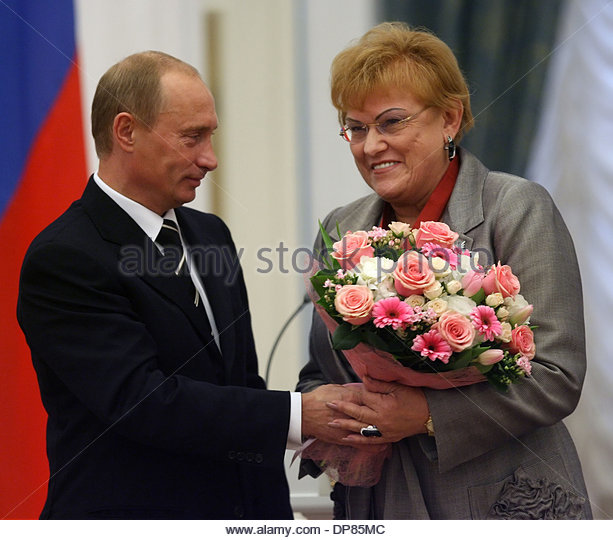
Vladimir Putin and Ludmila Verbitskaya. Photo courtesy of alamy.com

There is no less genuinely patriotic crowd in today’s Russia than Putin and his cronies. They have a wild hatred for everything really good about the country, its history, culture, and language:

Ludmila Verbitskaya, president of the Russian Academy of Education, has suggested removing Leo Tolstoy’s War and Peace from the school curriculum and replacing it with “works of spiritual literature.” According to her, children “cannot understand the full depth” of this work, but everyone should read the Bible.

Read the details (in Russian) and weep on RBC.

UPDATE. Comrade VK has drawn my attention to the following statement by Professor Verbitskaya. While it does complicate the picture a bit, it brings home again the thoroughgoing hypocrisy of the current regime, whose alleged conservatism consists only in battering, dispiriting, and tricking their would-be constituents by hook or by crook to keep themselves in power for as long as humanly possible.

“I have almost no free time, and so I am obliged to read what I still poorly understand due to the fact that my generation was deprived of it: the Bible. Since I was educated as a Russianist, I sense how imperfect my English is, and so before going to sleep I make sure to read something interesting, like Agatha Christie, in the original. But my favorite novel is War and Peace. I pick it up quite often and reread parts of it.”

Source: Zampolit.com

Living Levada Loca

Komar & Melamid, Russia's Most Wanted Painting, 1995. Image courtesy of Dia Art Foundation
Komar & Melamid, Russia’s Most Wanted Painting, 1995. Image courtesy of Dia Art Foundation

The Picture Is Going to Get Prettier
Greg Yudin
Vedomosti
September 6, 2016

The latest attack on the Levada Center (this past Monday, the organization was labeled a “foreign agent”) provoked a justified outcry from people in various parts of the ideological spectrum, from the center’s friends competitors, and opponents. The formal basis of the attack was the insane law that punishes people and organizations for something that should be rewarded. If Russia wants to be strong in academic research, then here were researchers who collaborated with serious foreign partners. (The University of Wisconsin, with whom the Levada Center had been working, has traditionally been a powerhouse in sociology.) Worse, the law construes “political activity” as something unsavory right at a time when Russia really needs to awaken an interest in politics, and any NGO willing to study the dynamics of political life in Russia deserves all the encouragement it can get.

The Russian Ministry of Justice can paralyze the operations of one of the country’s three major public opinion polling factories one and half weeks before national and regional parliamentary elections on September 18. In this case, the elections will be held with a newly configured polling industry, which has not changed for a long time. Putting our emotions aside, however, the assault on the Levada Center seems unexpected. For the past decade, the organization has objectively worked to maintain the current regime’s legitimacy.

The public opinion research field, a field once populated by many players, was purged by the Kremlin ten years ago, leaving only three companies standing. Two of them, FOM (Public Opinion Foundation) and VTsIOM (Russian Public Opinion Research Center) are substantially affiliated with the Kremlin, since they are wholly dependent on the commissions they regularly receive from the presidential administration and other government agencies. The Levada Center, on the contrary, has been financed independently of the Kremlin, and the liberal views of its senior staff have put the company almost in political opposition to the current regime. Yet the outcomes of the Levada Center’s polls have rarely diverged from the data published by its colleagues and competitors. The numbers adduced by all three pollsters have usually generated a sense of broad or overwhelming support for everything the authorities do, however aggressive and irrational it sometimes might appear.

Praise from the enemy is worth twice as much, especially if it is voiced publicly. Vladimir Putin has confessed on several occasions that polls mean a lot to them, and when the Levada Center records public support for him, this is proof the support is undeniable. Look, even our opponents are forced to admit the people are behind us, the regime’s supporters say time and again. These same people sincerely believe research results depend on who pays for the research.

Research studies, however, are much more complicated, and the results of Levada Center’s polls have had nothing to do with the political stance of its executives. Instead, they are stipulated by the way polls are conducted. In daily life, Russians show little interest in politics, so if you deluge them with a wave of news reports about some issue of little importance to them, such as relations with Turkey, and then ask them the next day whether we should be afraid of Turkey, they will respond in good faith based on the information they got the day before. With few exceptions, the Levada Center has humbly tackled the political agenda set by television, and asked the same questions as the other pollsters, questions focused on this agenda, predictably garnering nearly the same outcomes as the other pollsters. However, the center’s alleged oppositional status made the answers more important for the authorities and, at the same time, indirectly increased the credibility of the other companies. The depressive antidemocratic discourse about the stupid, aggressive common people with which the middle classes have been spooking each other nationwide has largely been the product of the Levada Center’s poll numbers, even if the outcome was unintentional.

You need a good reason to shoot the goose that has been laying golden eggs. What compelled the authorities to break off a piece of the rigging propping up its legitimacy? I should explain right off the bat how the Levada Center does actually differ from the other two major Russian pollsters. The difference has nothing to do with honesty or professionalism. The myth that one group of sociologists does honest work, while the two others fake the numbers is not even worth discussing seriously, and yet they all get the same results.

What matters much more is the fact that the Levada Center does not get commissions from the Kremlin. The Kremlin cannot tell it what questions to ask and what results to make public. We should not forget the poll results reported in the Russian media are only the poll results the client has allowed them to publish. The client can impose a temporary or permanent veto on publication of the results. The media’s picture of public opinion thus passes through two powerful filters nowadays. First, the client imposes on the polling organizations the subjects for which he is willing to pay, and then he decides what information he would like to make available to the public. The Kremlin can easily ban publishing results that shatter the image of monolithic public support for its decisions, and it has often done this.  It has no such power over the Levada Center, although in recent times it has not needed it, since the company has not produced polling data that would put the Kremlin in a vulnerable position.

Polling data has been long the main fodder from which Russians shape their notions about the balance of power at election time and decide how to vote. The numbers act like a tranquilizer, persuading voters not to waste time and energy by getting involved in elections whose outcome is clear in any case. Simultaneously, they send a signal up and down the power vertical about how much “slack” needs to be made up at the local voting precincts. The main thing is not diverge to too radically from the polls. If the Kremlin has had to break with this way of doing things on the eve of the elections, it means the independent player had become too dangerous. The mirror reflected something that forced the Kremlin to throw a stone at it.

If the Levada Center is forced to suspend operations, the credibility of poll numbers will drop, and the client will increase pressure on the remaining players. We will have to treat the polling numbers we see before and after the elections with a bigger grain of salt. If before, the public was shown only the pretty half of the picture, while the ugly was hidden from it, now it will see even less of the picture.

Greg Yudin is a research fellow and lecturer at the Higher School of Economics in Moscow. Translated by the Russian Reader