Election Observers

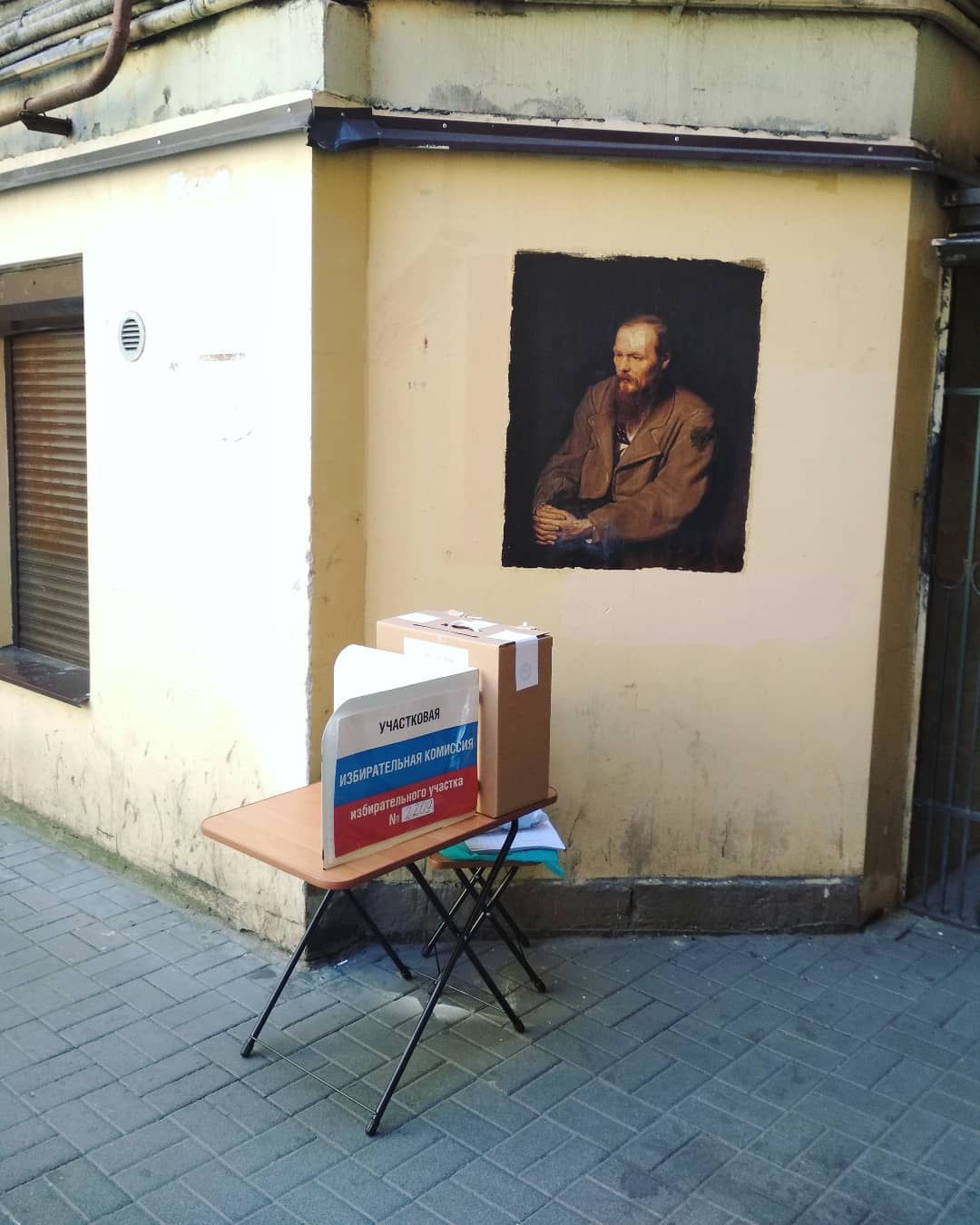
election observerArtist, activist and teacher Darya Apahonchich found this “polling place” in the courtyard of her building in downtown Petersburg, across the street from the city’s Dostoevsky Museum. Early voting is under way in a nationwide referendum on 206 proposed amendments to the Russian Constitution. Courtesy of Darya Apahonich’s Facebook page

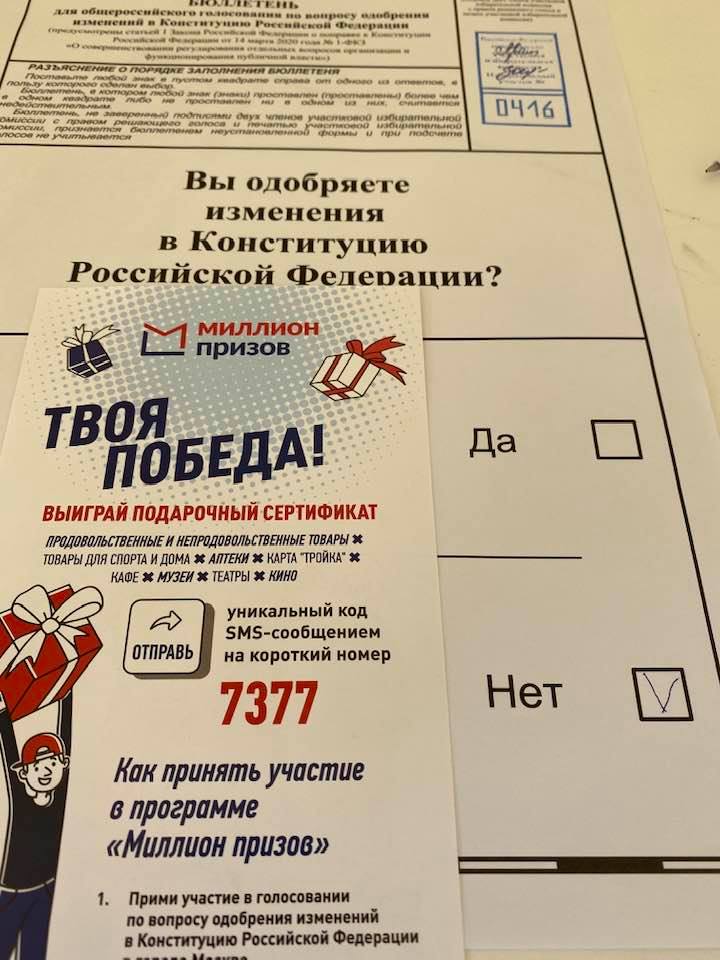
approvalFilmmaker Andrey Silvestrov took this selfie with his ballot paper at his polling place in Moscow. The question reads, “Do you approve [the] changes to the Russian Constitution?” Silvestrov voted no, of course. Note the fact that none of the amendments in question is listed on the ballot paper. Photo courtesy of his Facebook page

prizesFortunately, Silvestrov’s “no” vote will not, one hopes, disqualify him from entering the “Million Prizes” program, as outlined on a flyer he was given by polling place officials along with his ballot paper. Voters are asked to send a “unique code” in a text message to the number 7377. Winners are promised “gift certificates” redeemable for groceries, sporting goods, and household goods, and for unspecified goods at pharmacies, cafes, museums, theaters, and cinemas. I am going to go out on a limb and predict that the “gift certificates” (if any Russian voters actually receive them) will prove worthless. Photo courtesy of Silvestrov’s Facebook page

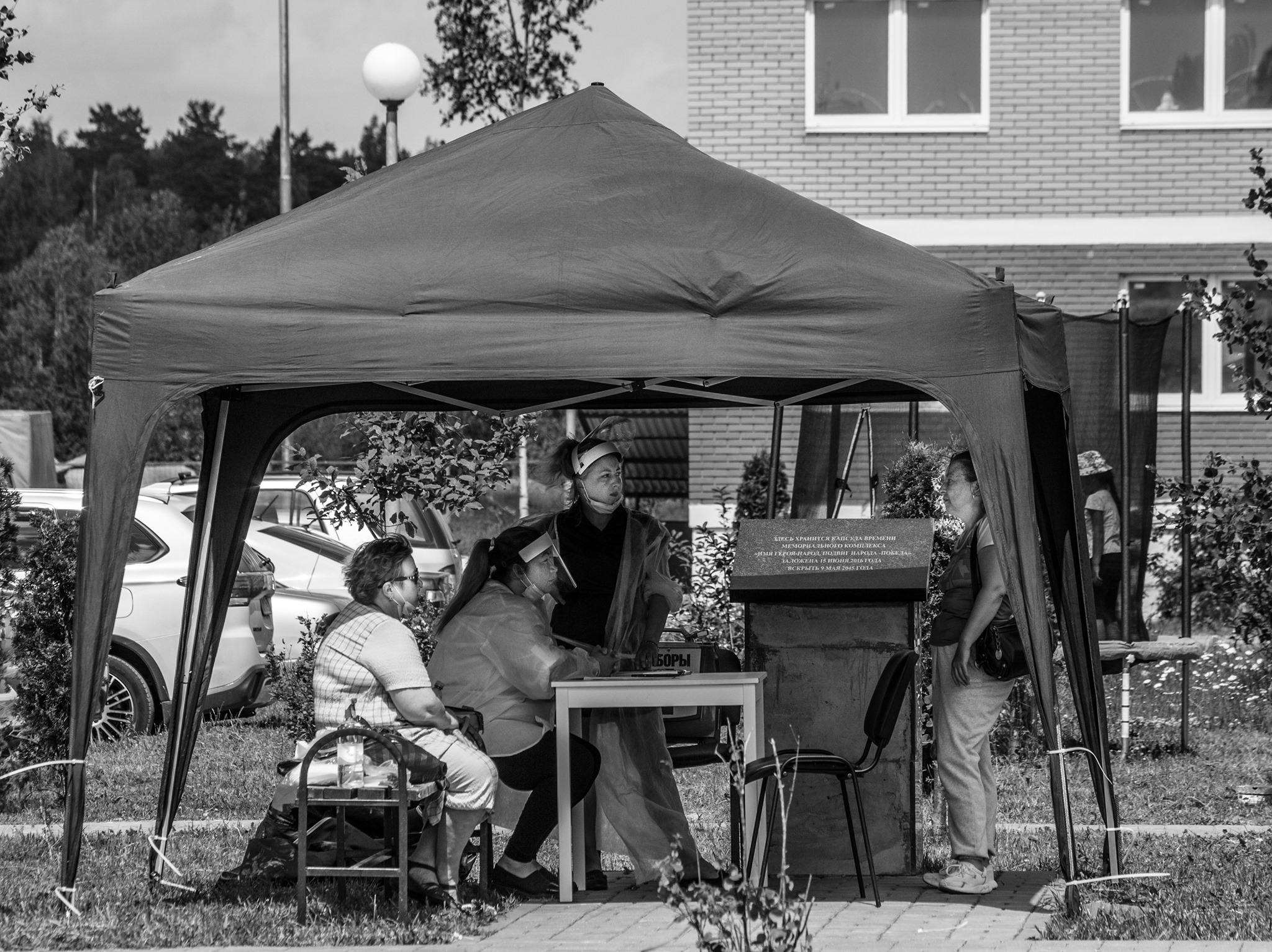
lurie precinctPhotographer Vadim F. Lurie took a snapshot of the referendum polling place in the courtyard in a town in the Moscow Region. Courtesy of his Facebook page. While the purported reason for such bizarre ad hoc polling places is ensuring health of voters during the coronavirus pandemic, still raging in many parts of Russia, they provide the added benefit of making it much harder for election observers to ascertain whether the referendum was conducted freely and fairly. Needless to say, “free and fair” is a meaningless concept to the Putin regime.

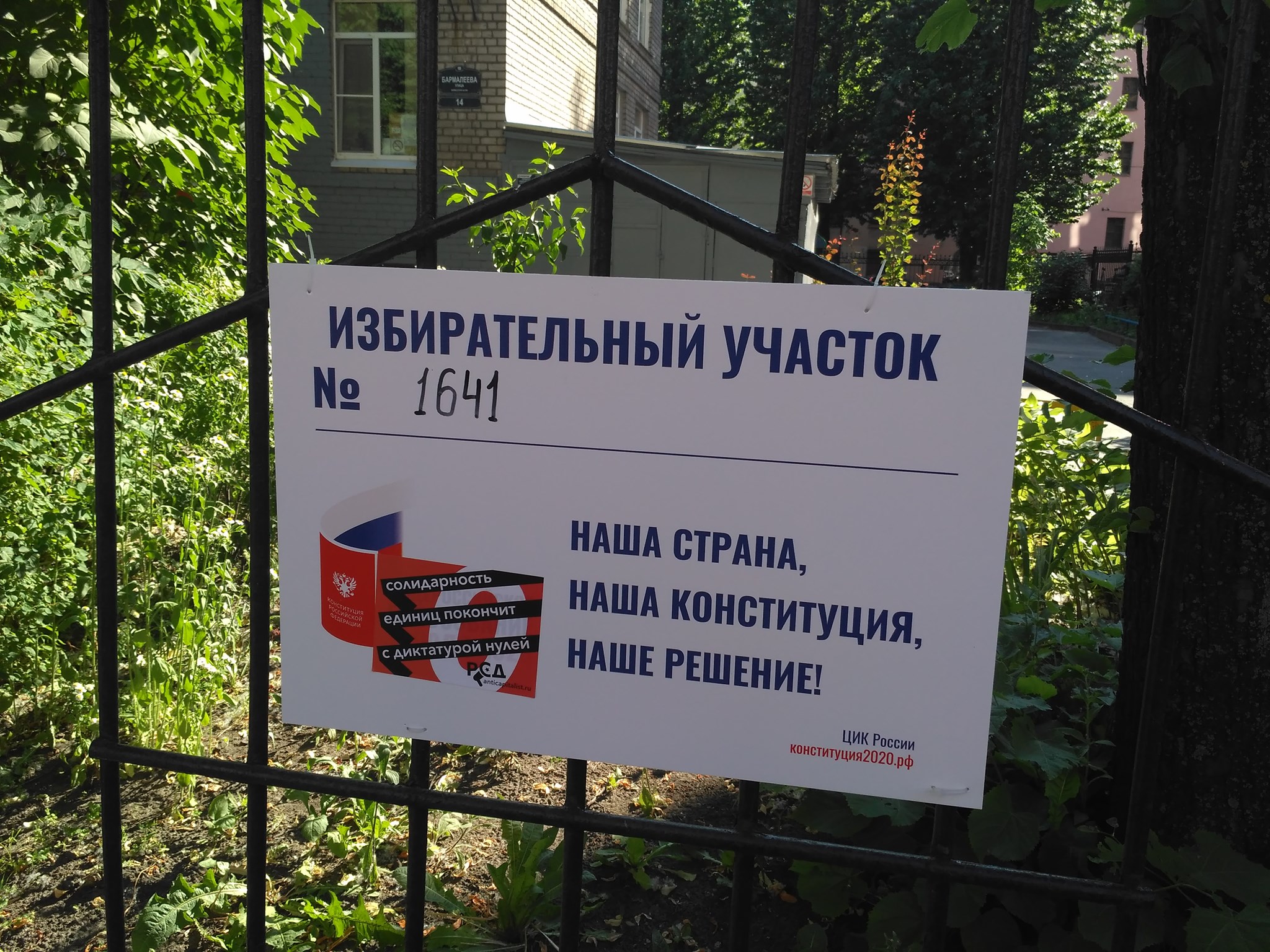
dictatorship of zerosJournalist and political activist Ivan Ovsyannikov took this snapshot outside Polling Station No. 1641, located on the Petrograd Side in Petersburg. The placard reads, “Our country, our constitution, our decision.” Someone has pasted a sticker on the placard, which reads, “The solidarity of ones will end the dictatorship of zeroes.” This is reference to the fact that one of the proposed amendments, if ratified, will “zero out” Vladimir Putin’s previous terms as Russian president, thus allowing him to run for two more consecutive terms of six years. If this scenario comes to pass, Putin would be able to rule until 2036. His current presidential term ends in 2024.

Konstantin Yankauskas and Alexander Zamyatin, popularly elected municipal councilors in the Zyuzino District of Moscow, discuss what their constituents can do to oppose the referendum under near impossible circumstances (the coronavirus pandemic, a ban on public campaigning against the amendments, evidence that thousands of state sector employees are either being forced to vote yes or hand over their passwords for electronic voting to their supervisors, etc.) They also reflect on why the Russian opposition has been unable to run a nationwide “no” campaign despite the fact that formal and informal barometers of public opinion have shown that Putin’s popularity has been falling and that many Russians are opposed to the constitutional amendments. The discussion was broadcast live on YouTube on June 24, 2020.

Amending the Dead

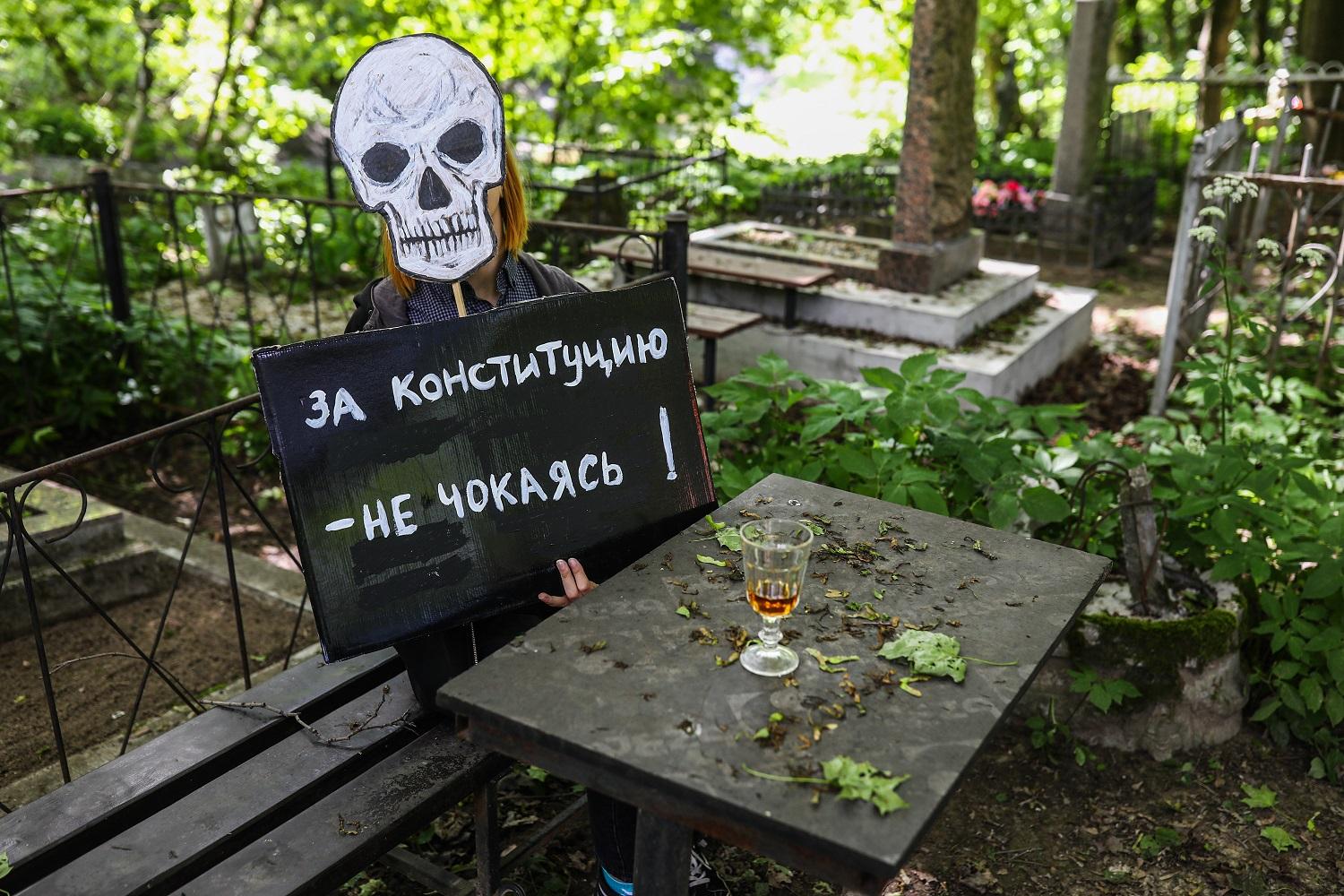
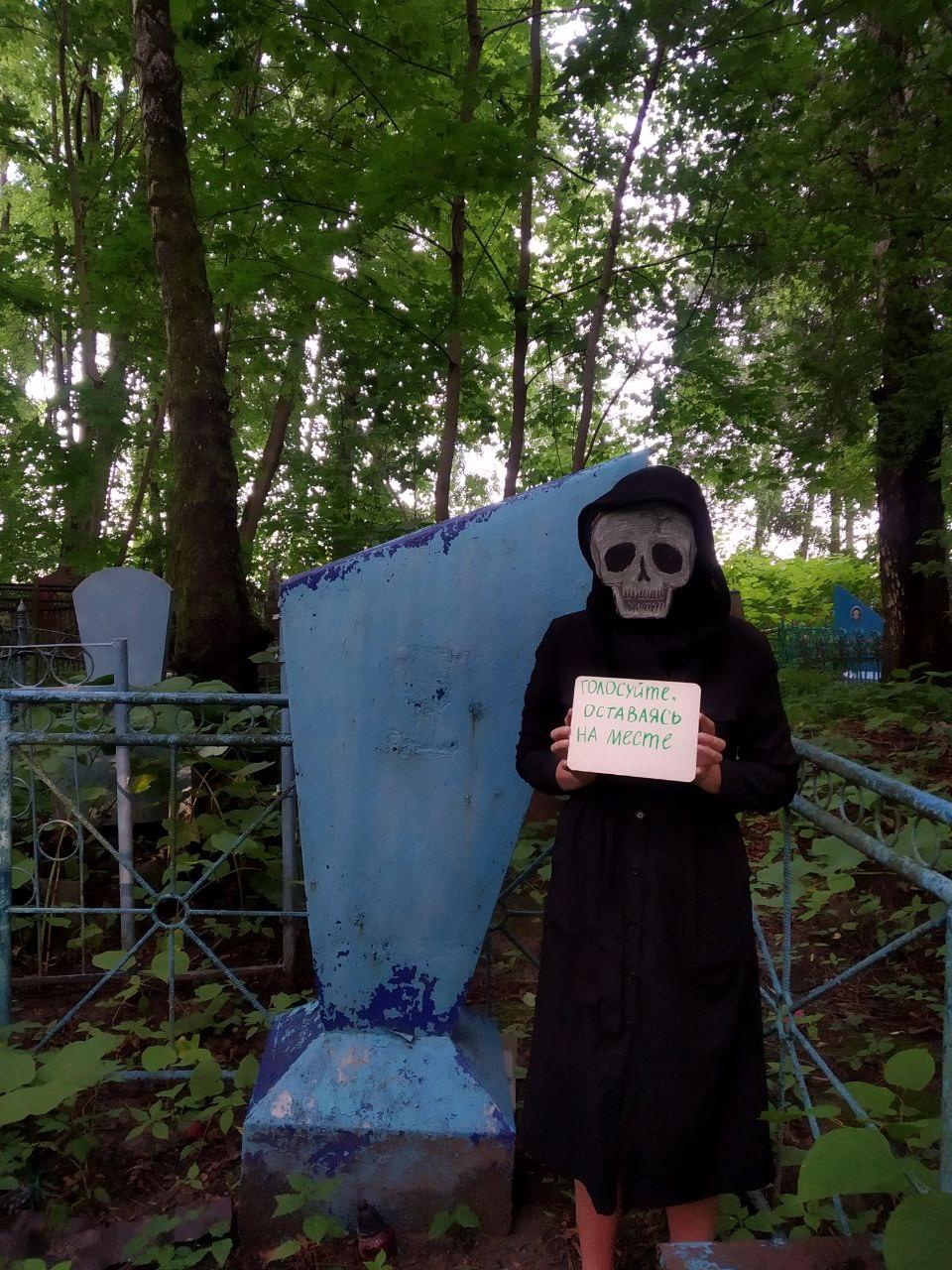
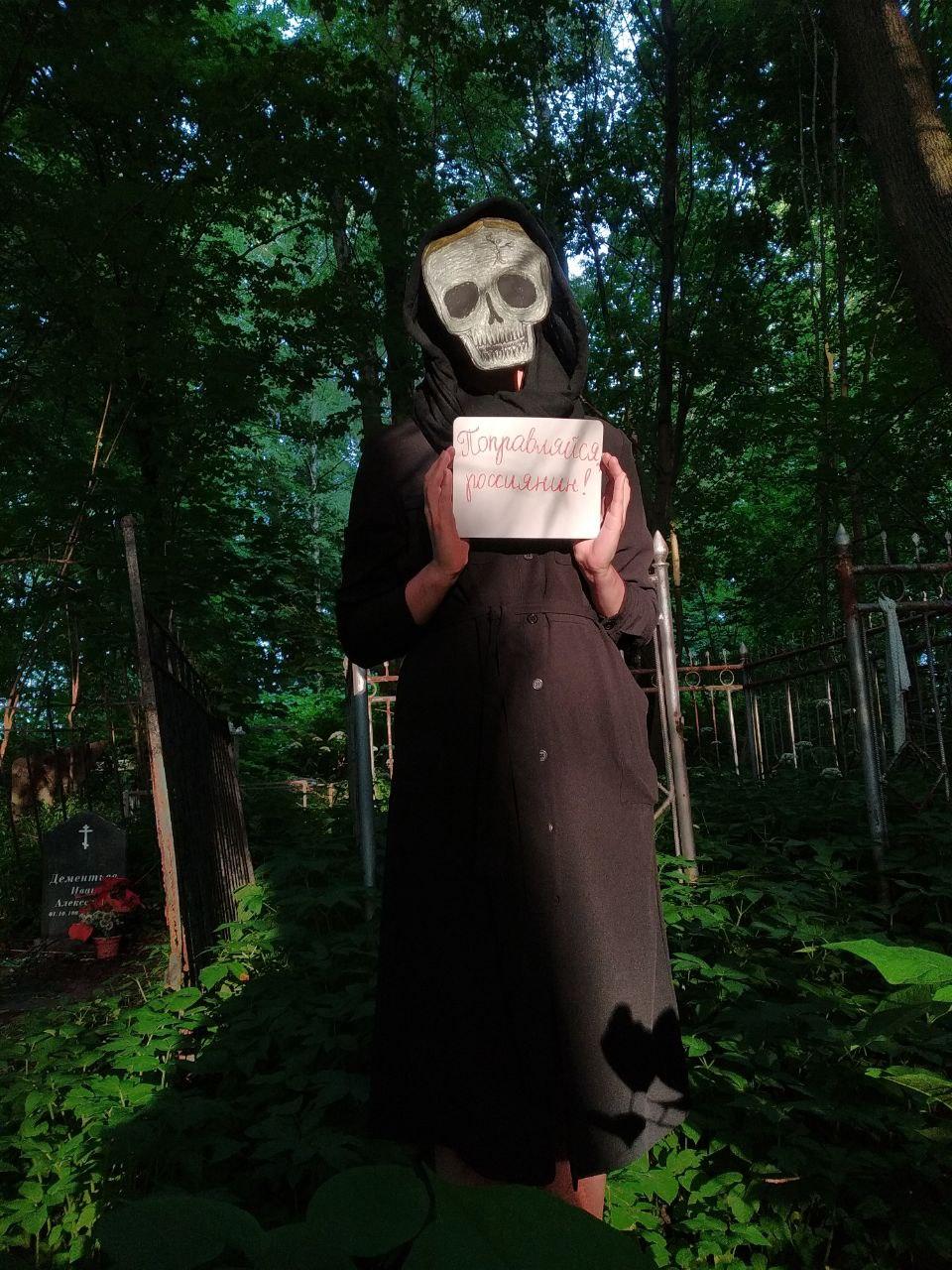
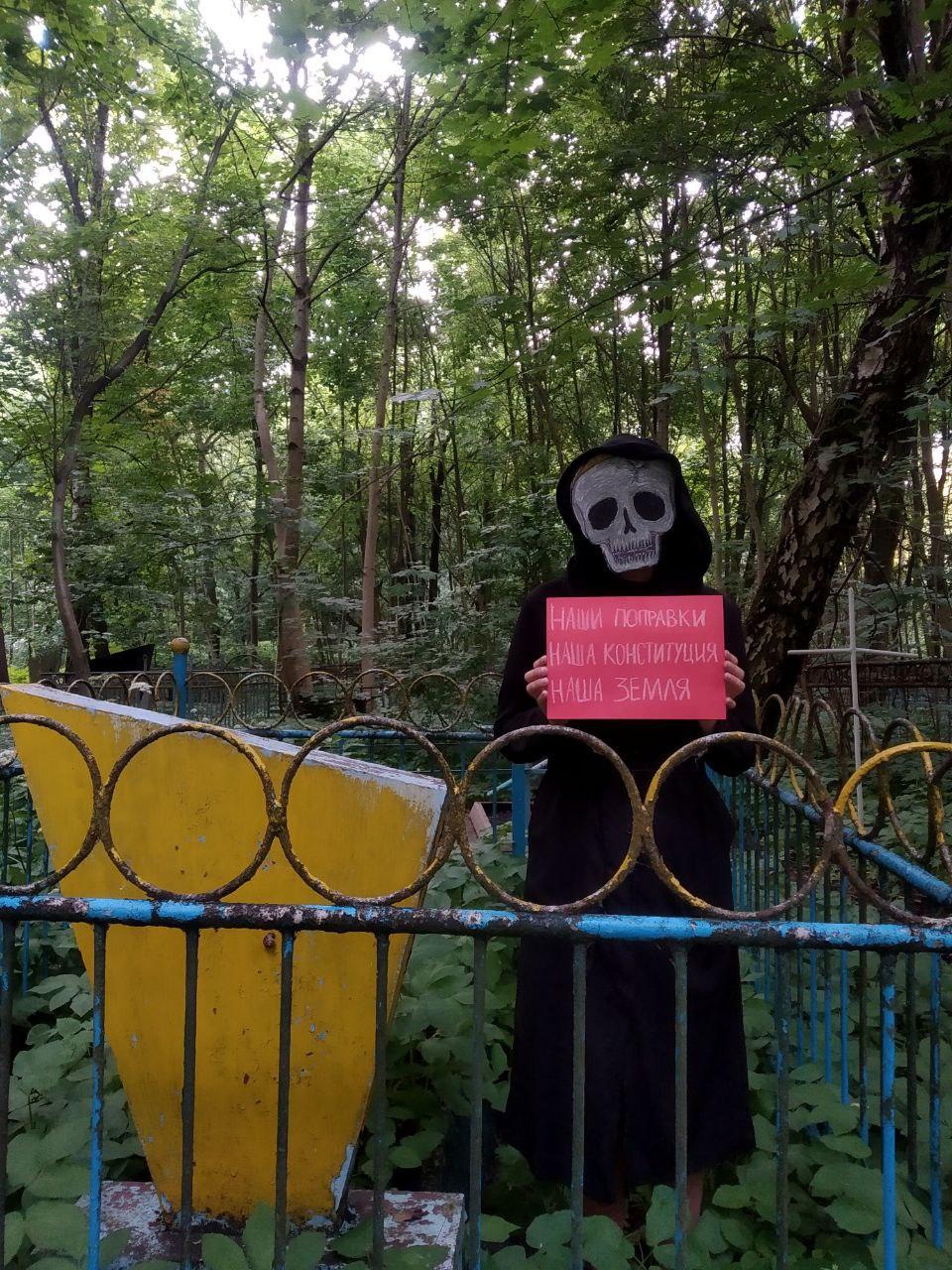
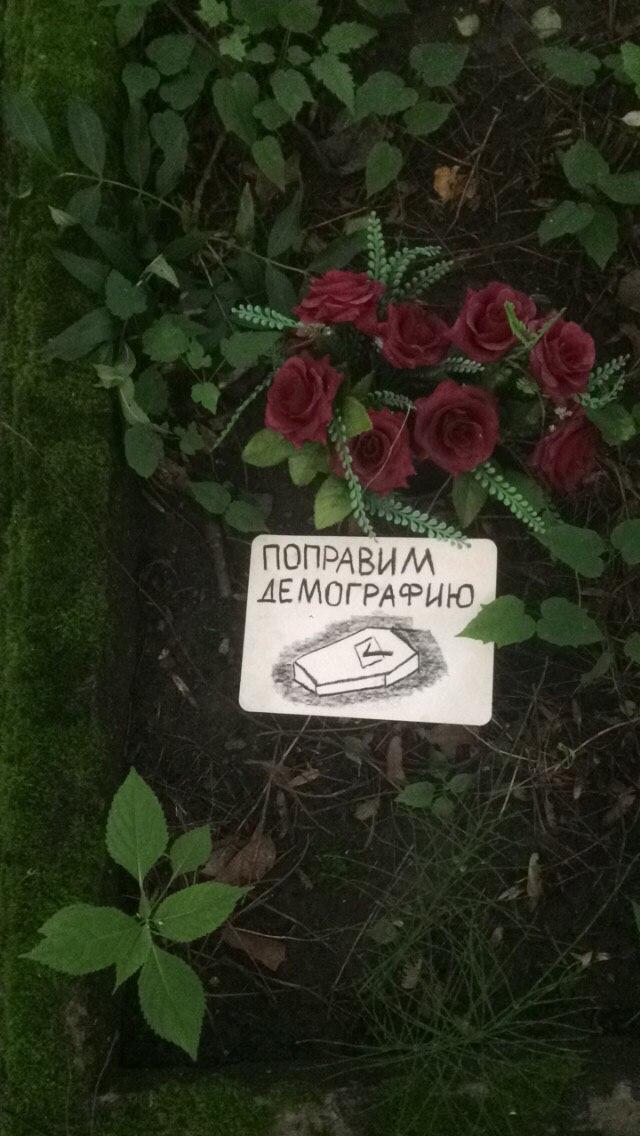
On June 21, 2020, the Party of the Dead staged two actions, one at the Volkovskoye cemetery in Petersburg, and another, by “Corpse Corpsevich,” in a cemetery somewhere in the Baltics, subversively affirming the proposed amendments to the Russian constitution, which would “annul” President Putin’s four terms in office, allowing him to remain in power until 2036. On July 1, 2020, Russians will vote on the amendments in a nationwide referendum widely seen as meaningless, and whose (affirmative) outcome is a foregone conclusion. (For more information, see “Russia’s Constitutional Court Approves Amendments Allowing Putin to Rule Until 2036,” RFE/RL, March 16, 2020.)

01
Eternity smells of Putin.
We shall annul ourselves and begin to live! We shall annul ourselves and return to life!
Dead people, get well soon!
The amendments are like hot packs for the dead.
The grave will straighten everyone out.*
Yes to death! Yes to the amendments!

*(This slogan plays off the Russian saying: “only the grave will straighten out the hunchback,” referring to an irredeemably flawed or “incorrigible” person.)

02
To the Constitution without clinking glasses!

(When toasting the dead, Russians do not clink glasses.)

Source: Activatica

 03
Vote while sheltering in place.

04
Be on the mend, Russian citizen!

(The reflexive Russian verb popravliatsia means to get well, to be on the mend. The non-reflexive form popravliat means to amend.)

05
Our amendments. Our constitution. Our country.

06
The “absolute majority” of citizens support the amendments.

(During his first public appearance after weeks in lockdown, Putin claimed that an “absolute majority” of Russians back his plan to change the Russian Constitution.)

07
Two things are certain in life: death and amendments.
It’s all predetermined on high.
Don’t console yourself with fleeting hope,
Annulment is our fate.

10
We will amend our demographics.

09
Here lies Vladimir Putin’s social approval rating.

Source: Facebook

Dreaming

Darya Apahonchich
Facebook
June 20, 2020

(just dreaming a little)

I look at how everyone is tired after twenty years of putin’s rule—tired of cursing, tired of fighting, tired of resisting, tired even of taking toll of the damage.

the alleged referendum is a three-ring circus, but (speaking for myself) my lack of surprise and faith in the success of resistance are such that I listlessly repost things and make sarcastic jokes, but don’t think seriously at all about acts of resistance.

but i believe in acts of feminist resistance: they work, albeit slowly, albeit surgically. no, there is no law against domestic violence, but individual rapists have been suspended or dismissed from their jobs, new codes of ethics are being written, and so on. all of you are watching this happen. i see how women’s self-esteem has been growing, i see that what was the norm for my parents’ generation is no longer the norm for my generation. women have become more active, they are increasingly choosing not to be silent when they encounter injustice.

Vladimir_Putin_with_Lyudmila_Putin-1

and so i am thinking: what if we suddenly stopped tolerating a “home boxer” and tyrant as president?

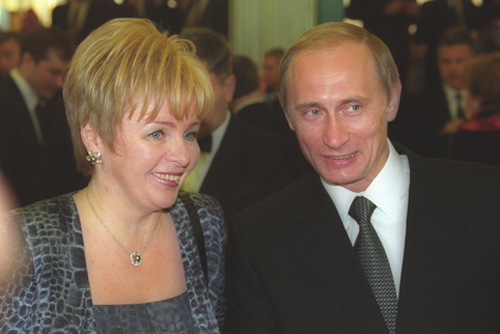
we know that putin is an abuser. we know he beat his wife, that he tortured her. even lyudmila putina’s memoir, chockablock with self-accusation and meekness, makes it clear that he treated his loved ones terribly. his wife published a memoir, which was quickly withdrawn from sale. but it’s all on the internet.

just dreaming a little: what if we stopped putting up with this scoundrel? (yes, we are used to putting up with him, but what if it’s reversible?)

Photo courtesy of Wikipedia. Translated by the Russian Reader

“Take Off Your Underpants and Squat Five Times”: Nadezhda Belova’s Journey from Grassroots Activism to “Exonerating Terrorism”

nb-1Nadezhda Belova. Photo by Vladimir Lavrov. Courtesy of RFE/RL

“Take Off Your Underpants and Squat Five Times”: A New “Terrorism Exoneration” Case
Svetlana Prokopieva
Radio Svoboda
June 2, 2020

Two years after the bombing in the Federal Security Service (FSB) building in Arkhangelsk, law enforcement agencies continue to launch criminal cases against people who comment on the case on social media, claiming they have violated the law against “exonerating terrorism.” The story of Nadezhda Belova is more proof that the bombing carried out by 17-year-old Mikhail Zhlobitsky, resulting only in his own death, has been turned into a tool for persecuting undesirable activists.

Nadezhda Belova is 36 years old. She was born and lived her whole life in Novaya Usman, the largest village in Russia, near Voronezh. She had never been involved in politics or protest movements. She first came to the attention of the authorities in 2019, when she organized and brought to a victorious conclusion two protest actions defending the interests of her fellow villagers. In 2020, a criminal case was opened against her for “exonerating terrorism.”

“You’re in Big Trouble”
Criminal Code Article 205.2 came into Nadezhda Belova’s life on March 31—”probably at around nine in the morning, under the guise of a search for coronavirus-infected Asians,” Belova says.

“First my husband opened the door. They told him they were doing a search. Naturally, they weren’t wearing masks. First, they asked who lived there. (We rent a flat in Voronezh.) My husband told them that no one lived there but us, the two of us and our son. I came out and asked them why they weren’t wearing masks. When they saw me, they said, ‘Nadezhda Belova, you’re coming with us for questioning.'”

Nadezhda, her 15-year-old son, and her husband were taken to the police station and questioned. On the advice of a lawyer friend, she invoked Article 51 [of the Russian Constitution, which gives people the right not to incriminate themselves].

“I expected to be punished for all my campaigns in Usman,” Belova says, but investigators showed her a comment she had posted on the VK community page Lentach under one of the very first reports about the bombing in Arkhangelsk. Nadezhda had forgotten all about it.​

“This circus lasted for an hour and a half,” she says of the first interrogation. “‘You’re in big trouble,’ they said. Of course, they threatened me—with five years in prison, and with sending my son to an orphanage if I didn’t confess. I asked them what I should confess to and told them I didn’t know what they were talking about. ‘Here,’ they asked, ‘did you write this comment in 2018?’ ‘Can you hear yourselves?’ I asked them, ‘A comment in 2018!’ The investigator says, ‘If I had written this, I would have remembered.’ I wouldn’t have remembered the comment even if they had tortured me, although the investigator said, ‘If we want you to confess to the Kennedy assassination, we have ways of making you talk.'”

Leaving her family at the police station, the investigators took Nadezhda with them to search the rented flat in Voronezh and her home in Novaya Usman. They confiscated all the gadgets they found, including four phones, a laptop, two hard drives, and a flash drive. They released Nadezhda only late in the evening, dumping her in the middle of the city without a phone and without a single kopeck.

“I walked three kilometers at night, bawling my eyes out and hungry,” she says.

The next day, Belova filed complaints with the prosecutor’s office, the Interior Ministry, and the Investigative Committee. (They, of course, would respond to the complaints by claiming that everything that had happened to her was “legal.”) At first, Belova was named as a witness in the “exonerating terrorism” case, but in May she was named a suspect.

“On May 13, they came up to me on the street, shoved a piece of paper in my face, and said, ‘If you don’t show up now, police will arrest you and bring you there,'” Belova says. “I told them I was going to hire a lawyer, that I wouldn’t come without a lawyer. But things turned out badly with the lawyer, too.”

Nadezhda had bad luck with her lawyer. The person she hired on a friend’s recommendation “turned out to be either a pro-Putinist from the get-go, or he changed his stripes along the way,” she says.

He tried to persuade Nadezhda to “tell the truth” and had no objections when the investigator decided to arrest his suspect right in the middle of questioning.

“You wouldn’t confess. Now you’re going to sit in jail, think things over, and see what lies in store for you,” Nadezhda recalls him saying. She spent twenty-four hours in a temporary detention facility.

“They were not locking me up just to teach me a lesson. They put me in a cold, smoky kennel crawling with bedbugs. There were streaks of blood on the walls: apparently, the people before had been crushing the bedbugs. I was given tea and a piece of dry bread in a metal bowl and a mug, like a dog. I called an ambulance. They just give me a shot of painkiller, that was it. I hung in there till morning. In the morning, they put an actress in my cell who immediately started chewing me out. Her performance lasted fifteen minutes. ‘What’s your name? What you in for? If you’re in here, there must be a reason. Clear the dishes. Act normal. I’m going to smoke, you mind?’ I told her I did, because I was a non-smoker. ‘I’ll do as I like.’ She stood next to the bed and lit up a cigarette. I turned toward the wall and thought, ‘If only she doesn’t strangle me.’ But I knew she was an actress, so she stopped talking, too. She had played her role. Then a policeman came in: ‘Hands behind your back. Against the wall.’ They took me to another room and did a complete body search. They told me to strip naked, and patted down all my things. I was told to take off my underpants and squat five times: the idea was that I had drugs stuffed in there,” Belova recounts.

“It’s going to be like this from now on. You’re suspected of committing a really terrible crime,” she was told.

When she left the detention center, the investigator met her, promising to send her back to her cell if she didn’t immediately sign a confession stating when, where, in whose presence, and on what brand of telephone she had posted the comment.

“I said, ‘You do understand that this is really a lie? It’s nonsense.’ Well, then the three of us—the lawyer, the investigator, and I—wrote an essay entitled ‘What I Wrote on October 31,'” Belova recounts. “‘You do understand that you could go to prison for forcing a confession and lying?’ But the investigator said, ‘In 1937, we would have tortured you for an hour, and you’d have confessed right away. We wouldn’t have had to drive you here and there, we wouldn’t have wasted time: we would have needed only an hour.’ They all laughed.”

__________________

[Prokopieva:] They have blood ties with 1937 . . .

[Belova:] I’ll say even more—they’re waiting for the go-ahead. Once they get permission, I don’t think they’ll even need to be persuaded. They’re too lazy to drive me here and there and waste time. They want to turn torture me quickly and get on with their lives. I said to them, “If you were ordered to shoot at children right now, you would shoot without flinching.” 

You later retracted the confession?

Yes, of course! On May 13, I was put in the lockup. On the 14th, I confessed to everything. On the 15th, I got a new lawyer and completely recanted my testimony. I wanted them to write that I had been coerced with the threat of prison, but the investigator categorically refused to do it. “Do you think I’m going to denounce myself?” he asked.

nb-2Screenshot of the social media post, dated October 31, 2018, under which Belova posted the comment that prompted the criminal case against her. The post reads, “There has been an explosion at the FSB building in Arkhangelsk. One person has been killed. The cause of the blast is under investigation.” Courtesy of RFE/RL

Belova was unable to recall the comment for which she was being prosecuted. But she did find the post on the social media community page and reread it. She called the slain man a “martyr” and wrote that he would “go to heaven.” Nadezhda now suggests that when she wrote it, she thought that an FSB employee was the victim since, at the time, there was no information about the identity and fate of the terrorist. Her comment also included the word “pushback.”

“Yeah, and there was also the phrase ‘Putin’s devils,'” Belova recalls.

Although her comment has been deleted, the responses to it are still there, including this one: “Nadezhda, they’re already coming to get you. Take care of yourself and your loved ones.”

“Many times I’d seen comments to many people on VK like ‘They’re coming to get you’ and ‘You’ve been reported to the FSB,’ but I’d always thought they were jokes. I’d been threatened many times in my life, after the campaigns for the parking lot and the jitneys, and people had filed ‘rioting’ complaints against me when I still lived in Usman. So I would have only laughed at such comments. I didn’t really believe people were jailed for the things they said. I didn’t realize that crackdowns like that were happening in Russia,” Belova says.

“There Was No Time to Choose Who to Be the Hero”
Belova has now been charged with violating Article 205.2 of the Criminal Code and released on her own recognizance. Her new lawyer, in whom she has confidence, is being paid by OVD Info.

The answer to the question of why it took the security forces almost two years to charge her with a “really terrible crime” is incredibly simple. In 2018, Nadezhda Belova was still of no interest to the regime’s watchdogs.

“I was born in Usman and had lived there all my life. My mother worked as a commercial freight forwarder, and my father was a mechanical engineer. I graduated from high school with a silver medal. I was a goody two-shoes, even a little bit of an outcast, you could say. I spent summers in the countryside reading books—Natasha Rostova, Chekhov, and Bunin,” Nadezhda says about herself.

nb-3Nadezhda Belova’s native village. Photo by Vladimir Lavrov. Courtesy of RFE/RL

She graduated from the Voronezh Technological Academy in 2005, giving birth to a child in her fifth year there.

“After that, as it happens, nobody hired me because I had a child and later nobody hired me because I had no experience,” Belova says.

An economics and information specialist by education, Belova worked at the post office, then as a clerk “punching out invoices.” She had a failed marriage, which she describes as “useless and unnecessary.” Finally, five years ago, she met Sergei, with whom she has started a real family and a family business. Sergei was teaching robotics and programming to children, their son had gradually begun helping out, and Nadezhda handled advertising and moderating group pages on social media. This year, to be closer to work, they moved to Voronezh.

“By the way, we had wanted to register as self-employed, but the coronavirus and the arrest have blindsided us,” Belova says.

Even before moving to Voronezh, Nadezhda had been in the public eye as a grassroots activist. She was motivated not by power, money or popularity, but by the sense that her “shoulders were pressed to the mat.”

“They have started taking away the last things we have. As it is, they haven’t been doing anything [for us], just skinning our hides,” she says by way of explaining the reasons for her activism. “That’s how I look at it. I took it as an occupation, a war, an attack by fascists. There was no time to choose who to be the hero, so I decided, ‘Who would do it if not me?'”

Belova was annoyed by the decision of the local authorities to let a parking lot next to the ospital be redeveloped as a store. She wrote posts on local community social media pages, invited journalists to Novaya Usman, and appeared on television herself. The protest campaign was successful: the construction site was moved, and a new “huge paved parking lot, four times larger” was built in place of the old one.

nb-4The parking lot that Nadezhda Belova and other people in Novaya Usman stopped from being redeveloped as a store. Photo by Vladimir Lavrov. Courtesy of RFE/RL

Six months later, in June, Novaya Usman faced a more serious problem: the governor of Voronezh Region, Alexander Gusev, announced that the area’s public transport routes would be optimized. Jitneys from Usman would be forbidden from entering Voronezh. People would have to transfer to Voronezh municipal transport routes on the outskirts of the city.

“We realized it would be a disaster for us,” Belova says. “I told people we shouldn’t wait for them to cut us off. We just needed to make ourselves heard: we’d make a video and circulate a petition, letting them see we were opposed. Naturally, people said yes, that nothing good could come of [the governor’s plans]. I wrote a post on a community page, asking people to meet at the shopping center to collect signatures on a petition. All that was written there was that we opposed the cancellation of suburban transport routes and banning jitneys from entering the city. That was it! No posters, no rallies against Putin.”

Belova again wrote social media posts, made media appearances, and met personally with various officials. She and her fellow campaigners successfully defended the right of rural public transport to make stops in Voronezh. Her fellow villagers thanked Belova in the comments to reports on the campaign’s progress: “Such a fragile young woman has been dealing with three big, experienced men trying to defend the rights of all the inhabitants of New Usman! And she’s not afraid to tell the whole truth to their faces! Thank you, Nadezhda! You’re a smart cookie!”

“Everyone supported me at that moment. When I wrote on the community page that someone was denouncing me to the authorities, they told me not to fear, that they would defend me, that I was doing a great job, that I should run to become village head, that they supported me,” Nadezhda recalls. “A year goes by, and people have forgotten. Not only did they not support me, but some of them suggested I should think hard about what I’d said. Back then they told me I should run for head of the village, but now they’re telling me to think about what I’ve done. People have forgotten.”

__________________

2019 was much quieter in terms of public politics, unlike 2017–18, when there was Navaly’s presidential campaign and then the elections. Where were you during this time?

I have never voted for Putin. I realized back in 1999 that our country was coming to a gradual end. I was only 16 years old—my brother, who is four years older, said, “That’s it, this country is over. The monster has come!” His phrase summed it up for me. Then there was the Nord-Ost siege, the Beslan school siege, and the annexation of Crimea. I already looked at our country with sadness and pain. When would the people wake up? I asked myself. I realized it would never happen! Where was I? We have no elections in Usman. There are some local clowns who either shuffle papers around or aid and abet corrpution. Usman is the total pits in this regard. We have no politics: there is no opposition in Usman, just bottomless corruption, theft and nepotism.

So you weren’t involved in politics or activism of any kind?

Absolutely not! By the way, I once went to meet with officials about the jitneys. One of Gusev’s people asked me, “You probably want something for yourself, right? To be a village head or a council member? What do you want? Money? power?” I told him, “No matter how poor I am, I will never join your party or knuckle under.” No, I live a dignified life, and I won’t be ashamed to look my grandchildren in the eyes in the future. I’m not a vegetable. That matters most of all. In fact, that’s what I have been punished for.

You haven’t missed Usman after moving to Voronezh?

I loved that village and am still happy when something happens there. I don’t regret speaking out, I don’t regret being arrested, because I am a human being. I always wondered who I was. For example, I could say that I was a mother, that I was a daughter. I realized in 2019 that I was a human being and a citizen. I’m not a punching bag, I’m not a pushover—I’m a citizen. I can say this with absolute certainty, and it gives me strength and confidence. Even if I were alone, I would be a citizen. That is the highest calling I could have.

nb-5Nadezhda Belova on the limits of Novaya Usman. Photo by Vladimir Lavrov. Courtesy of RFE/RL

You’re not resentful that your home village has turned its back on you at a difficult moment?

In the house where I lived, a neighbor lady has knocked together a playground—there are some benches and chintzy swings. I recently went there to paint pictures on the walls. I paid for the paint with my own money. I breathed this paint and cleaned up dog poo and empty bottles. As a child, I saw puddles of sewage, drunks and drug addicts. Books were my only salvation, as I lived in utter poverty and was hungry all the time. May their children grow up amidst beauty. If at least one child doesn’t become a drug addict or go to prison thanks to this beauty, I will feel that I haven’t lived my life in vain. These are children, these are our children! After all, someone did not provide warmth, kindness and morality to the people who detained me and undressed me. They grew up to be monsters. This is a universal problem. It is sad that children escape into drug addiction, that they blow themselves up. I have tried to change this little world as much as I can. Everything I could do, I have done and will do. I won’t be made into a monster. I won’t retaliate, I won’t hate, and I’m not going to kill myself.

Nadezhda Belova is the latest in a growing list of Russians who have been prosecuted for allegedly publicly “exonerating” the suicide bomber Mikhail Zhlobitsky. Belova has joined the ranks of Lyudmila Stech, Oleg Nemtsev, Ivan Lyubshin, Svetlana Prokopieva, Anton Ammosov, Pavel Zlomnov, Nadezhda Romasenko, Alexander Dovydenko, Galina Gorina, Alexander Sokolov, Yekaterina Muranova, 15-year-old Moscow schoolboy Kirill, and Vyacheslav Lukichev. Translated by the Russian Reader

In the Year 2035

“Will You Choose This Russia?”: Federal News Agency Releases Pro-Constitutional Amendments Ad in Which Male Couple Adopt Child as Sad Music Plays 
Bumaga
June 2, 2020

The Petersburg-based news website Federal News Agency, affiliated with Yevgeny Prigozhin and the so-called troll factory, has posted a pro-constitutional amendments ad on social media that shows two gay men adopting a child, thus reminding viewers that one of the proposed amendments to the Russian Constitution would enshrine the concept of marriage as a union between a man and a woman.

[. . .]

The action of the Federal News Agency video takes place in the year 2035. In the ad, a boy is collected from an orphanage by an adoptive father who is preparing to introduce him to his adoptive mother. “Mom” turns out to be another man, who is a recognizable caricature of a homosexual. As sad music plays, the boy gets upset, and a female employee of the orphanage spits on the ground and walks away. The video ends with the couple kissing and the phrase, “Will you choose this Russia? Decide the future of the country—vote for the amendments to the Constitution.”

The video has been heavily criticized on social networks for homophobia and its unrealistic portrayal of homosexuals. Many viewers did not understand the connection between the events in the video and the Constitution.

[. . .]

The video was created by the Patriot Media Group, which includes Federal News Agency and other media outlets associated with the troll factory. Patriot’s board of trustees is headed by Yevgeny Prigozhin, “Putin’s chef.”

Nikolai Stolyarchuk, the head of Patriot Media Group, said that the video was not aimed against the LGBT community, but defended “the institution of the family as a union of a man and a woman.” According to Stolyarchuk, homosexual couples should not adopt children. He added that this was only the first video in a large series of ads. The campaign, according to Stolyarchuk, was funded exclusively by Patriot, not by the Russian state.

The actor who played the role of “Mom”, told Coda that he was neutral towards homosexuals and did not think that the video would generate such a strong public response. He said that although he had never voted before, on July 1 he would vote against the amendments to the Constitution because he had been detained by police and fined for violating self-isolation rules.

photo_2020-06-02_15-14-34Actor Alexander Filimonenko plays “Mom” in the homophobic campaign ad. Photo courtesy of social media and Coda
The vote on the amendments to the Constitution has been scheduled for July 1, despite the ongoing coronavirus epidemic in Russia.

In Petersburg, activists demonstrating against the proposed constitutional amendments have been detained by police on several occasions. On March 15, activists laid carnations outside the doors of the Constitutional Court on Senate Square. They called their protest action a “funeral event.”

Translated by the Russian Reader

Ivan Davydov: A Poor Excuse for a Belarus

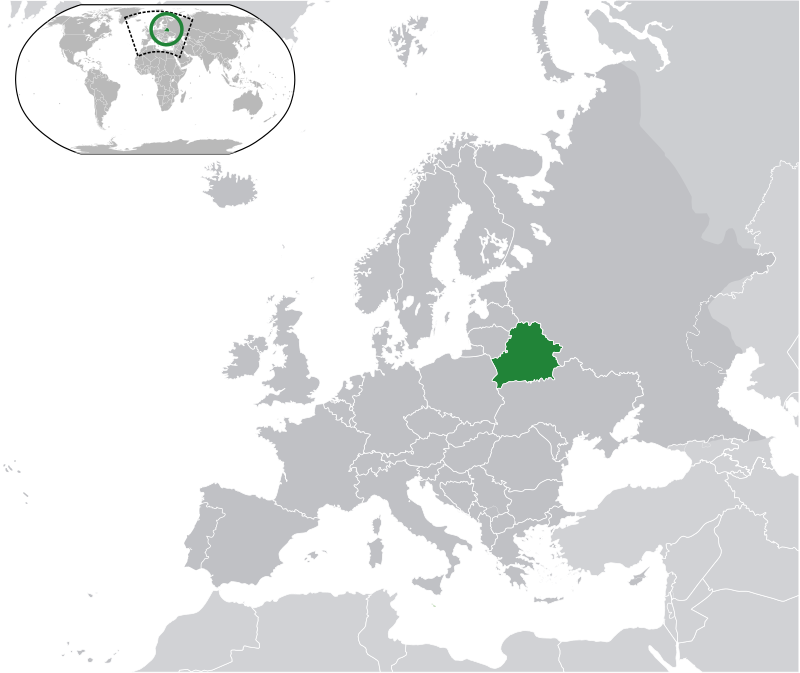
800px-Europe-Belarus.svgHow many Belaruses would fit into Mother Russia? Eighty-three! And yet, as Ivan Davydov argues, the current Russian regime is a “failed police state,” unlike the Belarusian regime. Neither fish nor fowl (although most certainly foul), Putin and his vassals have tanked their country’s economy while also signally failing to save people’s lives, nor have they been able to conjure away the coronavirus pandemic (rhetorically, if not in reality) as successfully as their frenemy the Belarusian dictator Alexander Lukashenko. Image courtesy of Wikipedia
A Poor Excuse for a Belarus: The Collapse of Vladimir Putin’s Police State
Ivan Davydov
Republic
May 14, 2020

My apartment looks onto the Yauza River and the park on the shore. In peacetime, there are crowds of people strolling there when the weather is good. And lots of shishkebabers, who are famously to blame for all our troubles.

For more than a month now, I have been locked up like all law–abiding Russians, making only occasional trips out of the house on urgent business. I watch the world mostly from my balcony, and my world has narrowed to the size of this selfsame park.

Going to parks has been prohibited in Moscow by a special decree of the city’s all-powerful mayor. In parks, the coronavirus is particularly brutal, tracking down rare passersby, lonely morning jogging enthusiasts, and mothers with children, attacking and devouring them. On construction sites, on the contrary, the virus is weak and cowardly: it is afraid of construction workers, whom it does not touch.

Parks are a different matter.

The irresponsible residents of my neighborhood would still go to the park. Not in droves, as was the case before, no. They would go in small groups, as families, apparently. Joggers occasionally popped up, and bicyclists flashed by. Children made their way to the playgrounds (which were also closed, of course). In other words, they violated the mayor’s wise orders.

To put a stop to this unbridled lawlessness, police patrols would come to the park. The guardians of law and order would park their car on a hillock and stand around smoking and watching people walking. Once, when it was particularly cold, wet snow was pouring down, and only a lone madman was sitting on a bench, they went up to the madman and forced him to sign some papers.

And once they went down to the park and fed the ducks, pointedly ignoring the people walking around, before returning to their car. Oh yes, and a couple of times they shouted into a megaphone about the fact that going to parks was temporarily prohibited, and that citizens should look out for themselves and their loved ones.

I will explain later what this pastoral sketch was all about, but in the meantime let us look through the window at our neighbor to the west. It is a fascinating story.

A Wonderful Neighbor
While the rest of the world has been in quarantine, Alexander Lukashenko has gained fame as a maestro of fiery speeches and colorful aphorisms. He has suggested treating the coronavirus with vodka, a bath, and field work. He has advised Belarusians who have lost their jobs to find a job and get to work. (It’s brilliant, really, and simple, like all brilliant solutions.) He advised overly light-minded men to be patient and not to mix with other men’s women for a while. Lukashenko is a president with real gusto, not a president who talks about ancient battles with the Polovtsy from his bunker.

To the frenzied delight of Russian jingoists, Lukashenko held a parade on May 9 [Victory Day], attracting crowds of people, including the elderly. And the very elderly—veterans, in fact. But that was only half the trouble. He also said that after the parade, the statistics on the incidence of pneumonia had gone down. He confessed (he’s an honest man) that he had feared an increase in the incidence of pneumonia, but it didn’t happen. “Well, what did we end up with? There has been a significant reduction in pneumonia in Minsk: it dropped by half yesterday. And I made the sign of the cross yesterday: God grant that we will continue giving hell to pneumonia like this.” Fresh air, he said, helps a lot.

And if Lukashenko had wanted, he could have said that people who died from the coronavirus had begun resurrecting after the parade. (As of May 12, according to the official statistics, 142 people in Belarus had died from the coronavirus.) Why? Because he can, that’s why. He can stamp out any protest. He can ignore the reports from the doctors.

It’s not even the Swedish model. The Swedish model, whose success is a matter of debate (a debate we will have later) stipulates that big public events not be held, and citizens behave responsibly. The Belarusian model assumes that there are no citizens. There is a populace that absolutely obeys the decisions of the supreme leader. Happily for us, the new virus is not the medieval black death: clearly, the country will not die off if you purposely avoid imposing a quarantine in order to save the economy. The Belarusian president made his choice by deliberately deciding to sacrifice a certain (non-essential) number of inhabitants, who cannot be saved by vodka or field work.

And after Vladimir Putin announced a “phased exit” from the semi-imposed non-quarantine, Lukashenko condescendingly praised his junior comrade, saying that Russia had followed the Belarusian path.

The Russian Miracle
But in fact, Russia has its own special path. The “non-working weeks” battered the economy considerably, but it is questionable whether they were able to protect residents. When the quarantine was imposed, there were very few cases. When the government started lifting the quarantine, Russia shot up to second place worldwide in the number of infected people.

Discussing the reliability of Russian statistics is a risky business: nowadays, the prosecutor’s office does not see much difference between well-founded criticism and “spreading fake news” about the coronavirus. But we will not make any arguments, we will just note what respected officials and politicians have been saying.

On May 12, Anna Popova, the head of [Russian federal consumer watchdog] Rospotrebnadzor, said that 28.4% of people identified in Russia as infected with the coronavirus were hospitalized. At the time, the total number of people identified as infected was around 230,000; a simple mathematical calculation gives us approximately 65,000 people in hospitals. (In fact, the real figure is another ten thousand less, since we are not taking into account the people who have recovered). But the next day, Health Minister Mikhail Murashko said at a cabinet meeting that there were more than 100,000 Russians hospitalized with the coronavirus. You would agree that all this makes it seem that our government is surprisingly footless and fancy-free with statistics, even with their own official statistics, with statistics intended for the public.

On May 13, the Moscow Health Department reported that 60% of those who died with a diagnosed coronavirus had not been included in the coronavirus fatality statistics for capital, because they had died from “obvious alternative causes.” The governor of Petersburg also reported that there had been a spike in the incidence of pneumonia in the city: the indicators were “five and a half times higher than the average.” Since the first of March, 694 residents of Petersburg have died from pneumonia, and 63 from the coronavirus.

Perhaps this is the reason for the Russian miracle of rather low mortality rates from the coronavirus infection. Especially if you remember that Russia is not only made up of capital districts and metropolitan areas, that in the regions, as a rule, all or almost all media outlets are controlled by the local administrations, and it is even easier for them to turn statistics from an enemy into an ally.

And why did the head honcho announce the end of the “non-working weeks”? Well, it’s not so hard to turn a terrible virus into a non-scary one. It’s like with elections: what matters is not what really happened, but who counts the votes and how they count them.

Amulets for MPs
But what’s really going on? In fact, our high officials are afraid, and they are trying to protect themselves by turning the nightmare into a joke and not standing on ceremony with the public. Saving your own life is more important than standing on ceremony.

On May 13, Igor Molyakov, an MP from A Just Russia, asked State Duma Speaker Vyacheslav Volodin why some of their colleagues were coming to sessions of parliament not wearing their MP pins, as required by law, but wearing quite different pins featuring a white cross on a black background. Molyakov added that he was a dog breeder himself and would like to know whether it would be possible for him to wear the pin of his kennel club instead of the Russian tricolor on his lapel.

Volodin’s answer, I hope, will go down in the annals: “Let’s ask the people who are wearing these pins, but as far as my colleagues have told me, they are special devices for repelling the virus.”

I wouldn’t be surprised if, one day soon, MPs ran naked around the State Duma building on Okhotny Ryad banging on pots: this method of fighting pestilence has been described by anthropologists. And we can only pray that no one tells them that fresh human flesh, for example, staves off the virus. They would believe them.

Dmitry Peskov, the president’s press Secretary, has fallen ill. And now he remembers regretfully the “virus blocker” that he wore and then stopped wearing after he was mocked in the press.

Here it is important to understand that the people wearing the miracle badges and warding off the virus with life-giving white crosses are the same people who explain why “phasing out restrictions” at the peak of the epidemic is justified, and make decisions that affect our lives.

Of course, they themselves get sick and get infected, but let’s not forget that we will be treated in slightly different hospitals, if push comes to shove.

It’s hard to stop. For dessert we have another intellectual delicacy, this time from Petersburg Governor Alexander Beglov. He has explained why masks cannot be distributed for free in the city during the mandatory mask regime: “Yesterday, we adopted a resolution not to give out free masks, but to hand out money. There are a lot of people in our city, both visitors and non-visitors, and people from other regions. How should we should distribute these masks? We should make you show your passport and ask where you are registered.”

The virus, you understand, asks to see people’s residence permits and attacks only native Petersburgers. It presents no danger to out-of-towners and migrant workers, nor can they themselves infect anyone. Governor Beglov is in charge of Russia’s second largest city, the home to millions of people and a “pneumonia outbreak” that, of course, has nothing to do with the coronavirus.

By the way, Beglov’s “money” amounts to 800 rubles [approx. 10 euros] for pensioners and members of large families to buy masks.

A Failed Police State
But let’s go back to my park. I started with it to illustrate the fact that the police state in Russia has failed. There has been a lot of overkill, and people all over Russia have been pretty annoyed, but the police have been unable to ensure compliance with the imposed restrictions. They are good at breaking up peaceful protest rallies, but bad at everything else.

The government had a choice. It could have engaged the citizenry in dialogue, rejected intimidation in favor of education, sought compromises where possible, and, of course, provided direct financial assistance to those forced to stay at home. It could have made Russia’s citizens its allies instead of making them the targets of an incoherent police dragnet. To do this, however, it would have had to see the populace as citizens, but we have a big problem with this sort of thing in Russia.

The government could have done it, but it was impossible—forbidden—for the government to do it.

It would have been possible to issue endless prohibitions of varying degrees of savagery and to force the population to comply with them using an old and proven argument—the police billy club. But that didn’t work out either. It turns out that there is no police state in these parts. There is a useless system of governance that starts to crumble at the first serious test. Ensconced in his bunker, the head honcho denounces the immorality of the Spartans, while his subordinates are decked out in life-saving amulets, expecting that by summer everything will have somehow worked itself out.

The reason they terminated the “non-working weeks” is that they simply could not enforce the lockdown measures. And they decided to rescue the economy since they had been unable to save people. But there was a tiny twist: they did this only after after the economy had been dealt a serious blow.

The Russian state makes war on Russian citizens as if they were the main threat when, in fact, there are no real threats to it, but it simply vanishes when there is a real threat. This is exactly what Putin has built over the last twenty years. This is the whole “Russian federal system”—terrifying, unsinkable, tending to totalitarianism. It’s a poor excuse for a Belarus. It’s a slightly rotten Belarus.

Take care of yourselves and help each other. No one else is going to help us.

Translated by the Russian Reader

Russia’s Most Dangerous Shaman

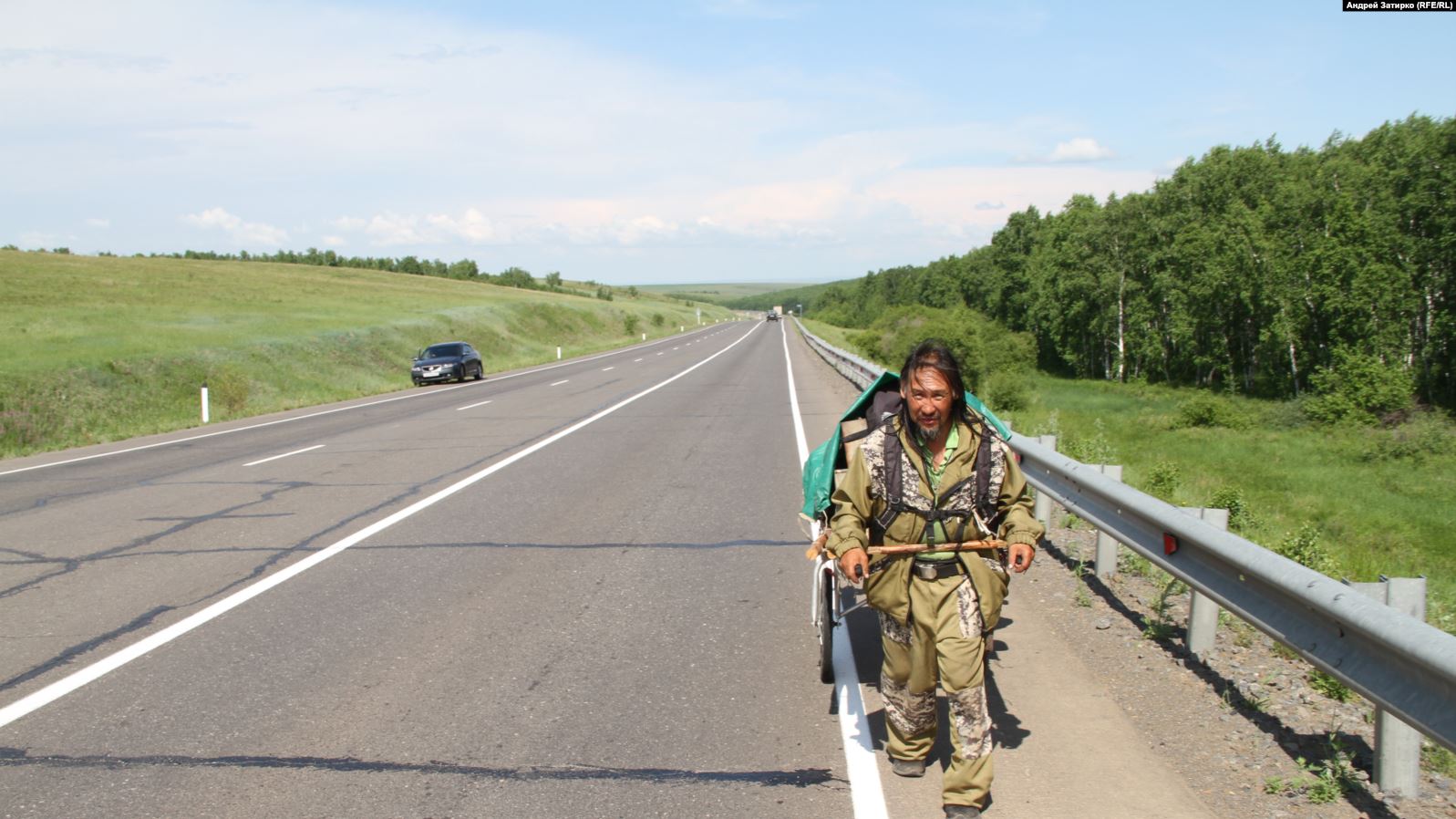
shamanAlexander Gabyshev. Photo by Andrei Zatirko. Courtesy of RFE/RL
Riot Police Storm House of Alexander Gabyshev, Yakut Shaman Who Promised to Exorcise Putin
Radio Svoboda
May 12, 2020

Riot police have detained Alexander Gabyshev, the Yakut shaman who last year promised to exorcise Russian President Vladimir Putin from the Kremlin, and taken him to a mental hospital, according to MBKh Media, citing Alexei Pryanishnikov, the coordinator of Pravozashchita Otkrytki [Open Russia’s human rights program].

According to the human rights activist, at least twenty special forces officers had stormed the shaman’s house in Yakutsk. The reason for his arrest is unknown. Earlier in the day, Gabyshev had been visited several times by people who presented themselves as medical professionals, and asked to test him for the coronavirus. Two of Gabyshev’s supporters were detained along with him for violating self-isolation rules.

Gabyshev gained notoriety in the spring of 2019, when he set off on foot to Moscow to perform an exorcism ritual to force Russian President Vladimir Putin from the Kremlin.

___________________________________


A Shaman for Putin: What Siberians Are Telling Gabyshev on His Way to Moscow, Radio Svoboda, September 12, 2019. Yakut shaman Alexander Gabyshev believes that Vladimir Putin is the “spawn of dark forces,” so he set off on foot to Moscow to “exorcise” him. The shaman began the journey alone, but soon followers began to join him. In Chita, he spoke to a large rally. Buryatia was the next region on Gabyshev’s journey: mass protests started in Ulan-Ude after his supporters were arrested. Gabyshev planned to take two years to get to Moscow so he could unhurriedly converse with the people along the way. The shaman and his followers moved along the roads, covering an average of twenty kilometers a day, stopping for the night in tents, sometimes at roadside motels. Local residents and passing people went to talk to Gabyshev, taking pictures, and helping with food and money.

___________________________________

On September 19 of last year, Gabyshev was detained at the border between Buryatia and Irkutsk Region during an operation involving special forces. He was identified as a suspect in a criminal investigation into alleged instances of “incitement to extremism” and released on his own recognizance. A psychological and psychiatric examination ordered by police investigators found that Gabyshev was mentally incompetent.

Gabyshev subsequently tried to resume his campaign, promising to make another march on Moscow in June.

The criminal case against Gabyshev was suspended for the duration of the epidemic. International human rights organization Amnesty International declared him a prisoner of conscience.

“‘What sounds like a tale from Russian folklore has become, in today’s Russia, just another act of brutal suppression of human rights,” the organization noted.

Translated by the Russian Reader

BBC Russian Service, From Yakutia to Moscow: A Shaman’s Journey Against Putin, September 24, 2019

Presumption of Guilt

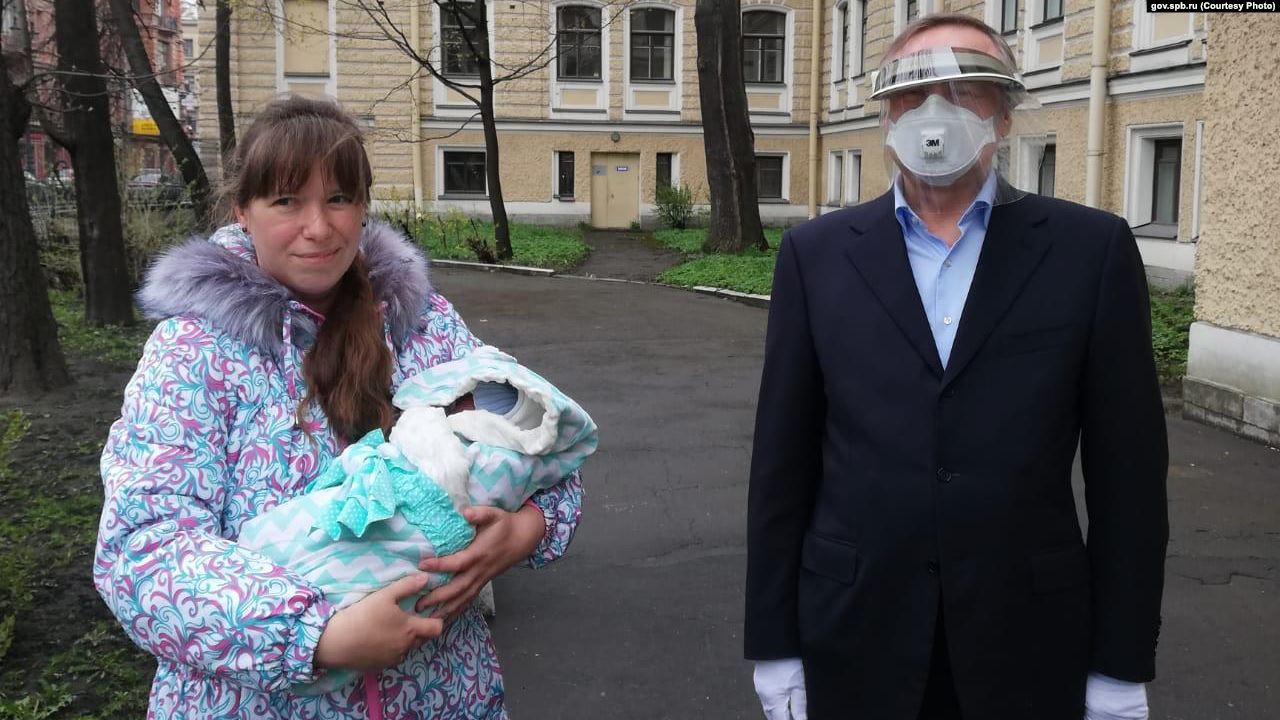
beglovPetersburg Governor Alexander Beglov (in mask, on right) visited the city’s Maternity Hospital No. 9 on May 3. Photo courtesy of Sever.Realii
Beglov Explains Outbreak at Vreden Center Through Failure of Employee to Self-Isolate After Returning from Turkey
Bumaga
May 1, 2020

Speaking on TV channel 78, Governor Alexander Beglov claimed that the source of the coronavirus outbreak at the Vreden Traumatology and Orthopedics Institute in Petersburg was an employee who had returned from Turkey and failed to self-isolate.

“Again, we’re talking about conscientiousness, about people’s other qualities . . . One employee at the Vreden Institute came back from Turkey. By law, he should have stayed home fourteen days in self-isolation. He went out on the fourth day, engaged in certain activities and, consequently, brought the infection into the hospital. And a large number of people were infected, on the order of 150 people. Naturally, the hospital had to be closed,” Beglov said.

Beglov noted that during this time, a large number of patients were discharged and released to other regions of the country, thus “spreading” the coronavirus.

The governor did not directly respond to a question about whether any measures would be taken against the employee who did not self-isolate. “The law stipulates criminal liability. We have already opened five criminal cases. This is no a joke, ” Beglov said. The governor also cited the closure of three maternity hospitals where women in labor “forgot to warn” staff about their recent trips.

The Vreden Institute of Traumatology and Orthopedics has been closed for quarantine since April 9 due to the coronavirus. Doctors reported a lack of personal protective equipment. There is no official information about the number of cases, but according to media reports, sixty out of 260 employees tested positive. TASS reports that 300 people at the hospital have been infected.

[. . .]

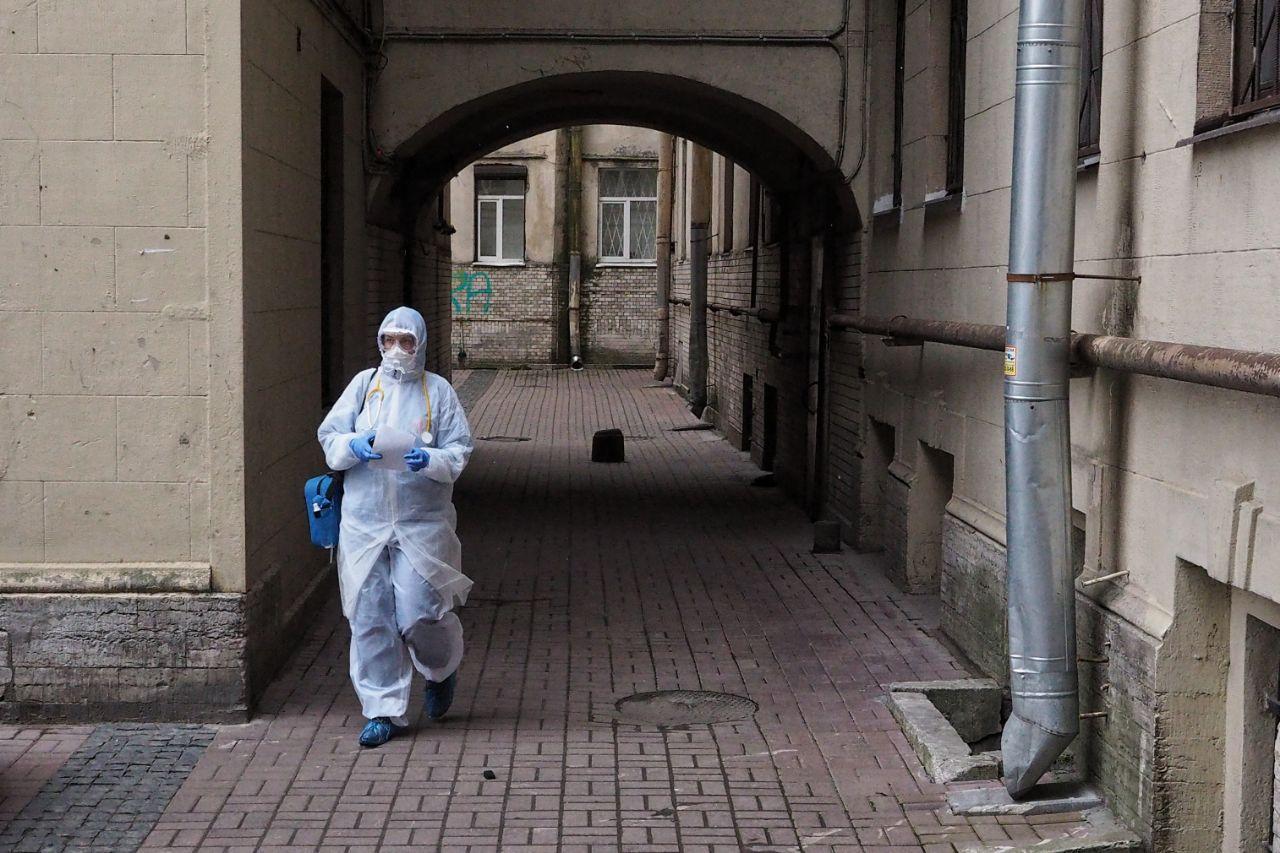
fontankaPhoto by Mikhail Ognev. Courtesy of Fontanka
Presumption of Guilt: Petersburg Doctors Warned They Should Die from the Coronavirus Correctly
Alexander Yermakov
Fontanka
May 1, 2020

Not all doctors infected with COVID-19 will receive financial compensation from the city. The municipal public health committee has made it possible to shift responsibility to health workers and thus save the municipal government money.

The Smolny [Petersburg city hall] has given head physicians at the city’s hospitals the right to decide whether health professionals were “correctly” infected with the coronavirus or took ill due to their own negligence. Occupation health and safety experts see this as an acute conflict of interests and predict a wave of refusals to make cash payments to people whom President Putin has compared to soldiers fighting on the front line.

The Smolny decided two weeks ago on the amount of lump-sum payments to health professionals who have suffered while treating patients with COVID-19. The death of a hospital or ambulance employee has been valued at one million rubles [approx. 12,000 euros]; disability, at 500,000 rubles [approx. 6,000 euros]; and infection with no particular health consequences, at 300,000 rubles [approx. 3,700 euros]. Thirty million rubles [approx. 368,000 euros] have been allocated for this purpose. The small matter of outlining the procedure for determining whether a health professional was a victim of the virus remained. The task was assigned to the city’s public health committee.

While the committee has been designing this procedure, Petersburg health professionals began contracting the coronavirus in large numbers and dying. As of April 30, around 250 cases of COVID-19 had been registered among the city’s doctors, paramedics, and orderlies.  If each of these cases had resulted in compensation, Smolny’s thirty-million-ruble limit would now have been surpassed: eight million rubles would have been paid to the families of the dead, and 75 million rubles to infected health professionals [for a total of approx. 981,000 euros].

A few days ago, a draft order appeared on the public health committee’s website, establishing the procedure for recognizing a medical worker as a victim. The document indicated that the families of those who died with a confirmed diagnosis of COVID-19 would automatically receive payments.

On Friday, April 30, the final version of the document was published on the Smolny’s website. A significant addition has been made to it. The death certificate must cite the novel coronavirus infection as the cause of the medical worker’s death. If the medical worker died of concomitant diseases, their family cannot claim compensation. As cynical as it might sound, the family of Sergei Beloshitsky, an emergency room anesthesiologist at the Alexander Hospital, would not have received the million rubles promised by Governor Beglov had Beloshitsky died after April 30. The death certificate lists pneumonia-induced cardiopulmonary failure as his cause of death.

“This item [on the exact cause of death] was added at the approval stage of the draft municipal government decree ‘On the procedure and conditions for providing lump-sum payments to injured medical workers’; it is a clarification,” Fontanka was informed by the public health committee.

According to the committee’s order, payment to infected health professionals is almost entirely contingent on the opinion of the head physician at the institution where the person works.

Medical workers must append a whole stack of documents to the compensation application, including—and this will be the main obstacle to receiving money—a “certification of injury caused by rendering assistance to sick patients.”

For a medical worker to obtain this certification, he or she will be subjected to an investigation carried out by a commission convened at the hospital where the infected person works. The commission will include the hospital’s deputy head physician, the worker’s immediate supervisor (for example, a department head), someone from the hospital’s occupational health and safety office, and a trade union member.

The hospital’s head physician will have to approve (or deny) the certification of injury.

The investigation must not merely confirm or deny that the health worker contracted the coronavirus in the line of duty (and not in the subway), but also name a specific factor, for example, violation of sanitary regulations, working conditions, failure of ventilation systems, or lack of personal protective equipment. In addition, the commission has the power to determine in percentages the degree of the medical worker’s own liability.

For example, on April 30, Sergei Sayapin, an emergency room anesthesiologist at the Pokrovskaya Hospital, filed an application to be certified injured as a result of having treated a patient with a confirmed case of COVID-19. Sayapin was infected and underwent treatment at the Botkin Infectious Disease Hospital.

The Pokrovskaya Hospital will investigate this claim. The investigation’s findings will be approved (or denied) by the head physician, Marina Bakholdina. Sayapin claims that he was infected due to a lack of personal protective equipment, which was allegedly not provided by Bakholdina. In order for Sayapin to be entitled to compensation in the amount of 300,000 rubles, his hospital’s head physician must declare herself guilty.

“No hospital director in their right mind will take responsibility and sign a certificate recognizing their employee as a victim,” said Oleg Shvalev, an occupational therapist and associate professor of occupational medicine at the Mechnikov Northwestern State Medical University. “Under the usual procedure for certifying occupational illnesses and injuries, an independent commission headed by an official from Rospotrebnadzor runs the investigation.”

It is obvious that head physicians are not interested in recognizing medical workers as victims. Rostrud (the Russian Federal Labor and Employment Service) has already proposed deeming each case of coronavirus infection an acute occupational illness, running an investigation (involving Rospotrebnadzor), and holding the management of medical institutions accountable. It is entirely possible that while a hospital’s own commission could deem individual medical workers guilty of their own infections (thus depriving them of the right to compensation from the Smolny), the social security disability assessment board would find the hospital liable.

A source at city hall told Fontanka that the city had already clearly decided on its method for counting COVID-19 cases and did not plan to change it.

“Our statistics include people who died from covid, not with covid,” the official said. “There are dozens of instances when patients with confirmed cases of the coronavirus have had cancer, heart failure, or pneumonia listed as their cause of death. The same method will be applied to medical professionals.”

The Petersburg public health committee confirmed that the death of every medical worker would be investigated by the commission for the analysis of deaths from influenza and severe forms of other SARS, including COVID-19. Only if the death certificate lists the cause of death as infection from the novel coronavirus will families of the deceased be eligible for compensation.”

Fontanka asked the Moscow health department how they keep their statistics. All patients with a positive test result for the novel coronavirus infection and a confirmed diagnosis of pneumonia are counted in Moscow. “The cause of death could be another concomitant disease, but it does not matter for our statistics,” an official at the department added.

According to the head of the working group on combating the coronavirus, Yevgeny Shlyakhto, director of the Almazov Medical Center, only half of the healthcare professionals in Petersburg who have fallen ill with COVID-19 contracted it directly through their work. Most likely, infected doctors working in non-specialized hospitals will not automatically be covered under the Smolny’s compensation order.

Thanks to Dmitry Kalugin and Vadim Klebanov for the heads-up. Translated by the Russian Reader

Hard to Be a God

Moscow City Duma Deputy Besedina Ruled Out of Order for Proposing Putin Officially Be Called “God” and “Bright Star”
Mediazona
March 12, 2020

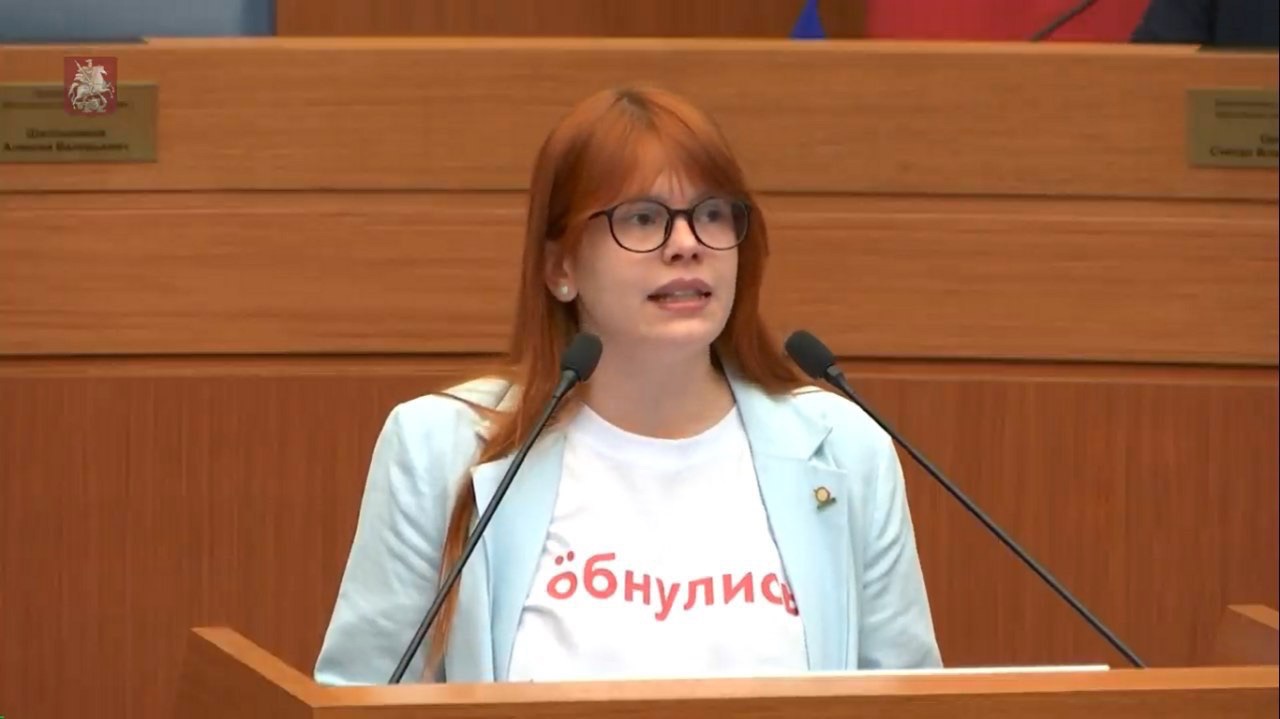
Darya Besedina, a deputy of the Moscow City Duma from the Yabloko faction, was ruled out of order after proposing fifty amendments to a draft resolution on amendments to the Russian Constitution. The session was broadcast on the Moscow City Duma’s YouTube channel.


Footage of Darya Besedina addressing the Moscow City Duma, followed by a brief interview with Besedina on Radio Svoboda’s  Current Time program.

“I believe that the text of the submitted amendments contains deliberately false information,” said Moscow City Duma Speaker Alexey Shaposhnikov, without specifying what information he had in mind.

Besedina’s fifty amendments included suggestions to insert the words “given that Putin is the apostle of national unity” and “noting that in future it will be necessary to add to the Constitution that a family is a sacred union between a man and a woman and Putin” before the phrase “the Moscow City Duma resolves.” Besedina also suggested inserting the phrases “faith in the God Vladimir Vladimirovich Putin” and “V.V. Putin is a Bright Star.”


https://twitter.com/naive_elf/status/1238126214503698432/photo/1

Besedina posted the text of her proposed amendments on Twitter

The deputies decided to vote on the entire set of amendments rather than considering each one separately. Besedina’s proposed amendments were thus rejected since only three deputies voted for them, including Besedina herself. Soon thereafter the Moscow City Duma approved the amendments to the Russian Constitution itself.

obnulis

Besedina came to the session wearing a t-shirt embossed with the slogan “Zero Out (Fuсked in the Head)”* and harshly criticized the new amendments to the Russian Constitution. Moscow City Duma Deputy Chair Stepan Orlov said her speech was an “assault” and asked the regulations committee to analyze it for possible slander. Deputy Elena Nikolayeva called on Besedina to resign her seat.

The previous day, the Russian State Duma approved an amendment to the Constitution that would give Vladimir Putin the right to seek two more presidential terms.

* The umlauted ö on Besedina’s shirt suggests that obnulis’ (“zero out”) should also be read as ëbnulis’ (“they’re fucked in the head,” “they hit themselves hard on the head”).

Photo courtesy of Medialeaks. Translated by the Russian Reader

Don’t Protest Here

miting
Petersburg historic preservationists gathering for a “sanctioned” protest near the Sports and Concert Complex (SKK), a late-Soviet era landmark in southern Petersburg that recently collapsed while being illegally dismantled, killing one worker. Photo by Sergei Yermokhin. Courtesy of Delovoi Peterburg

Don’t Rally Here: It Will Be More Difficult for Petersburg’s Historic Preservationists to Protest
Svyatoslav Afonkin
Delovoi Peterburg
March 11, 2020

The Petersburg Legislative Assembly is amending the city’s law on protest rallies. The rules for holding protests have become more complicated, especially for historic preservationists.

The city parliament passed in the second reading a new redaction of the law on protest rallies. Thanks to amendments introduced by the parliamentary majority, the minimum number of “Hyde Parks” [locations where it is legal to have public protests] has been reduced from eight, as stipulated in the first redaction of the draft law, to four. Moreover, the parliament’s legislative committee added another restriction: a ban on public events outside dilapidated buildings in danger of collapsing.

Several sites designated as “dangerous” have inflamed the passions of historic preservationists in recent months. The roof on the Petersburg Sport and Concert Complex (SKK) was deemed dangerous. The Basevich tenement building on the Petrograd Side, which has been threatened with demolition, is also considered dangerous. Protest rallies have recently taken place on more than one occasion at both sites. The resettled houses on Telezhnaya Street, which the Smolny [Petersburg city hall] wants to sell, have also been the focus of public attention once again.

Drone footage of the collapse of the Sport and Concert Complex (SKK) in Petersburg in January 2020. Courtesy of Fontanka.ru

Alexei Kovalyov, leader of the Just Russia faction in the legislative assembly and deputy chair of its commission on municipal facilities, urban planning, and land issues, argues that new language in the bill appeared for a reason.

“Of course this will be an obstacle for historic preservationists. Our faction opposed these cretinous amendments. There is no doubt that this is why the new norm was introduced. It was done deliberately,” Kovalyov told DP.

Anna Kapitonova, a member of the presidium of the Petersburg branch of VOOPIiK [Russian Society for the Preservation of Historical and Cultural Landmarks], noted that the amendments could make life more difficult for protest organizers: small protest rallies, such as a series of solo pickets, sometimes take place right on the sidewalks, after all. According to Kapitonova, the authorities were also able earlier to prevent even solo pickets on the pretext that scheduled maintenance or construction work was taking place nearby.

“Last year, I held a solo picket at the entrance to the Smolny. After a while, an official with the law enforcement committee came out of the building. Although the Smolny is hardly a dangerous site, scheduled maintenance of the facade was underway over fifty meters from my picket. But the official told me it was dangerous for me to be there, and asked me to move away,” Kapitonova said.

Denis Chetyrbok, head of the legislative assembly’s legislative committee, told DP that the amendments were introduced in connection with a Constitutional Court ruling, and parliamentarians had no other motives.

“If there is a dangerous building that might collapse located next to the place indicated in the [protest rally] application, then it will be difficult to secure approval for a public event,” Chetyrbok confirmed.

Translated by the Russian Reader