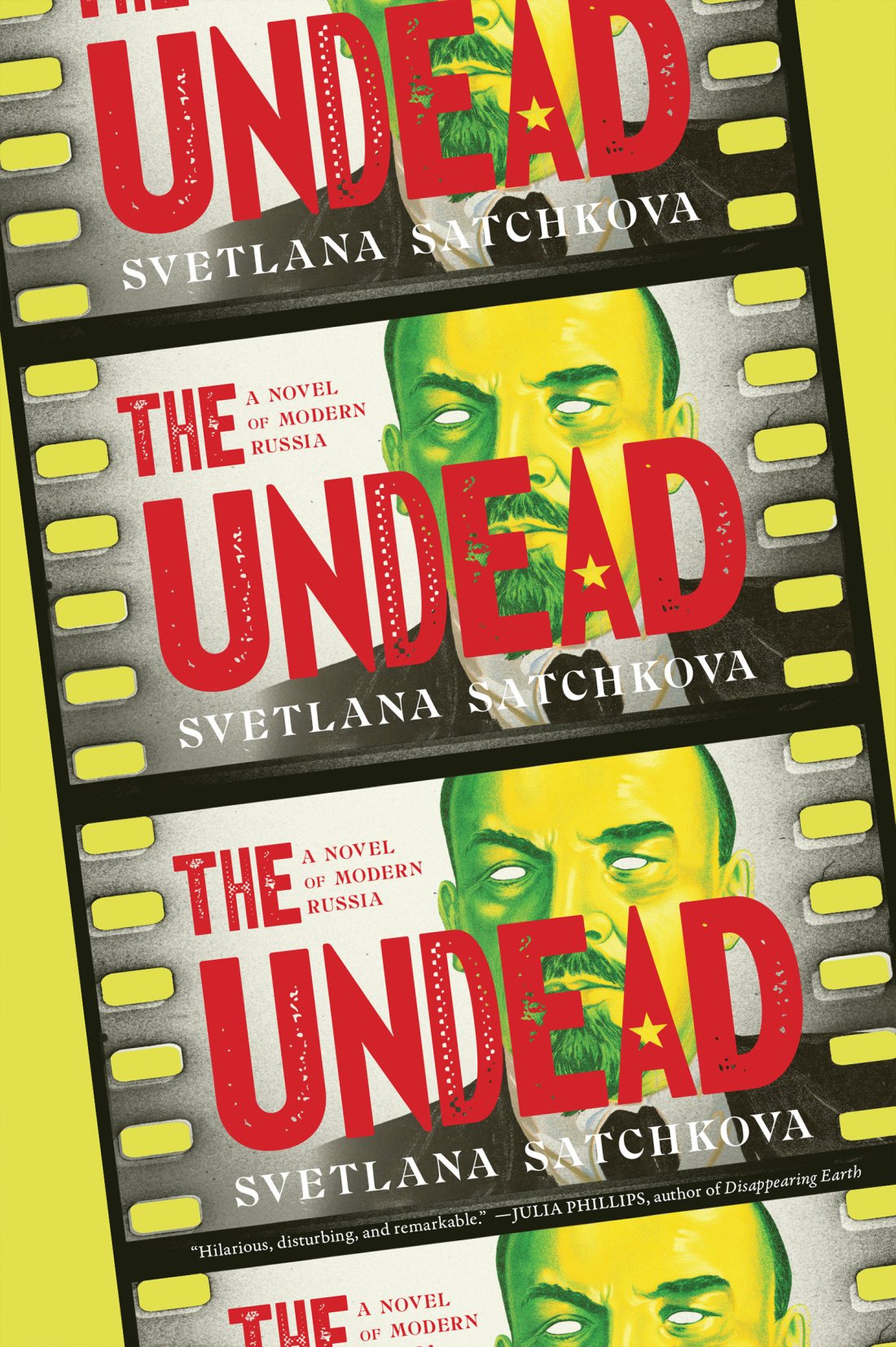
In this gripping tale of contemporary Russia, a young filmmaker and her friends run afoul of a government that ruthlessly oppresses artists who dare to satirize the regime…
When Maya, a young Russian filmmaker, makes a low-budget horror movie with her friends, it seems like a promising start to a career in indie film. Little does she know that her jokey lo-fi film will soon attract the attention of the autocratic censors at the highest levels of the Russian police state.
What follows is a propulsive narrative of an artist being crushed by state power, and the choices that one makes within a system where free expression is literally illegal. Written with the undeniable voice of a emigre from Putin’s Russia, The Undead is a tense, piercing story that serves as a parable, and a warning, about political oppression.
Contributors
Svetlana Satchkova is a Russian-born journalist and writer who immigrated to the United States in 2016. She is an established arts journalist with bylines in the Rumpus, Newsweek, LARB, and others. She is currently a research fellow at the Jordan Center for the Advanced Study of Russia at New York University, has an MFA from Brooklyn College, and lives in Brooklyn. The Undead is her first novel in English.
Praise
“[An] exquisite balance between contentment and foreboding, tranquility and chaos” — Vogue
“Chillingly examines the Russian government’s stranglehold on the arts and media industries …. a convincing cautionary tale of the dangers of political apathy.” —Publishers Weekly
“[A] brisk, vivid page turner” — The Milwaukee Shepherd Express
“There is nothing supernatural about the zombies in Svetlana Satchkova’s savvy, frightening novel. They are all of us, wherever we are, who keep looking away when authoritarian forces crush expression. Witty and unsettling, The Undead is a cautionary tale about, among other things, never quite admitting where the danger lies until it’s too late.” —Sam Lipsyte, author of The Ask
“The Undead is a courageous and witty book about art and politics. With keen insight and wry humor, Svetlana Satchkova evokes a devastating artistic and moral reckoning. This fascinating, propulsive novel will stay with me.” —Helen Phillips, author of The Need
“The Undead has the force of an undertow, pulling us relentlessly away from safety. Svetlana Satchkova has written a gripping, haunting portrait of a world coming undone.” —Madeleine Thien, author of Do Not Say We Have Nothing
In The Undead, the career and well-being of Maya, a young filmmaker in Moscow, unravel in the most bizarre, realistic way, showcasing the insidious, absurd nature of a totalitarian state. Deeply informative and engrossing, The Undead examines how bizarre and horrific human nature can evolve under the pressure of the desire to live unharmed rather than free. A moving examination of the meaning of home, the horror of a dictatorship, the hilarity and joy of movie-making, and one woman’s political coming of age in Putin’s Russia. Truly important reading for our times.” —Paula Bomer, author of The Stalker
Glintshake, “Have a Heart” • Erarta Museum, St. Petersburg, 2 April 2017 • Source: Denis Morozov (YouTube)
[Verse 1] Beyond the bright lights Of sleepy buildings Lines in the snow Send signals From distant stations Docks are waiting Waiting in the fog For distant shores In the haze of summer In the arctic circle
[Chorus] Have a heart
[Verse 2] A gusty wind Noise on the line The compactor gently crushes the white Volga, waves splash The markings are washed away The airfield is not visible in the fog, the camera clicks The speed drops The waves crash The earliest The most distant flight Faces and shadows Of random passersby
[Bridge] In dark apartments In yellow deserts In blue snows In fiery rivers In the foggy sea
[Chorus] Have a heart
[Outro] Salt on the dials The needle flutters The airfield is invisible in the fog, the camera clicks Step on the gas! In the endless field, in the pink jungle, in the summer haze Have a heart
[Verse 1] Headlights, I see a shadow Someone’s been hanging around for days Standing around the corner Lying on the grass under the window A bloodsucker Or the corner Loading His black barrel His black barrel His black barrel His black barrel
Who is he, a skinner Or a TV reporter A maniac, a Satanist Or a Russian Orthodox Stalinist I hear the wind An ominous moan The pungent scent Of pouring cologne
[Chorus] A halfman Roams Moscow A halfman In a half-jacket
[Verse 2] Strolls in places Where everything is sold without a passport Zhiguli cars are burning We gotta move before they sweep us away Gritting my teeth I dance In a techno club Four days
When I grow up I’ll stop thinking and understand everything The light of faith will dispel the darkness My same-sex marriage will fall apart I’ll go out into the world I’ll throw away my syringe I’ll become the best Of all the shop girls
[Chorus] A halfman Roams Moscow A halfman Not in his right mind
In my days as a magazine editor in Russia, I used to write about movies Volodymyr Zelensky starred in. I thought of him as a decent actor and a nice enough person. Over the last few weeks, I’ve seen him turn into a towering historical figure. Watching his impassioned address to the UN Security Council, in which he spoke about war crimes committed by Russian troops in a town of Bucha, I caught myself thinking that I want Russia’s next leader to be just like him – courageous, principled, and boundlessly empathetic.
In the fall of 1993, I began my first semester at NYU. Just one year earlier, I’d been a regular Moscow teenager, whose wildest ambition was to own a nice pair of jeans. But my father had been offered a job at an American company, and our family relocated to New York. With the move, the world suddenly opened to me, possibilities beckoning. My father, ever the practical man, told me to study business. Ever the obedient Soviet child, I didn’t protest, despite the fact that nothing could interest me less — but fortunately for me, there was no such thing as a business major at NYU, and, when I got my BA in philosophy, I moved back to Russia, leaving my parents and younger brother behind. The fact that I did so was testament to how profoundly I’d changed in four years.
I was barely 20, but my reasons for returning were clear. I’d fallen in love with a man who lived in Moscow, and I longed for the glorious city which I still considered to be my home. In 1997, Moscow was an exciting place where everything was changing at an incredible pace. New lives were being built on top of the remnants of the USSR. I also felt drawn to Russian intellectual culture, having started writing my first novel in Russian, and I wanted my child, whom I was already carrying, to speak my native language as fluently as I did.
My marriage to the father of my son didn’t work out, as was perhaps expected of a union between people so young. But I was busy becoming who I wanted to be — a writer and a mother — and quickly bounced back. Meanwhile, Russia continued to change. In August 1999, I saw Vladimir Putin on television for the very first time, introduced as the new prime minister. I’ve never been particularly politically astute, but at that moment, I saw in his face, as in a crystal ball, what was going to happen in the years to come: the scheming, the corruption, the crackdown on independent media, the police state.
In September of that same year, a series of explosions destroyed several apartment blocks in the cities of Moscow, Buynaksk, and Volgodonsk; over 300 people died and 1700 were injured. I remember watching the news late at night, my two-year-old son asleep in the next room, and trembling in fear as I wondered if my building would be next. I imagined the most horrible thing – not that we’d both be dead, but dying, separated by fallen walls, him calling me, pleading for help. In a few days, rumors abounded that it was Putin who’d ordered the explosions with the aim of blaming them on Chechen militant Islamists. He became president in 2000, after starting the second war in Chechnya and famously having promised to “snuff ‘em in the outhouse,” to the delight of the majority of the population of Russia.
Had I believed my initial premonition, I would’ve left right away, but I liked to think of myself as a rational person. And so I tried to convince myself that I was being paranoid. It wasn’t easy.
Over the next ten years, Putin’s regime took away people’s freedoms in tiny steps that were probably meant to be unnoticeable, while he gathered enough power for himself that he could change the constitution and effectively be president indefinitely. Meanwhile, I built up my Moscow life. I was a writer, but I was also a single mother whose relatives lived across the ocean, and I worried about what would happen to my son if anything happened to me. So, though I wanted to report on the shrinking of democracy, I wrote instead about beauty and culture. In this way, I thought, I’d protect myself from the dangers of those who covered nationalist movements and wars. I wouldn’t end up dead, like Anna Politkovskaya and countless others.
But self-preservation under a regime like Putin’s can only take you so far. In 2014, when the people of Ukraine ousted their pro-Russia president Victor Yanukovych from his office, Putin swiftly moved into the neighboring country and annexed the Crimean Peninsula. Russian society split into two opposing camps, one cheering Putin’s maneuver and the other incensed by it. The question “Who does Crimea belong to?” became the most salient marker of “them” versus “us.” Marriages crumbled under the weight of this question; friendships were irreparably broken; people became estranged from their parents. Later that year, a provision to the criminal law obligated all dual nationals to report to the authorities. I made a copy of my American passport, filled out the requisite forms, and went to my local branch of the Federal Migration Service. The man who inspected my documents had the unmistakable air of someone who was embroiled in Russian state bureaucracy, at once condescending and menacing. He made it exceedingly clear what he thought of the likes of me, and when I came home that evening, I told my partner that, finally, I wanted to leave Russia for good.
It took us another two years to make the move, and we arrived in the United States in 2016. I began writing fiction in English and continued to work for Russian media outlets that didn’t support Putin’s regime. Still, I was careful not to write about politics, knowing that, if I went back to Moscow, I could face prosecution. Everything changed this February, however: Putin’s invasion into Ukraine — a country that I’d visited often and love, a country where many of my friends hail from — made it impossible for me to keep silent. I need to say publicly that this war is abhorrent and that Russians do not equal Putin –– even those of us who, like me, have been afraid to speak out in the past.
I do realize that I’m able to take this risk because I’m in New York, protected by my American passport. A law has been passed in Russia that prohibits its citizens from using the word “war” to refer to the “special operation” that’s taking place in Ukraine, and effectively prevents them from saying they’re against it under the threat of imprisonment. My heart goes out to all the people back home who feel the same way I do. I know that there are many of them and that they are experiencing crushing guilt for failing to somehow stop Putin, the president they didn’t elect. And while we’ll agonize for a long time over the question of what more each of us could have done, it’s beyond clear that peaceful protests don’t stand a chance against Putin’s weapons and his complete disregard for human life.
Source: Svetlana Satchkova, “I’m Russian and I stayed quiet about Putin for a long time. This is what I really think,” The Independent, 11 April 2022. The emphasis is mine.||||| TRR
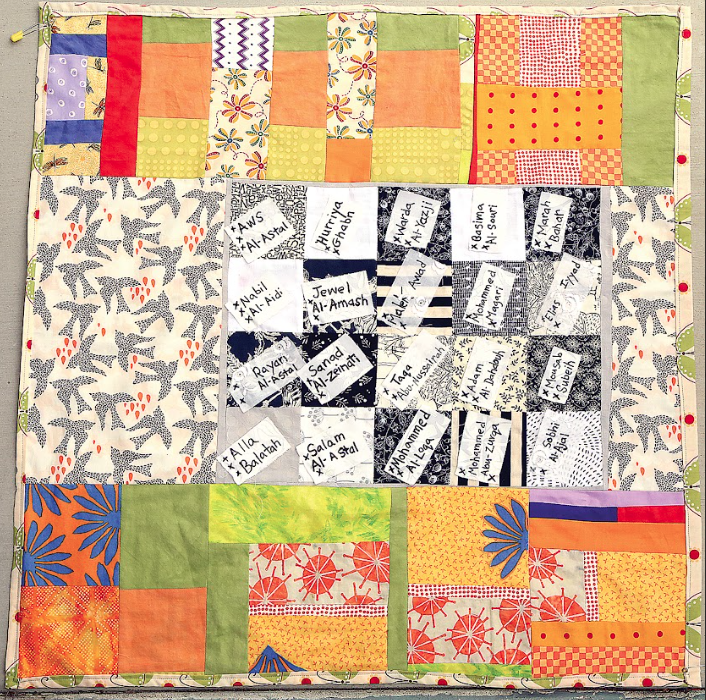
LOCAL INSPIRATION of the day. This quilt by Joleigh Kambic is part of a larger quilt titled “Babies in Gaza Who Never Made It To Their First Birthday.” The quilt is composed of smaller quilts created by nearly 40 quilters from across the Monterey Bay, commemorating the children who were killed in the Israel-Hamas war. It is on display through Oct. 3 at the Unitarian Universalist Church of the Monterey Peninsula, 490 Aguajito Road in Carmel.
As a Kyrgyz woman born in the last years of the Soviet Union, I never thought twice about whether my usage of the Russian language was problematic or not — until recently when I reached out to my Ukrainian friend in Russian, and she responded to me in Ukrainian.
I have been thinking about the political aspects of language since then.
Last week I was invited to a podcast to talk about de-colonial feminism in Central Asia by a research group that does memory studies in Kyrgyzstan. There we sat in a warmly lit Bishkek studio in comfortable canary-yellow armchairs — two women of clearly Central Asian descent, with names that mean ‘honey’ and ‘worship’ in our native language, discussing whether the Soviet Union was a colonial empire, and how a more than 100-years history of Russian presence in the region has disrupted and affected the lives of peoples of Central Asia. I am making smart jokes and incisive observations, we laugh, we debate, we lament — all in Russian.
Although this language was not the main subject of our discussion, we comment in passing on it — noting how intangible colonial legacies can sometimes have a constructive element to them.
It is, of course, possible for all of us to drop the language of the colonizer, whether it’s English, French, Spanish, Russian, or Chinese — and speak our own languages, but the ease and comfort of using these when trying to communicate with people outside our cultures is just so tempting! And so then the question is whether to take offense towards the language because it happens to have been “originated” by the ‘big bad’ or to ignore that and make it our own?
Russian was the language of books that took me on journeys across galaxies, of Soviet-era films that fanned the fire of idealism in me, of finding community with other post-Soviet teenagers that, like me, had traveled to the United States as exchange students. We spent the year yell-singing Kino’s songs, making the olivier salad for a New Year’s celebration, and rooting for Evgeni Plushenko in the 2001 Winter Olympic Games in Salt Lake City.
It was the language of the early science fiction stories I wrote when I was twelve, of expressing my first heartbreak in broken poetry form, and of clumsily flirting, building alliances, or of standing up to bullies.
It is also the language of differentiation — a tool of categorizing people into social strata, both inside Russia and in the non-Russian republics during Soviet times. My own mother had been ridiculed for not speaking Russian well, considered ‘dark’ and uneducated, uncultured. To this day she gets offended when my Russian-schooled siblings sometimes laugh at the little mistakes she makes when attempting to speak it because it reminds her of how she was treated when she was younger.
Not to worry though — this is a very rare occurrence, because our mom is so strong-minded that she’s bent everyone to her will, forcing everyone to speak Kyrgyz if they wanted to be understood by her. Even our dad, who was a Russian speaker with a beautifully reverberating voice, had mastered the Kyrgyz language for our mother’s sake. My siblings too, although their attempts at translating their jokes and anecdotes from Russian into Kyrgyz for our mom sometimes backfire because they do not take into account the semantic nuances of the two languages. And despite her lack of Russian, she made a successful career in the 90s as a kommersantka — just like thousands of other women who picked up the baton when the system that was oppressing them fell — traveling by bus and train to Moscow, Minsk, Tallinn, and later by plane to Meshhed, ensuring we were never hungry or dependent on anyone.
Maybe that’s a good example of how language does not have to be a cornerstone of someone’s lived experience. Some people choose to speak the oppressor’s language, some people choose not to. As long as there’s a way of making each other understood, even by mixing words or even using gestures, it’s all good.
My Ukrainian friend was so kind and gracious when I apologized for using Russian when I reached out to her, and she sent me a beautiful voice message back in Russian. I could hear she struggled a little speaking it because, as she explained, she had not spoken it in a while. She said she didn’t mind using it to communicate with me, and that she was sorry she hadn’t learned some Kyrgyz by now because she has other Kyrgyz friends too. And I was sorry I hadn’t learned Ukrainian by now. But eventually it was Russian we exchanged these lamentations in, and the question remains open to me — whose language is it anyway?
Syinat Sultanalieva is a human rights activist and researcher from Kyrgyzstan, who writes science fiction on the side when she’s not busy dissecting power structures and dynamics in the region and the world.
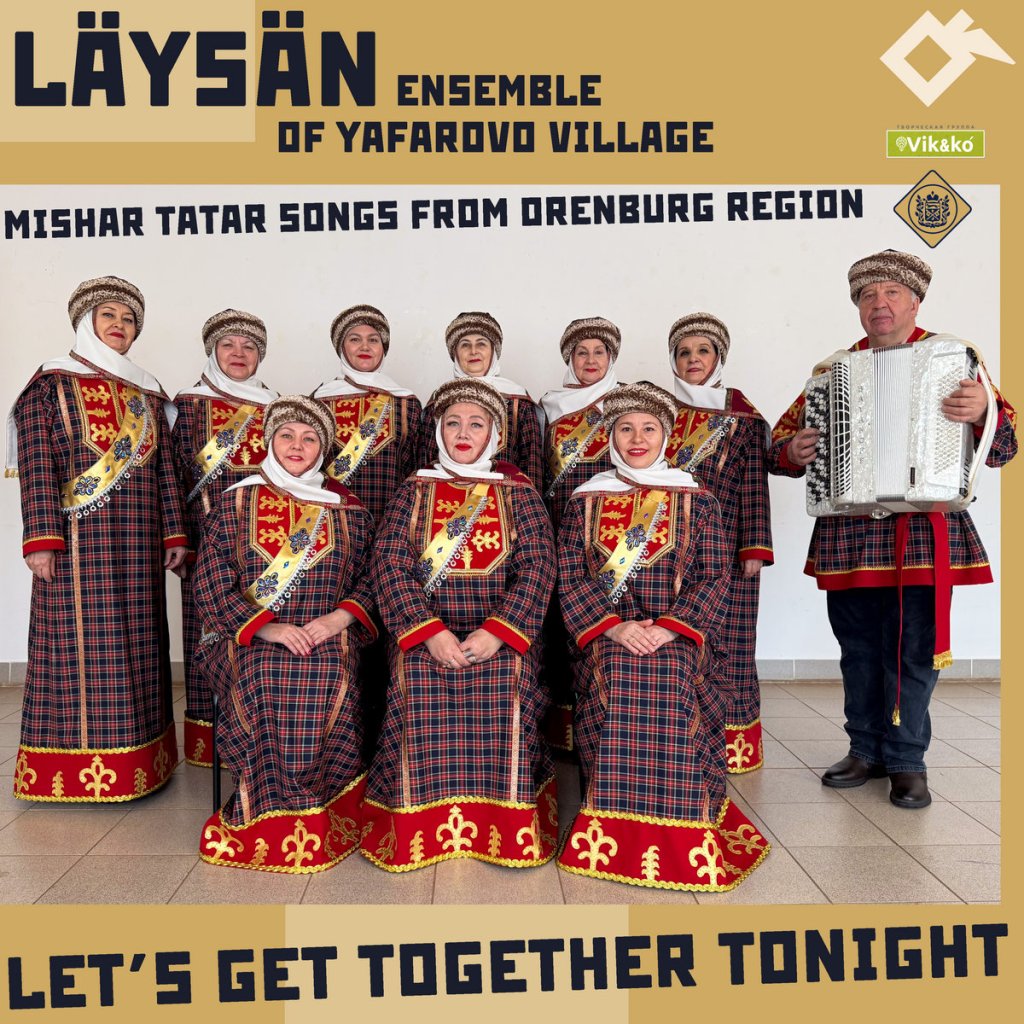
Lӓysӓn Ensemble of Yafarovo Village Let’s Get Together Tonight: Mishar Tatar Songs from Orenburg Region
The Mishars are an ethnic subgroup of Tatars. They have their own dialect and their own culture. The main part of the Mishars live in the Middle Volga region and the Urals.
Yafarovo is a Mishar village located in the Aleksandrovsky district of the Orenburg region.
Izhevsk long ago nabbed Tula’s de facto title as Russia’s arms manufacturing capital: the Kalashnikov Concern is headquartered there, producing shells, assembling drones, and making rifles. But in a seemingly parallel reality amid the rumble of the factories, young Izhevskers have opened an independent bookstore, and they have also been translating the Udmurt avant-garde of the twenties into Russian and publishing literary magazines. Who are these young people? And how was all of it possible?
“We’ll be having a children’s New Year’s party in there”
Five years ago, Albert Razin, an Udmurt activist and patriot, set himself on fire in the capital of Udmurtia, on the square outside the republic’s State Council building. Razin held a placard featuring a quotation from Rasul Gamzatov: “And if tomorrow my language disappears, I am willing to die today.”
In late 2024, I lived in Izhevsk a stone’s throw away from the spot where Razin had burned on behalf of the Udmurt language. It is the very heart of the city: the Eternal Flame, the republic’s government house, the opera house, a Rostic’s fast-food restaurant, the residence of the head of Udmurtia, and the Kuzebay Gerd National Museum are nearby.
Gerd (a pseudonym meaning “knot” in Udmurt; Gerd’s birth name was Kuzma Chaynikov) was a poet, folklorist, and probably the most important Udmurt of the twentieth century. In 1932, he was arrested along with other prominent members of Soviet Finno-Ugric ethnic groups as part of the fabricated SOFIN Case. [SOFIN was the acronym of the fictitious “Union for the Liberation of Finnish Peoples” — TRR.] The poet was accused of plotting to get Udmurtia and other autonomies to secede from the Soviet Union and establish a Finno-Ugric federation under the protectorate of Finland. Kuzebay was shot in 1937 at Sandarmokh in Karelia. He was exonerated in 1958.
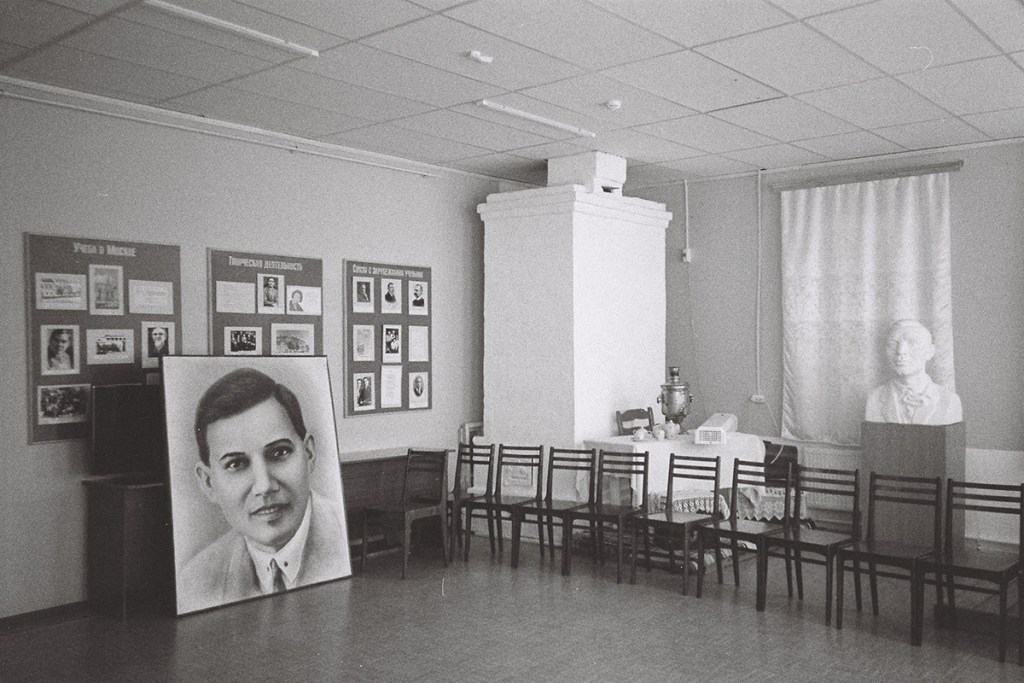
The Gerd Museum’s website advertises a separate exhibition dedicated to the Udmurt national poet. The museum is located in the building of the former arsenal. The entrance to the main exhibit is on Kuzebay Gerd Square, where twenty years ago a monument to the poet was erected. Perched on a rock, a quite youthful Gerd gazes thoughtfully at the former military warehouse. He is writing a poem, apparently.
I am all alone at first, but schoolchildren wearing blue ties later come running into the museum. A museum worker, dressed in a traditional costume adorned with a monisto necklace, greets the children in Udmurt — Chyrtkemesi! — but she immediately switches to Russian and talks about the pre-Petrine history of Udmurtia, that is, before Izhevsksy Zavod (the name of the settlement which preceded city) arose in these parts. Count Peter Shuvalov built an ironworks there with the permission of the Empress Elizabeth. A little later, Izhevsk became the Russian Empire’s virtual arms capital (no offense to Tula).
The rooms I have visited recount this history as well as a little bit of Soviet history (artisanal carpets are intermingled with IZh motorcycles and cars — a total delight!), but I cannot go any further.
“But where is the Kuzebay Gerd section?” I wonder aloud.
“Ah, you wanted to see it?” responds the docent. “Unfortunately, it is impossible at the moment. It was in the room next to the ticket office, but it has been temporarily moved to the warehouse. We’ll be having a children’s New Year’s party in there.”
“Nobody the whole day”
Kuzebay Gerd is to Udmurtia what Pushkin is to Russia. One of the creators of the modern Udmurt language, Gerd also lived a very short life, thirty-nine years (five of them in Stalin’s camps). But over those years he wrote hundreds of articles, poems, plays, and prose works which became the foundation of the living Udmurt language.
The writer gained genuine recognition only during perestroika, and it is only recently that streets and museums have been named in Gerd’s honor and his legacy has been studied anew.
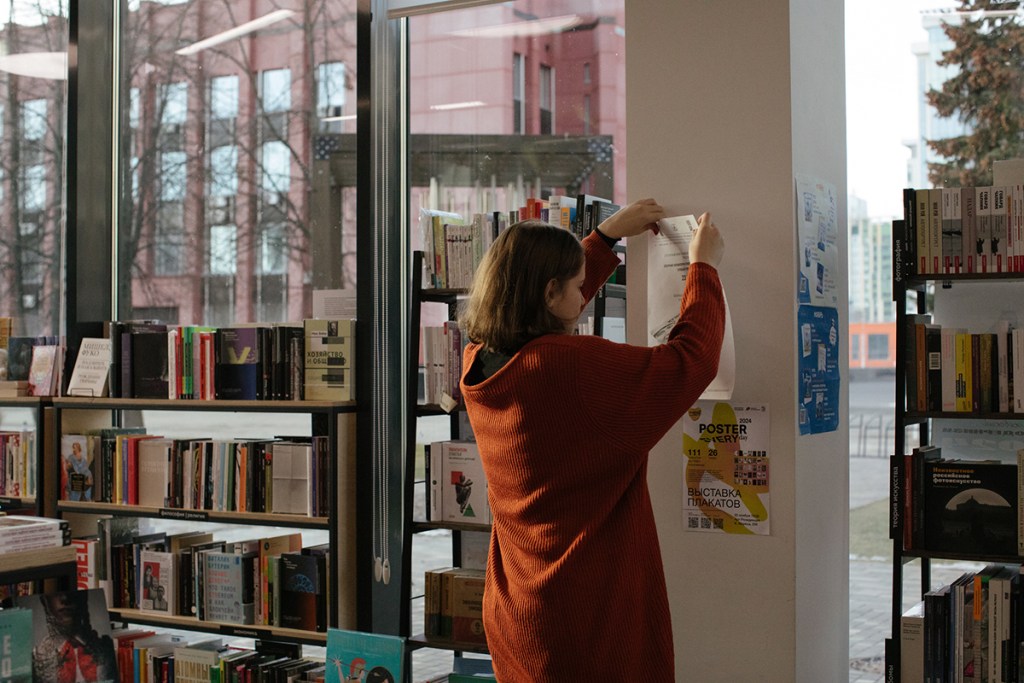
Sonya, a clerk at Kuzebay Bookstore, puts up an event flyer.
Kuzebay’s cheerful face can now be seen on posters, lapel pins, and even as an emoji on Telegram. The only independent bookstore in Izhevsk, and maybe in the whole of Udmurtia, bears his name — Kuzebay Bookstore.
Like its spiritual forebear, Kuzebay Bookstore thrives in spite of its circumstances. Today, it is an absolutely metropolitan store that is no shabbier than Vse Svobodny in Petersburg or Falanster in Moscow: Kuzebay stocks the same books on its shelves, and it has the same friendly vibe. But Kuzebay opened a year before the quarantine. Back then, it occupied a small corner at the Center for Contemporary Dramaturgy and Directing. Les Partisans Theater, in which the store’s co-founders, German and Ksenia Suslov acted, was also based there. Kuzebay achieve relative stability in early 2022, after moving to its current location.
The Kuzebay Gerd Museum in the village of Bolshaya Gurez-Pudga, Udmurtia. The museum is located in a hut next door to the local school.
“We were a quite small operation during the covid, so we didn’t give a shit whether we shut down or not,” recounts German Suslov. “We were open for deliveries. Back then, the state still paid me twelve thousand [rubles a month] for the fact that I was my own sole employee. I was like, Great, money’s coming in, cool beans. Things have somehow been growing ever since.”
German even now regularly works as a salesclerk and is awfully good at cleverly persuading people who stop by for the latest detective novel by Darya Dontsova to buy family sagas from House of Stories publishers. But the first person I meet in the store is Gosha, a tall thin salesclerk who looks like a Viking sporting a tiny cap. He sits in a cozy swing chair, playing chess on his phone. He is the only soul in the store.
German Suslov, co-owner of Kuzebay Bookstore and editor-in-chief of Luch magazine, at work.
“Is it so empty often?” I ask as I peruse Mushroom Kingdom, a wacky book by local artist Andrei Kostylev, better known as Bi-jo.
“Not nowadays, but it used to happen,” says Gosha. “This one [female salesclerk] and I even had a competition to see who had fewer people stop by the store in a day. It was a draw: zero.”
“No one at all for an entire day?”
“Yeah, it was winter, so not a single person came in. But there are always people coming in now. And even if there are no sales at the store, there are sales on Ozon almost every day.”
“The worst thing is poetry readings”
German shows up at Kuzebay about half an hour late for our interview. He is in a terrible rush, as always. The Moscow Non/Fiction Book Fair is coming up: Kuzebay is supposed to represent the publishing house and the store, and we have to send the books out in time. We pull a few boxes out of the car together, while Gosha sits down to check the books and put stickers on them. Like the many-armed Shiva, German simultaneously supervises the process, does the interview, eats a flatbread from the Tatar bazaar, pours tea for everyone, and chats with the customers who do come in.
German Suslov and Andrei Gogolev in the storage room of Kuzebay Bookstore
German has always been an energetic multi-tasker. Although he is not yet thirty, he has been a prominent figure in Izhevsk’s cultural scene for nearly ten years. He used to be an actor at the local independent theater Les Partisans, which exists to this day. But his restless nature needed something else besides theater and the history program at Udmurt State University.
“And so, I thought: the craving for theater, music, cinema was instilled in me by older comrades,” says German simply. “But what were my interests before the theater? I wrote poetry. So, I had to get into the business of poetry. And I quickly realized that no one here was doing poetry seriously.”
According to German, the literary scene in Izhevsk was rather fragmented ten years ago. There were no decent places for young people to publish and perform their work. After graduating from college, many people left for the big cities.
In St. Petersburg, a whole generation of young poets from Izhevsk emerged all at once in the early twenty-teens, including Tatiana Repina, Pyotr Bersh, Ilya Voznyakov, and Grigory Starovoitov, all of whom I know personally. Most of the members of that scene gave up writing poetry a long time ago, although Tanya Repina has achieved some fame, and my friend Petya Bersh continues to write and perform.
“When I left in the early teens, nothing was happening in Izhevsk at all. There were no prospects,” Petya, who returned to his homeland in 2022, told me. “Everything has changed now, of course, and Kuzebay has played no small role in that.”
There was no Kuzebay Bookstore at first, though. In 2016, five actors from Les Partisans dreamed up the PoetUP Contemporary Poetry HQ to consolidate Udmurtia’s most interesting poets, give them a venue, and relaunch the literary scene in Izhevsk.
“The worst thing you can imagine is an open mic poetry reading. It’s hell on earth,” says German, laughing. “And even worse is an open mic poetry reading in Izhevsk with no prescreening at all. So, what did we do in 2016? We started selecting and inviting people. Yes, we would have embarrassing events too, but far fewer. What mattered was what we were striving for. We did not want it to happen that one person would read and all his friends would get up and leave when he finished.”
[…]
Excerpted from: Ilya Semyonov (text) and Natalya Madilyan (photos), “Why does a star gurgle?” Takie Dela, 23 January 2025. Translated by the Russian Reader. I would like to finish translating this fascinating long article (this is the first quarter of it) and publish it in its entirety on this website, but that would take a lot of time and hard work. In the real world, where I have worked as professional freelance translator for nearly thirty years, I would charge 600 to 850 euros to translate this article if someone commissioned me to do it. If you would like to support my work in general and read this article in full, please donate to me via PayPal (avvakum@gmail.com) or Venmo (@avvakum). If you cannot afford to donate money right now, you can help my cause by sharing my work on social media and with friends. Thank you!
Western free society is seriously sick too. The symptoms pop up here and there, but one of the most disgusting is the massive support for the alleged “people of Palestine”—that is, Hamas—in this whole monstrous story. I really don’t understand HOW it has been possible, after the atrocities of October 7, after the taking of hostages, including children, to pretend that this was a minor trifle? That the ruthless Jews suddenly out of the blue started tormenting the unfortunate residents of the Gaza Strip?
After all, bolstered by this wave of international support, Hamas thinks it has won. This will lead to fresh terrorist attacks, of course.
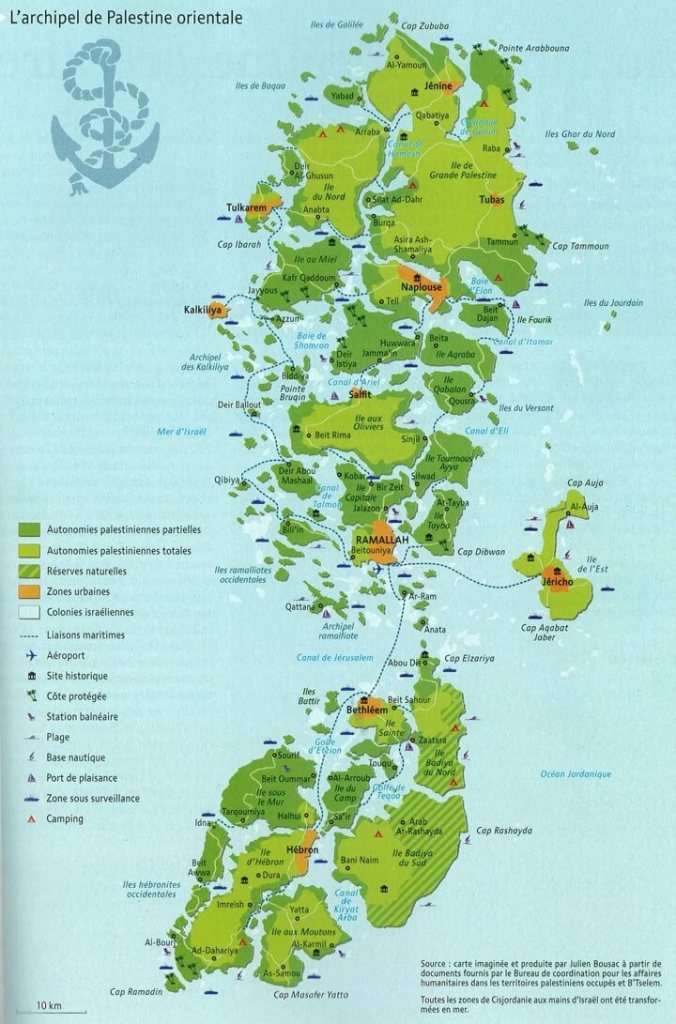
The map above shows what Palestine’s West Bank would look like if all non-Palestinian land suddenly turned into water.
All that would remain would be an archipelago of small islands with the sea of Israel to the west and the Jordanian ocean to the east.
The map is designed to show just how broken up Palestinian land in the West Bank really is. And while originally published in French, it is quite clear in the main point it’s trying to make.
Here are some key points about the map:
Regions of Palestinian Authority:
The map shows areas of partial and total Palestinian autonomy, marked in different shades of green. The darker green areas represent total autonomy, while the lighter green areas represent partial autonomy.
Israeli Settlements:
Areas in blue indicate Israeli settlements.
Urban Zones:
Orange areas represent urban zones.
Protected and Historical Sites:
Natural reserves and protected coasts are marked, along with historical sites.
Geographical Representation:
The map depicts the West Bank as a series of islands, which illustrates the fragmented nature of Palestinian territories due to the division created by Israeli settlements, roads, and checkpoints.
Symbols:
Various symbols denote airports, historical sites, protected coasts, beaches, and camping areas. There are also symbols indicating maritime connections, which, in the context of the map, seem to suggest metaphorical “water” crossings between different areas of Palestinian control.
Geographic Features:
Names of regions and cities such as Ramallah, Nablus, Hebron, Bethlehem, and Jericho are mentioned, providing a sense of the location and distribution of these areas.
The map’s creation by Julien Bousac aims to highlight the challenges faced by Palestinians due to the fragmentation of their territories. The fictional archipelago metaphorically represents how the West Bank is divided and isolated, illustrating the complex political and social landscape of the region.
Red America and Blue America have become two different and mutually antagonistic countries sharing the same geographic space. They barely talk to each other, don’t understand one another — and while Blue America happens to be aware that both itself and Red America exist in a larger, infinitely complex world that needs both of them to be one whole for its survival, just as both of them need that larger world for theirs, Red America is not interested in and indeed is hostile to anything and anyone that is not itself and, while generally tending to be poor and perennially gripped by bitterness and resentment, derives its existential satisfaction almost exclusively from making Blue America feel bad — “owning the libs,” as Red America calls it.
A really good series. I don’t know to what degree it straight up deserves а rating of eight, but it has interesting and fairly unique ideas, and the lead actress is pretty and acts well. We’ll see what the next episodes are like, but on the basis of the first one we can say [that the show] has fine potential. If it develops in a good direction, it could turn out to be decent.
Source: Ororo.TV. Translated by the Russian Reader
6:00 pm–7:30 pm, Friday, February 7, 2025 • Deutsches Haus, 420 W 116th St., New York, NY 10027 + Google Map
Please join the Harriman Institute for a presentation of the book “Konstantin Vaginov. Goat Song” (NYRB, 2025) with presentations by Edwin Frank, Ainsley Morse, Geoff Gebula, and Polina Barskova. Moderated by Mark Lipovetsky.
Konstantin Vaginov was an early and exemplary figure of Soviet modernist writing in all its agonized and glorious contradictions. Born into an educated middle-class family at the turn of the century, Vaginov came of age with the Bolshevik revolution. His novels of the late 1920s and early 1930s are daringly experimental and tragically nostalgic, mourning the irrevocable loss of pre-revolutionary intellectual culture with mercilessly ironic prose. Hopelessly adrift in the brave new Soviet world, Vaginov’s protagonists attempt to conjure the recent and distant past by stockpiling old books and songs, vulgar baubles and bad jokes, newspaper clippings, coins, and graffiti.
This volume contains two novels. The first, Goat Song, is an ironically literal translation of the Greek word “tragedy” (tragodia—goat song). It features thinly veiled portraits of Vaginov’s contemporaries, the luminaries and leftovers of the once-flourishing Petersburg, Petrograd, and Leningrad arts community, as they flounder and self-destruct in their new bracingly materialist circumstances. Echoing Gogol, Dostoyevsky, and Bely, Goat Song is both a classic Petersburg city text and its swan song: “Now there is no Petersburg. There is Leningrad; but Leningrad has nothing to do with us—the author is a coffin-maker by trade, not a cradle expert.”
The second novel, Works and Days of Wistlin, follows the nonchalant novelist Wistlin as he unscrupulously mines the lives of his friends and fellow citizens for literary material. Like the flea-market trinkets hunted by Goat Song’s marginal figures, Wistlin’s eccentric and frivolous victims are yesterday’s relics and nobody’s concern. His exploitation of human material is a wry commentary on the concurrent efforts to industrialize and collectivize the Soviet economy, at a horrific human cost.
Elkhorn Slough, as seen from the Carneros Creek watershed. The Western Flyer is moored in the marina at Moss Landing, where the slough flows into Monterey Bay (near the smokestacks on the center right). Photo by the Russian Reader
I have never directly acknowledged the fact that, since May 2021, this weblog has come to you from Monterey-by-the-Sea, California, where I have happily found many things to do that have nothing to do with Russia and the heavy, steady flow of bad news from there. I want to share that happiness with you by way of saying goodbye to 2024 and thanking you for sticking with the Russian Reader this past year.
The distinctly Monterey story, told below in four short but fascinating videos, is a fascinating, inspiring, and happy one. I hope you enjoy it as much I did. See you next year! ||| The Russian Reader
Western Flyer Foundation Channel, “The Western Flyer with Nick Offerman”
The Western Flyer sails again! Come aboard with Emmy-award-winning actor and comedian Nick Offerman for a fun new look at the life, near-death, and resurrection of the famous old fishing boat in John Steinbeck’s The Log from the Sea of Cortez (1951). From the coast to the deep sea and from the tide pool to the stars, the nonprofit Western Flyer Foundation stirs curiosity using a blend of science and art inspired by John Steinbeck, Ed Ricketts, and their 1940 journey on the Western Flyer.
Learn more about the vessel’s history, adventures, and exciting future or marine science and education at http://www.westernflyer.org.
CBS Mornings, “John Steinbeck’s ‘Western Flyer’ gets brought back to life”
After writing “The Grapes of Wrath,” author John Steinbeck explored the Gulf of California in a famous boat called the Western Flyer. Since then, the boat has inspired adventurers and scientists for generations, but the original ship was nearly lost. CBS News’s Jeff Glor reports on the person determined to give it new life.
Western Flyer Foundation Channel, “The boat John Steinbeck and Ed Ricketts made famous. Western Flyer: The Next Chapter”
Almost lost forever, the iconic vessel that carried the acclaimed novelist John Steinbeck (who penned Of Mice and Men, Grapes of Wrath and more) and marine biologist Ed Ricketts to the Sea of Cortez on an epic scientific mission gets new life and a new mission.
When you woke up yesterday the idea that Pete Hegseth—a philandering morning TV host who has never run anything bigger than a frozen banana stand—could serve as the secretary of defense was the most preposterous idea in the history of the federal government.
By the dinner time Trump issued two nominations that made Hegseth look like Bobby Gates.
The Matt Gaetz appointment is getting most of the attention because of the irony. The DoJ being controlled by a man who was recently investigated by the same department for having an alleged sexual relationship with a 17-year-old girl, whom he (allegedly) paid to travel with him? It’s too good.
Also, in the near term, the attorney general can a lot of damage to America. The AG has the power both to turn the state against its citizens and to shield wrongdoers from accountability.
But it’s the appointment of Tulsi Gabbard as director of national intelligence that worries me more. Because for a decade Gabbard has looked and behaved like a Russian asset.
In four terms as a congresswoman her most notable actions were ongoing defenses of two war criminals: Bashar al-Assad and Vladimir Putin.
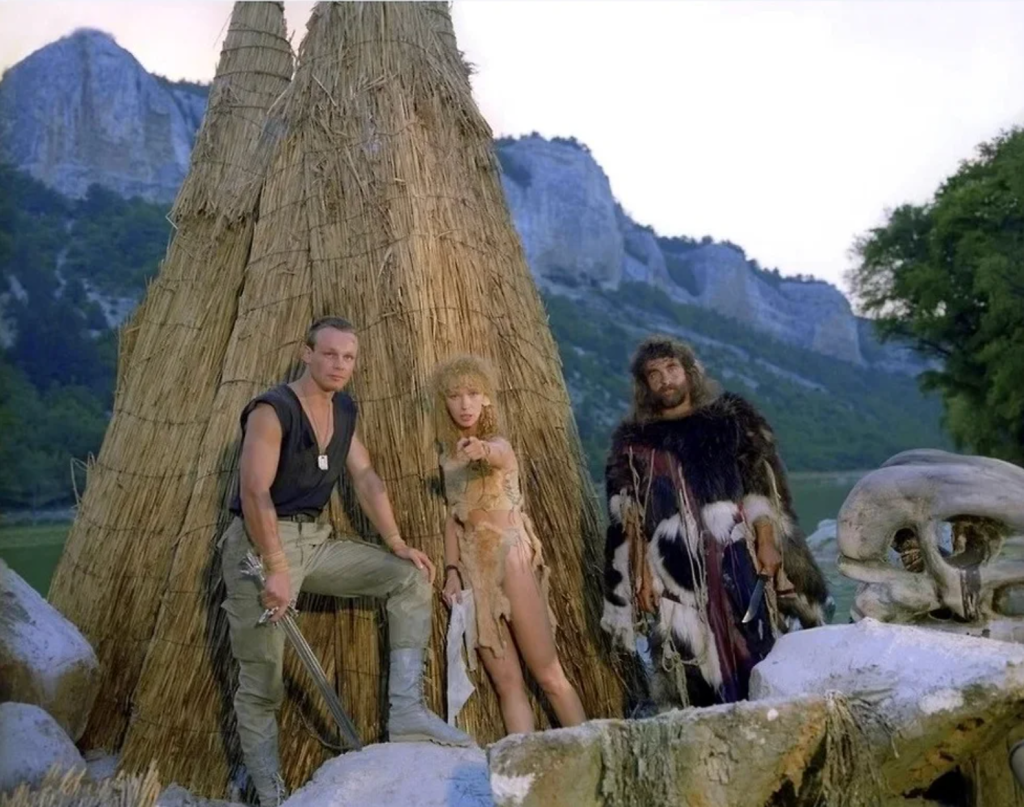
Richard Viktorov, Per Aspera Ad Astra (1981). In Russian, with English subtitles.
Per Aspera Ad Astra/Through the Thorns to the Stars (1981), a new version, in Russian with English subtitles.
Soviet film directed by Richard Viktorov, based on a novel [sic] by Kir Bulychev. Music by Alexey Rybnikov (original score); Sergei Skripka (conductor).
Yelena Metyolkina as Neeya • Uldis Lieldidz as Cadet Stepan Lebedev • Vadim Ledogorov as Sergei Lebedev • Yelena Fadeyeva as Maria Pavlovna • Vatslav Dvorzhetsky as Petr Petrovich • Nadezhda Semyontsova as Professor Nadezhda Ivanova • Aleksandr Lazarev as Professor Klimov • Aleksandr Mikhajlov as Captain Dreier • Boris Shcherbakov as Navigator Kolotun • Igor Ledogorov as Ambassador Rakan • Igor Yasulovich as Torki • Gleb Strizhenov as Glan • Vladimir Fyodorov as Turanchoks • Yevgeni Karelskikh
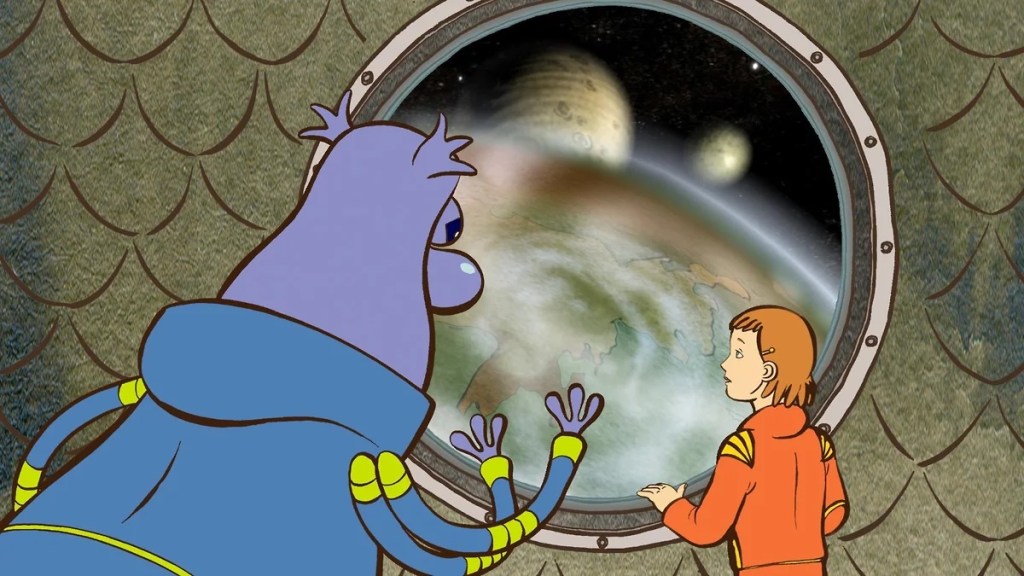
The lone survivor of a derelict spaceship is brought to Earth to recuperate and regain her lost memories. Given the name Neeya, a series of events triggers her telekinetic powers and a number of flashbacks reveal her origins on the planet Dessa. A human spaceship returns her to Dessa. The planet is found to be in ecological ruin and run by a businessman who intends to keep it that way. The crew of the ship, aided by their robot and Neeya’s powers, defeat a monster unleashed against them. They repair the planet’s ecosystem and Neeya remains to help rebuild Dessa while the crew returns to Earth.
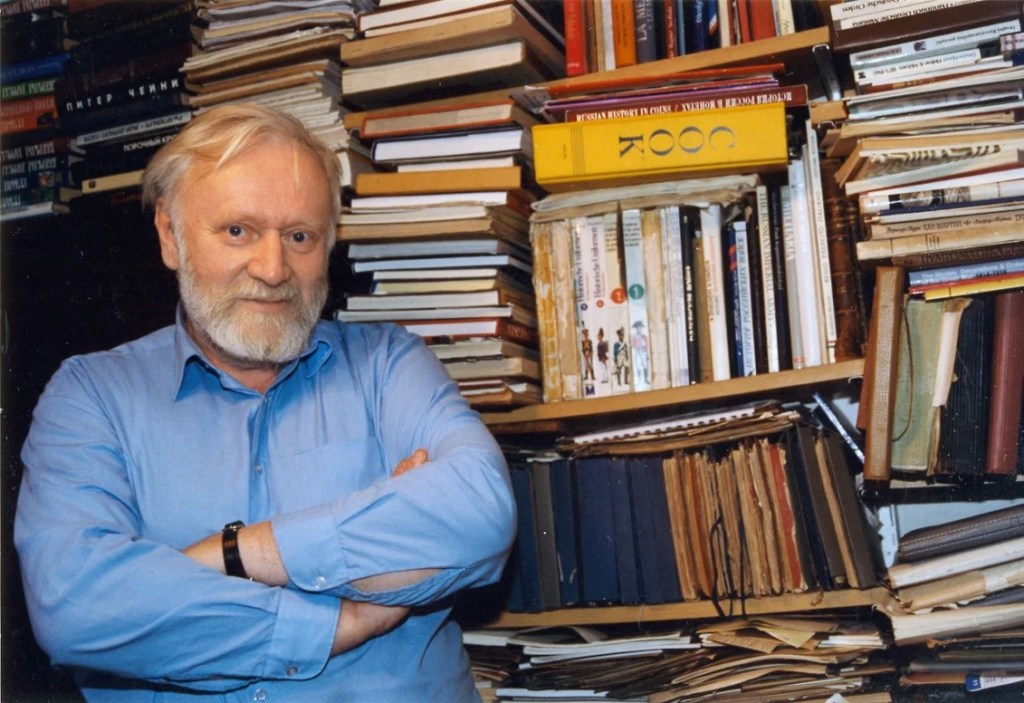
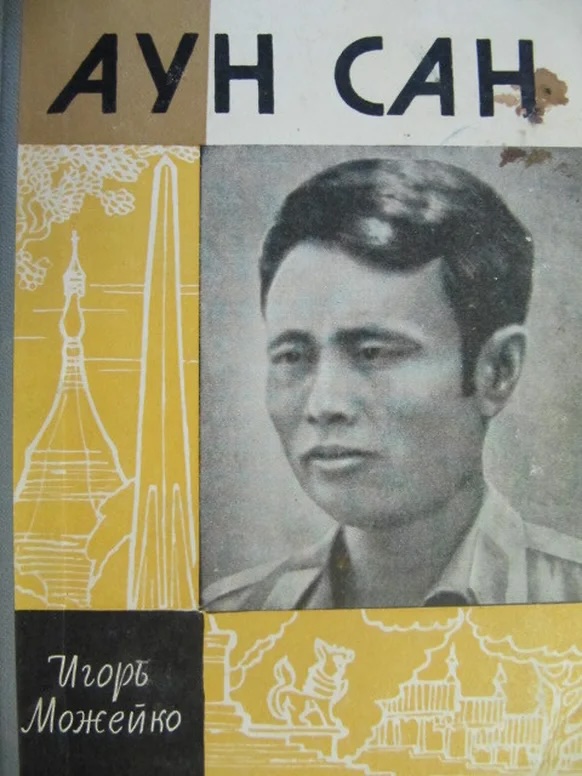
Igor Mozheiko was born ninety years ago in Moscow. Mozheiko was a failed spy, a narrowly focused academic and extraordinarily wide-ranging popularizer and encyclopedist, a passionate collector, a skillful translator, and a great writer. As an author, Mozheiko was renowned under the pseudonym Kir Bulychev, but far from all his accomplishments are well known.
Soviet science fiction writer Kir Bulychev (aka Igor Mozheiko) Photo: Ogonyok magazine photo archive/Kommersant
The Darling
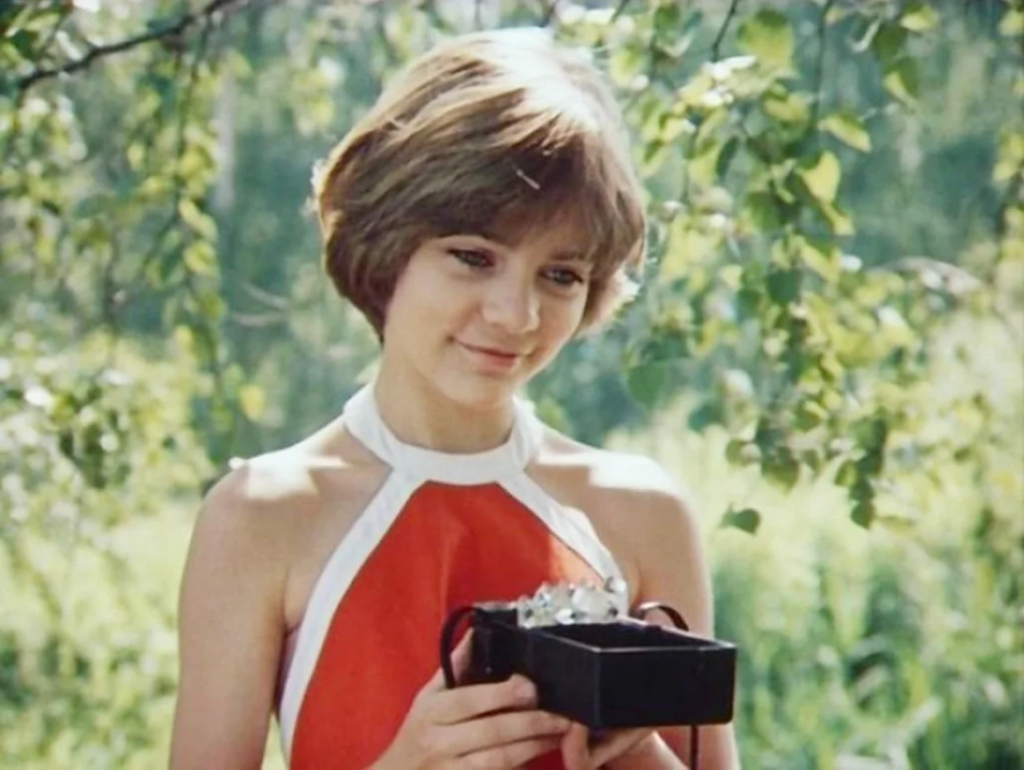
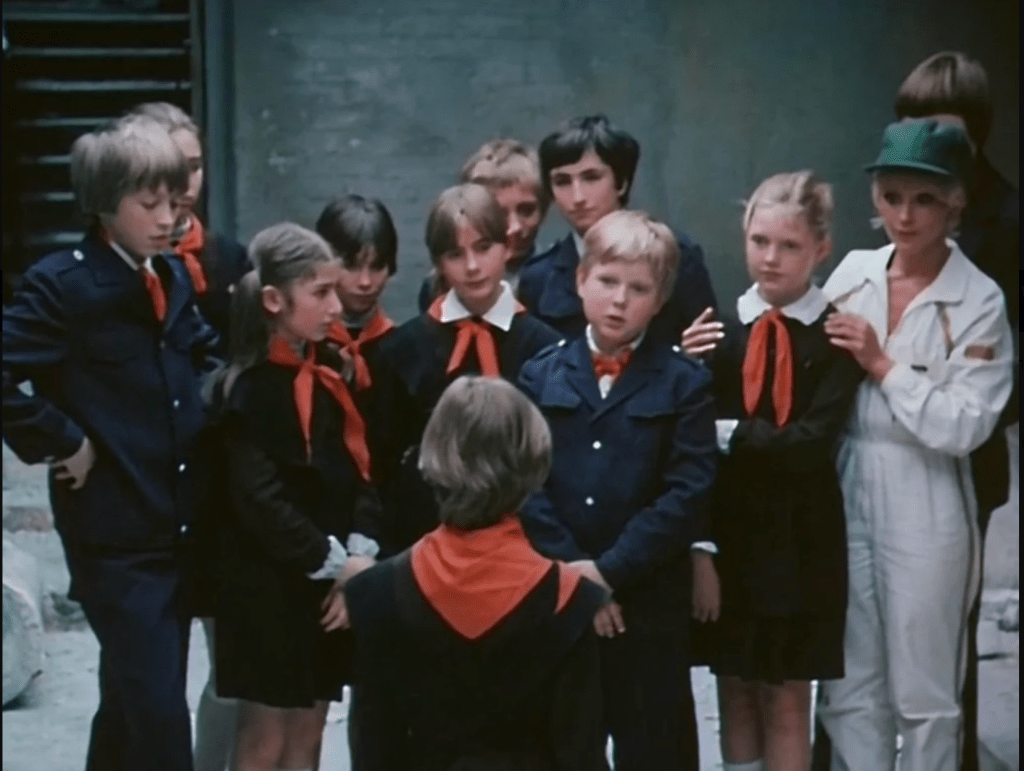
The popular take on the happy Soviet era is founded, as we know, on the realities of the final Five-Year Plans. The cultural component of these notions consists almost entirely of cinematic images and lines from movies. The enormous eyes of Natalya Guseva and Yelena Metyolkina, the ominous Turanchoks, the catchphrases “I have the mielophone” and “He will turn speckled purple,” jokes about the android Werther and, of course, the song “The Beautiful Afar” stole the hearts of thousands of Young Pioneers.
Thanks to clever mental gymnastics, for many of these erstwhile Young Pioneers the beautiful afar speaks not from the future, which they would have had to make happen, but from the past, when Young Pioneer ties were redder, ice cream tasted better, and friendship was stronger.
The key creator of this beautiful afar was Kir Bulychev, the screenwriter and author of the literary works on which these movies, TV series and cartoons were based.
It is impossible to argue with this, as well as with the fact that this reputation would amuse, if not offend, Bulychev. He explained the popular love for science fiction by the fact that “any alternative reality was hostile to communist reality,” and in the Theater of Shadows series he turned the concept of yesterday into a dusty boring hell in which scoundrels perpetrate madness.
The cinema noticed Bulychev late, and at first not as a writer, but as an imposing extra. His beard and his friendship with novice actors got the young Orientalist a role in the film Hockey Players (1964) as a silent sculptor who beautifully shares the screen with a portrait of Ernest Hemingway. The first screen adaptation of his work — based on the story “The Ability to Throw a Ball” — happened twelve years later in Alma-Ata, and after that his cinematic career was up and running.
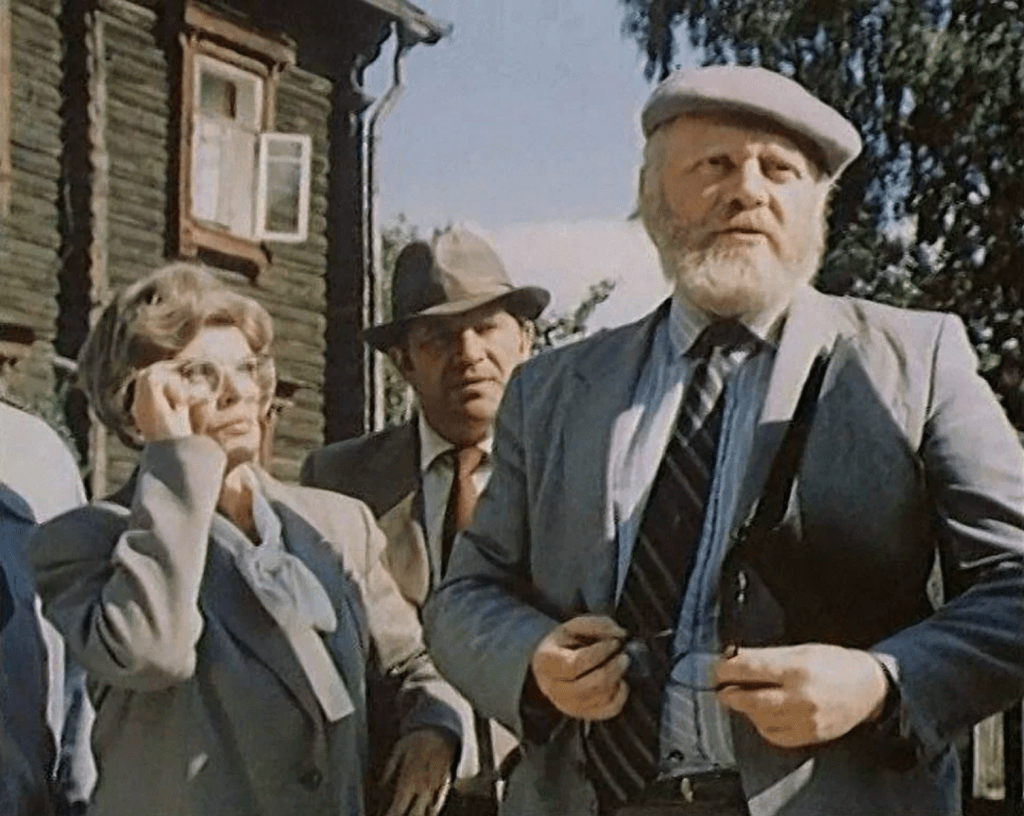
Writer Kir Bulychev, aka scholar Igor Mozheiko, in the film Birthmark, based on a story from his collection Aliens in Guslyar: Photo: Mosfilm
Bulychev’s stories were adapted by both novice filmmakers and the country’s leading directors. A vivid example in all senses is Georgiy Daneliya’s Tears Were Falling (1982). Bulychev’s plots were the basis for comedies (Chance, 1984), action films (The Witches Cave, 1989) and slapstick tragedy (The Comet, 1983). Some of the stories have been adapted more than once. For example, “The Ability to Throw a Ball” was reshot for Central Television twelve years after the first adaptation, and another twelve years later in Poland. The story “Abduction of the Wizard” was made into a two-part television play in Leningrad in 1981, and into a feature film in Sverdlovsk in 1989. It is superfluous to remind readers of the fresh remake of Guest from the Future into the science fiction film One Hundred Years Ahead(which diverges almost entirely from its source), but it does make sense to note that this year the television series Obviously Incredible, based on the Veliky Guslyar series, was released.
There are a lot of questions raised by the 1989 film adaptation of The Witches Cave, but they definitely don’t involve the plot and the cast. Photo: Gorky Film Studio
In his memoirs, which Bulychev wrote in 1999, four years before his death, he said, “I did not make a noticeable mark on the cinema.” Since then, the number of films, cartoons, and TV series based on his texts has increased by a dozen. Now approaching fifty, this number will clearly continue to grow.
Sanctuary
The adventures of Alisa Seleznyova, as played by Natalya Guseva, deprived Soviet schoolchildren of sleep, but they were seemingly the least worried about the mielophone. Photo: Gorky Film Studio
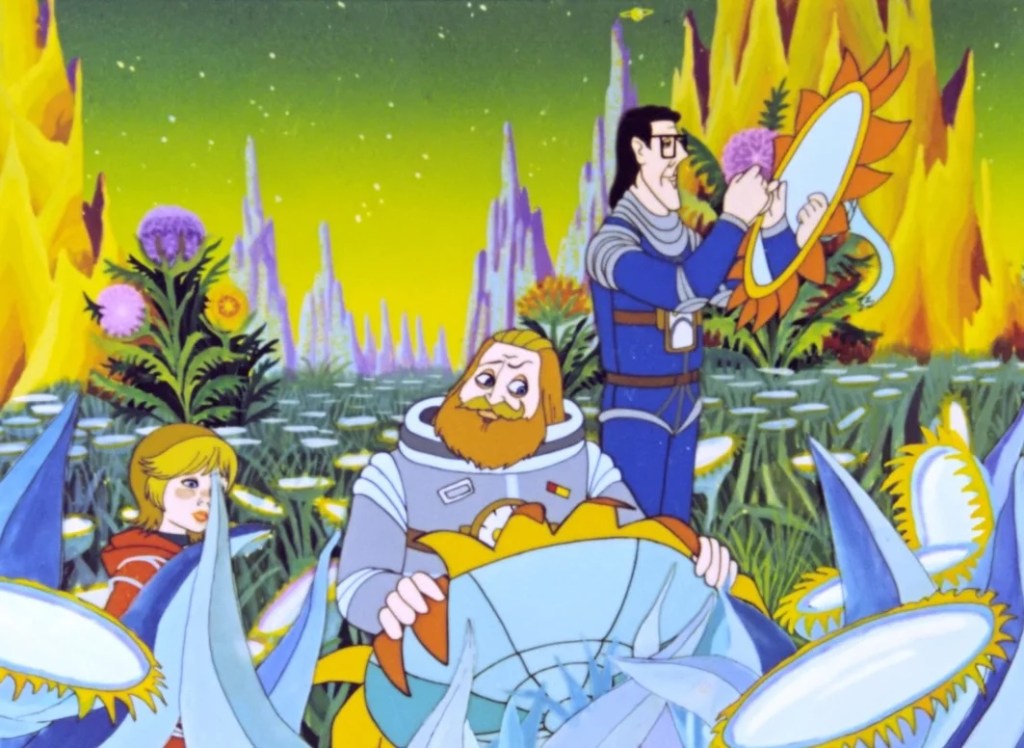
Kir Bulychev became the number one Soviet science fiction writer in the early 1980s. He was awarded two State Prizes at once — for his screenplays for The Mystery of the Third Planet and Per Aspera Ad Astra, thus revealing at last the real man behind the pseudonym. Previously, few people had known that the mega-popular books were written by an Orientalist specializing in Burmese history.
He proved to be one of the few science fiction writers whom editors were not ashamed to publish and who were safe to publish. This was a massive virtue in an era in which the people in charge were guided by the slogan “Fiction is either anti-Soviet or crap” (said to Boris Strugatsky by a Leningrad filmmaker) or “I divide socially engaged science fiction into two kinds: the first I send to the trash bin, the second to the KGB” (related to Mozheiko by an editor at Molodaya Gvardiya, the only dedicated publishers of new Russian science fiction at the time.)
The film A Guest from the Future was window into another world for many Soviet children. Photo: Gorky Film Studio
In the early 1980s, the Soviet Union was going through the so-called gun carriage races (a series of funerals for the country’s rapidly expiring leaders) and the unnamed Afghan war, and butter and meat rationing cards were introduced in some regions at the request of workers. Meanwhile, schoolchildren were being readied for nuclear war by taking them out of classes for practice runs to bomb shelters, which in most cases were nonexistent. And the cries of punks (who, according to Soviet propaganda, were exemplars of decadent petty-bourgeois ideology, and sometimes even neo-Nazis), “No future for me,” resounding from the other side of the Iron Curtain, resonated painfully in immature hearts, and they did not presage confidence in the future.
The Olympics proved a poor substitute for the communism promised by 1980. The Food Programme, scheduled to run until 1990, was little inspiration, and the world’s most advanced ideology could not offer any more attractive image of the future. But Kir Bulychev could and did.
The animator partly modeled the characters in Mystery of the Third Planet on her own relatives. Image: Soyuzmultfilm
He brought Alisa Seleznyova into every home and the dreams of man. Even more importantly, he became a major source of intellectual entertainment, a kind conversationalist and a sensitive shepherd for a vast army of Soviet teenagers. Bulychev’s stories and novels were printed in most children’s newspapers and magazines, which were widely available, unlike the books (especially those with illustrations by Yevgeny Migunov), and anyone could try his or her hand as a co-author. Mozheiko agreed to publish two of his novels in Pionerskaya Pravda in an interactive mode: the author took into account the suggestions and wishes sent by Young Pioneers by mail in each new installment.
Neither children, their parents, nor any normal person could resist the world described vividly and painstakingly in his books: a prosperous, bright and fascinating world with no ideology at all, a world in which a girl can fly not only to the Medusa system, but also abroad, dress beautifully and easily break century-old Olympic records, descend to the seabed in the arms of dolphins, fight with pirates, make friends with Baba Yaga, sit down for a chat with her teacher, know all languages and basically everything in the world, while being friends with whomever she wants. She is A Girl Nothing Can Happen To.
It was a world of private interests and emphatically personal growth rather than a collective existence based on the principle that the majority were always right. It was a world of tenderhearted people, where only pirates were evil and only robots were stupid.
It was a world in which one would like to live, like the Noon Universe of the Strugatskys, only tailored to younger and middle-aged children. “Let’s give the globe to children,” sang Sofia Rotaru, and nobody believed it, but what if we could do it? Everything was free, everything was cool, you didn’t have to die at all, and there were vending machines on the streets dispensing free ice cream and soda of all sorts. And there was no communism, capitalism and other historical materialisms, no Young Pioneers, Komsomol members, Communards and Soviet power, no giant monuments to Lenin looming over Sverdlovsk, as in the early Strugatsky novels. On the contrary, the Stalinist monument to Gogol on the eponymous boulevard was replaced by a pre-revolutionary one, and the boulevard itself was turned into a jungle complete with cypresses, bananas and monkeys.
Actress Elena Metyolkina (seated) starred in the film Per Aspera Ad Astra, based on a script by Kir Bulychev, and then appeared as Polina in Guest from the Future. Photo: RIA Novosti
Such an approach was tantamount to an “Attack!” command for conservative editors and their curators in the security services. But it was Molodaya Gvardiya whose internal reviewers noted that “We know what the author is hinting at when he writes that dark clouds were creeping over Red Square” and also pointed out that the author’s secret goal in “Cinderella’s White Dress” was to discredit Soviet cosmonauts. This review, according to Mozheiko, had been written by Alexander Kazantsev, a veteran Soviet science fiction writer and the prototype of Professor Vybegallo in the Strugatskys’ novel Monday Begins on Saturday. The requirements of the publishing house Detskaya Literatura (Children’s Literature) were milder, and the censorship’s scrutiny of it, more lax.
As a matter of fact, a well-fed future in which carefree children bounce between planets had long been a commonplace in Soviet science fiction, but the world was quite sterilely fantastic, the characters were cartoonish, and the action was forced in the works of Vitaly Gubarev, Vitaly Melentyev and Anatoly Moshkovsky.
As painted by Bulychev-Mozheiko, Alisa’s world is natural and authentic.
The girl with with the Carrollesque name made Wonderland beautiful and desirable.
Few people paid attention to the fact that in the original version of the song about the beautiful afar, as heard in Guest from the Future, the voice summons viewers not to “marvelous lands” (as in all subsequent reprints and collections of lyrics), but “to non-paradisal lands.”
In any case, the voice asks strictly.
An Aerial View of the Battle
Science fiction writer Kir Bulychev published serious historical books under his real name. Image: Molodaya Gvardiya
According to a popular legend, Kir Bulychev was born by accident. In 1967, the censors removed a translated story from the upcoming issue of the almanac Iskatel (Seeker), which already had a cover featuring a dinosaur in a glass jar. Replacing the cover would cost a hell of a lot of money and threatened the editors with the loss of their bonuses, so the young feature writer Mozheiko overnight came up with a sci-fi story on the given theme, which he signed with a pseudonym inspired by his wife’s name and his mother’s surname, in keeping with the habit of academics of not blowing their cover in in non-academic outings. The editors kept their bonuses, and world literature gained a new author.
The legend, of course, is false. By 1967, Mozheiko had already published four books, including a very popular one about the Burmese revolutionary Aung San, in The Lives of Remarkable People series. He has also published a couple of science fiction stories under the pseudonym Maung Sein Ji, passing them off as translations from the Burmese. Most importantly, he had published several stories about Alisa under the pseudonym Kirill Bulychev.
As a translator he had debuted a decade earlier, when he published a story by Arthur C. Clarke, which he translated with his childhood friend and future academic colleague Leonid Sedov. Initially, the pals had offered the publisher their translation of an unknown book about a girl who fell down a rabbit hole into a magical land. The young men had no clue about the book’s cult status beyond their one-sixth of the world nor about the existence of at least four previously published Russian translations. But at least one of the failed translators obviously remembered the heroine’s name.
In any case, Bulychev — initially, Kirill or “Kir.”, then just Kir — was born an experienced author with a steady hand, a broad outlook, a constructive mindset and a quite recognizable style. It was a style capacious and not simple even, but simplified at times, almost, to the point of outright silliness. But only almost.
The life of Soviet individuals was subject to a set of unwritten rules that changed markedly from department to department and from decade to decade. Mozheiko learnt them early —because there was no other way.
He was born into the family of a prosecutor from the Middle Volga region and the commandant of the Shlisselburg Fortress. However, by that time the fortress had been turned into a chemical warehouse. His mother had gone into the reserves before her maternity leave, and came to work as a rank-and-file staffer at a chemistry institute. His father soon took the post of Chief Arbitrator of the USSR (a position similar to the chair of the Supreme Arbitration Court), but by that time he had already left the family. Igor’s stepfather, who had fought through the entire conflict, was killed on the last day of the Second World War. Igor and his sister and mother survived bombings, evacuation, a return to Moscow and starvation.
He learnt to read late, fell in love with science fiction early and started writing it, went to a “special faculty for future intelligence officers,” which “was modestly called the translation department of the Institute for Foreign Languages,” and twice dodged KGB drafts (after graduation and as a correspondent for the APN news agency in Burma) and escaped into academia, which he combined with popular science journalism from the very beginning.
As a translator he worked on Zarubezhstroy construction projects in Burma, Ghana and Iraq. As a correspondent for the magazine Vokrug Sveta (Around the World) he journeyed to the most exotic fringes of the Soviet Union, and as a simultaneous interpreter he traveled in Europe and the USA. “Asimov greeted me with a handshake, Harlan Ellison chatted with me, I heard [Clifford] Simak speak, I argued (I was so brazen) with Frederik Pohl, I appeared on the radio with Lester del Rey, and I palled around with James Gunn, but most importantly I spent a whole day drinking with Gordon Dickson and Ben Bova, not to mention his gloriously beautiful wife, Barbara Benson,” recalled Mozheiko. This, of course, was not only unimaginable for most venerable Soviet writers, but also for the so-called Gertrudes — the Heroes of Socialist Labor [Geroi truda] who led the Writers’ Unions for decades.
Mozheiko himself never joined either the Writers’ Union or the Communist Party, flatly refusing the most persistent invitations. The explanation “I consider myself unworthy” did the trick, but just barely. When it didn’t work, Mozheiko changed jobs.
This, by the way, enabled him to keep his beard, since the recruiters from state security, or high-ranking guests like cosmonaut Valentina Tereshkova insistently advised him to shave it off. (“As a correspondent for APN, I photographed cosmonauts for our newspaper. Valentina Tereshkova sent back one of the photos I had given to her with the following autograph: ‘Your wife should make you shave off your beard. After all, a person’s dignity is determined by their character, not by their personality.’ Our guest believed that personality was the nose and the ears.”)
Mozheiko was no longer allowed to travel abroad after 1970, but at least he did not go to jail with several of his acquaintances, passionate collectors like him who were handed lengthy prison sentences in the so-called Case of the Numismatists. (Dozens of lines in the indictment amounted to nothing more than “Defendant No. X criminally exchanged one coin for another.”)
And he continued to write.
The Academicians’ Reserve
The talking tiger in Two Tickets to India, a cartoon based on Kir Bulychev’s screenplay, has an unearthly charm. Image: Vitaly Karpov/RIA Novosti
Mozheiko’s reputation as a supremely tenderhearted storyteller was reinforced by his appearance and his work for Detskaya Literatura, but he was actually quite a tough-minded author. Bulychev’s first novel, The Last War, deals with the aftermath of a nuclear armageddon: even if it was set on another planet, such topics were not encouraged in Soviet literature. A couple of years earlier, a scene depicting a tactical nuclear strike was thrown out of the magazine version ofInhabited Island, by the Strugatskys, and the book edition was put on hold for two years. The release of The Last War in the same series (The Library of Adventure and Science Fiction) seemed to pop the cork, so Inhabited Island was also published, but both books waited twenty years to be reprinted in the capital.
A considerable portion of “Abduction of the Wizard” is given over to a quasi-documentary account of brilliant children killed in childhood by Nazis, pogromists and torpid relatives. In the prologue to the story “A Pet,” the touching rendezvous of a young couple ends with the words, “They were incinerated.” And the protagonist of the later story “A Plague on Your Field!”, whose son has died of an overdose, dooms a outsized segment of humanity to starvation in order to take revenge on the drugs mafia.
Bulychev was also quite decisive in interviews and in correspondence with dissatisfied readers: “I beg you: stop reading me. Spare your nerves.” He spared himself even less, however, and he repeatedly explained this in his final years. “I had no willpower, no courage, no determination to oppose the authorities. Yes, I was duplicitous. I wrote certain things for myself, for my friends. I’m not a battler by nature. Since I lived in our country, I went to my job at the institute and was certain that I would die under unfinished socialism.”
The phrase about his job is significant: censorship troubles occasionally threatened him not only on the literary front, but also on the academic one. A good illustration is the 1966 popular history book about the colonizers of Southeast Asia, With Cross and Musket, whose depth and unconventionality overwhelmed readers and amazed experts. Mozheiko wrote it in collaboration with Leonid Sedov and Vladimir Tyurin. Sedov, his old friend and now a prominent Khmerologist, resigned from the Institute of the Peoples of Asia after Warsaw Pact troops invaded Czechoslovakia. Tyurin, a specialist on Malaysia, was declared a defector and dismissed fifteen years later. (Subsequently, however, he returned safely and was reinstated to his post.) The book has never been reprinted.
But Mozheiko published many other scholarly and popular scholarly books, including those dealing not only with his main subject of study, the history of Myanmar.
It is time to mention the encyclopedia Nagrady (Honors; 1998) and the fact that Mozheiko spent the last ten years of his life as a member of the Presidential Commission on State Honors developing the country’s current system of state honors, based on the traditions of the Russian Empire.
Mozheiko’s fundamental study of piracy, In the Indian Ocean (later published as Pirates, Corsairs, Raiders) also deserves special mention, as well as the absolutely revolutionary monograph 1185, a cross-section of one year in world history, focused on events which the author considered crucial in many senses.
Reviewers noted with some bewilderment that individual people’s motives and feelings are far more interesting to the historian Mozheiko than historical processes and the movements of the masses, and even more so than quotations from the classic Marxist-Leninist authors (defiantly ignored even in a book published on the fiftieth anniversary of the October Revolution).
The River Chronos
The animated film Alisa’s Birthday was produced in 2008, marking Alisa’s rebirth in the twenty-first century. Image: Cinema Panorama
The writer Bulychev declared his humanism with his trademark rigor. “There is nothing in literature but man,” he explained in an ancient interview (in 1980). Bulychev’s texts, which are chockablock with miracles, journeys through time and space, incursions of fairy tale into reality and vice versa, are populated by nothing but people, or rather, by what he identified as the typical triad of “man, society and time.” That is why his work is still massively reprinted and, more significantly, still massively read, along with the Strugatsky brothers and Vladislav Krapivin. Other stars of Soviet science fiction have not passed the test of time much less well.
Bulychev pointedly assigned himself on a lower shelf. “If God has not given me the talent of Tolstoy or the Strugatskys,” he said, “I am to some extent willing to compensate for this deficiency through hard work,” while also stipulating, “I can usually spare two months a year for science fiction.” After the collapse of the Soviet Union, the reason for the stipulation, apparently, became less pressing. In any case, the author’s productivity increased manifold, if not by an order of magnitude.
According to his own estimates, Bulychev wrote a total of fifty volumes: a dozen were popular science books, another dozen were children’s science fiction, while the rest were science fiction for adults. Understandably, the most visible and talked about were the works in the Alisa Seleznyova series, almost fifty novellas, most of them pounded out in the post-perestroika years in frankly machine-gun mode. Only the first five or six of them are actively reissued nowadays, which is not surprising.
Puppet animations based on Kir Bulychev’s series about the town of Veliky Guslyar are less renowned than the drawn stories about Alisa. Photo: Kuibyshevtelefilm
Almost as popular is the series about Veliky Guslyar: a hundred stories and seven novellas, alternately ironic and mocking, about the inhabitants of a provincial town teeming with aliens, and rife with paranormal phenomena and outright devilry.
Fans of old-school science fiction love the Doctor Pavlish series, about a space doctor facing generally insoluble ethical dilemmas.
Bulychev himself appreciated the River Chronos series, which plays with the twists and turns of Russian history. The author always gravitated to such games: back in 1968, he wrote (with no hopes of publishing it) the story “Misfire ’67,” about reconstructors who accidentally cancel the October Revolution.
And yet Kir Bulychev remains in world literature and in the hearts of readers as a genius of the short story — psychological stories for adults about the impossibility of understanding someone else’s mind and feeling someone else’s love and the fierce necessity of it. These stories are told in the same stingy style, which does not distract from their initially unpretentious plots, which conclude quite unsophisticatedly. But they make you catch your breath for a moment, because you recognize them as familiar — as painful and akin and tenderhearted.
Few people call these texts their favorites and keep them at their fingertips for quick infusions of wisdom, but every few weeks, the story “Can I Ask Nina?” suddenly pops up in social networks, messengers, and private conversations, and like an avalanche, everyone starts asking each other, “Have you read ‘The Snow Maiden’? And ‘Professor Kozarin’s Crown’? And ‘Red Deer, White Deer?’”
The list goes on and on and on.
At the end of the Soviet era, Bulychev explained, “I write only what I find interesting. This is unforgivable from the point of view of a reader who loves science fiction of a certain style and school. But it isn’t a shortcoming to me.”
Chimamanda Ngozi Adichie, “The Danger of a Single Story” (TED, YouTube, 7 October 2009)
Diversity and Inclusion
Allrecipes is and always has been a community built around love. We are people who love food, love to cook, and love to share recipes and stories. There is no room for hate, racism, or inequality in our community. The 60 million cooks who make up the Allrecipes audience are extraordinarily diverse. We strive to celebrate the home cooks who bring Allrecipes to life, featuring them on the website and in the pages of Allrecipes magazine.
We are committed to the goal of having contributors, featured cooks, featured recipes, and stories reflect the diversity of the Allrecipes community in our digital properties and in the magazine—and know that we still have much work to do.
We are working to highlight more of the stories and traditions of our diverse audience. In 2022, we are reviewing and editing content representing 20 percent of our traffic, with the goal of removing any bias in language and instances of cultural appropriation, including language around race, gender, sexual orientation, and glamorized colonialism.
We are also focused on recruiting more diverse voices and diverse contributors to our staff, our freelance pool, and our Allrecipes Allstars brand ambassador program. And we are working to ensure that our video and voice programming features the same diversity as our audience.
We are dedicated to working with recipe developers, food writers, editors, food stylists, photographers, videographers, podcasters, illustrators, and models who reflect the strength and diversity of our community.
What can I say to the question, how are we? I was at my Arabic lesson, while Natan, Dan and our nanny Vika were at home. Usually, Natan and I would have been returning from the beach right at this time. Everyone was expecting Iranian missiles, so some of the students were looking at their phones during the lesson. In Hebrew, which we are forbidden to speak in class, there is no word for “terrorist attack”; the word used is פיגוע — “assault,” “infliction of harm.” We hadn’t had time to learn it in Arabic. When the woman sitting next to me uttered it in conjunction with the name of our street, we decided to take a five-minute break to make sure everyone was okay. Dan said they were fine, but that there was the corpse of a very young guy lying outside the house and that he was afraid it was someone from the neighborhood. (We moved in three months ago and haven’t met everyone yet.) Itai, Dan’s son, could not reach him and texted me to lock all the doors urgently, as the chase was still on. So I started calling Dan and Vika again, but couldn’t get through right away. Then the siren went off and we had to go to the bomb shelter in the upscale building next door. Normally, sitting in a bomb shelter in Israel is pretty fun and privileged, but when your child and loved one are sitting in an old building with huge windows on all sides and you don’t really know when it’s going to end, it spoils the fun a bit. When the sirens stopped, I jumped on my bike as quickly as I could and raced home. The whole neighborhood was cordoned off, and no argument that I lived there and that my child was there had any effect. The back entrance from the street parallel to ours came to my rescue. The next corner was also cordoned off, and chockablock with cops and ambulances. While I was fiddling with my bike, a woman said, “That’s the second terrorist,” pointing to a long black rubbish bag in the middle of the block, which several people were lifting and packing into another rubbish bag. I glimpsed it all very quickly, and I was in a hurry to get home, to pack Natan’s things in case we had to go to the bomb shelter on the next block. But then it was sort of over, and the phones started ringing off the hook.
This morning was quiet and so idyllically beautiful, as it almost always is here, that I felt like getting out of bed and just living. The entire street in front of our building and the building next door was still splattered with blood. I ran to find out from the neighbors if everyone was alive. They said they were. They had rescued a few people from the bus stop by dragging them into their yard. (Yes, these are the same neighbors who yell at each other in the evenings in such a way that it looks like a murderous rampage is about to kick off.) The woman from the supermarket opposite said that her nephew and niece and their mom had been on that tram. The three- and six-and-a-half-year-old children saw a head shot through, and blood and brains pouring out of it onto the floor. The boy vomited all night, while the younger girl panics when she sees a tram and screams רכבת שרמוטה (“Fucking tram!”) at it.
The murdered mom with the baby in the sling turned out to be the wife of Dan’s colleague. He visited us a couple of months ago, and we talked about whether AI can assist non-verbal children in communicating. He and his family had recently gone on holiday somewhere in Asia. Dan says that the last time they had met, he was beaming with happiness.
Now there are flowers, candles, notes, and (for some reason) an Israeli flag draped over the bus stop. There are many journalists on hand, but most people refuse to be interviewed.
For the second time in the last year and a half, death had missed us by about a quarter of an hour. I couldn’t say I have any strong feelings about it. I had no time to be scared for myself or even for Natan. It was either that there is so much anxiety in a mother’s everyday life that there are no reserves of fear when it would be warranted, or the realization that for almost a year now the enormous number of murders, deaths from malnutrition and other savage things happening every day has dulled the feeling that the disaster happening on your doorstep is one of a kind.
Apparently, the very young man who was lying outside the building had been one of the shooters. Dan saw them cut his shirt open. I don’t know the proper word for what happened. An act of terror? An act of desperation? An act of stupidity? An act of struggle? Revenge? Madness? An attack? A suicide?
Remembering the acute orphan-like longing when your mom leaves you to sleep at someone’s house and goes away. Fearing that a nine-month-old baby will live his whole life with that feeling — along with tens of thousands of other children.
Source: Olga Jitlina (Facebook), 2 October 2024. Translated by Thomas Campbell. Ms. Jitlina is a friend of mine whose artwork and writings have been featured on this website on several occasions.
Western leaders and politicians are calling for an end to the airstrikes in the Middle East. Do they even want to know and understand what is going on here?
Israel is the only country of freedom and democracy in this part of the planet. It has made serious progress.
After talking to relatives in Kharkiv, once again shelled by Russia, and hearing news of the missile strike on one of Ukraine’s largest printing plants, I touch the bindings of the books on my shelves. I think about how many of them were printed in that same city, now very much on the frontlines again. This time it was not only transport and urban infrastructure that were targeted but books as well.
Factor Druk is one of the largest full-cycle printing plants in Europe. It is part of the large Factor holding, which includes, among other companies, Vivat, one of the top Ukrainian publishing houses, which has its own network of bookstores. Factor’s customers include not only Ukrainian publishers but also such global publishers as Penguin Random House, Simon & Schuster, Hachette, and Macmillan.
I look at the kaleidoscope of photos—the burnt-out shop floors, the waves of pages, the scattered covers (one—oh, the bitter irony!—bears the title “The Club of the Rescued”)—and wonder how much a Russian missile costs. The internet, for example, reports that an Iskander runs for around three million dollars. Instead of “liberating” us from twenty thousand books a week before Book Arsenal, Ukraine’s most important book fair, the aggressors could, say, print themselves a few more copies of books by their own classic authors. This is not the first such strike, by the way. On 20 March of this year, Russian forces hit another printing plant in Kharkiv where many Ukrainian publishers also had their books printed.
The Factor Druk printing plant, damaged by a Russian missile strike on Kharkiv. Photo: Nicolas Cleuet/Le Pictorium/MAXPPP/dpa/picture alliance
Solidarity in response to terror
But the further away they are from Ukraine, the less people in the rest of the world understand the symbolism of these events. As the well-known Ukrainian journalist Kristina Berdynskykhwrote on her Facebook page, “Three days ago, I bought the diary of Volodymyr Vakulenko, as published by Vivat. [Vakulenko’s] shot corpse was found in a grave in a forest outside Izium in autumn 2022. The diary was found by Ukrainian writer Victoria Amelina, who unearthed it in a courtyard near the house where he lived during the occupation. Amelina died [from the wounds she suffered during] the missile strike on Kramatorsk in 2023. The plant where this book was printed was destroyed by a Russian missile strike today, in 2024. ‘Volodymyr Vakulenko kept a diary during the occupation, hoping that you, the world, might be able to hear him. If you are holding this book in your hands, the writer Vakulenko has won,’ Victoria writes in the foreword. Hold books printed in Ukraine in your hands. The world will never understand all the way anyway.”
Ukrainian social networks have been overflowing with solidarity and sympathy. Thousands of people have simply gone and ordered books by their favorite publisher, Vivat, and so for a while, due to the number of orders, the publisher’s website was down, and long queues formed in some bookstores. This is probably the least that can be done now. It is the constructive fact that gathers us every day, in the midst of worries and threats, when just being is a victory in itself.
Bookshops opening in Ukraine during the war against all odds
Against all the odds, new bookshops have been opening in Ukraine amidst the war. Literary events, festivals and book fairs have been taking place. In Kyiv, one major book fair ended a month ago, another is due to start in a week, and two more are planned for the next few months. There are many reports about the growing demand for books. The other day, a bookshop manager I know commented, “People are just jumping on books. This not only furthers the culture but also helps to maintain some level of normality.”
I take one of my favorite Vivat books from the shelf—Lazarus, a novel by Svitlana Taratorina, a Ukrainian author originally from Crimea. It’s a contemporary fantasy set in an alternative magical Kyiv in the early twentieth century. The city is inhabited by both ordinary people and various “impure” creatures such as water sprites, ghouls, and werewolves. Although the book presents an interesting, intriguing and self-contained world of magical adventure, it is not hard to see its political aspect. The human beings in Lazarus come to Kyiv from the Empire. They try to impose their centralized way of life on the city, seeking to neutralizing its peculiarities and nuances, to level anything outside the imperial framework, anything “impure,” that is. This clampdown eventually and inevitably leads to an explosion. Sounds familiar, doesn’t it?
Everything can be restored but people cannot be brought back to life
It is a day of mourning in Kharkiv. Ukrainian President Volodymyr Zelensky has visited the site of the attack.
“The production facility was destroyed, and tens of thousands of books were burned by this strike. A lot of children’s literature, manuals, and textbooks…. Russian terror should never go unpunished,” he said.
Seven workers were killed at the printing plant: five women and two men who were printing children’s books that day. Twenty-one people were injured. As Elena Rybka, editor-in-chief of the publishing house, wrote, “Everything can be restored. It is impossible to bring people back to life. We sympathize with the families of the victims. We pray for the wounded. We support Ukrainian culture, because it will never be beyond politics.”
Julia Stakhivska is a Ukrainian writer who has published books of poetry and fantasy stories for children and co-edited anthologies of Ukrainian poetry.
Russia’s strike on the Factor Druk printing house killed seven workers and left 16 wounded, according to Suspilne. The company estimates that 20,000 books were destroyed, of which 40 percent were schoolbooks.
Factor Druk printed around half of Ukraine’s schoolbooks, CEO Serhii Polituchniy said in an interview with Radio Liberty.
“I don’t know how we will print tomorrow,” he added. The strike on the company’s printing facilities stands to reduce the volume of Ukraine’s publishing industry by 40 percent, according to Polituchniy’s estimates.
Three out of 10 leading publishing companies in Ukraine are located in Kharkiv which is constantly under Russian missile assault. Factor Druk did not evacuate its facilities from its location, around 40 kilometers from Russia’s border, due to the complexities and costs involved.
Polituchniy stated that most publishing professionals have chosen to stay in Kharkiv rather than move westward, where the right skills and knowledge are believed to be harder to find. “One should teach a professional for 4-5 years minimum,” Polituchniy said.
Industry leader
Factor Druk became a founder of Vivat Publishing House, one of the most prominent and popular book brands in the country, printing non-fiction and fiction books in the Ukrainian language. In 2023, Vivat became the seventh largest in Ukraine’s book publishing industry, with Hr. 191 million in revenue (almost $5 million), according to Pro-Consulting estimates provided to Kyiv Post.
Ukraine’s honey exports amounted to almost a third of the commodity’s imports to the EU in the last year, with China taking the leading position.
Vivat’s two bestsellers include Winston Churchill’s biography written by ex-UK prime minister Boris Johnson (50,000 books sold) and “Stus’s Case” – a novel about how the KGB arrested and tried Vasyl Stus, Ukraine’s poet, translator, literary critic, journalist, and an active member of the Ukrainian dissident movement. Around 120,000 copies of the book have been sold.
In addition to books, Factor Druk prints newspapers and magazines, booklets, catalogs, as well as stationery products such as calendars, notebooks and school diaries according to the company’s website.
The company also prints for other publishers, including:
Industry leaders KSD and Folio (both also Kharkiv-based)
Schoolbooks publishing company Ranok
Faith books publishing house Svichado
Children’s publishing house Zelenyy Pes
Vivat forms the majority of Factor Druk’s revenues. Overall, between 2017 and 2023, Factor Druk generated Hr. 230 million ($5.7 million) as an annual average, according to the company’s financial statements on Vkursi big data platform. The enterprise did not generate losses even during the first year of Russia’s full-scale invasion of Ukraine.
Ukraine’s publishing industry includes 385 publishing enterprises of different sizes, 200 of them each generating more than Hr. 1 million (£25,000) in revenues in 2023, according to Pro-Consulting’s data provided to Kyiv Post.
Well I turned around in time to see the clouds fade Running back could only make them stay Forward now I run down a winding road Try to pay back everything that I have ever owed
And when your money runs, will you buy a friend? And when your guns don’t fire, will that be the end? With no land left to burn, and nowhere left to run Where then can we stand when it’s all said and done?
Well I hear the thunder roll, I feel the cold winds blowing But you won’t find me there, ’cause I won’t go back again While you’re on smoky roads, I’ll be out in the sun Where the trees still grow, where they count by one?
Well you take from our schools to build a bigger bomb You tell us fiery lies about the course we’re on And you’ll kill all the world, and you’ll reverse the sun And which would you sell first, your soul or your gun?
But I hear the thunder roll, I feel the cold wind blowing But you won’t find me there, ’cause I won’t go back again While you’re on smoky roads I’ll be out in the sun Where the trees still grow, where they count by one?