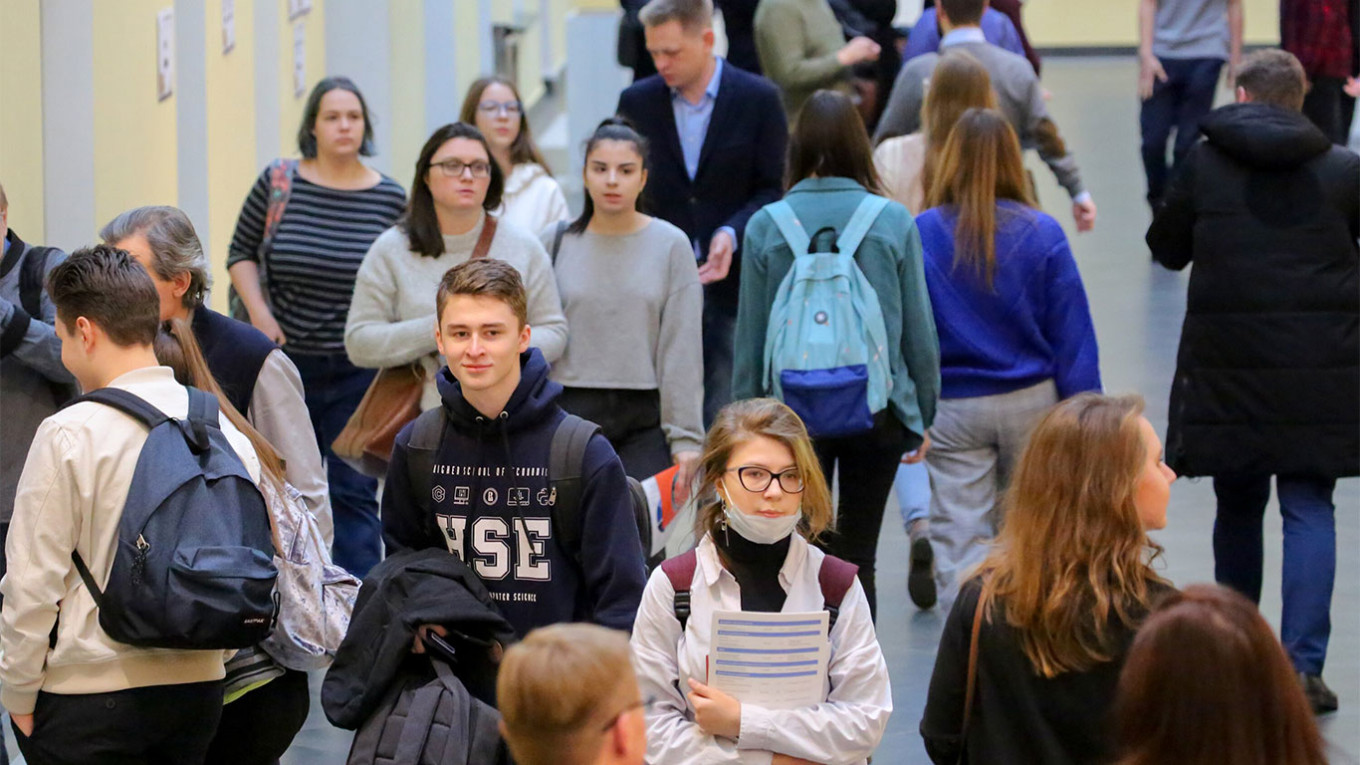
Once regarded as one of Russia’s liberal universities, the Higher School of Economics (HSE) has become a reactionary hellhole in recent years. Photo: Sofia Sandurskaya/Moskva Agency/Moscow Times
The Higher School of Economics (HSE) has forbidden applicants applying to its journalism program from quoting “foreign agents.” Any mention of people with this status or their publications will cause the results of admissions exams or interviews to be annulled, the university’s regulations say.
Applicants are also obliged to comply with the law “On Protecting Children from Information Harmful to their Health and Development.” They are thus not permitted to use materials “promoting” LGBT, “gender reassignment” and “denying family values” in their admissions applications.
A screenshot of the anti-“LGBT” and anti-“foreign agents” clause in HSE’s regulations for the oral interview taken by applicants to its bachelor’s program in journalism.
The application to HSE’s bachelor’s program in journalism involves undergoing a “creative test”: applicants [discuss] a “literary or sociopolitical” topic. The regulations state that the future journalists must demonstrate “an original position and awareness of current events and problems.”
Russian laws do not prohibit using and disseminating materials published by “foreign agents,” and only registered media outlets are obliged to flag individuals and organizations who have been designated as such.
Journalist Renat Davletgildeyev, who once served on HSE’s admissions committee, explained that in years past, applicants were, on the contrary, encouraged to mention the media outlets now designated “foreign agents.”
“I remember when we used to administer these exams at Vyshka [HSE’s nickname in Russian] and would give applicants the maximum score if they quoted the cool journalists and the media outlets who today make up the bulk of ‘foreign agents’ (in other words, the list of honest and cool journalists and media). I feel sorry for my alma mater. But it’s long been clear where things were headed,” he wrote.
[Last week], it transpired that the Higher School of Economics in St. Petersburg had announced that the use of feminitives by students was unacceptable. The leaders of student organizations were warned that the presence of such words even in conversations on social networks would be tantamount to involvement in the “international LGBT movement,” which has been deemed an “extremist” organization by the Russian authorities.
Previously, the HSE fired several lecturers for their anti-war stance, banned the remaining instructors from talking about political topics, and installed surveillance to monitor them, said Igor Lipsits, doctor of economics, who resigned his post at the university. According to him, cameras were installed even in classrooms under the pretext of “quality control,” but in reality they were meant to censor and purge instructors who did not agree with the Kremlin’s policy.
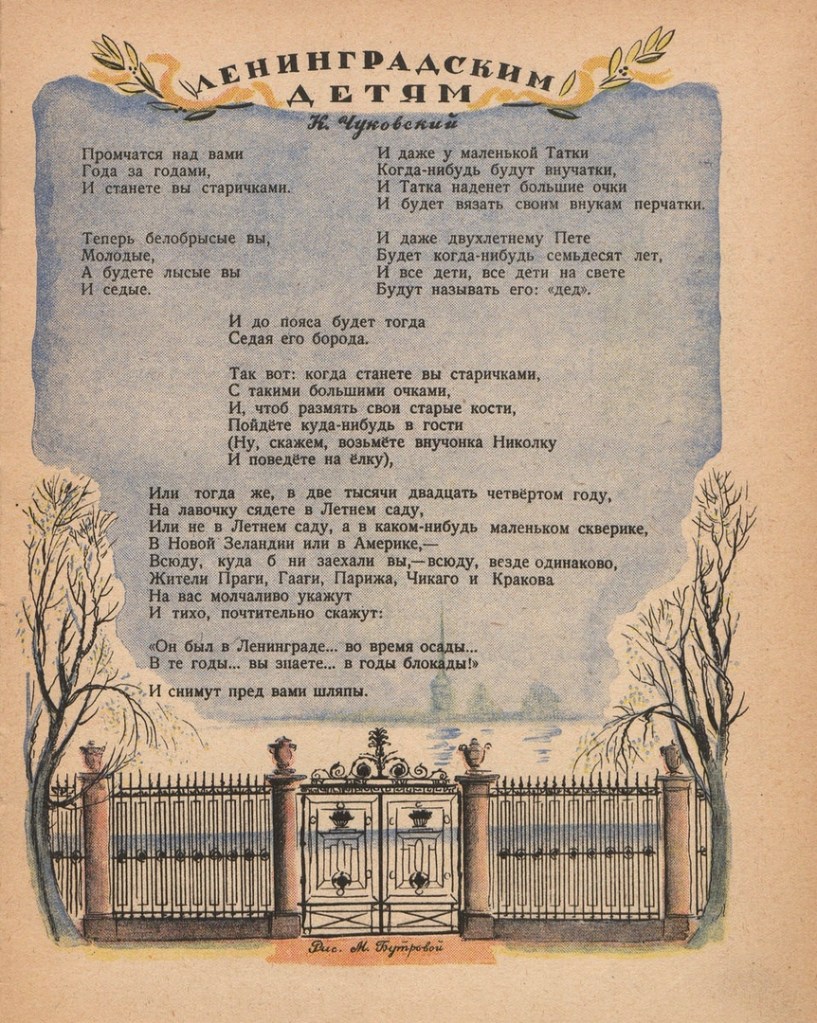
Kornei Chukovsky’s poem “To the Children of Leningrad” (1944), as published in the children’s magazine Murzilka in 1945. Source: dinasovkova (LiveJournal)
The years will speed past you, Year after year after year, And you’ll become old women and men.
Now you are towheaded, Now you are young, But then you shall be bald And grey.
And even little Tatka Shall someday have grandkids, And Tatka will put on big glasses And knit mittens for her grandchildren.
And even two-year-old Petya Will someday be seventy years old, And all the children, all the children in the world Will call him “old man.”
And his grey beard will Hang down to his waist.
Now, when you’re old women and men, Wearing those big glasses, To stretch your old bones You’ll go on an outing. (You’ll pick up your grandson Nikolka, say, And take him to a New Year’s party.)
Or, in that very same year, two thousand twenty-four, You’ll sit on a bench in the Summer Garden. Or not in the Summer Garden, but in some little square In New Zealand or America. It will be the same everywhere, wherever you go — Prague, The Hague, Paris, Chicago, Krakow. The residents will silently point at you And quietly, respectfully say:
“They were in Leningrad during the Blockade, Back in those days, you know, in the years of the Siege.”
And they’ll doff their hats to you.
1944
Translated by the Russian Reader. Thanks to Alexander Voitsekhovsky and Svetlana Voskoboinikova for the heads-up.
Actor Alexander Sushchik recites Kornei Chukovsky’s “To the Children of Leningrad”
Few people in Russia see the March 2024 presidential election as a real opportunity to change the country’s leadership. Voting in Russian elections has not been free and fair in recent times, and since the invasion Ukraine, the Russian regime has tightened the screws dramatically. There is no freedom of speech, people are persecuted for making anti-war statements, many opposition leaders and activists are in prison, and hundreds of thousands of people have fled Russia.
In January [2024], however, thousands of people unexpectedly showed up to sign petitions supporting the presidential candidacy of Boris Nadezhdin, a former State Duma deputy who entered politics in the 1990s. Nadezhdin is running under the slogan “End the special military operation.” Many people view endorsing Nadezhdin as a legal opportunity to voice their anti-war sentiments. Standing in long queues at signature collection points, people said they had come to see other people who thought like they did and voiced hope for change.
Their conversations are featured in Nadezhdin’s Queue, a film in Radio Svoboda’s documentary project “Signs of Life.”
Henry Slesar was born in Brooklyn, New York City. His parents were Jewish immigrants from Ukraine, and he had two sisters named Doris and Lillian. After graduating from the School of Industrial Art, he found he had a talent for ad copy and design, which launched his twenty-year career as a copywriter at the age of 17. He was hired right out of school to work for the prominent advertising agency Young & Rubicam.
It has been claimed that the term “coffee break” was coined by Slesar and that he was also the person behind McGraw-Hill’s massively popular “The Man in the Chair” advertising campaign.
Bohdan Ziza, a Ukrainian artist, poet and activist, is serving a 15-year sentence for “terrorism” after pouring blue and yellow paint – the colours of the Ukrainian flag – on to a municipal administration building in Evpatoria, Crimea, his home town. He made and circulated a video of the action – on 16 May 2022, shortly after the all-out Russian invasion of Ukraine – and for that was also charged with “incitement to terrorism”.
Bohdan Ziza. From his instagram channel
This is Bohdan’s speech from the dock, before being sentenced by a Russian military court on 5 June last year.
Do I regret what I have done?
I am sorry that I over-reached, and that my action resulted in charges under the Article [of the Russian criminal code] on terrorism. I am sorry that my grandmother is now without the care and support that she needs. Apart from me, she has nobody. And I am sorry that I can not now help others who are close to me, who need that help now.
As for the rest: I acted according to my conscience.
And also, according to my conscience, I do not deny or disavow what I did. I behaved stupidly, and could have expressed my opinion in some other way. But did I deserve, for what I did, to be deprived of my freedom for ten years or more?
I would like to appeal to the court: do not follow the regime’s script, do not participate in these awful repressions. But obviously that would have no effect. The judges and other similar political actors are just doing what they are told.
For these reasons, I will continue to protest, even in prison. And I am well aware of the sentence I may receive, and how it may affect my health and even my life.
But am I worthy of the life that I live? Is each one of us worthy of a carefree life, when we stay silent at a time when, every day, innocent people’s lives are being taken?
This was the worst night of my life. I never experienced anything like it. I thought we would die. There were three Kinzhal rockets, and loads of Kalibrs. They fell very close, they were right above our building. The building shook – several explosions, one after the other. For the first time in the war there was a white glow, the sky was white from the explosions. It was as though we were in a trench, not in our own home. At one moment I thought that it was all flying towards us. There was the very clear sound of a rocket, and then a very powerful explosion. But we have been lucky, again, and we are still alive.
That was a message from my sister, in Kyiv, who had to live through another night of bombardment of the city by the Russian armed forces.
When she went out in the morning, she learned that one of the rockets had hit the next-door building.
For many people, this war that is going on now is happening over there somewhere, far away.
One of the staff at the pre-trial detention centre said to me: “Bloody hell, I am sick of this war. Whenever you turn on the TV, it’s more of the same.” I answered that the war is not over and so you can not get away from it. And then he said: “Yeah, yeah, I know. It’s just that everything is getting more expensive. The cost of running a car now!”
And that’s the problem, here in Russia. For you, this war is an inconvenience, an irritation. You try to wait it out, living your usual life, trying to avoid bad news, and in that way simply not valuing simple things, not valuing the fact that you can wake up in a warm bed, in a warm flat, and say to someone who is dear to you, “good morning”. At a time when in the country next door, millions of people are losing their homes, losing their loved ones, when whole cities are being destroyed. Every day. That’s the everyday reality for Ukrainian citizens now.
In theory, Russian people’s failure to act could be explained, if only what is happening was not being done by Russian hands. The hands of those who bear arms, and those who don’t do anything to stop them. Every day that an ordinary Russian person carries on, reasoning that this is all politics and doesn’t concern him, and living his normal life, he adds money to the Russian Federation budget and in that way sponsors this criminal war.
Of course there are those who do not support what is happening, who take action, who are not silent participants: journalists, various activists – those who refuse to keep quiet.
My action was a cry from the heart, from my conscience, to those who were and are afraid – just as I was afraid – but who also did not want, and do not want, this war. Each of us separately are small, unnoticed people – but people whose loud actions can be heard. Yes, it is frightening. Yes, you can end up behind bars – where I, for sure, did not plan to be. Even for these words I could face a new criminal case. But it is better to be in prison with a clear conscience, than to be a wretched, dumb beast on the outside.
I am also an ordinary citizen of my country – Ukraine – who is not used to keeping quiet when confronted with lawlessness. I am not alone here today in this “goldfish bowl” [slang for the glass cage in which the accused appears in Russian courts]. There are more than 200 people with me: Ukrainian political prisoners, serving time in Russian prisons on fabricated charges. Many of them are Crimean Tatars, who are once again faced with repression by Russia. I am myself half Crimean Tatar, and angry at our people’s suffering.
Many Ukrainians are serving time in Russian prisons simply because they are Ukrainians, and were somewhere that the Russian state thought they should not be. In Russian prisons people are beaten up for speaking in Ukrainian. Or not even for speaking it, but simply for understanding it. Bastards among the guards at pre-trial detention centres or other places where people are imprisoned address prisoners in Ukrainian, to see if they get a reaction, to see if they provoke an answer or a response. If a person reacts, they beat him up.
Those who so passionately seek “Nazis” in Ukraine have not opened their eyes to the Nazism that has emerged in Russia, with its ephemeral “Russian world”, with which armed forces have come to us, to try to extirpate Ukrainian identity.
People in prison suffer in the most terrible conditions. Many of them are elderly. More than 40 people [in the pre-trial detention centre] have critical health problems, and can not access the medical treatment that they need. People die in prison. They are not criminals. Deport them from the country! Why do you keep them here?
I am no kind of terrorist. It sounds ridiculous to even say that. I am a person with morals and principles, who would rather give his own life than take the life of another person. But I am not ready to give my life to the Federal Penal Enforcement Service of the Russian Federation.
I declare a hunger strike, and demand that I be stripped of my Russian citizenship. I demand that all Ukrainian political prisoners be freed. If anything happens to me in prison, I want the world to know that it happened only because I am a Ukrainian, who took a stand against the war in his country.
And if this is my last word, let it be my last word in the Russian language. The last thing I will say publicly in Russian in this country, as long as this regime lasts. The reddish regime.
[Ziza then switched from Russian to Ukrainian, and recited this poem. Explanation of names mentioned below.]
I am not Red, I am Crimson!
I am not playing to the gallery!
These are not rhymes, they are wounds!
And I am not Melnik, I am Bandera!
The weather: it’s snowing in my summer,
From Symonenko’s motherland
I go to the end, like Teliha!
And I believe in wings, like Kostenko!
□ Note. The Ukrainian for “crimson” (“bahrianyi”), was also the pseudonym of Ivan Lozoviaha, a dissident writer and political exile from 1932 to his death in 1963. Andriy Melnik and Stepan Bandera were leaders of Ukrainian nationalist partisan military formations in the 1940s. Vasyl Symonenko was a Ukrainian poet, active in dissident circles until his death in 1963. Olena Teliha was a feminist poet, member of a nationalist underground cell in Nazi-occupied Kyiv, killed by the Nazis in 1942. Lina Kostenko is a Soviet-era dissident who has continued working as a poet and writer in post-Soviet Ukraine.
□ This is translated from the Russian text on the Graty news site, with reference to the Crimea Human Rights Group report.Thanks to M for help with translation.
□ What happened next. After Bohdan Ziza made this speech to the Southern District Military Court in Rostov, Russia, on 5 June 2023, he was sentenced by the judge, Roman Plisko, to 15 years in a high-security penal colony. Shortly after that, Ziza wrote to Zmina, the Ukrainian human rights organisation. He ended his hunger strike and then wrote to Uznik on-line, which coordinates correspondence with anti-war prisoners in Russia, to thank them and the many supporters who had written to him.
Bohdan, who marked his 29th birthday on 23 November, was moved to Vladimir prison. On 5 December, the Kharkiv Human Rights Protection Group reported that he had been visited by his lawyer and is in good spirits. He is sharing a cell with Appaz Kurtamet, another Crimean Tatar political prisoner, and was serving time in a punishment cell after stating that he is not a criminal and refusing to wear prison clothing.
□ What we can do. Advice to non-Russian speakers who wish to write to Bohdan and Appaz is included in this article on the Kharkiv Human Rights Protection Group site. The group also appeals to other countries’ diplomats to help Ukrainian citizens in Russian prisons (although this does not include Bohdan, since he was compelled, as a teenager, to take Russian citizenship after Crimea was annexed by Russia in 2014).
□ More information. Solidarity Zone (see facebook, telegram and twitter) supports anti-war activists jailed in Russia. The Kharkiv Human Rights Protection Group, Crimea SOS and Zmina are among the Ukrainian human rights organisation that publicise the fate of more than 180 Crimean political prisoners in Russian jails. SP, 17 January 2024.
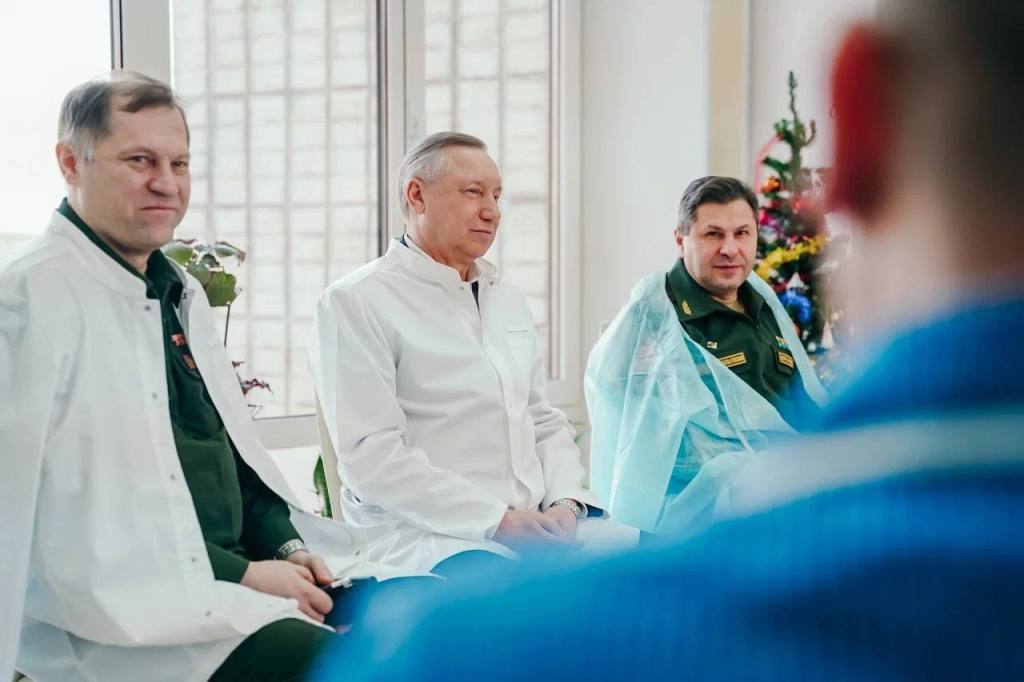
Governor Alexander Beglov (center), visiting wounded Russian soldiers at a military hospital in Petersburg. Source: Telegram
The Russian military understand well what they are fighting for in Ukraine because they have seen gender-neutral toilets in the local schools there, Petersburg Governor Alexander Beglov wrote on his Telegram channel after meeting with wounded soldiers at a hospital.
“It is easiest to talk politics with servicemen. Those who marched through the Ukrainianized version of Donbass carrying a machine gun understand well what we are fighting for,” Beglov wrote.
According to Beglov, the combatants saw bathrooms in Ukraine “in which instead of two spaces—for girls and for boys—there are three spaces: for girls, boys, and gender-neutrals.” That is why, the Petersburg governor argues, “these guys […] don’t need it explained to them what values we stand for.”
In response to Beglov’s statement, Boris Vishnevsky, a member of the St. Petersburg Legislative Assembly, reminded Beglov of the problems with Russia’s infrastructure: “According to Rosstat, a quarter of Russians do not have centralized sewerage.” He suggested redirecting the efforts aimed at fighting the West and NATO to more pressing problems. “And basically, it is hard to imagine something more gender-neutral than a backyard ‘latrine’-style toilet,” the local lawmaker concluded.
The need to protect children from western influence and fortify “traditional values” is regularly mentioned in statements by Russian politicians and officials as justification for the invasion of Ukraine. Earlier, President Vladimir Putin accused western countries of trying to “impose perversions” on children. “Do we want to have ‘parent number 1, number 2, number 3’ instead of ‘mom’ and ‘dad’ here in our country, in Russia? Have they completely lost their minds?” Putin claimed in 2022 at a ceremony to annex parts of Ukraine. In December 2022, Foreign Minister Sergei Lavrov complained about gender-neutral toilets in Sweden: “You have no idea how inhumane-it is, just inhumane.”
I paid a visit to our guys at a military hospital and wished them a happy Old New Year.
The conversation warmed my heart: we were finishing each other’s sentences.
It is easiest to talk politics with servicemen.
Those who marched through the Ukrainianized version of Donbass carrying a machine gun understand well what we are fighting for.
These guys—who saw in the [local] schools bathrooms in which instead of two spaces—for girls and for boys—there are three spaces: for girls, boys, and gender-neutrals—don’t need it explained to them what values we stand for.
We talked a bit about the future, about [their] prospects. I wrote down a few requests. I promised to bring Paralympic athletes to the hospital so that the servicemen could discuss starting sports careers with them if they wished. I am sure that if these guys—with their energy, endurance and team spirit—join our national teams, it will be impossible to defeat us.
Illustration by Danny Berkovskii for Mediazona. Source: New Tab
Aided by a team of volunteers, journalists at Mediazona and the BBC’s Russian Service have identified 41,731 Russian soldiers killed in the war in Ukraine using open sources. This number includes employees of the Wagner mercenary group, but it does not include those who fought on Russia’s side in military units fielded by the self-proclaimed Donetsk and Luhansk “people’s republics,” the BBC noted in an article published on Friday, 12 January.
According to the article, more than 1,100 Russian military personnel killed in the war were under 20 years of age. Since the State Duma approved amendments to the relevant laws, in April 2023, thus permitting 18-year-old high school graduates to sign military service contracts, 48 Russians born in 2004 and five born in 2005 (who were thus “barely 18 years old” when they enlisted) have perished in the war.
As of 11 January, 2,377 airborne troops, 913 marines, 537 members of the Russian National Guard’s special forces, 450 members of the GRU’s special forces, 206 military pilots, and 77 FSB and FSO officers have been killed in combat operations.
The BBC points out that the number of casualties among those who voluntarily signed a contract to serve in the Russian armed forces has increased in recent months. Thus, volunteers, prisoners, and private mercenary company “recruits” now account for 37 percent of all confirmed losses 0n the Russian side. Another 12 percent of the identified casualties were draftees (of whom 5,005 died in Ukraine and 62 in Russia).
According to Ukrainian intelligence, the Russian forces in Ukraine currently consist of 462,000 military and 35,000 National Guard troops, responsible for the functioning of the occupation regime. This number of troops allows the Russians to carry out rotation — to withdraw units and subdivisions and bring them to the front line.
When looking for a new advertising/PR agency in Ukraine in autumn 2023, PepsiCo made it a condition for a potential partner to exclude any mention of the war, or support for Ukraine and its army in future communications, according to a brief seen by B4Ukraine.
“NO: mention of war, hostilities, aggression, military personnel (from Brand side), Armed Forces of Ukraine. NO: support Ukraine and the army. NO: negative connotation, creating a feeling of ‘unsafe,’” states the “Pepsi restrictions” section of the brief.
The B4Ukraine Coalition contacted Pepsi offices in Ukraine and the US to ask for comment on this article but at the time of publication had not received any response.
In the meantime, the October 17 message on PepsiCo’s Instagram page announced that “PepsiCo volunteers distributed food kits to 1,200 families in the city of Borodyanka, whose homes were destroyed.” The message does not specify who exactly brutally destroyed the homes of these people.
Perhaps because PepsiCo’s Russia net profit increased by 333% to $525 million last year and the company paid about $115 million in taxes to the Kremlin? Treating such contributions as support for the economy of the aggressor state, Ukraine’s National Agency on Corruption Prevention (NACP) in September included PepsiCo in the list of international sponsors of war.
PepsiCo produces soft drinks, juices, chips, snacks, dairy products and other food products under the main brands Chester’s, Chipsy, Lay’s, Mirinda, Pasta Roni, Pepsi, Propel, Sandora, 7Up, Simba, Snack a Jacks, Sonric’s, Tropicana, etc.
The company has 19 factories, about 20,000 employees, 40,000 agricultural workers, and 600 open vacancies in Russia, according to the NACP.
The company announced the cessation of advertising activities and the production of some beverages in Russia in March 2022, while still allowing other products, such as infant formula and baby food to be sold, in order, as PepsiCo put it, “stay true to the humanitarian aspect of its business.” Yet in fact, the company continues the production and distribution of chips, snacks, and soft drinks. According to Bloomberg, PepsiCo’s revenue rose 16% in Russia and profits quadrupled, and the soda maker said operations in Russia accounted for 5% of consolidated net revenue for 2022, up from 4% a year earlier.
Now the iconic Pepsi cola is sold under the Evervess-Cola brand, although regular Pepsi Cola is still easy easily purchasable in Russian supermarkets due to the so-called parallel imports, when goods are imported without the manufacturer’s permission.
At the beginning of September last year, PepsiCo came under fire over its Russian business when the firm’s products were dropped by the Finnish parliament and Scandinavian Airlines’ operator SAS, and already on September 21, ironically, [a] Russian missile damaged a PepsiCo plant near Ukraine’s capital Kyiv.
A global [c]oalition of civil society organizations, B4Ukraine, is calling on PepsiCo to exit Russia ASAP and for the US government to issue a business advisory, warning US businesses of the growing legal, reputational, and financial risks of doing business under military control in Russia.
The war has markedly changed the Russian economy. Moscow has had to adjust its policy to fund its armed conflict against Kyiv, maintaining its military apparatus and police force, and integrating the territories it has annexed from Ukraine. These priorities have necessitated significant spending commitments that collectively threaten Russia’s economic stability. The Kremlin will spend six percent of GDP (more than eight percent when combined with spending on national security) on the war in 2024. This is more than the 3.8 percent of GDP that the United States spent during the Iraq war, although it falls short of the prodigious sums the Soviet Union allocated during the years of stagnation and its invasion of Afghanistan (18 percent of GDP).
Military spending has even eclipsed social spending—currently less than five percent of GDP—for the first time in Russia’s post-Soviet history. This pivot toward a militarized economy threatens social and developmental needs. The four annexed regions of Ukraine have already received the equivalent of $18 billion, and in 2024 almost $5 billion is expected to be transferred from the federal budget to regional budgets. No other regions in Russia receive this level of investment, which only increases interregional inequality. Rather than restore dilapidated housing in Russia, the Kremlin prefers to spend money on building houses and roads in annexed territories, to replace the houses and roads that Russian troops destroyed during their brutal invasion.
Russian industry has been transformed, with defense sectors now overshadowing civilian industries. The defense sector’s enterprises are now operating at a fever pitch and, as a consequence, any surge in demand is likely to force prices to rise because of the sector’s inability to increase supply. The military sector is receiving a disproportionately high amount of government spending, and it is also siphoning off labor from the civilian workforce, leading to an abnormally low unemployment rate of 2.9 percent. Before the war, Russia’s unemployment rate typically stood at aroundfour to five percent. The military and public sectors now employ 850,000 more people than in late 2022–23. The invasion of Ukraine also prompted about 500,000 Russians to emigrate in 2022, driving shortages of qualified specialists and blue-collar workers.
Meanwhile, living standards have risen across Russia, and the percentage of Russians living below the poverty line has dropped to 9.8 percent, the lowest since 1992. Naturally, there are regional variations, and areas that have sent a significant number of their men to fight in Ukraine—including Altai Krai, the Altai Republic, Buryatia, Chechnya, and Dagestan—have witnessed the fastest income growth in low-income groups. This relative increase in prosperity can be expected to continue as Moscow disburses funds to the families of the deceased and wounded.
Overall, the Kremlin wishes to maintain an illusion of normality and even increasing prosperity for its citizens. The distortions in the labor market have pushed up salaries in military industry, as well as in civilian manufacturing, because of the need to compete to attract workers from well-paying military plants. Moscow is, meanwhile, making high payments to soldiers and people mobilized to fight in Ukraine, which are driving consumption. At the same time, thanks to a supply of cheap credit, the government is handing out subsidized mortgages, that are, for the moment, shielding families from economic reality.
Elsewhere there are signs that the invasion of Ukraine may have disrupted the Russian economy more severely than the frothy party scene suggests. The Olivier salad, a mayonnaise-drenched confection of root vegetables, sausage and boiled eggs, is a staple at every table during the holidays. This winter the price of eggs suddenly rocketed (no one is quite sure why, but it may have been because farms were short of labour since so many workers have been conscripted or left the country). In some regions people cannot afford a box of six eggs and have to buy them individually. One pensioner even raised this with Putin during the president’s annual end-of-year call-in with the public. Putin promised to look into it.
In the two years that have passed since the start of Russia’s large-scale invasion of Ukraine, residents of Ukraine have become less likely to use the Russian language, according to a press release on the outcome of research done by the Ludwig Maximilian University of Munich in cooperation with the University of Bath and the Technical University of Munich, which was published on Wednesday, 10 January.
Language plays a leading role in the identity of post-Soviet Ukraine, the authors of the study say. Many Ukrainians are fluent in both Ukrainian and Russian. And yet, only a few years ago, 50 to 60 percent of the country’s residents called Ukrainian their principal language of communication. After the Maidan protests in late 2013, sparked by then-Ukrainian President [Viktor] Yanukovych’s refusal to sign an association agreement with the EU, and Russia’s subsequent annexation of Crimea in 2014, more Ukrainians abandoned Russian.
[…]
The researchers explore this trend in a study published in the journal Communications Psychology. Using artificial intelligence and statistical analysis, they examined more than four million messages posted by 63,000 Ukrainian users on the social network X (formerly Twitter) between January 2020 and October 2022.
According to the study’s authors, users began switching from Russian to Ukrainian even before the large-scale Russian invasion, but this trend increased dramatically after the war began. In their opinion, this change in user behavior was a political reaction to events. Users wanted to distance themselves from both support for the war and Russia as such, so they started using Ukrainian en masse.
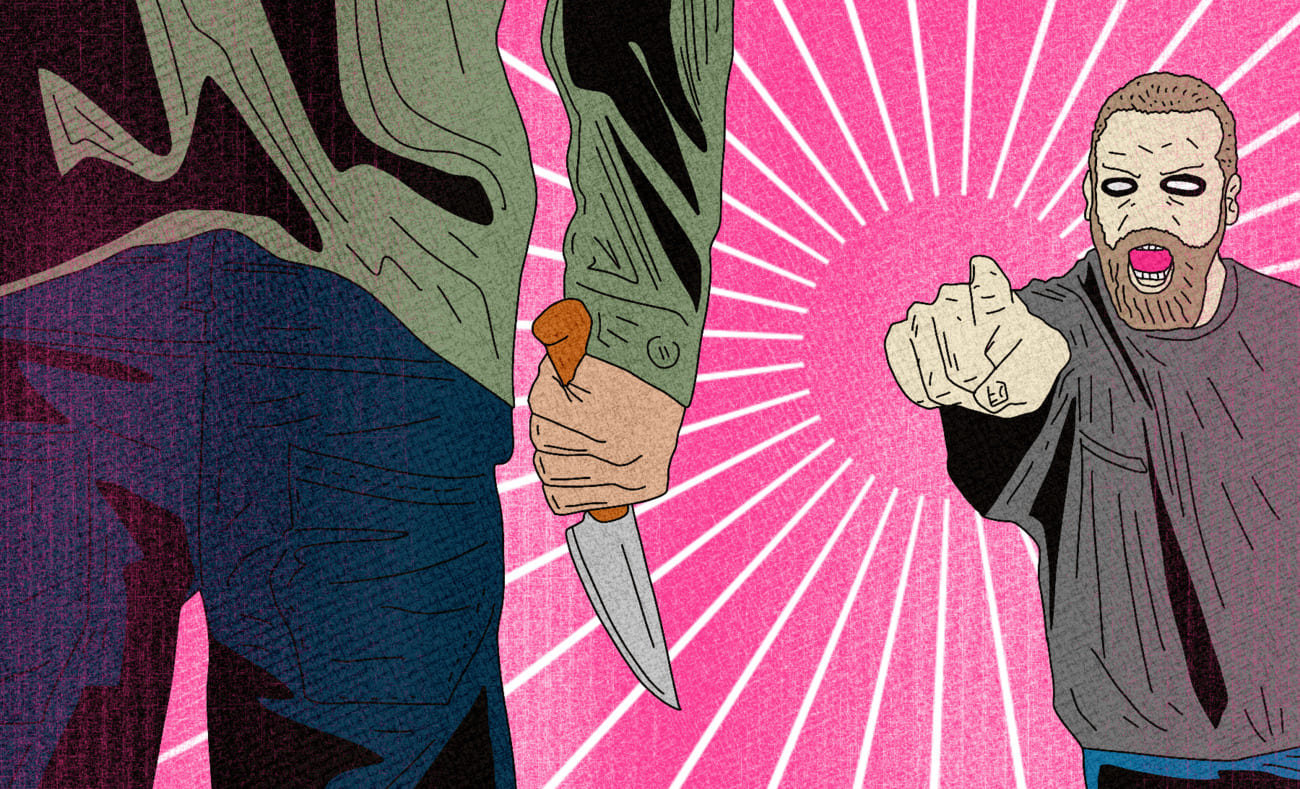
The full-scale war in Ukraine, which began almost two years ago, has led to increased violence in Russia itself. Military personnel with PTSD and criminals recruited into combat return from the front and maim and kill people in civilian life. Sometimes conversations about the war even end in violence. Mediazona and New Tab have uncovered over thirty criminal convictions for assaults and murders that occurred during quarrels about the “special military operation.” (The courts use the official wording for the war as mandated by the authorities.)
In Berdsk, Novosibirsk Region, draftee Khuler Mongush stabbed Nikolai Berezutsky, a passerby. The latter had asked Mongush why he was going to Ukraine. Saying that he was going there “to defend the Motherland,” the mobilized man attacked Berezutsky. Mongush was sentenced to eight years in prison for murder.
In the Irkutsk Region, farmer Maxim Khalapkhanov was drinking with an acquaintance, who began ridiculing the state of the Russian army during the war. Khalapkhanov eventually got angry and killed the acquaintance with a knife, whose handle was decorated in the colors of the Russian flag, and drew the letter Z on his stomach with a fireplace poker. Khalapkhanov was sentenced to seven years in a high-security penal colony.
Anton Rakov, a resident of Orenburg, was drinking with a new acquaintance. They began arguing about the war. Rakov did not like what his interlocutor was saying and killed him. While his victim breathed his final breaths, Rakov recorded a video with the dying man in the background, shouting, “This is what will happen to anyone who disagrees with me!”
Viktor Konnov of Zlatoust beat up a friend who said something nice about Ukraine, while Ivanovo resident Mikhail Vitruk received two and a half years in a penal colony for beating up his girlfriend, who allegedly called him a “Nazi” while they were watching the news.
In 2020, Mikhail Taskin attempted to shoot three people over a parking space and was sentenced to nine years in a penal colony, whence he was freed by the Wagner Group. Taskin spent several months in combat, where he lost a leg, eventually returning to his native village of Nerchinskiy Zavod in the Transbaikal Territory. In August 2023, he got into a fight at a local cafe. Taskin mocked the waitresses and promised to “hump all of them.” The incident ended in a brawl, and the police detained five people, but not Taskin was not among them. His sister and the local authorities argued that the disabled man had been assaulted by “opponents of the war.” But the news website Regnum discovered that two of the detainees were certainly not against the war because they had been involved in patriotic campaigns in the region.
It is not only drinking buddies and casual acquaintances who quarrel and fight over the war. Mediazona and New Tab turned up no less than seven court rulings in cases where the defendants and the victims were members of the same family. Vladimir Tofel from Petropavlovsk-Kamchatsky killed his nephew during an argument about the war. Yuri Makarkin stabbed his son, while Anna Cheremnova, a resident of the Altai Territory, stabbed her husband.
The experts asked for comment by Mediazona and New Tab argue that these are signs of a deep split within society, and the policy of the authorities does not help society to overcome this fissure. On the contrary, the hysterical rhetoric of propaganda only heightens the degree of intolerance, and people are increasingly willing to maim and kill each other.
Military court of appeal to consider the case of photographer Mikhail Babintsev
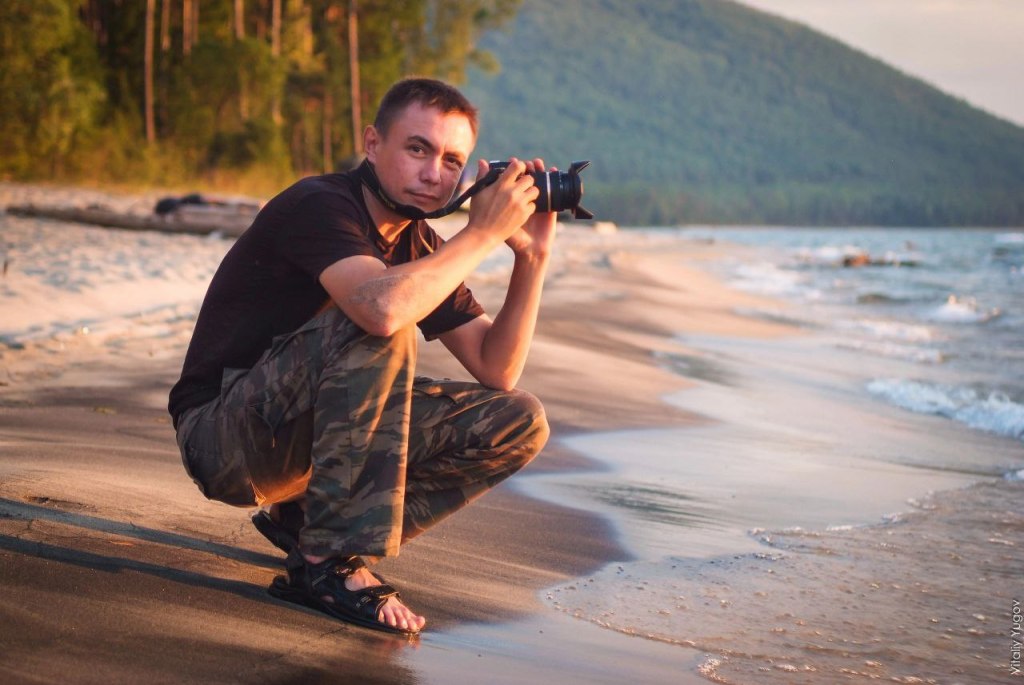
In October, Mikhail Babintsev, a resident of Buryatia, was sentenced to thirteen years in prison: the investigation argued and the court ruled that his attempt to set fire to the military recruitment center in the village of Mukhorshibir was a a “terrorist act.” Mikhail disagrees with this ruling and has appealed the verdict. With support from you, we aided the prisoner’s family in paying the defense lawyer’s fees during the appeals phase.
Mikhail Babintsev
On 17 January, the Military Court of Appeal in Vlasikha (Moscow Region) will hear the defence’s appeal of the verdict.
Solidarity Zone argues that treating arsons of military recruitment centres as violations of Article 205 of the Russian Federal Criminal Code (“Terrorist Act”) is unreasonable and politically motivated. The same conclusion has been reached by Memorial’s Political Prisoners Support Project, for example, in the case of Roman Nasryev and Alexei Nuriyev.
The Military Court of Appeal is located in a closed military town in the Moscow Region. The headquarters of the Strategic Missile Forces is also located there. Therefore, no one is allowed to enter the court or the town itself, but a live broadcast of the court hearings will be arranged at the security checkpoint on the edge of the town.
Come follow the trial and support Mikhail with your presence!
10:00 a.m., 17 January 2024
Military Court of Appeal, 25 Solnechnaya Street, Vlasikha, Odintsovo District, Moscow Region, Security Checkpoint 1
To travel by public transport from Moscow, you can use one of the following options:
from the Kievsky railway station by bus No. 477 to the Vlasikha security checkpoint;
from the Belorussky railway station (or from Fili or Kuntsevskaya metro stations) by train to Odintsovo station, then by minibus No. 46 to the Vlasikha security checkpoint.
We recommend that you call the court in advance at 8(495)598-74-29 and tell them that you wish to attend the court hearing so that the broadcast is definitely organised.
#political prisoners #crackdowns #no war #solidarity #arson attack #buryatia #court
[Ksenia] Sobchak: You want your children to live in a stable country without revolution?
[Chulpan] Khamatova: Without revolution. It could be some kind of changes in mindset. Without revolutions. I don’t want revolution. I’m categorical on this point, because the heads of completely innocent people fly in revolution and all these wars. I don’t think it’s right. Both sides have to do their utmost to avoid this.
Sobchak: But would you accept any compromise for the sake of avoiding revolution? Figuratively speaking, I don’t know whether you have any notion of geopolitics or not, whether you understand what’s happening in North Korea. People eat grass, and there’s a city within a city where officials live, while [ordinary] people live a completely different life without electricity. It’s just that I’ve been there, and so I know what I’m talking about. To put it starkly, which would you choose—living in a country like North Korea, for example, or revolution?
Khamatova: I would choose North Korea. I don’t want victims. It means that the people who oppose this regime lack certain tactics, know-how, and wisdom, that’s all.
Russian holiday-goers are set to be the first known tourists allowed into North Korea since it closed its borders as a pandemic response in early 2020. A five-day jaunt was arranged by an agency in Primorsky Krai after the eastern region’s governor visited the hermit kingdom’s capital for talks. The countries pledged closer ties after a series of meetings in September.
Friends, we apologize for replacing the video. The Zygar channel team reposted it due to a factual textual error, but the time codes remain the same.
Since I am a writer, I think that in the near future I will have to write a book which could be called The Empire Must Die, but only about another empire—Putin’s Russia.
And, of course, in this book one of the most important characters will be Chulpan Khamatova, the actress and co-founder of the Gift of Life charitable foundation.
She was one of the first to protest against the war with Ukraine and leave Russia.
Chulpan will talk about her life, starting the foundation, her encounters with Putin, and fighting for the lives of children, friends, and her own honor.
[…]
You can help children with cancer and donate an affordable amount to the Gift of Life Foundation: https://podari-zhizn.ru/ru.
00:00 – First meeting with Putin 09:57 – The germ of charity 13:30 – Anton Chekhov in the Kremlin 17:47 – Meeting Yuri Shevchuk 21:40 – The foundation’s first concert 24:31 – On medicine, doctors, and building a new hospital 26:41 – Putin and the PR move 30:22 – The Friendship Medal and the search for the missing money 33:20 – The relationship between Putin, the doctors and the clinic 36:53 – Canceling Matvienko and Gref’s speech 40:10 – Putin’s meeting with the creative intelligentsia 42:07 – Putin on democracy and freedom 45:24 – Chulpan, Putin, and the breast pump 48:48 – President Dmitry Medvedev in the lives of charitable organizations
49:44 – Medvedev’s meeting with foundations, the story about the hamsters and beads 1:01:51 – Putin’s election campaign 1:07:05 – “This clinic should be turned over to the doctors.” 1:09:57 – Decentralization of hospitals, opening the center in Yekaterinburg 1:14:50 – Bullying and depression 1:18:58 – “Chulpan chooses North Korea”: the problematic headline 1:25:50 – “If I chose North Korea, why didn’t I stay there?” 1:28:53 – Reorganizing the foundation”from a church into a McDonald’s” 1:31:32 – Unholy Chulpan and Dima Yakovlev’s Law 1:35:53 – One-on-one with Putin 1:44:23 – Petition for the annexation of Crimea 1:45:53 – Offer to become children right’s ombudsperson 1:54:44 – Kirill Serebrennikov and detention 2:01:22 – Last meeting with Putin 2:05:56 – “Should I be afraid?” 2:09:56 – War in Ukraine: 24 February 2023 2:16:23 – The difficulty of emigration
The wife of a Russian soldier killed in action recorded a video message.
I would like to tell this story, if possible, from the very beginning. My name is Maria Ishkova, and I’m from St. Petersburg. I’m an absolutely genuine, living person. I’m no agent engaged in PSYOP.
All in all, my husband had been mobilized and deployed in the field with the Russian federal armed forces since September 2022, with periodic withdrawals [from the front] for rest and relaxation. But he had only one [home] leave during that whole time.
But none of that matters because yesterday—or rather, today—I learned that my husband passed away yesterday.
And that’s not all. The big thing I want to tell all the people who are fighting for the men they love—for their love, for their heart, for their life, for their fate—is that you’re out of time. You’re completely out of time because any day may be the fateful one.
I also want to say that I’ve now arrived in those selfsame new territories. I’ve come for my husband to Berdiansk, in the Zaporizzhia Region. And you know, I want to tell you that the people here have no need of [the war], no one has any need for it.
The people we love are simply getting killed for nothing. They’re of no worth to anyone.
I want to say that today—precisely today because I found out about it—my mind has split in two. One part of my mind, the lower part, it understands this grief, it grieves, it feels like weeping—all that stuff.
The second part of my mind, which has split off, it looks at all this a little bit from above and tries to understand how the world order could let such things happen.
And you know, I think that we ourselves are probably to blame for everything. I think that we let it happen by taking the minimal civic stance that we did—when each of us says, I don’t get involved in politics, it doesn’t interest me, it doesn’t worry me.
Each of us lived in this little world—where nothing mattered, where politics was decided by itself, where things happened of their own accord.
Now we find ourselves in a situation in which, basically, the chickens have home to roost because of our world view, because of our outlook on life. We were indifferent to these things, and now these things have devoured us.
The BBC and Mediazona have been able to ascertain the names of at least 40,000 Russians killed in Ukraine.
“Bring back my husband. I’m fucking tired of this shit.”
All over Russia, the wives and relatives of mobilized soldiers have been organizing protests to demand that their loved ones be returned home.
I’m standing next to the Russian Defense Ministry. I’m doing a solo picket in the hope that we, the wives and mothers of mobilized men, will be heard. [I hope that] our pain will be heard, that our request to bring our husbands [and] our boys back home will be heard.
They are tired. They’ve been deployed in the special military operation zone for a year and four months with no rotation.
Personally, my husband has been sent on the attack. He has a master’s in applied physics. He works in IT. He has a child who is one and a half years old. When he was [mobilized], the child was three months old. But now he’s on the attack. People like him shouldn’t be sent on the attack.
Generally, all the mobilized men should be brought home: they need to rest. We demand that the period of mobilization of no more than a year be restored.
That’s why I’m here today, and I expect to be heard.
And what else do you plan to do if you’re not heard?
We’ll keep on going. We’ll continue to fight for our boys because we don’t really have a choice. Each time there are more and more of us. More and more wives, mothers, and sisters are beginning to understand that their inaction could get their husbands or brothers killed.
You don’t have as much time as you think you do. Every days could be the decisive one, the last one.
How long are you going to stand here?
I’m probably going to stand here until I’m finally frozen. Because the weather outside is frightful, to be honest. But I also know that my husband is facing even worse conditions, and the fact that I’m standing here in the cold for an hour or two cannot be compared with the fact that for a year and four months he has faced simply inhumane conditions without being relieved, and now, to make matters worse, he’s on the attack.
I’m not afraid to talk about it. I’m not afraid to fight because the worst thing that could happen has already happened.
Nevertheless, if we disregard volunteers, prisoners and mercenaries, we can say with a high degree of certainty that by the beginning of 2024 the Russian armed forces will not have recovered the number of contract-based personnel that they had on the eve of February 2022. This is indirectly evidenced by other figures cited by the Kremlin: approx. 244,000 military personnel are officially at war today, while 650,000 people have gained combat experience since February last year, 458,000 of whom have already received certificates confirming their status as combat veterans. This, of course, includes both regular servicemen and mobilised personnel from various combat units, as well as those serving in the navy and combat support units, ground staff of military airfields, etc., servicemen of the Rosgvardia and Federal Security Service (FSB), mercenaries and volunteers, military personnel from the Donetsk and Luhansk People’s Republics, as well as police officers. And apparently, these 650,000 veterans include all: the living, the dead, the missing, the captives and the disabled.
And given the Russian servicemen’s numerous complaints about the lack of rotation, it is not clear—even taking all the losses into account—where the claimed 490,000 new contract soldiers could have dissolved, alongside the unclear number of ‘old’ contract soldiers and the remaining mobilised troops. Simply put, the figures on paper have ultimately diverged from the actual number of people in Russian troops.
Female activists calling for the return of mobilized Russians from Russia’s war against Ukraine held a series of solo pickets in Moscow. The actions took place near the presidential administration offices and the Defense Ministry, according to a post on the Telegram channel of the movement The Way Home (Путь домой) on Saturday, January 6.
None of the picketers were detained. According to a female activist who picketed outside the offices of the presidential administration, a Federal Protective Service called the police, but the latter, after arriving at the site, confirmed that solo pickets were a legal form of protest.
At the same time, SOTA notes that about fifteen wives of mobilized Russians laid flowers at the Tomb of the Unknown Soldier near the Kremlin. According to SOTA, five relatives of mobilized men laid flowers at the Eternal Flame in St. Petersburg, demanding the return of their loved ones from the front.
Calling for the return of mobilized men home
Wives of mobilized Russians have been increasingly active in recent months in demanding the return home of men who have been at the front for over a year. They have been holding flash mobs, going to protest rallies, and sending official letters to the authorities, demanding that the tour of combat duty for mobilized men limited to one year, that all wounded men be discharged, and that the list of illnesses for which they cannot be drafted be expanded.
The leaders of many regions have refused to allow relatives to hold protest rallies, citing the threat of COVID-19. The Kremlin has practically not commented on their demands.
At the end of 2023, the Russian Defense Ministry turned down a request by Boris Vishnevsky, a member of the St. Petersburg Legislative Assembly, to limit the tour of duty of mobilized Russians to one year. Their tour of duty will end as soon as the country’s President Vladimir Putin signs a decree ending the mobilization, the ministry explained. At the same time, presidential spokesman Dmitry Peskov said on 1 November 2022 that Putin’s decree was not required to end the mobilization.
“The Way Home: Wives of the Mobilized.” In Russian, with Russian subtitles. Maria Ishkova (above) and the young female solo picketer featured in the second part of this post both make appearances in this film.
Russia mobilized 318,000 men for its war against Ukraine, according to Vladimir Putin. The so-called partial mobilization was announced in September 2022, six months after the start of Russia’s invasion of Ukraine. Many mobilized men and their relatives believed that the mobilization would be for a relatively short period of time, up to six months, although no official announcement was made.
Almost a year later, in August 2023, The Way Home movement emerged in Russia, uniting relatives of mobilized soldiers. Several female activists who had met in one of the numerous online groups for the wives and mothers of Russian soldiers decided to move from talk to action and created a chat room to coordinate their efforts. Initially, most of the chat room participants were loyal to the government and avoided politics. Over time, they realized that the mobilized soldiers were not going to be brought home, the local authorities were making empty promises, and the topic was taboo to the federal press, and so the activists turned to public protests to make themselves heard. They have refrained from criticizing the government’s decisions and the war itself, focusing on the sole goal of bringing the mobilized men back home.
On 7 November 2023, a group of women armed with placards attended a Communist Party rally on Manezhnaya Square in downtown Moscow. On December 7, the movement published a collective manifesto demanding demobilization. The Way Home became the talk of the town, and the community began growing rapidly while also coming under increasingly harsh attacks. Opponents of the war ridicule those who did not dodge the draft and obediently reported to military recruitment centers. Supporters of the war have declared the female activists “Navalny supporters. Television propagandist Vladimir Solovyov said that The Way Home was created by foreign special services for subversive activities. The community’s rallies are banned under the pretext of preventing the spread of covid, its female members and their husbands are visited by law enforcers, and The Way Home’s Telegram channel has been labeled “Fake.” (Pro-government blogger Ilya Remeslo said this was done after he filed a complaint.) Despite the pressure, the community continues to function.
Vladimir Sevrinovsky’s film Wives of the Mobilized tells the story of an activist in The Way Home who wished to remain anonymous.
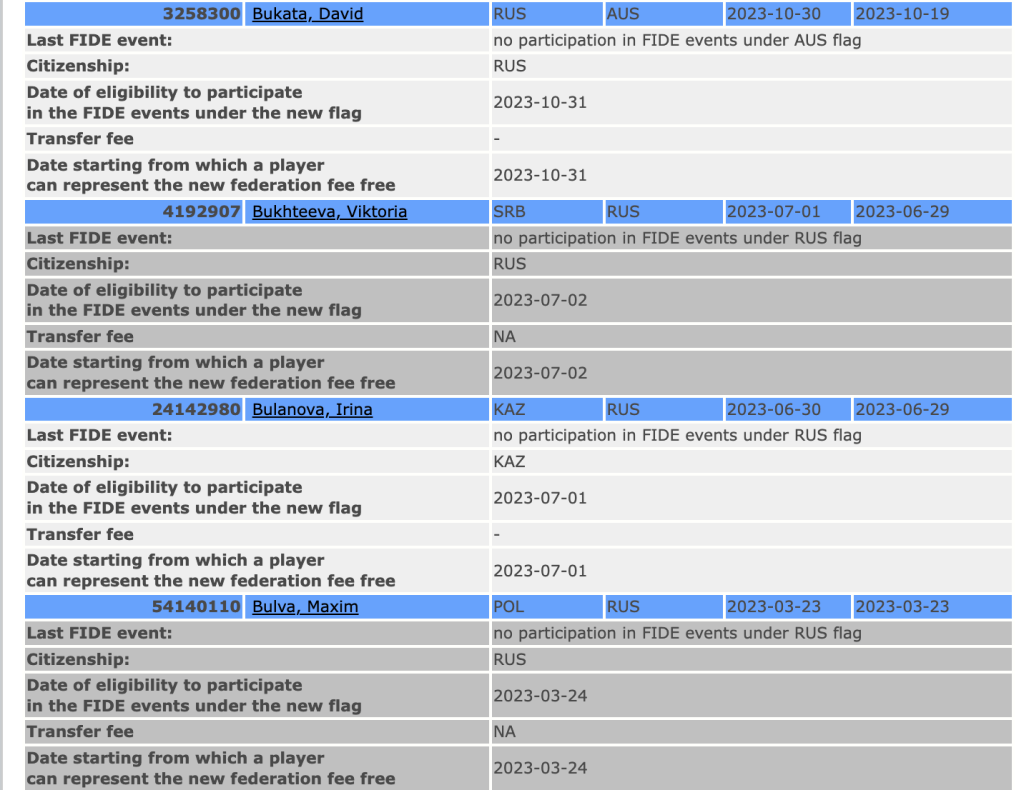
As Australian chess player David Bukata was joining the Russian chess federation last year, three Russian players whose surnames also start with B were quitting it. Screenshot of the 2023 transfers page on FIDE’s website.
In 2023, 104 Russian chess players changed their national affiliations, according to information published on the website of the International Chess Federation, FIDE.
Among the top hundred players in the world chess rankings, Sanan Sjugirov (40th place), Alexey Sarana (41st), Vladimir Fedoseev (45th), Nikita Vitiugov (50th), Alexandr Predke (64th), Kirill Alekseenko (89th) and Alexandra Kosteniuk (11th in the women’s rankings) quit the Russian national chess federation.
In turn, five competitors transferred their affiliation to the Russian chess federation last year: Yuriy Ajrapetjan and Viktor Filonov from Ukraine, David Bukata from Australia, Kanan Geidarli from Azerbaijan, and Nadezhda Iskichekova from Kazakhstan.
In the almost two years since Russia launched its full-scale invasion of Ukraine, 192 Russian chess players have changed their national sporting affiliations.
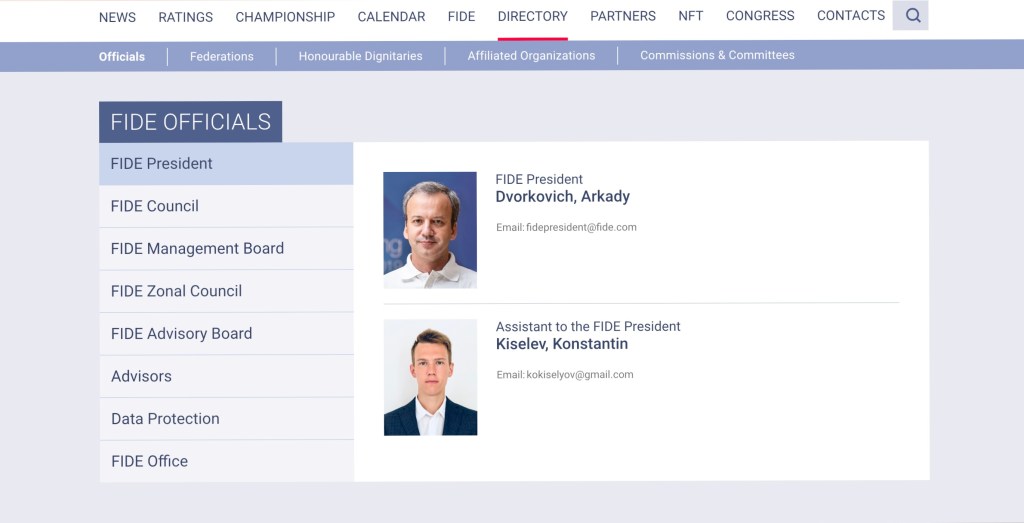
Former Russian deputy prime minister Arkady Dvorkovich is FIDE’s current president.
Arkady Vladimirovich Dvorkovich (Russian: Арка́дий Влади́мирович Дворко́вич; born 26 March 1972) is a Russian politician and economist, currently chairman of the International Chess Federation, FIDE. He was Deputy Prime Minister in Dmitry Medvedev’s Cabinet from 21 May 2012 until 7 May 2018. He was previously an Assistant to the President of the Russian Federation from May 2008 to May 2012. He has the federal state civilian service rank of 1st class Active State Councillor of the Russian Federation.
Dvorkovich was considered to be a close confidant of Dmitry Medvedev and an important figure in Russian politics. He rose to prominence during Medvedev’s presidency but has suffered from the resurgence of Igor Sechin. From 2018 to 2022 he was the Chairman of Skolkovo Foundation. Since 2015, he is also the Chairman of the Board of the Directors in Russian Railways company.
[…]
In March 2022, Dvorkovich condemned Russia’s invasion of Ukraine, saying that “Wars are the worst things one might face in life…including this war. My thoughts are with Ukrainian civilians.” Andrey Turchak, a lawmaker from Putin’s United Russia party, condemned Dvorkovich’s anti-war stance and called for his “immediate dismissal in disgrace,” saying: “This is nothing but the very national betrayal, the behavior of the fifth column, which the president [Putin] spoke about today.” Later Dvorkovich said on the website of the Skolkovo Foundation that he was “sincerely proud of the courage of our (Russian) soldiers” and that Russia had been targeted by “harsh and senseless sanctions.”
In August 2022, he was re-elected for a second term as FIDE president receiving 157 votes as against 16 by his rival Andrey Baryshpolets.



 10:00 a.m., 17 January 2024
 Military Court of Appeal, 25 Solnechnaya Street, Vlasikha, Odintsovo District, Moscow Region, Security Checkpoint 1
 We recommend that you call the court in advance at 8(495)598-74-29 and tell them that you wish to attend the court hearing so that the broadcast is definitely organised.