Five Time’s the Charm

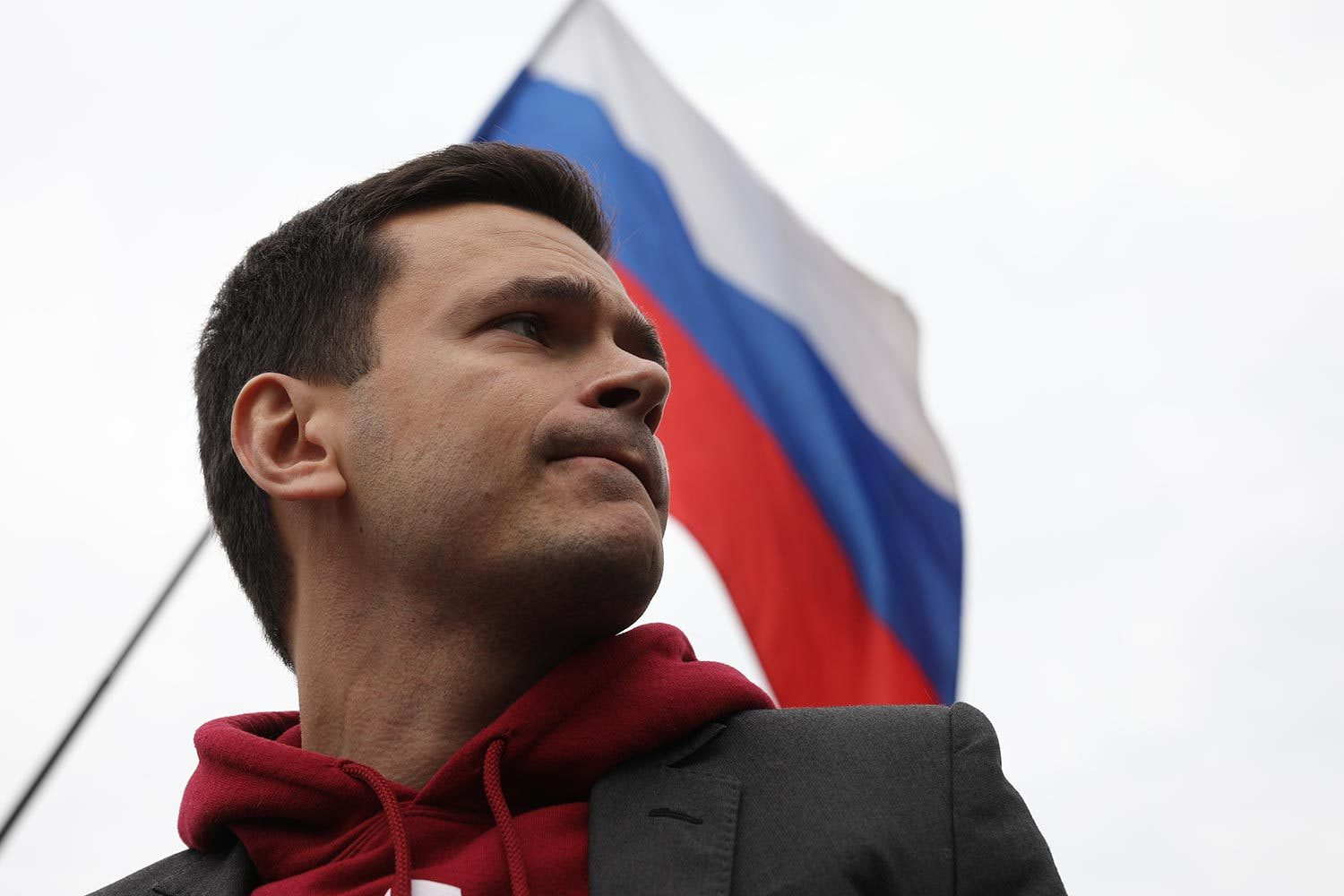
yashinIlya Yashin is not the only unregistered candidate for the Moscow City Duma against whom the tactic of consecutive arrests has been used. Photo by Yevgeny Razumny. Courtesy of Vedomosti
Yashin Breaks Record for Numbers of Arrests: Moscow Test Drives New Method of Combating Activists
Anastasia Kornya
Vedomosti
August 30, 2019

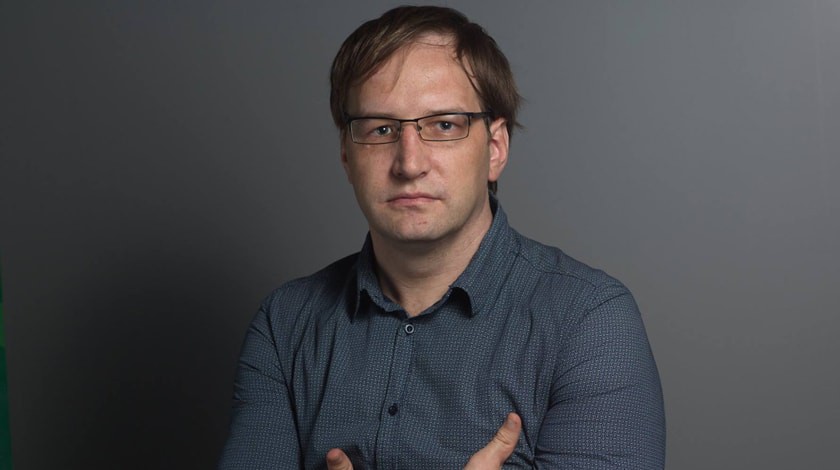
On Thursday, Ilya Yashin, head of the Krasnoselsky Municipal District Council in Moscow, was sentenced to his fifth consecutive jail sentence of ten days for an administrative violation. The Tverskaya District Court found him guilty of calling on the public to attend an August 3 “unauthorized” protest rally in support of the independent candidates barred from running in the September 8 elections to the Moscow City Duma.

Yashin has been in police custody since July 29. He has been detained every time he left the special detention center after serving his latest sentence. Police have taken him to court, where he has faced fresh charges of holding an “unauthorized” protest or calling on the public to attend one and then been sentenced to jail again. The municipal district councilman has thus been in detention almost continuously for thirty-two days, while the total time he has spent in jail this summer is forty-one days. This considerably exceeds the maximum allowable sentence of thirty days, as stipulated by the Criminal Procedures Code.

Yashin is scheduled to be released on September 7, but there is no guarantee he will not go to jail again.

Yashin’s lawyer Vadim Prokhorov told the court that the prosecution of the councilman was tantamount to a political reprisal. Formally, he noted, one arrest can follow another without violating the law. The problem was that the courts could make one wrongful ruling after another. Prokhorov saw no point in amending the laws, which are quite logical on this point.

“It would be like treating cancer with aspirin,” he said. “We have to change the whole judicial system.”

Ilya Yashin is not the only unregistered candidate for the Moscow City Duma against whom the tactic of consecutive arrests has been used. Former MP Dmitry Gudkov was sentenced to thirty days in jail on July 30, but several days before his scheduled release he was sentenced to another ten days in jail for calling on people to attend the July 27 protest rally. Yulia Galyamina has been convicted of three administrative offenses and sentenced to ten days in jail twice and fifteen days once; she is still in police custody. Konstantin Yankauskas has been arrested and sentenced to seven, ten, and nine days in jail, respectively; like Yashin, he was detained by police after leaving the special detention center. Oleg Stepanov has been sentenced consecutively to eight and fifteen days in jail; Ivan Zhdanov, to ten and fifteen days in jail.

The authorities are unwilling to charge the protest leaders with felonies and remand them in custody, but they clearly do not want to see them at large, said Alexei Glukhov, head of the project Defense of Protest. He noted that the current tactic of arresting opposition leaders multiple times is something novel: in the entire history of the protest movement [sic], no one had ever been arrested more than two times in a row.

Glukhov warned that the tactic was quite dangerous. Courtesy of the Russian Supreme Court, which in the recent past has ruled that violating the deadline for filing charges (legally, the authorities have two days to do this) did not preclude filing charges later, any person who attends a protest rally has the sword of Damocles hanging over their head for a year after the rally.  The authorities can arrest them at any time, for example, by claiming they had only just established their identities.

Glukhov pointed out that, in its review of the government’s draft project for a new Criminal Procedures Code, the Presidential Council on Human Rights had drawn attention to the fact that the one-year statute of limitations in such cases was not justified and could be misused.

Translated by the Russian Reader

Pskov Region: Copyright Trumps Voting Rights

Yabloko Candidate in Pskov Region Barred from Election for Not Crediting Composer in Campaign Videos
Novaya Gazeta
August 30, 2019

A court in the Pskov Region has disqualified Yabloko Party candidate Sofia Pugachova from standing in the election for the post of head of the Novorzhev District due to the fact that the composer of the music used in her campaign videos was not credited, according to Lev Schlosberg, a member of the Pskov Regional Assembly.

“There was no copyright violation since the composer had consented to use of his piece. The original agreements, in English and Russian, were submitted to the court. The court, however, failed to react to this evidence, not even mentioning it in its ruling,” explained Schlosberg, adding there was a danger similar lawsuits would be filed in the Pustoshka District and Pushkin Hills District.

Schlosberg said the videos did not credit the composer, but when the error was caught, the videos were removed from the web and replaced with new ones.

The music in question was the Italian composer Daniele Dinaro’s Lux.

Pugachova said that Alexei Ivanov, the Growth Party’s rival candidate for the same post, had petitioned the court to disqualify her.

“They could not find fault with anything else, so they found this way of barring me from the election. The court even questioned whether the composer’s signature on the agreement was genuine. That was why we also entered into evidence a video showing Dinaro signing the agreement with us,” Pugachova said.

She argues that the court’s ruling was completely illegal and is currently preparing to appeal it.

Translated by the Russian Reader

The After Party, or, The Electoral Iguana

iguana

Artplay to Hold “Posh Gubernatorial Election After Party”
Sergei Feofanov
The Village
August 30, 2019

Artplay Design Center in Petersburg (Red Guard Square, 3) will hold Election Night 2019 in the wee hours of September 9, the event’s organizers have informed us. They have dubbed the event a “posh invitation-only after-party” to celebrate the city’s gubernatorial election [on September 8].

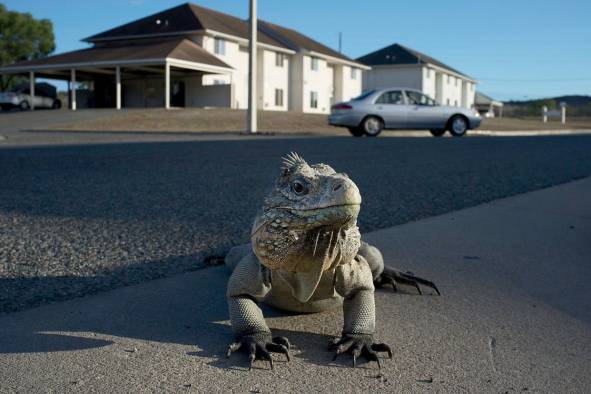
Political operatives, politicians, and celebrities [selebriti] will take part in the event. Guests will be treated to projection mapping [sic] and musical sets by Markschneider Kunst and Junkyard Storytellaz, as well as an immersive show [immersivnoe shou] involving actors “made up to look like the eye-catching residents of a communal apartment.” In addition, organizers plan to release an “electoral iguana,” which will crawl to one of four bowels representing the candidates.

Last year, Election Night was held in Moscow, and this autumn the main event will also take place in the capital, including video links with the regions. Organizers include the Russian Public Chamber, National Public Monitoring, the Russian Public Relations Association (RASO), RASO’s Political Strategists Committee, and the Russian Political Consultants Association.

Znak.com reporter Ksenia Klochkova, who writes on the Telegram channel Rotunda, told us that spin doctors working for the campaign of [acting governor and gubernatorial candidate] Alexander Beglov have their headquarters at Artplay. Activist and public figure Krasmir Vranski said that “all normal people” would be up all night contesting the elections.

The organizers claim there will be no campaigning and support for any candidate at the event. Artplay simply met certain criteria as a venue, they explained.

Earlier, the band SBPCh [“The Largest Prime Number”] canceled a concert in the infamous, political scandal-plagued municipal district of Ekateringof. The band’s musicians did not want to play at a politically charged event.

Thanks to Julia Galkina for the heads-up. Photo courtesy of Newsweek. Translated by the Russian Reader

Out Through the In Door, or, The Victim Is Always the Guilty Party

yevgeny kurakinYevgeny Kurakin. Courtesy of Facebook and Daily Storm
Journalist Yevgeny Kurakin Detained after Release from Special Detention Facility 
Mediazona
September 30, 2018

Journalist Yevgeny Kurakin has been detained in the Moscow Region city of Elektrostal. Kurakin was scheduled to be released from a special detention facility after ten days in jail for an administrative violation, Vera Makarova, who had planned to meet Kurakin when he left the facility, told OVD Info.

According to Makarova, the journalist was scheduled to be released at 5:30 p.m. At 5:30 p.m., five people in plain clothes entered the facility, soon emerging with Kurakin in their custody. They put him in an unmarked car and drove away.

Kurakin managed to tell Makarov that three of the people in plain clothes were police officers, while the other two were official witnesss. The people detaining Kurakin told him they had an order to take him into custody without giving him any of the details. Makarova thought Kurakin may have been taken to the police station in Balishikha.

On September 21, a court in Reutov sentenced Kurakin to ten days in jail after finding him guilty of failure to pay a fine (Administrative Offenses Code 20.25 Part 1), which he had been ordered to pay in June after he was found guilty of violating Administrative Offense Code 6.1.1 (battery).* In addition to the fine, he was then also sentenced to fifteen days in jail. According to Kurakin, he paid the fine immediately.

*“Kurakin was detained on his way to a public meeting with Moscow Region Governor Andrei Vorobyov. Kurakin said the cause of his arrest was an incident that had taken place at the Territorial Electoral Commission during the March 2018 presidential election. According to Kurakin, who was involved in the commission, he discovered “systematic blockage of telephone and internet connection at polling stations in the city in order to hinder election observers.” When Kurakin attempted to switch off a blocking device, a member of the electoral commission at Polling Station No. 2639 assaulted him. The man subsequently filed charges against Kurakin with the police.” Source: Mediazona

Translated by the Russian Reader

Twenty Percent of Russian Schoolteachers Contemplate Quitting

Twenty Percent of Russian Schoolteachers Contemplate Quitting
Salaries Lower than Official Rates, While Workload Is Extremely Heavy
Yelena Mukhametshina
Vedomosti
June 27, 2018

russian teacher salariies

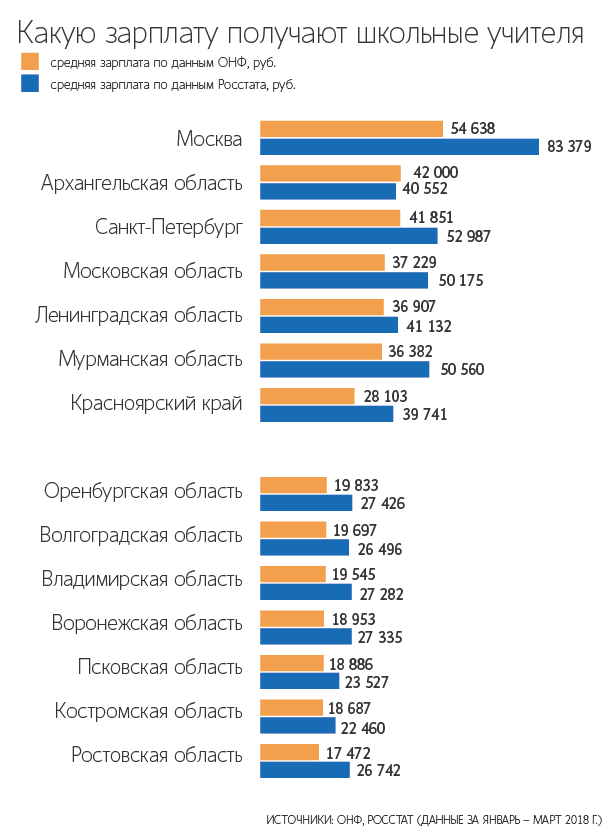
“How Much Schoolteachers Are Paid.” Orange = average monthly salary according to ONF survey, in rubles; blue = average monthly salary according to Rosstat (Russian State Statistics Service), in rubles. From top to bottom, the two sets of figures are provided for Moscow, Arkhangelsk Region, St. Petersburg, Moscow Region, Leningrad Region, Murmansk Region, Krasnoyarsk Territory, Orenburg Region, Volgograd Region, Vladimir Region, Voronezh Region, Pskov Region, Kostroma Region, and Rostov Region. The figures given are for the period January–March 2018. Courtesy of Vedomosti

A third of Russian schoolteachers do not know how their salaries are calculated or whether incentive payments and reimbursements are added to their paychecks. This was one finding of a survey carried out by the Russian People’s Front (ONF) in May 2018, during which researchers interviewed more than 3,000 teachers in 82 regions.

“Wage growth remains insignificant, making it impossible to attain the wage levels claimed by Rosstat,” the ONF concluded.

In Murmansk Region, for example, the survey showed teachers earned an average of ₽36,382 a month [approx. €495 a month], while official statistics showed they earned ₽50,560 a month [approx. €688 a month].

But even the salary the teachers earn comes at the price of an extremely heavy workload, the researchers stressed. The workload was heaviest in Kemerovo, Kostroma, and Samara Regions, where teachers averaged over thirty classes a week.

A quarter of schoolteachers have second jobs or hold additional positions at the same school, while twenty percent think of quitting the profession due to the heavy workload. Seven percent of the teachers surveyed spoke of not having been paid at all or paid in full at times. Twenty-three percent said their paychecks had been miscalculated, while fifty-seven percent had not been paid for overtime or additional duties.

Lyubov Dukhanina, deputy chair of the State Duma’s education committee and a member of the ONF’s central staff, argues the current nontransparent system of calculating salaries, which divides salaries into basic pay and incentive pay, should be abandoned. Instead, teachers should receive a guaranteed salary for their work. She also notes that, according to many teachers, incentive payments are unfair and opaque, and the amount of these payments can vary wildly from month to month.

Igor Remorenko, rector of Moscow State Pedagogical University and former deputy education minister, said all systems of compensation include guaranteed basic pay.

“In organizations undergoing reform, the lower the guaranteed basic pay, the better, because it enables you to rotate employees. In stable organizations, the constant part of the paycheck is more important, because it motivates employees. We need to move in the direction of having teachers sign annual contracts and feel confident in the future, while accepting the possibility of being paid different amounts depending on differing workloads from month to month,” said Remorenko.

The ONF’s survey actually embellished the real picture, noted Vsevolod Lukhovitsky, co-chair of the Teacher Trade Union.

“There are legal means of turning tiny salaries into big salaries on paper. For example, in Moscow, until 2018, the statistics included only full-time employees who had open-ended contracts, while the part-timers, who earned less money, were not included in the stats,” said Lukhovitsky.

According to Lukhovitsky, a law bill would be tabled in the State Duma this autumn that would establish a guaranteed minimum salary, equal to at least two minimum wages, for eighteen academic hours.

“It’s nice a large organization like the ONF has supported our conclusions four years after we started talking about going back to a fixed salary,” said Lukhovitsky.

Naturally, teachers are dissatisfied with their salaries. They are thus fertile ground for the ONF, argues political scientist Konstantin Kalachev. Teachers play a key role in elections and the entire political system.

[The ONF is a pro-Putin, astroturfed “populist” front organization. Teachers are critical to the Putin regime because many of them serve as polling station workers during elections, due to the fact that polling stations are commonly set up in schools. Teachers are thus often involved in the systematic vote rigging and electoral fraud that have helped keep Putin and his allies in power for twenty yearsTRR.]

“The current system of governance sometimes needs to let off steam. There is nothing frightening about the fact the stats are fudged, and the president’s May decrees are not fully implemented. The president sets tasks, and if they are not solved that is the problem of the people trying to solve them,” said Kalachev.

It is pensioners, teachers, and physicians who have the most impact on approval ratings, “so it makes sense the powers that be are focused on worrying about teachers,” he concluded.

Translated by the Russian Reader

Valery Dymshits: After the Fight

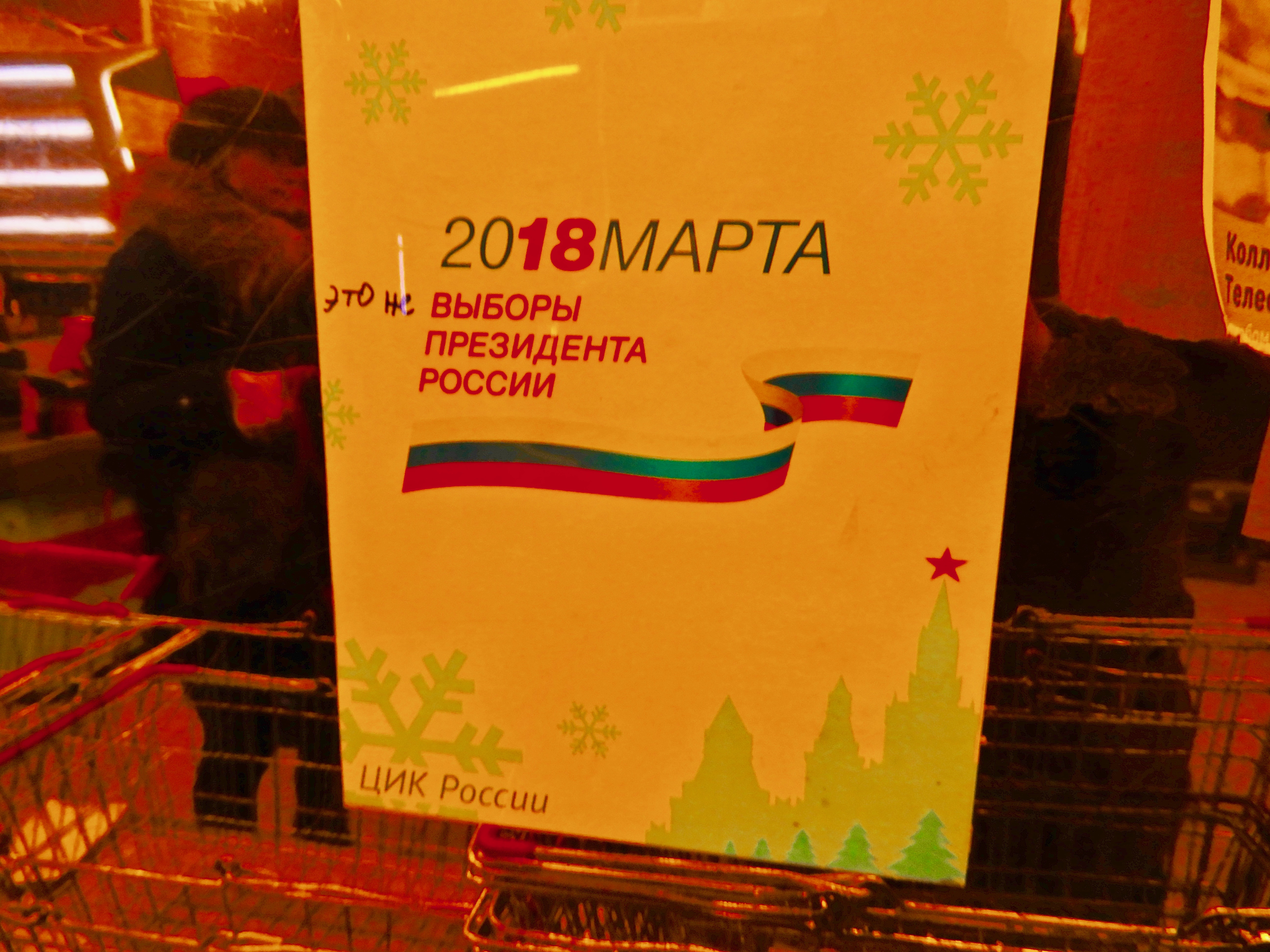
DSCN4942Poster: “March 18, 2018. Russian Presidential Election. Russian Central Election Commission.” || Graffiti: “This is not an election.” Dixie grocery store, Central District, Petersburg. Photo by the Russian Reader
Valery Dymshits
Facebook
March 20, 2018

After the Fight

I wrote so often about the election or, rather, the non-election, that it is time to sum up.

I admit I had hoped for a qualitative decrease in turnout, but it is true we did not manage to achieve this.

Of course, the feverish ideas (I heard them voiced more than once, alas) that if it were not for the boycott, the “forces of good” either would have returned a mystical 10% of the vote tally (whatever for?) or made it into the second round (yes, yes, I read such claims with my own eyes) have nothing to do with reality. The fact the turnout was a few percentage points less, and Putin got a few percentage points more, makes no difference at all to anyone.

Nevertheless, I continue to regard the boycott as the right choice. Here is the reason for my stubbornness.

It is self-evident the election—not the day of March 18, but the process—was god knows what, only it was not an election.

Accordingly, the feeling of disgust kept many people from voting. Disgust is a worthy emotion. But that is not my point here.

In so-called normal countries, candidates and parties fight over half a percentage point, and a threepercent difference is deemed a crushing victory or crushing defeat. In our archaic autocracy, the regime and the populace communicate with each other in a language of symbols. As soon as it transpired the Kremlin was planning to fight for a 70% turnout and 70% of the total vote tally, I immediately realized the Kremlin wanted fifty percent of all possible voters, plus or minus one percent, to come out and vote for Putin and—voilà!—a 65% turnout and a 75% share of votes cast is exactly 50% of all potential voters. Meaning the Kremlin’s statement was purely symbolic and qualitative. Qualitative, symbolic collective action was, likewise, the only possible counterargument. It largely did not come off, but there were no other gestures of resistance except the boycott. The attempt to talk back to the regime quantitatively—for example, Yabloko’s responding to the argument “we have half of all voters” with the rejoinder “but we have 10% of everyone who voted” (i.e., “you have 50%, but we have a whole 5%”)—was ridiculous. Now, if it had been possible to counter the claim “we are robustly supported by half of the populace” with the countargument “ha-ha, you have the support of no more than a third of the populace,” but, alas, it proved impossible.

It is clear the numerous violations, committed here and there by zealots who were not thinking straight, generated a certain stench on election day, but I don’t imagine they had a serious impact on the outcome. It was the outcome that sincerely floored me.

The issue of voter turnout, so hysterically raised by the regime, had nothing to do with a fear of Navalny and the boycott, but with the fact that in the absence of real suspense and real rivals, Russians would be reluctant to go out and vote for Putin, who would be elected anyway. After Navalny was not allowed to run, it was impossible to generate any suspense, so the regime combined the carrot and the stick. Russians were driven and dragged to polling stations by the gazillions.

I would like to make a slight digression. First of all, you can make people who are subordinate and dependent—state employees and employees of state corporations—vote by forcing them or threatening them. The state’s share in the economy has been growing continuously: in 2005, the state controlled 35% of the Russian economy, while it now controls around 70%. That means the numbers of dependent Russians have also been growing.

The Kremlin felt it was vital to drag lazy Russians to the polls whatever the cost. As for voting as they should, they would do that all on their lonesome. The Kremlin knew they would do it, but I didn’t. I thought more or less that people would feel their weekend had been ruined. They had been forced to go somewhere and then forced to report back to their superiors. How swinish! So these people would do something spiteful: vote for Grudinin, vote for Sobchak, vote for Yavlinsky, vote for a four-letter word.

No, since they were dragged all the way to the polling stations anyway, enticed with carrots and prodded with sticks, they voted for Putin.

This is an important albeit gloomy outcome. It means the regime relies on a not terribly active but quite considerable majority. It means the regime can do whatever it likes with whomever it likes, and will be able to do so for a long time to come.  Previously, it could do a lot of things, but not everything. Now, however, it can do anything. Strictly speaking, things have been this way for several years, but now it has been proven in a large-scale, expensive experiment. It is like in the Arabian tales: destroy a city, build a palace, jail a director, close a university, etc., just for the heck of it, just for the fun of it. This does not mean the regime will immediately start throwing its bulks around in all directions, but it can. A clear awareness of this circumstance should make us feel bleak.

Translated by the Russian Reader

Suffer the Little Children, Part 2

Sergei Akimov
Facebook
March 19, 2018

#Elections2018 #NoElections2018

A young woman with a child сame up to another observer and me.

“Where do I get the piece paper I have to photograph the kid with and send to the kindergarten?” she asked.

She showed us a photo of another child. He was holding a piece of paper a bit larger than a business card. The Russian flag, an inscription reading something like “2018 Elections,” and so on were printed on the piece of paper.

“That’s miserable and disgusting,” said my fellow observer.

“What can I do about it? The kindergarten asked for it,” the woman replied. She went off to continue her search.

To be honest, I did not see members of our polling station’s election commission giving people anything of the sort. They only handed out ballot papers.

On the other hand, we had a whole flashmob of parents taking snapshots of their (kindergarten-age) children dropping ballots into the ballot box.

Thanks to George Losev for the heads-up. Translated by the Russian Reader. Photo courtesy of the Cheboksary Municipal Education Department

Alexei Gaskarov: Why the Boycott Failed

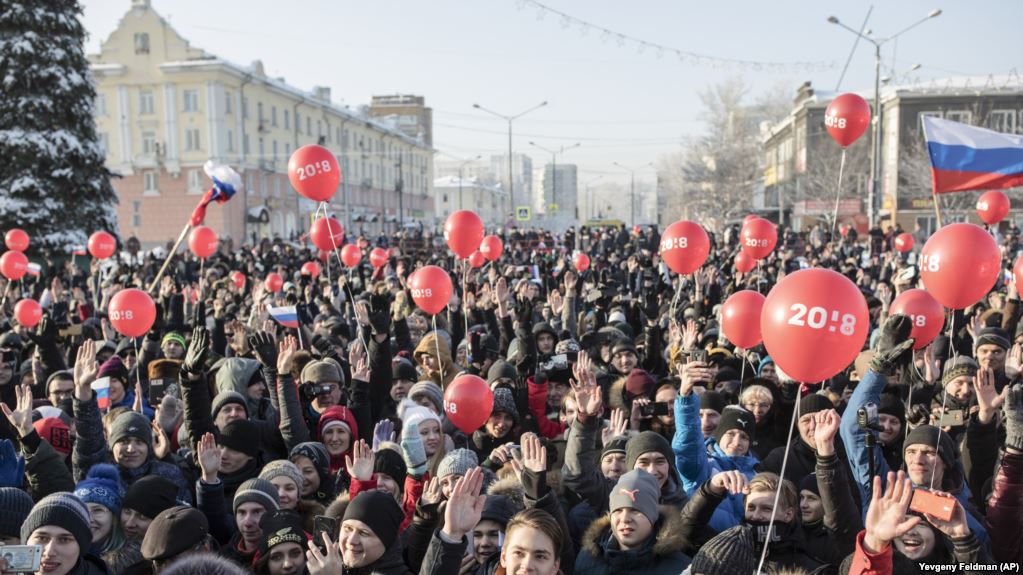
Rally by Alexei Navalny’s supporters in Novokuznetsk, Siberia. Photo courtesy of sibreal.org

Alex Gaskarov
Facebook
March 19, 2018

The boycott campaign’s objective was to keep voter turnout under 50%. This would have been a clear signal the populace regarded the election as dishonest and unfair. We lost this battle, but we need to understand that not everything was smooth and cool on part of our opponents.

The prinicipal techniques for rigging the vote were as follows.

1. Reducing voter rolls. I hung out at a polling station in a Moscow Region village for a mere half an hour, and six of the twenty-two people who tried to vote while I was there were not listed on the rolls. In my hometown of Zhukovsky, the difference between the number of voters on the rolls and the growth in the town’s population between 2012 and 2018 was 5,000 people or 7% of all potential voters, meaning the voter rolls had been pruned. The point of the trick is simple. People who are unlikely to show up to vote are struck from the rolls, thus reducing the overall numbers of registered voters while increasing the relative weight of the turnout.

2. The new possibility of using the Gosuslugi.ru public services website to pick another polling station at which to vote.  This is a cool and convenient option, but it is impossible to monitor. Theoretically, the number of voters who removed their names from the rolls at their home polling stations should have exactly matched the number of voters who temporarily added their names to the rolls at other polling stations. But how was it possible to verify this when we are talking about a country the sizeof Russia? The scary part is that two polling stations, say, are located side by side. They each have the same numbers of voters on their rolls. But in one polling station, the number of people who voted with absentee ballots is 280, while in the other polling station, it is 67.

3. The massive use of the administrative resource for ratcheting up the turnout. Did you know that a quarter of all voters showed up at their polling stations before ten in the morning? There were endless scandals over the fact they were not given some calendars or other that their children were supposed to collect for school. Officials also held simultaneous polls to rate public amenities in which they used ballots with people’s names printed on them. People photographed their ballot papers at polling stations. And, of course, everywhere there were exhibitions about the great outdoors in Crimea, fairs offering cheap food, pop music, and patriotic songs about our beloved president.

The problem is that, despite the administrative resource, participating in this farce was also a choice. If people had refused en masse to follow the orders of their bosses at work to vote a certain way, they would not have been fired or deprived of their bonus pay. But the distance between the value of elections and the discomfort caused by taking a brave civic stance is, for now, so huge, it is somehow ridiculous even to appeal to it.

Translated by the Russian Reader

“We Are Racing into a Huge Pit”: The Small-Town Russian Businessman Who Publicly Opposed Putin

All that is left of the anti-Putin leaflets posted by Nikolai Korshunov
“We Are Racing into a Huge Pit”: The Businessman Who Spoke Out against Putin
Аlexander Valiyev
Radio Svoboda
26 February 2018

In the town of Verkhny Ufaley, Chelyabinsk Region, police have torn down posters cataloguing the “brilliant” outcome of Putin’s reign from the outside walls of several shops. The posters were hung there by a local businessman, who has already had occasion to fight the authorities in this way. 

Nikolai Korshunov owns six small shop in this company town 120 kilometers from Chelyabinsk. Police paid visits to Korshunov’s shops on the eve of Fatherland Defenders Day, February 23. The businessman told Radio Svoboda what happened.

Николай Коршунов (в центре) с сыном и родственником на Забастовке избирателей в Москве

Nikolai Korshunov (middle) with his son and another relative at the Voters Strike, Moscow, January 28, 2018. Photo courtesy of Nikolai Korshunov and Radio Svoboda

Nikolai Korshunov: I am very active civically. I always serve as an elections monitor during elections. I own six small shops. We sell the basics: bread, milk, etc. The stores are my venue for voicing my opinion about current events. This takes the shape of handmade posters, information leaflets.

My argument is that, since the stores are my property, I have the right to post any information whatsoever in them. The Constitution gives me that right. But I have run into opposition from law enforcement and the city hall in our town. It also happened before the 2016 Duma elections, in which Verkhny Ufaley famously voted only four of the twenty United Russia candidates into the local parliament. People read my posters very carefully. Naturally, they regard anything that is not propaganda as out of the ordinary. It is interesting because if they, say, live in one part of town and the neighborhood dairy plant has shut down, they still remember that, but if, say, a timber plant or infant feeding center has ben closed on the other side of town, they might not have heard about it at all, because it does not affect them.  But when they read the entire list, they think to themselves, “What a lot of things have happened in our town over this time.” Even since the 2016 Duma elections there have been colossal changes for the worse in Verkhny Ufaley: total poverty, unemployment, and hopelessness.

An excerpt from one of Korshunov’s information leaflets. It lists by name the Verkhny Ufaley plants, companies, businesses, and services that have closed during Putin’s eighteen-year reign. Photo courtesy of Nikolai Korshunov and Radio Svoboda

​Radio Svoboda: What was on the the posters?

I have lived in Verkhny Ufaley for a very long time. I was born and raised here. In the run-up to the presidential election I decided to make a list of things that have changed in our town during the eighteen years of Putin’s administration. What businesses and factories have closed? The town’s main employer, the Ufaley Nickel Plant closed [in December 2017]. The Metalworker Factory closed. The open hearth and wheel spring shops closed. Then all hell broke loose: the sausage plant, the dairy, the furniture factory, etc., closed. There are thirty-four items on the list, including the children’s hospital and the railroad’s inpatient clinic. Then there are the plants that are barely hanging on. I wrote about them, too, for example, the metallurgical plant where five thousand people once worked. Now it employs a maximum of five hundred to seven hundred people.

Do you think people have suddenly forgotten about what has been happening in town?

Of course they know, but it is just another reminder, a way of saying, Hey, guys, you say that Vladimir Putin has raised the country from its knees, but I don’t think that is the case. I think we are racing into a huge pit at enormous speed. I cannot answer for the entire country, but as a resident of a small industrial town, I see what has been shut down, what has been destroyed, what has been dismantled, what has been pilfered. When you go and vote, people, think a bit before making your choice.

The continuation of Korshunov’s list. Photo courtesy of Nikolai Korshunov and Radio Svoboda

​How many votes do you think Putin will pick up in Verkhny Ufaley?

He will win for one simple reason. Our town is small: everyone knows everything about everyone else, and everyone tells everyone else about everything. I will give you an example. At the employment office—our town has terrible unemployment, by the way, because everything has shut down—the boss gathers his underlings and says, “God forbid you don’t go and vote. If you don’t, I won’t pay you bonuses.” This is more or less what goes throughout state sector. So a huge number of people, maybe even dissenters, will naturally go out and vote in order to keep their miserable jobs at places like the employment office. No one will buck against the bosses. So, Putin will definitely win. Because he has the administrative resource behind him, and huge numbers of people are incapable of thinking.

The administrative resource can compel people to turn out for an election, but people go into the voting booths alone. 

They have their tricks. They can ask people to photograph their filled-out ballot paper on their telephones and send them the photos. We have been through it before. It happend during the 2016 Duma elections, and during the 2012 presidential election, when I was a polling station monitor. It’s all elementary. It’s not a problem at all. But most people have, of course, been hypnotized by television. They cannot reason, think or compare facts. When it comes to them, what the TV says definitely goes, although it is flagrant, mendacious, aggressive propaganda.

I am sure people have asked you, “If not Putin, then who?” People do not see an alternative. How do you counter them?

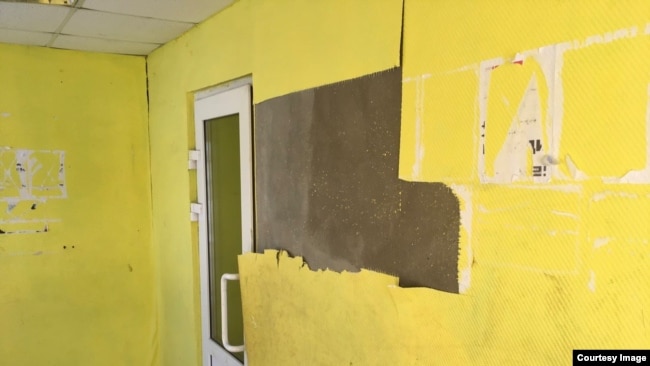
В таком виде полиция оставила стену магазина после своего визита
The wall of one of Korshunov’s shops looked like this after a visit from the local police. Photo courtesy of Nikolai Korshunov and Radio Svoboda

There is no alternative for one reason and one reason alone: all of politics has been purged by the administrative resource. Anyone who could compete against Putin would never be allowed to run in honest, alternative elections under any circumstances. That’s why there is no alternative. Putin’s only “opponents” are people who have definitely been appointed to the role. They stand for nothing and no one, and compared with them Putin looks like a superhero. On top of everything is the propaganda and hypnosis that reinforces the message that Putin is the most respected politician in the world, and we are the world’s mightiest country.

Do people in Verkhny Ufaley know about Alexei Navalny, his exposés, and his call to boycott the presidential election?

Most of them don’t know, of course. A particular segment knows, young people mainly, of course, because Navalny has access only to the internet, to YouTube, which is largely viewed by young people, by schoolchildren and university students. Elderly people know nothing about Navalny, naturally. They know only what the propagandists on TV tell them: that Navalny is an out-and-out thief, scoundrel, and so on.

What about middle-aged people?

Middle-aged people are probably more thoughtful, but not so very thoughtful at the end of the day. Our town is basically a village. We live in a kind of swamp. Middle-aged people are averse to risks. They work somewhere in the state sector, earn ten thousand rubles a month [approx. 142 euros], and are up to their necks in debt. When they sit around chatting in the kitchen, they support Navalny, of course. But they cannot voice their opinions actively, because they would be fired from their jobs in two seconds flat. People primarily think about themselves. Their political views come second.

A photograph of all thirty-four factory and other closures in Verkhny Ufaley during the Putin years, along with the message, “Think hard! What will become of the town between March 18, 2018, and March 2024? || March 18: Not an election, but a fraud. Don’t let yourself be fooled. Don’t go [and vote]. The Voters Strike.” Photo courtesy of Nikolai Korshunov and Radio Svoboda

How have the authorities reacted to your protests?

Our mayor is also secretary of the local United Russia party branch. During the 2016 election campaign, I hung up leaflets in my shops saying United Russia was the party of crooks and thieves. The United Russians came running and blatantly tore down the posters. Many locals approached me afterwards and said, well done, I had done the right thing, because the United Russians were high-handed, arrogant, and had lost all sense of measure. During this campaign, they have reacted differently. First, they sent young women who work in lowly positions at city hall to photograph the leaflets in my shops. Then city hall put pressure on the police, who showed up on the eve of Fatherland Defenders Day, February 23. The leaflet had been up for around two weeks by then, and from time to time I had added information to them. They showed up when I was not there and tore down everything. In one shop, they tore down a big piece of fiberglass along with the posters. There were five or six of them. They intimidated the cashiers. They took statements from them and drove away. That happened in five shops. They showed up at the sixth shop the next day. There, however, the cashier is a serious woman. She did not let them tear down the posters and called me. I arrived, and we hashed things out with them for two and a half hours. There were two neighborhood beat cops and an investigator. They were unable to tell me what laws I could have violated. I imagine they are quite unfamiliar with the Administrative Offenses Code. From time to time they would call the dispatch center for instructions. I know there is nothing illegal about my actions. Nothing will come of it, just like last time.

There was no pressure on you after the Duma elections? You were not tormented with surprise inspections of your shops?

No, there was nothing of the sort. I was written up for an administrative violation, but apparently the magistrates told the police there was no law covering leaflets. So nothing came of it, nor was any pressure put on me.

Are you planning to file a complaint against the police?

I did not complain last time, and I will not complain this time, either. It is a waste of time. There is honor among thieves.

Will you put the leaflets back up?

Yes, definitely, they are already up in some shops.

What are your plans for March 18? Will you vote?

I completely agree with Alexei Navalny. I’m going to boycott the vote. I even traveled to Moscow on January 28 for the Voters Strike. But I will definitely go to some polling station or another on election day to help prevent vote rigging.

Translated by the Russian Reader. Thanks to Comrade Uvarova for the heads-up

Lev Schlosberg: Why Russian Democrats Should Vote on March 18

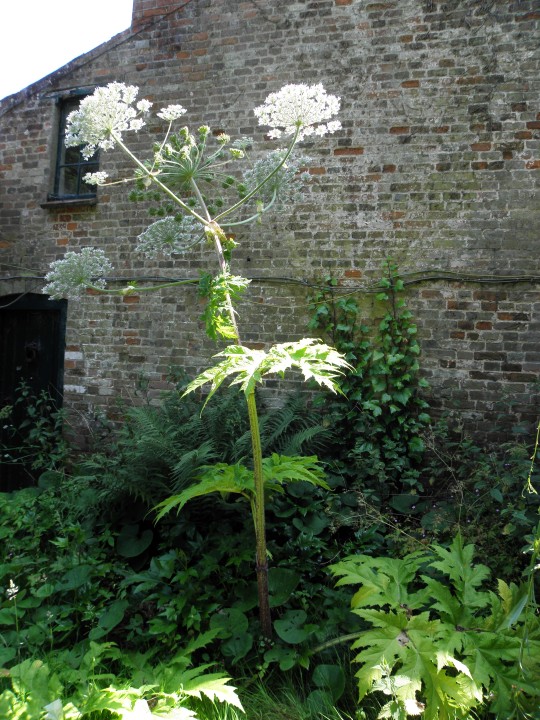
OLYMPUS DIGITAL CAMERA“They want a turnout for Putin that is as huge, wild, and unnatural as a giant hogweed plant.”

Voter Turnouts: Who the Russian Authorities Want to See at the Polls and Who They Do Not Want to See
Lev Schlosberg
Pskovskaya Guberniya Online
March 12, 2018

On March 18, Vladimir Putin plans to become president of Russia once again. The unnatural political system created under his rule is not meant to produce any other outcome.  Realizing this, many people do not want to vote in an election whose outcome is a foregone conclusion. The anger and desperation of these people can be understood and explained. Nevertheless, we must take part in the procedure [sic] scheduled for March 18. We must take part because the tally makes a difference. You can lose on points, but you cannot lose by a knockout, because life could depend on those points.

Amidst increasing stagnation, only the numbers of dissenting citizens whose votes were officially recorded by election commissions, albeit in a dishonest election, can protect dissenters from such things as physical harassment and destruction.

It is all too obvious and extremely dangerous.

Putin will never change. He will not become kinder or smarter. He will not repent for his misdeeds. He will not become a believer in democracy. He will not begin defending the rights and liberties of his fellow Russian citizens.

Putin is a cynic. Like all cynics, he understands only thing: strength. In elections, this strength consists, in the most literal sense, in numbers, in votes.

Russia is tired of Putin. Putin himself is tired of Russia and, in this sense, he is particularly dangerous. He does not inspire people. Votes for Putin are votes cast not enthusiastically, but votes cast in despair. “If not Putin, who else?” people wonder aloud. But no one else in Russia gets round-the-clock press coverage.

In order to protect himself from all risks, Putin has purged the political arena and poured it over with concrete. Any living thing that pushes it way up through the concrete lives despite the system Putin has built. But these living things cannot grow to their full height. Democracy is impossible without the sunlight of liberty. It exists in the old Soviet national anthem, but not in real life in Russia. Putin and freedom are incompatible, because he is a product of unfreedom.

Putin’s likely victory in the upcoming election is as tedious as the man himself, who has long contributed nothing new to Russia and the world except flagrant military threats.

The government’s desperate campaign to get out the vote in the presidential election is founded on the understandable, humdrum intentions of officials, which are in full keeping with the big boss’s desire to paint a ballot, whose outcome was announced before the election, as the result of sincere grassroots enthusiasm.

People forced to watch and listen to this bacchanalia might imagine that voter turnout in this election is the most important objective pursued by officials.

“Our” Voter for “Our” President
Does this mean the Russian authorities want all voters to turn out on March 18, whatever their political preferences? No, it does not mean that at all. The Russian authorities desperately want Vladimir Putin’s voters to show up for this election and no one else. They want a turnout for Putin that is as huge, wild, and unnatural as a giant hogweed plant. Everyone who prevents them obtaining this unnatural percentage of votes are superfluous when it comes to the election. The authorities do not want to see them at polling stations. They will tolerate only the convinced supporters of the other registered candidates, whom they cannot stop from voting.

The omnipresent official election advertisements and the propaganda message that you can vote wherever you want on March 18 are bound to nauseate all decent, self-respecting people. They are a carefully planned and professionally implemented tactic on the part of the authorities. They are like a missile with multiple warheads.

This dull and simultaneously aggressive advertising is meant to help the authorities drag voters obedient to Putin out of their houses on March 18. Such people really do wait for the authorities to tell them what to do, where to go, and what box into which to drop their ballot papers. Programmed by the lies and violence of total propaganda, they reflexively execute direct instructions. So, the authorities have a single objective: to reach out to these votes whatever the cost, through all the windows, doors, attics, cellars, and cracks state propaganda is able to penetrate. This means directly zombifying people whose antennas, so to speak, are tuned to the regime’s transmitter. The authorites send a command to people capable of picking up simple, repetitive signals: go and vote.

Likewise, the deliberate promotion of the election in this digusting manner is meant to turn off people from voting who are independent, self-sufficient, and critical of the regime. Unfortunately, it really does prevent them from voting. Such people do not like being shepherded anywhere, much less to polling stations.

The regime thus kills two birds with one stone. It gets the electoral partisans loyal to Putin out to vote and radically reduces the turnout of democratic voters.

We encourage our people to vote and discourage their people from voting. This is the recipe for so-called victory.

It is sad to see millions of energetic people, sensitive to insincerity and fraud, falling into this primitive psychological trap.

It is sad to see democratic politicians, who will be the first to succumb to the hardly virtual mudslide generated by the absence of democratic politics in Russia, vehemently campaigning for a so-called voters’ strike, which absolutely satisfies the authories. It as if these democratic politicians had lost the capacity to understand events and their consequences, because they are calling for democratic voters to sit out the election, rather than people planning to vote for Putin, Zhirinovsky or Grudinin. This is a self-inflicted wound, a provocative call for democrats to eliminate themselves.

It is unacceptable to let the authorities exploit you as a useful idiot, as the Bolsheviks cynically did with the intelligentsia back in the day.

If democrats sit out elections, they are absent from politics as well.

You Don’t Want a Second Round?
State-driven polling in Russia has become part of the system of state propaganda and popular deception. It is the loyalist “public opinion” polls that have forecast a turnout of 81% of eligible voters, Putin’s share of the tally reaching the desired 70% threshold, and the votes cast for all his opponents squashed into a gamut that runs from 0.1% to 7%.

In reality, as borne out by other public opinion polls whose results are not made public, the voter turnout in many regions of Russia will barely crawl above the 50% mark, which should be expected amidst public apathy and socio-economic crisis, while Putin’s share of the tally will not be much higher than 50%, and a second round-like scenario has been predicted in many cities, meaning Putin will receive less than 50% of the vote there. Even the loyalist pollsters at VTsIOM have reflected this turn of events. Putin’s support rating has been falling throughout the election campaign and will keep on falling, because the public manifestation of alternative political views undermines Putin’s monopoly. Things are getting serious.

What should the democratic voter do in these circumstances? Go vote and support a democratic candidate, thus reducing the share of votes cast for Putin and increasing the number and percentage of votes cast for democrats and democracy.

No one know the numbers of democratically minded citizens there are currently in Russia. Only general elections can show how many there are, but the majority of democratic voters have rejected voting in general elections a long time ago. They continue to refuse to vote nowadays, thus throwing in the towel and relieving themselves of all responsibility for what happens to all of us.

Not only that, but it also makes makes the chances of democratic politicians extremely low in elections. We thus find ourselves in a classic vicious circle: no voters > no results > no voters.

As D’Artagnan said, a thousand devils. How can this be incomprehensible to educated, informed people? But, as we can see, it is incomprehensible.

I cannot fail to remind readers that democrats have learned how to win Russian elections such as they are now. The know-how that was on display in Karelia, Petersburg, Pskov, Yekaterinburg, Yaroslavl, and Moscow has shown that when a large amount of hard work is invested, voters are energetic, and voting is strictly monitored, democrats can win elections. Yes, it is hard. But we do want to win, don’t we?

Does Putin have a plan for Russia?

Yes, he does. On March first, he laid out his plan to the entire world. His plan is as simple as an old grammar school primer: guns instead of butter, and grief to dissenters. Grief to consenters, too, however. It is just that they have not figured it out yet. Putin is the president of war.

Is there anything that can stop or at least limit Putin in his maniacal willingness to sacrifice not only our country but also the entire world to his virtual reality?

There is only one thing: the votes of Russian citizens who disagree with him.

Operation Fiasco
If democratic voters do not turn out to the polls on March 18, the consequences will be  enormous. Not subject to any political restrictions, dependent on the bureaucracy and the security services, listening only the counsel of imperialists and Stalinists on the back of the election results, Putin will cross the line, perhaps more blatantly than he himself intends to right now.

If there is a fiasco on the democratic political flank as the result of the presidential ballot, everything will be caught up in it, both those who voted and those who did not vote. There will be a single political pit for everyone, a mass grave for soldiers killed in war.

In conditions of unfreedom, all that people who do not want violence can do is vote for freedom while the possibility still exists.

Because if it transpires that next to no one wants freedom, the changes that occurr in Russia will be extreme, sending us in a free fall towards the unforgettable Soviet Union, which perished in political and economic paralysis only twenty-six years ago, but which is currently undergoing a political reincarnation.

Will the March 2018 election be honest at least when it comes to tallying the votes? On the whole, no, but the percentage of rigged votes is fairly well known. In approximately fifteen regions of Russia, the so-called electoral sultanates, election results have nothing to do with how citizens vote. In those regions, the final official tallies are simply fabricated, giving the authorities around 10% of the votes of all voters on the rolls nationwide.

In other regions, however, the results do depend on how people vote to a greater or lesser degree. After massive civic outrage over the results of the 2011 parliamentary elections, vote rigging has become much harder, thanks in part to tougher laws.

Who achieved all this? The Russians who went to protest rallies in defense of their votes. The 2011–2012 protests were primarily a civic protest of voters whose votes had been stolen. That is why the authorities took it seriously [sic], and it lead to reforms in the voting system. Criminal penalties for so-called carousel voting were adopted after the protests.

What can supporters of the voters’ strike defend at a protest rally? Nothing. They did not vote. What impact can they make by not voting? None at all. They do not have any arguments, because they have no votes or, rather, they gave up their votes.

Who will notice the 10% of voters who do not go to the polls on Sunday? No one. The numbers will not be recorded anywhere. But it would be impossible not to notice the 10% of votes cast by democratic voters, since they will be recorded in the official final vote tallies. The ballot paper is the citizen’s main weapon.

No one will take into account the people involved in the voters’ strike. But it will be impossible to ignore the votes of four, five or six million people.

Russian democrats have one main objective in the 2018 presidential election: to show that we exist, that we do not agree with Putin’s politics, and that we see Russia’s future differently. This means defending ourselves, our loved ones, friends, and comrades, giving ourselves and the entire country the chance for a normal future, a chance that war will not break out, a chance for peace, a chance to save the lives of people who are still alive.

Elections are a public action, an expression and movement of the popular will. They are the only peaceable means of regime change. Often, things do not work out in single step. But we cannot stand in place. We have to keep moving.

The Russian regime will not change on March 18, 2018, unfortunately. But on that day millions of democratic voters in Russia can save the country’s and their own chance for freedom.

Translated by the Russian Reader. Photo courtesy of the Norfolk Wildlife Trust

P.S. Sometimes it’s useful to carefully rehearse and examine arguments that strike you as just plain wrong—in this case, the argument that “Russian democrats” (whoever they are) will surrender their place in Russian “politics” (as if there is politics in Russia) if they boycott the presidential ballot scheduled for this Sunday.

This argument is made by one of Russia’s smartest cookies and bravest democratic politicians, Lev Schlosberg, in his latest column for Pskovskaya Guberniya Online.

Unfortunately, Mr. Schlosberg is reduced to such a queer combination of sophistry and outright bullying that one recalls the remark Tolstoy supposedly made about the writer Leonid Andreyev: “He tries to scare us, but I’m not frightened.”

This is not to say that the political conjuncture in Russia is not objectively frightening. But Mr. Schlosberg’s argument that the “ballot paper is the citizen’s main weapon” rings hollow when even he admits the extent to which vote rigging and coercion will be big factors in Sunday’s vote.

Finally, Mr. Schlosberg urges Russian democrats (let’s assume they really exist) to vote for “democrats” in the presidential election, which immediately begs the question, What democrats does he mean? Grigory Yavlinsky, the de facto leader of Mr. Schlosberg’s own Yabloko party since its founding in 1993 and a man who has run for president so many times I’ve lost count? Or does he mean Ksenia Sobchak, Vladimir Putin’s real-life god-daughter? She talks the good talk once in awhile, but under what real democratic “procedures” were she and the perennial Mr. Yavlinsky nominated to run for president? Meaning by what democratic majorities?

And this is the real problem. There is no democracy in Russia not because of the villainy of Putin and his satraps, although of course they really have done everything in their power over the last eighteen years to make Russian undemocratic.

The real problem is so-called Russian democrats either have no idea what democracy really entails or they’re all too willing to sell the farm for a penny so they can get the chance to run, with the Kremlin’s approval and vetting, of course, in rigged elections whose outcomes are foregone conclusions.

Can a serious man like Mr. Schlosberg really imagine that a few more percentage points here or there for Ms. Sobchak and Mr. Yavlinsky will genuinly serve as a bulwark against the hell that will be unleashed after March 18, when Putin imagines he is invincible and has yet another six years to do as he likes?

What a naive if not utterly specious argument. TRR