Free and Fair, or, The All-Russian University of Justice

Tests on Protest Rallies and Compulsory Voting in Workplaces: What Is Happening in Petersburg’s Public Sector Institutions as the Election Nears
Vladislav Chirin and Sofia Volyanova
Bumaga
March 7, 2018

In early March, a test about the law on protest rallies was distributed to lecturers in Petersburg’s tertiary educational institutions. Pupils at Petersburg schools have been forced to take the same test, while employees of schools and hospitals report they have been forced to apply for absentee ballots and vote at different polling stations under threat of punishment.

Bumaga has been monitoring the goings-on in Petersburg’s public sector institutions in the run-up to the March 18 presidential ballot. In the following article, we discuss what violations have already surfaced.

Schoolchildren Required to Pass Test about Law on Protest Rallies 
Pupils at a school in the Vyborg District told Bumaga that on March 6 all groups had been excused from classes in order to take a test on protest rallies. In particular, the pupils were quizzed on whether participants of public events had the right to bear arms and under what circumstances demonstrations could be held on Palace Square and Nevsky Prospect.

test“Tests like this have been handed out in Petersburg schools. This is only the second page of the test, featuring questions about the Field of Mars, invitations to protest rallies via the internet from persons unknown, etc.” Post courtesy of Telegram channel Somebody Else

According to senior pupils at the school, teachers removed them from their second period classes and made them stay during the break to familiarize them with the test. In the event, the teachers explained to the pupils what the right answers were.

When the pupils asked whether the test was connected with protest rallies organized by opposition politican Alexei Navalny, the teahers replied the test was being administered since a pupil at the school had been detained at one such rally and fined.

Central District School Headmaster and Vocational School Employee Talk about Compulsory Test
Svetlana Lebedeva, headmaster of Gymnasium No. 168 in Petersburg, also talked about the test. According to her, the prosecutor’s office had sent them the test, demanding it be administered to upperclassmen.

“It was by order of the district prosecutor’s office. The order was sent to Nelly Simakova, head of the Central District education department. They sent it to us. All the schools did it. The test was on Saturday, and today the pupils who were absent on Saturday took the test,” Ms. Lebedeva told MR7.ru.

On March 6, the same test was administered to students at all the city’s vocational schools, an employee at one of them told Bumaga.

MR7.ru also published a screenshot of the letter sent to educational institutions.  The letter makes it clear the testing had been administered at the behest of the city’s education committee after an urgent request from the Petersburg prosecutor’s office.

A pupil at Lyceum No. 126 has also told Bumaga that, during an event for war veterans on March 6, one of the guests took to the stage and urged attendees to vote for Vladimir Putin.

The prosecutor’s office and the education committee did not return our telephone calls.

Council of Rectors Sent Test on Protest Rallies to Lecturers at Tertiary Educational Institutions
Lecturers at Petersburg’s tertiary educational institutions allegedly received the same test about the law on protest rallies, only electronically.

Echo of Moscow reporter and Higher School of Economics graduate student Valery Nechay published a letter allegedly sent to Petersburg’s tertiary educational institutions. The letter asks university employees to take the test online “at the request of the Council of Rectors.”
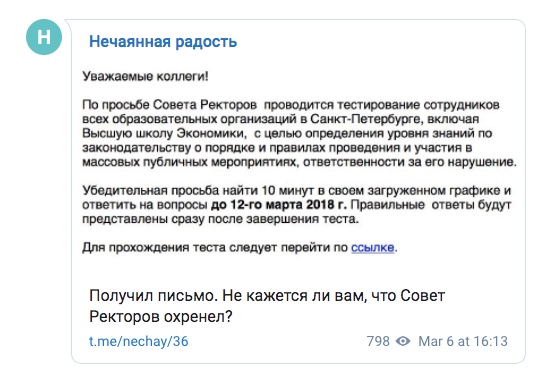
letter“Dear colleagues! At the request of the Council of Rectors, staff at all educational organizations in St. Petersburg, including the Higher School of Economics, are being tested in order to determine the level of their knowledge of the laws on rules for holding and attending large-scale public events and the penalties for violating them. We strongly encourage to take ten minutes from your busy schedules and answer the questions before March 12, 2018. The correct answers will be provided immediately after you complete the test. To take the test, follow this link.” Post courtesy of Telegram channel Unexpected Joy.

The test, a link to which Nechay has published, features questions about the rights of people attending protest rallies and punishment for extremism. Some of the questions describe particular circumstances, for example, “You have been invited on the internet to attend a protest rally on the Field of Mars. The rally in question has not been authorized by the relevant executive authorities for the exact time or day listed. You are curious, however, and so you go to the rally. Have you violated the law?”

Students at Petersburg University Say They Have Been Forced to Monitor Elections 
First-year students at the Petersburg campus of the All-Russian State University of Justice have been assigned “compulsory on-the-job training” on March 18: they must attend the presidental election as grassroots monitors. They told the organization Petersburg Observers about their plight.

The correspondence published by Petersburg Observers makes it clear that if the students fail to report for duty they have been threatened with administrative punishments and bad marks in their permanent record. But if they show up for duty, they allegedly will have a day off on Monday, March 19, and be sent official thank-you letters.

observerss“Where do the fake election observers come from? On March 4, 2012 [the date of the previous presidential election] grassroots oversight was usually portrayed by pensioners and state employees. Over the past six years, however, the fake election observers movement has mastered the streams of financing, gone large scale, and become much younger. For example, first-year students at the Petersburg campus of the All-Russian University of Justice received this message from their class leader: ‘March 18 is a school day, compulsory on-the-job training, meaning that everyone will be a grassroots election observer at the polls. Sponsored by the Association of Lawyers, our university is officially taking part in the Observers Corps for Clean Elections event, so if you do not show up you face administrative penalties and a bad mark in your permanent record.’ In addition to free food and transportation on voting day, letters of gratitude and a day off from classes on March 19 have been promised to the students. Basically, this is how correct public opinion is forged: in return for a day off, free grub, and a certificate of [political] trustworthiness.” Screenshot of a post on the VK community page of Petersburg Observers for Fair Elections 

A student at the Petersburg campus of the Russian Presidential Academy of National Economy and Public Administration (RANEPA) has told Bumaga that out-of-town students at the academy are going to be forced to vote in the presidential election. However, he was unaware of whether the students would be encouraged for turning out or punished for failing to vote.

ranepa“Very Important Information! In the next 30 minutes ALL out-of-two students need to shoot back the following information: what resources you will use to vote in the March 18 Russian presidential election; where you will vote (at what polling station); how you will register to vote. Send it to https://vk.com/%5Bdeleted]. […] Basically, we have been asked by [illegible] to register as many people living in each section as possible to vote. Meaning that each manager is responsible for his section and, subsequently, for sending everyone off to vote. The section in which the most people vote will get the Prize Sector [a reference to the “prize” section on the spinning wheel in the Russian version of Wheel of Fortune]. Ideally, you could assemble your entire section and all go together to the district voting commission. This is a mandatory request that concerns everyone. I think it is in our interest to give our vote . . .” Screenshoots of correspondence among RANEPA students. Courtesy of Bumaga

Schoolteachers and State Employees in Petersburg Say They Are Being Forced to Apply for Absentee Ballots and Vote Somewhere Other than Their Own Polling Stations
A teacher at a school in the Central District has told Bumaga that the school’s headmaster has obliged the entire teaching staff to report to the polling station in School No. 183 [an English-language magnet school on Kirochnaya Street in downtown Petersburg] on voting day. According to her, the teachers in all Central District schools have been given the same orders.

According to the teacher, if staff fail to vote as instructed, they will be given extra work during the spring holidays, from March 26 to April 1. When the voting is over, the headmasters of the Central District’s schools will receive lists of teachers who reported to the polling station in School No. 183, the teacher said. Her headmaster added, however, the orders were “not his whim,” but that all school headmeasters had received the same orders from the “top brass.”

Instances in which the heads of state-sector institutions have tried to force staff and students to apply for absentee ballots and vote at other polling stations have been reported by Petersburgers claiming to be employed at the Center for the Social Rehabilitation of Disabled People and Disabled Children in the Krasnoye Selo District, the Center for Social Assistance to Families and Children in the Central District, the Alexander Hospital, Children’s Health Clinic No. 68, Children’s Health Clinic No. 71, the Leningrad Regional School for Culture and Art, School No. 684 [a kindergarten and grammar school in the Kirov District in the city’s south], and the Municipal Monitoring Center.

Violations Reported by Members of Several Petersburg Election Commissions 
Member of Precinct Election Commission No. 1164, located in City Hospital No. 15, have reported that Irina Nikolich, the polling station’s deputy chair, had drawn up absentee ballot declarations, based on photocopies of four voters’ internal passports, although the voters themselves were not present at the polling station, and Nikolich came to the polling station when it was not her shift.

The polling station was visited by police officers, who interviewed witnesses and submitted the evidence to the Investigative Committee.

Members of Territorial Election Commissions No. 1 and No. 14 have reported to Bumaga that in their electoral districts, precinct commissions had in several instances approved four ballot boxes for at-home voting, although only three ballot boxes are legally required. The extra ballot boxes could lead to vote rigging and ballot box stuffing.

UPDATE
On the evening of March 7, Territorial Election Commission No. 1 reduced the number of mobile ballot boxes in its district to three.

Students at St. Petersburg State University of Film and Television Complain They Have Been Forced to Vote (Updated March 10, 2018) 
A student at the University of Film and Television told Bumaga he and his classmates in the Screen Arts Department had received a message from the student leader of second-year students.

The message made it clear that the master of the filmmaking course had informed the student leader that students who did not vote would be threatened with explusion, said the source. The dean’s office had allegedly issued the orders, and all students were required to register to vote at the same polling station.

Another student at the university told Bumaga she and her classmates had received messages containing a list of five polling stations at which they had to register to vote. Information about whether a student had registered to vote or not would allegedly be reported to their department. The students were promised they would be given postcards at the polling stations that could be used to get into a private screening of the film Dovlatov, the young woman told us.

Translated by the Russian Reader

Leviathan

DSCN4214“Precinct Election Commission for Polling Station No. 2218.” This is the innocent-looking sign the leviathan that has strangled democracy, including free elections, in Russia puts out to signal its presence. It achieves victory over earnest voters and honest election observers, some of whom valiantly serve on such commissions, by killing them with a hundred thousand cuts. Writ large, the flagrant tricks and shady practices used by neighborhood and local election officials add up to national elections that are rigged from top to bottom. Although this trickery has been well documented by independent observers, Russian reporters, and researchers, the sheer weight of it somehow has never made an impression on western journalists, who continue to write as if Putin’s popularity were a scientifically proven fact instead of carefully crafted mixture of massive coercion and hoodwinking. Photo by the Russian Reader

Central Election Commission Does Not Accredit 4,500 Presidential Election Observers Affiliated with Navalny 
Mediazona
March 7, 2018

The Russian Central Election Commission (CEC) has refused to accredit 4,500 presidential election observers affiliated with the news website Leviathan, created by Alexei Navalny’s Anti-Corruption Foundation. Navalny has written about the incident on his Telegram channel.

“We were suddenly told today that [Leviathan] had been shut down by the court, and the CEC would not accredit it. Earlier we have received accreditation for 4,500 observers affiliated with Leviathan. Now they are left without accreditation. Even [Vladimir] Churov [the previous CEC chair, replaced in 2016 by Ella Pamfilova] didn’t do such things,” wrote Navalny.

In addition, the CEC has refused accrediate observers affiliated with the online publication Molniya (“Lightning”), which sponsors election observers from the Golos Movement for the Defense of Voters’ Rights.

Golos co-chair Grigory Melkonyants confirmed to Mediazona there were problems with accrediting election observers registered by Molniya. He said that 850 people who had signed contracts with Molniya in October 2017 were at issue.

Molniya submitted accreditation applications to the CEC two weeks ago. The CEC informed them that it had sent them a written reply by post. Melkonyants said that in the the past the CEC would always simply invite Golos to come to its offices and pick up the accreditation papers. Now, on the contrary, the commission’s decision is unknown: they would have to wait for the letter to arrive. Melkonyants believes this testifies to the likelihood the Molniya observers will have their accreditation requests rejected.

However, he noted it was still possible to register as an observer affiliated with a particular candidate, and Golos was now working on this.

Translated by the Russian Reader. Thanks to Comrade GMV for the heads-up

No Contest

DSCN4290“March 18, 2018. Russian Presidential Election. Our Country, Our President, Our Choice! Russian Central Election Commission.” February 19, 2018, Ligovsky Prospect, Central Petersburg. Photo by the Russian Reader
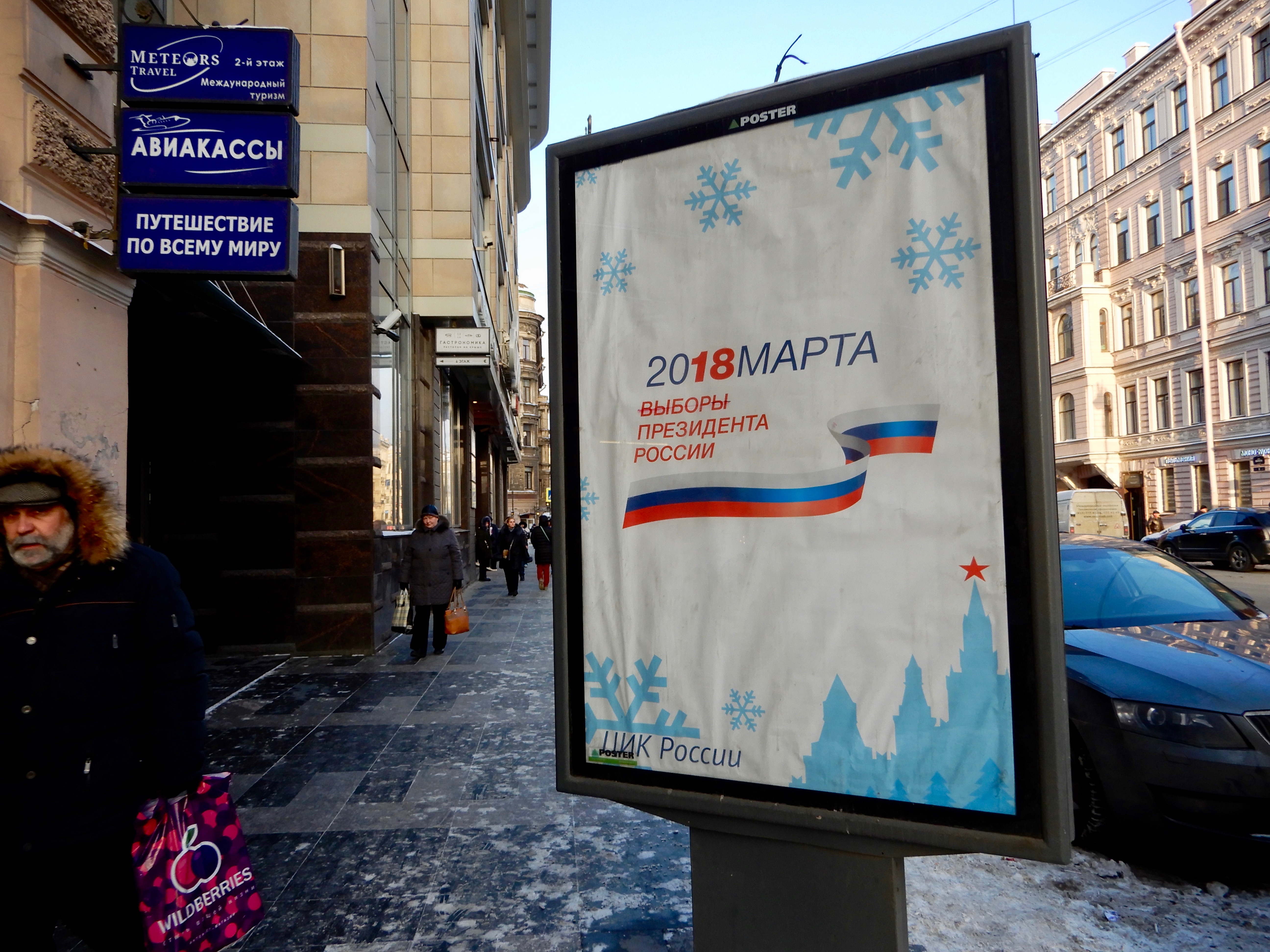
Valery Dymshits
Facebook
March 4, 2018

I am somewhat surprised to see the ongoing discussion on whether to vote in the [Russian presidential] election or not. Some people write that if you don’t vote, your ballot will be used, and so on. Meaning it is assumed in advance the election commission is a band of brigands. If this is so, however, they can do whatever they want and, most important, at any level they can enter any figure they like in their official count. What difference does it make, then, if they use your ballot or not?

Actually, there is no election. Why be involved in something that does not exist? I think it is important not only to avoid attending this strange event oneself but also to explain to everyone why they should not attend, either.

DSCN2984On this “get out the vote” billboard, recently photographed somewhere in central Petersburg, a “vandal” has lightly crossed out the word “election.” Photo by the Russian Reader
Cities with populations over a million will have voter turnouts just over 50%, says a person close to the presidential administration.

All polling is a tool for actively shaping reality. Figures are used to try and suggest a particular interpretation of events, notes another source close to the administration. In his opinion, the downturn in Putin’s support rating can be explained by a lack of activity and mistakes during the campaign.

“In reality, the figure are much lower. The actual turnout is expected to be between 55% and 60%. Putin’s result will range, depending on the region, from 50% to 65%. It will be an accomplishment if the turnout in Moscow is over 50%.”

The difference between the turnout in major cities and the provinces could be as much as 20%. Usually, on the contrary, the turnout in the provinces is between 10% and 12% greater, says another person close to the presidential administration.

What happens next depends on the whether the mechanism for penciling in votes gets turned on or not. If the election is staged with the full use of the administrative resource, something I do not rule out, it does not matter who gets what in reality. If the elections are staged fairly, Putin’s result in cities with populations over a million will be lower, while his opponents’ will be slightly higher.”

The turnout in cities with populations over a million will be between 45% and 55%, the source believes.

Source: Yelena Mukhametshina and Olga Churakova, “Putin’s Rating Has Dropped Abruptly in the Major Cities,” Vedomosti, March 7, 2018

Translated by the Russian Reader. The emphasis, above, is mine.

Valery Dymshits: What Boycotting the Presidential Election Would Mean

OLYMPUS DIGITAL CAMERA

Valery Dymshits
Facebook
January 7, 2018

Recently, discussions whether it makes sense to boycott the presidential election or, on the contrary, whether you should vigorously exercise your right to vote have been flaring up on the web ever more emphatically. I was involved in one such discrete discussion. Its instigator, Alexei Kouprianov, recommended I publish my comments as a separate post.

There are currently no presidential elections in our country, neither elections with alternative candidates nor elections with a single candidate, neither competitive elections nor non-competitive elections. There are no presidential elections at all. For the time being, there are regions in Russia that are electoral anomalies, while all other regions do the right thing, so to speak. In those regions, you need not worry how long ballot stuffing has been going on, and it is no problem to rewrite the final official vote tally reports. So, for all intents and purposes, elections have been abolished. What matters, therefore, is not Putin’s apparent impending victory. The procedure could not even be passed off as a sound sociopolitical survey, answering the question of how many folks in Russia are for the Reds, how many are for the Whites, how many are for apples, and how many are for pears.

Since no election will take place, this should tone down the debate to a certain extent. This is my call for peace and a peaceable tone among those debating involvement and non-involvement in the election. Those who will go to the polls and those who do not are in the same straits. Neither the former nor the latter will be taking part or not taking part in an election, whatever they imagine they are doing, because objectively, that is, regardless of subjective impressions, you cannot take part in something that does not exist.

You cannot take part in it, not in the sense it is forbidden to take part, but in the sense it is impossible to take part.

The only thing that remains to be seen is what behavior is preferable given the circumstances.

The people currently involved in the electoral process have never been able to get back the significant numbers of votes stolen from them nor have they been able to make this highway robbery the subject of a serious public debate. This is possibly not their fault, since the Russian judicial system is dysfunctional, but that is not my point. The existing parties and candidates will try and raise the turnout by campaigning for themselves. In this wise, the candidates and the Kremlin are pursuing the same end. Later, a final vote tally will be whipped up for them in keeping with deals made before the elections or, on the contrary, they will be conned. This is no concern of ours. That is, the well-known scenario, implemented many times before, will be reprised. In short, we have been through this before.

What we have not been through before is a serious, well-organized boycott, although they were some calls for boycotts in the past. At least there is chance to find out on the ground whether we have a chance of organizing an election boycott or not, whether it has an effect on anything or not. This, at least, would expand our experimental knowledge of the subject.

Simple mathematical calculations have shown a decreased turnout increases the percentage of votes cast for Putin. But do we care what percentage of votes are cast for him, whether it is 65% or 75%, if the final figures are knowingly false and dictated by the top bosses? In the extreme case, if only solid Putin supporters turned out to vote, he would take home 100% of the vote, and that would be utterly unacceptable, because a European leader cannot win 100% of the vote, and Putin is well aware of it.

A noticeable decrease in the turnout, one that was clearly distinguishable from the statistical margin of error, would be tantamount to saying a considerable segment of the Russian populace had concluded that elections in Russia were wanting, to say the least. This would be an important political outcome.

For the time being I leave aside additional moral perks, say, deliberate non-participation in a fictitious process, non-participation in events approved by the Kremlin, etc.

Translation and photo by the Russian Reader

P.S. Every reporter or “Russia expert” who has written or been tempted to write something like, “With an 80% approval rating, Putin should easily cruise to victory in March,” should be made to read multi-talented Valery Dymshits’s short but sweet piece on why there are no such beasts as elections in Russia and the possible political benefits of a more or less massive non-turnout to the non-election scheduled for March.

I would like to add that every such reporter and “Russia expert” should be made to read this short primer on what amounts to common knowledge in Russia right before they are fired and drummed out of the profession, but the angel in me reminds me that some people cannot help liking and supporting tyrants and imagining that lots of other people like them, especially in “inferior” countries.

That it’s accredited journalists and academics involved in this baseless condescension should not surprise you. It’s always easier to get along in life if you say and do what the majority of your so-called peers and colleagues are doing, especially if you’re mansplaining a place where you don’t actually live and about which you are really quite clueless, and you get paid to do this more or less harmful work.

I thought the attack on the Russian pollocracy that was mounted by me and several other people several years ago had begun to make a dent, that some journalists and “Russian experts” were coming to see the light that polls and elections are nearly always rigged in Putinist Russia and thus provide us with nearly zero knowledge of what “Russians really think.” But I had forgotten that most reporters are lazy and many academics are dazzled by tyrants and numbers as “scientific facts.” With Putin’s self re-election just around the bend, push has come to shove, and the unprovability of his actually nonexistent popularity has been shoved back under the rug. TRR

The Poster Maker

“I’ll Go All Out to Ensure Putin Loses”
Yelizaveta Mayetnaya
Radio Svoboda
December 5, 2017

“Citizen Putin! If there is a clampdown on public liberties under the pretext of terrorists attacks, it will be clear to everyone who is behind them!”

“Putin is war. Say no to war!”

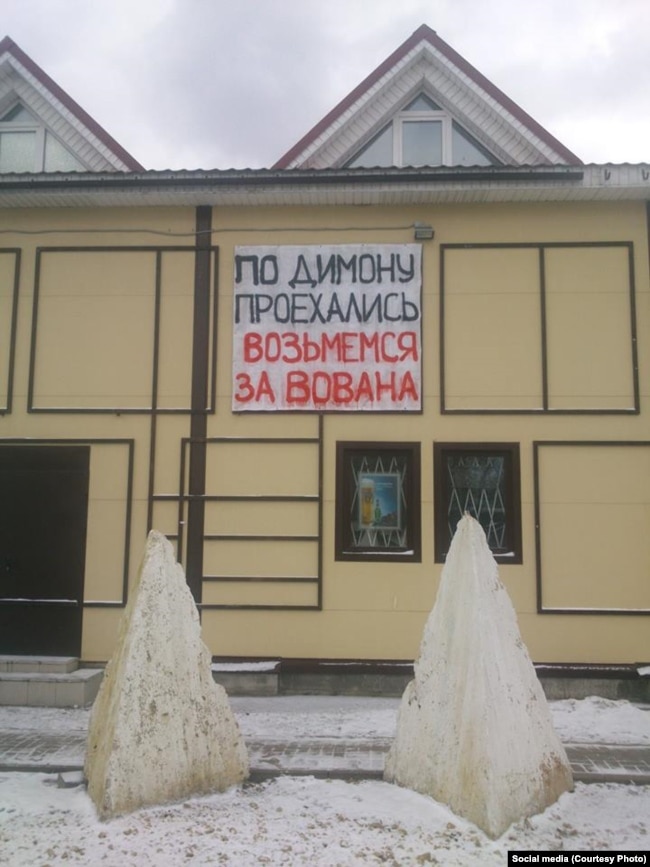
“Dimon got what was coming to him. Let’s go after Vovan.”

“We live the way we vote.”

Dmitry Skurikhin, owner of a store in the village of Russko-Vysotskoye, near Petersburg, reacts immediately and visually to every political event in Russia.

Skurikhin immediately hangs each new poster on the front of the store, a small, two-storey building, so it is readily visible from the nearby bus stop. They usually do not stay up for long, however. The record is held by the slogan “Peace to Ukraine,” which stayed up for two weeks.

На митинге Навального

Skurikhin at a pro-Navalvy rally on the Field of Mars in Petersburg

43-year-old Dmitry Skurikhin is a local businessman, whose family owns three village shops. By local standards, he is well off. His family owns several cars, and they have everything they need. However, Skurikhin says the incomes of villagers have taken a nosedive in the past year: “They buy almost nothing, because they barely have enough for food.” Around six thousand people live in Russko-Vysotskoye. Very few of them are holiday cottage dwellers. The majority commute to work in Petersburg. Skirukhin was the first businessman in the village to open self-service stores, but “then the Pyatyorochka and Magnit chains moved in, and we croaked, of course.” He now sells toys, newspapers, clothings, and sundries.

He has been hanging political posters on his store, situated along a road, for almost four years. Before that, he pasted homemade bumper stickers on his car. Skirukhin recalls that the first bumper sticker read, “No new taxes!” The year was 2005.

Skurikhin: They had decided to raise taxes on us local businessmen then. It was one of those taxes you couldn’t avoid paying. Either you worked and paid the tax or you didn’t work and didn’t pay the tax. We businessmen realized they were clamping down on us. We joined forces and beat back the tax. It made such an impression on me that since then I haven’t been able to stop going. There are at least some improvements in our lives, specifically in our village. I’m a local grassroots activist, not even a region-wide activist, but a village-level activist. I was born here, and I live and work here. My kids go to school and kindergarten here. I think I have helped improve life in our village.

Radio Svoboda: How exactly have you improved life in the village?

Skurikhin: As they call it now, I was a municipal district council member from 2009 to 2014. At the time, our district authorities were running this interesting scam. They were “milking” the villages. They would buy heat from the producer and sell it to residents. They marked up the price one hundred percent. When the situation had reached a deadlock, it transpired they were charging residents, but not paying the producer anything. They were getting heat for free. The chair of the district council was mixed up in the scam. Thanks in part to my efforts, the gentleman was conveyed directly from the district chairman’s office to prison. That was in May 2012. Since then we haven’t had any disasters with our supply of heat and water.

We still have problems sometimes, but we are now longer in that disastrous state when a group of people affiliated with district officials were just robbing people by latching onto the flow of payments for housing and utilities. Then we had problems with the road. I organized a decent protest rally. A lot of folks turned out for it: 165 people, which is a huge number for our village. We demanded the road be repaired. The road was repaired. So, by starting with small changes like that, stirring people up, I have been trying to bring them round to the idea that fair elections, free speech, and democracy mean improving the welfare of society. On May 1, we had a rally that wasn’t about the roads (we’ve had the roads fixed), but was about healthcare, fair elections, and responsible authorities. Those were the topics of our rally. 45 people showed up. The rally was authorized. I always try and authorize events with the authorities, but we rallied at the skating rink on the edge of the forest.

Кто будет следующим

“Dimon got run over. Let’s go after Vovan.” This is a reference to Alexei Navalny’s film documentary exposé of Prime Minister Dmitry Medvedev and his untold riches, Don’t Call Him Dimon. “Vovan” is a humorous reference to Vladimir Putin.

In 2014, my time as district council member ended for a simple reason: our team doesn’t pay for votes. If you don’t buy yourself votes, meaning if you don’t pay off the right people during early voting, then you’re out of the race, because your opponents do pay for votes. United Russia paid 1,500 rubles per vote! All the other candidates lost.

Radio Svoboda: Did you prove in court they paid for votes?

Skurikhin: It’s impossible to prove in court, because the scam is quite competently organized. They don’t buy votes, but pay for the services of fake campaign workers, meaning they contract out their campaign. United Russia has a team of between ten and fifteen people, depending on the number of seats that are up for grabs in a specific municipal district, and they hire canvassers. But the canvassers don’t have to canvass. They just need to show up and vote ahead of time, for which they are paid 1,500 rubles a pop. That’s it. It’s perfectly legal. All the evidence is circumstantial. When I tried to get hired as a canvasser in a neighboring village, I was told I would not do, because I wasn’t registered in that precinct.

“How’s that?!” I said. “I’m a local resident. I have a store here. I know everyone in the village, and they all know me. I’ll canvass for you like nobody’s business.”

“No, no, you don’t fit us.”

“What’s the deal?”

“You’re registered somewhere else.”

It’s all clear, guys! You don’t need canvassers: you need voters, whom you buy off for 1,500 rubles apiece. I dubbed the technique “bribing a voter under the guise of paying a canvasser.” It works like a charm in all the villages, where the populace is not too savvy. The populace in general is not very savvy, but in the countryside it’s just unbelievable. The salary in these places is commonly 1,000 rubles a day [approx. 14 euros a day]. People who get a 1,000 rubles a day don’t suffer. I ran a counter-campaign against this.

When the villagers were going to vote, I would say to them, “Guys, are you really unaware that when they get seats on the council, they’ll shake a hundred times more out of your pockets?”

“I toss manure on a farm with a pitchfork for a 1,000 rubles a day. But here I’m getting 1,500 rubles for five minutes of my time. Maybe you’d like to go and pitch manure for me?” one guy told me.

That’s their whole rationale! There’s nothing more to say.

Radio Svoboda: When did you hang the first political banner on your store? How long did it stay up?

Skurikhin: It was the spring of 2014. My fifth daugther was born then. I decided to give my wife a present by building a politicized bus stop opposite the store. I fashioned the frame and the foundation. We didn’t have a stop there. People would always stand outside there, and the buses would stop to pick them up. I built a bus stop and draped it with posters. This was when the annexation of Crimea was happening. We had a couple of posters about Crimea: I demanded an end to the disgrace. Then there were posters demaning pay rises for ordinary doctors and school teachers. I was still a council member. I gathered information on how much doctors were paid in Russia. President Putin had literally just claimed that there were no doctors in Russia who were paid less than the average monthly salary in their regions. That was an outright lie. I wrote it on my poster, because I knew how much our doctors were paid. I had gathered the information in my capacity as a municipal district council member.

Radio Svoboda: How much did doctors really make then?

Skurikhin: The ophthalmologist in our village was paid 14,000 rubles, while the average monthly wage in Leningrad Region was 35,000 rubles. I think this as an absolutely proven lie. I hung it up on the bus stop. The local authorities were completely shocked by it. The stop had been turned into a shelter and was hung with banners and pasted with posters. They didn’t know what to do, so the posters stayed up for three weeks or so, I think. Then a major from Center “E” [the so-called anti-extremism police] in Petersburg came and had a long chat with me. That was April 1, 2014. I remembered the date, because it was the day the Russian State Duma issued a resolution condemning restrictions on freedom of speech in Ukraine. And I was sitting there chatting with this little vampire who was directly threatening me and my business.

“We will shut you down if you don’t stop it!” he told me.

The bus stop stood for a month, and then it had to be demolished. All that’s left is the concrete slab, where locals still wait to catch the bus.

Radio Svoboda: Who demolished it?

Skurikhin: I did, on orders from the local authorities. They told me either I had to demolish it and haul it away or they would do it themselves. Since then I have been hanging posters on the store.

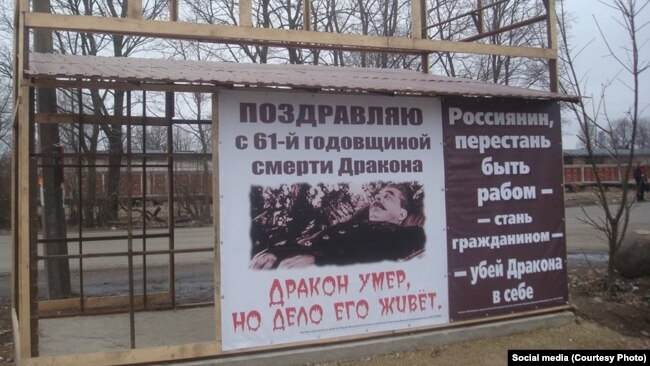
I hung up the poster “I congratulate you on the 61st anniversary of the Dragon’s death. The Dragon is dead, but his cause lives on. // Russian citizens, stop being slaves. Become citizens. Kill the dragon inside you.” The poster, which showed Stalin in his casket, used to be coupled with the second part, about citizens, which was swiped by the polizei. The poster “Peace to Ukraine” broke all the records: it hung for two weeks.

Вторую часть плаката

The second part of this poster, featuring a dead Stalin and a call to “kill the dragon inside you” and “become citizens” was “swiped by the polizei.”

The local authorities, by the way, didn’t know how to react. The poster was hanging on my building. It’s my property and my land, and the poster belongs to me. It hung there for quite a long time. Other events took place, for example, the 2014 elections. I hung my campaign posters there. As a municipal district council member, I was competing for votes. I would hang up a poster. It would become stale, and I would hang up a new one. And then, when I clearly campaigned against Putin. . . For example, I had posted a banner reading, “Putin should resign.” It was 9.4 meters by 2 meters. The banner caught everyone’s eye: my store stands next to the road. Well, they just came and swiped the banner. I decided to hang up another banner. Since it was forbidden to demand Putin’s resignation, I demanded Putin be freed. Since he considered himself a galley slave, I wrote, “Free Vladimir Putin! Let’s free this galley slave. Otherwise, he and his pals will row [rake in] too much.” This banner was also 9.4 meters by 2 meters.

Radio Svoboda: It was probably removed immediately, no? 

Skurikhin: I don’t know why, but it stayed up for nearly two weeks. I saw policemen come and look at it. Maybe they didn’t get it? I can’t say how the authorities make decisions. But then they removed it anyway. I have been doing this on purpose. My goal is to ensure President Putin loses this election. During the last election, in 2012, I printed flyers and ensured that Putin got the least number of votes in our district in our precincts, although he won anyway, of course. Our precinct was among the ten worst precincts in Leningrad Region. Numbers decide everything in a democracy. I worked on the electorate the best I could.

Radio Svoboda: Do the security services often summon your for talks and try to reason with you?

Skurikhin: Earlier they did, but recently they have left me alone for some reason. I think they just realized, probably, that they should be talking to me in handcuffs, whereas talking to me just for the heck of it, what’s the point? Besides my chat with the major from Center “E,” a major from the FSB, a colonel from the FSO (Federal Protective Service), and the Investigative Committee summoned me. Each of my posters has been sent off for a forensic examination. Policemen photograph them, and the photos are sent to Center “E” and Saint Petersburg State University for analysis: they have this forensics examination center there. Their forensics experts study my posters and render their findings. If the findings are neutral, the posters are returned to me, accompanied by an official ruling refusing to file criminal charges against me. I’ve had around a hundred such posters. Each one is also accompanied by a description. The police also try to do everything by the book. In Nazi Germany, they incinerated Jews by the book. Here in Russia, they have been trying to shut me up by the book, to put it crudely.

Radio Svoboda: What grounds do the police have for removing posters from private property? How does it usually happen?

Skurikhin: First, they get a complaint either from the local council or from a resident: someone is unhappy with the poster hanging on my store. The police arrive and write me up for violating the regional law that all posters must be vetted with the local council. This little law was invented in Leningrad Region. I disagree with it, so I simply say it wasn’t so. They write me up, then they bring a slave from the local housing authority, whom they force to climb up and remove my poster. Then they leave. After which the situation proceeds as I’ve described it. Unfortunately, the forensics experts have concluded that two of my posters insulted the honor and dignity of the president and incited social discord. I try not to insult anyone. I think through all my posters and make sure that they are worded as properly as possible, because you don’t help things by insulting people. I want to persuade people to vote against Putin, persuade them we need democratic values, freedom, and liberalism. Yet two of my posters have been deemed insulting to Putin. They were the reason I was summoned to the Investigative Committee to talk with an investigator.

Radio Svoboda: Have criminal charges been filed in connection with the two posters?

Skurikhin: You know, I haven’t asked the police about it. But they did get me summoned to the Investigative Committee, where I was asked for an explanation. I was shown the findings of the forensics experts. The poster in question was “Putin is war. Say no to war.” As you remember, it was Anna Politkovskaya who said, “Putin is war.” The slogan was written with bloody smudges, so there was nothing in particular to interpret. It was clear as clear could be. The poster was deemed to have insulted Putin’s honor and dignity. I don’t think I insulted him, but the Investigative Committee does.

Radio Svoboda: What war did you have in mind when when you wrote the slogan?

Skurikhin: Any war. Because Putin is, in fact, war. We were flattening Ukraine at the time.

Radio Svoboda: Have they threatened to close your business?

Skurikhin: The major from Center “E” threatened me, but no one else has. It’s just I’ve been in business for twenty-one years, and all the agencies they could sick on me, I’ve been working with them for a long time. I have a good relationship with them. Most important, all of them are on my side. As they’re tearing down the posters, the policemen say to me, “Damn, what you write is true.” But they’ve taken an oath, they have their orders, they would immediately get hell from their commander, so they can’t say it that way. I can because I don’t have a commander. Firefighters, the guys at Health Inspection Services, they all understand what is happening in Russia. Most of them are smart people.

Против кого на самом деле надо сакции вводить

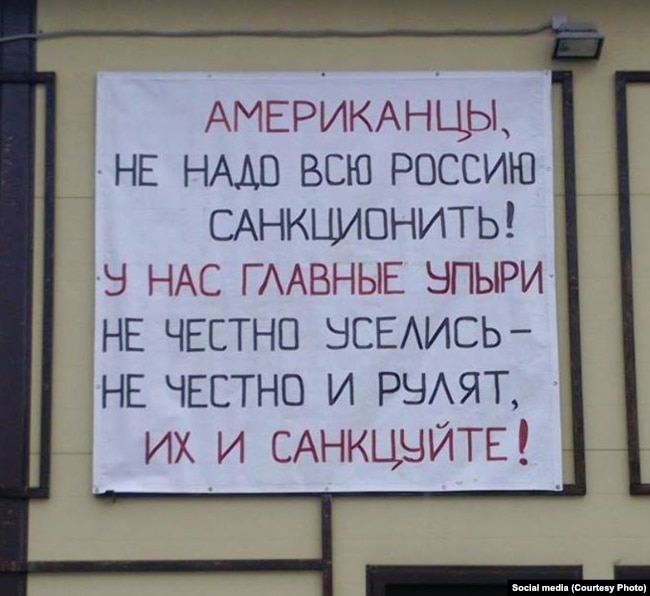
“Americans, don’t sanction all of Russia. Our head vampires got their jobs dishonestly and run things dishonestly. Sanction them!”

Radio Svoboda: Does your family support you?

Skurikhin: Yes, of course. Sure, they worry about me. The situation in Russia is such that the most active dissenters are shot down. My kids are aged nineteen, fourteen, seven, and four. All of them are girls: I live in a flower garden. If I’m arrested, my wife will feed the family: she’ll be like Vassa Zheleznova. I hope it doesn’t come to that, but we’ve talked it all throgh, of course. So that’s why I try and write slogans that are legal. I have studied a ton of material on the subject. What is an insult? It’s when you compare someone with an animal. The rest can be offensive and unpleasant, but it is not insulting in the criminal sense. You can say, “Skurikhin, you’re an idiot.” Yes, it’s possible for you to have this opinion. But I think differently. But if you say, “Skurikhin, you’re a jackass,” that is an insult.

Radio Svoboda: Have other businessmen put up similar posters?

Skurikhin: There were elections to the State Duma in 2016. As a member of Parnas (People’s Freedom Party), I ran in them in my own electoral district, the southwest  district of Leningrad Region. Sergey Naryshkin, now our top spy, ran in the same district. I made the rounds of all my businessmen friends and asked them to support me. I made banners that read, “Skurikhin and Parnas are your only worthy choice.” In our part of the world, most of the shops are village shops, and they are on private property, so I was able to hang them up for free. No other candidate got that kind of support. The rest had to pay for billboards. I spent 150,000 rubles on my election campaign. My wife later gave me a piece of her mind about that. I took second place in the elections in my own village. Only Naryshkin got more votes. I got support for my posters and ideas, for saying “Putin should resign.” My fellow villagers gave me the number two spot. In my native Lomonosov District, I took sixth place, and I took eighth place in the entire electoral district, which has a population of 500,000. What does that tell you? I would argue the outcome shows that liberal and democratic ideas are popular in society, but they simply never get conveyed to the voters, since the media are totally blocked. I have no other way of telling people Putin should have been dismissed from the Kremlin long ago. I only have my posters. But, generally speaking, it’s very hard for a Parnas member to get around United Russia on the first try.

Radio Svoboda: Do you attend all protest rallies?

Skurikhin: Yes, I try to go to all of them. At the last pro-Navalny rally, in June, I was wearing a “Sick of Him” t-shirt and carrying a flag. I was taken to a police station, but I escaped. This year there were also primary elections—Naryshkin gave up his seat in the Duma when he was appointed head of the SVR (Foreign Intelligence Service) in October 2016—and this year there were reelections. We also held events that, in my opinion, were meaningful to our district. I couldn’t let my people down, so I had to hightail it from the police station.

Radio Svoboda: Are you following the presidential campaign?

Skurikhin: Yes, of course. I’ll go all out to ensure Mr. Putin loses the election, at least in my precinct. I support Navalny’s registration as a candidate and Ksenia Sobchak’s candidacy, because we need as many candidates as possible in the first round just to take votes away from Putin and get a second round. If there is a second round, that will be a significant victory in itself.

Thanks to Comrade Uvarova for the heads-up. Translated by the Russian Reader

Valery Brinikh: The News from Adygea


07_brinikh
Valery Brinikh

Valery Brinikh
Facebook
September 9, 2017

Hello!

I wrote a report on this Sunday’s elections. Don’t be lazy and read it to the end. You’ll learn a lot of new things.

Who Elects the Head of Adygea: A Political Portrait of the Republic’s Parliament

As you know, on Sunday, September 10, the State Council of the Republic of Adygea (in Adyghe, the Khase) will elect a new head for the republic. There are three candidates, but the outcome is predetermined. Who would doubt it? Correct me if I’m mistaken, but in the history of modern Russia this was probably the first instance when the outgoing head of a Russian region brought his own kinsman to Moscow so that Putin could view the bride, i.e. his chosen successor. Nor, we must note, were he and his kinsman immediately shown the door. This was probably taken by the petitioners from Adygea as a favorable sign.

Everything kicked off when, in March of last year, as it was about to give up the ghost, the members of the Adgyean parliament’s fifth convocation nearly unanimously voted (fifty yeas, four nays) to abolish direct, popular elections of the republic’s head, adopting a special law and making the relevant amendments to the Adygean Constitution. Having denied Adygeans the right to vote directly for head of the region, the “people’s” elected representatives formally explained their decision as a means of making the electoral process less expensive. However, no one abolished another law, a law of everyday life: cheaper doesn’t mean better.

So elections to the sixth convocation of the Adygean Khase, in 2016, took place with the understanding that it would be the new parliament, not the people, that would be picking the republic’s new head. So, the requirements for sifting out the winners were tougher than usuaul. It was boom or bust, literally, all or nothing. The powers that be backstopped its chosen candidates to the hilt, and the elections took place in a stifling climate of lawlessness, generated by the acting executive branch and the local office of the United Russia party. Functionaries of the Rodina (Motherland) party did everything they could to force the Adygean Central Elections Commission to remove the opposition party’s entire regional list of candidates from the ballot, although the party had a good chance of taking several seats in parliament. The billboards, posters, and flyers of all candidates and parties except United Russia and LDPR were destroyed hours, if not minutes, after they were posted. The vote tallies at the polling stations were skewed, and the votes received by candidates and parties that are not part of the so-called parliamentary grouping (United Russia, CPRF, A Just Russia, and LDPR) were totally nullified. The latter parties divvied up their shares of the vote totals in keeping with quotas that had been agreed in advance in Moscow. So, the current Adygean Khase consists of 38 MPs from United Russia, four MPS each from the CPRF and LDPR, and two MPs from A Just Russia. Two more MPs have to be elected in by-elections on September 10. There is no doubt that one of the two will be a United Russia member. Thus, MPs from United Russia make up 80% of the republic’s parliament, while the CPRF and LDPR have 8% of MPs each, and A Just Russia has 4% of MPs. Now let’s compare these proportion with the spread of MP mandates in the Russian State Duma. United Russia’s MPs occupy 76% of the seats; the CPRF, 9.5%; the LDPR, 8.7%; and A Just Russia, 5.8%. The Duma also has two MPs who are not members of these parties. One of them is a member of the Rodina party, the party that was successfully sent packing in Adygea. The outcomes are quite similiar, don’t you think? It’s as if the same templates had been used.

The lineup of MPs running in the 2017 elections has been thoroughly purged. Anyone who provoked the slightest doubts has been removed from the lists. Only five people who have been MPs for more than three convocations are left, and only nine MPS from the last three convocations are still in the running. Two of them are from the CPRF’s faction (Adam Bogus and Yevgeny Salov), while the rest are from United Russia. The other thirty-four MPs (out of a total of forty-eight) were elected during Aslan Tkhakushinov’s last two terms as head of the republic [he resigned in January 2017, after ten years in office], under the watchful eye of his team. In fact, they are part of his team.

Clearly, they express not the will of the people, but the will of their true masters, the men who got them elected. Thus, the clearly unelectable United Russian candidates Sergei Belokrys (District No. 16) and Rustam Kalashov (District No. 21) got the cherished mandates. During their party’s so-called primaries [the English word is used in Russian], they both took an honorable third place in their districts with 7% and 27% of the vote, respectively. Even more unelectable pawns were kinged after winning spots on United Russia’s party list.

They hardly all have the right to be called people’s representatives, if only because not all the MPs in the Khase’s sixth convocation were elected by the people on the new single voting day. Thus, seven of the winning candidates from United Russia list soon resigned for different reasons, and their mandates were automatically handed over to five new MPs from the party list (Yuri Gorokhov, Yevgenia Dyachkova, Zurab Zekhov, Azamat Mamkhegov, and Murat Shkhalakov). Two more MPs will be selected on September in single-mandate constituencies. LDPR’s list of of winners included party leader Vladimir Zhirinovsky and the party’s regional leader Denis Ogiyenko, neither of whom took their seats in the Adygean parliament. Why Zhirinovsky did this is clear enough, but Ogiyenko works as an aide to an MP in the State Duma, where everything is grown-up and they feed you caviar sandwiches. The two LDPR leaders were replaced as Khase MPs by Valentina Chugunova and Tembot Shovgenov, thus technically bypassing the will of voters.

It is interesting to compare how much the majoritarian MP mandates in the republic’s urban districts and rural districts are worth in terms of votes cast by voters. Thus, Maykop, the capital city, is divided into nine electoral districts, inhabited by a total of 132,890 voters. One majoritarian mandate is thus worth, on average, 14,776 potential votes.  The Maykop Municipal District [not to be confused with Maykop per se] has three electoral districts and 46,111 voters, so an MP’s mandate is worth slightly more there: 15,370 votes. The Teuchezh District has only one majoritarian mandate, worth 13,549 votes. The Takhtamukay District is home to 51,840 votes, and so its four majoritarian mandates are worth an average of 12,960 votes. In the Giaginskaya District, the mandates are worth a bit less (12,563 votes on average), while in the neighboring Shovgenovsky District, it is worth 12,482 votes. Adygeysk’s single majoritarian mandate is worth 12,029 votes, while the Koshekhabl District’s two mandates are worth 11,407 votes apiece. The Krasnogvardeyskoye District has the “cheapest” mandates: two at 11,013 votes apiece. But strangers do not roam the homeland of the sweet couple of Aslan Tkhakushinov and Murat Kumpilov [Adygea’s acting head and Tkhakushinov’s chosen successor]. They elect only their own people and only on the advice of their superiors.

It was not entirely accurate to distribute MP mandates generally (whether from majoritarian single-mandate constituencies or party lists) in terms of the number of voters in the districts. The largest number of voters lives in Maykop (39% of all voters in Adygea), and its goes down from there. The Takhtamukay District has 15% of voters; the Maykop District, 13.6%; the Giaginskaya District, 7.4%; the Koshekhabl District, 7%; the Krasnogvardeyskoye District, 6.5%; the Teuchezh District, 4%; the Shovgenovsky District, 3.7%, and the town of Adygeysk, 3.5%. Meanwhile, the MPs from Maykop have only 30% of the mandates in the Khase; Takhtamukay District, 20%; Maykop District, 14%; Giaginskaya District, 6%; Koshekhabl District, 10%; Krasnogvardeyskoye District, 8%; Teuchezh District, 6%; Shovgenovsky District, 4%; and the town of Adygeysk, 2%.  The imbalance is obvious.

The sixth convocation of the Adygean Khase has only eight MPs (16.7% of the total number) employed in the state sector. Six MPs (12.5%) are party officials. The remaining MPs (over 70%) run businesses in different sectors of the economy. The largest number of them (21 MPs out of a total of 48) earn their money in construction, commerce (including wholesale commerce), and services. Four MPs (8.3%) get their income from agriculture. Three MPs (6.3%) work in banking and investing, while two MPs each (4.2% each) are involved, respectively, in the hotel and tourism business, logging and extractive industries, and industrial manufacturing. Yet the CRPF and A Just Russia factions are dominated by party officials (four out of six), while members of United Russia have a clear advantage in all other lines of work.

The sixth convocation of the Khase includes two high-profile businessmen with criminal pasts (according to the media): United Russia member Gissa Baste (aka Voloskevich) and non-partisan MP Adam Bogus (aka Mazai), who blocks with the CRPF faction. Several well-known businessmen from United Russia have close ties with different dubious firms and people with criminal pasts. In particular, nine deputies (six from United Russia, two from the LDPR, and one from the CPRF) are involved in the construction business in the Takhtamukay District, run by Azmet Skhalyakho aka the Foreman. According to the media, he earned the nickname not on the fields of his native Takhtumukay District, but by shaking down market traders in Krasnodar during the “wild” 1990s. The notorious prosecutor Murat Tkhakushinov, son of ex-republic head Aslan Tkhakushinov, worked in the same district until recently. The Takhtamukay District’s proximity to Krasnodar, the much lower prices for land in the district than in Krasnodar, and the total control over the black market for land plots by criminal gangs, who have fused with Adygea’s government agencies, have made the construction business in the district quite profitable. Especially if you are not bothered by the legality of particular transactions, do not waste money on pollution treatment facilities, and pay no mind to the quite costly environnmental requirements.

Questions also arise when you take a closer look at the life and times of Vladimir Narozhny, head of the United Russia faction and chair of the republic’s parliament. There are strange blanks in his CV from 1981 to 1991, which for some reason he does not particularly advertise. Judging by occasional references, he ran various agricultural businesses during this period. Currently, he is associated with a number of firms, also involved in agrobusiness, in Adygea and Krasnodar Territory. They have different names and legal addresses, and yet they have the very same Primary State Registration Number and Taxpayer Identification Number. Obsessive thoughts of criminal money laundering schemes come to mind, but I have probably read too many detective novels.

As a final touch to my sketch of the current Adygean Khase, I want to focus on yet another imbalance, which testifies to a deeply embedded problem, if not a chronic disease, that affects the regional authorities in Adygea. I have in mind the distortions in personnel policy that favor the so-called titular ethnic group, the Adyghe. This phenomenon, which I would dub the Adyghization of power in the republic, was especially rampant during Aslan Tkhakushinov’s second term and has kept evolving in the present. I would not argue it has anything to do with ethnic conflicts between two great peoples, the Russians and the Adyghe, but has been caused only by attempts by specific members of the so-called Ulyap clan, who have ruled the republic for the last ten years, to ensure they will stay in power for the indefinite future. This is done both by depriving the Adygean populace of the right to elect the republic’s leaders and local government officials in direct elections, and through a deliberate personnel policy of giving preference to members of the titular ethnic group when filling vacancies in state and municipal agencies—if possible, to members of one’s own clan and numerous kinsmen. This cup has also touched the republic’s legislative branch. Whereas the republic’s population consists of approximately 63% Slavs, 25% Adyghe, 3.5% Armenians, and 8.5% other ethnic groups, the Khase is dominated by members of the titular ethnic group, who hold 28 seats (or 58.33%), while the Slavs are represented by 19 MPs (or 39.58% of seats). There is also one Armenian MP in the parliament, and no one else. I do not insist on introducing ethnic quotas. (God forbid, we have already been through such attempts at achieving parity.) I merely want to draw attention to this obviously non-random outcome as the inevitable side effect of dishonest elections.

Valery Brinikh, Chair of the Adygean Regional Branch of the Greens Russian Ecological Party, September 8, 2017

Translated by the Russian Reader. Photo courtesy of Bellona

How to Get Fired from Your Job in Russia

Historian Alexei Petrov. Photo courtesy of Radio Svoboda
Historian Alexey Petrov. Photo courtesy of Radio Svoboda

Historian Alexey Petrov Fired from Irkutsk State University
Radio Svoboda
November 16, 2016

Alexey Petrov, deputy dean of the history department at Irkutsk State University has been fired from his job, allegedly for engaging in public activism to the detriment of his work as an educator. As Petrov reported on Facebook on Wednesday, his work book* was brought directly to his workplace.

Petrov heads the regional branch of Golos, a grassroots organization that combats electoral fruade. He is also renowned as organizer of the project Walks through Old Irkutsk.

The dismissal has come in the wake of an inspection of the university by the prosecutor’s office, which was instigated by the so-called Trade Union of Independent Citizens, our correspondent reports. Two complaints were sent to the prosecutor’s office. The first complaint, which was anonymous, states that Petrov, deputy dean of the ISU history department, publicly presents and promotes insufficiently patriotric views during his lectures. The second letter, signed by Sergei Poznikov, focuses on the historian’s absences from the deans’ offices at the university during working hours and his frequent trips overseas.

The complaints against the “excessively liberal-minded historian” were made to the prosecutor’s officer after the Russian Congress of University Vice Chancellors for Morale and Discipline, in October, at which a program for assessing the “protest potential” of students and professors was presented.

* “Every person working for an employer in Russia is issued a work book by the person’s original employer. A work book contains the record of a person’s employment history, dates of employment, as well as other information. Employers have the duty to keep and timely update an employee’s work book while the employee is working for the employer. On the employee’s final day of employment with an employer, the employer must complete and return the employee’s work book, against the employee’s signature.” Source: Multitran

Translated by the Russian Reader. Thanks to Comrade AT for the heads-up

“We Have a Surrogate Democracy”: An Interview with Ekaterina Schulman

Ekaterina Schulman. Photo courtesy of Andrei Stekachov and The Village

Political Scientist Ekaterina Schulman on Why You Should Vote
Anya Chesova and Natasha Fedorenko
The Village
September 16, 2016

This Sunday, September 18, the country will vote for a new State Duma, the seventh since the fall of the Soviet Union. The peculiarity of this vote is that it will take place under a mixed electoral system for the first time since 2003. 225 MPs will be elected to five-year tears from party lists, while the other 225 MPs will be elected from single-mandate districts. Several days before the elections, The Village met with Ekaterina Schulman, a political scientist and senior lecturer at the Russian Presidential Academy of National Economy and Public Administration (RANEPA). We talked with her about why you should vote if United Russia is going to win in any case, as well as about the changes in store for the Russian political system in the coming years.


The Upcoming Elections

The Village: On Sunday, the country will hold the first elections to the State Duma since 2011. The social climate in the city and the country as a whole has changed completely since that time. Protests erupted in 2011, and the people who protested on Bolotnaya Square and Sakharov Avenue believed they could impact the political situation. Nowadays, few people have held on to such hopes. What should we expect from the upcoming elections? And why should we bother with them?

Ekaterina Schulman: Everything happening now with the State Duma election is a consequence of the 2011–2012 protests, including changes in the laws, the introduction of the mixed system, the return of single-mandate MPs, the lowering of the threshold for parties to be seated in the Duma from seven to five percent, and the increased number of parties on the ballot. These are the political reforms outlined by then-president Dmitry Medvedev as a response to the events of December 2011. Later, we got a new head of state, but it was already impossible to take back these promises. The entire political reality we observe now has grown to one degree or another out of the 2011–2012 protest campaign, whether as rejection, reaction or consequence. It is the most important thing to happen in the Russian political arena in recent years.

The statements made by Vyacheslav Volodin, the president’s deputy chief of staff, on the need to hold honest elections, Vladimir Churov’s replacement by Ella Pamfilova as head of the Central Electoral Commission, the departure of someone more important than Churov from the CEC, deputy chair Leonid Ivlev, and the vigorous sacking of chairs of regional electoral commissions are all consequences of the protests. If they had not taken place, nothing would have changed. We would still have the same proportional voting system, the same seven-percent threshold, the same old Churov or Churov 2.0. Continue reading ““We Have a Surrogate Democracy”: An Interview with Ekaterina Schulman”

Watching the Watchers

Sveta Erpyleva after finishing her 24-hour shift as elections observer in the wee hours of Monday morning. Photo courtesy of the author
Sveta Erpyleva after finishing her 24-hour shift as an elections observer in the wee hours of Monday morning. Photo courtesy of the author

Sveta Erpyleva
Watching the Watchers
September 20, 2016

I want to articulate a few ideas about the practice of working as an elections observer from a slightly different perspective than people usually write about it. In my view, there are two things that make the practice attractive to many of us.

The first thing is the indescribable feeling of belonging to an anonymous community, a team of strangers involved in an important cause. Such communities are nearly absent in our everyday lives. We have friends and families, but that is not the same thing, of course. We have colleagues and people who share our interests. We might not know them personally, either, but we never come together with them to touch on something that affects the entire country. In this case, however, over the course of twenty-four hours we experience the same events and emotions as hundreds of other observers in different parts of the country. We share our impressions with each other in comments sections on social networks, we all stay awake for days on end, and together we quarrel with members of electoral commissions. It is a very unusual and powerful sensation. I think many people have experienced it, whether they were aware of it or not.

The second thing is the chance to feel we are not couch potato dissidents or whatever it is called, but real citizens, conscientious citizens. We voluntarily get up early in the morning, we wrestle with a large group of people on our lonesome, and we struggle mightily with fatigue. And then, naturally, we write about it, hearing in reply all sorts of compliments from loved ones and acquaintances. But that is what we expected to hear, isn’t it?

In connection with these two things, I think it is important we be aware of the following. An anonymous political community is groovy, but sometimes it is not worth getting carried away with it. Are we certain we want the exact same things as the conscientious, get-up-and-go people who seem so much like us on elections day?

I chatted with a pleasant, conscientious young man who, like me, had come of his own free will to work as an observer at my polling station. Nope, his way was not my way, I discovered. We wanted different things.

As for the second thing, it is quite simple to selflessly surrender twenty-four hours of your life to “civil society” once every two or three years and then hear lots of nice things about yourself. Meanwhile, there are people in our midst who selflessly give up several hours every day to political struggles and social activism. Ninety-five percent of that time vanishes into the mist, because that is the nature of modern politics. These people do not get any doughnuts in the guise of society’s approval for ninety-five percent of their work. I admire people like this if their views are congenial to mine rather than people who have worked as election observers. Sorry.

I am not saying you should not go work as an elections observer. I did it myself, and I imagine I will go and do it the next time round. What I mean to say is that, first and foremost, we should not look at ourselves through rose-colored glasses.

Sveta Erpyleva is a sociologist who works at the PS Lab (Public Sociology Laboratory) in Petersburg. This past Sunday, she volunteered as an elections observer at a polling station in the city’s Central District. My thanks to her for allowing me to translate and publish her remarks here.

“I Will Find You and Kill You”: How Petersburg Celebrated “Democracy Day”

democracy

“Whatever anybody says, especially our foes from abroad, both you and I know that we live in the most democratic country, in Russia.”

— Georgy Poltavchenko

This past Sunday, September 14, was declared “Democracy Day” in Petersburg, Europe’s fourth largest city. What this meant on paper was that the city’s Kremlin-appointed governor, Georgy Poltavchenko, swept to an overwhelming victory in his first “real” gubernatorial race, while ruling United Party crushed the opposition in elections to the city’s neighborhood councils. Then the victors celebrated “democracy” with a pop concert on Palace Square.

What this meant in practice was that Poltavchenko’s only real challenger had been peremptorily “filtered” from the race two months ago, and the melancholic KGB nonentity was left to face a quartet of stick-figure opponents almost no one had heard of before; the United Russia machine pulled out all the stops doing what it loves best—brazenly rigging elections and just as flagrantly cracking down on anyone who challenges its right to do that; and a band of foreign fascists, ultra-right-wingers, and Stalinist clowns, masquerading as “international monitors,” showed up to rubber stamp this bloody farce. No wonder Robert Mugabe backs Russia.

I received the following letter from a friend whose son celebrated “Democracy Day” by serving as a member of the electoral commission at a polling station in central Petersburg. I have translated the letter and published it here with her permission, but I have changed the names of people and places to protect “Dmitry,” “Lyuba,” and the author from further persecution and harassment.

**********

I don’t know whether you are aware of yesterday’s elections in Petersburg. They were completely hellish.

[Our son] Dmitry was a voting member of the electoral commission at Polling Station No. 86, on Austerlitz Street. His girlfriend Lyuba had the same status at Polling Station No. 85, which was in the same building. A bunch of Dmitry’s friends worked in the same capacity at various other polling stations.

The chairs of the commissions hid from them all the time. On Saturday, the day before the elections, Dmitry went to his polling station, where he immediately faced aggression and intimidation: “We’ll have you removed from the polling station,” “Don’t you dare photograph anything,” “We’ll settle your hash later,” and so on. Dmitry demanded to be shown the certificate for receipt of the envelopes containing the absentee ballots. The chairwoman started screaming that this was a provocation. Saturday ended with the chairwoman turning Dmitry over to the police for allegedly photographing the voter lists.

Dmitry was taken to the eighty-third police precinct on the Old Barge Channel, where he was immediately released because the arrest had been illegal. I went to the precinct to get him.

Then came Sunday [election day]. Right away in the morning, Dmitry wrote to us that there had been a bunch of violations; he was again being threatened, and so forth. He was sent out with a mobile ballot box to make the rounds of the old women [pensioners confined to their homes], and while he was out, the chairwoman sent someone with two unregistered ballot boxes to a hospital. At the end of the day, the ballot boxes came back with twenty additional votes that had appeared out of nowhere, as if people had been admitted to the hospital the day before and were immediately registered as voters at this polling station. It was like this with the ballot boxes at nearly every polling station: two hundred votes apiece, cast by completely unknown people, ended up in them.

In the afternoon, I brought Dmitry coffee, because he was afraid to leave the polling station. Lyuba went out to have tea, and while she was out, two ballot boxes were carried away from her polling station: she was informed of this after the fact.

When I arrived at the polling station, they also made as if they were going to arrest me: “Who the hell are you? His mama?” and so on. I snapped at them and told them they were shameless. Dmitry and I went out onto the porch. Some security guards—not cops—came out after us, as if they were keeping track of us. They smoked and swore. We remarked to them that both smoking and swearing were administrative violations. They cussed us out. When Dmitry started filming them with his telephone, they began pushing us down the stairs, trying to snatch the telephone from Dmitry. They got the telephone from him, and Dmitry hurt his hand. (Also, one of the guards got doused with coffee, meaning that Dmitry was left without coffee.) We called the police. When they heard us doing that, the guard cooled their heels and gave back the telephone, but they had erased the video.

Then a polizei came, and Dmitry and I filed an assault complaint. The polizei said he would charge the men with an administrative violation for smoking.

I told the chairwoman that hopefully she was being well paid for everything, because otherwise I saw no point to this mayhem. To which she replied that she was glad I was concerned about her welfare.

But it got really gnarly after the polls closed. We got reports from everywhere about [opposition electoral commission members and observers] being removed from polling stations during the counting of the votes. When Lyuba’s turn came and she refused to leave the polling station voluntarily, the police were summoned and told that she had spit on a local cop. Lyuba was taken away, and like Dmitry the day before, she was just released. She has filed a bunch of complaints against everyone.

At Dmitry’s polling station, on the contrary, they didn’t start counting the votes for four hours: they were supposedly verifying the voter lists. However, the chair of the Shostakovich Municipal District Electoral Commission, a man who weighs over a hundred kilograms, would come up to Dmitry and whisper in his ear, “I will find you and kill you.” He did this several times. Dmitry was alone against twenty gangsters who insulted and threatened him.

Dmitry called us and said he was being threatened, that they were trying to remove him from the polling station for videotaping and interfering with the commission’s work. I telephoned GOLOS (in general, I spent all of Saturday and Sunday phoning and writing everywhere). The people at GOLOS [a Russian electoral rights NGO] told me I should go to the polling station. At one in the morning, Grigory [her husband] and I ran to Austerlitz Street.

Just as we got there, Dmitry rang to say he was being forcibly dragged from the polling station. A police jeep was already parked outside. Dmitry had also called the police and told them he was being unlawfully removed, but they hadn’t shown up, or rather, they showed up to arrest him.

I was talking to Dmitry on the phone, and he was yelling, “Don’t you dare arrest me, you’re breaking the law.”

The door opened, and Grigory and I saw a cop dragging Dmitry from the polling station. I ran up to the cop and told him he was breaking the law and so on. To make a long story short, Dmitry was again being taken to the eighty-third police precinct. We headed there.

Before leaving, I asked the cop a question.

“Look me straight in the eyes and tell me you aren’t ashamed.”

“I am just doing my job,” he said.

“But what about the law?” Grigory asked.

The cop began to walk away.

“Do you believe in God?” Grigory shouted to him as he walked away.

“Yes,” the cop firmly replied.

Well, then we arrived at the police station. Dmitry was almost immediately released. He also dashed off a bunch of complaints.

We got home at four in the morning. Dmitry ate and drank for the first time in a twenty-hour hellish day. Then we were online until six in the morning watching as his electoral commission kept putting stuff up and erasing and rearranging it. They didn’t even have the obligatory large summary vote tally.

Dmitry’s friends were practically removed from all the polling stations [where they served as electoral commission members and observers]. One friend, Eduard Dubinsky, who was a candidate for the municipal council in the Kamenka district, was arrested for allegedly resisting the police. He spent the night in jail, and the next day a court sentenced him to a five hundred ruble fine. So Dmitry got off lightly. But we are waiting for responses to all his complaints.

P.S. We also found out that there were around two hundred ballots in the unaccounted ballot boxes at Dmitry’s polling station that were secretly sent out and brought back from the hospital, but it is impossible to verify who filled them out and how. Twenty-one of these ballots were allegedly filled out by people who had been admitted to the hospital the day before. It is unclear how they could be entered onto the voter lists. In fact, it couldn’t have been done legally. Plus, now Dmitry has checked and spotted the fact that another one hundred additional voters appeared up out of nowhere. He found this while looking over the final report. Meaning that approximately three hundred fake votes were added to the tally at his polling station. That is roughly fifty percent added to the total. Now I understand why the commission was so aggressive and didn’t allow the results to be known, and whey they were looking for an excuse to kick Dmitry out.

Translated by the Russian Reader. Image courtesy of academichelp.net