13 musicians not allowed to perform at City Day concert in Moscow due to support for Navalny The Village
Tasya Elfimova
September 11, 2021
The Federal Protective Service (FSO) did not allow several musicians to perform at a concert in honor of City Day in Moscow due to their alleged support of Alexei Navalny.
Sergei Sobyanin and Vladimir Putin were planning to attend the celebration, so the FSO vetted the lists of performers in advance. The FSO did not admit thirteen people to the performance without explaining the reasons. Dmitry Klyuyev, an employee of the State Academic Chapel Choir, believes that it happened because the musicians were in the leaked databases of Alexei Navalny’s projects or had taken part in protest rallies.
Four employees of the chapel choir, three people from the Svetlanov State Orchestra and six people from the team of directors were removed from the concert.
“The organizers are in shock, no one has explained anything to them,” Klyuyev said.
Source: OVD Info
Translated by the Russian Reader
Alexander Gudkov, “Aquatic Disco,” a song inspired by Alexei Navalny’s revelations that the blueprints for “Putin’s palace” contained a room labeled as such
Moscow Police Use Leaked Personal Data To Investigate Navalny Supporters RFE/RL Russian Service
August 18, 2021
Moscow police are using leaked online personal data from projects linked to jailed opposition politician Aleksei Navalny to investigate people who have supported the Kremlin critic.
The OVD Info website said on August 17 that police had visited some 20 individuals who registered for online projects developed by Navalny associates or donated to Navalny’s Anti-Corruption Foundation (FBK) and his other projects.
According to OVD Info, police are demanding explanations from the people as to how their names were included in the leaked data related to Navalny’s online projects and why they are involved with him.
In June, a court in Moscow labeled FBK and Navalny’s other projects and groups extremist and banned them. Under Russian law, cooperation with such groups is considered illegal and may lead to criminal prosecution.
Police have not said how they obtained the people’s personal data from Navalny’s websites.
One person, who was not identified, told OVD Info that police asked him to file a legal complaint against Navalny to accuse him of sharing personal data.
Journalist and municipal lawmaker Ilya Azar, whose personal data was among those leaked, wrote on Telegram late on August 17 that police had tried to visit him as well, but he was not at home.
“They talked to [my] neighbors about some personal data leaked on the Internet,” Azar wrote.
One such leak took place in April, when the online campaign called “Freedom to Navalny” was reportedly compromised.
Navalny associates said at the time that a former FBK worker had “stolen” all the personal data of those who registered at the pro-Navalny site.
After that leak, the Moscow [subway] fired dozens of workers whose personal data turned up among the names of Navalny supporters.
Mihkel Ram Tamm (center) was a guru for hippies in Estonia and other parts of the Soviet Union. Courtesy of Vladimir Wiedemann and the Guardian
Reading of Durnenkov Play Banned in Vladivostok
Vitalia Bob Teatr
September 1, 2021
A reading of Mikhail Durnenkov’s play How Estonian Hippies Destroyed the Soviet Union at the Primorsky Youth Theater [in Vladivostok] has been banned [sic].
The Primorsky Youth Theater’s new season was to open on September. The theater had announced this event a long time ago: it was planned for the theater’s courtyard and featured a reading of Mikhail Durnenkov’s play How Estonian Hippies Destroyed the Soviet Union. According to Maritime Territory media, yesterday, August 31, on the eve of the Russian president’s visit to Vladivostok, the management of the Youth Theater was forced to cancel the reading of the play and all events scheduled for September 2 after getting a call from the Maritime Territory Ministry of Culture and Archives.
Sergei Matlin, former head of the regional department of culture, commented on the reading’s cancellation on social media.
“It’s disgusting. This, by the way, is exactly what is meant by vicarious embarrassment. That is, when someone else does something, but for some reason you feel ashamed… The ministry actually doesn’t have the right to ban the reading of the play. Since this production definitely doesn’t qualify as a state commission, that means it is not financed from the budget. In any case, even if there were some controversial aspects about the text of the play, this is a creative issue and should definitely not be solved in the offices of bureaucrats. What has happened sets a dangerous precedent. If we do not fight back today, then tomorrow officials will want to veil nude pictures in a gallery, the day after tomorrow — to edit the wording of signage they don’t like in a museum exposition, and a couple of days later — to alter the costumes of characters at the Puppet Theater,” Matlin wrote.
Matlin also noted that Durnenkov’s play is currently being staged at the Meyerhold Center in Moscow with financing from the Presidential Grants Fund.
Lydia Vasilenko, the Youth Theater’s artistic director, declined to comment, but wrote on her Facebook page, “I’m having a hard time, a really hard time. Today, the reading of the Durnenkov play has been canceled. I’m at a loss.”
____________________
How Estonian Hippies Destroyed the Soviet Union is a tragicomedy about the adventures of six Estonian hippies who are hungry for freedom and love. Despite the fact that the reading was canceled in Vladivostok, the play, produced with money from a presidential grant, is currently running at the Meyerhold Center in Moscow.
Vladimir Putin has repeatedly expressed regret about the collapse of the Soviet Union, calling it “the greatest geopolitical catastrophe of the twentieth century.” He touched on this topic at his meeting with schoolchildren yesterday.
The play most suited to a large stage would have to be Mikhail Durnenkov’s How Estonian Hippies Destroyed the Soviet Union, which was written on commission for a theatre in Estonia. It is a dream-like psychedelic journey where reality and the imaginary become entangled, only disentangling at the play’s denouement, when it becomes clear that while the eponymous Estonian hippies may be forced to physically submit to the will of authority, it is their ideals of love and freedom that ultimately collapse the Soviet project from within, at the level of the individual.
— Alex Trustrum Thomas, “Moscow’s 2018 Liubimovka Festival: New Trends, Old Problems,” The Theatre Times, 12 October 2018
Flowers and hair grow everywhere! A wild flower power ride on the footprints of the Soviet hippie movement take you into the psychedelic underground of 1970s. In search of freedom and happiness under the thumb of the strict political regime a colorful crowd of artists, musicians, freaks, vagabonds and other long-haired drop-outs created their own System in the Soviet Union. Years later, a group of eccentric hippies take a road journey to Moscow where people still gather annually on the 1st of June to commemorate a tragic event in 1971, when thousands of hippies were arrested by the KGB. Directed by Terje Toomistu.
Four solo picketers detained in Moscow demanding that authorities not exacerbate the epidemic OVD Info
June 19, 2021
Alexander Rimov has informed OVD Info that four people involved in a series of solo pickets demanding that authorities not worsen the epidemiological situation have been detained.
During the United Russia party congress, taking place at Moscow’s Expo Center, several people took turns holding up a placard containing a message encrypted using a QR code. The protesters urged the authorities not to worsen the epidemiological situation and postpone the elections so that the ruling party does not endanger the electorate.
Among the detainees, according to Rimov, are two virologists, a law enforcement officer and a municipal employee. They were taken to the police department in the city’s Arbat district, where they were cited for violating the rules for holding public events (per Article 20.2.5 of the Administrative Code).
UPDATE 10:00 P.M. After the charges were filed, the detainees were released, a friend of theirs has told OVD Info.
During the United Russia congress, President Putin announced the first five names on the party’s federal list for the upcoming State Duma elections.
United Russia has set itself goal of winning the elections, but this is not an end in itself. The main thing is to achieve more for the country, Vladimir Putin said.
He noted that the platform of United Russia, as a leading party, should be truly popular.
In the top five of United Russia’s federal list in the elections, there should be both political heavyweights and relative newcomers, Putin believes. The Russian president named Shoigu among those whom he sees at the top of United Russia’s federal list in the elections.
Putin also said that Protsenko, Lavrov, Shmeleva and Kuznetsova should be among the names at the top of the federal list.
Source: TASS, June 19, 2021. Translated by the Russian Reader. Mediazona editor Yegor Skovoroda writes that new data from Rosstat, the Russian federal statistics service, shows how authorities in many of Russia’s regions have been hiding covid-19 deaths by passing them off as mortalities from respiratory and circulatory diseases. In Chechnya, for example, such deaths suddenly increased by 674%, while in the Samara region they increased by 202%. It was mostly the elderly that have been dying from these alleged causes, prompting Skovoroda to call the phenomenon a “nightmarish variety of ‘pension reform.’” All the particulars are contained in Mediazona’s survey of the stats, published on June 18, 2021.
When Alexei [Navalny] came to after the coma, and everything began to gradually improve, I thought that I would not soon have to endure minutes worse than I had in the plane from Tomsk as it was landing in Omsk. Things didn’t happen like that. It was a law of life, or something. Such powerful emotional experiences didn’t happen one after another.
But now eight months have passed, and I’m back on that plane, only this time it is landing very slowly.
People usually avoid the word “dying.” Some avoid it out of superstition. I personally avoid it because loud words like that shouldn’t be used lightly.
But Alexei is now dying. In his condition, it’s a matter of days. The lawyers just can’t get into [the prison] to see him at the weekend, yet no one knows what will happen on Monday.
We witnessed tremendous support in Omsk. Alexei himself later said many times in interviews that Putin had let him to be taken abroad for treatment because he realized it would do him no good to have Navalny die “live on the air.”
Now he is dying in exactly the same way, in plain view of everyone, only this time more slowly, and access to Alexei is much more difficult. Apparently, that’s why it seems to everyone that nothing terrible is happening. The hunger strike has lasted for eighteen days, Navalny has been gradually losing the feeling in his arms and legs, and some tests have been done. All this has been blurred in time, and people don’t have the sense that they are again witnessing a murder.
In 2015, we were organizing a big spring protest rally and heavily promoting it. Alexei himself handed out leaflets in the subway, which landed him in jail for fifteen days. But then [Boris] Nemtsov was murdered. In the end, the rally did take place, and it was huge, only the occasion for the rally had changed altogether.
Now, too, a rally is being organized to demand Alexei’s release, and it will be huge as well. But I don’t want it to happen for any other reason.
Putin reacts only to mass street protests. Even the threat of them scares him. The Kremlin has also been looking at the counter of people [who have pledged to attend the protest] on the Free Navalny website and thinking, Aha, the pace has slowed down, there is no reason to be worried, we can keep going. Navalny is dying: let him die. We won’t let a doctor see him. We won’t allow him to be treated. We should push even harder: we’ll declare his supporters extremists to keep them quiet.
This rally is no longer Navalny’s chance for freedom. It is a condition of keeping him alive. And every new day could be the last.
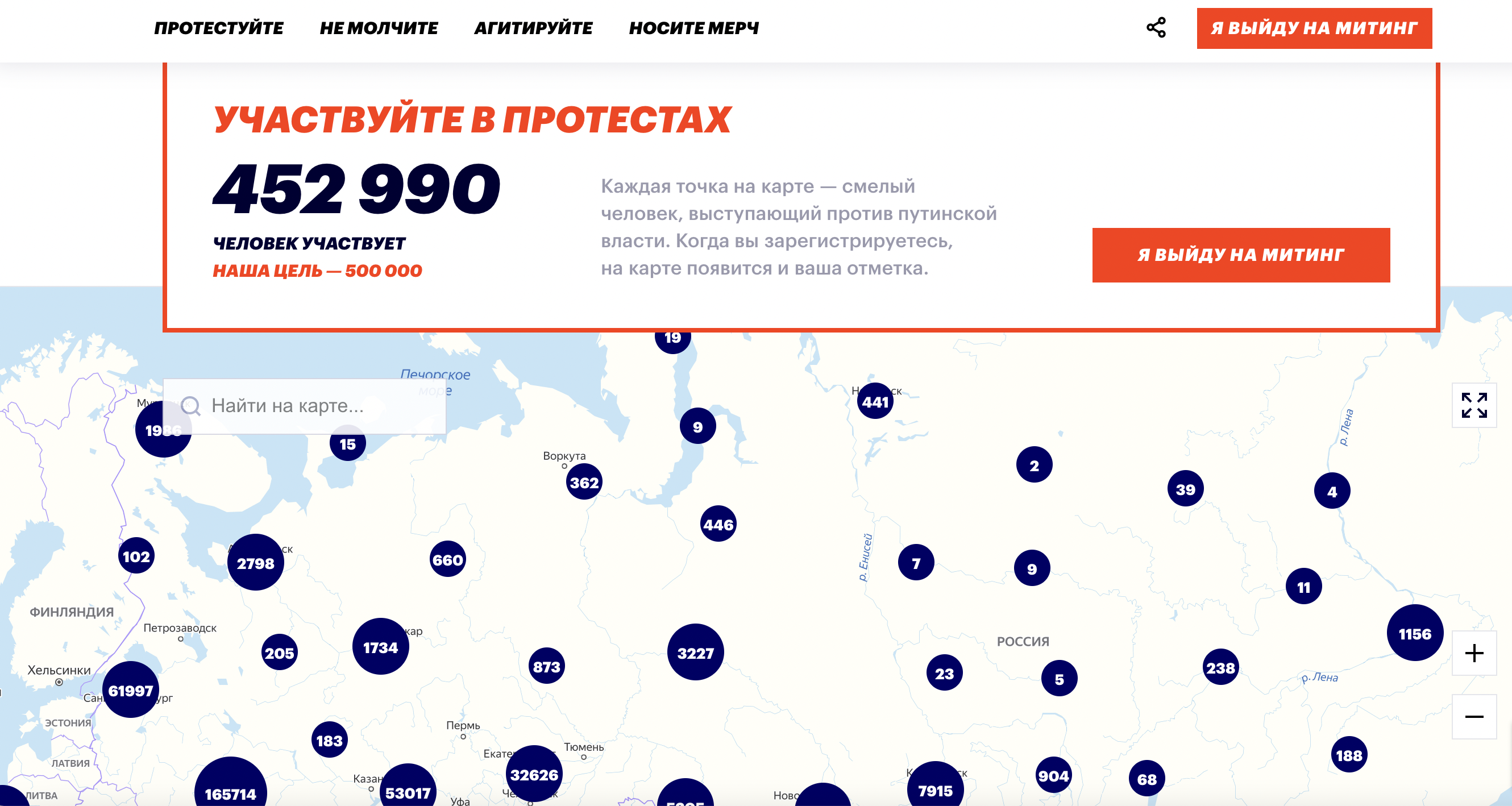
Register now. We need to reach 500,000 people as soon as possible.
Kira Yarmysh is Alexei Navalny’s press secretary. As of today (April 17, 2021), nearly 453,000 Russians had pledged to attend protests demanding Navalny’s release (see the screenshot, below). Photo of Yarmysh courtesy of Wikipedia. Translated by the Russian Reader
I usually like what Kirill Martynov writes, but the screed, below, is overdoing it. DOXA are just four nice smart, brave kids, not the Red Army Faction. They shouldn’t have to bring down the Putin regime on their own. This is not to mention the fact that Russia has been an “ordinary dictatorship” since 2012, if not much earlier. || TRR
At work, I have to constantly write about the “socio-political situation.”
My thoughts are now as transparent as Patrushev’s tear: we have arrived at an ordinary dictatorship with a president for life, prisons and a ban on practicing their professions for dissenters, and the subsequent collapse of the state—after this patriotic feast ends with some pathetic and shameful event, as usually happens to dictatorships.
Accordingly, there is practically nothing to write, except for specific stories—for example, about when they try to block YouTube or how they will simulate elections under the new circumstances.
The DOXA case should be read in this light: this is not about random “siloviki going after a student magazine,” but about the dictatorship purging education and the media. It is impossible to win a trial against the dictatorship, so further bets will hinge on whether everyone remains free or not.
The advantage in this case is that “DOXA’s criminal video” says nothing except the that students also have the right to take a civic stance, and university administrations should not try to persecute them for this. It looks like the kind of case that should end in a suspended sentence, which, by Russian standards, is tantamount to an acquittal.
However, so far the state has imposed special pre-trial restraining measures on DOXA. All four editors can leave their homes for one minute a day, from 11:59 p.m. to 12:00 a.m. (so as to avoid putting them under house arrest for some reason).* All four of them have already been issued summonses for more than twenty interrogations, scheduled for every working day between now and late May.
In a better world, Summit Brewing Co.’s fabulous Slugfest IPA would be my new sponsor. Instead, it only dulls the pain I feel when contemplating the one-sided slugfest happening in the world’s biggest country. Image courtesy of Summit Brewing Co., St. Paul, Minn.
Armen Aramyan wrote his honor’s thesis in epistemology with me as his academic advisor. I hope that the investigator will have time to talk with him about this interesting subject. (“Why so many books?” the police asked when they searched his apartment.)
So from an epistemological point of view, the situation looks something like this. The authorities are now able to kill DOXA’s entire support line in a matter of days: the state will simply devour a few lives and go on, thus maintaining “stability.” But the state’s weakness is that it has no idea what phenomenon it is facing.
It has no idea how these people think, what they want, and what to use to “break” them. When the Americans were at war with Japan, they commissioned anthropologists to study Japanese culture. Our state is waging a war on young people blindly, like a drunken gangster in a dark alley.
I have no idea at all what DOXA—a horizontal student editorial board that writes about modern philosophy and harassment—looks like to police investigators.
And while the state is trying to figure out this unknown quantity, to unravel how it can be bought off or destroyed, many more interesting things will happen.
* As reader Pavel Kudyukin pointed out to me, house arrest was not imposed in this case so that its duration could not later be subtracted (as “time served”) from a sentence of imprisonment or probation imposed after a trial and guilty verdict. This suggests, he argued, that the powers that be have already decided to convict the four DOXA editors and send them to prison. || TRR
Covid is raging in Russia: over the past twelve months, there have been about 500,000 unexplained excess deaths. Putin is killing Navalny in prison, right now, literally. And this is the scene today, Friday, at 11:15 p.m., on Pyatnitskaya Street in downtown Moscow. How is this possible?!
“Horses, men and nonsense”: song and dance as matters of state
Ivan Davydov Republic
April 4, 2021
I must admit that I am quite unfamiliar with the work of Dima Bilan. You could even say that I’m not familiar with his work at all. It’s probably nothing to brag about, but it is what it is. I am truly grateful to Dima Bilan, however. It was he who jumped out of the piano with a violin (possibly on skates) and gifted Russia a few years of not having to discuss the “Russophobic conspiracy” at the Eurovision Song Contest.
Or maybe it was not Bilan who jumped out of the piano. Honestly, I’m not a big fan of Eurovision either, and I could have mixed up the details. But Bilan definitely won the 2008 contest in Belgrade, after which Russians calmed down a little, putting up with Eurovision for the next two or even three years.
Eurovision does strange things to people. Once a year, even people with decent taste who listen to normal music in real life, and not what Russia (like all the other participating countries) sends to the contest, suddenly start following the antics of comically dressed people, counting up the points and muttering to themselves, “Ukraine… The hell with them… What can you expect from them? But the Armenians?! How could the Armenians not vote for us?”
Then, for another week, the results of the competition are discussed not only on TV talk shows, but even in serious publications, not to mention social media.
New trends
Before Bilan’s victory, Russians every year rediscovered Europe’s alleged dislike of Russia: they would suffer fits of outrage and curse a blue streak, wasting time and fraying their nerves. Bilan broke the goddamn chain: Russians calmed down and, for a few years, reconciled themselves to the musical freak show. At first, they were proud of Bilan’s victory and, the following year, of the incredible show (costing many billions of rubles) that Moscow put on. Then… Well, to me, an inattentive observer, it at least seemed that the controversy around the contest had subsided, and only sincere fans of bad music were still getting worked up about it.
Now the contest has not even started, and yet passions are already boiling. The singer Manizha, who will represent Russia at the Eurovision Song Contest this year, has been threatened. The lyrics of her song have been analyzed by members of the Federation Council, the upper house of the Russian parliament, at their sittings, and spokesmen for the Russian Orthodox Church and Russian Muslim leaders have weighed and judged the song before TV viewers have even voted. Hired and voluntary Twitter campaigners against “Ukrainian fascism” have forgotten their vocation, denouncing Manizha without mincing their words. I won’t even quote them: there is not a word in what they’ve written that is not punishable under the Russian Criminal Code. (By the way, have you noticed that professional Russian fighters against “fascism” are mostly brownshirts and smell accordingly?)
Interestingly, drift of the polemics has changed. Previously, people looked for a conspiracy after the contest was over, and they looked for it outside Russia. Now we have achieved total clarity about the conspiracy “from without”: all high-ranking officials talk about the “hybrid war” against Russia every day in unison, and to prove its existence, they no longer need to refer to the results of the Eurovision Song Contest. Now they are hunting for internal enemies, and prior to any international vote.
Manizha, “Russian Woman,” Russia’s entry for the 2021 Eurovision Song Contest
I know the work of the singer Manizha a little better than I know the work of Dima Bilan, because I listened to the song about Russian women that is going to the contest. But I don’t want to pretend to be a music critic. I’m not going to discuss the song’s merits of the composition. Instead, I intend to talk about the reaction of high-ranking Russian officials.
Offended women
I wasn’t joking about the discussion in the Federation Council. Elena Afanasyeva, a member of the Federation Council’s international affairs committee (Eurovision is an international event, after all!) subjected Manizha to a withering critique: “The song has no meaning. It is a random set of phrases by an immature thirty-year-old girl with unresolved personal problems who doesn’t know what she wants. Excuse me, what does this have to do with Russian women? The style of the performance, African-American dances, a costume similar to that of an American prison inmate. Aggressiveness, senselessness, a negative image of the Russian family.”
That is, the song smacks of a provocation: it is an obvious machination on the part of Russia’s internal enemies.
Valentina Matviyenko, the speaker of the Federation Council, supported her colleague: “I recommend anyone who is not familiar with the lyrics of the song [to read them]. It’s about horses and men, and is basically nonsense. I don’t understand at all what it means.”
The speaker also demanded an inquiry to find out who had selected the song for the competition and how it was selected.
High-ranking Russian women have thus taken offense at the song “Russian Woman.” By the way, there is no mention of “horses” in the song, but it is quite clear why Matviyenko thought of them. They come from Mikhail Lermontov’s poem “Borodino”:
The ground shook like our breasts,
Horses and men mingled in the battle,
And the volleys of a thousand guns
Merged into a long-drawn-out howl.
So, even oblique associations put the speaker on the warpath.
Konstantin Ernst (after all, the song was chosen on Channel One) was forced to explain that the audience had voted: nothing could be done, it was will of the people. Ernst’s strategy is clear: we remember how in 2014, on the eve of the occupation of Crimea and the war against Ukraine, he managed to sell the world the image of a kind-hearted and open-minded Russia by putting on a show at the opening ceremony of the Olympic Games in Sochi. A song about the plight of a woman crushed by the patriarchal world, performed in Russian and English by an ethnic minority singer, is a similar move (and alas, it is possible that it is also being made on the eve of a new war). It is quite consistent with European trends, and could work. But it’s not a matter of trends. Europe is the same, but Russia has changed.
No black jack
The overripe Putinism of 2021 is not remotely the equivalent of the Putinism of 2014. Today’s Russia not only aspires to total control over anything its citizens do, but has been trying to exercise this control in practice. And so a pleasant freak show has been turned into a national affair in which the fatherland’s prestige is at stake. What we need now, supposedly, are not pop songs, but a solemn oratorio about the Russian nation’s acts of valor during the Second World War.
I would, by the way, send Dmitry Rogozin to the contest. He could handle the mission: it is not too late to dial everything back. It’s a shame to waste such an enormous talent.
The Eurovision Song Contest scandal has become a purely political story, another example of what the Russian state has been turning into. And yes, of course, the desire to interfere in cultural life is very important here, because the Russian state, which claims to be total, considers culture to be its exclusive bailiwick. This was the case back in the twentieth century, and the current proprietors of the state are in awe of Soviet best practices. We ordinary people hear a song that we like, dislike, or could not care less about, but they think about ideology, influencing opinion, and the blow to Russia’s image. And they see nothing else.
Dmitry Peskov, the president’s press secretary, thus sounded surprisingly reasonable when he commented on Matviyenko’s initiative: “We are talking about a show business competition at which different images are presented: there is a bearded woman performing, there are singers in chicken outfits… We do not consider it possible to comment on this or to intervene in any way.”
But let’s not forget that Peskov’s immediate superior once bluntly said that Peskov often “talks rubbish,” and his comments do not necessarily reflect the innermost thoughts of the best friend of singers and composers. The president met with young cultural figures not so long ago. Although they did not discuss Manizha, of course, the context was still legible. One of people at the meeting, the pianist Oleg Akkuratov, voiced a sore point to the supreme leader: “There is another problem. I really love songs in Russian, which are in short supply right now: at all competitions, including children’s ones, a lot of songs are sung in English. But I think that’s wrong. We need to encourage love for the Motherland, love for our country, love for our native tongue, because I think this is important for all of us. Maybe what we are missing is a Russian-language song contest? We have not, of course, completely lost our love for Soviet poetry, especially Russian poetry. But what we hear today is not meant for our ears, and especially not for children, because it is, of course, horrible.”
“I will immediately start with what I think is a large-scale and important idea – a Russian-language song contest: we will definitely think about it. I ask my colleagues in the Government and in the Administration to submit relevant proposals,” Putin replied.
Let’s have our own patriotic “Eurovision” without bearded women! Belarus, I am sure, will support us, and if we are lucky, Kazakhstan will close ranks with us, too.
Translated by the Russian Reader
Manizha, “Russian Woman” (Russia ESC 2021). Lyrics and music: Manizha, Ori Kaplan, Ori Avni
Russian text
English translation
Поле поле поле
Я ж мала
Поле поле поле
Так мала
Как пройти по полю из огня
Как пройти по полю если ты одна?
А-а-а?
Ждать ли чьей-то ручечки, ручки?
А-а-а?
Кто подаст мне ручку девочки?
Из покон веков
С ночи до утра
С ночи-ночи
Ждем мы корабля
Ждем мы корабля
Очень очень
С ночи до утра
Ждем мы корабля
Ждем бы корабля
А что ждать?
Встала и пошла.
Every Russian Woman
Needs to know
You’re strong enough, you’re gonna break the wall
Шо там хорохорится?
Ой, красавица?
Ждешь своего юнца?
Ой, красавица
Тебе уж за 30
Ало? Где же дети?
Ты в целом красива
Но вот бы похудеть бы
Надень подлиннее
Надень покороче
Росла без отца
Делай то, что не хочешь
Ты точно не хочешь?
Не хочешь?
А надо.
Послушайте, правда.
Мы с вами не стадо
Вороны пщ-щ-щ пыщ-щ-щ
Отвалите
Теперь зарубите себе на носу
Я вас не виню
А себя я чертовски люблю
Борются, борются
Все по кругу борются
Да не молятся
Сын без отца
Дочь без отца
Но сломанной Family
Не сломать меня
You gonna
You gonna break the wall
Every Russian Woman
Needs to know
You’re strong enough, you’re gonna break the wall
Every Russian Woman
Needs to know
You’re strong enough, you’re gonna break the wallHey, Russian woman
Don’t be afraid, girl
You’re strong enough
You’re strong enough
Don’t be afraid
Don’t be afraid
Don’t be afraid
Don’t be afraid
Борются, борются
Все по кругу борются
Да не молятся
Сын без отца
Дочь без отца
Но сломанной Family
Не сломать меня
Fields, fields, fields
I’m so small
Fields, fields, fields
I’m too small
How do you cross a field through the fire?
How do you cross the field if you’re alone?
Heeeey?
Should I wait for a helpful hand?
Whaaat?
Who will stretch out for me, girls?
For ages now
From night till dawn
From the deepest of the night
We are waiting for a ship
A Sailing ship
Waiting very much
From night till dawn
Waiting for a ship
Waiting for a ship
But what’s the wait?
Stand up, let’s go!
Every Russian Woman needs to know
You’re strong enough, you’re gonna break the wall
Every Russian Woman needs to know
You’re strong enough, you’re gonna break the wall
What’s the rattling about?
Hey, beauty!
Are you waiting for your prince?
Hey, beauty!
You’re 30!
Hello? Where are your kids?
You are cute overall
But should lose some weight
Wear something longer
Wear something shorter
Oh you grew up without a father?
You should do what you don’t want to
You sure you’d don’t want to?
Don’t want to?
You SHOULD!
Listen up, really!
We’re not a flock
Hey, crows, shoo!
Leave me alone (give me a break)
Now learn it by heart:
I don’t blame you a bit
But damn do I like myself
They just fight, always fight
Go round and round to just fight
But never pray
Boy without a father
Girl with no dad
But this broken family
Can’t break me
Every Russian Woman needs to know
You’re strong enough, you’re gonna break the wall
Every Russian Woman needs to know
You’re strong enough, you’re gonna break the wall
Hey, Russian woman
Don’t be afraid, girl
You’re strong enough
You’re strong enough
Don’t be afraid
Don’t be afraid
Don’t be afraid
Don’t be afraid
They are fighting, they are fighting
Everyone around is fighting
Yes, they don’t pray
Son without father
Daughter without father
But a broken family
Does not break me
According to a poll by the Superjob.ru job board published Friday, 18% of men and 17% of women surveyed named President Vladimir Putin as Russia’s most handsome man.
The 68-year-old bachelor is the only individual to receive double digits in the open-ended questionnaire. Nineteen percent of men named themselves as Russia’s most handsome man, while 18% of women said there are no handsome men in Russia.
“Russians still call Vladimir Putin the most attractive famous man in the country,” Superjob.ru declared, despite the 1% dip in his rating from last year.
“Neither actors nor athletes or other politicians can compete with him today,” it said.
Indeed, the commando-in-chief maintained a comfortable lead on his closest competitors actors Dmitry Nagiyev, Danila Kozlovsky and Konstantin Khabensky, whose handsomeness was identified by a mere 2-3% of respondents.
Superjob.ru said it carried out the in-person survey among 1,000 men and 1,000 women in more than 300 Russian cities between March 22-April 1.
The results were published days after lawmakers passed legislation allowing Putin to remain president until 2036, when Russians’ biggest crush turns 83.
Over the years and until quite recently, Vladimir Putin has consistently denied that he would amend the Russian Constitution so that he could remain in the president’s office longer than prescribed by law. But that’s exactly what he did in 2020, and now he’s signed into “law” his coup d’état. Video by Current Time TV. Thanks to @sibirskykot for the heads-up. || TRR
Putin Signs Law Paving Way to Rule Until 2036 Moscow Times
April 5, 2021
Russian President Vladimir Putin has signed legislation formally granting him the right to stay in power until 2036.
Putin’s second consecutive and fourth overall presidential term ends in 2024, the year when Russia’s previous Constitution would have required him to step down.
But an overhauled Constitution that Russians approved in a nationwide vote last year allows Putin to run for two more six-year presidential terms. If elected both times, he would remain president until 2036, surpassing Josef Stalin as the longest-serving leader of Russia since Peter the Great.
The 68-year-old signed a law Monday that resets his number of terms served, allowing him to extend his 20-year rule until he turns 83.
Former President Dmitry Medvedev, who served in 2008-2012 when Putin was constitutionally mandated to step down after his first two consecutive terms, is also granted the right to run two more times. Putin served as prime minister during Medvedev’s presidency.
Critics slammed last summer’s vote on the sweeping constitutional reforms — which contained populist economic measures and enshrined conservative values in Russia’s basic law — as a pretext to allow Putin to become “president for life.”
Putin has previously said he hasn’t yet decided whether to run for president again, saying 2024 is still far off.
The emphasis, above, is mine. Image courtesy of Frieze. || TRR
P.S. “Protesters in Myanmar took to handing out Easter eggs painted with protest messages at renewed marches in Yangon, the main city, and elsewhere around the country. They oppose the military government that seized power in February. Police shot and killed two men in the capital, Naypyitaw; over 500 people have died since the coup.” (The Economist Espresso, 5 April 2021)
Стирание людей с помощью дезинформации: Сирия и “анти-империализм” дураков
Недобросовестные писатели и СМИ, часто действующие под эгидой “независимой журналистики” с якобы “левыми” взглядами, распространяют агрессивную пропаганду и дезинформацию, целью которой является лишение сирийцев политической свободы.
[Следующее oткрытое письмо было совместным усилием группы сирийских писателей и интеллектуалов и других лиц, которые солидарны с ними. Она подписана активистами, писателями, художниками и учеными из Сирии и 34 других стран Африки, Азии, Европы, Ближнего Востока, Северной Америки, Океании и Южной Америки и выходит на нескольких языках: английском, арабском, французском, испанском, греческом и итальянском.]
С начала сирийского восстания десять лет назад, и особенно с тех пор, как Россия вмешалась в Сирию от имени Башара Асада, произошло любопытное и пагубное развитие событий: появление сторонников Асада во имя “анти-империализма” среди тех, кто в противном случае обычно идентифицирует себя как прогрессивных или “левых”, и последующее распространение манипулятивной дезинформации, которая обычно отвлекает внимание от хорошо документированных злоупотреблений Асада и его союзников. Изображая себя “противниками” империализма, они обычно проявляют крайне избирательное внимание к вопросам “вмешательства” и нарушениям прав человека, что часто согласуется с правительствами России и Китая; тех, кто не согласен с их строго контролируемыми взглядами, часто (и ложно) клеймят как “энтузиастов смены режима” или обдураченных западными политическими интересами.
Раскольническая и сектантская роль, которую играет эта группа, безошибочна: с их упрощенной точки зрения, все движения за демократию и за достоинство, которые идут против российских или китайских государственных интересов, обычно изображаются как нисходящая работа западного вмешательства: ни одно из них не является автохтонным, ни одно из них не связано с десятилетиями независимой внутренней борьбы против жестокой диктатуры (как в Сирии), и ни одно по-настоящему не представляет желания людей, требующих права на достойную жизнь, а не угнетения и насилия. Их объединяет отказ бороться с преступлениями режима Асада или даже признать, что имело место жестоко подавленное народное восстание против Асада.
Эти авторы и средства массовой информации выросли в последние годы и часто ставят Сирию на первый план своей критики империализма и интервенционизма, которую они характерно ограничивают западом; российское и иранское участие, как правило, игнорируется. При этом они стремились присоединиться к давней и почтенной традиции внутренней оппозиции злоупотреблениям имперской властью за рубежом, не только, но и довольно часто исходящей от левых.
Но они не принадлежат к этой компании по праву. Никто из тех, кто явно или неявно присоединяется к пагубному правительству Асада, этого не делает. Никто из тех, кто избирательно и оппортунистически выдвигает обвинения в “империализме” из соображений своей конкретной версии “левой” политики, вместо того чтобы последовательно противостоять ей в принципе по всему миру — тем самым признавая империалистический интервенционизм России, Ирана и Китая, — этого не делает.
Часто под прикрытием практики “независимой журналистики” эти различные авторы и средства массовой информации функционировали в качестве главных источников дезинформации и пропаганды о продолжающейся глобальной катастрофе, в которую превратилась Сирия. Их реакционная, перевернутая Реалполитика так же зациклена на нисходящей, антидемократической “политике власти”, как и Генри Киссинджер или Сэмюэл Хантингтон, только с обратной валентностью. Но этот сводящий с ума упрощающий риторический ход (“переворачивание сценария”, как однажды выразился один из них), каким бы привлекательным он ни был для тех, кто стремится определить, кто такие “хорошие парни” и “плохие парни” в любом конкретном месте на планете, на самом деле является инструментом специально подобранной лести для своей аудитории о “истинной работе власти”, которая служит укреплению дисфункционального статус-кво и препятствует развитию действительно прогрессивного и международного подхода к глобальной политике, в котором мы так отчаянно нуждаемся, учитывая планетарные проблемы реагирования на глобальное потепление.
Доказательства того, что мощь США сама по себе была ужасающе разрушительной, особенно во время холодной войны, ошеломляют: по всему миру, от Вьетнама до Индонезии, Ирана, Конго, Южной и Центральной Америки и за ее пределами, массовые нарушения прав человека, имевшие место во имя борьбы с коммунизмом, очевидны. И в период после окончания холодной войны, так называемой “Войны с террором”, американские интервенции в Афганистане и Ираке не сделали ничего, чтобы предложить фундаментальную национальную перемену.
Но Америка не играет центральной роли в том, что произошло в Сирии, несмотря на то, что утверждают эти люди. Идея о том, что это так или иначе, несмотря на все доказательства обратного, является побочным продуктом провинциальной политической культуры, которая настаивает как на центральной роли власти США в глобальном масштабе, так и на империалистическом праве определять, кто “хорошие парни” и “плохие парни” в любом данном контексте.
Идеологическое сближение правых поклонников Асада с такого рода авторитарно-дружественной “левизной” симптоматично и указывает на то, что очень реальная и очень серьезная проблема заключается в другом: что делать, когда народ подвергается такому же насилию со стороны своего правительства, как сирийский народ, удерживаемый в плену теми, кто охотно прибегают к пыткам, исчезновениям и убийствам людей даже за малейший намек на политическую оппозицию их власти? По мере того как многие страны все ближе и ближе приближаются к авторитаризму и отходят от демократии, нам кажется, что это чрезвычайно важный политический вопрос, на который пока нет ответа; и поскольку ответа нет, во всем мире растет безнаказанность со стороны сильных и растет уязвимость для бессильных.
Об этом у этих “антиимпериалистов” нет полезных слов. О глубоком политическом насилии, которому подвергли сирийский народ Ассады, иранцы, русские? Нет слов. Простите нас за то, что мы указываем на то, что такое стирание жизни и опыта сирийцев воплощает саму суть империалистических (и расистских) привилегий. Эти писатели и блогеры не проявили никакой осведомленности о сирийцах, в том числе подписавших это письмо, которые рисковали своей жизнью, выступая против режима, которые были заключены в пыточные тюрьмы пыток Ассадов (некоторые в течение многих лет), потеряли близких, у которых есть друзей и родственников, которых насильственно исчезли, бежали из своей страны – хотя многие сирийцы пишут и говорят об этом опыте в течение многих лет.
В совокупности сирийский опыт от Революции до настоящего времени представляет собой фундаментальный вызов миру, каким он представляется этим людям. Сирийцы, которые напрямую противостояли режиму Асада, часто ценой больших потерь, сделали это не из-за какого-то западного империалистического заговора, а потому, что десятилетия злоупотреблений, жестокости и коррупции были и остаются невыносимыми. Настаивать на обратном и поддерживать Асада значит пытаться лишить сирийцев всякой политической воли и поддержать давнюю политику Асадов по внутренней политике, которая лишила сирийцев какого-либо значимого права голоса в их правительстве и обстоятельствах.
Мы, сирийцы и сторонники борьбы сирийского народа за демократию и права человека, воспринимаем эти попытки “исчезнуть” сирийцев из мира политики, солидарности и партнерства как вполне соответствующие характеру режимов, которыми так явно восхищаются эти люди. Это “анти-империализм” и “левизна” беспринципных, ленивых и дураков, и только усиливает дисфункциональный международный тупик, демонстрируемый в Совете безопасности ООН. Мы надеемся, что читатели этой статьи присоединятся к нам в противостоянии этому.
Подписанты [Институциональная принадлежность указывается только для целей идентификации, полный список можно найти тут]
Ахмад Айша, журналист и переводчик (Турция)
Али Акил, основатель и представитель Сирийской солидарности в Новой Зеландии (Аотеароа/Новая Зеландия)
Амина Масри, активистка/педагог (США)
Асмаэ Дачан, сирийско-итальянский журналист (Италия)
и многие другие.
___________
Источник: New Politics. Перевод яндексовских роботов с моей посильной помощью. Спасибо Гаральду Эцбаху и другим за подсказку. Фото: “Дейли Бист”/Дэвид Грей/Рейтерс
Photographer Dmitry Markov with his viral photograph. Courtesy of his Facebook page
Dmitry Markov Is Auctioning Off His Photo from a Moscow Police Precinct in Support of OVD Info and Apologia for Protest Takie Dela
February 6, 2021
Photographer Dmitry Markov has announced a charity auction on his Facebook page. He is selling a print of the photograph that he posted on February 2 from a police precinct in Moscow. Markov will divide the proceeds equally and send them to the civil rights organizations OVD Info and Apologia for Protest.
The photographer set the starting price for the snapshot at 10 thousand rubles. Bids of 100 and 200 thousand rubles were made in comments to his post. The auction ends on at 12:00 p.m. Moscow time [GMT +3] on February 7. [As of 9:15 p.m. Moscow time on February 6, the highest bid for the print was 850,000 rubles, which is approximately 9,500 euros.]
In the photo, a uniformed security forces officer sits with a portrait of Russian President Vladimir Putin on the wall behind him. It has been dubbed a symbol of early 2021 and generated numerous memes. Markov toldTakie Dela that he “would like there to be other symbols.”
On February 2, Markov was detained at a rally protesting the trial of the politician Alexei Navalny in Moscow. The photographer said that he did not take his press credentials along because he had gone to the rally “of [his] own accord.” Markov was released from the police precinct on the evening of the same day, charged with involvement in an unauthorized rally.
Over a thousand people were detained at the February 2 protest rally in Moscow. Takie Delacovered the rally live online.
UPDATE. Markov sold the only authorized print of his iconic snapshot for 2 million rubles (a little over 22,000 euros). This money will be of tremendous help to OVD Info and Apologia for Protest as they continue to fight the good fight in these dark times.
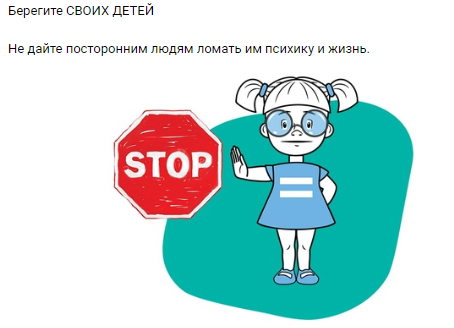
“Protect your children. Don’t let strangers wreck their minds and their lives.” Screenshot of a social media post by the Udelnaya Library of the Vyborg District Centralized Library System in Petersburg. Courtesy of dp.ru
“Protect your children”: Smolny launches mass posting before rally Delovoi Peterburg
January 21, 2021
On January 21, the social network pages of Petersburg’s district administrations, as well as of municipal schools, libraries, and educational organization, published the same message, appealing to parents not to let their children attend the rally urging the release of politician Alexei Navalny.
“Protect your children from being dragged into destructive actions that can lead to psychological problems in the future, but also to unpredictable consequences in their lives today,” the text of the mass posting says. It stresses that the upcoming rally is a “blatant provocation.”
A search for the phrase “protect your children from being dragged into destructive actions” yielded around a hundred hits on the social media pages of municipal organizations. At the time of writing, the post had been published on the VK pages of the Kolpino and Vyborg districts, as well as the press services of the Shuvalovo-Ozerki, Posadsky, Kronverk, and Sampsonievsky municipal districts, and dozens of schools.
Earlier today, First Deputy Interior Minister Alexander Gorovoy said that the Russian Interior Ministry has “all legal grounds” to charge with misdemeanors those who “in person, on the internet, [or] by sending written appeals” call on people to attend the rally [sic]. The Prosecutor General’s Office ordered the blocking of websites containing posts with calls to attend the [rallies].
Alexey Navalny recently published a large-scale investigation dealing with the construction of a grand residence on the Black Sea. The Anti-Corruption Fund (FBK) founder claims that the palace was built for Vladimir Putin. Navalny and his FBK team have called on their supporters to come out to protest on January 23. He has been supported by bloggers on Instagram and TikTok who have over a million followers.
________________________
Alexei Navalny, Putin’s Palace: The Story of the World’s Largest Bribe, January 19, 2021. [There were over 51 million views as of 1:00 a.m. Moscow time, January 22, 2021]
The printed text of the investigation, including all relevant documents, is here: https://palace.navalny.com/
Navalny recorded this video before his return to Russia, but we immediately agreed that we would release it after he returned: Alexei did not want the protagonist of this investigation—Vladimir Putin—to think that we were afraid of him and that we were telling his biggest secret from abroad.
Today, you will see something that is considered impossible to see up close. Along with us, you will go where no one is allowed. We will go for a visit to Putin’s house. With our own eyes, we will see that, in his craving for luxury and wealth, Putin has completely lost his mind. We will find out whose money has financed this luxury and how it was done. And we will learn how, over the past fifteen years, the biggest bribe in history was paid and the most expensive palace in the world was built.
Alexey was detained at the airport [in Moscow], where he arrived after five months of medical treatment in Germany. He went to Germany after Putin tried to kill him. On January 18, Navalny was illegally arrested and placed in a pre-trial detention center.
Alexei has always fought for our rights, and now we have to fight for his. Vladimir Putin must answer for all his crimes.
At 2:00 p.m. on January 23, go to the central streets of your cities. Don’t stand on the sidelines.
Here is a link to information about the rallies in different cities (this post will be updated): https://navalny.com/p/6454/
Translated by the Russian Reader
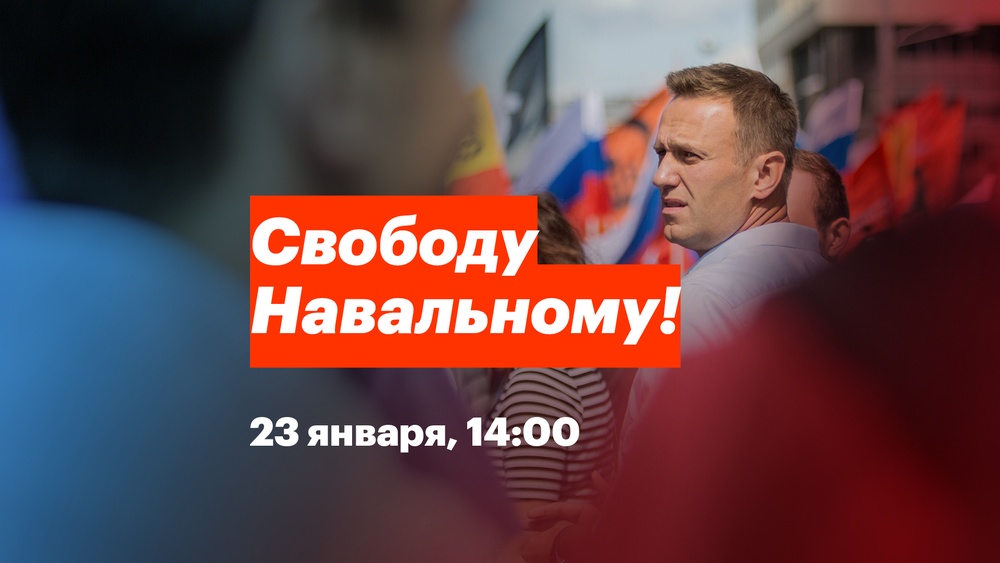
“Free Navalny! 2:00 p.m., January 23.” Image courtesy of navalny.com