Trans(national) Solidarity

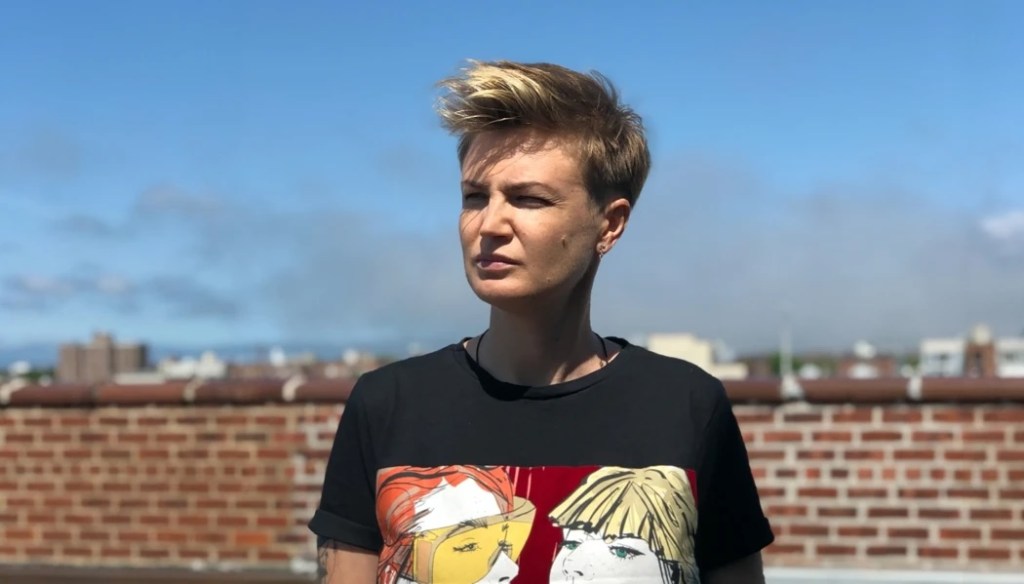
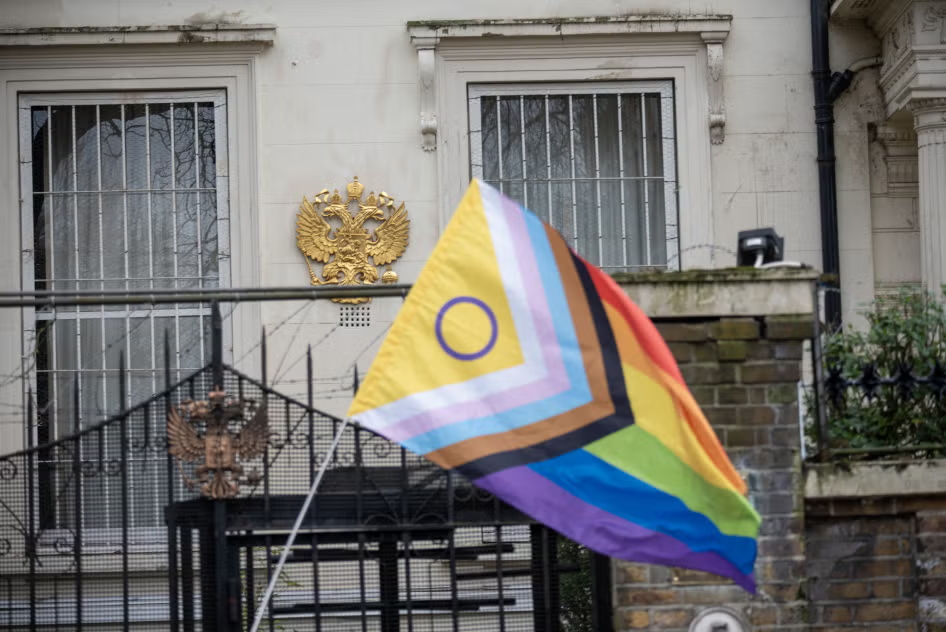
“Yara Tychina, a young transgender woman and Astana resident, picketed on Vodno-Zelyoniy Boulevard next to the House of Ministries and the Parliament. Unfurling a handmade transgender flag, she demanded that the Senate, the Presidential Administration, and the President reject the ‘LGBT propaganda’ amendments. She was taken to the Yesilskoye District Precinct of the Astana Police. Further details are in the video.”

[In which video Ms. Tychina says] Hello! I am Yara Tychina. I’m an ordinary citizen of Astana. I work in the coffeehouse [?] industry. I’m an openly trans women. I am protesting peacefully today because there are no other means to impact my country’s repressive policies. I don’t simply oppose this law. [It] violates my rights and freedoms, the rights and freedoms of my friends, my colleagues, the people in my life and, most importantly, my family, over half of whom are members of the LGBT minority community. I have carefully scrutinized this law and I can say truthfully that it has nothing whatsoever to do with ‘propaganda,’ since in black and white it says that any mention of LGBT—in a positive vein, in a neutral vein, it doesn’t matter which; in personal profiles, in personal conversations with people, it doesn’t matter where—is considered ‘propaganda.’ The fact that I’m an openly trans woman makes me a criminal, according to the new amendments. These amendments also don’t have anything whatsoever to do with ‘protecting children,’ since hundreds of Kazakhstani LGBT children, who had no way of influencing [who they are], will find themselves outlawed. They will be banned. They will be forbidden from talking about themselves on social media. They will be forbidden from gathering together in public or in private.

[Ms. Tychina is interrupted by Astana police officers, who claim she is violating the law. She repeatedly states her willingness to go with them to the police station. She then continues.] I heartily and tearfully implore the Presidential Administration, the Senate, and the President of the Republic of Kazakhstan, Kassym-Jomart Tokayev, and the Constitutional Court, if that doesn’t work, to reject these amendments. Otherwise, hundreds of thousands, if not millions, of Kazakhstanis, will unavoidably suffer. With these amendments, you will bridge the gap between Kazakhstan and Russia, but you will also drive away all international investments and significantly harm Kazakhstan’s standing in the international arena. But first of all you will harm people. You will harm my family. I implore you to stop it. Thank you!

[Responding to a reporter, who asks her name, Ms. Tychina says] My name is Yara Tychina. I’m in the coffeehouse [?] industry. I have a small business. I’m an ordinary [female] citizen. [Responding to a question about her flag, she says] It’s a transgender flag, the flag of my identity. It’s homemade. [To the police officers] Let’s go! Thank you! [A police officer explains to the press that Ms. Tychina has not been detained but has voluntarily agreed to go with them to the station.]

Source: werequest.kz (Instagram), 3 December 2025. Translated, from the Russian, by the Russian Reader. Thanks to Peter Leonard for the heads-up.


Police in Kazakhstan’s capital detained a transgender activist for staging a solitary protest against pending legislation prohibiting so-called “LGBT propaganda.” Yara Tychyna held up a handmade transgender flag near government buildings in downtown Astana and called for the Senate and the presidential administration to reject changes to the law, which are designed to proscribe “propaganda of non-traditional relations,” a formulation broad enough that positive portrayals of same-sex relations could be treated as prohibited content. Lawmakers have been debating the measure since the lower house approved it in November. Officials insist the restrictions are framed as child-protection rules. Critics warn that the draft’s language is vague and that equating LGBT themes with harmful content risks legitimising discrimination.

Source: Peter Leonard, “Central Asia’s week that was #82,” Havli, 3 December 2025


On Wednesday, November 12, the [lower house of the] Parliament of Kazakhstan (Mäjilis) unanimously passed a law banning “LGBT propaganda” in the media and on the internet. Violators face fines, and in the case of repeat violations, up to ten days in jail.

“Endeavoring to protect children from information detrimental to their health and development, provisions have been made to restrict the dissemination of information promoting pedophilia and non-traditional sexual orientation in public spaces, as well as via the media, telecommunications networks, and online platforms,” the document states.

The changes will affect nine laws. Violations of the ban will be punishable by a fine of up to forty minimum calculation indices (in 2025, this amounted to 157,000 tenge, or approximately 260 euros, or 24,500 rubles), or up to ten days in jail.

Kazakhstan’s Deputy Minister of Culture Yevgeny Kochetov explained that materials containing “propaganda of non-traditional relationships” would have to be labeled “18+.” Content that violates the law would be blocked.

Kochetov added that the strictures currently apply primarily to those who distribute materials. If minors attend a screening of a film rated 18+, the cinema’s managers, not the parents, would face a fine, he explained.

“If, for example, [men] are holding hands in the park, this is not considered propaganda. These are their personal boundaries, and there are no questions here,” said one of the sponsors of the bill, MP Yelnur Beisenbayev.

The Mäjilis initially sought to ban “LGBT propaganda,” in April 2024, by amending the law “On Mass Media.” They later proposed criminalizing “LGBT propaganda” and equating it with incitement to ethnic, social, or religious hatred.

When MPs began discussing banning “LGBT propaganda,” a petition entitled “We oppose open and covert LGBT propaganda in the R[epublic of] K[azakhstan]” was posted on the website E-Petition.kz. It was the third petition in the country to gather the fifty thousand signatures required for consideration by the government.

The Ministry of Culture and Information decided to partly accede to the petitioners’ demands—when it came to strictures aimed at “protecting and shielding adolescents and children from the promotion and cultivation of sexual relations.”

Consequently, the ban was presented as an amendment to the draft law on archiving.

Traditional values

In recent months, Kazakhstan President Kassym-Jomart Tokayev has repeatedly spoken about the need to protect “traditional values.” The day before the Mäjilis passed the bill, and ahead of his visit to Moscow, Tokayev published an article in Rossiiskaya Gazeta in which he spoke about the friendship between the two countries.

“We are united by a common take on traditional values, similar views on the pressing issues of contemporary life, and cooperation in ensuring the welfare of [our two] brotherly peoples,” Tokayev wrote.

In Russia, the law banning “LGBT propaganda” among minors was first introduced in St. Petersburg in 2011, and then at the federal level in 2013. In 2023, the Russian authorities went so far as to declare the “international LGBT movement” extremist.

As of July 2025, Human Rights Watch had catalogued more than one hundred criminal indictments and convictions [in Russia] for involvement in the “international LGBT movement” or for displaying symbols which the authorities attribute to this movement.

Following Russia’s lead, “LGBT propaganda” was banned in Hungary in 2021, and in Georgia in 2024.

LGBTQ+ in Kazakhstan

Homosexuality was decriminalized in Kazakhstan de facto in 1997 and de jure in 1998. Since 2003, transgender people have been able to change their gender marker in official documents.

In 2021, the Williams Institute at UCLA School of Law ranked Kazakhstan 154th out of 175 countries in terms of public acceptance of LGBTQ+, below Uzbekistan, Russia, and Afghanistan.

The online platform Equaldex, which researches the rights of sexual minorities around the world, writes that “[a]ccording to recent survey data, there appears to be strong opposition to LGBTQ+ rights in Kazakhstan.”

Many human rights organizations have already criticized Kazakhstan’s ban on “LGBT propaganda.”

Human Rights Watch urged lawmakers to reject the bill. The NGO argues that the proposed amendments violate fundamental human rights and could make LGBTQ+ people in Kazakhstan more vulnerable.

Organizations including ILGA-Europe (the European branch of the International Lesbian, Gay, Bisexual, Trans and Intersex Association), the World Organisation Against Torture (OMCT), and TGEU (Trans Europe and Central Asia) have also issued a joint statement against the bill.

The Kazakhstani organization Queer.kz commented on the Mäjilis’s passing the amendments banning “LGBT propaganda” as follows: “We continue to write letters! Our organization will continue to work together with our colleagues to defend human rights and freedom!”

Source: “Kazakhstan parliament votes to ban ‘LGBT propaganda,'” BBC Russian Service, 12 November 2025. Translated by the Russian Reader. Thanks to Peter Leonard for the heads-up.


Over the past four years of America’s modern anti-transgender panic, Missouri has been one of its chief laboratories. Each legislative session brings a flood of new proposals targeting transgender people—with each year opening with often more than a dozen bills—and 2026 is already shaping up to continue that pattern. In the first batch of early bills, lawmakers introduced 21 anti-LGBTQ+ measures, many escalating the state’s enforcement tactics beyond even last year’s cruelties. One stands out in particular: a bill that would ban “social transition” in schools—blocking teachers from using a student’s chosen name or pronouns, even with parental consent.

The bill, SB1085, filed by Senator Joe Nicola, states in its summary that it would prohibit “public school staff members from encouraging minor students in their ‘social transition,’” which the measure defines as engaging in any activity “with the goal of helping a student become perceived as a member of the opposite biological sex.” The text defines social transition broadly—“participating” in a student’s gender transition based on “details such as his or her name, appearance, or behavior”—and bars schools from taking part in any conduct that could contribute to a student “not being perceived and treated as a member of the student’s biological sex.”

The bill explicitly forbids all school staff and faculty from “the use of alternative pronouns or names for the minor student, either in school records or otherwise.” Notably, it contains no provision for parental consent—meaning the restrictions apply not only to unsupportive parents but also to parents who affirm their transgender children. The measure appears to single out trans students exclusively: nothing in its text bars name changes for any other reason unrelated to gender transition.

You can see the provisions here:

The bill marks the latest front in anti-transgender legislation: an effort not just to ban medical transition for trans youth, but to prohibit any form of transition at all, including social transition. Earlier this year, reporting out of Texas showed how a similar law led teachers to suddenly deadname students who had used their affirmed names for years without issue. Variations of this language have surfaced in several states, but Missouri’s proposal is among the most explicit and far-reaching attempts yet to regulate social transition in schools.

The ban on social transition—even with parental permission—underscores a shift in how anti-trans legislation is being sold to the public. For years, supporters of bathroom bans, sports bans, and “don’t say gay” policies framed their efforts as battles for “parental rights.” Increasingly, though, that language has fallen away as lawmakers move to strip supportive parents of any authority at all, mirroring the approach in medical transition bans that override parental consent entirely. Under Missouri’s proposal, parents would have no right to approve their child’s affirmed name or pronouns, and any teacher who honors a family’s wishes could face the loss of their license.

The social-transition ban is just one front in a broader offensive. Missouri lawmakers have already filed bills to outlaw public drag by defining it as prurient “male or female impersonation,” to strip Pride flags from public schools, and to roll back nondiscrimination protections for transgender people in housing, employment, and public accommodations. And more proposals are almost certain to follow. When the legislature gavels in on January 8, the real question for observers won’t be whether these bills appear—they already have—but which ones Republican leadership chooses to fast-track. That early movement will signal just how aggressive Missouri intends to be in advancing its anti-LGBTQ agenda this session.

Source: Erin Reed, “New Missouri Bill Would Ban “Social Transition” In Schools, Even With Parental Permission,” Erin in the Morning, 3 December 2025


On April 27, 2023, Kansas became the first state in the country to institute a statewide definition of sex. “A ‘female’ is an individual whose biological reproductive system is developed to produce ova,” the law declared, “and a ‘male’ is an individual whose biological reproductive system is developed to fertilize the ova of a female.” Since then dozens of state legislatures have introduced similar bills; sixteen have passed. In Indiana and Nebraska governors have issued executive orders to the same end. Each of these measures effectively strips transgender people of legal recognition.

The language of these policies usually distinguishes men from women by their reproductive capacity, which is assumed to be determined at birth or even at conception. Each statute mandates that its definitions of “sex,” “female,” and “male” be used whenever those words appear in any part of the state code. Some purport to be establishing a “women’s bill of rights,” as the titles of Kansas’s and Oklahoma’s bills suggest; Louisiana’s is titled “The Women’s Safety and Protection Act.” (On the other hand, the name of North Dakota’s bill—into which legislators slipped another term they wanted to define—captures the arbitrariness involved: “The Definition of Female, Male, Sex, and Scrap Metal Dealer.”)

This legislation is part of a broader onslaught. In the past few years Republican-controlled state legislatures have introduced thousands of bills targeting trans people, with measures to ban puberty blockers and hormones for trans youth, bar trans girls and women from sports, mandate that bathroom access be based on birth sex, outlaw drag performances, and more. So far more than two hundred of these laws have passed, with grave, often life-changing consequences for the trans residents of red states across the country.

Continue reading “Trans(national) Solidarity”

Sunday Reader No. 5: American Pie

Jade Bird, “American Pie” (Don McLean cover). Thanks to the amazing Dick Gregory for the heads-up.

Nearly 3 million Americans identify as transgender, including one in 30 of those aged 13 to 17, according to a new report. But data on the country’s trans community may soon be hard to come by, its authors warned, as the Trump Administration and a number of GOP-led states seek to limit the recognition, and rights, of transgender people.

The UCLA Williams Institute has been publishing reports about transgender Americans since 2011, tracking information such as the race, ethnicity, age, regional location, and mental health of transgender individuals. 

Trans adults and youth make up 1% of Americans aged 13 and older and 3.3% of 13-to 17-year-olds, according to the institute’s Wednesday report. Researchers found that younger adults, those aged 18 to 34, were more likely to identify as transgender than their older counterparts, making up more than 50% of the country’s transgender population.

For its initial 2011 report, the institute relied on just two state-level population surveys. Researchers noted that they have since been able to access broader and higher-quality data through the Centers of Disease Control and Prevention (CDC): To generate the most recent findings, they used data from the CDC 2021-2023 Behavior Risk Factor Surveillance System and 2021 and 2023 Youth Risk Behavior Survey. The report authors noted that the Youth Risk Behavior Survey in particular “currently provides the best available data for our estimates of the size and characteristics of youth who identify as transgender in the U.S.”

But the agency will no longer collect information on transgender people in compliance with President Donald Trump’s Executive Order calling for federal recognition of only two biological sexes. 

Since Trump returned to office in January, information regarding trans people and health resources for LGBTQ+ people has been quietly removed or modified on federal websites. And the Department of Health and Human Services (HHS) has stepped away from its previous practice of supporting gender-affirming-care, in spite of numerous statements from all major medical associations in the U.S., including the American Medical Association and the American Academy of Pediatrics, declaring the care as best practice. In May, HHS called for “exploratory therapy” or psychotherapy to treat individuals with gender dysphoria instead of the medically recommended care.

Multiple states have also sought to restrict access to gender-affirming care, particularly for minors, amid broader global efforts to target such care for trans youth. A June Supreme Court decision upholding a Tennessee state-level ban on gender-affirming-care for youth delivered a heavy blow to the U.S. LGBTQ+ community, permitting similar bans that have been enacted across the country and presenting a significant obstacle to future efforts to challenge restrictions in the courts.

Amid the current political climate, the authors of Wednesday’s Williams Institute report say they are unsure whether survey respondents will accurately respond to questions regarding their gender identity moving forward. In addition to the uncertain future of data on the U.S. transgender population, they wrote, “It is also unclear whether individuals’ willingness to disclose on surveys that they identify as transgender will remain unchanged in the years to come.”  

Despite those looming challenges in gathering information, however, the authors noted it is already clear that younger people are more likely to identify as transgender and they anticipate that to continue being true.

“This has implications for institutions in our society, including educational institutions, the U.S. Armed Forces, civilian workplaces, health care settings, and other areas, regarding how to meet the needs of and provide opportunities for current youth and future generations,” they said.

Source: Solcyré Burga, “1 in 30 U.S. Teens Identifies as Transgender—But That Data May Soon Disappear,” Time, 20 August 2025


Jade Bird, “I’ve Been Everywhere” (Johnny Cash cover)

In the Central Coast, where my father farmed strawberries, the land is mostly flat for miles in every direction so it was easy to spot the green vans and trucks of the Immigration and Naturalization Service heading our way in the distance, kicking up a cloud of dust in their wake. It was the late ‘70s and raids were an occasional part of working in the ag industry.

When the trucks were spotted — most often by a worker — a loud call would go out: “La Migra, la migra.” That’s when immigrant workers without legal status would drop what they were doing and sprint away, either for a nearby riverbed or over a set of raised railroad tracks adjacent to the fields. The immigration raids on my father’s strawberry fields fascinated me when I was a boy. It wasn’t until I was older that I understood the impact on the workers who were rounded up and deported, as well as the effects on the families left behind. I now recall them in a more somber light.

My father worked as a sharecropper in the Central Coast. He oversaw several acres of strawberries and managed up to a dozen workers for Driscoll Inc., the berry company headquartered in my hometown of Watsonville.

From the time I was about 6 or 7 years old until I was 16, I spent my summers and most weekends in the fall in my dad’s strawberry fields. It was backbreaking work. I have the chiropractor invoices to prove it.

Immigration raid methods have changed. The toll they take has not

The ICE raids of the past few months across Southern California reignited my boyhood memories of the strawberry field raids.

What has not changed is the impact on the immigrant families, especially the children. Children of immigrants sustain deep emotional scars from immigration raids.

A study published last month on Psychiatry News said immigrant children or children of mixed-status parents endure serious trauma when their parents are deported.

“Forced family separations, particularly those resulting from immigration enforcement (e.g., detention, deportation), introduce acute psychological risks,” according to the study, which list the results as an “elevated risk of suicidal ideation, externalizing behavior and alcohol use.”

Even living under the threat of having a parent deported is traumatizing to children.

“These fears have been shown to lead to school absenteeism, academic disengagement, and heightened emotional distress,” the study says.

Even as a boy, the fear and desperation were palpable

When I worked in the fields, the raids came about once or twice a summer. I didn’t witness this myself, but the family lore includes the story of a worker who was so desperate to escape the INS that he jumped into a nearby port-a-potty — hiding among the feces and urine in the holding tanks — until the INS agents departed.

Each summer, two or three of my father’s workers would be deported, only to return the following season. That was more common back in the ‘70s than it is today. My dad tried to help his workers without green cards by connecting them with legal aid groups or lawyers so they could straighten out their legal status. Not all of them did and some who had green cards ran at the sight of INS trucks anyway.

In a recent conversation with my younger brother, Peter, he recalled panicking during the first raids he witnessed. He said he asked my older siblings if he should run from the agents, too.

“No, you’re an American. Just shut up,” they told him.

“How do they know that?” my brother asked.

Source: Hugo Martín, “Essential California” newsletter (Los Angeles Times), 22 August 2025


Jade Bird, “Grinnin’ in Your Face” (Son House cover)

[…]

A lost white race of Bible giants—literally bigger, stronger, and whiter than everyone else—fashioned as a symbol of everything conservatives wanted to remake America into, is an all-too-convenient bit of lore for the conspiracy-besotted right. (Never mind that the Nephilim were technically the villains in Genesis!) And the Smithsonian was, if anything, a useful foil for a fringe movement looking for an enemy to accuse of suppressing the truth.

Soon enough, claims that the Smithsonian intentionally hid the bones of Bible giants went mainstream, presaging the country’s own rightward shift. By the 2010s, the Smithsonian’s secret giants appeared in popular paranormal books, on late-night radio shows, in multiple cable TV documentaries (including at least two separate History Channel shows), and across a network of evangelical and far-right media outlets.

Among the most popular of these were the Christian DVDs and later podcasts produced by Steve Quayle and his Nephilim-hunting partner, Timothy Alberino. Quayle, an archconservative, blamed Bible giants for “teaching” men to be gay. He and Alberino were regulars on the right-wing podcast circuit in the 2010s, often appearing with figures like Alex Jones and Jim Bakker so Quayle could hawk their merch, attack Democratic politicians as demonic, and advocate for a targeted genocide of Nephilim-controlled liberals.

Burlinson told Blaze TV that he had been radicalized against the Smithsonian through Alberino’s podcasts and videos. In his podcasts, Alberino has described Bible giants as a “superior race society.”

In recent years, Alberino has made moves to go more mainstream. He has appeared on Ancient Aliens, the History Channel show advocating historical conspiracies, where David Childress is a featured star. That same show also hosted Tucker Carlson, Tennessee Republican Representative Tim Burchett, and others to peddle conspiracies about government cover-ups of space aliens, interdimensional beings, demons, and more.

For the far right, the E.T.s of Ancient Aliens—the same ones Congress is currently hunting in various UFO hearings—are actually angels and demons, and those demons are the souls of the giants who died in the Flood, according to a nonbiblical text Alberino endorses. Burlinson said in 2023 that he thinks UFOs could be angels, and more recently he promised that a congressional UFO hearing to be held on September 9 would feature witnesses who “handled the bodies” of these beings.

Conspiracies about Bible giants are basically the Christian version of UFOs and aliens, and it’s no wonder there is significant cross-pollination between believers in the two camps, even in Congress, where several representatives like Burlinson and Burchett have publicly discussed their belief in both. In fact, both conspiracies give pride of place to the Nephilim narrative from Genesis 6:4 as proof of either fallen angels or alien intervention.

It would be laughable if the Smithsonian conspiracy theory and tales of Bible giants now being spread on Blaze TV, on Joe Rogan’s podcast, and across right-wing media, were not a kind of Trojan horse to soften up the public to accept political propaganda in place of history and complete the assault on America’s museums that failed in the 1990s. But the conspiracists continue to spread their lore, and mainstream conservative politicians continue to escalate their attacks on the Smithsonian—a far-right pincer movement directed at an institution that is both the nation’s premier repository of historical fact and a potent bolsterer of America’s civic fabric. And that is no laughing matter.

Source: Jason Colavito, “The Super-Weird Origins of the Right’s Hatred of the Smithsonian,” New Republic, 21 August 2025


Jade Bird, “Love Has All Been Done Before”

THE BIZARRE TWISTS AND TURNS of Donald Trump’s Ukraine peacemaking project continue: Just three days after the president announced in a triumphant Truth Social post that Vladimir Putin was willing to meet with Volodymyr Zelensky—either one on one or in a trilateral summit with Trump—and to accept an arrangement in which NATO countries would provide postwar security guarantees for Ukraine, the Putin regime has unequivocally shot down both proposals. Russian foreign minister Sergei Lavrov (last seen sporting a “USSR” sweatshirt on his trip to Alaska) has made it clear that there won’t be a meeting with Zelensky until “all the issues” have been resolved—including the question of Zelensky’s legitimacy as president, given that Ukrainian elections have been put on hold on account of the war—and that Russia will not accept the presence of foreign troops, presumably other than its own, on Ukrainian soil.

Trump’s stormy bromance with Putin seems to be off again, too: in social media posts on Thursday, he criticized “crooked and grossly incompetent” Joe Biden for not allowing Ukraine to strike back at Russia and (speciously) compared his chummy-seeming interaction with Putin in Alaska with Richard Nixon’s confrontation with Nikita Khrushchev in Moscow in 1959.

It’s impossible to tell whether Trump’s social-media posturing will translate into action. There is still no word, for instance, on whether the administration is greenlighting Ukraine’s proposal, unveiled after the Monday White House meeting, for $100 billion in U.S. arms shipments to Ukraine (with the Europeans footing the bill) and an additional $50 billion project for joint U.S.-Ukrainian drone production. Nor is there any word on whether or when new sanctions will kick in.

WHILE THE CIRCUS PLAYS ON in Washington and Moscow, the war on the ground—and in the air—continues in Ukraine, and sometimes in Russia. Ukraine is in an undeniably tough position, though nowhere near the desperate predicament imagined both by haters and by worriers who keep predicting an imminent “collapse” of its defenses. On August 12, just before the Alaska summit, many thought they saw a sign of such collapse in a Russian “breakthrough” not far from the long-contested city of Pokrovsk (Donetsk region), near the former coal-mining town of Dobropillia, where Russian forces managed to make rapid advances past severely undermanned Ukrainian lines, move about nine miles forward, seize three villages (now mostly deserted, though some residents who have not been able to get out still remain there), and cut off a vital supply route for Ukrainian troops. These gains appeared to augur the fall of Pokrovsk itself, a prospect that has been discussed since late last year.

But a few days later, the supposed catastrophic defeat turned into an impressive Ukrainian victory thanks to the quick deployment of new units from the Armed Forces of Ukraine and the National Guard, which retook two of the captured villages as well as four previously occupied settlements and cleared the area of Russian troops, reportedly inflicting significant losses. As for Pokrovsk itself, there have been some clashes inside the city, with incursions by small Russian units; but observers such as expatriate Russian military expert Yuri Fedorov think it’s extremely unlikely that the city will fall before inclement weather forces the Russian offensive to wind down.

It is true that momentum is on Russia’s side, in the sense that only Russia is currently conducting offensive operations. But Russian forces’ progress is snail-paced and intermittent, with the Ukrainians often successful in pushing them back (and using drones to make up for manpower and ammunition shortages). The result, more often than not, is a ghastly tug-of-war over small patches of devastated land—contests in which a “win” may consist of planting a flag in a ghost settlement.

Overall, analysts agree that Russia has no chance of capturing the entirety of the Donetsk region—as it has tried to do since the start of Putin’s covert war in Eastern Ukraine in 2014—anytime in the foreseeable future; doing so would require taking heavily fortified urban areas, and even the most cavalier willingness to sacrifice men may not accomplish that goal without several more years of costly fighting. Hence Russian demands for Ukraine to surrender the remainder of the region without a fight.

Ukraine also continues to score successes in its aerial war on strategic Russian targets such as oil refineries, arms and ammunition depots and factories, and trains carrying weapons and fuel to the frontlines. (Russian troops aren’t the only ones feeling the effects: there are reported miles-long lineups for gasoline in parts of Russia.) And, Western arms deliveries aside, Ukraine is making strides in developing its own weaponry, like the new Flamingo long-range cruise missile capable of hitting targets more than 1,800 miles away; Zelensky has said that it could be mass-produced by February.

In other words: Ukraine is still not losing. But there is no question that it is exhausted—and that the enemy’s continuing terrorism against its civilian population is taking its toll. On Wednesday night, Russia launched one of its heaviest assault waves yet: 574 drones and 40 missiles, with targets located as far away from the frontlines as Lviv and Transcarpathia. Most were intercepted by Ukrainian defenses, but one person was killed and over a dozen wounded.

Was this a deliberate middle finger to Trump over his supposed peace effort? It sure looks like it, especially considering the bombing of an American factory in the Transcarpathian city of Mukachevo—the premises of Flex Ltd., a manufacturer of civilian electronic goods. At the very least, it shows that Russia is not de-escalating. Likewise, it’s unclear whether the incursion of a Russian drone that crashed and burned in a rural area in eastern Poland during the overnight attack on Ukraine was a deliberate provocation, as the Polish government charged. But it certainly doesn’t tell us that Putin wants peace.

He can still be forced into it, however. A scenario in which Ukraine drives Russian troops and occupation forces out of its territory is as impossible as one in which Russia makes major territorial gains in Ukraine; but there may come a point, perhaps soon, when the war’s economic and political burdens for the Putin regime become too heavy. Even with rigged elections and a thoroughly owned population, Putin still cannot afford too much discontent among the Russian middle class—or among the elites. There is a reason he has not undertaken another round of mobilization since 2022. But right now, recruitment is dropping, soldiers recovering from wounds or suffering from serious physical and mental health problems are being forced into combat, and mobilization may be the only way to keep the war going. The war will end when Putin starts to see its costs as too high and the chances of achieving his aims, stated and unstated, as too low.

U.S. policy could be instrumental in making that happen. But for that, the Trump administration would have to commit to a firm and consistent pro-Ukraine policy. For starters, the president’s promises of “very severe consequences” if Putin stands in the way of peace should mean something more than memes and empty talk. (And the vice president shouldn’t keep fawning about the “soft-spoken” Kremlin dictator who “looks out for the interests, as he sees it, of Russia.” Sorry, JD, but you sound like a jackass.)

Yet here we are, with Putin doing everything to sabotage any meaningful peace talks but put up an “I ♥ WAR” neon sign on the Kremlin walls—and what is Trump’s response? Another deadline: this time, he says, we’ll know whether a deal can be made “within two weeks”—famously, Trump’s “placeholder” unit of time. No doubt they’re quaking in their boots in the Kremlin.

Source: Cathy Young, “Putin Tanks Trump’s Supposed Peace Effort,” The Bulwark, 22 August 2025

Photo by the Russian Reader

The Trump administration has quietly rescinded long-standing guidance that directed schools to accommodate students who are learning English, alarming advocates who fear that schools will stop offering assistance if the federal government quits enforcing the laws that require it.

The rescission, confirmed by the Education Department on Tuesday, is one of several moves by the administration to scale back support for approximately 5 million schoolchildren not fluent in English, many of them born in the United States. It is also among the first steps in a broader push by the Trump administration to remove multilingual services from federal agencies across the board, an effort the Justice Department has ramped up in recent weeks.

The moves are an acceleration of President Donald Trump’s March 1 order declaring English the country’s “official language,” and they come as the administration is broadly targeting immigrants through its deportation campaign and other policy changes. The Justice Department sent a memorandum to all federal agencies last month directing them to follow Trump’s executive order, including by rescinding guidance related to rules about English-language learners.

Since March, the Education Department has also laid off nearly all workers in its Office of English Language Acquisition and has asked Congress to terminate funding for the federal program that helps pay for educating English-language learners. Last week, education advocates noticed that the guidance document related to English learning had a new label indicating it was rescinded and remains online “for historical purposes only.”

On Tuesday, Education Department spokeswoman Madi Biedermann said that the guidance for teaching English learners, which was originally set forth in 2015, was rescinded because it “is not in line with Administration policy.” A Justice Department spokesman responded to questions by sending a link to the July memorandum and said he had no comment when asked whether the guidance would be replaced.

For decades, the federal government has held that failing to provide resources for people not proficient in English constitutes discrimination based on national original under Title VI of the Civil Rights Act.

In rescinding the guidance, the Trump administration is signaling that it may stop enforcing the law under that long-standing interpretation. The Education and Justice departments have been responsible for enforcing the law.

In the July memorandum, Attorney General Pam Bondi cited case law that says treating people, including students, who aren’t proficient in English differently does not on its face amount to discrimination based on national origin.

Other guidance related to language access for people using services across the federal government is also being suspended, according to the memo, and the Justice Department will create new guidance by mid-January to “help agencies prioritize English while explaining precisely when and how multilingual assistance remains necessary.” The aim of the effort, Bondi said in a statement published alongside the memo, is to “promote assimilation over division.”

The consequences for school districts were not immediately clear, but advocates worry that rescinding the 2015 guidance could open the door for weaker instruction for English learners and upend decades of direction from the federal government to provide English-language services to students who need them.

“The Department of Education and the Department of Justice are walking away from 55 years of legal understanding and enforcement. I don’t think we can understate how important that is,” said Michael Pillera, an attorney who worked at the Office for Civil Rights for 10 years and now directs the Educational Opportunities Project at the Lawyers Committee for Civil Rights.

Without pressure from the federal government to comply with the law, it is possible that some school districts will drop services, Pillera said, particularly as many districts struggle with financial pressures.

“It’s going to ripple quickly,” he predicted. “Schools were doing this because the Office for Civil Rights told them they had to.”

Many districts will probably not change their services, but rescinding the guidance opens the door, said Leslie Villegas, an education policy analyst at New America, a think tank. Advocates may watch for changes in districts that previously had compliance problems or those that had open cases with the Office for Civil Rights related to English-language instruction, she noted.

“The rescission of this guidance may create the mentality that no one’s watching,” Villegas said.

In recent months, the Justice Department notified at least three school districts — in Boston; Newark; and Worcester, Massachusetts — that the government was releasing them from government monitoring that had been in place to ensure they offered services to English-language learners.

Officials in Worcester said they expected the action even before Trump took office. But in Boston, some parent advocates questioned why the monitoring had ended, the Boston Globe reported.

Supporters of immigration restrictions argued that relieving pressure on schools to provide these services might be helpful, especially given the costs to districts.

“If you devote all these resources to these kids coming in [to school] completely unprepared, inevitably it will diminish the quality of education others are getting,” said Ira Mehlman, spokesman for the Federation for American Immigration Reform.

Todd DuBois, communications director for U.S. English, a group that advocates for English as the official and common language, said some education is needed to help “bridge the gap” for students who do not speak English, but the group is concerned that multilingualism “gets in the way of teaching English literacy earlier in life.”

The requirement to serve English-language learners in school is based on two federal statutes. The first is Title VI of the Civil Rights Act, which bars discrimination based on national origin, among other traits. Alandmark 1974 Supreme Court case, Lau v. Nichols, interpreted this law to include a mandate for English-language services in schools.

The second federal law at issue is the 1974 Equal Educational Opportunities Act, which requires public schools to provide for students who do not speak English. A 1981 case decided in federal appeals court, Castañeda v. Pickard, laid out a test to determine whether schools were properly providing services to English learners in school.

In 2015, the Justice and Education departments published their 40-page guidance document, explaining how schools can properly comply with these laws and avoid potential federal investigations and penalties.

“For a teacher, it was kind of like the Bible,” said Montserrat Garibay, who headed the Office of English Language Acquisition under the Biden administration. “If, in fact, we want our students to learn English, this needs to be in place.”

In her memorandum, Bondi said that in addition to cutting back on multilingual services the administration deems “nonessential,” federal agencies would be tasked with boosting English education and assimilation.

“Instead of providing this office with more capacity and more resources to do exactly what the executive order says — to make sure that everybody speaks English — they are doing the total opposite,” Garibay said.

Mark Krikorian, executive director of the Center for Immigration Studies, which supports immigration enforcement measures, suggested the federal government should not direct how school districts offer services. But he also said that teaching children English is consistent with efforts to make sure people living in the United States speak English.

“I’m all for English-language education. We probably need to do even more of that,” he said. “If you’re going to let people in who don’t speak English, then you want them to be acquiring English as soon as possible.”

Source: Laura Meckler and Justine McDaniel, “Education Department quietly removes rules for teaching English learners,” Washington Post, 20 August 2025

Are These the Bad Old Days?

Source: Ekaterina Reznikova and Alexey Korostelev, “2024: A study into repression under Putin,” Proekt, 22 February 2024


Russia jails dissident once targeted by Putin at KGB for 16 years

A court in St. Petersburg has sentenced Alexander Skobov, a 66-year-old Soviet dissident and activist, to 16 years in jail on charges of justifying terrorism and joining a terrorist group. Skovov was first arrested more than four decades ago and Vladimir Putin was among the KGB officers who worked on his case. Prosecutors said Skobov justified terrorist attacks on Russian territory and supported the Freedom of Russia legion, which Russia has deemed a terrorist organisation for fighting alongside Ukrainian forces.

  • Skobov will spend the first three years of his sentence in prison (typically reserved for highly dangerous criminals such as kidnappers and terrorists and repeat offenders), with the rest in a high-security penal colony. He will be 80 by the time he can be released, although it is questionable whether he will survive that long in Russia’s harsh prison system. The activist has many health problems, including diabetes, hepatitis C, asthma and glaucoma.
  • At the court hearing, Skobov made clear that he did not believe he was facing a fair trial. He refused to answer questions and did not stand when the judge addressed him. “Today they will ask me again – do I plead guilty? Well, now I’m the one asking,” he said in his closing statement. “It’s me asking the servants of Putin’s regime who are present here, who are small cogs in his repressive regime: do you plead guilty to complicity in Putin’s crimes? Do you repent of your complicity?”
  • In the USSR, Skobov was repeatedly charged with “anti-Soviet” offenses. He was first arrested in 1978 on charges of distributing anti-Soviet leaflets and was sentenced to two years in a psychiatric hospital (punitive psychiatry was widespread in the Soviet Union and used as one of the main tools of repression in the 1960s, 70s and 80s). Skobov was forcibly hospitalized again in 1982 for daubing anti-Soviet graffiti on the walls of a building and then released in 1985. 
  • Vladimir Putin, who worked in the Fifth Department of the KGB that was tasked with combating “ideological sabotage,” was among the KGB officers that handled his original cases, independent media and rights groups reported.

Why the world should care

This is far from the first instance when somebody in Russia has been imprisoned for a post on social media. Since 2010, prosecutors have opened more than 1,000 such criminal cases. But a 16-year sentence for an elderly activist in frail health stands out as particularly punitive. It’s safe to say that treatment of dissidents in modern Russia is growing far tougher than it was in the post-Stalin Soviet Union. 

Source: “THE BELL WEEKLY: Billion-dollar loss for Russia’s Facebook,” The Bell, 25 March 2025


“Illinois Governor JB Pritzker (D-IL) Speaks at the 2025 HRC Los Angeles Dinner,” Human Rights Campaign (YouTube)

The Trump administration and his Republican lackeys in Congress are looking to reverse every single victory this community has won over the last 50 years. And right now, it’s drag queens reading books and transgender people serving in the military. Tomorrow, it’s your marriage license and your job they want to take. Bending to the whims of a bully will not end his cruelty. It will only embolden him. The response to authoritarianism isn’t acquiescence. Bullies respond to one thing, and one thing only, a punch in the face.

But you see, that starts with fully acknowledging what is happening. The meme lords and the minions in the White House are intentionally breaking the American system of government so they can rebuild it in their own image. They’ve shut down cancer research and HIV prevention. They’ve eliminated drinking water and clean air regulations and upended the lives of veterans. They’ve said that a recession that Trump is likely to cause will be worth it, which is an assessment worthy of Trump University.

At its core, what Elon Musk and Donald Trump are doing isn’t about efficiencies or cost savings. It’s about giving their wealthy friends a tax break and making the middle class and veterans and public school kids pay for it. It’s a few idiots trying to figure out how to pull off the scam of their lives.

Meanwhile, the scariest part is that they’re using the power of the presidency to try to delight their base by targeting vulnerable people, people they think can’t fight back, calling them domestic enemies or claiming they’ll ruin American culture. Remember their slogan, “Make America Great Again.” Authoritarians target vulnerable minority communities first because they think that if they can conquer those that they deem weak, and they can show everyone else who’s boss, which is why we can’t sit back right now and wait to see what happens. If we wait, I guarantee you the battle will have already been lost.

Donald Trump cannot take anything from us that we don’t choose to give him. He and his henchmen don’t want people to realize that. But now is the time for us to wake up. The good news is every day I’m seeing more and more people across this country realize that they don’t want to give him much at all.

The question I get asked most right now is, “So what can I do? What can I do?” And I’m going to be blunt about this. Never before in my life have I called for mass activism, but this is the moment. Take to the streets, protest, show up at town halls. Jam the phone lines in Congress, 202-224-3121, and afford not a moment of peace to any elected representatives who are aiding and abetting Musk and Trump’s illegal power grab. This is not a drill, folks. This is the real thing.

Seize every megaphone you have. Go online and make a donation to the legal funds fighting Trump, to HRC, and to the candidates for Congress that vow to take this country backward. And don’t limit your voice to the traditional political channels. Be like Lucy Welch. When JD Vance went to vacation at the Sugarbush Resort in Warren, Vermont, Lucy, who writes the Sugarbush Daily Snow Report, used her report to defend her diverse and wonderful community, ending by saying, “I am using my relative platform as a snow reporter to be disruptive. What we do or don’t do matters.”

What we do and don’t do matters. It matters right now more than it ever has before. When my future grandkids look back on this moment, I want them to know that my voice was one of the loudest in the room, screaming for justice and fighting against tyranny.

And in the midst of this existential fight, this battle that seems to consume everything, well, let’s not take the soul-sucking path of sacrificing the most persecuted for that which we deem to be most popular. I know that there are transgender children right now looking out at this world and wondering if anyone is going to stand up for them and for their simple right to exist. Well, I am. We are. We will.

I know that amidst the ongoing assault on our institutions, it is easy for people to fall into despair about our democratic system. But I love this country too much not to fight for it. You’re here tonight because you do too. And when I think about that love, I think back to all the times in our history when our ancestors had to fight back against tyrants and racists and those who couldn’t understand that freedom and justice are our foundational promises in this country.

That group of people, that small group of people that got together in Chicago to found this country’s first known gay rights organization. Well, it was called the Society for Human Rights. It was 1924 and the flicker of light was brief. It only lasted a matter of months before social persecution and criminal prosecution bankrupted the promise of the group’s charter. But oh, that flicker ignited something. By whisper and by word of mouth, folks around the country started to catch wind of the idea. And eventually, it ended up in the ears of a man here in California who later said the idea of gay people getting together at all was an eye-opener for him.

Well, that man’s name was Harry Hay. And a couple of decades later, he went on to found the Mattachine Society right here in Los Angeles. It was the first sustained gay rights organization in the United States. Harry said that he was first told about the Chicago group as a warning that the idea was too dangerous and nobody should try to pull anything off like that ever again. How lucky the world is that Harry didn’t listen.

When we say history repeats itself, it’s not because the villains and battles don’t evolve with the ages. They do. But the fight itself remains elemental. It’s always men who would be king, blaming the suffering of the masses on those who look different or sound different or live differently. And since the dawn of time, the triumph of good over evil has relied on those who believe in empathy and kindness, summoning the steel spine needed to defend those values that by their nature leave us vulnerable to attack. This community knows that. You have lived and breathed this fight for generations. Our hope, our hope lies in this room.

The fact that we are still here today means that we have the faith and courage that we will win the battles that really matter. Now, when I first ran for governor in 2018, I started every single stump speech by saying, and this will tell you why Donald Trump doesn’t like me very much. I said at the beginning of every stump speech, everything we care about is under siege by a racist, misogynist, homophobic, xenophobic Donald Trump.

Source: Parker Molloy, “Watch Illinois Governor JB Pritzker Reject the Politics of Trans Abandonment,” The Present Age, 24 March 2025. Thanks to Rebecca Solnit for the heads-up.

Alexandra: A Russian Trans Woman in Trump’s America

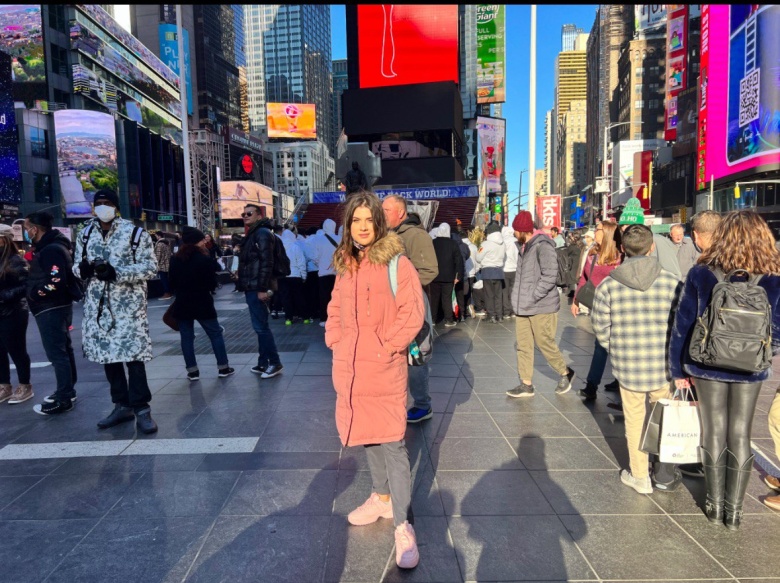
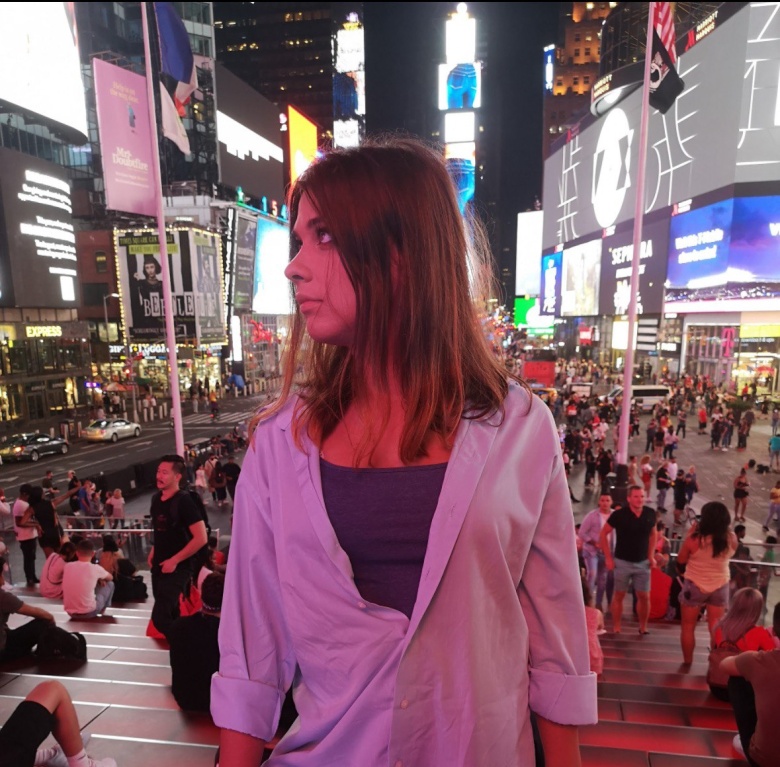
Alexandra in Times Square. Personal photo courtesy of Republic

Alexandra left Russia four years ago, fleeing oppression, propaganda, and ever harsher anti-LGBT laws. She applied for political asylum in the U.S., made a home in New York, and felt safe for the first time. But with Donald Trump’s return to power, her fears have returned. The new rules and laws, the rhetoric, and the swaying of public sentiment against trans people have been much too reminiscent of what she had escaped. Alexandra spoke to Republic about how America has been changing and what now lies in store for thousands of people like her.

I arrived in the U.S. exactly four years ago yesterday. A lot has changed in that time. I arrived right when the covid restrictions were still in force. Just a couple of days before I arrived in New York, an order to wear two masks each had been issued. The city was completely empty. I went straight to Times Square, and there were maybe one or two people walking down the street. Gradually, the restrictions were lifted, and more and more people were out in public. And then the border with Mexico was opened, and everything changed dramatically in terms of jobs, the economy, and real estate — rent went up about forty percent. Now there are new problems: Trump and Musk. But first things first.

“I always had a hard time in Russia”

I am thirty-four years old. I lived in Perm until I was twenty-five, then I moved to St. Petersburg and lived there until I moved to the U.S. I did a lot of jobs in Russia, mainly sales. In my final years in Perm, I worked at a real estate agency.

I had traveled a lot and at first I decided to just move to a big city in Russia, which didn’t make me safe in the end. I decided to leave Russia after the lockdown started. My ex-husband had gone to the U.S. in 2011 on the Work and Travel Program and he had really liked the country. Besides, when it was possible to fly anywhere again, the only valid visas we had were for the U.S.

When I was twenty-five years old, I officially changed my gender and got a woman’s passport. This was in 2016, back in Perm. It was quite difficult to do this. The problem was that at the real estate agency where I worked, no one knew about me, but I had to sign legal documents there. So I had to change my surname, first name, and patronymic to something feminine, but without specifying my gender. The civil registry office did not immediately know how to do this legally: they discussed it among themselves for several months. In the end, they changed my name and surname to the feminine versions of the original ones. I had been Alexander, and so I became Alexandra. They got rid of my patronymic because they didn’t know how to come up with a feminitive for it.

Later, after the updated information had been entered into my birth certificate, I went to the passport office. They remembered me there because a couple of years earlier they had refuse to issue me a passport on the grounds that the photo I had given them was of a young woman, but my papers indicated my gender as “M.” I had filed a complaint with the prosecutor’s office, but it hadn’t led to anything at the time. Ultimately, though, the [passport office] staff decided to meet my needs and help me. I was issued a passport with an “F” in it. I have had several cosmetic surgeries, but have not had intimate plastic surgery, meaning I haven’t undergone a complete transition, but a social one. I don’t want to have surgery yet.

It was always hard for me in Russia. If you are lesbian or gay, you can hide it from society somehow. This is impossible for us transgender people.

You go to apply for a job and you are simply rejected, at best. At worst, you are threatened and humiliated.

I was also harassed at school. For example, I was subjected to a full body search with no clothes on at the checkpoint when I took my Unified State Exam. When it comes to medical institutions, even if you go to a private clinic for a paid operation, you still face discrimination. When I tried to get permission for a sex change, they suggested I go to the male ward because in the female ward they thought I would “rape all the female patients.”

I was an activist in Rainbow World, the Perm branch of the Russian LGBT Network: I constantly attended events and was actively involved in organizing them. When I needed supporting evidence [for my asylum claim] from the head of Rainbow World, she was afraid to communicate with my lawyers, since she seriously feared reprisals from the authorities. Now she doesn’t contact me at all.

We once took part in the May Day rally. We had got all the permissions beforehand, but the placards had not been discussed, and so we ended up having our own mini-gay pride parade. Things were still relatively calm at the time: we marched down the street and people heard us; we were written about and discussed. But then the pressure started. Public opinion shifted dramatically in the direction of aggression towards LGBT people. A few months later, the police came to the offices of our organization and searched them. They confiscated our laptops, and there, of course, they found all our info — addresses, contacts, and passwords. No one thought at the time that things would take such a turn for the worse.

At one point, when I was working at the real state agency in Perm, a local activist came into my life. I don’t know who he was, but he had sent me clip from an episode of the Malakhov show in which he had taken part. He was always stalking me outside the real estate office where I worked. When I would walk past him with my colleagues, right in front of them he would say, “You have to give me an interview.” I would say, “I don’t know you. What’s this about anyway?’ And he would say, “If you don’t, I’ll tell everyone who you are.” This would happen in public, right on the street.

After the first law banning so-called LGBT propaganda for minors was adopted in 2013, police officers started showing up at my house because I right then I was helping out transgender teenagers. The police would knock on our door and ring the doorbell. They would try to get into my flat under various pretexts. One time they stood outside the door for three hours. We just pretended nobody was home. Then, when it got quiet, we looked out the window. The police officers looked up too, realized we were looking at them, and came upstairs again. They stood outside our door again for a while.

Then some people assaulted me and my ex-husband. It turned into a brawl, and a police patrol turned up “by chance.” We were all taken to the police station and advised to “keep quiet and stay inconspicuous.” After that, in 2019, we decided to move to Peter. Everything was relatively calm in Petersburg. But then they found us there too. I do not know what kind of databases they have, but they found us, although I didn’t show my face anywhere at all in Petersburg, and I wasn’t involved in any organizations. The only thing I did was go to the Side by Side LGBT film festival.

I was in no hurry to leave Russia because I have an elderly father, who is seventy-one. I didn’t want to leave him. And I never thought that I should leave the country where I was born, grew up, worked, and paid taxes. Plus, I had a flat and a car in Russia. I didn’t want to start all over again in another place. When covid started, my husband’s and my Schengen visas had expired. We only had our U.S. visas left, and they were still valid for about six months. We decided to give it a try, because we were afraid that, later, the authorities wouldn’t let us go anywhere at all, that the country was heading towards the Iron Curtain.

“Since Moving to the U.S., I Haven’t Been Hiding Anything from Anyone at All”

We arrived in New York on a visa, on a direct flight from Moscow. We started looking for human rights organizations who could provide free lawyers. We called various places: our English was nonexistent, so we used online translators and sometime just read the text into an answering machine. Several organizations reached out to us. Eventually, an organization which deals with domestic violence helped us out. We lived in a hotel at first. We were quarantined there for a fortnight, then we rented a place through Airbnb and looked for a permanent place. I started working three weeks later.

I am currently working as a cleaner and as a webcam model. Webcam modeling is not an easy gig. I started doing it back in Petersburg, because I was afraid of getting a on-the-books job. Initially, you think that it’s easy money and that it won’t affect you in any way, but then you realize you’re just a piece of meat. It’s quite tough psychologically. All this overlapped with my old traumas, and eventually led to big psychological problems. Before the New Year, I stopped taking the antidepressants I’d been taking since 2018.

You can make $100, $300, and $500 a day in the webcam industry. Here in the U.S., it’s a legitimate job, you pay taxes, it’s all above board. Since moving to the U.S., I haven’t been hiding anything from anyone at all. It’s my new principle in life.

I am horrified to read the news from Russia about LGBT people being labeled “extremists” and being murdered in prisons, about gay bars and clubs being raided. It’s wacky, it’s incomprehensible. After moving to the U.S., especially after Russia’s war with Ukraine began, I realized how effective propaganda was in Russia. All my friends and acquaintances in Russia suddenly changed their opinions about politics dramatically, even about LGBT people. Even my friends who are LGBT people themselves either try to avoid the topic or say, “Well, that’s right, but what can we do? It’s the way it has to be.” Some of them I’ve stopped talking to, some I haven’t. Maybe they are simply afraid to say too much.

The authorities inserted pedophilia into the law on “LGBT propaganda” and thus made a strong link in people’s heads between LGBT people and pedophiles. This propaganda has been effective even in my own family.

My dad’s new wife has a niece. The niece’s son was three years old at the time. Kids are drawn to me and I always play with them. But at one point I saw how afraid she was to leave her child alone with me. The propaganda has affected even those closest to me.

In the U.S., I saw a completely different world and attitude towards people like me. When I told someone at work for the first time that I was a transgender woman, I got a neutral reaction, as if I was talking about something quite ordinary. The first time I went to the New York Pride March, it was more like a carnival: it was beautiful, friendly, and flamboyant. There were a lot of children there, and there were separate events for them. For the first time in my life I felt I was no different from anyone else, that I had rights, that I could speak openly, that I could receive proper medical care. When I lived in Perm, I was even unable to find an endocrinologist who did hormone replacement therapy. [Living in New York] has changed my sensibility a lot.

Alexandra in Times Square. Personal photo courtesy of Republic

Donald Trump’s policies have not affected me specifically yet. But knowing how it all kicked off in Russia, I am scared. In 2013, there was the ban on “gay propaganda,” and consequently, teenagers were left without the support that, for example, they had received from Lena Klimova and her project Children 404. I also helped kids out then, shared my know-how with them, and tried to support them. All transgender people have been dismissed from the [U.S.] army. It’s a nightmare. When the state starts cracking down on a single albeit tiny segment of the populace, and it succeeds, it keeps on going.

“Judging by the First Month of Trump’s Presidency, We Are in for Tough Times”

I believe that common sense should prevail in all things. Previously, the bias had gone in the other direction in the U.S.: people used to be afraid to say something against LGBT, and this was also wrong. Everyone should have freedom of speech. For example, my acquaintances from [the country of] Georgia had this thing happen to them. They were working on a commission for a moving company: a gay couple was moving. One of the workers looked askance, or they said something among themselves. They then got a call from the front office and a dressing-down. They were warned that they would be fired if it happened again. Or there was the case of the flower shop: the owners refused to sell flowers for a same-sex wedding, and the shop had to close because of the scandal that erupted. That’s over the top. I think that if you’re refused service somewhere, you can go to some other place. Let them lose their profits. It’s the same with clubs: if the bouncers don’t let you in, well, those are their views. Everybody has different views. But now it’s going too far in the other direction and it’s scary. I hope that one day we will reach a sensible balance.

Now I live with my fiancé, who is from Ukraine. We discuss politics, and we both want the war to end soon, for people to stop dying. I would like to make a trip to Russia.

I don’t think Russia belongs to Putin and his lackeys. It’s my country, just like it is yours, just like it is everyone else’s. I would like to believe that things will change and we can go back someday.

I am in the U.S. legally, but I am waiting for political asylum. There are numerous such cases, and they take a very long time to process. The approximate wait time for a green card in the past was ten years . I was involved in a class action lawsuit against the U.S. Immigration Service, and I was told that as long as I had a short wait time, the case would not be considered. I appealed that decision and have been scheduled for an interview for late 2026. I would like to go to Turkey, for example, to meet my relatives. I would really like to see my dad. But even if everything goes well at the interview, I will probably not get a green card until 2028.

My father loves me, but over the last three years, since the war started, we have come to disagree about Russian politics, and over time we stopped discussing it. He watches [Russian] television and relays to me what is said there. He constantly accuses me of being under the influence of “American propaganda” and “brainwashed.” But I just reply, “Fine.”

They usually say that the first one hundred days of a presidency set the course for the next four years. Judging by the first month of Trump’s presidency, we are in for tough times, although maybe these measures are like Margaret Thatcher’s — first shock therapy, then stabilization. I hope to get citizenship in the future. I would finally feel safe: there is still a risk of deportation for now. I try not to give up, to hope for the best. Let’s see if positive thinking does the trick.

Source: Maria Litvinova, “‘Trump’s rhetoric has become similar to Putin’s, and it’s scary’: How does a Russian trans woman who emigrated to America under the Democrats feel?” Republic, 27 February 2025. Translated by the Russian Reader

This Deadly Love

Source: Arkadiy Kurta (Facebook), 25 February 2025. Mr. Kurta posted this photo among a set of photos he took at yesterday’s pro-Ukrainian demonstration in Berlin on the Facebook public group Street Photography.


— I read about your wedding to Yana last year. Tell me, are you happy?

— Yes. But happy in what sense? I don’t feel like I’m in a happy period in my life as a human being. But I’m very happy with Yana. We didn’t even plan to get married: we just had to get married for the paperwork. We are now traveling a lot between countries and applying for visas, and it’s much easier to explain why Yana has to travel with me and I with her by showing them a marriage certificate than by telling them a long story about how we’re from Russia, where gay marriage doesn’t exist. Anyway, we got married, and it as if nothing has changed in our lives: we love each other just as much, and we have the same joint budget.

But the morning after the wedding, I woke up and looked at Jana and realized that she really drives me crazy.

And then Yana woke up and started looking at me funny. Basically, we went around for a week looking daggers at each other, and then we went to psychotherapists, each to her own, and found out that, despite the fact that getting married was a purely formal act to us, it meant a lot to our subconscious minds. That’s why all kinds of shit had started to come out of our heads, which had been building up there all our lives, as it transpired.

For example, after we got married, Yana suddenly moved from the category of “my lady love” to the category of “my family.” I have completely different requirements for my family. Yana looked at me and thought, “I never wanted to get married. Marriage is a trap, it’s the worst thing that can happen.” Because of her family history, she had come to the opinion that there was basically nothing worse than marriage. When we realized what was coming out of us, we just talked to each other and calmed down. Everything fell into place. Now my therapist says we should definitely learn to fight because it’s a good way to find a new common ground, to talk about things, to release emotions. We just haven’t fought yet.

— How many years have you been together?

— Three years. We’ve argued, we’ve been pissed at each other sometimes, but we’ve never really fought. My therapist says this is potentially the weakest point in our marriage, because people in real families should fight and yell at each other periodically. I agree with her. My sister and I or my mom and I sometimes yell at each other so hard that glass shatters. So now we’re learning how to fight.

— Don’t you think that the very fact that you were able to get married is a privilege for people from Russia?

— Of course I do. There is a huge number of people living in Russia who are no less deserving than me and who cannot get married because of their orientation. Of course, it’s very unfair. I’m aware of that, and I’m very grateful to the people who have given their lives, among other things, to make it possible for me to have a same-sex marriage in the United States and for that marriage to be recognized around the world by countries which agree on the simple fact that all people are equal and all people have the right to a family.

— You don’t feel guilty about that?

— No, because I remember that my goal hasn’t changed.

My goal is to get married on Red Square.

I believe that it will happen sooner or later. Every person should have the right to a family, every person should have the right to call their loved one a relative. This, by the way, should not necessarily be bound up with sexual orientation or gender identity. I think a lot about single women or men for whom the most important person in their life is a male or female friend with whom they would like to share a household, bequeath property to them, and identify them as their nearest and dearest. That is, the very mechanism of civil partnerships would be useful not only for LGBT people.

— In interviews you gave long ago, you said that people in Russia generally didn’t care who you slept with. Has propaganda succeeded in turning LGBTQ+ people into enemies?

— I’m not in Russia at the moment, so I can’t see what is happening there now. But I am glad that for every snitch and provocateur who goes to a gay club to turn people in to the cops, there are hundreds of people who know that their friends, brothers and sisters, and coworkers are not hetero- or cisgender people, and yet do not go to the authorities and snitch on them. But of course this is a very difficult time, because, pardon the expression, all sorts of scum who derive power and joy from the fact that they can take away another person’s life feel quite free and easy in Russia now, because a group of people with whom they can do as they pleased has been pointed out to them, and the state will only pat them on the heads for doing it.

Source: Konstantin Shavlovsky, “‘It hurts, hurts, hurts to love now’: a long conversation with Elena Kostyuchenko,” Republic, 12 January 2025. Excerpted and translated by the Russian Reader.


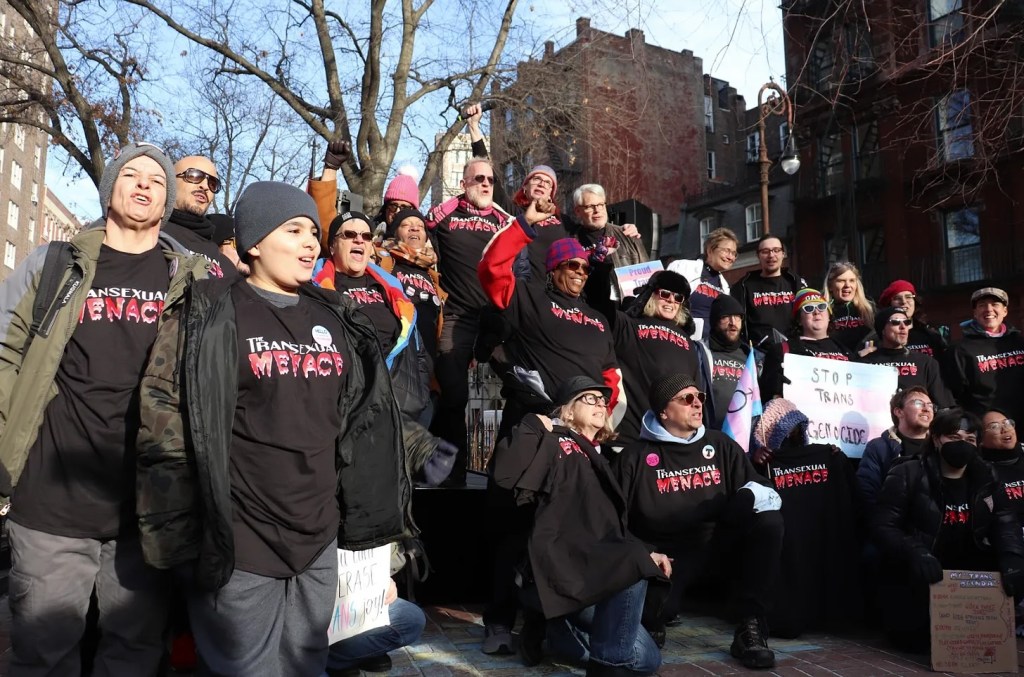
Protestors at Christopher Street Park pose for a photo. Photo: S. Baum/Erin in the Morning

This weekend at Stonewall, trans pasts and trans futures collided. The crowd of over 300 people at Christopher Street Park cheered on as the two kids took the stage, all smiles as they were wrapped in the pink, white and blue. They were led by Denise Norris, co-founder of The Transexual Menace, a direct action group which began organizing against trans exclusion in 1993.

In 1969, the Stonewall uprising spilled out from the iconic gay bar and into the streets — including that same park, a small patch of pavement and grass across the road. Many see this as the birthplace of the LGBTQ liberation movement as we know it today.

Now, a new generation has joined the fight.

“Even in our middle school, which supposedly accepts everyone, we face hate from many of our classmates,” one of the kids told the crowd.

They passed the mic to their friend. “They’re saying, ‘Oh, this school is progressive. And we don’t stand up for hate, and homophobia, and transphobia,’” the other youngster added. “Well, maybe they should do something about it.”

Donald Trump’s second term as president has wrought an unprecedented wave of anti-trans vitriol. The administration has effectively sought to ban trans and intersex people — or likely anyone suspected of being trans or intersex —from joining the militaryusing the correct bathroomsplaying on sports teamsaccessing life-saving medical care, and acquiring state IDs that acknowledge their existence, to name just a few of the provisions’ effects. Trans youth, especially, have been targeted. Meanwhile, politicians and pundits have condemned transness as “toxic,” a “virus” and “a fad”.

But Saturday’s rally was living proof of trans histories, resilience and joy. One protestor held a sign reading: “We are older than your laws and we will outlive them. There are queer and trans kids, adults and elders in the future.”

People gathered at Christopher Street Park in New York City to protest the Trump Administration’s repression of trans people on Feb. 22, 2025. Photo: S. Baum/Erin in the Morning

The area in and around Stonewall, including the park, was incorporated into the National Parks Service in 2016 as a historical monument of the West Village enclave where trans, queer and gender nonconforming youth made their home for decades. But after Trump’s return to office, even the NPS webpage for Stonewall saw the word “transgender” removed.

“Before the 1960s, almost everything about living openly as a lesbian, gay, bisexual (LGB) person was illegal,” the new website now reads, the “T” conspicuously missing. “The Stonewall Uprising on June 28, 1969 is a milestone in the quest for LGB civil rights.”

Norris spoke about organizing the event within her own intergenerationally trans family, including her nephew, Garrett. Now in his twenties, Garrett is working with his aunt to cultivate a national network, encouraging trans people and their allies everywhere to take autonomous action.

“If you don’t want to be transgressive, if you’re not here to make the systemic change that we need in this society so trans people have space to be equal — not merely acceptable — you might as well be the ‘transgender happy friends,’” Norris told Erin in the Morning at the rally. “The battle is not about if we are going to be passable or acceptable to the oppressor. It doesn’t matter if you’re ‘passing,’ they’re still going to come for you.”

The Transexual Menace, whose blood-stained logo is a campy, tongue-in-cheek nod to “The Rocky Horror Picture Show,” cut its teeth mobilizing against trans exclusion from queer spaces and causes in the 1990s. Where some gay and lesbian organizations sought to align themselves with more white, heteronormative, upper class sensibilities, the Transexual Menaces — “Stone Butch Blues” author Leslie Feinberg among them — refused to center respectability politics in their actions, Norris said.

At the rally, speakers showcased a tour de force of trans life spanning generations. Dr. Carla Smith, CEO of The NYC LGBT Community Center, told the crowd how she brought along her wife and grandchild. Jay Walker, a founding member of groups like the Reclaim Pride Coalition and Gays Against Guns, led the protestors in chants. Bernie Wagenblast, the much-beloved voice of New York City subways, was also spotted among the masses.

Angelica Torres, an actress and activist on the board of directors for The Stonewall Inn Gives Back Initiative, spoke passionately about trans histories, referencing the mass slaughter of gender nonconforming people by world powers like colonial Spain and Nazi Germany.

“We’re criminalizing trans people for existing and decriminalizing those that commit actual crimes, like Donald Trump and his 1,500 insurrectionists,” Toress said in her speech.

She could be heard from outside the metal gates of Christopher Street Park, which are adorned with archival images of trans and gender nonconforming youth — smiling, hugging, protesting. It was these street queens and butches of color that are said to have “thrown the first brick at Stonewall,” a common phrase used to characterize the much-mythologized riots. Protestors left bricks beneath the photographs in their honor.

Source: S. Baum, “‘We Will Outlive Them’: At Stonewall, Resistance Flares,” Erin in the Morning, 24 February 2025. The Russian Reader has been a proud subscriber of Erin in the Morning for over a year and encourages his readers to subscribe to it as well in this time of peril and resistance.

Trump’s War on Trans: An American Story

Late Monday evening, President Donald Trump signed an executive order that effectively lays the groundwork for a sweeping ban on the 15,000 transgender troops currently serving in the United States military. The order, delegating much of its implementation to Defense Secretary Pete Hegseth, declares that being transgender is “incompatible with service.” It further mandates that all transgender personnel must be misgendered in official military communication and policy. Most notably, the order frames transgender identity as inherently at odds with “a soldier’s commitment to an honorable, truthful, and disciplined lifestyle, even in one’s personal life.”

The executive order, titled “Prioritizing Military Excellence and Readiness,” claims its purpose is to “protect unit cohesion” from “ideologies harmful” to it—explicitly targeting the service of transgender troops. It asserts that the medical needs of transgender individuals are incompatible with military service, despite evidence that treatments like hormone therapy result in no operational downtime. Aware of this contradiction, the order offers an additional justification for the ban, framing transgender individuals as inherently “selfish” and “false.”

See the rationale given by the order here:

Consistent with the military mission and longstanding DoD policy, expressing a false “gender identity” divergent from an individual’s sex cannot satisfy the rigorous standards necessary for military service. Beyond the hormonal and surgical medical interventions involved, adoption of a gender identity inconsistent with an individual’s sex conflicts with a soldier’s commitment to an honorable, truthful, and disciplined lifestyle, even in one’s personal life. A man’s assertion that he is a woman, and his requirement that others honor this falsehood, is not consistent with the humility and selflessness required of a service member.

While the order itself is vague on the specifics of implementation, its intent is clear: to serve as a ban on transgender service members. It declares that being transgender is “inconsistent with service” and mandates that pronouns used by the military must “accurately reflect an individual’s sex.” The order gives Defense Secretary Pete Hegseth 60 days to implement these directives, including ending “invented and identification-based pronoun usage” and prohibiting transgender service members from bunking with others of their gender.

If implemented broadly, the ban will have immediate and damaging consequences for both transgender service members and military readiness across the United States. SPARTA, a leading transgender military advocacy organization, estimates that removing 15,000 transgender service members would result in the loss of an $18 billion capital investment, with the Palm Center projecting an additional $1 billion cost to recruit and train replacements. Notably, up to 73% of these service members are senior enlisted personnel with 12-21 years of experience—expertise that cannot be easily replaced by the U.S. government.

You can see SPARTA’s figures here:

When asked about the potential for a ban when it was first floated in November, Emily Shilling, President of SPARTA, stated, “The most immediate impact is that transgender people serve in every theater of the world. If it were a fairly fast-moving ban, you would be pulling these individuals out of their units, leaving critical gaps in skill sets, experience, and leadership positions that you’re just not going to be able to fill with equivalent people anytime soon, especially given the shortfalls in recruiting,”

A transgender officer with years of military experience, speaking anonymously about the rumors of an impending transgender military ban, shared that she had recently spoken with several transgender service members deeply concerned about the possibility. When asked about claims that transgender people are a liability to the military, she dismissed the notion outright, stating, “Every trans service member that I have observed performing their job excels at their job, and that’s because we have to… Every trans sailor, every trans soldier, every trans Marine, and airman that I have known has excelled at their job.”

It remains unclear how swiftly or extensively Defense Secretary Hegseth will implement these changes, how many transgender service members will face discharge, or whether the administration will revert to a “don’t ask, don’t tell” approach—forcing transgender personnel back into the closet or demanding their detransition. What is clear, however, is the administration’s framing of being transgender not as an inherent aspect of human diversity but as a dishonorable and incompatible choice. This rhetoric signals a chilling disregard for the thousands of transgender service members who have served with distinction for decades, suggesting the administration feels no obligation to temper its actions with respect or restraint.

Source: Erin Reed, “Trump Military Ban Says Being Trans Conflicts With ‘Honorable, Truthful, Disciplined Lifestyle,” Erin in the Morning, 27 January 2025


Source: Poetry Daily


Within hours of his inauguration, President Trump signed an executive order titled “Defending women from gender ideology extremism and restoring biological truth to the federal government”, following a whipping up of anti-trans feeling during the US election.

The order states that Trump’s administration will make it “the policy of the United States to recognise two sexes, male and female. These sexes are not changeable and are grounded in fundamental and incontrovertible reality.”

The response from LGBTQ+ groups was dismay and fear. Quoted in the Detroit Free Press, trans woman Rachel Crannell-Crocker remarked that Trump “wants to say we are not real,” while Bobbie Hirsch said “I’m scared, I’m really scared for my future.” Kimberly Frost, co-director of ILGA World, said Trump was “emboldened by anti-gender movements” to “use the lives of trans people as tools to sow divisions in society. Our communities deserve better.”

Trump’s move is not unexpected. During a fraught and divisive election campaign, Republicans spent nearly $215m alone on network TV ads that vilified transgender people, according to recent data from AdImpact. The past few years have seen a rush of anti-trans bills in red states, such as banning changes to birth certificates or defining sex as immutably set at birth. Books featuring LGBTQ+ content have been banned, and drag shows have faced protests and been subject to lurid conspiracy theories by Trump’s far right supporters.

Having spent nearly a decade reporting on far right threats to gender rights, the order’s purpose is clear to me: it sits squarely within the attack on so-called “gender ideology” with the ultimate aim to restore a “natural order” of white male supremacy. And while the target is trans people, the threat goes much wider, potentially laying the groundwork for further attacks on the US’s already degraded abortion rights.

What is gender ideology?

Originating in the mid-1990s in Catholic and other conservative Christian circles, the term “gender ideology” sprung up in response to feminists seeking to place “gender” into a United Nations report on its 1994 women’s conference. Initially the term focused on abortion rights, but quickly expanded to criticise any rights related to gender and sexuality, including LGBTQ+ and trans rights.

As the term gathered momentum, it became framed as a threat to ‘traditional’ – see conservative and Christian nationalist – values. LGBTQ+ activists and feminists were accused of imposing “gender ideology” on everything from schools to families and government, determined to “indoctrinate” children and young people with the “transgender agenda.”

Attacks on “gender ideology” were amplified by conservative writers such as Dale O’Leary who popularised the term in her book Gender Agenda, and picked up by the Vatican, as well as the anti-abortion, anti-LGBTQ+ ‘religious freedom’ organisations such as Alliance Defending Freedom and the Heritage Foundation. The right-wing think tank is behind the controversial Project 2025, with ADF on the project’s advisory board.

The project – which brings “together … over 100 respected organizations from across the conservative movement, to take down the Deep State and return the government to the people” – is key to understanding Trump’s move.

Project 2025 published a “Mandate for Leadership”, providing an anti-rights blueprint for the incoming administration. It offered policy ideas to demolish so-called “gender ideology”, demanding that “enforcement of civil rights should be based on a proper understanding of those laws, rejecting gender ideology.” It demanded that “gender ideology” be removed from school curricula and, in language echoed in Trump’s order, warned “radical gender ideology is having a devastating effect on … young girls.”

The project also called on the government to “reverse the DEI [diversity, equality, inclusion] revolution in Labor policy”. Trump’s order did so willingly, revoking previous executive orders that protected against discrimination and stating that government agencies must “take immediate steps to end Federal implementation of unlawful and radical DEI ideology.”

A threat to abortion?

While the executive order is first and foremost a frightening attack on trans people, its wording sets alarm bells ringing for abortion rights, too. It will be no surprise that curtailing abortion rights is a key focus of Project 2025 – the mandate mentions “abortion” 199 times.

Trump’s previous administration created a conservative-majority Supreme Court that overruled Roe vs Wade, opening the door for individual states to implement deadly and devastating abortion bans across the US. Now, the executive order’s wording suggests a wider attack on reproductive rights.

The order defines “female” as meaning “a person belonging, at conception, to the sex that produces the large reproductive cell”, while male is defined as “a person belonging, at conception, to the sex that produces the small reproductive cell.”

As well as being troubling for trans identity, the wording defines male and female foetal personhood from conception. If the foetus is recognised as a person at conception, then that foetus legally has the same rights as a born person, with catastrophic consequences for pregnant women and people. Foetal personhood means a woman can be prosecuted for murder if she has an abortion, as it violates the right to life. She can face manslaughter charges if she has a miscarriage for which she is blamed.

Bethany Van Kampen Saravia, senior legal and policy adviser at the gender rights NGO Ipas, told openDemocracy that “the language used in this cruel and dehumanising executive order is undoubtedly deliberate and deeply flawed on several counts. Simply put, it is outside of the executive authority to declare a fertilized egg a ‘person’ who has constitutionally protected rights.”

This is not a new threat. So far, 24 US states have included foetal personhood language in laws regulating or banning abortion, while 17 states have foetal personhood by law or judicial decision that applies to either criminal or civil law, or both. There have already been multiple cases where women in the States have been criminalised for miscarriage.

“Personhood arguments have long been used by anti-rights actors in attempts to fully ban and criminalize abortion and to punish pregnant people,” warned Van Kampen Saravia. “This language can also ban some forms of birth control and fertility treatments like IVF. This is a clear and deliberate signal of what is to come from this Administration.”

“It is outside of the executive authority of the President to instate a nationwide abortion ban, yet there is much that he can do to limit access to medication abortion and those threats need to be taken seriously,” she added. “Ipas US condemns these egregious acts of hate and bigotry. These executive orders are nothing shy of human rights violations and the world should be paying very close attention now to what is being feigned as ‘defending women’ and who is actually being targeted and criminalized.”

The ideology behind the ‘natural order’

The attacks on abortion and LGBTQ+ rights are often interlinked, as both pose a threat to the far right idea of a ‘natural order’ which has been undermined by feminism and human rights, and must be returned to through reversing social progress and protections.

The idea that there is a ‘natural order’ which needs to be re-established has its roots in fascist ideology, and its intent is found in almost all attacks on gender rights including from Trump, Putin, and anti-gender ideologues in Europe. It valorises male supremacy, female subordination, and declares the non-existence of LGBTQ+ people.

As I write in my book, the existence of trans people is a grave threat to the natural order and its advocates who want to reassert male supremacy and abolish the rights of LGBTQ+ people. The goal of male supremacist, anti-gender movements is to ‘naturalise’ gendered stereotypes about men’s and women’s behaviour and status: they want to naturalise male supremacy and female inferiority.

The far right wants to tie women’s inferiority to biology, and to claim that harmful gendered stereotypes are biologically innate in order to pin women to specific roles in society. These same stereotypes are used to justify women’s oppression: women are just more nurturing, or they are bad at leadership, for example, they should stay in the domestic sphere and leave the public sphere to the boys. The anti-gender movement wants to claim that women’s oppression is natural, rooted in women’s biology, and therefore cannot be challenged.

But biology is not destiny, as the famous feminist slogan states. The ‘natural order’ of female inferiority and male supremacy is disrupted by feminists saying women can have control over their fertility, or LGBTQ+ people saying one can express their gender identity as they choose. They therefore have to be stopped.

This order has nothing to do with “defending women” from “extreme gender ideology.” The extreme gender ideology is the one that tries to push women into oppressive boxes, ban abortion, and seek to abolish the existence of trans people and the LGBTQ+ community more widely.

The extreme gender ideology is the movement that elects a President after a judge in New York found a rape allegation made against him to be “substantially true”. It is the movement that celebrates his election with the slogan “your body, my choice.”

Source: Sian Norris, “Trump’s new anti-trans executive order is a ‘human rights violation’: Trump’s first act in office is part of the global far-right’s war on so-called ‘gender ideology’,” openDemocracy, 23 January 2025

The Russian Reader Reads: Erin in the Morning

This is the second in a series of posts in which I showcase some of the newsletters, blogs, Substacks, and websites — all of them produced by hardworking, passionate lone wolves or tiny, perpetually underfunded grassroots collectives — which inspire me to continue making the Russian Reader and inform me about parts of the world and communities about which otherwise I would be utterly clueless.

Erin Reed describes Erin in the Morning as a place to “stay up to date on all of the most important pieces of trans and queer news and legislation for the week. I summarize it all complete with links to source documents. I hope to distill the information that you get from me in other places like @erininthemorn on TikTok and Twitter into a digest so that you can be sure you didn’t miss anything!”

Ms. Reed’s latest post on Erin in the Morning, endorsing Kamala Harris for U.S. president, could not be timelier, of course. More importantly, as a blogger who has chronicled the Putin’s regime ferocious war on Russia’s LGBT community and their rights, I cannot help but be inspired by Ms. Reed’s fierce, fact-driven defense of the transgender community and their rights in the U.S. I hope you’ll consider subscribing to Erin in the Morning and supporting it financially, as I have done. \\\ TRR


As one of America’s leading transgender journalists, I have reported on the wave of anti-transgender legislation sweeping across the United States over the past four years. These laws impact nearly every aspect of our lives: from using restrooms in peace to accessing essential medical care, from seeing our histories taught in schools to expressing our identities through art at Pride parades. I’ve listened to thousands of hours of testimony on these bills. Facing the 2024 election, I can’t stay silent on the dangers a second Trump term would pose to my community. For the long-term safety and dignity of transgender Americans, I believe there is only one viable path forward: electing Kamala Harris this November.

In some of my earliest reporting on anti-trans laws, many Republican elected officials were less fanatical than they are today. For instance, the first bill banning transgender healthcare in Arkansas was vetoed by Republican Governor Asa Hutchinson. In his veto statement, Gov. Hutchinson described the bill as “overbroad and extreme,” noting that it would “create new standards of legislative interference with physicians and parents.” In early 2022, Republican Gov. Spencer Cox vetoed a sports ban, making an impassioned plea: “I want them to live.” Many anti-trans bills failed early on, failing to gather enough Republican votes. Even Republican-nominated justices crossed party lines to side with Democratic-nominated justices, affirming that transgender individuals deserve protection under the constitution.

But soon after, the party began waging a fear campaign, leaving countless people in my community harmed in the process. I watched as one Republican-controlled statehouse after another, spurred on by far-right Freedom Caucus members, voted to enact some of the most draconian laws targeting transgender individuals ever seen. I listened as members of my community were labeled “dangerous,” “an infection,” and even “demons.” Gov. Cox no longer “wanted us to live,” and instead quietly signed the first bathroom ban to cross his desk.

I have seen transgender people forced to flee anti-trans states, seeking new lives in places where they are protected. Some of my earliest work involved families in Texas with transgender children who were targeted by Attorney General Ken Paxton, accused of child abuse simply for supporting their kids. Soon, other states followed with healthcare bans, bathroom bans, and more. I reported on these bills as families begged their state legislators for dignity, only to be ignored. I then helped these families raise funds, and I’m glad to report that many now lead fulfilling lives as valued members of their new communities.

I am keenly aware of which states transgender people are fleeing—and which ones they are fleeing to. Every state enacting extreme anti-trans laws has either a Republican trifecta or a Republican supermajority. Meanwhile, transgender people are finding refuge in states where Democrats have established safe havens. One of those havens is Minnesota, thanks to Governor Tim Walz. I know people whose lives were saved by his actions—people who can now live authentically and freely, without fear of government persecution.

Erin Reed posted the latest edition of this periodically updated map yesterday. It was not included in her endorsement of Ms. Harris, but I’ve inserted it to show what is at stake in the upcoming election.

I have followed this election cycle intently and was among the first to report that transgender people would be a primary target of Trump’s 2024 campaign. In early 2023, Trump released a video outlining a dozen anti-transgender policies he would enact upon taking office, including national bans on trans care for youth, investigations into hormone therapy manufacturers, probes into affirming teachers, and eliminating funding for schools that treat transgender students with dignity and respect. These policies would take the harmful measures I’ve seen in Republican statehouses and nationalize them.

In 2024, it’s clear that the Trump campaign intends to follow through. If you’ve watched any sporting event or turned on the TV in a battleground state, you’ve seen the culmination of this fear campaign against transgender people, now led by Trump himself. Nearly $100 million in anti-trans ads have blanketed the nation, with Trump spending more on these ads than on immigration, housing, and the economy combined. I have seen what other Republican leaders do when they center their focus on my community, and I know the end results are not pretty.

When Kamala Harris was chosen as the Democratic nominee, I watched her closely. While the Biden administration was not flawless on transgender rights—and I often criticized it for these shortcomings—no federal anti-trans laws passed during his presidency. I reported on the defeat of 50 anti-trans and anti-LGBTQ+ policy riders as Republicans threatened to shut down the entire government over transgender issues, and Biden did not back down. His nominees have overturned anti-trans laws and policies. Thanks to Biden, I was able to change my passport, even though my home state of Louisiana doesn’t allow birth certificate changes. I wanted to see if Harris would continue that commitment.

I’m convinced she will. One of Harris’s first moves that reassured me was selecting Gov. Tim Walz as her choice for vice president, fully aware of the Republican attacks against him for making Minnesota a safe haven for those fleeing anti-trans laws in other states. Walz, who campaigned on his record of starting his high school’s first Gay-Straight Alliance decades ago, has consistently been at the forefront of supporting LGBTQIA+ people. He brought that commitment with him to the Governor’s office, where he governed with a focus on making the state welcoming and inclusive for all.

Then in the final weeks of the campaign, she and Tim Walz were asked no less than three times about transgender people in interviews with Fox News, NBC, and Glennon Doyle’s podcast. I was encouraged to see Harris stand on her record of supporting transgender people when questioned. She had ample opportunity to throw us under the bus—as some other Democrats have done this campaign cycle—but she did not.

On Fox News, she criticized Trump for spending $20 million on ads targeting our community. On NBC, echoing her stance on abortion, she emphasized that transgender care is a decision to be made between doctors and patients. Her framework mirrored the approach used by many Democrats—and even some Republicans—to successfully push back against anti-trans bills in dozens of states. Meanwhile, that same week, Walz passionately defended transgender youth, stating that Donald Trump was attempting to “demonize a group of people for being who they are” and pledging that the administration would appoint justices committed to protecting our rights.

With over 1,000 bills introduced in the past three years targeting trans and queer people, undoing the harm they’ve caused will require sustained and strategic effort. The path forward depends on nominating justices who can help reverse these laws, while also protecting our rights in cities and states that offer refuge. For those living in oppressive states where their care, bodily autonomy, and right to exist freely have been threatened, we will continue organizing, supporting each other through mutual aid, and building the foundation to dismantle these discriminatory laws for good. The future rights of transgender people depend on electing Harris, uplifting Walz’s leadership, and securing the justices their administration will appoint.

If Trump wins a second term, we could be bound by his justices for an entire generation. Many transgender adults may never see the day when his court no longer controls our right to exist peacefully in public. Project 2025 could become a national reality, turning the same hateful bills and rhetoric shaping statehouses across the country into federal law. Schools could be defunded for allowing transgender youth to use restrooms in peace, and our very existence could be labeled obscene. There may be no return from the harm he intends to inflict on our community.

Transgender people are in a fight for our lives, and we are a powerful voting force, with millions of us across the United States. In an election that could come down to a few thousand votes in key swing states, we have the numbers to make a difference. In states like Georgia and Arizona, the transgender population is four times the size of the previous vote margins. We cannot afford complacency this election cycle. There is a path forward from the harm inflicted by Republican policies championed by Trump—a path that depends on us showing up and casting our votes for Kamala Harris.

Source: Erin Reed, “As A Leading Transgender Journalist, Here’s Why I’m Endorsing Kamala Harris,” Erin in the Morning, 29 October 2024

Pride (and Shame)

Guerneville, Calfornia, 11 August 2024. Photo by the Russian Reader

KOBLENZ, Germany (AP) — Sasha Skochilenko and Sofya Subbotina are planning to get married. That wasn’t an option in their native Russia, but it’s possible now that they live in Germany, which recognizes same-sex weddings.

“We don’t know how or in which city we will do it, but that’s the plan,” Skochilenko, 33, told the Associated Press, looking lovingly at Subbotina, who radiated happiness.

They reunited earlier this month in Germany, shortly after Skochilenko and other Russian prisoners were exchanged in a historic East-West swap — a happy if unlikely ending to an over two-year ordeal.

Skochilenko, an artist and musician, was jailed for speaking out against Russia’s war in Ukraine. Subbotina campaigned for her partner’s release while also trying to make her life behind bars as tolerable as possible.

They talked about marriage in Russia, too, but same-sex weddings have been effectively banned there. Laws restricting LGBTQ+ rights have been on the books for over a decade and intensified since the war began as part of the Kremlin’s campaign for “traditional values,” fueled by its anti-Western views and close ties to the Russian Orthodox Church.

Now, “I feel that I’m in a really free country,” Subbotina said, as they make plans for a life together in the quiet city of Koblenz in western Germany.

Skochilenko was arrested in her native St. Petersburg in 2022, just weeks after the invasion of Ukraine, for replacing price tags in a supermarket with anti-war messages like saying that Russia bombed civilian targets. She was charged with making false statements about the military, part of the massive crackdown on all dissent over the invasion.

She struggled in pre-trial detention, suffering from chronic illness, including celiac disease, requiring gluten-free meals. Subbotina commuted to Skochilenko’s jail at least twice a week, bringing food, medicine and other necessities. She and their friends made sure the case, which drew public outrage, stayed in the headlines.

Last year, Subbotina was diagnosed with cancer. “I just felt like I was giving up, and honestly, I was just ready to die,” she said.

The couple didn’t see each other for a year. Since they weren’t married, investigators made Subbotina a witness in the case and refused to allow her visits or to receive phone calls from Skochilenko.

“It is not a small thing, when a person you love can’t visit you,” Skochilenko said.

Subbotina added it was “very painful,” noting that she knows many women who married imprisoned men — often with the wedding held in pre-trial detention facilities or in penal colonies.

“It gives them the right for long visits, it gives them the right to get phone calls, short visits, because they have a certain status in the eyes of the authorities,” she said. “We’ve never had this opportunity.”

Subbotina says she eventually was allowed short visits.

They were always very open about their relationship, despite laws against any public endorsement of LGBTQ+ activities, driven by President Vladimir Putin’s close ties with the Russian Orthodox Church.

Skochilenko said it was clear in the early 2010s the Kremlin was headed in a “homophobic direction,” and some of the laws the authorities were adopting drove her to protest back then. In recent years, she said her openness was a form of activism.

People “often have distorted opinions about the LGBTQ+ community because they don’t know anyone” who loves someone of the same sex, and their views often change once they do, she said.

In November 2023, Skochilenko was convicted and sentenced to seven years in prison — an unusually harsh verdict.

This summer, while awaiting an appeal hearing at a detention center in St. Petersburg, she said there was a point when she reached a particular point of desperation about her long sentence. She said she was traumatized by the lack of freedom and privacy, the constant body searches, and the persisting hunger from being unable to eat prison food.

Subbotina visited her in July, and Skochilenko recalls bursting into tears for the first time in months.

“I told her, ‘Sonya, I’m tired of wanting to go home. Please tell me that I won’t have to serve the entire sentence, that some miracle will happen.’ And she said, ‘Yes, why don’t you hope for a miracle?’” Skochilenko said.

That same day, a prison official told Skochilenko to “urgently” apply for a presidential pardon, she said. The artist did not want to admit guilt, but the official said she could simply explain her health problems. She wrote the request and forgot about it, thinking that it would take a long time to even process.

Several days later, she was transferred to Moscow without explanation. In the same van was Andrei Pivovarov, an imprisoned opposition politician that she knew from years earlier. There was hardly any reason for them both to be transferred at the same time, so it suggested that perhaps something good was happening.

Skochilenko spent several long days in Moscow’s notorious Lefortovo Prison, where she was cold and hungry, unable to eat much of the food she was given.

Subbotina learned of the transfer and rushed to Moscow with a care package, visiting every detention center she could think of, without success.

The rest became what many Russians critical of the Kremlin describe as the first good news since the start of the war. On Aug. 1, Skochilenko and 15 others were put on a bus, driven to an airport and flown to Ankara, Turkey, where they were exchanged for eight Russians imprisoned in the West.

From Ankara, the former prisoners were flown to Germany, where Chancellor Olaf Scholz greeted them on the tarmac. The next day, Skochilenko was finally able to embrace Subbotina, who flew to Germany when she heard the news.

The days since then have been “euphoric,” Skochilenko said, filled with small pleasures like walking and buying the food she wants — but also spending time with the woman she loves.

Subbotina particularly enjoys being able to hold Skochilenko’s hand and kiss her in public without worry. In Germany, she says, it is something that is “just in the nature of things.”

They’ve settled for now in Koblenz but want to visit other cities in Germany before they decide where to live permanently. They’re eager to learn German and begin their new lives.

Skochilenko plans to return to making art, displaying sketches she drew about the prisoner swap -– a moment in history in which she became an unlikely participant. She also said she intends to seek treatment for post-traumatic stress disorder from her time in prison.

Subbotina, a nurse and a pharmacist whose cancer treatment was successful in Russia, hopes to work in the human rights field and help the hundreds of political prisoners in her former country.

Both admit that they never expected to leave Russia in the way they did.

“I don’t feel stressed about moving, because I’m very happy. I’m very happy that Sasha is with me,” Subbotina said with a smile.

Added Skochilenko: “My relationship with Russia is over. I need to accept that. I’m glad there’s a new life.”

Source: Dasha Litvinova, “Russian artist released in swap builds a new life in Germany, now free to marry her partner,” Press Democrat, 12 August 2024. (“The Press Democrat, with the largest circulation in California’s North Bay, is a daily newspaper published in Santa Rosa, California.” Santa Rosa is twenty miles from Guerneville, both of which are located in California’s Sonoma County, which I have had the pleasure of visiting three times this year.)


On Friday, Trump appeared in Bozeman, Montana, marking his first public appearance since Kamala Harris selected Tim Walz as her running mate. The former president took the stage later than scheduled, citing engine troubles on his plane. The event garnered significant attention from political pundits, especially in light of Trump’s declining poll numbers. Many speculated on how his campaign messaging might evolve. A noticeable shift emerged quickly: a heightened focus on attacking transgender people.

You can see a compilation of his attacks on transgender people here:

Erin in the Morning, “Trump Targets Trans People in Montana”

Trump’s initial attack targeted Imane Khelif, the Olympic athlete who was falsely accused by prominent right-wing figures of “being a man.” Trump commented on Khelif, saying, “I’d like to congratulate the young woman who transitioned from a man into a boxer. You saw he won—she won—the gold medal. How about the beautiful young Italian boxer? She got in there, didn’t know what was going on… she was a very good boxer, against other women. She didn’t count on this. She said, ‘OK, I had enough.’ It’s crazy what they are doing… this person won the gold medal. How crazy is this? And she wants it. She wants men to play in women’s sports.”

Imane Kehelif is not transgender, and has never transitioned. She was assigned female at birth, has always been cisgender, and was ruled out of competition by the International Boxing Association (IBA) after defeating an undefeated Russian boxer. Notably, the IBA is presided over by Umar Kremlev of Russia, and has been suspended by the International Olympic Committee due to corruption, judging scandals, and more.

Trump then shifted his focus to Tim Walz, declaring, “He signed a law letting the state kidnap children to change their gender so that they go home… I’m not talking about him, I’m talking about her. This is her ideology, this is why she picked him. And he signed a bill allowing pedophiles to claim human rights protections under the state law.”

The law Trump referenced is Minnesota’s legislation designating the state as a refuge for transgender individuals seeking care across state lines. The law does not permit the state to “kidnap children.” This misconception arises from a misinterpretation of a provision that allows Minnesota to “take jurisdiction” in cases involving youth transitions where one parent resides in a state that criminalizes such care and the other in a state where it is legal, particularly during divorce or custody disputes. As for the claim of “allowing pedophiles to claim human rights protections,” this is also false. The confusion stems from the removal of pedophilia from the definition of sexual orientation, but pedophilia remains illegal under Minnesota law.

Finally, Trump addressed schools, stating that he would “remove funding from any school pushing critical race theory, transgender insanity, and other inappropriate racial, sexual, or political content onto the lives of our children.” While this could be referring to book bans, which have proliferated in many states, Trump might also be threatening to use similar tactics against schools that allow transgender youth to use bathrooms matching their gender identity, change their names, or avoid forcibly outing trans youth to their parents.

Attacks on transgender people have little record of electoral success, with similar efforts failing in many campaigns over the last few elections. In elections where Republicans made trans people the major issue, the Republican Party faltered: 70% of Moms for Liberty and Project 1776 candidates lost their races in 2023. In Kentucky, the American Principles Project spent millions on anti-trans ads against Democratic Governor Andy Beshear, who won by a larger margin than his first election. Other losses Republicans have suffered on this issue occurred in the Virginia legislature elections, the Arizona Governor’s race, the Michigan legislature elections, the Wisconsin Supreme Court election, the Walker-Warnock Senate race, and in dozens more places. Furthermore, recent polling from GallupNavigator, and the LA Times indicates fading public support for such laws, with huge majorities of respondents seeing them as a distraction and opposing bans on trans youth care.

Despite a history of limited success with these tactics, Trump seems to be doubling down on the issue in a desperate bid to boost his poll numbers. If he succeeds and regains office, transgender individuals could face unprecedented threats as his administration intensifies its targeting of their rights and protections.

Source: Erin Reed, “Seeing Falling Poll Numbers, Trump Targets Trans People In Montana,” Erin in the Morning, 13 August 2024

“We Shall Overcome”: Russia’s New Anti-Transgender Law

The State Duma has been drafting a ban on transgender transition in Russia since spring. Despite the fact that experts and doctors opposed it, the MPs have now passed the law in its second reading.

And it has proven even worse than expected.

The original bill already prohibited all “medical interventions” for transgender transition and changing gender markers in passports and other documents. But the MPs also proposed new restrictions.

Now, according to the draft law, if one spouse changes their gender marker, their marriage will be annulled. In addition, those who have transitioned to another gender will be banned from serving as guardians and adopting children. Depriving them of parental rights is not on the table yet, but the Russian authorities have taken children from trans people in some cases in the past.

Moreover, MPs would ban not only “medical intervention” in the form of surgery, but also hormone therapy.

Finally, the Duma reworded the law on vital records. Previously, it was possible to amend a passport using a sex-change certificate issued by doctors. Official documents can now be amended if the individual provides a medical report “on the correspondence of [their] sexual characteristics with the characteristics of a particular sex.”

Although the bill has not yet been adopted into law, it is already causing trouble for transgender people. Robert Lebedev, a transgender man, told Bumaga, citing his own acquaintances, that civil registry offices in Moscow had been delaying issuing new documents to transgender people for longer than the month prescribed due to an “order from above.” And yet, the draft law does not even prescribe penalties for doctors or civil servants who violate the ban on assisting a person with transgender transition and gender marker change.

The bill’s co-sponsor, Pyotr Tolstoy, argues that “the western transgender industry is trying to infiltrate our country,” and Russia’s “cultural and family values” must be preserved.

Even before the adoption of the law, transgender people faced endless humiliation and persecution. The new law will give the security forces a free hand and effectively outlaw an entire group of citizens.

Source: “State Duma decides to turn lives of transgender people into hell,” I Don’t Get It newsletter (Mediazona), 13 July 2023. Translated by the Russian Reader


Alexei Sergeyev

We shall overcome

On this dark day, when we find ourselves at rock bottom, I want to scream with rage and impotence. While voicing emotions is vital, I’m also trying to find a foothold—in myself, in others, in my own experience….

I have nothing but a profound belief that this night of total obscurantism, injustice, and hatred will end one day, and hopefully sooner rather than later. I am overwhelmed with feelings of love and admiration for the trans activists to whom life has introduced me during my ten-plus years in activism. I didn’t always say these feelings out loud.

We started working hand in hand when I didn’t know a single open trans person in my own circle yet. Gradually, I was surrounded by more and more trans people, who did a lot of cool, useful and, sometimes, fantastic things.

I befriend trans people and even became romantically involved with them. Over the years, trans initiatives and trans people have truly accomplished a great deal. It’s no exaggeration to say that they have become the vanguard of the Russian LGBT+ movement.

I learned about the difficulties they face and about ways to help them. I still appreciate the patience, tact, determination, and dignity with which I was corrected when I made mistakes myself, or when mistakes were made in the communities I moderated.

Things became visible that I, a cisgender person, simply had not noticed before: sniggering and transphobic “jokes” at passport control at the airport, misgendering, violence, rejection at home, discrimination at work, sexual exploitation, increased risk of suicide, etc. Interacting with trans people also helped me to understand the narrowness of the binary gender framework and my own gender nonconformity, despite the fact that I consider myself a man.

Further immersion in the topic, collaborations, and a desire to contribute in this area led to the creation of the project Transformation on trans people in the Russian prison system. At the same time, we tried not to speak for trans people. Instead, we delivered their own stories about their prison experience and commentary by experts, among whom there were also trans people. We plan to continue, realizing that it is a long-term job, although the new law will make this work more complicated, apparently.

Again and again I listen to the song “We Shall Overcome,” the anthem of the movement for the rights of African Americans. In new, difficult circumstances, the importance of mutual support, assistance, unification, and finding non-standard channels increases.

I believe in the power of the LGBT+ community’s solidarity in the face of difficulties. Fear and feeling powerlessness are understandable emotions. But it’s important to move on and fight the consequences [of this law].

The song ends with these words:

We are not afraid,

We are not afraid,

We are not afraid today.

For deep in my heart

I do believe:

We shall overcome someday!

The photo, above, from his personal archive, shows the author during the campaign against transphobic legislation in St. Petersburg, with a view of Trinity Bridge in the background.

Source: Alexei Sergeyev (Facebook), 13 July 2023. Translated by the Russian Reader

The Russian National Idea

Putin Proclaims National Idea
Fontanka.ru
February 3, 2016

In Russia, there can be no other unifying idea than patriotism, argues President Vladimir Putin, as reported by TASS.

“This is, in fact, the national idea,” the head of state announced during a meeting with the Leaders Club, which brings together entrepreneurs from forty of the country’s regions.

According to Putin, this idea is not ideologized and is not linked to the work of a particular party, reports RIA Novosti.

“It is a common rallying point. If we want to live better, the country has to be more attractive to all citizens and more effective,” the president stressed.

_________

Who Killed a Transsexual in Ufa and Why?
Ufa1.ru
February 2, 2016

On Monday, February 1, Angela Likina was stabbed in the chest and killed in Ufa. The Ufa resident had gained notoriety in 2014, when a video recorded on a traffic police dashcam entitled “Ufa Traffic Cops Stop a Transvestite” [sic] went viral on the Web. Ufa1.ru found out who killed Oleg Vorobyov, who had changed his sex and become Angela Likina, and why.

2-z23-8ba7384a-0952-45c2-a705-e03be67de8d4
Angela Likina. Photo courtesy of Ufa1.ru

The controversial video from the traffic police car dashcam recorded an inspector checking the papers of a female motorist. It transpired, however, that the motorist’s name, according to his internal passport, was Oleg Vorobyov. The inspector was very surprised by this. The motorist was a transsexual who had been preparing for a sex change operation for several years, becoming Angela Likina. The restricted video was leaked to the Web.

Later, the State Auto Inspectorate conducted a review of the incident, because the restricted footage should have not ended up on the Web. Angela Likina also commented on the video herself. She was surprised the incident had provoked so much interest among Web users.

“People die in accidents, children get hurt, cars are stolen, blood is needed to save someone’s life. Gentlemen, why are you setting records for likes and reposts about me? I honestly don’t understand,” said Likina, adding, “I don’t care how you live, what you do, and so on, so long as you are alive, healthy, and happy. But my life does not concern you in absolutely any way.”

How Did Oleg Live?
Ufa1.ru spoke with friends and acquaintances of Angela Likina, who talked about the life of the murdered woman. We found out this sad ending had emerged from a number of factors. Before becoming Angela Likina, Oleg Vorobyov had been married. Acquaintances confess that, outwardly, the couple were seemingly happy. They were raising two daughters, now aged fourteen and nine. The family lived in a private house, which also housed Oleg’s auto repair garage. Many of the people with whom we spoke said automobile owners were satisfied with Oleg’s work, that he had a magic touch.

Over five years ago, Oleg realized he was living in someone else’s body. He understood he wanted to change his sex and become the person he thought he was. Oleg began calling himself Angela Likina and started the complicated process of preparing to change his sex. He took hormone pills and began dressing like a woman. According to his internal passport, however, he remained Oleg Vorobyov. He could only change his name after finally changing his sex.

Five years ago, the Vorobyovs divorced, but the former husband and wife and their two children kept living under the same roof. The house was the wife’s property, and her former husband had an established business there. Several of the family’s acquaintances believe that Angela did not want to lose her income from the auto repair garage and spend money on renting a place to live. After all, she had to save up a large sum of money for the operation, and the medicines she took to prepare for the procedure were expensive. Close friends emphasize that Angela worked a lot, sometimes seven days a week.

At the same time, Ufa1.ru’s sources noted the Ufa resident simply had no choice.

“He once tried to rent a flat, but was kicked out. A neighbor had said, ‘I don’t want my children to see this!’ Consequently, he was evicted and didn’t even get his money back,” said one of our sources.

Friends of the family noted that those who have lived under the same roof with ex-spouses can imagine the atmosphere that prevailed in the Vorobyov house. Some say that the rows over living arrangements caused the Vorobyovs to come to blows. Things were aggravated by the fact that the head of the family had become a woman. Their children also became the targets of reproaches and ridicule at school.

“They would come home in tears, and sometimes refuse to go to school, but Angela loved her daughters and gave them a lot of time,” acquaintances noted.

Who Killed Angela?
According to friends, a boyfriend came to visit Oleg’s ex-wife on the ill-fated evening. The criminal investigation will shed more light on what exactly happened in the house. For now, the family’s acquaintances have their own hypotheses. Perhaps the man intervened in yet another family row. Maybe he stood up for his girlfriend and wanted to intimidate Angela by demanding she pack her things and leave. The row, however, escalated into something bigger.

“She was stabbed in the chest near the heart. She did not die immediately. She made it to a neighbor’s house, told him what had happened and who had done it, and an ambulance was summoned. Then Angela died in the neighbor’s arms. It was apparently too late to help her. I don’t know what was happening in the family. Angela was a good person, but strangers often beat her up. Her neighbors respected her choice. It is a bad thing when a person steals, kills or rapes, but everything else is a private matter,” said an acquaintance of Angela’s.

“The best human qualities—kindness, fairness, compassion, and unselfishness—were powerfully manifested in her. Unfortunately, that is a rarity nowadays. And she really never held a grudge against anyone, although there were a fairly large number of people who wished her ill. Most of them, it is true, were people who did not know her at all. They insulted and mocked her. You could say she was understanding about it: far from everyone in our city, or even our country, is ready to comprehend the decision to have a sex change. And that is another reason I have endless respect for her: the determination to go her own way to the end, to change her life fundamentally, the willingness to take one and overcome all the difficulties,” another girlfriend of Angela’s confided to Ufa1.ru.

“Apparently, Angela sensed her impending death. Not long before this she had asked forgiveness from her wife for all the rows that had happened between them,” said another family acquaintance.

__________

Fire at Moscow workshop kills 12 people, including 3 children
Boston Globe
January 31, 2016

ASSOCIATED PRESS, JANUARY 31, 2016, MOSCOW — A fire at a textile workshop in Moscow has killed 12 people, including three children, officials said.

The victims were not identified but were reportedly immigrants.

The Investigative Committee, the top state investigative agency, said the fire broke out late Saturday in northeastern Moscow, damaging more than 32,000 square feet of the structure.

Investigators said they are looking at negligence or arson as possible causes.

Russia’s children’s rights ombudsman, Pavel Astakhov, said Sunday on his Twitter account that three children were among those who died, including a baby. He said the victims were migrant workers who lived next to their workplace.

Several dozen fire engines responded to the blaze, and it took firefighters about five hours to extinguish the blaze.

Investigators continued to sift through the rubble Sunday for evidence.

Many immigrants work in Russian factories, some of which have been investigated for hazardous working conditions. In April, a blaze on the outskirts of Moscow killed 17 migrant workers.

__________

The death toll of Kyrgyz citizens (according to the Embassy of the Kyrgyz Republic in the Russian Federation):

1. Sajida Masaliyeva, born 1988. Home address: Village of Kyzyl-Bel, Batken District, Batken Region.

2. Toktokan Saliyeva, born 1983. Home address: Village of Tayan, Batken District, Batken Region.

3. Uulkan Saliyeva, born 1997, sister of Toktokan Saliyeva.

4. Isa kizi Aizat, born 1995. According to available information, Isa was a native of the Village of Kaiyndy, Batken Region.

5. Milikajdar uulu Koshonbay, born 1990.

6. Tologon Kozuyev, born 1991.

7. Manas, born 1995; brother of Tologon Kozuyev; no other details.

8. Daniel, 4-5 years old, son of Ergeshbay Japarov, a Russian national who perished in the fire; born in the village of Rout, Batken District, Batken Region; according to the victims, Daniel was a citizen of the Kyrgyz Republic.

Source: Radio Azzatyk

__________

The four-minute-and-twenty-five-second rap version of Alexei Navalny’s exposé of Russian prosecutor general Yuri Chaika, as performed by Nadya Tolokonnikova. Thanks to Comrade SC for the heads-up.

_________

[Elena Bobrova:] You are something of a patriot yourself?

[Nikolai Kolyada:] How else should I relate to Russia? I love her whatever she be like. Like Gogol I can tell the whole unvarnished truth about her. And Nikolai Vasilyevich said such awful things about Russia. He sobbed bloody tears when thinking about the country. But not because he hated it. On the contrary, because he loved it. When foreigners start speaking badly about Russia, I begin to boil: “Shut up, it is none of your business. I have the right to say anything about her, but you do not.” Well, it is okay when Europeans or Americans sling mud at us: they have a hard time coping with the fact we are different, unpredictable, and freer than they are. But when our own people hate their own country, that is terrible. This morning, I was reading Facebook and I thought, “Why do you live here if you hate Russia so much?”

[Bobrova:] But you just said yourself we have a right to chew out Russia because we live here.

[Kolyada:] Chew out but not hate. But Facebook is just seething with hatred.

—Excerpted from “20% of the Petersburg audience are loonies,” Gorod 812 (print edition), February 1, 2016, page 34

Items one, two, four, and six translated by the Russian Reader