The Package

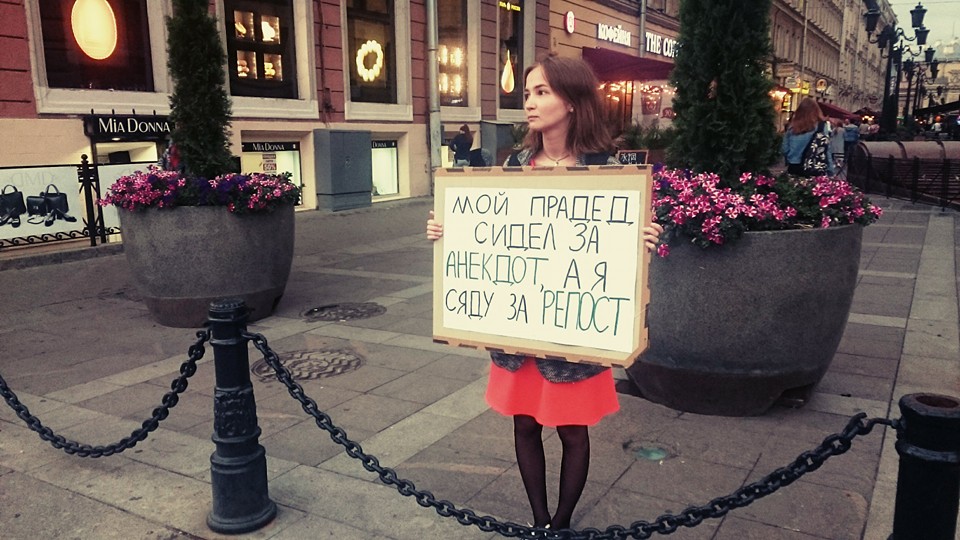
"My grandfather was imprisoned for a joke, while I'll go to jail for a repost."
“My grandfather was imprisoned for a joke, while I’ll be going to jail for a repost.”

Varya Mikhaylova
Facebook
June 24, 2016

As you know, the so-called Yarovaya package, a series of flagrantly repressive amendments to the Russian Federal Criminal Code, whose official aim is combating terrorism, was passed today by the State Duma in its third and final reading.

You can read here why this is bad:


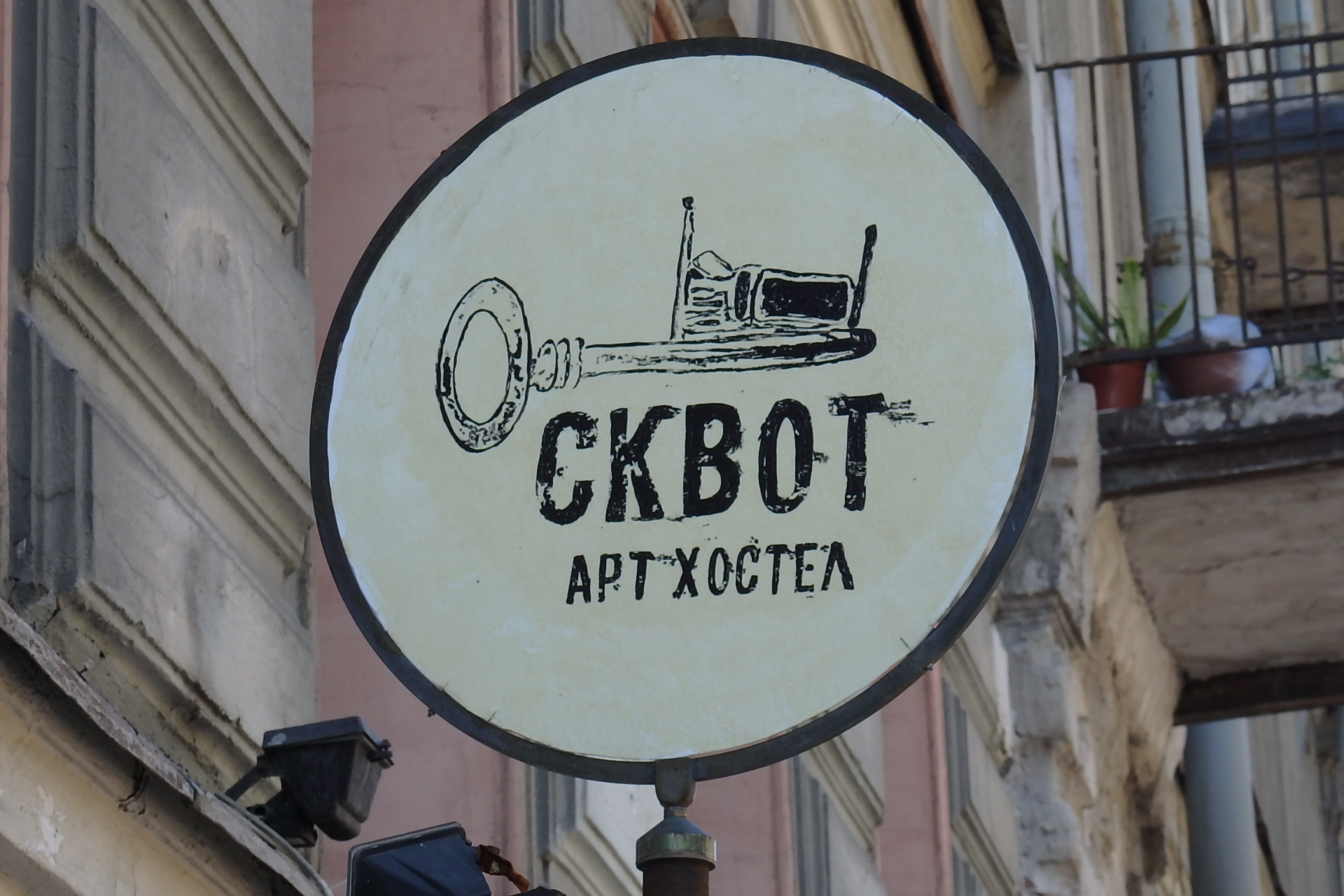
Aleksandra Ermilova and I summarized the worst things about these amendments and went to Nevsky Prospect to hand out leaflets. Or rather, I handed out the leaflets, while Sasha stood holding a remarkable autobiographical placard [pictured, above].

This is what we wrote in the leaflets:

IF YOU DON’T INFORM YOU’LL GO TO JAIL
An article on non-informing has been added to the Criminal Code. “Failure to report a crime” will entail a sentence of up to one year in prison. This law applies to such crimes as terrorism, seizure of power, and attempts on the life of a public official.

ALL YOUR COMMUNICATIONS WILL BE SAVED AND READ
Monitoring of correspondence has been toughened. Records of all your telephone calls, SMS messages, and emails will be saved for six months, and the security forces will be provided with the means to decode encrypted communications.

YOUR PACKAGES WILL BE VETTED
Postal workers will now be obliged to search vigorously for prohibited items in our packages: money, narcotics, weapons, explosives, and “other devices that pose a threat to human life and health.”

YOU INVITED A FRIEND TO A PROTEST RALLY, YOU GO TO JAIL
The Criminal Code will now include an article on “inducing, recruiting or otherwise involving” someone in organizing a “riot.” The law stipulates a penalty of 300,000 to 700,000 rubles or a prison sentence of five to ten years.

YOU REPOST THE “WRONG” THING, YOU GO TO JAIL
The punishments for “extremist” entries, reposts, and comments on the web have been toughened. Despite the fact that freedom of speech is guaranteed by the Russian Constitution, you can now be fined from 300,000 to 500,000 rubles or sent to prison for two to five years for making certain statements. By the way, 369 people were convicted of “enciting hatred by means of the Internet” in 2015.

YOU’RE STILL A KID? YOU’RE GOING TO JAIL ANYWAY
14-year-olds will now be tried as adults not only for serious crimes but also for involvement in riots and non-informing.

Translated by the Russian Reader

Hostel Hostile

Sign for the Squat Art Hostel in central Petersburg. According to an article in the March 2, 2015, issue of Ekspert Severo-Zapad, the city had between 1,250 and 1,270 budget accommodations, including 270 hostels.
Sign for the Squat Art Hostel in central Petersburg. According to an article in the March 2, 2015, issue of Ekspert Severo-Zapad magazine, the city had between 1,250 and 1,270 budget accommodations, including 270 hostels. As of today’s writing, Airbnb listed over 300 rentals in the city. Photo by the Russian Reader

MPs Plan to Evict Hostels from Apartments
But entrepreneurs don’t intend to pull up stakes yet 
Elena Gorelova
Vedomosti
May 12, 2016

At its Friday session [Friday, May 13, 2016], the State Duma will consider a bill that could ban Russian hoteliers from housing hostels in apartment buildings. Galina Khovanskaya, chair of the Duma’s committee on housing and communal services, had tabled the amendment back in September 2015. According to MPs, mini hotels violate the rights of residents in adjacent apartments. If the changes take effect, it will be possible to install hotels in residential buildings only after rezoning the spaces from residential to non-residential. Mini hotels will have to be equipped with soundproofing, fire safety equipment, and security alarms. They will have to be located on the first floor and have a separate entrance.

The ban would have a catastrophic impact on hosteliers, argues Yevgeny Nasonov, chair of the committee on budget accommodations at the Moscow branch of Opora Russia and general director of Clover, a network of hostels. A study conducted by the League of Hostels in December 2015 showed that around 80% of Moscow’s mini hotels and serviced apartments are located in the city’s residential housing stock. In Petersburg, Crimea, and Krasnodar Territory, those percentages are even higher.

From 2012 to 2014, mini hotels were most often opened in residential buildings, says Roman Sabirzhanov, who owns sixteen hostels, including the Fabrika and the Croissant. But residents dissatisfied with their new neighbors then began complaining and showered the prosecutor’s office with lawsuits. Seeing the risks of doing business in residential buildings, Sabirzhanov opened his own hostels in non-residential buildings from the very beginning. It is not always more expensive, he claims. For example, Sabirzhanov has invested 3.5 million rubles [approx. 47,000 euros—TRR] in a new, 225-square-meter hostel on Chistye Prudy. 40% of the money went for rent; 40%, on repairs; and the remaining 20% on obtaining permits and undergoing classification. As of July 1, 2016, all hotels must be classified, receiving from one to five star, while hostels will receive the the no-stars category.

Even if the bill is not passed into law, hostels in residential buildings will be banned sooner or later, Sabirzhanov believes. At the moment, big cities are in the process of being purged of dubious flophouses in the run-up to the 2018 World Football Cup, and hostels have been subjected to more frequent inspections, he says. Even normal hotels might get the axe, the hotelier is convinced. Over the past five years, the number of beds in discount hotels and serviced apartments has grown twentyfold in Moscow, and the major hotel chains that have been lobbying the ban on hostels are not pleased with this redivision of the market, Sabirzhanov claims. He advises hoteliers against making hasty decisions. For the time being, he says, they should operate as they have before, recoup their investments, clean up their premises, and settle conflicts with building residents. At the same time, however, they should think about relocating if they have the means, launching a new hostel in a non-residential space, and going through classification. In the end, you can close the hostel and put the apartment up for rent, says Pavel Gorbov, executive director of Re:Sale Expert.

Launching a small hostel in Moscow runs you approximately two million rubles, estimates Nasonov. But rezoning a space as non-residential is quite expensive for small businesses. Nasonov cites the example of an entrepreneur he knows who has been attempting to build a separate entrance for a store in a residential building near Vykhino subway station. (The procedure for obtaining permissions is the same as for hostels.) He has already spent 1.5 million rubles on construction.

Translated by the Russian Reader.

Invitation to the Voyage

border guards-1
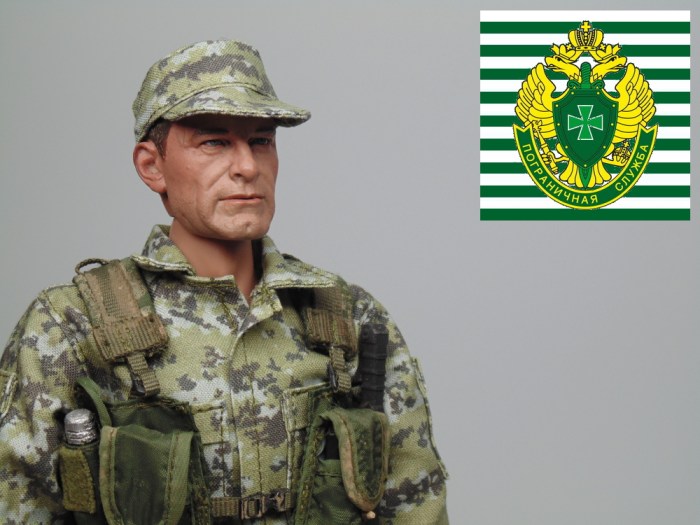
Action figure of a Russian border guard and seal of the Russian Border Guard Service

Boris Vishnevsky
Facebook
May 13, 2016

I have sent this to the Echo website. I hope they will post it soon.

I ask you to repost it.

Friday the thirteenth is a black day in the calendar.

It is no coincidence that on the same day the editorial staff of RBC, one of the best and most professional Russian media outlets, was gutted, the latest paranoid law bill authored by Irina Yarovaya was passed by the Duma.

First, if the bill is passed into law, the Federal Security Service (FSB) will have the right, after issuing a so-called official warning, to ban any citizen from traveling abroad for five years.

For your information, according to FSB Order No. 544, dated November 2, 2010, this “warning” can be given “to an individual in the absence of grounds for criminal prosecution in order to prevent the commission of crimes.” Only “pre-confirmed information” about the “outwardly (verbally, written or otherwise) manifested intent to commit a specific offense in the absence of signs of preparation to commit a crime or an attempt to commit a crime” has to exist.

Let’s translate this from legalese into Russian. There are no signs a crime is being prepped, there are no signs of an attempt to commit a crime, and there are no grounds for criminal prosecution. There is only “information” about the “intent to commit a crime,” information that has appeared out of nowhere and has been obtained god knows how.

Under such rules any undesirable or dissenter can be subject to a “warning,” including people shopped by informers to our beloved secret police for “verbally” or “otherwise” (say, by the look on their face) expressing the intention to commit a crime.

Second, criminal liability will be introduced for “failing to report a crime,” meaning for failing to shop someone to the secret police. As Igor Yakovenko has aptly put it, this will turn “squealing into a civic duty.”

Third, revocation of citizenship would be stipulated for crimes of a “terrorist and extremist tenor,” despite the fact that opposing the authorities is easily classifiable as “extremism.”

All three provisions are blatantly unconstitutional, but they were confidently passed in the first reading, with opposition from an overwhelming minority consisting of Dmitry Gudkov, Sergei Petrov, and Ilya Ponomaryov’s voting card.

You can bet your boots there will be a second and third reading, and the president will sign the bill into law.

I would like to say the Constitutional Court would be bound to quash the law, but considering how it has behaved in recent years there are no grounds for such political optimism.

The darkness is deepening.

However, that always happens before the dawn.

Boris Vishnevsky (Yabloko Party) is a member of the Saint Petersburg Legislative Assembly. Translated by the Russian Reader. Thanks to Comrade Nastya for the heads-up.

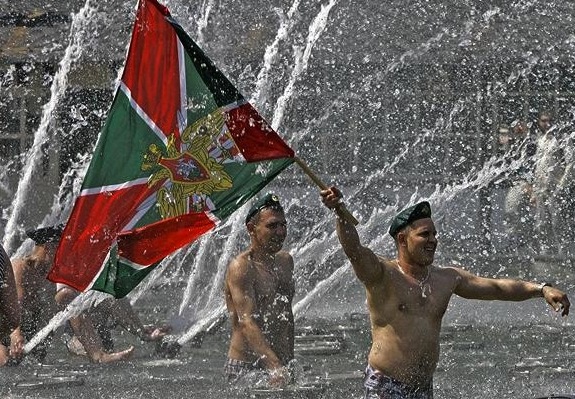
Border Guard Service veterans celebrating their professional holiday, May 28

L’invitation au voyage

Mon enfant, ma soeur,
Songe à la douceur
D’aller là-bas vivre ensemble!
Aimer à loisir,
Aimer et mourir
Au pays qui te ressemble!
Les soleils mouillés
De ces ciels brouillés
Pour mon esprit ont les charmes
Si mystérieux
De tes traîtres yeux,
Brillant à travers leurs larmes.

Là, tout n’est qu’ordre et beauté,
Luxe, calme et volupté.
Des meubles luisants,
Polis par les ans,
Décoreraient notre chambre;
Les plus rares fleurs
Mêlant leurs odeurs
Aux vagues senteurs de l’ambre,
Les riches plafonds,
Les miroirs profonds,
La splendeur orientale,
Tout y parlerait
À l’âme en secret
Sa douce langue natale.

Là, tout n’est qu’ordre et beauté,
Luxe, calme et volupté.
Vois sur ces canaux
Dormir ces vaisseaux
Dont l’humeur est vagabonde;
C’est pour assouvir
Ton moindre désir
Qu’ils viennent du bout du monde.
— Les soleils couchants
Revêtent les champs,
Les canaux, la ville entière,
D’hyacinthe et d’or;
Le monde s’endort
Dans une chaude lumière.

Là, tout n’est qu’ordre et beauté,
Luxe, calme et volupté.

Source

A special day for border guards was established by presidential decree in 1994
The special holiday for Russian border guards was established by presidential decree in 1994

Invitation to the Voyage

Let us leave this tiresome clime
And quit cities made of stone,
Where you are cold and bored,
And sometimes even scared.

The flowers are softer and stars brighter
In the land where the Southern Cross shines,
In the land rich as the dowry chest
Bestowed on enchanted brides.

We’ll build a house taller than a fir,
And face its corners with stone,
Mahogany will panel its walls,
And we’ll put down rosewood floors.

And among the scattered paths
In the vast rose garden
The speckled beetles’ backs
Shall flicker like the stars.

Let’s leave! Unless you do not need
In that hour when the sun has risen
To hear the terrible ballads,
The tales of Abyssinian roses.

Of ancient fairy queens,
Of lions in crowns of flowers,
Of black angels, and of birds
What weave their nests amid the clouds.

We shall find an ancient Arab,
Chanting in a singsong drone
A verse about Rostam and Sohrab
Or the virgins of Zanzibar.

And when we tire of fables,
Twelve slender little Negroes
Shall dance round us in a whirl
And never want to rest.

And magnificent chieftains,
Decked out in ivory gear,
Shall come to visit us
When in spring the rains begin.

In the mountains merry, where the winds
Cry and shout, I shall chop the trees,
Cedars, redolent of resin,
Plane trees spanning to the skies.

I will alter the streams
Of rivers flowing down the hills,
Teaching them now to please
Me according to my will.

And you, you shall have flowers,
And I will give you a gazelle
With such gentle eyes
That it seems as if a flute trills.

Or a bird of paradise, prettier
Than roses and summer lightning flares,
To flutter over your miraculous
Dark blond bonnet of hair.

And when Death comes, slightly sad,
Sliding along the fateful line,
To stand at our threshold,
We shall say to Death, “What, it’s time?”

And, neither longing nor dreaming,
We shall go to God’s highest paradise,
Clear smiles on our faces, recognizing
Everywhere familiar climes.

Original

The Border Guard Service, created in the 18th century, was a separate ministry until 2003, when it became a branch of Russia's Federal Security Service
The Border Guard Service, created in the 18th century, was a separate ministry until 2003, when it became a branch of Russia’s Federal Security Service (FSB)

Invitation to the Voyage

Start by taking a brick and shattering the glass.
Go from the kitchen (mind the steps!) to the dining room.
Sweep Peter Ilyich and Beethoven from the baby grand,
Unscrew the third leg. That is where you’ll find the loot.

Don’t traipse into the bedroom, don’t rifle the chest of drawers,
Lest you start to masturbate. The bedroom and the wardrobe
Smell of perfume, but except for rags from Dior,
There’s nothing you can hustle in the Old World.

Two hours later, when they announce the flight,
Don’t bolt for the gate. Stretch your legs and feign boredom.
In any crowd of passengers you will usually spy
A Jew with forelocks, kiddies in tow. Join their hora.

The next morning, when Zizi pulls up the venetian blinds
And tells you the Louvre is closed, grab hold of her wet curls,
Bury her stupid mug in the pillow and, snarling, “Bite!”
Do to her the thing that deprives the soprano of her trills.

Original

border guards-5
Action figures of a modern Russian border guard (with dog) and an NKVD border guard

Images courtesy of the Telegraph (“Vodka and swimming at Russian Border Guards’ Day celebrations”) and One Sixth Warriors

The War as Holy Writ

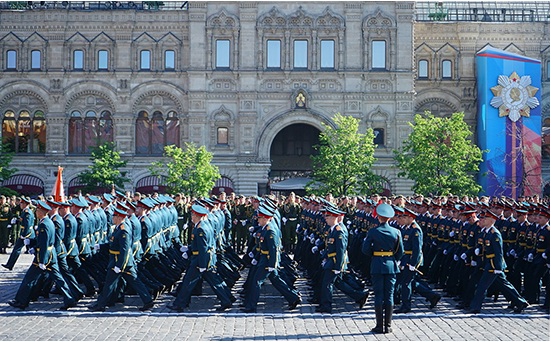
Victory Day parade in Moscow, May 9, 2016

Communists Propose Equating Feelings of War Veterans with Feelings of Religious Believers
Grani.ru
May 8, 2016

A group of Communist Party MPs plans to submit a law bill to the State Duma that would criminalize insulting the feelings of war veterans and stipulate a punishment of up to three years of forced labor. As Gazeta.ru writes, if the draft law is adopted, Article 148 of the Criminal Code (violating the right to freedom of conscience and religion) would be amended.

The newly amended article, 148.1, is entitled “Insulting the feelings of Great Patriotic War [Second World War] veterans.” The Communists will send the bill to the government and the Supreme Court for review on May 10, immediately after the holidays.

There are three paragraphs in the new law. The first paragraph stipulates punishment for “public actions expressing clear disrespect for society and committed with the intent of insulting the feelings of Great Patriotic War veterans by deliberately distorting information about the Great Patriot War, or humiliating or belittling the heroism of the Armed Forces of the USSR.”

Violation of the law would be punishable by a fine of up to 300,000 rubles, or up to 240 hours of community service, or up to one year of forced labor.

The second paragraph stipulates criminal liability for “dismantling, moving, destroying or damaging Great Patriotic War monuments,” even if they are not listed as Great Patriotic War cultural heritage sites. In this case, a violation would be punishable by a fine of up to one million rubles, or up to 360 hours of community service, or up to one year of forced labor.

The maximum penalties are prescribed in paragraph three and cover the same actions, as listed above, if they are performed on May 9, or involve the abuse of office, or are committed by someone who has already been convicted of the same violation. In this case, the offender faces a fine of up to four million rubles, or up to 480 hours of community service, or up to three years of forced labor, and a ban on holding certain positions during the period in question.

Communist Sergei Obukhov, who is spearheading the initiative, coauthored the law on “insulting the feelings of religious believers,” adopted by the Duma in 2013 in the wake of the Pussy Riot trial.

In the explanatory note to the new law, Obukhov defends the need to protect the feelings of war veterans, drawing parallels with the adoption of law on insulting the feelings of religious believers. According to him, that law “does not extend to the belief in goodness and justice, the ideals for which the veterans of the Great Patriotic War fought.”

According to Obukhov, he and his colleagues have tried to draft the most non-repressive law possible, so the punishments stipulated do not include imprisonment. Obukhov calls the bill a “full-fledged legal mechanism for defending their truth about that terrible war as well as criminal protection of their honor and dignity.”

In November 2013, A Just Russia MP Oleg Mikheyev proposed punishing those who insulted the memory of the Great Patriotic War with up to seven years in prison or a fine of one million rubles. Mikheyev submitted a draft of amendments to the Criminal Code and Criminal Procedural Code to the State Duma.

Mikheyev proposed adding an article entitled “Insulting the memory of the Great Patriotic War” to the Criminal Code. The offense was described as follows: “Actions expressing clear disrespect for society and insulting the memory of the events, participants, veterans, and victims of the Great Patriotic War, and committed at the sites of Great Patriotic War monuments and the burial grounds of those involved in the Great Patriotic War.”

The draft law stipulated a fine of between 500,000 and one million rubles or the amount of the convicted offender’s income for a period of three to four years, or a prison term of up to seven years. Mikheyev explained this choice by analogy with Criminal Code Article 148 (insulting the feeling of religious believers), “insofar as both articles deal with the spiritual realm of human life, the realm of values.” As an example of “insulting the memory” of the war, he cited the articles of journalist Alexander Podrabinek.

In April 2014, Irina Yarovaya, head of the Duma’s security and anti-corruption committee, proposed criminalizing “desecration of days of Russian military glory and memorable dates” connected with the Great Patriotic War. The United Russia MP said the relevant amendments would be inserted into a draft law on “rehabilitating Nazism” during its second reading.

“We will propose equating liability for this crime with the liability for desecrating burial sites dedicated to the fight against fascism [sic] or victims of Nazism,” said Yarovaya.

Individuals accused of “desecrating days of military glory” were to face up to three years in prison, forced labor of up to five years, arrest for a period of three to six months, or five years in a penal colony.

Yarovaya said she had found a post on a social network containing a negative assessment of the May 9 holiday.

“I think such statements should be assessed not just morally or ethically, but from the viewpoint of criminal law,” Yarovaya said in this connection. “Because it is a deliberate crime aimed at desecrating the memory of the Great Patriotic War.”

Translated by the Russian Reader. Photo, above, courtesy of Oleg Yakovlev/RBC

This Ain’t No Disco

Police Major General Tatyana Moskalkova, Russia's newly minted federal human rights ombudsman. Photo courtesy of zampolit.com
Police Major General Tatyana Moskalkova, Russia’s newly minted federal human rights ombudsman. Photo courtesy of zampolit.com

As the free world mourns the passing of Prince Rogers Nelson, the Russian State Duma has appointed a former (?) police general, Tatyana Moskalkova, to the post of Russian federal human rights ombudsman.

Appearing in the State Duma, Moskalkova spoke of the need to raise the prestige of the Russian ombudsman to the world level.

“The topic of human rights has been actively used by western and American organizations as a weapon for blackmail, speculation, and threats, as a weapon for attempting to destabilize and pressure Russia,” TV Rain quotes her as saying.

The new ombudsmen added that “compatriots living abroad” are in need of her protection.

“Russian schools have been closed. The basic rights of Russian citizens living abroad—political, social, economic, and other rights—have been infringed. The human rights ombudsman should take up this problem.”

In 2012, as the trial of punk rock group Pussy Riot was taking place, Moskalkova proposed criminalizing “assaults on morality,” but the State Duma did not support her bill. In April 2015, she also proposed renaming the Interior Ministry the Cheka and giving the police the “appropriate powers for restoring order and preserving the country’s peace and security” in connection with the crisis.

According to the information on her website, she served 27 years in the Interior Ministry [i.e., the Russian police].

Source: Mediazona

Translated by the Friends of the People

________

Base

rds-pensioner-banner
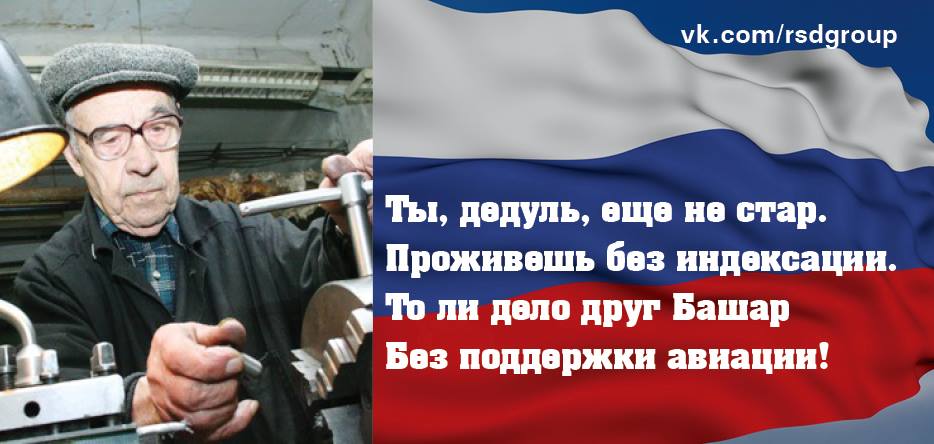
“You, Grandpa, are still not old. / You’ll live without indexation. / It’s not the same for our friend Assad / Who can’t live sans our aviation.” Courtesy of Ivan Ovsyannikov and the Russian Socialist Movement (RSD)

_________

State Duma Rejects Indexation for Working Pensioners
October 9, 2015
Lenta.Ru

Photo: Alexander Kozhokhin/RIA Novosti

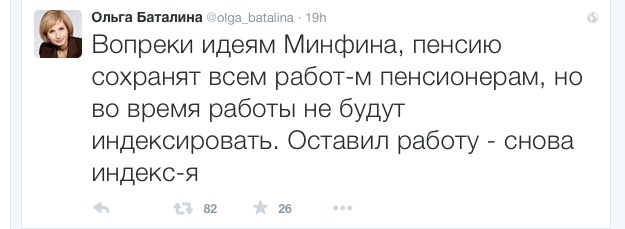
The pensions of working pensioners will not be indexed for inflation. Olga Batalina, head of the State Duma’s Committee on Labor, Social Policy and Veterans Affairs, made the announcement on Twitter.

batalina
“Despite the Finance Ministry’s ideas, the pension will be preserved for all working pensioners, but will not be indexed [while they are still working]. You quit work, indexation kicks in again.”

She noted that all working pensioners would continue to receive payments, but the payments would not be raised while they are employed.

“You quit work, indexation kicks in again,” added Batalina.

Earlier, on October 9, she announced that the government had to decided index pensions twice in 2016. Batalina explained this would be done so that pensions would increase to the level of inflation for 2015.

On October 8, however, Deputy Prime Minister Igor Shuvalov noted that the possibility of a second indexation next year would depend on the Russian economy’s growth.

On the same day, the government approved the draft budget for 2016. It is expected that revenues will reach 13.58 trillion rubles, expenditures, 15.76 trillion. The deficit is projected at 2.8 percent of GDP (2.18 trillion rubles).

A part of the treasury’s expenditures will be covered by a freeze on pension savings. Another cost-saving measure is reducing the indexation of pensions (to 4 percent at an expected inflation rate of 12 percent). Moreover, the idea of terminating pension payments to working pensioners was considered.

Translated by the Russian Reader

_________

Balancing Russia’s Budget Could Cost Pensioners $46 Billion
Anastasia Bazenkova
June 24, 2015
The Moscow Times

Russia’s roughly 40 million pensioners receive on average 12,900 rubles ($240) in state pension payouts. Photo: Denis Abramov/Vedomosti

Russia’s economic crisis is forcing the government to consider sweeping savings on pension payouts, a move that could go down badly with a core part of President Vladimir Putin’s electorate.

The Finance Ministry this week floated a proposal to save more than 2.5 trillion rubles ($46 billion) over three years by raising pensions at less than the rate of inflation.

The measure comes as the ministry struggles to slash spending amid an economic recession that is eroding budget revenues.

A steep devaluation of the ruble has meant that prices have grown much faster over the past year than salaries, and since payroll taxes are the main source of income for the pension system, the Finance Ministry has said continuation of inflation-linked pensions could threaten the country’s state-run pension fund.

In May, average nominal incomes were 7.3 percent higher than in May 2014, while prices were on average 15.8 percent higher, according to the Rosstat state statistics service.

“If the income of the fund continues to grow slower than its payouts, it could break the entire pension system,” the Vedomosti newspaper quoted Deputy Finance Minister Maxim Oreshkin as saying last month.

The government is already subsidizing a 3.3 trillion ruble ($60 billion) hole in the pension fund, said Pavel Kudyukin, an associate professor at Moscow’s Higher School of Economics.

“This is no longer affordable for the state,” he said.

Pre-Crisis Thinking

According to documents for a government meeting on Monday obtained by news agency RBC this week, the Finance Ministry has drawn up plans to curb planned pensions increases from 7 percent to 5.5 percent in 2016; from 6.3 percent to 4.5 percent in 2017 and from 5.1 percent to 4 percent in 2018.

That means that payments will be increased not in the line with the actual inflation, which is expected to fall back into single digits early next year, but according to inflation forecasts made in early 2014, before Western sanctions over the Ukraine crisis and a sharp decline in global oil prices pushed Russia’s economy into recession. Russian GDP is expected to shrink by around 3 percent this year.

These changes, together with cuts to some other undisclosed social spending items, would save around 2.5 trillion rubles over 2016-2018, RBC reported, citing the Finance Ministry documents.

The government has said no decision has yet been taken.

The changes may require changes to legislation, which requires that Russian pensions are indexed twice a year in line with inflation.

Political Consequences?
Spending on pensions has risen rapidly in recent years as President Putin has sought to use booming oil revenues to raise living standards of pensioners and low-paid state employees.

Pensions were raised even in 2009, during Russia’s last economic crisis, Kudyukin said.

Russia’s roughly 40 million pensioners receive on average 12,900 rubles ($240) in state pension payouts, according to the data from Russia’s pension fund.

The Finance Ministry’s proposal to abandon the link between pensions and inflation aroused sharp criticism from other ministries.

Maxim Topilin, the labor minister, demanded that money be found for the indexation of pensions for next year and the following years and for an analysis of the effectiveness of spending, news agency RIA Novosti reported Tuesday.

Analysts polled by the Moscow Times doubted that the measure would be implemented, as pensioners provide a bedrock of support for President Putin ahead of planned elections in 2018.

“Pensioners are the current government’s main electoral support,”said Pavel Salin, head of the political science center at the Financial University. “The authorities will not reduce pension payments on the eve of the election period.”

Unwillingness to alienate voters is why another Finance Ministry proposal, to cut government expenses by increasing the retirement age of civil servants from 60 to 65 years, has little chance of approval, analysts said.

Hiking the retirement age has been on the agenda for several years — the idea has been repeatedly promoted by former Finance Minister Alexei Kudrin — but has never gained traction.

But even if the Finance Ministry succeeds in making savings on pensions, any discontent would not lead to dramatic political consequences, experts said.

The move could cost Putin a few percentage points off his rating, but not dozens, Salin said.

Putin could afford that — the president’s approval rating is at a record high of 89 percent, according to a poll by the Levada Center released Wednesday.

Given the political apathy of Russians and a surge in patriotic feeling that followed Moscow’s annexation of Crimea from last year, people will bear less generous pensions, Kudyukin said.

“The question is, for how long will they bear them?” he added.

The Joseph Brodsky Law

Let’s call it the Joseph Brodsky Law, especially since it was drafted in that incubator of shamelessness and obscurantism known as the St. Petersburg Legislative Assembly, in Brodsky’s hometown.

I have an acquaintance who was laid off seven months ago from his job of many years in the marketing department at a reputable, Soviet-era instruments manufacturing company. He has been diligently looking for a comparable job (or any good job) since then, but has found nothing.

Part of the reason his company tanked was that the wise guys (pun intended?) who now own it, diversified into real estate development and construction during the “boom” times a few year ago, and lost tons of money building luxury high-rises somewhere in the middle of Leningrad Region which no one wanted to move into.

Igor will be thrilled to learn his country has plans to label him a “social parasite” and assign him to a life of slave labor because he, a hard-working, pleasant, smart, decent guy, had the bad fortune to be born in a country where, in reality, “labor” and hard work have always been vilified and criminalized, whether by the serf-owning noblemen of the eighteenth and nineteenth centuries, the vanguard of the proletariat during the twentieth century or the new overlords, the Ozero dacha co-op and their minions from the worlds of organized crime and petty officialdom.
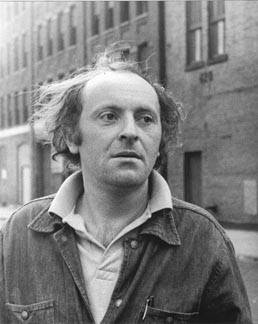
rus_lit_60_05Joseph Brodsky, convicted social parasite and Nobel Prize winner

By the way, this is yet another reason the abomination known as the Joseph Brodsky Memorial Apartment Museum, which seems closer than ever to becoming a reality, now that the Friends of Brodsky have finally made a deal with the nasty old neighbor lady from the Brodsky family’s communal flat in the Muruzi House who was holding out on the Friends of Brodsky and asking for too much for her portion of the flat, should never be opened, much less have been contemplated in the first place.

The nasty old neighbor lady has been the only (albeit inadvertent) heroine in this tedious, drawn-out saga, because she has been the only one of the players trying to prevent the building of a needless, unwieldy monument to a man who, whatever his other extreme personal and political quirks, would hardly have wanted to return—whether in the flesh, in the spirit, as a bronze suitcase with his severed head propped on top, as yet another salon of old knickknacks and furniture (aka the Russian writer’s museum), etc.—to a city which is not only run by a, so to speak, legitimately elected ex-KGB officer and where homophobia is not merely legalized but almost functions like a quasi-state ideology, but where the law that was used to put Brodsky away when he was just a punk poetry slammer is now being revived, if only, so far, on the “exploratory” and “thought experiment” level.
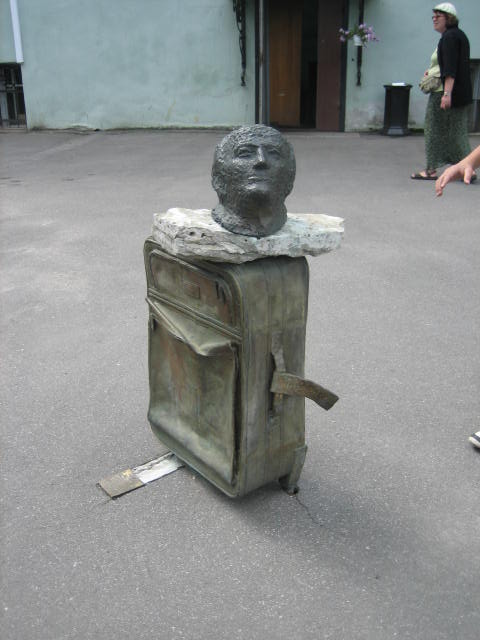
BrodskySimunKonstantin Simun, Memorial to Joseph Brodsky, Philological Faculty, Saint Petersburg State University

The Brodsky Museum should not be opened if for no other reason than that all these creeps from the Mariinsky Palace and the Smolny (you can fill in their names), so keen on grinding gays into the dirt and stigmatizing the jobless, among their other hobbies, will show up for the grand opening. And the Friends of Brodsky will have invited them there. God knows that is exactly how Brodsky would have wanted to be remembered—as a door mat for thieves and crooks to wipe their feet on while accumulating cultural capital. (They already have a lock on the real capital, the shiny stuff you can buy swanky digs in London with.)

Finally, note that the only person who talks any sense, in the article, quoted below, is the guy from the Communist Party. Go figure.

_________

In a move reminiscent of the Soviet era, Russian lawmakers have proposed introducing a penalty for being unemployed, and called for amending the Constitution to make labor the duty of each citizen, Russian media reported Monday.

The bill, drafted in the municipal legislature of St. Petersburg and soon to be introduced before the State Duma, would make “employment dodging” an offense punishable by community service, Izvestia reported. The daily claimed to have obtained a copy of the draft bill.

The move would echo the practice of the Soviet Union, whose Constitution enshrined labor as the “right” and also the “duty” of each citizen. It would also echo a law that the former Soviet republic of Belarus adopted recently, making “social parasitism” — a Soviet-era term for unemployment — punishable by a fine, in a bid to crack down on tax evaders.

Joseph Brodsky, one of Russia’s most prominent poets and its last Nobel prize winner in literature, was convicted of social parasitism during a 1964 trial, over the course of which the judge famously wondered who had recognized him as a poet.

Izvestia reported that under the new bill, adult and able-bodied Russians who have been out of a job for more than six months “when there is appropriate work available,” could be sentenced to up to one year of community service.

St. Petersburg lawmaker Andrei Anokhin was quoted by Interfax as saying that jobless Russians should apply to state-run employment agencies, and the “state should provide everyone with work.”

“Then it would be much easier to track down those who avoid working,” Anokhin was quoted by Izvestia as saying.

A lawmaker on the State Duma’s labor and social policy committee, Valery Trapeznikov, said that his panel would review the proposal, adding that Russians who do not work are costing the state income tax losses, the report said.

Communist State Duma deputy Vadim Solovyev referred to the proposal as “unconstitutional” in comments carried by Interfax.

“The introduction of a criminal penalty for being unemployed would mean violating the Constitution and international agreements,” Solovyev said Monday, noting that Russia is bound by its ratification of the International Labor Organization’s convention prohibiting forced labor.

Mikhail Yemelyanov, a Duma deputy from the A Just Russia party, said that he is confident the proposal will not survive a parliamentary vote. “This initiative cannot be approved because it is meaningless,” Yemelyanov told Interfax on Monday.

Meanwhile, Federation Council member Alexander Ryazantsky offered an alternative to the proposed penalty in comments to Interfax, suggesting that the unemployed should lose their rights to certain social benefits, such as advanced medical coverage and pensions.

source: Moscow Times

P.S. Kommersant reports a bill has been introduced in the State Duma that, if passed, would ban the use of hunger strikes “by way of resolving collective and individual labor disputes.”

You cannot make this stuff up, but they can. Have a gander at yesterday’s post, about the work-to-rule strike in Moscow medical clinics, where recent and current hunger strikes by Ufa health workers are also mentioned.

♦♦♦♦♦♦♦♦♦♦♦♦♦♦♦♦♦♦♦

1

Christmas has come and my pocket is empty.
My novel’s finished, but the publisher’s iffy.
The Koran has made the calendar itchy.
There’s no one to visit, no one to worry.
Not my pal, whose kiddies just bawl.
Not my folks nor the broad down the hall.
Everywhere money’s the end and be all.
I sit on a chair, trembling with fury.

2

Ah! the poet’s accursed craft.
The telephone is dumb, a diet’s at hand.
I could borrow at the local, but that’s
like borrowing from a dame.
Losing one’s independence is much worse
than losing one’s innocence. I suppose
it’s a vicarious pleasure to dream of a spouse,
to say to oneself, “It’s high time.”

3

Knowing my status, my betrothed
hasn’t changed hers five years in a row.
Where she is nowadays, I do not know:
The devil himself couldn’t make her spill.
She says, “It’s useless to grieve.
Feelings are what’s important! Agreed?”
And from where she sits, that’s keen.
But she, it seems, is more fond of the swill.

4

I’m altogether skeptical of kith and kin.
My extra stomach offends the kitchen.
To top it off, my personal opinion
of man’s role in life makes them bristle.
They consider me a bandit
and make a mockery of my diet.
With them I enjoy no credit.
“Cut him a piece of gristle!”

5

I see my unmarried self in the windowpane.
One simple fact I’ll never explain
is how I’ve survived until Christmas Day,
Nineteen Hundred Sixty-seven A.D.
Twenty-six years of jolts and bumps,
scrounging for money, the judge’s thumps,
learning to play the deaf-mute, to primp
for the Law like a lady.

6

Around me life flows like molasses.
(I have in mind, of course, the masses.)
Marx is vindicated. But, following Marx’s
theory, long ago I should’ve been slaughtered.
Whose balance this favors is anyone’s guess.
My existence is a philosopher’s mess.
I somersault from this age without a net.
Please forgive me my hauteur.

7

Meaning, there’s every reason to rest assured.
The cry “Mount your horses!” is no longer heard.
The nobles have been squashed to the last earl.
Pugachev and Stepan Razin are long gone, honey.
The palace is taken, if you believe the rumors.
Dzhugashvili lies, a pickled cucumber.
On the forecastle all the cannons slumber.
The only thing on my mind is money.

8

Money is hiding in safes and in banks,
in stockings, in ceilings, in toilet bowl tanks,
in fireproof tins, in money order blanks.
Nature is drowning in money’s mere!
Packs of the newest notes make a commotion
like the distant crowns of birches, acacias.
I’m overwhelmed by hallucinations.
Give me some air!

9

Night. The rustle of falling snow.
A shovel gently scrapes the pavement below.
In the window opposite, an icon lamp glows.
I loll on the sofa’s steel springs.
I see only the icon lamp. But the icon is
out of sight. I draw closer to the balcony.
The snow covers the roof with a blanket,
and the houses stand like someone else’s.

[…]

source
Standing Ovation

Kirill, white-bearded and bespectacled, clad in a black monk’s robe and a white cowl topped with a golden cross, started his Duma speech [in January 2015] by lambasting western liberalism, same-sex marriages, legalisation of euthanasia and other “pseudo-values” that are being “propagated in and even imposed on Russia”.

Kirill praised what he called the “Russian civilisation” rooted in the religious and political principles adopted from the Byzantine Empire. Comparing this “civilisation” to today’s West, he claimed the latter is doomed.

“The idea of absolute value and priority of freedom, the freedom of choice, and the refusal from the priority of ethical standards have become some sort of a time bomb for western civilisation,” Kirill said.

Kirill also offered his views on a kaleidoscope of topics that included statehood, ethics, family values and Russia’s plunging birth rates. He called on the lawmakers to ban free abortions at government health clinics. He urged them to increase the number of public school lessons on the Orthodox doctrine, provide state funding for Orthodox colleges, and include theology in the list of scientific disciplines.

The lawmakers gave him a standing ovation.

source: Al Jazeera

__________

10380895_915887598443308_8278153437058766447_n

“It’s easy to oppose abortions when you’re one of those who can’t get pregnant!”

source: Facebook (thanks to Comrade SC for the heads-up)

The Life and Times of a Russian Lawmaker

176303364

The topsy-turvy life and times of Alexei Zhuravlyov, Russian “lawmaker”:

MOSCOW, November 29 (RAPSI) – A Russian lawmaker said Thursday that the State Duma will throw its weight behind making sure that the Russian language is recognized as an official language of the EU. The drive could become a reality after changes to EU rules allowed citizens to propose adding languages as long as they could collect one million signatures, Defense committee member Alexei Zhuravlyov told a roundtable. Zhuravlyov said the signature-collection drive should not pose any problems as there were large Russian communities in the EU and that the initiative would be [supported] by a federal agency that promotes international cooperation. The proposal was first aired by Russian deputy Prime Minister Dmitry Rogozin.

Source

MOSCOW, October 19 (RIA Novosti) – A bill that proposes stripping gays with children of their parental rights, introduced by Russian lawmaker Alexei Zhuravlyov, has been withdrawn from the parliament, a spokesperson for the lawmaker said Saturday. “Yes, he has indeed withdrawn it,” spokesperson Sofia Cherepanova said, adding that the document would be later revised and again submitted to the Russian State Duma. She said that the author’s position on the matter “remains unchanged.” “Anyway, we are interested in passing the bill,” Cherepanova added. Zhuravlyov, a member of the ruling United Russia party, submitted the bill to the lower house of the Russian parliament in September. However, the proposal has not received any significant public backing.Between 5 and 7 percent of the Russian population are gay, a third of whom have children, Zhuravlyov’s bill claimed, citing unspecified experts. If true, between 2.3 million and 3.3 million Russians could possibly lose their children if the bill was passed.

Source

Photo © RIA Novosti and Sergey Mamontov

Andrei Malgin: A Mere Four Words

Today, October 11, is celebrated as National Coming Out Day in many countries around the world. Unfortunately, as respected Russian journalist and blogger Andrei Malgin reminded readers of his LiveJournal blog a few days ago, the Russian State Duma will, allegedly, soon be considering a bill that would make “non-traditional sexual relations” grounds for stripping Russian gays and lesbians of their parental rights.

NationalComingOutDay-300x285

__________

avmalgin.livejournal.com

A Mere Four Words

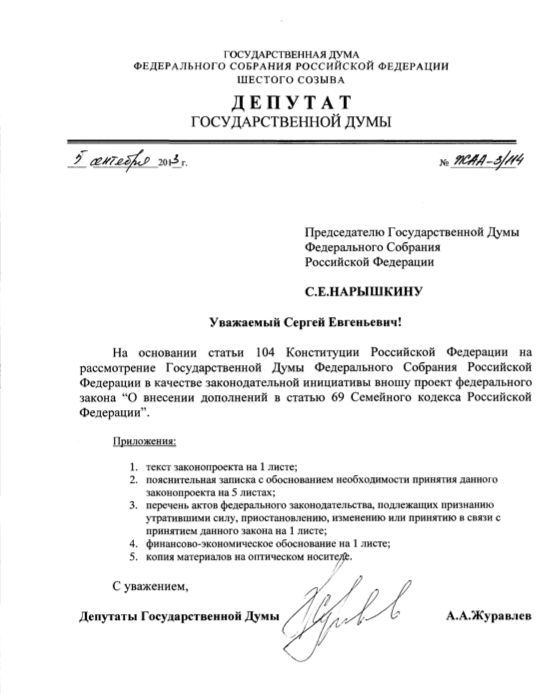
The State Duma has given the green light to Draft Bill No. 338740-6, “On Amending Article 69 of the Family Code of the Russian Federation (On Expanding the List of Grounds for Terminating Parental Rights).” A single line will be added to the list—a mere four words, but what weighty words they are.

Article 69 of the Family Code now reads as follows:

Parents (one of them) may be deprived of parental rights, if they:

 shirk the discharge of parental duties, including the willful refusal to pay child support;

refuse without good reason to take their child home from a maternity hospital (department) or other medical facility, educational establishment or social welfare institution, or other similar institutions;

abuse their parental rights;

treat their children cruelly, including exercising physical or mental violence against them, and infringing on their sexual inviolability;

suffer from chronic alcoholism or drug addiction;

have committed a premeditated crime against the life or the health of their children, or against the life or the health of their spouse.*

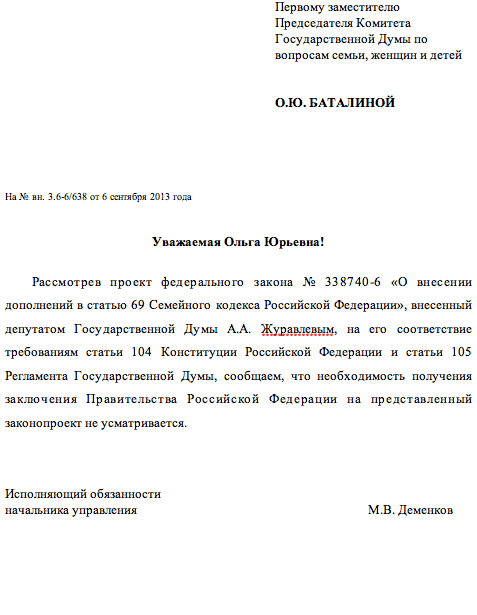
It all began with this. The draft bill itself looks like this. The draft bill was reviewed by the State Duma’s legal department, which issued a positive opinion. The relevant committee reviewed and approved it. All that remains is to schedule the date of the vote.

Full documentation of the bill is on the State Duma’s web site.

Thus, after the bill is passed into law, the Family Code of the Russian Federation will contain the following provision:

Parents (one of them) may be deprived of parental rights, if they:

have non-traditional sexual relations.

So, one divorced spouse wants to deprive the other of parental rights. She or he just has to inform the court that their ex-spouse once had non-traditional sexual relations. To make the charge stick, they can produce “witnesses” or get an affidavit from the neighborhood police inspector.

Or even better. Police raid a gay club and check people’s internal passports. Do any of them have children listed in their passports? That’s that: we’ll deprive them of their parental and send the children to an orphanage, where things will be better for them.

And so on.

And what scope for grassroots activism, for endless denunciations on the part of vigilant neighbors, disgruntled relatives, veterans committees, and so on.

Especially because, unless I’m mistaken, there is still no definition anywhere of what is considered traditional and what isn’t. If spouses have had oral sex, what is that? Traditional?

In an “Explanatory Note to the Bill,” the State Duma Committee on Families, Women and Children justifies the need to amend the Family Code thus:

In accordance with Article 63, Part 1 of the Family Code of the Russian Federation (hereinafter, “the Code”), parents are responsible for the upbringing and development of their children. They are obliged to take care of the health and the physical, mental, spiritual and moral development of their children […] Through life lessons and sometimes by their own example [they are obliged] to instill in the child traditional family values, loyalty to the Fatherland, respect for the older generation, and many other universal values.**

[…]

Unfortunately, experience shows that parents often do not completely fulfill their responsibilities for raising children, thus depriving them of a moral compass. […] In the final analysis, this is the cause of poor development, the degradation of a child’s personality and deviant behavior. Timely government assistance to such a child makes it possible to adjust their upbringing by transferring them to a foster family or putting them in the care of relatives or relevant institution. Implementing this assistance is only possible after the termination of parental rights, thus insulating the child from the immoral lifestyle of the parents or one of the parents.

On this basis, it appears that when one of a child’s parents has sexual contacts with persons of the same sex, the harm that may be caused to the psyche of this child is huge and cannot be measured by the Administrative Offenses Code, as the mother or father is a role model for their child. […] According to experts, the number of people in Russia with a non-traditional sexual orientation is around 5-7% (for large cities, the percentage is slightly higher), of which at least a third have children.

Based on this fact and the above-mentioned reasons, this bill proposes supplementing Article 69 of the Family Code of the Russian Federation with a new paragraph, according to which the grounds for terminating parental rights would be non-traditional sexual orientation on the part of one or both parents.

The adult population of Russia is 119 million people. Five percent (we’ll use the lower figure) is six million people. One third of them have a child, meaning there are two million such children. And what if they have two or more children? This is difficult to take into account, so let’s stick to the one-child minimum as the basis of our calculations. What do we end up with? It turns out that the State Duma is planning, in the spring of 2014, to add two million children to the ranks of the country’s orphans.

_____

Footnotes

* In his original post, Mr. Malgin does not quote the current wording of Article 69 in full. We have cited it here for convenience’s sake. The translation is our own.

** Actually, Article 63 of the Family Code does not stipulate that parents are obliged to inculcate “traditional family values, loyalty to the Fatherland, respect for the older generation,” etc., in their children.

_____

UPDATE. The draft bill has, reportedly, been withdrawn by its author, MP Alexei Zhuravlyov, but a spokesperson for him said that it would be revised and resubmitted to the State Duma. The news prompted journalist Masha Gessen to write this comment.