Vladimir Putin speaking with a group of Russian war widows. English subtitles by Julia Khazagaeva
Death as the national idea. Look at the faces of these women who lost their men in the war against Ukraine. They glow with newfound meaning. “I am a mom of four children and, recently, a widow…. Thank you, Vladimir Vladimirovich,” ”I lost my brother in the SVO [special military operation], but my three sons are growing up to be future defenders. Thank you,” they say to the killer of their kin. The Russian existential vacuum has finally been filled. Life has a purpose that redeems existence’s meaninglessness. Losing your life in war confers valor and honor. Nothing in the old life, in peacetime, guaranteed it. A contract [to serve in the army] turns a man into a hero. He is no longer a bastard in the eyes of the women who matter to him.
So the million lives taken by the war do not particularly faze anyone [in Russia]. All the sacrifices and victims are worthwhile as long as they are converted into national pride in the minds of Russians. They won’t spare three million people or more if it comes to it. And it doesn’t matter who they kill, whether they are Ukrainians, Estonians, or Poles. War is a drug. As long as war is underway, the harsh comedown is postponed. This is bad news for the world, especially for those who imagine that it is Putin who is waging the war, while Russians themselves want peace.
P.S. I made English subtitles for the video. You can download it from my Telegram channel. Show it to everyone seeking to understand l’âme russe mystérieuse.
“Tatiana Sokolova will never hear her son call her ‘mom’ again. He heroically fell in the special military operation zone,” began a news broadcast in the Chelyabinsk region about International Women’s Day celebrations for the mothers of Russian soldiers.
This event, which saw flowers handed to soldiers’ mothers, was organized by the United Russia Women’s Movement, a group affiliated with the ruling party.
It was just one of many celebrations focusing on the mothers and wives of soldiers fighting in Ukraine — as well as the widows and families of those killed — ahead of International Women’s Day this year.
International Women’s Day is one of Russia’s most significant holidays, celebrating women’s contributions to society, science and the workforce. It has deep roots in Soviet history, when it was promoted as a symbol of gender equality.
But since the full-scale invasion of Ukraine, Russian officials and state media have upheld a different ideal: being the wife or mother of a soldier.
“With the militarization of society, the education system and the economy, and with the ‘ideal citizen’ — the male soldier — being placed at the center, authorities are actively promoting the image of the soldier’s wife as his counterpart,” gender researcher Sasha Talaver told the Moscow Times.
“The portrayal of women in times of war and state crisis always emerges as a key point for political imagination,” Talaver said.
This Women’s Day, members of the United Russia party and pro-Kremlin activists have been delivering flowers, organizing literary events and visiting military families with gifts and food.
“We are proud of the women who raised the heroes of the special operation and the young men who have signed up as contract soldiers,” Senator Daria Lantratova, co-chair of the United Russia Women’s Movement, said this week.
The movement this week launched the “Flowers for the Mothers of Heroes” campaign to deliver presents and flowers to soldiers’ relatives, which has spread to 40 regions.
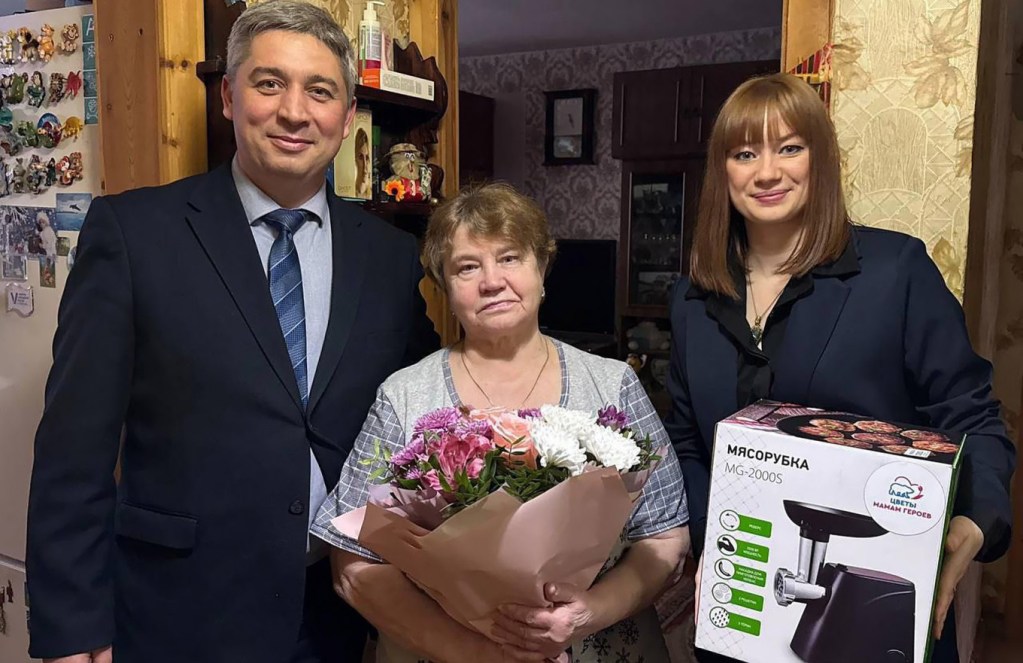
A resident of the Murmansk region who lost her son in the war was given a meat grinder for March 8 by the United Russia party. Photo: social media
In perhaps the most shocking Women’s Day event, mothers of fallen soldiers were gifted meat grinders from local United Russia officials in the Murmansk region.
The news sparked a wave of criticism, as the kitchen appliance has become a grim symbol of the Russian military’s high-casualty assaults in Ukraine.
After the story went viral in Russian and Ukrainian media, one mother of a deceased soldier recorded a video statement in which she said she had been planning to buy a meat grinder herself, but United Russia “gifted it to her just in time.”
“I actually asked you for it,” the elderly woman said.
In Cheboksary, a city in the republic of Chuvashia, officials organized an event exclusively for the widows and mothers of fallen soldiers.
“May grief soon turn into pride!” declared local deputy Yevgeny Kadyshev. The women were given bouquets and gift bags labeled “Happiness and Joy.”
Russian authorities, including the United Russia party, promote the image of a military wife or mother as the ideal of femininity, gender studies researcher Ella Rossman told the Moscow Times.
The United Russia Women’s Movement was founded in the months following the invasion of Ukraine in 2022 “as a clear response to feminist anti-war activism,” Rossman said, referring to groups like Feminist Anti-War Resistance and movements of mobilized soldiers’ wives and mothers.
“Right now, the most visible female archetype in the public sphere is the woman waiting for her soldier to return from the front,” Rossman said. “But this is not the only image. There are completely opposing narratives, like that of military women themselves.”
Rossman pointed to an article in a pro-Kremlin tabloid about a woman from Rostov who signed a military contract and went to war.
“She is a mother who left her daughter to fight, has already lost a leg in combat and tells journalists that as soon as she recovers, she will go back to the battlefield,” Rossman said.
Local television stations have been covering Women’s Day events for soldiers’ mothers and wives, while also highlighting women assisting the war effort or fighting on the front lines.
After these official celebrations, politicians sometimes invite the women for tea. In Stavropol, a table was set for the mothers and wives of soldiers following a concert at a veterans’ hospital.
“Some of them are waiting for their sons to return home. Others, unfortunately, have lost their defenders who gave their lives for the Motherland,” Senator Daria Lantratova, representing occupied Luhansk, wrote on social media.
United Russia activists also delivered flowers to soldiers’ mothers in occupied Donetsk.
“Your son is a hero. We congratulate you on this holiday and wish you well. We hope this war will end and peace will come,” a United Russia Women’s Movement activist told an elderly woman. After hearing the word “hero,” the woman teared up.
“Don’t cry,” the United Russia activist told the older woman as they parted.
Russian soldiers fighting in Ukraine also sent video messages to military mothers and widows ahead of the holiday.
“Heroes are born in families. Women give birth to us. Women raise us in kindergartens and schools. The making of any hero is thanks to the great women in his life,” Leonid Lapin, a soldier who fought as a sniper platoon commander in Ukraine, said in a video message.
Putin meets with Olga Chebnyova, widow of ‘Hero of Russia’ Sergei Chebnyov. Photo: kremlin.ru
United Russia has even involved children with disabilities in the celebrations. In the Yamalo-Nenets autonomous district, mothers from a center for parents of children with mental and physical disabilities — along with their children — made greeting cards for soldiers’ relatives.
“This is not just a good initiative. Seeing how children with special needs get involved, how their eyes light up, you realize we are on the right path,” said United Russia member Alexei Komarevtsev.
In an interview with a local news channel, he described the craft project as “socialization” for children with disabilities. Some of the cards, he added, will be sent to the front lines, “because there are also girls serving there.”
In some regions, such as Tula, soldiers’ wives and mothers received a one-time payment of 10,000 rubles (about $100) for Women’s Day. Elsewhere, gifts included makeup sets or tickets to the philharmonic.
In the Moscow region, United Russia organized a makeup seminar for soldiers’ wives, saying such initiatives “help strengthen family values and improve quality of life in society.”
“War disrupts social norms and the way of life,” Rossman said. “But war also imposes constraints on the very possibility of a rigid binary between male and female roles, even though war seems to fit that binary perfectly.”
That is likely why the authorities have been working overtime to reinforce the Kremlin’s idea of “traditional” values since the start of the war, she said.
“Russian authorities are forced to declare and reinforce traditional values [because] many families that were once intact before the war have now lost their fathers,” Rossman said. “There are also military women — doctors, for example — and women who have voluntarily gone to war. Ignoring these women is impossible. They, too, are a target audience from a propaganda standpoint.”
As the war drags on and Russia’s battlefield losses mount, authorities are forced to balance different ideals of femininity in their propaganda messaging, Rossman said.
“They are constantly having to create different female archetypes for different audiences,” she said.
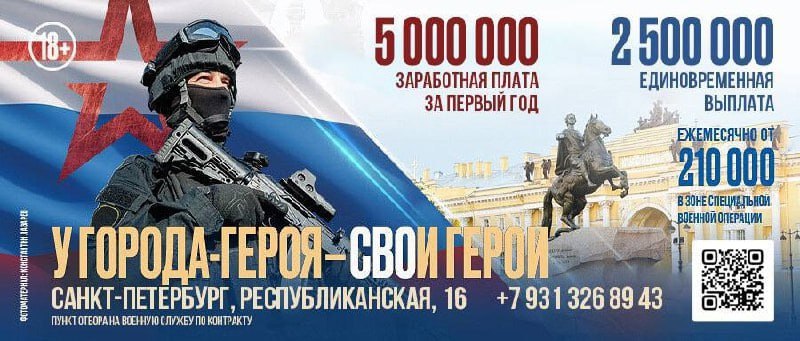
“A first-year salary of 5,000,000 rubles [approx. 48,000 euros]. A one-time [signing bonus] of 2,500,000 rubles. Monthly pay starting at 210,000 rubles [approx. 2,000 euros] in the special military operation zone. THE HERO CITY HAS ITS OWN HEROES. 16 Republican Street, Saint Petersburg, +7 931-326-8943.”
The signing bonus for volunteering for combat duty has been raised to 2.5 million rubles in Petersburg
The amount was increased by 400,000 rubles. Previously, those wishing to go to the front were paid a lump sum of 2.1 million rubles. On the poster, which was published in the Red Guards District administration’s chat group, the amount that can now be earned for a year of service in the war zone is listed as 5,000,000 rubles.
Judging by the information on the Smolny’s [Petersburg city hall’s]website, the signing bonus was increased three days ago, at the expense of the city budget. Rotunda was told the same thing at the military service recruiting center in the Central District.
Low-price chain store seeks a sales assistant-cashier.
Responsibilities: serving customers at the cash register; restocking products in the sales area; maintaining order and cleanliness. The candidate should be energetic, trainable, and ready for intensive work.
On-the-books employment. Schedule: two days on, two days off. Salary: 56,000 rubles[a month, i.e., approx. 540 euros a month].
The employer pays for training and a medical examination, offers corporate discounts at all stores in the chain, provides material assistance in difficult situations, and arranges for gifts for children.
In 2025, Russian authorities are continuing to increase payments for contract soldiers participating in the war in Ukraine.
From January, men who sign a military contract in the Samara region will receive a one-time payout of up to 4 million rubles ($38,900) — the highest of any region in the country.
In addition to these one-time payouts, which vary by region, military personnel also receive a monthly salary of at least 210,000 rubles ($2,000). In the event of a soldier’s death, their family is entitled to a “funeral allowance,” which can amount to up to 5 million rubles ($48,600), according to a presidential decree.
The substantial payouts to contract soldiers are part of the authorities’ efforts to turn the military into the country’s new elite, says historian Dmitry Dubrovsky.
“One of the key outcomes of the ongoing war is the attempt to construct a ‘Putin Elite 2.0’ to replace the original elite that emerged in the early 2000s, built on oil and gas revenues,” Dubrobsky said. “This process began as early as 2014, when the ‘heroes of the Russian Spring’ gradually started integrating into Putin’s regime. However, it became fully evident with the onset of the full-scale aggression [against Ukraine].”
In addition to million-ruble payouts, the state also provides military personnel with subsidized mortgages and free university education for their children, including at prestigious institutions such as Moscow State University and the Higher School of Economics.
Nearly 15,000 soldiers who fought in Ukraine, as well as their children, were admitted to Russian universities under this program in 2024 — almost double the number from 2023. And increasingly, Ukraine war veterans are being appointed to political roles, though not on a wide scale.
“The privileges of military personnel are evident in the growing practice of integrating ‘veterans’ into various political projects and regional administrations, often as deputy governors,” says historian Dubrovsky. “Overall, the families of military personnel see themselves as part of a superior class, a perception eagerly reinforced by Putin’s propaganda.”
Monterey, California, 4 November 2024. Photo: The Russian Reader
I’m worried about the left’s demonization of America’s origins and the future of Western civilization, as many conservatives feel that the basic tenets of society as we’ve known it are under attack.
Carolina Performing Arts, “Omar the Opera: Behind the Scenes”
Rhiannon Giddens’ opera Omar was presented at Carolina Performing Arts in February 2023. In this video, take a deep dive into the opera’s creation and hear from cast members about their experiences. To learn more, visit: https://southernfuturescpa.org/projects/omar/Omar was co-commissioned and co-produced by Spoleto Festival USA and Carolina Performing Arts at the University of North Carolina at Chapel Hill. Additional co-commissioners include LA Opera, Boston Lyric Opera, San Francisco Opera, and Lyric Opera of Chicago.
“Video has come out from Bucks County, Pennsylvania showing a ballot counter destroying ballots for Donald Trump and keeping Kamala Harris’s ballots for counting,” an account called “Dan from Ohio” wrote in the comment section of the far-right website Gateway Pundit. “Why hasn’t this man been arrested?”
But Dan is not from Ohio, and the video he mentioned is fake. He is in fact one of hundreds of inauthentic accounts posting in the unmoderated spaces of right-wing news site comment sections as part of a Russian disinformation campaign. These accounts were discovered by researchers at media watchdog NewsGuard, who shared their findings with WIRED.
“NewsGuard identified 194 users that all target the same articles, push the same pro-Russian talking points and disinformation narratives, while masquerading as disgruntled Western citizens,” the report states. The researchers found these fake accounts posting comments in four pro-Trump US publications: the Gateway Pundit, the New York Post, Breitbart, and Fox News. They were also posting similar comments in the Daily Mail, a UK tabloid, and French website Le Figaro.
“FOX News Digital’s comment sections are monitored continuously in real time by the outside company OpenWeb which services multiple media organizations,” a spokesperson for the company tells WIRED. “Comments made by fake personas and professional trolls are removed as soon as issues are brought to our attention by both OpenWeb and the additional internal oversight mechanisms we have in place.”
Breitbart replied to WIRED’s request for comment in Russian: “Пожалуйста, скажите Newsguard, чтобы они пошли на хуй.” In English, this means “please tell Newsguard to go fuck themselves.”
The Gateway Pundit and the New York Post did not respond to a request for comment from WIRED.
“The actors behind this campaign appear to be exploiting a particularly vulnerable part of the media landscape,” McKenzie Sadeghi, the AI and foreign influence editor at NewsGuard, tells WIRED. “Comment sections designed to foster reader engagement lack robust security measures, allowing bad actors to post freely, change identities, and create the illusion of genuine grassroots campaigns rather than orchestrated propaganda.”
The disinformation narratives being pushed by these accounts are linked to Storm-1516, according to Newsguard. Storm-1516 is a Russian disinformation campaign with a history of posting fake videos to push Kremlin talking points to the West that was also connected to the release of deepfake video falsely claiming to show a whistlelbower making allegations of sexual assault against vice presidential candidate and Minnesota governor Tim Walz. (WIRED first reported that the Walz video was part of a campaign by Storm-1516. A day later, the US government confirmed WIRED’s reporting.)
Links to the video were posted by multiple accounts with names like “Disobedient Truth” and “Private Patriot” in the comment section of outlets like Breitbart and the Gateway Pundit.
“More bad news for the Dems: Breaking: Tim Walz’s former student, Matthew Metro, drops a shocking allegation- claims Walz s*xually assaulted him in 1997 while Walz was his teacher at Mankato West High School,” the comments read.
The links posted in the comments came hours before the video was shared on social media platforms like X, where it racked up millions of views.
“Replying in threads is a tactic that can have an impact with very little investment,” Darren Linvill, codirector at Clemson University’s Media Forensics Hub, tells WIRED. “By inserting disinformation into an unrelated conversation it might be seen, even if the account being used has no followers and was just created yesterday. It also doesn’t matter if the account you are using is caught and shut down because you haven’t lost an investment, you can just create another account five minutes later.”
The fake comments, Newsguard found, are also then used in reports from Russian state-backed media outlets to bolster claims about how Western audiences are responding to a particular incident.
After the Trump assassination attempt in July, Tsargrad TV published an article titled “Biden’s Trace in Trump’s Assassination Attempt. Americans Agree with the Kremlin’s Version: ‘Russians Are Right.’” The article outlined how Americans believe that the Biden administration played a part in the shooting, citing “comments to articles in Western media” as evidence.
NewsGuard’s researchers identified 104 articles in Russian state media that cited comments from Western news outlets as evidence to back up their claims between January and August of this year.
“This tactic allows bad actors to reduce the risk of detection and embed propaganda in a subtle, seemingly organic way, blending it into the casual commentary of supposed everyday Western readers,” Sadeghi said. “The repetition of the same claim across multiple formats and contexts can create a sense of familiarity that may lend the narratives an appearance of credibility.”
The network of accounts has also been used to seed other narratives, including one earlier this month where dozens of comments in the New York Post and Breitbart claimed, without evidence, that Ukrainian president Volodmyr Zelensky had used Western military aid to purchase a car that once belonged to Adolf Hitler.
That claim has been spread by the network of inauthentic websites controlled by former Florida cop John Dougan, who now lives in Moscow and runs a network of pro-Kremlin websites. Dougan’s network of websites have previously shared disinformation narratives from Storm-1516.
This very disturbing story about Russian grassroots lucre in wartime was published on the front page of yesterday’s print edition of the New York Times. I’m quoting it in full here for the benefit of non-subscribers.
On the other hand, as perhaps only I am in a position to know, there is something disturbing about how certain of the sources for this story boldly claim eyewitness-like knowledge of events in the Russians provinces which they couldn’t possibly have witnessed, while also cashing in on the chaos unleashed by Russia’s vicious war against Ukraine, only from the opposite side of the world.
I’m also troubled that PS Lab, which was founded long before the war, is portrayed here as an outgrowth and brainchild of those selfsame academic entrepreneurs at George Washington University. ||| TRR
Expensive new cars and motorcycles crowd the streets. Apartment prices have more than doubled. And once-strapped residents are suddenly seen wearing fur coats and carrying ostentatiously overflowing grocery bags.
That is how one resident of a small, long-impoverished industrial city in Siberia describes her hometown these days. The explanation for the burst in prosperity lies in the isolated cemetery, with rows of Russian flags marking the new graves of soldiers killed in Ukraine, and also downtown, where a billboard lists the scores of local men who went to fight.
“I was stunned by how many,” said the resident, the wife of a middle-aged firefighter who enlisted last summer without telling her beforehand. “Money from the war has clearly affected our city.”
The Kremlin has been showering cash on men who enlist. It wants to avoid an unpopular draft, while also addressing the lack of men with sufficient patriotic zeal to join up. There are large signing bonuses, fat monthly salaries and what Russians call “coffin money,” a substantial payment to the families of the tens of thousands of soldiers killed in battle.
The money is changing the face of countless Russian backwaters like the Siberian city. “The allure of extremely high salaries and other benefits has been a major factor in attracting voluntary recruits, especially from relatively poor regions,” said a report issued this year by the Bank of Finland’s Institute for Emerging Economies.
By improving the standard of living among Russia’s poor, the payments have spurred support for President Vladimir V. Putin and the war, researchers noted, while also changing the perception of fighters from patriots to “soldiers of fortune.”
The names and hometowns of the people living inside Russia who agreed to discuss these war payments are not being published to avoid possible legal problems for speaking publicly about the conflict.
Russia has stopped publishing various economic statistics, leaving only a patchwork of indicators about the effects of the war payments. Some studies have documented the influx, however.
For example, the Bank of Finland researchers found that the number of bank accounts in Russia’s poorer areas surged over the past year. Nationwide data was too uneven to establish a concrete correlation with signing bonuses and enlistment data, the study said, but general estimates of casualties by region coincided with the areas experiencing high growth in bank depositors.
Also, in recent months, recruitment posters across Russia changed noticeably, replacing patriotic themes with financial offers. State TV and advertisements on social media carried the same messages.
“Pride of Russia,” some ads used to say, naming the soldier pictured, or “Homeland Begins with Family,” showing a soldier silhouetted with a mother and child. There were comparisons to heroic feats during The Great Patriotic War, as World War II is known in Russia.
Now, a ruble sign dominates the posters, which display the large sums on offer for signing a military contract. Payments vary by region.
“The people who wanted to join out of patriotic sentiment have mostly already been recruited and died or were wounded,” said Oleg Jouravlev, one of the founders of PS Lab, a group of mainly sociologists organized under the Russia Program at George Washington University to study attitudes toward the war. “There are not many like that left in Russia.”
On July 31, Mr. Putin issued a decree more than doubling the contract signing bonus from the federal government to 400,000 rubles, or more than $4,000, from 195,000 rubles. At least 47 regional governments followed suit after he encouraged them to match the reward, according to a survey by the independent media outlet iStories, with the average signing bonus nationwide quadrupling in the past eight months.
U.S. officials estimate that Russia is recruiting 25,000 to 30,000 new soldiers a month, roughly equal to the number of dead and wounded. As soon as local governments see interest lagging, they jack up the financial incentives, experts say.
This past month, the frontline Belgorod region broke all records with a signing bonus amounting to more than $30,000, well above the previous leader, Moscow, at about $20,000. The lowest bonuses are around $500.
The larger sums constitute a small fortune in many of the less developed towns and villages of Russia — where the average salary is a few hundred dollars per month — especially when combined with a frontline fighter’s monthly salary starting at 210,000 rubles, or about $2,100.
A study of the payments for Re: Russia, an online platform for political and economic analysis, found that the signing bonus equals roughly the average annual per capita income in Russia, and the monthly salary is three times the average wage. Rural wages are significantly lower than those in big cities.
“The money is a social elevator for those who went to war,” said Ayan, a resident of Buryatia, a Siberian region with a considerable proportion of people living below the poverty line and high levels of personal debt.
Coffin money payments amount to almost $150,000 per family, enough to buy an apartment in all but the most expensive Russian cities. While an apartment is often the main goal, recipients say they buy all kinds of things, including new teeth, breast implants and vacations.
The war payments are especially attractive to impoverished, middle-aged men who see them as their last chance to escape a lifetime of debt, said Ivan Grek, the director of the Russian Program at George Washington University. Beyond that, people getting the money are eating in restaurants, and buying cars, electronics, clothes and property.
Government statistics from early 2024 show a 74 percent growth in ordinary Russians across the country purchasing cars compared with the same time period last year, Mr. Grek noted, while those paying off consumer debts jumped to 21 percent, up from about 9 percent before the war.
“There is the spirit of a party out there,” he said, even if the source of the money limits the euphoria. His program recently sent three researchers to live for a month in small Russian communities to gauge perceptions of the war. “Now they have a car, they can drink and eat, it is a whole new life for them,” he said.
Artem, a soldier who fled Russia, estimated that 60 percent of the men in his unit signed up because they had unpaid loans. “Almost all of them had problems with alcohol and debt,” he said.
Some experts question whether the spiraling payouts are sustainable and expect that the draw, like patriotism, will eventually fade. Overall, war payments to Russian soldiers — whether for signing, injury or death — will amount to at least 7.5 percent of federal spending for the year, according to Re: Russia.
The sister of a dead officer from Makhachkala said that while he was alive he kept telling her that the death payment would take care of her, their mother and his daughter: “‘Buy an apartment,’ he said, and I told him, ‘You are a moron! Don’t even say such things.’”
Despite the shattering grief after his death, the sister said, the money makes it feel as if her brother is watching over them posthumously. “He did everything he wanted for us,” she said.
The money often has a trickledown effect. A resident of North Ossetia said that a couple of years ago his local plumber had applied to emigrate due to the lack of work. But recently, he said, the plumber told him, “I’ve never had so much work in my life,” with war widows buying new apartments or refurbishing old ones.
The firefighter from Siberia, aged 46, had gone heavily into debt over failed foreign exchange trades, according to his son. After losing several fingers in an industrial accident, he had burned through a $25,000 settlement and a considerable chunk of his disability pension. The father sold the family car to raise money, but ultimately the man filed for bankruptcy before enlisting.
A few days after the first interview for this article, the firefighter’s wife, who had not heard from him in a month, received a military report saying that he had been shot in the chest and killed on July 30, just four days after he deployed in Ukraine. Two younger soldiers trying to rescue him also died, but no bodies have been recovered.
“You are signing your death warrant,” his son said of his father’s decision to enlist. “It was a foolish decision to abandon my mother and my sister and cause everyone so much pain. Money is irrelevant in this situation.”
Reporters without Borders demand Russia ends torment of Crimean Tatar journalist sentenced to 14 years for defending human rights (Kharkiv Human Rights Protection Group, 1 November)
Fundraiser for scary drones (Solidarity Collectives, 30 October)
Upcoming events:
Thursday, 7 November, 19.00. On Zoom. Emergency Forum on the US presidential election with Tanya Vyhovsky (Vermont State Senator), Bohdan Ferens (SD Platform Ukraine) and Alex Sobel MP. Ukraine Solidarity Campaign.Information and registration here.
Monday, 18 November, 18.00. “Political prisoners in Russia and the Occupied Territories of Ukraine”. Panel discussion with speakers from Memorial, Kharkhiv Human Rights Protection Group and others. Queen Mary University, London, Centre for Eurasian, Russian and East European Studies. This is a hybrid event with in-person and on-line attendance. Register on eventbrite here
This bulletin is put together by labour movement activists in solidarity with Ukrainian resistance. To receive it by email each Monday, email us at 2022ukrainesolidarity@gmail.com. To stop the bulletin, reply with the word “STOP” in the subject field. More information at https://ukraine-solidarity.org/. We are also on X, Facebook and Substack, and the bulletin is stored online here.
John Oliver’s compelling but soberly made case for voting for Kamala Harris was pointed out to me by my fellow exile from fascist Russia, Mark Teeter. ||| TRR
Expo of war materiel captured in SMO opens in Petersburg on National Unity Day; visitors handed volunteer army service recruiting brochures
Visitors to the Russia Is My History Park were shown equipment from the Kharkiv and Sumy fronts, including an American Abrams tank and a Bradley IFV. The city hall media outlet Petersburg Diary reports that the exhibition was organized at the behest of Governor Alexander Beglov.
Beglov himself attended the opening. In his speech, Beglov said that, in the SMO [special military operation], the enemy’s vehicles “burn just like they burned during the Great Patriotic War.”
“Only three of the twenty-two ‘death machines’ [on display] are Ukrainian-made. All the rest were made in America, Canada, Europe and even by our neighbors in Finland, who basically have always lived at our expense,” Fontanka quotes the head of the city as saying.
Fontanka reports that there were so many visitors in the park that it was difficult to get close to the [captured] equipment. Those who came to the expo were handed propaganda booklets about volunteering for the army. Volunteers who are sent to the SMO zone are now promised 2.1 million rubles [approx. 19,500 euros] in a lump sum and 210 thousand rubles [approx. 1,950 euros] monthly.
The Russian Justice Ministry has once again designated Republic a “foreign agent.” This happened for the first time in 2021, but at that time a legal entity with which we soon severed ties was placed on the register of foreign agents. Now the publication itself has been put on the register. We are charged with “shaping a negative image of the Russian Federation,” as well as publishing “inaccurate information about the decisions taken by Russian federal officials and the policies they pursue.” I would like to remind you that Republic has always been financed solely by subscriptions, and Justice Ministry’s unjust ruling is a great reason to subscribe (if you are not subscribed already) or to renew your subscription.
And now, as usual on Saturdays, here are links to our latest articles and the best stories of the past week.
In “Power,” Ivan Davydov attempts to explain the psychology of Russians who have taken a position neither for nor against the war, but are “unopposed” to it. They probably make up the majority, but what explains their stance? A habitual mindset that regards political power as a force of nature, with which nothing can be done and which is better to ride out. “This stance is ethically vulnerable, but it is warranted by the know-how of several generations and supported by the self-preservation instinct,” argues Davydov.
[…]
Dmitry Kolezev, Editor-in-Chief, Republic
P.S. This is my last newsletter as editor-in-chief of Republic. I am leaving the post of my own free will. I announced my resignation a week ago: it has nothing to do with the Justice Ministry’s decision. I thank the authors, editors, and readers of Republic for the three years we have spent together. As they say in such cases, take care of Republic. And take care of yourselves, too.
Source: Republic Saturday newsletter, 1 June 2024. Translated by the Russian Reader, who has (mostly) happily subscribed to Republic for several years running. I will definitely be renewing my subscription later today to show them my support.
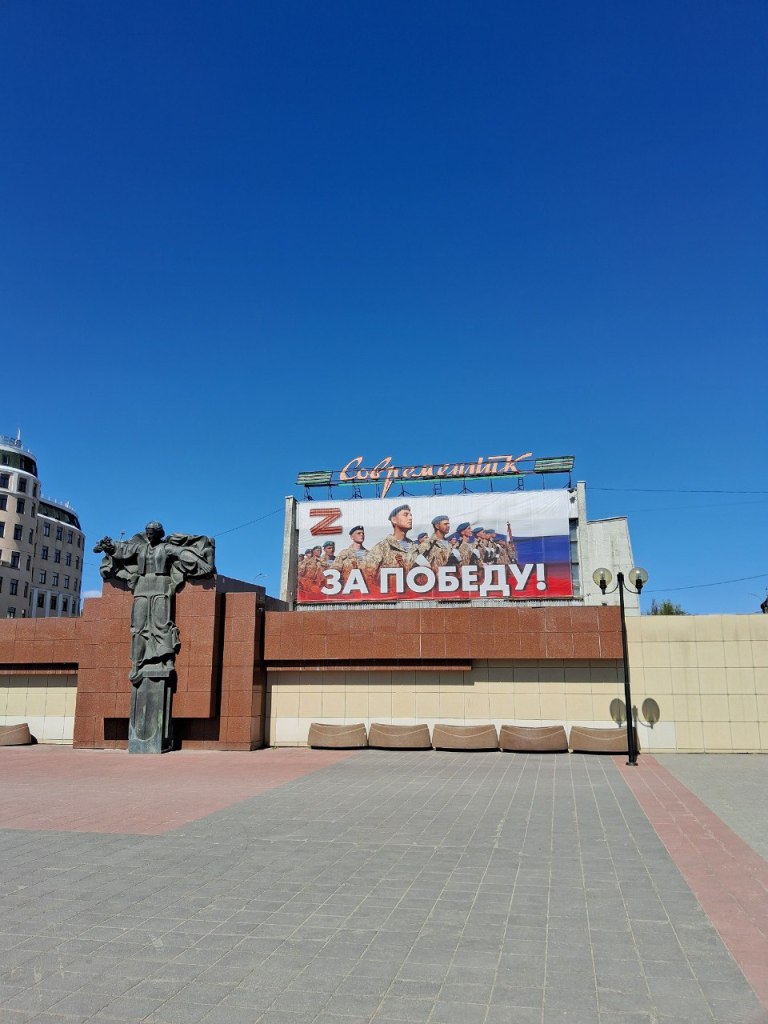
A “For Victory!” banner on the facade of the Contemporary, a long-shuttered movie house in Ivanovo, Russia. Photo: Ivan Davydov/Republic
Since the death of public opinion polling, people who are professionally obliged to speculate about Russian politics and make predictions about the future have been looking for signs literally everywhere, gradually turning from analysts into soothsayers.
For example, a respected opposition political scientist based in Europe recently wrote that “General Popov’s arrest may generate serious friction between society and the authorities.” By the way, this same political scientist has also been trying to gauge the mindset of Russians by counting the poop (excuse me!) and other unpleasant emojis that Russians (presumably) post as comments on the Telegram channels of Russian government officials and pro-regime propagandists.
He is an optimist, of course, confident that the regime is about to collapse. Poop emojis don’t lie!
Another political scientist, a pessimistic lady, on the contrary, gazes at Russia from her distant American vantage point, but does not even condescend to comment—she simply reposts a photo from a certain bookstore where Darya Dugina’s works are displayed on a separate shelf.
And really, what good are words? One glance at the photo is enough to get the whole point, to forget forever about terrible present-day Russia and wave it goodbye.
Nor am I an insider, alas. I’m not endowed with secret knowledge, and it has been a long time since I perused the “real polls” said to be commissioned by the presidential administration and other important agencies. Frankly speaking, I’m not even sure that such studies are still being conducted.
But there are still some advantages to being a participant observer, a person looking at Russia from the inside. In any case, I will risk sharing my own observations.
Has the Russian state been expanding into the cultural realm (since we mentioned bookstores)? Does it seek to reshape culture for propaganda needs? Yes, undoubtedly. It would be foolish to deny the obvious. And it has been invading more and more realms, where, until recently, it seemed one could sit back and wait out the storm. It has finally gone after “bad” books in a big way, it seems. Museums have also been toeing the line. Right now, for example, there are two exhibitions related to the special military operation underway in Moscow: Behind the Lines, a large-scale project at the Russian State Historical Museum, in whose launch [pro-war TV presenter] Vladimir Solovyov personally had a hand; and War Correspondents, at Zaryadye Park, in which the work of today’s TV correspondents is shown as a continuation of the work of journalists during the Second World War, in full compliance with the basic propaganda narratives. Regional museums have not been lagging behind the capital’s museums either.
Although television has indeed reduced the number of programs dealing with the ins and outs of the special military operation, even now they take up most of the airtime on the major channels.
The information warriors have been firing all guns. The only question is their firepower’s effectiveness.
In February and March 2022, the special military operation was undoubtedly the main topic of all conversations, from television studios to kitchens. Emotions were voiced in a variety of ways (and I wouldn’t say that enthusiastic support prevailed in the kitchens and subways), but rather quickly it all shifted to the outskirts of public opinion. There has been a “normalization” (that’s the accepted term, it seems) that has equally outraged both the vocal pacifists and the supporters of an immediate nuclear strike on Washington, the latter, perhaps, even more so. Complaints that no one on the home front cares about the war front are the leitmotif of many posts on the social media channels of the Zeds [Russian pro-war activists].
The zed (since we are on the subject of signs) is also an important sign. Nowadays you can find this letter in ordinary Russian cities, but it is no longer as prolific as it once was. There is, as a rule, one, big, main zed (Z) somewhere on a government building in the city center, but that’s all. And even that one is faded, mounted there long ago and thus overly familiar to the point of invisibility.
There are, of course, the Defense Ministry posters for recruiting contract soldiers. But they seem out of context as it were, speaking as they do about the chance to “join up with people just like you,” solve your financial and social problems, and, ultimately, rake in hefty paychecks. They are outside of time and devoid of specifics, of references to reality. We see a rugged-looking man in soldier’s kit, the Russian tricolor flag, tantalizing numbers….
If we speak, as is fashionable, of the current Russian regime as restorationist, we can argue that the country’s masters have succeeded in restoring only one thing—total depoliticization, the leadership’s fear of any doings that might be unwieldy and thus regarded as political. This was typical of the late-period Soviet Union (and ended overnight, we should note, when Gorbachev loosened the screws a bit). Cities that are like enclaves, people who are like atoms, the plight of the Russian opposition in the twenty-teens, and the isolated (yes, as yet isolated) crackdowns have vividly reminded the doubters what happens to eager beavers.
In this sense, nothing has changed in recent years. Perhaps the intensifying propaganda shows that the authorities have new ideas in this regard, that they have decided to make their words about the nation’s unprecedented unity mean something. It is unclear why, though: the regime will get nothing but problems by politicizing the populace. So far all these efforts have failed, however. The Master and Margarita and 1984, not the works of the Dugin family, are still atop the Russian bestseller lists. Brought to museums by their teachers, schoolchildren yawn and poke at their smartphones, while adults are almost absent. The escalating propaganda makes people neurotic rather than political, but since Soviet times the populace has had a remedy—an effective remedy—for countering this neuroticization.
It’s all the business of the folks in power. As long as it doesn’t directly concern you, don’t make a move, nothing good will come of your flailing. Political power is a force of nature, an element beyond human control, so try to have as little contact with it as possible. When asked whether you are for or against something, answer evasively, “I’m unopposed to it.” Better yet, hang up immediately if pollsters call you. The times are such that they can be even more dangerous than bank fraudsters.
Talking to crooks may make you poorer, but it certainly won’t get you sent to prison.
This stance is ethically vulnerable, but it is warranted by the know-how of several generations and supported by the self-preservation instinct. This stance poses obvious problems for the future—for any future, both the one cherished by fans of rights and freedoms and the one imagined by armchair slayers of Washington.
In his state of the nation speech, President Vladimir Putin announced the launch of the national project “Time of Heroes” for veterans and current participants of the special operation by Russian troops in Ukraine.
Photo: Pixabay courtesy of Rabota.ru
Servicemen with university degrees, managerial experience, and no criminal records can apply to the personnel program. The head of state called such people the country’s “true elite” and argued that they should “lead regions, enterprises, and the largest public projects.”
The program will kick off on March 1. Veterans will be trained per the standards of the School of Governors and the Leaders of Russia competition, and ministers and heads of enterprises will act as their mentors.
Currently, all participants of the special military operation also enjoy priority hiring, and their employers also receive benefits.
Crimean Solidarity journalist and activists arrested, their families terrorized, in new Russian offensive against Crimean Tatars (Kharkiv Human Rights Protection Group, March 6th)
Ominous denials a month after Crimean Tatar father abducted by Russian FSB (Kharkiv Human Rights Protection Group, March 6th)
Reshat Ametov and 10 years of Russia’s systematic torture, abductions and killings of civilians for supporting Ukraine (Kharkiv Human Rights Protection Group, March 4th)
Russia passes huge conveyor belt sentences against Ukrainians tortured for propaganda videos (Kharkiv Human Rights Protection Group, March 4th)
All’s fair in art and war: Russia’s plunder of Ukrainian museums (The Insider, February 29th)
Veterans of the special military operation and combat veterans will be able to teach the new subject “Fundamentals of the Security and Defense of the Motherland” in schools after undergoing retraining at the State University of Education (GOOP), according to Education Minister Sergei Kravtsov, who was speaking at a plenary session during the Russian national pedagogical forum “Memory Is Sacred.”
“A center for retraining veterans of the special military operation and combat veterans as teachers was created this year at GOOP to implement a new subject area with a priority on practical training in the new subject ‘Fundamentals of the Security and Defense of the Motherland,'” Kravtsov said.
According to the minister, the basic military training module would be enhanced in this subject, which is being implemented as part of the “Fundamentals of Health and Safety” curriculum. The new subject would be trialed this year, and it would be taught in schools beginning in the next academic year, he added.
On June 30, Kravtsov said that, as part of the subject, schoolchildren would gain knowledge of the “role the defense of the country plays in its peaceful socio-economic development and the current complexion of our our Armed Forces.” Schoolchildren would be introduced to concepts such as “military duty” and “military service.” The minister emphasized that the load on schoolchildren would not increase—the number of classroom hours would remain the same.
GOOP’s acting rector Irina Kokoyeva told Vedomosti that the Apex Center for Military-Patriotic Education had been operating at the university since September 1. One of the center’s focus areas is the professional development and retraining of special operation veterans as coordinators of military-patriotic clubs and teachers of the subject “Fundamentals of the Security and Defense of the Motherland.” “We plan to recruit a pilot group in this focus area. Information about the conditions and criteria for recruitment will be posted on the university’s official website in the near future,” she added.
Tuition for veterans of the special operation will be free, Olga Kazakova, head of the State Duma’s education committee, told Vedomosti. According to her, the program at the training center will help veterans who don’t have the requisite knowledge in the fields of child psychology or pedagogy. The deputy also recalled that it was the education committee’s initiative to establish the center. “Together with the State Duma’s defense committee, we are forming a working group on the teaching of this subject. And, of course, we will be directly involved in the process of preparing the curriculum, teachers, and the facilities and resources for these lessons,” she added.
All people, regardless of whether they were involved in the special operation, must undergo special psychological tests to be cleared to work with children, says clinical psychologist Ilya Gavin. “It is good practice to check any category of people working with children. People come in all shapes and sizes, including those with PTSD [post-traumatic stress disorder],” the expert said.
Per the Health Ministry’s standing order No. 342n, all teaching staff are required, as of 1 September 2022, to undergo a psychiatric examination to be cleared to work with children. Previously, teachers were only required to undergo an annual medical examination, as well as an examination when applying for a job. Prior to 2022, employees of educational institutions underwent psychiatric examination at least once every five years.
According to Gavin, the time it takes to recover from PTSD and return to everyday life directly depends on the severity of the disorder, because it can also be accompanied by the emergence of addictions. “The rehabilitation period can vary from three months to a year. The PTSD treatment protocol also includes ten to fifteen sessions of work with a psychologist once a week,” Gavin concluded.
GENEVA, June 15 (Reuters) – A group of U.N. experts said on Thursday they had written to Moscow raising concerns about the use of torture by Russian military forces on Ukrainian civilians and prisoners of war.
The U.N. experts said in a statement the torture included electric shocks, hoodings and mock executions and had been carried out to extract intelligence, force confessions or in response to alleged support for Ukraine’s forces.
It had resulted in damage to internal organs, cracked bones and fractures, strokes and psychological traumas, they said.
A spokesperson for Russia’s diplomatic mission in Geneva did not immediately respond to a request for comment. Moscow has previously denied torturing or mistreating prisoners of war and says it does not deliberately target civilians in Ukraine.
While torture allegations have previously been levelled against both sides in the 15-month conflict, the team of U.N. independent experts said Russian forces’ methods may be “state-endorsed”.
The consistency and methods of alleged torture suggested “a level of coordination, planning and organisation, as well as the direct authorisation, deliberate policy or official tolerance from superior authorities”, according to U.N. Special Rapporteur on Torture Alice Jill Edwards, who sent the letter on 12 June alongside several other independent experts.
“Obeying a superior order or policy direction cannot be invoked as justification for torture, and any individual involved should be promptly investigated and prosecuted by independent authorities,” she said.
Under the U.N. system, a government has 60 days to give a formal response.
A roadside fireworks stand in Soledad, California, 28 June 2023. Photo by the Russian Reader
When issuing diplomas, colleges in Ingushetia now require graduates to sign a summons to the army or refuse to accept the conscription notice and face possible administrative and criminal charges, Fortanga was told by a source close to one college.
“To get a diploma, you need to sign a conscription notice. Otherwise, you will not receive a diploma no way no how. Either you accept the conscription notice, or you sign a waiver . That is, accepting the notice means you have to join the army, while turning it down means saying ‘Hello, prison, here I come,'” the source said.
According to the source, the practice was introduced after the director of the college in Nizhnie Achaluki reported, at a meeting involving the head of the republic Mahmud-Ali Kalimatov, that thirty students had been drafted from his institution into the army. Subsequently, military enlistment officers and government officials “jumped on the bandwagon,” the source claims.
Students are being forced to come to colleges in person to get their diplomas, the source added. That is, young men cannot receive them by mail or ask that they be handed over to a family member or a proxy.
When the graduate refuses to sign the conscription notice, a report is immediately drawn up and signed by witnesses. First-time offenders face administrative charges under Article 21.5 of the Administrative Offenses Code (i.e., “Non-fulfillment of military registration duties by citizens”) and a fine of 500 to 3,000 rubles. Repeat offenders face criminal charges under Article 328 of the Russian Federal Criminal Code (i.e., “Evasion of military and alternative civil service”) and a fine of up to 200,000 rubles, forced labor, arrest, or imprisonment for up to two years.
Ingush lawyer Kaloy Akhilgov noted that the legality of such a practice “depends on the procedure for issuing a summons.”
“Educational institutions can only serve conscription notices, not issue them themselves. That is, first the military enlistment office must send the notice to a specific citizen, and after that the organization can hand it to the student,” he explained.
For those who want to avoid receiving a military conscription notice , the lawyer recommended that after completing their bachelor’s or master’s degree, they take postgraduate leave until August 31 and file the relevant paperwork with the military enlistment office. “Then they should not be bothered during the [current] spring conscription drive. And such ‘automatic’ draft notices issued along with diplomas lose their significance,” he added.
Mark, 26 years old: a former engineer turned waiter in Yerevan Before I left Russia I was building a career: I was a senior fire and security systems engineer. Such people are needed everywhere: it’s a fairly good position. I worked in government agencies, so I was served my conscription notice directly at work. However, I had never served in the military: I had a deferment due to health reasons.
That was October seventh: I usually have a hard time remembering dates, but this was like in a movie since it divided my whole life into before and after. At night, I packed all my things and moved to another apartment, then I flew to Turkey and from there to Armenia.
It’s amazing: my grandfather is Armenian, but I had never been to Armenia before then. The authorities have even confirmed that I can get citizenship. But if I get it while I’m still eligible for military service, I will have to serve in the Armenian army for two years. And if you evade military service you can be banned from leaving the country or imprisoned. I went to the local draft board, and they told me straight up: come back in a year to get your citizenship. So that’s what I’ll do.
A short time before the mobilization, I was offered the chance to rent an apartment near Rybatskoye subway station in Petersburg for fifteen thousand rubles a month. I was sitting at the dacha, thinking about how I would rent this apartment, how I would invite friends over to my place—everything was good. But the next day the mobilization was announced, and my parents said to me, “Maybe you should leave?” I thought it over for a long time, and didn’t talk to anyone for several days. Then the conscription notice was delivered. Almost all of my friends supported me [in my decision to leave]. I had this conversation in the smoking room with a colleague, who told me, “I’m not going anywhere, I’ll sue. If push comes to shove, I’ll fight within the system.” In the end, he was drafted.
I had savings, so I didn’t work for six months. I tried to get a job as a technician or engineer in my field, but the old boys network is quite strong in Armenia: it is unlikely that they would hire a person off the street, and one who isn’t Armenian at that. And you need to know Armenian for any serious job. For a while I was depressed that I couldn’t find a job, that I had had everything squared away, but here I was nobody. I was a highly qualified specialist, but now I was unemployed. It was a big blow to my pride. At my old job, they waited another six months for me to return.
At first I went to work as a courier at Yandex Delivery. Maybe it is still possible to do the job on scooters and bicycles, but it is absolutely impossible. I had to walk 40-50 kilometers a day. I came home on the third day, soaked my feet in a basin, and sat there for several hours. There is an inadequate system of fines and impotent support staff that knows nothing. All couriers want to protest, both in Yerevan and in Moscow.
The delivery job was so hard on me that I even wanted to go home. I was in such a depressed state that the part of my brain that is responsible for the comfort zone was activated: “Yes, everything is fine, everything has already quieted down, and I have a home there.” I know several people who have returned [to Russia] after working such jobs. I even called my boss in Petersburg and asked if they’d hired someone to replace me, but they already had.
When you’re getting started in a country, I advise everyone to go to work as waiters. You have to carry plates and interact with people, but we all know how to do that. And you have to memorize the menu. I speak to foreign tourists in English or Russian, and I tell Armenians that I am learning the language, and they are always understanding. I tell them, “Come back in six months, and we’ll chat,” and they’re happy that I’m learning their language. Sometimes even Armenians who don’t know Armenian themselves come in and ask for a Russian menu. I even asked once, “How’s that?”
I think I lucked out: I’m treated well, we have a very friendly atmosphere, the cooks teach me Armenian, and everyone is always supportive and understanding. The money is enough to live on. And they treat me well as a Russian. Today, a client, a friend of the owner, gave me a teach yourself Armenian book in a beautiful paper bag printed with Armenian letters.
Very many young researchers and decent specialists have left Russia. This is sad, of course, but it is natural after such actions on the part of the state. It was pretty hard to swallow the whole thing. You can say it was pride, that, like, you’re going have to work in completely different jobs. I don’t like the buzzword “relocatees”—we are all migrants.
I am learning the language and I can already make myself understood: Armenian is not as difficult as it seems. When I learn the language, I will return to my profession, because it will stand me in good stead wherever I go. Naturally, emigration is not at all what I’d imagined. But this is our new home, and we have to learn to live here. Remarque has a book about emigration, Shadows in Paradise. A lot of people who also moved after wars became very strong personalities: it is an incredible experience. It is so intense that when you look through time into the past, you feel so much more mature, so different as a person, that you regard everything differently. So I’m even grateful to fate for these changes.
A farewell ceremony was held at the Serafimovskoe Cemetery in St. Petersburg for four soldiers of the Neva Battalion who perished during the special military operation, the governor’s press service reported on July 3. The funeral was attended by the city’s head, Alexander Beglov, and the speaker of the St. Petersburg Legislative Assembly, Alexander Belsky.
The deceased men—Mikhail Sokolov, Roman Galinsky, Mikhail Manushkin, and Sergei Isayko—were posthumously awarded the Order of Courage. In his speech, Beglov said that the men had been killed in heavy fighting.
“They are continuers of Russia’s military glory. We are proud of our fellow townsmen. Petersburg shall cherish their memory,” the governor said.
After the start of the special operation, the Smolny’s press service began publishing news about the deaths of Petersburgers in the Donbas, accompanying them with a mention of the condolences expressed by Beglov. Later, the release of such reports was abandoned for a long time. In December, Beglov unveiled a plaque on the facade of School No. 369 in memory of army officer Alexander Zhikharev, who perished in the SMO. In February, the governor and education minister Sergei Kravtsov met with Zhikharev’s relatives, and in March the school was named in his memory.
You can’t show them your vulnerabilities or reveal your desires and fears. (Don’t ask!) This information will be used to intimidate and torture you. (Don’t be afraid!) Or it will be used for bargaining: they will promise to go lighter on you in exchange for your cooperation and will certainly deceive you. (Don’t believe!)
Source: Elena Efros (Facebook), 4 July 2023. Translated by the Russian Reader. Ms. Efros, a well-known human rights activist, is the mother of imprisoned theater director Zhenya Berkovich. Thanks to Ivan Astashin for the heads-up.
Russian businessman, owner of the Concord Group of companies, “Putin’s chef” and confidant of the president, founder of a media empire and the Wagner Group, and one of the most famous people in Russia, Yevgeny Prigozhin now faces criminal charges of organizing an armed rebellion.
Prigozhin was born in Leningrad on 1 June 1961. We know that his mother, Violetta, worked at a hospital, his father died early, and his stepfather Samuel Zharkoy raised the future “Kremlin chef.” Zharkoy also encouraged Prigozhin to ski: his stepson graduated from Athletics Boarding School No. 62, where the swimmer Vladimir Salnikov and the gymnast Alexander Dityatin were his classmates. Prigozhin then enrolled at the Leningrad Chemical and Pharmaceutical Institute, but, according to his own account, he did not finish his degree there.
In 1979, the entrepreneur was given a suspended sentence on robbery charges. According to media reports, in 1981 he was sentenced by the Zhdanov District Court to twelve years in prison for a number of crimes at once, but in 1988 he was pardoned, and in 1990 he was released from prison early.
Beginnings
As Prigozhin himself recounted in an interview, his first business, founded in 1990, was selling hot dogs at the Apraksin Dvor market, the first such outlet in the city. “The mustard was mixed in my apartment, in the kitchen. My mother also tallied the proceeds there. I earned $1,000 a month, and that amounted to piles of rubles,” the businessman said.
In the 1990s, Prigozhin managed Kontrast, a chain of private grocery stores. He launched his future restaurant business in 1995 by opening Wine Club, a bar and shop on Vasilyevsky Island. In late 1996, after meeting the Briton Tony Gere, Prigozhin opened the Old Customs House, which is considered one of the first elite restaurants in Petersburg. According to some reports, his partner in this business venture was Mikhail Mirilashvili, a well-known Petersburg entrepreneur who years later cofounded the VKontakte social media network.
Prigozhin later opened three more establishments: Seven Forty, Stroganov Yard, and Russian Kitsch. In 1998, he opened the restaurant New Island on the used passenger ship Moscow-177, purchased for fifty thousand dollars, which became a popular spot in Petersburg. When Prime Minister Sergei Stepashin and IMF managing director Michel Camdessus visited the city in June 1999, New Island was the only decent place to wine and dine the high-ranking guests.
In 2001, Vladimir Putin dined there with Jacques Chirac, and a year later with George Bush. In 2003, according to media reports, the Russian president celebrated his birthday there. Since the businessman personally served dishes to the president, he was dubbed “Putin’s chef” and “the Kremlin’s chef.”
By that time, Prigozhin had already moved into the catering business, founding Concord Catering in 1995. In 2002, he launched the Damn!Donalds chain of fast food restaurants: the businessman came up with the name himself. The chain was shuttered ten years later, however.
As the businessman recounted in an interview about the success of his catering business, by 2005 he owned “the largest catering company in Russia for ten years running.” “We did all the G8s and the summits,” Prigozhin recalled. From information available in open sources, it follows that the businessman actually did organize a number of banquets for high-ranking guests, including meals at the Russian Federal House of Government.
Buoyed by this success, Prigozhin decided to enter the school meals market. “I decided to try my hand at it and chose a couple of schools on Vasilyevsky Island — No. 10 and No. 18. Of course, it wasn’t a business. I began feeding the schoolchildren airtight-packaged box meals. I set up modern compact kitchens right in the schools — everything fit in a six-square-meter space. At the same time, I carefully researched the topic.”
In the 2000s, Prigozhin went into the construction business. In particular, he built Northern Versailles, a gated mansion community, in Petersburg’s Lakhta district. In 2016, a company belonging to the businessman built the Lahta Plaza[apartment and hotel] complex next to St. Petersburg Tricentennial Park.
In 2016, it transpired that a Prigozhin-affiliated company bought the premises of the Shop of Merchants Yeliseyev, which he had occupied on lease since 2010, after making expensive renovations. By 2015, Prigozhin’s companies had become the largest supplier of food to the Defense Ministry.
In 2018, Vladimir Putin said in an interview with western media, “He is not my friend. I know such a person, but he is not on my list of friends.”
Media Empire
In 2013, it was reported that the Internet Research Agency, which was informally dubbed the “troll factory,” was located on Savushkin Street in Petersburg. Hundreds of people worked on the media holding’s websites. Prigozhin’s connection with the growing media empire was denied by Concord’s press service.
2019 saw the emergence of the Patriot Media Group, which included the Federal News Agency (FAN), Economy Today, Politics Today, and Nation News. Yevgeny Prigozhin headed its board of trustees, but the businessman’s financial involvement in the project was denied.
Western sanctions against Prigozhin were imposed for the first time over the involvement of his media outlets in the information campaign [sic] for the US presidential election.
Wagner
The Wagner Group, a private military company, was founded in 2014. Subsequently, Wagner soldiers were involved in fighting in eastern Ukraine and, later, in Syria. In 2017, the company was placed on the US sanctions list. But [Prigozhin]admitted his involvement in founding Wagner only in 2022. Western countries have claimed that Wagner mercenaries have also operated in Libya, the Central African Republic, Sudan, Mozambique, and Mali.
SMO
Since 24 February 2022 and the beginning of the SMO, Prigozhin gained worldwide fame in connection with the Wagner Group’s actions in Ukraine. Wagner’s troops have been heavily involved in the fighting. Mercenaries recruited among convicts have been actively joining the ranks of Wagner PMC. In March, the businessman claimed that over 5,000 ex-convicts had returned to Russia after participating in combat.
The conflict between the Defense Ministry and Prigozhin rapidly deteriorated in 2022, although friction between the two parties had essentially begun several years earlier.
A year later, in February 2023, Prigozhin publicly voiced dissatisfaction with the lack of ammunition during the battles for Bakhmut (Artemovsk). A campaign entitled #GiveWagnerShells gained momentum on the internet.
On May 10, the businessman, amid rumors of a “shell famine,” publicly announced his willingness to transfer Wagner’s positions in Bakhmut to Chechnya’s Akhmat Regiment at the suggestion of Chechen ruler Ramzan Kadyrov. On May 20, the businessman said that Wagner had taken Bakhmut, and once again made highly critical remarks about the Defense Ministry. Five days later, Prigozhin announced that he was withdrawing his units from the city.
In June 2023, the businessman asked Defense Minister Sergei Shoigu to release the Concord Group from its catering contract in the SMO zone after more than sixteen years of successful cooperation with the Russian military’s kitchens.
Moreover, Prigozhin said that an order that members of volunteer detachments must sign contracts with the Defense Ministry did not apply to the Wagner Group.
Then came June 23. Wagner’s founder made new public statements, triggering criminal charges against him. If convicted, Prigozhin faces up to twenty years in prison.
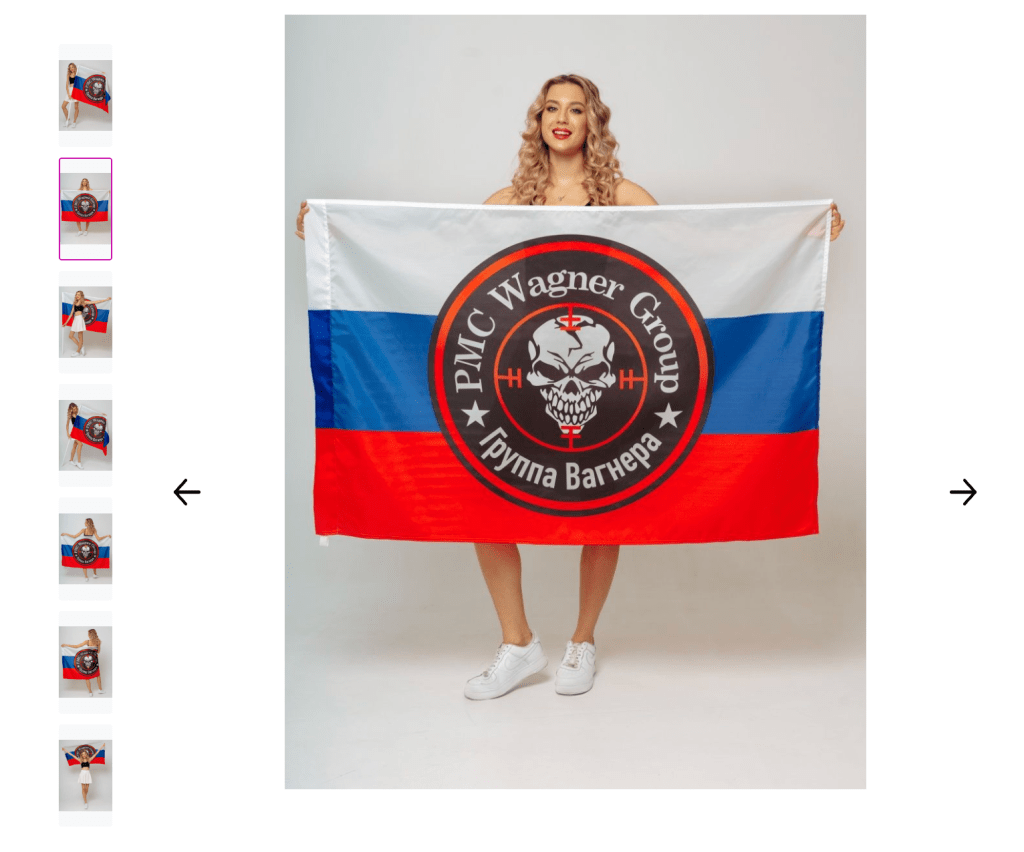
Goods bearing the emblems of the Wagner Group (including chevrons, flags, t-shirts, baseball caps, and sewn-on patches) have been brought back to the “counters” at Wildberries, as our correspondent verified on the evening of June 24.
In the first half of the day, a source at Wildberries told RIA Novosti that the online retailer had bearing removing goods bearing the [private military] company’s emblems and was going to remove them altogether. Later, such goods were hidden by Ozon, where they are still unavailable.
A search for the phrase “Wagner PMC” on the website of popular Russian online retailer Wildberries garnered 8,736 items, including the fetchingly reimagined Russian tricolor flag, below. This search was performed at 11 p.m. Moscow time on 24 June 2023.
Zenit FC midfielder Wendel has decided not to return to Petersburg due to the situation with the Wagner PMC, reportsSport Express, citing the player’s agent Cesare Barbieri.
“This is definitely a very delicate situation. Wendel will stay in Brazil until the situation improves. The club has already been notified of this. Zenit has reacted understandingly to the situation,” the agent said.
In the 2022–2023 season, 25-year-old Wendel has played twenty-five matches for Zenit in the Russian Premier League, scoring eight goals.
Alexander Beglov, the governor of St. Petersburg, congratulated all Orthodox Christians on yesterday’s Easter holiday during his weekly program on Radio Russia, wishing them peace and health.
“Easter is a symbol of the victory of life over death, light over darkness, good over evil. Today, our soldiers are defending by force of arms the ideals of goodness and justice, and protecting the historical truth and our culture,” the official added.
In his opinion, it was observance of the ancient Christian traditions that made Russia “strong and invincible.”
Announcing his upcoming trip to the St. Petersburg Days celebration in Belarus, Beglov said that both countries opposed fascism. This year, the city will be sending its largest delegation in the history of Petersburg-Belarusian bilateral relations to the neighboring state.
“Christ is risen!”: the traditional Russian Easter greeting, as seen here on a card I received yesterday.
Basically, what I want to say is that I have been incredibly lucky when it comes to people. It is the only real thing, the future. The rest is hell.
Source: An Easter greeting sent to me by an old friend and lifelong resident of St. Petersburg. Translated by TRR
Petersburg mayor [sic] Alexander Beglov and the head of the city’s parliament [sic] Alexander Belsky addressed the residents of the Northern Capital on the occasion of the Orthodox holiday of Easter. The speeches made by the politicians were quoted by the press service for the Smolny.
Beglov and Belsky spent last night at a service in Our Lady of Kazan Cathedral.
Metropolitan Varsonofy conducted the service. Addressing the residents of St. Petersburg, the mayor [sic] recalled the special military operation.
“Today our country is undertaking a special mission. Our military has been facing difficult trials in the name of justice and the future of our children. Our hearts are with them. Our prayers are for them!” the governor said.
In his address, Beglov mentioned Mariupol, St. Petersburg’s sister city, as well as the involvement of Russians in the SMO.
“Our Church prays for them, for the soldiers, for all who are united with us in our values,” Beglov concluded.
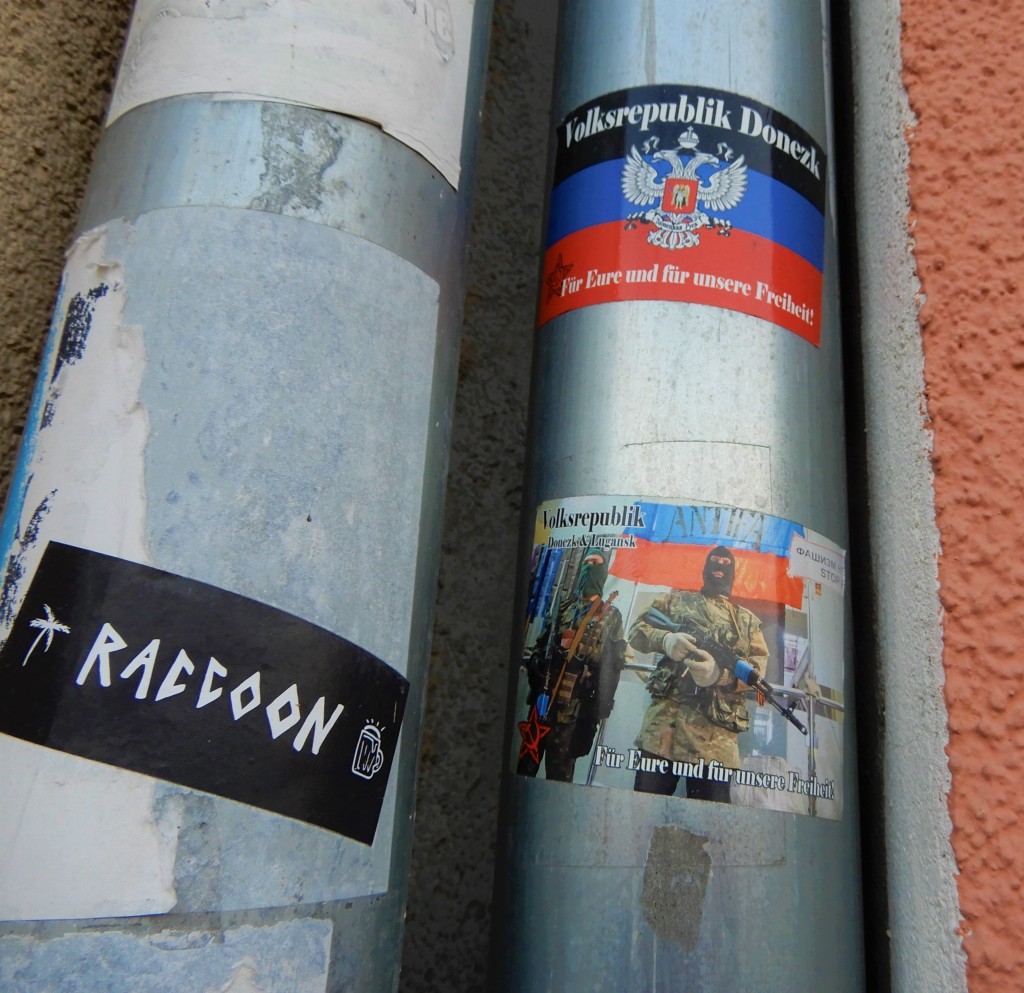
“Donetsk People’s Republic. For your and our freedom!” Berlin-Friedrichshain, 6 February 2023. Photo by the Russian Reader
State Duma deputy Andrei Kolesnik proposes reinstating the death penalty for treason
A proposal has been made in the Russian State Duma to revive the death penalty for those who have left the country and commenced criticizing the Russian authorities. The initiative was launched by deputy Andrei Kolesnik.
In an interview with Moscow Region Today [see translation below], the parliamentarian noted that an exception could be made for those who have simply left the country. According to him, traitors are those who have left and at the same time are waging an information war against Russia.
Security Council deputy chair Dmitry Medvedev said that Russians who fled the country and wish its destruction should be treated in accordance with the law, but the rules of wartime should also be remembered.
Following Nevzorov, Belotserkovskaya has been sentenced in absentia to nine years in prison for spreading fake news. State Duma deputy Andrei Kolesnik commented on this practice of “absentee sentences.”
“Okay, some people merely fled Russia. There are a lot of yellow bellies. They can stay there and work. But when a person works against Russia, it is called an information war. It’s more serious than a weapon, sometimes. Evil tongues are scarier than a gun,” the deputy said in an interview with Moscow Region Today.
However, Kolesnik stressed that the “traitors to the Motherland” had been punished according to the law: there is evidence, i.e., publications. But the deputy noted that he himself would have dealt with them more harshly.
“This is my personal opinion, although maybe I will voice it in parliament. If a person has committed serious crimes against Russia, then the sentence might be different. And this sentence could be enforced in the place where he (“traitor to the Motherland” — ed.) is located. Combat is currently underway. So, they should behave more carefully,” the deputy said.
When our correspondent asked whether he was talking about the death penalty, Kolesnik replied as follows.
“The [death penalty] can be employed for treason. We currently have a moratorium on the death penalty, although it exists in our laws. The decision to lift the moratorium is made not by the State Duma, but by the court. Although many people in the State Duma are leaning in this direction,” the deputy said.
Earlier, State Duma deputy [Maxim Ivanov] said that the unemployed could be sent to the SMO zone.