The New Normal

Is life in Russia still normal?

Dmitry Vakhtin • Lives in Russia • Jun 3

Life in Russia is a “new normal.”

Shops are full of food, but no Nespresso capsules (I still have some for a couple of months).

Stores are still selling printers, but not ink cartridges (I had to re-fill the used one last week).

There is clothes in shopping centers, but stores I used to go to are closed.

European countries still formally issue visas, but not really, although they might, but probably not, and getting there by air costs the same as becoming a space tourist.

Some countries are still open, but flights abroad are few and expensive and airbnb doesn’t accept payments from Russia, so I have to ask my son living in Germany to pay for our Summer trip.

Speaking of my son, I still can transfer money to him, but sometimes it takes weeks and sometimes they never get through, though sometimes they do, and you never know.

Speaking of the money, I still get my salary, but sometimes it is delayed because transferring money to the right bank account in the right currency in time makes our financial team prematurely gray-haired.

Speaking of the salary, our high-tech company is still working, but neither electronic components, nor equipment, nor people can cross borders, although sometimes they can, and then they don’t, and you never know when and why, and nobody knows it.

I keep reading and watching Youtube videos about the war every day, although it has all become a routine, and I hate myself for that, and I did protest but stopped because it’s all pointless and dangerous, though it isn’t, but it is, and we are all cowards, but it doesn’t matter, though it does.

I want Ukraine to win this war, and I don’t feel as if I am betraying my country but rather that my country is betraying me and itself, and this is probably the only crystal-clear thing in my life.

Yes, life is still normal in Russia.

91.7K views • 6,390 upvotes • 32 shares • Answer requested by Emirey Jackson

Source: Quora
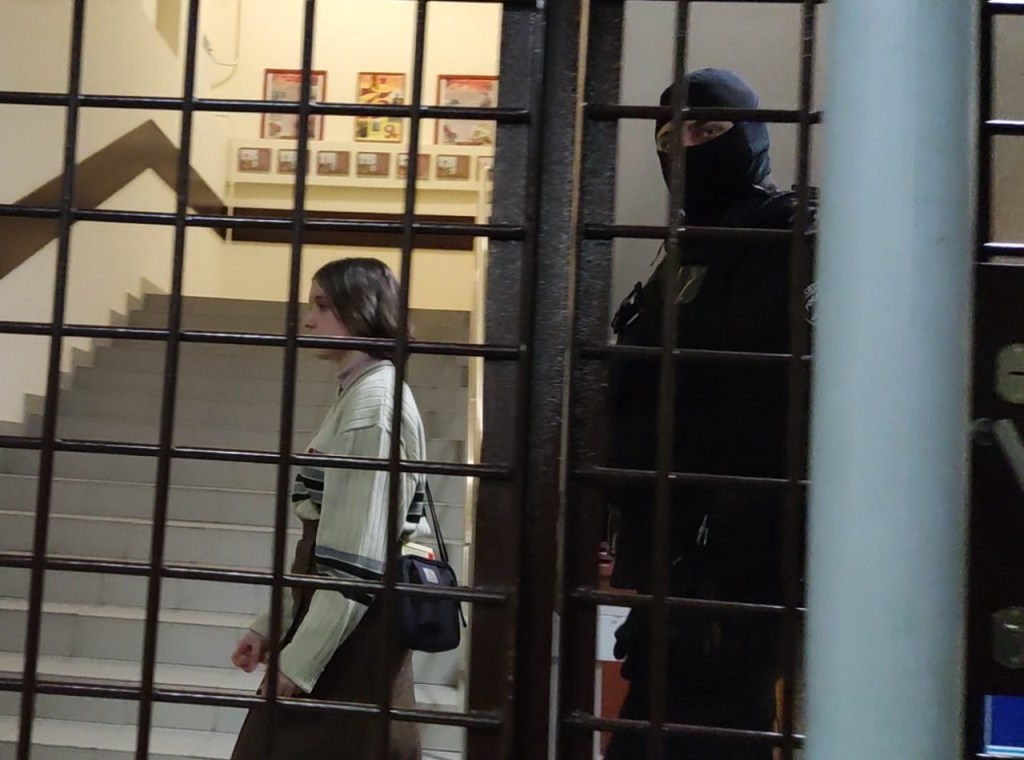

“Blue Eyes,” who physically assaulted Ksenia Tamurka, escorts her around the police station. Photo courtesy of SOTA

SOTA correspondent Ksenia Tamurka was detained along with the other attendees of a solidarity event for the defendants in the so-called Tyumen Case. The event was held at Open Space, an activist co-working space in Moscow The journalist was beaten when she refused to show her phone to men who had their faces covered. Despite this, Tamurka did not succumb to pressure and for several hours defended her rights to police officers. We publish this monologue by our correspondent, from which you can learn how to talk to the security forces and what you must do for your own safety.

Masked security forces officers [siloviki] burst into Open Space, and I started filming. I was either knocked down with a chair, or I tripped over it when I was pushed. I dropped my phone, and they put me face to the wall — they told me to stand like that. People around me were knocked down and thrown on the floor. They were not allowed to turn their heads; they could only look at the floor or at the wall. A Narcotics Anonymous meeting was being held in the basement of the premises, and one of the [recovering drug addicts] was asked what he used and how long he had been going there. They found some kind of book on LGBT topics in his possession and the siloviki read it aloud. In the process, they made nasty jokes about the guy. They said that there was no such thing as a former drug addict, and reproached him for being so young and already hooked. They collected everyone’s phone and papers, including mine and my press pass.

One guy begged them to let him call his mom. When these masked me with no insignia on their black uniforms had broken in, he thought it was a terrorist attack and had written to his family about it. The boy was very afraid that his mother would be worried, but the siloviki laughed, saying, Come on, how could you confuse us with terrorists? Why are you scaring your mother?

Then one of the Center “E” officers [eshnik] — the nastiest, most weaselly one — called me over because he thought I was hiding something when I was tucking in my sweater. He asked me to be a good girl and give him what I had allegedly hid; otherwise they would search me and stick their hands in my underpants. I said that I hadn’t hidden anything, that I was a journalist and had come there on assignment. He asked me strange questions, but I answered reluctantly. I said that I would only answer an investigator’s questions. For this, I was “punished” — I was made to stand with my face to the wall, although the others were sitting. When the siloviki nearby suggested that I sit down too, this eshnik said, “No, she’s being punished. She will stand.”

A couple of hours later I was summoned again. “Point your finger at your phone. Come on, unlock it,” they said. I refused because the request was illegal. Those men in uniform saw that I had Face ID, and they brought my phone close to my face, but I closed my eyes and looked away. The eshnik said all sorts of nasty things to me, getting angry and shouting. One of the masked siloviki, a man with blue eyes, grabbed me by the hair. Someone else hit me in the face and tried to open my eyes with his fingers. I was surrounded by five masked men. I screamed and cried and screwed up my face. I was very afraid to glance lest my phone be unlocked, god forbid. They dragged me back and forth by the hair. They shouted, “A drama queen! Ah, what a drama queen!” The police officers threatened to take me to the Moscow Region and talk to me in a basement.

At Open Space there is a mailbox for postcards designed to look like the bars in a jail. They punished me again by forcing me to stand looking at this box, like I was serving a prison sentence. Every police offer who walked by me thought I was backing away from it and pushed me closer. When one policeman passed by, he snapped his fingers before my eyes. When he was passing by, another policeman inserted a postcard with a beautiful picture in the box and said, “Let’s change the view — gaze at this.” Almost everyone passing by noted the pulled out hair on my clothes. Then that eshnik came up to me and tried to persuade me to unlock my phone. He asked whether I was tired, offered to deal with me “the normal way,” and said that I was delaying everything and would be the last to leave. “Just say the password, just enter it,” he said, but I wouldn’t enter it. They offered to give me a chair, to which I replied, “I’m not going to bargain with you. And bring a high chair.” They brought it. I sat down: I was comfortable, it was great, I looked at the wall. The blue-eyed man who had pulled my hair came up to me. I told him, “You beat me,” and pointed out that it was illegal, but he was like, “I don’t care.” The siloviki also tried to scare me by saying that my mobile phone would be entered into evidence and returned a year later, at the earliest, if we didn’t resolve everything on the spot.

The men in uniform constantly asked the organizers and participants why they supported terrorists and wrote postcards to them, and why the slogans on their walls were so filthy.

The siloviki asked everyone to tell them the PINs to their phones first, and then, if the person refused, they put the device in their hands and told them to enter it personally. They asked them to show their Telegram chats and film rolls and enter some other commands, like they were checking whether the mobile phone was stolen. When I asked what it all meant and why they needed my phone, they replied that they suspected me of theft, that there was a criminal complaint and even an APB out on me. I asked them to show them me and asked whether all those lying and sitting at Open Space had APBs out on them too. The siloviki replied that they would not show me anything because it was official information, and they stopped talking to me.

Everyone was photographed and searched, and their documents were photographed too — illegally, of course. They also took a picture of my father’s library card and public transport pass, although I didn’t consent to this. I was told that I was not in a position to forbid them to do anything. All the time I heard the same conversation: “We are checking your phone for theft, we are checking your phone for theft, enter the IMEI.” And almost everyone agreed to do it! Very few refused — and they were beaten, in my opinion. In any case, they were not treated very pleasantly. The eshnik asked me who I worked with at SOTA, who gave me the assignment, who I knew. He asked me about books and suggested that I read 1984. I told him to read Zamyatin’s We.

Th eshnik tried to make friends with me. He kept asking how I was feeling and complimented me, calling me a “persistent lady.” He even took my number and suggested that we discuss books later. He was constantly trying to get me to talk about “opposition” literature, bragging about his knowledge and telling me about Orwell. This man then invited me to take a stroll with him, but when he saw my face, he wimped out himself. “Well, you don’t want to walk with such scum, do you?” he said.
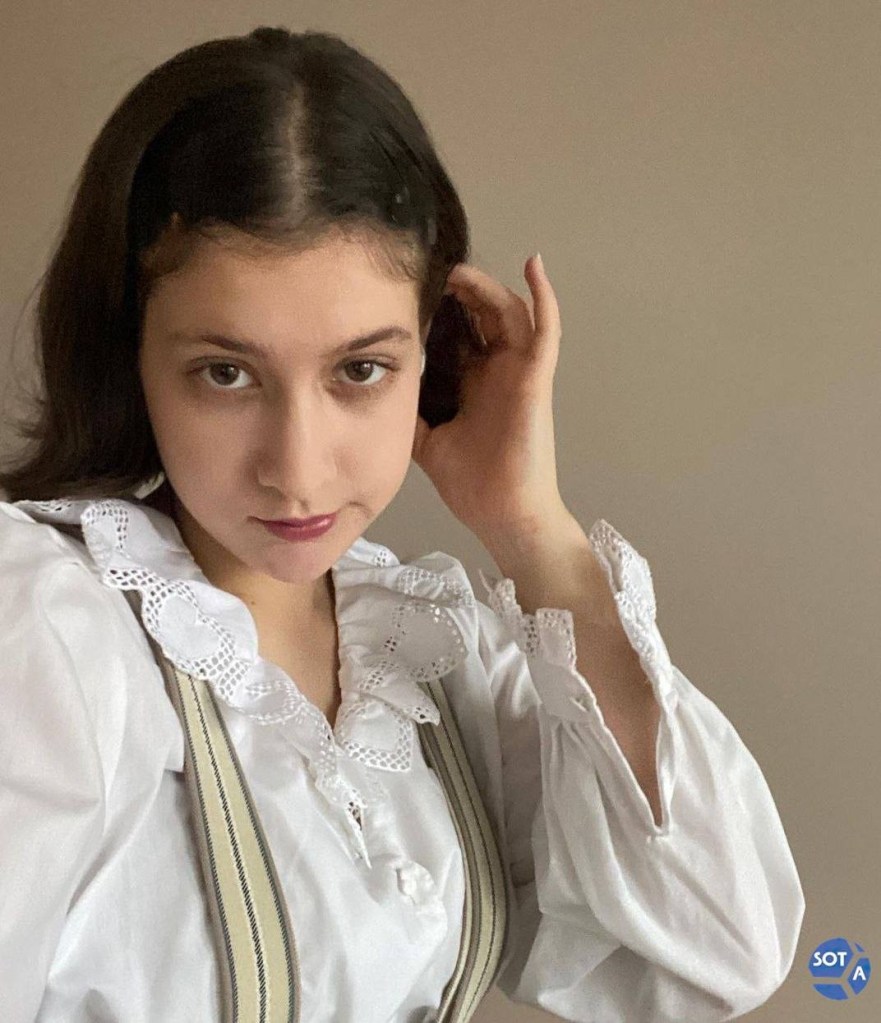
Ksenia Tamurka. Photo courtesy of SOTA

When I had already lost track of time, the intercessions on my behalf were conveyed to me. I was so glad when I found out that journalists had already gathered [outside], that my colleagues were there too! I was relieved because I had been very worried that I couldn’t contact anyone.

A man who did not agree to unblock his phone was beaten quite hard, judging by the sounds. We were forbidden to turn and look. One boy was whipped on his legs — the police officer made him spread his legs wider and thrashed him with all his might. It was so loud and scary.

They also promised that they would talk to me separately — I was afraid that they would just start torturing me, because I asked the policemen about it, and they either jokingly or seriously answered that yes, they would. There was a moment when everyone was really led away, and I thought, Well, that’s it — it’s about to start. But no, I was just sent to a paddy wagon.

At the station, I realized that everyone was pretty sick of me, judging by the comments that came my way. They called me a dumb broad and a pest. They said that I should be beaten with a rod. Later, in the department, they suggested that I should be “whipped with an officer’s belt in a dark room.” It also transpired that I was a dumb broad because no one was fucking me. They said disgusting things about me. I wrote down everything they said and all sorts of atmospheric details in the blank spaces in the book I had with me, [Vladimir] Sorokin’s Sugar Kremlin. The police saw it and tried to take a peek. Then the blue-eyed duded just stole it from me. They read all my notes in front of me and laughed in my face: “What? Who beat you? No one touched you. Why are you making things up?” But one of them added that I could still be beaten, because there was no other way to make me understand.

I was held separately and constantly harassed. And yet, when I asked to make a phone call, they said that it was specifically forbidden to me. When I asked to let a lawyer in to see me, that was also forbidden to me. I wanted to go to the toilet, but that too was specifically forbidden to me, while everyone else was allowed to go. They lied to me that there was no one waiting for me outside, that no one had any use for me and no one was waiting for me, although I knew that a crowd had already gathered at the station. The policemen discussed my breasts in front of me. Then they asked me my size — I cited Article 51 [of the Russian Constitution] and refused to testify.

When everyone else had already been released, they continued to drag their feet with me. The policemen kept their promise. I had to prove to them that the phone was mine for some reason. But if they had confiscated it from me, they should have known whose phone it was! It was their problem that they didn’t follow the legal procedures and forced me to deal with the consequences of their negligence! Moreover, my phone was the last one. The cunning eshnik and the blue-eyed devil finally decided to punish me too for my perseverance and entered the wrong password many times so that my phone would be blocked.

While we were waiting for the on-duty officer, the fool who dragged me by the hair ran out through another exit. Today I will file a complaint regarding the theft of my book and the actions of those police officers. I also went to the emergency room — I feel that it hurts me to touch it [sic]. I had the assault and battery documented there. The trauma specialist told me that it was an “industrial” injury because I had been on the job.

By the way, the slogan “The people’s trust is the police’s strength” was written on the wall of the police department.

Source: “‘The police threatened to take me to the Moscow Region and talk to me in a basement’: The story of the assaulted SOTA journalist,” SOTA (Teletype), 25 November 2022. Translated by the Russian Reader. The original article contains three embedded Telegram posts featuring video footage taken during the events described above.

Kirill Butylin: The Partisan of Lukhovitsy

Kirill Butylin. Image courtesy of Solidarity Zone

Solidarity Zone supports Kirill Butylin. And you can too!

On February 28, four days after the Russian army’s full-scale invasion of Ukraine, 21-year-old Kirill Butylin threw Molotov cocktails at the military enlistment office in Lukhovitsy, a town in the Moscow Region.

A video of the attack and the arsonist’s manifesto were posted online on March 8.

Their author said that he had painted the gates of the military enlistment office in the colors of the Ukrainian flag and written the message “I’m not going to kill my brothers!” on them, before climbing the fence, pouring gasoline on the outside wall of the building, breaking the windows, and tossing Molotov cocktails through them. The insurgent saw as his goal the destruction of the archive containing the personal files of conscripts, which according to his information was located in that part of the building. He hoped that his actions would hinder mobilization in his district.

The partisan also stated in his manifesto: “I hope that I will not see my classmates in captivity or the lists of the dead. I think this should be circulated. Ukrainians will know that there are people in Russia who are fighting for them, that not everyone is afraid or indifferent. Our protesters should be inspired and act more decisively. And this should break the spirit of the Russian army and government even more.”

Butylin was detained on the day the manifesto was published. After the arson attack, he got rid of his phone and managed to travel to the Lithuanian-Belarusian border, Vremya MSK and Moskovsky Komsomolets claimed, but he was detained there. Butylin allegedly confessed that he wanted to go fight in Ukraine. The young man was promptly extradited to Russia and taken to the police station in Lukhovitsy.

On March 13, Butylin managed to escape. He took advantage of the moment when he was allowed to go to the toilet: finding himself not in handcuffs, he jumped out of the window. He then climbed over a fence and ran off in the direction of the M5 highway. He was soon detained again, however.

The criminal charges against Butylin have morphed, during the course of this case, from “vandalism” to “terrorist attack.” And if initially he was threatened with no more than three years of community service, he now faces from ten to fifteen years in prison.

In October, Solidarity Zone tracked down Butylin in the Matrosskaya Tishina pretrial detention center in Moscow and established a connection with him. He accepted our offer of support and said that he would be glad to receive publicity, letters and books. According to him, all his other needs are being taken care of. Butylin’s lawyer is paid for by his relatives.

Solidarity Zone supports Kirill Butylin and will continue to cover his case, as well as provide him with all necessary assistance.

You can also support Kirill by writing him a letter, sending him a book (we recommend that you first find out what kinds of books he likes and how to send them by writing him a letter) or publicizing his case.

✉️📦 Address for letters and parcels:
Butylin Kirill Vladimirovich (born 2001)

18 Matrosskaya Tishina Street

Pretrial Detention Center No. 1

Moscow 107076 Russian Federation

(It is possible to send letters through the FSIN-Pismo service and the RosUznik volunteer resource.)

Solidarity without borders!

#writeletters#solidarity#prisoners#no war

Source: Solidarity Zone, Facebook, 7 November 2022. Translated by the Russian Reader. People living outside Russia will not be able to use the Russian Federal Penitentiary Service’s FSIN-Pismo service. It is also probably the case that it is impossible or nearly impossible to send parcels to Russian detention facilities from abroad. But you can send letters — translated into Russian (if you don’t know a competent translator, you can use a free online translation service such as Google Translate) — via RosUznik. You can also ask me for assistance and advice in sending letters by writing to avvakum@pm.me.

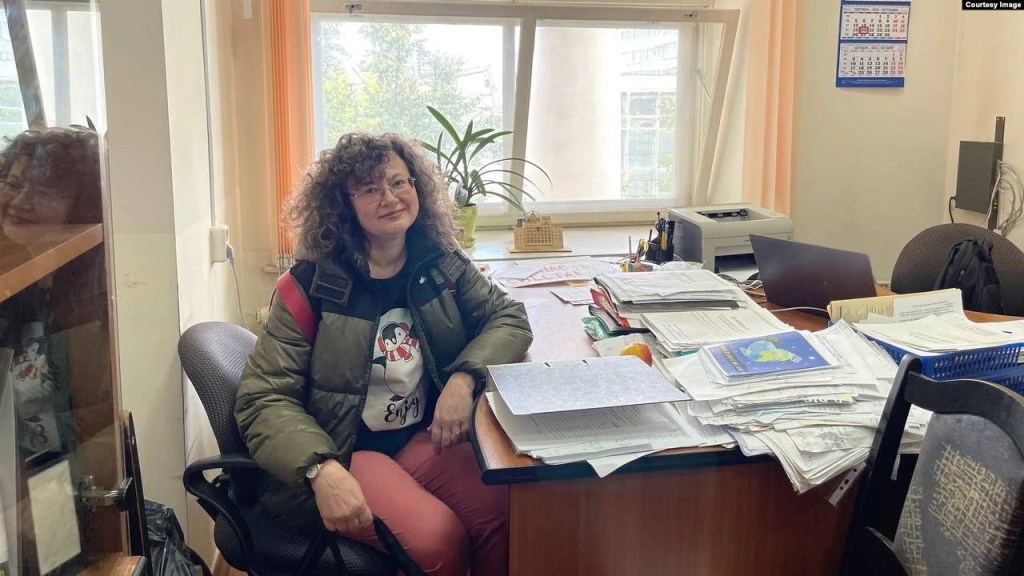
Olga Nazarenko: “What Is the Point of Having Principles If You Don’t Act on Them?”

Olga Nazarenko, a university lecturer in Ivanovo, risks going to prison for simply hanging the Ukrainian flag in the window of her own flat. Neighbors from the building opposite regularly complain about her. Nazarenko goes on anti-war pickets, where aggressive fellow citizens attack her. And the pickets have already triggered a criminal case against her. Repeated visits and searches by police officers at night and early in the morning have become routine for her children. Nazarenko sees the situation in Russia as nearly hopeless. She is amazed at how the country’s maternal instinct has even been destroyed: Russians dutifully send their children off to die for nothing. Despite all this, she considers it her duty to talk to people. She remains in Russia, and has no plans to emigrate.

Recently, the police rang at Nazarenko’s door at three o’clock in the morning. They demanded to be let in so that they could remove the Ukrainian flag. It has been hanging for six months on the balcony of the activist’s flat in an ordinary multi-storey residential building in the city of Ivanovo. Nazarenko refused to let the police in without a search warrant. Through the door, the night visitors informed her that neighbors had filed another complaint about the Ukrainian flag. The law enforcement officers left, only to return at seven in the morning and knock on the door for a long time. Nazarenko did not unlock the door, but wrote a complaint against the police to the prosecutor’s office.

Over the past two months, the police have visited the well-known anti-war protester at least four times. In the autumn, two criminal cases were opened against Nazarenko, one of them under the so-called Dadin article of the Russian criminal code. The medical school at which the activist has worked for almost twenty-four years has suspended her employment. The university lecturer is currently listed as a “suspect” by the authorities. Despite the fact that term of her undertaking not to leave the country, which went into effect after the criminal case was launched, has recently expired, she has no plans to leave Russia. She talked to Radio Svoboda about her principled choice.

Olga Nazarenko, holding a placard that reads: “If those who oppose the war are imprisoned, fascism has won.
Alexandra Skochilenko face five to ten years in prison for anti-war stickers…” Photo courtesy of Radio Svoboda

— How did you find out that you had been identified as a suspect in a criminal case?

— I learned that a criminal case had been launched against me under Article 280.3 of the Russian Federal Criminal Code (“Public actions aimed at discrediting the deployment of the Armed Forces of the Russian Federation”) from the Center “E” officers who came to my workplace at around eleven a.m. on September 20. They obliged my colleagues to to serve as witnesses, searched my desk, and found two placards. Before that, my laptop was seized without my knowledge. The bigwigs at the medical school wanted to conceal it at first, but I made a fuss. It transpired that the Center “E” officers did not even give our management rep a copy of the report for the seizure of the laptop, nor did he demand one from them. Then we went to my house; fortunately, there were no handcuffs on me. There they carefully rummaged for a long time: they took our phones (even the phone of my young son), a computer, old leaflets, our personal money, and the savings of our daughter, who is a university student. The money was returned to her, but the police kept our funds for themselves, and they are not planning to give them back to us, apparently.

— How did your children react to the search of your home?

— My son was in a little shock, especially since they took something that belonged to him. My daughter behaved calmly. She talked to the police a little. She asked whether their “assistant” was an adult: the computer technician they brought with them looked quite young. A Center “E” officer replied tersely that they were all adults and all officers. My daughter is already an adult, and she understands everything and supports me. My family took the search well, because this was not my first encounter with the relevant authorities due to politics. In the spring, at seven a.m., the riot police came to search the flat since I had been identified as a witness in a vandalism cased launched against another activist. Then they tried to prevent me from calling a lawyer, seized my phone, my computer, 138 posters, and the Ukrainian flag from the window. The law enforcement agencies’ interest in me had already become something routine.

Оlga Nazarenko in her office at the medical school. Photo by Oskar Cherdzhiyev. Courtesy of Radio Svoboda

— How long has the Ukrainian flag been hanging in the window of your flat?

— Every year since 2014, I had hung up the flag of Ukraine on the country’s Independence Day. Last year, I put it in the window and decided not to take it down. Police officers visited me after complaints were made, and they demanded explanations about the flag. I refused to explain anything to them. In the spring, after my apartment was searched, and they took the Ukrainian flag with them. I sewed a new one and hung it in the window again. I did the same thing after the search in the autumn.

— Why did you do that?

— For reasons of principle: if I support Ukraine, then I support it. And most importantly: no one in uniform and flashing a badge gets to decide what hangs in my window.

— What was the first criminal case brought against you for?

— They think that I posted anti-war leaflets in Ivanovo. I refused to give evidence by citing Article 51 of the Constitution.

— Were you not intimidated when they launched a criminal case and searched your flat?

— All this was to be expected. And no, it didn’t intimidate me. I continued going to anti-war pickets and rallies in support of those who have been persecuted for making anti-war statements, and I talked to people on the streets. A second criminal case was soon launched against me under the so-called Dadin article (i.e., Article 212.1 of the Russian Federal Criminal Code: “repeated violation of the established procedure for organizing or holding a meeting, rally, demonstration, march, or picket”). In October, Center “E” officers and the investigator who was running the first criminal case against me came again to search my flat. They were accompanied by several people in black masks and bulletproof vests. It’s hot in our flat, and I saw sweat on their faces, probably from overexertion. I even felt sorry for them. The search was superficial; they didn’t see anything new, apparently. They again seized our phones and a couple of posters. Once they got into the flat, they immediately rushed to the balcony and again pulled down the Ukrainian flag. I told them that I hadn’t violated the law when I hung up the flag, since I wasn’t infringing on the building’s communal property. The Center “E” guys replied that I should understand how turbulent the situation was now. They asked me why I was hanging the flag up. I said that it reflected my position and my aesthetic tastes.

— Do you like the colors yellow and blue?

— Yes, they are my favorite colors: the sky and the sun. The next day I sewed another Ukrainian flag and hung it out.

— Do you usually sew Ukrainian flags on a sewing machine?

— Yes. There are many shops in Ivanovo where you can buy fabric. I found a good one and bought three sets at once. It will last for a long time.

— Why do you think that it is the neighbors who filed complaints against over the flag?

— Only residents of the house located opposite mine can see the flag all the time. The denunciations are probably written by neighbors and residents of the neighboring house. I saw one complaint. The poor lady wrote: “I see the Ukrainian flag every morning and I consider it unacceptable in such a situation as we have now.” I even felt sorry for her. After I hung out the Ukrainian flag, the neighbors living in the apartments below and above mine hung out Russian flags. After the search, a “Z” was again written on my apartment’s mailbox and a note was tossed in it that said, “Ukraine is no more. Take down your rag and dry yourself with it.”

– How did the medical school react to the criminal cases against you?

– The management suspended me on the grounds that the articles of the Criminal Code brought against me hinder my work as a lecturer. My colleagues were upset. We have worked together for many years. Besides, now they have to do my duties. My colleagues do not talk about politics. Most of my colleagues are apolitical. But they have voiced their support to me and hope that everything will be resolved somehow. I studied at the medical school for six years, and after graduation I stayed on there to work. That is, my entire adult life, almost thirty years, has been connected with the medical school.

— Have you been able to get another job?

— Due to the criminal cases, I cannot tell an employer how long I would be able to work for them. So, I will look for something temporary, and then my professional career will depend on the court’s decision.

— How many pickets did you hold in the autumn?

— In September and October, I held four or five pickets. Since the second criminal case was launched, I have not yet gone out to protest, but I’m going to continue to voice my civic stance.

— Why are you going to continue to hold anti-war pickets, despite the serious risks of ending up in a Russian prison?

– I have beliefs, and I will act in keeping with them. As long as I can talk, I’ll keep doing it. What is the point of having principles if you don’t act on them, regardless of the risks?

— Do you have the support of friends, family, and associates?

— I have moral support from friends, and there are also simple acquaintances who support me and help me raise the money for fines. I am being defended by attorney Oskar Cherdzhiyev.

Aren’t you annoyed by like-minded people who emigrated instead of getting involved in anti-war protests with you?

— If the question is about ordinary Russian citizens, and not about protest leaders, then I’m not annoyed. I understand that nothing will change in the near future. People in difficult circumstances choose the best option for themselves. We have one life, and everyone has the right to live it as they please. Besides, emigration is now a rational, appropriate solution. Many of those who have gone abroad continue their protest activities: they go to anti-war protests at Russian embassies, help refugees from Ukraine and Russia, and work on publicity.

— But why is it the best option for you to stay in Russia and go to anti-war pickets, rather than worry about your own safety?

— My choice is based on the fact that I can do more in terms of working with people in Russia than I could in emigration. I’m rubbish at information technology. It’s easier for me to talk to passersby at street protests in the hope of getting my message to them. Russia is my country, and I won’t let them kick me out. I have the right to my own country and I don’t want to leave Russia for anywhere else. I will stay here and do what I think is necessary, voice my position. If I left, I would feel bad because I got scared and ran away.

— Do you think your long-term street activism has produced any results?

— If we’re talking about changing people’s minds, I don’t see any particular results. The war is so propagandized that a few people who publicly voice a different viewpoint cannot shift the minds of the majority in the other direction. My protests are meant to have an effect on the people who are having doubts. I have succeeded in making such people think. But the main purpose of my protests is to support like-minded people among Russians and Ukrainians. Thanks to my actions, among other things, friends in Ukraine know that not everyone in Russia is an “orc.”

— How has the reaction of passersby to your pickets changed since the war with Ukraine began?

— I’ve observed that people have become more guarded and scared. They usually dash past me quickly, averting their eyes. The reactions of those who do not hide them have become quite polarized. Either passersby are emotionally grateful, or they almost pounce on me, fists flying, and call me a Banderite. At the last picket, a man grabbed my placard and tore it up. There have been more negative reactions to my pickets than friendly ones, but this is not surprising. It is amazing how, with such propaganda, one hundred percent of people don’t react negatively to anti-war protests.

— How do you manage to be so tolerant towards people whose views differ from yours?

— I would not call my attitude towards them tolerant. I just understand what motivates their behavior: a lack of critical thinking skills, plus the fear and the reverence for the authorities that is inscribed in their subcortex. Powerful state propaganda combines with excessive loyalty to those in power. Thus, Russian citizens support all decisions by high-ranking officials.

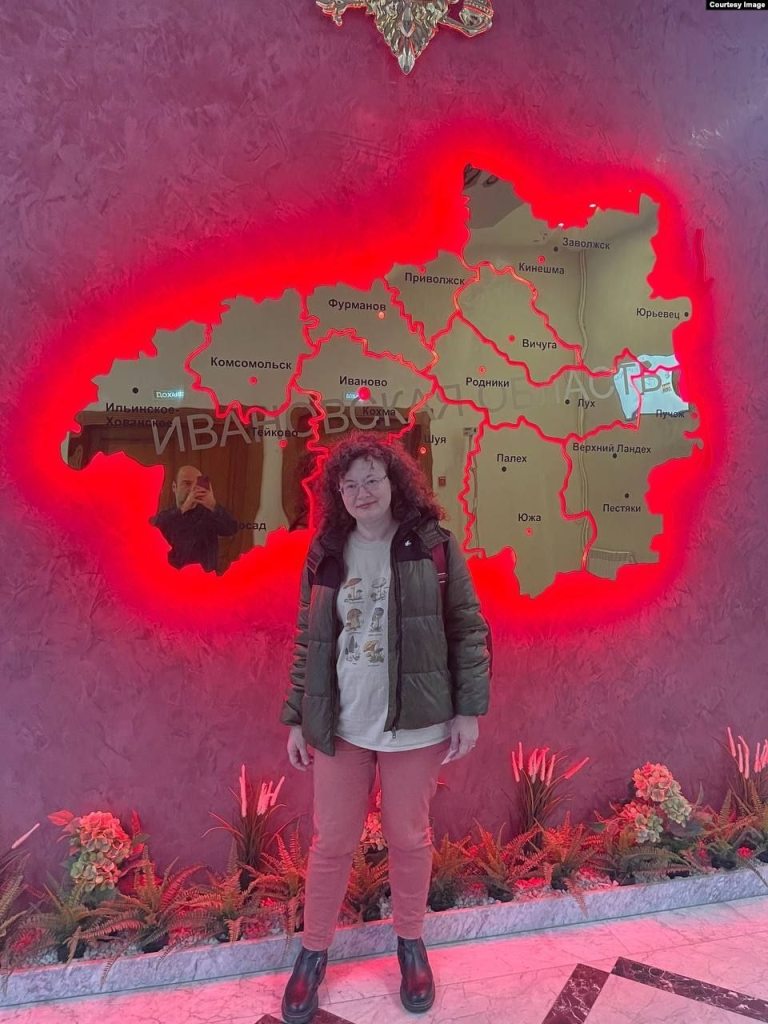
Olga Nazarenko in the lobby of the Ivanovo Regional Office of the Interior Ministry. Photo by Oskar Cherdzhiyev. Courtesy of Radio Svoboda

Are you able to understand why the parents of conscripts did not come out in droves to protests after the mobilization was announced?

— It’s beyond my comprehension. The maternal instinct is a powerful biological mechanism. As conceived by nature, it should be stronger than any propaganda. Apparently, there has been a real degradation in our society over the past twenty years. Total state propaganda, which includes not only the media, but also the education system, has aimed to completely distort values. Fear and reverence for power, submission to it, which never disappeared in many Russians, have now resurfaced especially strongly. Unfortunately, learned helplessness has overcome the maternal instinct. I do not know if such people can change anything.

— This is not the first year that you have been constantly going out to protest. Perhaps you have a hope that Russia will become a free country?

— It’s hard to say. Historically, Russia has been going in circles all the time, rather than developing in a spiral. But I still want to hope that Russia will become a developed and free country. However, this won’t happen soon, perhaps in one hundred years.

Source: Daria Yegorova, ‘Why have principles if you don’t act?’: A fight over the Ukrainian flag in Ivanovo,” Radio Svoboda, 29 October 2022. Translated by the Russian Reader

Irina Tsybaneva: “You Raised a Freak and a Murderer”

Irina Tsybaneva. Photo courtesy of Mediazona

A court in St. Petersburg has put sixty-year-old accountant Irina Tsybaneva under house arrest for leaving a note that read “Death to Putin” on the grave of the Russian president’s parents. The woman was able to steal up to the gravestone, which is guarded, but she was unable to leave the cemetery unnoticed. The police and the prosecutor’s office asked the court to send Tsybaneva to a pretrial detention center, calling the crime “audacious,” but the court found that this was too harsh a pretrial restraint. Mediazona has delved into the details of the case and found out what role the news played in the Petersburg woman’s spontaneous actions.

“I just saw a [TV] program, at that time very serious, there was some news, and something just…,” said Tsybaneva, trying to explain her actions, while standing in the defendant’s cage at the Primorsky District Court in Petersburg.

Tsybaneva has been charged with desecrating the burial place of deceased persons due to political or ideological enmity. It is alleged that she went to the grave of the parents of Russian President Vladimir Putin and left a note there that included the following phrase: “You raised a freak and a murderer.”

“And how often do you go and write notes to everyone [sic] while watching the news?” the prosecutor asked her.

“Never. I watched the news and realized that everything is quite scary, everything is very sad, a lot of people have been killed.”

“We had the coronavirus, everyone was depressed. Did you also write something to someone then?”

“What for? No, of course not,” said Tsybanev, smiling.

“Well, I don’t know. You watched the news and decided to write.”

“Yes, under the influence of the news.”

“Are the media to blame for your actions?”

“That’s the upshot.”

Irina Tsybaneva. Photo courtesy of Mediazona

Before the war in Ukraine, Tsybaneva, who is employed as an accountant in Petersburg, was not particularly interested in politics. Even after the Russian invasion, she practically never raised the topic of war raised in conversations with relatives, her son Maxim told Mediazona.

“She went to concerts, festivals, theaters, and museums. She traveled a lot both in Russia and abroad,” the man added. “At one time, she was a big fan of bard music. I don’t know how it is now, but it’s probably still the case. She went to the Grushinsky Festival many times. She was a prominent figure in Trofim‘s fan club.”

Tsybaneva spent a lot of time with her six grandchildren. (Her daughter and her son each have three children.) She moved to St. Petersburg in the 1980s from the Tver Region, working as an engineer and then as an accountant in various companies.

On October 6, the eve of the Russian president’s birthday, Tsybaneva went to the Serafimovskoe Cemetery, where Mr. Putin’s parents are buried.

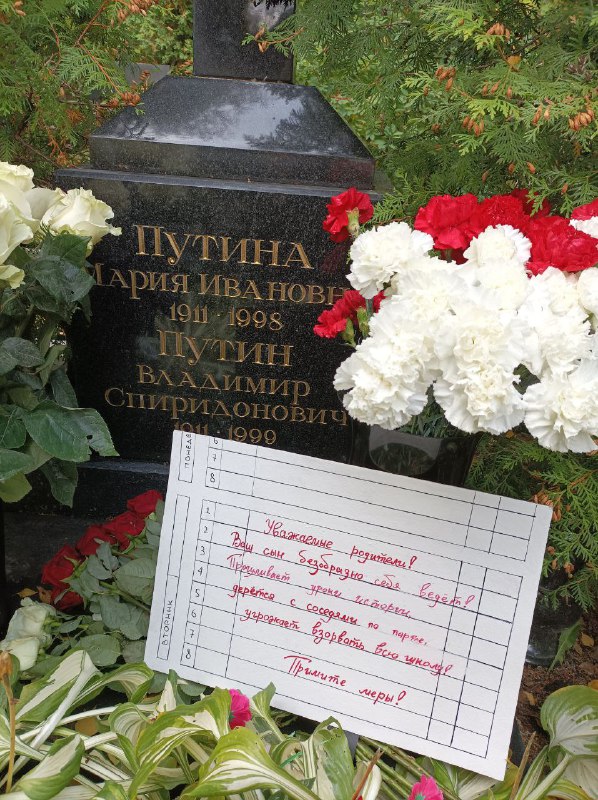
Security had already been beefed up at the cemetery and specifically at the graves of Vladimir and Maria Putin, probably due to the fact that, in late September, a small poster in the guise of a school pupil’s class journal appeared on their headstone. It read as follows: “Dear parents! Your son has been behaving disgracefully! Skipping history lessons, fighting with his desk mates, and threatening to blow up the whole school! Take action!”

“Dear parents! Your son has been behaving disgracefully! Skipping history lessons, fighting with his desk mates, and threatening to blow up the whole school! Take action!”
Photo courtesy of Feminist Anti-War Resistance

A week later, a court in Petersburg jailed the activist Anastasia Filippova for ten days on charges of disobeying a policeman. As reported by Bumaga, Filippova’s relatives linked her arrest with the poster. Yesterday, a court overturned her arrest, and she was released from the special detention center.

Despite the beefed-up security and the police officers on duty at the cemetery, Tsybaneva was able to walk up to the grave of the Putins.

“They got distracted there, and she somehow left the note. It transpired that there are a lot of cameras there,” Maxim Tsybanev said, adding that his mother was able to photograph the note on her phone, which was later seized, however.

The contents of the note were made public today during Tsybaneva’s pretrial restraints hearing. “Parents of the maniac, move him in with you. He has caused so much pain and trouble, the whole world is begging for his death [illegible]. Death to Putin, you raised a freak and a murderer,” Tsybaneva’s message read.

In a linguistic analysis, a copy of which was submitted as part of the written request for pretrial restraints in court today, experts concluded that the note contains a “negative assessment of Russian President Vladimir Putin” addressed to his parents. But how exactly the police identified the person who left the note is unknown. In court, the prosecutor cited an “ongoing investigation.”

The leaflet containing the appeal to Putin’s late parents was found the same day by a cemetery guard, who immediately informed the police. On Monday, October 10, they were already knocking on Tsybaneva’s door.

“She wouldn’t open it for a long time, but eventually a policeman promised to pry it open, and she opened it. At three p.m. yesterday she was taken to the 35th police precinct. For some reason, they kept her waiting there for a long time. Finally, around nightfall, she telephoned and said that there would be a search. We immediately went to her house, but she wasn’t there,” Maxim Tsybanev told Mediazona.

The accountant was placed in the temporary detention center and a criminal case was opened against her for abusing the burial place of deceased persons due to political or ideological enmity. If she is convicted, Tsybaneva could face up to five years in prison.

During the couple of days that Tsybaneva was in custody, the police were able to conduct a DNA examination, which confirmed that the traces of skin found on the note were hers. Handwriting analysis also indicated that it was Tsybaneva who wrote it. In addition, a picture of the note was found on her phone.

“I immediately admitted that I had written [the note], and that there was no need to do these analyses,” Tsybaneva said in court.

Police investigators and the prosecutor’s office asked that Tsybaneva be sent to a pretrial detention center.

“She is suspected of a crime whose danger to public consists in insulting the memory of the dead, the deceased, and the feelings of the living towards the dead,” the prosecutor argued.

She called the crime committed by the accountant “audacious” and, given Tsybaneva’s impressionability and the impact the news has on her, she argued that it was better for the woman to be in custody.

The defense lawyers were able to convince the court that the restraint measure requested by the state was too harsh. Consequently Judge Dmitry Lozovoy put Tsybaneva under house arrest for twenty-eight days, forbidding her to use the internet, telephone and mail.

“Given the actions committed, this is too harsh, but given current situation in the country, it is quite good,” said her son Maxim, commenting on the judge’s decision.

Source: Pavel Vasiliev, “‘Move him in with you’: 60-year-old Petersburg woman put under house arrest in case of note left on grave of Putin’s parents,” Mediazona, 12 October 2022. Translated by the Russian Reader

“Telephone Terrorism”

Alexander Petrosyan, “Today on Sennaya Square [in Petersburg],” Facebook, 24 September 2022

In Petersburg, police have searched the homes of activists, as well as the home of Sota journalist Victoria Arefieva. The security forces broke down the door to Arefieva’s apartment, seized electronic devices belonging to the journalist and her sister, and detained her for forty-eight hours on suspicion of making a phoney bomb threat to the St. Petersburg City Court, Sota wrote on Saturday, September 24.

In addition, searches were conducted at the homes of persons implicated in the case of the Vesna Movement activists Yevgeny Fateyev and Valentin Khoroshenin, whom a court has banned from “engaging in certain activities.” The security forces also visited the home of activist Pallada Bashurova, against whom two “telephone terrorism” investigations have been launched, OVD Info reports. Yevgenia Litvinova, a member of the Petersburg Human Rights Council, was also detained in connection with a “telephone terrorism” case.

New protests against mobilization scheduled for September 24

According to Sota, the searches are connected with protests, scheduled for September 24, against the “partial mobilization”; law enforcement agencies thereby are attempting to prevent their coverage in the press. Vesna, a democratic youth movement, called on Russians to engage in a new round of protests in the wake of the first wave that occurred on the day Russian President Vladimir Putin made the announcement. “Mogilization [“grave-ization”] is actively going on all over the country. Soon thousands of our men could go to the front. We can and must oppose it!” Vesna said in a statement issued on September 22.

According to the online human rights project OVD Info, on September 21, the police detained more than 1,300 protesters in thirty-nine cities across Russia. Most of the arrests occurred in Moscow and Petersburg. In some police departments, the detainees were handed summonses to the military enlistment office right on the spot.

Source: Olga Lebedeva, “Homes of activists and journalists searched in Petersburg,” DW, 24 September 2022. Translated by the Russian Reader

“No Future”: Popular Reactions to Putin’s Mobilization

Outside Gostiny Dvor [metro station and shopping center, in downtown Petersburg]. The police are plucking out the protesters one by one and dragging them away.

Passersby ask, “What happened?”

Most either don’t read the news or support the mobilization.

They look at us like we’re idiots.

I asked a middle-aged woman whether she had any children.

“Two sons, so what?” she answered me defiantly.

Today I thought for the first time that there is no future.

[Comments]

Natalia Vvedenskaya

Just for balance. Today, in the supermarket, I quietly eavesdropped on the conversations among the saleswomen (these were two different conversations). Irritated and indignant, these middle-aged women said that the members of parliament [who quickly passed laws enforcing Putin’s mobilization] should go to war themselves.

Source: Galina Artemenko, Facebook, 21 September 2022. Translated by the Russian Reader


On the bus. A middle-aged woman in the front seat yells into the phone, not mincing her words. She says that there is a panic at work, that they have seven days to keep the guys from getting drafted. This was followed by instructions for direct action. The young fellow sitting with his back to her listened attentively, while the girls opposite him could not have cared less.

Source: Friends-only post on Facebook by a trusted source and occasional contributor to this website, identified here as “AR” for future reference. Translated by the Russian Reader


This hurts a lot. I console myself with the fact that, as in private life, the most vital and beautiful thing is the process itself, when you are initially in a hole, but you fight to make things better. But can I please go back to the time when I have to confront myself, and not a crazy autocrat with a nuclear button?

I try to shift my focus from irritation towards Russians who support the war, and the collective Europe playing along [sic], to endless love. First of all, to people who are in Russia and are not afraid to speak out against the war. I am glad that I am living at the same time as you. Of course, we are far from being Iran, where people take deadly risks for their beliefs. But we’re cool, too. We’re doing what we can. If everyone in Russia were like us, the war would have ended today. Now, when it is important to support myself, I console myself with this thought, and I advise you to do the same.

Source: Friends-only post on Facebook by a grassroots activist in Petersburg, identified here as “JA” for future reference. Translated by the Russian Reader


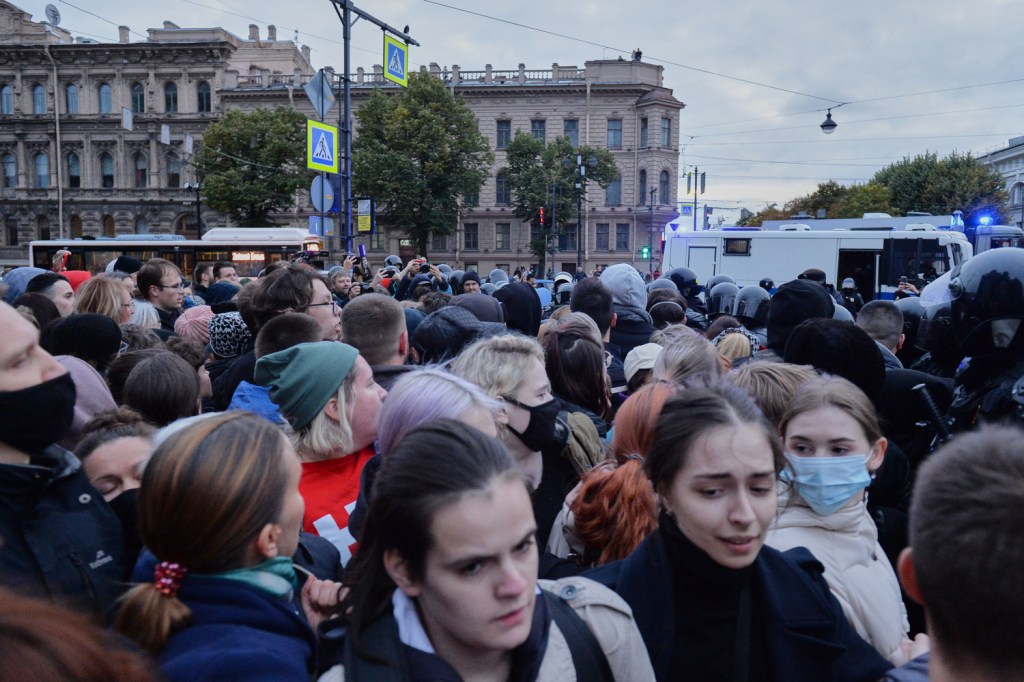
On the evening of September 21, in Petersburg, as in other cities, a protest was held against the mobilization of Russians for the war in Ukraine. The protest was called by the Vesna Movement. The protesters gathered at 7 p.m. on St. Isaac’s Square.

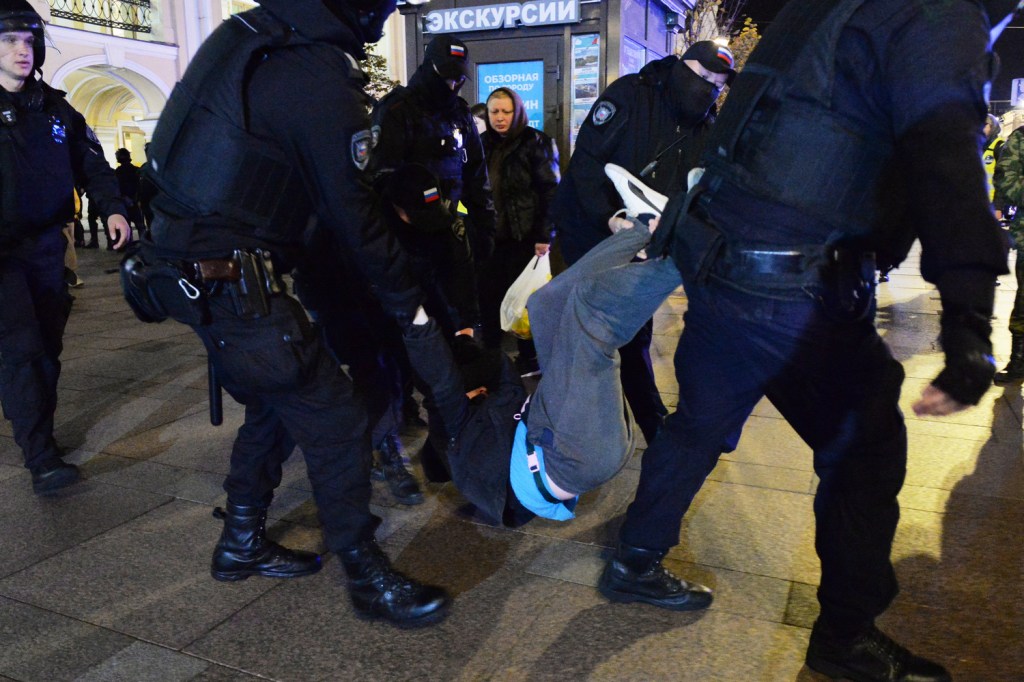
Riot police vigorously detained protesters, beat them with batons, dragged them on the ground, and put them on their knees. According to OVD Info, at least 444 people were detained in St. Petersburg.

Bumaga has put together a photo chronicle of the first popular protest in the city in the last six months.

Source: “How an anti-mobilization rally — the first mass protest in six months — took place in Petersburg,” Bumaga, 21 September 2022. There are several more photographs of the protest rally at the link, including photos from a second, separate protest the same evening outside Gostiny Dvor (as described by Galina Artemenko, above). Translated by the Russian Reader


Conscription Notice Russia. This channel was created to inform the residents of Russia about the delivery of conscription notices in our city! [sic] Write here with information about which addresses conscription notices in Russia are being sent — @maks_ge

“Prospect Mira. A conscription notice was just served to a man approximately 40-45 years of age. He was strolling with his wife and dog. Then they [the police?] went up to some young guys sitting on a bench and had a chat with them.”

“They’ve already started handing out conscription notices at the factories in the town of Gatchina in Leningrad Region.”

“The Gazpromneft filling station at Amurskaya 15A. Two men got into a scrap, and the attendant called the police. The cops came and gave them tickets. They threatened the men, saying that tomorrow, other people in uniform would come visit them at home — I think they meant the military conscription office.”

Source: Screenshot of the Telegram channel Where Draft Papers Are Being Handed Out — Russia. The channel was created on August 13, but only started posting on September 21. It already has over ten thousand subscribers. Thanks to VL for the heads-up. Translated by the Russian Reader


Well, my prognosis was mistaken. I underestimated the regime’s vileness and meanness. As the supreme ruler declared a partial mobilization, the local military enlistment offices issued decrees concerning all reservists without exception.

This is totally fucked up. For example, “temporary residents must depart for their legal place of residence.” Accordingly, millions of unregistered men or men registered at their temporary residences in large cities must leave for their hometowns or home regions. Accordingly, all these millions of men are “lawbreakers” — they can be seized in dragnets, blackmailed with prison terms, locked up, beaten up, and anything else that our cops do with our citizens. When [the cops] are faced with passive resistance, they will indiscriminately rake in whomever they catch.

These people will certainly “engage in combat,” but that will happen later. What matters now is filling the quotas.

Source: George Losev, Facebook, 21 September 2022. Translated by the Russian Reader


Putin has announced a “partial mobilization.” Only time will tell how “partial” it is, but it is already clear that the mobilization will affect many people. What options do those whom the Kremlin wants to mobilize have?

  1. Become cannon fodder.
  2. Go to jail.
  3. Illegally flee the country. If you fail, you go to jail.
  4. Go underground. If you fail, you go to jail.
  5. Go underground and become a guerrilla. You could also go to jail.

I do not consider legal ways to avoid mobilization, since the rules of the game can change at any moment, and those who were not subject to mobilization yesterday will be subject to it tomorrow.

The choice isn’t great, but there is a choice.

Source: Ivan Astashin, Facebook, 21 September. Mr. Astashin is a former political prisoner and human rights activist who now seems to be living in exile in Berlin. Translated by the Russian Reader


In the kitchen of a communal flat:

— Soooo, you live closer to the front door, don’t open it to anyone. If they come, tell them there are no men living here.

— I’ve been dodging the draft for so long I don’t even remember how to do it anymore. I’ve had so many chronic illnesses since then. Do you think it will help?

— At my work, a friend of a friend of a friend of a colleague is offering to drive [men] to Finland for 50 thousand rubles [approx. 855 euros]. Any takers?

— He’s definitely going to Finland? That’s too cheap somehow. What if he takes you to the military enlistment office?

— My pop says that he would volunteer himself, but he’s already sixty-seven, they won’t take him. But he’s weird that way. He never goes to the welfare office, because he believes you have to have pride: he didn’t work all his life to ask the state for something in his old age! His pension is 25 thousand rubles a month [approx. 440 euros].

— Maybe he is also one of those people who have nothing, and who donates money to buy socks for soldiers?

— No, he believes that we have the strongest army and does not give them a kopeck. He says the people asking for that money are scammers.

Source: Friends-only post on Facebook by a veteran human rights activist in Petersburg, identified here as “NN” for future reference. Translated by the Russian Reader

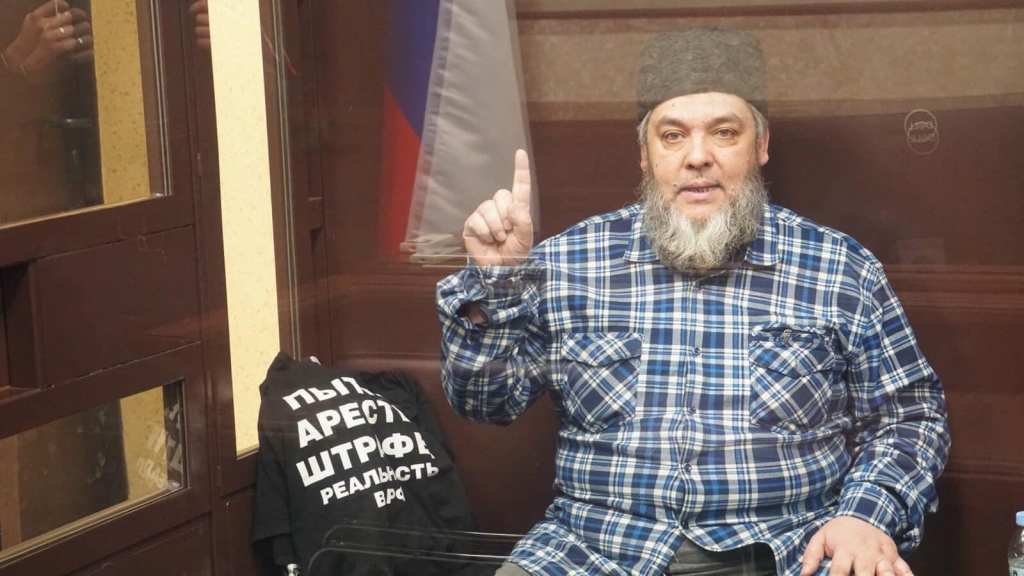
Yashar Shikhametov: 11 Years in Maximum Security for “Kitchen Conversations”

Yashar Shikhametov

⚡️ Another sentence: 11 years in a maximum security penal colony for a 52-year-old cook from Crimea

Today, the Southern District Military Court [of Russia] announced the verdict in the trial of Yashar Shikhametov, a Crimean Tatar, a cook from Sevastopol, and a political prisoner. He was charged with membership of the Islamist political party Hizb ut-Tahrir, which has been banned in Russia since 2003. In Ukraine and most countries of the world, however, the organization operates without any restrictions in terms of national legislation.

According to the case file, the accused had no weapons, explosives, or ammunition, did not plan to commit a terrorist act and did not call on others to carry out terrorist acts. There is no evidence that he was planning to overthrow the constitutional order of the Russian Federation and seize power. The case materials contain audio recordings on which religion and politics are discussed. In fact, this was the only evidence presented by investigators, along with the testimony of secret witnesses, which cannot be corroborated.

Shikhametov was was arrested on 17 February 2021, and then spent over a year and a half in a pre-trial detention center, where he suffered from many ailments. In July of the same year, his case was submitted to the military court of Rostov-on-Don. The trial of the case on the merits took place over the course of twenty-four hearings.

On August 14, 2022, Prosecutor Sergei Aidinov asked the court to sentence Shikhametov to eleven years of imprisonment in a maximum security penal colony, with the first four years of the sentence to be served in a closed prison.

The verdict issued by the Russian court today gave the prosecutor exactly what he had asked.

At yesterday’s court hearing, the political prisoner complained of feeling unwell. When the court suggested that he take part in the closing arguments, Shikhametov insisted on the need for a recess.

The court turned down the defense’s request to declare a recess.

Judge Alexei Magomadov deemed Shekhametov’s inability to take part in the closing arguments as a voluntary refusal to testify, despite the fact that the defendant had written a twenty-one-page-long closing statement for the hearing. He also turned down [defense] lawyer Alexei Larin’s request to postpone the hearing.

“Did we have a choice in 2014? I will tell you that it’s all true. Ethnically, we are Crimean Tatars; we are Muslim in terms of religion and culture, and we are citizens of Ukraine. Is this proof of my guilt? We do not hide, we do not hide it, but we declare it directly and everywhere. Is that a crime? But the FSB investigator cooks up this whole [case] with remarks made around the kitchen table, and by tormenting people and intimidating them with searches,” Shikhametov wrote in the [closing statement], which he was unable to deliver in court.

Source: Mumine Saliyeva, Facebook, 9 September. Photo courtesy of Crimean Solidarity. Thanks to Natalia Sivohina for the link. Translated by the Russian Reader


Shikhametov is from Orlinoye on the outskirts of occupied Sevastopol.  He earlier appeared as a defence witness in the political trial of Enver Seitosmanov, which may have been the reason that the Russian FSB turned their attention to him.  They added him, six years after the earlier arrests in 2015, to Russia’s first conveyor belt ‘trial’ of Crimean Muslims on charges of involvement in Hizb ut-Tahrir. The latter is a peaceful, transnational Muslim organization which is legal in Ukraine, and which is not known to have committed any acts of terrorism anywhere in the world.  Russia’s prosecutions, under ‘terrorism’ legislation, are based solely on an extremely secretive Russian Supreme Court ruling from February 2003, which declared the organization ‘terrorist’ without providing any grounds or explanation. Russia is increasingly using these charges as a weapon against Crimean Tatar civic activists and journalists, with men who have committed no recognizable crime being sentenced to up to 20 years’ imprisonment. The charges are a favourite with the FSB and their decision to arrest any particular person is a near 100% guarantee that their victim will be imprisoned and receive a huge sentence.

Shikhametov was charged under Article 205.5 § 2 of Russia’s criminal code with ‘involvement’ in a Hizb ut-Tahrir group.  This was seemingly the same fictitious ‘group’ which the FSB claimed that Ruslan Zeytullaev had ‘organized’ (a more serious charge) and that Ferat Saifullaev, Yury Primov and Rustem Vaitov were supposed to have been members of. Russia was still ‘testing the ground’ (and international reaction) in that case and all of the men initially received much lower sentences than required by legislation. The prosecution (or, more likely, the FSB) challenged the sentence against Zeytullaev until they got a 15-year sentence but did not appeal against the other three sentences (more details here). One difference now is that the prosecution almost invariably adds the charge (under Article 278) of trying to overthrow the Russian state. This charge is even more nonsensical, as not one of the men has ever been found to have any weapons, but does enable them to increase the sentence.

Both the earlier ‘trials’ and that against Shikhametov were, as the latter said, based on ‘conversations in the kitchen’ on religious and political subjects. These were sent to FSB-loyal ‘experts’ (from the Kazan Inter-Regional Centre for Analysis and Assessments) who provide the opinion demanded of them.

Russia’s FSB have, however, discovered that such prosecutions do not go to plan, primarily because of committed lawyers who insist on demonstrating the flawed nature of both the charges and the alleged ‘evidence’.  Although the convictions remain essentially predetermined, the men’s lawyers, as well as the important Crimean Solidarity human rights initiative, provide important publicity about the shocking methods used to fabricate huge sentences.

Armed and masked enforcement officers burst into Shikhametov’s home on 17 February 2021 and carried out ‘a search’, before taking the father of three away and imprisoning him. As in all such cases, lawyers were illegally prevented from being present. The officers claimed to have found three ‘prohibited religious books’. The books, which did not have any fingerprints on them, were in a cupboard holding coats and shoes which was a place, as Shikhametov himself told the court, that no practising Muslim would hold religious literature.

During one of the hearings, Shikhametov stated that he considered the real criminals to be those who planted ‘prohibited books’ in his home. Typically, the only outcome of this was that Shikhametov himself was removed from the courtroom. Shikhametov has been open in calling those involved in this prosecution and others “accomplices and criminals” and this was not the only time he was removed from the courtroom.

In July 2021, the FSB carried out an armed search and interrogation of Ferat Saifullayev (who had been released after serving his sentence).They threatened “to come back and find prohibited literature” if he did not give false testimony against Yashar Shikhametov.  During this interrogation, he was neither informed of his rights, nor told what his status (suspect, witness, etc.) was. Saifullayev signed the document thrust in front of him, but later stated publicly that he had only done so because of the pressure and threats against him. He insisted that this supposed ‘testimony’ should be excluded as having been obtained with infringements of the law and issued a formal complaint to the FSB in Sevastopol, naming senior ‘investigator’ Yury Andreyev. 

Prosecutor Sergei Aidinov was never able to explain how Shikhametov, working as a café chef was supposed to have ‘carried out ideological work’ or what such ‘work’ was.

All of this was ignored by presiding judge Alexei Magamadov, together with Kirill Krivtsov and V.Y. Tsybulik who actively took the side of the prosecution. Such bias was seen here, as in all other political trials of Crimean Tatars and other Ukrainians, in the use of ‘secret witnesses’. The only real ‘evidence’ in this ‘trial’ came from people whose identity was not known, and whose supposed testimony could not be verified. In all these trials, the judges invariably disallow questions aimed at demonstrating that the person is lying and that he does not in fact even know the defendant.  

Please write to Yashar Shikhametov! 

He will almost certainly remain imprisoned in Rostov until his appeal hearing. Letters tell him that he is not forgotten and send an important message to Moscow that their persecution of Crimean Tatars and other Ukrainian political prisoners is under scrutiny.

Letters need to be in Russian, and on ‘safe’ subjects. If that is a problem, use the sample letter below (copying it by hand), perhaps adding a picture or photo. Do add a return address so that the men can answer.

The addresses below can be written in either Russian or in English transcription. The particular addressee’s name and year of birth need to be given.

Sample letter

Привет,

Желаю Вам здоровья, мужества и терпения, надеюсь на скорое освобождение. Простите, что мало пишу – мне трудно писать по-русски, но мы все о Вас помним.

[Hi.  I wish you good health, courage and patience and hope that you will soon be released.  I’m sorry that this letter is short – it’s hard for me to write in Russian., but you are not forgotten.] 

Address

344022, Россия, Ростов-на-Дону, ул. Максима Горького, 219 СИЗО-1

Шихаметову, Яшару Рустемовичу, г.р. 1970

[In English:  344022 Russian Federation, Rostov on the Don, 219 Maxim Gorky St, SIZO-1

Shikhametov, Yashar Rustemovich, b. 1970 ]

Source: Halya Coynash, “Crimean Tatar sentenced by ‘accomplices and criminals’ to 11 years in Russian captivity,” 9 September 2022, Kharkiv Human Rights Protection Group

Ilya Yashin: Life Is Everywhere

I spent almost a month in Pretrial Detention Center No. 7 in Kapotnya. But on Sunday the order came down to transfer me, and I was met by the legendary Butyrka Prison. What an interesting place this is, friends! Oak gates, ancient walls, every brick here is steeped in history. A genuine Russian prison with its own unique flavor.

Ilya Yashin in happier times. This was the photo included in his original post on Facebook.

Moving here from Kapotnya, where a “red” regime is strictly observed, you feel the strong contrast. A “black” flag flies over Butyrka, and its units have their own rules.

Life comes to a standstill in Pretrial Detention Center No. 7 after lights out. One of my cellmates was sent to solitary for getting out of bed at night and making himself tea. In Butyrka, life is just beginning when darkness comes. “The roads” — a communication system of ropes connecting the windows — run between the cells. Information is exchanged instantly. The senior inmates in the wings give instructions and bring their juniors “up to speed.” Prisoners make entries in a house book, recording the movement of people around the prison. Prisoners locate acquaintances, exchange malyava [letters and notes] sweets, and cigarettes, and get the news. “The roads” function like a social network.

Butyrka has its own currency — cigarettes. For a pack of Parliament you can get a good pillow or a plate of cottage cheese for breakfast. For four packs — a soft new mattress. Almost everyone smokes, and a thick tobacco smog is found in most cells.

The prison is overcrowded and simply teeming with people: the “overload” amounts to about a thousand people. Thirty prisoners share twenty beds in the large cells. I wound up a small cell in the special unit: four prisoners are crammed into nine square meters. Some time ago, the prosecutor’s office decided to restore order and launched an inspection of Butyrka after getting complaints about the conditions. On the eve of the prosecutors’ visit, several hundred prisoners were promptly scattered to other Moscow detention facilities. As soon as the inspection was over, everyone was brought back to Butyrka.

The most amazing thing in Butyrka Prison is the cats. There are a lot of them here, and they feel like the real proprietors of the place. They calmly stroll the corridors, lounge on the duffel bags of prisoners awaiting assignment at the assembly point, and solicit food with an absolutely imperturbable look.

If the duty guard leaves the food hatch in your cell open, the cats can then jump through it freely and pay you a visit.

Imagine my surprise when, waking up in the morning, I found a purring lump at my feet. It stretched out, asked me to scratch it behind the ear and went to the table, wondering what we were having for breakfast that day.

Life is everywhere.

Source: Ilya Yashin, Facebook, 17 August 2022. Translated by the Russian Reader

Ilya Yashin Is Standing His Ground

Ilya Yashin (center), at a recent court hearing. Photo: Alexandra Astakhova

Every morning, Radio Russia turns on in my cell at the temporary detention center. At 6 a.m., the national anthem plays, and then the brainwashing begins.

The news items don’t differ much from one another. Russian troops have inflicted another “surgically precise strike” on the positions of the Armed Forces of Ukraine, destroying more than three hundred “nationalists” and about a hundred pieces of military equipment. The Ukrainian butchers responded by once again shelling residential neighborhoods in the DPR with American (emphasis on “American”) weapons. A rocket hit a kindergarten. Miraculously, there were no casualties.

Audio letters to the editor then come on the air. “Maria from Saratov” or “Elena Nikolayevna from Kirov” read out their original poems dedicated to our heroes who, fighting in Ukraine, have put themselves on a par with the “veterans of the Great Victory.” For dessert, there are “songs of the Russian spring” — amateur ensembles twanging about Mariupol’s return to its “home port” or about the crimes of the Maidan.

And so on — wash, rinse, repeat — every single day. Sometimes I feel like the character in the movie A Clockwork Orange who is seated in front of a screen, his eyes held wide open with clamps. It seems to me that the UN should deems forced listening to such broadcasts a form of torture.

But seriously, my observations suggest that fewer and fewer people are taking this brainwashing at face value. Surprisingly, despite the aggressive war propaganda, I haven’t encountered any manifestations of hatred on this side of the bars at all. Quite the opposite. A detainee escort guard, snapping the handcuffs on me, whispers “Hang in there, Ilya.” The woman on duty at the temporary detention center gives me an extra blanket, “so that at least you can sleep more comfortably.” A bailiff in court thanks me for my video about Kadyrov. Such moments reinforce one’s sense of being morally right.

Even now, sitting in a cell facing the threat of a ten-year prison sentence, I understand that my decision to stay in Russia was the right one, although it was a very difficult decision. Because it knocks out Putin’s main trump card about the opposition’s foreign affiliations and that we would all flee at the first sign of danger. But now people see that we are not fleeing, that we are standing our ground and sharing our country’s fate. This makes our words weightier and our arguments stronger. But the bottom line is that it leaves us a chance to get back our homeland.

After all, the winner is not the person who is stronger right now, but the person who is willing to go all the way to the end.

Source: Ilya Yashin, Facebook, 26 July 2022. Translated by the Russian Reader


“Opposing Putin but Staying in Russia”
Yuri Dud’s interview with Ilya Yashin was posted on YouTube on 16 June 2022. With English subtitles.
As of today (26 July 2022), the video has been viewed over 8.5 million times.

Russian authorities have launched a criminal case against Ilya Yashin, one of the last [prominent] opposition figures remaining in the country, for allegedly spreading false information about the army, his lawyer said Tuesday.

“I got a call from an investigator — they are beginning to search his home,” lawyer Vadim Prokhorov said on Facebook.

Prokhorov was later quoted by Russian news agencies as saying the probe was launched because his client spoke of “the murder of civilians in Bucha” on his YouTube channel on April 7.

Russian forces have been accused of committing war crimes in the Kyiv suburb after civilian bodies were discovered there following their withdrawal.

Another of Yashin’s lawyers, Mikhail Biriukov, said a search had been carried out at his home and that Yashin was taken out of prison to attend.

In June, Yashin, who is a Moscow [municipal district] councillor, was sentenced to 15 days in jail for disobeying police. He was set to be released in the early hours of Wednesday. 

Yashin has been a prominent opposition figure in Russia since the mass protests against President Vladimir Putin in 2011-2012. He has denounced Russia’s offensive in Ukraine.

He is an ally of jailed opposition leader Alexei Navalny and was close to Boris Nemtsov, an opposition politician assassinated near the Kremlin in 2015.

After Putin sent troops to Ukraine on Feb. 24, Russia introduced legislation imposing prison sentences of up to 15 years for spreading information about the military deemed false by the Russian government.

Writing on social media earlier Tuesday, Yashin, who turned 39 in jail, said he was supposed to be released at 1:20 a.m. Wednesday (22:20 GMT Tuesday).

“Maybe they will let me out. Maybe not,” he said. “What do you think?”

[…]

Source: Moscow Times (AFP), “Russia Opens Criminal Case Against Activist Yashin,” 13 July 2022

The Denounced and Their Denouncers

This is my detailed summary — for the Russian-impaired — of Proekt’s grim but poignant short new documentary about Russians denounced to the police for their anti-war actions and statements in the last month and the people who denounced them (neighbors, relatives, pupils, etc.). It’s worth watching and reading, I think, especially because it humanizes the whole ugly business in a very moving, personal and easy to grasp way. While I wouldn’t say that it gives me hope, it is inspiring to see how such seemingly different people in terms of their backgrounds (businessman, artist, university student and blogger, district council deputy, ex-policeman and teacher) behave bravely in harrowing circumstances that have silenced many other people, or worse. It’s also to Proekt’s credit that in the case of several of the film’s protagonists they interviewed them where they live, including in public (which leads in two cases to run-ins with the powers that be). It goes to show that however frightening things have become, Russia is not yet “North Korea.”  ||| TRR

Proekt, “How the war in Ukraine has triggered a wave of denunciations in Russia,” 24 April 2022.
Published on Proekt’s website on 25 April 2022 under the title “Your denunciation is very important to us”

  1. Mikhail Zheltonozhsky, a businessman and “extreme travel” enthusiast from Bryansk, was denounced by a neighbor lady for flying Ukrainian pennants from his window. His denouncer, Elena Ruchkina, a midwife at a local outpatient clinic, wrote in her complaint to police, “[The pennants] seemed suspicious in light of recent events.” That was grounds for sending three police cruisers and a high-ranking police colonel to their apartment building to detain Zheltonozhsky.
  2. Elmira Khalitova, a university student and political blogger from Moscow, was denounced by her father, Timur, who telephoned police and demanded that they bust down the door to her flat to detain her. He claimed that his daughter had been urging her readers to “murder Russians.” His denunciation was captured on tape. Elmira claims that her father has extreme pro-Putinist views. Among them are his view that Ukraine is “one big fiction” and that it should be merged with Russia. A heavy drinker, Timur is a fan of the rabid pro-Putin TV talk show host Vladimir Solovyov. Fortunately, Elmira was able to convince police (for the time being?) that she had not urged anyone to “murder Russians.”
  3. Sasha Skochilenko, an artist from Petersburg, was arrested and remanded in custody for replacing price tags with anti-war messages at a Perekrestok chain supermarket in Petersburg. Her friend Alexei shows Proekt’s film crew around the store as he talks about the circumstances of her arrest. They are confronted by a store employee, who angrily orders them to leave the premises, explaining that she doesn’t want to be “imprisoned and murdered” like Skochilenko. Alexei explains that the Perekrestok customer who reported Sasha was a woman from the neighborhood born in 1947, whom the voice-over narrator claims is the target audience of this particular anti-war campaign because, supposedly, they peruse supermarket price tags more intently than younger shoppers.
  4. Alexandra Arkhipova is an anthropologist. She explains that the authorities have three methods for ferreting out anti-war dissidents. First, so-called Center “E” (the federal “anti-extremism” police, established by the “liberal” Dmitry Medvedev during his term as president) monitor social media for “extremism” posts. Second, the authorities cook up such charges against well-known activists who are in their sights, such as Vladimir Kara-Murza, recently arrested in Moscow on the same criminal charges as Skochilenko. Third, “alert” citizens among the general public report such dissidents to the police. This segment features clips from a recent speech made on TV by President Putin in which he warned the Russian public that a “fifth column” and “national traitors,” as puppets of the west, would oppose his invasion of Ukraine.
  5. Sonya is Sasha Skochilenko’s live-in girlfriend in Petersburg. She explains that they met two and a half years on a dating website and fell in love almost immediately. They live together in Parnas, a neighborhood in Petersburg’s far north, on the border with the Leningrad Region. The voice-over narrator explains that Sonya and her friends are now focused on making sure Skochilenko survives her ordeal in remand prison, where she will be held at least until the end of May. Sonya explains that since Skochilenko is her “family” and closest friend she now feels lost and desperate. We see Sonya on an escalator in the Petersburg subway, which is festooned with Zwastikas. Sonya says that it’s strange that people pretend not to notice them, although the city is covered with them. The voice-over narrator cites the human rights organization Agora, which has recorded one hundred anti-war-related criminal cases launched by the Russian authorities between February 24 and April 20. He goes on to explain that the number of administrative cases filed during this same period would be hard to tally since over 15,000 people have been arrested at anti-war demonstrations since the war began on February 24. The anthropologist Arkhipova returns to explain that denunciations played a role in the prosecution of dissidents and demonstrators in previous years, but now the practice was been gaining more notice because everyone is paying attention.
  6. Andrei Shestakov is an ex-police officer and, now, ex-history teacher in the town of Neryungri (Sakha Republic). Shestakov was forced to quit the police after he publicly supported Alexei Navalny’s “smart voting” campaign. Now he has been forced to quit his teaching position for having “anti-war conversations” during class with his pupils. He was denounced to the authorities either by one or more of them or their parents. Shestakov says that he doesn’t even want to know who informed on him. 
  7. Elena Kotenochkina is a deputy on the Krasnoselsky District Council in Moscow. Kotenochkina called Russia a “fascist state” during a recent council meeting, which was videotaped and posted on YouTube. The video came to the attention of Russian State Duma deputy Oleg Leonov, who denounced Kotenochkina to the authorities. The security forces have also included in her case file a video for draft-age young men that she made in her capacity as district council chair and co-chair of the district’s draft board. In the video, she explained that conscripts were being sent into combat in Ukraine, but by law they were not required to sign the contracts that made their combat deployment there possible. Although she has not been formally charged with any crime (an official “inquiry” into her actions is underway), loyalist politicians like Leonov are making a fuss that might be lead to her being charged, especially as she is well-known opposition politician in Moscow. The nationally known opposition stalwart Ilya Yashin, shown in the footage, is a deputy of the same district council and her ally. He has pointedly chosen to stay in Russia and speak out publicly against the war.
  8. Zheltonozhsky compares the top-down campaign of support in Russia for Putin’s invasion of Ukraine to a “general psychosis.” The voice-over narrator explains that Zheltonozhsky has had trouble with the authorities since Soviet times, when he refused to join the (Communist) Party. The business he started in the nineties — a network of kiosks — was destroyed in the 2010s when Bryansk city hall carried out a “beautification” campaign that outlawed such commercial outlets. As he is explaining how one of his kiosks was torched as part of this municipal campaign, police officers approach him and Proekt’s film crew and ask him to go with them to a nearby police box (in the Bryansk city center). On their way, they pass a banner, featuring the Zwastika as its key graphic element, that reads, “For peace! For Russia! For the president!” At the police box, the officers ask Zheltonozhsky why his (blue and yellow) clothes are that color (he claims he ordered orange pants, but was sent yellow instead), and they ask to see his cellphone. The voice-over narrator explains that the authorities have placed Bryansk and other Russian cities near the Ukrainian border on high-level terrorism alert. The narrator then talks on the phone with Elena Ruchkina, the midwife and neighbor lady who denounced Zheltonozhsky to the police, asking her why she did it. She responds by asking whether the narrator thinks that Zheltonozhsky’s actions were “normal.”
  9. Khalitova says that while she had always been aware of the danger of being persecuted for her political outspokenness, she was now acutely aware of the threat. She has broken off all contact with her family after her father turned her in. She says he did it because he wanted to feel “important.” In a recorded phone conversation, Timur Khalitov claims to the narrator that he panicked when he got an “anonymous” phone call about his daughter’s alleged extremist activities. Walking through a park, Elmira tells Proekt that she has been thoroughly disappointed by the Russian public’s reaction to the invasion because she had been convinced that the widespread notion that there was a “Putinist majority” in Russia who supported the president was a “myth.” Now, she says, she understands that most people are willing to let young men die in battle as long as nothing else changes in their lives.
  10. Sonya reads aloud the first letter that Sasha Skochilenko wrote from remand prison. In the letter she says that while her accuser might get a “miserable reward” for denouncing her, Skochilenko herself will gain “immortality.” Sonya claims that none of the letters that she and other friends have sent to the remand prison have been delivered to Sasha, nor has she received the food care packages that she needs as someone who suffers from celiac disease. Her friend Alexei explains that patients with this diagnosis must not eat bread and pasta, but since the disease is not officially recognized by the authorities as a “serious” ailment, they are not obliged to meet her dietary requirements. Sonya explains that, when celiac disease is not managed properly, it can lead to cancer, osteoporosis and other life-threatening ailments. 
  11. Arkhipova argues that the practice of denunciation that has now come to the fore in Russia is “for art’s sake” in the sense that it is motivated neither by the need to protect oneself nor by the prospect of monetary gain. On the contrary, Russia’s new-model denouncers are “exercising their civic muscles” because they feel “needed.” The narrator says that the number of denunciations in wartime “civil society” will only grow, citing the United Russia party’s launching of a special bot for filing denunciations, which Rostelecom has promised to support by passing the denunciations on to the authorities. Elmira Khalitova says that she feels she is surrounded by people who, although they behave normal in everyday life, are quite willing to “condone a crime.” She says that because of this new sense of what her society has become, she feels “empty inside” and that the country has no future. Shestakov says that he has become more careful about what he says to whom. Zheltonozhsky says that he also no longer talks about political topics to certain people. Sonya says that everything has been changed by the war, but that this wasn’t clear at first. She says that Skochilenko loves Russia, is a “genuine Russian patriot,” and had hoped that things could be changed for the better. Kotenochkina says that although people are afraid, such a war in the twenty-first century is so wrong that they have no choice but to act. As she begins crying, the screen fades to black and the message “No war” appears on the screen.
“‘Your denunciation is very important to us.’ A film about how the war in Ukraine has revived the fashion of denouncing people in Russia.” A screenshot of the documentary film’s page on the Proekt website.