How to Be a Useful Idiot

DSCN5264

1.  Jump on the “Putin is genuinely popular” bandwagon.

“Putin will eventually leave power, but it is not Washington’s place to facilitate this, nor is it an inherently desirable outcome. No one knows what will follow in Putin’s wake, or who could fill his role after nearly two decades and counting in the Kremlin. And no one doubts that Putin is genuinely popular, although support for him in the capital and among younger educated Russians has slipped.”

Putin is not genuinely popular. As in other pseudo-populist dictatorships and autocracies, the alleged popularity of Russia’s president for life is the product of a thoroughgoing war against all dissenters, dissidents, and free thinkers, and an ever-evolving personality cult, produced by carpet bombing the populace with TV, radio, social media, and print propaganda twenty-four hours a day seven days a week.

The mental carpet bombing is periodically punctuated by two rituals, designed to confer “popular legitimacy” on the rampantly undemocratic regime: massively rigged, unfair “elections,” and plainly hokey and methodologically unreliable “public opinion polls.”

Nor is there any empirical evidence that “young educated Russians” are more critical of Putin than cranky old ladies in Petrozavodsk and Perm. My educated guess would be that, in fact, the opposite is true.

Finally, it is sheer insanity to argue that Putin’s departure is not an “inherently desirable outcome.” Every day Putin is in power is a decisive step backwards in the country’s political and social progress.

Not even the most milquetoast progressive reforms have been possible while Putin and his clique have been in power (i.e., the last eighteen years), and there is every sign that, during his next term, things will go from very bad to incomparably worse.

By the way, why is the writer so certain “Putin will eventually leave power”? If he means Putin is a mere mortal, like the rest of us, and will die sooner or later, this is a factually correct but politically vacuous claim. If the writer means Putin is planning to leave office in the foreseeable future, he must have psychic gifts that most of us do not have. There is no evidence whatsoever Putin is planning to go anywhere in the next twenty years.

But it is easy to engage in free verse exercises like this one when you live and work in Brooklyn. You just make up the facts as you go along, because you will never have to face the consequences of your irresponsible, shambolic analysis.

2. Blame the US government for everything that has gone sour or wrong in Russia, the world’s largest country, a land blessed with natural resources and human resources beyond measure, and thus certainly capable of making its own fortunes and forging its own destiny, which nothing whatsoever prevents from being democratic and progressive except the current regime and its mostly pliable satraps and timeservers. “Genuine popular support” for Putin would vanish in a second if his regime were ever challenged by a strong, broad-based, grassroots democratic movement determined to remove him from office and steer the country towards a different path.

“Putin will eventually leave power, but it is not Washington’s place to facilitate this, nor is it an inherently desirable outcome. No one knows what will follow in Putin’s wake, or who could fill his role after nearly two decades and counting in the Kremlin. And no one doubts that Putin is genuinely popular, although support for him in the capital and among younger educated Russians has slipped.

“The United States should not ignore human-rights abuses in Russia. But principled criticism is only undermined by the perception that civil-society groups in Russia serve as fronts for US intelligence, and Russia has become increasingly hostile to such groups. The next administration should make clear that the United States is not trying to bring Putin down, and that its support for human rights is genuine. It should be wary of directly supporting opposition figures, who are easily tarred as American puppets. And it should lead by example and hold its allies accountable for their human-rights abuses and elite corruption as well.

“Ultimately, the best way the United States can help civil society in Russia is by normalizing relations enough that private civil-society groups from the United States and other countries can more effectively work in tandem with Russian counterparts. It is hard to argue that the US-Russia tensions following the failure of Obama’s reset have done Russian civil society any favors.”

What real evidence is there that civil society groups in Russia serve as “fronts for US intelligence”?

None.

Who has actually been working day and night to generate this “perception”?

The Putin regime and its media propaganda outlets.

Why has “Russia” become “increasingly hostile to such groups”?

Because the Kremlin perceives them as direct threats to its authoritarian rule. It has thus declared them “enemies,” “national traitors,” “foreign agents,” and “undesirables,” and gone to war against them. This blog has published numerous articles detailing this “cold civil war” between Moscow and Russian civil society.

What evidence is there that any US administration has “[tried] to bring Putin down”?

There is no such evidence.

What Russian opposition figures have US administrations “directly supported”?

None.

Aren’t civil society groups “private” by definition?

Yes.

Was Obama’s so-called reset the only or even the primary reason that tensions between the US and Russia increased?

No. Even before Putin went ballistic, invading Crimea, Eastern Ukraine, and Syria, shooting down passenger planes (e.g., Flight MH17) and gunning down opposition leaders right outside the Kremlin (i.e., Boris Nemtsov), his minions were harassing the then-US ambassador to Moscow, Michael McFaul, the co-author of the miserable “reset,” whose purpose was to decrease tensions with Russia, not stoke them. There was no chance of this happening, however, when the Kremlin had long ago made rabid anti-Americanism the centerpiece of its public foreign policy.

Why do I call it “public” foreign policy? Because nearly everyone in the Russian ruling elite has made numerous junkets and trips to the US and other western countries over the years and has lots of personal and business connections to their boon enemies. They have extensive real estate holdings in the west. They educate their children in the west. They park their ill-gotten lucre in the west. In some cases, their families live in the west permanently, while they shuttle between the west and Moscow like some less fortunate people commute between Gary, Indiana, and Chicago.

The Russian elite’s anti-Americanism and anti-westernism, therefore, is a put-on, a hypocritical pose mostly meant for public consumption.

Has the Putin regime done Russian civil society “any favors”?

No, it has done its utmost best to destroy independent Russian civil society and co-opt the remnants it has not killed off. If you want some of the particulars, read what I’ve been posting on this blog for the last six years and, before that, on Chtodelat News, for five years.

Why did the guy who wrote the passage quoted above write what he did?

It is hard to say. The article is a very clever whitewash job for the Putin regime, all of whose high crimes and misdemeanors against the Russian Constitution and the Russian people are passed off as understandable reactions to the alleged predations of the US government against the Putin regime.

Where was this article published?

In The Nation, of course. Who else would print such crypto-Putininst tripe with a straight face?

Why all the needless hyphens, e.g. “civil-society groups,” “human-rights abuse”?

Sheer snobbery, meant to intimate to the magazine’s hapless readers they are dealing with real smart cookies, not tiresome neo-Stalinist windbags.

3. Publish wholly misleading articles about Russia, like the one quoted above. If you cannot manage that (because your readership would notice), publish wholly misleading headlines. They are even more effective than longwinded articles in The Nation, a pro-Putin magazine no one in their right mind has read in the last ten years or so.

People scan headlines, however. It is much easier than reading the fine print.

“US Drastically Reduces Visa Services in Russia after St. Petersburg Consulate’s Closure”

This is exactly the headline Russian Foreign Minister Sergei Lavrov would want to appear in the Moscow Times, because it places the onus for his government action’s and his own actions on the US government.

How could visa services not be drastically reduced if the Russian Foreign Ministry closed the US consulate in Petersburg and gutted the staff at the US embassy in Moscow once again?

But let us by all means imply, because this IS the message the Putinist tyranny wants its own people to hear, that the US did everything on its own as a way of punishing ordinary Russians. Sadly, a fair number of Russians will believe this.

4. Join a so-called leftist group in the west. Most of them behave as if the Comintern still existed and they were taking their orders from the Kremlin.

Most western so-called leftists these days are boring, uneducated morons. The most boring thing about them is their unshakeable reverence for the Soviet Union, a country about which they do not have the slightest clue, and for its woebegone “successor,” the Russian Federation, which has literally nothing in common with the long-dead Soviet Union.

So, they are just as defensive of Putin’s shambolic hypercapitalist despotism as they are of the country that killed off socialism once and for all by going on a murderous rampage in the 1930s.

The really hilarious thing is that most of them manage to maintain these cultish attitudes without ever having set foot in either country and without speaking a word of Russian. Star Wars fans have a more down-to-earth and coherent ideology than the post-Stalinists who pop up to crush you with their Anand Sheela-like rhetorical flourishes (i.e., truckloads of vehement slander and furious personal insults) if you so much as mention as their imaginary Motherland in a slightly untoward light.

I want to live long enough to see the influence of these dead-enders on progressive, anti-capitalist, anti-imperialist politics die off altogether. That would make me really happy, if not genuinely popular, like Vladimir Putin. ||| TRR

Photo by the Russian Reader

Just a Smack at the Russian Pollocracy

Russia is the world’s largest country in size and the ninth largest by population, but almost no one is interested in what actual Russians really think, least of all the Russian government, Russia’s leading pollsters, and the domestic and international media that dutifully cite the dubious results of their so-called opinion polls. Photo by the Russian Reader

Waiting for the end, boys, waiting for the end.
What is there to be or do?
What’s become of me or you?
Are we kind or are we true?
Sitting two and two, boys, waiting for the end.
William Empson, “Just a Smack at Auden”

Antifascists and antiracists often advocate the notion of “no platform,” meaning that no decent public institution, be it a university, a newspaper or a city council, should allow white supremacists, neo-Nazis, fascists, racists, and other ultra right-wingers to lecture on campus, publish their opinions in respectable periodicals or march down the streets shouting their vicious slogans.

I have begun to think the practice of “no platform” should be applied to the notorious troika of Russia’s top pollsters: Levada Center, VTsIOM, and FOM. The extremely valuable propaganda work they do for the Putin regime is often hilariously identified as “sociology” in Russian, but this is an insult to the real, tough-minded and rigorous sociologists doing actual research.

Although Levada Center was inexplicably tagged as a “foreign agent” in 2016, everyone who works there deserves a medal or two from the Kremlin, because the so-called pollsters at Levada have been working relentlessly over the years to prove a hypothesis dear to the hearts of a certain kind of Russian liberal or Russian conservative: that Russian society mainly consists of extremely stupid, servile proletarians who still love Stalin, long for a “strong hand” in the Kremlin, and enthusiastically support Vladimir Putin whatever he does and however he does it.

VTsIOM and FOM are up to much the same thing, the only difference being they serve the regime quite frankly and openly, unlike Levada Center, which pretends to engaged in a “scientific” mapping of Russian society on behalf of the opposition.

The problem is none of the polls any member of the troika publishes is worth the paper they are printed on, because, from a logical, discursive, and emotional viewpoint, they are flawed. To put it bluntly, they all ask the same unanswerable question: “Have you stopped beating your wife?”

The anthropologist Gregory Bateson called this dilemma a “double bind,” a situation in which no matter how you react, you are screwed, implicating yourself in something you had nothing to do with and might never have even contemplated doing your entire life. That is, you’re damned if you do, and damned if you don’t.

Meaning that the ethical burden is on the so-called pollsters. If they pose pointed, politicized questions to their respondent, such as whether they approve of Putin or think highly of the KGB or Stalin, as people brought up in a society that, historically, was first terrorized by the Romanov dynasty, then by the Bolsheviks, then, briefly, by the Nazis, and now, over the past eighteen years, by the Putinists, you can reasonably assume a very large percentage of them imagine there is a “right” answer to these questions and a “wrong” answer. Although there is no evidence people who give “wrong” answers to the questions in current Russian opinion polls suffer the consequences for their dissidence, it is better to be safe than sorry, especially when it is a complete stranger asking you these odd questions over the phone. Maybe he didn’t call you at random? Maybe his “poll” is a test of your loyalty?

Hence, all these polls are worthless as a measure of so-called Russian public opinion.

There is also what my friend the journalist Sergey Chernov once called the “TV-Levada-TV-Levada-TV (ad infinitum)” factor, meaning that the troika tend, unsurprisingly, to poll Russians about subjects that have just been subjected to a heavy propaganda barrage on the national TV channels. A good number of respondents have already been primed to respond to questions on these topics in a very specific way, thus generating a closed feedback loop that only benefits the regime, who wants its subjects passive but perpetually on message.

This brings us to the less obvious part of the nefarious work done by the troika in painting an utterly false portrait of Russian society at large, a society allegedly consisting mainly of rampant Putin supporters, racists, homophobes, Stalinists, and lovers of Cheka-NKVD-style rough justice: none of the fake polling they do would make a difference to anyone if the media, both domestic and international, were not there to report on their dubious “findings” every step of the way.

Although I have read, over the last five or six years (during which time what I have dubbed the “pollocracy” has gone completely wild), a decent number of articles by smarter people who are just as critical of the worth and reliability of the troika’s so-called public opinion polls as I am, using many of the same arguments I have just made, the media uncritically report the results of the troika’s latest polls as news events in themselves and indisputable evidence of what “Russians really think.”

To make matters worse, the overwhelming number of “Russia experts” see nothing fishy about the troika’s polls and cite their findings as fact in their lectures, scholarly articles, and white papers.

So, I have a modest proposal. If you accept the “anti-pollocratic” argument, as I have laid it out rather crudely here, you should refrain from giving a platform to the mighty troika of Russian pollsters and their demeaning, ultimately Russophobic, ultimately Putinist, incredibly skewed polls. You should not report them as news, because they are fake news. You should not cite them as facts, because they are anything but facts.

They are not very clever attempts to manipulate minds both inside and outside Russia. Putin is not wildly popular and thus handily wins free and fair elections. The elections are rigged up and down and sideways from the get-go in the most cynical ways possible, a real fact that has been documented and witnessed several hundred thousand times by hundreds of thousands of Russians. But since the elections are rigged, and since Putin and his satraps can never be allowed to lose an election, it has to be “scientifically” proven he enjoys unwavering “broad support” amongst the unwashed masses.

This is where Russia’s troika of pollsters comes to the rescue. Their main function, funny as it might seem, is to periodically certify Putin’s runaway popularity through “scientific polls.”

All the rest is icing on the cake. As I have written, the pseudo-liberals at Levada Center have made it their pet project to prove to themselves and their pseudo-liberal admirers that the Russian people (russkii narod) are the most ignorant, dark, illiberal, and retrograde losers on the planet.

But the way they have gone about “discovering” this non-fact is as methodologically faulty as the way they have doggedly proven month after month, quarter after quarter, that Putin is astronomically beloved by “the people.” The only difference between Levada and their colleagues at VTsIOM and FOM is the significance they attach to the exact same, absolutely bogus results.

Anyone who cites these results as fact is doing a real disservice to the actual Russian people and the democratic cause in Russia.

If those are things you care about, you should not platform Russia’s troika of pollsters, just as you would cast your local chapter of neo-Nazis or the North American Man-Boy Love Association into the outer darkness.

Because Russian opinion polls are as worthless, damaging, and flat out wrong as the above-named dangerous freaks. TRR

The Poster Maker

“I’ll Go All Out to Ensure Putin Loses”
Yelizaveta Mayetnaya
Radio Svoboda
December 5, 2017

“Citizen Putin! If there is a clampdown on public liberties under the pretext of terrorists attacks, it will be clear to everyone who is behind them!”

“Putin is war. Say no to war!”

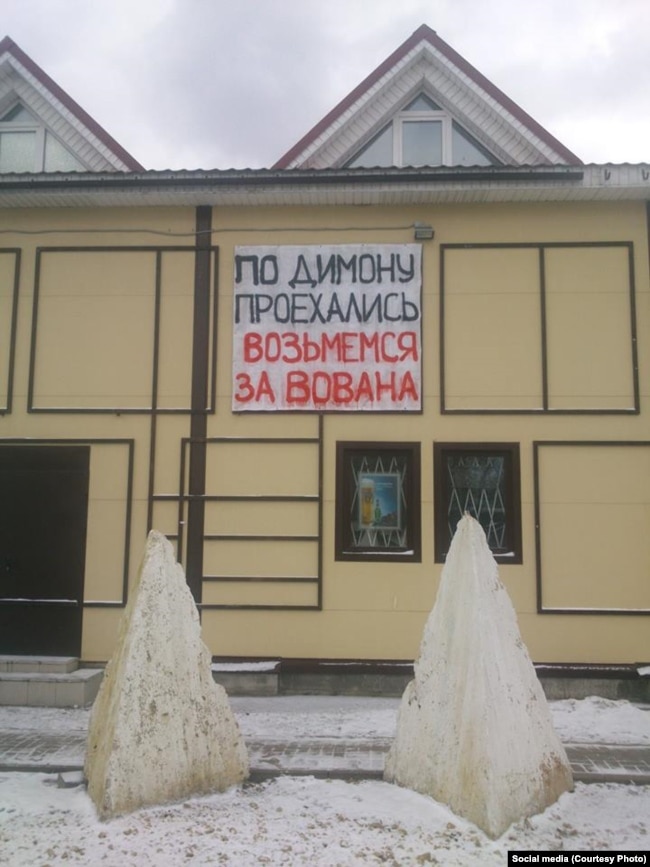
“Dimon got what was coming to him. Let’s go after Vovan.”

“We live the way we vote.”

Dmitry Skurikhin, owner of a store in the village of Russko-Vysotskoye, near Petersburg, reacts immediately and visually to every political event in Russia.

Skurikhin immediately hangs each new poster on the front of the store, a small, two-storey building, so it is readily visible from the nearby bus stop. They usually do not stay up for long, however. The record is held by the slogan “Peace to Ukraine,” which stayed up for two weeks.

На митинге Навального

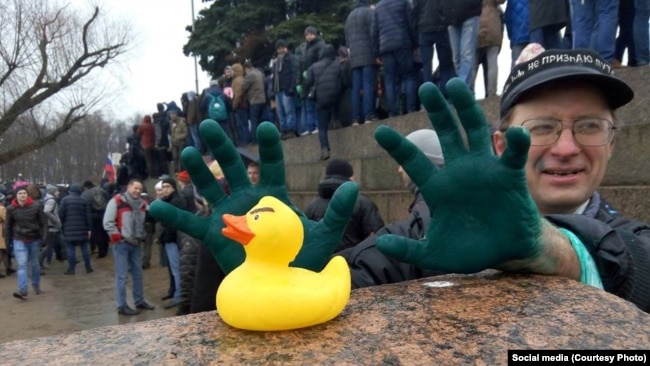
Skurikhin at a pro-Navalvy rally on the Field of Mars in Petersburg

43-year-old Dmitry Skurikhin is a local businessman, whose family owns three village shops. By local standards, he is well off. His family owns several cars, and they have everything they need. However, Skurikhin says the incomes of villagers have taken a nosedive in the past year: “They buy almost nothing, because they barely have enough for food.” Around six thousand people live in Russko-Vysotskoye. Very few of them are holiday cottage dwellers. The majority commute to work in Petersburg. Skirukhin was the first businessman in the village to open self-service stores, but “then the Pyatyorochka and Magnit chains moved in, and we croaked, of course.” He now sells toys, newspapers, clothings, and sundries.

He has been hanging political posters on his store, situated along a road, for almost four years. Before that, he pasted homemade bumper stickers on his car. Skirukhin recalls that the first bumper sticker read, “No new taxes!” The year was 2005.

Skurikhin: They had decided to raise taxes on us local businessmen then. It was one of those taxes you couldn’t avoid paying. Either you worked and paid the tax or you didn’t work and didn’t pay the tax. We businessmen realized they were clamping down on us. We joined forces and beat back the tax. It made such an impression on me that since then I haven’t been able to stop going. There are at least some improvements in our lives, specifically in our village. I’m a local grassroots activist, not even a region-wide activist, but a village-level activist. I was born here, and I live and work here. My kids go to school and kindergarten here. I think I have helped improve life in our village.

Radio Svoboda: How exactly have you improved life in the village?

Skurikhin: As they call it now, I was a municipal district council member from 2009 to 2014. At the time, our district authorities were running this interesting scam. They were “milking” the villages. They would buy heat from the producer and sell it to residents. They marked up the price one hundred percent. When the situation had reached a deadlock, it transpired they were charging residents, but not paying the producer anything. They were getting heat for free. The chair of the district council was mixed up in the scam. Thanks in part to my efforts, the gentleman was conveyed directly from the district chairman’s office to prison. That was in May 2012. Since then we haven’t had any disasters with our supply of heat and water.

We still have problems sometimes, but we are now longer in that disastrous state when a group of people affiliated with district officials were just robbing people by latching onto the flow of payments for housing and utilities. Then we had problems with the road. I organized a decent protest rally. A lot of folks turned out for it: 165 people, which is a huge number for our village. We demanded the road be repaired. The road was repaired. So, by starting with small changes like that, stirring people up, I have been trying to bring them round to the idea that fair elections, free speech, and democracy mean improving the welfare of society. On May 1, we had a rally that wasn’t about the roads (we’ve had the roads fixed), but was about healthcare, fair elections, and responsible authorities. Those were the topics of our rally. 45 people showed up. The rally was authorized. I always try and authorize events with the authorities, but we rallied at the skating rink on the edge of the forest.

Кто будет следующим

“Dimon got run over. Let’s go after Vovan.” This is a reference to Alexei Navalny’s film documentary exposé of Prime Minister Dmitry Medvedev and his untold riches, Don’t Call Him Dimon. “Vovan” is a humorous reference to Vladimir Putin.

In 2014, my time as district council member ended for a simple reason: our team doesn’t pay for votes. If you don’t buy yourself votes, meaning if you don’t pay off the right people during early voting, then you’re out of the race, because your opponents do pay for votes. United Russia paid 1,500 rubles per vote! All the other candidates lost.

Radio Svoboda: Did you prove in court they paid for votes?

Skurikhin: It’s impossible to prove in court, because the scam is quite competently organized. They don’t buy votes, but pay for the services of fake campaign workers, meaning they contract out their campaign. United Russia has a team of between ten and fifteen people, depending on the number of seats that are up for grabs in a specific municipal district, and they hire canvassers. But the canvassers don’t have to canvass. They just need to show up and vote ahead of time, for which they are paid 1,500 rubles a pop. That’s it. It’s perfectly legal. All the evidence is circumstantial. When I tried to get hired as a canvasser in a neighboring village, I was told I would not do, because I wasn’t registered in that precinct.

“How’s that?!” I said. “I’m a local resident. I have a store here. I know everyone in the village, and they all know me. I’ll canvass for you like nobody’s business.”

“No, no, you don’t fit us.”

“What’s the deal?”

“You’re registered somewhere else.”

It’s all clear, guys! You don’t need canvassers: you need voters, whom you buy off for 1,500 rubles apiece. I dubbed the technique “bribing a voter under the guise of paying a canvasser.” It works like a charm in all the villages, where the populace is not too savvy. The populace in general is not very savvy, but in the countryside it’s just unbelievable. The salary in these places is commonly 1,000 rubles a day [approx. 14 euros a day]. People who get a 1,000 rubles a day don’t suffer. I ran a counter-campaign against this.

When the villagers were going to vote, I would say to them, “Guys, are you really unaware that when they get seats on the council, they’ll shake a hundred times more out of your pockets?”

“I toss manure on a farm with a pitchfork for a 1,000 rubles a day. But here I’m getting 1,500 rubles for five minutes of my time. Maybe you’d like to go and pitch manure for me?” one guy told me.

That’s their whole rationale! There’s nothing more to say.

Radio Svoboda: When did you hang the first political banner on your store? How long did it stay up?

Skurikhin: It was the spring of 2014. My fifth daugther was born then. I decided to give my wife a present by building a politicized bus stop opposite the store. I fashioned the frame and the foundation. We didn’t have a stop there. People would always stand outside there, and the buses would stop to pick them up. I built a bus stop and draped it with posters. This was when the annexation of Crimea was happening. We had a couple of posters about Crimea: I demanded an end to the disgrace. Then there were posters demaning pay rises for ordinary doctors and school teachers. I was still a council member. I gathered information on how much doctors were paid in Russia. President Putin had literally just claimed that there were no doctors in Russia who were paid less than the average monthly salary in their regions. That was an outright lie. I wrote it on my poster, because I knew how much our doctors were paid. I had gathered the information in my capacity as a municipal district council member.

Radio Svoboda: How much did doctors really make then?

Skurikhin: The ophthalmologist in our village was paid 14,000 rubles, while the average monthly wage in Leningrad Region was 35,000 rubles. I think this as an absolutely proven lie. I hung it up on the bus stop. The local authorities were completely shocked by it. The stop had been turned into a shelter and was hung with banners and pasted with posters. They didn’t know what to do, so the posters stayed up for three weeks or so, I think. Then a major from Center “E” [the so-called anti-extremism police] in Petersburg came and had a long chat with me. That was April 1, 2014. I remembered the date, because it was the day the Russian State Duma issued a resolution condemning restrictions on freedom of speech in Ukraine. And I was sitting there chatting with this little vampire who was directly threatening me and my business.

“We will shut you down if you don’t stop it!” he told me.

The bus stop stood for a month, and then it had to be demolished. All that’s left is the concrete slab, where locals still wait to catch the bus.

Radio Svoboda: Who demolished it?

Skurikhin: I did, on orders from the local authorities. They told me either I had to demolish it and haul it away or they would do it themselves. Since then I have been hanging posters on the store.

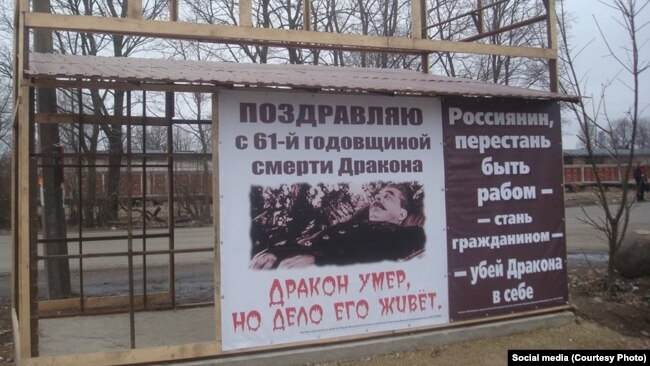
I hung up the poster “I congratulate you on the 61st anniversary of the Dragon’s death. The Dragon is dead, but his cause lives on. // Russian citizens, stop being slaves. Become citizens. Kill the dragon inside you.” The poster, which showed Stalin in his casket, used to be coupled with the second part, about citizens, which was swiped by the polizei. The poster “Peace to Ukraine” broke all the records: it hung for two weeks.

Вторую часть плаката

The second part of this poster, featuring a dead Stalin and a call to “kill the dragon inside you” and “become citizens” was “swiped by the polizei.”

The local authorities, by the way, didn’t know how to react. The poster was hanging on my building. It’s my property and my land, and the poster belongs to me. It hung there for quite a long time. Other events took place, for example, the 2014 elections. I hung my campaign posters there. As a municipal district council member, I was competing for votes. I would hang up a poster. It would become stale, and I would hang up a new one. And then, when I clearly campaigned against Putin. . . For example, I had posted a banner reading, “Putin should resign.” It was 9.4 meters by 2 meters. The banner caught everyone’s eye: my store stands next to the road. Well, they just came and swiped the banner. I decided to hang up another banner. Since it was forbidden to demand Putin’s resignation, I demanded Putin be freed. Since he considered himself a galley slave, I wrote, “Free Vladimir Putin! Let’s free this galley slave. Otherwise, he and his pals will row [rake in] too much.” This banner was also 9.4 meters by 2 meters.

Radio Svoboda: It was probably removed immediately, no? 

Skurikhin: I don’t know why, but it stayed up for nearly two weeks. I saw policemen come and look at it. Maybe they didn’t get it? I can’t say how the authorities make decisions. But then they removed it anyway. I have been doing this on purpose. My goal is to ensure President Putin loses this election. During the last election, in 2012, I printed flyers and ensured that Putin got the least number of votes in our district in our precincts, although he won anyway, of course. Our precinct was among the ten worst precincts in Leningrad Region. Numbers decide everything in a democracy. I worked on the electorate the best I could.

Radio Svoboda: Do the security services often summon your for talks and try to reason with you?

Skurikhin: Earlier they did, but recently they have left me alone for some reason. I think they just realized, probably, that they should be talking to me in handcuffs, whereas talking to me just for the heck of it, what’s the point? Besides my chat with the major from Center “E,” a major from the FSB, a colonel from the FSO (Federal Protective Service), and the Investigative Committee summoned me. Each of my posters has been sent off for a forensic examination. Policemen photograph them, and the photos are sent to Center “E” and Saint Petersburg State University for analysis: they have this forensics examination center there. Their forensics experts study my posters and render their findings. If the findings are neutral, the posters are returned to me, accompanied by an official ruling refusing to file criminal charges against me. I’ve had around a hundred such posters. Each one is also accompanied by a description. The police also try to do everything by the book. In Nazi Germany, they incinerated Jews by the book. Here in Russia, they have been trying to shut me up by the book, to put it crudely.

Radio Svoboda: What grounds do the police have for removing posters from private property? How does it usually happen?

Skurikhin: First, they get a complaint either from the local council or from a resident: someone is unhappy with the poster hanging on my store. The police arrive and write me up for violating the regional law that all posters must be vetted with the local council. This little law was invented in Leningrad Region. I disagree with it, so I simply say it wasn’t so. They write me up, then they bring a slave from the local housing authority, whom they force to climb up and remove my poster. Then they leave. After which the situation proceeds as I’ve described it. Unfortunately, the forensics experts have concluded that two of my posters insulted the honor and dignity of the president and incited social discord. I try not to insult anyone. I think through all my posters and make sure that they are worded as properly as possible, because you don’t help things by insulting people. I want to persuade people to vote against Putin, persuade them we need democratic values, freedom, and liberalism. Yet two of my posters have been deemed insulting to Putin. They were the reason I was summoned to the Investigative Committee to talk with an investigator.

Radio Svoboda: Have criminal charges been filed in connection with the two posters?

Skurikhin: You know, I haven’t asked the police about it. But they did get me summoned to the Investigative Committee, where I was asked for an explanation. I was shown the findings of the forensics experts. The poster in question was “Putin is war. Say no to war.” As you remember, it was Anna Politkovskaya who said, “Putin is war.” The slogan was written with bloody smudges, so there was nothing in particular to interpret. It was clear as clear could be. The poster was deemed to have insulted Putin’s honor and dignity. I don’t think I insulted him, but the Investigative Committee does.

Radio Svoboda: What war did you have in mind when when you wrote the slogan?

Skurikhin: Any war. Because Putin is, in fact, war. We were flattening Ukraine at the time.

Radio Svoboda: Have they threatened to close your business?

Skurikhin: The major from Center “E” threatened me, but no one else has. It’s just I’ve been in business for twenty-one years, and all the agencies they could sick on me, I’ve been working with them for a long time. I have a good relationship with them. Most important, all of them are on my side. As they’re tearing down the posters, the policemen say to me, “Damn, what you write is true.” But they’ve taken an oath, they have their orders, they would immediately get hell from their commander, so they can’t say it that way. I can because I don’t have a commander. Firefighters, the guys at Health Inspection Services, they all understand what is happening in Russia. Most of them are smart people.

Против кого на самом деле надо сакции вводить

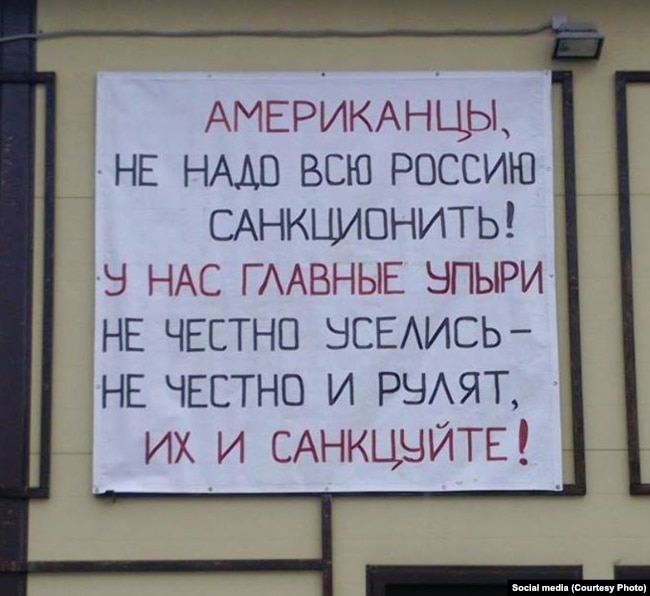
“Americans, don’t sanction all of Russia. Our head vampires got their jobs dishonestly and run things dishonestly. Sanction them!”

Radio Svoboda: Does your family support you?

Skurikhin: Yes, of course. Sure, they worry about me. The situation in Russia is such that the most active dissenters are shot down. My kids are aged nineteen, fourteen, seven, and four. All of them are girls: I live in a flower garden. If I’m arrested, my wife will feed the family: she’ll be like Vassa Zheleznova. I hope it doesn’t come to that, but we’ve talked it all throgh, of course. So that’s why I try and write slogans that are legal. I have studied a ton of material on the subject. What is an insult? It’s when you compare someone with an animal. The rest can be offensive and unpleasant, but it is not insulting in the criminal sense. You can say, “Skurikhin, you’re an idiot.” Yes, it’s possible for you to have this opinion. But I think differently. But if you say, “Skurikhin, you’re a jackass,” that is an insult.

Radio Svoboda: Have other businessmen put up similar posters?

Skurikhin: There were elections to the State Duma in 2016. As a member of Parnas (People’s Freedom Party), I ran in them in my own electoral district, the southwest  district of Leningrad Region. Sergey Naryshkin, now our top spy, ran in the same district. I made the rounds of all my businessmen friends and asked them to support me. I made banners that read, “Skurikhin and Parnas are your only worthy choice.” In our part of the world, most of the shops are village shops, and they are on private property, so I was able to hang them up for free. No other candidate got that kind of support. The rest had to pay for billboards. I spent 150,000 rubles on my election campaign. My wife later gave me a piece of her mind about that. I took second place in the elections in my own village. Only Naryshkin got more votes. I got support for my posters and ideas, for saying “Putin should resign.” My fellow villagers gave me the number two spot. In my native Lomonosov District, I took sixth place, and I took eighth place in the entire electoral district, which has a population of 500,000. What does that tell you? I would argue the outcome shows that liberal and democratic ideas are popular in society, but they simply never get conveyed to the voters, since the media are totally blocked. I have no other way of telling people Putin should have been dismissed from the Kremlin long ago. I only have my posters. But, generally speaking, it’s very hard for a Parnas member to get around United Russia on the first try.

Radio Svoboda: Do you attend all protest rallies?

Skurikhin: Yes, I try to go to all of them. At the last pro-Navalny rally, in June, I was wearing a “Sick of Him” t-shirt and carrying a flag. I was taken to a police station, but I escaped. This year there were also primary elections—Naryshkin gave up his seat in the Duma when he was appointed head of the SVR (Foreign Intelligence Service) in October 2016—and this year there were reelections. We also held events that, in my opinion, were meaningful to our district. I couldn’t let my people down, so I had to hightail it from the police station.

Radio Svoboda: Are you following the presidential campaign?

Skurikhin: Yes, of course. I’ll go all out to ensure Mr. Putin loses the election, at least in my precinct. I support Navalny’s registration as a candidate and Ksenia Sobchak’s candidacy, because we need as many candidates as possible in the first round just to take votes away from Putin and get a second round. If there is a second round, that will be a significant victory in itself.

Thanks to Comrade Uvarova for the heads-up. Translated by the Russian Reader

The Best Russia Experts Don’t Live in Russia, or, Crypto-Putinism

OLYMPUS DIGITAL CAMERA

“There’s a more likely possibility, and it doesn’t hinge on accumulated historical trauma or some irrational longing to go back to the Soviet system. With the USSR’s fall came the loss of many other things Russians valued: their country’s stature in the world, decent living standards, the welfare state, education, even a sense of community and collective identity. Putin’s apparent promise to restore some of these things is a far better explanation for his widespread popularity at home than the theory that most citizens have been too brainwashed or traumatized to think for themselves.”

But he’s been eighteen years “in office” and he hasn’t restored any of these things really, and he never really promised to restore most of them, not that you would notice if you hadn’t lived here during those eighteen years, as the author of the book review, quoted above, has signally not lived here.

Nor, as far as I know, did the author ever live in the Soviet Union he misses so much, but which lots of former Soviet citizens I know don’t miss at all.

Go figure why the western left misses a country most of its current supporters never lived in or visited for a millisecond, but which millions of its actual former inhabitants don’t miss for a second. It says something slightly disturbing about the intellectual integrity of the western left, doesn’t it?

As for brainwashing, I can’t say anything about Russians, but I know a lot of foreign so-called Russian experts and reporters covering the Russian beat who have been brainwashed by the triumvirate of dishonest Russian pollsters known as FOM, VTsIOM, and Levada Center into believing that Putin enjoys “widespread popularity at home.”

In fact, this popularity is a lot less apparent when you’re actually on the ground day after day for years on end, conversing and dealing with lots of different people who say lots of different things but somehow usually fail to express their ardent love of Putin. Here, in the actual Russia, not the imaginary Russia inhabited by the Russia experts, his “popularity” looks more like a dictatorship for life, reinforced by brute police force, flagrant corruption, major TV channels that have been nazified to the point that almost no one I know has watched them for years, and selective but regular show trials in case anyone has forgotten where they really live.

Why do so-called Russian experts, like the author of the review, quoted above, believe every poll about Russia those shysters and shills publish, including the pap about Putin’s rampant popularitry?

I’ll tell you why.

Because the world’s greatest Russia experts do not live in Russia, nor do they want to live here (they’re not stupid!), but endlessly citing so-called Russian public opinion polls as if they are the gospel truth gives their specious, highly partisan arguments an air of scholarly or empirical knowledge, of “knowing what Russians really think.”

The subject of today’s Russia and what Russians really think is way more complicated (and, sometimes, way more simple) than the certified Russia experts suspect or want to admit, however. TRR

Photo by the Russian Reader

The Standard Narrative

Is this the “real” Russia?

“I watched as the people of Chelyabinsk began to search for an identity—a Russian identity that would give them pride. Vladimir Putin’s unexpected ascent to power in 2000 was, for many, a godsend.”

How does the beloved Anne Garrels, formerly foreign correspondent of the dismal, faux-liberal but also mysteriously beloved NPR, know all this?

She claims she knows because she made repeated visits to Chelyabinsk, in Putin’s nonexistent “heartland,” over twenty years.

I gather she’s now even published a book about this fairy kingdom to great acclaim.

The problem is the story she pretends to have dug up has been the standard narrative for western journalists and academics pretending to cover or study the “real Russia” for a long while now.

The problem with the standard narrative is that it is not true, although it was partly spun from a combination of half-truths, outright but persuasive sounding lies, and thoroughly unexamined “facts.” It was cooked up, back in the day, by masterful Kremlin spin doctors like Gleb Pavlovsky and Vladislav Surkov and a whole team of other spin doctors.

Over the last eighteen years, it has been drilled into the heads of “ordinary Russians” and the legions of pollsters, academics, and journalists who have feigned to be studying what “ordinary Russians are thinking.” All of the above-named parties, including some “ordinary Russians,” have then gone on to vigorously scrubbing each other brains with the narrative in a completely closed feedback loop.

Or is this the “real” Russia?

However, the Putinist standard narrative was never true even when easy oil money made it seem partly true, and it’s even less true now when that money has dried up, and the Russian economy has been driven into the dirt by crisis, mismanagement, cosmic-scale corruption, and sanctions.

Yet the less true the standard narrative becomes, the more determined the western media and the west’s dubious posse of “Russia hands” (who don’t live in Chelyabinsk but always know what is best for the people of Chelyabinsk: twenty more years of Putin’s “heartlandism,” apparently) have been to pound the narrative into our ignorant little readerly, viewerly, and listenerly heads.

It’s no wonder the odious phrase “the Russians”—as in “the Russians think this” and “the Russians do that”—has come into vogue again. As if 144 million people all think and do the same thing, as if the eighteen years of Putin’s faux “heartlandism” hasn’t, in fact, been one long “cold civil war,” as a friend of mine aptly put it many years ago.

That is a really complicated story to report. Most western reporters are not up to the job for various reasons, so they have just rung the changes on the standard narrative, “heartlandism,” and Putin’s amazing “popularity” (measured by pollsters whose methods should not be trusted, and whose results should not be taken at face value in circumstances where polling cannot by definition produce objective feedback, if it ever could), and have called it a day.

Since editors and newscast producers are usually none the wiser and have lots of other stories to shepherd, they have let the journalists and their sources in the world of Russia hands spread the Putinist standard narrative up and down and round the west, so that schoolkids and soccer mums in Melbourne, Grimsby, and Cuyahoga County, if pressed, could regurgitate it almost as convincingly as Garrels does, in the “Comment Is Free” piece for the “liberal” Guardian readership, as quoted above.

If there is anything worth preserving about political and social liberalism, it is the desire to reject canned truths and dogmas and find out what has really been going down somewhere.

“Real Russians” are upset “the west’ has swallowed the standard narrative hook, line and sinker.

Instead, nearly the entire western press corps and a good portion of its academic experts on Russia have bought the whole bill of goods, freeing the Russian elite from any responsibility for its cynical, destructive, dysfunctional, and dangerous governance of the world’s largest country.

Amidst the fake moral panic over “hysterical Russophobia” this has always been the real story: how western political, media, and academic elites have mostly been letting the heartlandist-in-chief get away with it, in effect, aiding and abetting him and his old friends in the Ozero Dacha Co-op, serving as cashiers to him and the Laundromat, helping him amass his supplies of real and symbolic capital.

This shell game will all come to a screeching halt one day, however, and all the back stocks of bestsellers like Garrels’s will have to be pulped because they won’t be worth the paper they were printed on. TRR

All photos by the Russian Reader

Manufacturing Half-Baked Consent in Russia

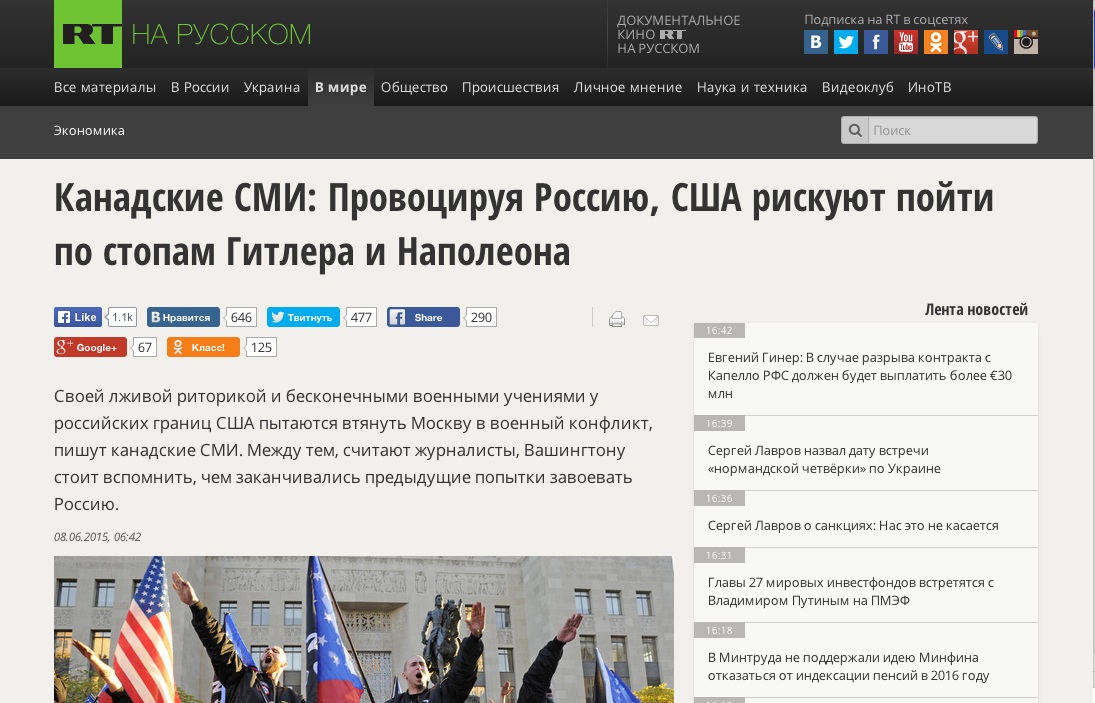
Here is a textbook example of today’s Russian-language propaganda journalism (the bill footed by Russian taxpayers, one sixth of whom have slipped below subsistence level living, according to Rosstat).

canadian smiThe headline reads, “Canadian media: By provoking Russia, US risks following in the footsteps of Hitler and Napoleon. With its mendacious rhetoric and endless military exercises near the Russian border, the US is trying to pull Moscow into a military conflict, write Canadian media. However, journalists [sic] argue that Washington should remember how previous attempts to conquer Russia ended.”

If you actually read the article—and why bother, because its robot compilers want you to scan three things very quickly and get the takeaway message in under ten seconds: 1) like Napoleon and Hitler, the US wants to “conquer” Russia for some reason; 2) the US has been taken over by neo-Nazis—just look at the picture; 3) even the otherwise loyal “Canadian media” are writing about this fiendishness—you’ll find out that the “Canadian media” referred to is really just this one article, published on the more than dubious Canadian Putin fan club website Global Research.

The article was written by someone named Stephen Lendmann, “who lives in Chicago.”

Well, Mr. Lendmann does much more than just live in Chicago. He has also edited a nice little anthology of pro-Putin writing by western leftists and “anti-imperialists,” entitled FLASHPOINT IN UKRAINE: How the US Drive for Hegemony Risks World War III.

At $24.95 a pop, it’s a steal, I think.

Meanwhile, back in Putinland, where it will probably soon be a crime to read or speak English (lest anyone get any funny ideas), Russian readers will have to content themselves with this Russian-language summary of Lendmann’s article, which features, inexplicably, a photo of someone dressed up as Hitler and looking desperate.

A waxwork of Adolf Hitler before a 41-year-old man tore its head off from the controversial exhibit on the opening day of Berlin's Madame Tussauds July 5, 2008 is seen in this July 3, 2008 file photo. The man was arrested by police after he jumped over the desk and ripped off the head of the waxwork figure in protest of the controversial exhibit that showed a glum-looking Adolf Hitler behind his desk in a mock bunker during the last days of his life.   REUTERS/Tobias Schwarz/Files  (GERMANY) - RTX7NQ0

A quick Google image search reveals that this is not someone dressed up as Hitler, much less the world’s greatest villain himself, photographed on the eve of his demise in the bunker, but a waxwork figure of Hitler whose head was torn off by an enraged visitor on the opening day of Madame Tussauds Berlin in July 2008.

This has been a brief lesson in how consent is manufactured facilely and cynically in Putin’s Russia at taxpayer expense. Basically, all the major Russian media outlets have been engaged in this manufacturing of reality for most or all of Putin’s reign, but since the winter of 2014, the brakes have come off the buggy and fact-based reality almost never makes an appearance in such “news reports.”

* * * * * *

Sadly, lots of people here buy into this stuff, at least partly, if only in a half-baked “since they rant on about it day and night, at least some of it must be at least sort of true” way. I am not the “liberal” (i.e., profoundly misogynistic, Russophobic) Levada Center, and I don’t believe that polls in this country are used in any other way than the implicitly violent, authoritarian “we get the feedback we want” mode, so I will never cite any of these dubious surveys to make an argument about how many people believe this crap, much less how they believe it. (Which really would be the only interesting aspect of this “pollocracy” to study.)

However, a student of mine, an otherwise level-headed psychiatrist, told me the other day that the large numbers of young patients he sees with severe personality disorders and traumas had something to do with the chaos of the nineties, when many of these young people, then small kids, were left to fend for themselves, emotionally, at least. It is hard to argue with that hypothesis.

But then he said something I am sure he didn’t believe himself when he said it.

“Russians have been better off psychologically when they have had a strong leader.”

The desire to conform to “public opinion” among God’s allegedly smartest creatures is strong, almost irresistible at times, and not only in Russia.

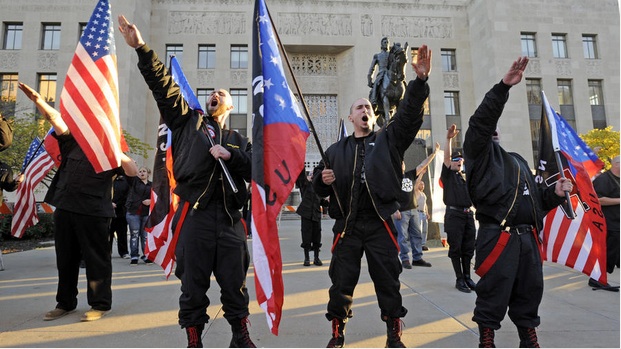
P.S. A simple Google image search revealed that the photo of the Sieg-Heiling US neo-Nazis, above, was undoubtedly filched from this Reuters article about how, according to the Southern Poverty Law Center (who never saw a hate group they didn’t like to blow out of proportion), the number of hate groups in the US has declined by 17% over the last year.

And yet, if RT is to be believed—visually and viscerally, so to speak—these selfsame declining neo-Nazis have somehow either seized power in the US or are dictating US policy towards Moscow. Or have something to do with provoking the powerful anti-American, pro-Moscow tilt of the “Canadian” media.

In reality, they have nothing to do with anything.

us neonazis

Viktor Voronkov on Why You Shouldn’t Trust Russian “Public Opinion” Polls

Can we trust opinion polls on the president’s popularity?
Serafima Taran
December 2, 2014
Gorod 812

Sociologists weekly poll Russians about their attitude to the president and government policies. Despite all the events happening inside and outside Russia, the level of trust in Vladimir Putin has remained virtually unchanged. 

According to the Public Opinion Foundation (FOM), nearly three quarters of the populace (72%) view the president’s actions positively. Can these figures be trusted? Sociologist Viktor Voronkov, director of the Center for Independent Social Research (CISR), discussed this in an exclusive interview with Gorod 812.

Can opinion polls be used to predict the near future, at least, whether stability or social upheaval awaits us?

The first thing I would note is that opinion polls are manipulative techniques that shape public opinion rather than reflect anything. You can interpret them as you like. This means, actually, that they are probably not amenable to interpretation.

In addition, most of the questions asked by polling centers are outside the competence of the people responding to them.

Sociology is generally not in the business of forecasting. That is not its function. Sociology studies the rules by which people live and act.

Is there a great difference between polls taken in authoritarian societies and polls in democratic societies?

In an authoritarian society it is more difficult, of course, to determine what people actually mean to say. Like the Soviet Union (although to a lesser degree), our society is now dominated by fear. The fear of saying the wrong thing, the fear that someone will use this information the wrong way, and so on. So just to be on the safe side, one has to stick to the mainstream when speaking.

But sociologists and the people in Kremlin probably realize this. Why, then, are so many polls conducted?

Their function is purely manipulative, but it is also has a lot to do with making money. The state manipulates public opinion polls and this, in turn, really influences people.

In general, the nature of public opinion in modern Russia is extremely primitive. There is Putin, whose rating is stable and basically cannot change rapidly. All other existing ratings are directly dependent on what President Putin says. You needn’t bother studying public opinion in Russia. It is enough to study the opinion of only one man, because in one way or another all other opinions will fall in line with this principal opinion.

We see, for example, how sentiments toward the US have evolved in recent years. In 1999, NATO bombed Kosovo. Putin condemned the US, and the country’s rating dropped to thirty-five percent. In 2001, the terrorist attack took place in New York. Putin expressed condolences: sympathy for Americans rose sharply, reaching seventy-five percent. We now have a negative outlook on the US, but if Putin decides tomorrow that we are friends with America, everything will change.

It doesn’t mean anything, except that people basically are not very concerned about it.

So the main objective of these polls is impacting the populace by publishing them in the media?

Of course. The media is mainly responsible for spreading the contagion of propaganda. I would say that in terms of impact on people, media publications of poll results are akin to horoscopes. Horoscopes, as we know, affect people’s lives. People try to interpret their lives in accordance with what the horoscopes say. It is the same with opinion polls.

But there is, nevertheless, real public opinion in Russia. Can one find out what it is?

Suppose you ask someone how he relates to the issue of “Crimea is ours” [Russia’s annexation of Crimea]. He says, “Yeah, it’s wonderful, it’s great, I support it.” You continue questioning him, asking him to tell you more. And the reply you hear is, “You know, I have no time for this. I’ve got work and kids. Spare me your nonsense!” So it is real life that is important, not sketchy answers to staged questions.

The fact that people give answers in no way means we can assess their behavior in terms of these answers.

Opinion polls reflect (at best!) attitudes, the values that society imposes, perhaps. But you would need to study people’s behavior, their real personal motivation, because there is no unambiguous connection between attitudes and behavior. People think one thing and then do something else altogether.

 Is it like this in any society, closed or open?

It is easier in an open society. People tell you what they think, but again, this does not mean their behavior will match it.

But in a closed, Soviet-type society, on the one hand, a “small victorious war” raises the government’s rating, because everyone rallies around the leader. On the other hand, within the country, everyone criticizes everything. There is no confidence in the army or the police, not to mention the parliament and the courts. There is no real confidence in anyone.

But in foreign policy, society almost unanimously supports “its” powers that be. The bulk of Russia’s citizens have an imperial mindset: it was not for nothing they were raised as patriots for seventy years, beginning with Stalin’s ideological turnaround in 1934. So the people see any foreign adventure undertaken by the Russian government as a symptom of our being “picked on.” And their justification of any aggression—the invasion of Afghanistan, Czechoslovakia, Hungary, etc.—follows this. All these military actions were fully supported by the people. The 2008 Georgian War had exactly the same support. The annexation of Crimea is now supported for the same reasons.

In Russia, it is almost impossible to find out not what public figures and experts think, but what the “common man” thinks.

This is true. The common man has very little right to be heard anywhere. Current sociology and anthropology, which are not dominant in Russia, aspire to give the average man a voice. Hence the spread of so-called qualitative, as opposed to quantitative, methods, publications of interviews with “ordinary” people. Attempts are made to produce texts in collaboration with them. Some sociologists even just publish the texts of these people without commentary.

But why don’t Russian sociologists do this?

In Russia, sociology has adapted to serve the powers that be. And the powers that be have little interest in the real opinions of ordinary people. Our powers that be are even uninterested in the opinions of sociologists, except those who publicize what the powers that be themselves say, couched in academic discourse.

If economic difficulties worsen, will the mood of Russians change?

People have now had a taste of a relatively prosperous life. At least twenty percent of the population has seen what life abroad looks like, and they are unlikely to want to live under war communism or as in North Korea. But it is already clear that this little splash of the good life, which was due to high oil prices in the 2000s, has ended. Real income levels will now fall. Those who lived in poverty will feel almost nothing. They will go on living as before. But the so-called middle class, who are supposed to support the authorities because they live well, will feel this first and foremost.

So I think that a political crisis cannot be avoided, whatever propaganda or opinion polls are thrown at it.

__________

See my previous posts on Russia’s authoritarian “pollocracy”: