Andrei Khrzhanovsky: Even Tel Aviv Hipsters Can Commit Genocide

Andrei Khrzhanovsky. Source: social media

Son of the renowned filmmaker Ilya Khrzhanovsky, anthropology graduate and activist Andrei Khrzhanovsky moved to Israel in 2022. He almost immediately adopted a pro-Palestinian stance in the Middle East conflict, dubbing Israel’s actions genocide, and Zionism an ethnically supremacist idea. He says he is fighting for the rights of Palestinians in the West Bank due to his sense of guilt over the war in Ukraine. He spoke with Marina Berdichevskaya about his radical stance and his conflicts with his family.


Andrei Khrzhanovsky, 26, has been living in Israel since 2022. When Russia launched its full-scale invasion of Ukraine, he found himself in Tel Aviv with his entire family, including his famous father, grandfather, and grandmother. When the time came to fly home, there was nowhere to go. On February 24, Ilya Khrzhanovsky had begun circulating a petition, condemning the invasion of Ukraine, among cultural figures. Andrei flew to Georgia and applied there for Israeli citizenship.

Since March 2022, Andrei X, as he likes to be called, has enthusiastically plunged into the weeds of Israeli life and quite quickly chosen a side: he has taken up activism and, so he claims, journalism, on behalf of “the most vulnerable group on Earth at the moment,” the inhabitants of the West Bank. At the same time, Andrei has been doing battle with “the genocide in Gaza” and on this score has found himself at odds with his father, who has repeatedly said that, in the wake of 7 October 2023, he has felt himself to be Israeli first and foremost.

We talked at length and quite emotionally about how the profoundly erudite Khrzhanovsky, who has a degree in anthropology from the University of London, has decided to atone for the collective guilt of generations for world colonialism. Andrei happily juggles concepts and historical facts and is sure that this is the only way to do things: to always stand up for the downtrodden and to never succumb to propaganda. Whether he himself is suspectible to propaganda is an open question. Ah, yes. The opinions expressed here do not necessarily reflect the views of Republic or its editors—nor should they.

“The closer you are to the empire’s center, the greater the blame”

— Let’s begin with where you live. Your Facebook page says you live in Jericho. Is this true?

— Nowadays, I don’t stay anywhere longer than a few days in a row. I rent a flat, but I won’t divulge its location, because I get several death threats a day. I come home once every month and a half for a couple of days and then I hit the road again. Yesterday, I came from Bethlehem.

—  How do people on the West Bank relate to you? Do they understand that you have an Israel passport?

— I’ve never had any problems with this because this is a political conflict, not an ethnic one. I speak with Palestinians deep in Area A (the West Bank is divided into three areas; Area A, which makes up seventeen percent of the West Bank, is wholly controlled by the Palestinian Authority — Republic) whose relatives have been killed, who have done time in prison. Israel fosters the illusion that all Palestinians want to kill all Jews. But this isn’t an ethnic conflict, and not even a religious one at the end of the day.

— In February of last year you said in an interview, “When the war in Ukraine began, I had an enormous sense of guilt that I hadn’t done more [to stop it]. That’s why I’ve thrown myself into all political activism here.” You explained your activism in terms of not wanting to “squander another country.” Where does such a young man come by a sense of personal guilt for what is happening in and with a country? After all, many Russian nationals, especially the remainers, reject the very principle of collective guilt.


Karèn Shainyan, interview with Andrei Khrzhanovsky and Artyom Nikitin (in Russian, with no subtitles)

Today’s episode of Who Am I After This? is very sensitive for me personally. The conversations with its two subjects, leftists and human rights activists, were the hardest and most emotional in the whole project because they both touch on a very painful personal conflict of loyalties for me. This is the only episode where there are two protagonists at once: journalist Andrei Khrzhanovsky and architect Artyom Nikitin. Quite handsome and young, both moved to Israel after the war in Ukraine began, and both travel to the West Bank to support the local Arab [sic] population, even and especially now, when there is a war in [sic] Israel.

Source: Karen Shainyan (YouTube), 2 February 2024


— Before February 2022 we all lived in a magical reality of sorts: there was a dictatorship in Russia, seemingly, but no one was getting killed, as it were; everything was sluggish, we had to tackle corruption and so on. But there was no sense of the disaster that any dictatorship represents. This illusion personally crumbled for me on 24 February 2022. The disaster started then, and then intensified after the genocide in Gaza began. Over the past few years, the feeling has only grown in me that we are all to blame for what is happening; some more, some less. The closer you are to the empire’s center, the greater the blame.

— And when did you personally start counting down that blame?

— If we speak of the entire timeline, there were three moments. The first was 24 February 2022. The second was an article by Yuval Abraham (an Israeli journalist and co-director of the Oscar-winning film No Other LandRepublic), based on conversations with soldiers fighting in Gaza who admitted that they had been tasked with firing on civilian targets. And the third was the morning when I woke up, opened Instagram, and saw the video of a man in Gaza burning alive after an IDF strike on a hospital.
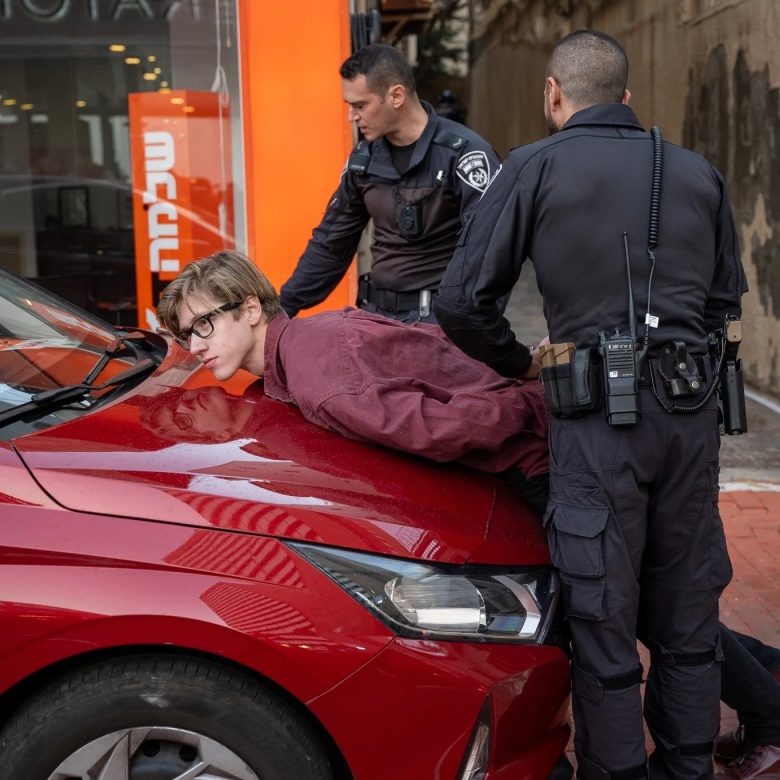
Andrei Khrzhanovsky. Source: social media

— How did you get involved in political activism in Israel?

— I had an approximate, general notion of what was happening here when I turned up here. I grew up in the Russophone media space after all. But when I arrived I realized that I had to figure out what was happening. I started reading books and talking to people. The more I researched, the more horrified I was. Suddenly, I found out about the status of Palestinians in East Jerusalem: their land was annexed, but they weren’t granted [Israeli] citizenship. To get into the Shuafat refugee camp, which the Israelis annexed and surrounded with a wall, Palestinians have to go through a security checkpoint. The sheer number of different methods for constructing a state based on ethnic supremacy is insane.

Continue reading “Andrei Khrzhanovsky: Even Tel Aviv Hipsters Can Commit Genocide”
Archipelagos

Western free society is seriously sick too. The symptoms pop up here and there, but one of the most disgusting is the massive support for the alleged “people of Palestine”—that is, Hamas—in this whole monstrous story. I really don’t understand HOW it has been possible, after the atrocities of October 7, after the taking of hostages, including children, to pretend that this was a minor trifle? That the ruthless Jews suddenly out of the blue started tormenting the unfortunate residents of the Gaza Strip?

After all, bolstered by this wave of international support, Hamas thinks it has won. This will lead to fresh terrorist attacks, of course.

Source: Boris Akunin (Facebook), 16 January 2024. Translated by the Russian Reader. Boris Akunin’s wit and wisdom have been featured in previous posts on this weblog.


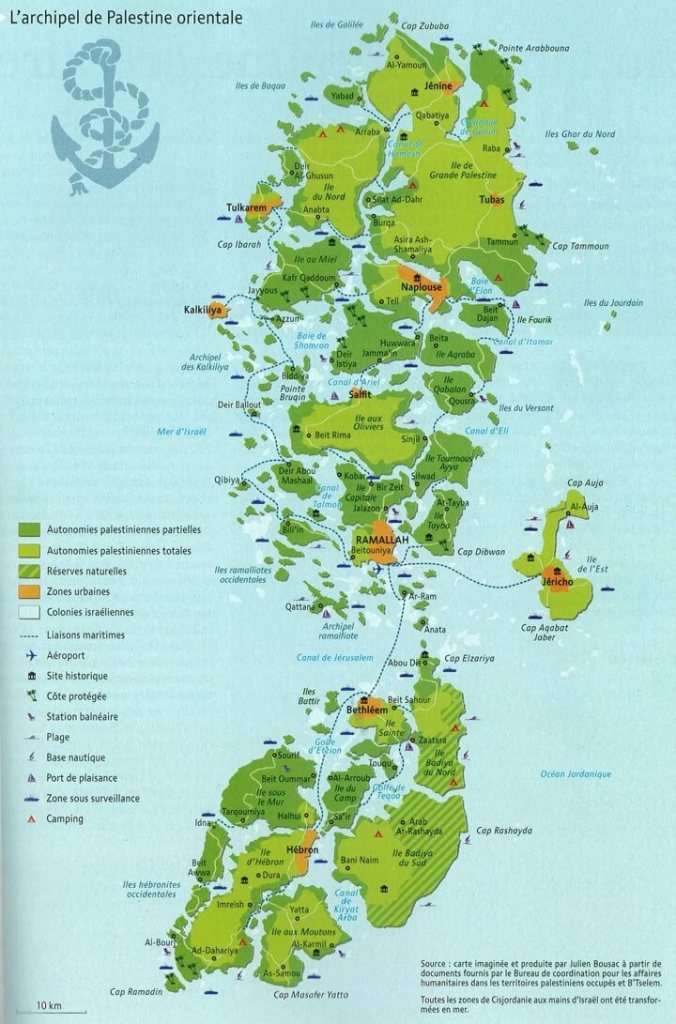
The map above shows what Palestine’s West Bank would look like if all non-Palestinian land suddenly turned into water.

All that would remain would be an archipelago of small islands with the sea of Israel to the west and the Jordanian ocean to the east.

The map is designed to show just how broken up Palestinian land in the West Bank really is. And while originally published in French, it is quite clear in the main point it’s trying to make.

Here are some key points about the map:

  1. Regions of Palestinian Authority:
    • The map shows areas of partial and total Palestinian autonomy, marked in different shades of green. The darker green areas represent total autonomy, while the lighter green areas represent partial autonomy.
  2. Israeli Settlements:
    • Areas in blue indicate Israeli settlements.
  3. Urban Zones:
    • Orange areas represent urban zones.
  4. Protected and Historical Sites:
    • Natural reserves and protected coasts are marked, along with historical sites.
  5. Geographical Representation:
    • The map depicts the West Bank as a series of islands, which illustrates the fragmented nature of Palestinian territories due to the division created by Israeli settlements, roads, and checkpoints.
  6. Symbols:
    • Various symbols denote airports, historical sites, protected coasts, beaches, and camping areas. There are also symbols indicating maritime connections, which, in the context of the map, seem to suggest metaphorical “water” crossings between different areas of Palestinian control.
  7. Geographic Features:
    • Names of regions and cities such as Ramallah, Nablus, Hebron, Bethlehem, and Jericho are mentioned, providing a sense of the location and distribution of these areas.

The map’s creation by Julien Bousac aims to highlight the challenges faced by Palestinians due to the fragmentation of their territories. The fictional archipelago metaphorically represents how the West Bank is divided and isolated, illustrating the complex political and social landscape of the region.

For books on this topic have a look at:

Source: “Palestine’s West Bank Archipelago,” Brilliant Maps, 17 June 2024


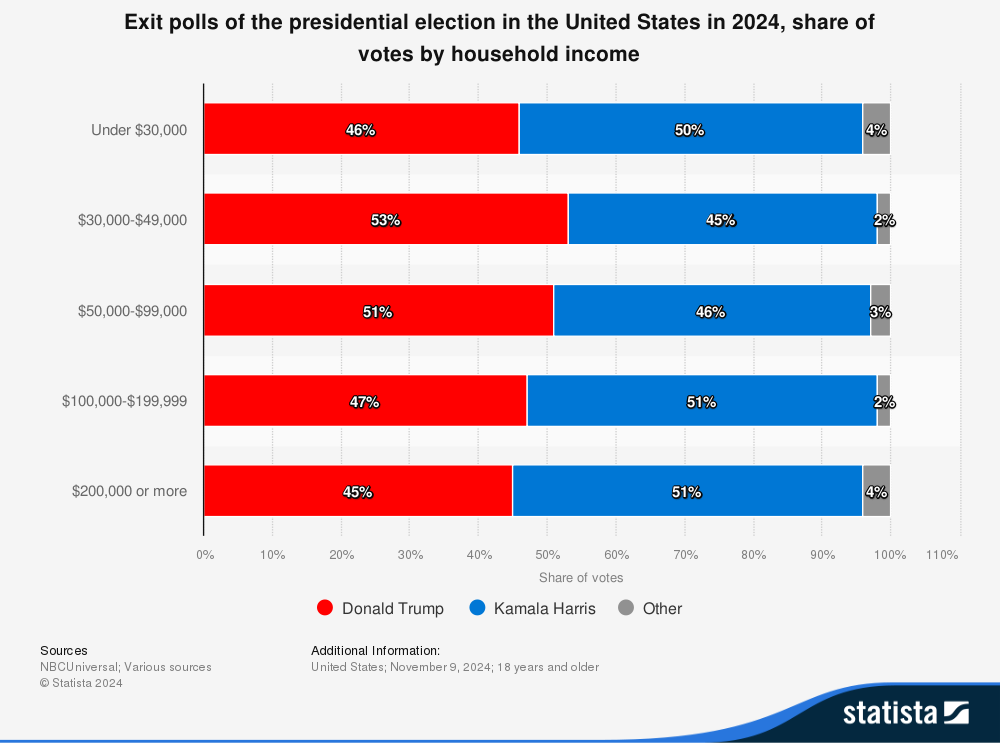
Red America and Blue America have become two different and mutually antagonistic countries sharing the same geographic space. They barely talk to each other, don’t understand one another — and while Blue America happens to be aware that both itself and Red America exist in a larger, infinitely complex world that needs both of them to be one whole for its survival, just as both of them need that larger world for theirs, Red America is not interested in and indeed is hostile to anything and anyone that is not itself and, while generally tending to be poor and perennially gripped by bitterness and resentment, derives its existential satisfaction almost exclusively from making Blue America feel bad — “owning the libs,” as Red America calls it.

Source: Mikhail Iossel (Facebook), 18 January 2024. The emphasis is mine. ||| TRR


Source: Statista


A really good series. I don’t know to what degree it straight up deserves а rating of eight, but it has interesting and fairly unique ideas, and the lead actress is pretty and acts well. We’ll see what the next episodes are like, but on the basis of the first one we can say [that the show] has fine potential. If it develops in a good direction, it could turn out to be decent.

Source: Ororo.TV. Translated by the Russian Reader

In Plain Sight

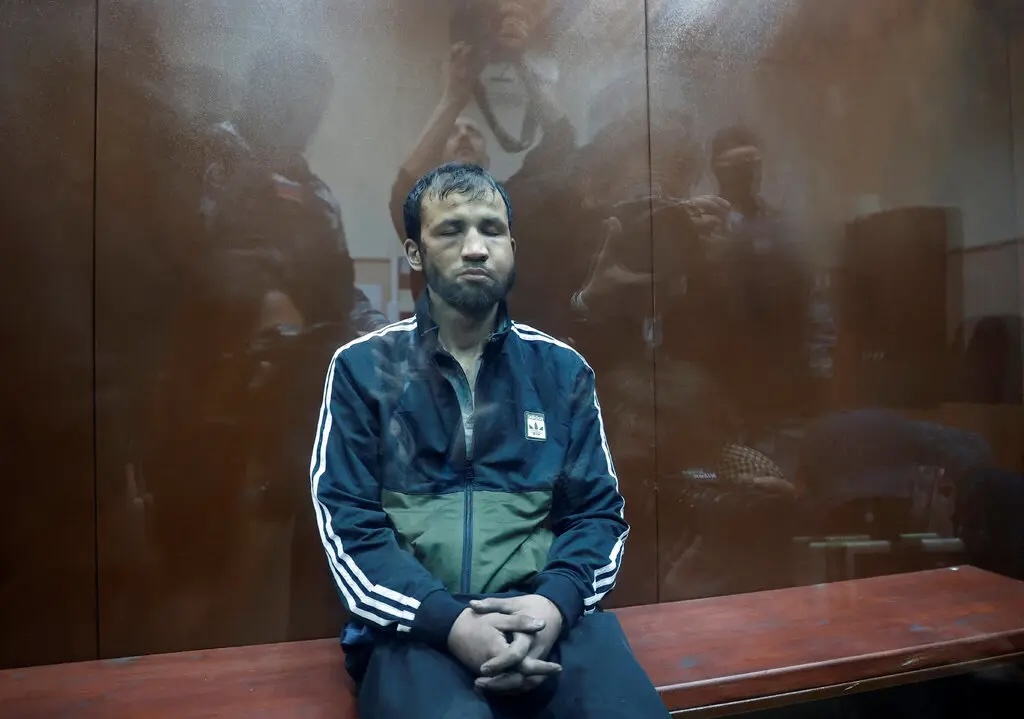
Accused terrorist Shamsidin Fariduni, with bruising on his face, inside a Moscow courtroom.
Photo: Yulia Morozova/Reuters via the New York Times

It seems that one of the consequences of this tragedy [i.e., the terrorist attack on the concert hall in suburban Moscow] has been the legalization, or legitimization, of torture. Torture existed before, but it was concealed and formally condemned. Now torture is openly praised and flaunted, and state institutions, including courts, do not react in any way. Another step towards fascization.

Source: Sergey Abashin (Facebook), 25 March 2024. Translated by the Russian Reader


Warning: this newsletter contains numerous descriptions of violence and torture.

People are tortured every day in Russia. For a long time we have been hearing about torture in penal colonies and police departments from victims and human rights activists. Mops and electric shockers have been mentioned in reports in the independent media and in the accounts of people who were subjected to violence, but the Federal Penitentiary Service (FSIN) and the police themselves have usually denied the accusations. Even in today’s Russia, however, the courts have periodically tried to imprison law enforcers who have tortured people, such as those implicated in the Karelian penal colony case, the Yaroslavl case, and the Saratov prison hospital case.

The terrorist attack in suburban Moscow has changed everything.

On 22 March, gunmen killed at least 137 people at the Crocus City Hall concert venue outside Moscow. They set fire to the building and left before the police arrived. Law enforcers have already detained suspects, and the Z bloggers have been salivating over the photos and videos of their abuse at the hands of the authorities. Never before have we had such flagrant acknowledgement of torture.

“The law enforcers have often covered their tracks by sweeping stories of torture under the rug, and we were told that there was no torture, that the reports were nonsense,” Sergei Babinets, head of the Crew Against Torture, said in an interview with Mediazona. “But since yesterday it seems as if there is a path to making torture a little more public.”

Dalerdzhon Mirzoyev (whom propagandist Margarita Simonyan dubbed the “ringleader” of the terrorists) was brought to his arraignment hearing with bruises on his face and remnants of a bag around his neck. He had no bruises at the time of his arrest, and the bag could have been used by law enforcers to strangle Mirzoyev. When the judge announced the pretrial restraint measures (Mirzoyev was remanded in custody to a pretrial detention center) Mirzoyev could not stand up. Instead, he leaned against the wall of the “fish tank” in the courtroom.

Saidakrami Murodali Rachabalizoda was brought to the hearing with his head bandaged. A law enforcer had cut off his ear when he was detained and tried to make him eat it. Neo-Nazi Yevgeny “TopaZ” Rasskazov of the nationalist subversive group Rusich announced an auction for the knife that was allegedly used to cut off Rachabalizoda’s ear.

The third detainee, Shamsidin Fariduni, was also apparently tortured. Telegram channels associated with law enforcement circulated a photo of Fariduni lying on the ground with his pants pulled down and law enforcement officers standing over him. There are wires from a field telephone attached to his groin. Such wires are used to electrocute detainees. (They have been used, for example, on detained Ukrainians in the occupied territories.) And someone is also stepping on Fariduni with a foot shod in an army tactical boot. Fariduni arrived in court with a swollen and beaten face.

Muhammadsobir Faizov. Photo: Alexandra Astakhova/Mediazona

Finally, the fourth detainee, Muhammadsobir Faizov, came to the court from the intensive care unit in a wheelchair. He could barely speak, and was hooked up to a catheter and a urinal. One of his eyes was injured. For the duration of the hearing, his doctors—two women in ambulance corps uniforms who had arrived with Faizov—were asked to leave the courtroom.

Why is this happening? Sergei Babinets argues that law enforcers could have been affected by the absence of major terrorist attacks in recent years.

“Many people were simply not ready for it—not ready emotionally, not ready psychologically, not ready on various fronts. And people may have started to lose their nerve due to this. That’s why there have been calls to reinstate the death penalty, to locate all the guilty parties and execute them, for example,” he said.

Аccording to Babinеts, Russian aggression in Ukraine has also played a role.

“The normalization of violence may have aggravated the situation with torture. We can see that law enforcement officers are really starting to let themselves go more,” he said.

Babinets adds, however, that there is no point to this violence.

“Torture most often leads to the torturer obtaining the information he wanted to obtain initially,” he said. “If they want a person to confess that they had been working, for example, for the Ukrainian army, they can be tortured until they confess. It is impossible to effectively investigate crimes in this way.”

Source: “Torture has gone public,” WTF? newsletter (Mediazona), 25 March 2024. Translated by the Russian Reader


It’s more than two decades since I read the late Stanley Cohen’s ground-breaking States of Denial: Knowing About Atrocities and Suffering (2001). In the introduction, Cohen recalls his own experiences growing up in apartheid South Africa, when he asked himself why his own outrage at the injustice he observed all around was not reflected in the society around him:

Why did others, even those raised in similar families, school and neighbourhoods, who read the same papers, walked the same streets, apparently not “see” what we saw. Could they be living in another perceptual universe — where the horrors of apartheid were invisible and the physical presence of black people often slipped from awareness? Or perhaps they saw exactly what we saw, but just didn’t care or didn’t see anything wrong.

Cohen went on to become a sociologist and a lifelong human rights activist. States of Denial was a valiant attempt to bring his discipline to bear on the subject of why people become become ‘everyday bystanders’ of atrocities who ‘block out, shut off or repress’ troubling or disturbing information to the point when they ‘react as if they do not know what they know.’

Some of these observations related to Israel, where Cohen moved in 1980. A Zionist in his youth, Cohen opposed the military occupation of the West Bank and Gaza, and became a strong critic of Israeli repression of the Palestinians. In his book, he describes his work with the Israeli human rights group B’Ttselem on the torture of Palestinian detainees and the obstacles it encountered:

Our evidence of the routine use of violent and illegal methods of interrogation was to be confirmed by numerous other sources. But we were immediately thrown into the politics of denial. The official and mainstream response was venomous: outright denial (it doesn’t happen); discrediting (the organization was biased, manipulated or gullible); renaming (yes, something does happen, but it is not torture); and justification (anyway ‘it’ was morally justified). Liberals were uneasy and concerned. Yet there was no outrage.

Cohen returned to the UK in 1996, and died in 2013, but were he alive today, I suspect he would have recognized the ongoing devastation of Gaza as a textbook example of the ‘politics of denial’. According to the latest figures from the United Nations Office for the Coordination of Humanitarian Affairs, the IDF has killed more than 31,988 people, most of whom are women and children, with another 7,000 buried in the rubble, and wounded 74,188. To put these figures in perspective, this February civilian casualties in Ukraine were estimated at 10,582 dead and 19,875 injured since the Russian invasion began on 24 February 2022.

So in just under six months, Israel has killed more civilians in Gaza than Russia has killed in two years. It has destroyed or damaged more than 60 percent of Gaza’s housing stock, 3 churches, 224 mosques, 155 health centres, 126 ambulances. Nearly 2.3 million Palestinians have been displaced, and 1.1 million people are facing ‘catastrophic levels of food insecurity,’ which threatens to become a famine.

All this has been done with the indirect support or direct collusion of the United States government, the European Union, and the British government. Despite the outpouring of rage and horror on the streets of so many cities across the world, liberal democracies that claim to uphold an international order based on human rights and universal moral norms have ‘known and not known’ what has been taking place in front of their eyes.

Many of these governments once railed against ‘dictators killing their own people’, and used atrocities and human rights abuses as a moral lubricant for liberal ‘interventions’ and ‘ humanitarian’ wars to prevent ‘massacres’ and ‘bloodbaths.’ Apart from a few tepid words of condemnation, when the obscenity of what is unfolding became too much to ignore, these same governments have enabled Israel to inflict incredible carnage on a mostly unarmed and defenceless population.

None of is taking place in secret. In February, Amnesty claimed that ‘Fresh evidence of deadly unlawful attacks in the occupied Gaza Strip…demonstrates how Israeli forces continue to flout international humanitarian law, obliterating entire families with total impunity.’ Israeli soldiers routinely post tweets and TikTok videos of themselves gleefully blowing up Palestinian homes, wearing Palestinian lingerie and women’s dresses, humiliating Palestinian prisoners made to strip down to their underwear, and generally exulting in the destruction.

[…]

Source: Matt Carr, “In Plain Sight: Atrocity Denialism and the Destruction of Gaza,” Matt Carr’s Infernal Machine, 26 March 2024

Don’t Stomp on the Ants, Sweetheart

KING CITY, Calif. — A group of men in masks opened fire at an outdoor party in central California, killing four people and injuring three others Sunday evening, police said.

Police responded to a reported shooting around 6 p.m. in King City and found three men with gunshot wounds who were pronounced dead in a front yard, the King City Police Department said in a statement.

Four other people sustained gunshot wounds, including a woman who died after being transported to Mee Memorial Hospital in King City, about 106 miles (170 kilometers) south of San Jose.

The three injured men were transported to Natividad Hospital in Salinas, police said.

Several people were at the party outside a residence when three men with dark masks and clothes got out of a silver car and fired at the group. The suspects, who were not immediately identified, then fled the scene in the car.

The investigation is ongoing, police said.

On Monday French lawmakers will vote on whether to enshrine in the country’s constitution a “guarantee” of women’s “freedom” to have an abortion. They will meet at a joint session of the lower and upper houses of parliament in Versailles, a rarely convened body known as the Congress. A constitutional revision requires three-fifths of the votes. 

Such cross-party support is widely expected. Last Wednesday the French senate, which is controlled by the opposition centre-right, voted overwhelmingly in favour of the bill. The revision also enjoys backing from the governing centre and the opposition left. Emmanuel Macron, the president, wants women’s freedom to have an abortion to be made “irreversible”. French politicians of all stripes have worried about the potential for a future rolling-back of such guarantees—especially since America’s [sic] Supreme Court overturned the ruling that protected abortion rights there in 2022.

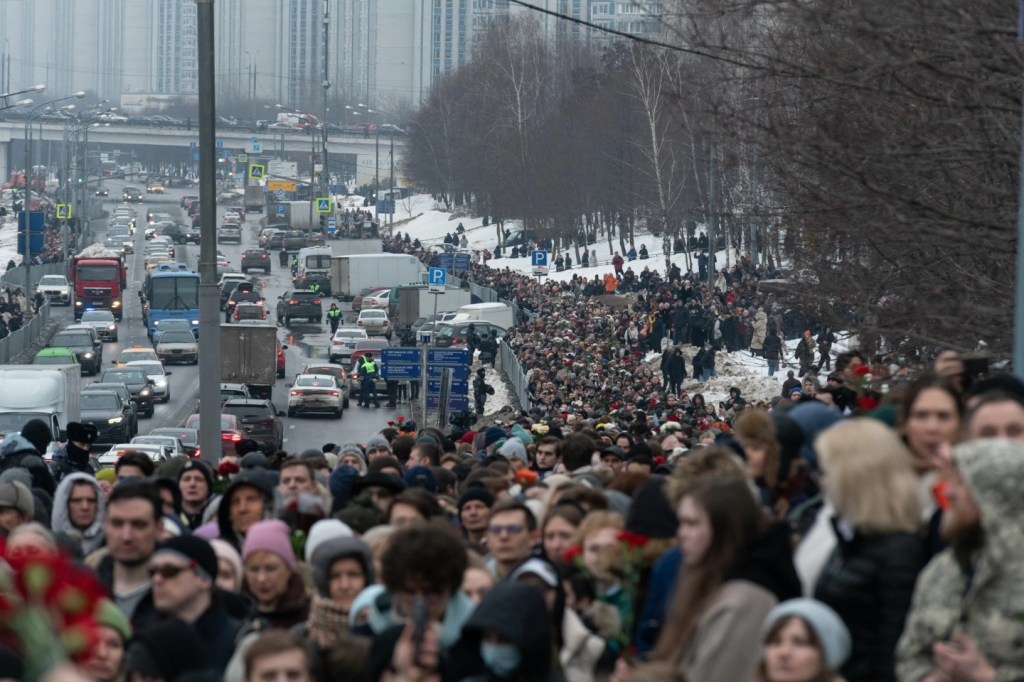
Sources: Spanishdict.com daily newsletter, 4 March 2024; Monterey Herald, 4 March 2024; Time, 4 March 2024; The Economist daily newsletter, 4 March 2024; the YouTube channels of The Insider (“Navalny’s Last Rally”) and Novaya Gazeta (“The Most Emotional Statements of People Who Came to Say Goodbye to Alexei Navalny”), with thanks to Tiina Pasanen; Andrei Bok (Facebook), 2 March 2024; Duolingo; random internet stock image.

The One-State Solution


The One-State-Solution Scenario

I imagine that only this solution can give Palestinians their full basic rights. What is the one-state solution? It enables both Palestinians and Israelis to live in one democratic secular state where everyone has equal rights and is free to practice his or her beliefs. Israelis claimed that Palestinians would be a demographic threat under the one-state solution, as Jews would become the minority. But equal rights are the solution that guarantees the most rights and protections for all. After all, Jews, Christians, and Muslims lived together peacefully in Palestine in the past. And, after 1948, Christians, who are a minority compared with Muslims, lived peacefully together with Muslims.

It’s July 2050, one of the hottest summers ever in Gaza. I live in Beersheba now, my family’s original city, but I often travel to Gaza where my mother still lives. She decided to stay in Gaza. She owns a house there and is used to the atmosphere of Gaza. Yet she comes to visit from time to time. There is no military checkpoint and no apartheid wall. Travel between the two cities takes only one hour, not the many humiliating hours we endured when we lived under occupation and separation. I work now as a physiotherapist at a new hospital in Beersheba.

Gaza has all the infrastructure and facilities that it needs: fresh water, electricity, and natural gas. The employment rate increases as agriculture improves and farmers no longer fear Israeli bombs. There is free movement of imports and exports and of industrial goods. Also, the population of Gaza has decreased as many refugees returned to live on their original land. There’s a new geographical distribution. My friend returned to Haifa and works as a teacher at one of the government schools.

The medical situation in Gaza is at its finest, with an adequate number of facilities for the population as well as ample supplies and equipment. People no longer need to travel for medical treatment or die waiting to get permission from Israeli officers.

Democratic elections take place every four years. We are now preparing for a new legislative election. Palestinian and Jewish citizens elect representatives together. Electoral lists feature candidates from different backgrounds, religions, and ideologies. The atmosphere is democratic. There are diverse political, social, and religious views, and everyone respects others’ views and beliefs. I call this “normal diversity”: no group is superior to the other.

We have both an airport and a seaport. We don’t have to struggle at crossings. We can simply visit, move, and travel to any other city or country. Gaza lives like any other place in the world with opportunities for development and production. Palestine lives like any other country within the range of acceptable normal diversity. Each citizen is a first-class citizen, and everyone has equal rights.

Source: Basman Aldirawi, “Gaza 2050: Three Scenarios,” in: Jehad Abusalim, Jennifer Bing, and Michael Merryman-Lotze (eds.), Light in Gaza: Writings Born of Fire (Chicago: Haymarket Books, 2022). Still, above, from Nicholas Hytner (director), The History Boys (2006).

Steven Salaita: The Inhumanity of Academic Freedom

team-22

“The Inhumanity of Academic Freedom,” a lecture Steven Salaita gave the day before yesterday at the University of Cape Town, is so powerful and echoes so many of the depressing things I have gone through as an agitator and (former) academic in the past several years that I would like to quote it here in full, but I’ll limit myself to quoting a single passage. Please read the lecture from beginning to end: it’s more than worth it. Salaita is a rare truthteller in a fallen world that fancies itself chockablock with truthtellers but which is actually pullulating with hasbaristas of various stripes. Thanks to George Ciccariello-Maher for the heads-up. Thanks to the Imatra IPV Reds Finnish baseball club for the image. (If you think it has nothing to do with the lecture, it means you haven’t read the whole thing.) // TRR

_____________________________________

In the end, we have to apply value judgments (mediated by lawless forces) to balance speech rights with public safety. In societies like the USA and South Africa, steeped in the afterlives of colonization, this task is remarkably difficult. We know that racism is bad, but global economic systems are invested in its survival. We know that anti-Zionism isn’t racism, that, in fact, it is the just position.  Yet no agreement exists about what comprises appropriate speech, in large part because maintaining a community is at odds with corporate dominion. As a result, there’s no way to prioritize a set of beliefs without accusations of hypocrisy (or without actual hypocrisy). The easy answer is to protect speech equally and let a marketplace of ideas sort the winners and losers. 

There’s a catch, though. Value judgments don’t arise in a vacuum and discourses don’t exist in a free market. Structural forces, often unseen, always beneficial to the elite, determine which ideas are serious and which in turn get a hearing. If we conceptualize speech as a market-driven phenomenon, then we necessarily relinquish concern for the vulnerable. We’re left with competing narratives in a system designed to favor the needs of capital. It’s a highly lopsided competition. Those who humor the ruling class will always enjoy a strong advantage, which aspiring pundits and prospective academics are happy to exploit. Corporate and state-run media don’t exist to ratify disinterest, but to reproduce status quos. 

The political left is already restricted, on and beyond campus. The same notions of respectability or common sense that guide discussion of academic freedom also limit the imagination to the mechanical defense of abstractions. Sure, academic freedom is meant to protect insurgent politics, and often does, but the milieu in which it operates has plenty of ways to neutralize or quash insurgency.  

I focus on radical ideas because Palestine, one of my interests and the source of my persecution, belongs to the set of issues considered dangerous by polite society, at least in North America and much of Europe (and, for that matter, the Arab World). Others include Black liberation, Indigenous nationalism, open borders, decolonization, trans-inclusivity, labor militancy, communism, radical ecology, and anti-imperialism. Certain forms of speech reliably cause people trouble: condemning the police, questioning patriotism, disparaging whiteness, promoting economic redistribution, impeaching the military—anything, really, that conceptualizes racism or inequality as a systemic problem rather than an individual failing. More than anything, denouncing Israeli aggression has a long record of provoking recrimination. Anti-Zionism has always existed in dialogue with revolutionary politics around the globe, including the long struggle against Apartheid. 

Hasbara

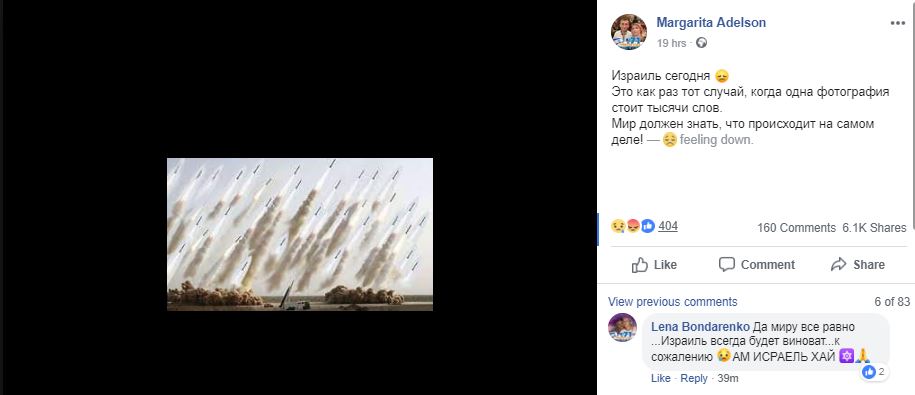
Here’s a great example of Israeli hasbara targeting Russian speakers.

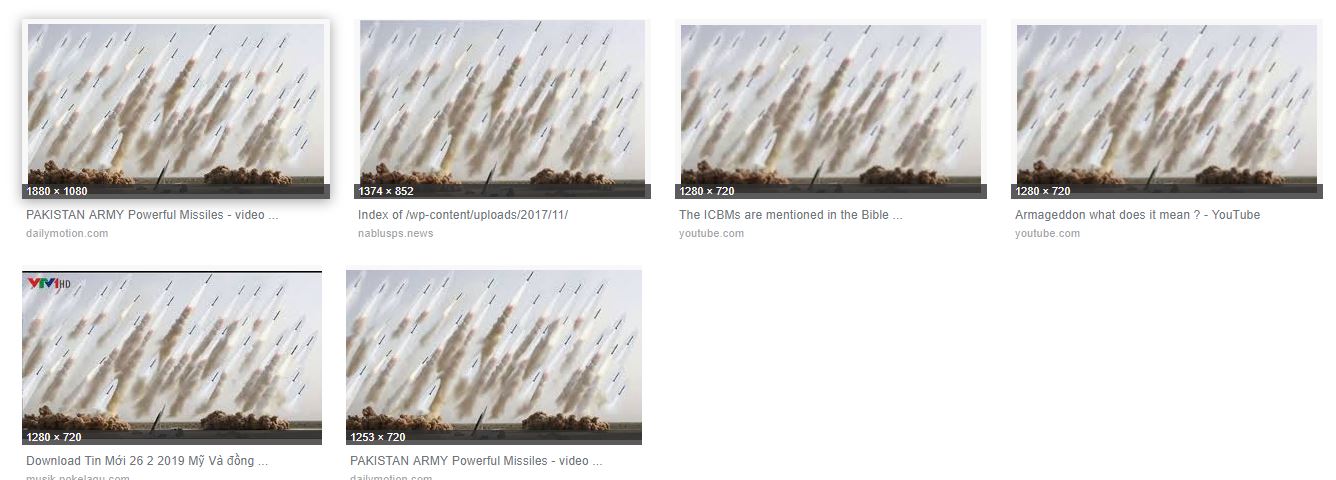
I found the short post on a friend’s Facebook news feed. It consists of three sentences attached to a powerful image of at least thirty missiles or rockets fired simultaneously.

The message reads (in Russian), “Israel today [sad face emoji]. This is exactly the instance when one photo is worth a thousand words. The world needs to know what’s really going on! — feeling down [sad face emoji].”

israel today-post

The post has been shared 6,800 times, garnered 451 likes, and elicited 173 comments in the 20 hours since it was published.

We are meant to imagine, of course, that the “photo worth a thousand words” is a photo of a Hamas rocket installation in the Gaza Strip firing its deadly cargo towards the utterly innocent state of Israel.

A simple Google image search turned up several instances of the same image, all of them bearing different dates and captions, none of which link the “photo” in question to Hamas or the current hostilities between Hamas and the IDF.


So, in fact, the photo is worthless, except to underscore something we already knew.

Zionist hasbaristas are utterly unscrupulous. They count on people not bothering to check any of their claims, but just to pass the “horrible truth” along, thus confusing more people about the real, complicated facts about the relationship between the state of Israeli and the stateless Palestinians. {TRR}

Aliyah

aliyah

Canadian professional wrestler Aliyah. Photo courtesy of WWE

It’s really unpleasant to discover that, for no apparent reason and unbeknownst to you, you have been unfriended long ago by someone you really did think of as a friend,

The funny thing is that, two years ago, I translated a dozen or so pages of essays and other documents this particular friend needed for their Fulbright application. I did all of this work literally overnight, with almost no advanced warning.

The friend didn’t think to offer me any money or anything else for my work, but when they did, in fact, get the Fulbright, they suddenly popped up again to ask for free English lessons.

Since I haven’t heard word one from them since then, I assume they and their family stayed in the States.

What happened to the film I had been helping them make for several years is for me to wonder alone about, too.

This is a lesson I should have learned the hard way when A.S. and I held what proved to be a truly savage and unpleasant “solidarity evening” for our old friend the artist B. in 2008 after he was deported from Brexitland, where he had applied, quite sincerely and on impeccable legal grounds, for asylum as a gay man whose life was threatened in his home country.

All three of us were roundly denouced by the rather odd audience in attendance at the erstwhile artists squat Pushkinskaya 10 (now a municipally subsidized arts center) for advocating the international human rights approach to asylum seeking.

The thing to do, we were told in no uncertain terms, was to trick your way into the promised land of your choice by hook or by crook, not to openly apply for asylum and get mixed up with the allegedly politically dodgy types (i.e., anarchists and other No Borders activists) who support asylum seekers in other countries.

Meanwhile, my wife’s cousin M., who up until a few months ago showed no interest in their late grandfather and his Jewishness, has suddenly decided to make Aliyah. The only problem is that his cousin, my wife, is the only living member of the family who knows anything about their grandfather, his Jewishness, and Jewishness in general, and who has kept anything she could pertaining to her grandfather’s life, because she loved him, and because she finds her fascinating multi-ethnic family’s history fascinating.

I am going to go out on a limb here and say that politics in Israel has been badly skewed  to the hard right by the huge influx of “Russian Jews” who emotionally, religiously, philosophically, and technically speaking had about as much business making Aliyah as I, a third-generation Scandinavian American, would have.

Naturally, since they have no real business being there or, rather, since they know they fudged their way into the country, they are even more resentful of the Palestinians, the natives brutally shunted aside to make room for their illegitimate millions.

This has been borne out by Likud’s strangehold on power in alliance with Avgidor Lieberman and the other radical right politicians heavily supported by immigrants from the former Soviet Union.

The only way out of this impasse is to declare Zionism a “triumphant failure” that did the job it set out to do when circumstances for Jews in the world were desperate. Now that they are much less desperate, Zionism, like “communism” in its own time, can phase itself out, giving way to a single Israeli-Palestinian state where everyone would learn Arabic and Hebrew at school, and to which anyone in the world would be eligible to immigrate if they chose to do it.

Of course, it would be a big mess, but it would also be a lot more fun than the current US tax payer-subsidized disgrace in Israel-Palestine.

But what to do about the alleged right of Russians to immigrate anywhere they choose by any means necessary when, in their majority, they themselves refuse to acknowledge the same rights for non-Russians? Spend enough time in these parts and you will realize that really large numbers of Russians do think quite sincerely and distressingly that Muslim, Asian, and African riffraff should not be allowed to live in their precious spiritual homelands of North America, Western Europe, and Israel, and certainly not in their beloved-and-hated Motherland itself.

I have no cheeky pie-in-the-sky solution to this racist silliness. I do know, though, that it had something to do (minus the racism) with why I lost a real friend. {TRR}