Anna Karetnikova: “The worse things are in Russia and the less money there is, the worse things are in the system” OVD Info
October 27, 2016
As promised, OVD Info has published the full version of our interview with Anna Karetnikova, civil rights activist and member of the last three Moscow Commissions for Public Monitoring of Detention Facilities. The term in office of the third Moscow Public Monitoring Commission (PMC) is coming to an end, and by law anyone who has sat on the same commission for three consecutive terms cannot apply to serve on it again. Karetnikova had applied to serve on the Moscow Region PMC, but was not included in the new commission’s lineup. Similar things happened to a large number of civil rights activists who tried to get appointments to PMCs in other parts of Russia.
The interview was conducted shortly before the new lineups of the oversight commissions were made public. In conversation with OVD Info, Karetnikova summed up the work of the Moscow PMC and talked about the Russian penitentiary system’s numerous problems.
What is a PMC?
A PMC is a public monitoring commission of detention facilities. On the basis of Federal Law No. 76, its members are admitted into institutions that have such facilities, from police stations to remand prisons, including temporary detention centers, military prisons, and so on. They see the conditions of detention and can make recommendations on enforcing the law, eliminating violations, and otherwise furthering the legal interests of the persons imprisoned there.
How would you assess the work of the current commission? During your term have you been able to effect changes in the system, in the treatment of inmates, and the way the system interacts with civil rights activists?
I would rate it quite highly. I can speak only about the Moscow PMC. We succeeded in implementing serious reforms in meal services, accountability, and expanding the range of products that can be delivered to inmates in remand prisons. We made definite improvements to the Kaluga Federal Unitary State Enterprise, the [online] prison store or shop where inmates’ relatives can order things for them. We definitely improved the conditions in Women’s Remand Prison No. 6. Unfortunately, among the things that have remained beyond our control and are getting worse, in my opinion, is medical care. The more we try and get on top of it, the worse it gets.
Medical care has remained a fallow field despite the huge effort we made to improve it just a bit. It was like running up the down escalator.
Nothing can be done. I understand the situation with healthcare is the same nationwide, but it is particularly horrible in our remand prisons.
What do you mean by accountability?
Registering complaints. If we are not around, say, the only way an incarcerated inmate can get something is by filing a complaint or petition. We expended a great deal of effort making sure these complaints and petitions were registered normally, because basically they save lives. It can happen that someone asks to see a doctor for six months and submits petitions to this effect, but none of them is registered. Then he dies, and we are sent an official reply that he never requested medical treatment. Continue reading “Anna Karetnikova: Monitoring Moscow’s Prisons”→
You would be forgiven if you imagined Russia’s liberal, leftist, technical, creative, conservative and other intelligentsias were abuzz right now with righteous anger or triumphant glee about what the country’s air force (now officially known, bizarrely, as the Russian Aerospace Forces or VKS) has been up to in Syria and, more specifically, Aleppo, these days.
No, many of them are terribly exercised, in various directions, about the controversy over an exhibition by American photographer Jock Sturges in Moscow.
This was borne out by the websites of some of the country’s leading dailies this morning.
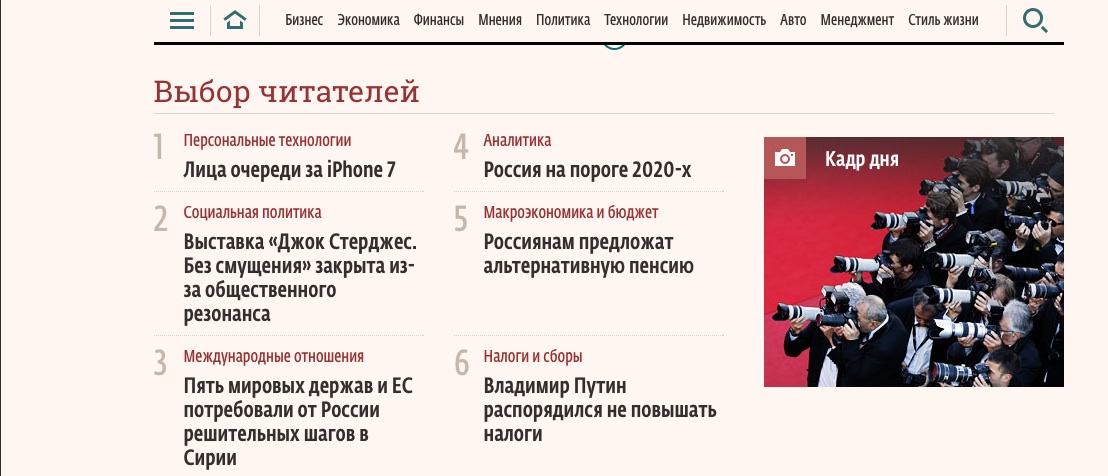
The liberal Vedomosti, a business-oriented newspaper, listed its top stories this morning. The top story was entitled “Faces in a Queue for the iPhone 7”; the second most-read story was about the Sturges show.
True, Vedomosti readers are serious lads and lassies, so the number three story was about Syria. It was headlined, “Five World Powers and EU Demand Decisive Steps from Russia in Syria.”
Earlier today, I posted a few bits from the bizarre article about yesterday’s emergency meeting of the UN Security Council, published in the country’s other serious, formerly liberal, business daily, Kommersant.
Similarly, Moskovsky Komsolomets could not figure out what its readers would find more titillating: reading about how the VKS’s top guns were bombing Aleppo to smithereens or how astroturfed patriots were threatening the God-given right of every self-respecting intelligent to implement Dostoevsky’s maxim that beauty would save the world.
By way of splitting the difference, this morning’s website featured a picture of a chap obviously meant to embody the most average-looking Russian bloke on earth, sadly contemplating one of Sturges’s blasphemous nudes, while a sidebar headline shouts, “Everyone [sic] Is Bombing: Churkin Thinks Peace Impossible in Syria.”
Izvestia has become a particularly noxious loudspeaker for the regime in the past years, so the front page of its website contained a fair number of articles and op-ed pieces chockablock with baldfaced lies about the bloodbath in Aleppo, but at least it had the dignity not to yield to the fake moral panic brewing around the Sturges show.
The relative paucity of Russian media coverage of the Syrian conflict and publicly accessible grassroots reactions was confirmed by the following completely unscientific Google search.
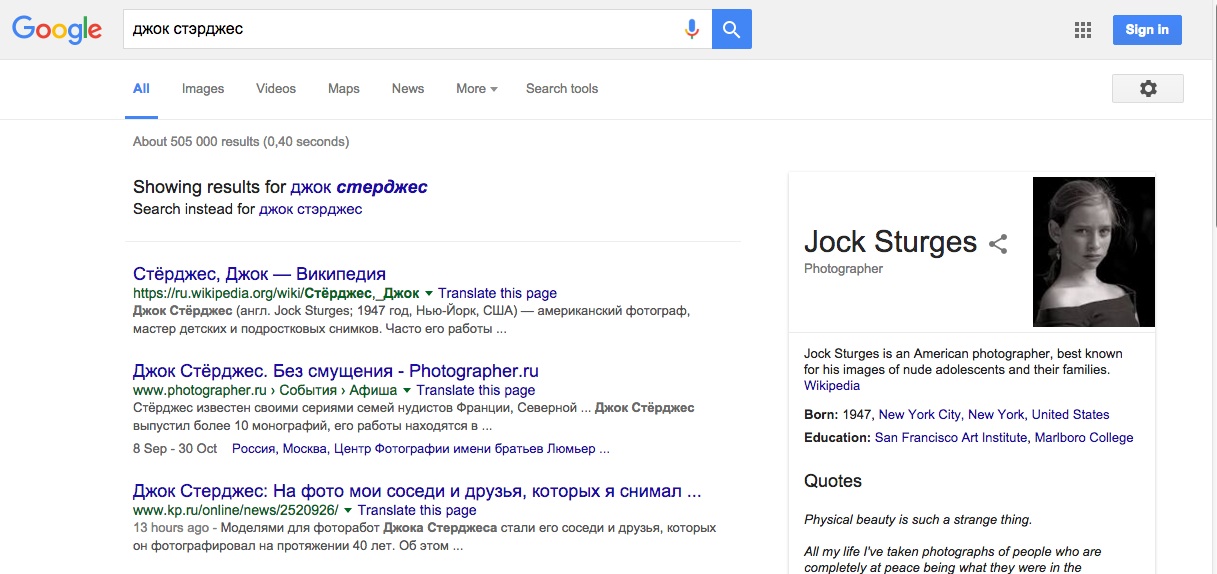
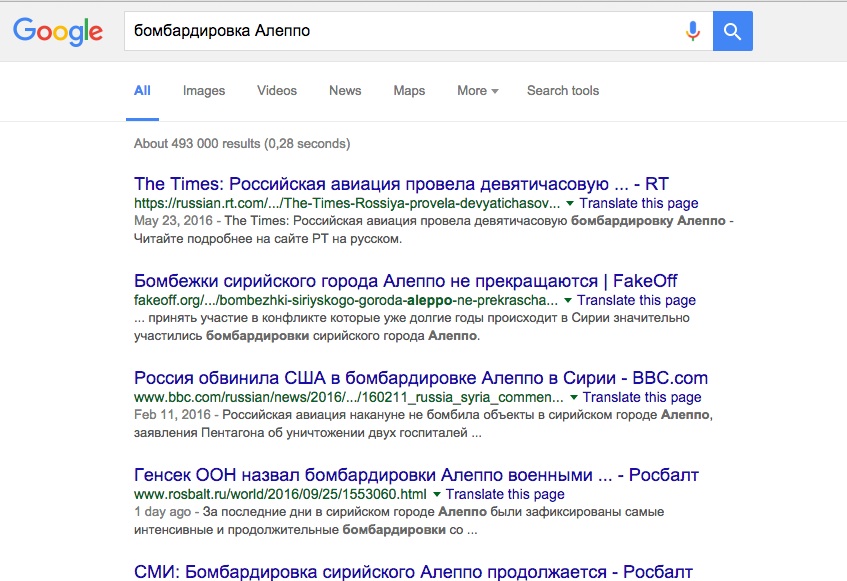
“Джок Стержес” (“Jock Sturges”) got 12,000 more hits than “бомбардироква Алеппо” (“bombing Aleppo”), even though, one could argue, the bombing of Aleppo by somebody or other has been a more topical item in the news for a longer time than Jock Sturges, whatever his longevity or virtues as a contemporary artist.
Results of Google search for “Jock Sturges” in Russian, September 26, 2016Results of Google search for “bombing Aleppo,” in Russian, September 26, 2016
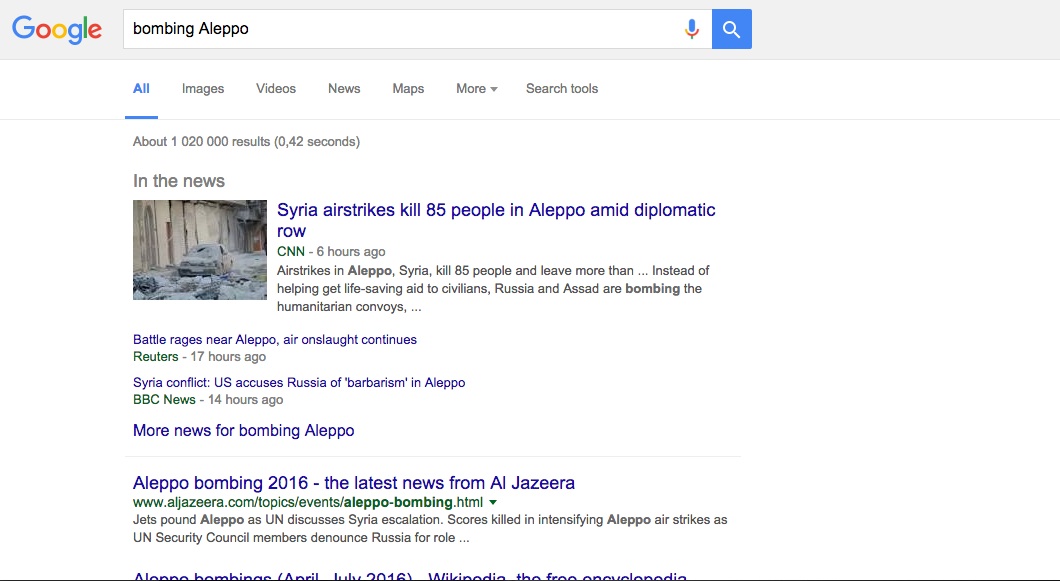
When I did the same search (“bombing Aleppo”) in English, I got over a million hits.
Results of Google search for “bombing Aleppo,” in English, September 26, 2016
Certainly, we immediately have to factor in the sheer numbers of Anglophone media and readers in the world. There are quite a few more of both than there are Russophone media and readers, and so one would expect to find more responses to particular topics of global interest in English than in Russian.
But what about the vox pop?
An even more unscientific survey of the Russophone segment of Facebook this morning (that is, the part of the segment to which I have access, amounting to several hundred people, most of whom could be identified as intelligentsia or quasi-intelligentisa) showed that quite a few people were up in arms over the Sturges show or coolly editorializing about it to their extended communities of invisible friends, while literally no one was writing anything about Syria.
This has been the case for the past year. Not only that, but I have shared a fairly large number of articles and opinions about Syria, including my own, over that time, and have elicited a total of zero likes and comments from my Russian Facebook friends.
Non-Russian friends, on the contrary, like and comment on these posts in the same numbers as they and their Russian counterparts usually react to the other, non-Syrian things I write about.
Maybe I have the wrong Russian friends, but my hypothesis is that “politically engaged” or “socially conscious” Russians are literally afraid to say or write anything in public about the Syrian conflict. They have the good sense to know that their president-for-life has sunken his teeth into this geopolitical chew toy and has no intention of unclenching them.
Hence, anyone foolish enough to comment on this catastrophic attempt to reassert an increasingly impoverished country as a super power might get themselves in trouble with the powers that be. Over the last year, they have been hauling in utterly ordinary people on “extremism” charges in fairly large numbers for reposting or commenting on the most innocuous things on Facebook and its Russian equivalent, Vkontakte.
Even more telling, there has not been a single public demonstration in Russia against Russian military involvement in Syria during the past year—to my knowledge, at least.*
Again, this has to be taken with a grain of salt. The current Russian regime has gone out of its way to make public demonstrations and pickets an unattractive pastime for all but the bravest of Russians.
Still, the war in Syria is the central international conflict of our time, and Russia’s best and brightest have literally nothing to say about it, even though their nominally elected government has not been merely a party to the conflict, but has come firmly down on one side, arguably, the wrong side, the side causing the most damage.
I find this deafening public silence about Syria more disturbing than anything else happening in Russia right now.
* After I posted this, Comrade BN wrote the following to me: “In Moscow last year there were some very small pickets protesting against the war in Syria, and the people who organized it attempted to set up an anti-war committee. As far as I know, though, the authorities pretty much intimidated them with varying degrees of extremity into giving up.”
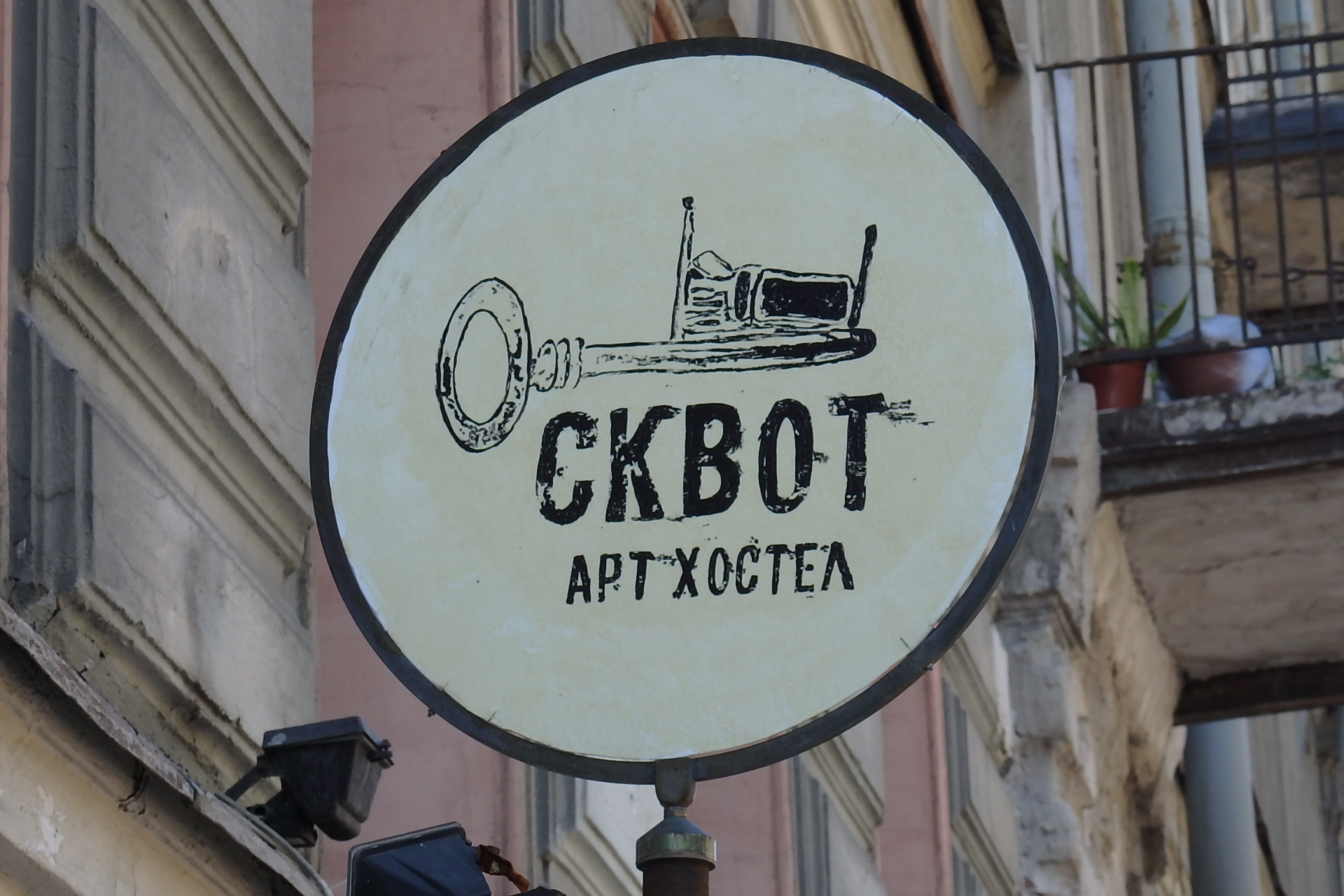
Sign for the Squat Art Hostel in central Petersburg. According to an article in the March 2, 2015, issue of Ekspert Severo-Zapad magazine, the city had between 1,250 and 1,270 budget accommodations, including 270 hostels. As of today’s writing, Airbnb listed over 300 rentals in the city. Photo by the Russian Reader
MPs Plan to Evict Hostels from Apartments But entrepreneurs don’t intend to pull up stakes yet
Elena Gorelova Vedomosti
May 12, 2016
At its Friday session [Friday, May 13, 2016], the State Duma will consider a bill that could ban Russian hoteliers from housing hostels in apartment buildings. Galina Khovanskaya, chair of the Duma’s committee on housing and communal services, had tabled the amendment back in September 2015. According to MPs, mini hotels violate the rights of residents in adjacent apartments. If the changes take effect, it will be possible to install hotels in residential buildings only after rezoning the spaces from residential to non-residential. Mini hotels will have to be equipped with soundproofing, fire safety equipment, and security alarms. They will have to be located on the first floor and have a separate entrance.
The ban would have a catastrophic impact on hosteliers, argues Yevgeny Nasonov, chair of the committee on budget accommodations at the Moscow branch of Opora Russia and general director of Clover, a network of hostels. A study conducted by the League of Hostels in December 2015 showed that around 80% of Moscow’s mini hotels and serviced apartments are located in the city’s residential housing stock. In Petersburg, Crimea, and Krasnodar Territory, those percentages are even higher.
From 2012 to 2014, mini hotels were most often opened in residential buildings, says Roman Sabirzhanov, who owns sixteen hostels, including the Fabrika and the Croissant. But residents dissatisfied with their new neighbors then began complaining and showered the prosecutor’s office with lawsuits. Seeing the risks of doing business in residential buildings, Sabirzhanov opened his own hostels in non-residential buildings from the very beginning. It is not always more expensive, he claims. For example, Sabirzhanov has invested 3.5 million rubles [approx. 47,000 euros—TRR] in a new, 225-square-meter hostel on Chistye Prudy. 40% of the money went for rent; 40%, on repairs; and the remaining 20% on obtaining permits and undergoing classification. As of July 1, 2016, all hotels must be classified, receiving from one to five star, while hostels will receive the the no-stars category.
Even if the bill is not passed into law, hostels in residential buildings will be banned sooner or later, Sabirzhanov believes. At the moment, big cities are in the process of being purged of dubious flophouses in the run-up to the 2018 World Football Cup, and hostels have been subjected to more frequent inspections, he says. Even normal hotels might get the axe, the hotelier is convinced. Over the past five years, the number of beds in discount hotels and serviced apartments has grown twentyfold in Moscow, and the major hotel chains that have been lobbying the ban on hostels are not pleased with this redivision of the market, Sabirzhanov claims. He advises hoteliers against making hasty decisions. For the time being, he says, they should operate as they have before, recoup their investments, clean up their premises, and settle conflicts with building residents. At the same time, however, they should think about relocating if they have the means, launching a new hostel in a non-residential space, and going through classification. In the end, you can close the hostel and put the apartment up for rent, says Pavel Gorbov, executive director of Re:Sale Expert.
Launching a small hostel in Moscow runs you approximately two million rubles, estimates Nasonov. But rezoning a space as non-residential is quite expensive for small businesses. Nasonov cites the example of an entrepreneur he knows who has been attempting to build a separate entrance for a store in a residential building near Vykhino subway station. (The procedure for obtaining permissions is the same as for hostels.) He has already spent 1.5 million rubles on construction.
Dr. Yekaterina Chatskaya, a gynecologist at Moscow Municipal Clinic No. 180 and a leader of the Moscow local of trade union Action told Novaya Gazeta what it is like to be a trade unionist when Russia health care has entered an area of turbulence.
Yekaterina Chatskaya is a gynecologist at Moscow Municipal Clinic No. 180. In April 2015, she was involved in a work-to-rule strike by Moscow physicians, meaning that doctors spent as much time with each incoming patient as was necessary and ignored newly introduced, stringent patient-intake standards. Novaya Gazeta found out what happened with the strike and personally with Dr. Chatskaya over the past year.
How did last year’s work-to-rule strike end?
I kept a diary of my patient intakes. We analyzed the standards that took shape during the course of the strike and sent them to the head physician. It turned out our figures were similar to those issued by the Health Ministry. But the problem is that the Health Ministry’s standards are recommendations. They are not obligatory, meaning that they virtually don’t function in practice.
For example, in Moscow, a gynecologist’s standard intake time varies from twelve to fifteen minutes at different hospitals, but the federally recommended initial appointment time is twenty-two minutes. That is a fundamental difference.
In the blogs and appeals written by physicians, they say they are fighting to increase appointment times by three minutes. Do these minutes add up to something in actual practice?
Of course, they do. I have a fifteen-minute limit for seeing a single patient, and I see patients for six hours in a row without a break, meaning this limit does not include a lunch break or even a simple trip to the toilet. Over this six-hour period, according to the standards, I should be able to see twenty-four patients, who have registered in the electronic data base. But it is virtually impossible to keep up with this pace. There are complicated patients, and there are urgent cases. Old women dress slowly. They require a special approach. And you must not hurry pregnant women at all, whether someone is pregnant for the first time or has had a miscarriage in the past. But when the intake period lasts longer than six hours, it is inevitable that doctors make mistakes. Your concentration is reduced, and your eyes are tired.
You really feel by the end of the intake period that you are losing concentration and can make a mistake?
That is exactly why I started thinking about how long it takes to examine a patient in reality. Before the strike, my official intake period lasted seven hours, but in fact it came to eight hours without stopping. After the strike, we succeeded in getting six-hour schedules, while everything is still the same at other clinics.
Has what happened last year changed anything about your team?
At first, a lot of people wanted to support me, but when a group letter was drafted and we took it to other doctors for them to sign it, people got scared. The head physician called me into his office and said it was extremism, that I was going against the regime, although there were no political demands at all in the letter. Certain colleagues stopped speaking to me altogether.
But the turning point came. A year ago, we organized a local of the independent trade union Action (Deistvie). Initially, there were three of us. Now there are six times as many. We managed to stop the introduction of so-called effective contracts. One of the points in the contracts was that incentive pay would be based only on the decision of the clinic or hospital director. My pay consists of 20,000 rubles base salary and roughly the same amount in incentive pay. Under the so-called effective contracts, incentive pay would have included work assignments that are not part of my job description. Theoretically, if I had refused to mop the floors on the orders of the department head, I could have been stripped of my incentive pay. We wrote to the head physician and the prosecutor’s office. The prosecutor’s office acknowledged the decree facilitated corruption and ordered it abolished. This was a victory. But many clinics have switched to the so-called effective contracts.
Your latest protest campaign has targeted the Moscow Health Clinics Standard. What don’t you like about it?
The standard has led to a collapse at work, and not only at our clinic. During the flu epidemic, GPs were working over twelve hours a day. One doctor made a house call to a patient at one-thirty in the morning, and before that she had been seeing patients since eight in the morning, and then went out on house calls. Another colleague of mine worked three weeks without a single day off.
They have begun to drive away specialists. How? For example, a GP has to refer a patient to an endocrinologist. But to do this, he or she has to write up a full justification for the referral, get the chart and referral signed by the department head, and manage all this within the twelve-minute limit for the appointment. Management have been strongly advising GPs not to refer patients to specialists but to threat them themselves. Naturally, the endocrinologist sits there without any work. After some time has passed, management decides that since such a small number of patients come to see him, the clinic has no need of his services. Our clinic fired a mammalogist, a dentist, and an endocrinologist in this way. There is very big queue to see the gastroenterologist. But our clinic immediately set up paid appointments to see him. If you have the money, you will be served right way.
Getting an ultrasound appointment has become a disaster. In late 2014, one ultrasound specialist went on maternity leave, a second was cut, and a third resigned of her own accord. For several months, a single specialist examined pregnant women in the entire district of Mitino. It even came to blows at the terminal when two women fought over an ultrasound appointment voucher. Another big minus of the reforms has been the virtual abolition of the principle of neighborhood health care.
Now you can make an appointment with any primary care physician at a clinic. Is that a bad thing?
In our conditions, it is a bad thing, because it leads to the unavailability of medical care. For example, my primary care neighborhood covers six thousand people, although according to the standards I should be serving two thousand two hundred people. When my appointment bookings for fourteen days in advance open up at 7:30 on a Monday morning, the appointment vouchers are already gone by eight in the morning. Patients can now choose a doctor themselves, and naturally they choose doctors with good reputations. Inevitably, these doctors will be overbooked. Patients assigned to these doctors as their neighborhood doctors are simply unable to get an appointment to see them, although they will be seeing many patients from other neighborhoods.
An absurd situation has developed. The municipal health department monitors the availability of specialists. On our clinic’s overall chart, there is constantly a red light next to my name, meaning that I violate the norm, because patients sign up to see me two weeks in advance. A good doctor is not profitable to a clinic because she or he skews the statistics.
How much do you earn?
My take-home pay is between twenty-five and thirty thousand rubles a month. My last paycheck was 35,000 rubles [approx. 465 euros a month per the current exchange rate—TRR]. I have been working at this salary since April of last years. I am not paid a kopeck more, only the mandatory minimum.
Does the Moscow health department know about this situation?
Yes. We regularly appeal to them. The last appeal by primary care physicians was sent to them on March 31. After that, we got paid a little more.
Doctors are pushed to the limit. Seeing the shiny pictures on the TV, our patients imagine that everything is alright with medical care, and if something is wrong, it is the doctor’s fault. A patient can come and sit outside a doctor’s door for an hour: that means he is a bad doctor. It was that way at first, though now, it is true, patients have begun to realize that if there is a queue, it means the doctor is good. I was reprimanded when an urgent care patient got wedged into my schedule, and I was unable to see another patient before my lunch break. I asked her to wait, but when I came back fifteen minutes later, she was filling out a complaint in the department head’s office. I was reprimanded, even though the patient was seen the very same day after my break.
Would it be easier if the Health Ministry issued strict regulations rather than recommendations?
It would be ideal. We have written several times to the Moscow health department asking them to establish regulations in keeping with the Labor Code and the Russian federal government decree stipulating that a doctor should see patients for no more than thirty-three hours a week. The reply we received was meaningless, as always.
Meanwhile, our head physician issues orders that violate the recommended norms. These two realities do not intersect at all.
For example, hardship pay has been abolished throughout Moscow. Even our radiologists lost additional holidays and pay. But the federal decree clearly stipulates that medical workers who come into contact with HIV and tuberculosis should receive both additional pay and additional holidays.
Folders from KGB Archive Dumped in Pile on Bolshaya Lubyanka Street What are the covers for the country’s main documents doing outside?
March 16, 2016 Moslenta.ru
Photo: Anton Belitsky/MOSLENTA
A MOSLENTA correspondent has discovered a mound of folders from the KGB Central Archive in the vicinity of Lubyanka Square. About a hundred empty boxes are lying along the wall at Bolshaya Lubyanka Street, 14, right next to the Orlov-Denisov House aka the Pozharsky Palace.
“There are KGB archival folders lying in the yard,” said our correspondent. “I took a couple snapshots on my telephone, and security guards immediately ran up to me. ‘What do you think you are doing?’ they said. ‘We got a call from the FSB. What are you doing here?’ They asked me to stop shooting.”
The duty officer at the Public Relations Center of the Russian Federal Security Service (FSB) informed MOSLENTA that he knew nothing about the KGB files and could not comment on their appearance in downtown Moscow.
Boris Nemtsov was murdered exactly a year ago. Some of the men who organized and carried out his murder have been caught, but the name of the person who ordered the killing remains a mystery.
On February 27, at least 20,000 people in Moscow took part in a march in memory of the opposition politician, who was murdered right outside the walls of the Kremlin. Apparently, the march’s organizers did not expect such a large number of attendees, counting, apparently, on a more intimate event for Nemtsov’s friends and supporters. There was, accordingly, almost no political rhetoric on display except for ritualistic slogans such as “We remember,” “Russia will be free,” and “Free the political prisoners” (inescapable in the current circumstances).
However, the anti-crisis march Nemtsov himself had planned for March 1, 2015, consequently did not take place, and no one from his entourage contemplated doing anything like it during the year that followed his death.
For the second year in a row, the event was a memorial. The slogan on one placard, “I’m speechless,” was the apotheosis of this helplessness. The crowd was mostly silent. Only here and there did marchers sing the Marseillaise or shout anti-Putin slogans, but almost no one among their fellow marchers repeated the slogans. The homemade placards were even fewer than usual, although the sunny pre-spring weather clearly lifted people’s spirits.
The demonstrators, however, had not come to downtown Moscow just for a stroll but to express their mutual disagreement with something that, alas, no one bothered to articulate. Today’s Nemtsov memorial march resembled a political rally without a political agenda.
—anatrrra
___________
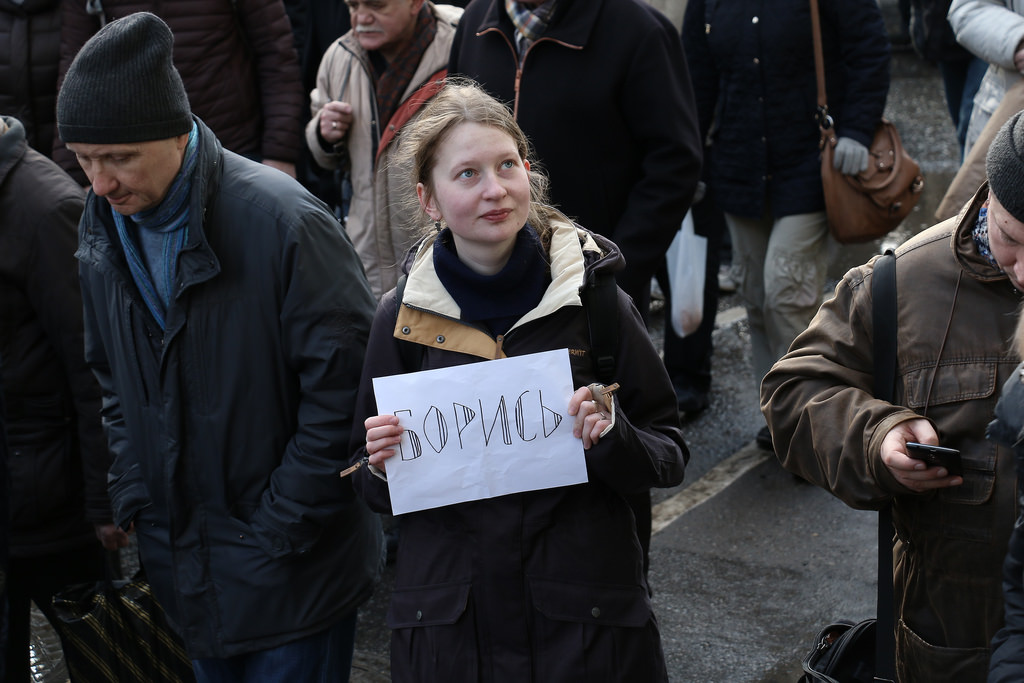
“Fight Back.” In Russian, the phrase (Boris’) is a play on Nemtsov’s first name (Boris). Photo by and courtesy of anatrra
Putin Proclaims National Idea Fontanka.ru
February 3, 2016
In Russia, there can be no other unifying idea than patriotism, argues President Vladimir Putin, as reported by TASS.
“This is, in fact, the national idea,” the head of state announced during a meeting with the Leaders Club, which brings together entrepreneurs from forty of the country’s regions.
According to Putin, this idea is not ideologized and is not linked to the work of a particular party, reports RIA Novosti.
“It is a common rallying point. If we want to live better, the country has to be more attractive to all citizens and more effective,” the president stressed.
_________
Who Killed a Transsexual in Ufa and Why? Ufa1.ru
February 2, 2016
On Monday, February 1, Angela Likina was stabbed in the chest and killed in Ufa. The Ufa resident had gained notoriety in 2014, when a video recorded on a traffic police dashcam entitled “Ufa Traffic Cops Stop a Transvestite” [sic] went viral on the Web. Ufa1.ru found out who killed Oleg Vorobyov, who had changed his sex and become Angela Likina, and why.
Angela Likina. Photo courtesy of Ufa1.ru
The controversial video from the traffic police car dashcam recorded an inspector checking the papers of a female motorist. It transpired, however, that the motorist’s name, according to his internal passport, was Oleg Vorobyov. The inspector was very surprised by this. The motorist was a transsexual who had been preparing for a sex change operation for several years, becoming Angela Likina. The restricted video was leaked to the Web.
Later, the State Auto Inspectorate conducted a review of the incident, because the restricted footage should have not ended up on the Web. Angela Likina also commented on the video herself. She was surprised the incident had provoked so much interest among Web users.
“People die in accidents, children get hurt, cars are stolen, blood is needed to save someone’s life. Gentlemen, why are you setting records for likes and reposts about me? I honestly don’t understand,” said Likina, adding, “I don’t care how you live, what you do, and so on, so long as you are alive, healthy, and happy. But my life does not concern you in absolutely any way.”
How Did Oleg Live?
Ufa1.ru spoke with friends and acquaintances of Angela Likina, who talked about the life of the murdered woman. We found out this sad ending had emerged from a number of factors. Before becoming Angela Likina, Oleg Vorobyov had been married. Acquaintances confess that, outwardly, the couple were seemingly happy. They were raising two daughters, now aged fourteen and nine. The family lived in a private house, which also housed Oleg’s auto repair garage. Many of the people with whom we spoke said automobile owners were satisfied with Oleg’s work, that he had a magic touch.
Over five years ago, Oleg realized he was living in someone else’s body. He understood he wanted to change his sex and become the person he thought he was. Oleg began calling himself Angela Likina and started the complicated process of preparing to change his sex. He took hormone pills and began dressing like a woman. According to his internal passport, however, he remained Oleg Vorobyov. He could only change his name after finally changing his sex.
Five years ago, the Vorobyovs divorced, but the former husband and wife and their two children kept living under the same roof. The house was the wife’s property, and her former husband had an established business there. Several of the family’s acquaintances believe that Angela did not want to lose her income from the auto repair garage and spend money on renting a place to live. After all, she had to save up a large sum of money for the operation, and the medicines she took to prepare for the procedure were expensive. Close friends emphasize that Angela worked a lot, sometimes seven days a week.
At the same time, Ufa1.ru’s sources noted the Ufa resident simply had no choice.
“He once tried to rent a flat, but was kicked out. A neighbor had said, ‘I don’t want my children to see this!’ Consequently, he was evicted and didn’t even get his money back,” said one of our sources.
Friends of the family noted that those who have lived under the same roof with ex-spouses can imagine the atmosphere that prevailed in the Vorobyov house. Some say that the rows over living arrangements caused the Vorobyovs to come to blows. Things were aggravated by the fact that the head of the family had become a woman. Their children also became the targets of reproaches and ridicule at school.
“They would come home in tears, and sometimes refuse to go to school, but Angela loved her daughters and gave them a lot of time,” acquaintances noted.
Who Killed Angela?
According to friends, a boyfriend came to visit Oleg’s ex-wife on the ill-fated evening. The criminal investigation will shed more light on what exactly happened in the house. For now, the family’s acquaintances have their own hypotheses. Perhaps the man intervened in yet another family row. Maybe he stood up for his girlfriend and wanted to intimidate Angela by demanding she pack her things and leave. The row, however, escalated into something bigger.
“She was stabbed in the chest near the heart. She did not die immediately. She made it to a neighbor’s house, told him what had happened and who had done it, and an ambulance was summoned. Then Angela died in the neighbor’s arms. It was apparently too late to help her. I don’t know what was happening in the family. Angela was a good person, but strangers often beat her up. Her neighbors respected her choice. It is a bad thing when a person steals, kills or rapes, but everything else is a private matter,” said an acquaintance of Angela’s.
“The best human qualities—kindness, fairness, compassion, and unselfishness—were powerfully manifested in her. Unfortunately, that is a rarity nowadays. And she really never held a grudge against anyone, although there were a fairly large number of people who wished her ill. Most of them, it is true, were people who did not know her at all. They insulted and mocked her. You could say she was understanding about it: far from everyone in our city, or even our country, is ready to comprehend the decision to have a sex change. And that is another reason I have endless respect for her: the determination to go her own way to the end, to change her life fundamentally, the willingness to take one and overcome all the difficulties,” another girlfriend of Angela’s confided to Ufa1.ru.
“Apparently, Angela sensed her impending death. Not long before this she had asked forgiveness from her wife for all the rows that had happened between them,” said another family acquaintance.
__________
Fire at Moscow workshop kills 12 people, including 3 children Boston Globe
January 31, 2016
ASSOCIATED PRESS, JANUARY 31, 2016, MOSCOW — A fire at a textile workshop in Moscow has killed 12 people, including three children, officials said.
The victims were not identified but were reportedly immigrants.
The Investigative Committee, the top state investigative agency, said the fire broke out late Saturday in northeastern Moscow, damaging more than 32,000 square feet of the structure.
Investigators said they are looking at negligence or arson as possible causes.
Russia’s children’s rights ombudsman, Pavel Astakhov, said Sunday on his Twitter account that three children were among those who died, including a baby. He said the victims were migrant workers who lived next to their workplace.
Several dozen fire engines responded to the blaze, and it took firefighters about five hours to extinguish the blaze.
Investigators continued to sift through the rubble Sunday for evidence.
Many immigrants work in Russian factories, some of which have been investigated for hazardous working conditions. In April, a blaze on the outskirts of Moscow killed 17 migrant workers.
__________
The death toll of Kyrgyz citizens (according to the Embassy of the Kyrgyz Republic in the Russian Federation):
1. Sajida Masaliyeva, born 1988. Home address: Village of Kyzyl-Bel, Batken District, Batken Region.
2. Toktokan Saliyeva, born 1983. Home address: Village of Tayan, Batken District, Batken Region.
3. Uulkan Saliyeva, born 1997, sister of Toktokan Saliyeva.
4. Isa kizi Aizat, born 1995. According to available information, Isa was a native of the Village of Kaiyndy, Batken Region.
5. Milikajdar uulu Koshonbay, born 1990.
6. Tologon Kozuyev, born 1991.
7. Manas, born 1995; brother of Tologon Kozuyev; no other details.
8. Daniel, 4-5 years old, son of Ergeshbay Japarov, a Russian national who perished in the fire; born in the village of Rout, Batken District, Batken Region; according to the victims, Daniel was a citizen of the Kyrgyz Republic.
[Elena Bobrova:] You are something of a patriot yourself?
[Nikolai Kolyada:] How else should I relate to Russia? I love her whatever she be like. Like Gogol I can tell the whole unvarnished truth about her. And Nikolai Vasilyevich said such awful things about Russia. He sobbed bloody tears when thinking about the country. But not because he hated it. On the contrary, because he loved it. When foreigners start speaking badly about Russia, I begin to boil: “Shut up, it is none of your business. I have the right to say anything about her, but you do not.” Well, it is okay when Europeans or Americans sling mud at us: they have a hard time coping with the fact we are different, unpredictable, and freer than they are. But when our own people hate their own country, that is terrible. This morning, I was reading Facebook and I thought, “Why do you live here if you hate Russia so much?”
[Bobrova:] But you just said yourself we have a right to chew out Russia because we live here.
[Kolyada:] Chew out but not hate. But Facebook is just seething with hatred.
—Excerpted from “20% of the Petersburg audience are loonies,” Gorod 812 (print edition), February 1, 2016, page 34
Items one, two, four, and six translated by the Russian Reader
“Prenatal clinics are now a source of obscurantism”: “Helpful Advice for Strengthening Family Ties” Brochure Handed Out in Prenatal Clinics in Moscow
Yuri Lvov
September 1, 2015 Kommersant
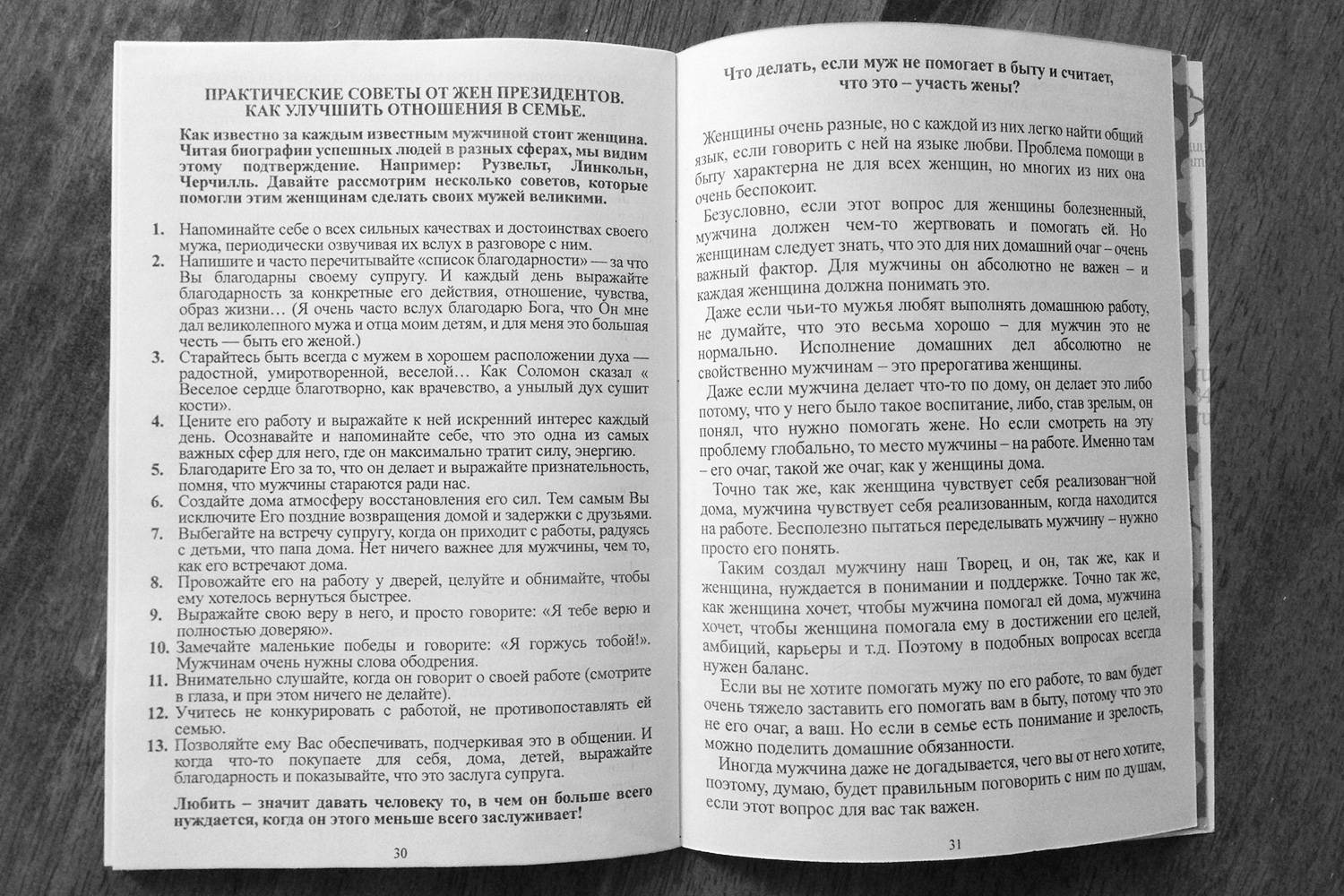
An acquaintance of mine is expecting a baby, and she was issued a so-called exchange card [obmennaya karta] at a prenatal clinic. This, for those of you who do not know, is a brochure containing about twenty pages of various medical tests. But my acquaintance’s exchange card was about twice as long, and this additional content makes it virtually a new work by Vladimir Sorokin. It is simply a monument to the New Middle Age. The ads at the back of the brochures—for diapers and rocking chairs that “imitate the motions of parents”—are one thing. But the text printed alongside them, “Useful Advice for Strengthening Family Ties,” is genuinely obscurantist and insulting.
Sample “exchange card” for pregnant women. Courtesy of 2polisa.ru
“It is best for the woman not to awaken the ‘beast’ in her man: a wife’s ability to be second constitutes her greatest value for the man.” “All men wish to be the heads of their families because it is their God-given destiny.” “The man cannot stand to be supervised by his wife: the head of the family cannot be supervised! Try and supervise the country’s president: will he be able to do much for his country?” argues the text’s author. He or she is not listed, by the way, and although the word “god” is capitalized, what god is meant is not spelled out. So we will assume that a certain denomination has played no role here. The Moscow Health Department Health itself simply converted to some faith, apparently, in connection with layoffs of doctors and cuts in the number of hospital beds.
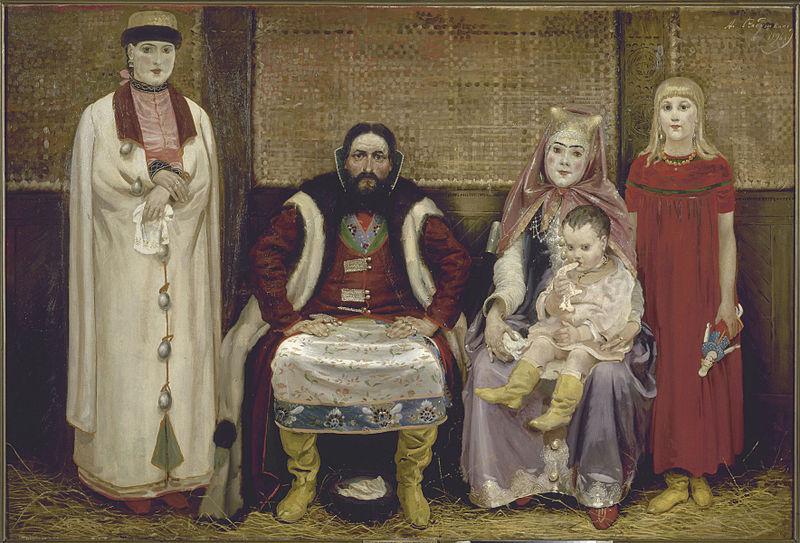
Andrey Ryabushkin (1861-1904), Merchant Family in the Seventeeth Century, 1896. Oil on canvas. The Russian Museum, St. Petersburg, Russia. Courtesy of Wikimedia Commons
It would seem that mandatory health insurance policies now come equipped with a divine covering and the rhetoric of the Domostroy. But in the sixteenth century, the man in charge was the tsar, who really could not be supervised, unlike, it would seem, the president in an electoral democracy. By the way, similar advice—e.g., to greet your husband in a clean apron and say nothing while he eats supper—was to be found in a Soviet book of the 1960s entitled Housekeeping [Domovodstvo]. Even back then, however, such advice looked like a stupid atavism: the Soviet regime had long ago destroyed the foundations of patriarchy. But now, half a century laters, we read, of all things, about the male’s divine status in the family. In the twenty-first century, neighborhood prenatal clinics in Moscow are a source of obscurantism. They could have at least thought what it is like for single pregnant women, whom god did not send husbands, to read stuff like this.
In Russia, whatever problem you tackle is serious, but the topic of feminism had always seemed concocted to me. Domestic violence in connection with widespread drunkenness and police inaction is a real problem, but feminism in the sense of the struggle for women’s rights appeared as far-fetched as the recent controversy over the word “chick” on the social networks. Russian women have long enjoyed all the same rights as men: they can be anything from bosses to rail sleeper layers. If anything, society rather suffers from a lack of respect for the work of housewives. But if the health department has hatched a plan to send women back to the kitchen, consider me a feminist.
________
Yulia Markina, the brochure’s publisher:
I myself am the mother of three children, and I discovered that the exchange cards at prenatal clinics were obsolete. They were compiled way back in the 1980s. Many tests were not listed in them, and OB/GYNs had to update them manually. Some other mothers and I contacted different departments, but no one responded. So then we offered the doctors to develop new cards, and our designer worked out the bugs. To recover our expenses somehow we added advertisements. We published 15,000 copies of this card and have been distributing them to prenatal clinics. Women have been grabbing them up, and some places have even run out of them.
In this issue of the exchange card, we decided to publish a psychologist’s advice on a trial basis. This advice is based on normal Christian principles. In fact, many obstetricians, worldly wise adults, have backed up this advice. My own life experience speaks to the fact that these recommendations works.
Marriages based on selfishness quickly disintegrate, so many women have to give birth alone. These tips will make selfish people indignant, of course: “How come I have to restrict myself in some way?” Well, what can you do: everyone is different. However, we are not going to publish such tips again so as not to upset anyone.
The heading on page 31 of the controversial Moscow “exchange card,” a brochure distributed to pregnant women at prenatal clinics, reads, “PRACTICAL TIPS FROM PRESIDENT’S WIVES ON HOW TO IMPROVE FAMILY RELATIONS. It’s a well-known fact that behind every famous man is a woman. Reading the biographies of successful people in various fields, we see confirmation of this. For example: Roosevelt, Lincoln, [and] Churchill. Let’s have a look at several tips that helped these women [sic] make their husbands great.” Image courtesy of Afisha Gorod
Burrow City versus Hipster Urbanism Sociologist Victor Vakhshtayn on why Moscow is a metropolis for newcomers
Viktoria Kuzmenko
August 1, 2015 Lenta.ru
Why do Moscow residents not trust each other? Why do they not want to live here? Why is Moscow still “rubbery”? Who perverted the concept of hipster urbanism and why? Lenta.ru discussed this with Viktor Vakhshtayn, director of the Centre for Sociological Research at the Russian Presidential Academy of National Economy and Public Administration (RANEPA) in Moscow and a professor at the Moscow School of Social and Economic Sciences[.]
You have repeatedly said that one percent of the population in Moscow trusts each other, meaning this is a society of mutual distrust. But what is Moscow really like in terms of interpersonal communication?
Victor Vakhshtayn: When sociologists talk about interpersonal communication in cities they usually mention two interrelated topics.
The first is the problem of public spaces, places where urbanites meet face to face. It is thought that such spaces shapes the identity of the city, because this is where its inhabitants face each other not as colleagues, friends or drinking buddies, but namely as urbanites. In Moscow, (as, indeed, in many large Russian cities), the problem of public spaces is very serious. In recent decades, they have either been privatized and redeveloped or strategically destroyed. The example of Moscow’s Manege Square, a source of constant concern for the authorities, is telling in this instance. When the Okhotny Ryad shopping center was being designed, the architects were tasked with making it impossible for large numbers of people to gather in this space. The problem was solved elegantly. The square was made the roof of the [underground] shopping center, which, however, did not prevent protesters from spontaneously mobilizing a few years ago.
A city that has no public spaces is rigidly divided into home, work, and transit. Your life is divided among apartment, office, and subway, car or commuter train. Hence the horror of the entryways in Russian apartment buildings, and the specific perception of the city that architects dub “burrowness.” (Bedroom communities are containers for burrows, and the subway is the crossing point between apartment-as-burrow and office-as-burrow.)
Things packed for moving, outside the entrance of a residential house on the outskirts of Moscow. Photo: Grigory Sobchenko/Kommersant
In recent years, much has been done in Moscow to bring public spaces back to life, but now the process of revitalization have stalled. We partly have ourselves to blame: the theme of public space very quickly began to be perceived à la the hipster urbanism of Richard Florida and Jan Gehl, meaning in terms of things like bike lanes, lawns for doing yoga, and eating cotton candy outdoors. The people who returned public spaces as a focus of discussion and planning preferred not to recall that the prototype of such spaces is not the promenade, but the Greek agora and the Roman Forum. Khimki Forest and the field in Troparevo-Nikulino are much more public spaces than Sokolniki Park.
But what about local communities?
The problem of local communities is the second talking point about communication in the city. Two thirds of Moscow’s permanent residents were not born here. More than half of them do not own their own dwellings. The average apartment rental lasts between two and three years. In other words, this is a city of nomads constantly on the move between rented encampments and the steppes of the office blocks. That is why it is nearly impossible to answer a seemingly simple question: how many people live in Moscow? According to official statistics, the figure is twelve and a half million people. But economists have calculated that twenty million people consume food daily in Moscow. It is hardly the case that twelve million people are eating for twenty million.
So the argument that Moscow is overpopulated has to be corrected. The nomads have not overpopulated the steppe. At worst, they have trampled it.
The metaphor of a city of nomads also nicely describes Moscow’s relations with the surrounding areas. When Pavel Stepantsov and I attempted to measure the density of social ties in Moscow and Moscow Region, we discovered that an alienation belt had formed round Moscow. In the surrounding towns, no urban life as such is left. Moscow attracts all the resources (primarily, of course, human resources).
So talking about local communities, as urbanists in Moscow like to do, is just ridiculous in such circumstances. As recent studies by the Moscow Institute of Sociocultural Programs (MISCP) have shown, local ties and identities have been preserved primarily in New Moscow and Zelenograd Administrative District. But these are the areas that are the least urbanized.
Photo: Sergei Kovalyov/Russian Look
The price for the nomadic lifestyle is people’s total mistrust of each other and the place where they live. Moscow is a rare metropolis where parents see their children to the subway and ask them to call when they get downtown. People see their own neighborhoods as more dangerous than the city center, although statistics show the exact opposite: most crimes are committed in the central districts. According to our study “Eurobarometer in Russia” (RANEPA) and the latest research by MISCP, half of Muscovites do not know the neighbors on their landing, much less in their stairwell. More than sixty percent believe that returning home late at night is either dangerous or very dangerous. About a quarter of the Russian population believe that people are not such malevolent creatures, and they can generally be trusted, but in Moscow this figure tends toward zero. (More precisely, only one percent of Muscovites believe people can be trusted.)
Hence the expectations for courtyard culture and local communities as little factory for the production of trust in the city. The argument that we need to work with local communities has become the new ideological cliché (like a few years earlier the argument that we had to make this city an interesting place to live). But I would caution against such community optimism. City and neighborhood are antonyms. As a final illustration, I can give you fresh data from MISCP’s project “Mechanics of Moscow.” It turned out that people feel anxious about their places of residence if they don’t know any of their neighbors by sight and have no acquaintances living in the neighborhoods. The feeling of insecurity wanes if they recognizer neighbors by site and develop a few weak, friendly ties. But when strong ties of friendship emerge in people’s habitat and their number grows, the feeling of insecurity and mistrust of the area is again high. When neighbors and friends are the same people, it is the first sign of ghettoization. In the end, the urban community’s ultimate is the ghetto, not the courtyard.
As a person who considers himself a Muscovite, you think that twelve to twenty million residents is a normal figure for Moscow and doesn’t need to be reduced, that the city and its transport system can serve so many people?
Again, nomads cannot overpopulate the steppe. If you cannot say for sure whether twelve or twenty million people live here, it is strange to speak of overpopulation. Is twelve million people a lot? What about eleven million? How many people is normal? At what point does it begin to be a lot?
It’s not a matter of infrastructure or service, but the impact people make. The economic rise of Moscow in the 2000s was in part an effect of its overcrowding and hyperconcentration of resources.
Photo: Sergei Kovaylov/Russian Look
Okay, your stance on the issue of the number of people living in Moscow is clear. But this raises another topic: the capital’s population is constantly increasing. You yourself mentioned the economic upturn of the 2000s was triggered by the influx of new people in the city. Hence the conclusion: if Russia has this center of gravity that is constantly growing, is it worth leaving everything as it is and keep expanding the city? And then everyone will want to move to Moscow, it will expand, and in thirty years or so, it will be twice as big. In this case, is a metropolis where, thirty years from now, forty million people, for example, a problem? And is it necessary to address this issue, for example, by moving some administrative offices and headquarters of major companies, developing other cities, and making them more appealing places to live?
That’s a good question. But first, let’s deal with the economic history. There was an American urban planner Robert Moses, to whom we owe much of the look of modern New York and the whole despised ideology of modernist urbanism. Moses was a bit like a New York Luzhkov, but with a better understanding of the urban economy. He understood that the main competitive advantage of the metropolis is the hyperconcentration of heterogeneous resources in a limited area. His idols were the density, speed, and mobility that make the city a “growth machine.” The more human, economic, administrative, and cognitive resources are compressed in one place, the higher the return, the faster the pace of urban development.
Now let me digress a bit. In 1997, a UK parliamentary committee led by Ron Dearing tried to answer the question of why Scottish universities were consistently outperforming English universities on all fronts. It turned out their competitive advantage was historical: the first (“ancient”) universities of Scotland—Edinburgh, Aberdeen, Glasgow, and St Andrews—were founded as centers of English political influence, and hence they were built in the major cities of the time. Conversely, the English universities of Cambridge and Oxford were established far from the bustle of the city, in the image of the monasteries. When rapid industrialization kicked off in the nineteenth century, urban universities stood to gain due to their location. They become resources for the economic growth of their host cities, and the cities, resources for their development. This is why ideology of hyperconcentration—having the all universities, factories, people, money, and power in one place—is not so absurd and outdated an idea as it might seem to a normal person.
Moscow today is a hypermobile city, 1870s Edinburgh and 1950s New York at the same time. I hesitate to say 1930s Vienna, although in some respects, this parallel is also not without grounds. The city’s economic growth in recent decades is not so much the cause as a consequence of the influx of migrants. Moreover, the migrants are very different: they include qualified young professionals willing to work for thirteen to fourteen hours a day to pay for food and rent, and unskilled migrant workers, who have become targets of exploitation unknown in Marx’s time. People who with a contemptuous grimace hold forth today about the “problem of migration” are usually the same people whose incomes and rapid career growth have been secured by the influx of migrants, who took the jobs they otherwise would have had to take.
Photo: Dmitry Dukhanin/Kommersant
Decentralizing Moscow is not just a utopia. It is a dystopia for a city that is a melting pot of people, money, power, and knowledge. As long it is being stoked with firewood, it can afford to grow. Forty million? Even fifty million people is possible if nothing changes. But change is inevitable. It can be triggered by both internal and external factors.
The external factors are more or less clear, and we are now seeing their effect on the city’s economy. The internal changes begin with the question, What it is like to live in a melting pot? What is it like to raise children and ensure a decent life for elderly parents in a melting pot? When such issues arise, then the stage of economic history in which the city is a machine of economic development is over.
Rising prosperity has side effects such as increased expectations for the quality of the urban environment. People no longer want to live and die in an office or on a construction site. The above-mentioned “Eurobarometer in Russia,” recorded an interesting effect two years ago: Moscow’s appeal had begun to rapidly decline, and within Moscow even more rapidly than outside Moscow. A rather remarkable group of potential migrants who put the quality of the urban environment above economic opportunities had taken shape. Economist Sergei Guriev and I then came up with a project: calculating the value of the ruble in Moscow. Because if you make money in a city where you don’t want to spend it, if you feel deeply unhappy and leave whenever possible (for example, on the weekend) for somewhere far away, it is possible that at some point you would prefer to make less money but in better conditions. And then the Moscow ruble is worth less than, for example, . the Petersburg ruble. Alas, for obvious reasons [Sergei Guriev’s emigration from Russia – Lenta.ru], the project has not been implemented.
This, then, is an interesting point. If the capital’s appeal is shrinking, the quality of the urban environment does not satisfy people, could Moscow in thirty years become a city for migrants only? As you say, one big office, only on a larger scale, where the houses have been turned into dormitories for workers and employees, and Muscovites themselves, no longer wishing to live in this office, en masse become rentiers and depart, for example, to comfortable suburban agglomerations or Thailand? Many are already doing this now. Will Moscow 2045 be a city unfit for normal life?
No, of course not. By 2045, Moscow will be radically decentralized. All the organs of state power will have been transferred to Petersburg and Vladivostok. Left without work, migrants will disperse to other cities and countries, and the residential areas, inhabited mainly by indigenous Muscovites, will all fit inside the Boulevard Ring. People will again visit each other at home and move around the city on foot.
But what will be left for them to do when unemployment is at seventy percent? By the way, there is a remarkable study, done at Columbia University, on how the pace at which men and women walked changed when there was mass unemployment. It was found that during the most severe years of the Great Depression in the United States, men began to walk more slowly around the city, and women, more quickly. Because women, unlike men, did not have less to d0.
Town-planning scale model of Moscow at the VDNKh. Photo: Vasily Shaposhnikov/Kommersant
Both scenarios we have described, yours and mine, are probably products of a morbid Muscovite imagination and have little to do with the urban reality. But yours is more realistic, with suburban Moscow dachas playing the role of Thailand, bedroom districts standing in for workers hostels, and the very meaning of normal life in the metropolis rapidly mutating. It is this situation that brought the ideology of hipster urbanism, probably the best thing that has happened with Moscow in recent years, onto the scene. But this is a separate and a slightly sad story.
I will elaborate on the topic by mentioning two talking points. The first is changing perceptions of law enforcement under these circumstance. According to “Eurobarometer in Russia,” forty-three percent of Moscow residents believe that “the police are a threat to ordinary people, perpetrating lawlessness and violence.” (Fifty-one percent of respondents hold the opposite opinion). This is even more than in the Republic of Dagestan (34%), which holds the second place in our sample.
Another talking point is who in Moscow feels most like Muscovites. According to our data, it is not people who were born in Moscow, but those who came here over ten years ago. They have the strongest Muscovite identity. They are the most active users of the city (from museums and exhibitions to citywide celebrations). It is they, rather than the notorious hipsters, who have shown the most lively response to transformations of the urban environment in recent years.
The main thing to remember is that these people arrived in Moscow ten to twenty years ago not for a “normal” life but for the sake of self-realization. And it is they who now define Moscow.
I understand that you are not a big fan of hipster urbanism. What is bad about it?
To be honest, today I regret that a few years ago I came up with the phrase hipster urbanism. Then it was necessary to more accurately capture the object of our study: the impact on specific urban spaces of the metaphor of the city as a stage, which had gained a foothold in the language of policy makers and officials. I naively supposed that if this concept were terminologically defined in an academic paper, the risk of erosion would be minimal. However, the phrase hipster urbanism caught on first as a cliché in critical journalism, then as a self-designation. Sergei Kapkov [Moscow’s former culture head] then decided to give a lecture on hipster urbanism. Some people in Samara, responsible for the reconstruction of the embankment, authoritatively reported they were working in terms of hipster urbanism. These words can stand for anything today. They do not refer to anything specific and only vaguely link Kapkov’s Moscow and abstract hipsters in a loose associative unity.
Photo: Konstantin Kokoshkin/Russian Look
Essentially, the modern city is less an arena where social groups, stable community or collective agents clash, and more an arena where languages, models of representation, and different urban ideologies clash. The metaphor of the city is the hard core of ideology; it determines how people see urban space, and what decisions they take in regard to it. Imagine officials from two rival departments at a planning meeting on “mayor’s Tuesday” dealing with city parks. For the some of them, the city is a giant organism in which the parks have been the given the place of “green lungs.” The parks are tasked with producing oxygen. Accordingly, they should be financed in terms of the number of green spaces. For the other officials, parks are public spaces, the city’s “stages.” And they should be financed according to the number of activities staged there, the number of people who attended them, and the public eventfulness they generate. The conflict of metaphors will have real consequences for the city.
At some point, the hipster metaphors—city as stage, city as generator of experiences, city as a set of events—suddenly comes into competition with the two Big City metaphors of the twentieth century: city as growth machine (modernist urbanism) and city as generator of inequality (Marxist urbanism). Moreover, in Moscow the hipster ideology beat out the other ways of thinking about the city for a short period. This is a very curious phenomenon that remains to be researched.
My criticism of hipster urbanism concerned the rhetorical strategies it employed (the way it substituted societal [obshchestvennye] spaces with “public” [publichnye] spaces, its use of vague clichés like creative class and livability), its blind spots (its inability to discuss, for example, migration), and its superficiality and unbending utopianism.
But today, it must be recognized, it is a quite workable ideology that changed the look of the city. Now, when a very different rhetoric and semantics has engrossed the minds of city managers, hipster urbanism looks like the last conquest of public policy. It reminds us of those glorious times when decisions were still determined by the clash of metaphors and ways of thinking, and even city managers needed to answer the question, What is a city?
Under these new cultural circumstances, I will defend the achievements of hipster urbanism to the last.
People relaxing on Olive Beach in Gorky Park. Photo: Alexander Miridonov/Kommersant
How do you think the city has changed under the impact of newcomers from the Russian provinces and migrants?
That is a funny way of putting the question. You used the words migrants (apparently from Central Asia) and newcomers (apparently from the provinces). I do not want to upset you, but the newcomers are also migrants, and the migrants are also newcomers. And, given the statistics I cited above, the category of migrants and newcomers must encompass two thirds of the adult population of Moscow, including the Russian president and the mayor of the capital. I find it difficult to answer the question of how their migration has impacted the image of our city.
In general, the notion of the city and migrants as two opposing forces (something like the Eternal City of Rome and the barbarians besieging it) is mistaken, to put it mildly. Because the city equals migration. This just applies to Moscow a bit more than to other Russian metropolises.
Translated by the Russian Reader. Thanks to Comrade ASK for the heads-up.
The Ninth of May
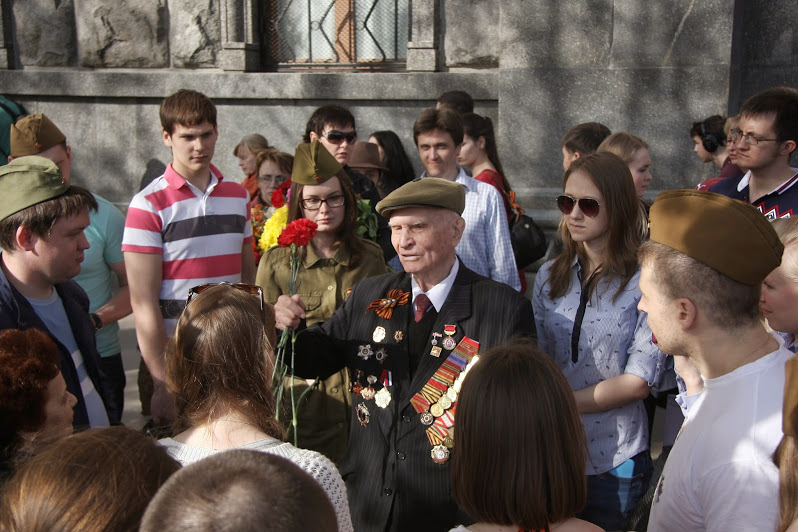
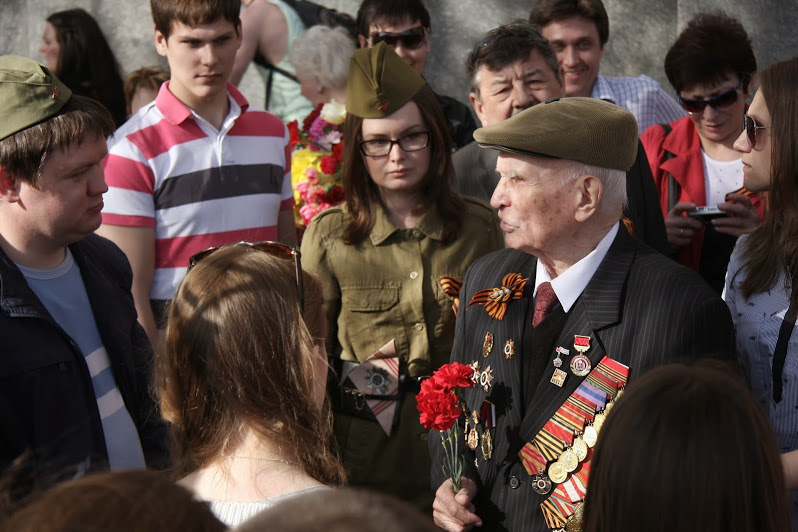
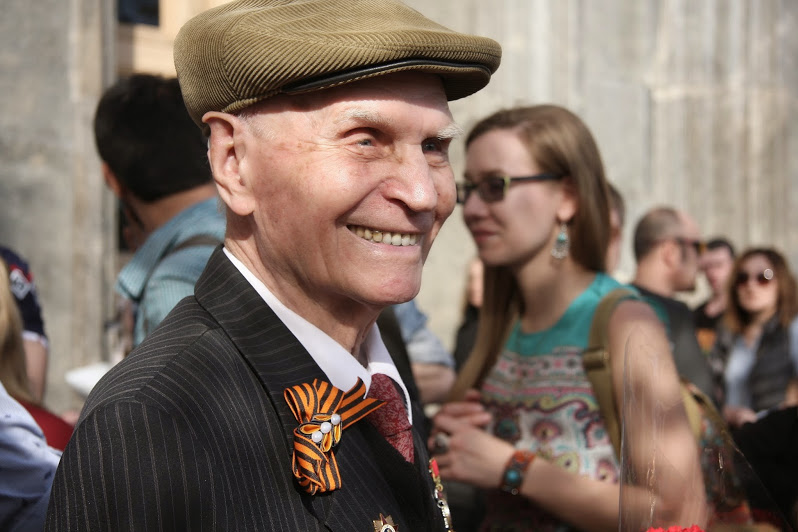
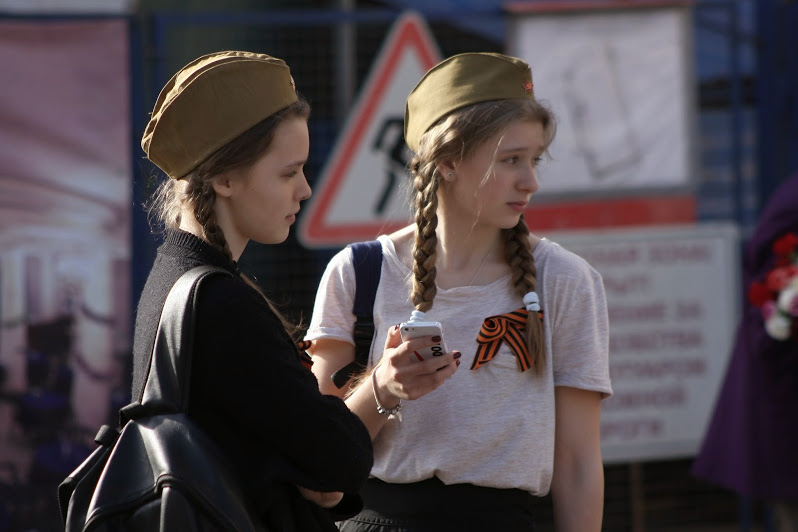
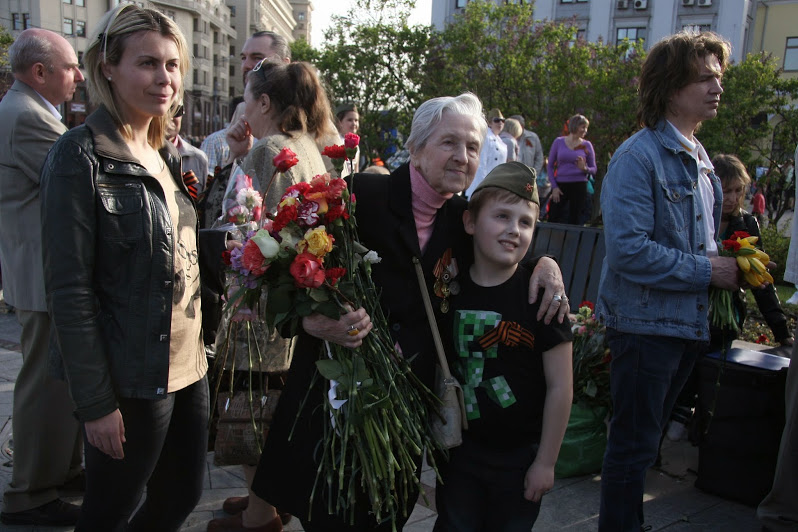
Seventy years of victory. An even more years of sorrow. But sorrow has no place on the ninth of May. People rejoice. This is a holiday. The veterans, to whose stories the younger participants in today’s festivities listened with curiosity, were the same age back then as some of the young women in these pictures are now. I wonder what kind of victory they will tell youngsters about in seventy years?
anatrrra’s photographs are reprinted here with their kind permission. Their complete poignant photo reportage of grassroots Victory Day festivities in Moscow can be viewed here.