Priorities

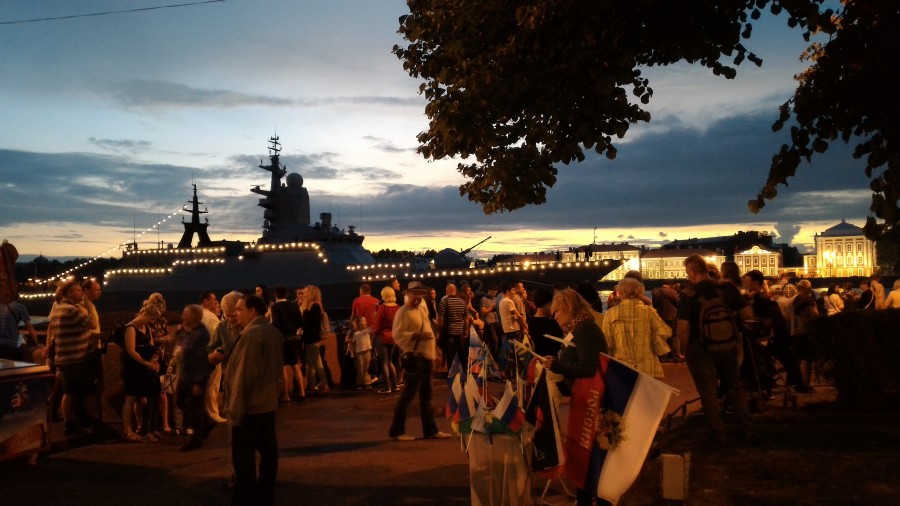
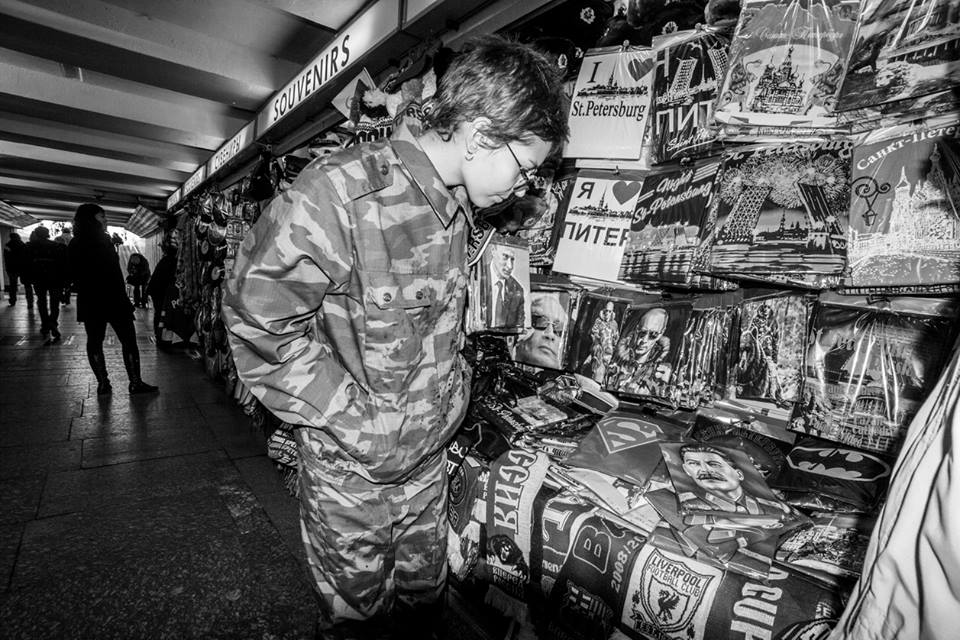
“Not Gonna Get Us,” t-shirt in souvenir shop and news stand at Petersburg’s Pulkovo Airport, October 23, 2016. Photograph by the Russian Reader

Budget Expenditures on Security Forces to Grow to Two Trillion Rubles by 2019
Vladimir Dergachov and Elizaveta Antonova
RBC
October 23, 2016

The authorities have decided not to save money on the security forces, despite the difficult economic situation in the country. The draft budget shows that annual spending on national security will grow to 2 trillion rubles by 2019.

The government has inserted an increase in expenditures from 1.94 trillion rubles to 2 trillion rubles [approx. 30 billion euros] by 2019 under the line item “National Security and Law Enforcement.” These figures are contained in the draft budget for 2017-2019, as submitted by the Finance Ministry. (RBC has the relevant memorandum in its possession.) These expenditures also include the secret part of the budget, which this year grew to 22.3%.

Total budgetary provisions for national security are supposed to reach 1.943 trillion rubles in 2016. Over the next three years, a spending increase in this sector has been laid into the budget. In 2017, 1.967 trillion rubles will be spent on the security forces; in 2018, 1.994 trillion rubles; and in 2019, 2.006 trillion rubles. That is, spending on national security will increase by 63 billion rubles [approx. 933 million euros] over three years.

The “National Security and Law Enforcement” section of the budget has fourteen subsections, including prosecution and investigation authorities (the Prosecutor General’s Office and Russian Investigative Committee, the Justice Ministry, the Interior Ministry, security, border guards, Interior Ministry Troops, drug police, and the penal system). The section also includes spending on emergency situations, migration policy, civil defense, and specialized applied research.

A government spokesperson forwarded RBC’s questions about spending on law enforcement to the law enforcement agencies.

RBC found out which ministries would benefit from the allocation of funds after the latest reforms in the law enforcement sector.

How Creation of the National Guard Impacted the Budget

In early April 2016, President Vladimir Putin abolished the Federal Drug Control Service (FSKN) and Federal Migration Service (FMS) as free-standing entities, incorporating them into the Interior Ministry. The Interior Ministry, in turn, lost part of its powers. Its internal troops and special forces units were turned into a new security agency, the National Guard of Russia. The National Guard acquired, in particular, the OMON (Special Purpose Militia Detachment or riot cops), the SOBR (Special Rapid Deployment Unit), the Licensing and Permit Center, and the Extra-Departmental Security Service.

As a result, the line item for spending on drug control agencies has been eliminated. (The subsection contains dashes after 2016, in which 27.3 billion rubles were allocated.)

The draft budget also incorporates a spending decrease in the line item entitled “Police Agencies,” from 683.4 billion rubles in 2016 to 625 billion rubles in 2019. (Hereinafter, expenditures are given for the period from 2016 to 2019.)

Spending on the line item “Internal Troops” will nearly double due to the formation of the National Guard: from 114.6 billion rubles to 206.6 billion rubles.

When asked about the growth in spending on this line item, National Guard spokesman Yevgeny Kubyshkin suggested that RBC readdress their question to the government officials who drafted the document.

Among other significant changes in spending due to agency and ministerial shake-ups is the more than tenfold reduction on “Migration Policy,” from 33.7 billion rubles to 285.5 million rubles. This line item incorporates spending on the Federal Migration Service, which has been merged with the Interior Ministry.

The Russian Interior Ministry’s press office confirmed to RBC that appropriations were reallocated when the budget for 2017-2019 was drafted. Monies were reallocated to pay for the Interior Ministry units transferred to the National Guard. Sources at the ministry also confirmed that spending on the abolished FMS and FSKN had been accounted for in the ministry’s budget.

“Thus, the parameters of the draft federal budget of the Russian Interior Ministry for 2017-2019, excluding pension funds, are 695.1 billion rubles in 2017; 691.9 billion rubles in 2018,; and 689.7 billion rubles in 2019. This testifies to the fact that federal financing of the Russian Interior Ministry will remain nearly at the levels of 2015-2016,” a source at the ministry told RBC.

Prosecutors Get More, Security Officers Less

The line item for “Prosecuting and Investigative Authorities” stands out among the expenditures, with an increase from 86 billion rubles to 94.8 billion rubles.

The growth of spending on prosecutors and investigators is due to the fact that, as of January 1, 2017, military investigators will be merged with the Investigative Committee and will be financed out of their budget, Investigative Committee spokeswoman Svetlana Petrenko explained to RBC. RBC is waiting for a response to its questions from the Prosecutor General’s Office.

Spending on the line item for the “Penal System” will be slashed from 196.3 billion rubles to 176.8 billion rubles. Federal Penitentiary Service (FSIN) spokeswoman Kristina Belousova declined to comment.

The subsection “Security Agencies” (which includes the FSB) will be also be cut, from 306.4 billion rubles to 292 billion rubles. RBC’s request for information from the FSB’s Public Relations Office went unanswered.

The line items for “Justice Authorities” and “Border Guards” have been marked for slight decreases in spending. Over the three years, spending on the Justice Ministry will decrease from 43.4 billion rubles to 42.6 million rubles, while the border guards’ budget will be reduced from 124.2 billion rubles to 119 billion rubles. The Justice Ministry promised it would answer RBC’s inquiries at a later date.

According to the government’s draft budget, spending on “Protecting the Populace from Emergency Situations” will be reduced from 81.2 billion rubles to 70.1 billion rubles. On the other hand, spending on “Fire Safety” will be increased from 109.9 billion rubles to 119.4 billion rubles. RBC has sent an inquiry to the Emergency Situations Ministry and is still waiting for a reply.

“Non-Transparent” Expenditures Grow by Two and a Half Times

However, expenditures on “Other National Security and Law Enforcement Issues” will grow by two and a half times, from 108.4 billion rubles in 2016 to 237 billion rubles in 2019. According to the budget classification codes, this subsection includes expenditures having to do with the “leadership, management, and provision of support for activities such as the development of overall policy, plans, programs, and budgets, as well as other undertakings in the field of national security and law enforcement not covered by other subsections in this section.”

The Russian budget already contains a voluminous secret section, and line items like “Other Expenses” make expenditures even less transparent, Vasily Zatsepin, head of the military economy lab at the Gaidar Institute for Economic Policy, told RBC. According to Zatsepin, this subsection could contain anything whatsoever, for example, “financial assistance to certain districts in the Donetsk and Lugansk regions [of Ukraine].”

However, the subsection “Applied Research in the Field of National Security and Law Enforcement” will be slashed from 27.5 billion rubles to 22.3 billion rubles, respectively.

Security Priorities

The government memo makes clear that overall allocations for the entire national security section of the budget amount to 2.3% of GDP. Their share of total federal spending is 11.8%.

Although spending in this category in terms of GDP will drop from 2.3% to 2% by 2019, spending on national security in terms of overall spending will increase over the next three years, from 11.8% in 2016, to 12.2% in 2017, to 12.5% percent in 2018, and to 12.6% in 2019. This is more than combined spending on education, health care, culture, sports, media, and environmental protection.

The regime’s priority is to redistribute the budget toward foreign policy and the deep state, as well as social welfare payments to the populace to maintain stability, Nikolay Mironov, head of the Center for Economic and Political Reform told RBC.

“Everything else is overlooked, although education, health care, and the national economy, whose line items have been cut, are strategic areas. Investment in them does not pay off in the current year, but always pays off later,” argued Mironov.

Translated by the
Russian Reader
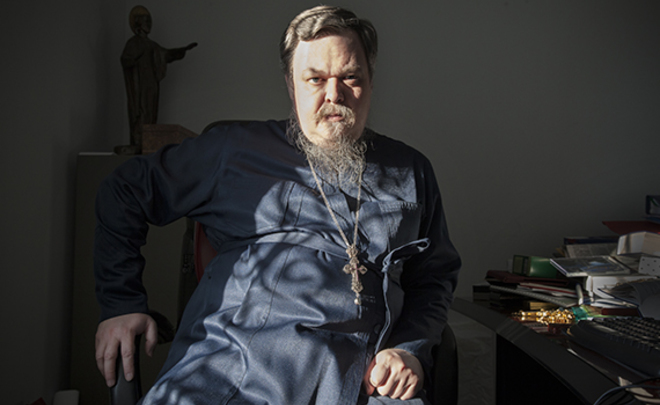
Nikolay Mitrokhin: The Church Militant, The Radio Complicit

Father Vsevolod Chaplin. Photo courtesy of Realnoye Vremya and Anna Artemieva (novayagazeta.ru)
Father Vsevolod Chaplin, the Russian Orthodox priest who recently argued on Russian radio station Echo of Moscow that it was sometimes necessary and possible to “destroy” whole groups of people as “internal enemies.” Photo courtesy of Realnoye Vremya and Anna Artemieva (novayagazeta.ru)

“For the Church, Violence Is the Norm”
Valentin Baryshnikov
Radio Svoboda
August 16, 2016

Father Vsevolod Chaplin, long-time head of the Moscow Patriarchate’s Synodal Department for Cooperation between Church and Society, made an appearance on Echo of Moscow radio in which he shocked many people by saying that some people “can and should be killed.”

Here is an excerpt of Father Chaplain’s appearance on Echo, which began with a discussion of erecting a monument to Ivan the Terrible in Oryol.

Presenter: Yes, but with that rationale you can also justify Stalin, for example. Sure, there were excesses, but he was an effective manager, they say.

Vsevolod Chaplin: He did a lot. Listen, at the end of the day what is wrong with destroying a certain number of internal enemies?

Presenter: “Destroying” people, that is what is wrong.

Vsevolod Chaplin: What is wrong with that?

Presenter: You cannot kill people!

Vsevolod Chaplin: Why not? Some people can and should be killed. That is for sure.

Presenter: “Some people”? Which ones are those?

Vsevolod Chaplin: So it is no accident that criminals are destroyed, and no accident—

Presenter:  I would remind you the death penalty has been abolished in Russia.*

Vsevolod Chaplin: I am not sure that was the right decision. Look, even God, if we read the Old Testament, if we read the Apocalypse, that is, the New Testament, directly sanctioned and sanctions in the future the destruction of a huge number of people for the edification of others.  For the edification of societies, it is sometimes necessary to destroy a certain number of people who deserve to be destroyed.

* In fact, capital punishment has not been abolished in the Russian Federation. President Yeltsin placed a moratorium on the death penalty in 1996 so that Russia could meet the requirements for joining the Council of Europe. The moratorium has remained in effect since then, but the death penalty is still listed in the law books as a legal punishment for certain crimes. TRR

When asked whether Chaplin’s statement was his personal opinion or a reflection of conversations within the Russian Orthodox Church (ROC), Nikolay Mitrokhin, a sociologist of religion and author of the book The Russian Orthodox Church: Its Current State and Challenges, confidently replied that church insiders think this way.

Nikolay Mitrokhin: The majority of rank-and-file clergy and the bishops are quite militantly minded. They do not rule out violence. Violence is the norm in ecclesiastical practice. Bishops hit priests who do something wrong on the altar. Its is a popular subject of stories told within the Church. In turn, priests are capable of hitting sacristans and subdeacons. The Church is now also the leading social institution that has come out against so-called juvenile justice, in other words, against bans on beating children. So for the Church, violence is the norm.  The Church supports militarist rhetoric. The Church supports the numerous military-patriotic clubs operating under its auspices. If you chat with a rank-and-file priest, he will surely talk like Chaplin or worse. It is another question whether it was worth putting Chaplin on the radio and giving his cannibalistic ideas a platform.  However, that is the stance of Echo of Moscow, which has given various kinds of fascists the chance to speak out on its airwaves. Let us not forget that several right-wing radicals have their own programs on the station.  So it all fits, in the first place, not only the mindset of the ROC but also the mindset of Echo of Moscow.

Echo of Moscow actually plans not to publish the transcript of this speech and, as far as I can tell, will not be inviting Father Chaplin on the air again.

With Chaplin’s appearance, they have reached a point where a lot of people have wondered whether the prosecutor’s office is asleep at the wheel and whether they should not file a complaint against Echo of Moscow radio station. In this case, they face quite specific criminal charges. But the reason they invited Chaplin to appear on the air is itself quite obvious. Yet again they had to rile up the liberal public with harsh statements so that a discussion would emerge around them. They are not shy about inviting someone who on several occasions has voiced his tough and, quite frankly, fascist stance. So I think this was a big mistake on the part of Echo of Moscow, which is no less liable for the statements than the person who made them.

When Chaplin says this, when priests en masse within the ROC hold such positions, does this somehow link up in their minds, if I can put it is this way, with the concept of Jesus Christ, who spoke of love and non-violence?

As we know, there is no Christ in the ROC. There is Orthodoxy in the ROC, but there is no Christ in the Church in the sense in which the idea of Christ was shaped by the Russian intelligentsia in the early twentieth century. For centuries, the phrase that Jesus is love just did not make sense. It was not a subject the clergy considered. From that point of view, it is not clear why it should be considered now. The concepts that the liberal intelligentsia have been attempting to discuss are all seemingly variations on western Christianity, so-called post-Holocaust thought, which has nothing to do with what the majority of the ROC’s ordinary parishioners think and believe. They see Orthodoxy as the national religion, which provides them with spiritual strength to oppose the “godless” west, and so on.  So Chaplin, who was driven from his post in the Church, deliberately shocked the audience by divulging what the conservative half of his brain thinks. The audience talked about it. Basically, though, any average Russian priest, whomever you approach, thinks exactly the same thing.

Does it come from the Church? Or does the Church trail behind its flock?

It comes from the Church, of course. Within the Church there has long existed a concept, which has been its main content, that has to do with Russian nationalism and militarism. The vast majority of the clergy espouse these ideas and communicate them to parishioners in one form or another. It is another matter to what extent the Church’s leadership controls all of this. To what extent are the clergy permitted to speak out or keep quiet about political issues? This is something that the Church’s leadership monitors. When it wanted the ROC to have a fairly decent image in Ukraine, priests were told they should not travel to Ukraine and help the separatists. A couple of people who violated the ban were banned from the ministry. The Russian clergy immediately began speaking carefully about Ukraine. The clergy can keep thinking as aggressively as it likes. The question is the things it will say in ordinary life. This is something that can be regulated both by society and the state.

Let us come back later to the question of regulation on the part of society and the sate. Let’s talk about the situation within the Church. Are there priests who follow the idea that God is love?

This is a concept common among a very narrow segment of Moscow and Petersburg intelligentsia, among university-educated intellectuals in the broad sense. The majority of clergymen have no secular education whatsoever (I mean higher education), and they have had a very average secondary education. Many of them either do not know about this concept or regard it as a bit of intellectualizing. There are individual priests (among the ROC’s 20,000 priests you might find several hundred, at best) who espouse this concept. But they are outside the mainstream of the Church and do not constitute a respected or influential minority.

Are they persecuted within the Church?

No, but these ideas are so remote from what priests really do it is impossible to say they in any way define the life of the Church. Especially because ideas of this sort are clearly articulated only by individual priests, priests who are closely associated, again, with liberal circles. One level down, in the provinces, a priest can very well tell his parishioners that Christ is love while running a military-patriotic club. It all gels perfectly in their minds depending on their personal views and the last book they read ten years ago. Nothing contradicts anything else. That is why priests with distinctly liberal views who are willing to say that God is love amount to a dozen. They are known to journalists, who turn to them all the time. Beyond the confines of this narrow circle, such concepts are not particularly popular, and they are not subjects of conversation.

The real life of the clergy and the real ideas in their minds are so diverse, so not amenable to systematization, that we can speak of a society, an ideology, that is in fact unknown to us. We can speak of their militarism. But for some priests this militarism is clearly defined—they wear camouflage all the time except during services—while other priests have these ideas in their heads, but they do not express them too publicly, because they think they should say something else to their parishes. In addition, there are the changes that come with age. When they are young, people’s blood runs hotter. As they age, they become smarter, but in old age, on the contrary, they lose their heads, senility sets in, and they can say things that completely contradict what they had said fifteen or twenty years earlier. For example, Father Dmitry Dudko became a communist in old age, although his whole life he was a harsh anti-communist. It is a dynamic environment of generally anti-liberal ideas, but certain noble notions can be found in what they think or say.

What about the natural objection that, in the twentieth century, a huge number of Russian Orthodox priests were murdered by the Bolsheviks on the same grounds that Father Chaplin cited? Does this objection just have no effect on these people? Do they not feel they are the successors to those priests, to the church that was destroyed by this massive crackdown?

They feel like this when it suits them. When they have to argue with the former collective farm chair and current local council head that the church needs paint, they remember the new martyrs. Generally, a person who is willing to remember the new martyrs was probably a Party or Communist Youth League member or even a political officer in the Soviet Army (that is a quite common case) or a local university graduate who wrote pro-Soviet articles. The fact is that there are very few people directly associated with the new martyrs in Russia, and there are fewer of them as the years go by. The bulk of the Church consists of former Soviet people who until 1991 believed in socialist ideas of some kind, were card-carrying Party members, were involved in political organizations, and did not give a second thought to anything religious. Ideas about the regime’s responsibility, ideas about the memory of the mass repressions, all had some importance in the late 1980s, but then quickly came to naught. In this case, what is urgent for the ROC is the question of so-called post-Holocaust thought that the intelligentsia has proposed, meaning the awareness of guilt and the needlessness of so many victims, but the Church has consistently rejected all this now. It believes you can kill, but you have to pick the right group to kill, as Chaplin said. This is the basis of the current ROC’s ideology.

Nikolay Mitrokhin is a research fellow at the Research Centre for East European Studies at the University of Bremen. He is the author of important books on the current state of the Russian Orthodox Church and Russian nationalist movements in the postwar Soviet Union. Read his previous reflection on the fascization of the Russian Orthodox Church, “Right-Wing Saints.” Translated by the Russian Reader

Petersburg’s Naval Disgrace

Putin and Petersburg’s Naval Disgrace
Dmitry Gubin
LiveJournal
August 1, 2016

Navy Day in Petersburg is not a holiday for adults, because the fleet is tiny, but there are tons of adults.

So Navy Day is really meant for two tiny groups of people: the demobbed navy vets who are already blotto by morning and stumble around town hanging onto a buddy and a flag, dressed in striped sailor’s shirts and pants bursting at the seams in the chest and the ass—and children.

Children gaze at the ships anchored in the Neva, tug on their parents as they queue to go on board, and in the evening wait for the fireworks to start.

“Pa, are the fireworks going to start soon?”

All the news agencies had reported the fireworks in Petersburg were supposed to start at 10:00 p.m. on July 31, 2016.

Since the city on the footloose Neva is the only tourist mecca in all of Russia, and tourists do not know Navy Day is meant only for children and demobbed sailors, the Neva’s embankments were threatening to collapse under the weight of the bodies yesterday evening at ten o’clock, as were the bridges. There were so many boats, craft, and ships on the Neva it looked less like a navy-style broth with dumplings, and more like a rich Marseilles bouillabaisse. The street vendors were doing a land office business in peddling patriotism, and sailor hats for the kiddies were selling like hotcakes. Flags and smartphones were raised in the air.

There were no fireworks at 10 p.m., however.

I am practically no longer a child, I am not a tourist, and I am certainly not a demobbed sailor. It was just that yesterday somewhere between ten o’clock and ten-thirty in the evening was my only chance to hop on my bike and have a gander at the ships standing at anchor. I jumped on my bike and took off.

I biked past the triple-parked cars on the Palace, Admiralty, and English Embankments, past the tense, frozen crowd glued to the granite parapet, past the nervously grumbling mob (“Pa, when’s it going be?!”), and realized that since the fireworks had not happened at 10 p.m, as had been promised, they were not going to happen at 10:30 p.m., either.

Because there is only one man who makes time stand still in this country.

We are the kind of country where even commitments to children mean nothing. Children in Russia, even as we swear by their future, exist only to be raised and overworked for the glory of the state, meaning so that all the Shuvalovs, Naryshkins, and Yakunins, all the tsar’s intimates, can own villas. We are the kind of country where military honor consists not in doing one’s duty but in sucking up to the supreme commander, who, I happened to know, had come to Petersburg for the celebrations and was probably late, as was his wont. He has long been late to everything.

When I biked away from the embankments, the fireworks still had not happened.

Children were crying, while the adults were poking at websites on their smartphones and swearing under their breath.

When I was already far from the big water and the ships, the salvos from the toy cannons finally thundered. The walls trembled, the skies lit up, the shots echoed off the walls, and the car alarms barked and growled. The time was approximately 10:51 p.m.

The tsar must have arrived in the end, and our brave admirals pressed their lips to his lips, or to what they took to be his lips as they shut their eyes in servile delight.

I was ashamed I felt not the slightest shame for the admirals, Putin or the adults telling their kids sorry lies as an excuse. Basically, I have not given a rat’s ass about any of them for a long while, just as someone could care less about a summer cottage standing on a crooked foundation, which is pointless to patch up because it will fall apart anyway.

Although behind me was a wondrous performance, a piece of contemporary art: the multi-figure personification of Russia’s modern disgrace, a state of affairs in which no one gives a fuck about children, and everyone is on their knees before the tsar, for he is the only person whom our gallant admirals genuinely fear.

Russia, blah, is a great country. Our navy is invincible. Dostoevsky, the tears of a child.

I am sympathetic to the senseless, drunken demobbed sailors, who have only one chance a year to prove they are men.

It is better to get stinking drunk and tear the sailor’s shirt on your chest, since drunkards are exempt from shame.

Ugh.

Translated by the Russian Reader. Photos courtesy of Dmitry Gubin and Washington Monthly/iStock.

This post is dedicated to my Russian dog, who was awoken at eleven o’clock at night by the shelling from the Neva, as described, above, by Mr. Gubin, and got so scared he wet the bed.

I could not sleep, either, and it occurred to me as I lay there waiting for the fireworks to end that there was a connection between the fun a few kilometers away and the siege of Aleppo. I am probably slightly off my hinges, but I have always taken such celebrations as a reminder to the folks on the home front that its “boys” are quite capable of doing to them what they do so casually to the swarthy types in Aleppo, Grozny, Fallujah, etc. That is, should the folks on the home front suddenly withdraw their loyalty or, rather, cheerful passivity towards the status quo and attempt to dethrone the tsar and his henchmen.

Karl Liebknecht, Warmonger

Petersburgers have lately been up in arms over a decision, by the municipal toponymic commission, to name a newish bridge over the Duderhof Canal, amid the new estates in the city’s far southwest, the Akhmat Kadyrov Bridge. The decision was recently confirmed by the city’s governor, Georgy Poltavchenko.

Little do Petersburgers suspect (or, rather, care) that for almost the past one hundred years they have been living cheek by jowl with a munitions plant named in memory of German socialist and anti-militarist Karl Liebknecht. TRR

____________________

[Modern militarism] wants neither more nor less than the squaring of the circle; it arms the people against the people itself; it is insolent enough to force the workers . . . to become oppressors, enemies and murderers of their own class comrades and friends, of their parents, brothers, sisters and children, murderers of their own past and future. It wants to be at the same time democratic and despotic, enlightened and machine-like, at the same time to serve the nation and to be its enemy.
—Karl Liebknecht

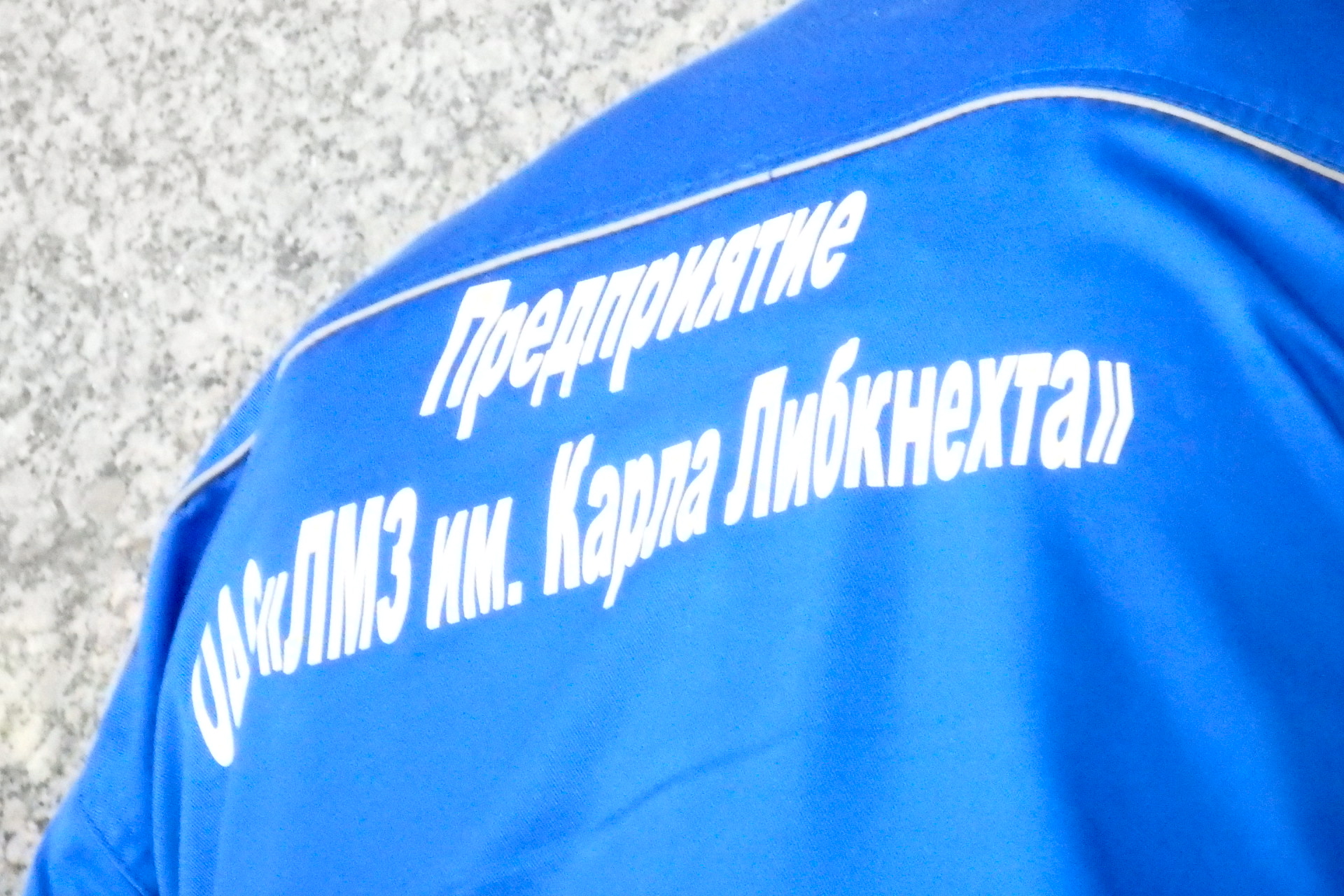
Karl Liebknecht Leningrad Mechanical Plant JSC. Photo by the Russian Reader

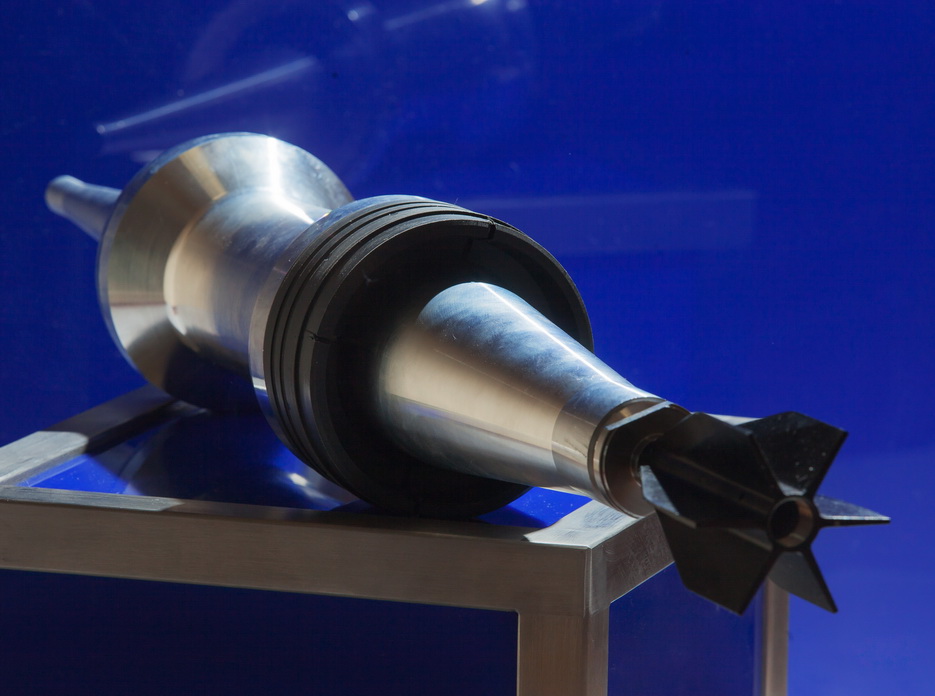
Karl Liebknecht Leningrad Mechanical Plant JSC is a leading machine-building enterprise of the military-industrial complex, supplying the army’s demand for empty armor-piercing tank ammunition shell casings.

The company manufactures advanced products for military use, popular on the international arms market, works on state defense orders and in cooperation with other plants, and produces non-military products and consumer goods.

snaryad

The Karl Liebknecht Leningrad Mechanical Plant is the only company in Northwest Russia specializing in the production of artillery shell casings.

We successfully execute important state commissions and make a significant contribution to the defensive power of our country and friendly nations.

Source: Karl Liebknecht Leningrad Mechanical Plant JSC. Photo courtesy of the company’s website. Translated by the Russian Reader
___________________

Russia is interesting from this point of view. The high state of tension in its international position has forced it to introduce universal military service, while as an Asiatic-Despotic state it is faced with an unequalled internal conflict. The internal enemy of Tsarism is not only the proletariat, but also the great mass of the peasantry and bourgeoisie, even indeed a large part of the nobility. Ninety-nine per cent of Russian soldiers are by class position bitter enemies of Tsarist despotism. A low level of culture, national and religious conflicts, and also contradictions in economic and social interests, together with the more or less subtle pressure exercised by the extensive bureaucratic apparatus as well as the unfavourable local organization, the inadequately developed transport system and other things: all these represent an important check on the development of class-consciousness. There exists a much attacked system of elite troops, who are provided with every facility: the gendarmerie, for example, and especially the Cossacks, which effectively constitute a special social class on account of their good pay and other material provision, of their extensive political privileges, and of the arrangement by which they live in a semi-socialist community; they are thus closely bound in an artificial way to the ruling classes. In this way Tsarism tries to secure a sufficient number of loyal supporters to offset the ferment which has penetrated deep into the ranks of the army. And to all this, to these “watchdogs” of Tsarism, there must be added the Circassians, and other barbarian peoples living in the empire of the fist, who were loosed over the land like a pack of wolves in the Baltic counter-revolution, together with all the other numberless parasites on Tsarism, the police and their accomplices, and the hooligans and black hundreds.

But if in the bourgeois-capitalist states the army based on universal military service and designed as a weapon against the proletariat represents a frightful and bizarre contradiction, the army based on the same system under the despotic Tsarist system of government is a weapon which is necessarily turned more and more with crushing weight against the Tsarist despotism itself. The experiences of the anti-militarist movement in Russia can therefore only be applied to the bourgeois-capitalist states with the greatest of care. And if the efforts of the ruling classes of capitalism in the bourgeois-capitalist states to bribe the people to fight against itself—to a great extent indeed with money actually taken from the people—are finally doomed to failure, we already see before our very eyes how the desperate and pitiable attempts of Tsarism to buy off the revolution by bribery are suffering a rapid and wretched fiasco in the tragic world of Russian finance, in spite of all the attempts of unscrupulous international capital to save the régime. The question of financial loans is certainly an important one, at least for the tempo of the revolution. But if the revolutions cannot easily be made, it is even less easy to buy them off, even with the means available to the big capitalists of the world.

Source: Karl Liebknecht, Militarism & Anti-Militarism 

____________________

Our Company
When it was founded on October 15, 1911, Karl Liebknecht Leningrad Mechanical Plant JSC was called the Parviainen Russian Society for the Manufacture of Shells and Military Supplies. Subsequently, it had a number of other names featuring the phrase “Karl Liebknecht Mechanical Plant.” By decree of the Council of People’s Commissars, the company was nationalized on June 28, 1918. In different periods of its history, the plant has been part of the Soviet Ministry of Machine Building (First Chief Directorate), the Department of Munitions and Special Chemicals at the Ministry of Industry, the Committee on the Russian Defense Industry, and the Russian Ministry of Defense Industries (from 1992), the Russian Federal Economics Ministry (from 1997), the Russian Munitions Agency (from 2000), and the Department of Munitions and Special Chemicals at the Russian Industrial Agency of the Ministry of Industry and Energy. From August 2008 to the present, the company has been been overseen by the Department of the Conventional Weapons, Ammunition, and Special Chemicals Industry in the Ministry of Industry and Trade.

Source: Karl Liebknecht Leningrad Mechanical Plant JSC. Translated by the Russian Reader
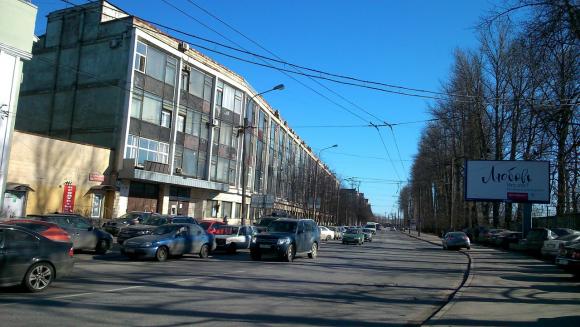
 klmp-1
Modern-day street view of the Karl Liebknecht Leningrad Mechanical Plant. Courtesy of Citywalls.ru
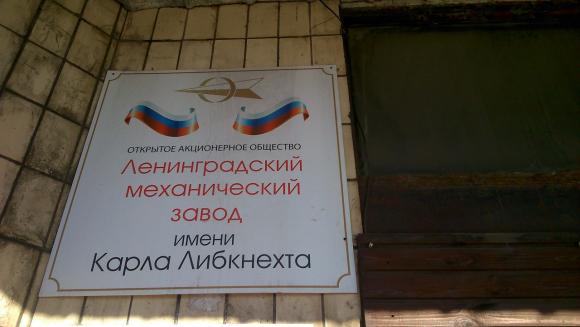
klmp-2
“Karl Liebknecht Leningrad Mechanical Plant JSC.” Sign at the plant’s main entrance. Courtesy of Citywalls.ru
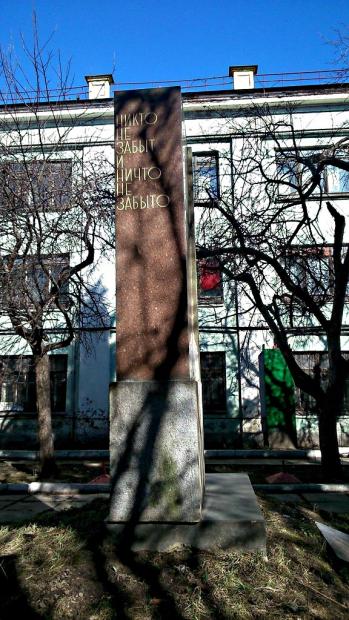
“No one is forgotten, and nothing is forgotten.” Part of a memorial to plant workers killed during WWII, in the plant’s courtyard. Courtesy of Citywalls.ru
Another monument, without a signature (perhaps the founder of the factory).
“Another monument, without a legend [sic], (perhaps the founder of the factory),” writes “liubliupiter,” the user who shot and posted these photos of the plant and its premises. Courtesy of Citywalls.ru
klmp-5
Ironically, the brother and sister-in-law of the plant’s founder, I. Parviainen, Peter and Anna Parviainen, sheltered Vladimir Lenin at their house in the village of Jalkala, near the resort town of Terijoki, just across the then Russian-Finnish border, in August 1917, when the Provisional Government put out a warrant for Lenin’s arrest. Likely as not, however, this is probably not a monument to Peter Parviainen’s industrialist brother, but to Karl Liebknecht, of course. Courtesy of Citywalls.ru
The revamped Karl Liebknecht Plant of the future. Courtesy of Wikimedia
An illustration of a revamped Karl Liebknecht Plant of the future. Courtesy of Wikimedia

____________________

Resolution Adopted by an Assembly of Workers at the Old Parviainen Plant, April 13, 1917

We, the 2,500 workers of the Old Parviainen Plant, having gathered on April 13 for a general plant assembly and discussed the current situation, have resolved as follows:

1) We demand the removal of the Provisional Government, which acts only as a brake on the revolutionary cause, and hand over power to the Soviets [sic] of Workers’ and Soldiers’ Deputies;

2) Relying on the revolutionary proletariat, the Soviet [sic] of Workers’ and Soldiers’ Deputies must put an end to this war [my emphasis], which has benefited only the capitalists and landlords and weakened the forces of the revolutionary people;

3) We demand the Provisional Government immediately publish the secret military agreements entered into by the previous government with the Allies;

4) That a Red Guard be organized and all the people armed;

5) We protest the issuing of the so-called Liberty Loan, which actually serves to subjugate rather than liberate;

6) That the printing presses of all the bourgeois newspapers leading the campaign of hatred against the Soviet of Workers’ and Soldiers’ Deputies and the workers’ press be requisitioned and handed over for use by workers’ newspapers;

7) Pending the requisition of the printing presses, the following newspapers should be boycotted: The Russian Will, The New Times, The Evening Times, Speech, The Day, The Little Newspaper, The Kopeck, The Living Word, The Modern Word, The Petrograd Gazette, The Petrograd Leaflet, The Petrograd Newspaper, and Unity;

8) We protest against England’s interference in our domestic affairs and the detention of emigrants;

9) That all food products be requisitioned for the needs of the masses, and fixed prices be set for all consumer goods;

10) That peasant committees immediately seize manorial, demesne, imperial, and monastic lands, and the tools of productions be handed over to the workers;

11) We protest the withdrawal of revolutionary troops from Petrograd;

12) That it be recognized the Provisional Government can in no way arrange for the issuing of pensions to former ministers and their families, indigenous enemies of the people.

Source: media.ssu.samara.ru. Translated by the Russian Reader
The so-called Old Parviainen Plant was located on the Vyborg Embankment. Correspondingly, the so-called New Parviainen Plant, the current Karl Liebknecht Leningrad Mechanical Plant, was located on Chugunnaya Street, roughly two kilometers to the east. TRR

Source: Wikipedia

800_dda70a6bc346eadcf94e36e4977d48be
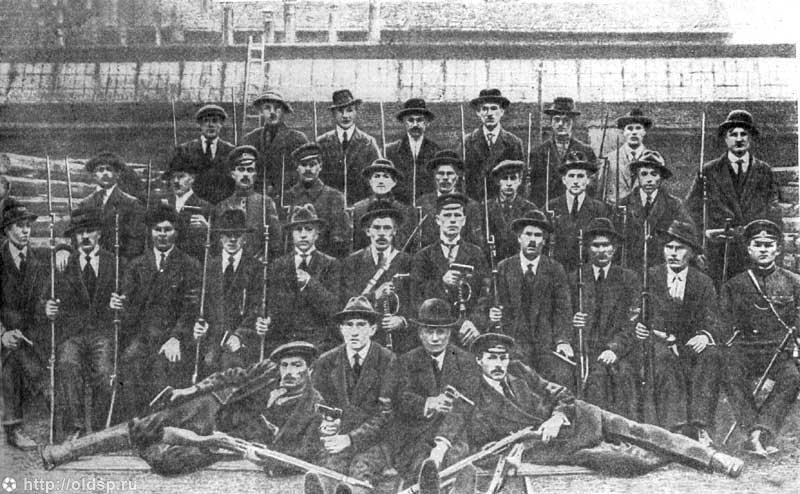
The Red Guard of the Old Parviainen Factory, circa 1917. Courtesy of Fotografii starogo Sankt-Peterburga (Photographs of Old Saint Petersburg)

______________________

Landwehr Canal, Berlin

The canal where they drowned Rosa
L., like a stubbed out papirosa,
Has almost virtually gone wild.
So many roses have moldered since that time,
It is no mean feat to stun the tourists.
The wall, concrete forerunner of Christo,
Runs from city to calf and cow
Through fields blood has scoured.
A factory smokes like a cigar.
And the outlander pulls up the native gal’s
Frock not like a conqueror,
But like a finicky sculptor,
Getting ready to unveil
A statue fated to live a while
Longer than the reflection in the canal
Where Rosa was canned.

Source: Radio Svoboda. Translated by the Russian Reader
800px-RosaLuxemburg2a
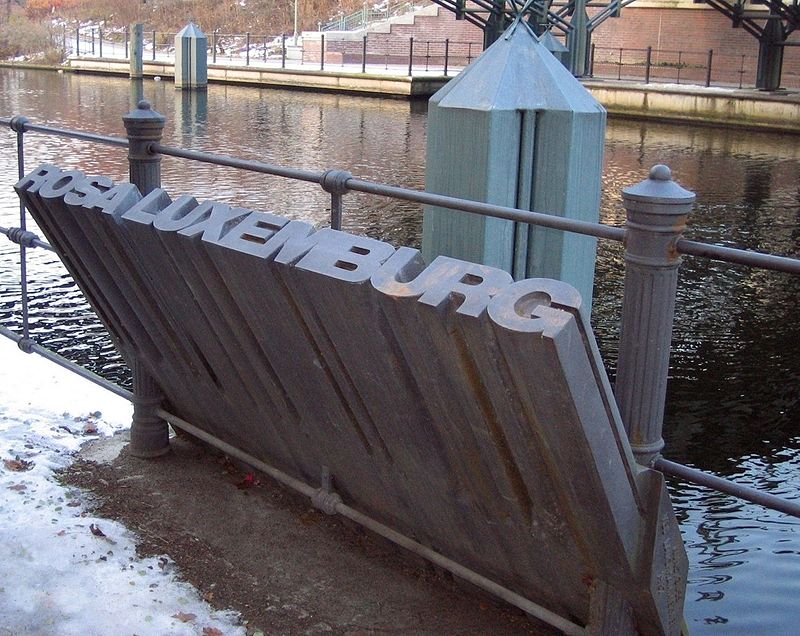
Rosa Luxemburg memorial at the site where she was thrown—either dead or alive—into the Landwehr Canal, Berlin. Courtesy of Wikipedia

On a Rope

c2e84d7025108ab8de16bf579854f5c7

Artem Kravchenko
Facebook
January 22, 2015 • Razvilka, Moscow Region

Re: words and deeds

My elder brother has a wife and four children, aged almost zero to nine years old. Boy-girl-boy-girl.

In this situation, of course, overall carelessness means that all six of them are stepping on each other’s toes, running around, jumping, being late getting somewhere, losing socks, toys, passports, and so on and so forth.

I don’t know exactly in what terms the youngest part of the family reflects on these difficulties (and whether they do reflect on them), but the eldest part of the family, it goes without saying, periodically tends to resort to dramatic statements on the matter.

For example, the mother of the family took a shine to a remarking, “It’s time to lather the rope!”

You can utter this phrase exhaustedly and phlegmatically. Or, on the contrary, belt it out while wringing your hands. Or stress each word strictly and disapprovingly. Basically, there are plenty of fine options.

But, as we all know well, “We cannot predict / How our words will resound” (Tyutchev).

Eventually, after a while my three-year-old nephew showed up and said, “Mom, I lathered you a rope.”

He pulled out a fairly long piece of twine, solicitously adding, “With good antibacterial soap.”

_________

Current Time
June 17, 2016

Community volunteers in Novosibirsk have spent a grant from the mayor’s office to organize a Zarnitsa [Soviet-era children’s war game] for children with disabilities. The goal was to adapt the children to life and integrate them into society. This is an interesting way of doing it.

[Subtitles]

The Novosibirsk authorities organized a Zarnitsa game for orphans and children with disabilities.

“And smile!”

“Put down the pistol.”

“There will be live fire. We are going to be firing, and we will be fired on.”

[Sign on left:] “Red Army warrior! The lair of the fascist beast lies ahead.”

“This is a war game, which the young generation needs nowadays.”

The game was meant to help the child adapt to life.

Translated by the Russian Reader. Photo courtesy of fakty.ictv.ua

___________

{NE MIR} Dialogues (Riga)

Vadim F. Lurie
Facebook
February 21, 2016

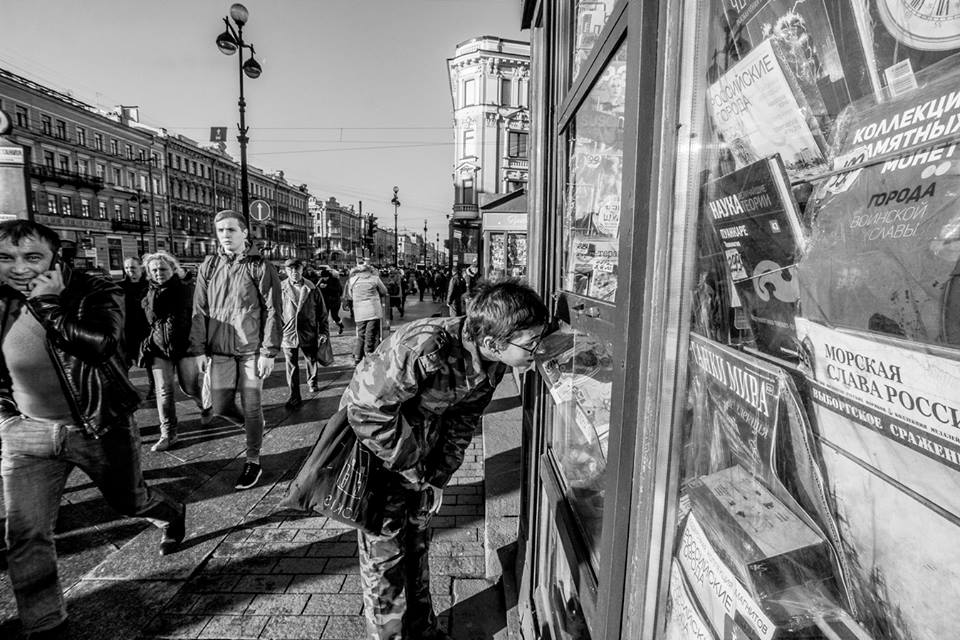
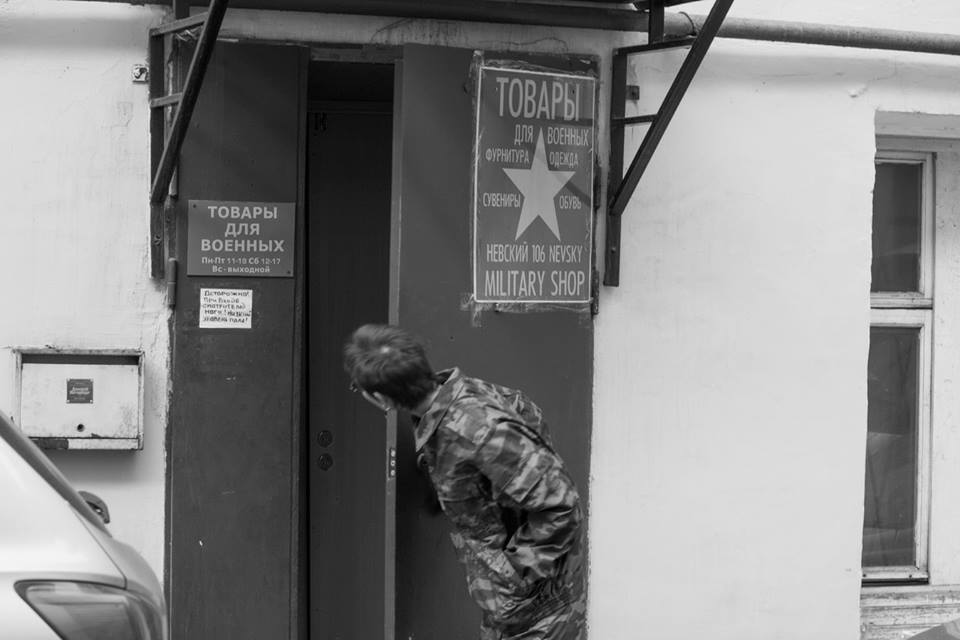
The exhibition {NE MIR} (NO PEACE), a sequel to and an elaboration on the itinerant exhibition/performance that recently took place in Petersburg, opens today in Riga. I sent my photographs of Antiwar Weekend, a walk around the city made by Ekaterina Nenasheva. She strolled around Petersburg in a blood-stained, camouflage uniform. We looked for places in one way or another connected with war, aggression, the army or the memory of them. Actually, we didn’t have to love for them: they were everywhere. Our city is traumatized. Aggression and the memory of wars are offered to tourists as souvenirs, and I see this as an attempt not only at self-assertion but also at conveying this feeling to everyone. As we walked round the city, passersby paid no special attention to the young woman in camouflage. She had become yet another military artifact, a customary sight here. Thirteen photographs, Petersburg, a sunny day in 2015.

Translated by the Russian Reader

12717180_10205713548746516_5004147964005267285_n
Ekaterina Nenasheva, Antiwar Weekend, 2015. Photograph by Vadim F. Lurie. Items for sale in the far right of the kiosk include “Cities of Military Glory,” “Russia’s Naval Glory,” and “The Battle for Vyborg.”
12715679_10205713548426508_695270159562902442_n
Ekaterina Nenasheva, Antiwar Weekend, 2015. Photograph by Vadim F. Lurie.
12742264_10205713548706515_5009893401106894565_n
Ekaterina Nenasheva, Antiwar Weekend, 2015. Photograph by Vadim F. Lurie.

__________

12705378_560104237485253_5926362963602784144_n

{NE MIR}: Dialogues in Riga
Opening: February 21, 2016, 7 p.m.
BOLDERĀJA, AVOTU, 29, RIGA

{NE MIR} is a series of antiwar street exhibitions launched by a group of artists from Moscow and Petersburg. The project’s objective is to discuss war in its different forms, make a collective artistic statement on the relationship between the individual and the state, and investigate the borders of street art in today’s Russia.

The first {NE MIR} exhibition took place in Petersburg on December 27, 2015.

In Russia, there is a law prohibiting marches and rallies (in fact, any political or public gathering of more than two people) without obtaining permission from the authorities ten days beforehand. Moreover, these rallies can be held only in specific places, which are usually situated on the outskirts of cities or are difficult for the public to access. The Russian authorities have the right to prohibit any rally, and in that case it will be considered illegal.

Since their request was turned down three times by local authorities, the artists who launched {NE MIR} had no other choice than to make mobile banners and wander the city under the watchful eye of regular police and riot police.

The urban environment, which dictated the form of protest (wandering round the city), thus functioned as the exhibition’s curator.

This interactive format raised many questions both in terms of art and civic involvement.

How should Russian artists act in the current situation when any statement is deemed disorderly conduct or even a crime? What is the visual code used by police and random passersby, and what are the circumstances under which dialogue is possible? How are absolutely defenseless artists regarded by viewers when they display their artworks in such an aggressive environment?

We intend to look for answers to these questions both inside and outside Russia.

{NE MIR}: Dialogues is a series of itinerant exhibitions and discussions held outside Russia in free art spaces and galleries. It is an attempt to promote dialogue among citizens, artists, and activists, and spark cultural and social interaction between people from different societies and countries.

The exhibition of the {NE MIR} project in Riga will include paintings, graphic art, installations, photographs, and video works by artists from Russia, Ukraine, Denmark, and Chile.

A discussion entitled “The Image of War: The Mass Image and the Private Image” will be held at 7 p.m. on February 21 at Bolderāja Bookshop and Cafe (Avotu 29, Riga), with the exhibition opening to follow at 8 p.m.

Adapted and edited from the original event notice in English on Bolderāja’s Facebook page

Syrias

Here are four very different but complementary reflections on the dangers of Putin’s new Syrian adventure by, respectively, an electrician and veteran grassroots activist, a sociologist, a magazine editor, and a political scientist and leftist activist.

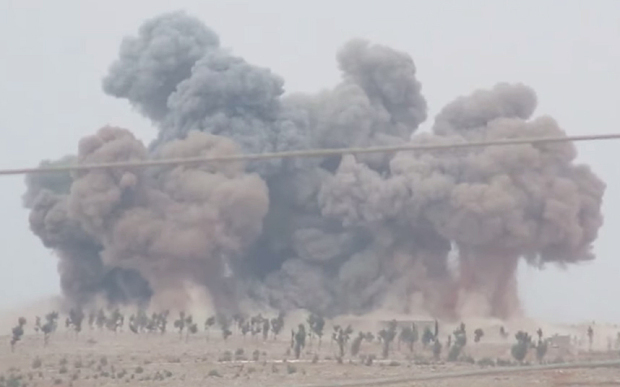
A video released on YouTube claimed to show Russian air raids targeting the ruins of al-Rabiyah and Shinsharah near Kafranbel

George Losev
October 1, 2015
Facebook

Russia pacified the North Caucasus just as the US pacified Afghanistan. The Taliban have disappeared from the news but not from life.

The US has started many wars, and the Russian Federation has already started two. The US has got into conflicts in the Middle East primarily for domestic political reasons, and the Russian Federation has done the exact same thing.

The US lies constantly, and the Russian Federation does, too. (As do the EU, Israel, Iran, Saudi Arabia, and everybody else.)

But is there even a single reason to support the dispatch of Russian forces to Syria? There are no such reasons, just as there were no reasons to support the NATO bombing of Libya or the [US/UK] bombing of Iraq.

And now, as in the case of the war in Ukraine, just watch carefully and take note of what you see.

P.S. That is, while there is no chance to do anything more substantial.

__________

Greg Yudin
October 1, 2015
Facebook

You would have to be Putin, of course, to support Assad by way of restoring order.

Assad is a man who, in the past four years, has:

  • let slip an armed grassroots uprising;
  • permitted a civil war with hundreds of thousands of victims;
  • used chemical weapons against his own citizens;
  • allowed the full-scale deployment of an international terrorist group;
  • and lost control of two-thirds of his country.

And this man, of course, is the man who will pacify all of Syria and calm everyone down.

It has often been said of Putin that he takes a cynical (i.e., “realistic”) approach to foreign policy. It is nothing like this. In the case of Syria, it is Obama, who says we should get together and appoint them a leader who can restore order, who has taken the cynical approach.

The approach of Putin and his elite, however, is not cynical but stupid. The point of this approach is that you should always support the current regime. Simply put, the boss is always right just because he is the boss. They arrived at this hard-won conviction through their own uncomplaining obedience. This belief is the basis of their power and their philosophy in life. For its sake they are even willing to entangle themselves in an international conflict.

________

Alexander Feldberg
October 1, 2015
Facebook

Until today, this business with Syria seemed strange to me in the sense that it would not be easy to sweep the Russian people off its feet with it. I understand about small victorious wars, but I imagined that this was not like Ukraine, which is next door, or Hungarian geese, which we could even fondle with our own hands until recently. And then, we are talking about a country that has lived through a war in Afghanistan, despite the incomparable scale of the conflicts and so on. But this morning I was riding the subway and saw this guy, an ordinary guy in his forties with a decent face, even, a guy who looked a little like actor Yevgeny Mironov. This guy was riding the subway and looking at something on his telephone. He was not just looking but literally devouring the phone with his eyes and putting it next to his ear from time to time to make out the sound over the roar of the subway. (For some reason he was not using earphones.) I peeped a little and saw that Sergei Ivanov was on the screen of the dude’s phone. This was when I got curious and a bit anxious, because, on the one hand, it is hard to imagine a situation in which a normal person would get so excited by a speech by Sergei Ivanov. On the other hand, in the morning I had heard on the radio about the Federation Council, which Putin had again asked for authorization, just like that other time, and that had made me a little queasy. So I broke down and gently asked the man what was happening.

yevgeny mironov
Russian actor Yevgeny Mironov

“Sy-ri-a!” he mouthed to me, clearly afraid to miss something important in the broadcast.

Then he briefly turned to me again and sighed, “We are going to bomb!”

He said it as if a weight had finally been lifted from his shoulders, as if the going had been tough, but now, thank God, it had been decided.

And at that moment I had the terrible desire not to be here, to disappear somewhere completely. I realize this was cowardice, a momentary weakness, but I felt it all the same. And I also remember a conversation I had with Bob when we were sailing down the Irrawaddy River, and thought that perhaps he had been right: “You may hate him, but you cannot get rid of him.” I don’t want to be responsible for these motherfuckers. I don’t want to think constantly about whom else they have taken it into their heads to crush or bomb. Let them build underwater chapels for scuba divers and invisible bus stops, but please, please, don’t let them bomb anyone.

invisible bus stop
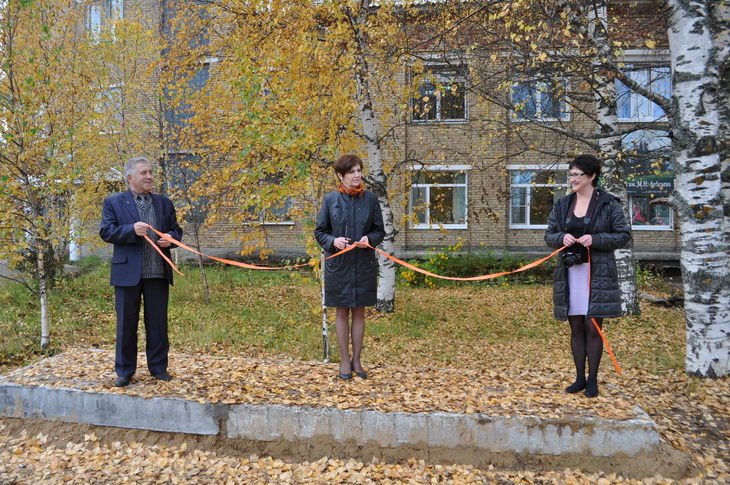
Officials opening an “invisible” bus stop in the village of Körtkerös, Komi Republic, on September 22

Bob
Bob, an Australian who looked like a gray-haired Homer Simpson, spoke intermittently and passionately, now and then dipping his elongated head into his third glass of claret.

“Very well, I know you Russians have it hard. You always have someone to answer for, either Putin or Stalin. ‘He’s Russian? Very well, let’s ask him about Putin.’ It’s the same crap with the Americans. At the drop of a hat they get told, ‘It’s all because you made a mess of things in Iraq, fellows!” You guys are constantly confused with someone else, with some big, important motherfucker. We have it much easier in this sense. ‘Australia? Isn’t that the place where there are kangaroos ?’ We are just Aussies, you know, Alex? I travel where I wish, live where I can earn money, and nobody is going to torment me with your Putin.”

“I already told you,” I replied, “I don’t like Putin.”

“Bingo!” Bob roused himself. “You may hate him, but you cannot get rid of him. Although I know that things are even more complicated in Russia. You Russians hate yourselves most of all.”

Then, in keeping with the conventions of bad movies, Bob laughed heartily and, winking conspiratorially, said, “I’ve read Tolstoyevsky!”

__________

Ilya Matveev
October 1, 2015
Facebook

If I were in Putin’s shoes I would think hard about the following paradox. Of course, you can accuse America of “destroying sovereignty” everywhere from Libya to Ukraine all the time. But America cannot just up and destroy sovereignty. It can encourage the opposition. It can even drop bombs. But it is not capable of just up and destroying state institutions themselves. The problem is that wherever a state has collapsed, it had already been weak. And a state’s weakness lies in the absence of its autonomy vis-à-vis narrow group interests, be they elite clans, oligarchs, tribes, and so on. A weak state is also labeled “patrimonial,” meaning it has been “privatized” by particular interests. This weak state syndrome was typical of absolutely all the countries Putin thinks the State Department got to. The paradox is that the Russian state, the Putinist state, is weak. It has low autonomy vis-à-vis elite groupings, and its formal institutions are window dressing for backroom deals. The more Putin “immunizes” the state from the opposition, the “fifth column,” and so, the more he strengthens precisely these same elite groups, all those Sechins and other “friends of the president,” who have an interest in weak institutions. Thus, everything Putin does only weakens the state. The easiest way to illustrate all this is with the dilemma of his successor. Putin has built a state in which no one knows what will happen after Putin, including himself. Ukraine-scale chaos is quite possible at the very least; Libya-scale chaos, at the very most. But unlike Libya and even Ukraine, Putin will only have himself to blame for this. After fifteen years, there is nothing left of the government, the parliament or the courts. All that remains are Putin’s “friends” and his “manual control.” It is a sure bet that the State Department and American imperialism are not to blame for this. In this case, it is homemade.

__________

My thanks to George Losev, Greg Yudin, Alexander Feldberg, and Ilya Matveev for their permission to translate and publish their remarks here. Click on the links, above, to read their previous contributions to this blog. Images courtesy of the Telegraph/YouTube, Tochka.net, and Zvezdakomi.ru

Suffer the Little Children

My friend L. writes:

Today a fourth-grader told me that his history teacher [at a school in Petersburg’s Central District] had explained in class that Stalin had shot traitors. “Is it true?” the child asked me. I said the teacher was a foolish woman and it was pity she hadn’t been shot! And that the student could go and tell her so. The child reasonably remarked that if he did that, she would call the police. I then gave him the rundown on Stalin, thus completely and utterly undermining the history teacher’s authority.

Save children-6303

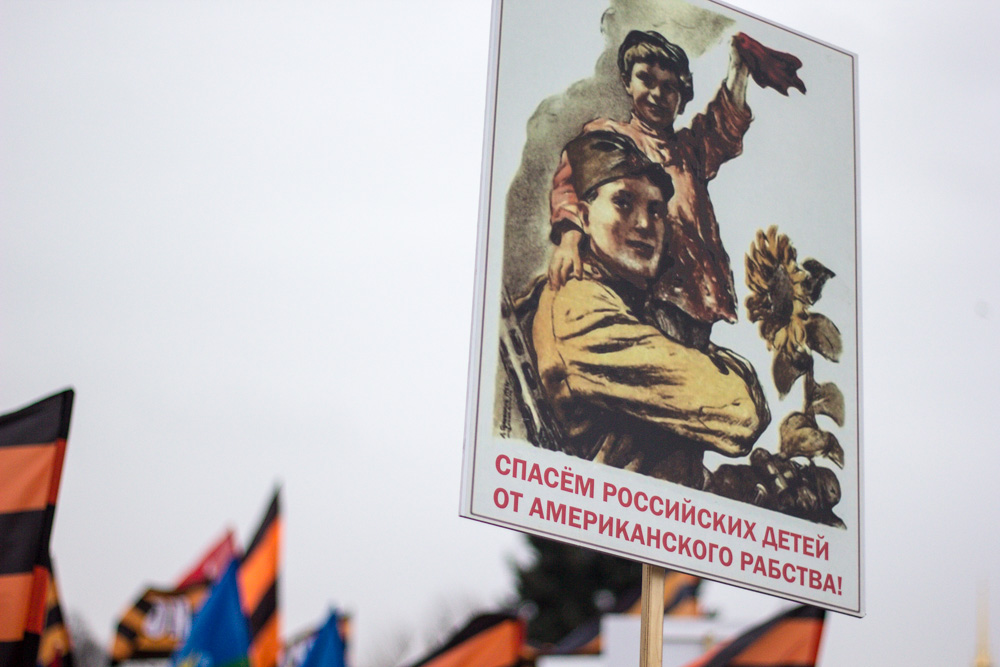
“Let’s Save Russia’s Children from American Slavery!” Placard at Anti-Maidan rally, Field of Mars, Petrograd, February 21, 2015. Photo courtesy of Sergey Chernov

_______

Fontanka looking for kindergarten that staged “Militiaman Day” with arms
February 24, 2015
Fontanka.ru

Photos from a “Militiaman Day,” allegedly held at a St. Petersburg kindergarten, are being discussed today on the blogs. In the photos, a man in a major’s uniform shows children all sorts of modifications of the Kalashnikov assault rifle, as well as a Dragunov sniper rifle, a rocket-propelled grenade launcher, and a shaped charged anti-tank grenade. The children happily pose with all these weapons, which are probably dummies used for training.

ds2

The photos has had a bombshell effect on the Russian segment of the Internet. The shots have been compared to images from children’s celebrations in institutions supported by Hamas.

ds1The blogger who posted these photos claims that one of the parents decided to make the children happy in this way.ds3

The only thing that remains off camera is what kindergarten would permit such a celebration? We ask parents who know in what kindergarten the photos were taken to contact Fontanka’s editors.

The images, above, are screenshots from twitter.com as reproduced on Fontanka.ru

__________

Gleb Kuznetsov writes on Facebook that it is no longer necessary to watch television [to experience Russian war hysteria]: it suffices to pay a visit to a kindergarten: “As she was undressing the child, Grandma vaguely heard what was being said in the group before classes began. Seated on little stools, the kiddies were gathered around the minder. ‘Children. There is a war on in Ukraine. People are dying. Little kids and their parents are being hurt. Enemies have attacked them. But our president is a good man, children. He is fighting for peace… He is sending arms to the militiamen. So today we’ll be gluing envelopes.’ A child of six heard this as was he was changing his clothes and yelled, ‘Hurrah! World war. We’ll beat everybody.”

source: online812.ru