That’s okay. The home audience just wants to hate on “Europe” and “Muslim terrorists” even if they have been edited, remixed, and totally fabricated out of thin air. The important thing in Putinlandia is to have something and someone to hate intensely all the livelong day.
And if you think this hatred is restricted to the “yobs” and other “uneducated” types, you’d be dead wrong. Over the last glorious seventeen years, I’ve been hearing this free-floating hatred spilling out in increasing quantities from the educated, from professionals, from the so-called intelligentsia.
In fact, I heard it again last night during my Finnish class (not the first time there, either). The remarks were “triggered” by the fact that I had had our group read a Helsingin Sanomatinterview with the up-and-coming Somali-Finnish screenwriter and filmmaker Khadar Ahmed, who spoke with an utter lack of bittnerness (and in a totally fluent Finnish that none of us “Aryans” have yet achieved) about the total alienation and discrimination he had experienced as an immigrant to Finland. He’s now relocated to Paris.
My classmates were totally unimpressed that a road movie based on Ahmed’s screenplay, Saattokeikka, would be hitting screens in Finland in the coming days, or that a previous screenplay of his (Kaupunkilaisia) had been filmed by country’s hottest young filmmaker, Juho Kuosmanen, whose luminous and completely perfect film The Happiest Day in the Life of Olli Mäkiwon the top prize in the Un Certain Regard section at the 2016 Cannes festival and was submitted by Finland to the 89th Academy Awards for Best Foreign Language Film.
My classmates had never heard of Kuosmanen or the film, either, although Olli Mäki was screened right down the street from where we were sitting. That was a few months ago during the annual Finnish film festival, paid for by the Finnish government, who have been trying so hard to be besties with the “neighbor to the east,” which just wants to puff out its chest and hate on everybody as a matter of state policy and mundane practice.
We also read another Helsingin Sanomat piece, about the state of the Finnish nation and the state of “Finnishness,” in which well-known Finns were asked to respond to a set of ten questions that pollsters had posed as well to a larger sampling of ordinary Finns. One of the respondents was the Finnish rapper Prinssi Jusuf (aka Iyouseyas Bekele Belayneh), whose family moved from Ethiopia to Finland when Jusuf was two.
Yet my classmates were convinced, for some reason, that Prinssi Jusuf must rap in English, not Finnish, as if Finnish were too complicated for black people to learn.
One of my classmates was also on the verge of making a comment about who Prinssi Jusuf resembled. As an amateur psychic, I could imagine what she was about to say (Barack Obama, although they don’t look a thing alike), but a well-timed glare shut her up.
This is the lovely world that Putinism has built over the last seventeen years, although everyone answers for the garbage in their own heads, ultimately.
By the way, here’s a video of Prinssi Jusuf rapping in what sounds to me like perfectly fluent Finnish. ||TRR
List of “Non-Russian” First Formers in Suburban Moscow Provokes Nationalist Brouhaha Commentators Divided on Issue of Assimilating Migrant Workers Moskovsky Komsomolets
September 1, 2016
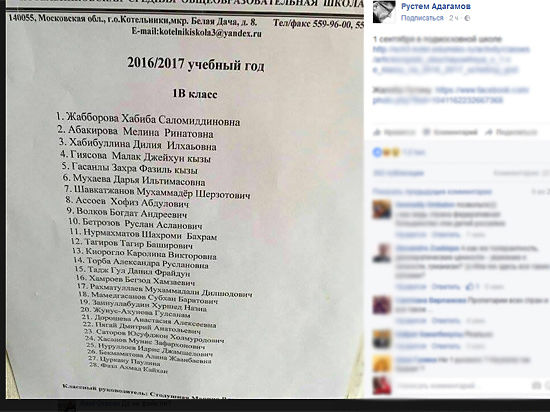
Publication of a list of pupils in a first form class at Kotelniki Comprehensive School No. 3, in suburban Moscow, most of whom have “non-Russian” names and surnames, has set off a row on the web.
The photograph quickly spread among top bloggers and various socio-political discussion groups, garnering a slew of nationalistic comments.
The children’s names, such as Habiba, Medina, Malak, Idris, Yufusjon, Muhammadyor, and Beghod (there are a total of twenty-eight children in the class) goaded users into making nationalist statements.
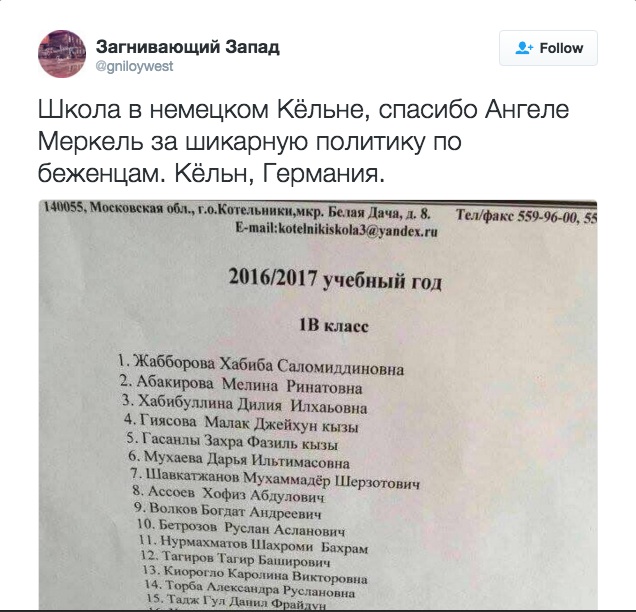
However, [the Twitter account]Decadent West, for example, which ironically passes off Russian realities as foreign, commented on the photograph as follows: “A school in the German city of Cologne. Thank you, Angela Merkel, for your excellent refugee policy. Cologne, Germany.”
Screenshot of Twitter account entry on the topic by Zagnivayushchii Zapad (Decadent West)
Nor all user, however, supported the nationalist rhetoric. Thus, Mitya Aleshkovskiy, director of the website Takie Dela, wrote that “people who are outraged children of migrant workers go to school are animals and a real shame to our country and society.”
He reminded his readers that schooling the children of migrant workers was the best means of assimilating them and claimed that Russia was a country where fascism had emerged victorious.
This prompted users to deluge Aleshkovskiy with nationalist comments.
In 2013, residents of Kotelniki wrote and distributed a letter, complaining to the president, prosecutor general, and governor of Moscow Region that their town had “turned into a ghetto of illegal migrant workers from Tajikistan, Uzbekistan, Kyrgyzstan, and other CIS countries, as well as Vietnam and China,” due to the fact it was close to the Sadovod Market.
We don’t ever think. We just have a small collection of tapes we stick in slots in the back of our heads when the need to say something “smart” arises.
* * * * *
Russian speakers living in Finland are not a homogeneous group, but one thing unites them strongly: a large number of them regard asylum seekers with a grain of salt.
“I relate to the phenomenon negatively. I think the people coming here do not have the necessary information on how people live here. They are trying to come here with their own traditions and customs, and at the moment this hinders their adaptation,” say Gleb Ulanov, who lives in Helsinki.
[. . .]
Despite the fact that the Russians themselves are immigrants, they do not want to compare themselves to the people now arriving from the Middle East. Russian speakers are of the view that they do not have similar adaptation problems.
“The biggest difference is the mentality. Most Russian speakers adapt,find work, and respect Finnish customs and celebrations. In my experience, only a small minority of people from the east does this. They prefer to form their own communities,” says Grigory Berkinfand, who lives in Helsinki.
[. . .]
Many Russian speakers fear that Finns have a naive attitude toward the asylum seekers, and do not properly distinguish those who are genuinely in need of protection.
Just like Finns, Russians are primarily concerned about safety. Many say that traditionally peaceful Finland is changing at a rapid pace.
Gleb Ulanov, who in Soviet times lived for about a year in the Caucasus, is of the opinion that merely integrating the refugees is not enough. In addition to telling the asylum seekers about Finnish customs and laws, Finns should also tell the refugees about culture and how they should behave around them.
[. . .]
Even a man from Russian Karelia who is living in a reception center and applying for political asylum questions the motives for coming to Finland of many of the people living with him. The man wished to remain anonymous.
“I can see what is happening here. They do not appreciate either the local culture or the help they receive. The majority are of the opinion that the Finns are obliged to help them. Many of them say that one can live here without working, and everything is given free of charge. They are quarrelsome if they notice they have not been given something and they complain about conditions. For example, I am really satisfied with everything here. Ihave not received such a warm reception in my own country,” he said.
Excellent, just excellent. I look and see that Ulyana Skoibeda has published a diary about how terrible life is in Germany [in the mass circulation newspaper Komsomolskaya Pravda]. I think, what is this crap? What would Skoibeda know about Germany? I have a look: the entire structure of their propaganda and the stuff of which it is made are visible after three paragraphs.
Ulyana Skoibeda (center) and friends
The diary’s author is a certain Galina Ivanova, who moved to Germany but is now escaping it in horror at the influx of immigrants and the inaction of Germans. Since the text is executed in the “eyewitness” genre, it has immediately become wildly popular. To drive the point home, Skoibeda has supplied the diary entries with “links to major German media and speeches by officials.” She is thus hinting that every piece of evidence of Europe’s disintegration is backed up with a reference in perfect German. This is not the story of the three-year-old boy, allegedly crucified in Slovyansk by Ukrainian soldiers, but since proven a fake, she seems to say. You won’t nitpick this one to death.
What is great is that if you follow these links and start reading, you will find that almost all of them are total lies. And the lies come in all sizes. Some of the links lead to off-topic stuff like poverty statistics. Or, for example, the diary’s author angrily reports that Muslims have been abusing Germans to such an extent that “in many school cafeterias, pork sausages, salami, and pâté have been banned.” The link leads to a story about a crazy Egyptian family who asked a court to ban pork dishes. This happened in Vienna (which, for Skoibeda’s information, is in Austria) and was laughed off by the local legal community. But does it really take much to scare Russian readers?
Or, for example, there is a tear-jerking story about German pensioners having to dig in trash urns to collect empty bottles. The link is to an item in Die Republikaner in which there is not a single (!) mention of pensioners. The item itself is about how a society in which people are forced to collect bottles (by the way, have you never seen such a society outside of Germany?) should deal with this rather than facilitating the collection of bottles.
And then there is the top of this pop chart, which, of course, consists in the fact that the majority of the links in the text (including the links to newspapers, officials, and various sensational news items) in fact lead to one and the same site, Netzplanet, a collective right-wing blog that went online two years ago. The bloggers there complain about immigrants and scare each other over Islamization. Their Facebook page has already been blocked because its owners were not willing to provide the necessary information about themselves. The site itself is registered to a company in Panama. I won’t go on.
No “Galina Ivanova” really exists, of course. (In any case, it wasn’t she who wrote this text, unless Galina Ivanova is Skoibeda’s real name.) Because at any newspaper, even this one, there are fact checkers, and if Skoibeda really had been sent a “diary with links,” she would have found people with a knowledge of German and verified the information.
But the miserable PR people and degenerates from the security service who were given the task of collecting facts about problems with immigrants in Germany do exist. And they blew it. And now Skoibeda’s byline is attached to an article with a thousand proofs that she lies.
I always recommend the first thing university students do is learn foreign languages. Because you are surrounded by tons of people who intend to mess with your brains, and your own government is engaged in this above all. It is not the gullible who are most easily manipulated, but those who don’t know how to check things. Languages are the best chance of navigating the world on one’s own. It is impossible to know all languages, but if you know one foreign language, and your friend knows another one, the government will find it much harder to put one over on you. That is exactly why our MPs are so keen to ban the study of foreign languages in schools. Then Skoibeda will be able to tell readers that people with dogs’ heads inhabit Europe.
Greg Yudin is a research fellow and lecturer at The Higher School of Economics in Moscow. Photo courtesy ofTrud.ru. Translated by The Russian Reader
Movements in Central Asia have become large-scale and permanent, involving all social groups, rich and poor, women and men, young and old. They move around their own countries and among countries. Some go for several weeks or months and come back, while others live far from their place of birth for years, only occasionally visiting their homelands. Still others leave forever, breaking all ties. Some travel in search of a new homeland, so to speak. Others go to make money, study or receive medical treatment. Still others go for fun and excitement.
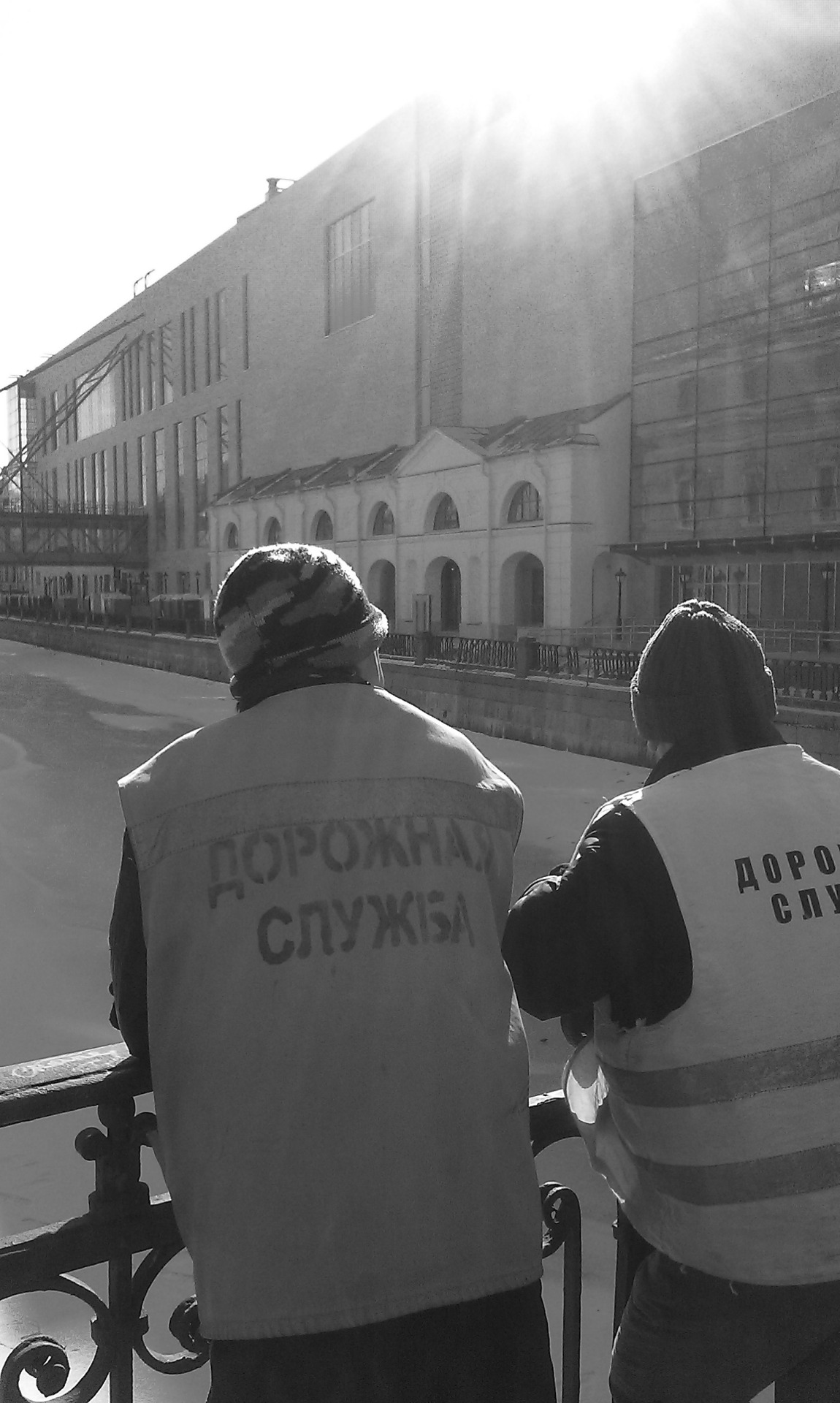
Immigrant road maintenance workers gaze at the newly completed second stage of the Mariinsky Theater. Kriukov Canal, Petrograd, March 15, 2013. Photo by the Russian Reader
All this movement has come as a surprise to experts and politicians. I still remember the debates in the Soviet Union in the 1980s as to why the people of Central Asia were reluctant to travel outside their region. Even then officials and academics in Moscow, observing the beginnings of the demographic decline in Russia itself, were planning to relocate people from borderlands with an excess labor force to the central regions of the then still-unified country. These plans failed, because few people wanted to leave their homes. Only organized and, in fact, involuntary labor recruitment and military labor brigades partly solved the increased need for labor power. The weak affinity that Uzbeks, Tajiks, and Kyrgyz felt for voluntary mobility was proclaimed, on their part, an inherent and incorrigible attachment to family, community, and the hot climate. However, all these explanations were put to shame only a decade after the collapse of the Soviet Union, when millions of people from the titular Central Asian nations felt an irresistible urge to hit the road, leaving and, sometimes, literally abandoning their homes.
Let us try and make sense of these circumstances, to understand why movement in the region has suddenly become a vital life strategy among a considerable number of people. The answer only seems to be lying on the surface. Yes, of course, the collapse of the Soviet system has led to the dismantling of all previous social and economic policies, which kept the population in place through social programs and investment in sometimes loss-making manufacturing enterprises. An abrupt, almost catastrophic decline in living standards, often accompanied by political turmoil and increased feelings of uncertain life prospects, could not fail to provoke an outflow of those wanting to find new prosperity and new stability outside their former worlds. Unemployment and negligibly small wages and pensions have pushed people into new labor markets in countries where even small incomes, by local standards, are much higher than the incomes Central Asians can expect to earn at home.
The future also looks ambivalent, depending on the forecaster’s optimism and pessimism. Some argue that economic, social, and political degradation in Central Asia will continue, becoming chronic, and the movements, therefore, will not stop but might even become even more intense, prolonged, and irreversible. Others, however, argue that sooner or later the situation will improve, investments and jobs will emerge at home, incomes and quality of life will increase and, consequently, outward migration will gradually dwindle.
This approach to movement as a consequence of degradation simplifies, in my view, the picture of events, distorting our perspective by ignoring and failing to analyze many important causes, factors, processes, and attitudes. If we look more broadly at the context in which human mobility in Central Asia has been growing, the first thing we see is an increase in the scope, range, and frequency of movement throughout the entire post-Soviet space and the world as a whole. Second, we see the unconditional link between mobility and the current stage of capitalism, which is sometimes called globalization, sometimes postindustrialism, and sometimes postmodernism. Viewed from this perspective, the picture of Central Asia appears in a somewhat different light than as a mere reflection of the disastrous state of affairs in the region’s newly independent countries. Spatial flows are not only a compulsory means of survival but also an impetus for distributing and assembling people, capital, information, and skills in new social configurations. The latter have a logic and meanings that do not depend directly on the characteristics of a particular country but are subject to wider trends and patterns.
What additional meanings can be attributed to the movements of people in Central Asia aside from as a reaction to post-Soviet degradation?
I think the situation can be described in terms of the momentum of the connections and mutual dependencies between Central Asia and Russia (and other lands) that developed and strengthened over at least a century and a half of coexistence within a single state. Usually, this kind of relationship is characterized as imperial or, if observers want to emphasize a distinctly unequal exchange, colonial. It is believed that empires inevitably fall, to be replaced by liberated nations. In this simple teleological scheme, which now dominates post-Soviet ideologies, much is not entirely clear, but one of the most controversial questions that many postcolonial critics ask is whether empire has actually disappeared or has adopted new shapes in which nations—i.e., constructs actually generated by empire—perform the old functions of borderlands, still pumping resources into the former metropoles in return for patronage and oversight. If we accept this argument, and there are many grounds for doing so, the massive movement of people from Central Asia to Moscow, Petersburg, and other Russian regions appears to be a post-imperial situation in which the circulation of labor power, money, practices, ideas, and information continues, acquiring new tempos and vectors. This movement establishes a new division of labor between the former “heartlands” and “borderlands,” and their hierarchy and mutual need for each other, even if the rhetoric has been dominated by harsh rejection of the newcomers.
Another implication of the movement of people in Central Asia is also quite obvious, although it is little remarked and little analyzed. The large-scale mobility—a significant (if not the lion’s) share of which consists of rural residents going to work abroad—is tantamount to a rather classic proletarization of a still largely agrarian Central Asian society. Soviet modernization attempted in its own way to organize this process by gradually transforming the locals into an agricultural working class while preserving the private agricultural sector and the corresponding rural practices, attitudes, and outlook in the region as a kind of compensation for semi-forced labor. The collapse of the Soviet Union also entailed the collapse of this transformative model. Consequently, the standard version of capitalist development, involving the ruin of the peasants, their impoverishment and exodus to the cities, where they are transformed into ruthlessly exploited proletarians, was inevitable. In other words, what is perceived as degradation is, in fact, a shift in the socio-economic order, not a return to old ways of life, as it sometimes has seemed, but accession to a completely new stage or form of community.
Proletarization has not been subject to discussion because, in particular, its course and effects have been concealed in a strictly ethnic view of the movement. In the countries of origin, the departed are considered traitors, victims or breadwinners. In the host countries, they are considered threatening outsiders or, again, victims. The emphasis, often cultural and racial, on their departure or arrival is more important than the social essence of movement. However, as soon as we remove our ethnic glasses we сan easily identify the class character of mobility. Its specificity consists only in the fact that the system in which class interaction takes place is not limited to particular countries and even regions but is non-national in scale. This system includes, first of all, the post-Soviet space as the nearest and most comprehensible space, a space that has, as I have already said, a history of a common existence and unequal relations of domination and subjugation between heartlands and borderlands. But mobility has already gone beyond the scope of the post-Soviet, spreading into new spaces of global capitalism and incorporating itself into a truly global order.
The other significance of the movement in Central Asia I would like to discuss is the mastery and appropriation of global space, infrastructures, and communication and transportation technologies. Let me explain this with a very simple example. Once upon a time, at the turn of the nineteenth and twentieth centuries, Russian imperial officials built a railroad that linked Central Asia with Russia’s central regions. The railway was built in no small measure to transport troops in the event of local uprisings and conflicts with other world powers, as well as for resettling Russian peasants, who were to colonize the new imperial lands. The railroad was also built to export the region’s cotton to the Ivanovo textile mills and import grain back to Turkestan, where the arable land was to be busy growing cotton. However, whatever objectives Petersburg officials pursued by allocating funds for the railroad’s construction, the end result was new transport infrastructure that made it possible to move large quantities of people and goods quickly, a means that had been available to different groups of people in different historical periods, and could be used for purposes that the said officials could not even imagine. Consequently, a hundred years later, the railway has become one of the main means of transporting millions of people of Central Asia to Russia and all over the world. This shift of functions and tasks might be dubbed mastery of new technologies and appropriation of completely new mechanisms for interacting with space, mechanisms which themselves define the impetuses and trajectories of movement. If we add highways and air travel to the railroads, we find ourselves with a huge network of possibilities that people transform into an element of their everyday practices and plans. The ease with which one can reach the other end of the world in a short time and gain access to new goods itself compels people to travel.
Here I would add the mastery of technologies for obtaining information about the world and communicating at great distances. They help create and maintain images and networks of acquaintances, which are also included in processes of movement and ensure its stability, direction, and reversibility. In a broader sense, I would also include here not only phones, internet, cars, and planes but also knowledge of languages, mastery of global systems of food and clothing, of finding and gaining employment, and so on. The penetration and expansion of such technologies and infrastructures in Central Asia and training oneself in the habits of using them shapes the demand for mobility as a distinct need and, sometimes, as a pleasure.
Finally, I want to use the notion of the migration of peoples for interpreting current movements. Despite the risks of drawing analogies between quite different historical periods, I think it vital to point out the temporal depth, continuity, and cyclical nature of movements, on the one hand, and, on the other, the gradual tectonic shifts in the spread of cultures, languages, and even genetic characteristics, shifts that may not always be visible from the perspective of several decades. I think we must keep sight of this prospect, too, because it is here that new mixtures and hybridizations happen, new cultural types and preferences are constructed, and new communities and identities are shaped. Marriages between locals and newcomers, children of newcomers who are born and grow up in the new land and speak the local language, shifts (back and forth) in musical and culinary tastes that are suggested by the newcomers and turn into new fashions, etc., are the individual and ephemeral symptoms of such transformations. They coalesce to form global trends that become visible after some time and only at a remove from the chaos of the present. The non-obvious nature of this tectonic shift and the uncertainty of its impact do not mean, however, that we do not sense, sometimes as vague and irrational fears and anxieties, the inevitability of this process by which completely new cultural forms emerge and acquire their own force and logic.
2. Migrants
I deliberately did not use the terms migration and migrants in the first part of my text, although in their original sense they are synonyms of movement and people in movement. However, the primarily recent negative usage of the word migrant in Russia, the destination of most Central Asians, has caused me to regard it as a discrete category, which indicates the particular circumstances in which people in movement find themselves. We can easily notice that the word is used selectively in the public debate and generally does not cover all types of movement, for which additional features and criteria are introduced. Why and how do certain people in movement end up in the exceptional circumstances of migrants?
The paradox of the present age is that the more massive and rapid the movement of people has become, the more societies and countries have established legal, political, social, and cultural obstacles and rules, including in the realm of ideology and ideas, for regulating and directing mobility. Having become an important feature of (post)modernity, movement has not changed the social order, which has remained hierarchical and antagonistic. But movement imparts to these hierarchies and antagonisms another, migratory dimension, which has become an important element in the allocation of status, wealth, and opportunity. More precisely, there are many such dimensions, and I will try to spell them out, based on the classification of the causes of increased mobility that I have proposed above. In particular, I mentioned post-imperialism, capitalization and proletarization, the appropriation of global space, and the migration of peoples.
The most obvious is the post-imperial or post-colonial conjuncture. The former distinctions between heartlands and borderlands, which in the past had a tangible and geographically measurable value, have been preserved, having forfeited, however, their sense of spatiality. The parts of the formerly united empire, fused over many decades and centuries, continue to need each other, even after the collapse of the unified state, in terms of resources, finances, labor power, military assistance, technologies, and ideas to maintain their existence and legitimacy. As before, mutual dependence has its own imbalances, which after the Soviet Union’s demise have not only not decreased but also in many ways have even increased. In the past, common imperial Russian and Soviet citizenship certainly served as tools of colonization and Russification, but aside from subordination, they contributed other modernizing and emancipatory consequences and effects. As the residents of the modernized and emancipated regions have flocked to the heartlands, depriving them of a common citizenship and, generally, of a stable legal status has been the new strategy for dominating the borderlands and its inhabitants. Earlier educational and Kulturträger aspirations have finally yielded to cold calculation: utopianism has become an unnecessary expense.
The status and label of the illegal (nelegal) has replaced the former terms aboriginal (tuzemets) and ethnic (natsmen) as the new tool of colonization. Illegality, which in its various shapes accompanies the majority of immigrants from Central Asia throughout their journey to Russia and other countries, is simultaneously a means of overexploitation and replacing distance (which in the past separated the residents of the heartlands from the populace of the borderlands, generating informal relations of “senior” and “junior”) with a new means of distancing. While reproaching the arriving hordes for illegality, Russia does everything possible to maintain this gray zone, which is a prerequisite of postcolonial welfare and subjugation and brings only material and symbolic benefits. Of course, the possibility of becoming a citizen and occupying a top position in the new circumstances remains for the illegal immigrant, just as once upon a time the aboriginal and ethnic could become a tsarist general or a member of the Central Committee, but this career requires stupendous effort, the overcoming of numerous obstacles, and repeated demonstrations of loyalty.
The proletarization of rural dwellers is accomplished not just as a movement from countryside to city but also as a movement from one country to another. This generates not only the possibility of doubly exploiting migrants as workers and, at the same time, as disenfranchised foreigners, but also impedes the formation of a pronounced class identity and class resistance among the new proletarians. Moreover, self-recognition as a working class occurs neither in the country of origin nor the host country.
In Russia, where migrants work and generate surplus value, they are considered guest workers and slaves who are not an electoral force, allegedly hinder the development of the local economy, skew the labor market by working for low wages, and increase crime rates. That is, they generate lots of so-called problems and threats. Even local leftist parties are not willing to recognize them as their own constituency, whose rights and class mobilization should be their concern. In Central Asia itself, where the migrants return with the money they have earned, they do not perceive themselves and are not perceived by others as a proletariat. Rather, they function as a kind of middle class who have successfully completed a business deal somewhere abroad. At home, the guest workers carefully maintain and reproduce all the attributes of prestige characteristic of the rural rich, community members, and supporters of a “traditional” lifestyle, albeit in contrived form. This method of joining the capitalist world prevents immigrants from Central Asia from recognizing their interests as proletarians and fighting for them, which only aggravates their oppressed position in their new circumstances.
Here I want to clarify an important point. Movement itself is not only proletarian in its import. The people involved in it also include businessmen, who attempt to preserve and capitalize their savings abroad; urban educated youth, hoping to enter the cohort of white collar workers; and cultural producers and academics, who are looking for freedom of inspiration and recognition in other countries, and so on. But these groups of Central Asians are often overlooked amidst the public phobias, are not identified as guest workers, and even occupy quite high-status positions in the new society. However, many of them are also under constant threat of ending up living their lives according to a proletarian logic. Subjugation, which cannot be reduced merely to proletarization but has a wider context, assigns people to different categories, leaving them very little choice in determining their own legal, professional, and social trajectories, eventually pushing them into the niche of disenfranchised workers, from which it is difficult to extract themselves.
Another factor associated with access to the infrastructures and technologies of mobility also generates its own limitations and hierarchies. The latter include abilities, skills, and psychological capacities, as well as, I intend to emphasize, the availability of the necessary financial means and connections for implementing this access. An important condition is the availability and number of intermediaries between the individual and the means of mobility.
The hierarchy begins to take shape the moment the decision is made who is personally capable of setting out on the long, distant journey. This decision predetermines who will be the breadwinner, and who, the dependent; who, by taking on heightened risks, will receive more of the symbolic and moral bonuses, and how roles and statuses will be allocated in the future within the family and the community. Depending on the availability of funds and skills, the emigrant chooses between strategies of searching for happiness individually or, more often, of joining a network. Within the network, each person is assigned a certain place, and strict limitations are imposed on all manifestations of independence. The network mediates between the individual and technologies. It gives him or her money for their first steps. It protects and insures them. It explains where they should go and what they should do. The societal network, which guides the individual down the beaten path, provides guarantees and confirms the usual order of relations, and reproduces its own forms of domination and subjugation among elders and youngsters, men and women, pioneers and followers, wise guys and foot soldiers. The technologies and infrastructures of globalization are for many people, paradoxically, a means of reproducing and even reinforcing so-called traditional collective practices and beliefs.
I want to note also that networks, by defining what each of its members should do and how they should do it, exacerbate the stigmatization of these people as illegal immigrants and guest workers. When he or she joins a network, the individual immediately ends up in a social niche already freighted with a given set of obligations and rights, symbols and identities. The Central Asian whom an older relative or acquaintance puts on a plane, then transports to a place of work and so on, is doomed to be a migrant, as no other roads remain open to him or her.
And, finally, the migration of peoples. I have spoken about the fact that this process leads to the invention and cultivation of new hybrid cultural forms and types. And yet the fabrication and materialization of these forms and types happens via alignment with a hierarchy, through assignment to specific superior or inferior positions in social classifications, through application of a whole set of rules and techniques for recognition and exclusion. In particular, in these processes, references to culture, religion, and race, alone or in various combinations, are turned into a necessary attribute for identifying migrants as a discrete category of people in movement.
Migrants are persons necessarily endowed with the signs of aliens. Their physical appearance, faith and religious practices, and cultural habits must be alien. Central Asians with Caucasoid and Mongoloid features are termed “blacks” (chornye). The Central Asian cultures, which experienced a large-scale modernization with the Russian Empire and Soviet Union for nearly a century and a half, are described as almost archaic and “traditionalist.” Central Asian Islam, which has just been recreated after an atheistic era and bears the stamp of eclecticism and internal inconsistency, already figures as a potential, homogenous “threat” both to Christians and atheists. The discursive racialization, and cultural and religious stigmatization to which a significant number of people traveling between countries are exposed is a condition for entering the new situation of constant movement. New generalizing identities and derogatory nicknames legitimize, albeit negatively, the redistribution of space currently underway. At the same time, endowment of legal, professional or class status is made dependent on cultural and biological characteristics. Despite the apparent relativization of culture in movement, the essentialization of these characteristics has only been amplified and has moved from the level of individual countries and regions to the global level.
I want to conclude my short essay on movement and migrants in Central Asia not with a series of conclusions but with something like an inquiry. The new era has opened up many new opportunities for people, but at the same time it has generated new types of dependence and subjugation. How will these opportunities be used? Have we recognized all the risks? I think that when answering these questions we must choose a particular point of view that opens onto a wider temporal and spatial context, that does not focus on details, whatever feelings of pride or resentment they might cause, and that would not be attached to a particular ethnic loyalty and affiliation. Depending on how this works out or whether it works out at all, we can hope for the emergence of a new dialogue about the new era, a dialogue that for the time being we sorely lack.
* My research was conducted with support from a grant by the Russian Humanities Academic Fund (“Problems of Intercultural Interaction between Migrants from Central Asia and Russian Society,” No. 11-01-00045а).
________
Sergey Abashin is British Petroleum Professor of Migration Studies at the European University in Saint Petersburg. His most recent book is Sovetskii kishlak: Mezhdu kolonializmom i modernizatsiei [The Soviet Central Asian village: between colonialism and modernization], Moscow: Novoe literaturnoe obozrenie, 2015.
This essay was originally printed, in Russian, in STAB Almanac No. 1: Regain the Future, edited by Georgy Mamedov and Oksana Shatalova. Published by the School of Theory and Activism Bishkek (STAB) in 2014, the almanac can be accessed in full (in Russian) here. This is the first in a series of new posts dealing with Central Asia, Central Asians, and immigration. Translated by the Russian Reader
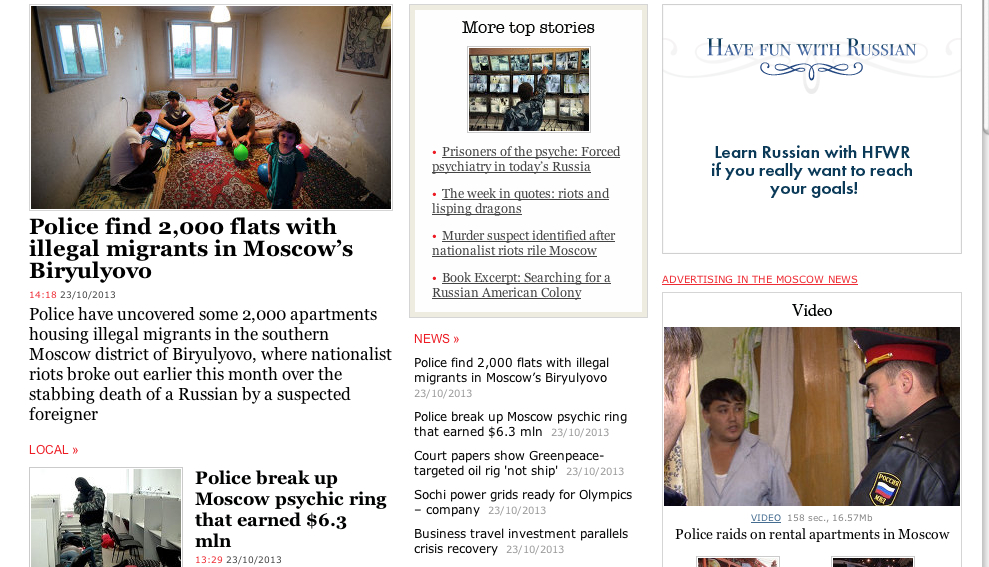
A bill against fictitious residential registration has been approved by parliament and is likely to come into force before the end of 2013. MPs who voted for the law insisted it targeted “rubber apartments” where hundreds of people are fictitiously registered and, more broadly, illegal immigration. Lenta.Ru has read the text of the bill along with lawyers from the Public Verdict Foundation and concluded that the tightening of controls over registration and movement will directly impact Russian citizens as well.
Introduced by Russian President Vladimir Putin, the bill, which has the neutral-sounding title “On Amendments to Certain Legislative Acts of the Russian Federation,” contains several subsections. Amendments have been made to the law on the freedom of movement of Russian citizens, the Administrative and Criminal Codes, and the law on the registration of foreign nationals by migration authorities. The preamble to the newly revised third article of the law on freedom of movement states residential registration is for informational purposes only, rather than a compulsory action. Whether someone is registered or not “cannot serve as grounds for restricting or a condition for exercising the rights and freedoms of citizens” as stipulated by the Constitution and other regulations.
This is consistent with the style in which new Russian laws are drafted: all attempts to prohibit something by law are based, allegedly, on a concern for protecting rights and freedoms. So it is in this case: a direct quotation from the Constitutional Court’s 1998 ruling that residential registration should not restrict the rights of citizens is followed by a list of the ways in which citizens will be restricted.
Thus, Russian citizens who have traveled outside their home regions must be registered within ninety days. If this does not happen, people renting housing and landlords may be held administratively or, in some cases, criminally liable. For living in an apartment without registering, tenants will be fined two to three thousand rubles [approx. 45 to 65 euros]; apartment owners, two to five thousand rubles [approx. 45 to 110 euros] and legal entities, 250 to 750 thousand rubles [approx. 5,500 to 16,500 euros]. Fictitious registration will be punishable by a fine of 100 to 250 thousand rubles, up to three years of hard labor or a similar term of imprisonment under Article 322 of the Russian Federal Criminal Code.
— Andrei Kozenko, “Who’s no longer a tenant here: how the ‘rubber apartments’ law will impact Russians,” Lenta.Ru, December 18, 2013
__________
There is a stark political economy to the illegalization of migrant labour that goes unremarked in much of the election-season hand-wringing over the city’s growing population of nelegaly (“illegals” in derogatory officialese). For one thing, demand for labour that is low-paid, verbally contracted, un-unionised, and flexible far exceeds the city’s (deliberately minimalist) quota of work permits. Perhaps as many as four fifths of the city’s migrant workers are therefore employed without an official work permit, or individual patent permitting private employment. There is an open market for official work permits, as well as a (near indistinguishable) market for fakes. As I have explored in my research on the difficulty of creating documented selves in Russia, the degrees of intermediation for obtaining a work permit means that “cleans” and “fakes” are often distinguishable only at the point that they are checked by the police.
At the same time, the gulf between average wages and average rental costs in the city mean that many migrant workers live in conditions that violate administrative regulations: in multi-tenant “rubber apartments” (rezinovye kvartiry) without corresponding residential registration, in container-dormitories on building sites, or in the unventilated basement of a multi-storey apartment building entirely unrecorded within city housing stock. The choices here are stark: for those on a typical migrant wage in the catering sector of 15-17,000 roubles (around £300-£330 per month) the only way to make ends meet in a context where the rental costs exceed average wages three or four-fold is to share an apartment illegally with 15 or 20 other tenants, paying money to a notional “landlord” (another migrant who takes a cut) and paying off the local policeman to ensure that the apartment is protected from raids. In a city where the 2010 census identified over 92% of the city’s registered population to be ethnically Russian (russkii), the economic constraints upon legal migrant labour have made for an easy popular conflation between being visibly non-Russian, being a “guest worker” (gastarbaiter), and being an illegal.
Xenophobia is not new in Moscow. But the combination of a laissez-faire wage policy (with a race to the bottom for undocumented labour), together with excessive restrictions on legally documented labour, and the widespread use of bribes to circumvent administrative regulations has allowed for the normalisation of a casual racism in which discrimination on the basis of ethnicity is justified through concerns for security and comfort—or protection against “illegals”. One commercial website offering temporary accommodation to non-Muscovites, for instance, cites its own policy of ethnic selection in the following terms:
[W]e don’t have racist prejudices, but today the situation has developed such that the largest demand for a place to stay in Moscow comes from Russians, Belorussians and Ukrainians. In accordance with the existing demand for inexpensive hostel accommodation in Moscow, we attempt only to house people of Slavic appearance (litsa slavianskoi vneshnosti), for the comfortable living conditions of all residents, and in so doing avoid any conflictual situations.
— Madeleine Reeves, “Mayoral politics and the migrant economy: talking elections and ‘illegals’ in Moscow,” cities@manchester, September 5, 2013
Not is only Georgy Poltavchenko, Petersburg’s unelected governor, a capable administrator and a pious Orthodox Christian, he is also, as he revealed last week during a passionate speech delivered at a special powwow with law enforcement officials and “representatives of ethnic diasporas,” a psychic, a mind reader or remote viewer capable of hearing what migrant workers in Tajikistan and Uzbekistan are saying as they depart for the former capital of All the Russias (apparently, to wreak mayhem, judging by further remarks made the governor and others at the high-level confab):
“So your countrymen travel to our country, to our city, in particular. They travel from distant villages there and so on. And just as they’re about to board the plane or the train going to Russia, they say, ‘We’re going there because the Russians don’t know how to work! They’re all drunkards. They’re all loafers!’ But members of the nation to which I myself belong, the Russian people, over the course of a thousand years created an enormous state along with other peoples. And if those loafers and drunkards hadn’t built the Russian state, who knows what the people who come to our country thinking such thoughts would be doing nowadays. I want everyone to remember what I’m about to say: the Russian people are a people that I won’t permit anyone to walk all over!”*
* As quoted in: Maria Gordyakova, “Make yourselves at home, but don’t forget you’re just visiting,” Gorod 812, December 2, 2013, p. 12; the online version of the article (which has a different title) can be accessed here.
Friday Dragnet
October 26, 2013
Svetlana Gannushkina grani.ru
On Friday evening, at half past five, I went from the offices of Civic Assistance, on Olimpiisky Prospekt, to a board meeting at the Memorial Human Rights Center. I was not feeling well for some reason, and two of our charges escorted me to the Dostoevskaya metro station.
Five minutes later, I exited the metro at Tsvetnoi Bulvar station and immediately heard my mobile ring. It was my escorts calling.
“We’ve been detained by the police. They’ve nabbed us and are taking us to Meshchanskoye police precinct.”
“Did they check your papers?”
“They didn’t check anything. They said they’d sort things out at the precinct.”
“But what happened?”
“Nothing happened. They just bundled us into a car, and that was that.”
“Put one of the police officers in the car on the phone.”
There was a pause.
“They won’t do it.”
“Show them your papers!”
“They refuse to look at them.”
Both my escorts are Uzbek nationals, and their papers are in order. One has a certificate stating that his application for refugee status is under review, while the other has a individual work permit. Both are registered with the migration service.
When I arrived at Memorial, I called the on-duty prosecutor, as Moscow city prosecutor Sergei Kudeneyev advised us to do only yesterday at a meeting with the prosecutor’s public advisory council. At first, the on-duty prosecutor opined that he had nothing to do with it, and then he suggested that our detainees had no papers. But a reference to the Moscow city prosecutor worked: the on-duty prosecutor wrote down the names of our detainees and my name, and promised to call the Meshchanskoe precinct.
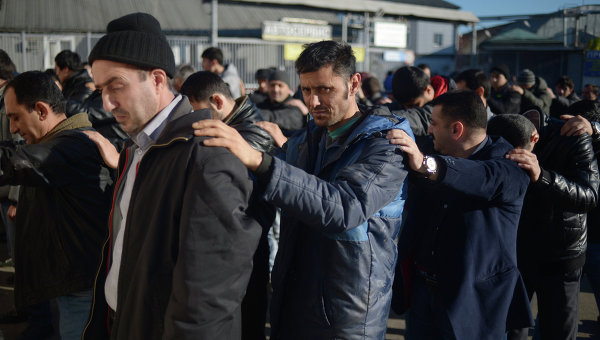
Then I called Alexander Kulikovsky, a member of the Moscow police’s public advisory council. He went to Meshchanskoe precinct. There were about a hundred people there who had been detained the same way as our guys: the police had simply grabbed them on the street, picking out only passersby of non-Slavic appearance.
Around half past eight, the precinct was called and the names of my escorts were mentioned. The guys heard this, raised a ruckus and demanded to be released immediately. The officers at the precinct did not particularly mind letting them go, but as they did, they said, “You had no business going to the mosque.”
It was only then we realized what had happened. There is a mosque not far from Dostoevskaya metro station: all its alleged visitors had been caught up in the dragnet.
Alexander Kulikovsky called me at half past eleven at night: there were still around fifty detainees at Meshchanskoe precinct.
Apparently, this is how Moscow police chief Anatoly Yakunin is fulfilling his promise “not to leave a single place in the city where illegal immigrants could take shelter, monitor the criminally inclined and drug addicted, and step up efforts in the fight against gambling and illicit smoking blends.”
So this is the so-called fight against illegal immigration and crime in Moscow we are now going to be witnessing every Friday?
On the evening of September 27, over thirty young neo-Nazis from the gang Moscow Shield attacked a dormitory in the first block of the Kapotnya District. The building is home to migrant works (mostly janitors and cleaners from Central Asia) and impoverished people evicted by the authorities from their flats because of their inability to pay maintenance bills.
Armed with batons and other objects, the neo-Nazis rushed into the building and went from floor to floor, announcing that they were looking for illegal immigrants and shouting nationalist slogans. On one floor, the bandits met with resistance. Clashes broke out during which smoke bombs and traumatic weapons were used. A female passerby was shot and wounded.
Police who arrived at the scene arrested sixty people, forty-seven of them workers who had been defending themselves and a mere thirteen of their neo-Nazi assailants. There is no information as to why the rest of the assailants were not taken into custody. At very least, for the time being “law enforcement” shows a clear sympathetic bias towards the self-proclaimed adherents of racial purity. Disorderly conduct charges have been filed.
The neo-Nazi attack on the dormitory marks a further escalation of far-right group terrorism in Russia.
What amounted to a Nazi pogrom took place in Moscow yesterday. A mob of scumbags attacked migrant workers in a dormitory in Kapotnya. http://www.aitrus.info/node/3290 But look at how it can all be turned round by the way news is laid out. Echo of Moscow turns everything upside down by reporting off the top that “police detained fifty people, most of them for violating immigration laws.” The information that this happened as a result of an attack on a dormitory by “activists from a nationalist organization” is relegated to the end of the story. That is, Nazi pogroms have essentially kicked off in the country, but Echo of Moscow pretends that it is something else. It’s not a news service they have at Echo of Moscow, but a disgrace. http://www.echo.msk.ru/news/1166376-echo.html





 On the evening of September 27, over thirty young neo-Nazis from the gang Moscow Shield attacked a dormitory in the first block of the Kapotnya District. The building is home to migrant works (mostly janitors and cleaners from Central Asia) and impoverished people evicted by the authorities from their flats because of their inability to pay maintenance bills.
