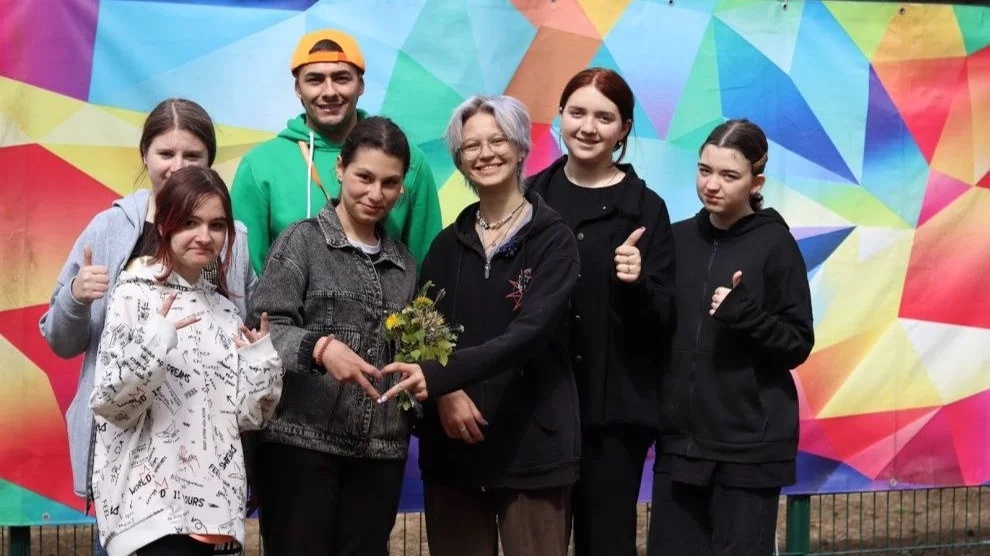
Some of Ukraine’s youngest defenders (clockwise from upper lefthand corner): Serhiy Dodurov, Oleksandr Romanuk, Deniz, Ivanna Tsimerman, and Sofiya Yanchevska
As Russia’s full-scale war enters its fourth year, a generation raised under air-raid sirens is now old enough to fight. Despite not yet being subject to conscription, these young Ukrainians are voluntarily joining the military, trading lecture halls for dugouts, or trying to balance both worlds.
Their decision comes at a time when Ukraine is facing mounting pressure to address critical manpower shortages. In 2024, the government lowered the mobilization age from 27 to 25 and later introduced one-year “special contracts” aimed at 18 to 24 year-olds, with Hr 1 million ($24,000) pay and free higher education.
Meanwhile, many young Ukrainians are making another choice — to leave the country — heightening fears of a looming demographic crisis.
The Kyiv Independent spoke to five young Ukrainians about why they enlisted, how they balance study and service, and what they hope for after the war.
Schoolchildren from Mariupol will be able to learn new professions in Petersburg. The beginning of the third session at Camp Friendly, where 400 children will relax until July 21, was announced on July 15 by Petersburg city hall’s press service.
“We will tell them about the opportunities that our vast country, including Petersburg, has to offer. We will make sure to take care of the health of our young guests and provide treatment if necessary,” said [Petersburg governor] Alexander Beglov.
The camp’s theme is “Childtown: Territory of Masters.” The children will have the opportunity to try their hand at such professions such as blogger, actor, artist, and architect.
On June 1, 2022, St. Petersburg and Mariupol became sister cities. Since then, Petersburg city hall has has been actively involved in restoring the city, which was destroyed during the special military operation.
The supposed ‘trial’ has begun in Rostov[-on-Don] (Russia) of 22 Ukrainian prisoners of war, many of whom, though not all, are members of the Azov Battalion who were seized while defending Mariupol against the Russian invaders in 2022. Moscow is using a baseless, and post-dated, ruling claiming the Azov Battalion to be a ‘terrorist organization’ as its excuse for violating international law and trying men and women for defending their own country against an invading enemy. The photos from the first hearing on 14 June suggest that at least the Ukrainian men are being held without enough to eat and probably in conditions which are, in themselves, a breach of the Geneva Conventions.
This legal travesty is to take place at the same Southern District Military Court which has been passing politically motivated sentences against Crimean Tatar and other Ukrainian political prisoners since 2014. That, however, is not the only similarity, since Russia is effectively using identical charges as those used to pass sentences of up to 19 years’ imprisonment against political prisoners from occupied Crimea, most of them Crimean Tatar civic journalists and activists.
The charges against the Ukrainian POWs are, firstly, of involvement in an organization recognized in Russia (and nowhere else) as ‘terrorist, under Article 205.5 of Russia’s criminal code. All of the men and women, however, were taken prisoner before Russia’s Supreme Court declared Azov to be ‘terrorist’ on 2 August 2022, making the charges illegal even according to Russian law. The second charge is more incredible. All are accused of ‘actions aimed at violent seizure of power or violent retention of power and violation of Russia’s constitution’. Even if, as is possible, the Russian Investigative Committee is claiming that the Ukrainians were seeking ‘to overthrow’ Russia’s proxy ‘Donetsk people’s republic’, this could still not begin to justify such a charge since Mariupol was not within this pseudo formation until Russia bombed and destroyed around 90% of Mariupol’s infrastructure in order to gain control of it. Those convicted, and the ‘court’ in question invariably passes only those sentences demanded of it, face sentences of from 15 years to life imprisonment.
It was originally reported that 24 men and women were to go on trial, however on 14 June, it was learned that two POWs — David Kasatkin and Dmytro Lablinsky — had been released in an exchange of prisoners.
Most reports call all of the 22 remaining members of the Azov Battalion, however the Russian newspaper Kommersant has indicated that several were either members of Ukraine’s National Guard or were seized in Mariupol, but had served in the Azov Battalion long before Russia’s full-scale invasion. The eight (perhaps nine) women were, Kommersant asserts, cooks for the Azov Battalion and, purportedly, all signed ‘confessions’. It is possible that those ‘confessions’, making it possible for claims that some ‘admit guilt’, are the reason why Russia has included them in the ‘trial’, as well as their assertion that they were only there because they needed a job, etc.
From the reports available, it would seem that many of those whom Russia has put on ‘trial’ should, in fact, be treated as civilians. Those who were defending Mariupol and the Azovstal Steelworks are prisoners of war who are protected, under the relevant Geneva Convention, from prosecution merely for taking part in hostilities. The only exception is if they are found guilty of war crimes. It is telling that Russia has thus far used its proxy ‘Donetsk and Luhansk people’s republics’ to stage any supposed ‘trials’ on war crimes charges. These illegal entities are not recognized by the international community and one of the many reasons why Freedom House earlier rated the two entities together as almost on a par with North Korea was the total lack of rule of law and mechanisms for a fair trial. There are absolutely no grounds for believing that the men sentenced to terms from 12 to 25 years by these quasi ‘republics’ were guilty of the crimes alleged, or indeed, that the supposed war crimes even took place. Among these ‘sentences’ was the 13-year term of imprisonment against well-known human rights activist and journalist Maksym Butkevych. He is known to have been denied access to a lawyer, and there is evidence that he was not even in Donbas when the ‘war crime’ was alleged to have taken place.
The farcical nature of such ‘court’ stunts was, in fact, seen and condemned by the international community when the so-called ‘Donetsk people’s republic’ ‘sentenced’ two Britons (Shaun Pinner and Aiden Aslin) and Moroccan Brahim Saadoun to death, claiming them to have been ‘mercenaries’ although all were contract soldiers in Ukraine’s Armed Forces and, unequivocally, prisoners of war.
The ’trial’ now underway is presumably for internal consumption as the images of emaciated Ukrainian prisoners of war are shocking, as is the cynical lawlessness of the charges against the Ukrainian men and women.
This story starts — but certainly doesn’t end — in 19th century Maryland, when John Townshend updated his will.
Townshend grew convinced at the end of his life that God would punish him if he did not free the enslaved people he owned and give them all of his property. But Townshend’s relatives challenged his final wishes in court, arguing that his decision had been the result of a delusion.
That 1848 case was the first U.S. appearance of what became known as the “insane delusion rule,” which remains grounds for contesting wills to this day. And Townshend v. Townshend itself has been cited in at least 70 other cases across the country — from New Hampshire to California — over the years, as recently as 2007.
It’s one of thousands of cases involving enslaved people that lawyers and judges continue to cite as good precedent, more than a century after the 13th Amendment abolished slavery in the U.S.
Justin Simard, an assistant professor at Michigan State University’s College of Law, estimates there are about 11,000 such cases out there — and about one million more that use them to back up their arguments.
“I’ve done some analysis just with a sample of cases and concluded that 18% of all published American cases are within two steps of a slave case, so they either cite the slave case or cite a case that cites a slave case,” Simard tells NPR. “The influence is really, really extensive.”
Simard has spent years documenting them, with the help of some two dozen law students.
The result is the Citing Slavery Project, a comprehensive online database (and map) of slave cases and the modern cases that cite them as precedent. They expect to add the last of their nearly 9,000 collected cases to the website this summer.
The project aims to push the legal profession to grapple with its links to slavery, an overdue reckoning that Simard hopes will start with lawyers and judges acknowledging their use of the troubling precedents.
He says 80% of the time judges don’t mention that these cases involve slavery at all, either because they’re unaware or uncomfortable.
“We’re not saying don’t cite them,” he explains. “All I’m asking people to do is just don’t cite them without acknowledgement, without thinking through whether it actually makes sense to cite them, which I think is a pretty reasonable thing to ask.”
Open Telegram and keep up with the news.
Rate this year in terms of its nineteenthirtysevenness.
Take a look at it, at its wooden hands,
At its iron cheeks, splotched with new partings.
This is a theater being demolished, a theater in which there is neither audience nor actors.
This is a theater being demolished, a theater in which there are only fishes and corpses.
Take a look at it and set aside your New Year's fun.
Rate the extent of this city's Stalingraditude.
Wave to the harlequins, dragons, and princesses,
And look at it, monitor the process without blinking.
Hang on to it: it will be both lamentation and reward.
Preserve its shadow if you like.
On second thought, forget it.
A video of a read-through of “Finist the Brave Falcon,” the play for which Russian theatrical director and poet Zhenya Berkovich was detained in Moscow earlier today on suspicion of “condoning terrorism.” Here is a link to a website where you can download the (Russian) text of the play, by Svetlana Petriichuk, who was also detained today. Thanks to Sergey Abashin for the heads-up.
Many have nearly forgotten the criminal case against the theater director Kirill Serebrennikov and his colleagues, who were tried several years ago. That affair was dubbed the Theater Case. Apparently, there will be another Theater Case in Russia: director Zhenya Berkovich (a former student of Serebrennikov’s, by the way) and playwright Svetlana Petriichuk have been detained in Moscow.
The criminal investigation is centered on the theatrical production Finist the Brave Falcon, which premiered in 2020. The play was staged as part of the theater project SOSO Daughters, which is run by Berkovich. It is based on the criminal trials of [Russian] women who married radical Islamists. They came to know the men online and, having never met them in person, went to live with them in Syria.
“Zhenya Berkovich’s staging of Svetlana Petriichuk’s provocative, documentary style play, tells the story of a Russian woman who befriends and is seduced by a member of an Islamic radical sect online, goes to Syria, marries him, and upon her eventual return to Russia is tried as a terrorist. In recent years, there have been hundreds, if not thousands of such cases in Russia, Kazakhstan and Uzbekistan. From what are these women running? What is driving them to abandon their friends, relatives, universities and workplaces for the promise of some shadowy paradise? All this takes place in the metaphysical space of the Russian fairy tale “Finist the Brave Falcon,” in which the heroine Maryushka seeks and cannot find her betrothed, the mysterious hero, whose face she has never seen and will never see, but is ready to sacrifice everything in order to meet him.” [This annotation has been edited slightly to make it more readable.]
The Investigative Committee claims that the production “publicly justified terrorism,” which is a criminal offense per Article 205.2 of the Criminal Code and punishable by up to seven years in prison. The details of the case are still unknown. Berkovich and Petriichuk spent the entire day undergoing interrogation as witnesses in the case, and it had seemed that they might be released, but as of evening both were still in police custody.
Last year, Finist the Brave Falcon won two Golden Mask Awards—for best playwright and for best costumes. Costume designer Ksenia Sorokina handed over her award to Petersburg artist Sasha Skochilenko, who has been in jail since April 2022, charged with disseminating “fake news” about the Russian army. (Skochilenko is alleged to have replace price tags in a grocery store with information about the war.)
Zhenya Berkovich has also not made a secret of her anti-war views, including in her poetry. A collection of her poems was published in Israel earlier this month.
“Open Telegram and keep up with the news. / Rate this year in terms of its nineteen-thirty-seven-ness,” one of them begins.
According to Berkovich, her grandmother, the 88-year-old writer Nina Katerli, was worried about her granddaughter, even going so far as to tell her, “Zhenya, be quiet for a while.” Actually, the director explained that she had decided to stay in Russia, no matter what, because she had to take care of her sick grandmother.
“It is to a large extent a necessity, due to all sorts of family obligations,” Berkovich said in December. “If it were now a question of going to prison or taking care of my grandmother, then of course I would leave, because I wouldn’t be able to take care of my grandmother from prison. But right now this is not the choice I’m facing.”
“Zhenya Berkovich: Why I have stayed in Russia and how to go on living”: Berkovich interviewed by journalist Liza Lazerson, as posted in on YouTube in December 2022 (in Russian)
This morning, the security forces searched Berkovich’s grandmother’s apartment. Berkovich and Petriichuk will spend the night at a temporary detention facility, and tomorrow a court will decide whether to remand them in custody or subject them to other restrictions.
Alexander Beglov, the governor of St. Petersburg, congratulated all Orthodox Christians on yesterday’s Easter holiday during his weekly program on Radio Russia, wishing them peace and health.
“Easter is a symbol of the victory of life over death, light over darkness, good over evil. Today, our soldiers are defending by force of arms the ideals of goodness and justice, and protecting the historical truth and our culture,” the official added.
In his opinion, it was observance of the ancient Christian traditions that made Russia “strong and invincible.”
Announcing his upcoming trip to the St. Petersburg Days celebration in Belarus, Beglov said that both countries opposed fascism. This year, the city will be sending its largest delegation in the history of Petersburg-Belarusian bilateral relations to the neighboring state.
“Christ is risen!”: the traditional Russian Easter greeting, as seen here on a card I received yesterday.
Basically, what I want to say is that I have been incredibly lucky when it comes to people. It is the only real thing, the future. The rest is hell.
Source: An Easter greeting sent to me by an old friend and lifelong resident of St. Petersburg. Translated by TRR
Petersburg mayor [sic] Alexander Beglov and the head of the city’s parliament [sic] Alexander Belsky addressed the residents of the Northern Capital on the occasion of the Orthodox holiday of Easter. The speeches made by the politicians were quoted by the press service for the Smolny.
Beglov and Belsky spent last night at a service in Our Lady of Kazan Cathedral.
Metropolitan Varsonofy conducted the service. Addressing the residents of St. Petersburg, the mayor [sic] recalled the special military operation.
“Today our country is undertaking a special mission. Our military has been facing difficult trials in the name of justice and the future of our children. Our hearts are with them. Our prayers are for them!” the governor said.
In his address, Beglov mentioned Mariupol, St. Petersburg’s sister city, as well as the involvement of Russians in the SMO.
“Our Church prays for them, for the soldiers, for all who are united with us in our values,” Beglov concluded.
First, if you know someone who might like this newsletter, please forward it to them.
Next, the story. I know many people this week are focused on the killing of Russian blogger Vladlen Tatarsky in St Petersburg. We are working on that (stay tuned).
But I want to talk about the long-term impact of Russia’s war on Ukraine and the social crisis it has caused in my country.
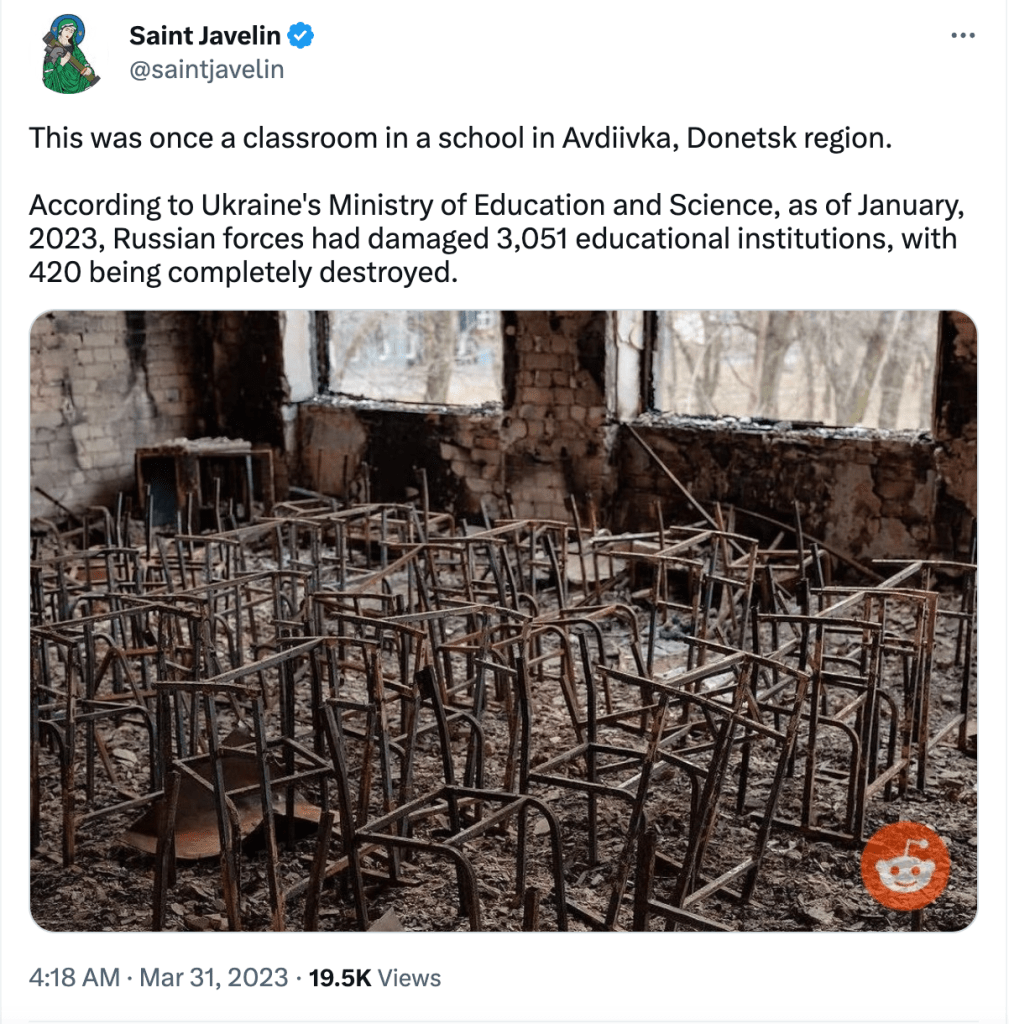
In this case, it’s about Ukraine’s teachers, who are facing serious salary cuts against a backdrop of high inflation, prices, rents and costs of basic services.
It’s a story about who is paying the price of Russia’s war, which has caused hundreds of billions of dollars of direct and indirect damage to Ukraine.
To do it, I spoke to teachers, local officials and trade union activists to find out how the Ukrainian government is being forced to pursue austerity – and what that means for hard-working people across the country.
I found that some local authorities are managing to pick up the shortfall in central grants – while others just can’t do it, as tax income has dropped off following the invasion.
Either way, local officials know it’s political suicide to fire people en masse, and have to scramble and scrape to get through the funding shortfall.
But it feels like a crisis postponed – rather than solved.
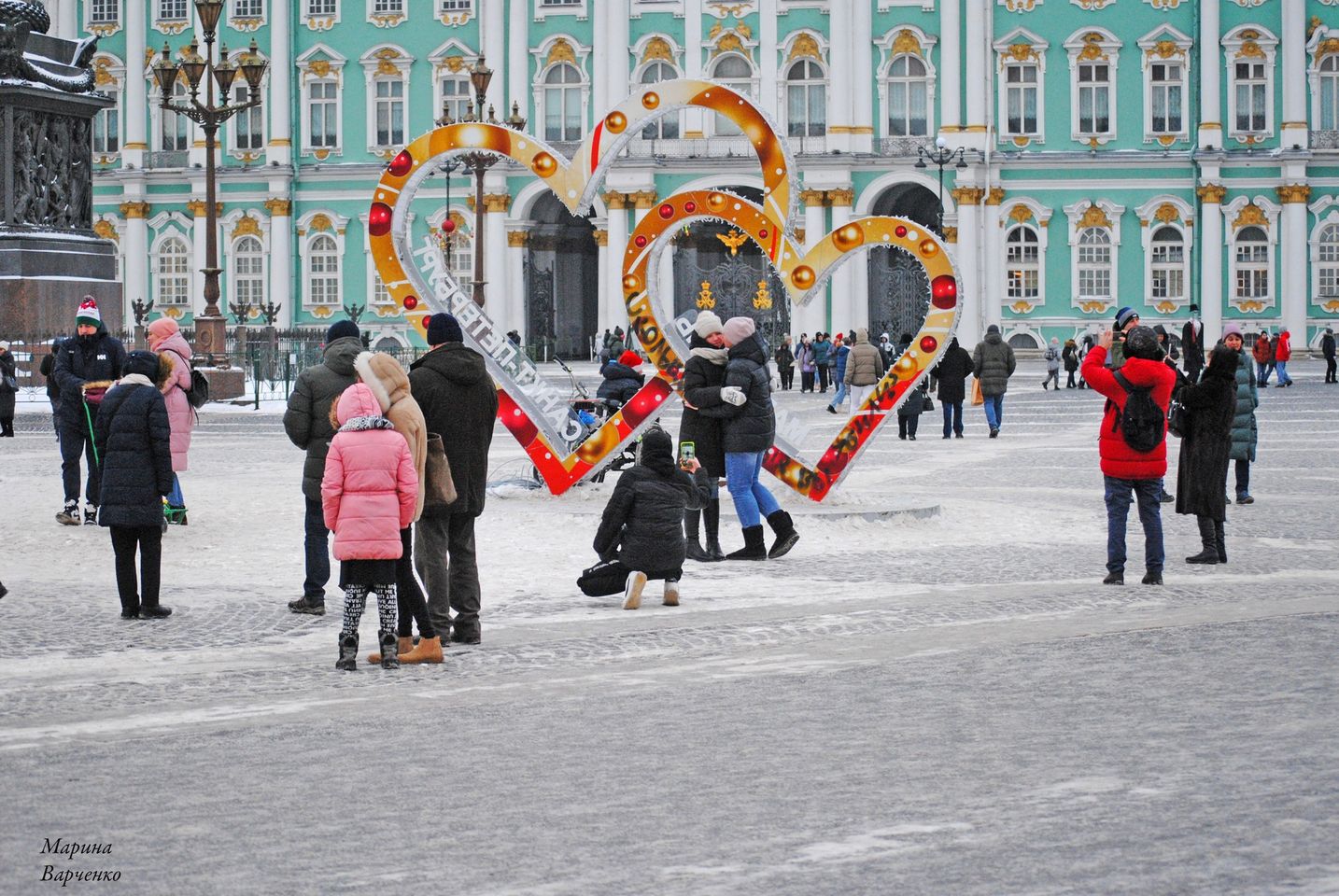
Of course, as a true masochist, I went to Palace Square to look at those hearts, small and large, supposedly symbolizing the sister cities of Petersburg and Mariupol. It is clear whose heart is the small one, and whose the big one, in the imperial capital. My thoughts about this are unprintable, so I’ll omit them.
But I went for curiosity’s sake: how many people would be getting their pictures taken in front of the hearts? As I’d supposed, it was a lot of people.
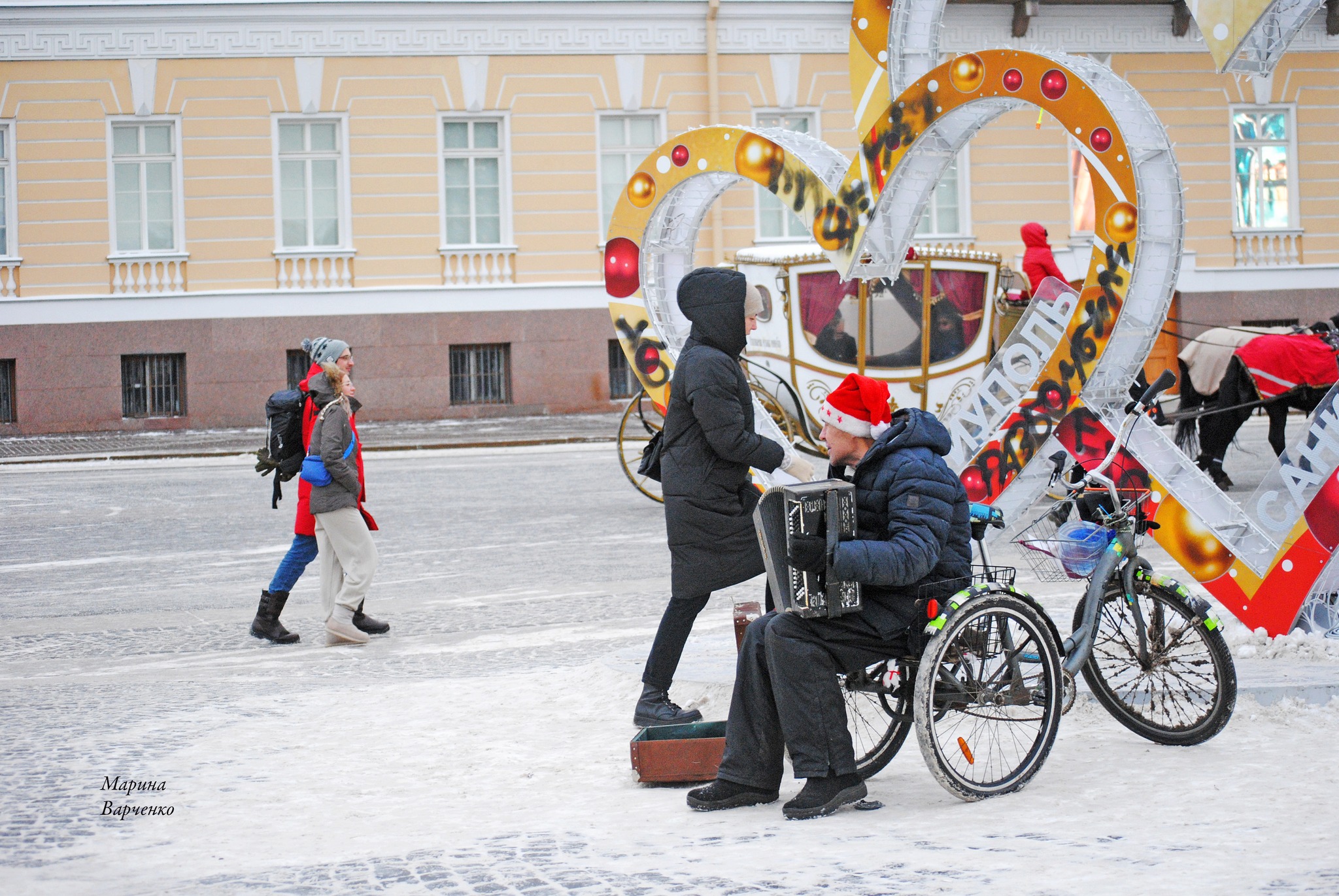
I saw much more than I’d expected. It was a total trash fest. There were the hearts, people taking fotochki, as they say now, frozen Peter the Greats walking around, carriages circling the square, and a drunk-looking little dude playing the accordion right there.
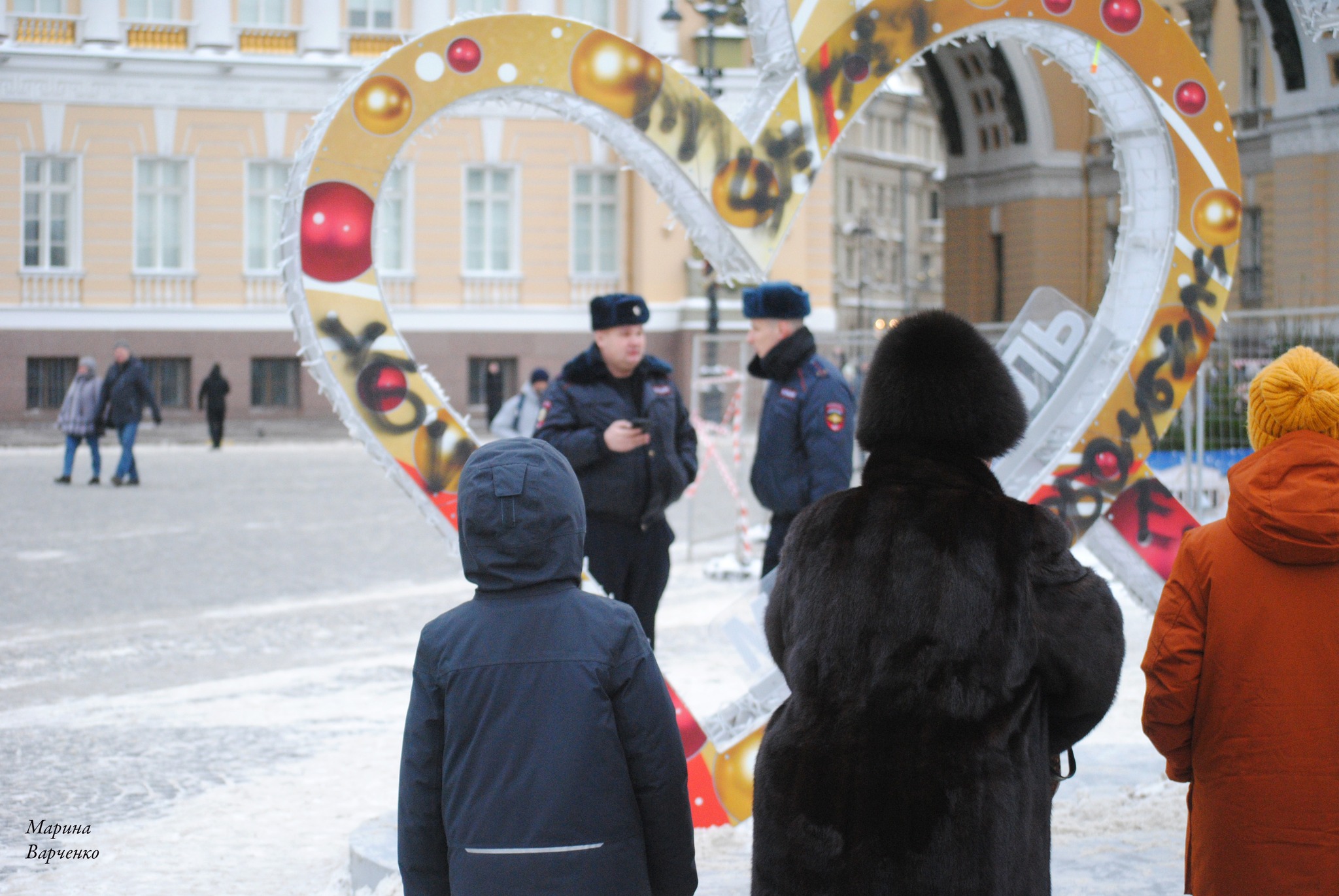
But no one seemed to be paying attention to the unauthorized inscription on the heart — black and large and truthful. (See the last two photos.)
While I was standing there, however, both citizens and law enforcement agencies finally noticed it. And they will call it vandalism, of course.
Source: Marina Varchenko, Facebook, 18 December 2022. Translated by TRR
A Petersburg woman detained on Palace Square has been charged with “discrediting” the army, the press service of the Interior Ministry’s Petersburg office has informed Bumaga.
Earlier, city media reported that the inscription “Murderers, you bombed it to smithereens. Traitors” had appeared on an installation dedicated to the sister-city relationship between Mariupol and Petersburg, and that a juvenile female had been detained.
When Bumaga asked it whether these reports were true, the press service of the Interior Ministry’s Petersburg office replied that on the afternoon of December 18, the police had detained seventeen-year-old girl on Palace Square “for committing illegal actions.” She was charged with an administrative offense for public actions aimed at “discrediting” the Armed Forces of the Russian Federation (per Article 20.3.3 of the Russian Federal Administrative Offenses Code).
The installation appeared on Palace Square on December 12. Rotundareported that the Petersburg authorities ordered it back in September. According to the contract, the city spent 1.05 million rubles on the installation.
On December 18, an inscription appeared on the installation, after which the structure was partially disassembled. Workers told our correspondent that the installation would remain on the square, but would spend the next few days without cladding until the inscription was removed from it.
Source: Bumaga, 19 December 2022. Translated by TRR
Dec 19 (Reuters) – President Vladimir Putin on Monday ordered the Federal Security Services to step up surveillance of Russian society and the country’s borders to prevent risks from abroad and traitors at home.
Speaking ahead of Tuesday’s Security Services Day — widely celebrated in Russia [sic] — Putin said the “emergence of new threats” increases the need for greater intelligence activity.
“Work must be intensified through the border services and the Federal Security Service (FSB),” Putin said.
“Any attempts to violate it (the border) must be thwarted quickly and effectively using whatever forces and means we have at our disposal, including mobile action units and special forces.”
Putin instructed the FSB to maximise their “use of the operational, technical and personnel potential” to tighten control of the society.
The FSB, the main successor to the Soviet-era KGB, has already been operating in Russia as an expansive surveillance and censorship apparatus and Moscow’s invasion in Ukraine has involved a large swathe of the security services.
“Maximum composure, concentration of forces is now required from counterintelligence agencies, including military intelligence,” Putin said, according to transcript of his speech provided by the Kremlin and translated by Reuters.
“It is necessary to severely suppress the actions of foreign special services, quickly identify traitors, spies and saboteurs.”
The FSB, headed by Putin ally Alexander Bortnikov, will also increase oversight of mass gatherings, strategic facilities and energy infrastructure.
Since the start of the war, demonstrations and dissent have been swiftly quelled in Russia, with more than 1,300 detained in September at protests denouncing Putin’s military mobilisation of 300,000.
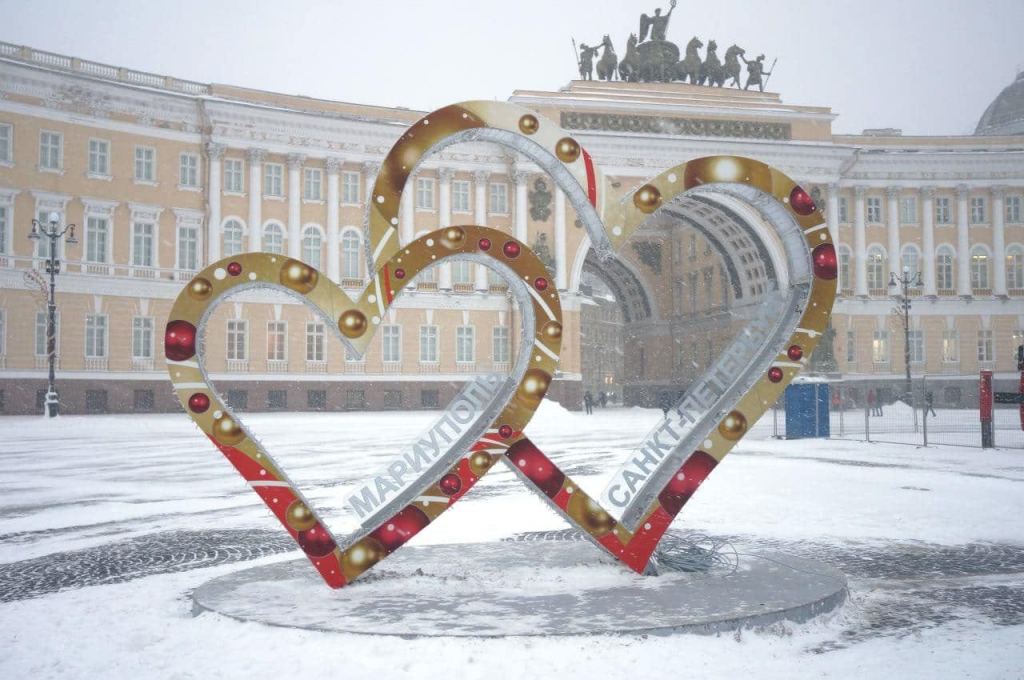
“Mariupol. Saint Petersburg.” A snapshot purportedly taken earlier today by Tatyana Razumovskaya (see her Facebook post, below).
The LED composition “Double Hearts” has been installed on Palace Square in honor of the sister city relationship between Petersburg and Mariupol, as reported on the city’s VK page.
The “Double Hearts” project was approved by Governor Alexander Beglov. Earlier, the installation was on display in a Mariupol city park. It symbolizes the unity, friendship, and love between people living in the sister cities.
Earlier, 78.ru reported that Petersburg authorities would hold a “Wish Tree” event for children from Mariupol.
Palace Square right now. It’s a three-minute walk from here to the house where I grew up and the school where I studied. Right there is the Hermitage, where I used to work.
I wish this were a dream and I could wake up.
Source: Tatyana Razumovskaya, Facebook, 13 December 2022. Thanks to VG for the heads-up. Translated by the Russian Reader
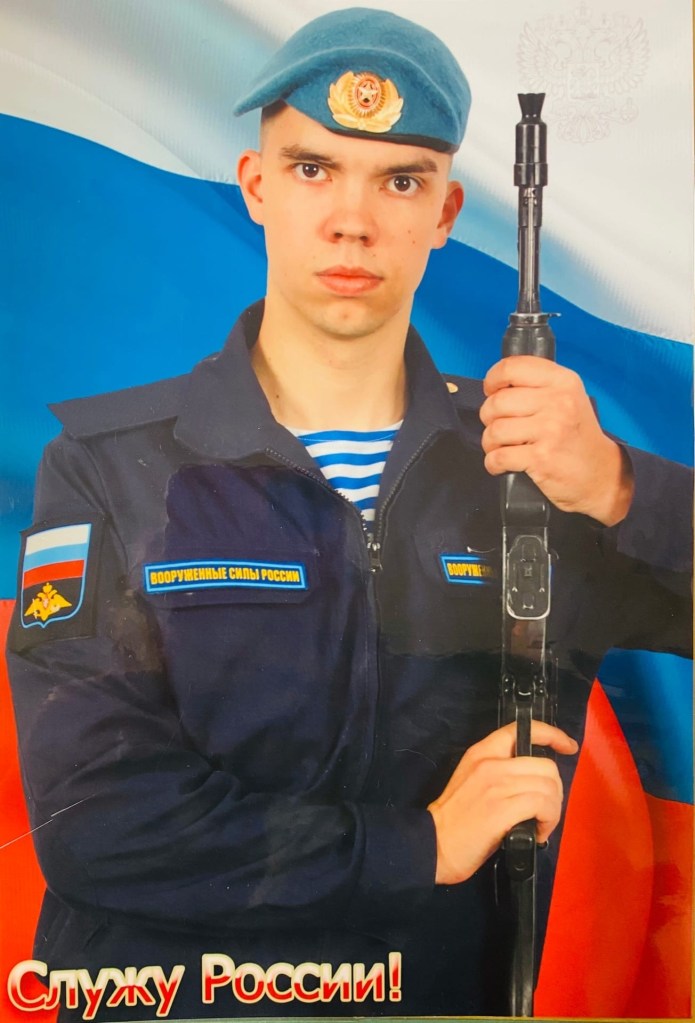
Alexander Andreyev from St. Petersburg has been killed in the military operations in Ukraine. In 2020, he graduated from School No. 368 in the city’s Frunzensky District. The school administration reported the news on its VK page.
During his school years, Andreyev was the captain of the 368 Superheroes volunteer group, and “from the very beginning he was eager to defend his Motherland,” reports the school’s VK page. In the summer, the young man went to serve and was enlisted in the 76th Pskov Airborne Division, the page reports. Later, he signed a contact, and in early October he was sent to the war zone, the post says.
Alexander was killed on October 18, according to the school administration, when the observation post where the soldier was located came under mortar attack. Andreyev was awarded the Order of Courage and buried in the Avenue of Heroes at Babigon Cemetery, the message says.
This is at least the fourth known death of a Petersburger in the war in Ukraine. Earlier, a school teacher from Petersburg, physical education teacher Vadim Sedov, was killed there. In addition, in the first week of October, Andrei Nikiforov, a member of the Nevsky Bar Association, was killed near Lisichansk. In mid-November, news arrived of the death in Mariupol of Konstantin Simonov, a Petersburger who volunteered to fight in March.
The Smolny [Petersburg city hall] is considering three options for special parking permits for residents of the Admiralty District [rayon], Fontanka.ruwrites. On November 1, paid parking was introduced there, and locals were given the option to park their cars in their municipal precinct [okrug] for 1,800 rubles a year, the online media outlet reported.
Petersburgers recalled that residents of the Central District use similar permits throughout its territory, and not only in their own [smaller] municipal precincts, Fontanka.rureports.
As the media outlet’s journalists have written without specifying their source, there are now three possible options for how paid parking will work for Admiralty District residents:
— everything will remain as it is: supporters of this proposal say that permits are needed so that a person can park outside their house for free, while trips around the district only increase traffic, which is what the reform is meant to combat
— the validity of permits will extend to the entire district: proponents of this idea believe that such innovations will soften the public outcry
— residents of the Admiralty District will be able to choose another district in which their permits are valid, giving them the opportunity to travel around nearby districts without worrying about paying for parking.
According to the media outlet, the Smolny will make a choice in the coming days.
Paid parking was introduced in the Admiralty District on November 1. Now those who want to park their car here have to pay 39 or 100 rubles per hour, depending on the type of vehicle, or buy an expensive monthly or annual pass.
But for those who live in the district, the authorities have introduced special annual parking permits that cost 1,800 rubles a year, but are valid only in the municipal precinct in which the motorist owns property or is registered to live. To park a car in any other municipal precinct, one has to pay the standard fare.
On December 9, our country celebrates Day of Heroes of the Fatherland. On this day, Heroes of the Soviet Union, Heroes of the Russian Federation, and recipients of the Order of St. George and the Order of Glory are honored.
And on this day we want to tell you about a hero of our time, Alexander Igorevich Andreyev, a graduate of our school.
ALEXANDER IGOREVICH ANDREYEV
During his school years, Sasha was the team captain of the 368 Superheroes volunteer movement.
From the very beginning of the SMO, he sought to defend the Motherland. In the summer he went to serve and was able to enlist in the legendary Pskov 76th Airborne Division.
He signed a contract [as a volunteer] and just recently, in early October, was deployed in the special military operation.
On October 17, his unit was involved in heavy combat. When a comrade’s machine gun jammed, Alexander covered him before he himself attacked the enemy’s positions, thus contributing to the further advance of the paratroopers. By the end of the day, an enemy fortification had been captured. The next day, October 18, Alexander was at an observation post when the enemy opened fire with a mortar. He was hit by a shell and fatally wounded.
He died at his combat post. He was twenty years old.
By decree of the President of the Russian Federation, Alexander Andreyev has been awarded the Order of Courage.
Alexander is buried at the Babigon Cemetery on the Avenue of Heroes.
May the memory of this Russian Hero, friend and faithful comrade live forever.
We will never forget you!
Source: Secondary School No. 368 Frunzensky District of St. Petersburg, VK, 9 December 2022. Image of Alexander Andreyev courtesy of School No. 368. Translated by the Russian Reader
Petersburg is all gussied up in sparkling joyful lights. The holiday is coming to our town.
I have just read a letter from an acquaintance in a neighboring country:
“There has been no electricity in my city for almost a month. Previously, it was on for four hours a day, then for two, and then for one to two hours every few days. The last time the electricity was on was Friday for two hours. There are no schedules: it can be turned on at three a.m. when everyone is asleep and you just miss it. Along with electricity, there is also no water and heating, although it’s winter outside. Since electricity is provided for one to two hours every few days, it is only at this time that the cellphone tower begins to send out a signal. The rest of the time there is no mobile connection or internet. We have been plunged into the nineteenth century and life has come to a grinding halt.”
Source: Sergey Abashin, Facebook, 13 December 2022. Photo, above, by the author. Translated by the Russian Reader
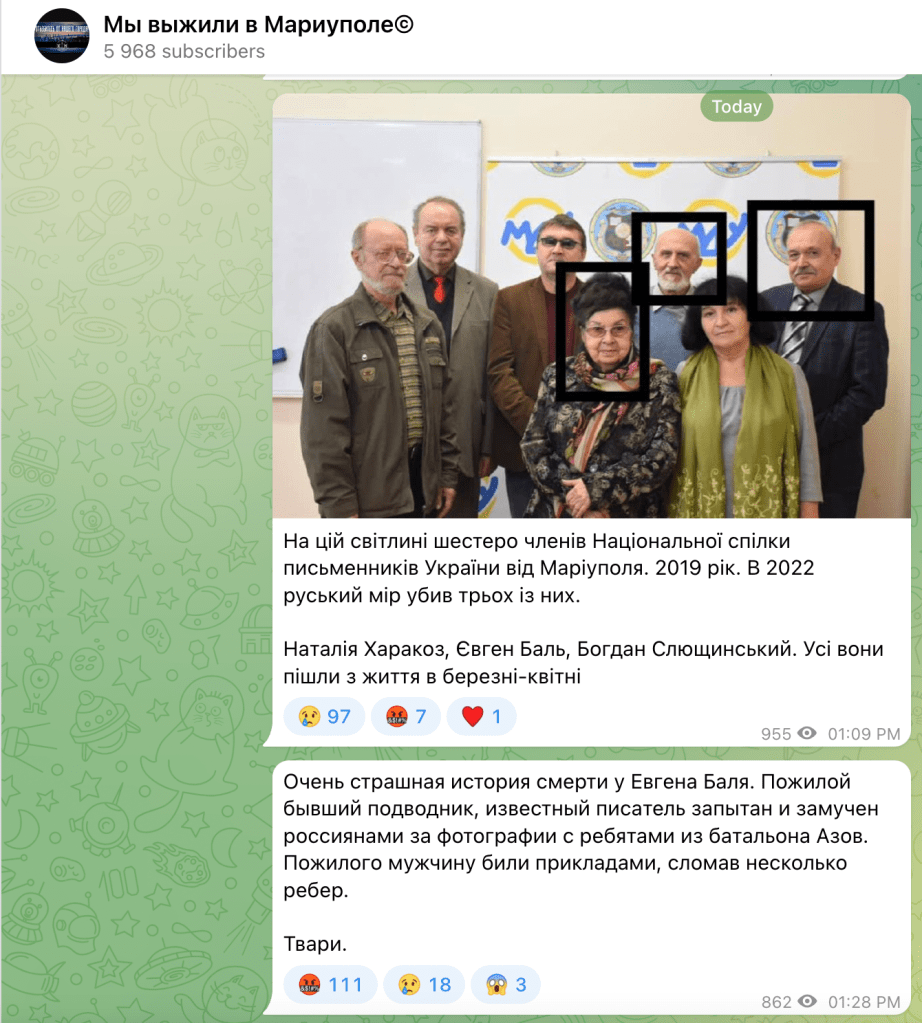
This photo shows six members of the National Writers’ Union of Ukraine from Mariupol in 2019. In 2022, the Russian World killed three of them.
Natalia Kharakoz, Evgen Bal, and Bohdan Slyushchynsky all died in March or April.
The story of Evgen Bal’s death is quite terrible. An elderly former submariner, the famous writer was tortured by the Russians over photos with guys from the Azov Battalion. They beat the elderly man with their rifle butts, breaking several ribs.
Scum.
Source: We Survived in Mariupol, Telegram, 25 July 2022, 1:09 p.m. & 1:28 p.m. Translated by the Russian Reader
78-year-old Ukrainian military pensioner, journalist and writer Evgen Bal died on April 2 after being tortured for days in captivity by the Russian military. The reason for the detention and bullying was the journalist’s friendly relations with Ukrainian servicemen.
The aggressor seeks to wipe out any mention of his crimes from the face of the earth. Therefore, they kill all possible witnesses — military, civilians and journalists.
If Yevgeny [sic] Bal had not died, he could have told about the crimes of the Russian army in Mariupol and its environs.
He would talk about the inhuman conditions in which the Russians are holding captured Ukrainian soldiers and civilians.
Through his articles and books, the world would know how the Ukrainian military, his friends, resisted the Russian invasion of the besieged Mariupol.
He could show how barbaric Russians behaved in the homes of ordinary Ukrainians.
Killings and shootings of journalists are a gross violation of international law. The enemy can turn a blind eye to laws, but he will not be able to close the eyes of the world to crimes. After all, honouring the memory of those who died for the truth, we will continue to tell their immortal stories.
Natalia Kharakoz, journalist, author, member of the National Union of Journalists of Ukraine and the National Writers’ Union of Ukraine, and head of the Azov Literary Club, died in the russian-blockaded Mariupol in Donetsk region.
This was announced by her relative, Mariupol journalist Anna Kotykhova.
In her comment to an IMI representative, Anna Kotykhova told that Natalia Kharakoz’s house burned down and collapsed. After that, the woman had to live and hide in the basement. In early April, the relatives learned about the woman’s death from her neighbors, but tried to find out the circumstances and causes of death. The lack of communication made it difficult to obtain this information.
“An author of countless books and the editor of my books, on the first day of the invasion she emailed me the draft of my next book with the postscript ‘Sending this while there is still Internet access, save it.’ I did.
But I did not save any of her books. The apartments – both mine and hers – burned to the ground along with all the books. And I don’t know if her lines have survived in at least one library, at least one museum, at least in someone’s intact house.
Now I really want to reread her short story ‘Anyuta’s Letters,’ about how Anyuta lived through the Second World War – same Anyuta after whom I was named. But I can only snatch fragments from memory,” Kotykhova wrote.
As IMI reported, as of April 29, 22 journalists had been killed in shelling by the russian occupiers since the beginning of their full-scale offensive in Ukraine.
The Russian occupiers killed Bohdan Slyushchynsky, a doctor of sociology and professor at Mariupol State University.
This was reported on Facebook by the Department of Philosophy and Sociology of Mariupol State University, Censor.NET informs.
“The Department of Philosophy and Sociology, Mariupol State University and the entire Ukrainian sociological community have suffered irreparable losses — as a result of Russian aggression, Doctor of Sociology, Professor Bohdan Slyushchynsky died.
“Bohdan Vasyliovych was the man who created and actively developed the specialty ‘Sociology’ in the industrial city of Mariupol from scratch. He managed to create a unique atmosphere at the department, when all teachers and students really felt like one family. They came to him with good news and support in difficult times, shared their victories and complained about failures. Bohdan Vasyliovych could find his own approach to each of those words. He raised many real professionals and just decent people. Scientist, teacher, musician, poet, talented manager — it is difficult to list all the talents of Bohdan Vasyliovych.
“On this tragic day, the MSU sociological family longs for its mentor. He will always remain in our hearts! Kingdom of Heaven!” said [the]statement.
Source: “Rashists killed Bohdan Slyushchynsky, professor at Mariupol State University,” Censor.Net, 8 May 2022
Archbishop Pitirim of Syktyvkar has called on his parishioners to rally not around Christ, but around Putin, calling the West “the enemy of the human race.”
“After [hearing] the appeal made by His Eminence the President (on supporting the war – ed.), I considered it my duty to appeal to all the clergy, monastics, and God-loving laypeople of the Syktyvkar Diocese of the Russian Orthodox Church, as well as to all the patriots of our Northern Region, to rally even closer around our supreme military and political leadership and our valiant army, which, as in the years of the Great Patriotic War, is defending our earthly Fatherland from the insidious enemy of the human race.
“Only by joint prayer and tireless military efforts will we be able to contain the enemy and erect a strong barrier to the West’s aggression.”
It should be noted that “the Great Satan” is Iran’s traditional name for the United States. Meanwhile, the Head of the Spiritual Assembly of Muslims of the Russian Federation, Mufti Albir Krganov, invoked the same metaphor in a speech he made during Eid al-Adha.
Previously, Pitirim (who had already taken holy orders) expressed his pride at being awarded the rank of Cossack colonel.
We should also add that Metropolitan Leonid, appointed Patriarchal Exarch of Africa, has devoted seven of his last ten posts on Telegram to the polemic with the “collective West.” Leonid’s position statements were published as part of the ROC’s revenge on the Patriarchate of Alexandria for supporting Ukrainian autocephaly.
Source: Sota, 11 July 2022. Photo courtesy of Sota. Translated by the Russian Reader
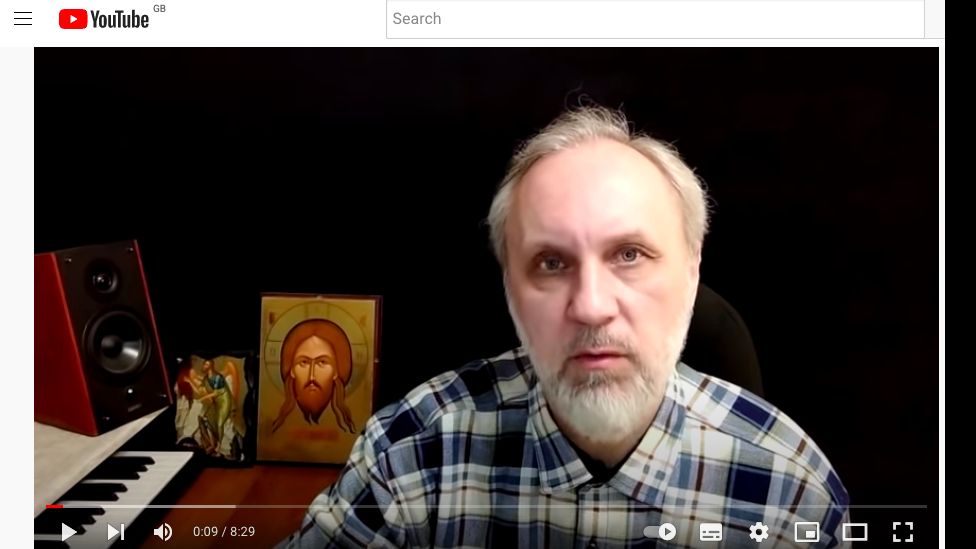
The officers who raided Father Ioann Kurmoyarov’s home reportedly seized his mobile phone, a laptop, two icons, a cassock and a wooden cross.
He was taken to a police station in St Petersburg, and allowed to make one phone call to his family.
He told them he had been arrested.
Father Ioann is believed to be the first priest imprisoned under laws introduced in Russia to punish those who spread information countering the Kremlin’s narrative of the war.
“I am a prisoner of conscience, suffering for my beliefs. I consider the charges against me and my detention to be illegal,” says Father Ioann now in a statement he dictated to his lawyer in St Petersburg’s Kresty Prison.
Father Ioann adds that he is a Christian pacifist whose moral views are entirely based on the commandments of the Gospel and canons of the Russian Orthodox Church.
“Blessed are the peacemakers for they will be called the sons of God,” and “Thou shalt not kill,” are among the quotes he includes in his statement.
On 12 March, just over two weeks after Vladimir Putin launched his invasion of Ukraine, Father Ioann uploaded an eight and a half minute video to YouTube.
In it he said that those who unleash aggression would not go to heaven, and that in this case it was not Ukraine that attacked Russia but the other way around.
“You are the aggressors who attacked and killed civilians. You will not be in any kind of heaven, you will be in hell,” he says of the Russian leadership.
In a sermon posted on YouTube, Father Ioann Kurmoyarov said Russian aggressors in the conflict would go to hell.
In his video Father Ioann goes on to compare the Russian invasion with violent “jihad” suggesting that bloodthirsty leaders in Moscow should have converted to become “militant Islamists”, a theme that he kept returning to.
“We worried but we just didn’t expect that he would be arrested,” says his brother Alexander Kurmoyarov. He tells me that Father Ioann is currently serving an initial two month detention and is then likely to face trial.
“We thought maybe he would be given a warning by the police, but now we are worried that he will get 10 years in prison,” he says, referring to the maximum sentence Father Ioann could receive.
The only visitor to have seen Father Ioann in Kresty Prison is his lawyer Leonid Krikun who says his client appeared to be in good health and also defiant.
“I told Father Ioann that if he pleads guilty he will probably get a shorter sentence, but he refuses to say he has committed any crime,” Mr Krikun says.
“He says that he would rather serve a longer sentence than admit any wrongdoing and if that happens he will preach to fellow inmates.”
Father Ioann has shown before that he is unafraid of speaking out. He was suspended from the church in 2020 after calling the newly-built Church of the Russian Armed Forces a “pagan temple”.
The Cathedral in Moscow was the brainchild of Russian Defence Minister Sergei Shoigu and was due to house frescos that featured President Putin and Josef Stalin as well as scenes that celebrated the Crimean occupation.
In a social media post, Father Ioann said Mr Shoigu should be arrested for offending religious sentiment.
But what makes Father Ioann’s story all the more unusual is that before he got in trouble with the Russian state, he also had a brush with the Ukrainian security service, the SBU.
Ioann Kurmayarov lived in Vinnytsia in central Ukraine for most of his life, his parents having moved there after his father retired from the Russian army.
“Even as a child he was always very outspoken, always searching for the truth,” says his brother Alexander who speaks to me from Vinnytsia.
“It was in the church that he found a place where that search for truth was satisfied,” says Alexander.
But in 2017, Father Ioann made the news in Ukraine for an act of defiance.
With Crimea annexed by Russia and parts of the east occupied by Russian-backed forces, Ukraine expanded laws banning Soviet symbols.
But Father Ioann posted pictures of one of the most controversial of them, the St George’s ribbon.
He was taken in by police for questioning and the SBU brought administrative charges against him.
“He was not radically pro-Russia, he was standing up for freedom of speech and simply believed the authorities were doing the wrong thing by banning displays of the ribbon,” says Alexander.
At the time Father Ioann said he was prepared to pay the fine, worth around $100 (£84.50), but said he would then openly wear the ribbon seeing as he had now paid for the privilege. The Ukrainian case against him was dropped.
He soon moved to Russia where he is already paying a much higher price for speaking out against curbs on freedom of expression.
In April he was defrocked by the Russian Orthodox Church’s Moscow Patriarchate, though members of the Russian Orthodox Church Abroad (ROCA) say he has been accepted by them.
More pressing is that he remains behind bars at Detention Centre Number One in Kresty Prison with the prospect of staying there for years. His initial detention period ends on 6 August after which his trial date is due to be set.
“I want him to be found innocent, as a Christian who was talking about Christian values,” says Alexander.
“But I worry about what is going to happen now and I worry about his future.”
There are tens of thousands of refugees from Ukraine in Russia. Some of them are trying to leave Russia for countries in Europe or the Transcaucasia, while others remain in temporary accommodation. Both groups are being helped by Russian volunteers. One of the informal leaders of this movement in Petersburg is Grigory Mikhnov-Vaytenko, a bishop of the Apostolic Orthodox Church and a member of the St. Petersburg Human Rights Council. Farida Kurbangaleyeva spoke with him about why he is not afraid of the Russian security forces, why Ukrainians are being taken to the Far East, and why the Russian Orthodox Church failed to oppose the war.
Father Grigory Mikhnov-Vaytenko, holding a copy of the Russian constitution across the street from the Russian Constitutional Court’s current home in downtown Petersburg. Photo courtesy of Facebook and Republic
— How did you start dealing with the problem of Ukrainian refugees?
— In the very first days of the war, we thought about the Ukrainian nationals already living in Russia. According to various estimates, there were from eight hundred thousand to two million such people. We assumed they might have problems. I proposed to the Human Rights Council that we set up a hotline for Ukrainian nationals, and all my colleagues [on the council] supported me. Immediately, there was a large number of inquiries from people trying to leave Russia. In fact, if people’s papers were in order, there was nothing complicated abut the situation. But while we were figuring it out, refugees from Mariupol reached out to us. Som of them wanted to leave Russia, while others wanted to stay. But all of them were asking for legal assistance.
— Could you have imagined that Ukrainians would be brought to Russia?
— To be honest, no. Although it didn’t surprise me. I don’t want issue any judgements now—for this you need to be inside these events. But if you believe what the people directly involved have been saying, there was no possibility of organized evacuation anywhere except to Russia. At least, that’s what these people were told. And yet, when it is said that these people were taken to Russia by force, this is a somewhat inaccurate way of putting it.
— When I spoke with refugees from Mariupol, they said they had wanted to go to areas controlled by Ukraine, but that was tantamount to death—the humanitarian corridor was being shelled all the time.
— I don’t question what they said. I accept it as a fact. There was a humanitarian corridor to Russia, and, apparently, it was quite safe. I know that some people also left for Ukraine, but mostly at their own risk and mainly those who had vehicles. There was no way out on foot, as far as I know.
— But isn’t this violence on Russia’s part?
— When we talk about forcible removal, what I see in my mind’s eye are stills of German shepherds and people being struck in the back with rifle butts. There was no such thing [in this case], of course. But as far as I understand, people were not offered much choice. So, there was an element of there being no alternative. I personally am not ready to speculate about why it happened. I was not an eyewitness myself, and I have not seen any documents in this regard. I have only heard stories.
But it would be much worse if people who found themselves on Russian soil were legally subjected to forced detention, if the authorities prevented them from moving freely. According to my observations, they have not been prevented from doing this. Those who do not want to go to the proposed temporary accommodation facilities can safely go wherever they want.
It is another matter that these people have no money, that they have telecommunications problems, problems with paperwork. In this sense, the Russian state has not been providing them with anything. Ukrainian nationals could not cope without the volunteers who have been helping them obtain papers, board trains, and buy clothes and medicines, including prescription medicines, because there are people with chronic diseases among them.
— But why do the Russian authorities tell Ukrainian refugees to evacuate if they cannot provide for them? Is there no Pharisaism in this?
— I think there is an element of Pharisaism. But, again, now is not the time for making judgements. Now is the time for action. For example, I need to find a place for refugees to spend the night. Here we are talking, but at the same time I am corresponding on a chat, because another family is waiting for help.
The point is that what happened on February 24 is a crime—a crime against humanity, the unleashing of a war of aggression. Period. Everything else is a consequence of this crime.
We’ll figure out a bit later who is a hero and who is a scumbag. But now everyone should do what they can where they can do it. Journalists should write stories, human rights defenders should defend human rights, and caring people should make moral decisions by sharing their apartments, cars, or their own time. Not helping a refugee—even from the point of view of a book called the Bible—is a very grave sin. As the saying goes, “for you were strangers in a strange land.”
— How many Ukrainian refugees are currently in Russia? And how many camps are there?
— There are no official statistics. There are figures from different departments, and they radically contradict each other. The Russian authorities cite certain fantastic figures that are impossible to believe—860,000 people. I don’t understand where they came from, because there are much fewer people in Mariupol. Are they from the Donetsk region? But there seemingly hasn’t been a mass evacuation from there.
I think that these figures, as they pass along the chain through different departments, get zeros and ones added to them. I think that around one hundred thousand people have actually arrived in Russia from the war zone. Several thousand of them have already left, while a certain number of others are planning to leave.
We know of around five hundred temporary accommodation camps. That sounds scary, but you have to understand that there are places housing literally between fifty to seventy people. They’re like small boarding houses. There are probably only a few large camps, like the one near Petersburg, where 550 people have been accommodated. Or, for example, there are around three hundred people at the camp in Vladivostok.
— But why have refugees been taken so far away? Do you have an explanation?
— To be honest, I don’t see any special malicious intent in this. Apparently, somewhere in the presidential administration there was a request to all regions of the federation to ready sites for taking in refugees. And each region reported how many people it could take in. They are still trying to place these people in more or less normal conditions. These are not tent camps or barracks in the taiga.
The regions were also tasked with providing jobs and papers to the people who wanted them. It is clear that no region in the European part of Russia is ready to take in one hundred thousand people and give them jobs. Where would they find them? So, they began spreading people [around the country] as thinly as possible. Taking into account the size of the country, it turned out the way it turned out. We should be grateful that the most distant reception center is in Vladivostok, not Kamchatka.
— The buzz on social media is that this is another [mass] deportation.
— I don’t want to use words lightly. And, since the phrase “special operation” was introduced, words don’t function anymore, they’re finished. The safety of people has been ensured, and tickets from Vladivostok to Moscow, Petersburg, or Tokyo cost no more than money. Of course, this is all redundant. But what can be solved with money is not the problem.
Excerpts from Facebook chats between Ukrainian refugees and Russian volunteers. Courtesy of Republic
— Can people who have no papers at all leave Russia—for example, if they burned up during bombing?
— Refugees can receive a temporary document called a “Certificate establishing the identity of a foreign national or a stateless person.” It’s a very valuable invention. It is issued at police stations, and features a photo, a seal, and three signatures. With this document, a refugee can leave Russia.
To apply for this paper, a person must confirm their identity in any way. They can even submit an electricity bill, or provide witnesses. For example, a family leaves [Ukraine]: five of them have their papers, but the sixth does not. Cases when an entire family does not have their papers are rare. Besides, there is an analogue of Russia’s Public Services Portal in Ukraine, so in ninety-nine percent of cases it won’t be difficult to confirm a person’s identity.
This document was introduced several years ago. As far as I understand, it was championed by the human rights activist Svetlana Gannushkina and her Civic Assistance Committee—because there were a large number of migrant workers in Russia, and their cases were different. Some people had lost their papers. Or, a person, for example, worked in Tyumen, but their country’s consulate was in Yekaterinburg.
Clearly, the nearest Ukrainian consulate is located outside the Russian Federation. Fortunately, the Russian border service understands this, so [Ukrainian refugees] face no particular difficulties when leaving [Russia].
There are more complex dilemmas. For example, there are infants who were born in the now-infamous Mariupol maternity hospital and did not have time to receive any papers. I met a couple here: the dad and mom are legally married, they have plastic biometric cards, but the child’s only ID is the tag it had on its hand or foot.
— Have you baptized any refugee children?
— I was asked to baptize two children, but at that moment there was no room ready. When I asked for a room to be readied, the baptism was postponed. I think we’ll go there in a week. God willing, we will baptize them.
— Who are more numerous—the people who want to leave or the people who want to stay?
— The overwhelming majority (and among them there are people who are absolutely pro-Russian) say that their greatest desire is to get home. You ask, “But isn’t everything wrecked there?” They reply, “That’s okay, we’ll rebuild it.” We’ll set aside how they imagine reconstruction from a political point of view—it’s not about that. The point is that people want to return [to Ukraine]. And they will do so the first chance they get.
That’s why, by the way, the vast majority of refugees do not apply for the fast-track Russian citizenship they are offered. They get either a temporary residence permit or a residence permit. Even those who don’t want to go to Europe and say “We’ll stay here for a while” still regard returning home as their ultimate task.
— How ethical is the offer of Russian citizenship under such circumstances?
— If we set aside February 24, it is something that is done within the concept that the Russian authorities have proclaimed.
— But we cannot set aside February 24, can we?
— That is why it is an outrage. But within this outrage, there may be things that are completely beyond the pale, and there may be things that, from a humanitarian point of view, make it easier for a person to live at a particular moment.
— It seems to me that this is like torturing a person and serving them cake during the breaks.
— But it’s a slightly more complicated scheme if they are told, “Eat cake and we’ll let you go.” Purely practically, there are people who gave the orders to start shelling, others who set up a humanitarian corridor, and still others in the federal migration service who offer fast-track citizenship. All of them together constitute the state apparatus. But individually, they are different people—who, by the way, also have different judgementsd of what is happening.
A very great misfortune has come into our home. But now, I repeat, is not the time for judgements. Now is the time for action.
If a person asks you to give them underpants, a t-shirt, and a toothbrush, you don’t need to ask them who they voted for in the previous election. You have to give them what they ask.
— If martial law is imposed in Russia, will refugees become more vulnerable?
— Such a turn of events would affect everyone. It’s another matter that I have a rather low opinion of our government’s administrative willpower. In Russia, things are usually loudly announced, but come to naught.
I strongly doubt that the authorities would impose martial law. Most likely, they will again make do by adopting hybrid measures so as not to call things by name, because the level of support for this whole business is quite low. In 2014, all the cars were decked out with Saint George’s ribbons and everyone shouted joyfully, “Crimea is ours!” But now we see the letter Z only on Russian National Guard vehicles.
— What about the opinion polls?
— In an authoritarian country that is smoothly segueing to totalitarianism, the worth of such polls is quite low. People are well aware of what answers are expected from them. By the way, the latest poll by the Levada Center says that support for the war has decreased ten percent in a month. This is quite a serious drop, despite the fact that hysteria is being whipped up.
Yesterday, we sent abroad a [Ukrainian] family who had arrived from Astrakhan. They got to Petersburg by train without concealing from others who they were. They did not hide the fact that they were leaving our blessed country. People gave them food, and money, and toys. This is a very important indicator. All the people they met tried to make amends to them.
— Many volunteers also say that they do not go to protest rallies, but help Ukrainians because they feel guilty.
— Now is not a time when you can change the opinion of the authorities with a protest rally. Now there is a flesh and blood problem—the people who have ended up here [in Russia]. And a lot more problems will start to emerge, because the war does no one any good.
I have an appeal on my hands from two hundred families of conscript soldiers who, as you can guess, wound up in this war without any desire or legal grounds for it. But now the high command won’t issue them papers stating that they were involved in hostilities [and are thus owed veterans’ benefits].
Some of them were injured and need long-term rehabilitation and treatment.
It’s called a “ruined life.” A man goes into the army to serve the Motherland and comes home without legs. But he is told, “Actually, fellow, you’re nobody, and we didn’t send you there.” I’m not even talking about those who came back in zinc coffins. War benefits no one except the idiots at the very top.
— If we go back to the statistics, the Ukrainian authorities say that about 200,000 children have been taken to Russia. It turns out that these numbers also don’t jibe with yours?
— Unfortunately, the situation is so monstrous that I am not sure that there is even one agency that can responsibly cite exact figures about the refugees. Imagine: it is a war zone. Management at each individual site belongs to the operational command located there. From there, people are sent to a variety of pretrial detention camps in the Rostov and Belgorod regions, and so on. And from there they are sent further on.
How well are the records kept there? How systematic and accurate are they? Or do people cross the border and that’s the end of it? If I understand correctly, the Russian border service should, theoretically, have more or less accurate data. It should also be borne in mind that among the refugees there are people who managed to get DNR-LNR passports, and people who managed to get Russian citizenship. Some are even citizens of third countries. My data revolves around the number I cited. Perhaps it is already larger. But in any case, it is tens of thousands of people.
— And what is happening in Russia with Ukrainian children who have been left without parents?
— This is the most important issue we are trying to deal with. Fortunately, so far we have not found documentary evidence of such cases. We know that a few days before the war started, an orphanage was evacuated from the DPR. As for all the other children from Ukraine who are in Russia, if they are not with their parents, they are with legal guardians—meaning grandmothers, grandfathers and so on. So we’ve read a lot of stories about total orphans, but we haven’t encountered them yet.
— Do you know what to do if such children turn up?
— Theoretically, we do. In the interests of such a child, a lawyer would represent them with the consent of its legal guardians. This is a difficult job, because the Ukrainian side would have to be involved. I think we would solve the problem somehow.
— You now communicate a lot with children from Ukraine. They say that a child’s psyche is supple, but surely war leaves an irreparable mark on it?
— Of course it does. We can do a deep dive philosophically and discuss when and how to talk to a child about death—what to do if its hamster has died. But what to do if a loved one has died in front of the child? Today, we helped a family travel on to Estonia. The father and grandfather were killed [in Ukraine]. The grandfather died in the arms of his grandson. The boy was barely eighteen years old. And his two younger sisters saw it. Words and tears fail me. This is monstrous.
— How do you find the right words for them?
— I don’t try to find the right words. I try to behave in such a way that, perhaps, they themselves will feel like talking. Of course, post-traumatic syndrome is a very difficult situation. Very often people need to talk to a person who inspires confidence. But I’m not unique in this. All our volunteers are caring, empathetic people. And they all tell their own stories about the refugees.
A few days ago, we had a difficult case getting a family out of the country. The eldest son, who is seventeen years old, has a severe form of cancer. We carried out the evacuation along with the Ukrainian League of Oncologists, because the boy was scheduled for surgery in Switzerland. That was why the family was evacuated directly there, via Warsaw. One of the younger children, a three-year-old boy, has a shrapnel wound. That is, out of four children [in this family], two are in serious condition.
Naturally, this family communicated with our case managers. Our volunteer asked them a completely standard question in the chat: “Do you have pets? Do you need carriers?” And the mother of these children replied, “No, we don’t need anything: our parrot was incinerated along with our apartment.” Such details reveal the degree of horror that has been occurring there.
Yes, a child’s psyche is supple, but we know that young prisoners kept their memories of Auschwitz for life. Many of those who survived have lived thoughtful, fulfilling lives. But this does not mean that they [the Ukrainian children] will forget everything. A lot will depend on the environment and the circumstances in which they find themselves. This is supremely hard work for many years to come.
Father Grigory (far left) with a family from Mariupol whom Russian volunteers were able to send to Switzerland. Photo courtesy of Facebook and Republic
— I can’t help but ask you as an Orthodox priest: how do you feel about the ROC’s position on the war in Ukraine?
— I feel bad about it. This stance was the basis for my leaving the ROC clergy—because I’d been seeing this position since 2014. Let’s set aside all the theological chatter and just say it outright: the ROC is a public organization with members in two countries. Naturally, this public organization has all the levers it needs for getting involved in peacemaking and bringing people together. Instead, the organization a priori takes one side: these guys here are right, and those guys there are wrong.
This is no dialogue. This is the clerical habit of preaching from the pulpit, from the position of “I teach, and you listen.” This has facilitated only one thing—a decline in the ROC’s authority among the faithful both in Russia and Ukraine and around the world. Read what Pope Francis had to say about his conversation with [Patriarch] Kirill: [he called him] “Putin’s altar boy.”
— But why does Patriarch Kirill support this war?
— Kirill is a man of the system. He has his assignment, and he is carrying it out. His assignment is to support the party line. He is part of the Russian leadership. Recently, a friend told me that there is Rosneft [the Russian state oil corporation], and then there is Roschurch, the state corporation in charge of spirituality. Rosspirituality is probably the right name for it.
That’s the wrong way of doing things, guys. In any case, [Patriarch Kirill] is the head of a powerful organization. It has tens of thousands of regional branches—let’s call them that. It has tens of thousands of rank-and-file clergy. I’m not even talking about the millions of believers in Ukraine. And Ukraine is a much more religious country, a much more “observant” country than Russia. That is, they are people who don’t go to church only out of obligation. Many people in Ukraine now say, “Yes, we are parishioners of the Ukrainian Orthodox Church in the Moscow Patriarchate. But, of course, it should stop communicating with Kirill. Of course, Kirill should no longer be our leader.”
I’m not even talking about the huge number of people in Russia who say, “That’s it, we’re not setting foot in that church.” [The ROC] doesn’t have to condemn or anathematize Putin. But it can and should clearly explain the difference between killing and peacemaking.
— Does this mean that Orthodoxy as a whole is losing its reputation?
— The reputation of religion generally will be greatly devalued by this war. Because religious leaders, unfortunately, do not have sufficient resources for peacekeeping missions. Yes, I know a number of clergymen in Ukraine—they are not necessarily Orthodox, many of them are Protestants—who are working in the war zone, evacuating civilians and helping the wounded. This is the Church’s business.
But the Church cannot make political decisions nowadays. Its word doesn’t have the weight it did in the Middle Ages, when wars were stopped and started because the Pope said so. It has no such resources. And there is no Sergius of Radonezh in Russia nowadays who could seal off the churches in Nizhny Novgorod.
One could, of course, do a performance. I could go to Red Square and seal the doors of St. Basil’s Cathedral. It would get written about, but it would be forgotten in five minutes, because [the Church] has now sway over minds. Society has long been de-Christianized.
— But the Pope has spoken out against the war, hasn’t he?
— I have a lot of sympathy for Pope Francis. But the Catholic Church is not just the Pope. There are also a huge number of people who should have worked even more vigorously. Now, unfortunately, what the Pope says is not heard by those to whom it is primarily addressed. Putin does not hear [the Pope], and Kirill does not tell him what the Pope says. We have reached a dead end. This is the trouble with ecclesiastical diplomacy and the Church’s influence.
— Do you cooperate with the Catholic charity organization Caritas?
— I don’t have any prejudices about anyone at all, especially when it comes to humanitarian cooperation. People can be atheists to the fourth degree or Catholics to the eighteenth power, but I say, “Lord, what a blessing that there are people who care.” Basically, we are willing to work with absolutely everyone—with the police, the border service, the Defense Ministry, the FSB. If it can be of real benefit to people, I say let’s cooperate, let’s look for a solution. If people are sitting and talking it’s always better than when they are looking at each other through the sight of a gun.
— Some of the volunteers helping the refugees have now become targets of harassment. Aren’t you afraid of this?
— I’m definitely not afraid of bullying. I didn’t experience it in 2014, when I supported Ukraine. Although I was asked a lot of puzzled questions. I think that the events that are happening now with the volunteers have to do with the fact that one of the heads of the regional special services isn’t quite up to his job. He misunderstands the state’s goals and objectives.
I talked to the big bosses in Petersburg and got their full agreement that everyone who wants to leave [Russia] should be sent away as soon as possible. This is in the public interest. Because otherwise we end up with an unmanageable number of socially disadvantaged people who still have personal ties to Ukraine and may have grievances against the Russian state.
Today, they say they want to live here, but tomorrow? Are we sure? Maybe we should get them out of her faster? And if the state does not have the material resources to keep them here and send them off, then thank God that there are volunteers who are willing to help these people go quietly and calmly wherever they want. [The officials] thought it over. They said, “This is an approach that suits the state.” I replied, “Well, you see.”
— Is it true that volunteers do not unite in one big movement and instead operate as discrete partisan detachments intentionally so that the authorities don’t harm them?
— We don’t have time to unite in one big movement. We would start spending time on organizational work, on electing a chair—on nonsense. Now there is a simple task: a man arrives at a train station [in Petersburg] and writes, “I have three bags and four kids.” He needs to be helped through simple efforts.
You can even just stand at the Moscow Station in Petersburg holding a sign that says, “I am driving refugees to Ivangorod.” That’s it. If you seem basically trustworthy, [the refugees] will approach you.
I am very happy (if I can say that at all nowadays) when I see thousands of volunteer chats. All my hopes rest on this.
People ask me, “Aren’t you afraid that half of [the people on the volunteer chats] are officers in the special services?” If that’s the case, then I’m doubly happy that they see and read everything. A person with the remnants of a healthy psyche cannot help but reach the right conclusions. It is a lot of fun to press a button and destroy an abstract opponent from afar. You listen to [pro-Putin TV talk show presenter Vladimir] Solovyov and go into battle for denazification. But when you come across people who have nothing to do with it at all—such as the dead grandfather [that Father Grigory mentioned, above] and the dad, who worked as an engineer at the Azovstal plant—you get a completely different picture.
— Aren’t you afraid of being named a “foreign agent”?
— I am a foreign agent by definition, because I abide by the the laws of the Kingdom of Heaven. It is not subject to the jurisdiction of the Russian Federation. This does not mean that I would deliberately and maliciously violate the laws of the state. But there are primary laws and secondary laws. The primary laws are: do not kill, do not steal, and so on down the line. So it is shameful to be afraid.
I don’t believe that I am violating the law by doing what I do. I obey it scrupulously. The law does not stipulate that the phrase “no war” is a crime.
Nor do I think that these words discredit the armed forces. I believe that they are words that any sane person would say. War is something that should not be part of humanity in the twenty-first century.
— Now you are you refraining from judging what is happening. When can we make this judgement?
— First of all, the fighting must end. Secondly, all refugees must find a home. It is clear that everyone won’t be getting home anytime soon. And considering such dangers as the use of nuclear weapons, this whole business could drag on for a very long time.
But that day will come. Someday a peace treaty or an act of surrender will be signed. The guns will stop talking. Not only analysts, but also historians will start talking. Sooner or later, judges and prosecutors will have their say. It’s a very sad spectacle. Of course, I would have rather that Russia had avoided this shock. But that didn’t happen.
Source: Farida Kurbangaleyeva, “‘I am a foreign agent by definition, because I abide by the laws of the Kingdom of Heaven’: how a Petersburg priest who left the Russian Orthodox Church has been helping Ukrainian refugees,” Republic, 10 May 2022. Translated by the Russian Reader







 On December 9, our country celebrates Day of Heroes of the Fatherland. On this day, Heroes of the Soviet Union, Heroes of the Russian Federation, and recipients of the Order of St. George and the Order of Glory are honored.
 May the memory of this Russian Hero, friend and faithful comrade live forever.