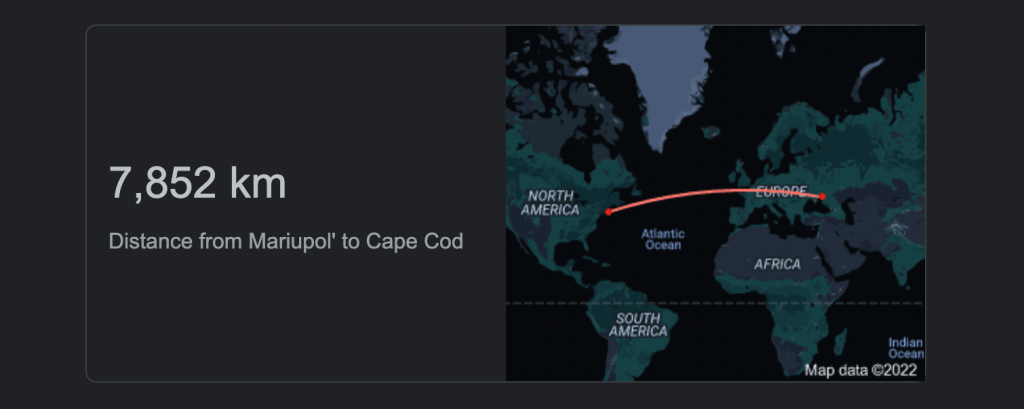
Olga lived in Mariupol for many years. Until February 24, she worked as a courier, while her husband worked at the Azovstal steel works, and their two children studied at school. Since early March 2022, due to the so-called special operation, Mariupol has been under siege, and fighting has been going on in the city. In the middle of the month, when humanitarian corridors opened up, the family was able to get to Donetsk, and from there they took a bus to Petersburg. Their bus tickets were bought by volunteers — ordinary people who are not connected with government agencies. They also met the Mariupol residents in Petersburg and housed them in their apartment for the night, and then took them to Ivangorod, where Olga and her relatives crossed the Estonian border. The family is now in Finland.
There are many similar stories. In Petersburg, hundreds of residents help transit refugees every day. There are so many people willing to help that all requests — from putting up a family of five people and two dogs to transporting a nursing mother with a baby to Ivangorod — are claimed by volunteers in a matter of minutes. Over the border, in the Estonian city of Narva, Ukrainians are also welcomed by volunteers. This is the story of how ordinary citizens sat and watched the news, feeling powerless, but then found an opportunity to help others and themselves.
How Volunteering Heals Witness Trauma
Alexander from Petersburg is an artist. If it weren’t for [the war], he would now be engaged in art making. “I won’t be getting around to art anytime soon, but there will be food for it,” he says.
In April, Alexander and other volunteers launched a platform on the internet where they coordinate requests for assistance in crossing the border with Estonia and (less often) Finland. For security reasons and at the request of the volunteers, we are not publishing a link to this resource. Currently, there are more people willing to help than requests for help: people span up the requests in minutes.
Here is an example of a typical request: “A family is coming from Mariupol: a grandmother, grandfather, their daughter, grandson (12 years old), and a pregnant cat. You need to meet them at the train station, feed them, provide overnight accommodation, chip the cat and put the family on the bus to Tallinn the next morning.”
“Society has been traumatized. People were watching the news and tortured by a feeling of impotence, so we created a platform where we try to cure this powerlessness. I have the feeling that any problem can be solved en masse. People are competing for the opportunity to help,” says Alexander, “and so [the campaign] has turned out absolutely horizontal. People find the requests on their own and fulfill them on their own. In the past, I worked on the problems in my neighborhood, and back then it was several activists dragging the whole movement like locomotives, but now the wave rolls on by itself.”
We thought we were going to disappear inside Russia, the refugees tell local volunteers. People travel mostly in groups. Most of them are women, children, and the elderly. There are fewer men. “Many people are traveling with their pets,” says Alexander. In addition to Mariupol and the surrounding area, they come from the Kharkiv region, Donetsk, and Luhansk. They are going to European countries, but some seek to return to Ukraine as quickly as possible because they have relatives there, they can speak their native language, and they don’t have to deal with the “refugee” label.
It is not only Petersburgers who have been helping them to make the journey to the Russian-Estonian border. There are also hundreds of volunteers in Moscow. The Petersburgers are now establishing contacts in Rostov, Krasnodar, and Belgorod, the [southern] Russian cities through which the refugees travel most often.
“The other day I came to my senses, looked up from the screen, and realized that nothing was hurting inside me. I haven’t watched the news for more than a week and I don’t know what is happening in the political space. I have a specific task, it is very simple and clean. Unlike everything else, I have no doubt that it’s a good thing,” says Alexander. “Everyone wants to do good, and helping refugees certainly satisfies this need.”
How Natalia Got from Mariupol to Vilnius via Petersburg
Natalia got from Ukraine to Lithuania thanks to the internet platform where Alexander volunteers.
Previously, she worked as a cook in the Shchiriy Kum retail chain. She has two daughters: one is a high school student, the other, a university student. On the morning of February 24, Natalia went to work as usual. “I heard that there had been an explosion somewhere. But in Mariupol this is so routine that no one paid it any mind. (Echoes of the fighting have been audible in Mariupol since 2014, and most residents were used to the sounds of distant explosions and shooting — The Village.) When I arrived at work, I realized that things were serious. I finished up by three o’clock, and they let us go home. I didn’t go to work anymore after that.”
Natalia and her family remained in Mariupol until March 23. There was no “serious fighting” in her neighborhood, so she and her daughters stayed in their apartment, not in a basement or a bomb shelter. “But our things were packed to leave at any moment,” she says. The electricity in the city had been turned off, and the water was also turned off, so the family went to a spring to get water. Then the gas was turned off, so they had to cook on a bonfire.
When the fighting got close, Natalia, her girls, and her eldest daughter’s boyfriend went to the outskirts of city, where “there were buses from the [Donetsk People’s Republic].” They went on one of these buses to her parents who live near Mariupol and stayed there for three weeks. Then all four of them traveled to Taganrog [a Russian city approximately 120 km east of Mariupol]. At the local temporary accommodation point, they were offered a choice: they could go either to Khabarovsk or to Perm. Natalia didn’t want to go to Khabarovsk or Perm. She needed to get to Lithuania, where a friend of hers lives. That was when a Mariupol acquaintance put her in touch with the Petersburg volunteers.
“The vbolunteers bought us tickets to Petersburg. We got to Rostov, where we boarded a train. In Petersburg, we were met by Ivan, who took us home to eat. We washed up and changed clothes, and he took us to get on a minibus to Ivangorod,” Natalia says. The Mariupol residents crossed the Russian-Estonian border on April 23. “At the Russian border, they asked [my daughter’s boyfriend] where he was going and why.” The Petersburg volunteers had put Natalia in touch with Narva volunteers, and so the family immediately boarded a free bus to Riga.
Natalia is currently in Vilnius. She has no plans to leave — she no longer has the strength to travel with suitcases. “We’ve rented a room. We’re going to look for jobs,” she says.
How to Help via Twitter
“It all started with the fact that I felt helpless and useless. I really wanted to do something,” says Katya from Petersburg.
You can find out about helping refugees who are traveling to Europe via Petersburg on various websites. The one on which the artist Alexander volunteers is the largest. There are others. For example, Katya saw such a request on Twitter. In mid-April, a friend of hers asked whether anyone could welcome a family (a mother, son and daughter) and an 18-year-old girl who was traveling with them for a couple of days. Katya responded. The family was put up by her friend, while Katya took in the girl. “She met the family she came with two weeks before [the war]. They went for a walk once with the boy, and he decided to take her with him. Her mother refused to leave, and so now the girl is all alone, without relatives here,” says Katya.
Katya met the girl at the Moscow Railway Station and they traveled the rest of the way to her house. The question arose: how to talk to a person who has country has been invaded by your own country? “Either we were a match, or the girl herself is this way, but it was easy to communicate with her, like with a sister,” says Katya. They sat down to drink tea, and the girl recounted in a calm voice how one day a tank drove up to the nine-story building in Mariupol where she was hiding in a bomb shelter, raised its turret, and began shooting into the distance. “I was bored, and I started counting. It fired seventy shots,” the girl said.
Before the girl left, Katya and her guest hugged tightly. The Mariupol family eventually stayed in Sweden, while the girl ended up in Germany. “I was constantly thinking about what is it like to live when your city is gone, when it has been wiped off the face of the earth,” says Katya.
What Ivangorod, the Transit Point for Refugees Going to Estonia, Looks Like
It takes two hours to drive from Petersburg to Ivangorod. At the outskirts of the city, you need to show the frontier guards a passport or a special pass for entering the border zone. Refugees are allowed through with an internal Ukrainian passport. A kilometer from the checkpoint, on a pole right next to the highway, storks have built a large nest.
Ivangorod is home to around nine thousand people. Its main attraction is a medieval fortress. In the six years that have passed since The Village‘s correspondents last visited the city, it has become prettier. The local public spaces have been beautified under the federal government’s Comfortable Environment program.
Estonia can be seen from the bank of the Narva River. To get to the European Union, you need to walk 162 meters across the Friendship Bridge. At the entrance there is a hut where insurance used to be sold, but now it is abandoned, its windows broken. People walk down the slope carrying bags and plastic sacks stuffed with things. The local children ride scooters. Closer to the shore, the children turn right onto the embankment, which the local authorities attempted to beautify in the 2010s with funding from the EU. The people carrying bags go to the left.
There are several dozen people at the border checkpoint. A heart-rending meow resounds from the middle of the queue. A woman removes a black jacket from a pet carrier: a hairless Sphynx cat stares at her indignantly.
“Maybe I should let him out on the grass?”
The people in the queue say there is no need, that they will get through quickly. But it seems that this forecast is too optimistic.
“Are they all Ukrainians?” a man with a reflector asks loudly. The people in front of him shrug their shoulders. “Are they Maidanovites? Refugees? Are they fleeing from the nationalists?”
Someone argues that the frontier guards should organize two queues — “for people and for refugees” — to make the border crossing go more quickly.
Under the bar at the border restaurant Vityaz hangs a homemade “Peace! Labor! May!” banner and an image of a dove. On the way to the Ivangorod fortress there is a memorial stone dedicated to “the militiamen, volunteers, and civilians who perished and suffered in the crucible of the war in the Donbas.” The Village‘s correspondents did not encounter a single letter Z — the symbol of the “special operation” — in Ivangorod. Nor they did encounter a single pacifist message either.
How Narva Helps Transit Refugees
At the border checkpoint, people are met by numerous volunteers from various associations, including the Friends of Mariupol. “These are all private initiatives,” says Narva volunteer Marina Koreshkova.
“We have been seeing exhausted people,” says Marina. “Many are in rough psychological condition, and they really want to talk. We listen to them for an hour, two, three — we empathize with them and share important information. People say that while they were traveling through Russia, they saw the Z, heard unpleasant messages addressed to Ukrainians, and were forced to put up with it and remain silent just to get to Europe. But I often see examples of Stockholm syndrome. Or maybe people are just afraid to say the wrong thing.”
Six years ago, Marina and her children moved to Narva from Petersburg, because she understood that the situation in Russia was getting worse. In Russia, she was a lawyer, working for ten years in a government committee on social policy, then as an arbitration manager. She started her life from scratch in Narva, and is now studying new professions. She is a member of Art Republic Krenholmia and Narva Meediaklubi, nonprofits engaged in civil society development and social and creative projects.
On April 10, Marina received a call from the manager of the Vaba Lava Theater Center, who said that they had decided to temporarily convert a hostel for actors into an overnight accommodation for refugees. Soon, the Narva Art Residence also let transit refugees into its hostel for artists. Then the Ingria House, located near the train station, equipped a room to accommodate Ukrainians. And on May 1, a Narva businessman temporarily vacated his office, located near the border, for daytime stays.
“For the first week, Sergei [Tsvetkov, another volunteer] and I tried to do everything ourselves. We quickly realized that at this pace we would burn out or get sick. Now about sixty local volunteers are involved, and people have come from Tallinn to help. The number of people helping out has been growing every day. Local residents collect the refugees’ laundry for washing, and bring them food and medicine.”
Almost none of the refugees remain in Narva. “The proximity to the border generates a new sense of uncertainty for them,” Marina argues. In addition, the region’s refugee registration office, which enables Ukrainians to gain a foothold in Estonia, has been closed. The nearest one still in operation is in Tartu [a distance of 180 km from Narva by car].
Narva is also “the most Russian city in NATO.” Only four percent of the city’s population is ethnic Estonian, and thirty-six percent of residents are Russian passport holder. “I don’t have time to read social media, but until April 10, I constantly observed negative comments [from Narva residents] about the refugees, although I have not seen any outward aggression in the city,” says Marina.
She believes that a welcoming station where refugees could get basic information and relax inside in the warmth should be equipped at the border. “It was quite cold in late April. People were freezing on the border outside in the wind, then thawing out for an hour and not taking off their outerwear.”
There is not even a toilet on the Russian side of the border, however.
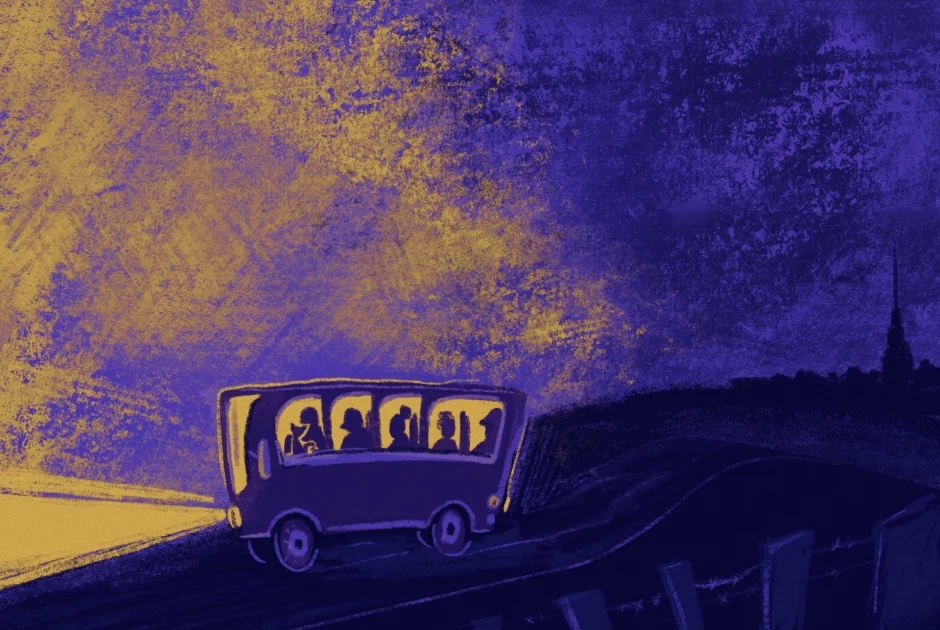
Source: “‘An absolutely horizontal business’: How residents of Petersburg and Narva are helping Ukrainian refugees going to Europe,” The Village, 5 May 2022. Image (below) courtesy of The Village. Thanks to JG for the story and the link. Translated by the Russian Reader
______________
Umm Khaled hardly leaves the tent where she lives in northwest Syria, and she says she doesn’t pay attention to the news. But she knows one reason why it is getting harder and harder to feed herself and her children: Ukraine.
“Prices have been going up, and this has been happening to us since the war in Ukraine started,” said the 40-year-old, who has lived in a tent camp for displaced people in the last rebel-held enclave in Syria for the past six years since fleeing a government offensive.
Food prices around the world were already rising, but the war in Ukraine has accelerated the increase since Russia’s invasion began on Feb. 24. The impact is worsening the already dangerous situation of millions of Syrians driven from their homes by their country’s now 11-year-old civil war.
The rebel enclave in Syria’s northwest province of Idlib is packed with some 4 million people, most of whom fled there from elsewhere in the country. Most rely on international aid to survive, for everything from food and shelter to medical care and education.
Because of rising prices, some aid agencies are scaling back their food assistance. The biggest provider, the U.N. World Food Program, began this week to cut the size of the monthly rations it gives to 1.35 million people in the territory.
The Ukraine crisis has also created a whole new group of refugees. European nations and the U.S. have rushed to help more than 5.5 million Ukrainians who have fled to neighboring countries, as well as more than 7 million displaced within Ukraine’s borders.
Aid agencies are hoping to draw some of the world’s attention back to Syria in a two-day donor conference for humanitarian aid to Syrians that begins Monday in Brussels, hosted by the U.N. and the European Union. The funding also goes toward aid to the 5.7 million Syrian refugees living in neighboring countries, particularly Turkey, Lebanon and Jordan.
Last year, the EU, the United States and other nations pledged $6.4 billion to help Syrians and neighboring countries hosting refugees. But that fell well short of the $10 billion that the U.N. had sought — and the impact was felt on the ground. In Idlib, 10 of its 50 medical centers lost funding in 2022, forcing them to dramatically cut back services, Amnesty International said in a report released Thursday.
Across Syria, people have been forced to eat less, the Norwegian Refugee Council said. The group surveyed several hundred families around the country and found 87% were skipping meals to meet other living costs.
“While the humanitarian crisis in Ukraine continues to demand world attention, donors and governments meeting in Brussels must not forget about their commitment to Syria,” NRC’s Mideast Regional Director Carsten Hansen said in a report Thursday.
The U.N.’s children’s agency UNICEF said more than 6.5 million children in Syria are in need of assistance calling it the highest recorded since the conflict began. It said that since 2011, over 13,000 children have been confirmed killed or injured.
Meanwhile, UNICEF said funding for humanitarian operations in Syria is dwindling fast, saying it has received less than half of its funding requirements for this year. “We urgently need nearly $20 million for the cross-border operations” in Syria, the agency said in a statement.
Umm Khaled is among those who rely on food aid. With her aid rations reduced, she has gone deeper in debt to feed her family.
Her husband and eldest son were killed in a Syrian government airstrike in their home city of Aleppo in 2016. Soon after, she escaped with her three surviving children to the rebel enclave in Idlib province. Ever since, they have lived in a tent camp with other displaced people on the outskirts of the town of Atmeh near the Turkish border.
Her family lives on two meals a day — a small breakfast and a main meal late in the afternoon that serves as lunch and dinner. Her only income is from picking olives for a few weeks a year, making 20 Turkish liras ($1.35) a day.
“We used to get enough rice, bulgur, lentils and others. Now they keep reducing them,” she said by telephone from the camp. She spoke on condition her full name is not made public, fearing repercussions. She lives with her two daughters, ages six and 16, and 12-year-old son, who suffered head and arm injuries in the strike that killed his brother and father.
The price of essential food items in northwest Syria has already increased by between 22% and 67% since the start of the Ukraine conflict, according to the aid group Mercy Corps. There have also been shortages in sunflower oil, sugar and flour.
Mercy Corps provides cash assistance to displaced Syrians to buy food and other needs and it says it has no plans to reduce the amount.
“Even before the war in Ukraine, bread was already becoming increasingly unaffordable,” said Mercy Corps Syria Country Director, Kieren Barnes. The vast majority of wheat brought into northwest Syria is of Ukrainian origin, and the territory doesn’t produce enough wheat for its own needs.
“The world is witnessing a year of catastrophic hunger with a huge gap between the resources and the needs of the millions of people around the world,” said WFP spokeswoman Abeer Etefa.
In many of its operations around the world, WFP is reducing the size of the rations it provides, she said. Starting this month in northwest Syria, the provisions will go down to 1,177 calories a day, from 1,340. The food basket will continue to provide a mix of commodities, including wheat flour, rice, chickpeas, lentils, bulgur wheat, sugar and oil.
Rising prices have increased the cost of WFP’s food assistance by 51% since 2019 and that cost will likely go even higher as the impact of the Ukraine crisis is felt, Etefa said.
Earlier in the year, before the Ukraine conflict began, a 29% jump in costs prompted the Czech aid agency People in Need to switch from providing food packages to giving food vouchers. The vouchers, worth $60, buy less food than the group’s target level, but it had to take the step to “maximize its coverage of food assistance to the most vulnerable,” a spokesperson told The Associated Press.
As the world turns to other conflicts, “Syria is on the verge of becoming yet another forgotten crisis,” Assistant U.N. Secretary-General for Humanitarian Affairs Joyce Msuya warned in late April.
In northwest Syria, “a staggering 4.1 million people” need humanitarian aid, Msuya said — not just food, but also medicines, blankets, school supplies and shelter. She said almost a million people in the territory, mainly women and children, live in tents, “half of which are beyond their normal lifespan.”
Many fear that the situation could only get worse in July, because Russia may force international aid for the northwest to be delivered through parts of Syria under the control of its ally, President Bashar Assad.
Currently, aid enters the Idlib enclave directly from Turkey via a single border crossing, Bab al-Hawa. The U.N. mandate allowing deliveries through Bab al-Hawa ends on July 9, and Russia has hinted it will veto a Security Council resolution renewing the mandate.
A Russian veto would effectively hand Assad control over the flow of aid to the opposition enclave and the U.S. and EU had warned earlier they will stop funding in that case.
The result will be a severe humanitarian crisis, likely triggering a new flood of Syrian migrants into Turkey and Europe, the German Institute for International and Security Affairs warned in a report.
Umm Khaled said she has no choice but to endure her deteriorating living conditions.
“They keep reducing our food basket,” she said. “May God protect us if they cut it completely.”
Source: Bassem Mroue, “Syrians in desperate need of aid hit hard by Ukraine fallout,” AP News, 8 May 2022. Thanks to Harald Etzbach for the story.