KYIV, Ukraine – It’s the last evening of my vacation.
I’m sitting in a taxi taking me to the Lviv railway station so I can return to Kyiv, and I can’t hold back my tears.
It’s not that I’m sad about returning to work and my normal routine. But when I get home, I know I won’t be able to sleep in my own bed. Once a cozy little nest, my own bed is now a place of constant fear, where even the deepest sleep comes at the risk of a ballistic missile or drone attack. I don’t trust monitoring channels anymore. I don’t trust anyone, except this primal fear that fills every cell of my body as soon as it starts getting dark.
And this fear is warranted. Russia has spent the whole summer launching large-scale ballistic missile attacks on Kyiv, taking advantage of Ukraine’s shortage of interceptors. They also used drones, including jet-powered Shaheds. Russia ramped up its missile production and also relies on North Korean missiles to intensify the attacks.
On top of that, Moscow seems to be adopting a new tactic, launching jet-powered drones throughout the whole day to paralyze the entire city. On August 27, there were 13 air raid alerts in Kyiv — a record-setting number of attacks lasting more than half a day. Since then, the attacks have been almost non-stop.
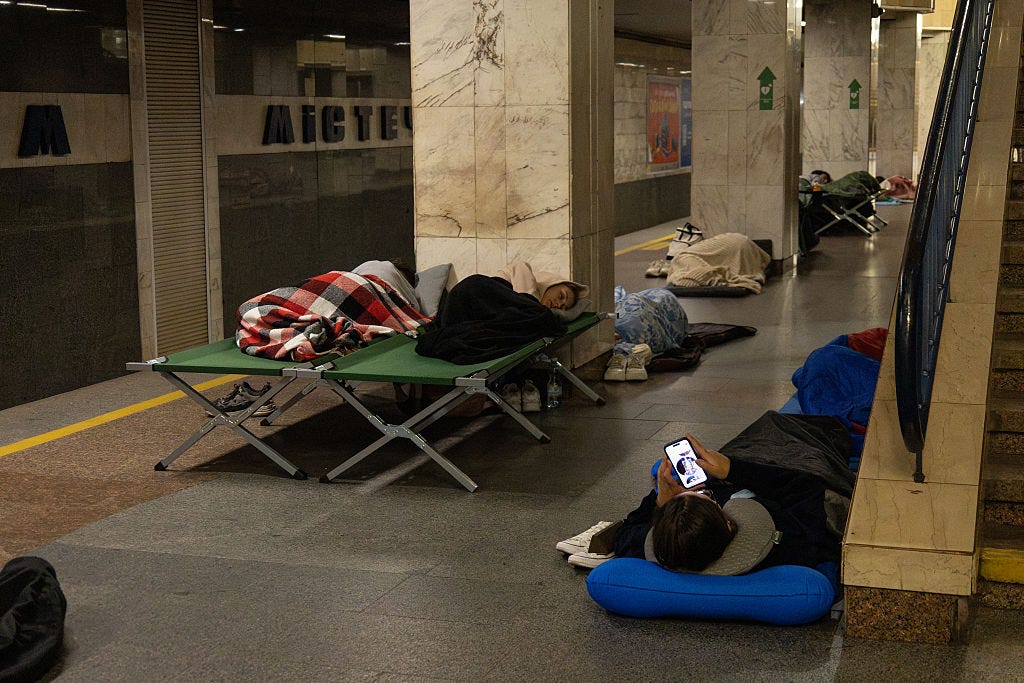
Basements and underground parking garages no longer feel safe enough. That’s why more and more Kyiv residents have started spending the night in the metro, often heading down there even before an air raid alert is issued.
A person checks a smartphone and others sleep as they take shelter overnight in a Kyiv metro station. Photo by Serhii Okunev/AFP via Getty Images and The Counteroffensive
Even when there’s no attack, people would rather spend a night in the metro than wake up suddenly to explosions in their own bed, unprotected.
Zoriana can’t sleep well anymore as the constant threat takes its toll
Night strikes started happening more and more in July.
I took the first few nights of ballistic attacks as something I simply had to accept. Last year, Russia had also stepped up its attacks on Kyiv during the summer, so I was mentally prepared for it.
But this time, they started using ballistic missiles more often.
I told myself that they would run out soon, since ballistic missiles are very expensive, while flinching at every new explosion in my bathroom.
But it only got worse.
Notifications about air raid alerts have become useless, as they only give two minutes before the first explosions, which can mean an endless night of hundreds of those two-minute windows and lots of panicked running.
So I couldn’t sleep well anymore.
My psychologist suggested breathing exercises and a ritual to help me calm down. But when I tried that, all I could hear was how hard my heart was beating.
That’s how my bed turned into a place of tormented waiting. Waiting for loud explosions and … my own death.
So I started going to the metro, regardless of whether there are air raid alerts or not.
Mariana wasn’t afraid of air raid alerts until this summer
I used to be pretty calm about air raid alerts. I went to the basement only a few times at the beginning of the war, when every alert was new and seemed scary and dangerous. But luckily, my hometown of Vinnytsia didn’t get attacked much. So I stopped going to the shelter and just continued on with my life, despite sometimes hearing the sounds of faraway explosions.
When I moved to Kyiv in 2023, I was a bit more cautious.
At night, the corridor became my sleeping spot during attacks. And although the explosions became more frequent, I still didn’t care enough to disrupt my sleep and go somewhere safer to hide.
But constantly seeing news of residential buildings completely ruined after massive attacks on Kyiv made me feel like the corridor was not enough. So in June, I started going to the shelter.
Zoriana wonders why she pays rent when she sleeps in the metro every night
People can go into the metro and stay overnight even without an air raid alert. Of course, you can wait and go once the alert starts, but I definitely can’t make it there in two minutes — the approximate time of a ballistic missile’s approach.
That’s why, at 10 p.m. every day, I have to decide whether or not to spend the night in the metro.
Without an attack warning, there aren’t that many people in the metro — typically around 30. I have already started to recognize a few familiar faces, and every evening we exchange a tired smile. But when there’s word of a massive attack coming, there’s not even enough room to drop a pin.
I have a separate warm tracksuit that I sleep in at the metro, my own folding bed, a comfortable pillow and a blanket. I always bring a thermos of tea, too.
But the constant thoughts never go away: maybe it will be quiet and I can stay home; maybe it won’t, and then it will be sheer terror.
Mariana sleeps better on hard school chairs than in a cozy bed at home
When I go home by metro at night, I see some people preparing to sleep there. They set up an improvised camp using mats, pillows and blankets. But even the metro can’t guarantee us complete safety.
At the end of July, the vestibule of the Lukianivska metro station, which I always use when commuting to my university, was damaged. At the time, people were sheltering there from the attack.
Since the closest metro station is 15 minutes from where I live, I go to the basement of a nearby school. I always bring a bottle of water and a sleeping bag with a pillow — they help me feel a little bit more comfortable while lying on hard school chairs.
I constantly check the Telegram channels that monitor incoming attacks, while other people in the basement whisper among themselves or snore. I hear the explosions outside, but it seems like the missiles can’t reach me in the shelter.
Eventually exhaustion gets the better of me and I fall into a restless sleep until I hear the all-clear signal. But I don’t leave the shelter right away. The thought of having to come back again because of another attack makes me stay until 4 a.m., the time when I for some reason feel that the threat is over.
With drones being launched constantly now, there’s no period of time that is truly safe. A new alert can come at any time, day or night. And when that happens, I’m too exhausted to care. I stay in my corridor and listen to the explosions, just hoping that I’ll be lucky and not get hit.
I’m consumed by only anxiety and exhaustion now, and whichever feeling is more intense at any given time is what dictates how I respond.
Zoriana fears this living nightmare made her a bad person
For the past two months, I haven’t been able to rest at all. There are no weekends or weekdays anymore, only day and night. Days filled with anxiety about my life. Nights full of fear and uncertainty.
And, strangely, I felt the worst when there was no attack. Exhausted, I walked home from the metro at 6 a.m. after taking shelter there overnight. That was when I caught myself thinking that I was sorry there had been no attack. I had wasted my night, and they hadn’t even bombed us. A second later, I burst into tears over that intrusive thought. How could I be disappointed that there was no attack? Am I really such a horrible person?
That was when I realized how much this is destroying me, dissolving everything joyful and bright that I had spent years filling my soul with.
It has been two weeks since my vacation ended, and I have slept alone in my apartment only twice.
I am still in Kyiv, trying to keep living my life. For how long? We’ll see.
And even as I write this right now, I’m packing my things for another night in the metro.
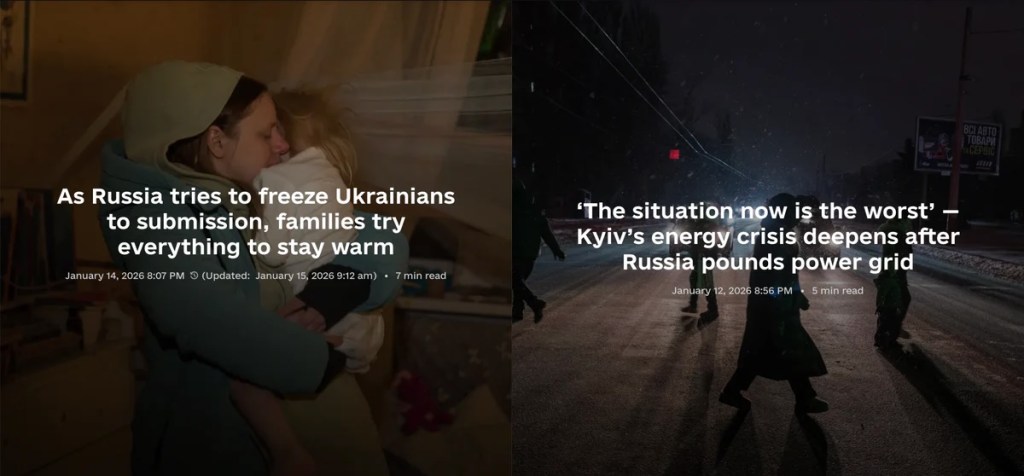
As temperatures in Kyiv plunged to -20°C (-4°F), Russia intensified its attacks on Ukraine’s energy infrastructure, leaving millions in total darkness and biting cold. Though Russia has tried this strategy before, this winter is different. The scale and relentlessness of these attacks have reached unprecedented levels. Many Ukrainians are now forced to survive winter without steady heat, without light, without the basic infrastructure that makes normal life possible.
While this crisis unfolds, international coverage has been limited. We want you to see what’s actually happening on the ground.
Our journalists are reporting these stories while living them — and so is everyone else in Kyiv, rushing to charge phones during brief power windows, cooking on camping stoves in their kitchens, huddling under blankets in apartments that feel like freezers. For the elderly, it’s worse. When elevators stop working, they are stuck in their own homes, unable to reach food or medical care. What was occasional last winter is now constant.
To light the darkness
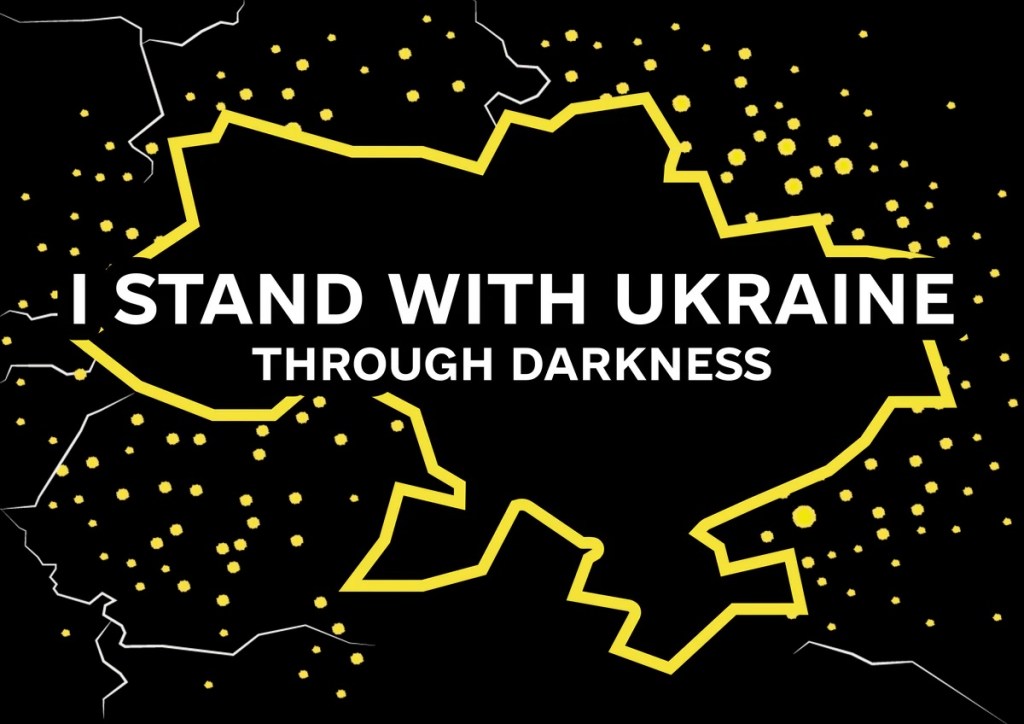
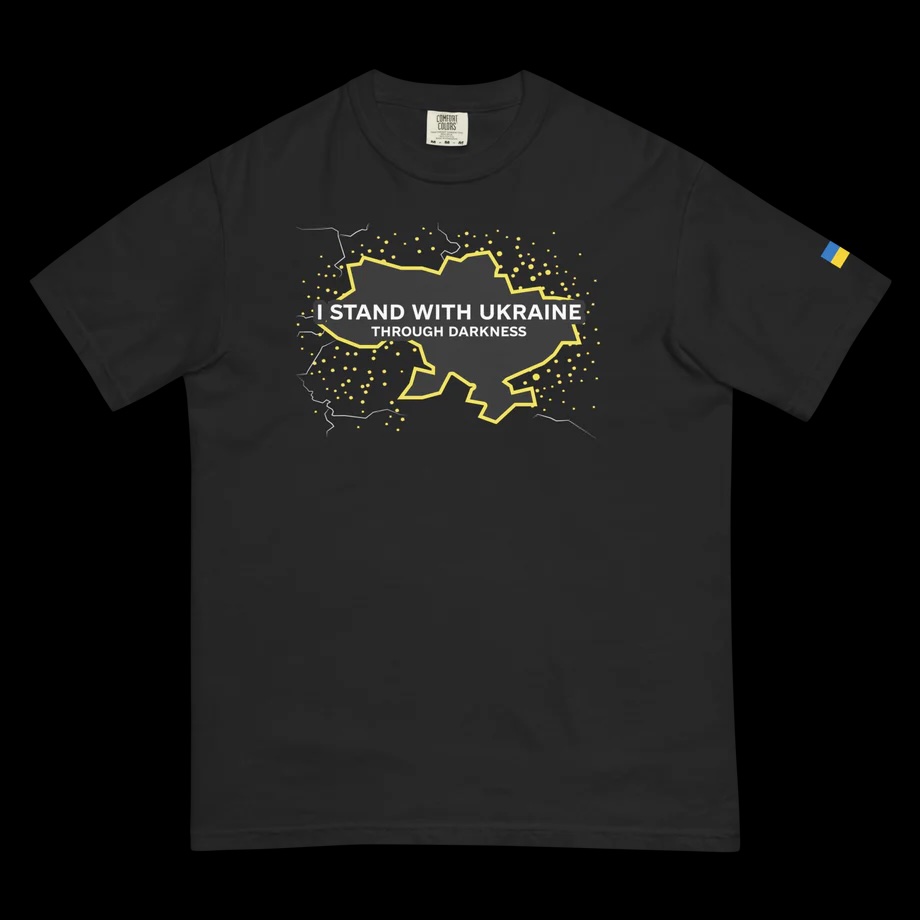
Building on our “I Stand with Ukraine” T-shirt, we’re launching I Stand with Ukraine Through Darkness — available as a T-shirt and hoodie.
From January 20 through February 3, all proceeds from this collection go to supporting the charitable organization Starenki, which helps older people living in vulnerable situations.
This winter Starenki’s volunteers provide a lifeline by:
Delivering essentials — Food and hygiene kits for older people, especially those who are physically unable to navigate stairs to reach shops. When high-rise buildings are left without power, elevators become inoperable — effectively trapping seniors in their apartments.
Providing emotional aid — Companionship and conversation to combat the profound isolation that comes with darkness.
As Ukraine enters its fourth winter of war, international attention is fading. The reality of these freezing blackouts is slipping from the headlines.
By wearing this design, you do more than help support the elderly in Ukraine — you raise awareness of the situation and keep Ukraine from slipping from the world’s attention.
Share this. Wear this. Spread the word.
Source: TheKyiv Independent Store email newsletter, 20 January 2026. I have purchased one of these t-shirts and would urge you to do so as well. ||||| TRR
[Editor’s note: On January 21, Kyiv’s Mayor, Vitali Klitschko, urged the city’s inhabitants to “leave if you can.” 600,000 have already left these last two weeks since Russia intensified its attack on the city’s energy infrastructure. The mayor says that the constant Russian attacks are pushing the city towards “a humanitarian catastrophe.” Temperatures are plunging to as low as –18°C (0°F). According to Klitschko, “the situation is critical with basic services – heating, water, electricity. Right now, 5,600 apartment buildings are without heating.” This morning, President Zelenskiy said that one million people in Kyiv are now without power. The city’s authorities have now have been forced to drain the city’s central heating and water system to prevent pipes from freezing and bursting. A couple of days ago, Ukraine’s Minister of Energy, Denys Shmyhal, said that “there is not a single power plant in Ukraine that has not been hit by the enemy during the war.”]
Today we received this from a dear, long-term friend in Kyiv:
BY OLEKSIY KURKA, resident of Kyiv, works in diplomacy and policymaking
I’ve written about Russian attacks so many times that the words no longer convey any new meaning, muted by repetition. But friends abroad cared to check in with me after last night, so here is an update.
As of this hour, only a fraction of the capital has electricity. I’ve been without power for about 24 hours now; others for much longer. It isn’t clear when it might return.
The heating is also off. The building is gradually cooling down. Soon I’ll be breathing out vapour, like some of my friends. Those living through ‘no-heat’ situations for longer – such as those near the front lines – are now camping out in their flats. It’s 5-7°C warmer inside a tent inside your flat.
The attack caused massive disruptions to public transport. Segments of the Metro I use to commute were closed due to electricity shortages. Many, myself included, had to stay and work from home.
My portable power station is gradually running out. Not having a predictable source of power is beginning to worry me more. I can predict one thing: our foes will stop at nothing to inflict more suffering on Ukrainians – while they can.
On a brighter note, I found and successfully installed a solution to the lack of internet at home. It’s an external antenna that catches and amplifies signals from nearby towers. Even during prolonged outages, I have about 15-20 Mbps, which is brilliant.
As for the power, I was inspired by my neighbour who took a mini petrol generator out to the courtyard and recharged his upper-floor flat via an extension lead. Now I fancy having the same system – and solar panels, for when there’s more daylight. Anything that minimises energy dependence is a win.
I went for a walk on the slippery, ice-clad streets of my district in an off-grid darkness that once again revealed the starred heavens. Most businesses and shops are running off generators, their light bulbs making up for the absence of proper street lights, coupled with the headlights from cars. This is how we see. That, and the torches in our hands.
Earlier today, we chatted with a visiting colleague who asked many questions about life these days. I made the point that a war of attrition forces things upon you that you’d otherwise never have thought you’d need.
But when it happens a few times, you spot the trend and start thinking even more creatively about what is yet to come. Do I need to consider satellite internet now, or are the mobile towers maintained well enough for me to avoid rushed decisions and unnecessary costs? Thinking ahead and learning from others makes the unpredictability a tiny bit more predictable, as it were.
Do I plan to leave Kyiv because of these ‘inconveniences’? I said a long time ago that there are two conditions for me to make such a significant decision: when there is no drinking water, and when the prospect of Russian occupation looms larger.
The first is not yet a reality for Kyiv, and I hope it never will be. The latter is no longer a reality, thanks to the Ukrainian army and our partners who provide Ukraine with air defence, long-range, and other weapon systems.
One more thing: Even if I leave the place, it’s only to come back.
The sun floods the room like a Christmas postcard: snow-covered trees, silence, a fairy tale.
But it ends at the windowpane.
I stand in the middle of the room in two sweaters and a robe, clutching a cup of hot tea as if it could save me. The thermometer indoors reads +9°C (48°F). It’s the third day without heat, and every hour the cold settles deeper into the walls.
In my arms is my six-month-old son, Ustym. I hold him tighter than I should, trying to give him my warmth. And suddenly it hits me: I don’t know how to protect him from the cold.
I can endure it. He can’t.
I cry quietly so he won’t hear. The tears on my sleeve are warmer than the air in the room.
I pack to leave the city.
There, the power may go out—but there is warmth. What a strange word now. A luxury. A reason to flee your own home.
I thought this fear was mine alone. But when I wrote to my colleague Nastia, I realized the cold does not discriminate. She has no child, but the same thermometer, the same сold walls, and made the same decision to leave.
As a result of Russia’s prolonged strikes on Ukraine’s energy infrastructure, including power plants and substations, large parts of Kyiv were left without heating for several days as temperatures dropped to –15°C — the lowest in recent years. During the January 9 attacks, damage to the power grid led to heating outages in approximately 6,000 apartment buildings, nearly half of the city, demonstrating how winter has become yet another front in the war.
Kyiv Mayor Vitalii Klitschko called the situation the most difficult for the capital since the start of the full-scale invasion and urged residents to temporarily leave the city, despite the opening of hundreds of heating centers. 600,000 Kyivans have fled the capital since January 9. For many, leaving the city is no longer a matter of comfort but one of survival.
It is a reminder that in times of war, even a major city can turn perilous overnight, and true security depends not only on the absence of missiles but on access to basic needs like heat, electricity, and water.
Our apartments turned into cold traps we had to escape. We came together to share this strange, frightening feeling, when every minute at home feels like a test, and survival becomes a daily struggle.
Nastia: On the night before the major strike that left us without heat, January 8, I took a hot shower for the first time in a week and had uninterrupted electricity for the whole evening.
Restoration work on hot water and heating had been underway in my building before, we always had problems with heating and water.
I felt like a human being again — someone who, after work, can properly warm up in the shower, instead of heating up a kettle 5 times.
After the attack, I was back to not having water, heating and electricity. When I woke up under two blankets I felt powerless again: I already knew I would cancel the plans I had that evening because of how exhausted I felt.
I didn’t even try to catch the internet in my apartment, because I knew I’d fail. I just washed my face under freezing water and went to the cafe nearby to work.
Later I was riding the metro and barely held back tears. Not even because of the cold, but because I would yet again have to spend my evening in a dark apartment all alone. Such evenings just gnaw at me, creating a deep sense of isolation. I know that when I set foot in the apartment nothing will be waiting for me there, except darkness, silence, and piercing cold.
“Please, come home. Don’t be there alone in the cold,” my parents told me. My dad suggested I go with his friend, who was also planning to leave Kyiv on January 9. I was hesitant at first: I had friends, plans, and work to do. But if I had been able to find ways to function with blackouts and distract myself before, this time I just couldn’t find the strength to bear it.
Myroslava: During the latest Russian attack on Friday, January 9, we immediately lost both electricity and heat. The boiler in the building runs on electricity, so it was clear that if there’s no power, there won’t be heat either.
At first I was calm; this was not the first time, and we’d get through it. But then Mayor Klitschko urged people to leave the city for the weekend, and that was alarming. The apartment was getting colder and colder.
My husband and I decided to go to his parents’ village to wait it out for the weekend, hoping that heat would return soon. On Sunday evening, we returned to Kyiv: heating had already come back in parts of the city. But not in ours. In the morning I took Ustym to my parents, where it was warmer, and went to work.
I dressed him in layers and held him close to share my warmth.
He seemed fine. It was I and even more so his grandparents who were truly scared.
I knew that we would only leave the Kyiv apartment at the most critical moment, when we had no strength left to endure. That’s exactly what happened on the last two nights–not only because my son woke up frequently, but also because of the cold, in which it was impossible to sleep. I was in warm pajamas, under a duvet and three blankets, surrounded by cats – and it still didn’t help.
I left for the Kyiv region on January 13th for my in-laws’ house, which has its own heating. The situation was so bad I couldn’t even wait for my husband to finish work. The frost had turned the roads into solid ice, and with darkness falling early, driving was dangerous. So my father-in-law drove out to pick up Ustym and me.
Nastia: As I was leaving Kyiv it was darker than usual – the blackouts had taken over the capital. Sorrow and the shame of leaving my own home kept me quiet and bitter in the taxi, but it changed when I met with my dad’s army friend; he cheered me up with conversations about life. The roads were covered with ice and snow.
That evening I got a message from my friend.
“I’ve never regretted more… the day I moved to Kyiv,” she said with an exhausted voice.
I often thought the same, but with the same thoughts I realized it was the best decision – it’s the city where I met most of my great friends, found work I love, and made plenty of great memories I want to keep until my last day.
For now I have to witness it from social media and news, or from my friends’ messages.
Energy workers are active around the clock. And they have been working under tremendous pressure for months. The brutal weather makes it much more difficult – just imagine working in the frost night and day, breaking through snow and ice to repair something, while Russia continues destroying more and more facilities.
DTEK, the country’s biggest private energy firm, posted on Threads: “It’s really difficult for us now. The damage from new big shellings is very serious. This was compounded by the severe weather we could all see outside our windows — the harshest winter in many years.”
Myroslava: The thought that we had to leave Kyiv hurts the most; it breaks me from the inside. I always saw the capital as a fortress, a place that must hold out under any conditions. In 2022, many Ukrainians stayed here even when the Russians stood on the outskirts of the city, because they believed Kyiv would be defended to the end. Now people are leaving not because of a military offensive, but because of the weather.
This is exactly what Russia wants – to make Kyiv unlivable, to break Ukrainians’ morale and force concessions. And they’re partially succeeding: home has stopped being a safe place.
That’s why visiting stores have become one of the most painful things for me. Supermarkets are a kind of marker of stability, an indication that tomorrow will still come. When they are open, it feels like life is still holding on.
But a few days ago, I saw a message that supermarkets in Kyiv were starting to close, including one near my home.
The store is closed, and a sign to that effect hangs on the entrance, Kyiv, January 13th, 2026
It stayed open at the start of the war, through heat, cold, and the blackouts of 2023.
And this time, it didn’t survive.
Nastіa: Leaving was difficult not only because it carried a sense of shame for giving up and escaping, while my friends and lots of other people had to stay and endure the cold.
But also it was hard to walk away from the places I love, not knowing how soon I’d be able to return. I don’t know how my apartment is now, or my favorite cafés and stores where I could go from my dark apartment to recharge my phone a bit.
I didn’t spend much time in the cold and blackouts after the latest attack, but it didn’t take long to feel its full effects. I was barely able to get myself out of bed; the indoor temperature had already plunged to about +10°C / 50°F.
And the rest of the time I spent dragging bottled water from the shop to clean up and take a shower before I could leave. At that point, I had no running water at all.
Myroslava: I miss my husband terribly, as he stayed in our Kyiv apartment. He works in Kyiv, and with this weather, regular trips aren’t realistic.
We’ve always done everything together, and now it feels like I’m without my main support. We text each other constantly. I send him photos of Ustym, and we wish each other good morning every day, trying to keep that closeness alive.
He has to keep the bathroom warm so the pipes don’t burst, otherwise the whole building could lose heat for the rest of winter. At –15°C outside, it’s frightening. He uses whatever he can: an oil radiator when there’s electricity, a gas heater when there isn’t.
Our cats, Stuhna and Sherri, stayed in the apartment. I constantly worry that they are cold, curling up and searching for any bit of warmth. They need to be fed and given water, and the rooms need to be kept warm. Every time I think about them, my heart tightens, because I left and they stayed behind.
The war has torn families apart on so many levels, and not just on the front lines. This winter brings a painful new wave of uncertainty and separation – endured not because people are giving up, but because they are forced to protect what matters most.
Editor’s note: The Counteroffensive team will continue to report from Kyiv, but we support any member of their team that wants to go back to their hometowns to be with their families.We also offered to take any member of the team to Warsaw for a week, at least until this blows over. They all refused to leave their country. I hope this shows, in some small sense, the grit, determination and courage of the small team I’m privileged to lead.
A view of Nevsky Prospect, Petersburg’s main thoroughfare, with the Russian National Library (the so-called Publichka), Gostiny Dvor shopping center, the tower of the former City Duma building, the cupola of Kazan Cathedral, and the cupola of St. Isaac’s Cathedral visible on the left in ascending. This picture-perfect cityscape was used by the Facebook page I Love St. Petersburg to illustrate the bizarre, banal, pseudo-historical sentiment that I’ve translated, below. Petersburg was built on the land of the Ingrian people and the captured Swedish fortress of Nyenskans. Or rather, that’s a no less valid way of putting it.
St. Petersburg is the only European capital that has not been captured by the enemy in any period of history.
Source: I Love St. Petersburg (@spb.love.you), Facebook, 13 August 2022. Translated by the Russian Reader
(Upper left, in Russian) “Kiev is the mother of Russian cities.” (Lower right, in Ukrainian) “If I had known, I would have had an abortion.”
Source: Petya Pyatochkin, Facebook, 12 August 2022. Thanks to Volodya Y. for the heads-up. Translated by the Russian Reader
The tables covered in beer Showbiz whines, minute detail (2) Hand on the shoulder in Leicester Square (3) It’s vaudeville pub back room dusty pictures of White frocked girls and music teachers The beds too clean Water’s poisonous for the system (4)
And you know in your brain Leave the capitol! (5) Exit this Roman Shell! (6) Then you know you must leave the capitol
Straight home, straight home, straight home One room, one room (7)
Tetiana Bezruk: “My neighborhood in Kyiv after it was shelled by the Russians.” Facebook, 21 March 2022
I really love my neighborhood in Kiev.
It seems that none of my friends and acquaintances gets this. They usually laugh at it.
I can even see their point. It’s a bedroom community, and residential buildings, kindergartens, schools, and shops are the only things there. By Kiev standards, it doesn’t even have a decent bar.
Every Saturday morning, I would wake up at a “non-weekend” time. I really could have slept until 10 a.m., but I had a little ritual.
Every Saturday morning, I would first go to buy coffee in a small cafe where they also sold Basque cheesecake. The small bits of sweet сurd stuck to the roof of my mouth and smeared on my plate. It was tasty and pleasant.
After having coffee, I would go to the market. I have several stalls where I buy everything. I buy large, sweet red peppers and tomatoes at the stall over there. Un-tomato-fortunately, I’m from the Kherson region and I won’t buy just any old crappy tomatoes. Tomatoes should smell like the field, as they did when I was a child, at Dad’s “fazenda.” They should be plum-like and dense, red and redolent — not green. It’s easier to find big, beautiful peppers.
Then I would have to go deep into the market to find basil or, say, green lettuce. After that I would look for apples, but they could not be sour or sweet. Apples are also a problem: it all depends on my mood. Then I would buy pears or plums. I might also go to the woman selling sweets and buy eight caramelized-milk “nuts.”
In autumn, chrysanthemums would be sold in flowerpots at the exit from the market. At home, we called such flowers “oaklings.” They have small flowers, like calendula: yellow, brown, burgundy, pink. It’s always hard to resist them. Once, I broke down and picked out a huge flowerpot for myself. But I couldn’t pay for it because I only had a bank card on me, no cash. I was quite upset.
After the market, I would go for a walk in the woods. I would put on headphones and listen to podcasts. Admittedly, one time I got fed up with them and I just walked through the woods, watching children climbing on ropes, grownup men and women drinking in the “great outdoors,” and a little boy asking a squirrel to get down from a tree. “Squirrel, get down!” he said to it.
By the way, there are a lot of squirrels in the woods. There are even three of them on one of the trails. They are brave, unafraid of passersby. Someone even brings them nuts.
I loved those Saturdays so much. When I was tired, I would live from one Saturday to the next. I had personal reasons. :)) I walked 8-10 km a day, so I had to keep the bar high.
If these walks happened in the evening, I would return home after dark. There were dozens of lights on in every building, the windows covered with different curtains. I always wanted one of them to be mine. For this neighborhood to become a real home to me, because it was already was a home, I only had to find a good realtor and buy a flat.
That was what I had been doing for two months before full-scale war broke out. I wanted a flat in my neighborhood or in Irpen. My parents urged me on. I was stressed and said that I didn’t have time for everything, that I had a lot of work, but I was looking.
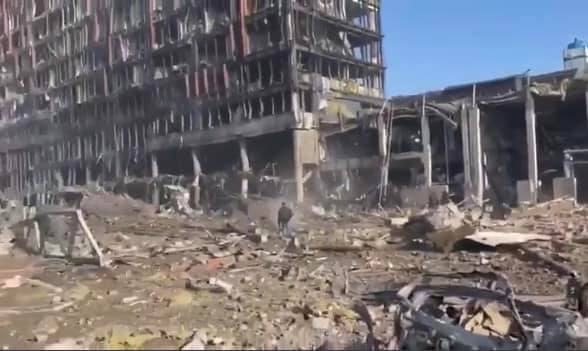
Yesterday, the Russian army shelled my neighborhood. I hate Russia for that. There are only kindergartens, schools, residential buildings, and shops in my neighborhood. And there is also a woods with ropes that children climb on weekends.
I really love the place where I live. I have always defended it in arguments with friends, trying to prove that my neighborhood is the best, because I feel good here. I’m at home here. My house has everything: my favorite hair masks and body scrub, photos of my parents, earrings that I don’t have time to wear, a new eyeliner that I spent as much time looking for as for an apartment.
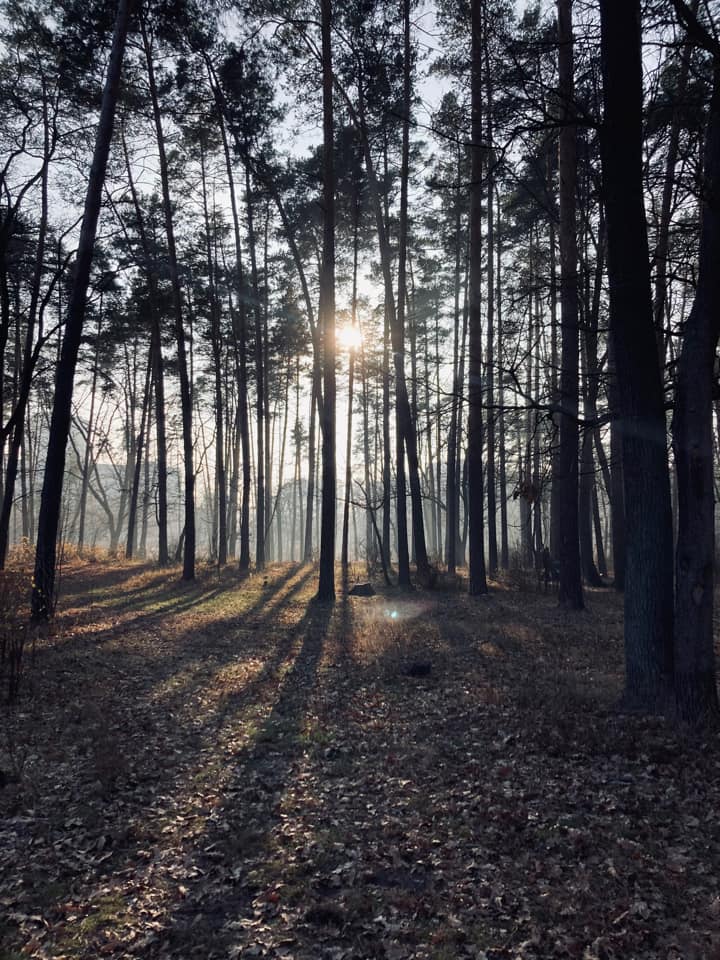
I love the tall pines and the neighborhood market. I love the baklava with nuts at the store next door. I love the store that sells the flowers that I buy to bring home, because I always have to have flowers in my apartment. And my love for my home will always be stronger than the hatred in me now.
Source: Tetiana Bezruk, Facebook, 21 March 2022. Translated, from the Russian, by Thomas H. Campbell. Thanks to Ms. Bezruk, a Ukrainian journalist based in Kyiv, for her permission to publish this translation.
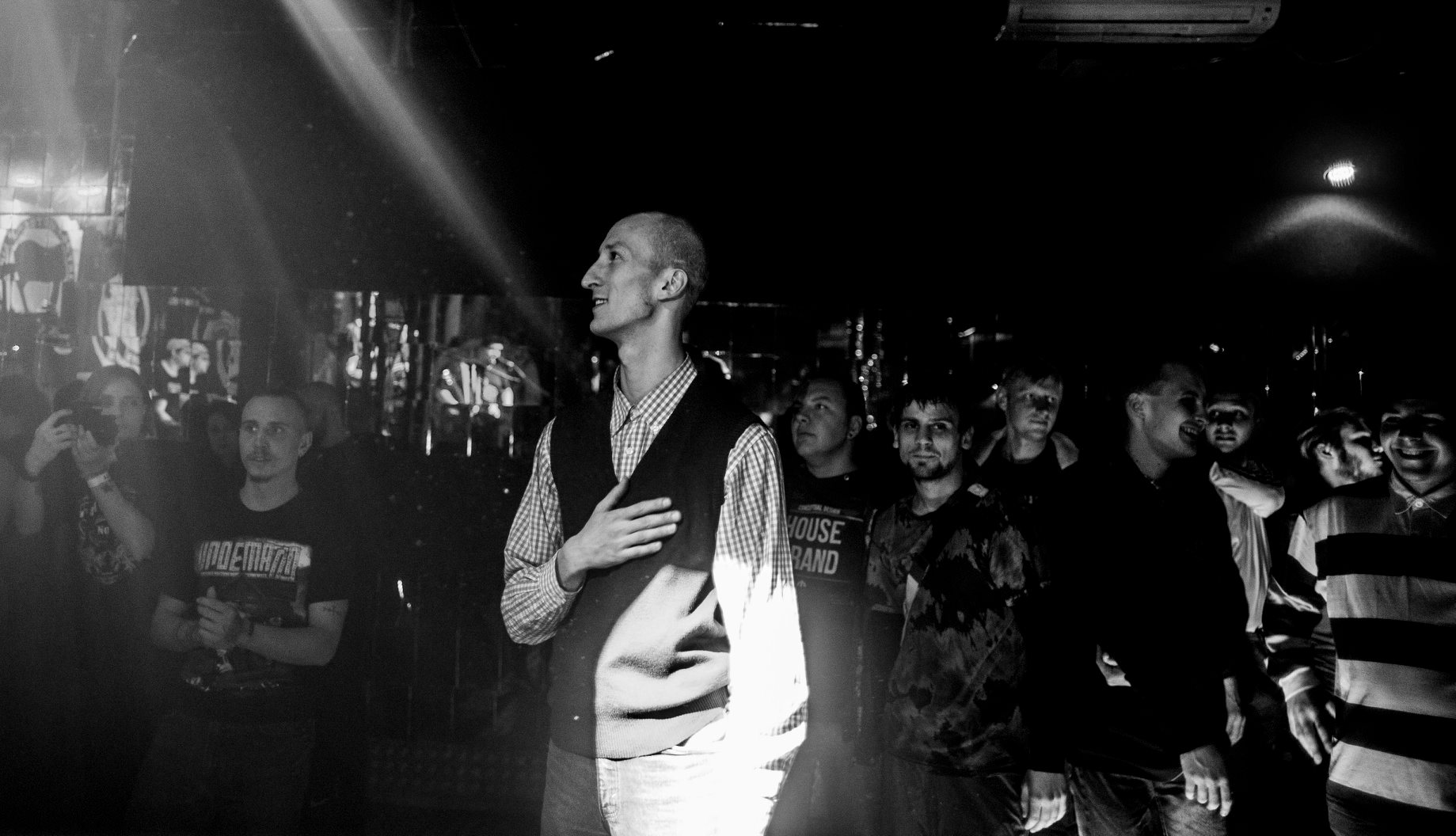
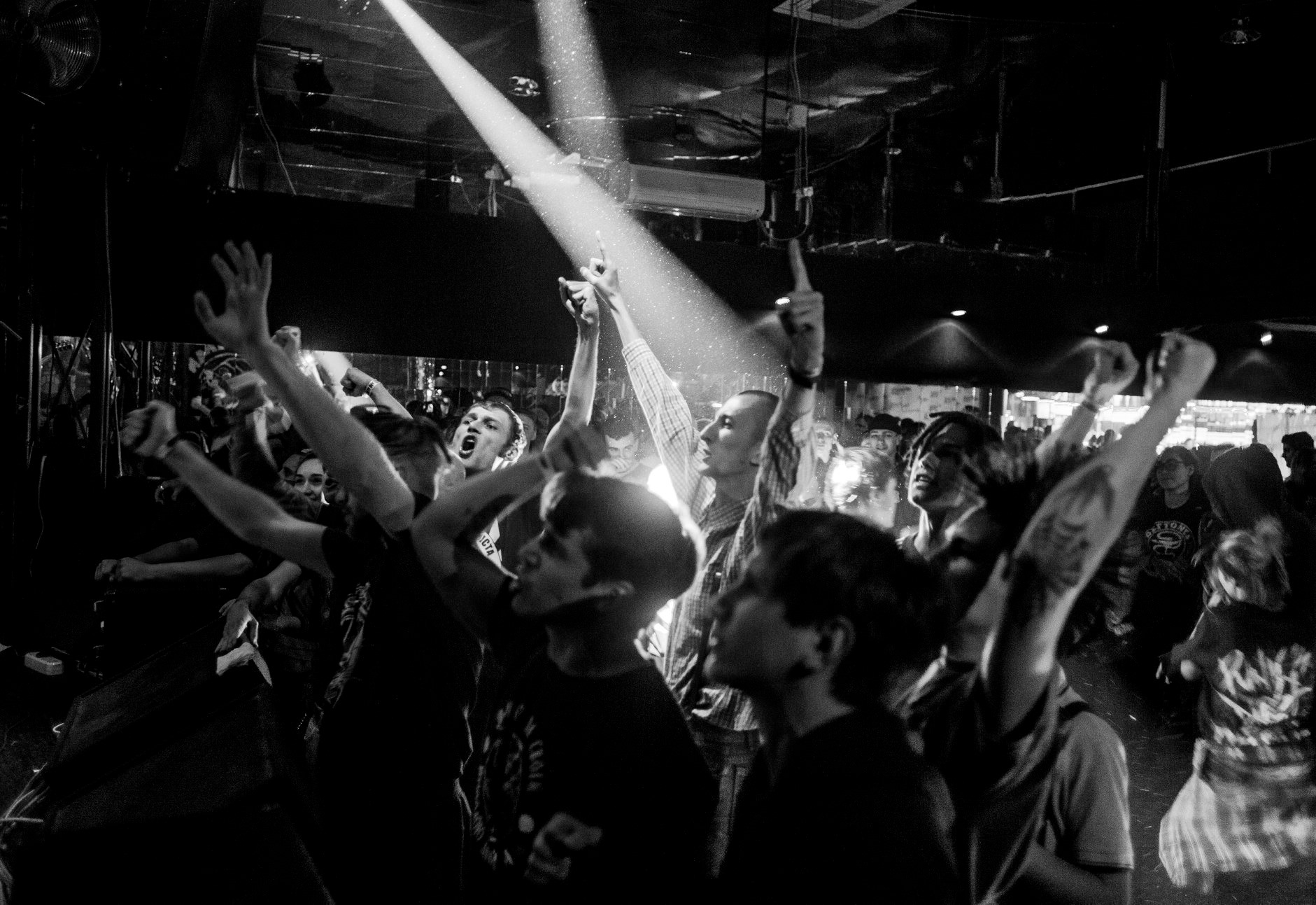
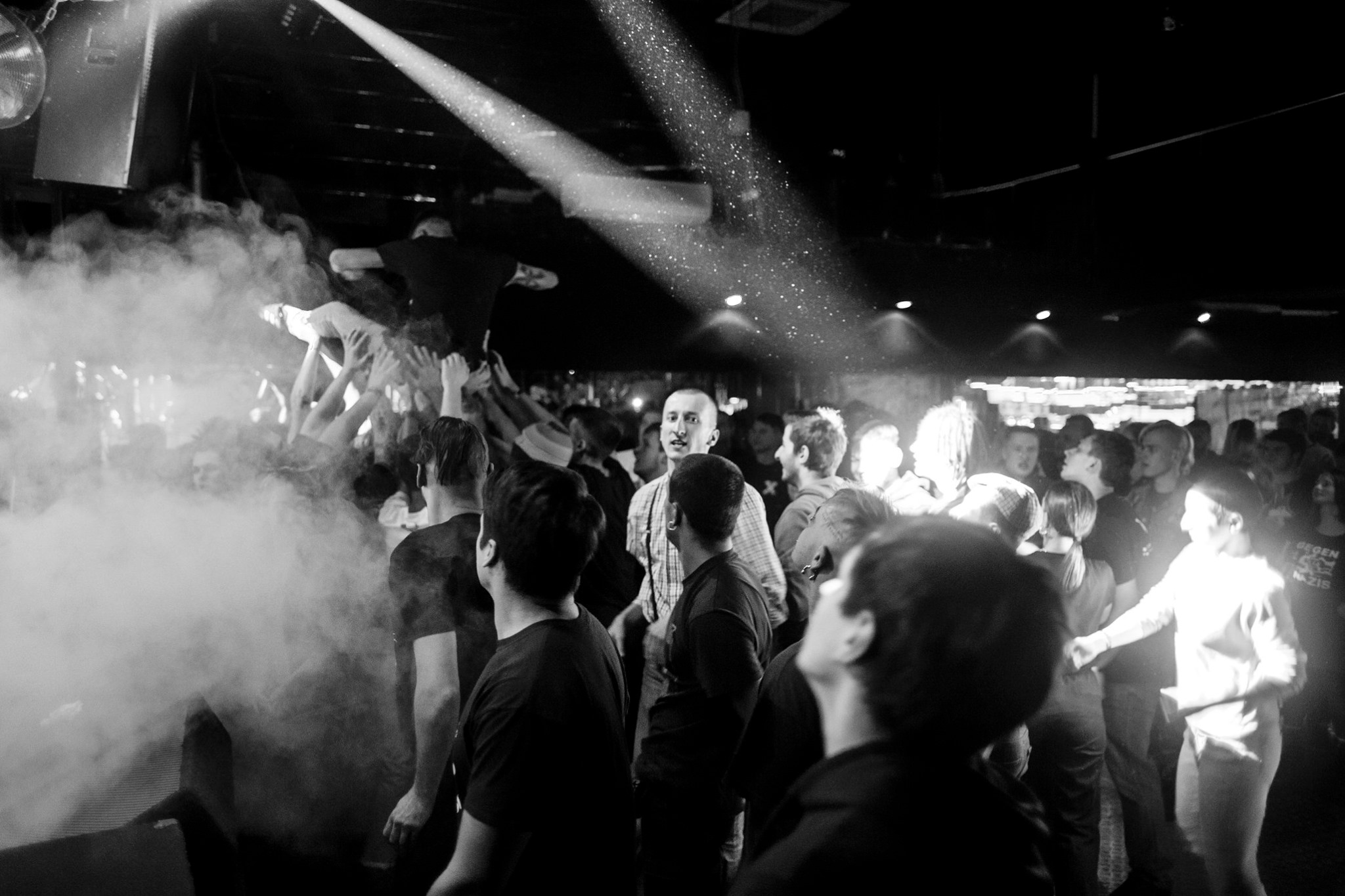
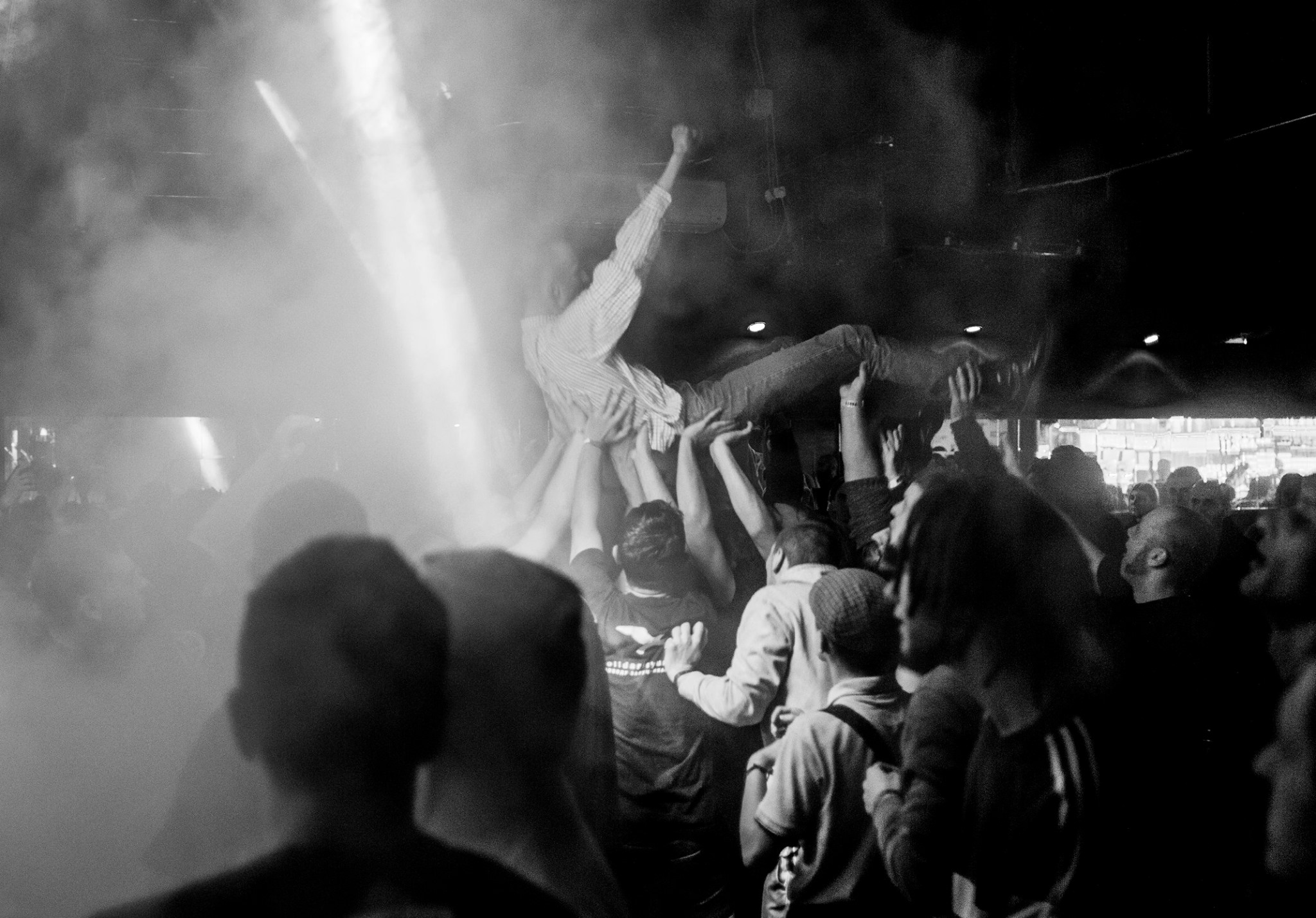
I spent my last evening in Kyiv at a concert thrown by anarchist punks in honor of Alexander Kolchenko’s birthday. I congratulated him, took a few pictures, listened to the music, and socialized.
Thanks to Vadim Lurie for his permission to publish his photos here. Translated by the Russian Reader
What all the rabid verbiage about Arkady Babchenko’s “stunt” boils down to is that a good number of Russians and, surprisingly, non-Russians (e.g., Reporters Without Borders, the BBC, etc.) believe that, when you are confronted by a much more powerful or cunning enemy, such as the Putinist state, the noble thing is to roll over and let yourself be killed.
Everyone loves a martyr for a cause, even when an endless series of martyrs jeopardizes any real cause, if only because at some point the people who believe in the cause will eventually surrender if the cause is so needlessly dangerous, and its leading lights forbid its lesser lights from defending themselves when attacked by the enemy, much more from going on the offensive against the same enemy.
That would be unthinkable!
No, it is better to roll over and bite the bullet in the back of the head. Your friends will relish laying flowers on your grave for years to come, and if you are famous they might even hold annual memorial rallies or marches for you. The regime does not find such powwows threatening in the least, because they make the opposition to their rule look weak and pathologically attracted to victimhood.
Besides, even ordinary Russian law enforcement and judicial practice tends to frown on people who defend themselves too vigorously, often prosecuting and punishing them instead of their assailants.
When the assailants are police officers, this is triply true, as we saw during the infamous Bolotnaya Square Case, in which over thirty people were charged with “rioting” and “violence against police officers” for the mildest acts of self-defense or even their entire absence, after a small army of police attacked a peaceable, authorized opposition march in Moscow on May 6, 2012, without provocation.
It is remarkable, then, how many Russians have internalized and made their peace with a quasi-doctrine of passive non-resistance that has been coupled with a total reluctance to come to the defense of others set upon by criminals or the police, whose actions and intentions are often indistinguishable.
What is surprising is that this madness is also endorsed by seemingly respectable foreign organizations like the BBC, who have been pushing the “this discredits Ukraine forever” line for the last forty-eight hours as if their lives depended on it, and Reporters Without Borders, who in their statement also came close to suggesting that if Babchenko had been an honorable journalist he would have let himself be iced by the Kremlin’s assassins.
The real back story is that there are considerable forces in western society who find it awfully irritating and inconvenient for their big picture that Ukraine and its defenders have not just given up the ghost, but have continued to put up a fight, however ineffective and puny when matched against the ostensible might of the Putinist empire.
For some reason, the resistance against this murderous empire mounted the other day by Babchenko and his defenders in the SBU has caused more offense and tongue-wagging than the actual armed resistance, often quite bloody and indiscriminate and crawling with unsavory characters, we have seen in Eastern Ukraine over the last four years.
Putting it as crudely as possible, Babchenko and his SBU collaborators figured out a way to fight back and win a small victory against the Putinist empire without spilling a single drop of blood, and now lots of high-minded people are hopping mad at them, including John Simpson of the BBC (who this morning attempted, hilariously, to make up for yesterday’s tirade by remarking that if Anna Politkovskaya had pulled off the same escapade, he would have been happy) and the now utterly discredited Reporters Without Borders, which has implicitly endorsed the murder of dissident journalists by the Kremlin.
At times like this I wish the fictional Harry Pearce, head of counter-terrorism at MI5 in Spooks, really were a defender of the realm, because, as he himself says at the end of the excellent Spooks movie (Spooks: The Greater Good), only people like him are ruthless enough to get the job done and actually defend the realm. If you have ever seen the show, you will realize that defending the realm does not consist of running around running up a high body count, but of being able to distinguish at the right time between friend and foe, a job that is infinitely harder than it sounds.
How is that a screwed-up but otherwise peaceable country that was invaded unprovoked by its much more powerful neighbor and a dissident journalist who fled to that country are seen as enemies by half the Russian intelligentsia and half the journalistic organizations in Europe?
If Harry Pearce were real, and I were his boss, I would want him delicately probing into why exactly the BBC has mounted such a vicious attack against Babchenko and the Ukrainian authorities in the last two days. I would be especially interested in investigating the motives of the avuncular John Simpson, whose tirade against Babchenko, live on the air yesterday on Radio 4, was so unseemly and vehement I felt I must be hallucinating. (After listening to the tirade, I was not surprised to find he had filed this crypto-Putinist copy from occupied Crimea in March 2015.)
The Babchenko affair has nothing to do with fake news. It has to do with whether smaller, less powerful countries and essentially powerless individuals who oppose more powerful countries have the right to defend themselves at all.
The implication is the SBU should have waited in ambush for Babchenko’s killer with a squad of fifty armed men and then lit him up like a Roman candle when he arrived, rather than plan and enact the much subtler and more effective counter-attack they claim to have carried out.
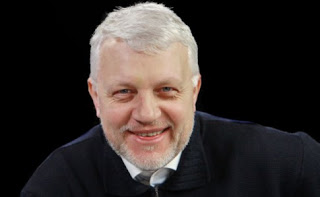
Pavel Sheremet, Belarussian Journalist
Simon Pirani The Pensive Quill
July 22, 2016
Ukraine’s political life has been shaken by the car-bomb killing of Pavel Sheremet, the Belarussian journalist, in Kyiv on Wednesday – a brazen, brutal murder in broad daylight in the city centre.
Pavel Sheremet. Photo: Ukrainska Pravda
Sheremet was an extraordinarily talented and honest reporter, which is why many people with power and money hated him. He was jailed, beaten and harassed by the authorities in Belarus; worked on Russian state television and then quit in protest at its one-sided coverage of Ukraine; and moved to Ukraine where he worked on television and on Ukrainska Pravda, the largest news web site.
Sheremet graduated from a prestigious university of international economic relations, right after the collapse of the Soviet Union in 1991. “My classmates became oligarchs, ministers, diplomats – and, true, some of them ended up in jail. When I moved from a bank job to work on TV, everyone said I was mad, but I never regretted it”, Sheremet said in an article, published by his colleagues this morning, entitled “Every Day As If It’s the Last: Rules for Living”.
The early 1990s was a golden era for journalism in the former Soviet Union. Sheremet hosted a popular news analysis programme on Belarussian state TV that was banned by president Aleksandr Lukashenko in 1995. Sheremet switched to Russia’s main state channel, ORT, as the head of its bureau in Minsk.
As Lukashenko’s regime descended into authoritarianism, Sheremet became a prominent dissident and spokesman for the Charter 97 human rights organisation. In 1997 his classic reportage on smuggling across the Belarussian-Lithuanian border earned him a two-year prison sentence. After serving three months he moved to Moscow.
The spirit of media freedom was still alive and kicking in Russia. Sheremet investigated the disappearances of Belarussian dissidents, some of them his close friends, and made cutting-edge documentaries, including one about the Chechen war. He set up Belaruspartizan.org, the most effective Belarus-focused dissident web resource. He won the International Press Freedom Award in 1998, the first of a string of such prizes.
“Pavel was a really rare bird among post-Soviet journalists”, wrote the Russian journalist Konstantin Eggert in one of a host of tributes. “He very well understood Russia, Ukraine and Belarus, and maybe because of that he was a European – and not a Russian, Ukrainian or Belarussian – journalist.”
From 2010, Sheremet began to spend more time in Ukraine, and then moved to Kyiv, continuing to work for the main Russian state TV channel (ORT, later renamed Channel One). But in July 2014, four months after the overthrow of Ukrainian president Viktor Yanukovich by the Maidan movement, Sheremet resigned from the station, complaining that those who contradict Kremlin propaganda were “hounded”.
“The TV still gives the impression that nothing has happened. That irritates people”, Sheremet wrote in the article published today. “The life people actually live is one thing, and then they turn on the TV and see a completely different picture. I quit [Channel One] because it became impossible to work there and preserve my reputation and good name.”
The news web site Ukrainska Pravda, where Sheremet worked for the last couple of years, along with broadcasting commitments, was his natural home. The site was set up in 2000 by Gyorgy Gongadze, another fearless child of the post-Soviet boom in free speech.
In September 2000, Gongadze was kidnapped and murdered by three police officers, who were many years later jailed for their part in the crime. The killers were clearly acting on the orders of elements in Ukraine’s political elite – although the connections beyond the internal affairs minister of the time, Yuri Kravchenko, who also died violently, were never completely clear.
The Gongadze case became a watchword for democratic rights in Ukraine. Rising to the challenge of censorship by thuggery, Gongadze’s colleagues turned Ukrainska Pravda from a penniless blog into the country’s prime web-based news resource, a position it enjoys to this day. Its news output is underpinned by comprehensive reporting on Ukraine’s oligarchs and the corruption that surrounds them. After the Maidan events two Ukrainska Pravda journalists, Sergei Leshchenko and Mustafa Nayyem, entered parliament on an anti-corruption platform.
Sheremet fitted in well in this company. The car he was driving when killed belonged to Aliona Prytula, Ukrainska Pravda’s co-founder and owner. The police at first suspected she may have been the intended victim, although on Thursday it was reported that investigating officers now thought the attack was most likely targeted at Sheremet himself.
There is no guarantee that we will ever know who killed Pavel Sheremet, and who ordered the killing. In the cases of many of the journalists murdered in former Soviet countries in the past 25 years, the trail of infamy that led to their deaths has been successfully covered up, often with the help of law enforcement agencies.
All we can be sure of is that the military conflict unleashed in eastern Ukraine over the past two years makes murders such as Sheremet’s more likely.
The complex clashes in eastern Ukraine that followed from Yanukovich’s removal were turned into war by the influx of huge quantities of military hardware and volunteer fighters from Russia, an influx for which the Russian state bears the main responsibility. Human life has been cheapened; more than 9400 people have died; human rights organisations now routinely issue reports (the most recent from Amnesty International and Human Rights Watch on 21 July) of torture, disappearances and arbitrary detentions.
All this has ratcheted up the danger to people like Pavel Sheremet, who so well understand the dynamics of such conflicts, and could explain them with frankness and good humour to their fellow citizens who don’t believe most of what the media tells them. (Pavel’s recent blog posts ladled sarcasm and wit on Russian war propagandists, Ukrainian business oligarchs and Ukrainian “volunteers”-turned-criminals alike, leaving us none the wiser about which of his enemies might have been involved in his killing.)
I have been travelling to Russia and Ukraine for the past 25 years as a journalist and a researcher. It’s easy for me: I have a British passport in my pocket and can leave at any time. For many like Sheremet, who in recent years I counted not just as a colleague but as a good friend, there is no such protection.
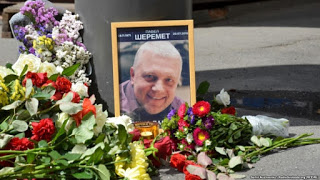
Flowers at the place in the centre of Kyiv where Pavel Sheremet was killed. Photo: Belaruspartizan.org
My thanks to Simon Pirani for his permission to reproduce this obituary here. TRR





 Where is Harry Pearce when we need him? Photo courtesy of Universum Film and