ICE Goes After Russian Asylum Seekers: The Cases of Alexander Bolokhoev and “Dimitry”

ICE agents in the U.S. have detained Alexander (“Sasha”) Bolokhoev, a cofounder of the movement Tusgaar Buryad-Mongolia, which advocates for Buryatia’s independence [from the Russian Federation].

Sasha left Russia in 2021—that is, before Russia’s full-scale invasion of Ukraine. In April 2022, he arrived in the U.S. and claimed political asylum. Unlike many of our compatriots, however, Sasha did not lie low and do nothing, pointing to the fact that he had been persecuted on ethnic grounds in Russia. He immediately joined the fight. He and Marina Khankhalaeva founded the Tusgaar movement, which has already been added to Russia’s official list of “extremists and terrorists.” He also spearheaded a congress of Buryat political organizations in New York.

Sasha’s detention by ICE was in no wise connected to his activism. He was detained in the state of Oklahoma during one of the anti-immigrant dragnets which have become a daily fact of life under Trump. Sasha was stopped on the highway and taken directly from his vehicle, which was left standing there.

Sasha is in the US completely legally. He has all the necessary papers, including a work permit. In the current reality, though, this may not matter much. Even green card holders and U.S. citizens have been detained and deported from the country.

Sasha is currently in custody in a deportation detention center in Oklahoma. He is held there along with a Chechen man who was also detained during a similar raid. The worst possible outcome for both of them would be deportation to Russia. I agree with Marina that torture and death would await Sasha in a Russian prison.

The Trump administration has instituted the systematic deportation of Russians on standalone flights to Moscow. As of October, at least three known charter flights have deported over a hundred people from the U.S. back to Russia. Upon landing in Moscow, all of these people are screened by the FSB (Federal Security Service) and they are often sent straight to a detention center.

Source: Julia Khazagaeva (Facebook), 21 October 2025. Translated by the Russian Reader. A special thanks to Ms. Khazagaeva for sending me the subtitled video interview with Sasha Bolokhoev, above.


The full interview with Buryat activist in exile Alexander Bolokhoev (in Russian and Buryat, with no subtitles)

Alexander Bolokhoev is a Buryat Mongol who immigrated to the United States and is a nationalist. He graduated from school with straight A’s, but soon left to work in Korea and then in the United States, where he currently is employed as a truck driver. In his featured spot “Saashyn Zam” (“Sasha’s Path”), Bolokhoev will talk about everyday life in the United States and his journey in life. You can join the discussion and ask questions every Wednesday at 8:30 p.m. (Ulaanbaatar time) on the channel @MiniiMongolGer.

Source: Buryadmongol (YouTube), 12 June 2024. You can watch a subtitled six-minute excerpt from this same interview in my translation of Ms. Khazagaeva’s Facebook post, above.


Buryat Emigrant Detained in US: Faces Deportation and Criminal Prosecution in Russia US

Immigration and Customs Enforcement (ICE) has detained Alexander Bolokhoev, an activist for the Buryat independence movement who has been living in the country since 2022 and seeking political asylum. The news was reported by Lyudi Baikala (People of Baikal).

According to the publication, Bolokhoev moved to the US in the spring of 2022, where he worked as a truck driver and participated in anti-war protests. He is an activist for the movement “Tusgaar Buryaad–Mongolia,” which is recognized as “terrorist and extremist” in Russia. In 2023, Bolokhoev participated in a congress of Buryat political organizations in New York, signed a declaration of Buryat independence, and joined the Buryat Independence Committee.

The movement’s leader, Marina Khankhalaeva, stated that if Bolokhoev is deported to Russia, he could face imprisonment or death due to his outspoken position and participation in the activities of the banned organization. The activist is currently being held in a detention center, and his status and a possible court decision on deportation are not yet known.

The movement “Tusgaar Buryaad–Mongolia” (“Independent Buryat-Mongolia”) was founded in the US by former opera singer and current homemaker Marina Khankhalaeva, and historian and professor Vladimir Khamutaev. The initiative advocates for “the self-determination of the Buryat people and the creation of an independent national state.”

Both founders have lived in the US for over ten years. Khankhalaeva was not previously involved in politics and stated she turned to activism after the start of the war in Ukraine. Khamutaev is known for his research on the annexation of Buryat lands to Russia and has been a proponent of Buryat autonomy since the 1980s.

The movement gained notoriety after Khankhalaeva spoke at the European Parliament during the Forum of Free Peoples of Russia, where decolonization issues were discussed. In 2023, the organization “Tusgaar Buryaad–Mongolia” was designated as terrorist and extremist in Russia.

According to Sota sources, the movement actively sought Buryat emigrants, suggesting they build their asylum cases through anti-war and “decolonization” speeches. However, after Trump came to power and mass migration acceptance was halted, such actions ceased to be beneficial for the emigrants but created a threat for them in Russia.

Source: Sota News (X), 21 October 2025


On a rainy evening in March, a Russian man named Dimitry stumbled through the dark, looking for a hole in a fence. In a former life, Dimitry worked as a fitness trainer for cops and bureaucrats in St. Petersburg, so he figured he could jump the barrier — “Honestly, with the shape I’m in, it wouldn’t be a problem.” But he was less confident about landing cleanly on the jungle terrain on the other side. Better, he thought, to look for a break in the chain-link.

The fence enclosed CATEM, a de facto immigrant detention center in Costa Rica where Dimitry, his wife, and their 6-year-old son were sent in February, along with 200 other asylum-seekers from Armenia, Afghanistan, Iran, Turkey, and Russia, among others. They were part of the first wave of migrants and asylum-seekers to be deported by the Trump administration to third countries — places other than their country of origin where, generally, the migrants had never been.

Dimitry’s plan, quickly formed a year earlier in an attempt to evade Russian authorities, had seemed straightforward. The family would fly to Tijuana, where they would download the U.S. Customs and Border Protection’s app, file a claim for political asylum, and wait to be given an appointment. But on January 20, 2025, after eight months of waiting, their appointment was canceled. They drove to the Tecate border crossing and restated their political-asylum claim. After being handcuffed and fingerprinted, the family was placed in a holding facility at the Otay Mesa border crossing. They spent a month there, separated, before they were put on a military plane to Arizona. In Arizona, they were led to a bus. One of the migrants asked the driver where they were being taken next.

“Costa Rica,” the driver replied.

Costa Rica, Dimitry thought. Is that a city or a country?

Continue reading “ICE Goes After Russian Asylum Seekers: The Cases of Alexander Bolokhoev and “Dimitry””
El lector ruso: La muerte como ideal nacional ruso

Vladimir Putin habla con un grupo de viudas rusas de la invasión a Ucrania. Subtitulado en inglés por Julia Khazagaeva.

La muerte como ideal nacional. Observen los rostros de estas mujeres que perdieron a sus hombres en la guerra contra Ucrania. Resplandecen con un nuevo significado. “Soy madre de cuatro hijos y, recientemente, enviudé… Gracias, Vladimir Vladimirovich”, “Perdí a mi hermano en la SVO [operación militar especial], pero mis tres hijos están creciendo para ser futuros defensores. Gracias”, le dicen a quien asesinó a sus familiares. El vacío existencial ruso finalmente se ha llenado. La vida tiene un propósito que redime la falta de sentido de la existencia. Perder la vida en la guerra significa valor y honor. Nada en la vida anterior, en tiempos de paz, garantizaba esto. Un contrato [para servir en el ejército] convierte a un hombre en un héroe. Ya no es un bastardo a los ojos de las mujeres que le estiman.

Así que el millón de vidas que se ha cobrado la guerra no inquieta particularmente a nadie [en Rusia]. Todos los sacrificios y las víctimas valen la pena si se convierten en motivo de orgullo nacional ruso. No escatimarán en personas, tres millones o más si llega el caso. Y no importará a quién asesinen: ucranianos, estonios o polacos. La guerra es una droga. Mientras la guerra siga en curso, la dura humillación se pospone. Estas son malas noticias para el mundo, especialmente para quienes imaginan que mientras Putin libra la guerra, los rusos desean la paz.

P.D.: Subtitulé el video en inglés. Puedes descargarlo de mi canal de Telegram. Compártelo con quienes quieran entender el misterio de “El alma rusa”.

Fuente: Julia Khazagaeva (Facebook), 2 de mayo del 2025. Traducido al inglés por the Russian Reader, y al español por Hugo Palomino.


Fuente: Nexta TV (X), 29 de abril del 2025 (captura de pantalla)


“Tatiana Sokolova no volverá a oír a su hijo llamarla ‘mamá’ nunca más. Él murió heroicamente en la zona de operaciones militares especiales”, decía el titular de un noticiero de la región de Cheliábinsk durante las celebraciones del Día Internacional de la Mujer, en honor a las madres de los soldados rusos.

Ese evento, en el que se entregaron flores a las madres de los soldados, fue organizado por el Movimiento de Mujeres Rusia Unida, grupo afiliado al partido de gobierno.

Esta fue sólo una de las muchas celebraciones de este año, previas al Día Internacional de la Mujer, alrededor de las figuras de madres y esposas de los soldados que toman parte en la invasión a Ucrania, así como de viudas y familias de los caídos.

El Día Internacional de la Mujer, una de las festividades más importantes en Rusia, celebra la contribución de las mujeres en la sociedad, la ciencia y el mundo laboral. Tiene profundas raíces en la historia soviética, cuando se promovió como símbolo de la igualdad de género.

Pero desde la invasión a gran escala a Ucrania, los funcionarios rusos y los medios estatales han defendido un ideal diferente: ser la esposa o la madre de un soldado.

“Con la militarización de la sociedad, el sistema educativo y la economía, y con el ‘ciudadano ideal’ —el soldado varón— al centro de esta, las autoridades están promoviendo activamente la imagen de la esposa del soldado como su complemento”, dice la investigadora de género Sasha Talaver al Moscow Times.

“La representación de las mujeres en tiempos de guerra y de crisis estatal emerge siempre como cuestión fundamental para la imaginación política”, afirma Talaver.

En este Día de la Mujer, miembros del partido Rusia Unida y activistas pro-Kremlin han entregado flores, organizado eventos literarios y visitado a las familias de la  milicia con regalos y comida.

“Estamos orgullosos de las mujeres que criaron a los héroes de la operación especial y a los jóvenes que se han alistado como soldados contratados”, dijo esta semana la senadora Daria Lantratova, copresidenta del Movimiento de Mujeres Rusia Unida.

El movimiento lanzó esta semana la campaña “Flores para las Madres de los Héroes” que se ha extendido a 40 regiones para repartir regalos y flores a los familiares de los soldados.

Una residente de la región de Múrmansk, que perdió a su hijo en la guerra, recibió del partido Rusia Unida una picadora de carne el 8 de marzo. Foto: redes sociales.

En lo que quizás sea el evento más desconcertante de este Día de la Mujer, las madres de los soldados caídos recibieron picadoras de carne como obsequio de funcionarios locales de Rusia Unida en la región de Murmansk.

La noticia provocó una ola de críticas y el electrodoméstico de cocina se ha convertido en un símbolo sombrío del gran número de bajas en los ataques del ejército ruso en Ucrania.

Después de que la historia se hiciese viral en medios rusos y ucranianos, la madre de un soldado fallecido grabó en video una declaración en la que decía que estaba planeando comprarse una picadora de carne, pero Rusia Unida “se la había regalado justo a tiempo”.

“Era justo lo que te pedía”, dijo la anciana.

En Cheboksary, una ciudad de la República de Chuvashia, los funcionarios organizaron un evento exclusivo para viudas y madres de los soldados caídos.

“¡Que el dolor se convierta pronto en orgullo!”, declaró el diputado local Yevgeny Kadyshev. Las mujeres recibieron ramos y bolsas de regalo etiquetados con el mensaje “Felicidad y Alegría”.

Las autoridades rusas, el partido Rusia Unida incluso, promueven la imagen de una esposa o madre militar como el ideal de feminidad, dice la investigadora de estudios de género Ella Rossman al Moscow Times.

El Movimiento de Mujeres Rusia Unida se fundó en los meses posteriores a la invasión de Ucrania en 2022 “como una clara respuesta al activismo feminista contra la guerra”, dijo Rossman, refiriéndose a grupos como la Resistencia Feminista Antibélica y los movimientos de esposas y madres de soldados movilizados.

“Actualmente, el arquetipo femenino más visible en la esfera pública es el de la mujer que espera a que su soldado regrese del frente”, dijo Rossman. “Pero esta no es la única imagen. Hay narrativas completamente opuestas, como la de las mujeres militares propiamente”.

Rossman señaló un artículo de un tabloide pro-Kremlin sobre una mujer de Rostov que firmó un contrato militar y fue a la guerra.

“Es una madre que dejó luchar a su hija,  perdió una pierna en combate y le dice a los periodistas que tan pronto como se recupere, volverá al campo de batalla”, dijo Rossman.

Las estaciones de televisión locales han estado cubriendo los eventos del Día de la Mujer para las madres y esposas de los soldados, mientras que también resaltan a las mujeres que ayudan o luchan en el frente.

Tras estas celebraciones oficiales, los políticos, a veces, invitan a estas mujeres a tomar el té. En Stavropol, se preparó una mesa para las madres y esposas de los soldados tras un concierto en un hospital de veteranos.

“Algunos esperan el regreso de sus hijos. Otros, lamentablemente, han perdido a sus defensores, quienes dieron la vida por la Patria”, escribió en redes sociales la senadora Daria Lantratova, representante de Luhansk ocupado.

Los activistas de Rusia Unida también entregaron flores a las madres de los soldados en el Donetsk ocupado.

“Su hijo es un héroe. La felicitamos por estas fiestas y le deseamos lo mejor. Esperamos que esta guerra termine y que llegue la paz”, le dijo una activista del Movimiento de Mujeres Rusia Unida a una anciana. Al escuchar la palabra “héroe”, la mujer rompió en llanto.

“No llores”, le dijo la activista de Rusia Unida a la anciana al despedirse.

Los soldados rusos que combaten en Ucrania también enviaron mensajes en vídeo a las madres y viudas de la milicia antes de la festividad.

“Los héroes nacen en familia. Las mujeres nos dan a luz. Las mujeres nos crían en jardines de infancia y escuelas. La formación de un héroe se debe a las grandes mujeres de su vida”, declaró Leonid Lapin, soldado que luchó como comandante de pelotón de francotiradores en Ucrania, en un mensaje de video.

Putin recibe a Olga Chebyova, viuda de Sergei Chebnyov, “héroe de Rusia”. Foto: kremlin.ru 

Rusia Unida incluso ha involucrado a niños con discapacidad en las celebraciones. En el distrito autónomo de Yamalo-Nenets, madres e hijos de un centro para progenitores de niños con discapacidad mental y física, elaboraron tarjetas de felicitación para familiares de soldados.

“Esta no es solo una buena iniciativa. Al ver cómo se involucran los niños con necesidades especiales, cómo les brillan  los ojos, uno se da cuenta de que vamos por buen camino”, dijo Alexei Komarevtsev, miembro de Rusia Unida.

En una entrevista en un canal de noticias local, describió el proyecto de manualidades como una forma de socialización para niños con discapacidad. Algunas de las tarjetas, añadió, se enviarán al frente de batalla, “porque también hay niñas sirviendo allí”.

En algunas regiones, como Tula, las esposas y madres de los soldados recibieron un pago único de 10.000 rublos (unos 100 dólares) por el Día de la Mujer. En otros lugares, los regalos incluyeron sets de maquillaje o entradas para la filarmónica.

En la región de Moscú, Rusia Unida organizó un seminario de maquillaje para esposas de soldados, afirmando que este tipo de iniciativas “ayudan a fortalecer los valores familiares y a mejorar la calidad de vida en la sociedad”.

“La guerra altera las normas sociales y el estilo de vida”, dijo Rossman. “Pero también impone restricciones a la posibilidad misma de una dicotomía rígida entre los roles masculinos y femeninos, aunque la guerra parezca encajar perfectamente en esa dicotomía”.

Es probable que esa sea la razón por la que las autoridades han estado trabajando horas extra para reforzar el ideal de valores “tradicionales”del Kremlin desde el inicio de la guerra, dijo.

“Las autoridades rusas se ven obligadas a declarar y reforzar los valores tradicionales [porque] muchas familias que antes de la guerra estaban intactas ahora han perdido a sus padres”, dijo Rossman. “También hay mujeres militares —médicas, por ejemplo— y mujeres que han ido voluntariamente a la guerra. Ignorar a estas mujeres es imposible. Ellas también son un objetivo desde el punto de vista de la propaganda”.

A medida que la guerra se alarga y las pérdidas rusas aumentan en el campo de batalla, las autoridades se ven obligadas a equilibrar diferentes ideales de feminidad en sus mensajes de propaganda, dice Rossman.

“Tienen que crear constantemente diferentes arquetipos femeninos para diferentes públicos”, dijo.

Fuente: Angelina Trefilova, “Autoridades rusas glorifican a las esposas y madres  de la milicia por el día de la mujer”. Moscow Times, 7 de marzo del 2025. Traducido al español por Hugo Palomino.

Death as the Russian National Idea

Vladimir Putin speaking with a group of Russian war widows. English subtitles by Julia Khazagaeva

Death as the national idea. Look at the faces of these women who lost their men in the war against Ukraine. They glow with newfound meaning. “I am a mom of four children and, recently, a widow…. Thank you, Vladimir Vladimirovich,” ”I lost my brother in the SVO [special military operation], but my three sons are growing up to be future defenders. Thank you,” they say to the killer of their kin. The Russian existential vacuum has finally been filled. Life has a purpose that redeems existence’s meaninglessness. Losing your life in war confers valor and honor. Nothing in the old life, in peacetime, guaranteed it. A contract [to serve in the army] turns a man into a hero. He is no longer a bastard in the eyes of the women who matter to him.

So the million lives taken by the war do not particularly faze anyone [in Russia]. All the sacrifices and victims are worthwhile as long as they are converted into national pride in the minds of Russians. They won’t spare three million people or more if it comes to it. And it doesn’t matter who they kill, whether they are Ukrainians, Estonians, or Poles. War is a drug. As long as war is underway, the harsh comedown is postponed. This is bad news for the world, especially for those who imagine that it is Putin who is waging the war, while Russians themselves want peace.

P.S. I made English subtitles for the video. You can download it from my Telegram channel. Show it to everyone seeking to understand l’âme russe mystérieuse.

Source: Julia Khazagaeva (Facebook), 2 May 2025. Translated by the Russian Reader


Source: Nexta TV (X), 29 April 2025 (screenshot)


“Tatiana Sokolova will never hear her son call her ‘mom’ again. He heroically fell in the special military operation zone,” began a news broadcast in the Chelyabinsk region about International Women’s Day celebrations for the mothers of Russian soldiers.

This event, which saw flowers handed to soldiers’ mothers, was organized by the United Russia Women’s Movement, a group affiliated with the ruling party.

It was just one of many celebrations focusing on the mothers and wives of soldiers fighting in Ukraine — as well as the widows and families of those killed — ahead of International Women’s Day this year.

International Women’s Day is one of Russia’s most significant holidays, celebrating women’s contributions to society, science and the workforce. It has deep roots in Soviet history, when it was promoted as a symbol of gender equality. 

But since the full-scale invasion of Ukraine, Russian officials and state media have upheld a different ideal: being the wife or mother of a soldier. 

“With the militarization of society, the education system and the economy, and with the ‘ideal citizen’ — the male soldier — being placed at the center, authorities are actively promoting the image of the soldier’s wife as his counterpart,” gender researcher Sasha Talaver told the Moscow Times.

“The portrayal of women in times of war and state crisis always emerges as a key point for political imagination,” Talaver said.

This Women’s Day, members of the United Russia party and pro-Kremlin activists have been delivering flowers, organizing literary events and visiting military families with gifts and food.

“We are proud of the women who raised the heroes of the special operation and the young men who have signed up as contract soldiers,” Senator Daria Lantratova, co-chair of the United Russia Women’s Movement, said this week. 

The movement this week launched the “Flowers for the Mothers of Heroes” campaign to deliver presents and flowers to soldiers’ relatives, which has spread to 40 regions.

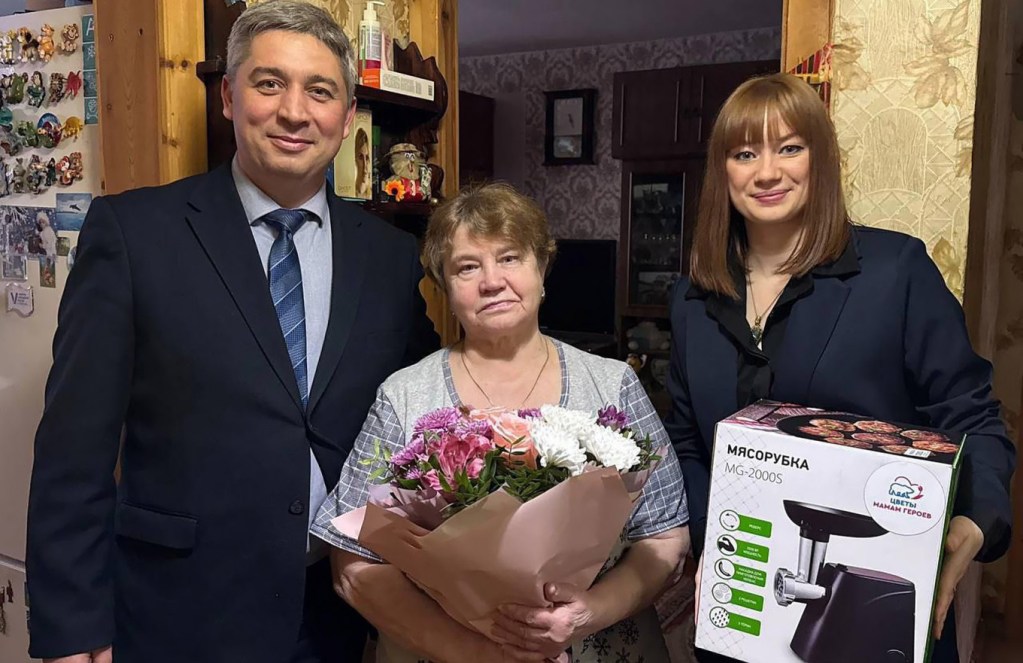
A resident of the Murmansk region who lost her son in the war was given a meat grinder for March 8 by the United Russia party. Photo: social media

In perhaps the most shocking Women’s Day event, mothers of fallen soldiers were gifted meat grinders from local United Russia officials in the Murmansk region. 

The news sparked a wave of criticism, as the kitchen appliance has become a grim symbol of the Russian military’s high-casualty assaults in Ukraine.

After the story went viral in Russian and Ukrainian media, one mother of a deceased soldier recorded a video statement in which she said she had been planning to buy a meat grinder herself, but United Russia “gifted it to her just in time.” 

“I actually asked you for it,” the elderly woman said.

In Cheboksary, a city in the republic of Chuvashia, officials organized an event exclusively for the widows and mothers of fallen soldiers. 

“May grief soon turn into pride!” declared local deputy Yevgeny Kadyshev. The women were given bouquets and gift bags labeled “Happiness and Joy.”

Russian authorities, including the United Russia party, promote the image of a military wife or mother as the ideal of femininity, gender studies researcher Ella Rossman told the Moscow Times.

The United Russia Women’s Movement was founded in the months following the invasion of Ukraine in 2022 “as a clear response to feminist anti-war activism,” Rossman said, referring to groups like Feminist Anti-War Resistance and movements of mobilized soldiers’ wives and mothers.

“Right now, the most visible female archetype in the public sphere is the woman waiting for her soldier to return from the front,” Rossman said. “But this is not the only image. There are completely opposing narratives, like that of military women themselves.”

Rossman pointed to an article in a pro-Kremlin tabloid about a woman from Rostov who signed a military contract and went to war.

“She is a mother who left her daughter to fight, has already lost a leg in combat and tells journalists that as soon as she recovers, she will go back to the battlefield,” Rossman said.

Local television stations have been covering Women’s Day events for soldiers’ mothers and wives, while also highlighting women assisting the war effort or fighting on the front lines.

After these official celebrations, politicians sometimes invite the women for tea. In Stavropol, a table was set for the mothers and wives of soldiers following a concert at a veterans’ hospital.

“Some of them are waiting for their sons to return home. Others, unfortunately, have lost their defenders who gave their lives for the Motherland,” Senator Daria Lantratova, representing occupied Luhansk, wrote on social media.

United Russia activists also delivered flowers to soldiers’ mothers in occupied Donetsk.

“Your son is a hero. We congratulate you on this holiday and wish you well. We hope this war will end and peace will come,” a United Russia Women’s Movement activist told an elderly woman. After hearing the word “hero,” the woman teared up. 

“Don’t cry,” the United Russia activist told the older woman as they parted.

Russian soldiers fighting in Ukraine also sent video messages to military mothers and widows ahead of the holiday.

“Heroes are born in families. Women give birth to us. Women raise us in kindergartens and schools. The making of any hero is thanks to the great women in his life,” Leonid Lapin, a soldier who fought as a sniper platoon commander in Ukraine, said in a video message.

Putin meets with Olga Chebnyova, widow of ‘Hero of Russia’ Sergei Chebnyov. Photo: kremlin.ru

United Russia has even involved children with disabilities in the celebrations. In the Yamalo-Nenets autonomous district, mothers from a center for parents of children with mental and physical disabilities — along with their children — made greeting cards for soldiers’ relatives.

“This is not just a good initiative. Seeing how children with special needs get involved, how their eyes light up, you realize we are on the right path,” said United Russia member Alexei Komarevtsev. 

In an interview with a local news channel, he described the craft project as “socialization” for children with disabilities. Some of the cards, he added, will be sent to the front lines, “because there are also girls serving there.”

In some regions, such as Tula, soldiers’ wives and mothers received a one-time payment of 10,000 rubles (about $100) for Women’s Day. Elsewhere, gifts included makeup sets or tickets to the philharmonic.

In the Moscow region, United Russia organized a makeup seminar for soldiers’ wives, saying such initiatives “help strengthen family values and improve quality of life in society.”

“War disrupts social norms and the way of life,” Rossman said. “But war also imposes constraints on the very possibility of a rigid binary between male and female roles, even though war seems to fit that binary perfectly.”

That is likely why the authorities have been working overtime to reinforce the Kremlin’s idea of “traditional” values since the start of the war, she said.

“Russian authorities are forced to declare and reinforce traditional values [because] many families that were once intact before the war have now lost their fathers,” Rossman said. “There are also military women — doctors, for example — and women who have voluntarily gone to war. Ignoring these women is impossible. They, too, are a target audience from a propaganda standpoint.”

As the war drags on and Russia’s battlefield losses mount, authorities are forced to balance different ideals of femininity in their propaganda messaging, Rossman said. 

“They are constantly having to create different female archetypes for different audiences,” she said.

Source: Angelina Trefilova, “Russian Authorities Glorify Military Wives and Mothers on Women’s Day,” Moscow Times, 7 March 2025

Julia Khazagaeva: I Am Just a Mom with Three Kids

The statements about the war made by Muscovite political exiles cause public indignation because what they say is at odds with the horror of the situation. Instead of taking to European podiums and demanding decisive action to defend Ukraine, they ask [European officials] to lift sanctions against Russians and mumble helplessly about “one nation.”

It is obvious that, for the fourth year running, Russia has been waging not just a war against Ukraine on the front lines, but a bloody, boundless campaign of terror. Nearly every day Russian missiles kill [Ukrainian] civilians, including children. Ukrainian soldiers who surrender unarmed are executed on the spot by the Russians, or are even ritually beheaded. But you continue to talk about Russia’s “democratic future,” ignoring the fact that the entire country, including schoolchildren, has been slaving away at destroying the Ukrainians.

I am not a politician, just a microblogger who cares about current events. But even I remember InformNapalm’s OSINT investigation which showed that the Russian fighter planes bombing Ukraine are still equipped with French avionics. Without this unique equipment, Russia’s Su-30SM fighter planes are blind and cannot fly. Russia obtains this equipment through Kazakhstan, thus bypassing sanctions. The report came out a year ago. I don’t know what the situation is like now, but warplanes are still taking off from Russian airfields.

Why couldn’t you have talked about that in the French Senate? Especially since, a week earlier, a Russian missile fired from a fighter plane and packed with shrapnel killed twenty people, including nine children, in Krivyi Rih. The photo of a young [boy] in a coffin, whose face had been riddled by the tiny metal shards, is impossible to forget.

The coffins of 15-year-old Nikita Perekrest and his cousin, 16-year-old Kostiantyn Novik. Nikita’s father serves in the Ukrainian Armed Forces, and his mother took Kostiantyn in after his parents were killed. The two boys were outside in the yard when the Russian army struck Kryvyi Rih. Photo: Evgeniy Maloletka/AP/Scanpix/LETA, via Meduza

I realize that none of Moscow’s so-called opposition activists have the courage of political prisoner [Vladimir] Bukovsky and demand that Ukraine be given missiles to target Lubyanka. But you could launch investigations into the schemes by which Russia circumvents sanctions and obtains not only components for its fighter planes but also foreign chips for its missiles. You could demand that the Bosphorus be closed to Russia’s shadow fleet, which brings Putin the revenue to produce new missiles. Finally, you could show solidarity with Ukraine at least in word [if not in deed] and stop embarrassing yourself by repeating the impersonal and irrelevant slogan “No War.” You could do a lot of things in your safe havens. But instead you just wait for Putin to die and are not even ashamed to say so. Meanwhile, it is not so much the Ukrainians or the decolonizers who are waiting for you to act as it is your own fellow Russian citizens, who have not yet lost their minds and are basically living under occupation in Russia.

///

As for the ridiculous claim that it is easier for non-Russians to go to war and that is why they make up the majority [of soldiers] in the [Russian] army, according to the analytical resource buryatmemorial.org, a total of 2,425 people from Buryatia have been killed in the “special military operation” as of March 2025. And you’ll pardon me, but hardly half of them are ethnic Buryats (as you can see from the photos). This is due to the fact that ethnic Buryats constitute no more than 31% of the republic’s entire population. According to Ukrainian figures, Russian losses have already lost 933,000 men in the war. Even if we multiplied the figures for Buryatia by ten, its war dead would still roughly amount to two and a half percent of the total. I emphasize that the Buryats are an ethnic minority in their own land.

A screenshot of the website buryatmemorial.org, showing the names and faces of Buryatia’s war dead

According to Caucasian Knot, as of March 2025, 233 men from Chechnya, 121 from Ingushetia, 104 from Karachay-Cherkessia, and 112 from Kalmykia have been killed in the special military operation. Again, we can multiply this figure by ten for the sake of statistical rigor, but we still get hundredths of a percent of the total losses.

To put an end to the topic of Vladimir Kara-Murza’s ridiculous misinformation drop, yes, I saw yesterday’s post by the activist Anastasia Shevchenko, from which it follows that she was the mysterious “colleague” who shared with Kara-Murza the “observation” that it may be easier for non-Russians to go to war, while Russians find it psychologically difficult to kill Ukrainians due to their cultural affinity. Anastasia writes that the source of this hypothesis was not even her, but a third party who voiced this conjecture in a private conversation. Do you realize what has happened? This was not a scientific observation; no studies or surveys of Russian POWs were done that would indicate such a trend. This “information” came from the bush telegraph and was repeated by a [Russian] opposition politician in the French Senate, where decisions are made on the basis of the words people utter. And even after the ruckus that this delusional phrase caused among the public, no apology or explanation has been forthcoming from the politician.

Again, I am just a mom with three kids who left Russia to avoid supporting the war. In exile, I wash floors and clean other people’s houses so that I can send at least thirty dollars [a month] to the Ukrainians so they can buy drones. At night I write social media posts and read decolonial literature. I try to do anything I can to stop my former country from murdering innocent people. In my opinion, I have the right to demand that those who call themselves politicians, who have the bully pulpits and the opportunities, do something meaningful to ensure that Russia can no longer wage war.

There is nothing more important right now.

Source: Julia Khazagaeva (Facebook), 14 April 2025. Translated by the Russian Reader

The Buryats Made Them Do It

This is Vladimir Kara-Murza, speaking at the French Senate:

There is another reason why the Russian Defense Ministry recruits so many members of ethnic minorities [to fight in the war against Ukraine]: as it turns out, because it is psychologically really difficult for [ethnic] Russians to kill Ukrainians. Because we are one people. We are very close peoples, as everybody knows. We have nearly the same language, the same religion, and centuries of history in common. But if it’s someone from another culture, allegedly it’s easier [for them to kill Ukrainians]. I hadn’t really thought about it before. I thought the reasons were primarily economic. But after what [a colleague who spoke about the Buryats] said, I started thinking about it too.

A screenshot of the video Ms. Khazagaeva cites in her Facebook post

You did get that, friends? It’s so difficult, so unbearable for ethnic Russians to kill you Ukrainians that Buryats and Chechens have been doing all the work for them — because [Buryats and Chechens] are beasts and savages. That makes sense, doesn’t it?

By the way, [Kara-Murza] refers to Buryats and Chechens as “those ethnic minorities.”

In other words, all eleven years [of Russia’s war against Ukraine], the Buryats, who number under four hundred and fifty thousand people, including children and the elderly, have been attempting to kill the forty million Ukrainians. It transpires, however, that the hundred million ethnic Russians have had it “psychologically difficult” all those eleven years. They are mere victims of this war, which is something “those [other] ethnic groups” want. Don’t get them wrong: ethnic Russians love you Ukrainians like brothers!

You have explained everything so clearly, Mr. Kara-Murza. I have literally just a couple of follow-up questions. Excuse me, has it also been the Buryats who have been launching missiles at Ukrainian cities? And the creatures who on Russian television rejoice at the deaths of Ukrainian children in Kryvyi Rih, are they also members of these same ethnic minorities?

I’m sorry, but I have another question. The whole world knows what the Pskov paratroopers did in Bucha. Do you have any ideas how to repaint them as Buryats? Although it would probably be a bit difficult, since “your lads” have already been testifying.

One more question. The other day, 7 April, was the thirtieth anniversary of the Samashki massacre. Eighty people, mostly children, women and old people, were burned alive in Samashki, and hundreds of people were killed in total. This is not to mention the forty thousand Chechen children killed in the two [Chechen] wars. Excuse me, did the Chechens shell themselves? Ethnic Russians are totally incapable of that, aren’t they? To hell with what Tolstoy wrote in Hadji Murat. Tolstoy was a renegade.

Oh, I’ve gotten a little carried away. Two million people were killed in the Soviet invasion of Afghanistan. They say that’s where the notorious practice of “mopping up” villages, leaving mass graves in their wake, originated. I’m sorry, who did the killing in Afghanistan? Was that the Buryats too?

Good Lord, where do you get so many of them?

The only thing I don’t understand is how the idea of the “Russian world” could have emerged, since you ethnic Russians live in love and friendship with all countries. It must have been the Chukchi who overdid it on that front.

I also don’t understand why it is the ethnic Russians who do ballet, but it is the non-Russians who make war.

P.S. Thanks to the lovely Olga Arles for her [translation] of Kara-Murza’s full speech.

///

Updated, 13 April. I have replaced the picture originally below the post with a video featuring the entire quotation by Kara-Murza. Thanks to the good people who provided the AI translation. It shows that Kara-Murza’s words, whether presented in expanded or abridged form, bear the same message: ethnic Russians don’t want to kill Ukrainians, and it’s easier for non-Russians to do it. Because we ethnic Russians and the Ukrainians are one and the same, but we’re not the same as those non-Russians. It matters not a whit that Kara-Murza referenced someone else’s observation. What matters is that he voiced this idea personally and voluntarily, and that he confirmed his commitment to it by saying that it has given him pause for thought too. Think about it. A Russian politician (as Kara-Murza fancies himself), while visiting the parliament of a major European country, says that it is mainly Buryats who want the war. He says this on the record in a place where every word uttered potentially has legal force. He said it not in a bar, not on a beach, but in the French Senate, where decisions on sanctions are made.

I have not emended the text of my original post, dated 12 April.

Source: Julia Khazagaeva (Facebook), 11 April 2025. Translated by the Russian Reader.


On 10 April 2025, the Senate Foreign Affairs Committee heard the testimony of Vladimir Kara-Murza, vice-president of the Free Russia Foundation and a former Russian political prisoner. A Russian politician and opponent of Vladimir Putin, Kara-Murza survived two poisoning attempts, in 2015 and 2017. In April 2023, he was sentenced to 25 years in a penal colony by the Russian justice system after criticizing Russia’s invasion of Ukraine. He was released on 1 August 2024 in a prisoner exchange. In his testimony to the senators, he stressed the autocratic and violent nature of Putin’s regime. He called on the European Union to maintain its sanctions against Russia, and to bring its weight to bear on peace negotiations in Ukraine. He maintains the hope that the country will soon become democratic.

Source: Public Sénat (YouTube), 10 April 2025. Annotation translated, from the French, by the Russian Reader

Kyle

Three years ago, one man saved my family and me. He knew nothing about us except that I was a journalist, that I had left Russia because of the war, that I had children, and that we had nowhere to go. Kyle and his wife Katie decided to take us in and give us shelter. We finally had a dot on the map where we were welcome. That was how we ended up in the United States, after traveling through five or six countries in the first three months of the war.

We still live in the house into which Kyle and Katie welcomed us. All these three years, I have felt the kind of care and involvement from them which you don’t normally expect from strangers. A few days after we arrived, Katie’s mom sent us a dinner consisting of food to which we were accustomed. And Kyle was always trying to help. He paid our utilities for a long time, and he gave my husband odd jobs.

Yesterday, Elon Musk fired Kyle and two hundred other employees at the research institute where they work.

“DOGE struck like a thief in the night. Too cowardly to fire us in person, virtually everyone at NIOSH learned they were laying us off via a summary overnight email,” Kyle writes on his Facebook page.

NIOSH is the National Institute for Occupational Safety and Health, which was established by Congress over fifty years ago. It researched health and safety hazards, recommended essential standards for occupational safety and health, and investigated workplace disease outbreaks. For many years, the Institute also monitored the health of 9/11 first responders and tracked occupational illnesses among firefighters and miners.

Kyle himself worked as pulmonary toxicologist at NIOSH. He studied the effects of inhaled toxicants on the lungs and other organs.

“Since 2017, I’ve studied the effects of micronized copper-treated lumber sawdust, Corian/alumina trihydrate, various 3D printer emissions, and, most recently, engineered stone dust. That last material, engineered stone, is currently responsible for a global outbreak of silicosis, a progressive and ultimately fatal lung disease. Truly a public health crisis with profound impacts on exposed workers,” Kyle writes in his post.

DOGE sent the institute’s employees a mass layoff notice at five a.m. Tuesday morning. The brief letter announced that NIOSH was being eliminated “to improve efficiency.”

“To be clear, nothing about these firings was efficient,” Kyle retorts. “This was not trimming the fat, or even a decimation, but a wholesale execution of the institute. Only a skeleton crew now remains, presumably to help sell off instruments and other assets before being fired themselves. Is it efficient to stop millions of dollars’ worth of studies in their tracks, never to be completed? The breadth of institutional knowledge lost is hard to fathom (not speaking of myself here; I have been lucky to be trained by true giants in the field). Were there inefficiencies at NIOSH? Of course, the same as with any large organization, and I would have been happy to see improvements in those areas. Unfortunately, the costs of what happened today will compound over the next several decades, yielding sick and dying workers—husbands, mothers, sons, and daughters. I hope it was worth it. For what? A billionaires’ tax break?

“Ultimately, I think I will be okay, although the prospect of job hunting in a field saturated with thousands of newly jobless scientists is daunting—especially as the current sole breadwinner and with a child on the way. What I know for certain is that somewhere today, a worker is being exposed to something that will eventually kill him, and there will be no one there to figure out why he died.”

///

On April fifth, people all across the United States will take to the streets in protest. Despite Trump’s threats to deport all disloyal people “to their country of origin,” I will be there too. What is more, I will be at a protest rally helping the organizers as a volunteer. Americans have been good to me, so I cannot fade into the woodwork when their accomplishments are under attack and their world is crumbling. I will stand with those who are willing to defend their values.

Source: Julia Khazagaeva (Facebook), 2 April 2025. Translated by the Russian Reader, who thanks the author for her kind permission to publish her text in translation on this website.

The Storming of Grozny: Thirty Years Later

A Chechen refugee in front of her destroyed apartment building
in downtown Grozny, February 17, 1995. Photo: Reuters (via Julia Khazagaeva)

On the thirtieth anniversary of the storming of Grozny, the liberal Russian media reminded the Russophone audience that there had been such a war—the Chechen War. When I see this title, I don’t even open the movie, I flip through it. A couple of excerpts are basically enough for me to be convinced that these people have still understood nothing after three decades. Even over the three years of the recent, utterly treacherous imperial war in Ukraine, the obvious facts about what Chechnya means to Russia have not became obvious to them.

Almost any decent Russian would point out to you, of course, that bombing towns chockablock with civilians was a bad thing to do and foul play. Carrying out mop-ups in villages and burying the victims in mass graves was also outrageous. But then the exclamation “but!” is sure to follow. They will tell you about Chechen bandits, forged letters of credit, and the intransigent Dudayev. Yes, it was wrong to destroy a third of Chechnya’s population, this notional Russian would lament, but the Chechens were bad eggs themselves and were asking for it.

If you ever do open a Russian [documentary] film reconstructing the events in Chechnya thirty years ago, you will find that it is about the enlisted lads who on New Year’s Eve 1994 were thrown into the epicenter of hell. Not properly trained to shoot or drive a tank, alone against hordes of heavily armed rebels, they were unfortunate sons of the Motherland: may their memory live forever. This artistic device is deployed, for example, by the Maxim Katz-affiliated project Minute by Minute. The [YouTube] channels Current Time and Popular Politics have also recalled this selfsame “Chechen War.”

Minute by Minute, “The New Year’s Eve Storming of Grozny: A Minute by Minute Reconstruction” (December 31, 2024)

Semantically, the construction “Chechen War” operates the same way as the coinage “captive of the Caucasus.” It conceals the aggressor, suggesting we look at the object of the aggression as the aggression’s cause. In this logical trap, Chechnya seems to have gone up in flames by itself. It was its inhabitants who shelled and bombed themselves silly. It was not Russia that invaded the Caucasus, it was the Caucasus which for some reason held Russia’s soldiers in captivity. It is not without reason that when people say “he was killed in Chechnya,” it is the place where he was killed that appears to be the malefactor. The listener is not prompted to wonder what this soldier was doing under arms in a foreign land. It is as if Chechnya had shown up in Samara and killed an innocent tanker.

When we think, write and say “Chechen War,” we automatically interpret it from the point of view of the colonizer and the aggressor. We accept the interpretation imposed by Moscow, which insists that Chechnya is part of Russia, not a sovereign country it attacked. If Russia is not mentioned in the nomenclaturee of this historical event, Chechnya is automatically read as an undeniable part of the empire, and the conflict itself sounds akin to the November Uprising or the Tambov Rebellion.

In fact, it was the Russo-Chechen War which began on December 11, 1994. The war deserves to be identified as such both in terms of the nature of the hostilities and the status of the warring parties, because by the time the Chechen Republic of Ichkeria was invaded by Russian troops, it had been three years since it had legally, by popular vote and a declaration of independence, withdrawn from the USSR on an equal footing with the RSFSR. The Chechens had NOT been part of the newly minted Russian Federation for a single day.

The independent journalist Vadym Zaydman has written about this better and more clearly than anyone else. There is no need to paraphrase him when I can instead quote what he has written:

“At the time of the USSR’s death/colllapse, Chechnya was no longer legally related either to the defunct Soviet empire or to the RSFSR. By that time the Chechen-Ingush ASSR had existed as a Union Republic for over a year. Thus, by definition it could not be a part of the Russian Federation, as proclaimed on December 25, 1991. When the Russian Federation was born, Chechnya was initially not a part of it.

“Russia itself did not regard Chechnya as part of Russia during this period. On March 31, 1992, the Federation Treaty was incorporated into the Russian Constitution. It changed the status of autonomous republics to sovereign republics within the Russian Federation. The treaty was signed by representatives of twenty federal subjects of the Russian Federation. Neither the Chechen-Ingush Republic nor Chechnya was involved in the treaty.

“It was only in the wake of the notorious events of October 1993, when Yeltsin was adopting a new Russian constitution, that he unilaterally incorporated Chechnya into the Russian Federation. In fact, Yeltsin committed a fraud like the one committed by the Russian authorities when, after the Soviet Union’s collapse, they declared Russia a member of the UN Security Council as the USSR’s legal successor, although Russia was not even a rank-and-file member of the UN. Ukraine and Belarus were members of the UN, but Russia aka the Russian Soviet Federative Socialist Republic was not! Having incorporated Chechnya, a year later Russia started to establish ‘constitutional order’ in Chechnya as its own fiefdom! Clever, isn’t it?!”

End quote.

The term “Chechen War” is thus as illegitimate as the use of the term “Ukrainian War” is unacceptable. Ukrainians would not allow the latter, and the entire civilized world would not agree to it. For everyone, the current war is the Russo-Ukrainian War. But the same thing should happen in our minds when describing the war in Chechnya. It is the Russo-Chechen War.

Many Russians would understandably prefer it go down in history in a more modest way—ideally, not as a war at all, but as a “special military operation,” or a “counter-terrorist operation,” for it is the security forces, not the simple folk, who are responsible for such operations. “SMO” and “CTO” sound mundane and localized, like a police “amber alert,” nor are they freighted with collective guilt and responsibility. Most vitally, if correlated with these Putinist terms, western sanctions come to be regarded as an exorbitant and unwarranted punishment, since they make “ordinary people suffer.”

Why do you think various Putinist and anti-Putinist institutions have spent the last three years relentlessly measuring public opinion on whether Russians want war? Yes, it’s simple: because of the sanctions—and Russia’s slightly tarnished image in the eyes of the international community. But if the West is shown the relevant polls quite often and reminded that “public opinion polls don’t work in a totalitarian society,” this mantra will work like a charm the thousandth time. It will then be much easier for Brussels officials to explain to themselves and their electorate why they are lifting restrictions: because they oppress an already “downtrodden” civil society, which in no way wanted war, but which was forced by Putin to want it.

Meanwhile, to answer the question of how much the Russian populace shares its leadership’s imperial mindset, it is enough to take the case of the Russo-Chechen War. From the sociological viewpoint, it is a scientifically pristine experiment. In 1994 (as in 1999, when the second phase of the war began) there was no totalitarianism in Russia. There were no western sanctions, and there were no Russian émigrés criticizing the regime from abroad. U.S. President Bill Clinton expressed “concern” when he learned that civilians were being killed in Chechnya. France supported the establishment of constitutional order on Russia’s own territory. They all thought that the new Russian Czar Yeltsin was better than any Communist, even if he fought like one.

Enjoying the full favor of the international community, Russia razed Grozny to the ground along with the remnants of its civilian population on New Year’s Eve 1994. This did not cause any outcry in Russian society. The first protest rally in Moscow took place on January 10, 1995: organized by Yegor Gaidar, it was a partisan affair and sparsely attended. Noticeable civil protests against the war in Chechnya would not begin until 2001—that is, five years later. [My comrade Antti Rautiainen, who was very much in the thick of things in those years (he was a co-organizer of the first antiwar street protest in Moscow, in November 1999), has pointed out to me (in a comment to Ms. Khazagaeva’s original post in Russian) that the biggest protest in Moscow against the Second Chechen War took place in January 2000, not in 2001 — TRR.] However, even then, according to Radio Svoboda, which interviewed passersby, “Muscovites were in no hurry to join the protesters: everyone was rushing about their business.”

Protests during the first phase of the Russo-Chechen War were isolated and (one might say) personal in nature. From the very first days of the invasion, the Soviet dissident, Russian human rights activist and Russian human rights commissioner Sergei Kovalev traveled to Grozny. He tried to stop the bombing of the city. In March 1995, he was removed from the post of human rights commissioner for supporting the “wrong” side. TV news presenter Svetlana Sorokina took liberties on air: after a commercial break she emotionally remarked that “no laundry detergent can wash clean the conscience of the Russian generals.” Independent Chechnya and its legally elected presidents Dzhokhar Dudayev and Aslan Maskhadov were subsequently supported by Valeria Novodvorskaya. Boris Nemtsov tried to stop the war by circulating a petition [which was allegedly signed by a million Russians—TRR]. But there was no grassroots public outrage in Russia, apart from the campaign led by the mothers of the conscripts, neither in the first phase of the war, much less in the second.

This was how sociologist Yuri Levada described attitudes to the war in Chechnya in 2001: “Sentiments against the war are strong in [Russia], but unfortunately we cannot overestimate their significance. The fact is that many people think that more decisive actions, with greater loss of life, perhaps could have led to success. Disavowing the war does not exclude, for example, approving such savage measures as ‘mop-ups,’ which are now quite difficult for the authorities in Chechnya and Russia to cope with. So, an unwillingness to continue the war is an expression of fatigue, not an expression of conscious, directed protest.”

Sociologist Lev Gudkov described Russians who supported Chechnya’s return to the bosom of the empire as follows: “They are younger and better educated Russians who argue that the Chechens must be crushed at any cost and this problem must be solved by force, that no negotiations with Maskhadov are possible, that he represents no one, and that there is only one solution—the total, crushing defeat [of the Chechens]. On the contrary, those who argue that it is necessary to seek a peaceful resolution however possible, including entering into negotiations with Maskhadov, are people of an older age, somewhat wiser and more experienced, and in this sense more tolerant, inclined to recognize Chechnya’s independence as long as the war is brought an end.”

So when Russian liberals, society’s cream of the crop, write and talk about the “Chechen War,” you now know their attitude toward the empire and its conquests. Were it not for the unprecedented western sanctions for invading the European country of Ukraine, you would be surprised to learn what Russians really think about the war. As a gentleman who left Russia twenty years ago once told me in a private conversation: “I still feel sorry for our guys. After all, the Ukrainians have killed more Russians in this war than the Russians have killed Ukrainians.”

Source: Julia Khazagaeva (Facebook), 4 January 2025. Translated by the Russian Reader

Basurka

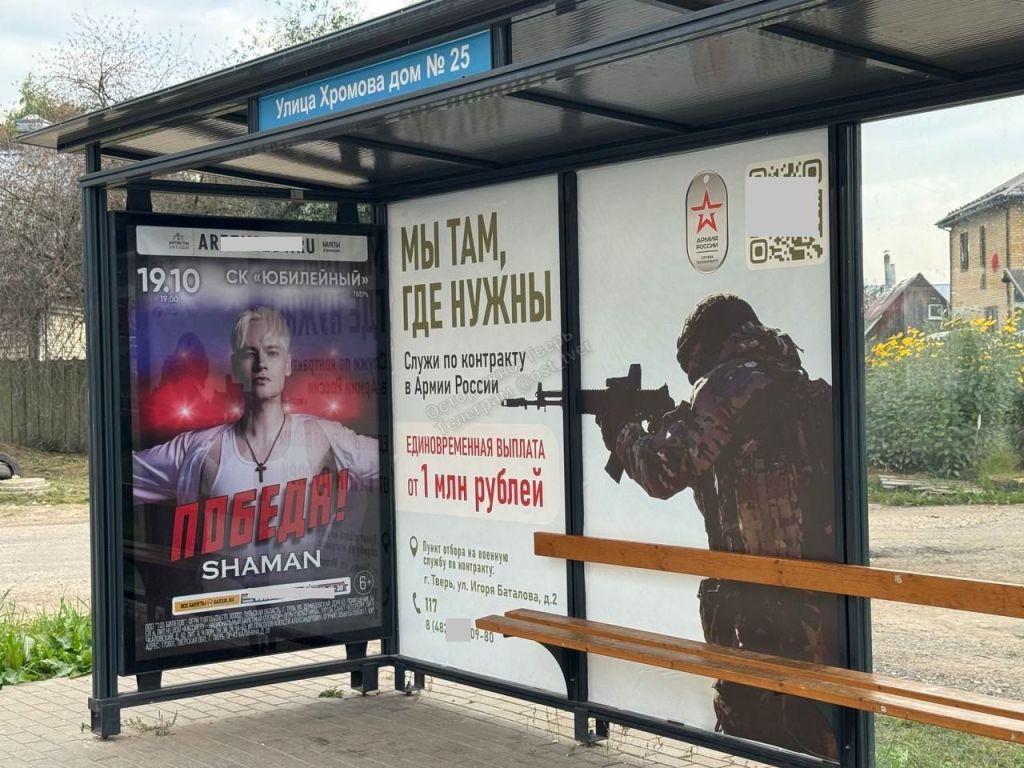
Top: “25 Khromov Street.” Left: “Shaman: Victory!” Right: “We are there where we need to be. Serve as a contract soldier in the Russian Army and get a one-time payment starting at one million rubles.”

Source: Caution, Tver! (Telegram), 1 September 2024. Thanks to Andrey Anissimov for the heads-up. “Basurka” is the faux-Russian nonce word I coined for this distressing post. It was suggested to me by our building’s bilingual garbage bin. ||| TRR


Many acquaintances from Russia condemn me for calling for the bombing of Russian factories and supporting the Ukrainian army’s Kursk offensive. They genuinely don’t get how one could wish defeat on one’s own country. Some have quietly unfriended me, while others continue to read my posts but are perplexed and perhaps even offended by them.

They are often the same people who “love (their) country no matter what.” This is where you all and I part ways. You REFUSE to look at reality—you turn away from it in order to love your country without breaking a sweat, as if love were a chain and you’ve been chained to a radiator since childhood. It works differently for me. I make my own decision about whether I like this scene or not. And, if my country jumps from one bloody shitstorm to another like a maniac running in circles, it’s not worthy of my love and I rescind its right to be my country. People are another matter, especially the unborn. It makes sense to fight for them. But it’s secondary to me what the country they’ll live in will be called and how big it will be. If they’ll have a better chance for a decent and safe life in a small country, then we should choose a decent and safe life for them.

Russia is an anti-human phenomenon. It is a threat to the entire world and to the people within the country. Like any rabid macaque with a grenade, it must be stopped. Look reality in the eye at last. Don’t look away. It’s happening right now, and you, with your unadulterated love, are a part of it.

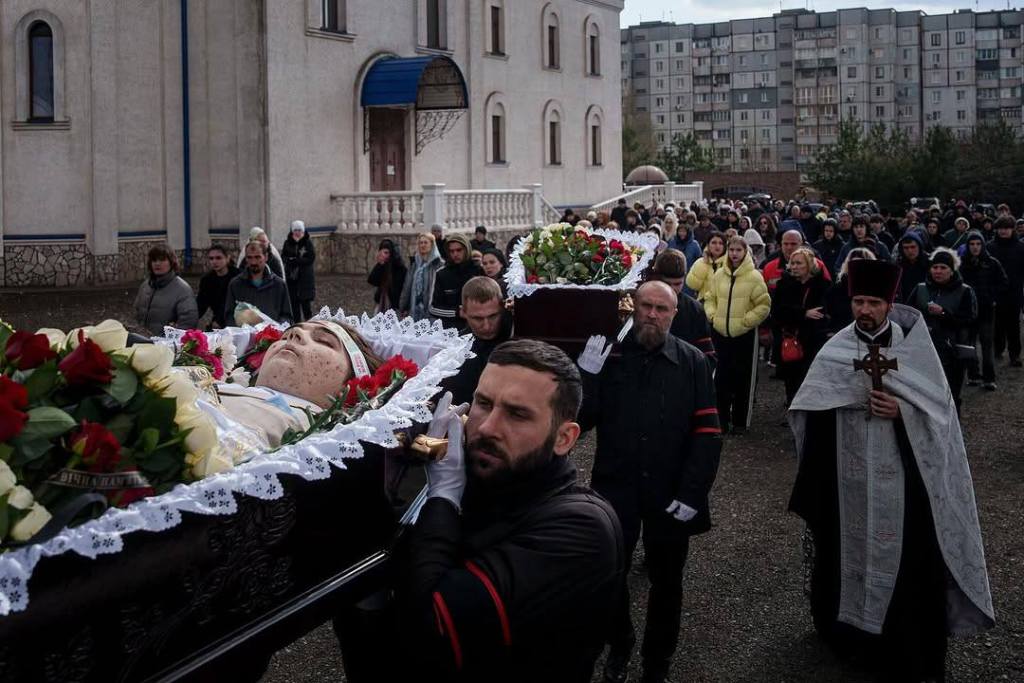
Image number one. A fourteen-year-old girl dressed in white sneakers and a white tank top, sitting on a bench in the yard of her house on an ordinary summer day. It all looks ordinary, but there is one catch: the girl is dead. A fragment of a cluster bomb, which the Russians dropped on Kharkiv on 30 August, tore off the child’s head. Everything happened instantly; no one had time to hide. The girl’s body remained seated on the bench. Perhaps her last thoughts were of her father, who had gone missing in action in the war with Russia. The family knows he was killed, but they can’t get his body back. The worst part is that he gave his life thinking he was protecting his daughter. Russia got to her, though, and so the family’s story is over. Father and daughter are not alive because they were born near Russia. Other Kharkiv residents who were killed in that senseless attack are also “guilty” in this sense.

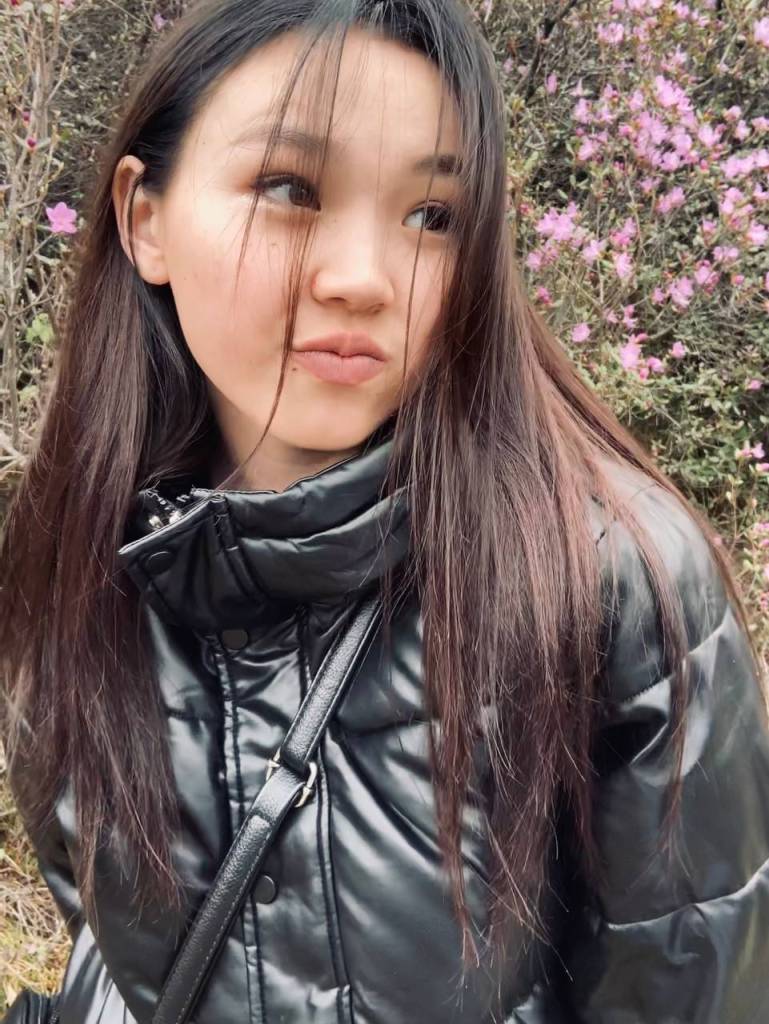
Image number two. A girl again, but from another city. She is fifteen years old and has come to Novosibirsk from the Altai to enroll in the Olympic reserve school. She is quite beautiful, gentle, kind, and has great hopes. She doesn’t understand why her fellow students call her a “dirty, slant-eyed pig.” They secretly pour waste into her backpack and mock her appearance in public. After two years of this terror, which was encouraged by coaches and school officials, the formerly cheerful girl will come to realize that this life is not for her. In her seventeenth year, she will kill herself and leave a suicide note on her Telegram channel. She will say in the note that the unbearable racist bullying was her reason for leaving this life.

The school will then post a touching obituary on their Vkontakte page. They won’t specify the cause of death, of course. All comments expressing outrage over the bullying will be assiduously deleted. Only the wishes of “soft clouds” and broken heart emojis will be left untouched.

Incitement to suicide is a criminal offense, actually. But no one will answer for the death of Ksenia Cheponova because it is not the custom in Russia to punish one’s own kind for a crime against outsiders. “You’re not my brother, black-ass louse,” says the immortalized Russian movie hero. These words are much more than a mere insult: this is how millions of people in Russia understand justice. Moral rightness is not based on your deeds, but on whether you are an insider or an outsider. It doesn’t matter what you did. What matters is whether you are stronger than me at the moment.

Ksenia Cheponova

Image number three. Beslan. September first marked the twentieth anniversary of the mass murder of children by Russian security forces in that ill-fated school. For twenty years, the perpetrators have never been held accountable for lying about “350 hostages.” There were 1,100 hostages, as we know. No one has been held accountable for firing from a tank at the building where the children were. Three hundred and thirty-four people were killed during the assault, including one hundred and eighty children. This terrorist attack might not have happened if Russia hadn’t started a war in Chechnya. The hostages might have lived if the security forces had actually tried to save them. But they were killed and twenty years on their sacrifices are still covered in lies and impunity.

All of those people could have lived if it weren’t for their country, sick with messianism and aggression. And the “it’s like this everywhere” ploy doesn’t work. No country in the world has 60 million lives lost in wars, gulags, and famines under its belt.

The time for saying “no war” has passed. It is clear that where there is a “great Russia,” there will be perpetual war. That’s why we should say no to Russia, and yes to independent Ukraine, Ichkeria, Buryat-Mongolia, and all free nations.

Or is the idea of a united Russia dearer than the lives of your children?

Source: Julia Khazagaeva (Facebook), 3 September 2024. Translated by the Russian Reader


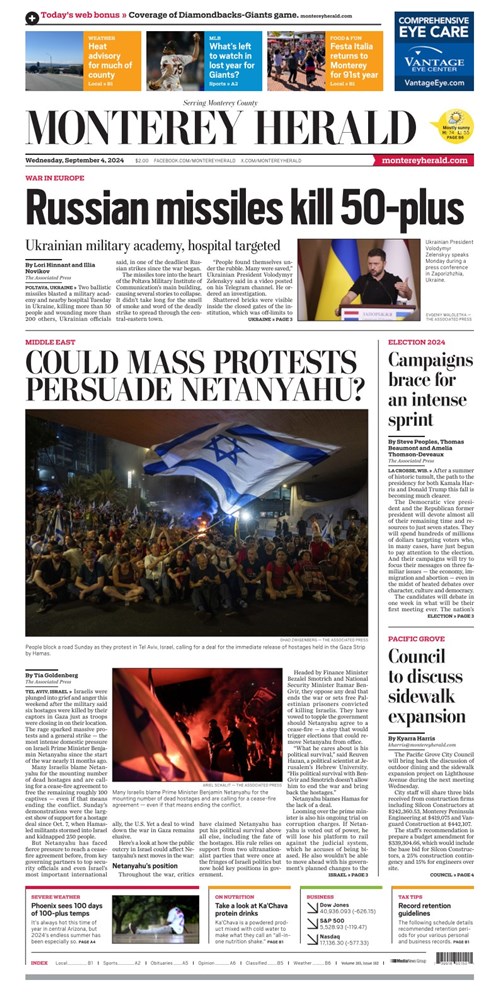
Two ballistic missiles blasted a military academy and nearby hospital Tuesday in Ukraine, killing more than 50 people and wounding more than 200 others, Ukrainian officials said.

The missiles tore into the heart of the Poltava Military Institute of Communication’s main building, causing several stories to collapse. It didn’t take long for the smell of smoke and word of the deadly strike to spread through the central-eastern town.

The strike appeared to be one of the deadliest carried out by Russian forces since the war began more than 900 days ago, with Russia’s Feb. 24, 2022, full-scale invasion.

“People found themselves under the rubble. Many were saved,” Ukrainian President Volodymyr Zelenskyy said in a video posted on his Telegram channel. He ordered an investigation.

Shattered bricks were visible inside the closed gates of the institution, which was off-limits to the media, and small pools of blood could be seen just outside hours later. Field communications trucks were parked along the perimeter. Roads were covered in glass from shattered apartment windows.

“I heard explosions … I was at home at that time. When I left the house, I realized that it was something evil and something bad,” said Yevheniy Zemskyy, who arrived to volunteer his help. “I was worried about the children, the residents of Poltava. That’s why we are here today to help our city in any way we can.”

By Tuesday evening, the death toll stood at 51, according to the general prosecutor’s office.

“My deepest condolences to the families of those killed and injured in the Russian missile attack on Poltava,” Ukraine’s first lady, Olena Zelenska, posted on social media Tuesday. “This is a shocking tragedy for the whole Ukraine.”

Filip Pronin, governor of the region that bears Poltava’s name, announced on Telegram that 219 people were wounded. Up to 18 people may be buried under the rubble, he said.

Ten apartment buildings were damaged, and more than 150 people donated blood, Pronin said.

He called it “a great tragedy” for the region and all of Ukraine, and announced three days of mourning starting Wednesday.

[…]

The academy trains officers in communications and electronics, honing some of the most valued skills in a war where both sides are fighting for control of the electronic battlefield.

“The enemy certainly must answer for all (its) crimes against humanity,” Pronin wrote on Telegram.

The Kremlin offered no immediate comment on the strike. It was not clear whether the dead and wounded were limited to Ukrainian military personnel, such as signal corps cadets, or if they included civilians.

Since it embarked on its full-scale invasion in early 2022, the Russian military has repeatedly used missiles to smash civilian targets, sometimes killing scores of people in a single attack.

Some of the deadliest such assaults included a 2022 airstrike on a theater in Mariupol that killed hundreds of civilians sheltering in the basement and a strike that same year on the train station in Kramatorsk that killed 61. Apartment buildings, markets and shopping centers have also been targeted.

Poltava is about 350 kilometers (200 miles) southeast of Kyiv, on the main highway and rail route between Kyiv and Ukraine’s second-largest city, Kharkiv, which is close to the Russian border.

The attack happened as Ukrainian forces sought to carve out their holdings in Russia’s Kursk border region after a surprise incursion that began Aug. 6 and as the Russian army hacks its way deeper into eastern Ukraine.

The missiles hit shortly after an air-raid alert sounded, when many people were on their way to a bomb shelter, Ukraine’s Defense Ministry said, describing the strike as “barbaric.”

Rescue crews and medics saved 25 people, including 11 who were dug out of the rubble, a Defense Ministry statement said.

The strike came on the day that Russian President Vladimir Putin visited Mongolia. There was no indication that his hosts would heed demands to arrest him on an international warrant for alleged war crimes.

Zelenskyy repeated his appeal for Ukraine’s Western partners to ensure swift delivery of military aid. He has previously chided the U.S. and European countries for being slow to make good on their pledges of help.

He also wants them to ease restrictions on what Ukraine can target on Russian soil with the weapons they provide. Some countries fear that hitting Russia could escalate the war.

“Ukraine needs air defense systems and missiles now, not sitting in storage,” Zelenskyy wrote in English on Telegram.

“Long-range strikes that can protect us from Russian terror are needed now, not later. Every day of delay, unfortunately, means more lost lives,” he said.

Ukraine’s air force said Monday that Russia had launched an overnight barrage of ballistic and cruise missiles and drones at Kyiv as children prepared to return to school. Multiple explosions echoed across the capital early Monday morning as Ukraine’s air defenses shot down many of the weapons, causing damage and fires as the debris fell onto the capital. 

Source: CBS News, 3 September 2024


Ufa’s Kirov District Court has remanded 20-year-old university student Makar Nikolayev in custody to a pretrial detention center for a month on charges of “promoting terrorism.” The court issued its ruling on 30 August, but it was made public only on Monday, 2 September, as reported by the Telegram channels of Baza and Idel.Realities, who cited sources. The court confirmed Nikolayev’s arrest to news website Ufa1.ru.

In 2020, Nikolayev, then a prep school student, designed an information retrieval method for creating a Russian national archive on the history of the Great Patriotic War. The boy wanted to recover information about his great-grandfather and in the process designed an entire system. His project, “Methodology for Creating a Family Archive,” won the Russian national contest “My Country — My Russia,” one of the projects of the Russia Is a Land of Opportunities presidential platform.

Later, Nikolayev went to Germany to study. According to Idel.Realities, Nikolayev had been studying at a university in Frankfurt am Main in recent years. In August 2024, he came home on holiday to Ufa, where he was detained.

According to police investigators, during his time abroad, Nikolayev wrote comments on social networks supporting Ukraine and urging people to join the Russian Volunteer Corps. The stipulated punishment for violating Russian Federal Criminal Code Article 205.2.2 (“Public calls to carry out terrorist activities; public justification of terrorism or promotion of terrorism, committed using mass media or electronic or telecommunication networks”) is five to seven years in prison.

Source: Sergei Kuprikov, “Winner of ‘My Country — My Russia’ contest detained in Ufa,” Deutsche Welle Russian Service, 2 September 2024. Translated by the Russian Reader

Hideout

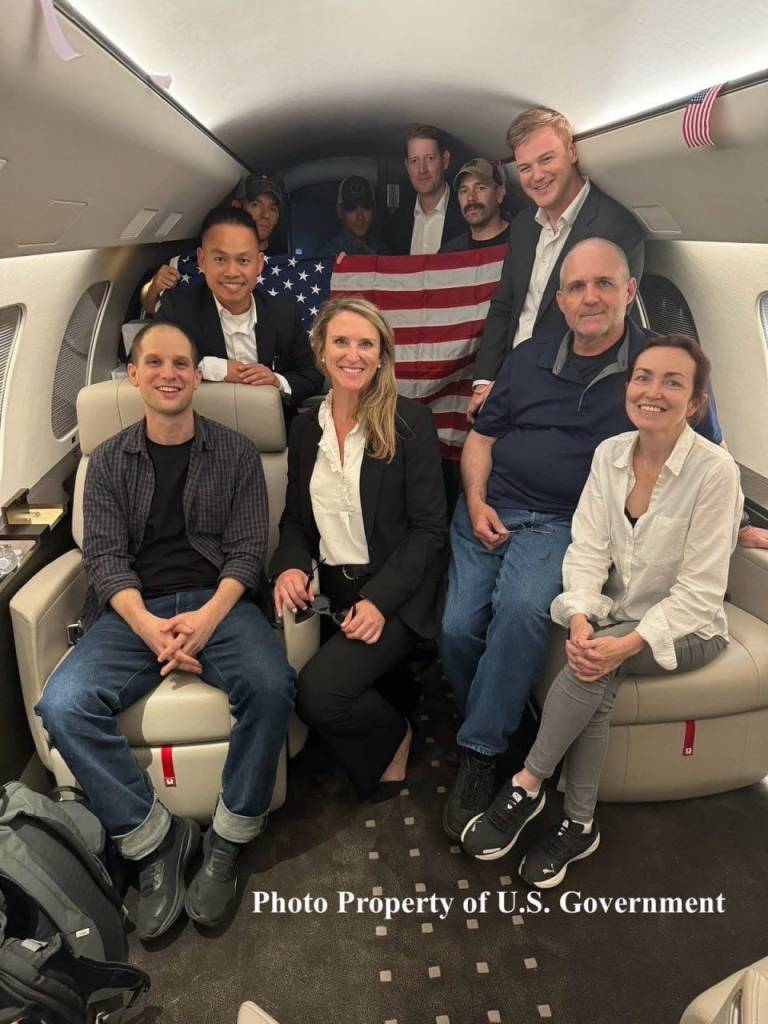
It took me a while to understand why the news about the prisoner swap has been making me feel bitter rather than happy, although I wish all these people freedom, of course.

No, it wasn’t because, thanks to an American journalist’s arrogance and a German tourist’s stupidity, a professional FSB killer has been set free, meaning that his crime will go unpunished and nullifying the enormous efforts a large number of people made in apprehending him. And not because they mainly swapped for prisoners celebrated by the media, leaving in the gulag the unknown loners who wanted to fight on behalf of Ukraine. And not even because the leaders of the Anti-Corruption Foundation themselves took credit for the release of Navalny’s supporters while failing to thank the US authorities for their unbelievable efforts in haggling for their people’s freedom.

My bitterness arises from the very fact that the haggling took place. It shows that Putin is treated as a force to be reckoned with, that he is given what he wants. And that means that Putin’s Russia will be around for a long time to come. The regime is recognized and there is still no strategic decision on what to do about it.

Source: Julia Khazagaeva (Facebook), 1 August 2024. Translated by the Russian Reader


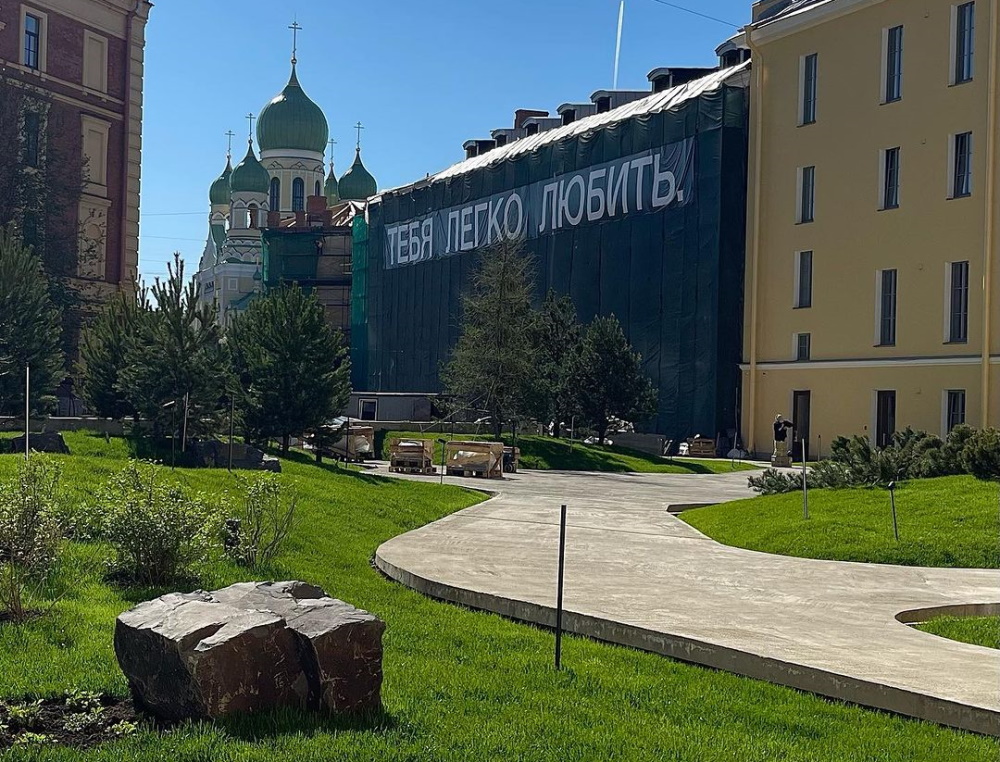
In 2024, the creators of the Wynwood Hotel opened Hideout, a new public space [sic] at 22 Rimsky-Korsakov Avenue [in Petersburg]. Bumaga shows its readers what the neighborhood looks like and explains how it is laid out.

“You’re easy to love.” Photo: @3axapkina (Instagram)

People started talking about the space in the spring of 2024, when a banner emblazoned with the words “You’re easy to love” was hung on the facade of a historic building. This Is a Sign, a team that installs similar messages in the urban environment, was commissioned by Hideout to do the piece.

The Hideout Residence apartments began operating in the summer, and a Scandinavian garden in the courtyard was also opened, Hideout told Bumaga.

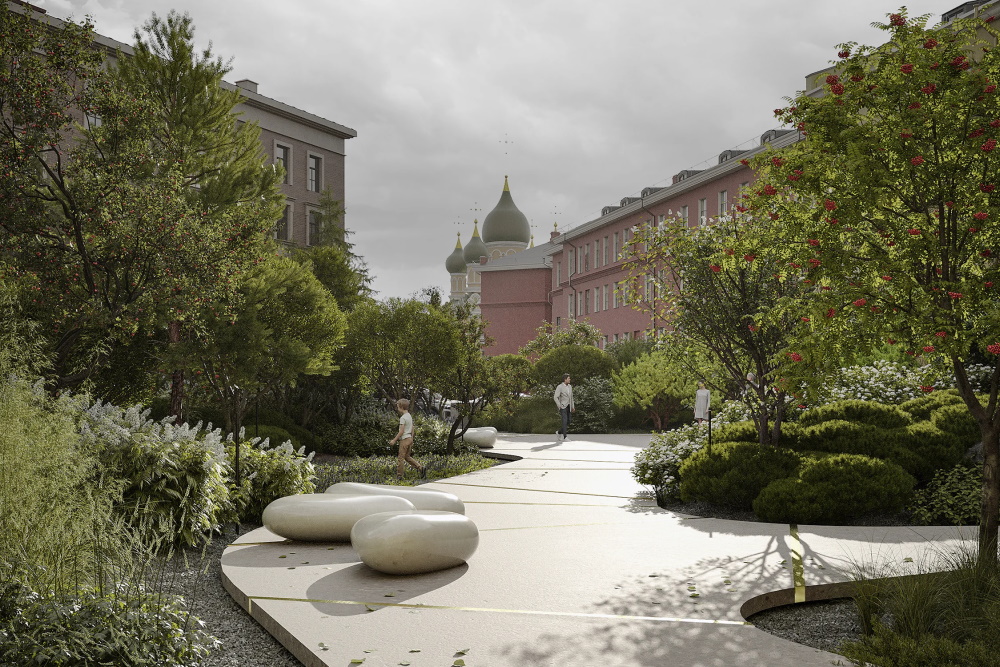
The garden in the courtyard was designed by landscape architecture studio L.Buro. The main works have been completed, but the garden will be developed and improved in the future, Hideout said.


L.Buro’s new Scandinavian garden project is now open to the public! Hideout is an urban space featuring an aparthotel, restaurants, and a fitness studio. Spoiler: a hotel and a contemporary art gallery will open there soon🤫 When designing this project, the studio’s architects managed to take a fresh look at Petersburg’s historic centre . In the video, L.Buro founders Valery Fedotov and Pyotr Lari talk in detail about the Hideout project.

The space’s press service of the space also noted that trees and plants were already growing at the site in the late eighteenth century. State Councillor Charles Gascoine, who owned the plot, laid out a fruit orchard near his mansion.

L.Buro’s rendering of Hideout’s garden

Suite Beauty Salon, Power Peach Yoga and Functional Training Studio, and other tenants operate in the space. The space’s first gastronomic tenant was Jam Café, by the creators of Atelier Tapas & Bar, which opened at the beginning of the year.

In the summer, Hideout added another gastro project, Aster Bakery‘s 23-table patio terrace in the courtyard.

Aster Bakery’s patio terrace. Photo: Hideout

An aparthotel featuring 60- to 100-square-metre residences has been welcoming guests. They have been decorated in neutral colors and sport designer furniture.

In August, the residences can be booked starting at 43,000 rubles [approx. 500 USD] a night.

A residence at Hideout

Source: “Hideout is a space in Kolomna with a Scandinavian garden, an Aster Bakery patio, and a sign that says, ‘You’re easy to love.’ Here’s what it looks like,” Bumaga, 31 July 2024. Translated by the Russian Reader

Inner Mongolia

WordPess AI-elicited image: “Mongolia, as imagined by Russian liberals”

Political scientist Andrei Nikulin writes on his Telegram channel: “If even Mongolia can be progressive and democratic, then all the more so can Russia be progressive and democratic.” Claims to the contrary are just neurolinguistic programming, he argues.

I am unironically aware that, from the Moscow intellectual’s lofty vantage point, Mongolia is a backward, third-rate country. The whole semantics of Nikulin’s turn of phrase says so. Since those nomads were able to do it, why can’t we, cultured Europeans, have a normal future?

I generally salute positive affirmation. But before we are cheered up by a sense of superiority, let’s face reality. Here are just a few facts about Mongolians today.

Yes, forty percent Mongolia’s population is made up of nomads who, like their ancestors, live in yurts and travel with their livestock. Yes, there are only three paved roads for a population of three and a half million people.

But since 1990, the Mongolian people have elected six presidents, never once allowing any of them to exceed their rightful term in office. The Mongolian constitution gives a leader only one six-year term without the right to re-election, and this norm has never been violated. The average turnout in elections at all levels of government is seventy percent. By comparison, turnout in progressive Moscow barely exceeded thirty percent when Navalny ran for mayor.

Further, while Russians were seizing Crimea and “nullifying” Putin’s previous terms as president, the humble Mongolian nomads forced their government to resign at least twice, in 2017 and 2021. In 2012, a former president was arrested and jailed on charges of bribery.

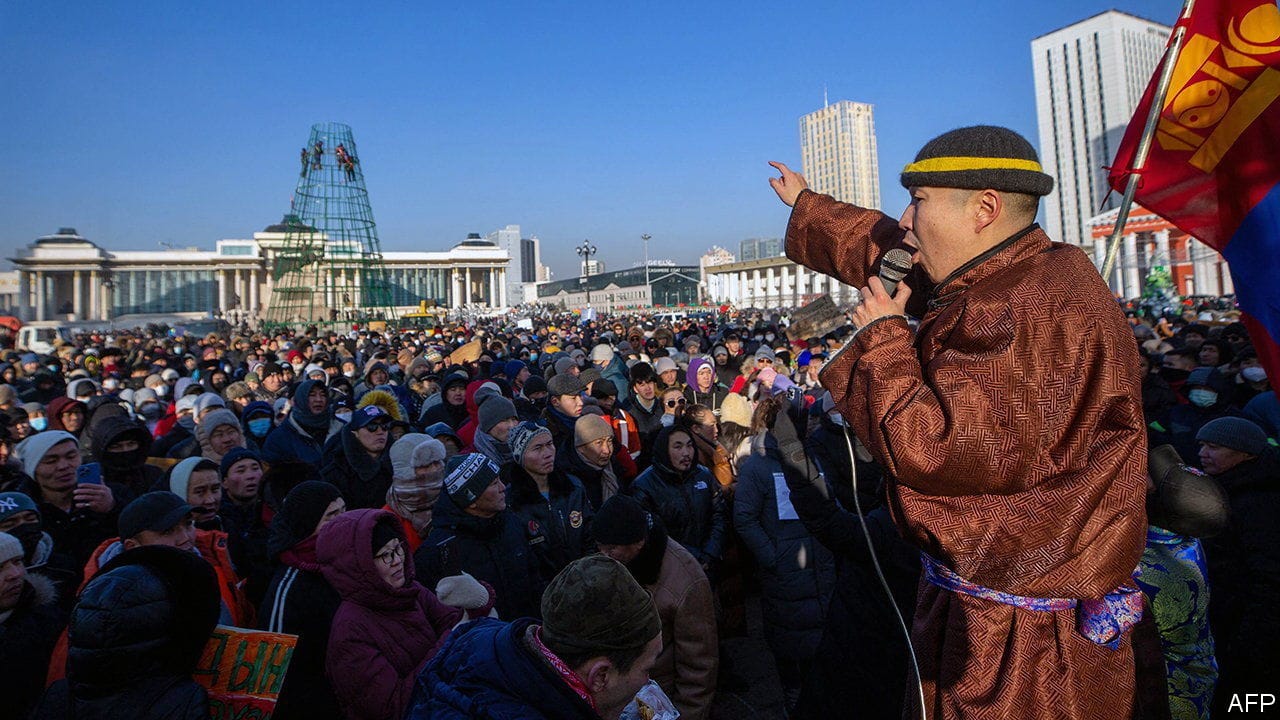
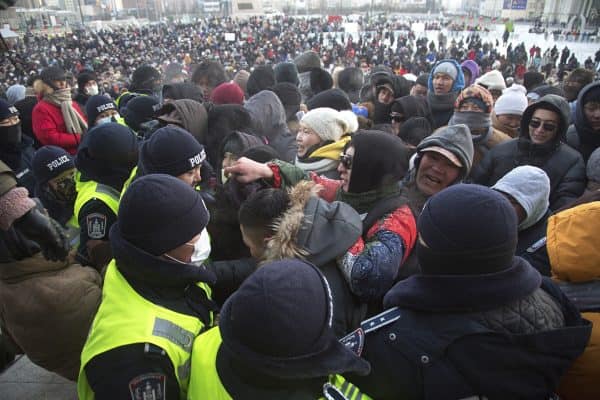
The real, democratic Mongolia, as seen in the photos selected by the author to illustrate her post

More recently, in the winter of 2022, Mongolians staged large-scale protests in Ulaanbaatar over a corruption scandal. It transpired that when exporting coal to China, customs officials had “diverted” six and a half million tons of the cargo, according to the paperwork. Mongolians considered this a theft of national revenues and marched on the capital’s square demanding that the theft be investigated and the names of those involved be made public. Eventually, the protesters stormed government house and demanded the government’s resignation.

Remind me again what Muscovites stormed in Moscow after Navalny’s investigations, of which there were dozens?

But Mongolians protested in the cold for three weeks until they forced the government to arrest the corrupt officials and reform the coal industry.

In April, the protests resumed. This time, Mongolian youth blamed the government for its poor performance and rising prices.

And lastly, let’s talk about the culture. Mongolians do not shout at their children or punish them. You will not hear from a Mongolian mom say to her child “I told you to shut your mouth” or “The more you cry, less you piss.” How should I put it? Mongolians love their children. There are only 924 orphaned children the entire country—that is less than 0.03% of the population. By comparison, there are 391,000 children living in Russian orphanages—that is 0.3% of the Russian population. In other words, children in Russia are left parentless ten times more often.

You can remain trapped in the old optics, looking down on everyone and denying reality. This will not bring social and political change any closer. If you want to go on living, but your body is rotting and falling apart, you need an accurate diagnosis. And the more honest it is, the greater the chances of your recovery.

Everything else can be put down to helplessness.

Source: Julia Khazagaeva (Facebook), 21 June 2024. Translated by the Russian Reader