The Olivier Index

The New Year’s spread on the tables of Petersburgers will be more modest this year than it was in 2021. They won’t have to skimp on ordinary goods yet, but delicacies such as caviar or red fish, as well as premium alcohol, will cost considerably more. Scammers and poachers who offer goods that aren’t readily available on the cheap may try to take advantage of this.

According to the Central Bank, annual inflation, as of November, was 11.98%. During the month, consumer prices increased by 0.37%; fruit and vegetables were among the items that rose most noticeably. Given that they are among the main ingredients in traditional dishes, we should expect that New Year’s Eve purchases will cost more.

Racing against inflation

As Svetlana Kazantseva, associate professor in the Basic Department of Trade Policy at Plekhanov Russian University of Economics, told DP, the annual growth rate of food prices in Petersburg was about 10%, according to research data.

“Prices for dairy and meat products are growing more slowly, which is explained by cheaper animal feed. Taking into account the inflationary component and the desire to save money, we can assume that the amount of the average bill [for New Year’s supper], if it does increase, will be an order of magnitude smaller than the rate of annual inflation, that is, about 5–7%,” the expert notes.

Marina Petrova, CEO of Petrova Five Consulting, is partial to other estimates, according to which the New Year’s meal will cost an average of four thousand rubles, which exceeds last year’s level by 12%. The simplest traditional dishes are taken into account: Olivier salad, herring under a fur coat, jellied meat, chicken with potatoes, sausage slices, champagne, and vodka. If the menu is expanded to include roast pork, fish aspic, red caviar, red fish, cheese, and cognac, then the cost will double. But it should be borne in mind that the percentage of consumers who themselves cook the food for their holiday meal has been decreasing every year. Many people have long preferred to buy readymade dishes at the store or order them delivered to their homes. However, this year they are likely to purchase more budget-conscious options. The desire to save money will primarily impact delicacies, seafood, salmon fish, beef, and caviar. The annual growth rate in prices for fish delicacies and caviar is already higher than the inflation rate.

“Traditional New Year’s menu for residents of Petersburg [clockwise, from far left]: Olivier salad, herring under a fur coat, roast chicken, caviar sandwiches, hard alcohol, sliced cheese, sausage and fish, juices, champagne, mineral water, candy, cake, tangerines.”

Beware of fakes!

According to market participants, a decrease in the total volume of red caviar is expected due to a lower salmon catch in the Far East. It will be bring a higher price than in previous years, however. During the pre-New Year sales period, it is possible that we will see an increase in prices of 35–40% compared to last year. On average, pink salmon has risen in price by 25%, chum salmon, by 5%, sockeye salmon, by 15%, and trout, by 10%. According to the Fishing Union, this year the percentage of Pacific salmon red caviar on the Russian market is close to 100%. Prices for grainy caviar from Far Eastern salmon caught in 2022 increased by an average of 10–15%. However, last year’s caviar is also on the market at a more affordable price. According to Nikita Ostrovsky, a purchasing manager at Lakifish LLC, imported red caviar appears only sporadically on the Russian and Petersburg markets.

“We can talk about insignificant amounts imported from neighboring countries, such as Armenia and, to a lesser extent, Kyrgyzstan (red trout caviar is imported from there). This category of goods is in a lower price and quality segment by comparison with trout caviar, for example, from Karelia,” he says. Another factor are the Russian government’s measures to restrict the import of red caviar to stimulate domestic production.

Ostrovsky also warns that, since caviar is considered a mandatory part of New Year’s feasts, it is likely that buyers will look hard for cheaper offers — for example, at illegal points of sale, where it is offered at a price 50% lower than the average market price.

“This can be imitation caviar, which is sold disguised as the real thing. Caviar diluted with sunflower oil. Or obtained by poaching, without the necessary paperwork. In pursuit of profit, people are willing to purchase such products,” he points out.

In fact, imitation caviar is sold legally in many stores.

Participants of the delivery market expect an increase in orders of readymade meals for the New Year’s meal, despite everything. Many of them note that they usually experience an increase in customer activity on December 21.

“We don’t take orders all day, only until 8 p.m., and then we deliver them to customers’ homes. This time round, we expect the number of orders to double compared to normal days. We regularly observes this pattern on holidays. The average bill for orders in Petersburg should grow this year. In any case, last year it grew by about 25–30%,” Vera Pradchenko, CEO of VIP Fish [a service that prepares and delivers Japanese food], told our correspondent.

[From top to bottom of tree]
Cost of Olivier salad: 408 rubles (2021) vs. 455 rubles (2022); cost of herring under a fur coat: 269 rubles (2021) vs. 292 rubles (2022); cost of a no-frills New Year’s meal: 5909 rubles (2021) vs. 6737 rubles (2022); cost of a more expensive New Year’s meal: 8391 rubles (2021) vs. 10,909 rubles (2022). 40% increase in the per bottle price of imported alcohol in the more expensive meal. 20% increase in the price of premium cheese in the more expensive meal. 2.4% increase in the price of domestic salmon caviar in Russia as of October. Consumer price index for groceries in Petersburg in November: 2021 – 111.3%, 2022 – 108.9%; consumer price index for alcoholic beverages in Petersburg in November: 2021 – 102.8%, 2022 – 106.3%; increase in the price of red caviar in Moscow and Petersburg since the beginning of 2022: Moscow – 13.3%, Petersburg – 13.66%

We won’t be left without champagne

Alcoholic beverages are an equally important part of the New Year’s feast. This year, the patterns of purchases in terms of category is almost identical to previous years. Sparkling wines and vodka are still the primary drinks. But there have been changes within the categories. They have been caused primarily by the aftermath of the departure of global brands, explains Dmitry Isachenkov, director of development at Ladoga. “It is safe to say that Russian vodka will be on 90% of Russian New Year’s tables — here consumers prefer domestic products with festive designs,” he says.

After the brands that made up about 50% of the champagne market in Russia left the country, producers less dependent on the political conjuncture began filling the vacant niches. For example, Ladoga signed contracts with three new suppliers and imported 80 thousand bottles in 2022 by year’s end, which is four times more than by the end of last year. So, Russian consumers can easily find real champagne wines in Russia if they wish.

It is worth noting that the share of imports of wines from Champagne [sic] did not exceed 2.8% of the total volume of sparkling wine imports. The choice of the mass consumer will be distributed one way or another among the major Russian producers: Kuban-Vino, Derbent-Vino, Novy Svet, and Inkerman. Affordable imported sparkling wines — Italian proseccos, Spanish cavas, French cremants, and Austrian sekts — will invariably remain popular.

Isachenkov notes that the structure of purchases in the whiskey category has changed significantly — it is this category that has undergone the most powerful changes after the refusal of major brands to do business in Russia. Most consumers were ready to look for a replacement within the category, including among domestic manufacturers. Thus, sales of entirely Russian-made Fowler’s brand whiskey had by year’s end increased four and a half times compared to 2021. Other consumers have shifted to other categories and are choosing rum, tinctures, brandy or vodka. Sales of still wines increased in proportion to the other categories. At the same time, the product range of both importers and Russian wineries has been growing.

“We should not talk about the growth of the average bill, but about the increase in the cost of each item in the bill. For many, this is a long-awaited holiday after the emotional turmoil experienced during the year, and the consumer selects special drinks for celebrations above the usual cost,” the expert argues.

Different things matter

On average, the prices of the ingredients for Olivier salad have increased by 10% in Petersburg. Potatoes and onions have fallen in price, while he price of carrots has not changed. Green peas and mayonnaise have risen the most, by 20% and 17%, respectively. Herring under a fur coat has risen in price by 7%, primarily due to the main ingredient, herring (which has gone up by 20%), while beets have fallen in price by 32% and potatoes by 25%. However, the so-called Olivier index should be treated with caution.

The various indexes are more of a marketing tool to draw attention to the researcher’s brand. There is the lipstick index (launched by Estee Lauder), which is a litmus test showing how women react to changes in the economy. The American manufacturer argues that, when incomes fall, sales of expensive clothes and shoes decline, while sales of luxury cosmetics, on the contrary, grow. There is Deutsche Bank’s cheap date index (based on the costs of taxi rides, lunches at restaurants, and hotel rooms [sic]). There is the latte index (based on the price of a cup at Starbucks, now Stars Coffee in the Russian Federation) and the Big Mac index (based on the price of a hamburger at McDonald’s, now Tasty, Period). The iPod index has become an atavism.

In Russia, the Telegram channel Sugar. Portion. Collect maintains a cup of tea index by charting weekly changes in the average retail price3s of the ingredients in the Russian Federation. Other researchers use the statistics issued by Rosstat as their benchmark when calculating the cost of preparing borscht, Olivier, or herring under a fur coat.

“Any index is an indicator of rising or falling prices. You can use it to calculate how the cost of goods changes from year to year,” says Daria Zhigalina, a business automation services systems analyst at Kontur.Market. “It is important to understand that all indices are real economic indicators, albeit served up in a humorous package. Every year we see how official agencies publish data on the basket of consumer goods. Everyone has been accustomed to this indicator for a long time and knows that it can be used to assess the quality of life in the country and the purchasing power of the populace.”

According to the expert, by assessing the fluctuations in the cost of ingredients, we can analyze the economic situation separately in each region and in Russia as a whole.


For retailers, the New Year’s Eve period is a time when they can increase their revenue. Judging by the foot traffic in stores, the current situation will most likely not affect retail chains negatively since their turnover is growing. At the same time, the structure of sales will be redistributed towards traditional and inexpensive goods. In my opinion, retail has already begun to change the structure of its offerings, reducing the number of goods above the average price. In this regard, premium retail chains may be in a less advantageous position.

—Irina Kapustina, Director, Graduate School of Service and Trade, St. Petersburg Polytechnic University

Caviar has not been imported [to Russia] since 2014, after government restrictions on the import of certain types of food were enacted. Prior to this, Russia imported frozen red caviar from the USA and Canada. Here it was processed and sold in salted form. The salmon catch this year amounted to 300 thousand tons, and 13–14 thousand tons of caviar were produced. Last year, the catch was over 500 thousand tons, while more than 20 thousand tons of caviar were produced. Compared to last year, the shortfall is 30%. Despite the fact that the supply of caviar is much lower than last year, the price has not increased. If there were a further rise in prices, people would simply stop buying it. It is possible that before the New Year some sellers will raise prices, but they will bring them back down after the holiday.

— Alexander Fomin, Vice–President of the Fishing Association

The growth in the price of goods that have always been considered delicacies — caviar and salted salmon— is indicative. They have doubled in price over the year, and the same dynamic is typical for most other frills. This year, salmon will be largely replaced by trout, which is cheaper, and eggplant caviar will be preferred. Real incomes fell in Petersburg by 2.7%, according to official statistics. By my calculations, for a business person, the celebration of the New Year will be about one and half times more expensive than a year ago. The selection has become somewhat smaller, but if you want them, you can find all the goods you need. We should especially not envy pensioners living on their own. The subsistence minimum doesn’t take factor in the cost of such events.

—Anatoly Golov, Co-Chairman of the Consumers Union of Russia

Russians have no reason to skimp on their New Year’s meal. On the contrary, consumer spending on the New Year’s meal may increase due to both inflation and the fact that some Russians will not be able to celebrate the New Year outside the Russian Federation and will spend money at home. Recently, statistics were published that about 15% of the population have experienced an increase in income, while 20% have experienced a decrease. Consequently, some consumers will still increase spending for the New Year and their average spending will grow at a level slightly higher than inflation.

—Artyom Tuzov, Executive Director of the Capital Markets Department at IVA Partners Investment Company

Source: Darya Zaitseva, Darya Dmitrieva & Yevgeny Petrov, “Petersburgers won’t be serving caviar and red fish on their New Year’s tables,” Delovoi Peterburg, 23 December 2022. Infographics, above, courtesy of Delovoi Peterburg. Translated by the Russian Reader


The morning begins with me looking at the light on the computer monitor. If it is on, it means there is still electricity. When I see that the light is on, I immediately get up and go put on the kettle to refill the thermoses. We got hold of the simplest gas stove, and you can of course heat water on it. But first of all, there is not an endless supply of gas and we skimp on it. Secondly, I am afraid of these stoves: over the past month they have exploded four times in our district alone. I walked past the residential buildings where these stoves exploded and saw the broken windows and cracks in the walls. It’s a little scary, let’s just say.

After I put the kettle on, I get on the Telegram channels. I have to find out whether there were [missile and drone] attacks at night, and if so, whether they hit infrastructure. Now this is the most terrible thing, because if it suddenly turns out they hit infrastructure, it means that soon there will be no heating and water. So then I start rushing between washing and drying my hair, charging the power banks and flashlights, getting the laundry going, and cooking food. You never know when the lights will go out and that’s why you do everything quickly, all at once. You feel like a trained circus animal.

When I’m going somewhere, I always put a few flashlights in my backpack. It’s strange to imagine that not so long ago a flashlight was not a mandatory item. Now it is a “must have” (my phone suggests writing “must heh” — heh!), like a medical mask during the time of covid. It’s even more important! When I go outside and travel somewhere, I never know if there will be light where I’m going. Most often there is no light — or cellphone connection for that matter. I hate this feeling of being in a vacuum: there is no mobile internet, no telephone connection, no light, and no matter what happens to you, you won’t even be able to call an ambulance. You’re living “in the moment,” damn it. Where there is no light, the elevators don’t work. I usually walk slowly up to the sixteenth floor by an isolated dark staircase. Somewhere on the eighth floor there is usually an old, peeling stool on which I can sit in the dark and take a break. I usually don’t need such a rest, but sometimes I turn off the flashlight and sit on this stool in the dark and listen to the wind blowing in the stairwell.

Last week I got stuck in the elevator: while I was going up, the lights turned off and the elevator stopped and went dead. There was a chair inside and a box containing water and medicines. I sat down, but quickly froze. Immediately, before the phone connection disappeared, I had telephoned my husband and asked him to call the help hotline so that they would get me out of there. Otherwise, it was possible to get stuck there and sit for four to seven hours. My husband got through to the hotline in half an hour — he was the twentieth in the queue. Half of the city sits in frozen elevators every day. They pulled me out of there.

When I’m returning home in the evening, I make a wish: please let there be light at home. I ride in a minibus and nothing is visible through its windows since neither the streetlights nor the traffic lights are working. I have developed a “sense” of a way that I cannot see, but I know and understand where I’m going and when I need to get out. After walking up and down all these stairs and unlit streets, I really want to find the light on at home for at least half an hour. If, when approaching our building, I see that there is no light, I slow down. There’s nowhere else for me to hurry — it’s dark and pointless everywhere. Life in general has become quite hectic. Although I have hated hurrying and scurrying my whole life, now I have to hurry and scurry.

Sometimes I manage to find a store where the lights haven’t been turned off yet. It’s like going into a church: it’s light and warm there and your mood improves a little just because you’re in a store and it’s bright inside. The prices have been shooting up monstrously and I wander the aisles for a long time figuring out what I can buy to fit my modest daily budget. But basically, since the light began to leave us, I have got used to eating rusks and croutons in different flavors. I’d never bought them before — they’re not my kind of food — but now they are quite handy. First, they are relatively cheap, and second, they come in different flavors. It’s the illusion of variety. Third, they don’t need to be cooked.

I went to see my mom yesterday. We discussed all these common everyday problems of ours. And then Mom decided to make a joke and asked:

“What are you all doing for the New Year?”

Neither she nor I laughed.

Source: Sergey Abashin, Facebook, 15 December 2022. Professor Abashin is quoting a letter he received from a Ukrainian friend or colleague, but he does not identify her by name or mention where exactly she lives. Translated by the Russian Reader

Buggered

rossiya This bankrupt agribusiness was called Rossiya (“Russia”). Photo courtesy of Maxim Kemmerling/Kommersant and Republic
“The Data Leaves Us at a Loss”: A Few Figures That Might Surprise the Kremlin
Yevgeny Karasyuk
Republic
April 4, 2019

“Why on shoes? Why a third? Where did they get these figures?”

Dmitry Peskov, President Putin’s press secretary, responded with questions to journalists who questioned him yesterday about Rosstat’s depressing report for 2018.

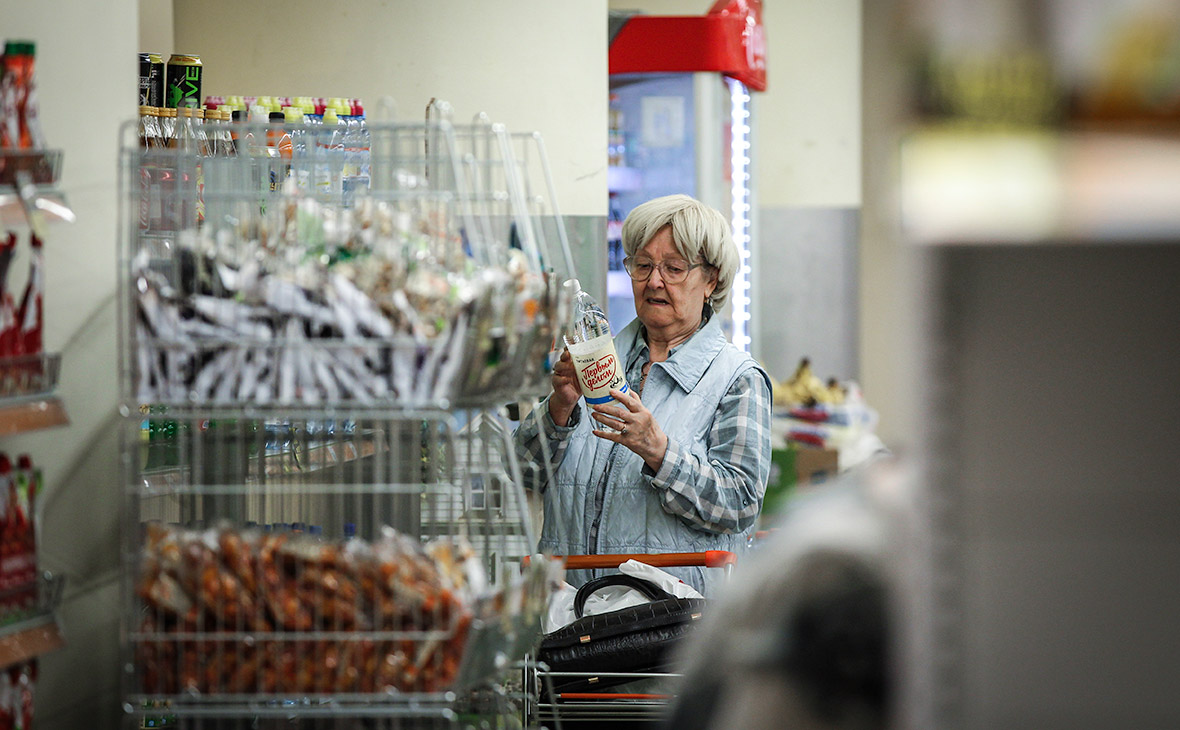
According to Rosstat’s study, in which sixty thousand Russian households were surveyed, every fifth Russian skimps on fruits and vegetables. Every other Russian family cannot afford to travel anywhere when they have a week’s vacation, while every fourth family does not have enough money to invite people over to celebrate birthdays and the New Year’s holiday.

And, indeed, the report does conclude that 35% of Russians are unable to purchase each family member two pairs of seasonally appropriate footwear.

“I would be grateful to Rosstat if they clarified these figures. The data leaves us at a loss,” Peskov added.

Meanwhile, there are other figures—lots of figures—that would probably also bedevil the Kremlin if they were aired in public. Let us recall a few of them.

Nutrition
Consumer watchdog Rospotrebnadzor concluded that 63% of deaths in Russia were associated with bad food and poor nutrition. According to official figures, Russians spend approximately 35% of their household budgets on food, while independent researchers put that figure at over fifty percent. However, the average Russian household skimps on all purchases and tries to do without everything it can, claim the researchers behind Romir’s Coffee with Milk Index, which charts the quantities of chocolate, coffee, milk, and bottled water purchased by Russians. Researchers at RANEPA recently described the diets of Russians as unhealthy, unbalanced, and lacking in energy.

Health
According to a report by RANEPA’s Institute for Social Analysis and Forecasting, 22% of Russians who live in straitened circumstances face the stark choice of whether to buy the bare minimum of the cheapest produce or the cheapest drugs, drugs they need to survive. It is typical of Russians, not only those below the poverty line, to postpone going to the doctor, if it involves costs, noted researchers at the Institute for Health Economics at the Higher School of Economics.

Education
According to the pollsters at VTsIOM, fifty percent of Russian parents experience serious financial difficulties when getting their children ready for the first day of the school year. Over the past five years, the average sum of money Russians claim to spend getting children ready for school has increased by sixty percent, rising from 13,600 rubles to 21,100 rubles.

Housing
According to the Construction Ministry, the Russian populace’s debts for utilities and housing maintenance bills have grown by five and a half times since 2015. The ministry reported that, as of the end of last year, the total amount of this debt was 1.2 trillion rubles [approx. 16.34 billion euros]. The rates for water, electricity, gas, and other utilities and services increase rhythmically year after year, and yet the real incomes of Russians have continued to fall five years in a row.

Transportation
Forty percent of Russian car owners “try not to use their own vehicles, taking public transport instead.” Another 22% of car owners follow their lead, but do it less frequently. VTsIOM has explained the outcome of its January opinion poll by citing the concern of Russians for the environment while failing to note that the price of petrol has skyrocketed in recent years. Last year, a liter of AI-95 rose in price three times faster than inflation. The government has resorted to artificial, decidedly non-market measures to depress prices, and yet petrol in Russia is now twice as expensive as it was when the decade kicked off.

Only twelve percent of Russians believe that, when it describes the economy and the social sector, the Russian regime always or mostly tells the truth. The Levada Center has done polls on the same subject since 2010. Russian society’s confidence in what the country’s leaders and senior officials say has never been as low as it is now.

By voicing surprise at Russia’s poverty, at least on paper, the Kremlin is, apparently, determined to convince people it inhabits a parallel reality in which Russia makes one breakthrough after another, and the rank and file enjoy “stability” by way of spiting the country’s numerous enemies. Peskov seemed genuinely puzzled by Rosstat’s claim that Russian families have trouble buying shoes, but he probably had not yet read the government’s report on the increase in mortality rates in every third region of Russia. Clearly, something is wrong with the figures. In short, we expect a reaction.

Translated by the Russian Reader

Why Most Russians Will Stay Home for New Year’s

Why Most Russians Will Stay Home for New Year’s
As Incomes Crumble, Even Celebrating with Friends Is Too Expensive for Them
Vladimir Ruvinsky
Vedomosti
December 27, 2018

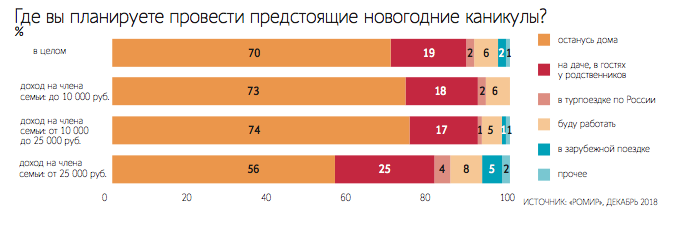
New Year’s, apparently, has become a truly stay-at-home holiday. The number of Russians who plan to spend the long New Year’s holiday at home has jumped from 41% in late 2015 to 70% in late 2018, according to a survey by Romir, a Russian research company. The main reason is the rapid return to the conservative tradition of growing poverty and uncertainty in the future, combined with the desire to maintain previous levels of consumption of the most vital goods and services, which no longer include a winter holiday away from home.

fullscreen-m4

“How do you plan to spend the upcoming New Year’s holidays?” Overall: at home, 70%; at dacha, visiting relatives, 19%; traveling in Russia, 2%; working, 6%; traveling abroad, 2%; other, 1%. Average monthly income per family member of 10,000 rubles: at home, 73%; at dacha, visiting relatives, 18%; traveling in Russia, 2%; working, 6%. Average monthly income per family member of 10,000 rubles–25,000 rubles: at home, 74%; at dacha, visiting relatives, 17%; traveling in Russia, 1%; working, 5%; traveling abroad, 1%; other, 1%. Average monthly income per family member of 25,000 rubles or greater: at home, 56%; at dacha, visiting relatives, 25%; traveling in Russia, 4%; working, 8%; traveling abroad, 5%; other, 2%. Source: Romir, December 2018. Courtesy of Vedomosti

Surveys of the same representative selection of respondents have shown a drop-off in all other ways of spending the New Year’s holidays, which have basically become yet another period of time off work for Russians. The number of Russians planning to spend the holidays at the dacha or visiting friends or relatives has decreased from 34% to 19% in three years. Trips within Russia have dropped from 8% to 2%, while trips abroad have fallen from 4% to 2%.  Nearly everyone has been scrimping, including Russians with above-median incomes. Fifty-six percent of Russian with monthly incomes of 25,000 rubles [approx. $364] per family memberwill stay home, as will 74% of Russians with monthly incomes between 10,000 rubles and 25,000 rubles per family member. As Tatyana Maleva, an economist from RANEPA, notes, the Russian urban middle class, which has grown accustomed to traveling, cannot afford it.

The picture emerging from the survey reflects the mood of many Russians. Since 2014, real incomes have fallen four years in a row, and all indications are they will be shown to have fallen in 2018 as well. According to Rosstat, the monthly modal income in in 2017 was 13,274 rubles [approx. $233], while the monthly median income was 23,500 rubles [approx. $412]. Given these circumstances, the ruble’s devaluation, which has made trips abroad more expensive, is not such an important factor. In December 2015, one dollar cost as much as it does currently, 67 rubles, and its value was rising.

Holidays at home are not cheap, either. In November 2018, the percentage of Russians who had noticed a rise in prices had grown in comparison with October 2018, according to the Russian Central Bank. Forty percent of Russians noticed upticks in prices for meat and poultry; 32%, rises in the price of petrol; 28%, rising prices for cheese and sausage; while 26% had noticed that milk and dairy products were more expensive. All of these goods are part of the home holiday menu.

In comparison with 2014, consumption levels have fallen. They have not returned to their previous levels. Attempting to wriggle their way out of poverty or maintain their previous income levels, Russians have taken out an ever-growing number of consumer loans, which have proven difficult to pay back. Every fourth Russian who had outstanding loans in 2015–2017 spent 30% of their incomes paying them off, note Olga Kuzina and Nikita Krupensky, economists at the Higher School of Economics, in an article entitled “The High Debt of Russians: Myth or Reality?” published in the November 2018 issue of the journal Voprosy ekonomiki.

Generally, the Russian populace has transitioned to a minimalist model of consumerism, notes Maleva. Scrimping begins literally with the New Year. As Romir’s survey indicates, this transition has become a trend that will, apparently, shape the strategies and tactics of Russian consumers in the future, too. The only thing that has not changed over the years is the president’s televised New Year’s greeting: it costs nothing.

Translated by the Russian Reader

Kremlinsplaining and Its Discontents

755094446431775

Vladimir Putin Explains How to Debate the 1917 Revolution
Delovoi Peterburg
November 3, 2017

Discussion of the 1917 Revolution should be based on facts and documents, President Vladimir Putin emphasized in his greeting to participants of international events occasioned by the Russian Revolution’s centenary.

“The turbulent, dramatic events of 1917 are an inalienable, complicated part of our history. The revolution had a tremendous impact on the evolution of Russia and the world, and it largely defined the political, economic, and social picture of the twentieth centure,” noted the president, as quoted by TASS.

The president also said the interest of public figures, scholars, and the media in a deep and comprehensive interpretation of the era was legitimate.

“Yet I am convinced that even the most heated polemics must be based on facts and docoments, on an objective and respectful attitude to the past. I hope that your meetings, which shall bring together people from many countries, will contribute to this constructive discussion,” Putin said.

Earlier, Rossotrudnichestvo (Russian Federal Agency for the Commonwealth of Independent States, Compatriots Living Abroad and International Humanitarian Cooperation) reported it would be holding various events commemorating the centenary of the October Revolution at Russian Culture Houses in over eighty countries.

“Russian Culture Houses in more than 80 countries [will] host exhibitions, science conferences [sic] and seminars, which aim on delivering an objective approach to historical events to foreign audience,” the agency said.

__________________________

Attack of the Bio Samples
How Conspiracy Theories Flourish
Vladimir Ruvinsky
Vedomosti
October 31, 2017

Vladimir Putin’s story about the collecting of “bio samples” in Russia by persons unknown for unknown purposes has stirred up Russians. It is a telltale case of a double distortion and an example of society’s sensitivity to conspiracy theories, which flourish in an impoverished informational environment.

The president made his remarks at a meeting of the Human Rights Council. They were seemingly spontaneous. Council member Igor Borisov had complained to the president that, according to his information, certain people were using video surveillance systems in Russia to gather images of Russians for unknown purposes. That was nothing, responded Putin. Bio samples from different ethnic groups and regions were also being “deliberately and professionally” collected nationwide. The question was why.

The story took on even more dramatic overtones when the president’s press secretary tried to explain it.

According to Dmitry Peskov, “Certain emissaries conduct such work: employees of nongovernmental organizations and other entities.”

The Russian secret services had reported them to the president, Peskov claimed.

But you did not need the secret services to tell you this. The notion of “bio samples” is broad, including, for example, blood tests, which have been done in Russia for approximately 150 years, and performed by Russians and foreigners alike. Obviously, Putin had in mind genetic samples. Methods for rapidly deciphering DNA sequences were discovered in 1977. DNA became a research subject at approximately the same time in the Soviet Union, and nowadays genetic research is carried out worldwide. Genes and genetics are global phenomena, and the DNA of all human beings is 99% identical.

There are two main areas of research. Medical genetics, in which individual samples from sick and healthy people are studied to determine, in particular, predispositions to certain diseases, and population genetics, which studies samples from different ethnic groups in order to reconstruct the history of peoples [sic], notes biologist Mikhail Gelfand. Research objectives can overlap. Apparently, Putin had population genetics in mind, but data has long been collected in Russia for both medical genetic and population genetic research. This work has been done by pharmaceutical companies (as part of clinical trials), medical centers (as part of genetic counseling), and researchers (as part of their search for the genes that trigger diseases).

Russia has been actively involved in international genome projects. In 2015, the results of a multi-year study of the gene pool of Slavic and Baltic peoples were published. The study was done by Russian and international geneticists, and one question they explored was who the Slavs were. In the same year, the Genome Russian Project, supported by Putin, was launched. Its aim is to create an open-accesss database containing anonymous genetic information about 3,000 men and women, the indigenous people of Russia’s various regions. The project has been coordinated by an American, Stephen O’Brien. There have been no reports the secret service has any gripes with the project.

Perhaps it is a commercial conflict. Valery Ilyinsky, director of the company Genotek, told RIA Novosti that two research centers in Moscow and Petersburg had been collecting bio samples from different Russian ethnic groups and sending them to colleagues in the US for research studies, but these studies could have bee done in Russia as well.

In the absence of a foreword such as I have just provided (I wonder how much the president was told), what Putin said sounded ominous, of course. Ignorance generates feelings of fears and danger. It is one step from there to conspiracy theories about genetic weapons and a future biological war that would threaten to destroy Russians. (According to Gelfand, even theoretically, it would be possible to devise a genetic weapon only against an ethnic group that had been living in isolation for a thousand years, which does not apply to Russians.) Of course it was wrong to claim that Russians were being targeted for biological war, stipulated Federation Council member Franz Klintsevich, but one must be ready.

This was not the first time the president has been sold a pack of imaginary threats. In 2007, FSB director Nikolai Patrushev reported to Putin that bio samples were being sent from Russia to the US. They were being used, allegedly, in a program for developing a “genetic bioweapon” targeting Russians. Patrushev claimed the weapon would be capable of damaging the health of ethnic Russians to point of killing them or rendering them infertile (as reported by Kommersant). Consequently, the Russian customs service banned the export of all bio samples, including hair, blood, and clinical analyses, which threatened the lives of thousands of Russians, who needed to be paired with bone marrow donors in German clinics. The ban was lifted after public protests, but the notion has proven tenacious.

__________________________

Central Bank Says Russians Mistrust Low Inflation Figures
Yevgeny Kalyukov
RBC
October 31, 2017

A survey conducted by the Central Bank of the Russian Federation has shown that most Russians had noticed a price rise for goods that, according to official statistics, had become cheaper.

Most Russians do not believe Russia’s inflation rate has slowed to 3% per annum, according to the Central Bank’s report. Commissioned by the bank, the survey showed 56% of Russians were certain that by the end of 2017 the total rise in consumer prices would be “considerably higher than 4%,” and 75% of respondents claimed that over the previous twelve months prices had risen no more slowly or even more quickly than earlier.

“People are not yet ready to believe inflation really has slowed to such a low level. A considerable role in this discrepancy has also been played by the volatility of prices for individual goods and services,” the Central Bank report says.

Zoya Kuzmina, head of the review group in the monetary policy department at the Central Bank, noted that Russians’ subjective perception of changes in prices of goods they purchase regularly was at odds with official statistics.

“In reality, sugar prices have decreased nearly by 50% on the year. Fruits and vegetables have also become cheaper, while prices for tea and coffee have increased somewhat (by around 2%). But respondents said prices for all these goods had increased,” Kuzmina explained.

According to Kuzmina, the survey’s outcome confirmed Russians “would need a little more time to get used to low inflation.”

According to the Central Bank’s reports, inFom’s October 2017 assessment of Russians’ inflationary expectations for the next twelve months had risen to 9.9%. The Central Bank, however, was confident that conditions for decreasing the populace’s inflationary expectations would emerge as inflation became entrenched at around 4%.

In early August 2017, Alexander Morozov, director of the Central Bank’s research and forecasting department, advised Russians to think less about rapid price growth, since it was just such sentiments that facilitated increased inflation.

Earlier, Central Bank chair Elvira Nabiullina warned that excessively low inflation could generate new difficulties for Russia’s “emerging economy.”

See my previous posts on the subject of official economic statistics in Russia:

Articles translated by the Russian Reader. Photo courtesy of Yekaterina Kuzmina/RBC. The emphasis in the translations is mine.


Suck in Your Gut

d9ZhG1F.jpg
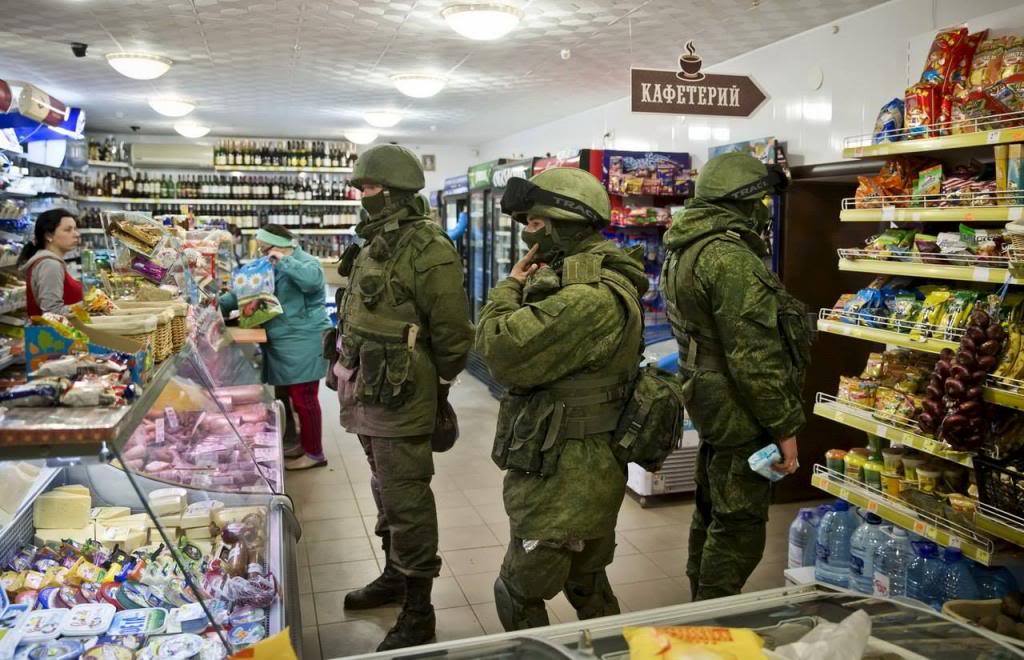
Russian soldiers shopping in a Crimean grocery store. Photo courtesy of Imgur

Rosstat Records Sharp Rise in Price of Minimum Grocery Basket
RBC
June 26, 2017

The price of the minimum monthly grocery basket in Russia has risen from the beginning of 2017 by 9.4% to 4,037 rubles [approx. 61 euros] , according to figures published on Rosstat’s website.

Significant growth was recorded in May. Compared to April, the cost increased by 4.2%, the report says.

The cost of the grocery basket in Moscow grew by 5% in the period from April to May and amounted to 4,946 rubles. Since the beginning of the year, it has increased by 11.1%, according to Rosstat. In St. Petersburg, the minimum produce basket has risen in price since January 2017 by 9.8%.

According to the agency, a significant impact on consumer price growth in May was due to higher prices for vegetables and fruits. The price for white cabbage increased 1.4 times, annd for onions, carrots, beets and potatoes by 1.2–1.3 times. At the same time, the cost of lemons increased by 11.1%, and apples, by 7.5%.

At the same time, as Rosstat noted, the price of cucumbers and tomatoes fell by 26.4% and 11.5%, respectively.

In January, Rosstat reported that, in 2016, the most expensive grocery item was butter. Its priced had increased by more than 20%. At the same time, the price of other dairy products increased by an average of only 9.5%.

In addition, a significant increase in prices was recorded for fish and seafood. They rose in price by an average of 8.6%.

TRANSLATED BY THE RUSSIAN READER

Alexei Gaskarov: A 25,000 Ruble Minimum Monthly Wage Is a Good Idea

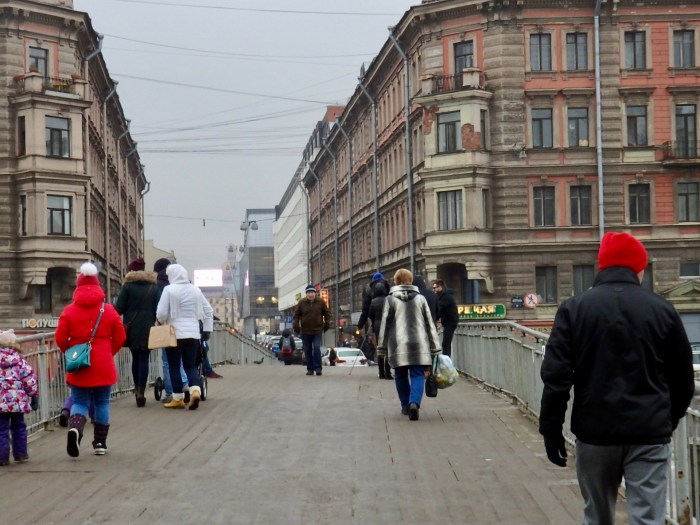
Rank-and-file Russians deserve a mandatory minimum wage, argues Alexei Gaskarov, and it would be good for the economy. Street scene near Haymarket Square in Petersburg, 4 February 2017. Photo by TRR

A 25,000 Ruble Minimum Monthly Wage Is a Good Idea
Alexei Gaskarov
Snob
February 8, 2017

How would a high minimum wage help Russia turn into a developed country? Why is Alexei Navalny’s campaign pledge not stupid at all? Financial analyst Alexei Gaskarov shares his opinion. 

What’s Wrong with Russia?
Russia ranks at the very top in international ratings of social inequality.

There are different means of combating inequality, including progressive taxation and raising unemployment benefits. But as soon as someone proposes a solution to the problem, he is immediately dubbed a populist.

This fate has befallen Alexei Navalny. In his presidential election program, he proposed setting a minimum wage of 25,000 rubles a month [approx. 400 euros at current exchange rates].

Is This Populism?
Let’s see how the structure of Russia’s GDP would change if this measure were implemented under current macroeconomic parameters. And let’s compare Russia’s GDP with the GDPs of the G20 countries.

GDP is the market value of all goods sold and services rendered in the country during the year. Costs are always someone’s income, so GDP can be calculated not only in terms of consumption, investment, government expenditures, and net exports but also in terms of income.

STRUCTURE OF RUSSIAN GDP IN TERMS OF INCOME IN % (PER ROSSTAT)
2015 2016 2017
GROSS DOMESTIC PRODUCT 100.0 100.0 100.0
Compensation of employees, including wages and mixed income not captured by direct statistical methods 47.2 45.0 46.6
Net taxes on manufacturing and imports 13.9 11.1 10.7
Gross economic profit and gross mixed income 38.9 43.9 42.7

There are three types of income:

  1. Compensation of employees, includes expenditures on insurance and pensions.
  2. Net taxes on production and imports. Essentially, this is revenue from the extraction of natural resources and their subsequent import abroad.
  3. Business income: company profits, capital gains, incomes of individual entrepreneurs.

The table shows that business income is nearly equal to the income of all employees.

Indirect taxes (e.g., income tax and VAT) are not included in GDP in order to avoid duplication, since they are based on the same profits and wages.

This is what average income distribution looks like in the G20 countries:

Source: The Labour Share in G20 Economies (ILO, 2015)

The labor share in Russia is 6–7% lower than the average for the G20 countries. The reason for the difference is the weakness of democracy and civic institutions in Russia. Election results do not depend on the opinion of the populace, trade unions are weak, and protests against social policy are far and few between. So it makes no sense to redistribute incomes to benefit employees.

How Much Would We Spend?
72,323,000 people are employed in Russia. We have to subtract entrepreneurs [i.e., the self-employed] from this figure. According to the Unified State Register of Individual Entrepreneurs (EGRIP), they amount to approximately 3.5 million people. We also have to subtract those people who work part-time: according to Rosstat, there are around one million such people, if we discount those involved in small business. So the upper limit of full-time employees in Russia is 67,820,000 people. Within this group, 50.3% earn less than 25,000 rubles a month.

However, 1.4% of employees earn between 5,000 and 5,000 rubles a month, and 20.9%, between 17,000 and 25,000 rubles a month. Another 50 percent of employees receive an average monthly wage of 15,329 rubles [approx. 240 euros].

Accordingly, the poorest wage earners would benefit most of all from the introduction of a mandatory minimum wage. On average, every employee currently earning less than 25,000 rubles a month would be paid an additional 9,671 rubles (i.e., 25,000 rubles – 15,329 rubles = 9,671 rubles ).

We would thus have to reallocate almost 3.96 trillion rubles annually: 9,671 rubles (the average pay rise) x 67,820,000 (the number of employees) x 50.3% (the share of those currently earning less than 25,000 rubles a month) x 12 (months) ≈ 3.96 trillion rubles.

Let us add in insurance premiums and pension contributions, which amount to 30.2%. The overall total would be around 5.15 trillion rubles (3.96 trillion x 1.302).

Russia’s GDP in 2015 was 83.23 trillion rubles. If we reallocate 5.15 trillion rubles from profits to wages, we arrive at the following ratio.

2015 2015 (%) 2015* 2015* (%)
GROSS DOMESTIC PRODUCT 83.233 trillion rubles 100 82.233 rubles 100
Compensation of employees 37.471 trillion rubles 45 42.621 trillion rubles 51
Net taxes on manufacturing and imports 9.272 trillion rubles 11 9.272 trillion rubles 11
Gross economic profit and gross mixed income


36.489 trillion rubles 44 31.339 trillion rubles 38

In the resulting structure, the share of labor income is slightly higher than the average figure among the G20 countries.

Obviously, many people would lose their jobs after a minimum wage of this kind was introduced, primarily those people who dig pits with a shovel where an excavator should be doing the work. These jobs are safe nowadays only because you can pay people almost nothing in Russia.

In turn, employers would seek to maintain profits by increasing prices for finished products. In aggregate, these effects would shape an economy typical of developed countries.

What Do We Risk?
Many people fear inflation. Let’s evaluate the risks. To introduce a mandatory minimum wage of 25,000 rubles a month, according to the structure indicated above, we would have to increase wage costs by 13.7%. The share of labor costs in the economy is 45%. Accordingly, to cover the increased costs, the price of finished products would have to be increased by 6.165% (13.7% x 45% = 6.165%). That would be the upper limit of possible inflation.

In reality, however, a rise in prices decreases consumption and forces prices to creep downwards. In addition, unemployment and inflation are inversely proportional to one another, meaning the higher the unemployment rate, the lower the rate of inflation.

Additional inflation would be two or three percent, and for the most part it would be spread out over the whole of society, meaning that people who earn a lot would forfeit this percentage of income, while the incomes of the poorest workers would increase significantly.

Of course, such a drastic rise in wages is a rather radical measure, given that the minimum wage is currently even below the subsistence level, and it is bound up with a variety of social benefits that would also automatically increase. But the tenor of the reform is absolutely correct and corresponds to successful examples in world practice.

The introduction of a statutory minimum wages in Germany has lead neither to inflation nor unemployment. In the US, increases in the minimum wage have increased the salaries of low-paid workers while maintaining employment.

Translated by the Russian Reader. Thanks to Alexei Gaskarov for the heads-up. For another take on the Russian economy’s performance and the figures provided by Rosstat, see yesterday’s featured post, “Lies, Damned Lies, and Statistics,” a translation of an op-ed piece by liberal economist Sergei Aleksashenko.

Nadya Tolokonnikova: The Year in Review

6_bottle

Nadya Tolokonnikova
The Year in Review, or, An Eternal Russian Winter in Solitary Confinement
December 29, 2015
Facebook

We rang in 2015 seeing Oleg Navalny sent off to a penal colony for three and a half years for the fact his brother was involved in politics.

Pyotr Pavlensky rang in 2015 by starting a bonfire on a Moscow quay.

“You spend the year the way you ring it in,” said Pavlensky as he left the Guelman Gallery, where we were seeing in 2015, and went off to an icy quay on the River Yauza to start a fire.

In November 2015, Petya pulled off the biggest art action of the year by torching the doors of the FSB. Pavlensky will greet the New Year in a cell at Butyrka remand prison.

In 2015 we found out you cannot only be imprisoned for political activism but also gunned down for it in the center of Moscow.

As 2015 ended, arrests in the Bolotnaya Square case continued. Anarchist Dmitry Buchenkov was arrested on December 3. The defense claims he was not at Bolotnaya Square on May 6, 2012.

Gallerist Guelman held a charity auction at his gallery in support of the Bolotnaya Square prisoners. The result was that the Guelman Gallery was no longer Guelman’s gallery. He was not forgiven by the powers that be for the auction, and the gallery was wrested away from him.

But the government also made humane decisions in 2015. After sentencing Vasilyeva to five years in prison, the court let her out on parole two months later.

In 2015, the government also destroyed embargoed produce, because they had no fucking clue what to do about falling oil prices. Russians were weaned off the notion of stability and tightened their belts as the Russian economic crisis made $400 a month a serious, substantial salary, as in the early noughties. In a number of Russian cities, the critical debts owed by municipal governments to fuel suppliers have led to stoppages of public transport, and electric companies have turned off the lights in the stairwells of apartment blocks.

The myth of stability has been destroyed, the state is the new punk, a rifle is a party, and everything is going to fucking hell in a hand basket. The New Year’s meal, by the way, will cost on average 5,790 rubles this year, which is 28% more than a year ago. So it is better to save money on December 31 and take a nap.

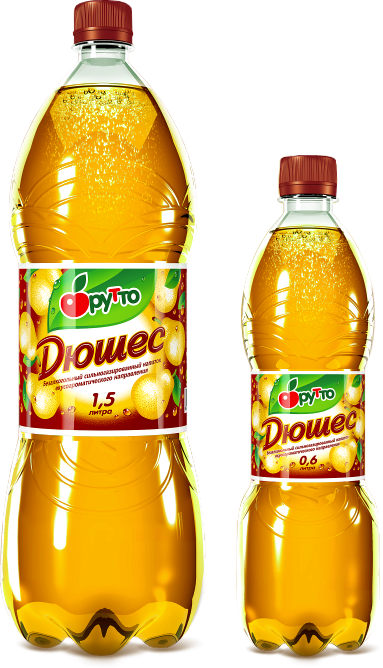
And, while you are sleeping, to dream of Pyotr Pavlensky, Oleg Navalny, and Bolotnaya Square political prisoner Alexei Gaskarov celebrating the New Year in their prison cells and pouring Duchesse, a domestic carbonated beverage, into recycled plastic instant mashed potato cups.

Amen.

Translated by the Russian Reader. Image of Duchesse soda bottles courtesy of Frutto

Tatyana Maleva: People and Oil Don’t Mix

Demolishing the Population’s Income Is a Big Mistake by the Authorities
Yevgeny Andreyev
Special to Novaya Gazeta
October 17, 2015
Novaya Gazeta

Why the government prefers oil to people, why poverty could touch half the population, and why social services are losing out to defense spending

Tatyana Maleva. Photo: TASS

In previous years, when it submitted the latest draft budget to the Duma for consideration, the government repeatedly emphasized its social focus: it was all about people, they would say. Now, as the 2016 budget is being worked out, the authorities prefer not to think about this. Spending on the most people-focused items—education and health care—will be significantly reduced. Despite annual inflation’s soaring to nearly 16%, public sector wages will not be indexed at all, while old-age pensions will be indexed only by 4%. Tatyana Maleva, director of the Institute of Social Analysis and Forecasting at the Russian Academy of National Economy and Public Administration (RANEPA) told us how the social sector would cope with all these blows.

Based on your analysis of the projections for the 2016 budget now being submitted to the Duma, which of the social sector issues do you see as most acute?

Those caused by the insufficient indexation of old-age pensions. The government has chosen the most economical solution to this problem.

A 4% indexation does not correlate at all with the expected outlook for inflation. Thus, the budget risks reducing the real value of pensions.

The acuteness of the problem is amplified by the fact that, if we look at the history of incomes in post-reform Russia over the past twenty-five years, we see that pensions have fallen lower than all other sources of income such as wages and benefits. Only in 2010, thanks to the valorization of pension rights [a one-time increase in the monetary value of the pension rights of citizens with time in employment before 2002Y.A.] and pulling the minimum pension up to the subsistence level, we pushed the real value of pensions to where it had been at the outset of reforms in the nineties. It had taken twenty years to restore the purchasing power of pensions. But now, during a crisis, they are being demolished again by the budget under consideration. This is a big mistake by the authorities.

But why? After all, budget cuts are not the government’s whim, but hard necessity dictated by the economic crisis.

As events of the last two years have shown, there are basically only two kinds of resources in this country, oil and people. The price of oil has collapsed, but the people are still here.

It is people who are, in fact, the most reliable of all resources. Sooner or later, investment in people produces economic growth. Oil, on the contrary, is impacted by circumstances unconnected with the Russian economy; we cannot influence the market price of oil. It turns out that one key resource makes us hostage to the situation, while we are voluntarily refusing to support the other resource. So I would argue that during the crisis we should look for ways to support people and even risk a larger budget deficit if necessary. Most economists, including me, are forecasting a long crisis. It is only beginning, and demolishing people’s real incomes right at the outset of the crisis is fundamentally wrong.

How painful will the decision to partially index pensions be?

The government thinks that indexing pensions by 4% will affect only the 38 million pensioners. This is misleading. Models of consumption and survival are based not on individual strategies, but on the strategies of households, meaning families. Around 40– 45% of Russian families include pensioners. The experience of the nineties tells us that even miserly pensions, when they were paid, served as a safety cushion against poverty in families when their younger member lost their jobs or faced nonpayment of wages. Because, in this case, pensions support the household’s minimum consumer budget and act as social insurance. Consequently, the forthcoming partial indexation of pensions will reduce the budgets of 40–45% of Russian households. Meaning that the real impact of this decision will be the growing risk of poverty not among pensioners but among nearly half the country’s population.

The government contends that real incomes have fallen by 2–3%, and real wages by 9–10%. Do you agree with these figures?

At one time, incomes showed a more moderate decline, but now they are rushing [downwards] hot on the heels of wages. Because the factors that were propping up incomes, including pensions, have ceased functioning, and incomes are going to fall, maybe even lower than wages. Over the last year, we have experienced a huge reduction in incomes. Basically, the entire growth they had achieved over the previous three or four years has imploded. And there is no reason to expect the growth will be restored. The decline might simply slow down due to arithmetic: the base for comparison will decrease from month to month, and therefore the rate of decline in real wages may turn out to be 7–8%, not 9–10%. But this does not alter the fact the population’s income is likely to be reduced.

How hard is inflation hitting people’s wallets?

Apparently, by year’s end we will be seeing 13–15% inflation. It is inflation that has a total effect on all incomes by devaluing them, regardless of social classes and age groups. But the risks that emerge among different social group because of high inflation are different. For examples, employees face the risk of job losses and cuts in nominal wages. This is already happening. We see cuts in benefits, reductions in allowances, and the axing of bonuses around the country. Moreover, while individuals are capable of combating other causes of income reduction such as job loss or reduction in wages by looking for a new job or retraining, they can do nothing to withstand inflation.

The number of poor people in Russia increased sharply over the past year—by three million people. Are the authorities capable of dealing with this scourge, or does everyone just have to wait for a rise in oil prices?

It is appropriate to recall how poverty has evolved in Russia. In the nineties, over 30% of the population was poor, but this was shallow poverty. When economic growth began in the nineties, poverty was significantly reduced. Many poor Russians moved into the so-called sub-middle class, rather than sinking into outright poverty. Economic growth reduced poverty levels relatively easily all by itself, without a restructuring of social benefits, without support for various social groups. But as soon as the country shifted from growth to recession, this seemingly happy trajectory turned into a disaster for us. Since, during the “fat” years, a reasonable system of targeted social support for the poor was not established, we are now reaping the consequences of its lack. Very many types of social support were eliminated in 2015, and certain “visionary” regions gutted many social benefits as far back as late 2014. Therefore, poverty will grow, and in this sense, indeed, the only hope is a hypothetical rise in the price of oil.

If the price goes up, there will be more money in the budget, and maybe benefits will return. But I am not so certain of this. It is absolutely not a fact that federal revenues are converted into institutions of social support. I think that in this case there will be a serious struggle with a high probability of the social sector’s losing to the military-industrial complex.

The country made this choice long ago, and it is clearly not going to be revisited.

The official unemployment rate in Russia has not exceeded 6%, which is quite a favorable figure by international standards. At the same time, there is lot of evidence that hidden unemployment has grown. What is your overall assessment of the employment sector?

Indeed, 6% is not a high figure at all. Actually, a low unemployment rate has been traditional in Russia in all phases of the economic cycle, whether the economy has been in growth, crisis, boom or recession. Over the quarter century that Russia has been living in the market economy, it has not really experienced unemployment. But economic laws still apply, and during crises, pressure on the market increases. Ultimately, the market extends possibilities for part-time employment, and this can be interpreted as hidden unemployment. People are willing to work a full workweek, but employers offer them part-time work, either half a day or two or three days a week.

The labor market has formed a kind of social contract under which employers save on costs by not dismissing employees, because the Labor Code forces them to bear exorbitant costs when letting employees go. Employees remain employed, which gives them the chance to earn seniority. And the state pretends not to notice any of this, because it also has a stake in the situation. It saves on unemployment benefits and thereby reduces its financial obligations.

Overall, how has the current economic crisis aggravated social problems in the country? Are there factors capable of causing society to protest and take political action?

It is not just the matter of the crisis. Long-term factors are also capable of impacting the social sector. Even during phases of economic growth, many social processes in Russia were not entirely favorable. Take demographics: the long-term trend has been determined by previous generations, and it cannot be changed. Nothing can be done about the fact that each successive generation in Russia will be smaller than the previous generation.

Furthermore, if we look at a longer trend, we have to admit that wages and other types of income have fallen undeservedly much lower than GDP has sunk. This has predetermined very many processes in the economy. Low-wage labor and a low-income population cannot be effective. We have repeatedly been taught this lesson over the last twenty-five years. Coming to terms now with a drop in incomes and wages means recognizing the inefficiency of our human resources. Yes, of course, no one gets rich during a crisis. But it is not a worsening of social tensions in the country due to a sharp collapse in incomes that we should be afraid of. We should be afraid of social apathy, of the population’s withdrawing into itself and washing its hands of the situation. From the socioeconomic viewpoint, this is a step backwards. This apathy can hold us back for many decades. And even if drivers of economic growth do emerge in Russia, and we expect that people will respond quickly, this might not happen.

But what is the source of this apathy?

In the nineties, the population really lent a helping hand to economic reforms by a creating a strong platform for the informal economy. Everyone predicted that society would explode, but it did not happen. The population thus gave an advance to the government that was carrying out reforms. The country managed to make this incredibly difficult transition from one type of economy to another. The people’s patience was rewarded. We are seemingly now in the same situation. However, our vector is pointing down, not up. The current patience of Russians might pull the country down. The population has not been integrated into this economy; it has not become its subject. It has elaborated its own behavioral trajectories, tactics, and strategies, which do not correspond in any way to state policy. The state and the populace lead separate lives.

Are you not idealizing the nineties? After all, even now, during a crisis, people’s living standards and incomes are much higher than they were then.

What saved people from hunger and many people from death in the nineties? First, grassroots unorganized trading, whose symbol was the famous shuttle traders. A huge informal trading sector was formed, flea markets emerged, and so on. But this sector ultimately disappeared, losing out to powerful commercial chains. Second, a powerful sector of private household plots formed in small towns and villages in the nineties. Even if they provided no cash income, people lived off the land. During the years of economic growth, this sector has turned into dacha villages with lawns, and has also ceased to exist as a source of subsistence for households. Third, a small business sector took shape in some form, albeit a specific form with many negative traits. Nevertheless, there was entrepreneurial freedom. Now, all attempts to get small business on its feet have led to nothing. The administrative obstacles erected in recent years have shut the door to the big economy for small business. Fourth, by the early noughties, a small but noticeable nonprofit and NGO sector had been established in Russia. Now, many of these organizations have been labeled “foreign agents.” Formally, [many of] the NGOs continue to operate, but they do not have the ability to act freely as they see fit.

These are the four legs that have been sawed off the Russian market economy stool, and it will not be able to stand up without them. The set of factors that prevented social catastrophe in the nineties is no longer functioning.

Maybe other mechanisms will be developed, but so far I do not see them. So everything is going to depend on the speed, depth, and duration of the crisis. But if we proceed from the most probable assumption, that the crisis will shift into a protracted, sticky recession, the quality of services will fall, despite the fact that, purely superficially, universities, schools, and clinics will continue to function. We do not know yet how the population will respond economically to these challenges. It has very few options. In fact, its only option is to wait for mercy from the state. People have been prevented from taking care of themselves.

Translated by the Russian Reader. Thanks to Ilya Matveev for the suggestion.

Base?

pensions
Russia’s old-age pensioners: menace to Russian liberal democracy?

Slava Rabinovich
October 2, 2015
Facebook
#‎ConcreteWall‬

Inflation: 14-17% in rubles.

Consumer basket inflation: 25-70% in rubles (depending on the specific consumer basket).

Currency devaluation:  50%. The value of foreign currency has risen 100%.

The government has decided to index pensions for inflation only by 4% in 2016.

Pensioners vote for Putin.

Putin has stoked and burnt their money in Crimea, Donbass, and Syria, and on an insane military and security services budget, and has stolen trillions right from the same budget.

Pensioners vote for Putin.

Putin has lucked out with pensioners.

________

And yet a little over ten years ago, it was the old-age pensioners (rather than portfolio investors like Mr. Rabinovich or the “rising middle class”) who mounted the first serious, massive grassroots challenge to Putin’s policies and his rule. 

Maybe the old-age pensioners have gone silent now and no longer want to mount such challenges to Putin’s rule. But it is quite amazing to observe so many able-bodied and mentally competent folks in the prime of their life engaged in casting around for whole (mostly imaginary, mostly disempowered, mostly lower) classes of people to blame for Russia’s slide into totalitarianism lite. What sense does it make to say that any whole class of people “votes” for Putin and constitutes his “base,” when we know that elections in Russia are rigged six  ways to Sunday? 

This is not say that Russia’s old-age pensioners shouldn’t be distressed by their deteriorating economic fortunes, as reflected in the distressing and real figures cited by Mr. Rabinovich, above, but the search for the “rubes” who have buttressed Putin’s rise to minor godhood should start with the classes of Russians who have really benefited from his rule. It has most signally not been the mass of old-age pensioners who have made out like bandits, although they may be more vulnerable, in some instances, to Putin’s propaganda machine and, at the local level, to the blandishments offered by the United Russia electoral machine.

If anything, my own (albeit limited) experience of grassroots protest campaigns in Petrograd has shown me that, more often than not, retirees and oldsters do more than their fair share of shouting, tussling, and scrapping with the powers that be.

But it must be nice for Russia’s worldly and well-heeled urban hipsters, thirty- and fortysomethings, and go-getters (whose brains, again in my limited experience, are no less addled by the popular prejudices of the Putin era, and whose bodies are no less averse to putting themselves in harm’s way) to imagine that Putin’s “base” is made up of old-age pensioners, the chronically poor, blue-collar workers, and residents of the Russian hinterlands.

__________

Putin Reforms Greeted by Street Protests
Steven Lee Meyers
January 16, 2005
New York Times

KHIMKI, Russia, Jan. 15 – Mikhail I. Yermakov, a retired engineer, has never before taken to the streets to protest — not when the Soviet Union collapsed, the wars in Chechnya began, the ruble plummeted in 1998 or President Vladimir V. Putin last year ended his right to choose his governor.

On Saturday, however, he joined hundreds of others in the central square of this gritty industrial city on the edge of Moscow in the latest of a weeklong wave of protests across Russia against a new law abolishing a wide range of social benefits for the country’s 32 million pensioners, veterans and people with disabilities.

Demonstrations were held in at least three other cities in the Moscow region, in the capital of Tatarstan and, for the fourth straight day, in Samara in central Russia. In St. Petersburg, several thousand demonstrators blocked the city’s main boulevard, with some calling for Mr. Putin’s resignation.

Taken together, the protests are the largest and most passionate since Mr. Putin came to power in 2000. They appear to have tapped into latent discontent with Mr. Putin’s government and the party that dominates Parliament, United Russia.

“It is spontaneous, and this is the most dangerous thing for the authorities,” said Mr. Yermakov, 67, as speakers denounced the government from a step beneath a hulking bust of Lenin. “It is a tsunami, and United Russia does not understand that it is going to hit them.”

The law, which took effect on Jan. 1, replaced benefits like free public transportation and subsidies for housing, prescriptions, telephones and other basic services with monthly cash payments starting at a little more than $7.

In a sign of bureaucratic inefficiency, some of those eligible have yet to receive any payments.

Mr. Putin and United Russia’s leaders have defended the law as an important reform ending a vestige of the old Soviet Communist system, but they clearly failed to anticipate the depth of opposition from those who relied most on the subsidies: millions of Russians living on pensions of less than $100 a month.

The protesters have denounced the payments as insufficient to cover the cost of the benefits and as miserly for a country that recently reported a budget surplus of nearly $25 billion.

As the protests unfolded in city after city across Russia, the Patriarch of the Russian Orthodox Church, Aleksei II, who typically allies himself with what is known here as “the party of power,” questioned the law and the government’s handling of it.

“What counts is that this policy should be fair and effective,” he said in a statement on Thursday. “It should be met with understanding by the people. The latest events show that these principles are not observed in full.”

Aleksei P. Kondaurov, a Communist member of the lower house of Parliament, said the law and the protests underscored the shortcomings of the political system that had evolved under Mr. Putin, one dominated by United Russia, which has refused to debate with opposition parties, let alone compromise with them.

“It was clear that it was not carefully calculated,” Mr. Kondaurov said of the new law in an interview.

Mr. Kondaurov predicted the protests would grow and spread to other pressing social issues, which he said Mr. Putin’s government and United Russia were ignoring.

At a minimum, the protests have raised doubts about Mr. Putin’s other proposed reforms, including those in banking, housing and electricity, which were supposed to be the centerpieces of his second term.

“It’s not going to be like Ukraine,” Mr. Kondaurov said, drawing a parallel, as some have here, to the far larger demonstrations that overturned the election there for president in November. “But it is clear to me that a political and economic crisis is taking shape in Russia.”

After first brushing off the protests, United Russia’s leaders have begun scrambling to respond. They have accused the Communists and other parties of inflaming tensions and have tried to deflect blame to regional governments, which they say are responsible for implementing the benefit changes.

Some local governments, most prominently the Moscow city administration, have vowed to reinstate the benefits stripped at the federal level, but few other regions are wealthy enough to afford to do so.

On Friday, the chairman of Parliament’s social and labor committee, Andrei N. Isayev, said that next week, lawmakers would consider raising pensions by 15 percent in February, rather than 5 percent in April, as now planned.

Others in United Russia have also tried to distance themselves from Mr. Putin’s new government, which has been in place for only 10 months. The deputy speaker of Parliament, Lyubov K. Sliska, said Friday that she did not rule out the dismissal of Prime Minister Mikhail Y. Fradkov and his cabinet.

But the protests have continued to grow. They began quietly, with a rally organized by the Communist Party in Solnechnogorsk, near Moscow, on Jan. 9, the 100th anniversary of the 1905 uprising.

A day later, here in Khimki, several hundred people briefly blocked the main highway to St. Petersburg in what several of those involved called a spontaneous uprising. After a scuffle with the police, 12 elderly protesters were arrested, but initial threats to prosecute them were quickly dropped.

Since then the protests have erupted in at least a dozen other cities, drawing thousands. In Tula, 110 miles south of Moscow, aging protesters clashed with bus conductors who refused to allow them to board city transport without paying, prompting the city to post police officers on the buses.

In Novosibirsk, in Siberia, a dozen pensioners mailed their cash payments for transit — the equivalent of a little more than $3 — to Boris V. Gryzlov, the leader of United Russia and parliamentary speaker, according to the Regnum news agency.

The protesters here in Khimki’s central square on Saturday represented those who have fared the worst in Russia’s post-Soviet transition.

Mr. Yermakov’s monthly pension equals roughly $85 a month. As a resident of the Moscow region, a separate administration from that of the city government, he qualified for a supplement of $7 to replace the subsidies lost under the new law. The bus fare for three trips to the small tract of land he is allowed for planting a vegetable garden, four miles away, will take nearly half that amount.

Vladilena T. Berova, whose given name is an homage to Vladimir Lenin, served at the end of World War II as a corporal in Soviet intelligence and went on to work as a psychotherapist for five decades in Moscow. Now 78 and widowed, she survives on 2,000 rubles a month, about $71.

“The fascists took my youth,” she said, referring to the war. “And now these people are taking away my old age.”

The protests have included something still rare in today’s Russia: personal criticism of Mr. Putin, who has remained popular by projecting an image of stability, one carefully protected by officials and state television.

“Instead of listening to us, he is listening to an organ,” Mr. Yermakov said, referring bitingly to Mr. Putin’s participation in the unveiling of a newly restored organ in St. Petersburg on Friday with Germany’s president, Horst Köhler.

The benefits law has already been credited, at least in part, with a slip in Mr. Putin’s ratings, as well as a general decline in the public’s mood.

A poll by the Levada Center, released on Saturday, said that only 39 percent of Russians considered Mr. Putin the most trusted politician. That is still higher than anyone else, but a drop from 58 percent a year ago.

Sergei Y. Glazyev, a member of Parliament who challenged Mr. Putin during the election for president last year, said in an interview that “the people’s struggle for social rights” should be decided in a national referendum, rather than imposed by the Kremlin and its governing party. Voters, he said, had been fooled.

“A majority of those who voted for Putin,” he said, “had a quiet different expectation of what they would get.”

Mr. Rabinovich’s Facebook post translated by the Russian Reader. Image, above, courtesy of the Moscow Times

Base

rds-pensioner-banner
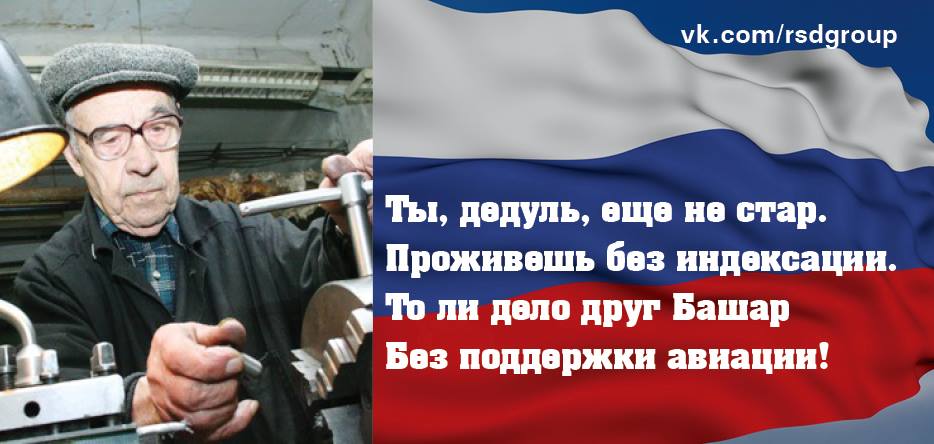
“You, Grandpa, are still not old. / You’ll live without indexation. / It’s not the same for our friend Assad / Who can’t live sans our aviation.” Courtesy of Ivan Ovsyannikov and the Russian Socialist Movement (RSD)

_________

State Duma Rejects Indexation for Working Pensioners
October 9, 2015
Lenta.Ru

Photo: Alexander Kozhokhin/RIA Novosti

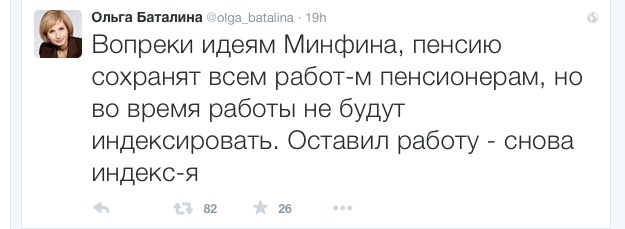
The pensions of working pensioners will not be indexed for inflation. Olga Batalina, head of the State Duma’s Committee on Labor, Social Policy and Veterans Affairs, made the announcement on Twitter.

batalina
“Despite the Finance Ministry’s ideas, the pension will be preserved for all working pensioners, but will not be indexed [while they are still working]. You quit work, indexation kicks in again.”

She noted that all working pensioners would continue to receive payments, but the payments would not be raised while they are employed.

“You quit work, indexation kicks in again,” added Batalina.

Earlier, on October 9, she announced that the government had to decided index pensions twice in 2016. Batalina explained this would be done so that pensions would increase to the level of inflation for 2015.

On October 8, however, Deputy Prime Minister Igor Shuvalov noted that the possibility of a second indexation next year would depend on the Russian economy’s growth.

On the same day, the government approved the draft budget for 2016. It is expected that revenues will reach 13.58 trillion rubles, expenditures, 15.76 trillion. The deficit is projected at 2.8 percent of GDP (2.18 trillion rubles).

A part of the treasury’s expenditures will be covered by a freeze on pension savings. Another cost-saving measure is reducing the indexation of pensions (to 4 percent at an expected inflation rate of 12 percent). Moreover, the idea of terminating pension payments to working pensioners was considered.

Translated by the Russian Reader

_________

Balancing Russia’s Budget Could Cost Pensioners $46 Billion
Anastasia Bazenkova
June 24, 2015
The Moscow Times

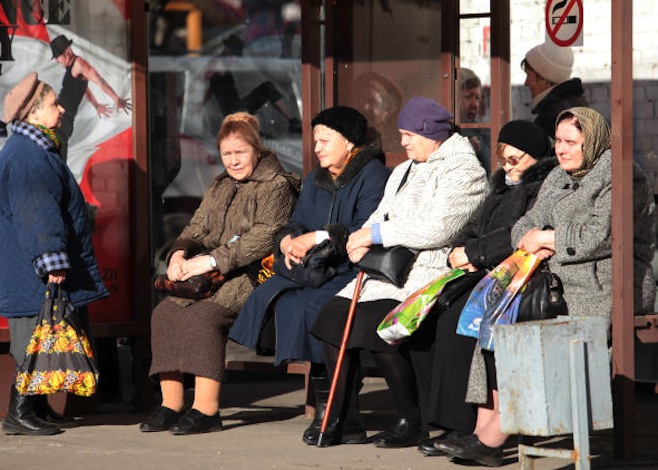
Russia’s roughly 40 million pensioners receive on average 12,900 rubles ($240) in state pension payouts. Photo: Denis Abramov/Vedomosti

Russia’s economic crisis is forcing the government to consider sweeping savings on pension payouts, a move that could go down badly with a core part of President Vladimir Putin’s electorate.

The Finance Ministry this week floated a proposal to save more than 2.5 trillion rubles ($46 billion) over three years by raising pensions at less than the rate of inflation.

The measure comes as the ministry struggles to slash spending amid an economic recession that is eroding budget revenues.

A steep devaluation of the ruble has meant that prices have grown much faster over the past year than salaries, and since payroll taxes are the main source of income for the pension system, the Finance Ministry has said continuation of inflation-linked pensions could threaten the country’s state-run pension fund.

In May, average nominal incomes were 7.3 percent higher than in May 2014, while prices were on average 15.8 percent higher, according to the Rosstat state statistics service.

“If the income of the fund continues to grow slower than its payouts, it could break the entire pension system,” the Vedomosti newspaper quoted Deputy Finance Minister Maxim Oreshkin as saying last month.

The government is already subsidizing a 3.3 trillion ruble ($60 billion) hole in the pension fund, said Pavel Kudyukin, an associate professor at Moscow’s Higher School of Economics.

“This is no longer affordable for the state,” he said.

Pre-Crisis Thinking

According to documents for a government meeting on Monday obtained by news agency RBC this week, the Finance Ministry has drawn up plans to curb planned pensions increases from 7 percent to 5.5 percent in 2016; from 6.3 percent to 4.5 percent in 2017 and from 5.1 percent to 4 percent in 2018.

That means that payments will be increased not in the line with the actual inflation, which is expected to fall back into single digits early next year, but according to inflation forecasts made in early 2014, before Western sanctions over the Ukraine crisis and a sharp decline in global oil prices pushed Russia’s economy into recession. Russian GDP is expected to shrink by around 3 percent this year.

These changes, together with cuts to some other undisclosed social spending items, would save around 2.5 trillion rubles over 2016-2018, RBC reported, citing the Finance Ministry documents.

The government has said no decision has yet been taken.

The changes may require changes to legislation, which requires that Russian pensions are indexed twice a year in line with inflation.

Political Consequences?
Spending on pensions has risen rapidly in recent years as President Putin has sought to use booming oil revenues to raise living standards of pensioners and low-paid state employees.

Pensions were raised even in 2009, during Russia’s last economic crisis, Kudyukin said.

Russia’s roughly 40 million pensioners receive on average 12,900 rubles ($240) in state pension payouts, according to the data from Russia’s pension fund.

The Finance Ministry’s proposal to abandon the link between pensions and inflation aroused sharp criticism from other ministries.

Maxim Topilin, the labor minister, demanded that money be found for the indexation of pensions for next year and the following years and for an analysis of the effectiveness of spending, news agency RIA Novosti reported Tuesday.

Analysts polled by the Moscow Times doubted that the measure would be implemented, as pensioners provide a bedrock of support for President Putin ahead of planned elections in 2018.

“Pensioners are the current government’s main electoral support,”said Pavel Salin, head of the political science center at the Financial University. “The authorities will not reduce pension payments on the eve of the election period.”

Unwillingness to alienate voters is why another Finance Ministry proposal, to cut government expenses by increasing the retirement age of civil servants from 60 to 65 years, has little chance of approval, analysts said.

Hiking the retirement age has been on the agenda for several years — the idea has been repeatedly promoted by former Finance Minister Alexei Kudrin — but has never gained traction.

But even if the Finance Ministry succeeds in making savings on pensions, any discontent would not lead to dramatic political consequences, experts said.

The move could cost Putin a few percentage points off his rating, but not dozens, Salin said.

Putin could afford that — the president’s approval rating is at a record high of 89 percent, according to a poll by the Levada Center released Wednesday.

Given the political apathy of Russians and a surge in patriotic feeling that followed Moscow’s annexation of Crimea from last year, people will bear less generous pensions, Kudyukin said.

“The question is, for how long will they bear them?” he added.