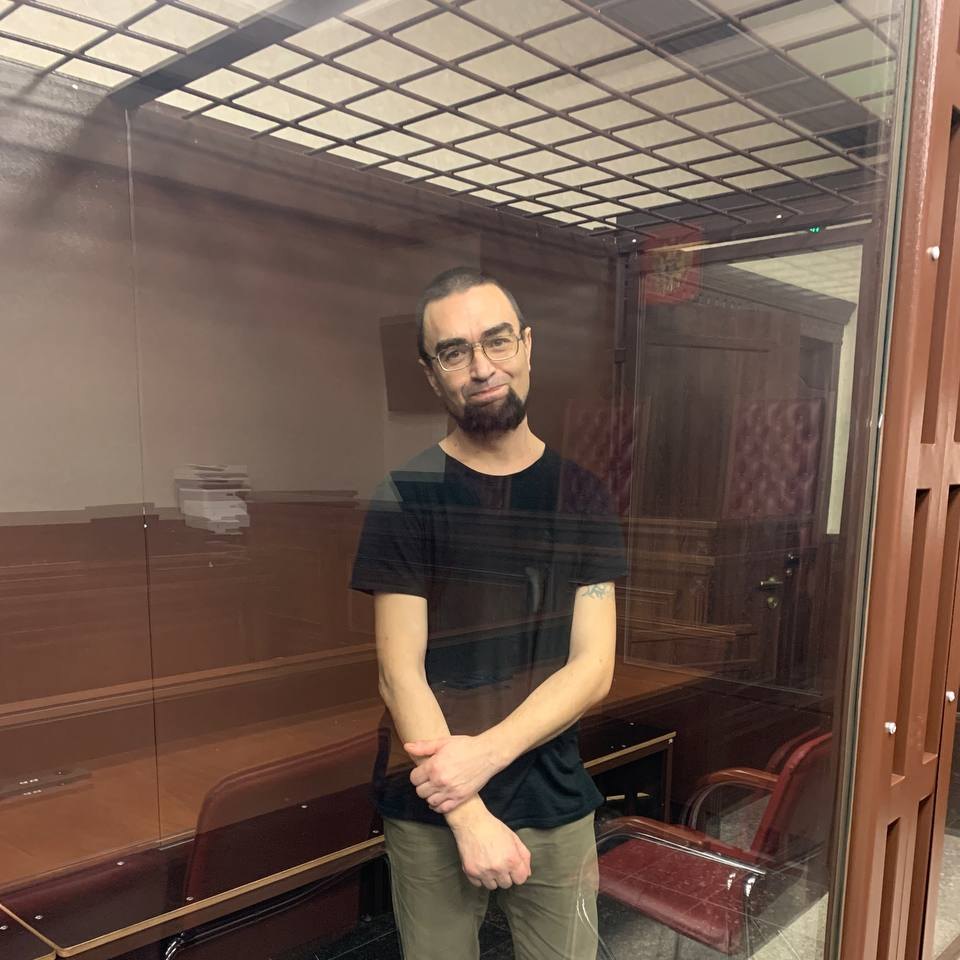
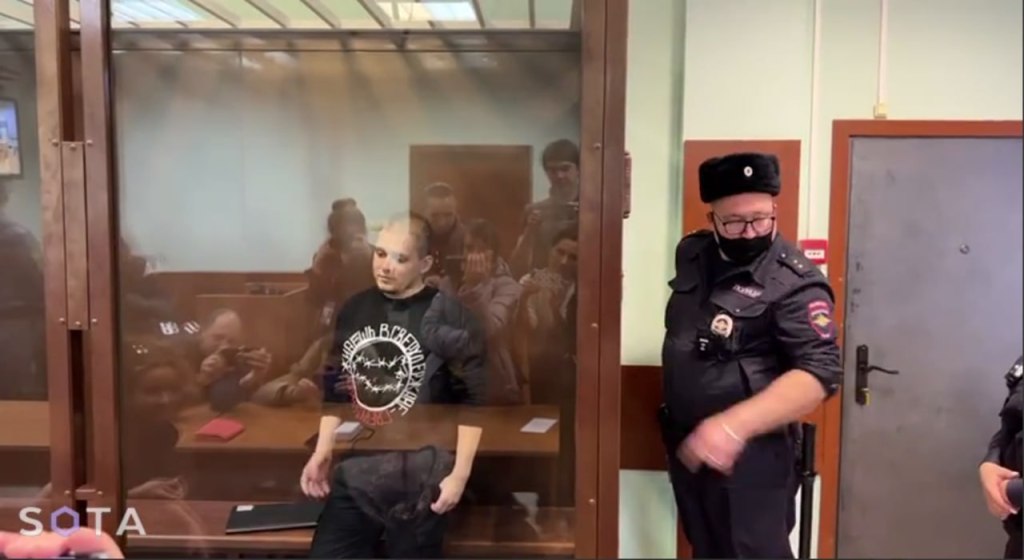
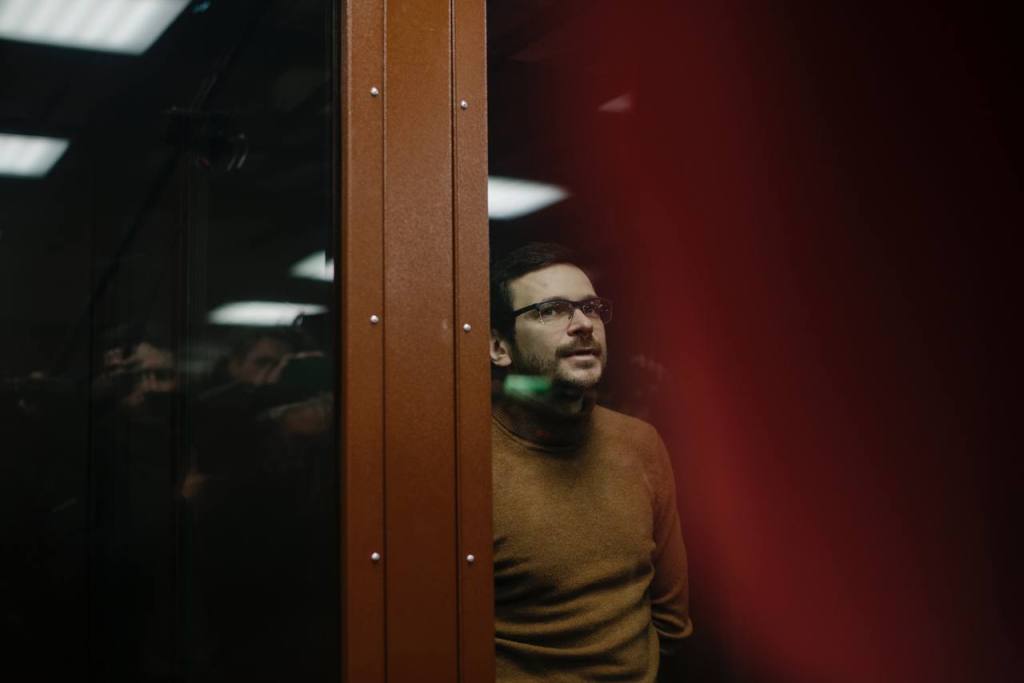
Lawyer Dmitry Talantov has been sentenced to seven years in a penal colony on charges of disseminating “fake news” about the Russian army and inciting hatred in connection with several social media posts about the war. Talantov had been on the defense team of journalist Ivan Safronov, who was sentenced to twenty-two years in a penal colony for high treason. Talantov had also served for many years as the head of the Udmurtia bar association, so it is likely that both the judge who sentenced Talantov and the prosecutor who petitioned the judge to sentence the respected 64-year-old defense lawyer to twelve years in prison knew him personally.
Talantov delivered a memorable closing statement today in court.
Dmitry Talantov, sentenced to seven years’ imprisonment for antiwar social media posts:
Brodsky once said that “prison is a lack of space counterbalanced by a surplus of time.” I didn’t completely understand this phrase. I didn’t get it. I’m certain that none of you totally understands it, because it is the surplus of time which is frightening about this situation, not the lack of space. It is the time during which you suffer, and the time that tries to kill you. Every minute tries to kill you, and every minute in there [in prison] is equal to an hour.
[…]
People often ask for forgiveness during their closing statement. I also want to ask for it. I’m saying this to my wife. Forgive me, Olga. I love you. If this is overdoing it emotionally, then I’ll put it this way. Olya, if you’re ever sent to prison for twelve years for some reason, I’ll wait for you to get out. Take it easy.
Sasha Skochilenko, the Petersburg artist and musician sentenced to seven years’ imprisonment for posting antiwar price tags in a supermarket and released as part of a prisoner swap in August 2024:
Alexei Gorinov, the Moscow municipal district council member who was initially sentenced to seven years in prison for “disseminating fake news” during an argument about whether it was appropriate to hold celebrations for children during a war, and who is now on trial a second time for allegedly “condoning terrorism” in conversations with cellmates:
I was also a municipal council member during the August 1991 coup. I stood with other defenders outside the Russian Supreme Soviet, the so-called White House. We were defending our freedom, our right to live freely and, thus, to speak freely, voice our thoughts, gather information, and share it. If they had told me then that thirty years later I would be tried by a criminal court for my words, for my opinion, I wouldn’t have believed them.
Nadezhda Buyanova, a pediatrician, was sentenced to five and a half years in prison for “disseminating fake news,” after she was denounced by the widow of an army officer killed in Ukraine: the doctor had allegedly said to the woman’s seven-year-old son that his father had been a “legitimate target”:
If there used to were doctors and patients, nowadays there are providers and clients. That’s what we were told at the planning meetings: “Humiliate yourself. And us.” We medics can be slandered, we can be insulted, we can be called every name in the book. We can’t defend ourselves, our explanations are not heard by our superiors, and conflicts are not resolved.
There was no interrogation and the child had nothing to say. “At the end of the appointment, he walked out of the office.” You cannot believe such a tale. You cannot lie like that: it’s a disgrace. How can you accuse a person without evidence, on the basis of a false accusation? Where is the logic? Where is the justice? Earlier, in ancient times, there were wise men. They would have said: “Well, what do you expect from a person without proof?”
Roman Ivanov, a journalist for RusNews, was sentenced to seven years in prison for three social media posts. During his closing statement in court, he knelt down to apologize to Ukrainians:
What can we do in this situation? I honestly don’t even know anymore. But I want to ask for forgiveness from all the citizens of Ukraine, to whom our country has brought grief, whom our country has robbed of their relatives, their loved ones, and their friends, who will never come back.
And [I ask for forgiveness] not for the whole country, but for me personally, for Roman Viktorovich Ivanov, a citizen of the Russian Federation. I would like to get down on my knees before the relatives of the people who were murdered in Bucha, although I don’t know who murdered them. But they are the consequences of what our country has become.
The politician Alexei Navalny was repeatedly tried on trumped-up charges before he was murdered in a penal colony on 16 February 2024. Perhaps it was Navalny, during his endless trials, who revived the closing statement in court as a literary genre. Here is an excerpt from his speech at his trial for “extremism” in July 2023:
Former Moscow politician Alexei Gorinov, the first known Russian to be imprisoned for denouncing the invasion of Ukraine, was sentenced to three more years on Friday on charges of “justifying terrorism” that he says he was framed for.
Ahead of his sentencing, he read the following statement to the court and the press:
Imprisoned Kremlin critic Alexei Gorinov, sits in a cage of the courtroom as his second trial for criticizing Russia’s actions in Ukraine swiftly nears its conclusion in Vladimir, Russia, Friday, Nov. 29, 2024. Photo: Dmitry Serebryakov/AP
“All my life I have been an opponent of aggression, violence and war, and devoted myself exclusively to peaceful activities: science, teaching, education, governance and public activities as a deputy, human rights activist, member of election commissions and controller of the electoral process. I never thought that I would live to see such a level of degradation of my country’s political system and its foreign policy, when ordinary citizens who favor peace and are against war, who number in the thousands, would be accused of slandering the Armed Forces and justifying terrorism, and would be put on trial.
“The third year of the war is coming to an end. The third year of casualties and destruction on European territory, of deprivation and suffering of millions of people on a level unprecedented since World War II. We cannot remain silent about this.
“Back in late April, our former defense minister announced the losses of the Ukrainian side in the armed conflict – 500,000 people. Think about this number! And what losses have been suffered by Russia, which, according to official information, is constantly successfully advancing along the entire front? We still do not know. And who will be responsible for this? What is all this for?
“Our authorities and those who support them in their militaristic aspirations wanted this war so much — and now it has come to our land.
“I would like to ask them: has our life become better? Is this how you understand the well-being and security of our country and its population? Or did you not envision these developments in your calculations?
“But for now we have to answer not to those who organized the war, continue to kill, propagandize the war and engage in mercenarism. Rather, we ordinary citizens of Russia, who raise our voices against war and for peace, have to answer, paying with our freedom and, for some, with our lives.
“I belong to the outgoing generation of people whose parents took part in World War II or survived it with all its hardships. The generation that has already passed away entrusted us with preserving peace with all our might as the most precious thing on Earth for all its inhabitants. But we have neglected these principles and devalued our memory of these people and the victims of that war.
“My guilt is that I, as a citizen of my country, allowed this war to happen and failed to stop it. And I ask you to note this in the verdict. But I would like my guilt and responsibility to be shared with me by the organizers, participants and supporters of the war, as well as the persecutors of those who advocate peace.
“I continue to live with the hope that someday it will be so. In the meantime, I ask the people of Ukraine and my fellow citizens affected by the war to forgive me.
“Within the framework of the case in which I was accused and tried for my opinion that we need to seek an end to the war, I have expressed my attitude fully to this abominable human endeavor. I can only say that violence and aggression breed nothing but reciprocal violence. This is the true cause of our troubles, our suffering, our senseless sacrifices, the destruction of civilian and industrial infrastructure and our homes.
“Let us stop this bloody, needless slaughter — neither for us nor the inhabitants of Ukraine. Isn’t it time to leave our neighbors alone and deal with our own snowballing domestic problems? Long ago we proved to the world how brave, resilient and peace-loving we are. So, maybe enough is enough?
“Lev Nikolaevich Tolstoy — from a letter to his son (1904): ‘For me, the madness and criminality of war is so clear that I can see nothing in it except for this madness and criminality.’
“I too join and subscribe to these words of our great compatriot.
“You can join too!”
SOTAVision reported that Judge Vladimirov interrupted Gorinov when he started to talk about losses in the war in Ukraine and called a 15-minute break so Gorinov could “think over his speech again.”
Anarchist and mathematician Azat Miftakhov has been sentenced to four years in a maximum security facility on criminal charges of “condoning terrorism.” The young man will spend the first two and a half years of his sentence in a closed prison. Miftakhov was detained in September 2023 as he was leaving the penal colony from which he had been released after completing his sentence on charges related to the breaking of a window at a United Russia party office. The next day he was remanded in custody in a pretrial detention center. According to the security forces, while watching TV with other inmates Miftakhov had spoken approvingly of the actions of Mikhail Zhlobitsky, who bombed the FSB’s Arkhangelsk offices [in 2018].
Why do I need to know this? Miftakhov’s wife, Yelena Gorban, argues that this criminal case was launched by members of the security forces who wanted to “extend Azat’s sentence for his past political activity.” In her statement to the court, she said that her husband was aware of the dangers of wiretapping in the penal colony, and so he had avoided discussing political topics in the company of inmates. “The conspicuousness and brazenness with which they fake evidence doesn’t embarrass them. It even plays into their hands. It’s like they’re telling us, ‘It’s no trouble for us to put anyone away,'” the anarchist himself said in [his closing statement at the trial].
Source: It’s Been That Kind of Week newsletter (OVD Info), 30 March 2024. Translated by the Russian Reader
A video and audio recording of Azat Miftakhov’s closing statement at his trial and his sentencing, 28 March 2024, Yekaterinburg. Source: FreeAzat (Telegram), 31 March 2024
During the years I was imprisoned on the charges in previous criminal case, I failed to fall head over heels in love with the state, and now I again find myself in the dock. I am now on trial for what the security forces have deigned to call “condoning terrorism” by faking the evidence, as they did five years ago. The conspicuousness and brazenness with which they fake evidence doesn’t embarrass them. It even plays into their hands. It’s like they’re telling us, “It’s no trouble for us to put anyone away.”
We see the same brazenness in the numerous incidents of barbarous torture perpetrated by the regime’s guardians, the FSB. These guardians don’t care that their shameful deeds are made public. On the contrary, these deeds are flaunted as a source of pride. In this way, the state shows its terrorist nature, as anarchists pointed out before the previous presidential election by taking to the streets with the slogan “The FSB are the main terrorists.”
What we were saying back then has now become obvious not only in our country but all over the world. We how see how the [Russian] state’s entire foreign and domestic policy has become a conveyor belt of murder and intimidation. While fake witnesses attempt to prove the charges that I “condoned terrorism,” national TV channels broadcast calls for the mass murder of people who disagree with state policy. We see that the state, while paying lip service to combating terrorism, in fact seeks to maintain its monopoly on terror.
No matter how the Chekists try to intimidate civil society, we see even in these dark times people who find the courage to resist the terror that has spilled over the state’s borders. Risking their freedom and their lives, their actions awaken our society’s conscience, whose lack we now feel so acutely, and their steadfastness to the bitter end stands as an example for us all.
One such example for me was my friend and comrade Dmitry Petrov (aka Dima the Ecologist), who died defending Bakhmut from soldiers who had become tools of imperialism. I knew him as a fiery anarchist who, amidst a dictatorship, did everything he could to lead us to a society based on the principles of mutual aid and direct democracy.
As a graduate of the history program at Moscow State University and a PhD in history, he was well versed in the structure of society and was able to argue his position well, something I had always lacked. And yet he was not limited to theorizing but was also heavily involved in organizing the guerrilla movement, which did not escape the FSB’s notice. Because of this, he was forced to continue his work as an anarchist in Ukraine.
When the grim events of the last two years kicked off, he could not stay on the sidelines. An enterprising comrade, he sought to create an association of libertarian-minded people who would fight for the freedom of the peoples of Ukraine and Russia. Unfortunately, no war is without casualties, and Dima was one of them. It would be unjustifiably selfish of me to admire the selflessness of strangers alone and not to acknowledge the sacrifice of those who are personally dear to me. I am well aware of this, despite my regret that all my fellowship with him is now irrevocably a thing of the past.
And yet I find it hard to accept this loss. Knowing that he was one of the best of us, and wanting to do my best to ensure his sacrifice was not in vain, I have to recognize that my contribution will be insignificant compared to what he was capable of.
What I’ve just said was perhaps unexpected for some people. I cannot rule out that some of my supporters could be disappointed, as I find it difficult, to my own regret, to speak out publicly. Perhaps someone will disagree with my beliefs, which are at odds with pacifism.
Striving to be rational about everything, however, I reject a belief in things whose existence has not been proven. Among other things, I do not believe in the world’s justice. I do not believe that all evil will be punished as a matter of course. That’s why I support vigorously resisting evil and fighting for a better world for all of us.
But even if some of my supporters do not share all of my beliefs, I am still grateful for all of their help.
I am grateful to everyone who has written me letters full of warmth and good wishes. Even amidst the desolation of the penal colony, I received stacks of them almost every week. I am certain that such great attention to me was borne in mind by the people who set out to make me submissive. I find it quite pleasant and touching that people share a part of their lives with me, whether the experiences are joyful or sad. Every letter is very dear to my heart, and I read every single one of them.
Many thanks to all those who have supported me financially. Thanks to them I have never lacked anything during all the years of my imprisonment. There have been times when I have run out of money to support me, but as soon as I put out a call for help, within a few days people who cared about me brought my budget back to a comfortable level. This is very pleasant and impossible to forget. Special thanks to Vladimir Akimenkov, who for more than ten years has been organizing fundraisers to support political prisoners, including me.
I am extremely grateful to the activists in the FreeAzat and Solidarité FreeAzat collectives, who have organized campaigns and events in solidarity with me on a scale which boggles my mind. Your recent “1001 Letters” campaign was one of them. After reading all those letters, I was pleasantly surprised to find out that people in dozens of different countries are concerned about me. Thank you very much to everyone who was involved in this campaign, thus showing me how much you support me.
I am extremely grateful to mathematicians all over the world, and specifically to the Azat Miftakhov Committee, for supporting me on behalf of the mathematical community. I am very touched that people to whom I look up, whose scholarly prowess I dream of achieving someday, know about me and voice their solidarity.
Thank you very much to everyone who has spoken publicly about me. And special thanks to Mikhail Lobanov, who was forced to emigrate to France for vigorously supporting me. But even there, despite all the difficulties of exile, his solidarity with me has been as strong as ever.
Many thanks to the Russian activists, including those who don’t belong to collectives mentioned above, who have risked their comfort by showing solidarity with me while living under a dictatorship. I am very grateful to all who came to support me with their presence by attending the trial. Some of you traveled hundreds of kilometers for this purpose, and some of you did it more than once and more than twice. I was once again pleasantly surprised by such a huge attention to me.
Many thanks to all the honest members of the press who, through their work, have been helping the public to follow my trial.
I thank my defense counsel, Svetlana Sidorkina, for her dedication in defending me at my trials. I never cease to admire her professionalism and I am convinced that I am very lucky to have her. Finally, I would like to thank Lena, my main support in my tribulations. She has helped me through her dedication to overcoming all the difficulties of my imprisonment. On top of that, I am blessed to be in love with her.
As I finish my acknowledgements, I am left with the feeling that someone may have been overlooked. This is a consequence of the tremendous, steady support I have received since the moment of my arrest. I am pleased to see I am not the only one who has been the object of your support—that, despite the dark events of recent years, your solidarity knows no territorial boundaries. This is what gives me hope for a bright future for all of us.
During his closing statement in court today the documentary filmmaker Vsevolod Korolev read a poem by Grigori Dashevsky:
1.
Across the river they’re making chocolate.
Out there the river-ice is breaking up.
And upriver we’re waiting, but for now
no bus comes, only its vacant ghost,
a desolate fleshless light flying ahead
to the engine’s howl
and the clatter of
the ad-slates changing.
We’re not cold, we bide our time.
The sky a deeper blue, the burning streetlights.
2.
To wait for each new minute as for a ghost,
to put on stage-paint for him alone,
to powder your face with light––and poorly it sticks,
but without it there’s nothing
to tell you apart: not from the many
faces—multitudes—
but from the lived-through years
which, like a star, are distant and weightless as smoke.
3.
But from the sweet smoke, the glory of heaven,
look up for a moment,
tear your eyes away as from a book:
As much as a star has its shining
or a factory its smoke,
all things have
their limit: a book’s gilded edges
or a band of cloud.
4.
And turned from weddings not my own, and graves,
not waiting for the end, I rose
and saw an enormous room, a hall,
walls, walls, Moscow, and I asked:
where is the light that lit these pages,
where is the wind that rustled them like leaves?
5.
It’s late to be asking: each person is lit bright,
thrown open to the right dream
for the minutes, like pupils widened,
unscathed, like smoke or sleep:
they fly in, gleam, collect a promise:
Remember, remember (take leave of) me.
“I don’t intend to speak for very long. Your Honor, I am in some sense a colleague of yours, since I’ve worked as a third-tier soccer referee; I understand that you’re in a tough situation, it’s hard to envy someone stuck in the middle of this whole business. But nevertheless I have always believed in people and will continue to do so, even when it makes absolutely no sense. In any case I know this is really hard for you, but I think you’ll figure it out.” (Vsevolod Korolev)
“To ask for ten years when the maximum is ten and given the absence of aggravating circumstances and the evidence of mitigating ones—this goes against the fundamental norms of the criminal code. And this demonstrates for the umpteenth time the invalidity and baselessness of the prosecution’s case.” ([Korolev’s defense] lawyer Maria Zyrianova)
Discourse journalist and documentary filmmaker Vsevolod Korolev has been sentenced to a three-year prison term on charges of “disseminating fake news” about the army.
During the trial on March 18 defense lawyer Maria Zyrianova noted that the case file did not indicate what information in Korolev’s posts had been determined to be knowingly false. Korolev is accused of making two posts on [the Russian social media network] Vkontakte about the mass murders of civilians in the Ukrainian cities of Bucha and Borodianka, as well as about the shelling of Donetsk.
The prosecution requested a nine-year prison sentence for Korolev. This, notedDiscourse, was the longest prison term ever requested by state prosecutors for the charge of disseminating “fake news” about the Russian army.
During the court hearing on March 20, bailiffs at St. Petersburg’s Vyborg District Court recorded the names of those who came to support Korolev, SOTA reports. Earlier, SOTA published a recording of a telephone conversation between the bailiffs, in which they announced their intention to provide the lists of those who came to the trial to Center “E” [the “counter-extremism” police].
The Case of Vsevolod Korolev
Vsevolod Korolev is a documentary filmmaker and poet. He worked as a correspondent for the culture magazine Discourse and made films on social themes — about children with disabilities and political prisoners.
Korolev was detained in July 2022. During the search, his electronic devices were confiscated.
The prosecutors argued that Korolev’s documentaries about the political prisoners Maria Ponomarenko and Alexandra Skochilenko should be deemed an aggravating circumstance.
Linguistic expertise in the case was provided by linguist Alla Teplyashina and political scientist Olga Safonova from the Center for Expertise at St. Petersburg State University.
One of the prosecution’s witnesses later recanted their testimony.
In his closing statement at the trial, Korolev quoted a poem by Grigori Dashevsky: “It’s late to be asking: each person is lit bright, / thrown open to the right dream / for the minutes, like pupils widened, / unscathed, like smoke or sleep: / they fly in, gleam, collect a promise: / Remember, remember (take leave of) me.“
Memorial has designated Korolev a political prisoner.
You can support Vsevolod Korolev by sending him a letter to the following address:
196655 St. Petersburg, Kolpino, Kolpinskaya Street, 9, FKU SIZO-1, Vsevolod Anatolyevich Korolev (born 1987)
Source: “Discourse journalist Vsevolod Korolev sentenced to three years for ‘fakes’ about the army,” DOXA, 20 March 2024. Translated by the Fabulous AM and the Russian Reader. People living outside of Russia will find it difficult or impossible to send letters to Russian prisons via regular mail or using online prison correspondence services such as FSIN-Pismo. In many cases, however, you can send letters (which must be written in Russian or translated into Russian) to Russian political prisoners via the free, volunteer-run service RosUznik. You can also write to me (avvakum@pm.me) for assistance and advice in sending such letters.||| TRR
Bohdan Ziza, a Ukrainian artist, poet and activist, is serving a 15-year sentence for “terrorism” after pouring blue and yellow paint – the colours of the Ukrainian flag – on to a municipal administration building in Evpatoria, Crimea, his home town. He made and circulated a video of the action – on 16 May 2022, shortly after the all-out Russian invasion of Ukraine – and for that was also charged with “incitement to terrorism”.
Bohdan Ziza. From his instagram channel
This is Bohdan’s speech from the dock, before being sentenced by a Russian military court on 5 June last year.
Do I regret what I have done?
I am sorry that I over-reached, and that my action resulted in charges under the Article [of the Russian criminal code] on terrorism. I am sorry that my grandmother is now without the care and support that she needs. Apart from me, she has nobody. And I am sorry that I can not now help others who are close to me, who need that help now.
As for the rest: I acted according to my conscience.
And also, according to my conscience, I do not deny or disavow what I did. I behaved stupidly, and could have expressed my opinion in some other way. But did I deserve, for what I did, to be deprived of my freedom for ten years or more?
I would like to appeal to the court: do not follow the regime’s script, do not participate in these awful repressions. But obviously that would have no effect. The judges and other similar political actors are just doing what they are told.
For these reasons, I will continue to protest, even in prison. And I am well aware of the sentence I may receive, and how it may affect my health and even my life.
But am I worthy of the life that I live? Is each one of us worthy of a carefree life, when we stay silent at a time when, every day, innocent people’s lives are being taken?
This was the worst night of my life. I never experienced anything like it. I thought we would die. There were three Kinzhal rockets, and loads of Kalibrs. They fell very close, they were right above our building. The building shook – several explosions, one after the other. For the first time in the war there was a white glow, the sky was white from the explosions. It was as though we were in a trench, not in our own home. At one moment I thought that it was all flying towards us. There was the very clear sound of a rocket, and then a very powerful explosion. But we have been lucky, again, and we are still alive.
That was a message from my sister, in Kyiv, who had to live through another night of bombardment of the city by the Russian armed forces.
When she went out in the morning, she learned that one of the rockets had hit the next-door building.
For many people, this war that is going on now is happening over there somewhere, far away.
One of the staff at the pre-trial detention centre said to me: “Bloody hell, I am sick of this war. Whenever you turn on the TV, it’s more of the same.” I answered that the war is not over and so you can not get away from it. And then he said: “Yeah, yeah, I know. It’s just that everything is getting more expensive. The cost of running a car now!”
And that’s the problem, here in Russia. For you, this war is an inconvenience, an irritation. You try to wait it out, living your usual life, trying to avoid bad news, and in that way simply not valuing simple things, not valuing the fact that you can wake up in a warm bed, in a warm flat, and say to someone who is dear to you, “good morning”. At a time when in the country next door, millions of people are losing their homes, losing their loved ones, when whole cities are being destroyed. Every day. That’s the everyday reality for Ukrainian citizens now.
In theory, Russian people’s failure to act could be explained, if only what is happening was not being done by Russian hands. The hands of those who bear arms, and those who don’t do anything to stop them. Every day that an ordinary Russian person carries on, reasoning that this is all politics and doesn’t concern him, and living his normal life, he adds money to the Russian Federation budget and in that way sponsors this criminal war.
Of course there are those who do not support what is happening, who take action, who are not silent participants: journalists, various activists – those who refuse to keep quiet.
My action was a cry from the heart, from my conscience, to those who were and are afraid – just as I was afraid – but who also did not want, and do not want, this war. Each of us separately are small, unnoticed people – but people whose loud actions can be heard. Yes, it is frightening. Yes, you can end up behind bars – where I, for sure, did not plan to be. Even for these words I could face a new criminal case. But it is better to be in prison with a clear conscience, than to be a wretched, dumb beast on the outside.
I am also an ordinary citizen of my country – Ukraine – who is not used to keeping quiet when confronted with lawlessness. I am not alone here today in this “goldfish bowl” [slang for the glass cage in which the accused appears in Russian courts]. There are more than 200 people with me: Ukrainian political prisoners, serving time in Russian prisons on fabricated charges. Many of them are Crimean Tatars, who are once again faced with repression by Russia. I am myself half Crimean Tatar, and angry at our people’s suffering.
Many Ukrainians are serving time in Russian prisons simply because they are Ukrainians, and were somewhere that the Russian state thought they should not be. In Russian prisons people are beaten up for speaking in Ukrainian. Or not even for speaking it, but simply for understanding it. Bastards among the guards at pre-trial detention centres or other places where people are imprisoned address prisoners in Ukrainian, to see if they get a reaction, to see if they provoke an answer or a response. If a person reacts, they beat him up.
Those who so passionately seek “Nazis” in Ukraine have not opened their eyes to the Nazism that has emerged in Russia, with its ephemeral “Russian world”, with which armed forces have come to us, to try to extirpate Ukrainian identity.
People in prison suffer in the most terrible conditions. Many of them are elderly. More than 40 people [in the pre-trial detention centre] have critical health problems, and can not access the medical treatment that they need. People die in prison. They are not criminals. Deport them from the country! Why do you keep them here?
I am no kind of terrorist. It sounds ridiculous to even say that. I am a person with morals and principles, who would rather give his own life than take the life of another person. But I am not ready to give my life to the Federal Penal Enforcement Service of the Russian Federation.
I declare a hunger strike, and demand that I be stripped of my Russian citizenship. I demand that all Ukrainian political prisoners be freed. If anything happens to me in prison, I want the world to know that it happened only because I am a Ukrainian, who took a stand against the war in his country.
And if this is my last word, let it be my last word in the Russian language. The last thing I will say publicly in Russian in this country, as long as this regime lasts. The reddish regime.
[Ziza then switched from Russian to Ukrainian, and recited this poem. Explanation of names mentioned below.]
I am not Red, I am Crimson!
I am not playing to the gallery!
These are not rhymes, they are wounds!
And I am not Melnik, I am Bandera!
The weather: it’s snowing in my summer,
From Symonenko’s motherland
I go to the end, like Teliha!
And I believe in wings, like Kostenko!
□ Note. The Ukrainian for “crimson” (“bahrianyi”), was also the pseudonym of Ivan Lozoviaha, a dissident writer and political exile from 1932 to his death in 1963. Andriy Melnik and Stepan Bandera were leaders of Ukrainian nationalist partisan military formations in the 1940s. Vasyl Symonenko was a Ukrainian poet, active in dissident circles until his death in 1963. Olena Teliha was a feminist poet, member of a nationalist underground cell in Nazi-occupied Kyiv, killed by the Nazis in 1942. Lina Kostenko is a Soviet-era dissident who has continued working as a poet and writer in post-Soviet Ukraine.
□ This is translated from the Russian text on the Graty news site, with reference to the Crimea Human Rights Group report.Thanks to M for help with translation.
□ What happened next. After Bohdan Ziza made this speech to the Southern District Military Court in Rostov, Russia, on 5 June 2023, he was sentenced by the judge, Roman Plisko, to 15 years in a high-security penal colony. Shortly after that, Ziza wrote to Zmina, the Ukrainian human rights organisation. He ended his hunger strike and then wrote to Uznik on-line, which coordinates correspondence with anti-war prisoners in Russia, to thank them and the many supporters who had written to him.
Bohdan, who marked his 29th birthday on 23 November, was moved to Vladimir prison. On 5 December, the Kharkiv Human Rights Protection Group reported that he had been visited by his lawyer and is in good spirits. He is sharing a cell with Appaz Kurtamet, another Crimean Tatar political prisoner, and was serving time in a punishment cell after stating that he is not a criminal and refusing to wear prison clothing.
□ What we can do. Advice to non-Russian speakers who wish to write to Bohdan and Appaz is included in this article on the Kharkiv Human Rights Protection Group site. The group also appeals to other countries’ diplomats to help Ukrainian citizens in Russian prisons (although this does not include Bohdan, since he was compelled, as a teenager, to take Russian citizenship after Crimea was annexed by Russia in 2014).
□ More information. Solidarity Zone (see facebook, telegram and twitter) supports anti-war activists jailed in Russia. The Kharkiv Human Rights Protection Group, Crimea SOS and Zmina are among the Ukrainian human rights organisation that publicise the fate of more than 180 Crimean political prisoners in Russian jails. SP, 17 January 2024.
I’ve always liked a certain phrase from our fellow countryman, the philologist Professor Lotman. In one of his university lectures he said: “A person is always in an unforeseen situation. And here they have two legs: conscience and intellect.”
This is a very wise thought, I think. And a person must rely on both of those legs.
Relying on your conscience alone seems intuitively right. But abstract morals that fail to take into account human nature and the real world will devolve into either stupidity or evil-doing, as we’ve seen more than once in the past.
Then you have reliance on the intellect without conscience—which is exactly what lies at the foundations of the Russian state today. At first this idea seemed logical to the elites. Using petroleum, gas and other resources, we’ll build a conscience-free, but very clever, modern, rational and merciless state. We’ll become richer than the tsars of the past. And we have so much gas that even the populace will get a little something. Making use of the contradictions and vulnerability of democracy, we will become leaders and be respected. And if not, then feared.
But what happens is what happens everywhere. The intellect, unfettered by conscience, whispers: seize, steal. If you’re stronger, then your interests are always more important than the rights of others.
Not wishing to rely on the leg of conscience, my Russia made several big leaps, pushing everyone else around, but then slipped and came crashing down, destroying everything all around it. And now it is floundering in a pool of either mud or blood, its bones broken, its population destitute and robbed blind, while all around lie tens of thousands of people killed in the stupidest and most senseless war of the 21st century.
But sooner or later, of course, Russia will rise again. And it’s up to us what [leg] it will rely on in the future.
Russian prosecutors have requested a 20-year prison sentence for jailed Kremlin critic Alexei Navalny on a new string of “extremism” charges, his team reported Thursday.
Navalny, 47, has been charged with creating an extremist community and an organization that infringes on the rights of citizens; financing extremism; making calls to extremism; and involving minors in dangerous acts and the rehabilitation of Nazism.
He and his allies have denied the charges as “absurd” and politically motivated.
If convicted, the trained lawyer and Putin opponent will spend a total of 29 years in prison.
In his final word in a prison court before his sentencing, Navalny slammed the invasion of Ukraine and expressed his hope for Russia’s future.
“My Russia made several big jumps, pushing everyone around, but then slipped and with a roar, destroying everything around, collapsed,” Navalny said, according to a statement published by his team.
“And now it is floundering in a pool of either mud or blood, with broken bones, with a poor and robbed population, and around it lie tens of thousands of people killed in the most stupid and senseless war of the 21st century.
“But sooner or later, of course, it [Russia] will rise again. And it’s up to us what it will rely on in the future,” he added.
His verdict is expected to take place on August 4.
The European Union added the chief of the Russian prison camp holding Navalny to its sanctions list as prosecutors requested the 20-year sentence.
Navalny was jailed upon his January 2021 return to Russia after recovering from a near-fatal poisoning with what Western scientists determined was Novichok, a banned military-grade nerve agent developed by the Soviets.
Russian officials outlawed Navalny’s political and activist organizations as “extremist” organizations later that year, prompting nearly all of his close associates to leave the country.
Igor Paskar in court. Photo courtesy of Solidarity Zone
On 31 May the Southern District Military Court in Rostov-on-Don sentenced Igor Paskar to eight-and-a-half years’ imprisonment on charges of “vandalism” and “terrorism”. He was found guilty of burning a Z-banner [a pro-war symbol] and the symbolic firebombing of the FSB [Federal Security Service] building in Krasnodar. The day before his sentencing, Igor gave his final statement in court. Here is a translation of his speech:
Almost a year has gone by since I carried out this action. During that year, I pictured this moment time and again, the moment when I would be given the opportunity to make my final statement. I agonised over the words I would say, and the motives that drove me to act as I did.
During the last sitting, your honour, you asked whether I regret my actions. I understood that the extent of my professed regret would influence the severity of the sentence. But if I renounced my beliefs, I would be acting against my conscience.
On the contrary, during the time I have been in prison, I have seen firsthand the injustices perpetrated against the people who we call our brothers: both prisoners of war who have served in the Ukrainian armed forces and ordinary Ukrainian citizens.
The war – or whatever term we use to label it – came to their homes, destroying their lives as they knew them. No matter what slogans and geopolitical interests we use to varnish this, in my eyes it cannot be justified.
Do I regret what has happened? Yes, perhaps I’d wanted my life to turn out differently – but I acted according to my conscience, and my conscience remains clear.
Rather than reflecting on who is right and who is guilty, I would like to pose this question: what did each of us do to stop this nightmare? What, ten or fifteen years from now, will we tell our children and grandchildren about these troubled times?
Unfortunately, God has not granted me the joy of fatherhood; the people who were closest to me have gone, and I am left alone with myself. It was easy for me to do what I did, even though I was well aware of the consequences. There was no-one to agonise about my fate, no-one to worry about me, or to cheer me on. But what I really did not expect was the huge number of letters and messages of support that I have received.
People have written from every corner of Russia, and not only Russia. Many were grateful for my position, so completely at odds with the notion of unanimous national support for what is being perpetrated. There were so many messages of encouragement: “stay strong”, “don’t despair”. So many warm words, so much sympathy.
But I’ll be so bold as to read just one part of a letter that I received in May, which really touched me, and pushed me to write this final statement to the court. Here it is:
“There is very little left of everyday life. It turns out that we can’t live everyday lives anymore. I am listening to the memoirs of prisoners from the 1930s, 40s and 50s. Right now, I’m on the breath-taking biography of [the actress] Tamara Petkevich [who spent seven years in a prison camp]. She was arrested in 1943 and lived until 2017. When they came for her, she was only 22 – just a girl, half the age I am now. I have not read Solzhenitsyn’s GulagArchipelago, and I never got round to Shalamov’s Kolyma Tales either. But now I’m listening to Petkevich, and it’s making me realise that this is exactly what we must listen to, what we must read at school. As a country we are obsessed with the past, but we hardly ever think about the present or the future. The Americans have their American dream: something to strive for. We have nothing but a fixation on that which happened long ago, that which cannot return. But time and again we try to bring back what has passed, and these attempts are absolutely pointless. It’s as though the whole country is stuck in the mud. As individuals we are caught in our feelings. It’s terrible that even now, for as long as we stubbornly turn our heads back, we will never live happily, never the way we want to. Let’s hope people can find happiness in the little things.”
You can support Igor Paskar by sending letters:
□ Address: Russia 344022, Rostov-on-Don, 219 Maksim Gorky Street, SIZO-1, Igor Konstantinovich Paskar (d.o.b. 1976)
□ You can send letters online via the volunteer service RosUznik.
Solidarity Zone gives full support to Igor Paskar. His legal representative is Felix Vertegel.
Note. Letters sent to Russian detention facilities that are not in Russian are unlikely to be delivered to prisoners, and RosUznik is also a Russian-language service. If you send short messages to Igor via Solidarity Zone supporters in the UK at 2022ukrainesolidarity@gmail.com, we will arrange for them to be translated and passed on.
□ More about Solidarity Zone on Facebook and Telegram. A report of the organisation’s work in May is here. Links to more information in English here. Russian original of Igor Paskar’s statement here.
Source: People and Nature, 8 June 2023. Thanks to Simon Pirani for the translation, the hard work, the heads-up, and his shining example of solidarity, which helps keep me going when times are tough.||| TRR
Nikita Tushkanov (above left), in the cage at his trial. Photo courtesy of RFE/RL
Nikita Tushkanov, 29, a history teacher from the town of Mikun in the Komi Republic, has been sentenced to five and a half years in a medium-security penal colony on charges of “repeatedly discrediting” [the Russian army] and “condoning terrorism” over posts and comments he made on the VKontakte social network. It took the court about nine hours to consider all the evidence in the criminal case and render its verdict. Sever.Realii takes a look at the trial and the basis of the prosecution’s case.
The criminal trial against Nikita Tushkanov, a 29-year-old historian and history and social studies teacher from the Komi Republic, ended with this brief closing statement by the defendant:
“I think we know the verdict in advance. So I cannot influence the decisions you make with my closing statement. I will not change my stance on the events in Ukraine. Moreover, I condemn them and consider them criminal. At the outset of the hearing, I asked for a recusal. It was not granted, of course. In this regard, I would like to say that I don’t want to ask you for justice, but I can’t ask you for mercy.”
The next day, a judge with the Second Western District Military Court sentenced Tushkanov to five and a half years in a medium-security penal colony over a post and several comments published on VKontakte about the war in Ukraine and the explosion on the Crimean Bridge on 8 October 2022, which the Russian authorities have declared a terrorist attack. Essentially, the judge needed only a single working day, 10 May, to review the evidence and testimony and reach a verdict. Nikita’s relatives, who were witnesses in the case, were not allowed to attend the first half of the hearing, at which the findings of a forensic examination were read into the record.
“A birthday gift for Putler”
The criminal case against Nikita Tushkanov was launched in December 2022. He was initially accused only of “condoning terrorism” over a post about the bomb blast on the Crimean Bridge, but subsequently he was also charged with “repeated discrediting” of the Armed Forces of the Russian Federation, also over posts he made on VKontakte.
[…]
The Russian authorities declared the blast on the Crimean Bridge a terrorist attack a day after the incident. The entries on Nikita Tushkanov’s social media page were made on 8 October, the day of the blast, when the incident had not yet been declared a terrorist attack.
Tushkanov was arrested in early December 2022. He later recounted that the police had been monitoring his VKontakte page for several months before the criminal case was launched. He had been written up on administrative charges of “discrediting the army” over social media posts.
The accusations were triggered by a post that read, “A birthday present for Putler. Grandpa turned 70 years old. The last anniversary of the last shithead. P.S. The Crimean Bridge was blown up today. De jure, the Ukrainians have destroyed their own bridge, what psychos…,” and discussions of the events in the comments to this post.
What other phrases were cited in the case against Nikita Tushkanov?
In addition to the post about the blast on the Crimean Bridge, the evidence in the case included comments that Tushkanov made beneath the post. Among the comments that were entered into evidence were the following (the original spelling and punctuation have been preserved — SR):
“Desktop photo for phone”
“Crimea was annexed (if you understand such words at all)”
“It’s delightful that the aggressor is getting f*****”
“My country carries out terrorist attacks by attacking peaceful cities in Ukraine. Any more questions?”
“Maybe you consider yourself a part of this state. I don’t. I didn’t elect this president, the government, and all the rest of it. My homeland has been seized by fascists and I don’t consider myself a part of it”
“How is it a terrorist attack? I don’t understand. Destroying the infrastructure and a symbol of Putin’s Russia, that’s a terrorist attack?”
“For what people? Ukraine did not ask [Russia] to build a bridge on its own land”
“Should we be sad?”
“Putin annexed the occupied territories”
“That’s what the ‘partial’ deadening mobilization does!”
“I *** didn’t get it, but it’s very interesting. What information? They weren’t annexed? Or were there no armed people there while the ‘referendum’ was going on? What’s wrong? Are the Armed Forces of the Russian Federation beating the **** out of the Armed Forces of Ukraine? Then why the mobilization? And what about ‘Z Power of PraVda’?”
The criminal case against Tushkanov was based on a forensic examination conducted by an expert from the Federal Security Service’s Komi Republic office. During the trial, Tushkanov asked the expert to explain how “discrediting” differs from ordinary criticism. The expert replied that discrediting involves creating a negative image, while criticism involves making suggestions to rectify a situation.
In the forensic examination itself, the expert found that there was no evidence in Tushkanov’s posts of his calling for the blast, but there were “signs of acknowledging the ideology and practice of perpetrating the blast that warranted support and imitation” and “discrediting” the Armed Forces of the Russian Federation.
The expert detected condoning of terrorism in the phrase about the “gift”: the word “gift” and the phrase “the Ukrainians destroyed their own bridge,” constituted, according to the expert, an attempt to condone the blast.
The purpose of the word “Putler,” according to the expert, was to “destabilize the activities of the authorities of the Russian Federation or impact their decision-making.”
The comment “Desktop photo” constituted “a positive assessment of the explosion on the Crimean Bridge, voiced as a desire to save” the picture.
The expert also detected justification for the explosion on the Crimean Bridge in the phrase “my homeland has been seized by fascists”: it was “expressed by the justification for the explosion: ‘My homeland has been seized by fascists’ (exploding the bridge is a response to the fact that the Russian Federation has been seized by fascists).”
The FSB expert also found evidence of discrediting the Armed Forces of the Russian Federation in Tushkanov’s comments about the annexation of the occupied territories, “the deadening mobilization,” and armed people during the “referendums” on annexation of the Ukrainian territories occupied by Russia.
Tushkanov’s relatives and his close friends were also questioned in court. They described Tushkanov positively and said that they had not touched on political topics in personal conversations.
Nikita Tushkanov. Photo courtesy of the Moscow Times
Testifying in court, Tushkanov again stressed that he had not renounced his comments and did not understand how he could be tried for condoning terrorism if his post had been published a day before the Russian authorities declared the explosion on the Crimean Bridge a terrorist attack. Here is a complete transcript of Tushkanov’s testimony:
I, Nikita Alexeyevich Tushkanov, date of birth 24 April 1994, was born and grew up in the small village of Chuprovo in Komi’s Udora District. My mother was a teacher and, later, the director of the school, while my father was the director of the House of Culture. My grandmother was a home-front worker and the daughter of a frontline soldier who was killed in the fight against Nazism on 1 January 1945 and was awarded the Order of the Red Star. Grandfather was the son of an exiled kulak from Voroshilovgrad (Luhansk), and his mother had been denounced by a neighbor and subjected to political persecution.
I grew up in this environment. From childhood I learned about the horrors of war and the horror of losing parents, through the tears of my grandmother and my grandfather I knew how hard it was for the children of victims of political persecution to live.
With this knowledge and a sense of duty, I joined a search party in 2013 and until 2019 was involved in searching for unburied soldiers and officers of the Winter War of 1939–40 and the Great Patriotic War of 1941–45 and reburying them with full military honors.
I loved my homeland and continue to love it, but my love changed due to the way my country, Russia, has behaved towards its own citizens (including veterans, leaving them on the sidelines of life, without assistance) and in the international arena.
I used to see no difference between the concepts of “State” and “Homeland,” but now they are absolutely opposed concepts for me. How did this happen?
It all started in 2014, and not with the annexation of Crimea, which I accepted, as did the majority of the [Russian] populace. It all started with combat involving unidentified military units in which my comrades served. They told me firsthand about what went on there and who did what.
Strelkov (Girkin)[…] has himself admitted on numerous occasions that he, a former FSB officer, “pressed the button that launched the war.” This was followed by the downing of Flight MH-17 and the emergence in Russian territory of fresh graves for soldiers and military personnel from the “they aren’t there” echelon. Since 2014, my State has supported the separatists and thrown more and more victims into the furnace of war.
[…]
We have had to pay for it all. Sanctions were imposed, and the so-called pension reform was carried out, but they simply confiscated the populace’s hard-earned money. They froze the invested part of pensions, raised the VAT, and much more. In the name of what?
It’s not the sea that drowns people, but the puddle.
I was baffled by the building of the Crimean Bridge. Didn’t we have other places where bridges needed to be built? There were thousands of possible places for this. But [they built the bridge] on territory that Ukraine recognizes as its own, as does the entire international community.
The Russian authorities called construction of the bridge a “historic mission,” one of the key tasks in the “final unification of Crimea and Russia.” Meanwhile, people’s salaries were not paid on time, and roads and bridges fell into disrepair. Why weren’t we building bridges to Sakhalin?
While still engaged in searches [for WWII soldiers still missing in action], I realized that war was pretty only at parades and musters, but in fact it was only DEATH and those whose remains I carried out of forests, fields, and swamps could tell the whole truth about war. Only the dead and the maimed know the truth about war! War is a crime, and unleashing it is a crime for which there is no justification.
The Anschluss of Austria took place in the same way as [Russia’s] “reunification” with Crimea. My state unleashed a war in Ukraine in 2014, and in February 2022, led by the President, it unleashed a full-scale war while simultaneously ensnarling the whole world by unleashing a world war, the third world war. It was my state that doomed tens of thousands of people to death and doomed millions to suffering. And the so-called special military operation has been going on for more than a year.
And now I am charged with violating two articles of the Russian Federal Criminal Code.
Article 205.2.2
I should say that I reject terrorism. I do not approve of acts of terrorism, and I regard them only negatively, no matter who commits them. I have not made calls for terrorist attacks, and I have never sought to condone their goals.
The Russian authorities allegedly declared on 8 October that the damage that had occurred on the Crimean Bridge was a terrorist act, but the media reported this only on the evening of 9 October, and the President of the Russian Federation himself did not refer to the damage to the bridge as a terrorist attack in his initial comments. Information about the terrorist attack also appeared on the [web] page of the Russian Investigative Committee in the late afternoon of 9 October.
The [social media] post in question [in the case against Tushkanov] was published on 8 October at 10:04 a.m. Moscow Time. I could not have foreseen the fact that the damage to the bridge, a military target, would be declared a terrorist attack.
From the very launch of the (auto and rail) bridge, it was used by the Armed Forces of the Russian Federation, including during preparations for the 24 February 2022 invasion of Ukraine. There were relevant publications on this topic, the use of the bridge (logically) as military infrastructure. The bridge is part of the military logistics chain for supplying the Southern Grouping of Troops in the war with Ukraine.
Thus, the damaging of the bridge as a facility used for military purposes (i.e., the transport of equipment, missiles, personnel, and provisions) cannot be declared a terrorist attack, just as is the case with all military facilities that are fair targets for damage and/or destruction. The sinking of the warship Moskva was thus also a “terrorist attack,” judging by the rationale of the Russian authorities.
Despite the fact that terrorism and acts of terrorism pursue clear goals of generating publicity and pressure [on their targets], no one has claimed responsibility for the incident on the bridge, no terrorist organization has made demands, and there have been no statements [of responsibility].
It was an act of sabotage, targeting a site that is still used for military purposes. So I thought at the time [when I published my social media post] and I still think so to this day. But it was in no way an act of terrorism.
Ukraine considers Crimea its own territory and is in the active phase of hostilities, which also points to the fact that [the attack on the Crimean Bridge] was and is an instance of sabotage.
In any military action, bridges are key targets for disrupting the logistics and supplying of enemy troops, as illustrated by the famous “rail wars” on the Berezina River during the Second World War and in this “special military operation,” which has been going on for over a year. The Armed Forces of the Russian Federation blew up and destroyed bridges in the Novomoskovsk District of the Dnipropetrovsk Region (22 April 2022), the Preobrazhensky Bridge in Zaporizzhia, and other bridges even BEFORE the incident on the Crimean Bridge.
In any war, bridges are key supply routes for armies, such as the bridges blown up by the Armed Forces of the Russian Federation, and the bridges under the control of the Armed Forces of the Russian Federation that have been attacked by the Armed Forces of Ukraine.
But while accusing Ukraine of engaging in terrorism by sabotaging the Crimean Bridge, the Russian authorities have continuously launched more than 18,000 missile strikes on Ukraine and, according to the Ukrainian authorities, 97% of those strikes targeted civilian sites, including (just to mention a few) Kyiv thermal power plant no. 5, Zmiivska thermal power plant, Kharkhiv thermal power plant no. 5, Burshtyn thermal power plant, and so on.
In response to the attacks on the Dnieper and the Kremenchuk hydroelectric stations, Russian President Vladimir Putin said that the bombing of civilian infrastructure was a response to a strike by Ukrainian drones on ships of the Russian Black Sea Fleet in Sevastopol. Fifty of [Ukraine’s] energy infrastructure has been damaged, and attacks continue, rendering cities literally uninhabitable.
These strikes did not affect the supplying of weapons and other materiel to the front. They affected such critical [civilian] infrastructure as heating, water supply, and healthcare.
And all of the above attacks on civilian targets took place before the attack on the Crimean Bridge. Who committed a terrorist attack after that?
When I published my post on the explosion on the Crimean Bridge I regarded it as damage to a military target. And I regarded the country [allegedly responsible for the sabotage], a country which is under direct attack from the Armed Forces of the Russian Federation, as involved in a war, as indicated in [my] comments to the text.
According to the Supreme Court of the Russian Federation, public condoning of terrorism constitutes a crime from the moment it is disseminated. [My] post was published on 8 October at 10:04 a.m., while the media reported the declaration of the incident as an act of terrorism on the evening of 9 October 2023.
Article 280.3.1
The concept of “discrediting” the Armed Forces of the Russian Federation is not specified anywhere and is not substantiated. There is no such concept in the case files or the indictment, and it is absent in regulatory acts.
As for the “maintenance of international peace,” after the outbreak of hostilities in Ukraine, Russia was subjected to sanctions that caused great damage to many of its economic structures, and caused many manufacturers to exit the Russian market.
According to the international community, the main purpose of the strikes on Ukraine’s energy grid was the desire to sow fear among the populace and make people’s lives unbearable!
As a result of this “defense of its own interests and its citizens,” Russia has turned into a worse scarecrow than Afghanistan.
On May 22, 2022, the Verkhovna Rada of Ukraine declared Russia a terrorist state.
On August 2, 2022, the Saeima of Latvia declared Russia a sponsor of terrorism.
On October 13 (after the bombing and destruction of a portion of the Ukrainian power grid), the Parliamentary Assembly of the Council of Europe declared the Russian government a terrorist regime.
On October 18, Estonia declared the Russian Federation a state sponsor of terrorism.
On October 26, Poland declared the Russian regime a terrorist regime, and Russia a state that supported and implemented terrorist measures.
On November 13, the Czech Parliament declared the Russian regime a terrorist regime.
On November 21, the NATO Parliamentary Assembly adopted a resolution stating that the Russian Federation and its current regime are acting as a terrorist organization.
On November 23, the European Parliament declared that Russia uses the means of terrorism and is a state sponsor of terrorism, due to Russian strikes on civilian targets in Ukraine, energy infrastructure, hospitals, schools, and shelters.
On November 24, the Netherlands declared the Russian Federation a sponsor of terrorism.
In 2022, after Russian strikes on vital infrastructure sites in Ukraine, from the. legal point of view Russia meets the criteria of a “terrorist state,” as adopted in the United States and the EU.
The world is on the verge of a nuclear war, and it all started with the actions of the Armed Forces of the Russian Federation and personally their commander-in-chief.
However, [the borders of Ukraine] were recognized by both parties (Ukraine and Russia) back in 1992.
[The borders] of the Russian Federation are fixed in the Constitution of the Russian Federation, which can be changed only by means of a referendum, in which the whole country, its entire multinational people, approves them. Amendments to the Constitution and its articles made arbitrarily by the President or anyone else are illegal and constitute a crime.
According to the laws of the Russian Federation, these are also crimes:
Planning, preparing, unleashing, or waging a war of aggression (per Russian Federal Criminal Code Article 353)
Publicly calling for war to be waged (per Russian Federal Criminal Code Article 354)
Genocide (per Russian Federal Criminal Code Article 357)
Engaging in mercenary activities (per Russian Federal Criminal Code Article 359)
Engaging in international terrorism (per Russian Federal Criminal Code Article 361)
Along with all of the aforesaid, I would like to say that no one apart from the authorities of the Russian Federation and the Armed Forces of the Russian Federation threatens international security, but the citizens of the Russian Federation, including myself, have no right or possibility to countervail the actions of the authorities and the Armed Forces of the Russian Federation.
The purpose of my posts was to show my disagreement with the horror that has gone on for over a year, a horror in which hundreds of people die every day. In the name of what?
With the start of the special military operation, war broke out not only on the front lines and in the international arena, but also in the soul of every person. The hearts of millions of Russians are in the firing line. We are all now in a state of mental civil war, a civil war that was unleashed by the Commander-in-Chief of the Armed Forces of the Russian Federation (Vladimir Putin), the Federation Council, the Security Council, and the State Duma of the Russian Federation.
I think we know the verdict in advance. I don’t think I can influence the decisions you make with my closing statement.
I have not changed my stance about the “incident” or, I don’t know, “the events that occurred in Ukraine”: it remains what it was. I condemn the war. I consider it criminal. Just like all aggression.
Well, even in the Criminal Code there is an article about necessary self-defense. Which is being employed by the other side [the Ukrainian military].
At the outset of the hearing, I asked for a recusal. You, of course, did not grant it. In this regard, I would like to say…
I don’t want to ask you for justice, but I can’t ask you for mercy.
After two decades spent in Russian politics, after all that I have seen and experienced, I was sure that nothing can surprise me any more. I must admit that I was wrong.
I’ve been surprised by how far my trial, in its secrecy and contempt for legal norms, has surpassed even the “trials” of Soviet dissidents in the 1960s and 1970s. And that’s not even to mention the harsh sentence requested by the prosecution or the talk of “enemies of the state”. In this respect, we’ve gone beyond the 1970s – all the way back to the 1930s.
As a historian, for me this is an occasion for reflection.
At one point during my testimony, the presiding judge reminded me that one of the extenuating circumstances [in my case] was “remorse for what [the accused] has done”. And although there is little that’s funny about my current situation, I couldn’t help but smile: A criminal, of course, must repent of his deeds. I’m in jail for my political views. For speaking out against the war in Ukraine. For many years of struggle against Vladimir Putin’s dictatorship. For facilitating the adoption of personal international sanctions under the Magnitsky Act against human rights violators.
Not only do I not repent of any of this, I am proud of it. I am proud that [assassinated opposition politician] Boris Nemtsov brought me into politics. And I hope that he is not ashamed of me. I support every word that I have spoken and every word of which I have been accused by this court. I blame myself for only one thing: that over the years of my political activity I have not managed to convince enough of my compatriots and enough politicians in the democratic countries of the danger that the current regime in the Kremlin poses for Russia and for the world. Today this is obvious to everyone, but at a terrible price – the price of war.
In their last statements to the court, defendants usually ask for an acquittal. For a person who has not committed any crimes, acquittal would be the only fair verdict. But I do not ask this court for anything. I know the verdict. I knew it a year ago when I saw people in black uniforms and black masks running after my car in the rear view mirror. Such is the price for speaking up in Russia today.
But I also know that the day will come when the darkness over our country will evaporate. When black will be called black and white will be called white; when it will be officially recognised that two times two is still four; when a war will be called a war, and a usurper a usurper; and when those who fostered and unleashed this war will be recognised as criminals, rather than those who tried to stop it.
This day will come as spring comes after even the coldest winter. And then our society will open its eyes and be horrified by what terrible crimes were committed on its behalf. Through this realisation, through this reflection, the long, difficult but vital path toward Russia’s recovery and restoration begins, its return to the community of civilised countries.
Even today, even in the darkness surrounding us, even sitting in this cage, I love my country and believe in our people. I believe that we can walk this path.
A Russian court sentenced opposition politician Vladimir Kara-Murza to 25 years in prison on charges of treason and “fake news” Monday, capping a high-profile trial of one of the country’s most defiant anti-war voices.
Moscow City Court found Kara-Murza, 41, guilty of treason, “false information about the Russian army,” and affiliation with an “undesirable organization,” Interfax reported.
“Russia will be free, tell everyone,” Kara-Murza said after the verdict, according to the independent news site Avtozak.info.
Russia has witnessed a widespread wartime crackdown on dissent, but the severity of Kara-Murza’s sentence marks a new record as the Kremlin seeks to muzzle any criticism of its ongoing invasion of Ukraine.
The Western-educated politician was detained in April 2022 on charges of “spreading false information about the Russian army” in an address to U.S. state legislators a month earlier.
Kara-Murza was later accused of being affiliated with an “undesirable organization” for participating in a conference in support of political prisoners. His treason charges came in October over anti-war comments made at three public events abroad.
Prosecutors had requested a prison sentence of 25 years — the maximum possible jail term — for Kara-Murza.
“My self-esteem even went up [on the prosecutors’ request]. I realized I was doing everything right,” Kara-Murza’s lawyer Maria Eismont recounted her client as saying.
“Twenty-five years is the highest score I could get for what I did, what I believe in as a citizen, as a patriot, as a politician,” Eismont quoted him as saying, adding that he greeted the verdict “with a smile.”
His trial was held behind closed doors.
Monday’s hearing was attended by several Kara-Murza supporters and foreign diplomats including a U.S. embassy official named David Bernstein, according to the Mediazona news site.
The Kremlin declined to comment on Kara-Murza’s prison sentence, which his supporters and Western governments slammed as politically motivated.
U.S. Ambassador Lynne Tracy called Russia’s criminal prosecution of Kremlin critics “a symbol of weakness, not strength,” while Canadian Ambassador Alison LeClaire said Kara-Murza’s sentence marked a “dark turn” in Russia’s post-Soviet history.
The British Ambassador in Moscow Deborah Bronnert denounced the court ruling and called for the “immediate” release of Kara-Murza, a dual British-Russian citizen.
“The British government expresses solidarity with Vladimir Kara-Murza and his family,” Bronnert told journalists from the steps of the courthouse.
A Russian citizen by birth, Kara-Murza received British citizenship after moving to the United Kingdom with his mother when he was 15.
Russia’s Ambassador in London Andrei Kelin was summoned by the U.K. Foreign Office, which condemned Kara-Murza’s sentence as a violation of his right to a fair trial under international law.
The European Union denounced Kara-Murza’s sentence as “outrageously harsh” and called on Russia to provide access to health care for the ailing Kremlin critic.
The opposition activist suffers from a nerve condition called polyneuropathy which his lawyers say was due to poisoning attempts in 2015 and 2017.
The condition has worsened in prison, and he was too unwell to attend some of his hearings, his lawyers said.
Kara-Murza says he was poisoned twice because of his political activities, but he continued to spend long periods of time in Russia.
Kara-Murza has said he stands by all of his political statements, including those opposing the Ukraine offensive.
“I subscribe to every word that I have said, that I am incriminated for today,” Kara-Murza said in his final address to court last week, highlighting his fight against the Ukraine offensive and President Vladimir Putin.
“Not only do I not repent for any of it — I am proud of it,” he said.
Germany condemned the “shocking level repression” in Russia on Monday, and Latvia announced it had banned 10 Russian nationals from traveling to the Baltic country in retaliation to the court ruling.
I have been in police custody since April of last year. I was formally charged in early June, and since then I have been an “accused” man. I see this word in paperwork, I sign statements containing it, and that is how the prison authorities address me. “Accused” has been my new social status for the past nine months.
A criminal change can be a serious burden. I have met people in prison, albeit a few, who are plagued by a sense of guilt for what they have done. In this sense, though, my case is simple. All the accusations against me are ridiculous and absurd, and the article [in the criminal code] under which I am being tried should not exist, basically. I find it easy and pleasant to take a consistent stance and to tell the truth. I have always adhered to this principle both in public life and in personal matters.
The investigation, whilst trying to accuse me of spreading “fakes,” has constructed one giant fake. Literally the entire indictment, from the first word to the last, is at odds with reality. I subscribe to every word I wrote a year ago. All my emotional assessments have retained their force, and all factual claims have been borne out many times. So there can be no question of any sense of guilt on my part in terms of the present case.
Life, though, is much more complicated than a trumped-up criminal case. A year ago, events happened that shocked the world. In a matter of days, the foundations of life, which had seemed to us unshakable, were destroyed. The most terrible pictures stepped off the pages of history textbooks, reviving the nightmares of bygone years and wars whose fury had long ago been stilled. Unable to stop this ongoing tragedy, tens of millions of Russians have come face to face with an oppressive sense of guilt. It is a normal reaction to the monstrously abnormal situation in which all of us find ourselves.
If you feel guilty, it means that you have a conscience. It means that you cannot see the suffering of innocent people without feeling pain in your heart, that you are able to empathize with someone else’s grief. What is more, a sense of guilt for the actions of one’s country is impossible without a sense of belonging. It means that no matter where you are now, you maintain an emotional connection with your homeland, you realize that you are a citizen of Russia and worry about its fate. You — we — are real patriots of Russia in the true sense of the word! We love our country, and so we are especially hurt and ashamed that this inhuman war is waged on its behalf.
It is vital to remember that the guilt that we cannot help but feel is irrational per see. After all, we are not actually to blame for what is happening. The blame is on those who unleashed and wage this war, on those who issue and carry out criminal orders, on those who commit outrages on foreign soil, as well as on those who condone these crimes by cracking down on their own people and generating an atmosphere of fear and intolerance.
On the contrary, we want to live in a free and peaceful country. We want a better future for ourselves and our neighbors. In order for our hopes to come true, we must move away from a passive sense of guilt, focused on the past, and strive to realize our own civic responsibility. We must move away from regrets about what has happened to solving existing problems and making plans for the future. Yes, right now we are unable to stop the war, but this does not mean that we are powerless. I want each of you to think about what you can do personally. The answer “nothing” is not acceptable. First, if you are not on the side of the scoundrels, if you have remained true to yourself, have kept your wits about you, and have not fallen into despair, if you are listening to me now or reading this text, this is much more than nothing. And second, even I can do something and am doing something. I keep talking, communicating the truth about events to people. I have been using this trial as a platform for public anti-war statements. To the best of my ability, I have been helping those who, due to their civic stance, have found themselves on the same side of the bars as me. You have many more opportunities to act today for the sake of our common better tomorrow.
Our problem is the inability to take the initiative and find allies. We are used to following leaders and waiting for instructions. Don’t wait — act! Become volunteers, help refugees, support political prisoners, form horizontal ties. Get to know your neighbors, colleagues and classmates, set common goals and achieve them together. When someone needs your help, don’t ignore them. Make this world a better place for us and for our children.
We like to repeat, like a mantra, the words “Russia will be free!” But Russia is us, and what it will be depends only on us. The war will inevitably end, and then the regime that unleashed it will cease to exist. This is the law of history. We have a lot of work ahead of us, work which we must start now. This work of ours, I am sure, is bound to succeed. Russia will be free — because we will make it so.
Source: Darya Kornilova (Facebook), 1 March 2023. Thanks to Elena Zaharova for the heads-up. Originally published on the website of the movement For Human Rights. Translated by the Russian Reader. The verdict in Mr. Ivanov’s case is scheduled to be announced on March 7. The prosecutor has asked the court to find him guilty as charged and sentence him to nine years in prison. See my translation of Mediazona‘s detailed account of the case and trial against Mr. Ivanov, below.
Russian lawmakers on Thursday voted in favor of a bill that would make it a criminal offense to “discredit” anyone fighting on Russia’s side in the war in Ukraine, not just the Russian military.
The legislation aims to expand current laws criminalizing the discrediting of the Russian Armed Forces to include mercenaries serving in the ranks of Russia’s growing number of private military companies, such as the Wagner Group.
The bill was unexpectedly introduced by State Duma deputies Wednesday in the form of amendments to two largely unrelated bills that were already due to be voted on in the lower chamber of the Russian parliament.
If signed into law, the amendments would introduce sentences of up to seven years in prison for “public acts aimed at discrediting volunteer formations, organizations or individuals” that are aiding the work of the Russian Armed Forces.
The proposed amendments also increase the maximum punishment for violating the existing law against spreading “false” information about the army.
Those found guilty of “spreading fake information” about the army or a volunteer military formation would then face up to five years in prison instead of the three years outlined in the current law.
The new law would also raise the maximum fine from 700,000 rubles ($9,250) to 1.5 million rubles ($19,830).
In cases in which the dissemination of “false information” is deemed to have had “grave consequences,” violators could face up to 15 years in prison, under the new legislation.
The bill must now pass its third reading in the State Duma on March 14 before going to the upper house of parliament for approval and then finally to the president for his signature.
The trial of Dmitry Ivanov, a mathematics student and creator of the Telegram channel “MSU Protesting,” is nearing completion in Moscow’s Timiryazevsky District Court. Ivanov is accused of disseminating “fake news” about the army. (The investigators claim that reports of war crimes, the killing of civilians and the destruction of Ukraine’s civilian infrastructure are “fake news,” as well as Ivanov’s refusal to call the war a “special operation.”) Today, Prosecutor Yulia Pravosud asked the court to sentence Ivanov to nine years in prison. Mediazona examines the grounds for the case against the activist and how investigators have tried to prove his guilt.
Dmitry Ivanov in the “fish tank” at court. Photo: Alexandra Astakhova/Mediazona
“Don’t betray the Motherland, Dima” was the message painted on 16 March 2022 on the door of the Moscow flat in which the Moscow State University student Dmitry Ivanov had lived all twenty-two years of his life. The message was embellished with three huge Z’s. At the time, Ivanov joked: “We have already washed off the door — a simple Soviet acetone helped us make short work of the paint.” The Telegram channel “MSU Protesting,” which he had created and ran, continued to write about the war and anti-war protests inside Russia, until its author was detained on April 28 as he was leaving the university. He has not been released since.
On April 29, the Nikulinsky District Court jailed Ivanov for ten days for “organizing a rally” — this is how the security forces deemed one of the posts in his channel. He served his jail sentence in the Sakharovo Temporary Detention Center for Foreign Nationals outside of Moscow, but on May 9 he was detained as he was leaving the facility and sentenced again under the same article of the Administrative Offenses Code — this time for twenty-five days. The student missed the state exams and was unable to submit his honor’s thesis. After serving the new sentence, he was immediately detained again on June 2, this time on a criminal charges. He was taken from the detention center to the Investigative Committee for questioning.
Ivanov managed to transfer the admin of “MSU Protesting” to his friend Nikita Zaitsev. Ivanov’s friends later created a separate channel in his support, “Prison MSU.”
“From the very beginning of my imprisonment, I have lucked out in terms of symbolic dates. I was tried on Victory Day and on the day the mobilization began, and I was transferred to the pretrial detention center on Russia Day. Another hearing will be held on the anniversary of Navalny’s return to Russia. Back then it seemed that all the masks had been doffed and there was nothing more that could shock us. If only we had known what would happen a year later,” Ivanov wrote in a letter to our correspondent.
What Dmitry Ivanov is accused of
The case against Ivanov was handled by the Investigative Committee’s First Major Case Department. Like most cases investigated under the article on “fakes about the military,” it was launched on the basis of “law enforcement intelligence.” Еhe report on the student was written by Lieutenant Colonel A.L. Kapustin, a field officer in the FSB’s Moscow and Moscow Region directorate.
Kapustin copied several posts from “MSU Protesting,” and Captain K.A. Myagkov, a major case investigator, concluded that they were sufficient to launch a criminal case.
The prosecution argues that the activist, “motivated by political hatred” and “foreseeing the inevitability of socially dangerous consequences in the form of undermining and discrediting the current state authorities,” is alleged to have disseminated the following claims on Telegram between 4 March and 4 April 2022:
— the Russian army attacked the Zaporizhzhia nuclear power plant;
— The Russian armed forces have been destroying cities and civilian infrastructure and killing civilians in Ukraine;
— Russia is waging a real war, not a “special military operation”;
— Russian aviation has suffered significant losses in the war;
— Russian soldiers committed war crimes in the towns of Bucha and Irpen.
Most of the posts that investigators attributed to Ivanov were reposts of allegations made by other people, including politician Alexei Navalny, Ukrainian president Vladimir Zelensky, BBC journalist Ilya Barabanov, blogger Maxim Katz, and the writers on social media news page Lentach.
From a broken phone to a canceled thesis defense: how field officers and MSU officials persecuted an undesirable student
In 2018, Ivanov was a student majoring in computational mathematics and cybernetics. Along with dozens of other students and lecturers, he protested against construction of a World Cup fan zone outside Moscow State University’s main building. The inhabitants of the building complained that the construction work prevented them from working during the day and sleeping at night, and that the crowds of fans would make their lives unbearable.
It was then that Ivanov launched the initially anonymous Telegram channel “MSU Protesting,” in which he described in detail the struggle of students and lecturers against developers. He would go on to write about other protest actions. On 16 December 2018, Ivanov was detained at a rally outside the FSB building in Moscow: the infamous Center “E” officer Alexei Okopny did not like the fact that the student had photographed him.
The very next day, Ivanov’s channel ceased to be anonymous. “Hi, my name is Dima, I’m 19, I study at Moscow State University, and today I became a victim of torture,” the student wrote. He said that after his arrest the security forces had demanded that he give them the password to his phone; when he refused, they beat him and threatened to rape him with a police baton. Having failed to achieve their goal, they simply broke the phone, and access to “MSU Protesting” was lost. Ivanov created a new channel with the same name and recounted his experiences in detail in his inaugural post.
Ivanov thus became one of the well-known activists whom the security forces snatched from the crowd first during protests. On 2 February 2021, he was detained at a rally in support of Alexei Navalny, who had returned to Russia after recovering from poisoning. It was then that, for the first time, the Meshchansky District Court sent the student to the Temporary Detention Center for Foreign Nationals in Sakharovo for thirty days. At this center for migrants facing deportation, where Moscow opposition activists were taken to serve their administrative sentences that winter, a second charge sheet was drawn up against Ivanov because he argued with the guards. Ten more days were added to the thirty days he had got for attending the rally.
Ivanov’s friends estimated that he spent a total of 101 days under administrative arrest.
Ivanov was scheduled to defend his honor’s thesis on 1 June 2022. The student was supposed to be released from the detention center on the second of June. Ivanov’s defense team asked the court to shorten the term of arrest by at least one day and requested a postponement from the examination commission, but to no avail. In July, Ivanov was expelled from Moscow State University for not having passed the state final certification.
“I got out of the subway, saw a building with paddy wagons, and decided to give evidence”: the prosecution’s witnesses
The investigation into the Ivanov case was completed in two months. During this time, several witnesses were questioned at the Investigative Committee. Only one of them, Yuliaslava Korolevich, a school friend of the activist, testified in his defense. The security forces searched the home of Korolevich and her mother, and then brought the young woman in for questioning. She said only that she knows Dmitry “as a person who can listen and help out in difficult times, and who is intelligent, rational and logical by nature.”
The other witnesses in the case did not have their homes searched. All of them unfailingly identified themselves as “patriots” during questioning, and the wording of their testimony against Ivanov overlaps almost verbatim. All of them described the arrested student “negatively as an anti-Russian fascist,” and his posts in the Telegram channel as “not corresponding to the position of the Defense Ministry of the Russian Federation.”
The most verbose among the witnesses was the former dean of the Faculty of Fundamental Physical and Chemical Engineering at Moscow State University Lyudmila Grigorieva, infamous for her confrontation with student activists. In 2021, she was forced to resign after she called the Initiative Group at the university “western liberasts” who “grunt, crawl and shit constantly for scraps.”
During questioning, Grigorieva labeled herself “a patriot and a person who loves her country very much, and also stands for kindness, state power, unity, and public order.” She thus considered it her duty to testify against a student who, in her opinion, is a “fascist” and “belongs to a political sect.”
“Ivanov hates people who do not share his liberal views, and defends all the dregs of society,” she said.
Later, at the trial, Grigorieva voiced the hope that not only Ivanov, but also another opposition mathematician from Moscow State University, associate professor Mikhail Lobanov, would pay for “anti-Russian activities.”
Three more prosecution witnesses are Grigorieva’s former subordinates Alexander Krasilnikov, Daniil Afanasyev, and her former graduate student Kirill Borisevich. In court, none of them (like the ex-dean herself) could explain how they had ended up in the investigator’s office and had decided to testify against Ivanov.
“I was walking from the subway, I had got out of the subway. I saw a building with paddy wagons, and decided to give evidence,” Krasilnikov said uncertainly. Each of the three repeated verbatim Grigorieva’s epithets for the student, and in court they read their testimony from a phone or a piece of paper.
What connects the unemployed man Ivan Lyamin and Kolomna Philharmonic musician Mikhail Zhuravlev with the case of Ivanov is not at all clear. In court, Lyamin explained that he had “accidentally stumbled upon” the Telegram channel “MSU Protesting.” He would sometimes read it. He then told an acquaintance about it, who advised him to contact the Investigative Committee.
Zhuravlev claimed that he had decided to testify so that justice would prevail.
“Because freedom of speech has become too much,” he said.
During questioning, Zhuravlev said that Ivanov “is trying to disorient his readers about the events in Ukraine and impose a sense of guilt for the conduct of the special operation not only on Russian citizens, but on all ethnic Russians. He is also trying to shape public opinion among citizens of the Russian Federation about the need to stop the actions of the Armed Forces of the Russian Federation in Ukraine in order to preserve the power of the nationalists.”
The witness could not repeat such a long statement from memory, so in court the prosecutor had to read out his written testimony .
The evidence and witnesses for the defense
The prosecution argues that, since the posts on the Telegram channel “MSU Protesting” diverged from the official reports of the Defense Ministry, meaning that they were “deliberately false,” this is sufficient proof of Ivanov’s guilt. This conclusion was reached by linguists from the FSB, who testified in court.
Defense counsel Maria Eismont asked psychologist Veronika Konstantinova and linguist Igor Zharkov to prepare an independent expert analysis of the activist’s posts. They concluded that, at the time of their publication, the information in Ivanov’s posts was not “knowingly false” from his point of view. The prosecutor retorted that the experts were only “trying to discredit the actions of the investigation.”
In addition to the expert analysis, the defense presented the testimony of seven people in court. Unlike the prosecution witnesses, all of them were personally acquainted with Ivanov. Andrei Stroganov taught Ivanov computer science at school. Ivanov worked on his honor’s thesis with Alexei Borodin, a senior researcher at the Institute of System Programming. Ivan Shmatin, a fifth-year student at Moscow State University is not only friends with the defendant, but also knows Lyudmila Grigorieva, whom he called “a person hyper-concentrated on people who espouse democratic values.”
All of them described the accused as an honest individual and a talented mathematician. This was said by activists Irina Yakutenko and Konstantin Kotov, with whom Ivanov had been involved in solidarity campaigns for political prisoners — the mathematician Azat Miftakhov and the defendants in the New Greatness Case.
Mathematician and leftist politician Mikhail Lobanov, for whose election campaign to the State Duma Ivanov had worked, was also summoned to court. He talked about defendant’s involvement in the life of the university. According to Lobanov, “Uniquely, Dima was not embittered, even as he was being persecuted for his views.”
Grigory Mikhnov-Voytenko, a bishop of the Apostolic Orthodox Church and a human rights activist, helps Ukrainian refugees who find themselves in Russia. Their accounts fully confirm the veracity of Ivanov’s posts, the clergyman said in court.
A billy club and a dog in court, summonses to the Foreign Ministry and the Defense Ministry
On January 19, Ivanov was beaten by a guard. The reason was that the defendant did not immediately exit the “fish tank” after the court hearing, but stayed to find out from Maria Eismont when she would visit him in the pretrial detention center. It later transpired that the escort guard’s name was Alexei Nikolayevich Zhalnin.
Without giving the defendant a chance to talk to his lawyer, Zhalnin dragged Ivanov into the escort guard room. The next day, Ivanov told Eismont that the escort had taken him downstairs, turned off his body cam, and kicked him in the head and ribs and beaten him with a billy club. Zhalnin tried to put Ivanov’s head into the toilet and threatened that he would “insert a stick in his anus.” The second escort guard “watched” this and “did nothing.” The bruises suffered by the activist were documented at the detention center’s medical unit.
Dmitry Ivanov and Alexei Zhalnin, the escort guard who beat him, allegedly, on 19 January 2023. Photo courtesy of SOTA via “Prison MSU” (Telegram)
The defense has filed complaints about Zhalnin’s actions to numerous authorities, but so far to no avail. At the subsequent hearings, however, Ivanov was escorted by emphatically polite guards, and Judge Daria Pugacheva asked whether he had any complaints about the escort. Meanwhile, bailiffs stopped letting members of the public who could not recall the judge’s surname into the courthouse. Previously it had been enough to name the defendant’s last name at the entrance. A continuously whining service dog appeared in the courtroom.
Coincidentally, all these security measures were introduced when Eismont persuaded the court to call as witnesses Defense Ministry spokesman Igor Konashenkov, Foreign Minister Sergei Lavrov, and Russia’s UN ambassador Vasily Nebenzya.
“Ivanov is charged with a serious crime based on a comparison of his texts with statements made by Nebenzya, Lavrov, and Konashenkov. This means that these people are essentially witnesses for the prosecution, and so he has the right to question them in court,” the lawyer argued.
Eismont had attempted to use this trick before, at the trial of the politician Ilya Yashin, but the court did not even issue summonses to the high-ranking officials then. In the Ivanov case, the summons reached their addressees, but the witnesses ignored them.
What else Ivanov was asked in court
Before oral arguments were made, Ivanov was himself put on the witness stand. While answering the questions posed by Prosecutor Yulia Pravosud, he explained why, as a student, he had written about pension reform, how he had checked his sources of information for reliability, and which media outlets he trusted. The prosecutor then tried to get Ivanov to talk about allegations that the Russian language has been banned in Ukraine.
“Do you know anything about Zelensky’s attitude toward the Russian language?” she asked.
“It’s his native language, basically. He’s completely fluent in it,” Ivanov replied.
“Is the Russian language banned or not banned [in Ukraine]?”
“I had not heard that the Russian language was banned in Ukraine. As far as I know, many regions used it as the primary one. The Mariupol City Hall maintained all its social media and websites in Russian even after 2014.”
“I see, and what about Zelensky’s position? Does he allow [Ukrainians] to communicate [in Russian]?”
“Probably, if he forbade communication in Russian, the mayor of Mariupol would not have spoken publicly in Russian, and would not have maintained online resources in Russian.”
Prosecutor Pravosud then read aloud a post from “MSU Protesting” in which Ivanov admitted that he could face criminal charges for his statements about the Russian army’s actions in Ukraine.
“Why did you, knowing of the criminal liability, still write on your Telegram channel?” she asked Ivanov.
“‘Freedom is the freedom to say that two plus two make four. If that is granted, all else follows.’ That’s a quote from George Orwell,” he said. “Should I explain it to you?”
This is a translated excerpt from Russian opposition politician Ilya Yashin’s closing statement, which he delivered at his show trial in Moscow earlier today. Charged with “spreading false information about the Russian military,” Yashin faces up to ten years in prison if convicted, which he almost certainly will be. ||| TRR
Ilya Yashin
Taking advantage of this podium, I would also like to address Russian President Vladimir Putin, the person who is responsible for this massacre, who signed the law on military censorship, and by whose will I am in prison.
Vladimir Vladimirovich!
Seeing the consequences of this monstrous war, you have probably already understand yourself what a grave mistake you made on February 24. Our army has not been greeted with flowers. We are called executioners and occupiers.
The words “death” and “destruction” are now firmly associated with your name.
You have brought terrible misfortune to the Ukrainian people, who will probably never forgive us. But you are waging war not only against Ukrainians, but also against your compatriots.
You have sent hundreds of thousands of Russians into the inferno of battle. Many of them will never return home, turned into dust. Many will be crippled and go crazy from what they have seen and experienced. For you, they are just casualty statistics, numbers in columns. But many families the face unbearable pain of losing husbands, fathers and sons.
You have deprived Russians of their home.
Hundreds of thousands of our fellow citizens have left their homeland because they do not want to kill and be killed. People are running away from you, Mr. President. Haven’t you noticed that?
You have undermined the foundations of our economic security. By putting industry on a war footing, you have sent our country back in the wrong direction. Tanks and guns are again a priority, and poverty and disenfranchisement are again our realities. Have you forgotten that such a policy has already led our country to collapse before?
Although my words might sound like a voice crying in the wilderness, I urge you, Vladimir Vladimirovich, to stop this madness immediately. You must acknowledge that the policy towards Ukraine has been mistaken, withdraw troops from its territory, and proceed to settle the conflict diplomatically.
Remember that every new day of war means new victims. Enough is enough.
Source: Ilya Yashin, Facebook, 5 December 2022. Photo by Zlata Milyavskaya. Translated by the Russian Reader


 Vsevolod Korolev