Russia Is Not a Land of Opportunity for Central Asians

Tajikistan has condemned what it called an “ethnic hatred” attack in Russia after a 10-year-old boy from a Tajik family was stabbed to death at a school near Moscow, in a rare public rebuke aimed at a key partner for labor migration and security ties. The killing happened on December 16 in the village of Gorki-2 in the Odintsovo district of the Moscow region, according to Russia’s Investigative Committee, which said a minor attacked people at an educational institution, killing one child and injuring a school security guard.

A video of the attack circulated on Russian social media after the incident. According to reporting by Asia-Plus, footage published by the Telegram channel Mash shows the teenage assailant approaching a group of students while holding a knife and asking them about their nationality. The video then shows a school security guard attempting to intervene before the attacker sprays him with pepper spray and stabs him. The assailant subsequently turns the knife on the children, fatally wounding the 10-year-old boy.

statement released by Tajikistan’s interior ministry said it feared the case could “serve as a pretext for incitement and provocation by certain radical nationalist groups to commit similar crimes.” Tajikistan’s response also drew attention after the foreign ministry said the attack was “motivated by ethnic hatred.” Dushanbe subsequently summoned the Russian ambassador to protest the attack, handing him a missive “demanding that Russia conduct an immediate, objective, and impartial investigation into this tragic incident.”

The condemnation is particularly notable as Tajikistan rarely issues public criticism of Russia, which remains its main destination for migrant labor and a key security partner.

According to Russian media, the attacker, who has admitted their guilt, subscribed to neo-Nazi channels and had sent his classmates a racist manifesto entitled “My Rage,” in which he expressed hostility toward Jews, Muslims, anti-fascists, and liberals, a few days before the incident.

Tajik migrants form one of the largest foreign labor communities in Russia and across Central Asia. Millions of Tajik citizens work abroad each year, most of them in Russia, sending remittances that are a critical source of income for families at home. According to the World Bank, remittances account for roughly half of Tajikistan’s gross domestic product in some years, making labor migration a cornerstone of the country’s economy. Many Tajik migrants work in construction, services, and transport, often in precarious conditions and with limited legal protections. The killing comes as Central Asian migrants in Russia face growing pressure to enlist in the war in Ukraine, with coercion through detention, deportation threats, and promises of legal status having been reported.

The killing has also renewed scrutiny of rising xenophobia in Russia, particularly toward migrants from Central Asia. The Times of Central Asia has previously reported an increase in hate speech, harassment, and violent attacks targeting migrants, especially following major security incidents. Human Rights Watch has warned that Central Asian migrants in Russia face growing discrimination, arbitrary police checks, and racially motivated abuse, trends that have intensified in recent years amid heightened nationalist rhetoric.

Source: Stephen M. Bland, “Tajikistan Condemns Fatal Stabbing of Boy in Russia Citing Ethnic Hatred,” Times of Central Asia, 17 December 2025


It’s curious. I looked through some of the [social media] pages of Russia’s [most prominent] political émigrés—[Ilya] Yashin, [Vladimir] Kara-Murza, [Ekaterina] Schulmann, [Leonid] Volkov, [Elena] Lukyanova, [Dmitry] Bykov, [Marat] Gelman, [Boris] Zimin, [Boris] Akunin—but I couldn’t find a word about the violent death of a Tajik boy in a school near Moscow. They have expressed no sympathy, voiced no criticism of racism and xenophobia. It seemingly should be their direct obligation to speak out on this issue. But for some reason, mum’s the word. I also looked at the Telegram channels of the leading official anthropologists, and there is a mysterious muteness among them too. Surely it is their professional duty not to remain silent on such a matter. They even published a book called Tajiks and themselves speak everywhere of interethnic harmony. But in this case, it’s as if they’ve dummied up.

Source: S.A. (Facebook), 18 December 2025. Translated by the Russian Reader


As FB is reminding, there were times I believed I could protect my non-Slavic looking friends, lovers, relatives, foreign students and migrant workers from the nazis marching in the streets, from the nazis working as policemen, from the general xenophobia and unsensibility by magic tricks of art.

Source: Olga Jitlina (Facebook), 18 December 2025
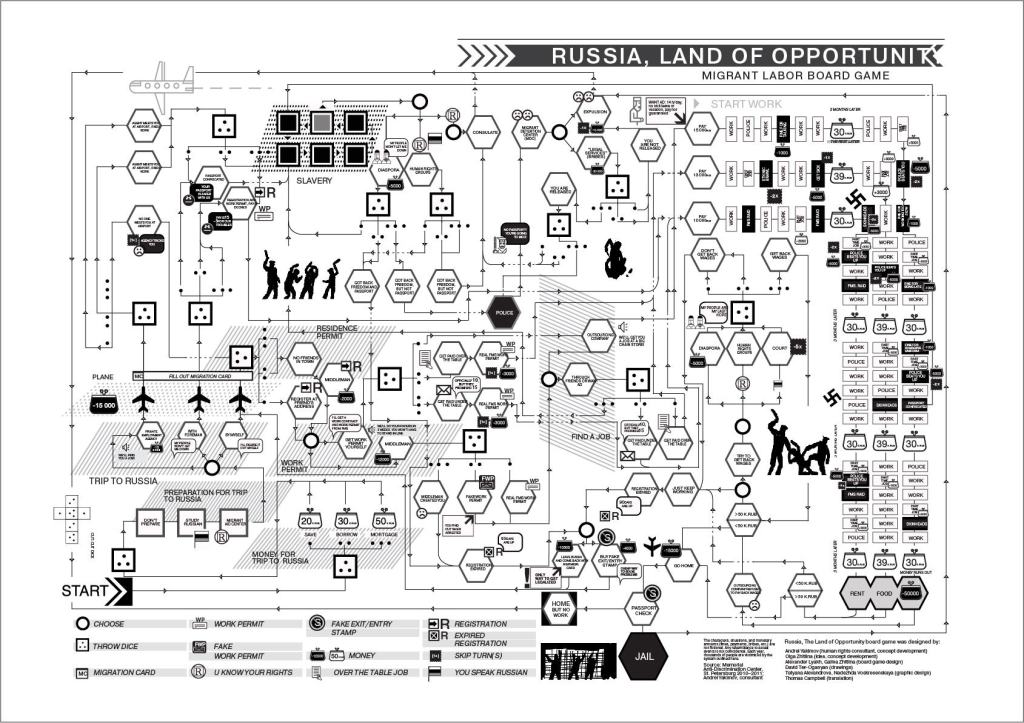

Thomas Campbell just translated our migrant labor board game Russia – The Land of Opportunity!!!

Russia – The Land of Opportunity board game is a means of talking about the possible ways that the destinies of the millions of immigrants who come annually to the Russian Federation from the former Soviet Central Asian republics to earn money play out.

Our goal is to give players the chance to live in the shoes of a foreign worker, to feel all the risks and opportunities, to understand the play between luck and personal responsibility, and thus answer the accusatory questions often addressed to immigrants – for example, “Why do they work illegally? Why do they agree to such conditions?”

On the other hand, only by describing the labyrinth of rules, deceptions, bureaucratic obstacles and traps that constitute immigration in today’s Russia can we get an overall picture of how one can operate within this scheme and what in it needs to be changed. We would like most of all for this game to become a historical document.

Source: Olga Jitlina (Facebook), 17 December 2011


Life for migrant workers is Russia is becoming increasingly difficult after stringent new controls introduced over the past year. These include a registry of “illegal” migrants, restrictions on enrolling migrant children in schools, new police powers to deport people without a court order, and a compulsory app for all new migrants in Moscow and the surrounding region to track their movements.

Working in Russia was already less appealing because of the war in Ukraine and the weakening rouble. Now, with these new restrictions, a growing number of young people from Central Asia are starting to look elsewhere — including to countries in Europe — in search of better opportunities.

Dreaming of Europe in Moscow

Like 89% of young Kyrgyzstanis, 25-year-old Bilal* had always dreamed of working abroad.

Young people in Kyrgyzstan grow up in an environment where leaving the country to find work is common, widespread, economically essential, and socially accepted — and where the domestic economy still cannot offer comparable opportunities.

The average monthly salary in the country is about 42,000 soms (around $480), while in Russia, for example, wages in manufacturing can reach 150,000 rubles (nearly $2,000). Unlike most of his peers, Bilal never planned to work in Russia. “Because many of our people face racism there,” he explains.

Europe was his dream, but without connections getting a job offer from an EU employer seemed nearly impossible. So Bilal turned to “intermediaries” — fellow Kyrgyzstanis who had established ties with European companies that were constantly seeking workers. They advised him to travel to St. Petersburg, where, they said, it would be easier to prepare the paperwork and apply for a visa.

But it was the height of the COVID-19 pandemic. Many Schengen countries had stopped issuing visas and temporarily shuttered their consulates. Bilal didn’t want to return home empty-handed, so he decided to stay in Russia — “not by choice,” as he puts it.

“At first I worked illegally at a ski resort. Mostly we chopped firewood and cleared snow around the cabins. They paid us in cash,” he says.

Two months later, Bilal moved to Moscow and obtained a patent — the work permit that allows citizens of visa-free countries to be legally employed in Russia. He found a job as a courier for Yandex.

Bilal speaks excellent Russian — something he says explains why, unlike many of his friends, he didn’t encounter xenophobia all that often. But conflicts still happened. “You’d run into people who’d say, ‘Migrants, coming here in droves…’ Especially when a customer had put down the wrong address and the delivery got messed up — somehow it was always the migrant’s fault.”

Bilal left Russia two months before the full-scale invasion of Ukraine. “Back then it wasn’t like it is now,” he recalls. “Yes, the police would stop you on the street, but they’d take some money and let you go. Now my friends talk about Amina (a Russian mobile app for monitoring migrants), about police rounding people up, and about being sent to the war.”

He decided to set his sights on Europe instead.

Watched and bullied

In Russia, the path to legal employment for migrant workers runs through a processing centre known as Sakharovo — located about 60 kilometres from Moscow and notorious for its massive queues, where people often wait for hours. The perimeter is guarded by armed security forces, and inside migrants undergo procedures such as blood and urine tests to screen for “socially significant diseases”. Those who manage to obtain their documents can work legally, but that doesn’t protect them from future problems.

Russians often refuse to rent apartments to migrants. Schools and kindergartens decline to accept migrant children, citing “lack of space,” while the adults themselves face workplace “raids” or frequent “document checks” on the street or on public transport. Even Russia’s war in Ukraine has become a tool for pressuring them: many migrants are pushed to join the military in exchange for various “bonuses,” such as fast-tracked citizenship.

After the attack on Crocus City Hall — which authorities say was carried out by four Tajik citizens —the security services launched large-scale raids. Tajikistan’s government, fearing a surge in xenophobic incidents, even advised its citizens not to leave their homes.

Lawmakers soon joined in. Over the past year, they have restricted the ability to obtain residency through marriage, granted the Interior Ministry the power to deport migrants without a court ruling, required migrant children to pass a Russian-language exam before being admitted to school, and created the Registry of Monitored Persons — a database of foreign nationals who supposedly lack legal grounds to stay in Russia. There are already known cases of people being added to the list by mistake, and effectively losing the right to move freely around the country after their bank accounts were frozen, and their driving permits revoked.

Officials have justified all these measures as necessary to fight illegal migration and prevent crime. In July, the Interior Ministry reported a rise in crimes committed by migrants, but migrants still make up only a small fraction of overall crime statistics. A study by the “To Be Exact” project found that adult Russian men are statistically more likely to commit crimes than migrant workers.

On September 1, a new pilot project went into effect: migrants from Uzbekistan, Tajikistan, Kyrgyzstan, Armenia, Kazakhstan, Georgia, Azerbaijan, Moldova, and Ukraine who are living in Moscow or the Moscow region must install a mobile app called “Amina.” Authorities openly acknowledge that the app’s main purpose is to continuously track users’ locations.

The app that doesn’t work

If a phone fails to transmit location data to Amina for more than three working days, the participant is automatically removed from the system. If the migrant cannot fix the issue quickly, they risk being added to the “monitored persons” registry — which can lead to frozen bank accounts, job loss, or even expulsion from university.

Imran, a 27-year-old Tajik citizen, is worried: “Location services on my phone are on, and Amina shows that everything is being transmitted, but several times a day I get notifications saying the app isn’t receiving my location. The app works terribly. And I have no idea what consequences this could have for me.”

Users report constant problems with Amina. Some can’t get past the first screen; others say the app won’t accept their photo; still others receive alerts that their data failed verification. But the most common issues are related to location tracking.

In comments on RuStore (Russia’s internal apps store), representatives of the developer respond that “specialists are constantly working to improve the app’s stability” and advise users to contact technical support. But migrants complain about waiting on the line for hours.

Anton Ignatov, the director of the Sakharovo centre, claims the programme will improve public safety and help “prevent violations by unscrupulous individuals”. He cites situations in which migrants buy a work patent — a permit to work — for a short period and then disappear “into the shadows,” “vanishing somewhere in the industrial zones of Moscow and the region”.

Such cases do happen, and the most obvious reason is money. Since January 1, the monthly payment for a work patent in Moscow and the Moscow region has been 8,900 roubles (about $115). For many migrants working in low-paid jobs — for example, in construction or warehouse work — this is a significant share of their income, pushing some into the informal economy.

Another factor is wage delays in the sectors where migrants from Central Asian countries most often work. Mukhammadjon from Uzbekistan, works on a construction site outside Moscow, hasn’t been paid in two and a half months. A month ago, he stopped paying for his patent — simply because he had no money left. He sees no tools to defend himself.

Employers, meanwhile, benefit from hiring such vulnerable workers: they can avoid paying social contributions, hand out wages in cash, and rely on employees who are willing to work overtime for low pay.

Getting a job is becoming harder

Kudaibergen, 32, from Kyrgyzstan, worked at a warehouse on the outskirts of Moscow — “to support my family”, he says. His employer provided hostel-style housing for migrant warehouse workers.

“OMON came to our building. They treated us like they were arresting dangerous terrorists. They showed up with batons and tasers, as if storming the place. They drove us all outside. We stood by the door with our hands behind our backs for about two hours while they checked everyone’s documents,” he recalls. “Some guys didn’t understand Russian well — it was very hard for them. If they didn’t understand something, they were beaten. […] Thank God, my documents were in order.”

Russian authorities typically insist that such inspections are carried out strictly within the law and that no unlawful actions are taken against migrants. As evidence, the Interior Ministry points out that migrants rarely file complaints with the police afterward.

As the new year approached — 2025 — the checks intensified, Kudaibergen says. Because of all the new rules and the overall treatment of migrants, he realized that working in Russia had become too difficult, so he returned home.

“But I still have to provide for my family,” he adds. “I’m thinking about Europe now. I ask friends and acquaintances how to leave. But I don’t know if it will work out. They say getting a visa is very hard.”

Gulnura, 35, a mother of three, had lived in Russia with her husband for more than ten years. In the spring of 2025, she flew with her children to her native Kyrgyzstan for a short break. Only after arriving did she learn about the new requirement obliging migrant children to pass a Russian-language exam in order to enroll in school. Her children speak Russian fluently, yet even before the rule change they hadn’t been admitted — schools said there were “no available places”.

“We originally planned to return to Moscow. But my friends who are still there complain that they can’t get their kids into school,” Gulnura says. “One friend has been collecting documents since April, but the school won’t accept them. Another managed to get her child to the test, but after the exam they sent a rejection: ‘Your child doesn’t know Russian well enough.’ Her daughter was born and raised in Moscow, speaks Russian fluently, went to kindergarten and prep classes, reads and writes.”

“Requiring language proficiency provides a pretext for an already widespread practice of arbitrarily refusing to admit migrant children to schools across Russia,” says Sainat Sultanaliyeva of Human Rights Watch. “By depriving migrant children of access to education, Russian authorities are effectively taking away the life opportunities schooling provides. Banning them from school undermines long-term social integration, increases the risk of harmful child labour, and heightens the danger of early marriage.”

Gulnura decided not to return to Russia with her children. “My husband is still in Moscow for now. He’ll come when everything is ready here, when he has work. But we — me and the kids — we’ve come back for good. It’s become impossible to live there.”

A chance to get into Europe

Despite numerous accounts of migrants becoming disillusioned with Russia, it’s impossible to say definitively whether labour migration has decreased in recent years: the available statistics are fragmented, and data from different government agencies often contradict one another.

The picture is further complicated by the Interior Ministry’s decision to stop publishing key data, as well as several changes to the methodology of migration accounting, which make year-to-year comparisons unreliable.

In 2024, researchers at the Higher School of Economics concluded that labour migration to Russia had fallen to its lowest level in a decade.

Since then, the number of entries into the country has grown, but the average annual presence of legal labour migrants has remained stable at around 3–3.5 million — noticeably lower than in previous years.

Rossiyskaya Gazeta writes that foreign workers are less willing to come to Russia for two reasons: tougher migration policies and declining incomes. With the rouble’s depreciation, earnings in dollar terms have fallen by roughly a third.

Yet Russia still remains the most popular destination for labour migrants from nearly all Central Asian countries.

In second place for migrants from Uzbekistan, Tajikistan, and Kyrgyzstan is Kazakhstan, where most work in construction, wholesale and retail trade, and various service industries.

Third is Turkey, where Central Asian migrants are employed in manufacturing — especially textiles and clothing — as well as construction, hospitality, and seasonal agriculture.

South Korea recruits migrant labor for factories, agriculture, construction, and the fishing and seafood-processing industries.

But for many — like Bilal, who left Russia behind — the dream is still to secure a job offer in Europe. In the end, he managed to do so through the same intermediaries he had relied on earlier, paying them $2,000, he says. They helped arrange an invitation from a logistics company.

“If you don’t have work experience in Europe, it’s hard at first to get a job with a good trucking company. There are bad employers who take advantage of newcomers not knowing their rights. They might underpay you or force you to work overtime. At the same time, the police keep a very close eye on work-and-rest rules and can fine you, so nobody wants to break the law. By law, if your driving time is up, you have to stop and rest,” Bilal says, recalling his first job at a Slovak company.

After gaining some experience, he moved to another company, where he now earns around €2,500 a month.

According to the International Road Transport Union (IRU), more than half of European transport companies cannot expand their business because of a shortage of qualified drivers. Across the EU, Norway, and the UK, more than 233,000 truck drivers are currently required. The crisis is deepened by the fact that the profession is aging rapidly, and young people are not drawn to it, despite decent pay.

Ukrainian citizens once made up a significant share of long-haul drivers in the EU, but because of the war many had to return home for military service. In addition, some European employers terminated contracts with Russian and Belarusian citizens (or their visas weren’t renewed), forcing them to return home as well.

In Slovakia, where Bilal is officially employed, the shortage reached 12,000 drivers last year. As a result, the country simplified visa procedures for several nations — including Kyrgyzstan, Tajikistan, Kazakhstan, Turkmenistan, and Ukraine — for applicants willing to work in freight transport.

Poland actively issues work permits to citizens of Uzbekistan and Kazakhstan; the Czech Republic attracts workers from Uzbekistan and Kyrgyzstan by fast-tracking work visas; Lithuania also issues visas to those seeking jobs as drivers.

In 2023, the number of first-time work permits issued in the EU to citizens of Kazakhstan, Uzbekistan, Kyrgyzstan, and Tajikistan rose by 30%, 39%, 50%, and 63% respectively compared to the previous year.

But Bilal believes that even with the current labour shortages, getting into Europe from Central Asia is still far from easy. “If you don’t have people here who can recommend you to a company, it’s a difficult process for ordinary working people,” he says.

All the more so because public frustration over migration has been growing across Europe in recent years, pushing some governments to tighten rules for third-country nationals — even in sectors suffering from labour shortages.

Bilal likes living in Europe. He’s satisfied with the good pay and the way people treat him — especially Italians and the French.

He describes his job as demanding. “We spend more time away from home than at home. Years go by, and people hardly see their families,” he says.

Bilal himself doesn’t yet have a wife or children. In a few years, he’ll be eligible to apply for permanent residency in Slovakia, but he hasn’t decided whether he’s ready to spend his whole life driving long-haul trucks across Europe.

*The protagonist’s name has been changed at his request. With contributions from Almira Abidinova and Aisymbat Tokoeva. Read this story in Russian here. English version edited by Jenny Norton.

Source: “Why Central Asian migrant workers are giving up on Russia,” BBC News Russian (Substack), 18 December 2025.

Judging Them by How They Look

A Russian National Guard serviceman checks residency documents during a raid outside the Apraksin Dvor clothing market, in St. Petersburg, Russia, Friday, July 4, 2025. (AP Photo/File)

The immigrant worker from Uzbekistan entered the bank in Moscow, but when he reached the teller, she refused to serve him and she wouldn’t say why.

For him and others from impoverished countries across Central Asia who seek better lives in Russia, such hostility is woven into everyday life. Sometimes it bursts into outright violence.

“Mostly you notice it when you go to the hospital, a clinic, a government office: You stand in line and everyone shoots you dirty looks,” said the man, who spoke to the Associated Press on condition of anonymity because he feared repercussions.

Such xenophobia clashes with economic realities at a time when Russia has a labor shortage, primarily due to its war in Ukraine. In the first quarter of 2025, over 20% of Russian businesses said they were hindered by a lack of workers, according to the Central Bank. 

But rather than welcoming laborers, Russian officials are fomenting anti-migrant sentiment and increasing restrictions on immigrants, which the government says number 6.1 million, but is probably higher. The government is tracking their movement, clamping down on their employment and impeding their children’s rights to education.

A massacre and a backlash

The continued crackdown comes as a trial began this month for four Tajik nationals who are accused of the shooting and arson attack at a Moscow concert hall in March 2024 that killed 149 people. The four were arrested within hours of the attack and appeared in court with signs of being severely beaten. An Islamic State group claimed responsibility but Russia sought to blame Ukraine for the bloodshed.

Anti-migrant rhetoric had been growing in Russia since the early 2020s. But the massacre in particular launched a wave of “terrible violence” against immigrants, said lawyer Valentina Chupik, who has worked with the immigrant community for over 20 years. In the eight days after the killings, she received 700 reports of injuries to immigrants, including “faces smashed against the doors of police stations,” she said.

Parliament speaker Vyacheslav Volodin captured the public mood after the massacre, saying “migration control is extremely important” to ensure foreign nationals carrying out “illegal activity” could be deported without a court order.

The violence drew concern from human rights groups.

“Central Asian migrants seeking work in Russia due to dire economic conditions in their countries of origin today face ethnic profiling, arbitrary arrests, and other harassment by police in Russia,” Human Rights Watch said in a report on the anniversary of the attack.

“The heinous massacre cannot justify massive rights abuses against Central Asian migrants in Russia,” said its author, Syinat Sultanalieva.

Raids, roundups and restrictions

While some violence has subsided, it hasn’t disappeared. In April, police raided a Kyrgyz-run bathhouse in Moscow with video showing masked men forcing half-naked bathers to crawl across the floor and deliberately stepping on them before covering the lens of a security camera.

Police also reportedly rounded up immigrants in raids on warehouses, construction sites and mosques, then coerced them into joining the military to fight in Ukraine. Some are threatened with having their residency documents withheld, while others are recently naturalized citizens who failed to register for military service. In such cases, serving in the military is presented as the only alternative to prison or deportation. For others, a fast track to Russian citizenship is offered as an incentive for enlisting.

Speaking in St. Petersburg in May, Alexander Bastrykin, head of Russia’s Investigative Committee, said “20,000 ‘young’ citizens of Russia, who for some reason do not like living in Uzbekistan, Tajikistan (and) Kyrgyzstan” were serving in Ukraine.

Those immigrants who have avoided violence still are subject to new anti-migrant laws. Much of this is targeted specifically toward workers from Central Asia.

In 2024, 13 Russian regions banned immigrants from certain jobs, including in hospitality, catering and finance, and even as taxi drivers. A pilot program starting in September in the Moscow region requires migrants who enter Russia without a visa to be tracked via an app. Those failing to comply are added to a police watchlist, impeding access to services like banking, and subjecting them to a possible cutoff of cellphone and internet connectivity.

A nationwide law banned children of immigrants from attending school unless they could prove they could speak Russian. Less than six weeks after the law came into force, officials told local media that only 19% of children who applied for the language test were able to take it, and the most common reason for rejection was incomplete or inaccurate documents.

Another man from Uzbekistan who has worked in Russia for almost two decades and lives in St. Petersburg said he’s had to wait in line for over seven hours to get needed residency documents. The man, who also spoke to AP on condition of anonymity for fear of reprisals, hopes to stay in Russia but says the climate has worsened.

“It’s hard to get paperwork,” he said. “There just isn’t the time.”

The oppressive laws sometimes force immigrants to resort to paying bribes. Chupik, the lawyer, believes that Russia’s system results in “violations that cannot be avoided.”

“This is exactly what this mass regulation is striving for: not for all migrants to be here legally, but for everyone to be illegal,” she said. “That way, they can extract bribes from anyone at any moment and deport anyone who resists.”

Encouraging anti-migrant sentiment

Anti-migrant sentiment is unlikely to diminish anytime soon, mostly because it’s encouraged by authorities like the Investigative Committee’s Bastrykin, who said immigrants “physically occupy our territory, not just with their ideology but with specific buildings” — referring to sites such as mosques.

Ultra-nationalist lawmaker Leonid Slutsky said foreign workers “behave aggressively, causing conflicts and potentially dangerous situations.”

Migrants are an easy scapegoat for many social ills, and not just in Russia, said Caress Schenk, an associate professor of political science at Nazarbayev University in Kazakhstan.

“Closing borders, conducting migrant raids and tightening policies are all tools that are easy go-tos for politicians the world over,” she said. “It goes in cycles that are sensitive to geopolitical pressures, as we’re seeing now, but also things like election campaigns and domestic political rivalries.”

A surge of “anti-migrant propaganda” has dwarfed previous rhetoric of recent years, according to the Moscow-based Uzbek immigrant who was ignored by the bank teller.

“If every person paying attention to the TV, the radio, the internet is only told that migrants are ‘bad, bad, bad,’ if they only show bad places and bad people, of course, that’s what people are going to think,” he said.

Such anti-migrant rhetoric has become part of the nationalist narrative from President Vladimir Putin and others used to justify the 2022 invasion of Ukraine — that Russia is under constant threat.

“Russia has started lumping together all of ‘the external enemies’ that it’s created over the years for itself: the migrants, the Ukrainians, the West,” said Tajik journalist Sher Khashimov, who focuses on migration, identity and social issues. “It all becomes this part of this single narrative of Russia being this castle under siege, and Putin being the only person who is on the lookout for ordinary Russians.”

The Uzbek immigrant in Moscow said Russia has created conditions “supposedly to help people, to help migrants.”

“But the rules do not work,’ he added. ”Special barriers are created that migrants cannot pass through on their own.”

Source: Katie Marie Davies, “Immigrants from Central Asia find hostility and violence in Russia,” Associated Press, 22 August 2025


Source: SEIU California (Facebook), 8 September 2025


A prominent nonviolent activist from Moroccan-occupied Western Sahara has been detained by federal immigration officers. Jamal Fadel was seized by masked ICE agents at Manhattan’s notorious federal building at 26 Federal Plaza on August 25 after a routine immigration hearing — an arrest that was caught on video.

Fadel is from the occupied city of Boujdour in Western Sahara. He’s been protesting nonviolently against Morocco’s occupation since he was a high school student, and was threatened by Moroccan authorities so many times that he left to seek political asylum in the United States.

Fadel is currently being held by ICE at the Moshannon Valley Processing Center in Pennsylvania. His attorney expects ICE will move for an expedited removal hearing. If deported, Fadel faces lengthy imprisonment, torture — or worse.

Source: Democracy Now (Facebook), 9 September 2025


I spotted some of the Trump administration’s wanted men on Tuesday, the day after the U.S. Supreme Court granted immigration agents virtually unchecked permission to continue the “largest Mass Deportation Operation” in America’s history.

The wanted stood outside of a U-Haul truck rental outlet in the San Gabriel Valley. They polished other people’s BMWs and Range Rovers at a Pasadena car wash. I saw the wanted women too, walking to jobs as nannies and housekeepers.

They looked suspicious, all right, by the definition outlined Monday by Supreme Court Justice Brett M. Kavanaugh. They were natives of Mexico and Central America, seeking “certain kinds of jobs, such as day labor, landscaping, agriculture, and construction.”

They were suspect to many Californians too, but only of wanting to work, wanting to earn a little cash, wanting to pay their bills and feed their families. One hundred and seventy five years to the day after land that once belonged to Mexico became the 31st American state, California felt to many people Tuesday like it had reverted to a kind of frontier justice, where racial profiling had become the law of the land.

“I am just working hard and paying taxes,” said Mario, 50, between sips of coffee on the sidewalk outside the U-Haul station. Even before the Immigration and Customs Enforcement raids began three months ago, the Honduran immigrant said, life for street-corner workers was not easy.

“People are just looking for work. Some of them are even homeless,” said Mario, who declined to give his last name. “But some people are showing them hate, sometimes even hitting or kicking the homeless. We see it out on the street.”

At the Pasadena car wash where six workers were carted away in late August, those left behind continued their buffing and polishing Tuesday.

“It feels like we have come down low, really low,” said Cesar, between checking in customers. Though he was born just blocks away at Pasadena’s Huntington Hospital, he said he does not feel immune from the raids.

“If now they are just going to judge you by how you look, or maybe how you talk, I can get pulled over. Anyone can get pulled over,” said Cesar, who did not give his last name. “It’s gonna be harder for people to live a normal life. They’re gonna just have to deal with harassment. That’s not something I would want anyone to have to go through.”

Earlier raids by Trump immigration agents have spread far beyond snagging the criminals and drug traffickers the president and his allies claimed to be after. With 10 million Latinos living in the seven Southern California counties covered by the court’s order, a rights group said the high court’s action cleared the way for “an extraordinarily expansive dragnet, placing millions of law-abiding people at imminent risk of detention by federal agents.”

“We should not have to live in a country where the Government can seize anyone who looks Latino, speaks Spanish, and appears to work a low wage job,” Justice Sonia Sotomayor wrote. “Rather than stand idly by while our constitutional freedoms are lost, I dissent.”

The action offered portentous echoes of the mistreatment and greater violence unleashed on Chinese immigrants in the late 1800s. Today, it had U.S.-born citizens, such as The Times’ Gustavo Arellano, feeling they will have to carry their passports to prove their citizenship.

Outside the U-Haul, Mario said he holds a green card. So he will continue waiting on the sidewalk for his next job.

“I believe in God,” he said. “We might think different things, but we all have the same heart. There should be the same heart for everyone. Everyone.”

Source: James Rainey, “Essential California” newsletter (L.A. Times), 10 September 2025


The United States deported 39 Uzbek nationals on a charter flight to Tashkent, the U.S. Embassy confirmed in what it described as part of ongoing efforts to remove migrants without legal status. Earlier this year, more than 100 Central Asians, mostly Uzbeks, were repatriated in a similar U.S.-funded operation. The deportations attest to close cooperation between Washington and Tashkent on migration enforcement. That partnership has been accompanied by political overtures. Last week, Presidents Shavkat Mirziyoyev and Donald Trump held a phone call in which they pledged to broaden their strategic partnership ahead of an expanded dialogue session this autumn. U.S. officials have pointed to investment opportunities in Uzbekistan, particularly in critical minerals, while both sides also highlight cooperation on security and migration.

Source: Peter Leonard, “Central Asia’s week that was #70,” Havli, 10 September 2025

Jesus Petrovich Christ and His Forty-Five False Apostles

The 45-year-old resident of the Tatarstan capital with the exotic first name and surname and the patronymic Petrovich has four prior criminal convictions

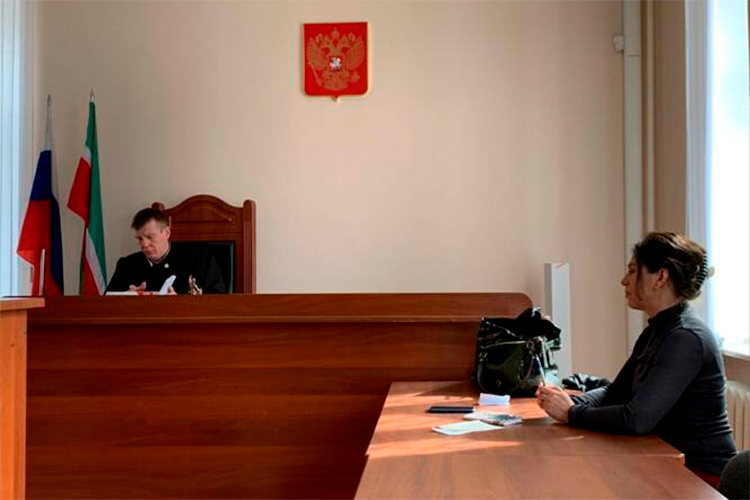
Holy Week has kicked off for a Kazan defendant with a quite uncommon name: Jesus Christ. The 45-year-old Kazan resident has been charged with falsely registering forty-five migrant workers at his address. Jesus Petrovich has prior repeat convictions for burglary and robbery, and in 2014 he underwent preventive care for substance abuse. Business Online reports on Christ’s failure to appear at his court hearing, and the “way of the cross” he has blazed through Kazan’s district courts.

This photo by Business Online reporter Eva Malinovskaya appears in her original article, but it is impossible to say whether it was taken at Jesus Petrovich Christ’s abortive court hearing in Kazan on Good Friday 2025.

Jesus Petrovich’s “Good Friday”

The biography of Kazan’s latest criminal defendant would not be too different from the average person’s — the divorced and unemployed high school graduate will turn forty-six on the tenth of May — were it not for one catch. His name is Jesus Christ: that is the name listed in his [internal] passport.

The story of how he got the name remains a mystery: neither the court staff nor the state prosecutor know what Christ’s name at birth was. All that the people involved in the criminal proceedings know is that the defendant was “obsessed” with numerology, and this led, allegedly, to his decision to change his name and surname several years ago. He kept only his real patronymic: Petrovich.

Christ was scheduled to appear before the Moscow District Court (the Kizichevsky Vvedensky Monastery is situated right next door to the court building on Justice Street ). The current case against Jesus Petrovich is an anniversary of sorts: he has four prior criminal convictions, having blazed a trail through the city’s district courts on his own “way of the cross.”

Jesus was first convicted in 1994 by the Lenin District Court (now the Aviastroitelny District Court) of robbery, per Article 145.2 of the RSFSR Criminal Code. He was given a two-year suspended sentence. Since his next conviction, for theft, per Article 144.2 of the RSFSR Criminal Code, was handed down by the Novo-Savinovsky District Court, he was given the standard sentence: two and a half years in a medium-security correctional labor colony and confiscation of his property.

After serving his sentence, Christ did not enjoy his freedom for long. In 1999, he appeared before the Volga Regional Court, where he was sentenced to nine years in prison per Article 162.3.g of the Russian Federal Criminal Code, for “robbery committed by a person previously convicted two or more times of theft or extortion.” The convict was sent to a maximum security penal colony and was released in 2007. A little more than a year passed before Christ again came before the Lenin District Court, which by then had been redubbed the Aviastroitelny District Court. He was sentenced to another three years in prison per Article 158.3.a of the Russian Federal Criminal Code, for “theft involving home invasion.”

In addition to his criminal record, Christ had a penchant for illegal substances. From 2014, he was registered with a substance abuse therapist, but not for long, according to his personal file, as submitted to the court. In 2015, a forensic psychiatric expert commission found that Jesus had an organic personality disorder, and he was removed from the substance abuse registry. His mental illness had been triggered by a severe head trauma received in 2010. At the time, Christ did not complete his treatment, leaving the hospital on his own. He was also diagnosed with brain malfunction due to multiple organ dysfunction syndrome and was thus registered as a class III disabled person.

During his last clinical examination, psychiatrists noted the patient’s irritability, brashness, inflated self-esteem, pretentiousness, egotism, and mood swings. Although Jesus’ truculent personality was palpable, it was not significant enough to warrant hospitalization, so his diagnosis was not a factor in the criminal investigation.

The charges

What is Christ accused of this time round? According to police, whose account has been corroborated by the prosecutor’s office, between April and December 2024, Christ registered forty-five foreign nationals as residing in his 31.9-square-meter flat. With the consent of the foreigners, Jesus filled out foreign national residential arrival notices in which he identified himself as their host and provided the address of his flat. He then submitted arrival notices to the Moscow District office of the Tatarstan Multifunctional Public Services Center.

The prosecution is certain that the foreigners did not reside at their registered address. The false information about the arrival of forty-five individuals, as received by the migration department of the Russian Interior Ministry’s Kazan office, was registered and entered into the federal migration registration database. Christ faces up to five years in prison.

“The case is quite ordinary. [Police officers] examine the Multifunctional Public Services Center’s identification numbers and files and identify violators,” said assistant prosecutor Nadezhda Moshkova in a conversation with Business Online before the court hearing.


Common practice in such cases

Such cases are not uncommon. There were several such cases in a row in February alone. Six Tatarstan residents and a foreigner were charged with organizing the illegal immigration and falsified registration of more than three thousand foreigners. Later in the month, three more cases of unlawful employment agreements, involving two thousand migrant workers, were uncovered, and on February 26 it transpired that another resident of Kazan had aided almost three thousand immigrants in registering illegally. So the list of Christ’s “apostles” is not that long compared to those of others.


“Has Jesus Christ stopped by?” the assistant judge asked hopefully over the phone exactly one minute before the start of the trial.

“No, he hasn’t,” the bailiff replied with a grin.

The mood of the people in the courtroom was upbeat, despite the fact that the “appearance” of Christ before the Moscow District Court did not take place. Moshkova assured the court that the defendant had been notified in every possible way, but she herself, even before the hearing, had not actually believed that he would show up. “He’s a curious chap,” the assistant prosecutor said, adding that defendants themselves do not like to appear at such hearings, and jokingly condoned Christ by saying that Easter had not yet arrived.

The accused himself, as it turned out, had no clue about the hearing.“What case? And wait, if a court hearing has been scheduled, why the fuck was a notification and a summons not sent?!” said a perplexed Christ, whom Business Online was able to reach by telephone. After voicing his indignation, our source asked us to leave him alone. “I have done twenty years in prison. You’ve got the wrong number, good luck,” concluded Jesus.

Nevertheless, court-appointed defense lawyer Ksenia Matveeva told us that the defendant fully admits his guilt. He had even requested expedited consideration of the case, but because of his failure to appear, the process had to be postponed to the end of May.

“I order that the defendant be forcibly delivered to the next court hearing,” the presiding judge, Nikolai Zakharov said as he concluded the proceedings. “No one has ever walked away from the court yet,” he said, shrugging.

Source: Eva Malinovskaya, “‘He’s a curious chap’: how Kazan tried to put Jesus Christ on trial,” Business Online, 19 April 2025. Translated by the Russian Reader. Thanks to Sergey Abashin for the heads-up.


A 45-year-old Russian national named Jesus Petrovich Christ has gone on trial in Kazan for fictitiously registering foreigners in his apartment. Information on the upcoming court hearing was posted on the website of the city’s Moscow District Court.

The defendant fictitiously registered forty-four illegal immigrants in his one-room apartment, in violation of Article 322.3 of the Russian Federal Criminal Code. In fact, [none of the immigrants] lived in the apartment. Christ did not appear in court, so the hearing of his case did not take place.

According to law enforcers, Jesus Petrovich Christ has four previous convictions — for robbery, armed robbery, and theft.

According to local media, the defendant was given a different name at birth, but he changed his first name and surname after becoming interested in numerology. The man’s patronymic is real.

Source: “Jesus Christ accused of aiding illegal immigrants in Kazan,” Vesti.Ru, 19 April 2025. Translated by the Russian Reader. Thanks to Sergey Abashin for the link.


A Russian citizen named Jesus Petrovich Christ is being tried in Kazan on charges of fictitiously registering immigrants. A notice of the upcoming court hearing appeared on the website of Kazan’s Moscow District Court.

A screenshot of Jesus Petrovich Christ’s court hearing record on the website of Kazan’s Moscow District Court,
courtesy of Sergey Abashin

Jesus Christ is suspected of fictitiously registering forty-five illegal immigrants in his one-room apartment, in violation of Russian Federal Criminal Code Article 322.3. Despite receiving a summons to appear in court, the 45-year-old Russian national did not show up for the proceedings, and therefore the hearing of the case did not take place.

It is also known that the man was previously convicted several times — in 1994 and 1996, for robbery; in 1999, for armed robbery; and in 2007, for theft.

[…]

Source: Danila Titorenko, “Kazan court to hear case of Jesus Petrovich Christ, charged with aiding illegal immigrants,” Gazeta.Ru, 18 April 2025. Translated by the Russian Reader. Thanks to Sergey Abashin for the link.

No Russian, No School

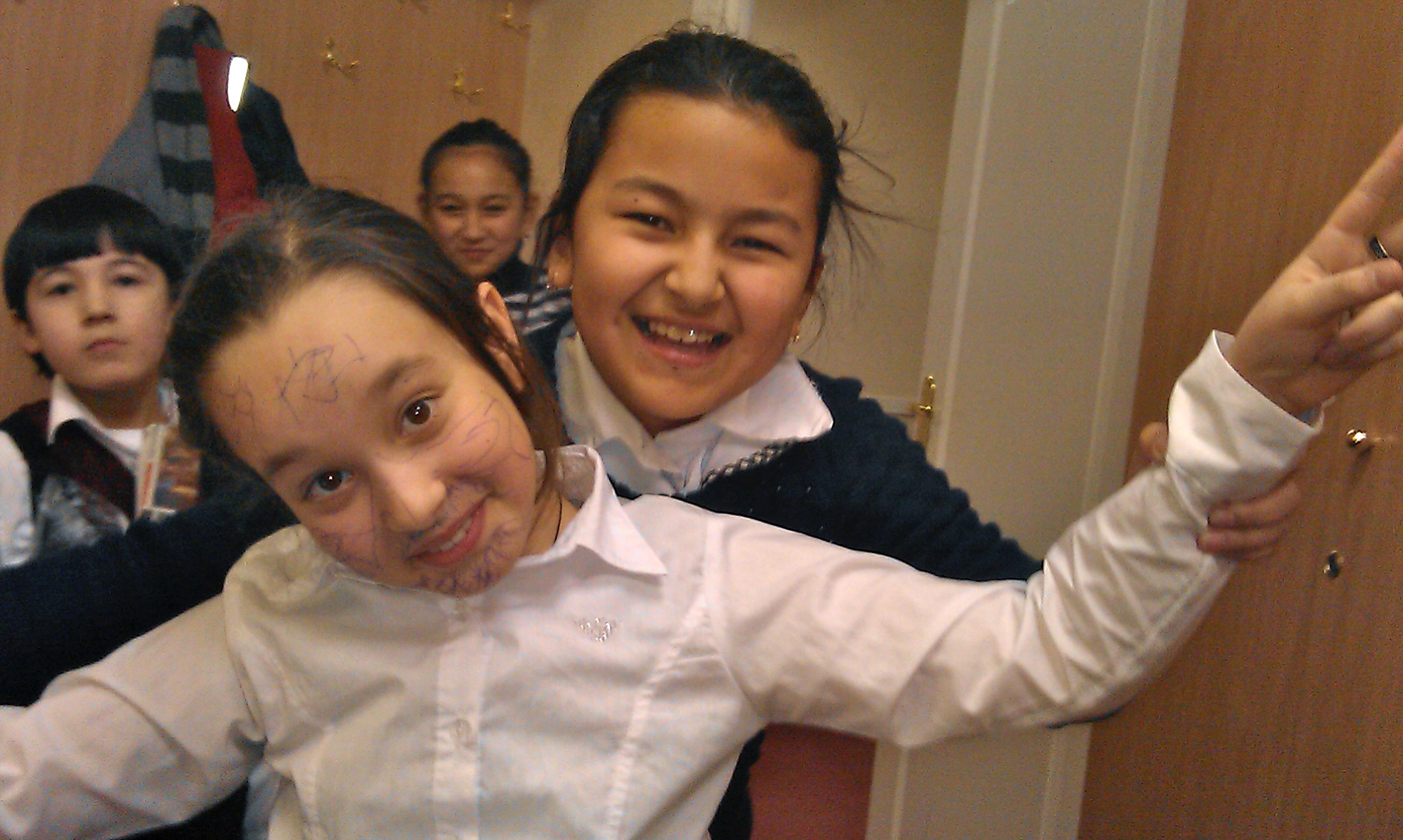
My pupils at the St. Petersburg Jewish Community Center’s RFL/RSL (Russian as a Foreign Language/Russian as a Second Language) program for immigrant children), 2016. This was the day we let our hair down. \\\ TRR


Living in circumstances in which evil is consciously perpetrated every day, it is difficult to keep getting bent out of shape over stupidity and injustice. This is also true of the new law prohibiting migrant children without a proficient command of Russian from attending school — a completely outrageous law that has caused little public outrage. I feel the need to write about it, and yet I sense the utter futility of arguing against it.

When I was at art school, we had our own local confrontation with the authorities: they dreamed of banning coil water boilers and other heating devices because they were a fire hazard. We dreamed of keeping them because of the fact that we were working in our studios late at night, which is inevitable if you are studying to be an artist. The authorities shamed us, they threatened us with expulsion, and they confiscated our boilers, but the boilers inevitably reappeared. This is an example of how you can’t solve a problem through bans without providing a solution. If the director, for example, had identified some place on the floor where water could be boiled, it is likely that many people would have stopped boiling water in their studios.

This applies to the populist bill as well. Teaching children who do not speak Russian is an actual problem. Our country has a rather complicated curriculum even in elementary school, which, of course, cannot be successfully navigated by someone who does not understand everyday vocabulary. I’ve been told that some teachers just give children plasticine out of hopelessness: if they’re sitting and molding things from playdough, at least they won’t be a bother to anyone else.

So here is a simple answer to this problem: let’s ban these children from going to school. They can go to school only after they have learned Russian.

The question immediately arises: where will they learn Russian? Do we have an extensive network of educational organizations with readymade programs (even ones for which parents would have to pay) for teaching Russian to children and teenagers, where they can be sent immediately after failing the language proficiency exam? No, there is no such network. Perhaps it will emerge one day, but it doesn’t exist right now.

But we have the know-how of other countries which have been trying to solve similar problems for a long time. We can choose something suitable based on foreign know-how, such as allocating extra classes, hiring visiting teachers, and instituting adaptation classes. But a ban is not a solution.

Besides, bans hit the most vulnerable groups the hardest. Loving parents will find a way to help their children with adaptation by paying for courses or tutors. Those for whom no one cares, those for whom school is the only chance to change their lives, will be left out. And it is not necessarily a matter of their turning to crime, although the rule that if you don’t want to invest in schools you’ll have to invest in prisons is inexorable. It will affect girls, for example: if they can read and write a bit (so the story goes) that’s enough for when they’re married.

Most importantly, children don’t choose to move to or choose a foreign country. It’s not their fault that they don’t know a new language. So why are you punishing them?

In fact, they are being punished for being newcomers, for being strangers. A clear xenophobic message is packed inside this entire caper: these migrants shouldn’t come to Russia, and if they do come (someone after all has to work for cheap), they shouldn’t drag their families here. Legislators are not worried about schoolteachers (who really do have it tough), but about smoking out all the “aliens” from our country. That’s how the matter actually stands. And that’s why all reasonable arguments are more or less useless.

Source: Natalia Vvedenskaya (Facebook), 12 December 2024. Translated by Thomas Campbell


Russia has banned children who do not speak Russian from being admitted to schools. This is a completely inhumane decision which could have terrible consequences.

For two years I taught Russian at the Russian Red Cross, where I had two groups of children and one group of adults. The adults were mostly women from Syria, Afghanistan, and Yemen, and they were often learning Russian from scratch and were unable to study it elsewhere.

But the children whom I taught came from a nearby school. Our lessons were supplementary Russian lessons to speed up their integration. And after six months they were already speaking Russian perfectly well.

The usual situation for children whose parents have come to Russia to work is seeing their parents at home only at night, when they hardly communicate, because the parents have to work like crazy to earn the bare minimum for survival, to pay for housing, food, and a work permit.

If these children are not able to go to school, they stay at home and play on their phones or tablets all year long. At best they go for walks in the yard. (Often these children get into trouble, suffering burns and other injuries, because they are left to their own devices.) It is impossible to learn a language on your own at their age, nor do migrant workers have the money to pay tutors to come to their homes and teach their children Russian.

I don’t understand why the Russian government is doing this. Why are they now, in an apparent effort to save money, cancelling these children’s futures, their prospects, their opportunities?

So that in a few years we have a group of young people who can’t read and write? To reinforce racism? To reinforce the social divide — one set of occupations for locals, another set for migrant workers?

The very notion that there are certain others who are not supposed to study in mainstream classes unless they know the language is harmful to the locals as well. It is vital that children see other children with special needs, with immigrant backgrounds and other experiences of life.

At that age, language is easiest to learn at school, and ethnically mixed classes are a wonderful experience for children for later life. I know what I’m talking about: I live in emigration with my children. My youngest son has always been in multi-ethnic classes, and he has no concept of “us” and “them.” (It was funny: in the first grade he had a friend with whom he played all year long, but it was only at the end of the year that Rodion found out his friend’s ethnicity.)

Poor children, poor adults: what a mess our lawmakers have made of things. Recently it was Human Rights Day, and every time I think about it, I realize that migration is dangerous terrain where human rights lead a piecemeal existence.

Source: Daria Apahonchich (Facebook), 11 December 2024. Translated by Thomas Campbell


Russian lawmakers voted Wednesday to ban migrant children from attending school unless they pass a Russian language proficiency exam.

The lower-house State Duma passed the bill in a 409-1 vote.

“Before enrolling the children in school, there will be mandatory checks of their legal status in Russia and their Russian language proficiency,” Duma Speaker Vyacheslav Volodin said.

The new rules will take effect on April 1, 2025, after upper-house Federation Council senators vote for the bill and President Vladimir Putin signs it into law.

Volodin claimed 41% of migrant children experienced “difficulties” with Russian language skills at the start of this school year.

The latest ban comes amid renewed anti-migrant sentiment following the deadly Moscow concert hall attack in March, which was claimed by the Islamic State and allegedly carried out by citizens of Tajikistan.

The fallout from the attack included police raids and deportations of migrants, a majority of whom come from poor former Soviet Central Asian republics.

Volodin said the Duma had passed a total of 14 bills aimed at “improving” Russia’s migration policy and combating illegal immigration since the start of 2024.

Source: “Russia to Introduce Language Exams for Migrant Children to Enroll in School,” Moscow Times, 11 December 2024


The draft law banning the enrollment in school of immigrant children who do not speak Russian has caused a flurry of outrage, its critics claiming that the decision will establish an insurmountable barrier to the integration of immigrants in Russia. However, if we shift our perspective and look at the bill not in a normative but in a positivе light, it pursues a quite rational goal — to institutionalize the exclusion of immigrants from Russian society. Their integration is not only seen as needless by the authorities and a considerable number of citizens (and yes, not only Russian citizens, but also citizens in many other countries), but is seen as an extremely undesirable process. That is, the presence of migrant workers as such is generally regarded as an unavoidable evil, but at the same time the political preferences are such that migrant workers should not be granted any rights at all while all possible obligations (including military service) should be imposed on them. Thus, the goal of policy toward migrant workers is to hire them only for unattractive jobs and pay them the less the better, never grant them or their children citizenship, never provide them with any social benefits (such as pensions and insurance), and if they squeak, hit them the full range of possible penalties. From this point of view, educating the children of migrant workers only generates needless complexities toward achieving this goal.

Source: Vladimir G’elman (Facebook), 12 December 2024. Translated by the Russian Reader

Janitors

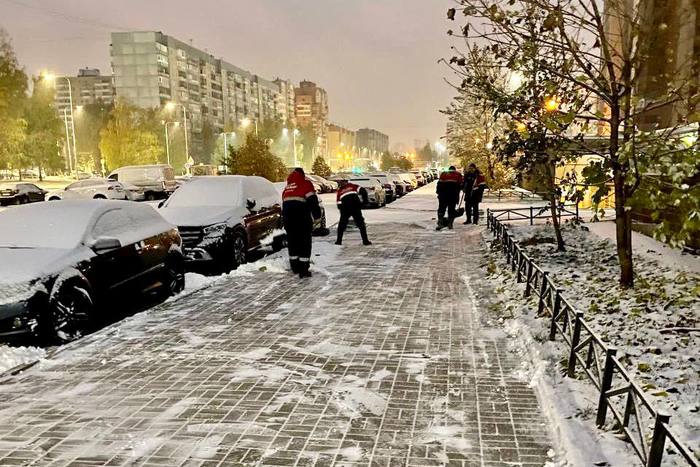
Central Asian migrant workers cleaning snow from the pavement somewhere in Petersburg.

Janitors are the hardest-to-find workers in Petersburg

Since the beginning of 2024, an average of 0.8 applications have been submitted for every janitor job vacancy, the press service of the employment website hh.ru has told Bumaga.

In the first nine months of this year, employers increased the wages offered to janitors by eighteen percent — up to 45,000 rubles a month [approx. 430 euros].

Shop cashier and auto mechanic are the most unpopular occupations among job seekers. During the year, the salary offered to workers applying for these jobs has increased by twenty-five percent and twenty percent, respectively.

According to analysts at hh.ru, “the country’s negative demographic processes” are the main reason for the shortage of employees. “They are long term and quite amenable to forecasting, so, unfortunately, positive trends are not to be expected here,” they argue.

Petersburg has long been short on janitors. In 2023, Yevgeny Razumishkin, deputy governor of St. Petersburg, said that the city had not yet been able to recruit the necessary number of these workers.

The city has tried to recruit janitors and machine operators by increasing their salaries up to 49,500 rubles and 76,800 rubles on average citywide. Last year, the Housing Committee also told Bumaga that it had improved working conditions by installing changing rooms, showers, relaxation rooms and even mini-saunas in janitorial offices.

The Housing Committee told Bumaga that the understaffing is partly caused by the social stigma of the janitorial profession in Russian society. Alla Bredets, the head of Housing and Utilities Control, a regional public monitoring center, argued that the situation with staffing in the housing and construction industry was affected by the outflow of migrants.

Source: Bumaga (Facebook), 10 October 2024. Translated by the Russian Reader. Photo, above, courtesy of the St. Petersburg Housing Committee, via Bumaga


Despite an acute labor shortage, the Russian authorities are trying to curtail the numbers of workers arriving from Central Asia. The crackdown intensified after the Crocus City Hall terrorist attack in March, which was reportedly carried out by Tajik nationals. But the appeal of Russia’s job market was already diminished prior to these restrictions. Now, Central Asian migrants are looking for job opportunities in other countries, including in Europe.

Historically, Russia has been the main destination for Central Asian migrant workers. Even after the full-scale invasion of Ukraine—and the recruitment of foreign migrants into the armed forces—Central Asians continued to go to Russia. The Crocus City Hall attack was a watershed moment. In its aftermath, labor migrants faced constant document checks, workplace raids, firings, flight delays, and hours-long lines at the border with Kazakhstan. If they were detained by law enforcement officials, they could be subjected to torture, or given a choice between conscription and deportation.

Even diplomats have been caught in the crossfire. In April, police officers burst into the Moscow apartment of an aide to Kyrgyzstan’s ambassador, ostensibly to establish who was living in the property. His wife and children were home at the time.

Afraid of antagonizing Moscow, Central Asian governments usually ignore such excesses. This time, the infractions have been so serious that officials have been forced into action, with both Dushanbe and Bishkek sending notes of protest. Tajik President Emomali Rahmon spoke up for his compatriots in a May meeting with his Russian counterpart, Vladimir Putin, urging him to fight terrorism, not Tajiks.

There has been no change in approach, however, and that has caused an outflow of migrant workers from Russia. Since April, the number of job seekers from Tajikistan in St. Petersburg has fallen 60 percent, while the number of job seekers from Uzbekistan dropped 40 percent. St. Petersburg is second only to Moscow in terms of its appeal to migrants.

More than a dozen Russian regions have tightened labor restrictions. As a consequence, the Krasnodar region, a leading producer of wheat, corn, sunflowers, and rice in Russia, is experiencing a shortage of agricultural workers. In the Ural Mountains, the same is true for factories, including those producing military equipment. In Yakutia in Russia’s far north, migrants have been banned from driving taxis and other transportation jobs. In Dagestan, there are not enough workers to dispose of the region’s waste.

As a rule, the impetus for imposing restrictions on migrants comes from regional officials. They claim migrants have taken jobs from Russian citizens and depressed wages. In fact, the reverse is true: the economy faces such an acute shortage of workers that wages are rising rapidly. The war on migrants goes on, however, having clearly been accepted by the authorities as an expression of patriotism.

Should the pressure continue, Russia’s labor shortage will only worsen. According to the Russian Academy of Sciences’ Institute of Economics, the country lacks about 4.8 million workers, with deficits particularly affecting industry, agriculture, trade, construction, and utilities: sectors that are generally staffed largely by migrants.

The crackdown is particularly baffling given that migration has gone some way to offset Russia’s demographic problems. At present, Russia’s mortality rate is nearly twice its birth rate, making migration key to maintaining population levels.

Over the past two years, the annual number of migrants entering Russia has remained stable at about 3 million. Most, however, are seasonal workers who do not stay long. Net migration was nearly 500,000 in 2021—the year before the start of the full-scale war in Ukraine—but it fell to 62,000 in 2022 as a result of Western sanctions hitting wages, and the recruitment of migrants into the Russian armed forces.

It might seem an inopportune time for Russia to be alienating Central Asian nations. After all, their governments did not break with the Kremlin after the full-scale invasion of Ukraine. But it seems Moscow believes Central Asian migrants have no alternative to the Russian job market. In any case, Russia has a history of using anti-migrant campaigns as a political tool. In 2006, Georgian migrants were targeted in raids after a group of Russian spies was arrested in Tbilisi. And in 2011, Tajik migrants were detained after Russian airmen were arrested in Dushanbe on suspicion of smuggling.

The Kremlin has even used threats to punish migrants as a way to squeeze concessions from Central Asian governments on issues from language policy to economic integration. Central Asian leaders may care little about the welfare of their compatriots in Russia, but they do worry about the consequences that a fall in remittances would have for their economies.

Remittances account for up to 40 percent of Tajikistan’s GDP, and more than 20 percent of Uzbekistan and Kyrgyzstan’s. With more and more Central Asians leaving Russia as a result of the pandemic, the invasion, and now the crackdown on migrants, less money is being sent home. In 2023, remittances to Uzbekistan, Kyrgyzstan, and Tajikistan fell by 42 percent, 12 percent, and 8 percent, respectively.

As a result, Central Asian governments are looking to help their citizens find work elsewhere, with officials facilitating labor migration to other countries and negotiating to reduce entry barriers to foreign job markets. Officials are even assisting laborers with visa applications. All of this is an attempt to soften the blow from the decline in remittances from Russia.

The number of those who have gone to work instead in Turkey, South Korea, and the Gulf states is already in the hundreds of thousands. Europe is also increasingly a destination for Central Asian laborers. In 2022, there were up to 6,000 Uzbek and Kyrgyz nationals working in the UK. In 2024, as a result of Brexit and the Ukraine war, London raised the caps on visas for Uzbek, Kyrgyz, and Tajik migrants to 10,000, 8,000, and 1,000, respectively.

There is also demand for Central Asian labor in the European Union: particularly in Eastern Europe, where many people have left to work in wealthier Western Europe. In Slovakia, 75 percent of companies report a shortage of workers. Little surprise, then, that the Volkswagen plant in Bratislava employed over 1,500 Uzbeks in 2023. Those workers made an average of 1,400 euros a month: far more than they could earn in Russia. Central Asian labor flows to Poland, Czechia, Lithuania, and Bulgaria are also on the rise.

For now, however, Russia remains the leading destination for Central Asian laborers, and no Asian or European job market will displace it anytime soon. Bureaucratic hurdles, language barriers, and cultural differences all act as obstacles in this respect.

Even so, just a few years ago it would have been impossible to imagine hundreds of thousands of Central Asians seeking work in Asia, or tens of thousands going to Europe. Russia is unmistakably losing its allure for Central Asian migrants: yet another unexpected consequence of the war in Ukraine.

Source: Galiya Ibragimova, “Why Are Central Asian Migrant Workers Spurning Russia?” Carnegie Politika, 1 August 2024

The War on Terror

This is not the first time the editors of our local newspaper have “platformed” the lies of the mendacious and violent fascist butcher Vladimir Putin.

1. US warns that Russia will invade Ukraine. General disbelief, daily Russian mockery. (December 3 2021-February 24 2022)

2.  Russia invades Ukraine, kills tens of thousands of people, kidnaps tens of thousands of children, commits other ongoing war crimes (February 24 2022-present)

3.  Russia blames US for Russia’s invasion of Ukraine (March 2022-present)

4. US warns of terror attack in Moscow. Putin denies any risk and mocks the United States. (March 7 and March 19 2024).

5.  Terror attack near Moscow, ISIS takes responsibility, Russia meanwhile kills Ukrainian citizens with drones and missiles as it has for more than two years. (today, March 22 2024)

6.  Russia’s security apparatus, focused on bringing carnage to Ukraine, has failed in Moscow.  Russia’s leaders, focused on demonizing the US, did not protect Russians. What next? Where to direct the blame?

7.  It would not be very surprising if the Kremlin blames Ukraine and the United States for terror in Moscow and uses the Moscow attack to justify continuing and future atrocities in Ukraine.

Source: Timothy Snyder, “Moscow Terror: A Chronology That Might Predict,” Thinking about…, 22 March 2024


This past Friday, 22 March, a horrifying terrorist attack took place in Crocus City Hall in the outskirts of Moscow.  Islamic State plausibly claimed responsibility.

Earlier that day, Russian authorities had designated international LGBT organizations as “terrorist.” Also earlier that day, Russia had carried out massive terror attacks on Ukrainian cities. Those actions reveal the enemies Putin has chosen. As the attack on Crocus City Hall demonstrated, his choices have nothing to do with actual threats facing Russians.

Russia and the Islamic State have long been engaged in conflict.  Russia has been bombing Syria since 2015.  Russia and the Islamic State compete for territory and resources in Africa.  Islamic State attacked the Russian embassy in Kabul.  This is the relevant context for the attack outside Moscow. The horror at Crocus City Hall obviously has nothing to do with gays or Ukrainians or any other of Putin’s enemies of choice.

Putin had publicly dismissed the real threat. The United States had warned Russia of a coming attack by Islamic State.  The United States operates under a “duty to warn,” which means that summaries of intelligence about coming terrorist attacks are passed on, even to states considered hostile, including (to take recent examples) Iran and Russia.  Putin chose to mock the United States in public three days before the attack. 

People reasonably ask how a terror attack could succeed in Russia, which is a police state.  Regimes like Russia’s devote their energy to defining and combating fake threats.  When a real threat emerges, the fake threats must be emphasized.  Predictably (and as predicted), Putin sought to blame Ukraine for Crocus City Hall.

What if Russians realize that Putin’s designations of threats are self-serving and dangerous?  What if they understand that there are real threats to Russians ignored by Putin?  He has devoted the security apparatus to the project [of] destroying the Ukrainian nation and state.  What if Putin’s obsession with Ukraine has only made life worse for Russians, including by opening [t]he way to actors who are in fact threats to Russian life, such as Islamic State? 

These are the questions Putin must head off. It is not easy, however, to blame Ukraine for Islamic State terrorism.  Putin’s first media appearance, nearly a day after the attack, was far from convincing.  The specifics he offered were nonsensical.  He claimed that the suspects in the terrorist act were heading for an open “window” on the Russian-Ukrainian border.

The term “window” is KGB jargon for a spot where the border has been cleared for a covert crossing.  That the leader of the Russian Federation uses this term in a public address is a reminder of his own career inside the KGB.  Yet Putin had obviously not thought this claim through, since a “window” must involve a clear space on both sides of the border.  For escaping terrorists, it would be the Russian side that opened the window.  By speaking of a “window” Putin indicated that the terrorists had Russian confederates preparing their exit, which he presumably did not mean.  It seems that Putin was hastily making things up.

Setting aside the “window” business, though, the whole idea that escaping terrorists would head for Ukraine is daft.  Russia has 20,000 miles of border.  The Russian-Ukrainian part of it is covered with Russian soldiers and security forces. On the Ukrainian side it is heavily mined.  It is a site of active combat.  It is the last place an escaping terrorist would choose. 

And there is no evidence that this is what happened.  Russia claims that it has apprehended suspects in Bryansk, and claimed that this means that they were headed for Ukraine.  (Western media have unfortunately repeated this part of the claim.)  Regardless of whether anything about these claims is true, Bryansk would suggest flight in the direction of Belarus.  Indeed, the first version of the story involved Belarus, before someone had a “better” idea.

In moments of stress, Russian propaganda tries out various ways to spin the story in the direction preferred by the Kremlin.  The reputed suspects are being tortured, presumably with the goal of “finding” some connection to Ukraine.  The Kremlin has instructed Russian media to emphasize any possible Ukrainian elements in the story.  Russian television propaganda published a fake video implicating a Ukrainian official.  The idea is to release a junk into the media, including the international media, and to see if anything works. 

Amidst the flotsam and jetsam are those who spread Russian propaganda abroad, who try out versions more extreme than Putin’s.  Putin does not directly deny that Islamic State was the perpetrator — he simply wants to direct attention towards Ukraine.  But actors outside Russia can simply claim that Ukraine was at fault.  Such actors push the discussion further than the Kremlin, and thereby allow Russia to test what might work abroad.

As a result, we have a bizarre discussion that leads to a harmful place.  Islamic State claims responsibility for Crocus City Hall.  The Islamic State publishes dreadful video footage.  Russia cannot directly deny this but seeks help anyway in somehow pushing Ukraine into the picture.  Those providing that help open a “debate” by denying that Islamic State was involved and making far more direct claims about Ukraine than the Kremlin does.  (This brazen lying leads others to share [a] Islamic State perpetration video (don’t share it; don’t watch it).  So the senseless “debate” helps Islamic State, since the reason it publishes perpetration videos is to recruit future killers.)

Meanwhile, Russia’s senseless war of aggression against Ukraine continues.  In its occupied zones, Russia continues to kidnap Ukrainian children for assimilation and continues to torture Ukrainians and place them in concentration camps.  It continues to send glider bombs, drones, cruise missiles and rockets at Ukrainian towns and cities. 

On the same day as the attack at Crocus City Hall, Russia carried out its single largest attack to date on the Ukrainian energy grid, leaving more than a million people without power.  Among other things it fired eight cruise missiles at the largest Ukrainian dam. Russia attacked the city of Zaporizhzhia (the consequences are in the four photos) and other cities throughout Ukraine.

On Friday Russia fired, in all, eighty-eight missiles and sixty-three explosive drones into Ukraine. And that represents just a single day (if an unusually bad one) of a Russian war of terror in Ukraine that has gone on for more than two years.

Putin is responsible for his mistakes inside Russia. And he is at fault for the war in Ukraine.  He is trying to turn two wrongs into a right: into his own right to define reality however he likes, which means his right to kill whomever he chooses. 

Source: Timothy Snyder, “Moscow Terror (2): The Claim and the Blame,” Thinking about…, 24 March 2024


It is obvious that the terrorist attack at Crocus City Hall on the evening of 22 March 2024, during which 133 people were killed, according to the official count, has clear goals and objectives. A week before Putin’s “election” I wrote that, after receiving a “mandate from the people,” Putin would unleash a mass terror campaign. But for this, of course, he needs a decent and obvious excuse. The exemplary terrorist attack in broad daylight in politically unreliable Moscow is intended to convince society that “decisive action” is what it needs now.

Why would Putin do that? It’s simple logic. Come hell or high water he has to win the war he has unleashed. This is obvious, for it is a matter of self-preservation. If Putin does not win, he is a weakling, a lowlife, and at the same time the person to blame for hundreds of thousands of deaths not only of Ukrainians, but also of Russians. It is clear that he will not last long in this state. Not to mention such a trifle as his sick, wounded ego, repeatedly insulted by Ukraine. But victory would wipe everything out, because victors are not judged, Putin is convinced, taking his cue from his idol Catherine the Great.

So, Putin has to have victory at any cost. But two things have long prevented him from achieving it: 1) his numerous domestic enemies, and 2) a lack of “manpower” in the ranks of the army.

Putin intends to solve problem number one by means of a mass terror campaign against malcontents, especially since he has long been urged to do so by a well-rehearsed chorus of heralds, from Dmitry Medvedev and General Gurulyov to a host of other, lower-ranking epigones of contemporary Russian fascism. Guessing the mood of their Führer, they demand that, at very least, he restore the death penalty; at most, that he carry out “total executions of the terrorists and crackdowns against their families” (per the latest quotable quote from Medvedev).

We can only guess at this point whether Putin’s forthcoming terror will exceed Stalin’s body count or whether the current ruler in the Kremlin will limit himself to “merely” increasing the number of prison sentences meted out to dissidents by a factor of two and carrying out demonstrative executions of dozens or hundreds of his fellow citizens. But there is no doubt that a serious expansion of such tactics is on his agenda.

Putin will solve problem number two through a mass mobilization. This is nothing new either. Piling hundreds of thousands of soldiers into the enemy’s trenches is a time-honored tactic practiced by both the Russian and Soviet military, and, as Putin has seen, it has worked well in the “meat assaults” on Avdiivka, Bakhmut, Severodonetsk, and many other small Ukrainian towns. But these towns are nothing compared to the million-strong cities of Kharkiv, Dnipro, Zaporizhzhia, and Odesa, not to mention the three-million-strong Kyiv. So there must be massively more cannon fodder. The second problem is directly related to the first.

Combined with large-scale crackdowns, the mobilization is sure to proceed more vigorously this time round.

As a bonus for the Kremlin, this terrorist attack diverts public attention (at least for a while) from such things as Russia’s largest-ever strike on Ukraine, involving a hundred and fifty missiles and drones, which happened just a day before the events at Crocus City Hall.

I’d now like to talk about other explanations of this terrorist attack. Looking through the news related to it, I honestly could not help but marvel at the comments of certain respected colleagues, opposition Russian analysts, who easily took the bait about IS, Islamist terrorists, and the other nonsense that the FSB obligingly leaked to the public in the first hours after the attack through the Russian media and Telegram channels.

To clarify, certain people of “non-Slavic ethnicity” were chosen to directly perpetrate this heinous crime. There are hundreds of thousands of Tajik, Uzbek, and Kyrgyz migrant workers in Russia, EVERY ONE of whom is literally turned inside out by the Russian Interior Ministry upon arriving in Russia, including with regard to their attitudes to radical Islam and similar things. The Russian secret services thus have the broadest selection of perpetrators available for such a terrorist attack.

Let us ask ourselves an elementary question: how could Islamist radicals purchase not only assault rifles and pistols but also the flamethrower with which the terrorists torched the unfortunate audience members at Crocus City Hall without the knowledge and support of Russian “law enforcement”? Is such a thing possible in today’s Russia, and in Moscow to boot? If someone thinks that it is possible, I would simply remind them that when members of Eduard Limonov’s National Bolshevik Party tried to buy weapons somewhere in the Altai Territory back in the 2000s, their plan was instantly exposed. The idea of Tajiks buying assault rifles and flamethrowers in today’s militarized Russia, which is chockablock with surveillance cameras and special services, is a bad joke.

Let me also remind you that the initial semi-official Russian explanation was that the terrorist attack at Crocus City Hall was revenge on Russia for its actions in Syria and Chechnya. Seriously? So, it matters not a whit that the Russian army and its air force have not conducted any active operations in Syria for two years now? If you have not been paying attention during this time, let me just remind you that the Kremlin is certainly not concerned with Syria right now. For the last two years all Russian armed forces, including those operating from military bases in Syria and in Armenia, have been deployed in destroying Ukraine. There have been no large-scale military operations in Chechnya for almost twenty years.

However, as it turned out, all this argumentation was completely superfluous, because my gullible colleagues were made to eat their lunch by Putin himself and his favorite propagandist, Margarita Simonyan. As a shadow of her “boss” (as she herself dubs Putin), Simonyan naturally cannot afford to indulge in improvisations not vetted by him, and especially at such a crucial moment. On her Telegram channel, she bluntly pointed out who, in her (and therefore her boss’s) opinion, had organized and perpetrated the terrorist attack: “It wasn’t IS. It was the Khokhols.”

The “boss” himself, who was supposed to address the nation in the early hours after the terrorist attack, unexpectedly postponed his address by twenty-four hours. The delay appears to have been caused by technical blunders. Obviously, organizing the details of a terrorist attack is not Putin’s pay grade. It is clear that in such cases the relevant special services are simply given the go-ahead from the top brass. They are told to do their job. The operation was entrusted, of course, to professional hatchet men. As usual, they made a miserable mess of it. You need a large-scale terrorist attack? The Russian security services always have two or three dozen Tajiks on hand for this purpose, who can be hastily given their marching orders, paid, and… And that’s basically it. The Tajik passport found in a car allegedly belonging to the terrorists is, of course, a masterpiece. It is clear that no terrorist, as he sets off to carry out an attack, ever forgets to take his passport with him. It was meant as a helpful hint to law enforcers, and also so decent folk would know whom to hate. It is strange that the business card of the already half-forgotten Dmytro Yarosh was not found in the car as well.

But the point is that this special operation were certainly not meant to spoil relations with the Islamic world. Russia’s allies—Iran, Hezbollah, Hamas—might take offense.

In addition to the domestic agenda we mentioned above, the terrorist attack was meant to firmly link the globally condemned villains of IS with Ukraine in world public opinion.

This was why Putin’s speech on the terrorist attack was postponed for almost twenty-four hours. The dictator’s dodgy mind was deciding how to clean up the mess made by his numbskulls and tie up the loose ends. That is, to tie IS (or any other Islamists) to Ukraine. And he probably thinks he has figured out how to do it. As he put it, [the terrorists were trying to escape through] “a window prepared for them on the Ukrainian side of the border.”

All these tricks of Putin’s are painfully obvious to people capable of thinking, but he doesn’t care about that. Moreover, having sensed a change in the mood of his American “partners” (remember the reports that the U.S. has been pressuring Ukraine to stop hitting Russian oil refineries, and the fact that for almost two months no American aid has arrived in Ukraine and it is not known whether it will arrive in the future), Putin makes a high-pitched appeal to all countries to unite against this inhuman evil—that is, against Ukraine + Daesh.

Another very important point from Putin’s speech, indicating that he is paving the way for a mass terror campaign at home, is that he called the shooting of civilians at Crocus City Hall nothing more or less than “a blow to Russia, to our people.” He, his propagandists, and the Russian media have already established the link between Islamist terrorists and Ukraine. The next logical step is to claim that those Russians who support Ukraine are direct and immediate supporters of the terrorists who struck “a blow to Russia, to our people”—that is, that they are enemies of the people.

To be honest, all of this is as monstrous as it is predictable. I will repeat what I have said many times before: as long as Putin is alive and in power, things will get even worse and even scarier.

Source: Alexander Zhelenin, “The terrorist attack at Crocus City: who benefits from it and what will happen next,” Republic, 23 March 2024. Translated by the Russian Reader

Life Under Fascism

What is life like for us under fascism? It’s fine. I eat, sleep, work, play computer games and football, and get laid.

Repairs have begun on the roofs of the Soviet high-rise buildings on my work beat. The contractor drags powerful electric roofing kettles onto the roof, hacks away the old tar, melts it down, and immediately pours it back onto the roof. The kettles are powerful—advanced technology that works quickly and efficiently.

The kettles are also five years old. They are left right on the roofs over the winter, and so they are rotted and burned out. The molten tar splashes onto the cables, and everything in the vicinity burns and smokes. It is no exaggeration to say that you can smell the stench two blocks away. It is unlikely that there is anything healthy in the fumes generated by the molten tar. It is Uzbeks who work on the roofs: their bosses persist in calling them jigits. They work without safeguards or personal protective equipment. On the first day, they asked their bosses for water. Their bosses told them to get it themselves—”otherwise, next time they’ll be asking for broads in bikinis.”

Yesterday the cops nabbed them. The cops told them, “Your registration isn’t in our database. So, you either spend a couple days in jail until we figure it out, or you each cough up 5,000 rubles now.” [At the current—official—exchange rate, 5,000 rubles is approximately 88 euros.]

Do you think there is a database somewhere that says that you are just a human being?

Their electrician is from Bashkiria, a skinny kid in glasses with a typical whistling accent. He graduated from an architectural college back home, came to Petersburg, and worked on a low-voltage network for a couple of months, but now has been hired as an electrician servicing the three-phase fifty-kilowatt kettles. On the first day, he regarded the whole setup with mortal dismay. In his bag he has a set of screwdrivers and a crimper for patch cords. Now he dives into the overheated equipment, changes the burnt-out heating elements, and splices the burnt, beaten cables. Then he unsuccessfully tries for hours to wash off the oil stench.

“Who will pay for your disability?” I ask him.

“They can’t pay us overtime.”

He put up with this as long as he could before breaking down and going on a drinking binge. He squandered all his money, arriving back at work with a black eye and his left cheek puffed up like a pillow. His glasses were still intact, however. He asked me to lend him money for beer.

“How much do they pay you?” I ask.

“They promise mountains of gold.”

“Could you be more specific?”

“It’s daily work. 2,500 rubles a day.”

The word he was looking for in Russia was “daywork” [podënnaia], not “daily work” [podnevnaia]. There is such a thing as “daywork” and “dayworkers.” Who make sixteen dollars a day if you calculate their pay in terms of the actual exchange rate.

How much does the Russian lad Vitya, who made the remark about the “broads in bikinis,” make? How much does their supervisor, a handsome, businesslike, quick-thinking middle-aged man with shifty eyes, make?

What will they buy for themselves by pinching the money budgeted for roof repairs? A car? A tiled path for their dacha? When they walk on this path, will they think about the people whose health has been permanently scarred by tar on hot roofs? I doubt it.

Fascist brutality springs from this everyday, workaday brutality. Indifference to people as individuals grows from this virtually legalized slavery.

Source: George Losev, Facebook, 28 June 2022. Mr. Losev works as an on-duty electrician for the housing authority in Petersburg. He points out that the roofing tar kettles he describes are nothing like the one in the video I inserted, above. They are much larger and electric-powered. This is not to mention that “Alfredo the kettle man” (in the video) is wearing protective equipment, unlike the Uzbek workers in Mr. Losev’s story. Translated by the Russian Reader


I was asked to show how to make a “syllable tram.”

I scanned the roadway (see the links, below). The drawings were quite hastily done, right before class. (

The strip should be glued with adhesive tape on the reverse side. (Leave a millimeter between the sections so that it is easier to fold and store.) The tram, which is approximately 290 mm wide (nearly the same width as an A4 sheet of paper) and 85 mm high, is fitted onto the strip. One window in the tram is cut out, and a transparent sleeve is pasted on the other, into which a consonant is inserted.

The strip needs to be fastened with something. (I fastened it to the table with tape.)

The tram travels from right to left. When it reaches a marked stop, a vowel appears in the cut-out window. When you make the tram, test it and draw the letters on the strip so that they appear in the exact same place as the empty spot.

The roadway:

https://disk.yandex.ru/i/dGXik7Z3Nmwpgg (Yandex Disk)

https://drive.google.com/file/d/13k0cDuhXD-hAzytGpGYgpsZEdR9jmsVd/view (Google Drive)

Source: Natalia Vvedenskaya, Facebook, 28 June 2022. Ms. Vvedenskaya teaches Russian to immigrant children at the St. Petersburg Jewish Community Center. Most of these children are originally from Central Asia, like the workers in Mr. Losev’s story. The first image, above, is a screenshot of a short video that Ms. Vvedenskaya included in her original post, showing her pupils playing with her “syllable tram.” Translated by the Russian Reader

Moscow, May 9

For the first time in my life (I swear!) I went to the Immortal Regiment march today. Let’s just say I was strongly encouraged to do it. I hesitated, I thought it over, but in the end my curiosity won out. I have been shooting almost nothing for more than two months, because I simply lost any sense of how to go on documenting urban life and civic activism in the new reality. What did I see and hear today? I found super polite people of all ages portraying the ideal “Russian world” in its peaceful aspect. “Nobody here wants war,” a man of about forty-five, holding a portrait of his grandfather and a flag emblazoned with an image of Stalin, told me. He is one of those who sees “pros and cons” in everything and everyone, and who, although experiencing some discomfort, still fully trusts the vision of the country’s leadership. Maybe some of the marchers were forced by their employers to go to the rally, but it seemed to me that people had gone there quite willingly. They were given free food and beverages: in exchange for such generosity, one can walk in the rain and sun for a couple of hours. The Uzbek workers seemed to be happy, because on Victory Day they are allowed to join the people of Great Russia, who for the rest of the year carefully monitor and maintain the existing division of society into “homeboys” and “aliens.” When, instead of periodic enthusiastic shouts of “Hur-ra-a-a-a-h!” or “Ru-u-u-u-sia!”, the crowd started chanting “fascism will not pass” behind me, I should have fought the good fight, but instead my instinct of self-preservation kicked in and I stupidly continued to shoot.

“NOD” = the so-called National Liberation Movement

Source: anatrrra, LiveJournal, 10 May 2022. Introductory text translated and photos reprinted with the author’s kind permission. Go to the original post to see their completely stunning photo reportage in full. Translated by the Russian Reader

(A Quiet) Civil War

(A Quiet) Civil WarDictionary of War, Novi Sad edition, January 25–26, 2008

My concept is “civil war”— or rather, “a quiet (civil war).” Another variant might be: cold civil war. I will talk about how the (global) economy of war—hot war, cold war, civil war—is experienced by victims and bystanders in a place seemingly far from actual frontlines. In reality, the frontlines are everywhere—running down the middle of every street, crisscrossing hearts and minds. This permanent war is connected to the project that posits the presence of civil society in one part of the world, while also asserting the necessity of building civil society in other parts of the world where allegedly uncivil social, political, and economic arrangements have been or have to be abolished. The real effect of this high-minded engineering is the destruction of people, classes, and lifestyles whose continued survival in the new order is understood (but hardly ever stated) to be either problematic or unnecessary. The agents of this destruction are varied—from random street crime, assassinations, inflation, alcoholism, factory and institute closures, to pension and healthcare reform, the entertainment and news industry, and urban renovation. The place I will talk about is Russia and Saint Petersburg, where I have lived for much of the past fourteen years. My concept is intended as a memorial to a few victims and local eyewitnesses of this war—people I either know personally or came to know about through the stories of friends or other encounters. I will also sketch the tentative connections between that civil war and the troubles in this part of the world; and, very briefly, show how the victors in this war claim their spoils.

This term—(a quiet) civil war—was suggested to me by the Petersburg poet Alexander Skidan during a conversation we had last spring. I had been telling Alexander about the recent murder of my friend Alexei Viktorov. Alexei is fated to remain a mere footnote in Russian art history. I mean this literally: in a new book, Alexei is correctly identified as the schoolmate of the Diaghilev of Petersburg perestroika art, Timur Novikov, and the painter Oleg Kotelnikov. I met Alexei in 1996, when Oleg let me live in his overly hospitable studio in the famous artists squat at Pushkinskaya-10. Alexei showed up a few weeks later. He had spent the summer in the woods, living off mushrooms and whatever edibles he could find. In his youth, he had acquired the nickname Труп (Corpse). With his gaunt features and skinny frame, he certainly looked the part. As I would soon discover, he was one of the gentlest men on earth. He was also a terrific blues guitarist. And he was the first Hare Krishna in Leningrad and, perhaps, the entire Soviet Union—which was quite a feat, considering that his conversion took place in the dark ages of the seventies.

Last winter, friends chipped in on a plane ticket, and Alexei was able to fulfill a lifelong dream and travel to India. When he and his companions arrived at the Krishna temple, Alexei was greeted by the community as a conquering hero. Since Alexei’s life had been quite miserable of late back home, his friends insisted that he stay behind in India. Instead, he decided to return to Petersburg. A few days after his arrival home he was walking from the subway in the northern Lakes district of the city to the house of a friend. Along the way he was attacked—the police say by a gang of teenagers. The teenagers beat Alexei within an inch of his life and pushed him into a ravine. The police investigator guessed that Alexei had lain unconscious for some time. When he came to, he had apparently struggled to raise his battered body up and clamber out of the ravine; in his struggle, he had for some reason started tearing off his clothes, perhaps because his rib cage and chest were so badly crushed that he was suffocating. His body was discovered a couple days later. The police held it for another few days while they completed their investigation, which led to no arrests. Alexei’s funeral was held a few days afterwards at the Smolensk Cemetery on Vasilievsky Island. He was buried a few hundred meters from the grave of his schoolmate Timur Novikov, who died in 2002.

It was this story that prompted Alexander Skidan’s remark to me: “A quiet civil war has been going on here.” What did Alexander have in mind? What could the random albeit violent murder of a single human being have in common with the explicitly political and massively violent struggles that have taken place here in the former Yugoslavia and such parts of the former Soviet Union as Abkhazia, Southern Ossetia, Tajikistan, Nagorno-Karabakh, and Chechnya? How could Alexei—who, as the Russian saying has it, lived “quieter than the water, lower than the grass”—be viewed as an enemy combatant in such a war? Can we really compare his unknown assailants to representatives of the opposite warring party? Given what they did to him, it is clear that they viewed Alexei as their enemy—an enemy subject to sudden, violent execution when encountered in the proper (hidden, invisible) setting.

I anticipate serious objections to my line of argumentation. One such objection I have already heard in the person of my friend Igor. Igor, whose father is Ossetian, and whose mother is Ukrainian, grew up in Dushanbe, which was then the capital of the Tajik Soviet Socialist Republic. I have never been to Dushanbe, but I have heard Igor describe it so many times in such glowing terms that I have come to think of it as heaven on earth. While I am sure that much of the paradisiacal tone in Igor’s recollections has to do with temporal and physical distance, it really does seem that the Dushanbe of the sixties and seventies was a kind of cosmopolitan oasis—a place where all sorts of forced or voluntary exiles from all imaginable Soviet ethnic communities and other cities ended up living in something like harmony.

This harmony bore the name “Soviet Union,” and Igor himself has often seemed to me the ideal homo soveticus (in the positive, internationalist sense of that term), a person to whom the refrain of the popular song—“My address isn’t a street or a building, my address is the Soviet Union”—fits perfectly. Before the collapse of the Soviet Union, Igor was the country’s leading expert on the seismic stability of electrical substations. From the onset of the Tajik civil war, in the early nineties, Igor was unable to return to Dushanbe. This had to do with the fact that in his internal Soviet passport, his place of birth was identified as Khorog, the capital of the Pamir region, which is where some of the “anti-government” forces had their power base. If Igor had returned to Dushanbe, he could easily have been stopped by soldiers during a documents check and executed on the spot. This is what happened to a number of his friends and schoolmates.

After the war was over, Igor’s father was able to reclaim the family home near Vladikavkaz, in Northern Ossetia, which had been confiscated by the authorities when Igor’s grandfather had been executed as an enemy of the people in the thirties. Northern Ossetia was a relative oasis during the nineties, despite the fact that Chechnya and Ingushetia were just over the mountains and neighboring Southern Ossetia had broken away from Georgia. This relative calm came to an abrupt end in September 2004, when terrorists besieged the school in neighboring Beslan. During the siege, members of Igor’s extended family were killed.

This is how Igor puts it: “Civil war is when the bus you’re on is stopped by soldiers and some of the passengers are taken off to be shot. And you sit there in the bus listening to the sound of gunfire and waiting for it to be over so that you can continue on your way. That’s civil war. What you’re talking about is not civil war.” Igor is certainly right.

He is also wrong in another sense. The quiet civil war I am describing here—among whose victims, I claim, was our friend Alexei—draws its energy and some of its methods from the real civil wars that have been fought in the hinterlands that are literally unthinkable to folks in such seemingly safe, prosperous places as Petersburg and Moscow. An immediate consequence of the siege in Beslan was that President Putin abolished gubernatorial elections in the Russian Federation’s eighty-four regions and federal cities. This, it was argued, would strengthen Moscow’s control—its so-called power vertical—over local officials whose incompetence and corruption had led, supposedly, to guerrillas infiltrating Beslan and capturing the school with such ease. Meanwhile, the civil wars and socioeconomic collapse in places like Tajikistan have led to a flood of refugees and migrant workers into Central Russia and its two capitals. The booming building trade in Moscow and Petersburg to a great degree now depends on the abundant, cheap supply of workers from Tajikistan, Uzbekistan, Moldova, and other former Soviet republics.

These workers are literally visible everywhere nowadays: with the oil economy fueling a tidal wave of consumerism whose major players have now turned to real estate as an outlet for investing their wealth, the capitals have become gigantic construction sites. And yet the conditions of their work and their lives are just as literally invisible. For example, Tajik workers and other darker-skinned Central Asians and Caucasians are subjected to frequent, unnecessary documents checks in public places such as subway stations. This is something that every Petersburger and Muscovite has seen ten thousand times, but it is also something they pretend not to see, judging by the lack of public reaction to the practice. Even less reaction is generated by neo-Nazi attacks on such workers, other foreigners, members of Russia’s ethnic minorities, and anti-fascist activists, which have become more and more common in the past several years.

I want to paint one more, brief verbal portrait of another victim in this quiet civil war. This portrait is connected with the violence inflicted on this city and other parts of Serbia during the NATO bombing campaign of 1999. The official and popular reaction in Russia to this violence was quite harsh. There were massive demonstrations outside the US embassy in Moscow; unknown assailants even fired a grenade into an empty office at the embassy. What surprised me were the more spontaneous reactions to the bombings. One day, a young American artist and I were standing in the courtyard of the squat at Pushkinskaya-10 chatting with a local artist. Two acquaintances of ours—members of a well-regarded alternative theater troupe—entered the courtyard. When they saw us, they shouted, “Don’t talk to those Americans! They’re bombing our Serbian brothers!” Since they said all this with a smile, it was hard to know to what extent we were supposed to take their warning as a “joke.”

It occurred to me then that a fundamental shift was occurring in the consciousness of Russians who had been, both in practical and philosophical terms, “westernizers” and “liberals” not long before. That this shift was also extending into the “masses” was confirmed for me a few days later. Late one night, I suddenly heard a drunken-sounding young man yelling up to an apartment across the street: “Masha! Goddammit, come downstairs and let me in!” Since repeated requests had no apparent effect on the silent, invisible Masha, the young man became more explicit in declaring his unhappiness with Masha’s thwarting of his affections. “Masha, you fucking bitch, come down and let me in! You’re breaking my fucking heart!” The turn the man’s soliloquy took next, however, signaled to me that we all were living in a new world. “Masha, go fuck yourself! NATO, go fuck yourselves!” (Маша, пошла ты в жопу! Блок НАТО, пошли вы в жопу!) This effusive condemnation of Masha and NATO continued for some time, after which the thwarted lover fell silent or fell over drunk.

If I had known that I would be invited to speak at this conference nine years later, I would have recorded the whole performance. Instead of speaking to you now, I would have played back the recording in full. Not in order to make fun of the young man whose heart had been broken in two by the combined forces of Masha and NATO, but so that you could hear what the quiet civil war I am trying to talk about sounds like. This is what I meant when I said, at the beginning of my remarks, that the frontlines in this new kind of war cross through hearts and minds and run down the middle of streets. This is not what happens when civil society breaks down; it is what happens when “civil society” is a code word (pronounced and enacted in tandem with other code words such as “democracy” and “liberal economy”) used to camouflage the incursion into the city of invading forces. The new regime they have come to establish can in reality do quite happily without “civil society,” democracy, and liberalism. But these words and the real actions taken and deals made behind their smokescreen are quite effective in destroying the historic and imaginary forms of solidarity that might have given folks like our unhappy young lover the means to defend themselves somehow. Instead, we end up with the muddle in our heads that lets us imagine that Masha and NATO are allied against us. Or that NATO is bringing democracy and security to Afghanistan. Or that, instead, to thwart NATO’s expansion to the east we have to round up Georgian restaurant workers and deport them back to Georgia—which, paradoxically, used to be nearly every Russian’s favorite place on earth.

As Alexander Skidan himself told me, the NATO bombing campaign of 1999 really had destroyed the illusions that he and most everyone else he knew had both about the west and about the meaning of the radical transformation of Russian society that was carried out under the banner of a rapprochement with the west and a leap forward into liberal democracy and neoliberal capitalism. What Alexander and his friends saw as the west’s treachery in the Kosovo crisis had thrown a new retrospective light on a period they had until then been experiencing as a golden age for artists and ambitious young people like themselves—an age of unprecedented opportunity for self-expression at home and dizzying trips abroad. Why hadn’t the massive immiseration and unemployment of the post-Soviet population during the early nineties produced this same enlightenment? Or the violent disbanding of the Russian parliament, in 1993? Or the first war in Chechnya? Or the fact that, in Alexander’s case, his own father, a professor at the city’s shipbuilding institute, had gone in a matter of a year or two from being a respected member of his society to being an outmoded nobody who had to struggle to survive? Somehow, Alexander and his kind had noticed all this, of course, and not seen it. Or seen it and decided that these were the sort of temporary measures and necessary obstacles on the road to a better future. As he sees it now, the whole point of the Russian nineties was to decommission and eliminate whole sections of the population—teachers, doctors, factory workers, the poor, the aging, the less ambitious, and the more gullible. And this civil war, which continues to this day, paved the way to the quite logically illiberal current regime.

Which of course is wholly staffed by the victors in the quiet civil war of the nineties—not by the victims, whose victimhood is converted into ever-greater quantities of political, symbolic, and real capital by those same victors. Thus, the current favorite to win the Russian presidential elections in March announced the other day that his goal was to create a strong civil society where the freedoms and rights of all citizens would be cherished and protected.

This is one way to cash in your chips at the end of a successful quiet civil war. But our globalizing economy is such that you can even profit from someone else’s civil wars. My favorite new example of such capitalization is the American alternative band Beirut, the brainchild of 22-year-old Zach Condon, a native of Santa Fe, New Mexico. Overly sensitive types might wonder how you grow up in peaceful Santa Fe and end up calling your band Beirut—but as we Americans love to say, It’s a free country.[1] (In its article on the band’s “Balkan-inspired” debut album, Gulag Orkestar, Wikipedia helpfully explains that the “Gulag was a system of Russian [corrective labor camps] in Siberia.”)

It is too much to expect that alternative radio stations would play, instead of Beirut’s fake Balkan wedding music, the 1999 lament of Masha’s spurned lover. Besides, I didn’t have the good sense to record it and release it as an album.


[1] “One of the reasons I named the band after that city was the fact that it’s seen a lot of conflict. It’s not a political position. I worried about that from the beginning. But it was such a catchy name. I mean, if things go down that are truly horrible, I’ll change it. But not now. It’s still a good analogy for my music. I haven’t been to Beirut, but I imagine it as this chic urban city surrounded by the ancient Muslim world. The place where things collide.” Rachel Syme, “Beirut: The Band,” New York, 6 August 2006.

The Persecution of Valentina Chupik

Human rights activist Valentina Chupik. Photo courtesy of DW

Human rights activist Valentina Chupik has left Russia
After ECHR decision prohibits Chupik’s deportation to Uzbekistan, the human rights defender was released from a special detention center and allowed to fly to Yerevan
Deutsche Welle
October 2, 2021

The Russian authorities have released human rights activist Valentina Chupik from a special detention center at Sheremetyevo Airport in Moscow. After the European Court of Human Rights (ECHR) forbade the Russian authorities from deporting her to Uzbekistan, she was allowed to fly to Armenia, the human rights defender’s assistant Alexander Kim told reporters on Saturday, October 2.

“Uzbekistan has issued Valentina Chupik a new passport. She is currently on board a plane that took off a little over an hour ago for Yerevan. [The Russian authorities] couldn’t hold her anymore,” Kim said.

The human rights defender’s further plans are unknown. Her representatives have submitted an asylum request to the Ukrainian authorities for Chupik and her 84-year-old mother Lyubov Kodentsova, but have not yet received a response. Chupik’s seriously ill mother is still in the Moscow region.

Revenge for human rights work
The 48-year-old Chupik fled to Russia from Uzbekistan after the shooting of demonstrators in Andijan in 2005, fearing torture, and she received political asylum in Russia in 2009. The founder of Tong Jahoni (“Morning of the World”), a migrant rights protection center that provides free legal assistance to migrants facing pressure from the security forces and other problems, Chupik was detained by the FSB at Sheremetyevo Airport last week after arriving from Yerevan.

The Russian authorities had stripped Chupik of her status as a political refugee, banned her from entering Russia for a period of thirty years, and begun the process of deporting her to Uzbekistan. The activist believes that she was punished for criticizing corruption in the Russian Interior Ministry and for her human rights work.

On September 30, the ECHR forbade Chupik’s deportation, invoking Rule 39 of the Rules of Court. This rule is applied as an urgent measure in cases where there is an imminent risk of irreparable harm.

Thanks to Sergey Abashin for the link. Translated by the Russian Reader