Happy Russia Day 2017

Office of the Guidance Counselor, Saint Petersburg State University of Film and Television
VK
9:11 p.m., June 9, 2017

Dear students,

June 12 is a public holiday, Russian Sovereignty Day [sic]. Certain people have been trying to use our national holiday to destabilize the situation in the country. Alexei Navalny has called for Russians to take to the streets of their cities in protest against the current regime.

The administration of Saint Petersburg State University of Film and Television asks you to approach the question of involvement in such events responsibly, not to yield to such calls and other provocative proposals whose objective is inveigle young people in unauthorized mass actions and marches aimed at destabilizing public order, calls and proposals that are transmitted via social networks and other sources of information. We cannot let these people achieve their political ambitions illegally.

Thanks to Comrade VS for the heads-up

happy russia day
“⚡️Gas sprayed on Pushkinskaya Square. Police in gas masks. If you smell gas, wet t-shirts and breathe through them. #12june.”

Alexandra Krylenkova
Facebook
June 12, 2017

So, 658 people were detained [in Petersburg]. Minors whose parents were able to come and get them and people with disabilities have been released. Nearly everyone else will spend the night in jail.

There will be court hearings tomorrow. Everyone who can make it should come. The hearings will take place at the Dzerzhinsky District Court [in downtown Petersburg]. The first detainees are scheduled to arrive at the court at 9:30 a.m. Considering the number of detainees, we will probably be there into the night.

happy russia day-2
Field of Mars, Petersburg, June 12, 2017. Photo courtesy of Alexandra Polukeyeva/Rosbalt

Alexei Gaskarov
I was invited to speak at the rally on Sakharov Avenue. I planned to talk about why it was important to support the anti-corruption campaign despite our political differences. In short, in order to put a stop to reaction, dissenters need to be represented on a massive scale, so the elites would not even think about just trampling them or not noticing them.  Everyone has the same goal right now: resurrecting political freedoms. The contradictions among people are secondary. Considering the scale of protests nationwide, things turned out quite well. You can see that people have stopped fearing crackdowns, and that intimidation no longer works. In Moscow, switching the rally to a stroll down Tverskaya was an absolutely apt response to the Kremlin’s behavior. Everyone who wanted to avoid arrest had the chance to do that. There were downsides as well, but given the colossal confrontation, they don’t seem important.

Ilya Budraitskis
Of course, one cannot help but welcome today’s protests on a nationwide scale. We are witnessing the continuing rise of a new protest movement that emerged on March 26. This movement is indivisible from Alexei Navalny’s presidential campaign and owes both its virtues and weaker aspects to that campaign. Despite the fact that Navalny’s campaign could have launched a broad grassroots movement, on the contrary, it has been built like a personalistic, vertical political machine in which decisions made by a narrow group of experts and approved by the leader are mandatory for the rank-and-file. This raises the majority’s political consciousness to the degree necessary at each specific moment of the campaign. The leader’s political strategy, his objectives, and the meaning of decisions are not up for discussion. Navalny must be believed like a charismatic CEO. What matters is that he is personally honest and “he has a plan.” On the eve of the protest rally, authorized for June 12 in Moscow, the rank-and-file found out a new particular in the plan: everyone had to go to an unauthorized protest march, which would predictably end in arrests and criminal charges along the lines of the March 26 protests. The rationale of the organizers is understandable. They have to pull out all the stops to keep the campaign moving at a fever pitch, keep it in the public eye, and use the threat of riots to pressure the Kremlin. Moreover, this radicalization in the media reduces the complicated picture presented by Russian society to a simple confrontation: the thieves in the Kremlin versus the honest leader who has united the nation. This set-up renders all forms of public self-organization and all social movements secondary and insignificant, and their real interest ultimately boils down to making Navalny president. However, even Navalny’s most dedicated supporters should pause to think today, the day after June 12. Would his campaign be weakened if it were opened up to internal criticism, if horizontal discussions of his political program and strategy were made possible, and the political machine, now steered by a few people, turned into a real coalition, where differences did not get in people’s way but helped them agree on common goals?

Anna Ivanova
“Sakharov Avenue is out,” Navalny said in his morning video message.

Navalny’s adviser Leonid Volkov put it more democratically.

“The hypocritical scum who dreamed up the ‘opposition rally on Sakharov’ will fry on a separate frying pan.”

The rally on Sakharov happened anyway. It was mainly attended by opponents of Moscow’s new law on the large-scale renovation of residential buildings: urban activists and residents of the buildings slated for demolition, as well as defrauded investors in residential building projects, foreign currency mortgage holders, and other victims of the construction sector. Many fewer of them came out, however, than on May 14, even considering that some of the outraged Muscovite anti-renovation protesters followed Navalny over to Tverskaya. Protests rise and ebb like the sea, and this time round the excitement was muted. These people—old women, families with children, old men—were not suitable for getting arrested at an unauthorized protest. Although they realize that Moscow’s problems are merely one logical outcome of the Russian political system, they are in no hurry to support Navalny and other inveterate oppositionists, for what is at stake are their housing and property, not supreme civil liberties.

happy russian day-4
“Day of Russian Cops” on Tverskaya in Moscow, June 12, 2017

Meanwhile, on Tverskaya, young folks realized that A.C.A.B. Around 700 people were detained in Moscow, and the social networks were flooded with even more photographs of derring-do amidst the so-called cosmonauts [riot cops]. The ultimate damage from the protest might be acknowledged only over time, when we know whether there will be new criminal cases, and if there are, what charges are laid against the protesters. But everyone loves looking at riot porn (and being involved in it), although this hobby devastates and dulls the senses as much as watching ordinary porn. This is the danger of protests “for all things good,” of protests focused on a certain political agenda or figure: neither fat nor thin, neither old nor young, neither socialist nor nationalist, but generally sweet and better than the old protest rallies. In this case, protest risks degenerating into a social order in which everything is decided by Sturm und Drang. Not the worse prospect, some would argue, but others would argue it would be a disaster. But whether you like it or not, “Russia has thousands of young people dreaming of revolution,” for the time abstractly encapsulated in the slogan “Dimon must answer for his actions,” and they have been taking to the streets.

Two worlds did not in fact meet in Moscow today. One world is the world of people who are mostly old, people whose property is threatened with eminent domain and who imagine politics as a way of building an urban environment. The second world is the world of bold young people (and their slightly older idols), who are hellbent on regime change. It would not be a bad thing if these worlds met and acted in concert. This is the only way for a democratic politics to emerge from this.

Source: openleft.ru
happy russia day-3
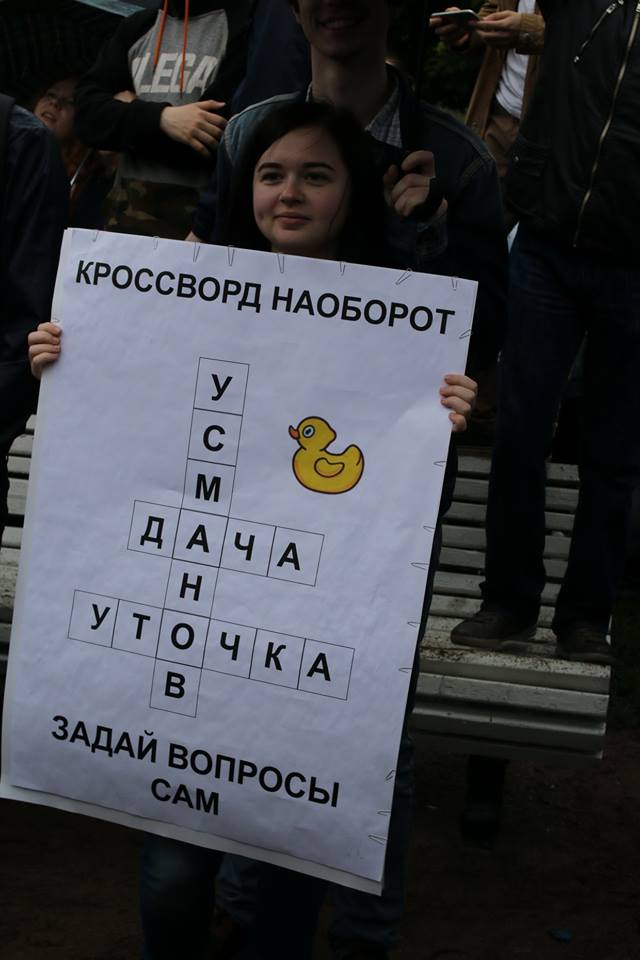
“A crossword in reverse. USMANOV, DACHA, DUCKIE. You provide the clues.”

Carine Clement
Facebook
June 13, 2017

Notes from the field (the Field of Mars). Putting aside emotions:
1. It’s true there were lots of young people. And they are not afraid of anything.
2. There were many young families, who are likewise not afraid for their children.
3. “We’re fed up” is the key phrase.
4. There were slogans about healthcare, infrastructure, and pension. Well, and about corruption, too.
5. The out-of-town students came out because “it is wrong to drive the regions into a pit like this.”
6. There was a sense of support and public acceptance.
7) The people who came out were true patriots genuinely worried about the country’s future.
8) A spirit of freedom . . .

Photos courtesy of Protestnaya Moskva, Rosbalt, anatrrra, and Vadim F. Lurie. Translated by the Russian Reader

P.S. On the Six O’Clocks News last night, BBC Radio 4’s Moscow correspondent had the temerity to refer to yesterday’s protest march on Tverskaya as “illegal.” Is this the new tariff for keeping one’s press accreditation under Putin’s perpetual reign? TRR
The Scare (The Sequel)

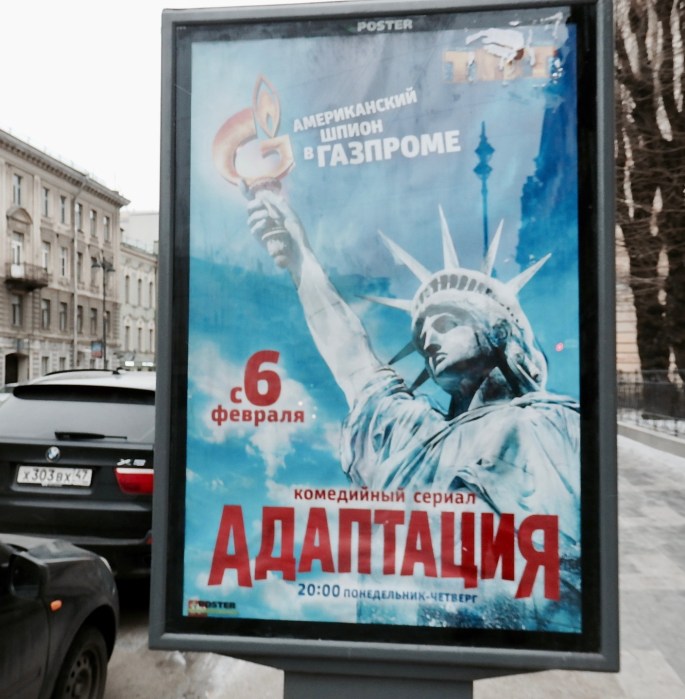
“TNT. An American Spy at Gazprom. From February 6. The comedy serial ‘Adaptation.’ 8 p.m., Mondays through Thursdays.” Central Petersburg, 2 February 2017. Photo by TRR

Why look for a new whipping boy when the dead horse you’ve been beating mock-ferociously for the last seventeen years shows no signs of giving up the ghost? Especially when you can play your profound, self-induced inferiority complexity and sheer intellectual bankruptcy for laughs, as it were.

Yep, no top-down, state-mandated anti-American hysteria round these parts. Just lots of good clean fun.

Meanwhile, back in the unreal world of Russian post-factual reality, it really is always more convenient to blame the mighty Americans for everything, especially total meltdowns within your hopelessly criminalized bureaucracy and security services, who operate like competing mafia gangs. TRR

Busting Down Doors in the Name of Jesus

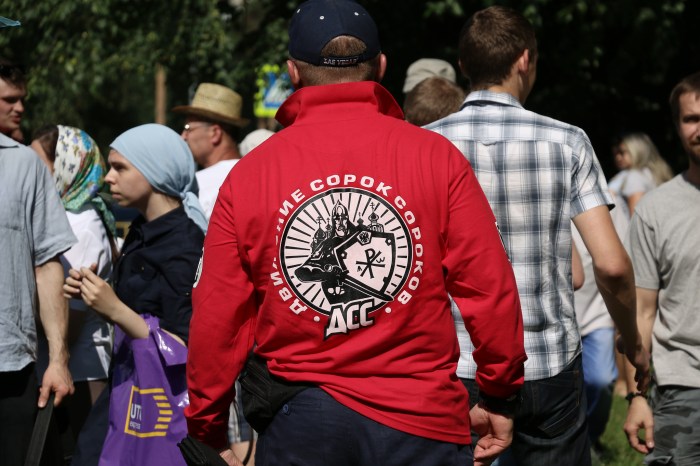
Member of the Russian Orthodox fascist movement Multitude (Sorok sorokov) during a "prayer meeting" at Torfyanka Park on June 27, 2016. Photo courtesy of anatrrra
Member of the Russian Orthodox fascist movement Multitude (Sorok sorokov) during a “prayer meeting” at Torfyanka Park in Moscow on June 27, 2016. Photo courtesy of anatrrra

Police Search Homes of Torfyanka Park Defenders
Grani.ru
November 14, 2016

Defenders of Moscow’s Torfyanka Park have had their flats searched by police. Olga Romanova, founder of the Imprisoned Russia project, reported the searches on her Facebook page.

According to Romanova, police visited the home of attorney Marina Verigina, who has been consulting the activists, and her husband Vladimir Grechaninov. Law enforcement officers broke into their apartment.

Police cordoned off Natalya Fyodorova’s stairwell and did not let her neighbors act as witnesses to the search, explaining they had brought their own witnesses with them. Fyodorova was loaded into a paddy wagon along with her disabled mother, her husband Boris, and her 18-year-old daughter. The door to the Fyodorovs’ apartment was cut down with a metal grinder.

After the search of his home, Pavel Alexeev was put in the paddy wagon with his underage son Alexander. Evgeny Lebedev and his wife were loaded into the paddy wagon with their underage daughter.

Police likewise searched the home of activist Vladislav Kuznetsov and his wife Svetlana Kuznetsova. Kuznetsov’s forehead was injured while he was detained. He was then handcuffed and a scarf was wrapped around his head.

In addition, Konstantin Yatsyn and his father Yuri Yatsyn were detained. It has been reported that several more families of Torfyanka’s defenders were incommunicado.

Natalya Kutlunina, a member of the Communist Party, has reported that her apartment has been searched as well. Law enforcement officers arrived there at six in the morning. Kutlunina is out of town, and the apartment was searched with her son present.

“The search lasted three hours,” wrote Kutlunina. “They confiscated placards, Party literature, my son’s and my husband’s laptops, and my younger son’s mobile phone.”

Meanwhile, OVD Info has reported that the search at the Verigina and Grechaninov household was still underway after 6:30 in the evening. Yet since lunch time law officers had refused to let lawyer Sergei Shank into the apartment, despite the fact he produced a warrant.

The people detained during the searches were taken to the Russian Investigative Committee’s Northwest Moscow District Office. According to RBC, each activist was escorted by fifteen to twenty police officers, and the arrests were filmed by employees of the national TV channel NTV.

All the detainees were interrogated as witnesses in a case opened up under Article 148 of the Criminal Code (insulting the feelings of religious believers) before being released.

OVD Info claims violation of Paragraph 1 of the article, which stipulates a maximum punishment of one year in a penal colony, is at issue in the case. Meanwhile, after his interrogation, activist Evgeny Lebedev wrote on the For Torfyanka Park! VK community page that a case had been opened under Article 148.3 (obstructing the activities of religious organizations), which carries a maximum penalty of a year of corrective labor or three months in jail.

Orthodox clerics want to build a church in Torfyanka. Local residents are opposed to their plans, and they have been protesting them since June 2015. The decision to permit construction of the church was made illegally. In the autumn of 2015, the Moscow Town Planning and Land Commission acknowledged this and canceled the permit, demanding that the construction site at the park be dismantled. However, this still has not been done.

Moreover, the park’s defenders have been assaulted several times by Russian Orthodox militants. In the early hours of February 13, militants from the Multitude (Sorok sorokov) movement attempted to start building the church without authorization, but they were stopped by police.

In the early hours of March 3, a camp set up activists maintaining a 24-hour vigil in the park was demolished with assistance from the police. Law enforcement officers drove the environmentalists from their tent and pushed them aside as persons unknown arrived in a GAZelle minivan, loaded up the tent and the activists’ personal belongings, and drove off. It transpired that the minivan belonged to the Losiny Ostrov (Moose Island) District Council.

In the early hours of August 29, police detained twelve people, claiming that activists had been trying to break the fence around the proposed construction site.

Ekaterina Schulman, political scientist
This is a bad story, and it is bad because of the numbers of people involved. Nine people have been detained. The police came to their homes at six in the morning and took them to the Investigative Committee on suspicion they have violated Article 148.1 of the Criminal Code (“Public actions expressing clear disrespect for society and committed to insult the feelings of religious believers”), for which the maximum penalty is a year in prison. Meaning that it is a minor offense. Why is the Investigative Committee involved at all? They supposedly deal with serious and very serious crimes in Russia, no? All the detainees are neighbors, husbands and wives, meaning the police carpet-bombed a neighborhood that had been protesting construction of a new church in a park. What is the magnitude of their crime, which did not involve violence? What, are they terrorists? If charges of insulting religious believers have been filed in connection with a complaint, then investigate the case the usual way. Dear Investigative Committee, as a law enforcement agency you are not in the best position nowadays, and if you think you are going to strengthen it by suddenly arresting a dozen ordinary Russians for the glory of the Russian Orthodox Church, you have another think coming. If you haven’t noticed, the trend now in Russia is against exacerbation, incitement, and extremism, and for keeping people calm during the economic crisis. The FSB at least pulled some terrorists from its sleeve who wanted to blow up shopping malls. People understand that, but what was your bright idea for cheering up the media scene?
Source: Facebook

Translated by the Russian Reader. Thanks to Nikolay Mitrokhin for the heads-up

__________

The Thermals, “A Pillar of Salt”

We were born to sin
We were born to sin
We don’t think we’re special sir
We know everybody is
We’ve built too many walls
Yeah, we’ve built too many walls
And now we gotta run
A giant fist is out to crush us

We run in the dark
We run in the dark
We don’t carry dead weight long
We send them along to heaven
I carry my baby
I carry my baby
Her eyes can barely see
Her mouth can barely breathe

I can see she’s afraid
She could see the danger
We don’t want to die or apologize
For our dirty God, our dirty bodies

Now, I stick to the ground
I stick to the ground
I won’t look twice for the dead walls
I don’t want a white pillar of salt
I carry my baby
I carry my baby
Her eyes can barely see
Her mouth can barely breathe

I can see she’s afraid
That’s why we’re escaping
So we won’t have to die, we won’t have to deny
Our dirty God, our dirty bodies

“A Pillar of Salt” as written by Kathleen Michelle Foster and Hutch Harris. Lyrics © TERRORBIRD PUBLISHING LLC

source

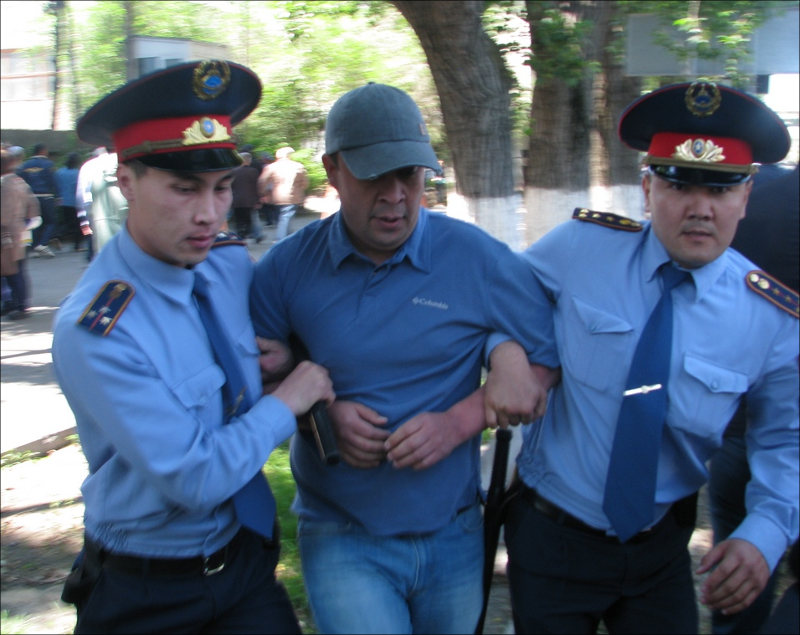
Kazakhstan: Land Protesters Face Police Rampage

Kazakhstan: Land Protesters Face Police Rampage
People and Nature
May 25, 2016

Street protests against plans to step up land privatization were broken up by police in many of Kazakhstan’s largest cities on Saturday, May 21. The demonstrations were organized by informal online networks rather than by any of the recognized opposition groups. Here are the key points from a report by Andrei Grishin, published in Russian on the website of the Fergana News Agency.

Special rapid-reaction police detachments attacked small groups [of demonstrators] wherever they gathered. They grabbed everyone, regardless of gender, age and nationality. Dozens of journalists were arrested.

Kazakhstan had waited for the events of May 21 with bated breath. [Protesters had named that as a day of action after a previous wave of demonstrations had forced the government to pull back from planned land reforms. See an earlier report here.] The official media had railed against the protests. And it all ended, as it has so many times before, with the “slaughter of the innocents,” but this time more brutal than usual. The detention of dozens of journalists, including foreigners, was proof of that.

Police detain land protester in Almaty
Police detain protester in Almaty, May 21, 2016

However, for the first time, people came out to protest all at once, in a number of cities and towns, without any leaders, because these leaders had either been arrested in advance, or had agreed to the authorities’ demands [after the previous demonstrations] and joined the [government’s] land commission.

[In Almaty in the southeast, the largest city in Kazakhstan and former capital, the authorities used every possible method of disrupting people’s plans to demonstrate. They created a “terrorism” scare, announcing the discovery of a stash of molotov cocktails, sticks, money and explosives; blocked social media; and issued orders forbidding public sector employees, students and workers in large enterprises from demonstrating, and in many cases, called people into work. Nevertheless, people gathered in small groups at Astana Square and by 11.30 am there were about a thousand of them. The police then went on the rampage, arresting and dispersing people.]

In other towns where activists made attempts to gather in squares or parks, the authorities acted similarly, although the numbers of both demonstrators and police were much smaller than those in Almaty. [There were arrests in Astana, the new capital, whereas things went compariatively peacefully in Kustanai and Pavlodar.]

In any case, no revolution took place! The president of the administrative policing committee at the ministry of internal affairs, Igor Lepekha, announced on Saturday that there had been “no unsanctioned gatherings or conflicts with the police. No breaches of order were permitted.” But at the same time he confirmed the detention of a number of people, including journalists; there had been a “misunderstanding” with the latter, he said.

Nevertheless, even this small number of demonstrations was a new phenomenon in Kazakhstan, in the sense that they started simultaneously in different regions. And all the experts noted in chorus that the land question was just the pretext, that in fact people have all sorts of other issues with the government. And that is really worrying parliament, above all, the fact that people are openly, and quite legally, calling for the resignation of the president.

And so it was clear that the government once again would deal with the problem [of protest] with repression. Evidence of this was the series of criminal cases opened even before May 21 against civil society activists, and the announcement by the internal affairs department of Western Kazakhstan about “preventing mass disorder.”And it is still possible, of course, that the Almaty police will “find” the owners of the molotov cocktails and sticks [i.e. use frame-up tactics against militants].

Police detaining protesters in Almaty on Saturday, May 21, 2016

However at the same time the authorities have treated the land question with great caution, thus the one-year moratorium [announced by President Nazarbayev on 6 May] on the amendments [to the land code], and the establishment of the land commission, and inclusion in it of several “disloyal” civil society activists, and the hints that have been dropped about the possibility that each citizen of the country could be granted by law 1,000 square meters of free land.

Riot police loading protesters onto a bus, Almaty, May 21, 2016

Just a few days ago, when the government feared the spread of mass action, President Nazarbayev appealed to Kazakhs “not to shame ourselves before the world, but to solve our complicated problems by means of constructive dialogue.”

Despite this talk of “constructive dialogue” from the president, the police special detachments hid firearms in their buses on Saturday. Whether they had plastic bullets, tear gas or live ammunition we don’t know. But thankfully they didn’t open fire on the crowds: bearing in mind the events at Zhanaozen and Shetpe [in December 2011, when police fired on a crowd of striking oil workers, killing at least 16 and wounding at least 60], it seems there was enough sense at the top to order that there be no repeat of that. 25 May 2016.

Moscow Police Abduct Leftist Activists Elena Bezrukova and Alexander Ognev

AST-Moscow Statement on the Detention of Elena Bezrukova and Alexander Ognev
AST-Moscow
November 18, 2015
nihilist.li

bezrukova
Elena Bezrukova

Police raided the Moscow flat of leftist activist Elena Bezrukova in the early morning of November 18. They searched her home, and our comrade was detained and taken to the Troparevo-Nikulino police station. As of this writing, police officers have refused to provide any information, denying that our comrade is being questioned. Police are denying her basic human rights by not allowing contact with loved ones. Attorney Dmitry Dinze has also not been allowed to see her.

Currently, the whereabouts of our comrade Alexander Ognev, the police’s principal target, are unknown. A native of Lipetsk, Ognev organized protest rallies in his hometown during the nationwide mass protests of 2011–2012. Ognev’s civic stance has come back to haunt him in way that has become common in Putinist Russia. The document exempting him from military service miraculously disappeared from his medical records, and then Ognev received a draft notice. As a conscientious objector, he ignored the call-up, after which he was summoned to the Investigative Committee for questioning. Ognev was then taken to the military recruiting office, where he was illegally detained for three days, choked, and threatened to be sent to “a unit in Dagestan from which [he] would not come back alive.” After his release, the opposition activist’s bruises were documented.

image14398835
Alexander Ognev: “Article 11.3 of the Federal Law on Trade Unions: ‘The level of wages will be agreed with the trade union…’ Thanks to the FNPR (Federation of Independent Trade Unions of Russia) for low wages.”

Today’s search was connected with plans to file desertion charges against Ognev. It is not clear how it is possible to desert the regular army without spending a single day in the service, but Russian investigators, who serve the criminal regime now established in the Russian Federation, have their own way of thinking, which is not accessible to ordinary citizens.

At this moment we are doing everything possible to find out what has happened to Elena and Alexander and facilitate their release. We are hoping for the best, but Russian realities are such that we should be mentally prepared for any eventuality. Now we really need the support of all libertarian activists. Circulate information and make plans for protest rallies against the latest politically motivated criminal charges, which may be filed against our allies. Remember that only the solidarity of working people can break this system, which cynically ignores basic human rights.

Red Poppies vs. St. George’s Ribbons

Remembrance Poppies versus St. George’s Ribbons
Sergey Chernov
Special to The Russian Reader
May 8, 2015

Petersburg police detained two activists and a photojournalist near Park Pobedy metro station on May 8 as pro-Kremlin provocateurs attempted to prevent Democratic Petersburg activists from handing out buttons and leaflets dealing with the end of the Second World War in Europe.

The Democratic Petersburg coalition, which opposes Russia’s current Second World War victory symbol, the St. George’s Ribbon, claiming it is “distinctly militarist,” passed out buttons featuring the red remembrance poppy, a European symbol for war victims, and leaflets explaining its meaning.

In 2014, Ukraine had rejected the St. George’s Ribbon, used by Russia-backed rebels in eastern Ukraine and Russian officialdom, choosing the remembrance poppy instead.

The buttons the activists handed out were emblazoned with the red poppy and the phrase “1939–1945 Never Again,” in Russian and Ukrainian, while the leaflets, which quoted John McCrae’s famous poem “In Flanders Fields,” described the symbol’s history and meaning.

Poppies-4892Buttons reading “1939–1945, Never Again” in Russian and Ukrainian

“We believe the St. George’s Ribbon, which has a distinctly militarist message, should also give way in Russia to the red poppy, the universal symbol commemorating those who perished in the most terrible war.”

Activists said Victory Day should be commemorated on May 8, because Russia was part of Europe, rather than on May 9, in keeping with Soviet tradition. According to them, what Russians have usually called the Great Patriotic War was in fact part of the Second World War and was launched in 1939 by both Germany and the Soviet Union, rather than in 1941, when Germany suddenly attacked its formal nominal ally the Soviet Union.

The pro-Kremlin provocateurs, mostly young people, who were apparently led by two older men, were already waiting outside the metro station, sporting St. George’s Ribbons, when the Democratic Petersburg activists arrived to hand out leaflets. The provocateurs approached them and started an argument, justifying Joseph Stalin and promoting what they saw as the Kremlin’s current interpretation of the war’s history. Some of the provocateurs took photos and videos as the argument proceeded. However, when asked, one of the young provocateurs said he was “just passing by,” denying he had come deliberately with the others to harass the Democratic Petersburg activists.

Poppies-4925Pro-Kremlin provocateurs harass democratic activist Igor “Stepanych” Andreyev

Within minutes, police had arrived at the scene, led by a colonel, the head of Precinct No. 33, whose beat includes the Park Pobedy station. The colonel argued with the activists before detaining 76-year-old activist Igor “Stepanych” Andreyev and, seconds later, our correspondent, who had attempt to photograph Andreyev’s arrest.

While the two detainees were held in the police room inside the metro station, police detained Anton Kalinyak, an activist who had been wearing a large red poppy on his lapel, allegedly for “using coarse language in public.” According to Democratic Petersburg, one of the provocateurs filed a false complaint with the police against Kalinyak, while the police officers at the scene corroborated his accusations.

Poppies-4999Andreyev detained by police

The detainees were taken to Precinct No. 33, where they were charged, correspondingly, with “smoking in a public place” and “using profane language in a public place.” After about two hours in custody, Kalinyak was fined 500 rubles (around $10) on the spot, while the formal written charges against the other two detainees will be sent to their respective local police precincts. They face small fines of between 500 and 1,500 rubles.

All photos by and courtesy of Sergey Chernov

“Anti-Extremist” Police Crack Down on Unionized Autoworkers in Kaluga

Automotive Industry Checked for Extremism
Center “E” Officers Detain Independent Trade Union Activists in Kaluga
Anatoly Karavayev and Daniil Lomakin
March 23, 2015
Gazeta.Ru

Kaluga police conducted a raid against independent trade union activists who had gathered to discuss layoffs at local car factories. Due to the decline of the auto market, 750 people might be fired in the very near future. After being detained on a technicality, the detainees talked to officers from Center “E”, the Center for Extremism Prevention. The trade union movement considers such actions a preventive measure by the authorities.

A scandal has erupted in Kaluga over the detention of fifteen activists from the Interregional Trade Union Workers Association (ITUWA). (Police claim that twelve activists were detained.) At the weekend, workers from local automotive factories had gathered at the offices of the ITUWA’s Kaluga local to discuss future personnel reductions in the region.

For example, there are plans to lay off 150 people at the local Volkswagen plant in the near future.

In addition, the Peugeot-Citroen plant in Kaluga could dismiss as many as 40% of its workers, around 600 people, without compensation after March 31. Unlike Volkswagen, the French automaker has not yet made an official announcement.

As the ITUWA local informed Gazeta.Ru, they are planning this week to negotiate with plant management. If an agreement to save jobs is not reached, the trade union intends to hold protest rallies and file a series of lawsuits.

The local security forces also took notice of the Kaluga trade union’s activism. Over the weekend, police conducted mass arrests of its members. Moreover, officers from Center “E”, which specializes in combating various forms of extremism, dealt with the activists.

As activists recounted, they had begun gathering for the meeting when police suddenly entered the ITUWA office in Kaluga and arrested everyone present. Ultimately, 15 people were taken to the police station. ITUWA local chair Dmitry Trudovoi is certain the detention of the activists was occasioned by the trade union’s increased activism.

“Layoffs are planned at Peugeot-Citroen and Volkswagen. All this has lead the trade union to ratchet things up. Strikes and all that are possible. Basically, this was an act of intimidation,” Trudovoi said of the incident.

“This was a ridiculous police provocation,” Dmitry Kozhnev, who was among the detainees, told Gazeta.Ru.

“First, a beat cop entered the office. He asked about two people who had committed a robbery nearby and had, allegedly, dashed into the building where the ITUWA meeting was taking place. Some time later, the ‘bigwigs’ arrived (around forty ranking officers), people in uniform and plainclothes who systematically arrested us and took us to the station.”

“At first, they told us that the arrests were linked, allegedly, to the robbery. But that doesn’t seem to be true, given that people were detained for an hour. Center “E” officers conducted the interrogations. They were trying to figure out what our organization was doing, what events were planned. But none of the detained ITUWA members answered their questions.”

According to Kozhnev, the ITUWA regarded the arrests as an attempt to intimidate members of the trade union.

“Center “E” officers told us we were agents of the West and wanted to destabilize the situation in the country,” said Kozhnev.

“But ultimately they didn’t achieve their objective; they only discredited themselves. On the contrary, the situation has united all ITUWA workers even more,” he added.

The Kaluga Region Interior Ministry office denied the arrests of the ITUWA members occurred during an investigation of their activity.

As Svetlana Somova, head of the press center at the regional Interior Ministry office told Gazeta.Ru that a robbery had occurred near where the trade unionists were meeting. Two unidentified men had attacked a third man and stolen his belongings.

“According to the victim, [the robbers] escaped into the building where the meeting was taking place,” explained Somova. “A group of people, some of whom had no documents, was in the room. They were unable to explain anything about the men who had entered the building. Therefore, they were taken to Police Precinct No. 2. And there it transpired that an out-of-town trade union movement leader was among them. Naturally, the desk sergeant summoned Counter-Extremism Center officers to avoid provocations.”

As Somova explained, no more than ten officers had been dispatched to the site where the ITUWA members were detained: an extra-departmental security squad, a patrol squad, and police investigators.

“There were no riot police, as has been previously reported in the media,” said the press spokesperson. “If citizens believe their rights have been violated, they can complain to the prosecutor about the police’s actions. ITUWA activists had earlier accused the police of illegal actions, but no violations were uncovered during the course of probes.”

According to the press service spokesperson, police did not suspect they were detaining trade union members because the building sported a large “Barbershop” sign.

“A signal had to be sent”

ITUWA chair and well-known trade unionist Alexei Etmanov deems the incident in Kaluga unacceptable.

“It’s an absolutely abnormal situation when workers gathered for a trade union meeting are raided by the police. These are the methods not even of the 1990s, but of the 1930s,” Etmanov told Gazeta.Ru.

According to Etmanov, the detainees had gathered on a weekend day at the Kaluga ITUWA office to discuss the situation at the region’s automotive plants.

“There were members from Volkswagen and Peugeot-Citroen and other plants,” said Etmanov. “A beat cop showed up under false pretenses, then a SWAT team. At the precinct, they tried to fingerprint people.  Those who were more experienced were able to wriggle out of it, but some had their fingerprints taken. No one filed any charges, of course, but it was a very heavy hint about not fighting so vigorously for one’s rights. I am certain that 90% of this was at the behest of the regional government. There are many foreign-owned plants here. A clear signal had to be sent that there was no need to defend one’s rights too vigorously.”

According to Etmanov, the ITUWA plans to send a letter about the incident to Russian Federal Interior Minister Vladimir Kolokoltsev via the All-Russian Confederation of Labor (VKT).

In turn, the Kaluga Region media relations office told Gazeta.Ru it was planning no statements regarding the incident.

“If there are any questions, we are happy to answer them upon written request,” said Anastasia Davydkina, head of the office.

Layoffs at Auto Factories in Kaluga Region

As Kaluga ITUWA organizer Dmitry Kozhnev explained to Gazeta.Ru, around 40% of the workers at the Peugeot-Citroen are on fixed-term contracts that expire on March 31 and, according to the union’s information, will not be renewed.

“The problem with this arrangement existed long ago and was a ticking time bomb. A fixed-term contract allows the employer to fire a worker without paying out any compensation,” explained Kozhnev. “At the same time, it is illegal to hire workers on such conditions. A fixed-term contract may be concluded only when it is impossible to hire an employee under an open-end contract.

“But in the case of the Kaluga plant, there were no such obstacles. Moreover, we already have won favorable court rulings for several plant employees. The court ordered the plant to sign open-ended contracts with them.”

But employees will be offered to transfer to the Volkswagen engine plant, whose launch in Kaluga is planned for the second half of the year. Volkswagen does not rule out the possibility that a portion of the downsized workers might be dismissed by mutual consent. They would be offered a compensation package.

“The packages include financial compensation and medical insurance valid until the end of 2015. In addition, those employees who leave the company by mutual agreement will be the first to be asked to return to the factory when the car market starts to recover,” Volkswagen spokesperson Natalya Kostyukovich told Gazeta.Ru.

In February of this year, the Volvo truck factory in the Kaluga Region shut down completely.  Due to the collapse of the auto market, demand for cars had slumped. About 200 people lost their jobs.